NEW YORK STATE REGENTS · U.S. HISTORY AND GOVERNMENT
June 2026 U.S. History and Government Regents Past Paper & Solutions
Work through disability rights, the Vietnam War and the Constitution with a question-by-question walkthrough of the exam.
- 37 worked questions
- 3 writing models
- 4 exam sections
The question images and page numbers come from the regular-size English exam. OnlyPrepy wrote the summaries and worked solutions.
Quick answer key for Part I
Part I Multiple choice
Question indexQ1 Treaty diplomacy
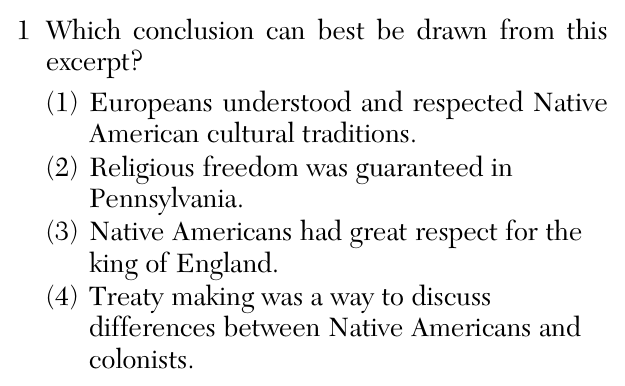
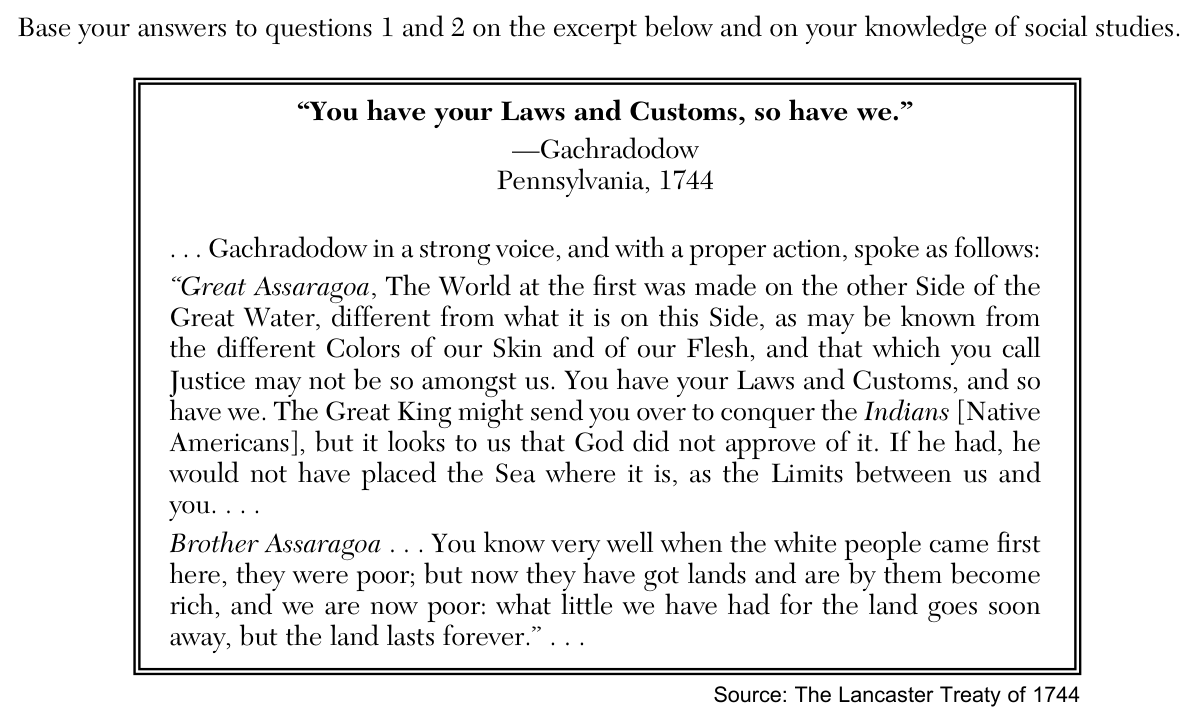
What does Gachradodow’s Lancaster Treaty statement show?
Worked solution for question 1
- He uses the meeting to contrast Native and European laws and raise the question of land loss.
- The exchange shows diplomacy being used to voice competing interests.
- A treaty meeting gives the parties a recognized way to exchange grievances and reach an agreement. The act of negotiating is evidence of the forum’s purpose.
Answer choice 4Treaties provided a forum to discuss differences.
Q2 Dispossession and expansion
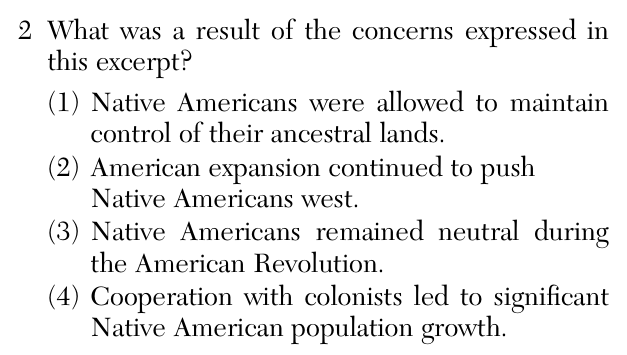
What happened despite the speaker’s concerns?
Worked solution for question 2
- The speech describes how colonists benefited from land transfers that impoverished Native communities.
- Expansion continued after independence and led to further dispossession and forced migrations.
Answer choice 2Expansion continued pushing Native peoples west.
Q3 Colonial self-government
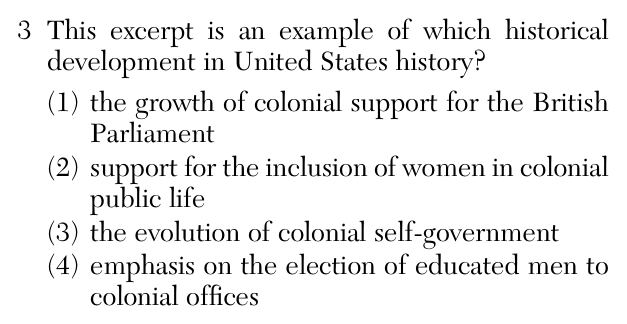
What historical development does the Virginia Declaration of Rights reflect?
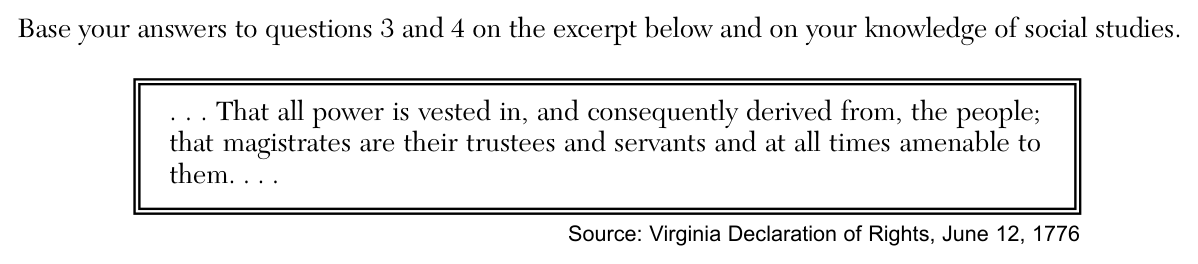
Worked solution for question 3
- Virginia declares that officeholders answer to the people.
- The declaration emerged as the colonies established governments independent of British authority.
- Compare the practices across the examples. The common thread is the growth of local arrangements in which colonists participated in decisions or selected people to make them.
Answer choice 3The evolution of colonial self-government
Q4 Legitimate government
Which Declaration of Independence principle appears in the Virginia document?
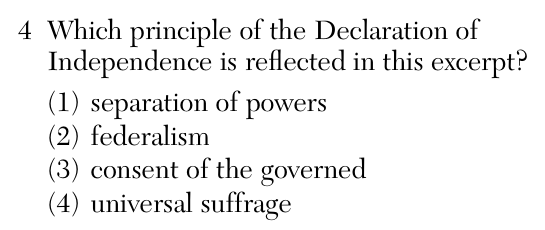
Worked solution for question 4
- The excerpt derives public power from the people and treats magistrates as their servants.
- That makes popular consent the basis of authority.
Answer choice 3Consent of the governed
Q5 Jefferson and Missouri
What did Jefferson fear about the Missouri debate?
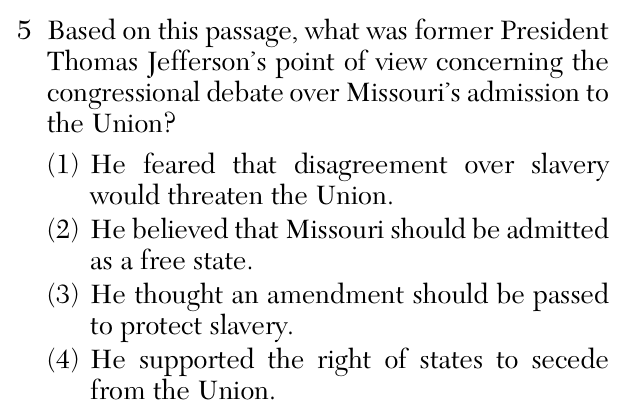
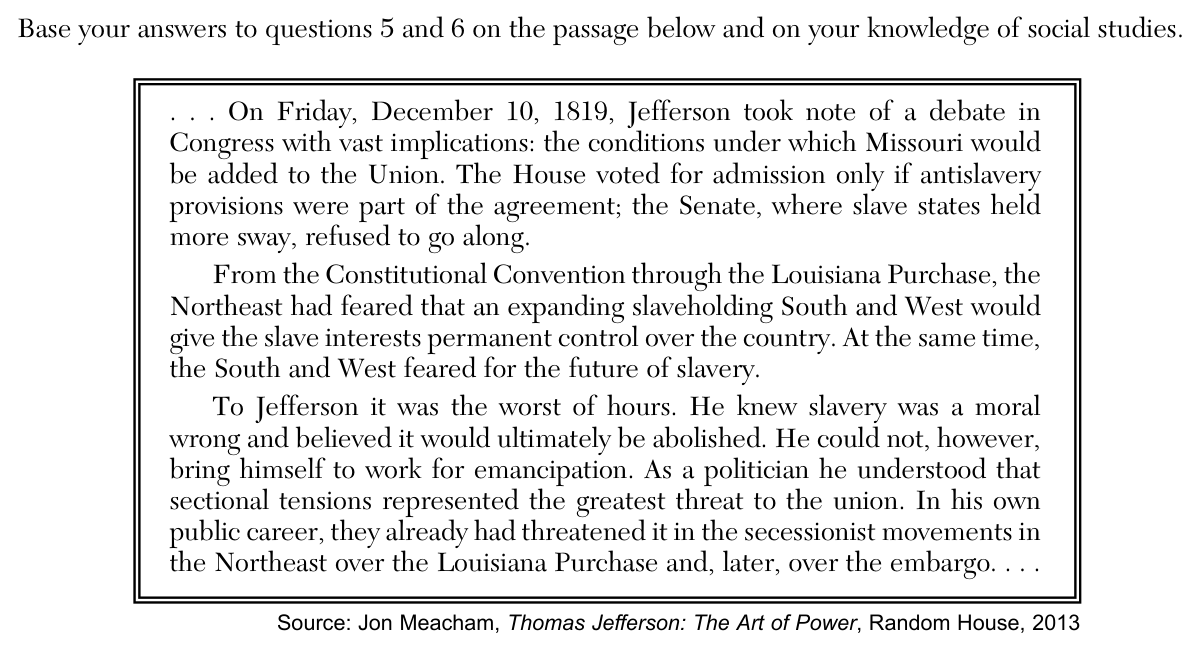
Worked solution for question 5
- The passage explains that expansion might shift sectional power toward slaveholding states.
- Jefferson sees this dispute as a danger to national unity.
- Missouri statehood mattered because admission as a slave state or free state affected the political balance. Jefferson treats the dispute as a sign of a division that could continue to widen.
Answer choice 1Disagreement over slavery could threaten the Union.
Q6 The Missouri Compromise
What was an important effect of the 1820 compromise?
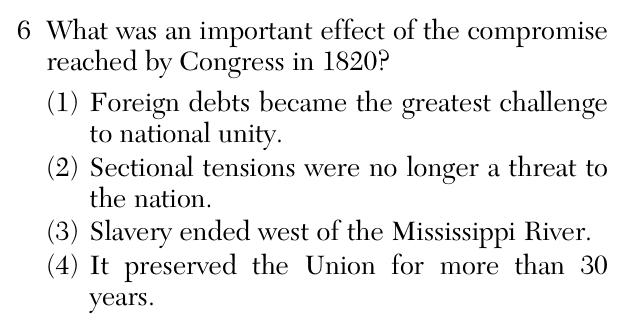
Worked solution for question 6
- Congress paired slave-state Missouri with free-state Maine and drew a restriction line in much of the Louisiana Purchase.
- The arrangement eased the immediate crisis while conflict over slavery continued.
Answer choice 4It preserved the Union for more than thirty years.
Q7 Lincoln’s inaugural purpose
Why did Lincoln include his assurances about slavery in 1861?
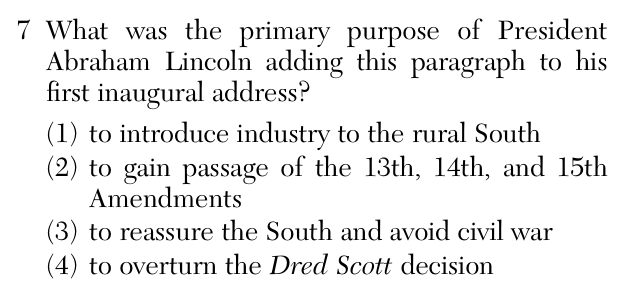
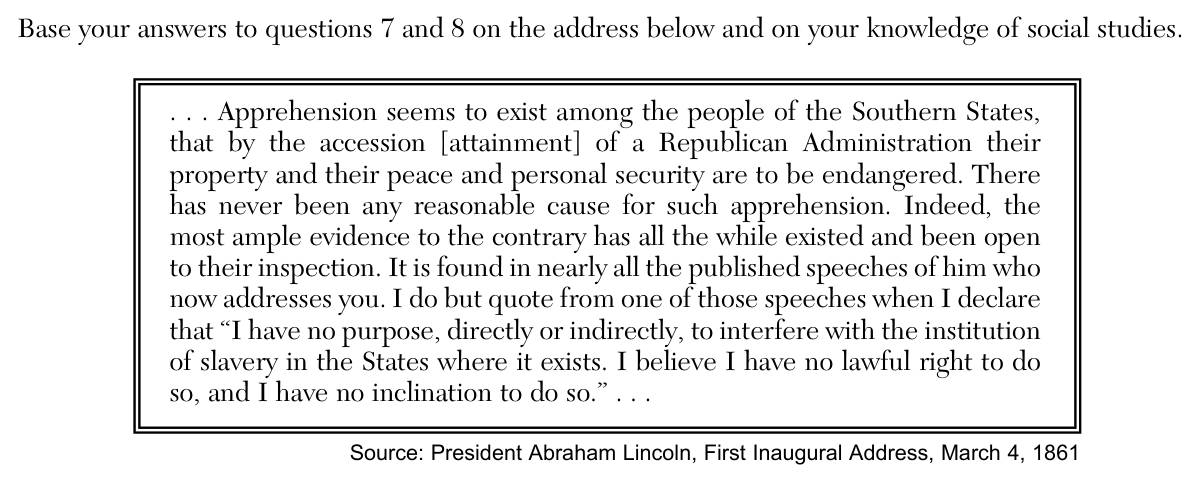
Worked solution for question 7
- He denies plans to interfere with slavery in states where it already existed.
- The assurance was directed toward fears surrounding his election and the secession crisis.
- An inaugural speech is evidence of what Lincoln intended to convey at the moment of taking office. His attempt to reassure the South fits the immediate risk of secession becoming war.
Answer choice 3To reassure the South and avert war.
Q8 A change in wartime policy
Which later Lincoln action expressed a different position on slavery?
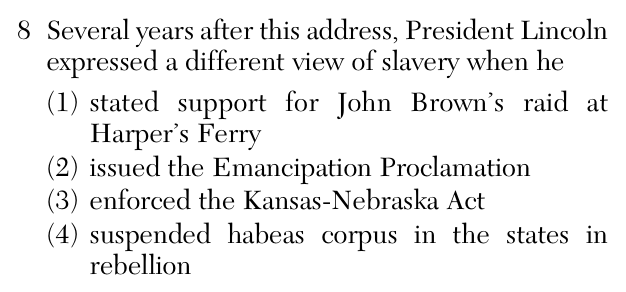
Worked solution for question 8
- In 1861 Lincoln emphasized preserving the Union without interfering with slavery where it existed.
- In 1863 he declared enslaved people in areas still in rebellion free as a wartime measure.
Answer choice 2The Emancipation Proclamation
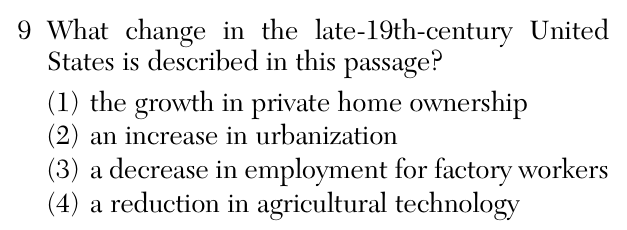
Q9 Growing cities
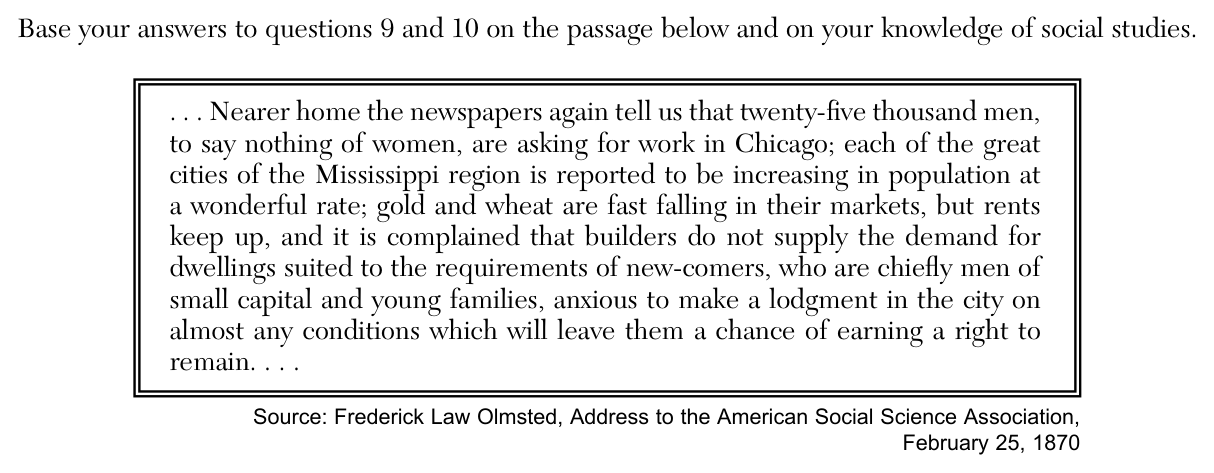
What change does Olmsted describe in 1870?
Worked solution for question 9
- He reports rapidly growing cities and newcomers looking for work and housing.
- These are signs of population concentrating in urban areas.
- The size and concentration of settlement are the clues. Urbanization describes population concentrating in cities, often alongside the development of industrial jobs.
Answer choice 2Urbanization
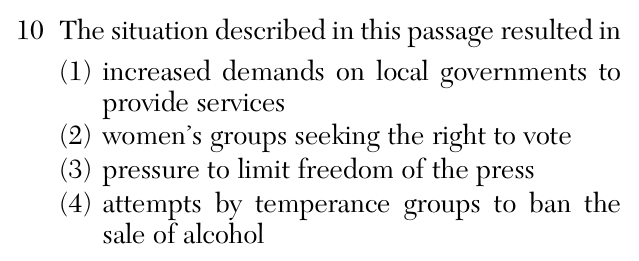
Q10 Municipal service demands
What result followed the urban conditions Olmsted describes?
Worked solution for question 10
- Rapid population growth put pressure on housing, sanitation and transport.
- Cities had to supply or regulate services for many more residents.
Answer choice 1Greater demand for local government services
Q11 Jim Crow in practice
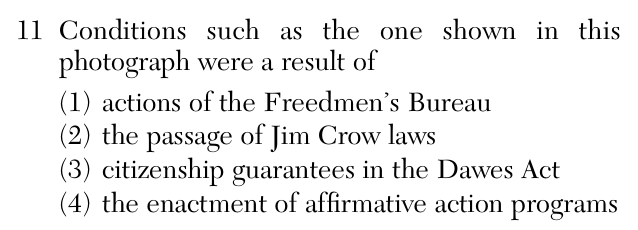
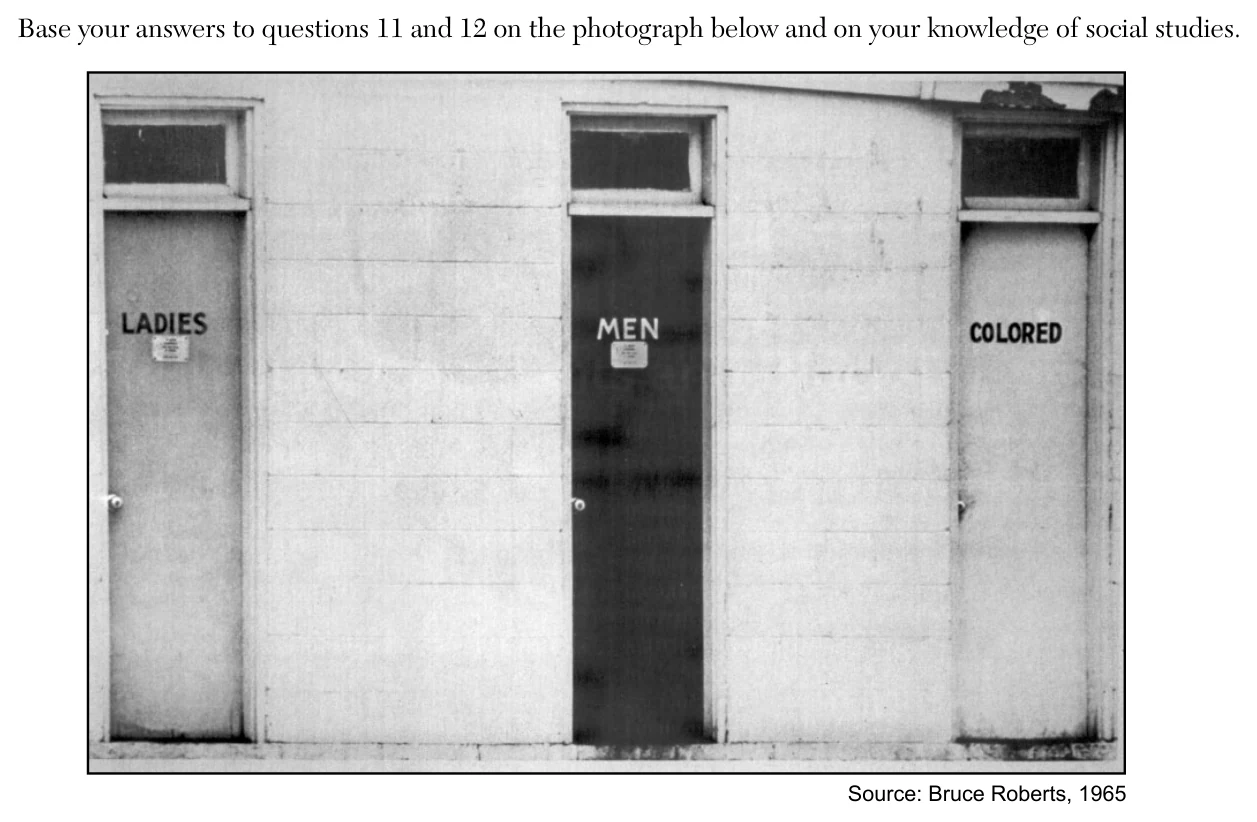
What produced the segregated condition in the photograph?
Worked solution for question 11
- The image shows access divided by race.
- Southern state and local laws imposed that division across many public facilities.
- Jim Crow turned racial separation into a system of state and local rules. The practices in the source show that segregation reached ordinary public life.
Answer choice 2Jim Crow laws
Q12 Judicial support for segregation
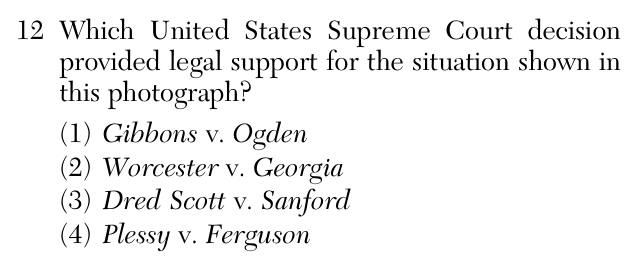
Which Supreme Court ruling provided legal cover for such separation?
Worked solution for question 12
- The Court upheld a segregated railway law in 1896.
- Its separate-but-equal reasoning was used to justify wider segregation.
- The distinction is between the law the Court upheld and the constitutional reasoning it used. The railroad case supplied a rationale that officials later applied to other public facilities.
Answer choice 4Plessy v. Ferguson
Q13 Economic case for the Panama Canal
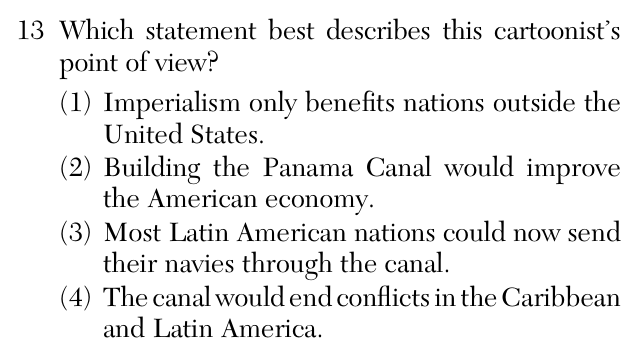
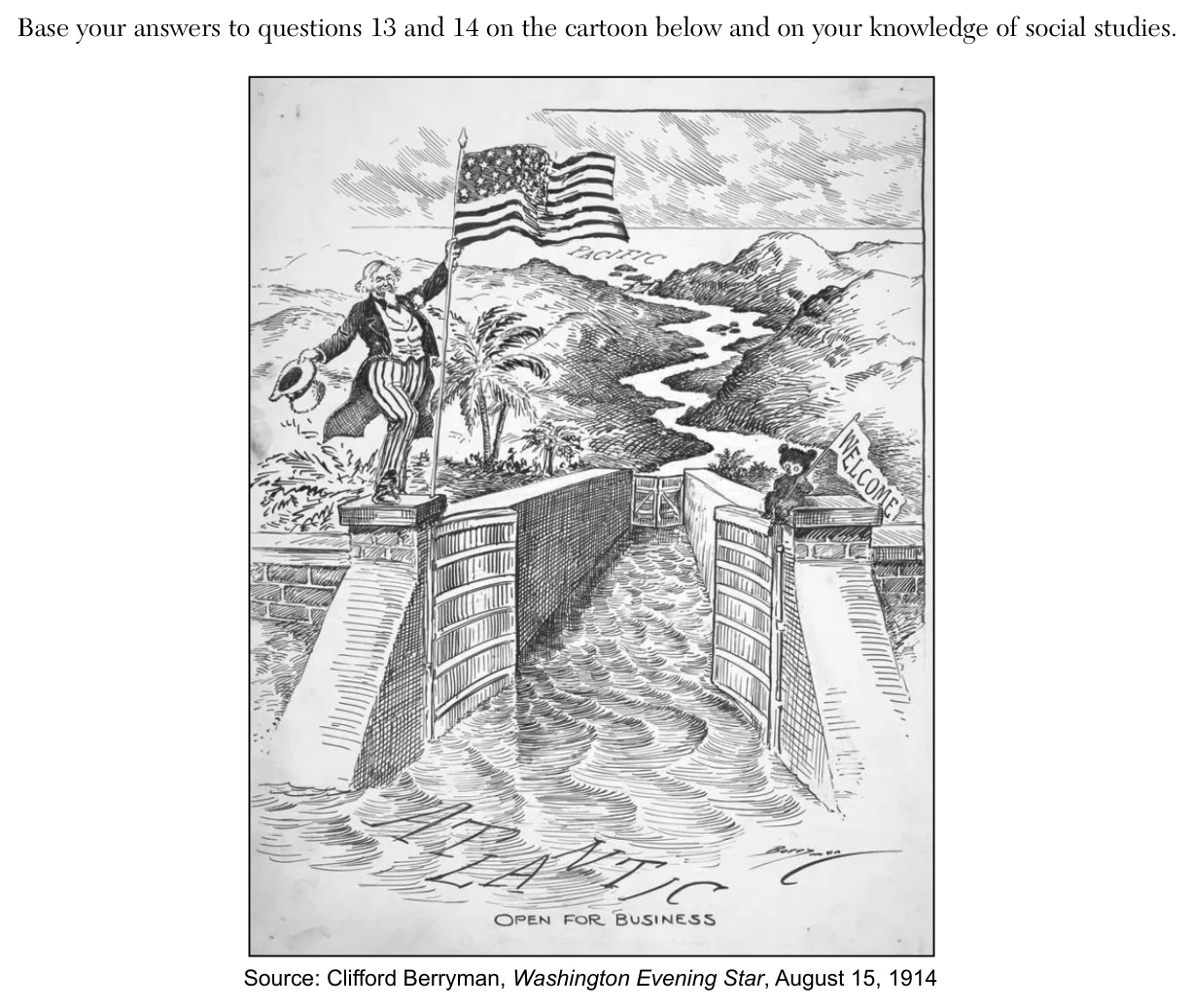
What point of view is shown in Berryman’s cartoon?
Worked solution for question 13
- The cartoon treats the canal as a means to expand commerce.
- A direct route between oceans lowered the distance and time required for shipping.
- The commercial advantage comes from shortening voyages between oceans. Shorter routes can reduce transport time and cost, which explains the economic case for the project.
Answer choice 2The canal would benefit the U.S. economy.
Q14 Opposition to overseas expansion
Which group would most oppose the policy behind the Panama Canal?
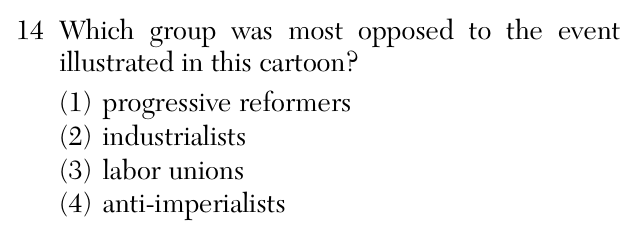
Worked solution for question 14
- Securing the Canal Zone extended U.S. control and influence abroad.
- Anti-imperialists opposed such expansion of American power over other peoples.
Answer choice 4Anti-imperialists
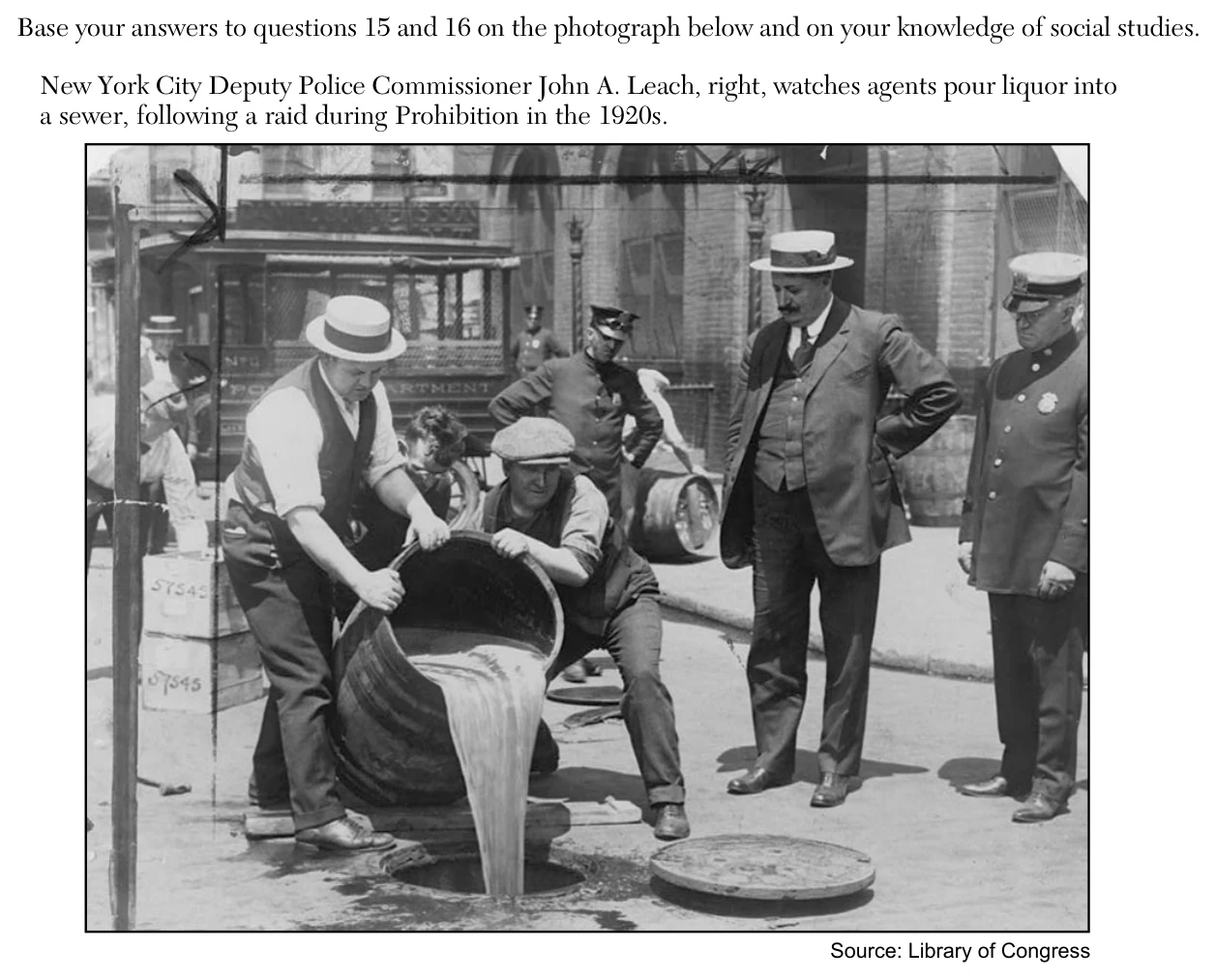
Q15 Authority for the liquor raid
Which action led to the Prohibition raid pictured?
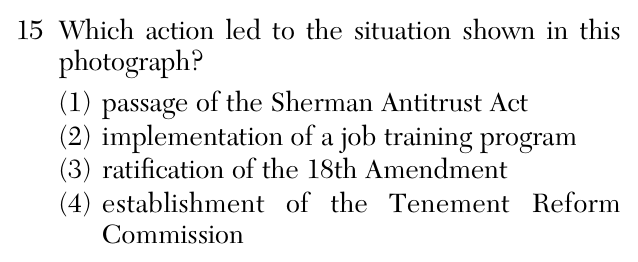
Worked solution for question 15
- The amendment prohibited manufacture, sale and transport of intoxicating liquor for beverage purposes.
- Federal enforcement under the Volstead Act explains why seized liquor was destroyed.
- The constitutional amendment supplied the authority for national prohibition. Enforcement of the liquor ban is the visible consequence of that change.
Answer choice 3Ratification of the Eighteenth Amendment
Q16 Declining support for enforcement
Why did public support for liquor raids decrease?
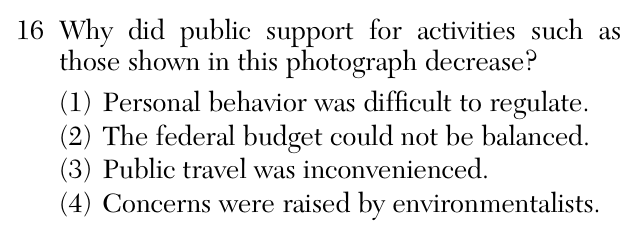
Worked solution for question 16
- Illegal supply and demand persisted despite raids and penalties.
- The gap between the law and everyday conduct weakened support for the ban.
Answer choice 1Personal behavior proved difficult to regulate.
Q17 Origins of Hoovervilles
Why did communities of makeshift housing develop?
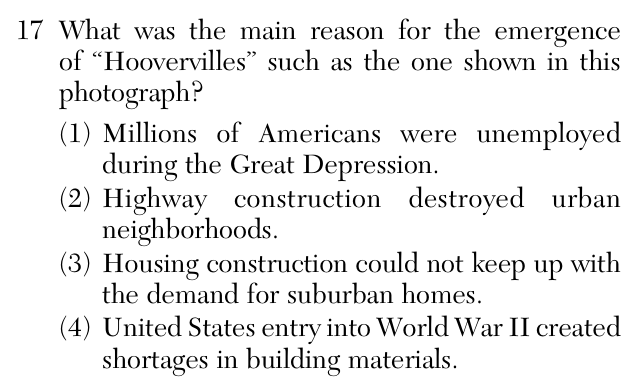
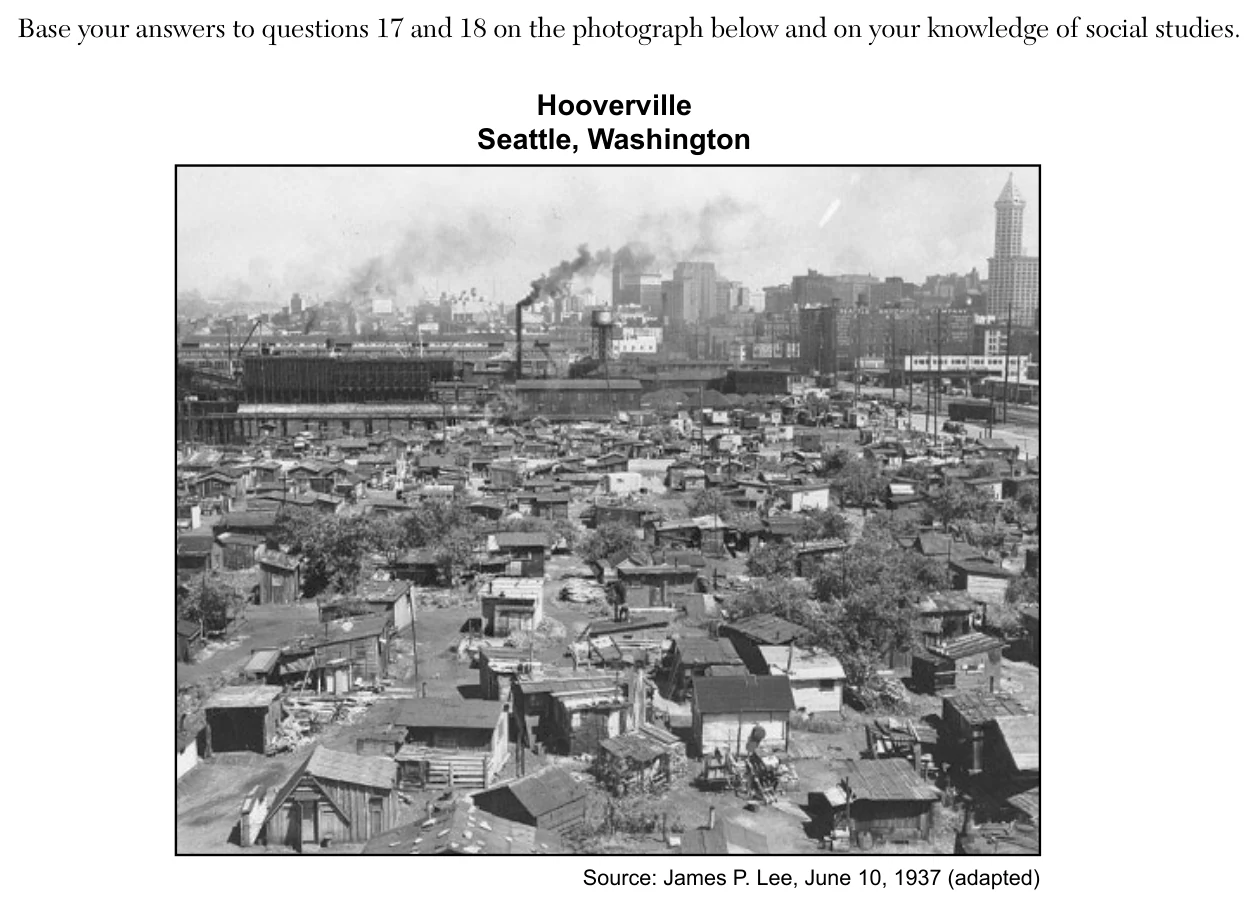
Worked solution for question 17
- Many workers lost income and could no longer pay for housing.
- Some built shelters from available materials, giving rise to settlements called Hoovervilles.
- The nickname links the settlements to contemporary blame of President Hoover. Their growth is evidence that widespread job loss had also become a housing crisis.
Answer choice 1Mass unemployment during the Great Depression
Q18 New Deal response to housing insecurity
How did the New Deal address the problem?
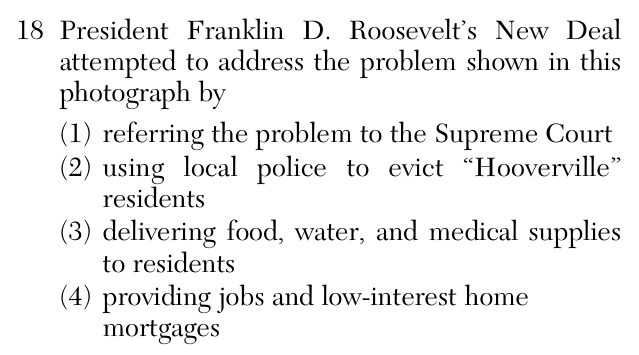
Worked solution for question 18
- Work-relief programs paid people to work on public projects.
- Federal mortgage policies also sought to stabilize and expand access to home loans.
Answer choice 4It provided jobs and made home financing more accessible.
Q19 Purpose of the 1935 neutrality resolution
Why did Congress limit arms exports to belligerents?
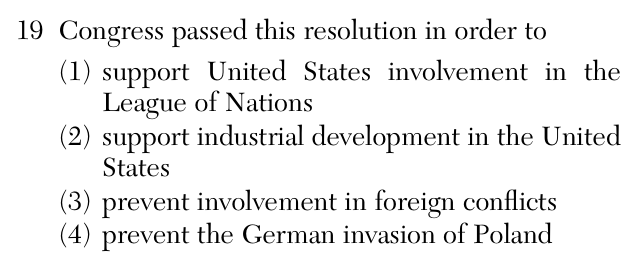
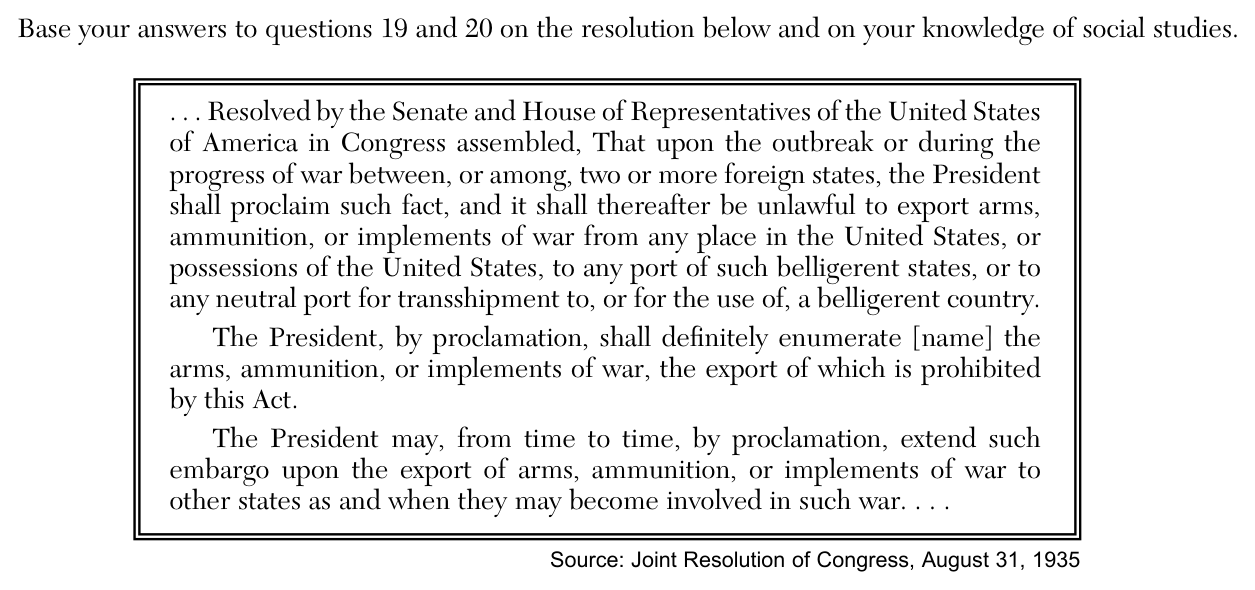
Worked solution for question 19
- The restriction applied to supplies for countries at war, including attempts to route them through neutral ports.
- Congress aimed to prevent trade from pulling the United States into another conflict.
- Keeping Americans from taking steps that might pull the country into conflict reflects the isolationist mood. Date the resolution before the United States entered World War II.
Answer choice 3To avoid involvement in foreign wars.
Q20 Lend-Lease and neutrality
Which later act departed from the arms embargo approach?
Worked solution for question 20
- The 1935 rule limited arms shipments to belligerents.
- In 1941 Lend-Lease allowed material aid to countries whose defense was considered vital to the United States.
Answer choice 4Lend-Lease Act
Q21 Pearl Harbor and wartime removal
Which event preceded and helped prompt the situation in the photographs?
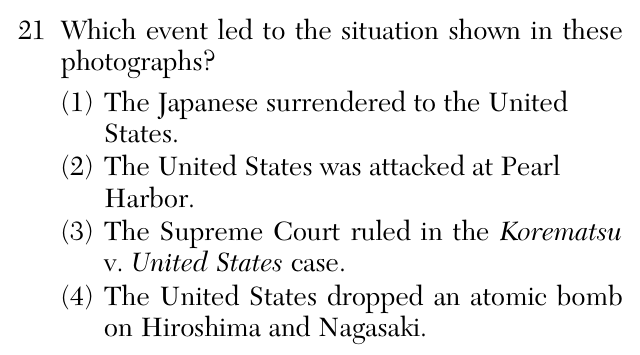
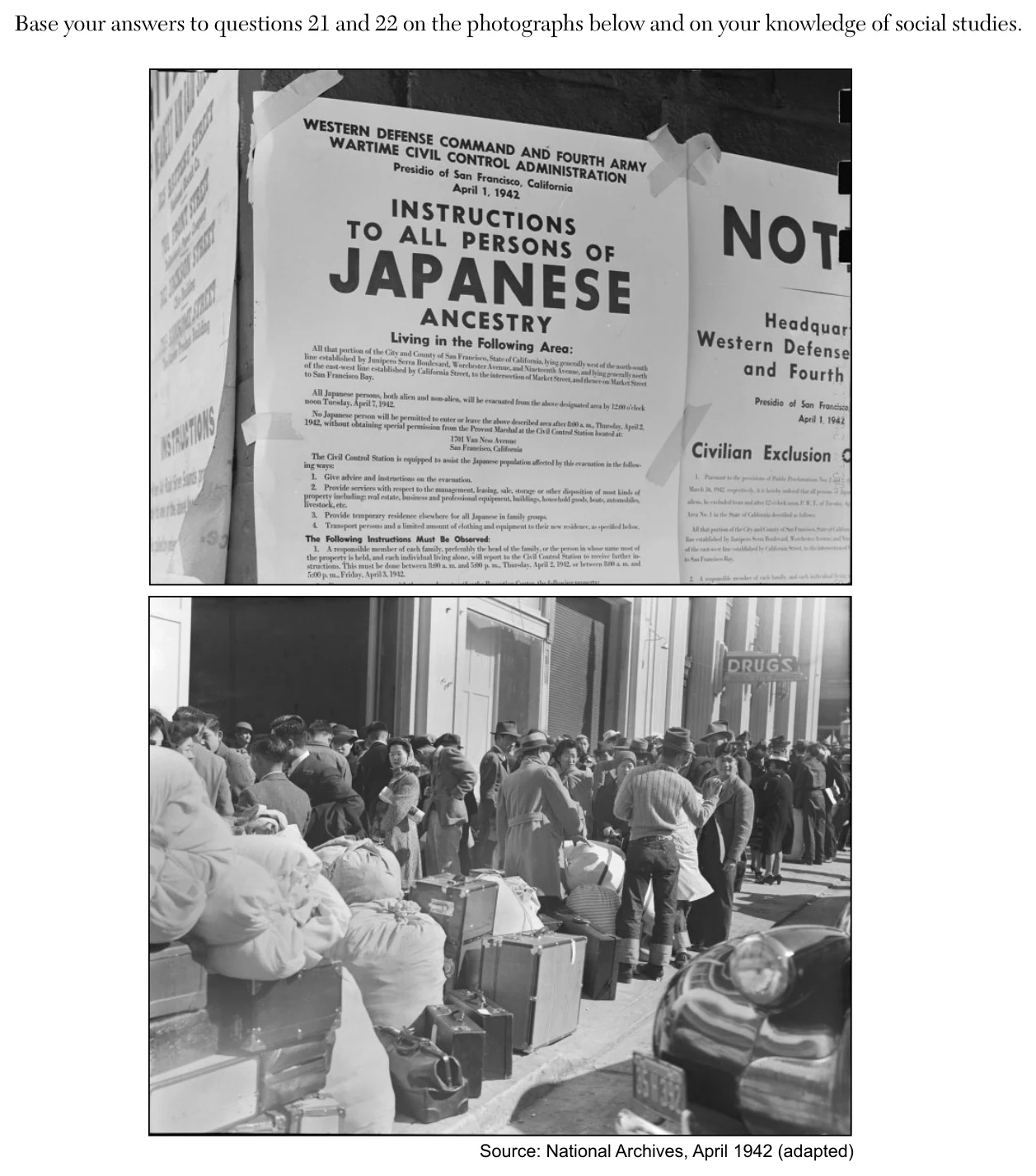
Worked solution for question 21
- After the December 1941 attack, wartime fear and racial prejudice helped drive exclusion orders.
- The 1942 photographs belong to the resulting forced removal.
- Pearl Harbor explains the wartime setting and the spike in suspicion. Distinguish that setting from evidence that individual Japanese Americans posed a security threat.
Answer choice 2The attack on Pearl Harbor
Q22 Japanese American incarceration
What wartime policy do the photographs illustrate?
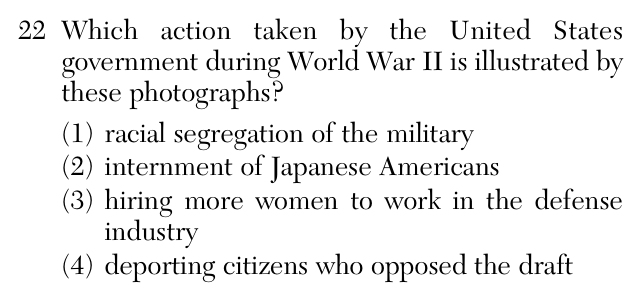
Worked solution for question 22
- Executive Order 9066 enabled military exclusion from designated areas.
- People of Japanese ancestry, many of them U.S. citizens, were removed and confined.
Answer choice 2Forced removal and incarceration of Japanese Americans
Q23 Aid for European recovery
Which program was Truman urging Congress to support in 1947?
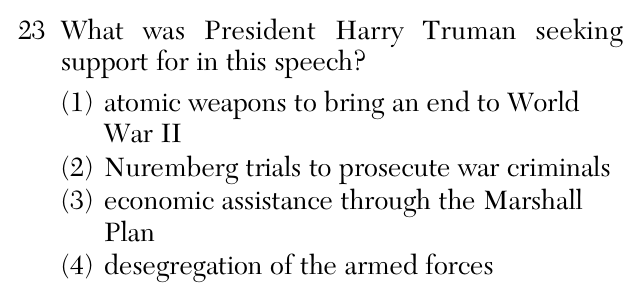
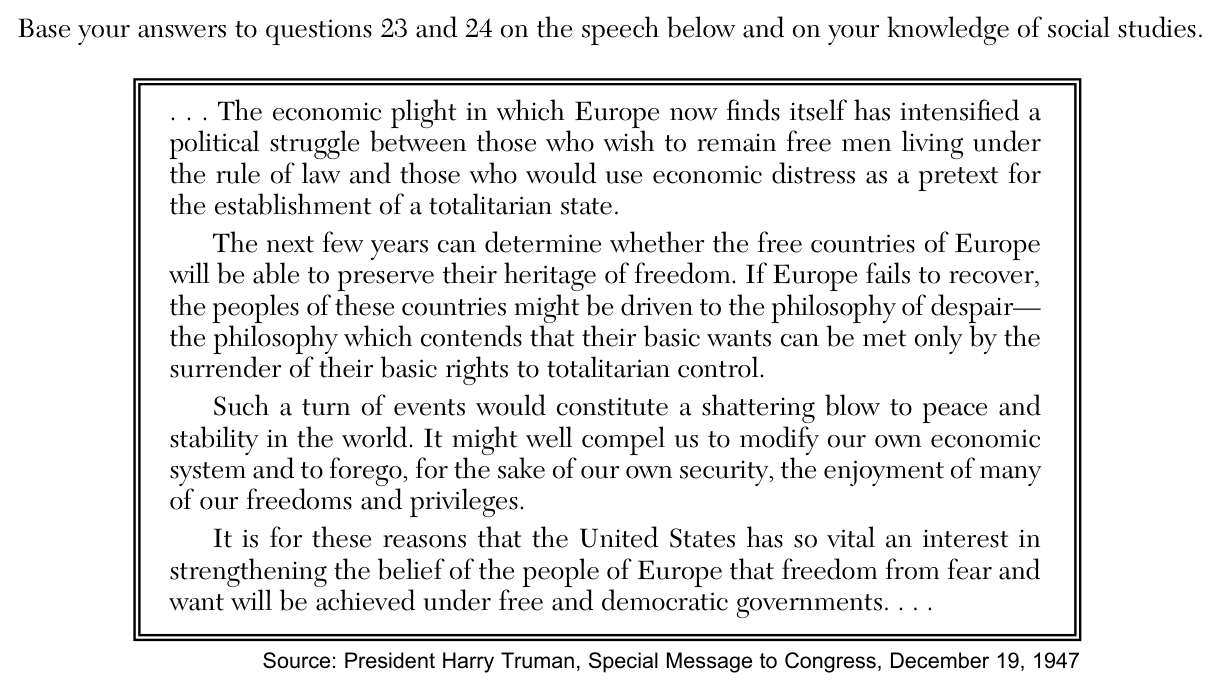
Worked solution for question 23
- Truman argues that economic distress makes totalitarian movements more appealing.
- The European Recovery Program used economic assistance to support recovery and stability.
- The Marshall Plan offered recovery aid to European economies after World War II. Its aim and method differed from alliances that organized military defense.
Answer choice 3The Marshall Plan
Q24 Containment
Which objective explains Truman’s argument?
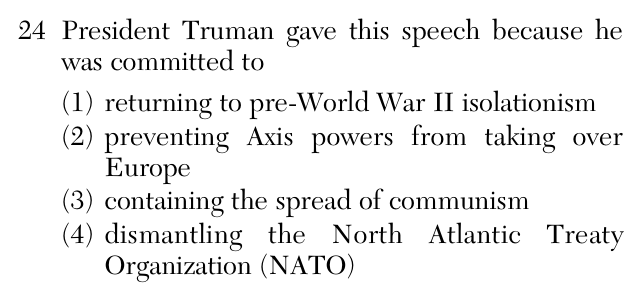
Worked solution for question 24
- Truman feared that economic collapse would undermine democratic governments in Europe.
- Aid was a way to counter Soviet influence through recovery rather than direct war.
Answer choice 3Contain the spread of communism.
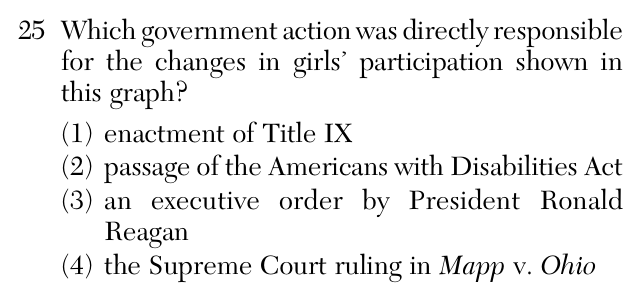
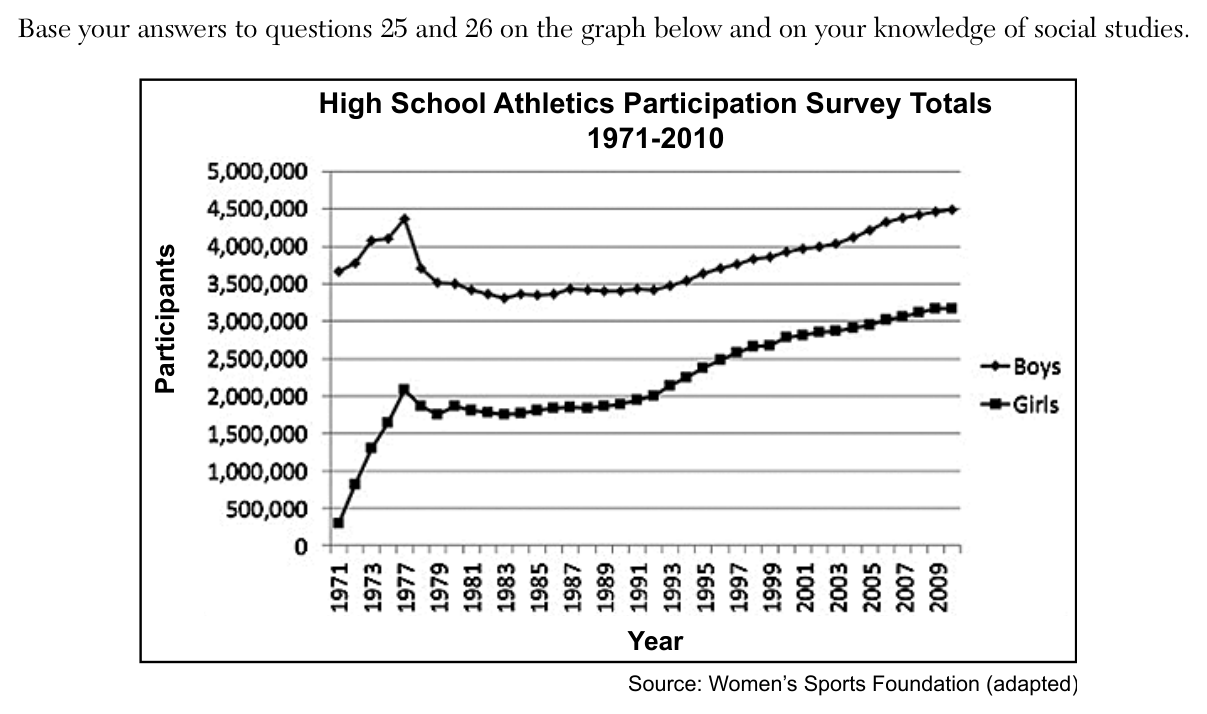
Q25 Girls’ athletic participation
Which federal measure explains the change in girls’ participation?
Worked solution for question 25
- Title IX bars sex discrimination in federally funded education programs.
- Its application to athletics expanded access and opportunities for girls and women.
- Title IX applies to sex discrimination in educational programs receiving federal funds. Athletics is one area in which that rule affected girls’ participation.
Answer choice 1Title IX
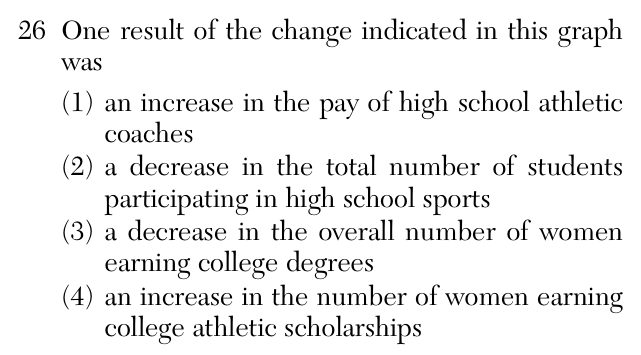
Q26 Opportunities after high school
What was one result of increased participation by girls?
Worked solution for question 26
- Broader school participation expanded the pipeline of athletes competing at the college level.
- Growth in women’s college programs also expanded opportunities for athletic aid.
Answer choice 4More women earned college athletic scholarships.
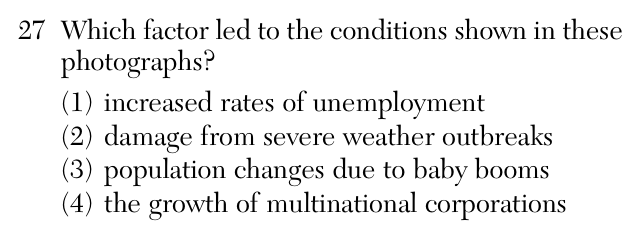
Q27 Public projects and unemployment
What did the 1939 and 2009 projects respond to?
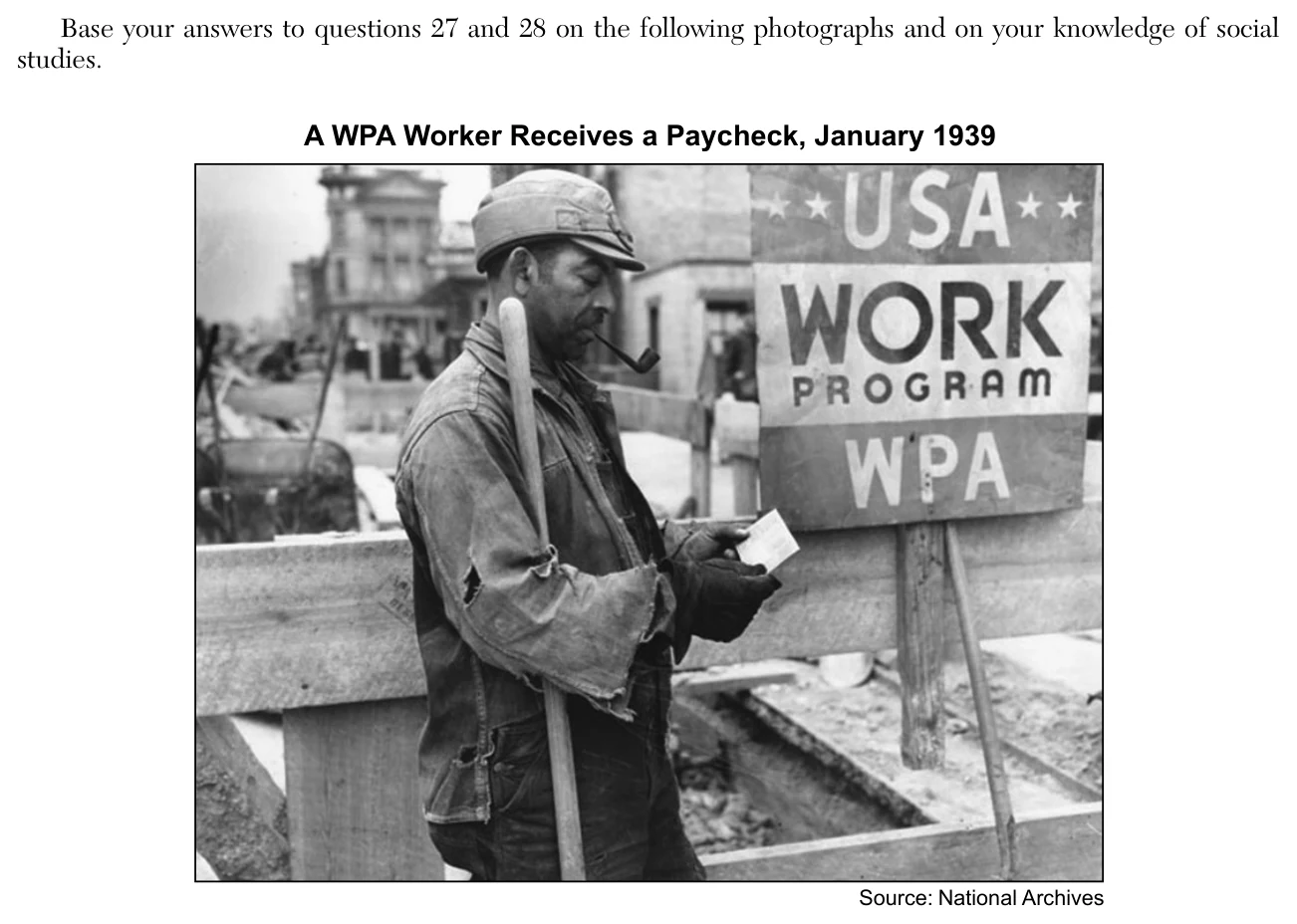
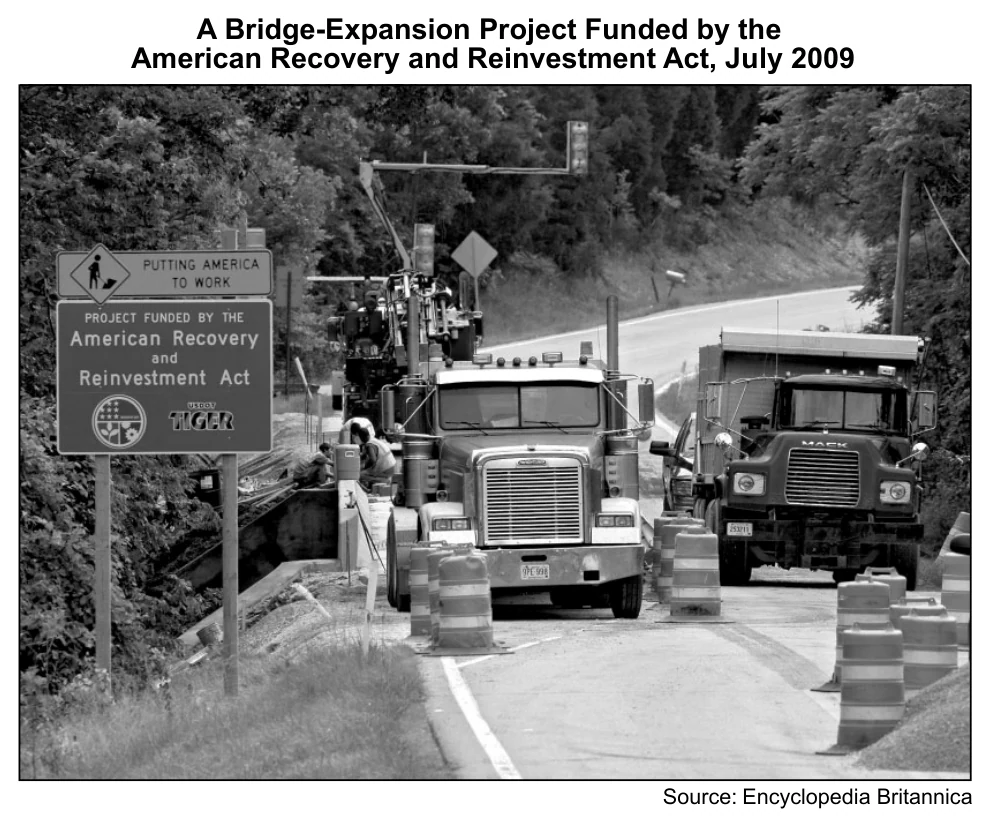
Worked solution for question 27
- The WPA operated during the Great Depression. The 2009 recovery act followed the financial crisis and recession.
- Both measures used spending partly to support employment.
- The public projects paid workers directly. In a depression with too few private jobs, putting unemployed people to work was one immediate objective.
Answer choice 1High unemployment
Q28 Federal investment in infrastructure
What kind of role for government do the two photographs show?
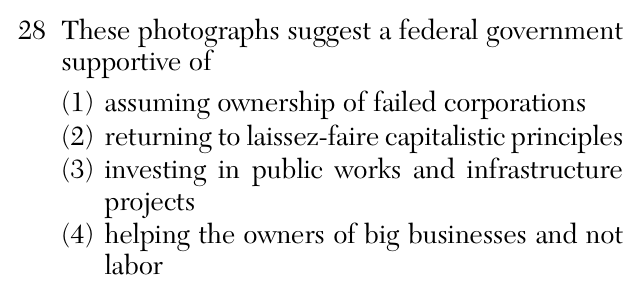
Worked solution for question 28
- One image documents government-funded employment and the other shows a funded bridge project.
- Together they illustrate federal spending on projects with public benefits.
Answer choice 3Investment in public works and infrastructure
Part II Short essays
Question indexQ29 Disability rights and the ADA
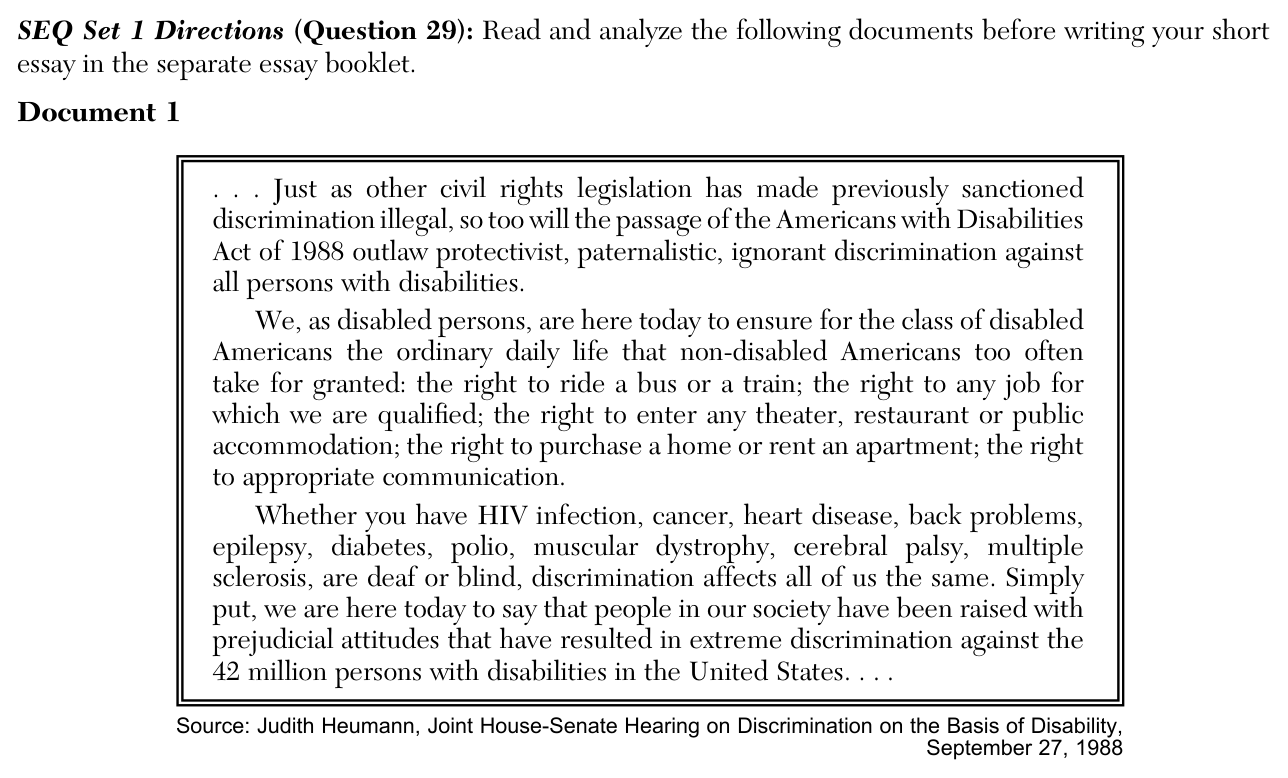
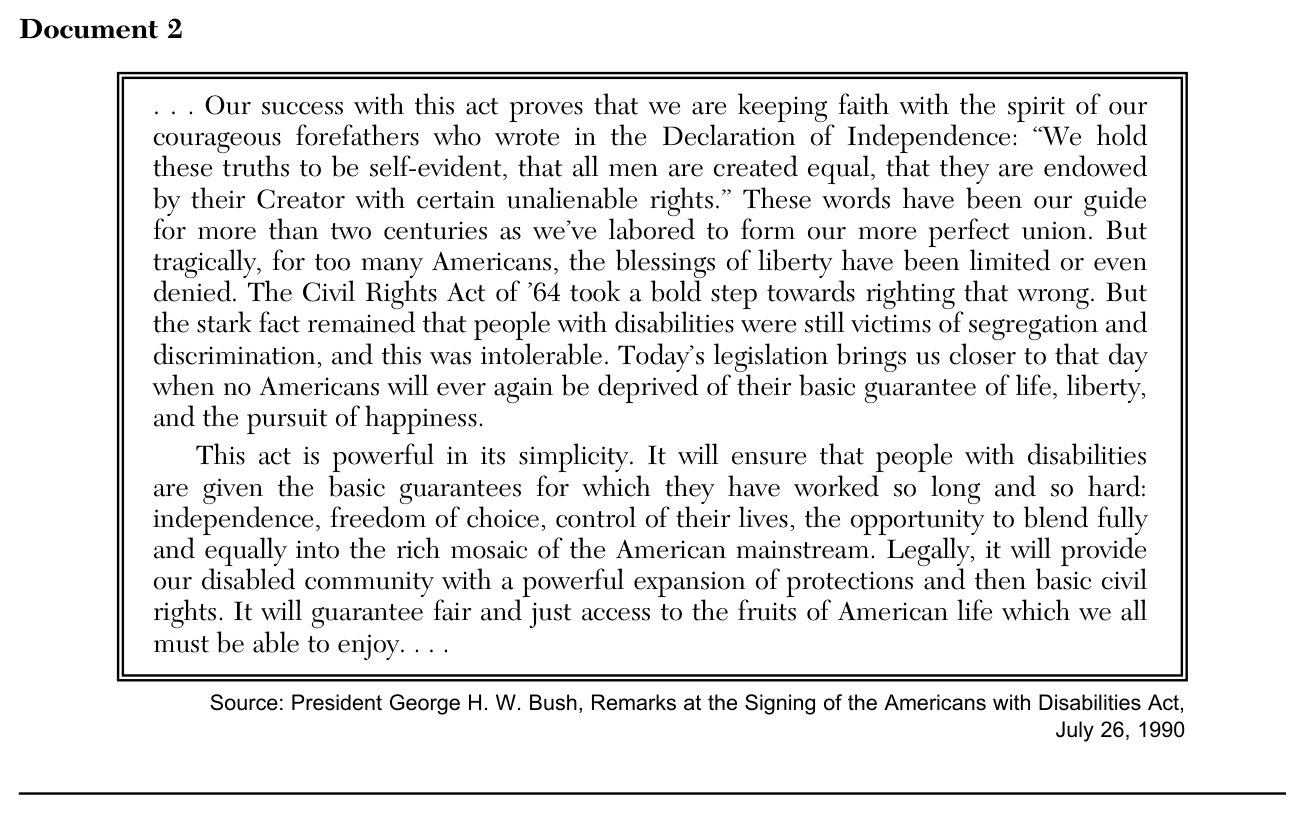
Describe the context of Heumann’s testimony and Bush’s signing remarks. Explain a relationship between the documents.
Writing plan and model response for question 29
- Identify barriers and the civil-rights tradition behind the testimony. Explain the relationship as advocacy and legislative response.
- Connect the law to specific public settings and limits.
Central claimDisability-rights organizing pressed for a federal response that the 1990 ADA supplied.
Model response
By the late twentieth century, disability-rights activists challenged barriers that kept people from transportation, jobs and public services. Section 504 of the Rehabilitation Act of 1973 already prohibited disability discrimination in programs receiving federal financial assistance, but activists sought broader protections. In Document 1, Judith Heumann tells Congress that people with disabilities should be able to ride buses and trains, enter restaurants and theaters, and apply for jobs for which they are qualified. She makes ordinary participation a civil-rights issue.
Heumann’s testimony shows the advocacy that helped bring about the Americans with Disabilities Act. At the 1990 signing in Document 2, President George H. W. Bush acknowledges that earlier civil-rights laws had left many people with disabilities exposed to segregation and discrimination. The ADA extended protections into employment, public services and many businesses open to the public. The documents show how organized demands for access helped produce a broader federal law addressing the barriers activists had identified.
Q30 The escalation debate in Vietnam
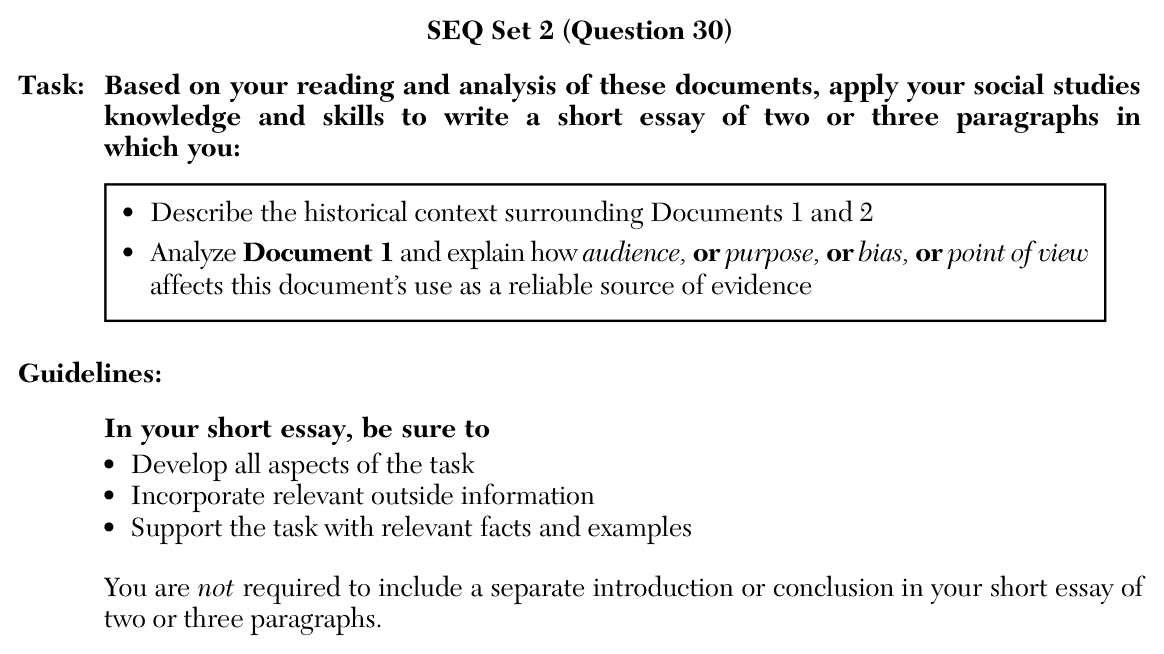
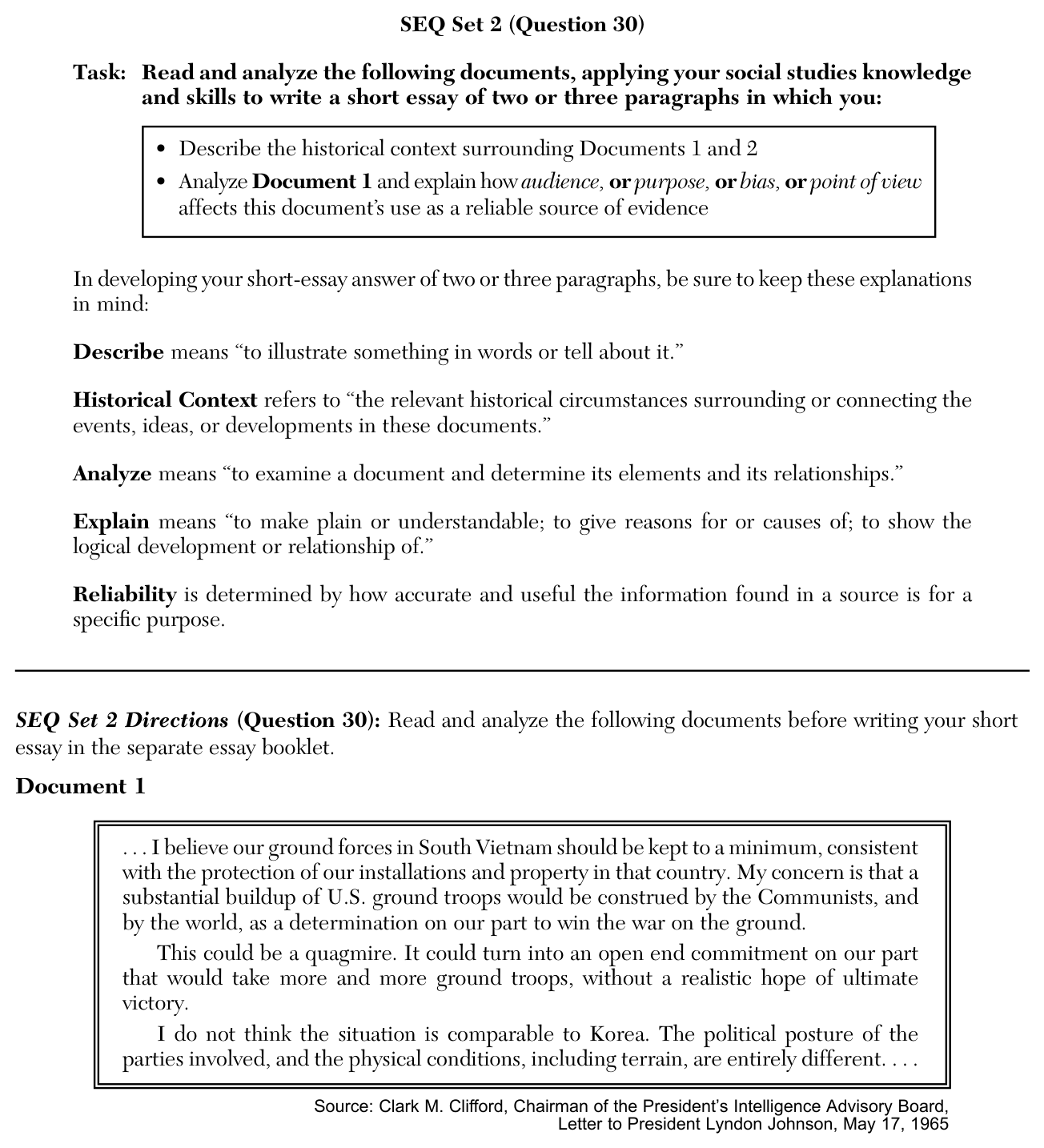
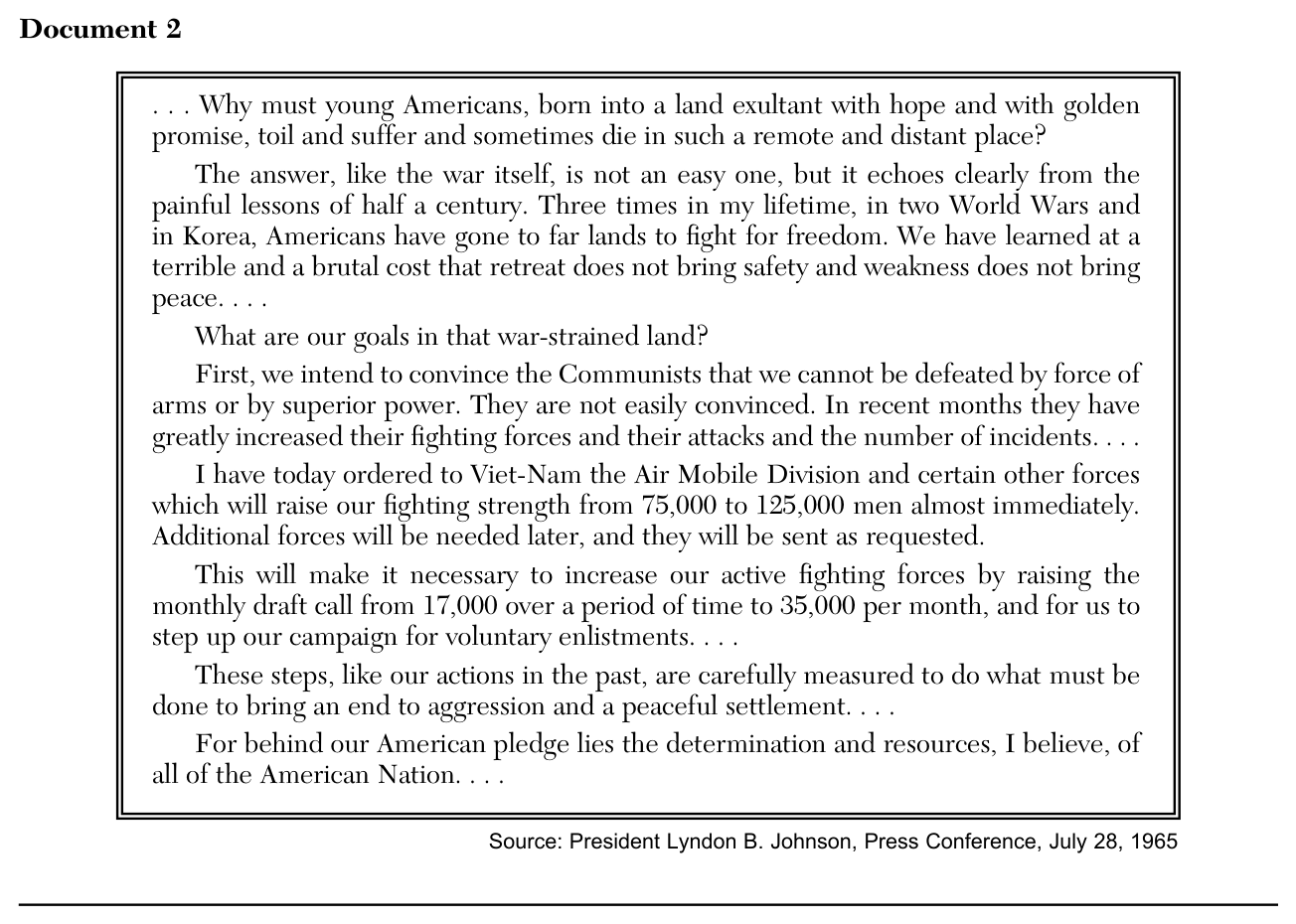
Describe the setting of Clifford’s private letter and Johnson’s public remarks. Explain how one sourcing factor affects Document 1’s usefulness.
Writing plan and model response for question 30
- Use the Cold War and 1964 Gulf of Tonkin Resolution as context. Contrast the documents’ audiences and explain what the letter can establish.
- Keep the analysis focused on Document 1 as the prompt requires.
Central claimClifford’s private warning is useful evidence of dissent among advisers during the escalation.
Model response
After France’s defeat in Indochina, Vietnam was divided and the United States backed the government in South Vietnam as part of containment. The Gulf of Tonkin Resolution in 1964 broadened Johnson’s authority to use military force. In 1965 the administration debated whether a larger American ground force could prevent a Communist victory. Johnson’s July press conference in Document 2 announced substantial increases in troops and draft calls.
Clifford’s May letter in Document 1 was addressed privately to Johnson. That audience makes it especially useful for studying advice the president received outside public speeches. Clifford warns that a large deployment could create an open-ended commitment and doubts the analogy to Korea. His access as an adviser makes the warning relevant, but the letter records his judgment and does not measure how many other officials shared it. Johnson’s public justification in Document 2 shows why the president’s announced policy must be studied separately from his advisers’ private recommendations.
Part III A Document questions
Question indexQ31 Weakness of national taxation
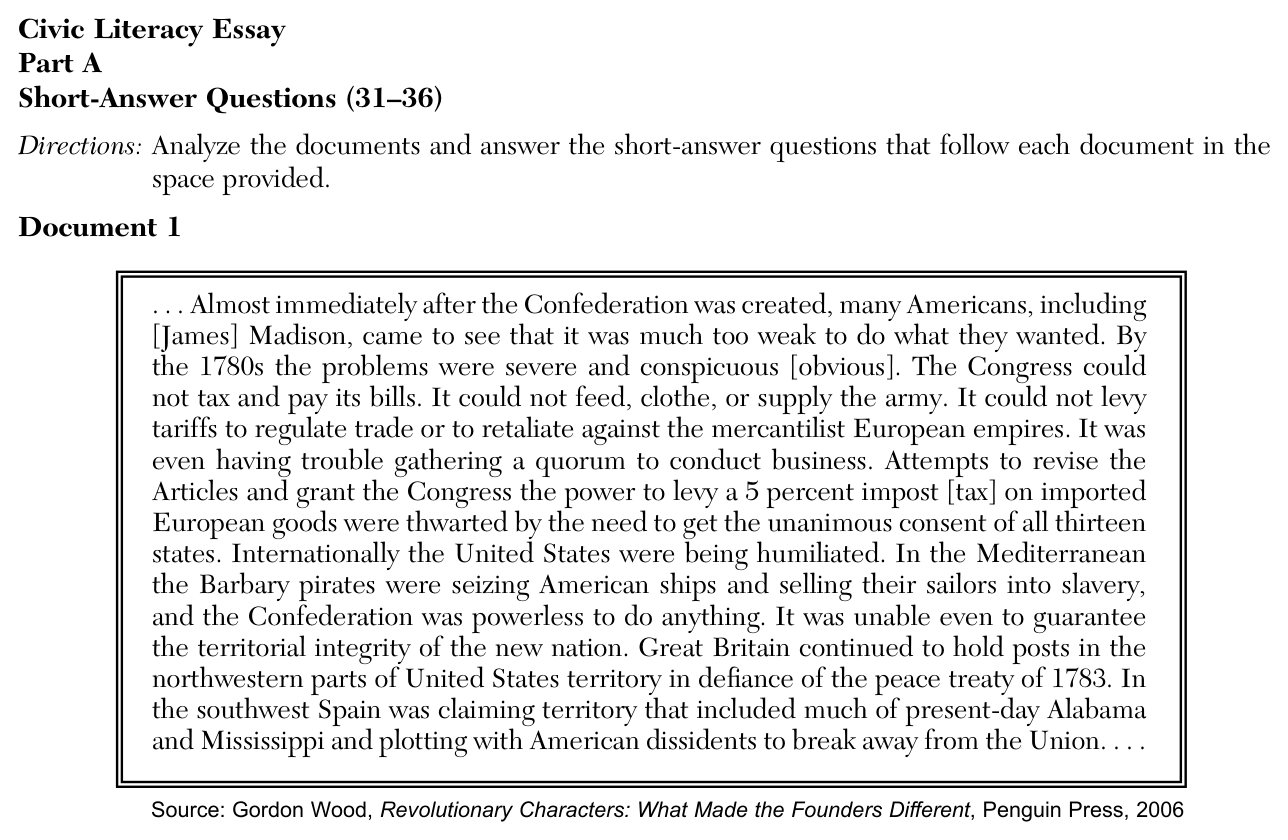
Give one weakness identified by Gordon Wood in Document 1.
Worked solution for question 31
- Wood describes the failed attempt to authorize a five percent impost.
- The failed effort shows why national revenue was unreliable.
- Tie the failed impost to the weakness in the Articles. Dependence on state agreement could keep Congress from raising revenue even when it proposed a specific national tax.
Final answerCongress could not impose a national import tax under the Articles without obtaining the necessary agreement from the states.
Q32 Shays’s Rebellion
Identify the historical circumstance shown in Documents 2a and 2b.
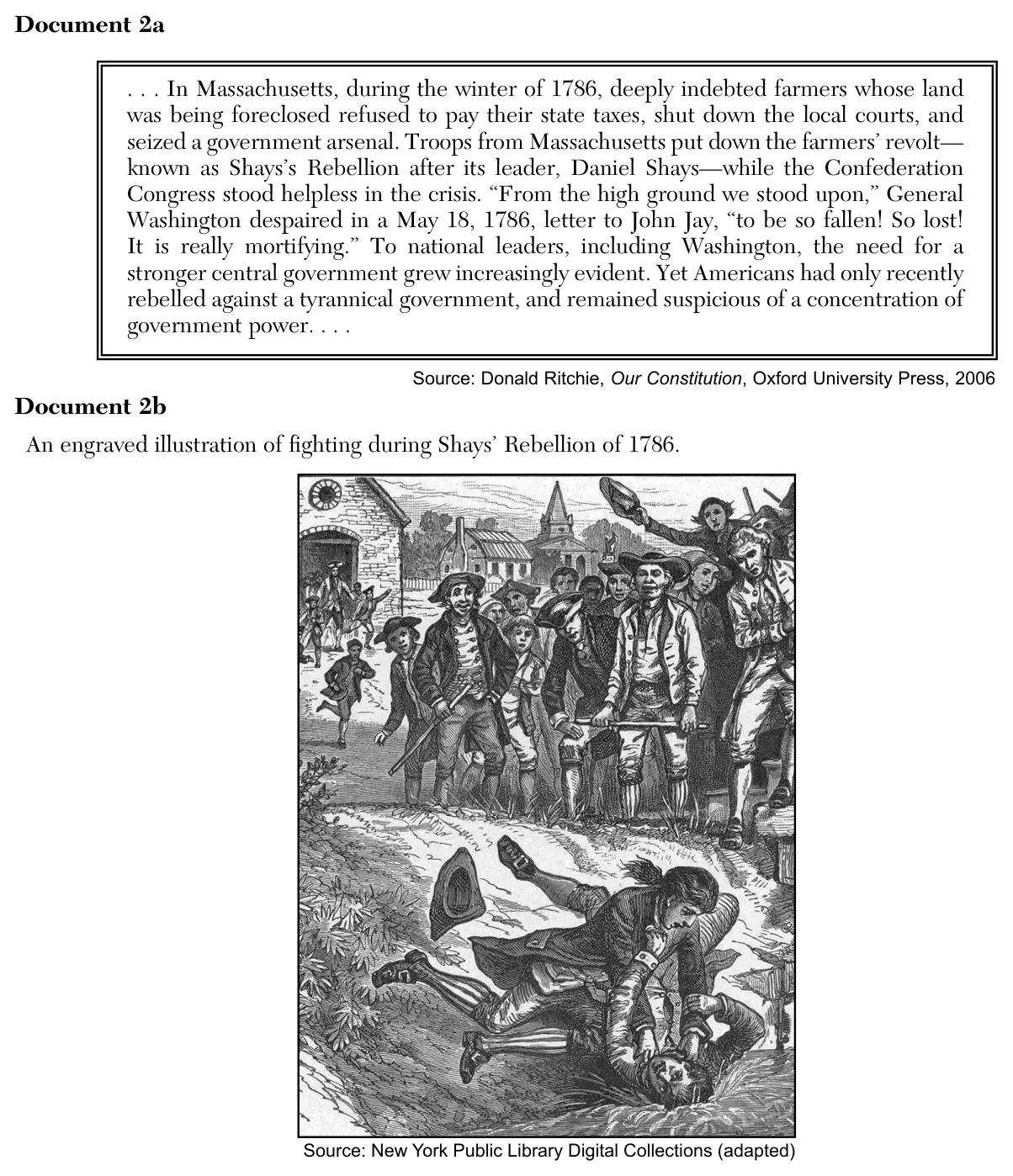
Worked solution for question 32
- The text explains why farmers closed courts and notes the Confederation’s weakness.
- The illustration depicts conflict connected to that uprising.
Final answerMassachusetts farmers protested taxes and foreclosures in Shays’s Rebellion while the national government lacked the power to respond effectively.
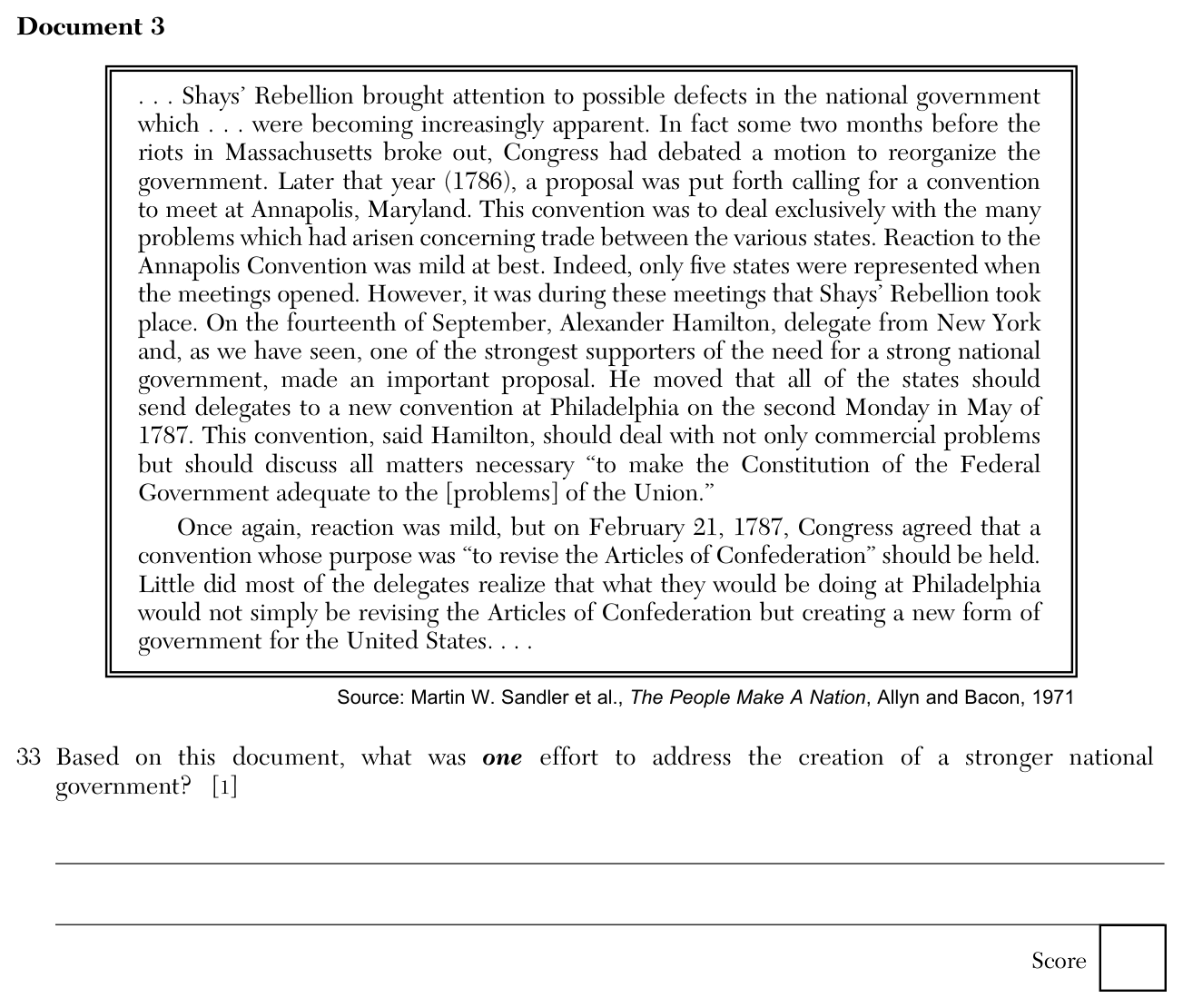
Q33 A convention in Philadelphia
What effort in Document 3 addressed the weaknesses of government?
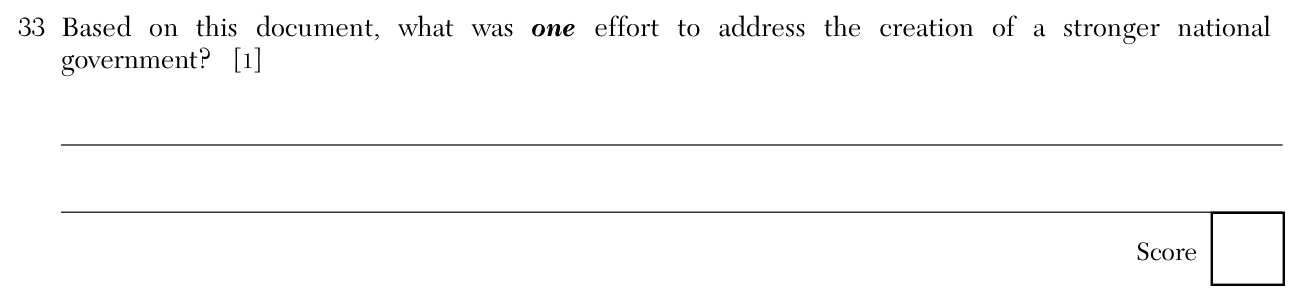
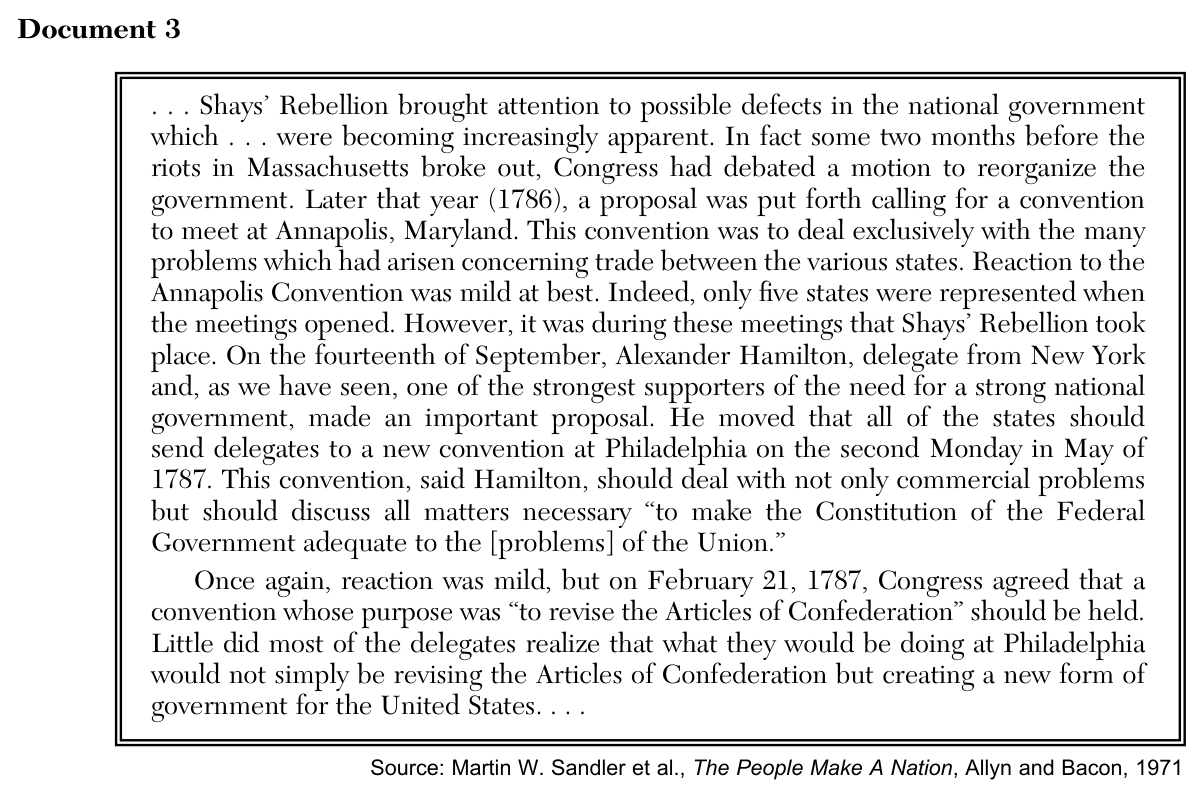
Worked solution for question 33
- The meeting followed earlier efforts to address national problems, including the Annapolis Convention.
- The Philadelphia delegates ultimately proposed a new Constitution.
Final answerCongress endorsed a 1787 convention in Philadelphia to consider changes to the Articles.
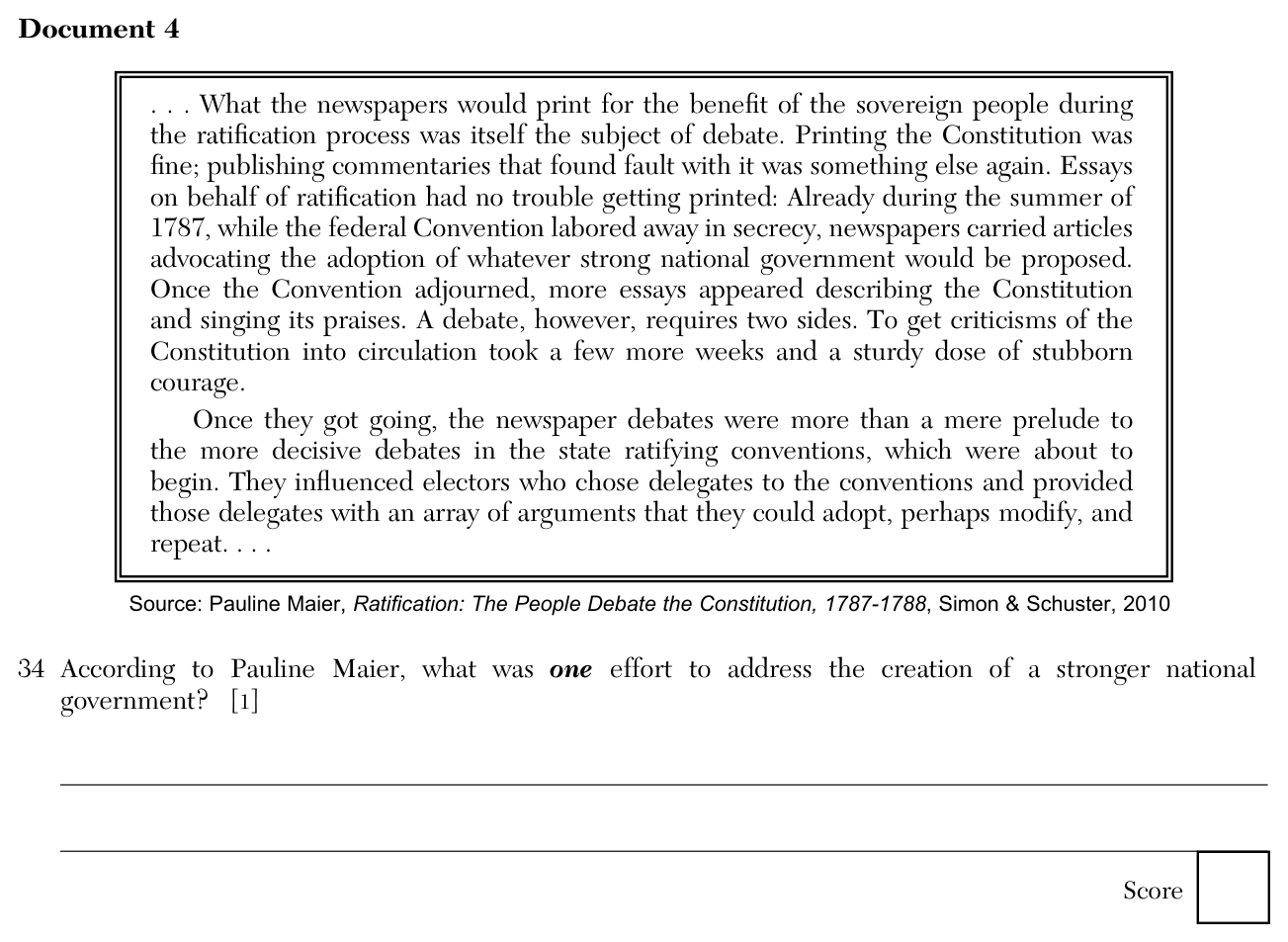
Q34 Public ratification debate
Identify an effort Maier describes in Document 4.
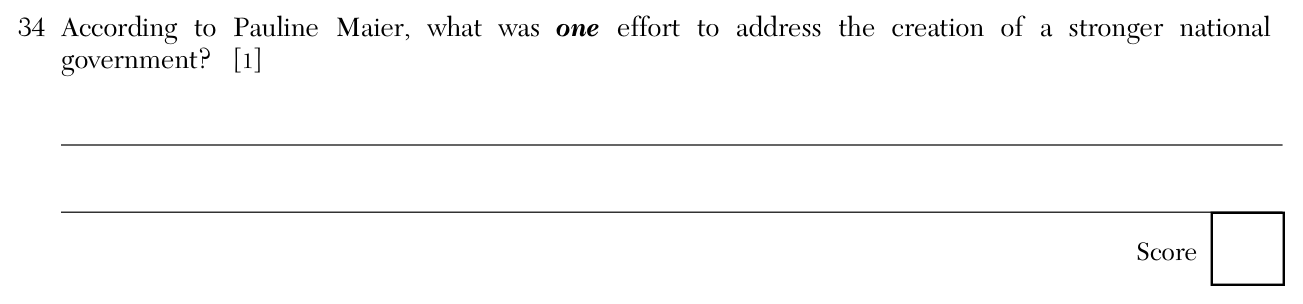
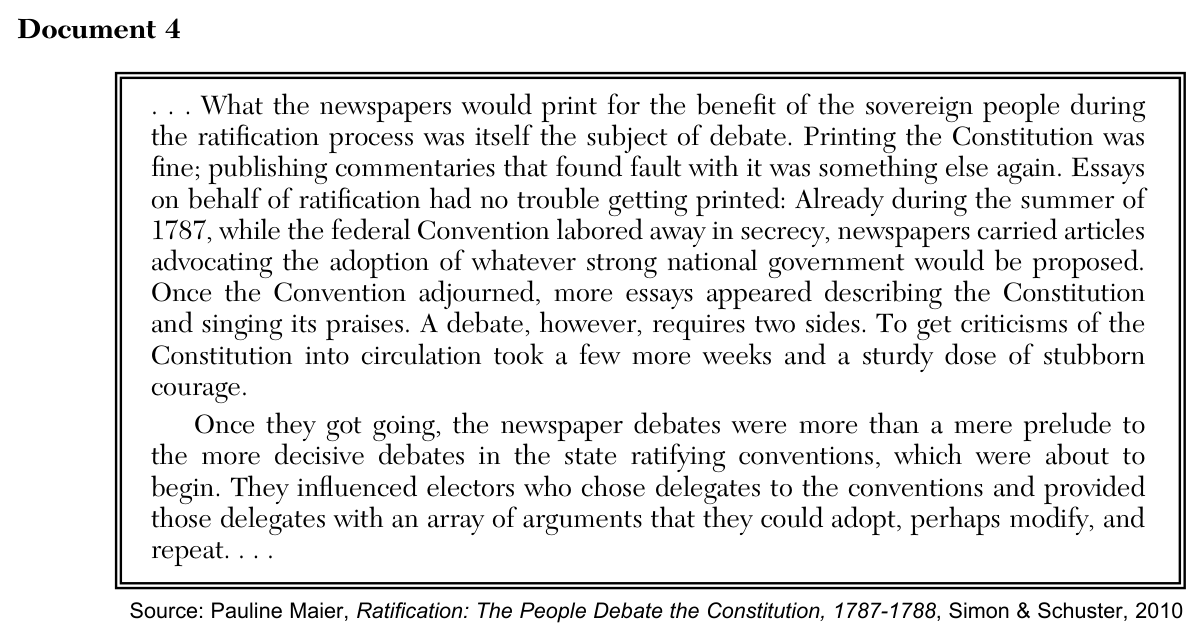
Worked solution for question 34
- The Constitution and commentaries entered a public debate through the press.
- Publication let advocates argue for adoption beyond the convention itself.
Final answerSupporters used newspapers to publish and circulate arguments for ratification.
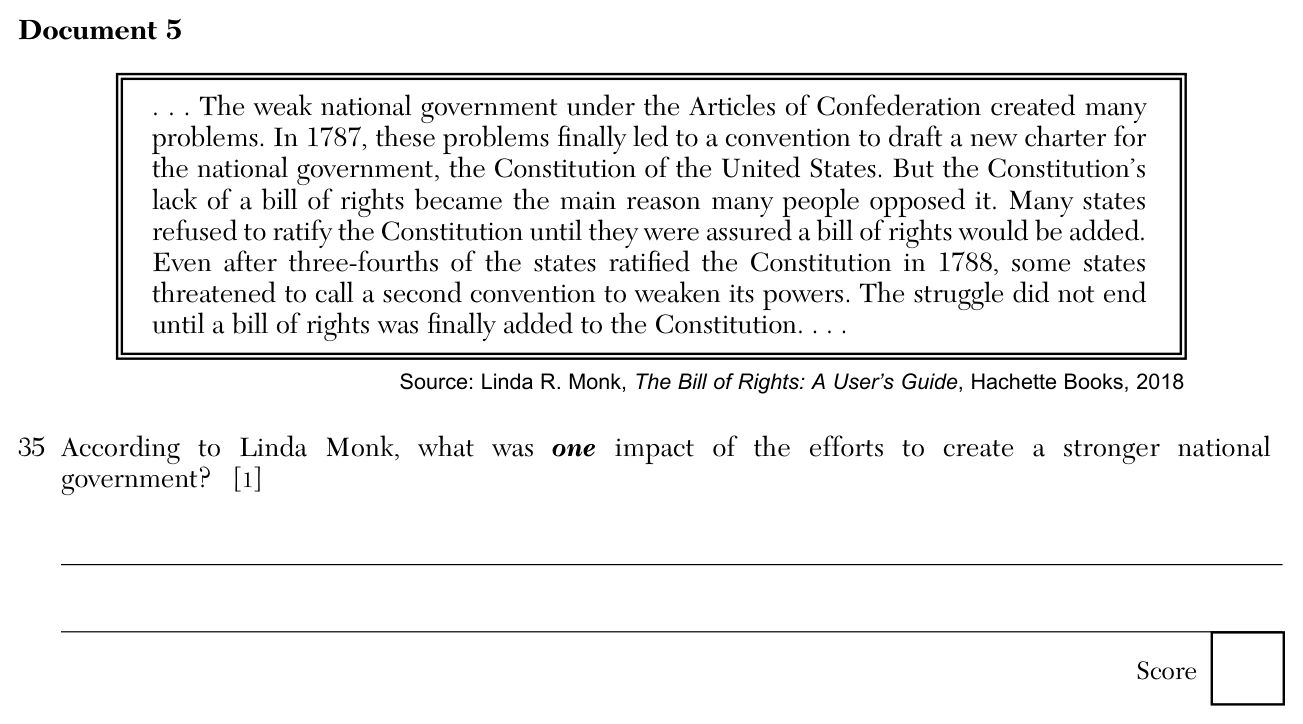
Q35 Demand for a bill of rights
What impact does Linda Monk identify in Document 5?
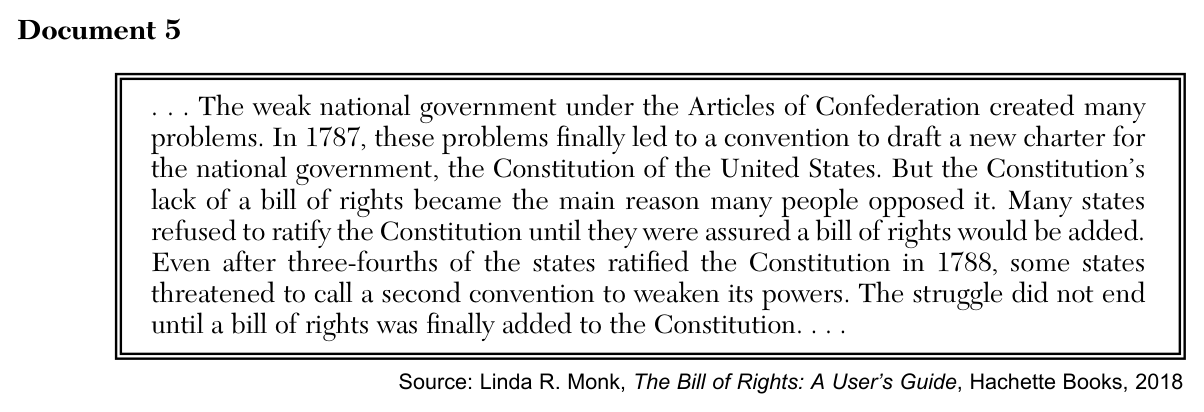
Worked solution for question 35
- Opponents feared the proposed government’s powers lacked sufficient safeguards.
- Pressure for amendments continued even after ratification secured the new framework.
Final answerThe absence of a bill of rights provoked opposition and increased pressure for explicit protections.
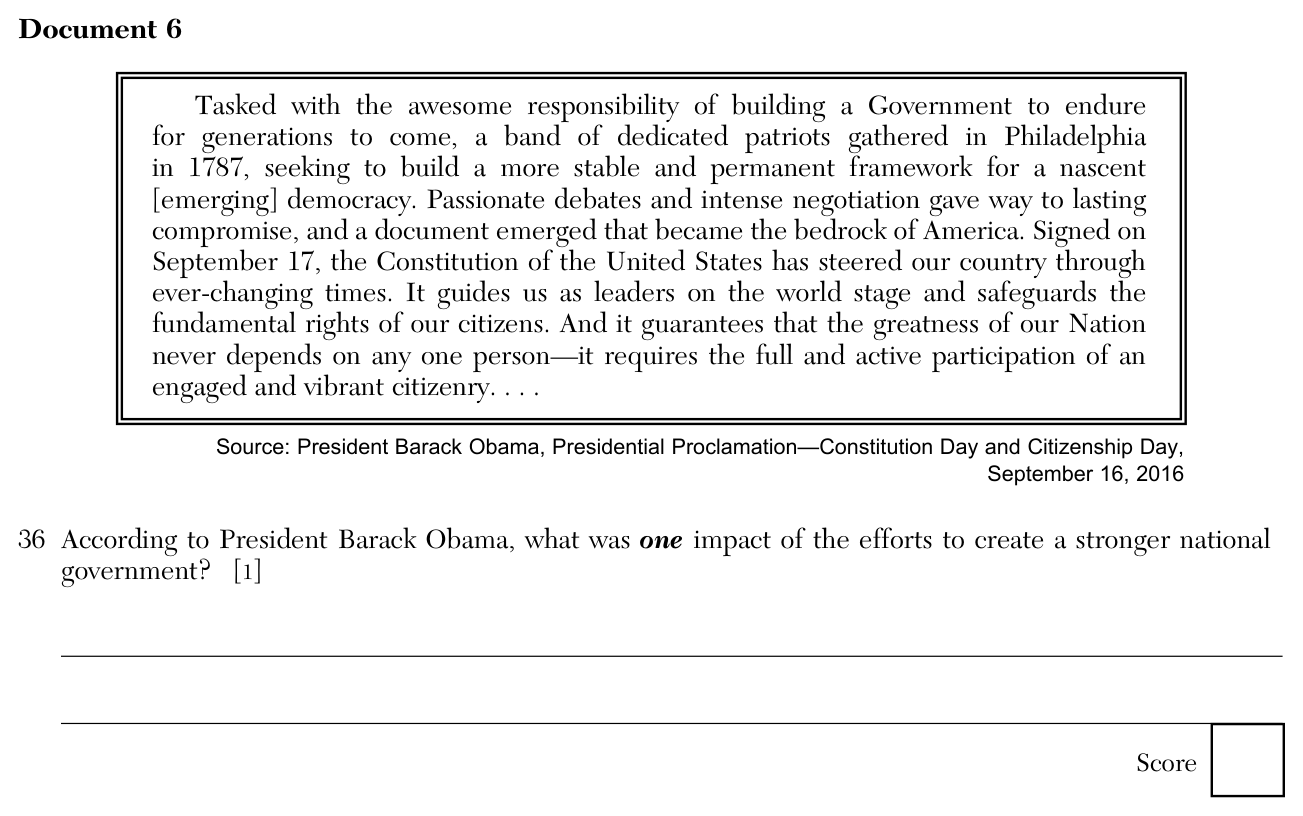
Q36 The Constitution’s legacy
What impact does Obama identify in Document 6?
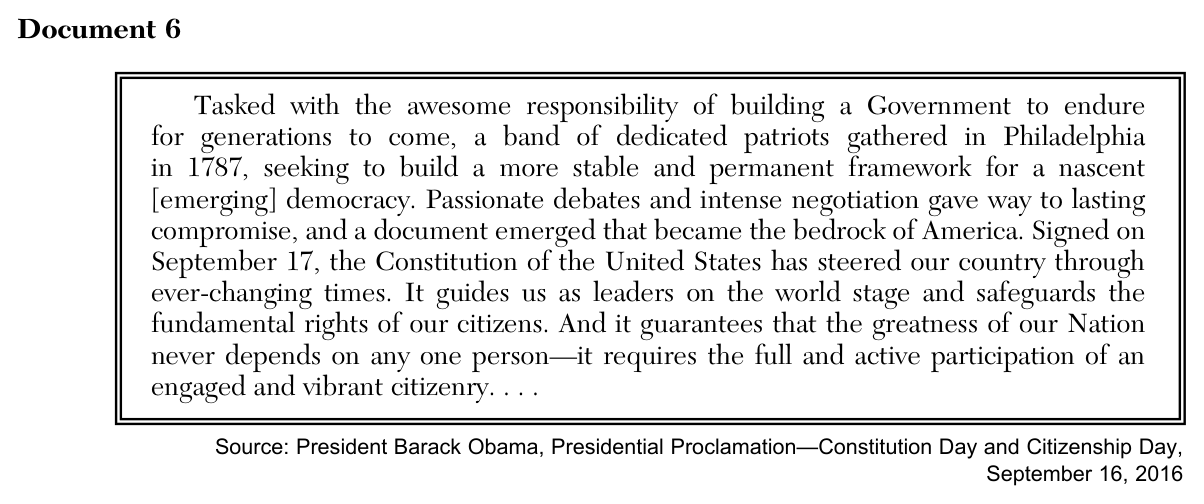
Worked solution for question 36
- The proclamation describes the Constitution as guiding the nation through changing circumstances.
- It also ties the government’s success to active civic participation.
Final answerThe Constitution provided a durable framework that safeguards fundamental rights.
Part III B Civic literacy essay
Question indexQ37 Building a stronger national government
Explain the circumstances, at least two efforts and their impacts. Use at least four documents and outside evidence.
Writing plan and model response for question 37
- Build the essay around the Articles’ limitations, the Philadelphia Convention, and the ratification campaign and Bill of Rights.
- Separate the powers gained by government from the protections added for the people.
Central claimThe Constitution strengthened federal capacity, while ratification debate helped secure protections against abuses of that power.
Model response
The Articles of Confederation expressed Americans’ fear of centralized authority after independence. Experience in the 1780s, however, convinced many that the national government needed greater power. Creating that government required both a new framework and agreement about limits on the authority it would exercise.
Congress could request money from the states, but it lacked an independent power to tax. As Gordon Wood shows in Document 1, the proposed import duty could not be secured. Economic distress also had political consequences. In Documents 2a and 2b, Massachusetts farmers resisted taxes and foreclosures in Shays’s Rebellion. The inability of the Confederation to respond effectively strengthened the case for a more capable national government.
One effort was the Philadelphia Convention, authorized after earlier discussions about reform (Document 3). Delegates produced a Constitution under which Congress could tax and regulate interstate commerce. They divided authority among branches and adopted a compromise that gave states equal representation in the Senate and population-based representation in the House. The system gave the national government tools it had lacked while leaving substantial authority with the states.
A second effort was the campaign for ratification. Newspapers circulated arguments over the new plan (Document 4), including essays such as the Federalist Papers. Opponents warned that a stronger government might threaten individual liberty. As Document 5 shows, the lack of a bill of rights became a major objection. The first ten amendments, ratified in 1791, addressed some of that opposition through guarantees such as freedom of speech and protection against unreasonable searches. The resulting government gained the ability to act nationally while acquiring explicit constitutional limits, a legacy recognized in Document 6.
From the New York State Education Department. June 2026 U.S. History and Government Regents Examination. Internet. Available from https://www.nysedregents.org/us-history-govt/626/ushg-62026-exam.pdf. Accessed .