SIXTH-FORM CHOICES · A STUDENT & PARENT GUIDE
Is IB Better
Than A Levels?
Neither is better for everyone. Choose the route that fits your subjects, university plans and way of working—with a school that can support you well.
34 chapters · 424 questions and study topics · Practical comparison tools

PART 1 · CHAPTER 1
1. Is IB Better Than A Levels? The Short Answer
Back to contents ↑1.1 Is IB Actually Better Than A Levels?
Neither qualification is automatically better. The IB Diploma combines a broad subject programme with a common core; A Levels allow earlier concentration on fewer subjects. The better choice meets your intended degree prerequisites, suits how you work and is taught well at an affordable school.
1.2 Which Qualification Is Better for University?
Both can support strong university applications. Start with the exact degree, institution and entry year, then compare required subjects and grades. A well-matched A Level combination can be stronger preparation than an unsuitable IB selection, and the reverse can also be true.
1.3 Is IB Harder Than A Levels?
IB can be demanding because you manage six subjects and core deadlines simultaneously. A Levels can be demanding because each chosen subject requires sustained depth. Difficulty depends on your subject combination, preparation, assessment pattern and school support; subject count alone does not settle the question.
1.4 Which Is More Respected Internationally?
Both qualifications are internationally recognized, but recognition is different from satisfying a particular course’s entry conditions. Check the receiving university’s subject, language and credential rules. There is no reliable worldwide prestige ranking that makes one qualification universally superior.
1.5 Which Is Better for Students Who Already Know Their Career Path?
A Levels can suit students whose degree prerequisites are already clear and who want to concentrate on those subjects. IB can also work well when the right Higher Level subjects are available. Choose the route that protects the required preparation without creating an unsuitable overall workload.
1.6 Which Is Better for Students Who Are Undecided?
IB keeps several academic areas in your timetable, which can help if your interests remain broad. A Levels can preserve options too when chosen strategically. Neither prevents future decisions from becoming narrower: missing a required science or mathematics course can close a degree route in either system.
1.7 IB vs A Levels: Quick Verdict by Student Profile
A student enjoying languages, science and essays may prefer IB breadth; a student wanting sustained work in Mathematics, Physics and Further Mathematics may prefer A Levels. These are starting profiles, not admission rules. Compare the actual subjects and teaching available before deciding.
1.8 Key Takeaways for Students and Parents
Make the decision in this order: degree prerequisites, realistic subject strengths, assessment fit, school quality, wellbeing and total cost. Treat rankings, anecdotes and headline pass rates as secondary context. A qualification label cannot compensate for the wrong subjects or a poor learning environment.
Consider IB when…
You enjoy several disciplines and value a shared research and core framework, with the required HL subjects available.
Consider A Levels when…
You want focused study in a few verified prerequisite subjects and prefer independent subject qualifications.
Let the school decide when…
Both routes fit academically, but teaching, feedback, support, timetable or affordability differs substantially.
PART 1 · CHAPTER 2
2. What Is the International Baccalaureate (IB)?
Back to contents ↑2.1 What Does IB Stand For?
IB stands for International Baccalaureate. The organization offers several educational programmes; this guide compares the two-year Diploma Programme with A Levels. Do not assume an IB primary or middle-years background is the same qualification as completing the IB Diploma.
2.2 What Is the IB Diploma Programme (IBDP)?
The IB Diploma Programme is generally studied by students aged 16–19 over two years. Students take six subjects at a combination of Higher and Standard Levels and complete the core. Individual course results are a different outcome from being awarded the complete diploma.
2.3 How the IB Education System Works
A school organizes subject options, teaching, internal assessment deadlines and core supervision within IB requirements. Students complete subject assessments and examinations as applicable. The shared framework does not mean every school offers the same languages, sciences, timetable or quality of feedback.
2.4 The Six IB Subject Groups
The six subject groups are studies in language and literature, language acquisition, individuals and societies, sciences, mathematics and the arts. Approved alternatives allow flexibility, including replacing the arts with another permitted subject. Confirm your full combination with the coordinator rather than assuming any six choices qualify.
2.5 IB Higher Level (HL) vs Standard Level (SL)
HL subjects involve greater scope and recommended teaching time than SL. Diploma students normally take three HL subjects, with four permitted, and the rest at SL. An SL subject still contributes to the total and may involve substantial work; it is not a subject you can ignore.
2.6 What Are Theory of Knowledge (TOK), Extended Essay (EE) and CAS?
Theory of Knowledge examines how knowledge claims are justified; the Extended Essay develops an independent investigation; Creativity, Activity, Service involves experiences, reflection and a collaborative project. TOK and EE can contribute core points. CAS is a completion requirement rather than an extra numerical subject grade.
2.7 How Long Does the IB Diploma Take?
The Diploma Programme is normally a two-year course. Ask the school which examination session and subject-guide edition apply to your cohort. A student starting in 2027 may encounter different first-assessment dates from someone taking final exams in 2027.
2.8 Who Should Consider the IB Diploma?
Consider IB if you want to retain languages, mathematics, science and humanities while developing research habits. Check that the compulsory breadth fits your strengths and degree goals. Enjoying many subjects is helpful, but realistic time management and dependable school support matter just as much.
2.9 IB Diploma vs Individual IB Course Results
The full diploma requires the complete subject and core programme and its award conditions. Individual IB course results record achievement in particular subjects. Universities may treat these routes differently, so do not assume a collection of course results automatically meets a full-diploma admission requirement.
PART 1 · CHAPTER 3
3. What Are A Levels?
Back to contents ↑3.1 What Does A Level Stand For?
A Level means Advanced Level, commonly referring to the General Certificate of Education Advanced Level or an international counterpart. Each subject is a separate qualification. Compare the exact awarding organization and syllabus, because the shared name does not guarantee identical content or assessment arrangements.
3.2 How the British A Level System Works
Students usually choose a small set of subjects for advanced study after GCSE, IGCSE or a comparable foundation. A school may impose entry grades, timetable blocks or compulsory enrichment. The qualification structure is subject-based, while the school determines much of the overall sixth-form experience.
3.3 AS Levels vs A Levels
AS is Advanced Subsidiary. In England’s reformed system, AS is a separate qualification and does not contribute to the full A Level. Cambridge International staged routes and Pearson IAL have different rules. Identify the system before deciding whether an AS result can be carried forward.
3.4 How Many A Levels Do Students Usually Take?
Three full A Levels are a common programme; some students take four, particularly where Further Mathematics is involved. More is not automatically better. Check whether the fourth subject strengthens preparation and whether it is likely to reduce performance in the subjects a university actually requires.
3.5 How Long Do A Levels Take?
A Levels are usually studied over two years. Accelerated, part-time and resit arrangements exist, but feasibility depends on prior knowledge, the centre and the assessment specification. Ask for the complete teaching and exam plan rather than assuming a shorter course offers the same preparation.
3.6 UK A Levels vs International A Levels
UK GCE A Levels and International A Levels are related advanced qualifications with potentially different assessment structures. Distinguish England’s linear route from Cambridge International and Pearson Edexcel IAL, and avoid applying England-specific AS or resit rules to every international candidate.
3.7 Cambridge International vs Pearson Edexcel vs AQA and Other Exam Boards
Cambridge International and Pearson Edexcel provide international routes; AQA, OCR, Pearson and other bodies offer particular UK qualifications. Compare the subject code, specification, practical arrangements and available examination centre. The board name alone does not determine whether a course is easier or better taught.
3.8 Linear vs Modular Assessment Systems
A linear qualification assesses the course at its end; a modular qualification builds from assessed units. Cambridge International also offers permitted staged AS-to-A-Level routes, which should not be confused with unrestricted unit-by-unit resits. Your exact syllabus and carry-forward rules control the options.
3.9 Who Should Consider A Levels?
Consider A Levels if you want focused study in subjects you enjoy and need for further study. Check that specialization does not remove an important prerequisite. Also compare coursework and practical requirements: A Levels are not uniformly examination-only qualifications.
PART 1 · CHAPTER 4
4. IB vs A Levels: Complete Side-by-Side Comparison
Back to contents ↑4.1 Curriculum Structure
IB is a coordinated diploma with subject-group requirements and a core; A Levels are independently awarded subject qualifications. This difference affects planning, assessment risk and how results are reported. Use the side-by-side table below to distinguish programme-wide obligations from subject-specific ones.
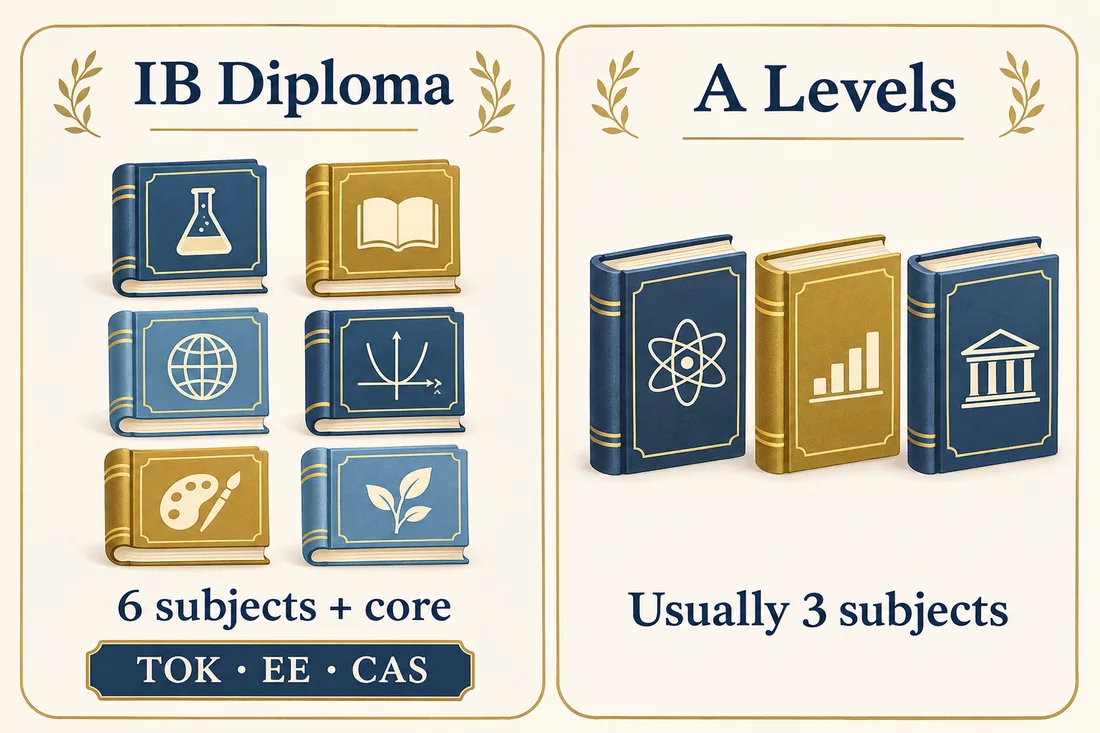
4.2 Number of Subjects
The standard IB Diploma contains six subjects. A typical A Level programme contains three, sometimes four, full subjects. These counts do not establish equal teaching time, equal difficulty or a fixed conversion between the qualifications.
4.3 Academic Difficulty
Assess difficulty through the actual syllabus, mathematical demands, writing load, practical work and marking criteria. A programme can feel difficult because it contains a weak subject or because many deadlines coincide. Compare a realistic fortnight of work, not only an examination paper from one subject.
4.4 Subject Depth vs Breadth
IB requires breadth while providing more specialized work through HL choices. A Levels allow a larger share of the timetable to concentrate on selected disciplines. Neither route has a monopoly on depth: compare specific subject topics and university preparation rather than relying on slogans.
4.5 Teaching and Learning Style
Both can involve seminars, problem-solving, practical investigation, feedback and independent reading. Classroom quality varies by teacher and school. Visit lessons, inspect anonymized assessed work and ask how students receive corrections; these reveal more than the curriculum label alone.
4.6 Examination Format
IB typically combines final examinations with other subject assessment components. A Level arrangements depend on the jurisdiction, board and subject, with linear, staged or modular routes in different systems. Compare when assessment happens and what can be retaken, not merely the number of papers.
4.7 Coursework and Internal Assessments
IB has subject-specific internal assessments and externally assessed work, while A Level non-exam assessment varies by specification. English, arts, sciences and computing can have different arrangements. Ask for the exact percentage, task, authentication process and deadline calendar for every proposed subject.
4.8 Grading Systems
IB subjects receive grades 1–7, with a diploma total out of 45 including up to three TOK/EE points. A Levels are graded A*–E, with U for unclassified results. These systems describe different qualification structures and have no universal grade-for-grade conversion.
4.9 Time Commitment and Homework
Workload depends on assigned work, independence, subject strengths and the timing of deadlines. Build an actual weekly schedule using school contact hours and your estimated study needs. Generic claims such as “every IB student studies twice as much” are not a sound planning basis.
4.10 University Recognition
Universities publish their own accepted qualifications and course prerequisites. Admission, school-leaving equivalency and university credit are separate questions. Verify each for your intended destination rather than assuming recognition means an offer or advanced standing is guaranteed.
4.11 Subject Flexibility
A Levels usually offer more freedom to specialize across selected subjects, subject to school blocks. IB offers choices within a broader framework and approved subject substitutions. Your practical freedom is the intersection of qualification rules, school availability and future degree requirements.
4.12 Research and Independent Learning
IB builds research into the core and subject assessments. A Level students can develop similar habits through coursework, an EPQ, extended reading or independent projects, depending on availability. Evaluate supervision and feedback rather than equating possession of a project title with strong research skills.
4.13 Extracurricular Requirements
CAS is a required IB component, but a school can integrate meaningful sports, service and creative activities into it when the requirements are met. A Levels have no universal CAS-style qualification requirement, though schools may require enrichment. Neither route prevents sustained activities beyond the classroom.
4.14 Cost and Availability
Costs vary substantially by school, country, centre, subject and included services. Compare two-year tuition and compulsory extras using written quotes in the same currency. An expensive school is not automatically a better implementation of either curriculum.
4.15 Career Preparation
Both routes can develop useful analytical, communication and organizational skills. Their value depends on what you practise and can demonstrate. Neither school qualification guarantees a particular job, salary or professional pathway independently of later education and experience.
4.16 Overall Advantages and Disadvantages
IB’s coordinated breadth can be valuable or burdensome depending on your profile. A Level specialization can create focus or narrow options prematurely. List the benefits and risks for your proposed subjects and schools, then identify which risks can realistically be managed.
IB Diploma and A Levels at a glance
These describe usual structures. Exact assessment and recognition conditions depend on the qualification and subject.
| Compare | IB Diploma | A Levels |
|---|---|---|
| Programme | A coordinated diploma with subject-group rules and core | Separate advanced subject qualifications |
| Subject pattern | Six subjects; normally three HL, with four permitted | Usually three full A Levels; some students take four |
| Shared core | TOK, EE and CAS required | No universal equivalent core; schools may add enrichment or EPQ |
| Breadth and depth | Broad participation with advanced study through HLs | Earlier concentration in selected disciplines |
| Mathematics and languages | Required within the diploma framework, with approved alternatives | Chosen subjects; degree or recognition requirements can still apply |
| Assessment | Subject-specific exams and other assessed work | Depends on jurisdiction, board and subject: linear, staged or modular |
| Project work | EE and subject-specific assessments | Coursework where specified; EPQ or other projects if offered |
| Grades | Subjects 1–7; diploma up to 45 with core | A*–E for full A Levels; U is unclassified |
| Admission | Overall and HL/subject conditions can apply | Named subjects and grades can apply |
| International recognition | Check country, institution and exact subject package | Check country, institution and exact subject package |
| Activities | CAS is a required element, not numerical bonus points | School enrichment and outside activities; no universal CAS requirement |
| Retakes | Session-, subject- and school-specific rules | Specification-, board- and centre-specific rules |
| Cost | Use the school’s complete two-year quote | Use the school/centre’s complete two-year quote |
| Best decision test | Can I sustain the full package and meet prerequisites? | Do my selected subjects preserve the pathways I need? |
PART 2 · CHAPTER 5
5. IB vs A Levels Curriculum: What Is the Difference?
Back to contents ↑5.1 Understanding the IB Curriculum
Plan the diploma as a whole: six subjects, HL/SL distribution, core work and assessment deadlines. A strong choice in one subject can create pressure elsewhere if the timetable is unbalanced. Ask the coordinator to approve the complete combination before paying deposits.
5.2 Understanding the A Level Curriculum
Plan A Levels around the degree prerequisites and the exact specifications offered. Three subject names are not a complete programme plan: include practical arrangements, independent study, coursework, optional EPQ and examination entries. Confirm whether the route is UK GCE or an international qualification.
5.3 Broad Education vs Subject Specialization
Breadth preserves experience across several disciplines; specialization allows concentrated work in a smaller set. Neither preserves every future option. For example, retaining a humanities subject does not replace required advanced mathematics for a mathematically demanding engineering degree.
5.4 Mandatory vs Optional Subjects
IB has subject-group and core requirements alongside permitted substitutions. A Levels do not impose one universal six-group programme, but schools and receiving institutions may require particular subjects. Separate optional preferences from conditions you must meet.
5.5 Language Requirements
The diploma normally includes language and literature plus language acquisition, with approved alternatives such as two different language-and-literature courses. A Levels allow languages as choices rather than a universal qualification requirement. Check destination language expectations even when your chosen school route does not require a language.
5.6 Mathematics Requirements
Mathematics forms part of the IB Diploma. A Level Mathematics is a choice, but many degrees require it. In IB, course and level matter: AA and AI are not interchangeable for every university course, and SL may not meet an HL requirement.
5.7 Science and Humanities Requirements
IB ordinarily maintains both science and individuals-and-societies study within its framework. A Levels can concentrate on sciences, humanities or a mixture. Check approved IB alternatives and university prerequisites before assuming three sciences or a wholly humanities-focused diploma is straightforward.
5.8 Practical Work and Laboratory Learning
Ask how experiments are taught, assessed and supervised in each proposed science. Practical work can develop experimental design, uncertainty analysis and evaluation even when its certification differs. Private candidates should confirm centre access well before enrolling in a qualification requiring practical evidence.
5.9 Interdisciplinary Learning vs Subject-Based Learning
TOK and the EE can connect questions across disciplines, while subjects still demand their own methods. A Levels organize advanced learning by subject, but projects can also draw on multiple fields. Compare the actual assignments rather than assuming one route never encourages connections.
5.10 Which Curriculum Offers Greater Academic Flexibility?
A Levels usually offer greater freedom to narrow the subject mix; IB usually preserves broader participation. Within either system, timetable blocks, teacher availability and recognition rules can remove an advertised option. Ask the school to demonstrate a workable timetable for your exact choices.
PART 2 · CHAPTER 6
6. IB Subjects vs A Level Subjects
Back to contents ↑6.1 Complete IB Subject Groups Explained
IB groups organize languages, humanities and social sciences, sciences, mathematics and arts. Approved substitutions can alter the usual pattern. Some courses are interdisciplinary or have overlap restrictions, so a simple checklist of six names is not enough to validate every possible diploma combination.
6.2 Popular IB Higher Level Subjects
HL choices should follow interests and degree needs rather than an assumed popularity ranking. Mathematics, sciences, economics, history and languages can each be appropriate for different goals. Use a school’s confirmed offerings and course requirements instead of treating a popular combination as universally safe.
6.3 Popular IB Standard Level Subjects
SL choices complete the diploma breadth and still affect the total. Choose courses that are appropriate for your background, especially language placement, and leave a manageable workload alongside HLs. “Standard” does not mean effortless or irrelevant to the diploma outcome.
6.4 Most Popular A Level Subjects
Common A Level choices include Mathematics, sciences, Economics, Psychology, English Literature and humanities, but availability and entry patterns differ by country and board. Popularity does not indicate suitability. Start with prerequisites and your demonstrated performance rather than choosing a subject because friends do.
6.5 IB Mathematics AA vs AI
Analysis and Approaches emphasizes analytical mathematical methods; Applications and Interpretation gives greater prominence to modeling, statistics and technology within its own mathematical programme. Both offer SL and HL. Compare exact university policies: some courses accept either HL route, while others specify AA HL. Revised IB mathematics courses begin teaching in 2027 for first assessment in 2029, so starting and examination years should be checked separately.
6.6 IB Mathematics vs A Level Mathematics
Compare IB Mathematics at its precise course and level with the actual A Level specification. Check calculus, statistics, mechanics, proof, technology and assessment arrangements. A Level Mathematics is not equivalent to every IB mathematics option simply because all contain the word mathematics.
6.7 IB Mathematics AA HL vs A Level Further Mathematics
AA HL and A Level Further Mathematics have overlapping advanced ideas but different structures and topic choices. Further Mathematics is normally studied with A Level Mathematics. Do not equate AA HL with two separate A Levels or assume it satisfies every requirement mentioning Further Mathematics without checking the university’s IB alternative.
6.8 IB Physics vs A Level Physics
Both Physics routes develop mathematical models, experimental reasoning and interpretation. Compare the current specifications, required mathematics and practical components. If engineering is your goal, verify the required Physics level and grade alongside mathematics rather than comparing Physics in isolation.
6.9 IB Chemistry vs A Level Chemistry
Both Chemistry routes include conceptual explanation, calculation and practical reasoning. Topic organization, assessment and investigation requirements differ. For medicine or chemistry degrees, confirm whether Chemistry must be at HL or full A Level and whether an additional science is required.
6.10 IB Biology vs A Level Biology
Biology in either route requires accurate concepts, data interpretation and application, not only recall. Compare the course editions, practical assessment and examination question styles. A science combination should be checked against the intended degree rather than assuming Biology alone keeps every health-related route open.
6.11 IB Economics vs A Level Economics
Economics involves models, explanation and evaluation in both systems. Mathematical demands vary across the school course and later degree. A university Economics degree may require advanced mathematics without requiring school Economics, so prioritize the published prerequisite over the degree’s name.
6.12 IB Business Management vs A Level Business
Business courses study organizations, decisions and evidence, but their specifications and assessment tasks differ. Some universities have policies on combinations of overlapping subjects such as Business and Economics. Check accepted subject combinations rather than assuming two related titles provide double the admissions value.
6.13 IB Psychology vs A Level Psychology
Psychology combines theories, research methods, evidence and quantitative interpretation. Compare the current syllabus and assessment components. University Psychology courses differ in science and mathematics prerequisites; taking Psychology at school does not automatically meet those separate conditions.
6.14 IB English vs A Level English Literature
IB English can refer to Language and Literature or Literature, while A Level English Literature has its own texts and assessed components. Compare close reading, comparative argument, spoken work and coursework. Check which English qualification a university accepts for subject or language requirements.
6.15 IB History vs A Level History
Both History routes develop source evaluation and sustained argument, but topics and assessment structures vary. Ask which historical periods the school teaches and what independent investigation is required. Your interest in the actual content matters for two years of reading and writing.
6.16 IB Computer Science vs A Level Computer Science
Computer Science comparisons require the syllabus edition, programming expectations, project or practical components and mathematics background. A university may value advanced mathematics more than requiring school Computer Science. Choose subjects that satisfy the exact degree conditions and provide genuine programming practice.
6.17 Which Subjects Are More Challenging in Each Curriculum?
A subject is challenging when its methods expose your weak areas: abstraction, extended writing, factual recall, data interpretation or sustained project work. Inspect sample tasks and recent feedback. Comparing top-grade percentages across unrelated subjects does not isolate inherent difficulty.
6.18 How to Choose the Right Subject Combination
List intended degrees, record their required subjects and levels, then add choices you enjoy and can sustain. Check timetable compatibility, permitted overlap, language placement and fallback options. Finish with a written school-approved combination, not an informal list of subject names.
Explore your exact IB Mathematics course
Compare the AA SL syllabus, AA HL syllabus, AI SL syllabus and AI HL syllabus. Match the assessment year to your cohort, then check the intended degree’s course and level policy.
PART 2 · CHAPTER 7
7. IB Higher Level vs A Levels: Which Is More Difficult?
Back to contents ↑7.1 What Is IB Higher Level?
Higher Level is the more extensive version of an IB subject where offered. It normally receives more teaching time and involves additional depth or content. HL choice is particularly important where universities attach subject-specific conditions to an offer.
7.2 What Is IB Standard Level?
Standard Level contributes to the diploma alongside HLs and core work. It usually has less scope and recommended teaching time than HL, but remains a full assessed subject. Universities may still set SL conditions or require specific mathematics or language preparation.
7.3 IB HL Teaching Hours and Assessment
IB recommends 240 teaching hours per HL subject and 150 per SL subject. These are course teaching recommendations, not total homework hours or a measure of difficulty. Assessment components and weighting remain subject-specific.
7.4 A Level Teaching Hours and Assessment Structure
A Level teaching time varies by school and specification; guided-learning figures are not the same as a weekly timetable or total independent effort. Compare the school’s planned lessons, assessment preparation and supervised practical work rather than inventing one universal hourly equivalence with HL.
7.5 Does IB HL Cover More Content Than A Levels?
There is no reliable statement that every HL covers more content than its A Level counterpart. Compare the actual topic lists, optional units and assessed skills. Content volume, depth of reasoning and time spent on a subject are related but distinct measures.
7.6 IB HL vs A Level Mathematics
For mathematics, specify AA or AI and HL, then compare the A Level board and any Further Mathematics options. Universities publish their own accepted routes. Cambridge Engineering’s AA requirement and Oxford Mathematics’ acceptance of both HL courses illustrate why a blanket rule is unsafe.
7.7 IB HL vs A Level Sciences
Compare Biology, Chemistry or Physics individually, including practical assessment and supporting mathematics. A stronger fit may come from teaching quality and your background rather than the qualification family. Required degree subjects and grades take priority over claims that one science route is universally harder.
7.8 IB HL vs A Level Humanities
Humanities comparisons should examine reading, essay length, source analysis, independent research and marking criteria. A student comfortable with sustained writing may still find unfamiliar historiography or evaluation demanding. Compare sample high-quality work and teacher feedback across the actual specifications.
7.9 Are IB HL and A Levels Academically Equivalent?
Universities may accept HL subjects and A Levels as alternative advanced preparation, but set different offer conditions for each programme. That does not establish a universal subject-by-subject conversion. Recognition, tariff value and admissions equivalence answer different questions.
7.10 How Universities Interpret IB HL Subject Requirements
An IB offer may specify an overall total, three HL grades and named subject conditions. A high total cannot necessarily offset missing a required HL Mathematics grade. Record each condition separately in the prerequisite tracker rather than reducing the offer to one number.
7.11 Which Qualification Demands Greater Subject Mastery?
Both demand mastery in their selected advanced subjects. A Levels concentrate more of your programme on those choices; IB combines HL depth with wider obligations. Judge mastery through unfamiliar problems, reasoned explanations and independent work, not only how many pages a textbook contains.
PART 2 · CHAPTER 8
8. IB Core Requirements vs A Level Coursework
Back to contents ↑8.1 What Is the IB Core?
The IB core consists of TOK, the EE and CAS. It forms part of the diploma’s shared structure rather than a set of optional extracurricular additions. Ask the school how supervision, deadlines and completion checks are coordinated across the two years.
8.2 Theory of Knowledge (TOK) Explained
TOK asks you to examine knowledge claims, evidence, assumptions and perspectives. Its assessment includes an exhibition and an essay under the current framework. Strong work develops a focused argument with examples, rather than presenting unsupported personal opinions about whether all knowledge is subjective.
8.3 Extended Essay (EE) Explained
The EE is an independent research project supported by school supervision and assessed externally. A manageable question, appropriate method, credible evidence and reflection matter more than choosing an impressive-sounding topic. Confirm the guide edition for your assessment year. A revised EE framework has first assessment in May 2027, including subject-focused and interdisciplinary pathways; use the edition for your cohort.
8.4 Creativity, Activity, Service (CAS) Explained
CAS includes creative, active and service experiences, reflection and a collaborative project. It is not simply collecting certificates or counting hours toward a universal official quota. Ask how your school verifies the programme requirements and whether existing sustained activities can contribute appropriately.
8.5 The 4,000-Word Extended Essay
The EE is up to 4,000 words; the limit is a ceiling rather than a target that substitutes for quality. Scope the question so it can be investigated well within that space. Keep evidence and citations organized from the beginning.
8.6 Research and Academic Writing Skills
Good research involves defining a question, evaluating sources, selecting a method, interpreting findings and acknowledging limitations. Both routes can develop these skills. Ask who will supervise you and how feedback is given without crossing academic-authenticity boundaries.
8.7 IB Internal Assessments (IAs)
IAs are subject-specific assessed work, often teacher-marked and externally moderated, with arrangements varying by course. An investigation in mathematics differs from a laboratory task or another subject’s assessment. Check the current weighting, permitted support and calendar for each subject.
8.8 Does A Level Have Coursework?
Some A Levels have coursework or non-exam assessment and others rely principally on examinations. English, arts and computing may include substantial non-exam components, depending on the specification. Never choose the route on the assumption that every A Level is coursework-free.
8.9 A Level Practical Assessments and Non-Exam Components
Science practical arrangements differ between England GCE and international boards. Some routes use a separately reported practical endorsement; others examine practical skills through particular papers or components. Ask about laboratory access and certification, especially for private-candidate study.
8.10 Independent Research Opportunities in A Levels
A Level students can research through an EPQ, subject coursework, extended reading, competitions or a self-directed investigation. The quality of evidence and reflection matters more than the activity’s label. Check that the extra commitment will not undermine required subjects.
8.11 EPQ (Extended Project Qualification) vs IB Extended Essay
An EPQ is a separate qualification with its own specification; the EE is part of the IB Diploma core. Their supervision, assessment and admissions treatment differ. Some universities value an EPQ in particular ways and others do not use it to alter offers.
8.12 Which Programme Better Develops Research Skills?
IB provides research obligations within the programme; A Levels can provide strong opportunities through suitable courses and projects. The decisive questions are whether you complete meaningful independent work, receive good supervision and learn to evaluate evidence. Neither route guarantees those skills automatically.
A research question needs a manageable scope
Too broad: “How does social media affect society?”
A more focused starting question: “How did two selected newspapers frame one local public-transport policy during a defined month?”
The second question identifies evidence and limits, but it still needs an appropriate subject method, feasible access and supervisor approval. This is an illustration of narrowing a question, not an approved EE title or a completed investigation.
PART 3 · CHAPTER 9
9. Is IB Harder Than A Levels?
Back to contents ↑9.1 Why Is IB Considered Difficult?
IB’s difficulty often comes from maintaining acceptable performance across varied subjects while completing the core. A weak language or mathematics course can absorb time needed elsewhere. Plan the full assessment calendar and identify support early rather than assuming strength in three HLs will carry everything.
9.2 Why Are A Levels Considered Difficult?
A Levels require increasingly independent command of the chosen subjects. Reducing the number of subjects does not remove advanced concepts or demanding examinations. A concentrated combination can also create pressure when all subjects rely on similar skills or assessments cluster together.
9.3 Is Taking Six IB Subjects Harder Than Taking Three A Levels?
Six subjects create more simultaneous study streams, but three A Levels can involve substantial depth and preparation. Compare contact hours, independent tasks, coursework and your starting strengths. Counting subjects without weighting their level and demands is not a fair workload comparison.
9.4 Academic Breadth vs Advanced Subject Depth
IB combines a wider academic base with HL specialization; A Levels permit a narrower advanced programme. Consider the opportunity cost: time spent maintaining a compulsory subject may be valuable breadth or may reduce time for a particular specialist interest.
9.5 Content Difficulty vs Overall Workload
Content difficulty concerns what you must understand; workload concerns the amount, timing and coordination of work. A conceptually manageable programme can still overwhelm you through deadlines. Inspect both sample tasks and a real school calendar before deciding which route is more manageable.
9.6 Which Requires More Critical Thinking?
Both can require critical thinking through analysis, evaluation, problem-solving and justified interpretation. TOK makes reflection on knowledge explicit, but it does not mean A Level students only memorize. Examine assessment criteria and actual questions rather than ranking the programmes by a single skill.
9.7 Which Requires More Memorization?
Both require knowledge that must be recalled and applied. The balance differs by subject and specification, not simply by IB versus A Level. Use retrieval practice alongside explanation and application instead of assuming understanding eliminates the need to remember core facts.
9.8 Which Has More Research and Writing?
IB includes the EE and TOK plus subject-specific writing. A Level students may also write substantial coursework, essays or an EPQ. Compare your actual combination: three essay-heavy A Levels can involve more writing than a generic subject-count comparison suggests.
9.9 Which Is Harder for Mathematics and Science Students?
STEM students should compare advanced mathematics, required sciences and the burden of compulsory breadth. A Levels with Further Mathematics may suit focused interests; IB with appropriate HLs can also prepare students well. University prerequisites and school teaching quality resolve the comparison more reliably than stereotypes.
9.10 Which Is Harder for Humanities Students?
Humanities students may enjoy IB’s research and cross-disciplinary work or prefer deeper concentration in selected A Levels. Consider mathematics and science obligations in IB, and whether your A Levels retain useful breadth. Reading and writing quality matter in both routes.
9.11 Is IB More Stressful Than A Levels?
Stress depends on deadlines, expectations, support, health and personal circumstances. IB can create coordination pressure; linear A Levels can concentrate assessment stakes toward the end. Ask students about their busiest weeks and the support that actually helped, not only whether the course felt stressful.
9.12 Which Is Easier to Pass?
A qualification’s pass rate cannot identify which route will be easier for you. IB diploma awards combine several conditions, while A Level pass statistics often count separate subject entries. Match your profile to the programme’s demands rather than comparing unlike headline percentages.
9.13 Why Difficulty Depends on the Student
A strong essay writer, an advanced mathematician and a student with substantial sporting commitments may experience the same programme differently. Use recent work, teacher feedback and a realistic timetable as evidence. A preference quiz can start a discussion, but cannot certify academic suitability.
PART 3 · CHAPTER 10
10. IB vs A Levels Workload and Student Life
Back to contents ↑10.1 Typical IB Student Timetable
An IB timetable must accommodate six subjects and core commitments across the programme. Exact lessons and protected project periods vary by school. Request a sample week and an assessment calendar, then add travel, activities and independent study to understand the real commitment.
10.2 Typical A Level Student Timetable
An A Level timetable commonly concentrates lessons into three or four subjects with independent-study periods. Those periods are work time, not automatically free time. Ask whether the school teaches an EPQ, requires enrichment or schedules practical sessions outside ordinary lessons.
10.3 Homework and Assignment Requirements
Compare the type and frequency of assigned tasks: problem sets, essays, preparation, practical reports and long projects. Estimate your own completion times rather than accepting a generic hours claim. A two-week trial of timed study can improve the estimate.
10.4 Internal Assessment Deadlines
Ask for the school’s internal deadlines, including draft feedback and final authentication. Several manageable tasks become difficult when they converge. Work backward from deadlines with buffers for feedback, experiments and unexpected absence.
10.5 TOK, EE and CAS Time Commitments
TOK, EE and CAS need regular attention rather than a final-year rush. Block research and reflection time around subject work, using the school’s actual requirements. Avoid converting every component into a supposed universal weekly-hour rule; individual tasks and schools differ.
10.6 A Level Revision and Exam Preparation
For linear A Levels, plan cumulative revision well before final examinations. Staged or modular routes need revision aligned with their available series and unit rules. Keep earlier content active through spaced practice rather than assuming it disappears after the first assessment.
10.7 Managing Six Subjects vs Three or Four
Use one calendar to coordinate subjects, deadlines and revision. IB requires rotation across more subjects; A Levels allow longer concentrated sessions but still need balance. Prioritize by upcoming deadlines and demonstrated gaps, not simply by the subject you enjoy most.
10.8 Sports and Extracurricular Activities
Both routes can accommodate sport and other activities with realistic planning. Some activities may contribute to CAS when requirements are met, but not every sporting hour automatically counts as programme completion. Account for travel, competitions and recovery in the timetable.
10.9 Time for Hobbies and Personal Interests
Protect time for activities that sustain motivation and recovery. A qualification choice should not assume that all non-school time can become homework. Look at the busiest likely week and decide which optional commitments could be reduced if necessary.
10.10 Time Management and Organization
Break large tasks into question selection, evidence gathering, drafting, checking and submission. Review the calendar weekly and leave contingency time. The workload planner below uses your own estimates rather than assigning an invented standard workload to either curriculum.
10.11 Stress, Burnout and Student Wellbeing
Persistent exhaustion, declining concentration or distress deserve attention from trusted adults and appropriate school support. Reduce avoidable overload and seek help early. A curriculum should be evaluated alongside the support available, without treating wellbeing difficulties as proof that a student lacks ability.
10.12 Which Curriculum Offers Better Work-Life Balance?
The better balance comes from a suitable subject mix, realistic workload and a supportive school. Neither system guarantees more free time. Compare actual timetables and peak deadlines, then protect rest and activities explicitly in your plan.
PART 3 · CHAPTER 11
11. IB vs A Levels Exams and Assessment
Back to contents ↑11.1 IB Final Exam Structure
IB subjects commonly combine externally assessed final examinations with other assessed components. Papers, permitted technology and weightings differ by subject and assessment year. Use the course guide and school calendar for your exact cohort rather than copying another subject’s structure.
11.2 A Level Exam Structure
A Level examination structure depends on the jurisdiction, board and specification. England’s reformed GCE route is linear; international routes may allow staged or modular assessment. Confirm paper codes, practical requirements and permitted combinations before organizing revision or resits.
11.3 Internal vs External Assessment
Internal assessment is completed or marked through the school under specified rules; external assessment is marked by the awarding organization’s examiners. Some work completed over time is externally assessed. Coursework is therefore not synonymous with teacher-marked assessment.
11.4 IB Internal Assessments Explained
An IA tests subject-specific skills through a defined task or investigation. Teacher support and authentication are controlled; it is not an unrestricted opportunity to have someone rewrite the work. Understand the criteria early and keep a clear record of your own decisions.
11.5 A Level Coursework and Practical Components
Coursework and practical components may contribute to an A Level grade or be reported separately, depending on the qualification. Check the specification and university practical-endorsement conditions. Private candidates should verify that their centre can provide every required component.
11.6 Exam Frequency and Assessment Windows
Assessment frequency changes the pattern of preparation rather than eliminating workload. Continuous deadlines require regular organization; final examinations require sustained cumulative recall. Ask how missed assessments, illness and access arrangements are handled under the relevant rules.
11.7 May and November IB Exam Sessions
IB has May and November examination sessions, but your school’s authorized programme, subjects and administration arrangements determine your route. November is not an on-demand alternative for every student and subject. Confirm the applicable session with the coordinator.
11.8 UK GCE vs International A Level Exam Sessions
UK GCE, Cambridge International and Pearson IAL have different examination calendars. Pearson IAL commonly offers January, May–June and October opportunities in most subjects; Cambridge availability is syllabus- and series-specific. Verify the subject timetable and centre’s entry options rather than assuming all sessions apply.
11.9 Are IB Exams More Difficult Than A Level Exams?
Exam difficulty must be compared within a subject, level, syllabus and task type. A challenging-looking isolated paper does not establish the overall programme’s difficulty. Attempt representative questions with their mark schemes and evaluate the preparation needed to answer well.
11.10 Marking and Moderation
Marking applies assessment criteria to work; moderation checks the standard of school-marked components where applicable. A moderated mark may change. Ask how the process works for the component concerned rather than assuming all work is marked or scaled in the same way.
11.11 Grade Boundaries Explained
Grade boundaries are the mark thresholds for grades in a particular assessment and series. They can vary with the assessment and awarding process. A boundary is not a universal percentage, an admissions conversion or evidence that one board intentionally makes a subject easier.
11.12 Predicted Grades and University Applications
Predicted grades are the school’s evidence-based estimate of future performance for applications. Universities can consider them alongside other material and issue conditional offers. They are not final results or an entitlement to admission, and providers differ in how they request and use them.
11.13 Rechecking, Remarking and Appeals
Reviews of marking, clerical checks and appeals follow awarding-body procedures, deadlines and centre processes. Marks or grades may go down as well as up in relevant reviews. Discuss consent, cost and the evidence with the school before requesting a service.
11.14 Retake and Resit Opportunities
Retake opportunities depend on the qualification, subject, session and centre. Linear and modular resit rules differ, and university policies on repeated attempts may matter. Obtain a written plan covering components, carry-forward rules, deadlines and any effect on an existing offer.
PART 3 · CHAPTER 12
12. IB Grades vs A Level Grades: How Do They Compare?
Back to contents ↑12.1 Understanding the IB 1–7 Grading Scale
Each IB subject receives a grade from 1 to 7. Both HL and SL grades contribute to the diploma’s subject total, although universities may set different level-specific requirements. A 7 in one subject is not the same achievement as a perfect overall diploma.
12.2 Understanding the IB 45-Point Diploma System
Six subjects at a maximum of 7 provide up to 42 points; TOK and the EE together provide up to three additional points, producing a maximum of 45. CAS is required for completion but does not add a separate numerical score to that total.
12.3 Understanding A Level Grades A*–E
A Level grades run from A* to E, with U indicating an unclassified outcome. AS uses a different upper grade structure. Universities can specify particular grades in particular subjects, so an aggregate tariff total may not satisfy an offer written as named grades.
12.4 IB Core Points Explained
TOK and EE grades combine through the official core-points matrix. They are not simply added as two independent 0–3 scores. CAS completion is separate. Use the matrix for your assessment year when interpreting an actual diploma outcome.
12.5 Minimum Requirements for the IB Diploma
At least 24 points are required, with additional conditions covering core completion, subject grades and HL/SL performance. The total alone is insufficient: a grade 1, particular low-grade patterns or an E in TOK or EE can prevent the award. Check all official passing conditions with the coordinator.
12.6 What Is a Good IB Score?
A good score is one that reflects strong achievement and meets the requirements of realistic next steps. Compare your overall total and HL results with actual course conditions. The global mean is useful context, but neither an average nor a top total guarantees a university place.
12.7 What Are Good A Level Grades?
Good A Level grades depend on your goals and subject requirements. A competitive course may require A*AA or A*A*A, while other routes have different conditions. Prioritize the named subject grades and a sustainable programme over collecting an unnecessary fourth qualification.
12.8 How Universities Compare IB and A Level Results
Universities interpret the two routes through their own published requirements. An IB condition may combine total and HL grades, while an A Level condition names three or four grades. Compare those parallel conditions for the same course rather than inventing a universal conversion.
12.9 IB Scores vs A Level Grades: Illustrative University Offers
For Oxford Mathematics, the checked course page lists 39 IB points including core with 766 at HL and 7 in HL Mathematics, alongside A*A*A with specified Mathematics/Further Mathematics conditions. This is one course’s admissions comparison, not a conversion that applies to every institution.
12.10 Why There Is No Universal IB-to-A-Level Grade Conversion
There is no universal statement such as “40 IB points equals A*AA.” Different universities can attach different requirements to the same course family and insist on particular HLs or A Levels. Tariff values, entry offers and academic comparability should remain separate concepts.
12.11 UCAS Tariff Points Explained
UCAS Tariff points assign values to specified qualifications and grades. Some providers use them and others set direct grade requirements. Equal tariff totals do not guarantee interchangeable subject preparation or acceptance. Do not add both an AS and its completed A Level in the same subject as independent credit.
12.12 How to Interpret Predicted Grades
Use predicted grades to build an ambitious but realistic application list, and ask what evidence supports them. Record total, subject grades and level separately. Revisit the plan as assessed work improves or reveals gaps; predictions should inform preparation rather than become a promise.
12.13 Grade Boundaries vs Grade Equivalencies
A grade boundary translates assessment marks into a grade for a given series. An admissions comparison states what a provider requires from a qualification. Confusing these can lead to false claims that a certain examination percentage automatically equals a different qualification’s result.
12.14 Worked Examples Using Actual University Requirements
Compare the worked examples in the course table: Cambridge Engineering lists A*A*A or 41–42 IB points with 776 at HL, plus named subject conditions. Imperial Mechanical Engineering distinguishes minimum standards from typical offers. Matching a headline minimum alone does not complete either application.
Three different numbers, three different meanings
IB Diploma points: six subject grades plus the TOK/EE matrix, up to 45.
UCAS tariff: values attached to covered qualifications/components; not an alternative diploma score.
University offer: a provider’s conditions for a particular course and intake, including subjects and other requirements.
For example, three A grades at full A Level give 144 tariff points. Three HL 6s, three SL 6s and B grades in both TOK and EE give 236 component tariff points under the covered 2027 entries. Those unequal totals do not establish an admissions ranking or a general equivalence.
IB Diploma award: check more than the total
- Complete CAS and receive a grade in every subject, TOK and the EE.
- Earn at least 24 total points, with no subject grade 1 and no E in TOK or EE.
- Have no more than two grade 2s and no more than three grades of 3 or below across HL and SL.
- Earn at least 12 HL points; if four HLs are registered, the three highest grades count for this condition.
- Earn at least 9 SL points; if only two SLs are registered, at least 5 SL points are required.
These are diploma-award checks, not a university offer or the UCAS component tariff. Ask the coordinator to confirm the full official outcome for an actual candidate.
TOK and EE core-points matrix
| EE grade / TOK grade | A | B | C | D | E |
|---|---|---|---|---|---|
| A | 3 | 3 | 2 | 2 | Failing condition |
| B | 3 | 2 | 2 | 1 | Failing condition |
| C | 2 | 2 | 1 | 0 | Failing condition |
| D | 2 | 1 | 0 | 0 | Failing condition |
| E | Failing condition | Failing condition | Failing condition | Failing condition | Failing condition |
For example, TOK B and EE C contribute 2 diploma core points. CAS is required but adds no numerical points.
PART 3 · CHAPTER 13
13. IB vs A Levels Pass Rates and Student Performance
Back to contents ↑13.1 Latest Available IB Diploma Pass Rates
The May 2026 provisional diploma pass rate was reported as 82.6%; treat it as a session-specific diploma-award measure. It is not the percentage of individual IB subjects passed. The IB’s statistical bulletin is the reference for its exact population and later revisions, rather than a school’s own pass rate.
13.2 Latest Available A Level Results and Grade Distributions
Ofqual’s summer 2026 England publication reports 28.3% of A Level results at A*–A and 78.1% at A*–C. Those are subject-result percentages, not percentages of students earning three specified grades. Keep country, session and denominator attached to every statistic.
13.3 May 2026 IB Results
The IB’s May 2026 results announcement gives a global average DP score of 30.88 and 209,607 recipients of combined DP and CP results. The recipient count is not DP-only. Do not divide diploma awards by that combined headline population to invent a diploma pass rate.
13.4 2026 A Level Results by Country and Exam Board
A Level statistics differ across England, Wales, Northern Ireland and international boards. The 2026 provisional national A*–A figures were 28.3%, 29.6% and 30.7%, respectively, in the published comparison. They describe different cohorts and arrangements; they do not establish which board or nation is easier. Cambridge International publishes separate March and June 2026 AS/A Level subject tables; Pearson publishes its own session-specific outcomes. Compare the same qualification and subject before discussing board differences.
13.5 Average IB Diploma Score
The official May 2026 newsroom average DP score was 30.88 out of 45. An average is not an admission threshold, a prediction for an individual or a description of every school. Compare your target course’s total and subject conditions separately.
13.6 Percentage of Students Achieving Top Grades
A Level A*–A is a band across individual subject results; an IB subject 7 and a diploma total of 45 are different outcomes. A fair top-grade comparison needs the same unit of analysis. Do not compare the percentage of perfect diplomas with the percentage of individual A* grades.
13.7 How Many Students Take IB vs A Levels?
Ofqual reports 320,505 students receiving A Level results in England in summer 2026 and 835,950 subject results. The IB’s 209,607 May 2026 DP/CP recipients are a worldwide combined-programme figure. These are not comparable national market shares or identical student populations.
13.8 Historical Performance Trends
Compare like sessions and definitions over time, accounting for changes to assessment and exceptional arrangements. A trend across pandemic-era and examination-based awards can reflect policy as well as performance. Preserve the source’s provisional or final status when recording a historical figure. For a like-labelled newsroom measure, the May DP global average rose from 30.58 in 2025 to 30.88 in 2026, a change of 0.30 points. Different cohorts and conditions prevent interpreting that as a change in inherent curriculum difficulty.
13.9 Why Pass Rates Cannot Directly Measure Difficulty
Pass rates combine curriculum demands, entry selection, completion rules, support and student populations. IB counts diploma outcomes with core conditions, while A Level reporting often counts separate entries. The difference between two percentages cannot isolate the causal effect of qualification difficulty.
13.10 Differences in Student Selection and Subject Entry
Schools may select students differently, allow subject withdrawal or enter candidates with different prior attainment. A Level subject combinations and IB diploma versus course-result status also change the population. Compare similar students and complete programme outcomes before making claims about relative performance.
13.11 What the Statistics Actually Tell Us
Statistics describe a specified group in a specified session. Use them to understand scale and patterns, then return to your own strengths and course requirements. They cannot tell you which qualification will yield higher grades, less stress or more offers for you personally.
Read 2026 result figures with their populations
| Figure | Value | What it describes |
|---|---|---|
| May 2026 DP global average | 30.88 / 45 | Official IB results announcement; a DP mean, not an offer threshold. |
| May 2026 DP/CP recipients | 209,607 | Combined programme headline count, not a DP-only denominator. |
| May 2026 diploma pass rate | 82.6% · provisional | Diploma awards within the reported DP population, not individual subject passes. |
| England A Level A*–A | 28.3% | Ofqual summer 2026 subject results, not students with three A grades. |
| Wales / Northern Ireland A*–A | 29.6% / 30.7% | 2026 provisional national subject-result comparison published from JCQ data. |
| International-board outcomes | Subject and session specific | Cambridge and Pearson publish their own tables; do not merge them into an invented comparable global pass rate. |
Sources named for this comparison: IB May 2026 results announcement and provisional bulletin; Ofqual summer 2026 results; Senedd Research’s JCQ-based national comparison; the awarding bodies’ session tables. Definitions differ, so the figures do not measure relative curriculum difficulty.
PART 4 · CHAPTER 14
14. Do Universities Prefer IB or A Levels?
Back to contents ↑14.1 Is IB Better Than A Levels for University Admission?
There is no general admissions advantage simply from choosing IB instead of A Levels. A competitive application meets the course’s required preparation and shows strong achievement in context. Compare published requirements for the same degree and intake rather than relying on a university-wide prestige claim.
14.2 Do Universities Prefer Academic Breadth or Specialization?
Some degrees require a very specific academic foundation; other institutions evaluate breadth alongside overall preparation. A Level students can demonstrate wider interests, and IB students can demonstrate subject depth through HLs. Follow the degree’s actual criteria instead of assuming all universities want the same balance.
14.3 Is IB More Prestigious Than A Levels?
Prestige is not a substitute for accepted qualifications, prerequisites or assessed performance. Both routes are used by applicants to selective universities. A claim that one is universally more respected needs evidence beyond anecdotes, school marketing or the success of a few selected students.
14.4 University Recognition of Both Qualifications
Recognition means an institution has a way to evaluate a qualification. Admission still depends on conditions such as grades, subjects, tests, language and selection. Credit or advanced standing is a separate policy that may depend on particular examination results after admission.
14.5 Importance of Individual Subject Requirements
The decisive condition may be a named subject and level rather than the overall total. Missing HL Physics or full A Level Mathematics can exclude a course even with strong grades elsewhere. Build the prerequisite list before deciding the qualification or school.
14.6 Higher Level Subjects vs Required A Levels
Universities write their own IB alternatives to A Level requirements. Read whether Mathematics must be AA or AI, whether an HL science is named and whether a minimum HL grade applies. Do not assume an SL subject substitutes for the requested advanced-level preparation.
14.7 Predicted Grades and Conditional Offers
Conditional offers can combine overall attainment with named subject results, tests or other requirements. Predicted grades help an institution assess an application, but final compliance is checked against the actual offer. Record each condition independently and ask admissions if wording is unclear.
14.8 School Reputation vs Academic Qualifications
A school provides context, teaching and application support, but its reputation is not the same as a qualification requirement. Assess subject expertise, supervision, inclusion and realistic progression evidence. A better-supported student at a less famous school can still build a strong application.
14.9 Does IB Give Students a Competitive Advantage?
IB can provide useful evidence of sustained breadth, research and organization when a student performs well. Those features are not a guaranteed admissions bonus. The advantage is meaningful preparation and demonstrable work, not an automatic preference attached to the diploma label.
14.10 Does A Level Specialization Give Students an Advantage?
A Levels can provide focused preparation and room for advanced subject choices such as Further Mathematics. This helps when aligned with degree demands and strong performance. Narrow specialization can become a disadvantage when it omits a prerequisite or an institution’s expected breadth.
14.11 Why There Is No Universal University Preference
Policies differ across countries, institutions, courses and entry years. Princeton and Stanford explicitly describe reviewing multiple curricula without preferring one system. UK courses often publish parallel grade conditions. Neither approach supports a universal claim that every university favors IB or A Levels.
PART 4 · CHAPTER 15
15. IB vs A Levels for UK Universities
Back to contents ↑15.1 University Admission Requirements in the UK
UK applications usually need the correct accepted qualification, subject preparation and course-specific grades, with additional selection requirements for some degrees. Compare the same intake and course. Standard, contextual and typical offers should be labelled separately rather than mixed into one headline requirement.
15.2 IB vs A Levels for Oxford University
Oxford publishes course-specific requirements for both routes. Its checked Mathematics example is 39 IB points with 766 at HL and 7 in HL Mathematics, or A*A*A with named Mathematics and Further Mathematics conditions. The department accepts both AA HL and AI HL; other Oxford courses differ.
15.3 IB vs A Levels for Cambridge University
Cambridge Engineering’s 2027 minimum offer level is A*A*A or 41–42 IB points with 776 at HL. Mathematics and Physics are required; IB applicants are asked for AA. Further Mathematics expectations and possible additional conditions depend on the school offering and college guidance.
15.4 IB vs A Levels for Imperial College London
Imperial Mechanical Engineering’s 2027 minimum is A*A*A or A*AAA, or 40 IB points. Its minimum IB subject conditions are 6 in HL Mathematics and Physics, while the listed typical IB offer asks for 7 in both. Do not present the minimum as the typical offer.
15.5 IB vs A Levels for UCL
UCL Mechanical Engineering BEng’s 2027 page lists A*AA with Mathematics and Physics, or 39 IB points with 19 across three HLs. Named Mathematics/Physics grades and no-HL-below-5 conditions also apply. The page identifies an additional admissions test for that cycle; a grade match alone is incomplete.
15.6 IB vs A Levels for LSE
LSE BSc Economics lists A*AA with A* in Mathematics, or 39 IB points with 766 at HL including 7 in Mathematics. Check the current mathematics-course, subject-combination and admissions-test guidance as well. An overall 39 without the named subject condition does not meet the stated academic profile.
15.7 IB vs A Levels for King's College London
King’s College London Law LLB’s checked standard conditions are A*AA or 38 IB points overall or an aggregate 19 from three HLs. Contextual conditions are lower and separate. Check LNAT, English-language and other application requirements; do not use the contextual 35-point figure as the standard offer.
15.8 Russell Group University Recognition
Russell Group membership does not create a shared grade conversion or uniform subject policy. Each university and degree publishes its own conditions. Compare course pages directly, especially for mathematics-heavy, laboratory, creative and professionally regulated subjects.
15.9 UCAS Applications with IB Qualifications
IB applicants should report the full qualification and subjects accurately, including HL/SL status and pending results as the application requires. Ask the school to provide predictions and references through its process. A diploma total alone does not communicate the subject preparation universities need to evaluate.
15.10 UCAS Applications with A Levels
A Level applicants should identify the exact qualifications, subjects, boards and achieved or pending outcomes. Include relevant AS or other qualifications according to application instructions without double-counting them as full A Levels. The school’s reference and predictions should match the actual programme being studied.
15.11 Required Subjects for Competitive Courses
Competitive courses may specify mathematics, sciences, languages or another preparation package. Further Mathematics can be important for particular quantitative degrees; Chemistry can be central for medicine. A high total or extra subject cannot be assumed to compensate for missing a required course.
15.12 Understanding Conditional Offers
Read the offer as a list of conditions, not a general endorsement. If it requires 39 overall, 766 at HL and 7 in Mathematics, all named elements matter unless the university explicitly says otherwise. Keep the exact wording and contact admissions about ambiguous alternatives.
15.13 Which Is Better for UK University Admissions?
Both routes can be excellent for UK study when the subjects and grades fit the degree. A Levels may offer straightforward specialization; IB may combine the necessary HLs with broader study. Select the route where you can meet the conditions while learning well and sustaining the workload.
Same-course university requirements: six checked examples
Examples for 2027 university entry, checked 3 November 2026. These are snapshots of named courses, not a complete admissions database or an eligibility decision. A student starting school study in 2027 should refresh conditions for their eventual university-entry year.
6 checked course examples
| University / course / entry | IB conditions | A Level conditions | Subject and selection checks |
|---|---|---|---|
| OxfordMathematics / Mathematics and Statistics · 2027 Published course conditions | 39 including core; 766 at HL, with 7 in HL Mathematics. | A*A*A; A* in Mathematics and Further Mathematics if available. Alternative conditions apply when Further Mathematics is unavailable. | Both AA HL and AI HL accepted by the Mathematics department. Read the course’s selection-test and other application instructions.Mathematics and Further Mathematics availability provisions must be read in full; no general grade conversion is implied. |
| CambridgeEngineering BA / MEng · 2027 Minimum offer level | 41–42 points; 776 at HL. Mathematics and Physics at HL; AA requested. | A*A*A. Mathematics and Physics; AS or A Level Further Mathematics if the school offers it, under the course guidance. | College-specific grades and additional conditions can apply. ESAT is part of the selection process; confirm the college and entry cycle.A minimum is not a prediction of admission. Check your shortlisted colleges, including any additional assessment conditions. |
| Imperial College LondonMechanical Engineering MEng · 2027 Minimum and typical distinguished | Minimum 40, with 6 in HL Mathematics and 6 in HL Physics. Listed typical offer: 40 with 7 in both. | Minimum A*A*A or A*AAA: A* Mathematics; Physics A* for three A Levels or at least A for four; A in the remaining subject(s). | AA HL and AI HL accepted; AA preferred. Typical A Level offers listed separately: A*A*A* for three, A*A*AA for four. ESAT and other selection requirements apply.Typical offers on the page describe offers to at least half of the relevant 2025-entry applicants, not a guarantee for this cycle. |
| UCLMechanical Engineering BEng · 2027 Standard conditions | 39; 19 across three HLs, including 7 and 6 in Mathematics/Physics in either order; no HL below 5. | A*AA including Mathematics and Physics, with A* in one of those subjects. | AA HL or AI HL accepted. The checked 2027 page identifies TARA and separate English-language requirements. Third-subject preferences and GCSE conditions also apply.Contextual conditions are separate; these figures are not the contextual offer. Check the current course page before applying. |
| LSEBSc Economics · 2027 Standard conditions | 39; 766 at HL including 7 in Mathematics. | A*AA with A* in Mathematics. | Check the detailed mathematics-course policy, Further Mathematics/subject-combination guidance and TMUA instructions for your entry year.Contextual conditions differ. Overall points without the required mathematics grade do not satisfy the stated academic profile. |
| King’s College LondonLaw LLB · 2027 Standard conditions | 38 overall including TOK/EE, or an aggregate 19 from three HLs, as stated on the course page. | A*AA; excluded subjects are listed by the provider. | LNAT and English-language/application conditions must also be checked. No particular subject is specified in this summary as universally required for Law.The contextual IB condition is 35 overall or 17 from three HLs; do not confuse it with the standard condition above. |
PART 4 · CHAPTER 16
16. IB vs A Levels for US Universities
Back to contents ↑16.1 Are IB and A Levels Accepted in the USA?
US universities evaluate international qualifications including IB and A Levels, but policies differ by institution. Admission, standardized testing, English proficiency and credit are separate requirements. Do not assume completing either school qualification automatically removes every other application obligation.
16.2 IB vs A Levels for Ivy League Universities
The Ivy League is a group of institutions, not a single admissions office. Evaluate each university’s academic preparation, application components and aid policy. Strong work in your available curriculum matters more than a claim that the group universally prefers IB breadth or A Level specialization.
16.3 Harvard University
Harvard asks schools to provide predicted grades for students taking IB or A Levels and evaluates the wider application. It does not publish one guaranteed IB-total or A-Level-grade admission formula. Check current testing and language instructions separately rather than treating school predictions as an automatic substitute.
16.4 Yale University
Yale evaluates applicants in their school context and has specific instructions for examinations and school reports. Distinguish predicted academic results from the institution’s standardized-testing requirement. There is no single IB-versus-A-Level conversion that can predict admission or replace the full application.
16.5 Princeton University
Princeton explicitly states that no particular educational system or country receives preference. It evaluates transcripts and available external results in context and may request predicted or achieved leaving-exam results. Its graded written-paper requirement is separate from simply completing an EE or a school project.
16.6 Stanford University
Stanford states that it does not prefer a particular curriculum such as A Level, IB, AP or a national system. Choose challenging preparation available to you and submit the required academic record. Curriculum recognition does not turn a particular grade profile into guaranteed admission.
16.7 MIT and STEM-Focused Admissions
MIT considers applicants from different school systems and advises strong preparation including calculus and sciences. The actual subjects and problem-solving skills matter. Neither six IB subjects nor three A Levels alone demonstrates that every part of that preparation is present.
16.8 University of California System
The University of California has its own international application instructions and examination-credit policies. Report IB or A Level results in the required sections and verify subject preparation. Campus and degree credit decisions can differ, and duplicate content does not automatically earn credit twice.
16.9 Holistic Admissions Explained
Holistic review considers academic preparation in context alongside other required evidence. It does not mean grades and course rigor become irrelevant or that activities compensate automatically for weak preparation. Read the institution’s stated process rather than assuming a universal checklist produces admission.
16.10 IB Research and Extracurricular Activities
An EE, IA or CAS activity can provide material for explaining intellectual interests and contribution when the work is meaningful. The activity’s existence is not an admissions award. Describe what you investigated, learned or changed rather than relying on the IB component name.
16.11 A Level Specialization and Academic Rigor
A Level students can demonstrate rigor through suitable advanced subjects and strong work, and breadth through other learning and sustained activities. Avoid adding an unnecessary fourth subject only to appear more demanding. Academic strength should remain supported by evidence and manageable commitments.
16.12 AP Credits vs IB Credits vs A Level Credits
AP, IB and A Level examination credit depends on the receiving university’s approved subjects, grades and limits. Similar tariff values are not US college-credit conversions. An institution may grant placement without equivalent course credit, or credit that does not satisfy your intended major.
16.13 College Credits and Advanced Standing
Advanced standing can affect placement or degree planning, but it is not guaranteed from a qualification name. Check the campus and department policy for your entry year and final results. Do not choose a school programme solely on an unverified promise to skip a university year.
16.14 Which Qualification Is Better for US Universities?
Choose the route that provides strong preparation, sustained performance and room for the other parts of your actual application. IB can offer structured breadth; A Levels can offer focused rigor. Institution-specific policies, school support and your own work matter more than a universal US preference.
PART 4 · CHAPTER 17
17. IB vs A Levels for Universities Around the World
Back to contents ↑17.1 United Kingdom
For the UK, begin with degree-specific accepted qualifications, grades, subjects and selection requirements. The parallel examples in Chapter 15 show why one broad qualification ranking is unhelpful. Verify the intake year and whether a condition is standard or contextual.
17.2 United States
For the US, check each institution’s curriculum review, application components, examination policy and credit rules. A course accepted for admission may not receive advanced credit. Report results honestly in the original qualification system unless the institution specifically requests a conversion.
17.3 Canada
Canadian institutions commonly publish routes for both IB and British-patterned qualifications, with programme-specific subject conditions. Check the province, institution and degree, plus any transfer-credit policy. A diploma’s general recognition does not remove required mathematics, sciences or English preparation.
17.4 Australia
Australian admission can use provider-specific qualification conversion and selection processes. IB admissions scores or ranks used by one admissions centre are not a worldwide IB-to-A-Level equivalence. Check the intended intake, degree prerequisites and the institution’s current international qualification table.
17.5 Germany
Germany’s recognition rules can depend on the full school background, subject combination, levels and grades. The IB label alone is not sufficient for every entrance route. Check the current KMK recognition conditions and the receiving institution before finalizing subjects or assuming direct access.
17.6 Netherlands
In the Netherlands, credential-level comparison and degree admission are separate steps. Universities can impose subject, mathematics and language requirements beyond a broad qualification assessment. Check the current Nuffic guidance and the chosen programme’s rules rather than assuming any three A Levels or any IB combination qualifies.
17.7 Switzerland
Swiss institutions can require particular subject combinations and calculate totals differently, including excluding IB core points for some conditions. The current swissuniversities tables are institution-specific. Do not apply one university’s threshold to the whole country or compare a total out of 42 directly with one out of 45.
17.8 Singapore
Singaporean universities publish their own IB and A Level routes, subject prerequisites and application evidence requirements. Distinguish UK/international A Levels from Singapore-Cambridge qualifications where the policy does. A similar qualification title does not guarantee the same grade or subject treatment.
17.9 Hong Kong
Hong Kong universities have separate routes and conditions for international qualifications. Check the exact degree, advanced subjects, language requirements and selection process. Record whether published scores are minimum eligibility, indicative ranges or actual offer conditions.
17.10 India
For India, verify the receiving institution’s eligibility rules, required subjects, relevant entrance examination and any current equivalency documentation. Medicine, engineering and other professional routes can have additional conditions. Do not rely on an old general recognition statement as proof that your exact combination is eligible.
17.11 United Arab Emirates
In the UAE, university admission and school-leaving certificate equivalency are distinct checks. Requirements can depend on curriculum, graduation cohort and documents. Ask the school and receiving university to confirm the current process in writing before assuming either IB or A Levels automatically completes it.
17.12 Other Middle Eastern Countries
Other Middle Eastern countries have their own ministry recognition, language and degree requirements. Do not transfer a UAE equivalency rule to Qatar, Saudi Arabia or another destination. Confirm the credential route and the institution’s prerequisites for the relevant intake.
17.13 European University Subject Requirements
European recognition can depend on maintaining a specified range of languages, mathematics, sciences or humanities, not only high grades in preferred subjects. Check national recognition and programme requirements together. A combination optimized for one UK degree may not preserve every continental route.
17.14 International Recognition and Credential Equivalency
Recognition evaluates a credential’s place within an education system; equivalency can be an administrative certificate; admission is a particular provider’s selection decision. Credit is another decision again. Record the authority and purpose for each instead of treating all four as one approval.
17.15 Which Curriculum Offers Greater Global Flexibility?
Both routes can support international mobility, but their practical flexibility depends on destination rules and available schools. IB’s common framework can help continuity; A Levels can provide focused subject portability. Language, syllabus, assessment-year and timetable differences can still complicate a move.
PART 4 · CHAPTER 18
18. IB vs A Levels for University Scholarships
Back to contents ↑18.1 Does IB Offer Better Scholarship Opportunities?
There is no general rule that IB produces more scholarship funding. Awards depend on the university, scheme, eligibility, grades, financial need and available budget. Compare named awards after identifying suitable courses, rather than choosing a qualification on an unsupported funding promise.
18.2 Do Universities Prefer IB for Merit Scholarships?
Merit awards may consider results, but providers decide how each qualification is treated. Some leading universities do not offer academic merit aid at all. Strong IB performance can help where a scheme recognizes it; it is not a universal scholarship preference.
18.3 A Level Grade-Based Scholarships
An A Level scholarship may specify grades, subjects, citizenship, fee status and whether results must be achieved in one sitting. Check the award’s exact terms and renewal requirements. Do not assume every student with the headline grades receives funding.
18.4 IB Diploma Score-Based Scholarships
An IB award may specify a diploma total, HL grades or other criteria. Confirm whether core points count and whether the scheme is automatic or competitive. An award for a particular school or nationality cannot be generalized to all IB students.
18.5 Academic Scholarships vs Need-Based Financial Aid
Merit aid recognizes specified achievement; need-based aid responds to assessed financial circumstances. They are different processes and may require different forms. Harvard-administered aid and Princeton’s undergraduate aid are need-based rather than academic merit awards, so higher grades alone do not determine the amount.
18.6 Scholarships in the UK
UK funding varies by institution, course, domicile and fee status. Separate tuition discounts, bursaries and external scholarships, and check whether living costs are covered. A strong offer does not automatically include funding, especially for an international fee-paying student.
18.7 Scholarships in the USA
US institutions have different policies for merit awards, need-based support and international applicants. Compare the net cost after an actual aid decision rather than a headline scholarship. Ask whether aid is renewable and whether financial circumstances must be reviewed each year.
18.8 Scholarships in Canada and Australia
Canadian and Australian providers can publish qualification-specific merit schemes or broader awards. Check the current intake, eligible citizenships, minimum results, application process and continued-enrolment conditions. Do not assume an IB scholarship is also available to every course-result candidate.
18.9 Scholarships for International Students
International-student eligibility can differ from domestic eligibility even at the same university. Check nationality, residency, fee status, intended degree and whether a separate application is needed. Keep scholarship and admissions deadlines in the same calendar so one does not invalidate the other.
18.10 How to Find Official Eligibility Requirements
Ask for the scheme’s current official terms, award year, criteria, deadlines, renewal rules and exclusions. Save the relevant wording in your own records and request written clarification for uncertain cases. This guide keeps clickable links internal; a school counselor can help open the named provider documents.
18.11 Does Choosing IB Guarantee More Scholarship Money?
Choosing IB does not guarantee more money, and choosing A Levels does not exclude scholarship opportunities. Evaluate actual eligible schemes alongside grades, total cost and academic fit. A programme that is unaffordable without a speculative award creates a risk that should be discussed before enrollment.
PART 5 · CHAPTER 19
19. IB vs A Levels for Medicine
Back to contents ↑19.1 Which Is Better for Studying Medicine?
Choose the route that lets you take the required sciences at the required level and achieve strong results while completing the wider application. Neither IB nor A Levels is a universal medical-school favorite. Medicine requirements vary significantly by university and country.
19.2 Required Subjects for Medical School
Chemistry is required by many medical courses, while Biology and other science or mathematics requirements vary. Create a course-by-course prerequisite list before selecting subjects. Do not assume that a generic “two sciences” rule covers every medical school.
19.3 IB Biology and Chemistry HL Requirements
Biology HL and Chemistry HL can preserve many medicine options, but they are not one universally required pair. Some courses specify Chemistry plus another science or mathematics, and some colleges require a broader science package. Check the precise HL grades and accepted mathematics route.
19.4 A Level Biology and Chemistry Requirements
Chemistry and Biology are a common A Level medicine combination, with a third appropriate subject chosen against actual requirements. Some universities require Chemistry plus one of several listed subjects rather than Biology specifically. Verify whether Mathematics or Physics would change the available course list.
19.5 Mathematics Requirements
Medicine mathematics expectations differ by course and school background. An IB mathematics course is compulsory for the diploma, but its presence alone does not settle the university’s level requirement. Read GCSE/IGCSE, SL/HL or A Level conditions separately.
19.6 Medicine in the UK vs USA
UK medicine commonly offers direct-entry undergraduate routes after school; US medical school usually follows undergraduate study and specified preparation. A school programme suitable for a UK medical application is therefore not an automatic US medical-school entry qualification. Plan the entire route, not just the first application.
19.7 Admission Tests and Interviews
Admissions tests, interviews, relevant experience and other selection components depend on the course and entry cycle. Chemistry grades alone do not complete an application. Track current test registration and application deadlines alongside subject preparation, without assuming last year’s test policy remains unchanged.
19.8 Example Medicine Subject Combinations
Illustrative options include IB Chemistry HL, Biology HL and an appropriate third HL, or A Levels Chemistry, Biology and Mathematics. These are examples to investigate, not verified eligibility packages for every school. Complete the remaining IB subject and core requirements and check each target course.
19.9 Recommended Pathway for Future Medical Students
Build a shortlist first, identify its shared prerequisites and choose a sustainable combination that meets them. Ask about laboratory teaching and application support at the school. A fourth A Level or fourth HL should have a clear purpose rather than being added as a prestige signal.
PART 5 · CHAPTER 20
20. IB vs A Levels for Engineering and Computer Science
Back to contents ↑20.1 Which Is Better for Engineering?
Engineering preparation usually depends heavily on mathematics and often Physics, but disciplines and institutions differ. Both routes can work well when those subjects are available at the required level. Compare exact prerequisites and the teaching of problem-solving rather than selecting by curriculum reputation.
20.2 IB Mathematics AA HL vs A Level Mathematics
AA HL is required or preferred by some mathematics-heavy courses, while others accept AI HL too. A Level Mathematics has its own specification and may be accompanied by Further Mathematics. Read the institution’s named IB alternative instead of assuming all advanced mathematics labels are interchangeable.
20.3 Importance of Further Mathematics
Further Mathematics can be required, expected where available or helpful for certain quantitative degrees. Cambridge Engineering asks for AS or A Level Further Mathematics if the school offers it, subject to its guidance. This is a course-specific condition, not a universal rule for every engineering applicant.
20.4 Physics Requirements
Physics is required for many engineering degrees and should be checked alongside mathematics and practical expectations. Some branches or universities differ. In IB, confirm the HL/SL requirement; in A Levels, confirm the full qualification and grade rather than relying on a short introductory course.
20.5 Mechanical and Civil Engineering
Mechanical and civil engineering often build on advanced mathematics and physical modeling. Compare actual course conditions and explore mechanics, materials and design through suitable school work. A degree’s engineering title alone does not establish identical entry subjects at every institution.
20.6 Electrical and Electronic Engineering
Electrical and electronic engineering emphasize mathematical and physical reasoning, with different course-specific prerequisites. Check mathematics, Physics and any additional expectations. Programming or electronics projects can support exploration, but do not assume they replace a required school subject.
20.7 Computer Science and Artificial Intelligence
Computer Science and AI degrees range from highly mathematical programmes to different applied routes. Mathematics is often a central prerequisite, while school Computer Science is not universally required. Check Further Mathematics or AA/AI policies and retain a subject mix appropriate to the actual degree.
20.8 Software Engineering
Software Engineering admissions can sit within computing, engineering or another faculty, with corresponding differences in prerequisites. Build programming experience alongside the required academic foundation. A portfolio is useful evidence of interest but not an automatic substitute for named mathematical qualifications.
20.9 University Entry Requirements for STEM Degrees
Record the exact course, entry year, accepted qualification, overall grades, required subjects and tests. Distinguish minimum from typical offers. Use the comparison table as a worked example, then verify your own shortlist rather than treating six examples as a complete university database.
20.10 Recommended IB Subject Combinations
An illustrative engineering diploma might include Mathematics AA HL and Physics HL plus a third HL selected for the target courses, with the remaining subjects meeting diploma rules. This can be demanding. Confirm both school availability and destination-specific recognition before finalizing it.
20.11 Recommended A Level Subject Combinations
An illustrative quantitative A Level programme is Mathematics, Physics and Further Mathematics, or Mathematics, Physics and another accepted subject where appropriate. Some students take four subjects, but the extra course should serve a clear need. Check the university’s treatment of Further Mathematics and school availability.
20.12 Which Pathway Better Supports Advanced Mathematics?
A Levels can dedicate a larger proportion of the programme to Mathematics and Further Mathematics. IB can provide substantial advanced mathematics within AA HL or AI HL alongside breadth. The best preparation depends on the degree’s accepted route, the actual teaching and your capacity to master the material.
PART 5 · CHAPTER 21
21. IB vs A Levels for Business, Economics, Law and Humanities
Back to contents ↑21.1 Which Is Better for Business Degrees?
Business degree prerequisites vary: some are flexible while others require mathematics or specific grades. School Business is not universally compulsory. Choose a route and combination that meet the intended degree while giving you opportunities to interpret data and communicate a reasoned argument.
21.2 Economics Degree Preparation
Competitive Economics degrees can be strongly mathematical. LSE’s checked BSc Economics conditions include A* in A Level Mathematics or 7 in IB HL Mathematics within its overall offer. Do not prioritize taking school Economics at the expense of a required mathematics route.
21.3 Accounting and Finance Degrees
Accounting and Finance programmes vary in quantitative prerequisites and accepted subject combinations. Compare Mathematics requirements and any restrictions on overlapping subjects. Practical financial interest can support exploration, but it does not determine whether a particular qualification package meets formal entry conditions.
21.4 Law Degree Preparation
Many Law courses value analytical reading and writing without requiring school Law. Some courses also use an admissions test and language requirements. Compare the university’s actual subject policy and use essays or relevant study to develop clear argument rather than choosing a subject solely because its title matches the degree.
21.5 Psychology Degrees
Psychology degrees can require a science, mathematics or particular combinations, depending on the institution. School Psychology may be accepted as one relevant subject in some policies and treated differently in others. Verify the exact list rather than assuming a universal humanities-only route.
21.6 Politics and International Relations
Politics and International Relations benefit from careful reading, evidence evaluation and clear writing. Languages, History, Economics or other suitable subjects may support preparation, but course prerequisites vary. Choose interests you can sustain while preserving any required quantitative or language preparation.
21.7 History and Humanities
History and humanities degrees may specify a particular subject or expect strong essay-based preparation. Check whether the requirement is essential, recommended or merely useful. IB and A Levels can both develop that preparation through appropriately chosen courses and independently reasoned written work.
21.8 Arts and Design
Arts and Design can involve portfolios, auditions or particular practical preparation in addition to academic grades. Do not assume either qualification automatically supplies the required portfolio. Investigate studio access, feedback, application deadlines and the relation between school projects and the intended degree.
21.9 Research and Essay-Writing Skills
Strong essays make a claim, evaluate evidence, address alternatives and reach a justified conclusion. The EE provides one structured opportunity; A Level coursework or an EPQ can provide another. The transferable skill is the quality of your reasoning and revision, not the name attached to the project.
21.10 Recommended IB Subject Combinations
Illustrative IB options might combine Economics, History or an appropriate language at HL, with Mathematics at a level matching quantitative degree requirements. Do not use one generic humanities combination for Economics, Law and Art alike. Each intended course can impose different conditions.
21.11 Recommended A Level Subject Combinations
Illustrative A Level choices could include Mathematics and Economics for quantitative interests or History and English Literature for writing-focused interests, plus a suitable third subject. Check required subjects and accepted combinations first. These examples are not universal admission packages.
PART 5 · CHAPTER 22
22. IB vs A Levels for Career Preparation
Back to contents ↑22.1 Academic Knowledge vs Practical Skills
School qualifications provide academic foundations, while practical competence develops through using those ideas in real tasks. Both routes can support projects, communication and problem-solving. Evaluate what you will actually do and learn rather than assuming a qualification label proves workplace readiness.
22.2 Critical Thinking Skills
Critical thinking involves checking evidence, assumptions, alternatives and conclusions. It can be practised through TOK, scientific explanation, historical sources or advanced problem-solving in either route. Ask how teachers assess reasoning rather than only factual recall.
22.3 Research Skills
Research skills grow through focused questions, credible sources, suitable methods and honest evaluation of limitations. IB embeds an EE; A Levels may offer coursework or an EPQ. Strong supervision and your own sustained decisions determine how much you gain from those opportunities.
22.4 Communication and Presentation Skills
Presentations, discussions, essays, laboratory explanations and group projects can develop communication in either route. Seek feedback on clarity, structure and audience understanding. Completing an oral task does not automatically mean you can explain an unfamiliar idea effectively.
22.5 Independent Learning
Independent learning includes diagnosing gaps, planning work, seeking appropriate help and evaluating progress. Both programmes become demanding when students rely only on last-minute instructions. Compare the school’s gradual development of independence and the support available when you struggle.
22.6 Time Management
Use milestone planning and a shared calendar to coordinate work. IB may require more concurrent streams; A Levels may demand long-term preparation for concentrated assessments. Neither makes organization automatic, so assess your current habits and how the school helps develop them.
22.7 Problem-Solving Skills
Problem-solving means selecting a method, applying it accurately and checking the result. It appears in sciences, mathematics, humanities and practical projects across both routes. Practise unfamiliar tasks and explain why your method fits, rather than only repeating familiar templates.
22.8 Teamwork and Leadership
Teamwork and leadership can develop through CAS, school societies, sport, service and collaborative projects in either programme. Describe your contribution and what changed through the work. A formal leadership title alone is weaker evidence than a sustained, useful contribution.
22.9 University Readiness
University readiness includes subject foundations, independent study, academic writing and realistic self-management. IB’s core can provide useful practice; A Level concentration can provide focused disciplinary preparation. Compare the support for transition and the work you can complete independently.
22.10 Employability and Long-Term Careers
Long-term careers depend on later study, skills, experience, opportunities and professional requirements. A school qualification is one part of that path. Avoid using isolated alumni salaries or job titles to claim that one programme causes better career outcomes.
22.11 Does IB Lead to Better Jobs?
There is no sound general guarantee that IB leads to better jobs. Students choose different degrees, countries and careers, making simple comparisons confounded. Choose a programme that prepares you well for realistic next steps rather than promising an employment premium from the label alone.
22.12 Do Employers Prefer IB or A Levels?
Employer preferences vary by job and stage of recruitment, and many later roles emphasize degrees, experience and demonstrated skills. Neither IB nor A Levels wins every context. Preserve the school result as evidence of preparation while continuing to build relevant capability.
22.13 Why University Course Choice and Skills Matter More Than the School Qualification Alone
The intended university course, its accreditation where relevant and the skills developed through it can matter greatly for later options. Work backward from the pathway you want. A respected school programme cannot compensate for missing degree prerequisites or an unsuitable professional route.
PART 6 · CHAPTER 23
23. IB vs A Levels: Fees and Total Cost
Back to contents ↑23.1 Is IB More Expensive Than A Levels?
IB is not automatically more expensive than A Levels. School pricing, location, facilities, inclusions and exam-centre arrangements can dominate the difference. Compare written two-year totals for actual schools rather than one programme’s premium-school fees with another’s basic exam-entry charge.
23.2 School Tuition Fees
Ask for Year 1 and Year 2 tuition, payment schedules, deposits, refund terms and likely permitted increases. Separate quoted charges from estimates. A current first-year fee is not a guarantee that the second year will cost exactly the same amount.
23.3 IB Examination and Registration Fees
Ask the IB school which candidate assessment or administration charges are included in tuition and which are billed separately. Fees depend on the school’s published arrangements and applicable services. Do not assume one global parent-facing charge applies to every candidate or retake.
23.4 A Level Examination Fees
A Level examination charges can depend on the board, subject, centre and number of entries or components. Private-candidate centres may add administration or practical fees. Request a quote for the exact syllabus and session rather than multiplying an old headline fee by three.
23.5 International A Level Exam Board Fees
International board fees and centre charges vary by country and session. Modular entries can create several separate payments, while retakes or late entries can add costs. Compare the full intended programme, including certification and practical arrangements where applicable.
23.6 Textbooks and Digital Resources
Include textbooks, digital subscriptions, required equipment and any compulsory devices or materials. Check whether resources are provided, rented or purchased separately. Avoid double-counting an item already included in tuition, and distinguish genuinely optional extras from necessary course materials.
23.7 Private Tutoring Costs
Tutoring costs depend on subject, level, frequency, provider and location, not simply on IB versus A Levels. Budget only for realistic support needs rather than assuming either route always requires tutoring. Effective classroom teaching and timely feedback may reduce the need for additional paid help.
23.8 Exam Retake and Remarking Fees
Resits, reviews of marking, appeals and late administration can carry additional charges. Ask the centre for current service fees and refund conditions. Keep a contingency estimate separate from confirmed compulsory costs so a possible future expense is not presented as certain.
23.9 Fees at International Schools
International-school prices can reflect facilities, location and services beyond the qualification. Compare similarly situated schools and the actual sixth-form provision. A school offering both routes can still have different inclusions or subject surcharges for each.
23.10 Comparing Total Two-Year Costs
Add both years’ tuition, examination charges, resources, compulsory extras, transport and realistic contingency, then subtract only confirmed funding. Use the same currency and period. The comparison calculator below uses your figures and performs no exchange-rate conversion or automatic market-price estimate.
23.11 Value for Money
Value depends on teaching, subject access, feedback, supervision, wellbeing support and whether the programme preserves your intended pathways. The cheapest or most expensive option is not automatically best. Compare what the student will receive, not only the final bill.
23.12 How to Compare Schools Fairly
Use the same checklist for every school: confirmed subjects, timetable, teacher expertise, assessment support, inclusion, progression evidence, complete fees and refund terms. Ask about the actual cohort, not a selectively promoted top result. Compare written answers before committing to a place.
Worked cost comparison: two hypothetical quotations
Use one currency and the same two-year scope. These figures demonstrate the calculation; they are not school prices or evidence that one qualification is always cheaper.
Add year-one and year-two tuition, examination charges, extras and travel, then subtract confirmed funding once. The result is the full modeled net cost, not the annual fee.
Subtract comparable net totals: . In this example only, the IB quotation is 15,000 higher. Recheck included services, timing and conditions before comparing real offers.
PART 6 · CHAPTER 24
24. IB vs A Levels in Dubai and the UAE
Back to contents ↑24.1 Which Is Better in Dubai: IB or A Levels?
In Dubai, the right choice depends on the school’s actual subjects, teaching, support, fees and your intended destination. Both routes can support international study. Check school-leaving equivalency and university requirements separately rather than assuming one curriculum label guarantees UAE or overseas eligibility.
24.2 IB Schools vs British Curriculum Schools
An IB school and a British-curriculum school can differ as much in implementation as in qualification structure. Compare the sixth-form teachers, options, laboratories, core supervision and pastoral provision. A curriculum offered in lower grades does not automatically mean the school offers every desired final-year qualification.
24.3 Grade 11–12 IB Pathway vs Year 12–13 A Level Pathway
IB Diploma study commonly maps to Grades 11–12, while British A Levels commonly map to Years 12–13. Numbering conventions differ and are not proof of an academic-year mismatch. Ask the school to confirm age placement, prior learning and the final qualification’s completion year.
24.4 KHDA School Inspection Ratings and Curriculum Choice
KHDA inspection information can help evaluate a Dubai school, but an overall rating does not describe every sixth-form subject. Read the report’s date and relevant findings, then ask about the current department and cohort. Combine inspection evidence with visits and specific questions.
24.5 IB Subject Availability in Dubai Schools
Ask which IB subjects and HL/SL options will definitely run for your cohort, including language placement and minimum enrollment rules. Confirm the exact mathematics course and science combinations. An advertised catalogue is not the same as a guaranteed workable timetable.
24.6 A Level Subject Availability in Dubai Schools
Ask which A Levels are confirmed, their boards and specifications, and how option blocks affect combinations. Check Further Mathematics provision, practical access and any subject entry grades. Clarify whether a subject might be cancelled if enrollment is low.
24.7 Cambridge International vs Edexcel IAL in Dubai
Cambridge International offers its own linear or permitted staged arrangements; Pearson Edexcel IAL uses a modular structure with specified session opportunities. The distinction can affect planning and resits. Ask the centre to show the exact subject-code and entry plan rather than treating all international A Levels identically.
24.8 University Admissions in the UAE
UAE institutions set programme-specific admission conditions, potentially including subject, language and equivalency documentation. Check the intended campus and degree, including branch-campus policies. Recognition of a school certificate does not guarantee acceptance to a competitive or professionally regulated programme.
24.9 UAE School-Leaving Certificate Equivalency and Recognition Requirements
UAE school-leaving equivalency depends on the applicable curriculum, graduation cohort and supporting records. Published guidance can be cohort-specific. Ask the school and relevant authority to confirm current subject, document and other requirements in writing; do not apply an older cohort’s exception automatically.
24.10 Studying in the UK After School in Dubai
For UK study after Dubai, use the same degree-specific prerequisites and intake-year requirements as the university publishes for your qualification. Confirm how predicted and final results are submitted. Separately plan any English-language, fee-status, immigration or funding steps that apply to your circumstances.
24.11 Studying in the USA or Canada After School in Dubai
For US or Canadian study, check each institution’s academic-document and testing instructions in the context of your school curriculum. Keep transcripts, predicted results and final examination records consistent. Do not assume a Dubai school’s location determines your citizenship, fee status or scholarship eligibility.
24.12 Tuition Fee Comparisons in Dubai
KHDA’s School Fees Fact Sheet is useful for comparing mandatory and optional charges at the named school. Read the relevant year and grade and check the parent-school contract. The calculator below compares your entered totals; it does not invent an average Dubai IB or A Level fee.
24.13 Which Curriculum Is Better for Expat Families?
For an expatriate family, prioritize continuity of subjects, languages, assessment year and likely destination requirements. IB’s shared framework can help, but moving schools still changes availability and deadlines. A Levels can transfer well when boards and specifications align; check compatibility before a planned move.
24.14 Questions to Ask Before Choosing a School
Ask: Will these subjects run? Are these levels available? Who supervises projects? What are peak deadlines? How are learning needs supported? What is the complete two-year cost? Can you confirm the intended recognition pathway? Obtain specific written answers rather than relying on broad curriculum claims.
PART 6 · CHAPTER 25
25. IB vs A Levels: Advantages and Disadvantages
Back to contents ↑25.1 Main Advantages of the IB Diploma
IB’s main strengths include sustained breadth, a coordinated core and built-in opportunities for investigation and reflection. These help when you engage meaningfully and have good support. The benefit is not automatic: subject fit and the quality of implementation remain essential.
25.2 Main Disadvantages of the IB Diploma
The required breadth and several concurrent deadlines can create pressure, especially when one compulsory area is a persistent weakness. Some combinations are unavailable or restricted. Evaluate whether support and planning make those demands manageable rather than dismissing the student’s concern as a lack of ambition.
25.3 Main Advantages of A Levels
A Levels allow focused advanced study and independently reported subject outcomes. They can align closely with a known degree pathway and leave room for selected enrichment. That flexibility depends on the school’s options and assessment route, not just the qualification’s general design.
25.4 Main Disadvantages of A Levels
Early specialization can remove later routes if a required subject is omitted. Concentrated assessment or a poor subject choice can also create pressure. Review degree prerequisites and realistic fallback options before narrowing the programme too far.
25.5 Academic Flexibility
Flexibility can mean choosing fewer disciplines, maintaining broad options, moving countries or resitting particular components. Different routes serve these needs differently. Define which type matters to you before deciding that one curriculum is more flexible overall.
25.6 Study Pressure
Pressure can arise from volume, high-stakes examinations, expectations or competition in either system. Compare peak assessment periods and available help. Choosing a manageable subject mix and protecting recovery time is more useful than assuming one curriculum is inherently stress-free.
25.7 Assessment Risks
IB combines an overall diploma outcome with additional award conditions; A Levels report separate subject qualifications. Assessment timing and retake rules add further differences. Understand what happens after an unexpectedly low grade, a missed component or a failed requirement before making the decision.
25.8 Subject Choice Restrictions
IB group rules and school blocks can constrain combinations; A Level availability, overlap policies and degree prerequisites can do the same. Ask the school to verify the exact programme in writing. Apparent freedom in a brochure may disappear when a timetable is constructed.
25.9 University Opportunities
Both routes can open strong university opportunities when the qualification, subjects and results fit. Neither opens every degree everywhere. Use a shortlist and preserve essential preparation rather than treating international recognition as unlimited access.
25.10 Career Specialization
A Levels can support early specialist preparation; IB can combine career-relevant HLs with wider study. Either can be appropriate when the student understands the intended route. Avoid closing options solely because a career idea sounds certain before the relevant prerequisites have been researched.
25.11 Personal Development
Personal development comes from meaningful challenges, reflection, collaboration and sustained effort. CAS gives IB a formal structure for some of this work, while A Level students can build similar experiences outside their qualifications. Evaluate the substance of participation rather than counting labels.
25.12 Summary of Pros and Cons
List each advantage beside its possible cost: breadth versus coordination, specialization versus narrowed options, structured research versus extra deadlines, and flexible assessments versus more administration. Then decide which trade-offs suit the student and the actual school choices.
PART 6 · CHAPTER 26
26. Can You Switch from IB to A Levels or Vice Versa?
Back to contents ↑26.1 Is Switching Possible?
Switching can be possible when a receiving school has a place and can support the new course. It is not an automatic transfer of equivalent credits or marks. Ask both schools about timing, knowledge gaps, assessment evidence, fees and the expected final completion date.
26.2 Best Time to Switch Curricula
The end of the preceding stage or very early in the two-year programme is often easier to manage than a late switch. The actual decision depends on syllabus coverage and assessment deadlines. Obtain a subject-by-subject plan before assuming the student can stay on the same graduation timeline.
26.3 Moving from IB to A Levels
When moving from IB to A Levels, compare the chosen subjects’ coverage, practical requirements and assessment structure. Previous HL study may help but does not automatically transfer marks. Confirm the board, exam series and whether additional teaching or a restarted year is needed.
26.4 Moving from A Levels to IB
When moving into IB, the student must satisfy the full diploma structure and remaining assessment requirements. Joining late can leave gaps in languages, IAs, TOK, EE or CAS. The coordinator should confirm feasibility rather than treating previous A Level work as automatic core completion.
26.5 Subject Prerequisites and Knowledge Gaps
Build a gap map by topic and assessment skill, not only by textbook chapters. For mathematics, compare methods and calculator expectations; for sciences, practical evidence; for humanities, texts and argument styles. Agree how missing prerequisites will be taught and assessed.
26.6 Changes in Grade and Year Placement
Year labels are not universal equivalence rules. Placement can depend on age, prior study, school policy and recognition requirements. Ask for the final qualification and examination year in writing so a switch does not unexpectedly delay university entry.
26.7 Effects on University Applications
A changed qualification can affect predictions, required subjects, application records and an existing offer. Inform the school counselor and relevant universities before assuming a revised combination remains acceptable. Keep written confirmation of any agreed change to conditions.
26.8 Academic and Administrative Challenges
Administrative work can include centre registration, transcript transfer, assessment authentication, subject availability and new deadlines. These are separate from the student’s ability to learn the content. Ask who is responsible for each step and when it must be completed.
26.9 Potential Extra Fees and Lost Study Time
A switch may involve new tuition, materials, examination entries, lost deposits or an extra term or year. Compare the full revised pathway cost with the cost of staying and receiving support. Do not treat a switch as a free reset.
26.10 Checklist Before Switching
Before switching, confirm the reason, receiving place, subjects, gap plan, assessment feasibility, completion year, total cost and effect on future entry requirements. Include the student in the decision. Keep the agreed plan and check progress early after the move.
PART 7 · CHAPTER 27
27. Who Should Choose the IB Diploma?
Back to contents ↑27.1 Students Who Enjoy Multiple Subjects
IB can suit students who want to continue several different disciplines rather than dropping them after the preceding stage. Check whether that enthusiasm extends to the required languages, mathematics and science or humanities work. Breadth is valuable when it remains sustainable alongside the chosen HLs.
27.2 Students Interested in Research and Academic Writing
Students who enjoy investigating questions and revising written arguments may appreciate the EE and other assessed work. Look for dependable supervision and a realistic topic. Interest in research should be accompanied by willingness to evaluate evidence and accept that a first draft needs substantial revision.
27.3 Students with Broad Academic Interests
A student interested in both quantitative and essay-based areas can use IB to maintain that range. Choose HLs strategically so future degree prerequisites remain open. A broad curriculum does not automatically preserve advanced routes in every discipline.
27.4 Students Comfortable with Continuous Coursework
Students who can work regularly across several deadlines may find the programme’s ongoing assessments manageable. Ask for the actual calendar and practice breaking large tasks into stages. Continuous assessment still coexists with final examinations; it is not a route for avoiding exam preparation.
27.5 Students Interested in International Education
IB’s international framework can be useful, but many A Level routes also support international study. Choose IB for its structure and learning fit, not the word international alone. Check the subjects and recognition conditions in the countries you are seriously considering.
27.6 Students Who Want a Structured Extracurricular Component
CAS provides a required framework for experiences and reflection. A student who likes sustained creative, active or service work may value that structure. Ensure the school helps students make the work meaningful rather than turning it into a collection of certificates.
27.7 Students Planning Multiple University Destinations
IB may suit a student comparing several destinations, provided the subject combination meets each destination’s requirements. Make a shared prerequisite list first. Languages, mathematics level and national recognition conditions can still narrow routes even when the diploma is widely recognized.
27.8 Students Who Are Academically Strong Across Subjects
Broad academic strength can make the required variety easier to manage, but a student need not be equally strong in every subject. Choose realistic courses and levels and identify support for weaker areas. Sustainable performance matters more than a perfect profile imagined before the programme begins.
27.9 Students Who May Struggle with the IB Structure
Students who strongly dislike required subject areas, face heavy external commitments or struggle with concurrent deadlines should investigate the risks carefully. Support may make IB viable, but it should not be chosen to prove ambition. Compare a well-designed A Level alternative and the student’s own priorities.
PART 7 · CHAPTER 28
28. Who Should Choose A Levels?
Back to contents ↑28.1 Students with Clear University or Career Goals
A Levels can suit students with clear prerequisites and a strong interest in the relevant subjects. Verify the intended degrees before narrowing the combination. Early certainty should still leave a realistic fallback if interests or admission options change.
28.2 Students Who Want to Specialize Early
If you want more of your school programme devoted to a few subjects, A Levels offer that structure. Check the actual specifications and depth rather than assuming fewer subjects always mean more freedom. Independent study and advanced assessment still require sustained effort.
28.3 Students Strong in Mathematics and Sciences
A Mathematics, science and possibly Further Mathematics combination can support a focused STEM pathway where it meets course conditions. IB with suitable HLs can also prepare students well. Select the option with appropriate prerequisites and strong teaching rather than treating STEM ability as a reason to reject breadth automatically.
28.4 Students Who Prefer Studying Fewer Subjects
Studying fewer subjects can make it easier to concentrate on your strongest interests. It can also make a poor subject choice more consequential. Try sample tasks, consider teacher feedback and check the possibility of an early change before committing.
28.5 Students Who Prefer Exam-Focused Assessment
Students who prefer examination-led assessment should compare exact A Level specifications, since some contain coursework or practical requirements. Linear examinations concentrate preparation toward the end; modular routes distribute it differently. Preference alone should be tested against evidence from recent assessments.
28.6 Students Applying for Subject-Specific UK Degrees
A Levels can map directly onto named requirements for specialist UK degrees. The IB alternative can be equally valid when the required HLs are taken. Check whether the A Level combination adds useful preparation, especially when Further Mathematics or a particular laboratory science is expected.
28.7 Students Wanting Flexible International A Level Exam Sessions
Pearson IAL’s modular sessions and permitted Cambridge staged routes can help some students plan assessments, but availability is subject- and centre-specific. Universities may also have rules about repeated attempts or sittings. Flexibility means having a verified entry plan, not assuming any unit can be resat whenever convenient.
28.8 Students Who Prefer Independent Subject Qualifications
Separate A Level subject qualifications allow results to stand independently rather than forming one diploma award. A university offer can still require a particular combined profile. Understand both the independent certificates and the collective conditions attached to the intended next step.
28.9 Students Who May Struggle with A Level Specialization
Students whose interests span many fields or who may change direction substantially should check what specialization would remove. A strategic mixed A Level combination may preserve breadth, but cannot cover every prerequisite. Compare the risks with IB’s required range before deciding.
PART 7 · CHAPTER 29
29. IB or A Levels: Which Should You Choose?
Back to contents ↑29.1 Choose Based on Academic Strengths
Use recent assessed work and teacher feedback to identify strengths in quantitative reasoning, writing, languages and independent tasks. Avoid reducing ability to a single overall average. Compare how those strengths and gaps would interact with the actual subject package.
29.2 Choose Based on Career Goals
Translate a career interest into likely education and entry requirements. Medicine, engineering, law and design can require different preparations and selection processes. Treat an early career idea as a hypothesis to investigate rather than an excuse to skip checking course conditions.
29.3 Choose Based on Preferred Universities
Choose a realistic shortlist across different levels of selectivity and compare the same entry year. Record accepted qualifications, subjects, grades, tests and language conditions. A university name without the exact degree is not enough information to guide subject choices.
29.4 Choose Based on Subject Prerequisites
Prerequisites are the first gate. Confirm required subjects and levels before considering preference scores, prestige or convenience. Where wording is uncertain, ask admissions for written clarification; a preference quiz should never overrule a missing prerequisite.
29.5 Choose Based on Workload Tolerance
Estimate your capacity using actual tasks and time commitments. Include travel, health, caring responsibilities, activities and rest. A plan depending on every evening and weekend being available has little protection against illness, difficult assignments or unexpected deadlines.
29.6 Choose Based on Learning Style
Consider which tasks you sustain well: concentrated problem sets, varied subjects, long projects or cumulative revision. Learning preferences are useful observations, not fixed personality diagnoses. You can develop skills in both routes, especially with suitable teaching and feedback.
29.7 Choose Based on School Quality
Compare the current teachers, confirmed options, supervision, feedback, practical access and inclusion support. A strong school implementation can outweigh a marginal preference for the qualification structure. Ask specific questions about the department and cohort you would join.
29.8 Choose Based on Budget
Compare full two-year totals and the reliability of any funding. Include mandatory extras and realistic contingency while avoiding double counting. A manageable financial commitment supports continuity; an uncertain scholarship promise should not be treated as confirmed income.
29.9 Choose Based on Extracurricular Commitments
Record the real hours and peak seasons of sport, music, service or other commitments. Ask how each school supports serious participation and handles assessment clashes. Neither IB nor A Levels guarantees spare time without a realistic timetable.
29.10 Choose Based on International Mobility
If a move is likely, compare subject codes, languages, assessment years and receiving-school availability before enrollment. A common qualification name does not guarantee seamless transfer. Obtain a plan for records, assessments and any possible change in completion date.
29.11 What If You Still Don't Know Your Career?
You do not need a final job title, but you should identify broad interests and prerequisites that would be costly to lose. Compare several possible degree families and choose a manageable combination preserving the most plausible routes. Revisit the plan as you learn more.
29.12 Final Decision Checklist
Confirm prerequisites, subjects, levels, school place, timetable, support, workload, fees, recognition and fallback options. Then let the student explain why the chosen programme fits. The printable checklist below turns these questions into a discussion record for families and schools.
PART 7 · CHAPTER 30
30. IB vs A Levels: Real-World Student Scenarios
Back to contents ↑30.1 Student A — Wants to Study Medicine in the UK
Illustrative scenario: a student considering UK medicine compares target courses before choosing Chemistry and the additional required science or mathematics. IB Chemistry/Biology HL or A Levels Chemistry/Biology can be starting options, not universal eligibility packages. The preferred route is the one meeting the shortlist’s precise conditions sustainably.
30.2 Student B — Wants to Study Engineering at Cambridge
Illustrative scenario: a Cambridge Engineering applicant checks Mathematics and Physics, the IB AA requirement and Further Mathematics expectations where available. They compare a suitable IB HL package with Mathematics/Physics/Further Mathematics A Levels and investigate college guidance. The decision follows verified preparation rather than a claim that Cambridge favors one qualification.
30.3 Student C — Wants to Study Computer Science in the USA
Illustrative scenario: a prospective US Computer Science applicant builds strong mathematics and problem-solving in the school’s available curriculum. They consider programming and other sustained interests without assuming an EE or a fourth A Level guarantees admission. Institution-specific application and testing instructions are checked separately.
30.4 Student D — Interested in Business and Finance
Illustrative scenario: a student interested in Business and Finance first distinguishes mathematically demanding Economics courses from more flexible business routes. They preserve the required mathematics and compare subject-overlap policies. Either qualification can work if it fits the actual degrees and the student’s strengths.
30.5 Student E — Strong Across All Subjects
Illustrative scenario: a student enjoys languages, sciences and essays and wants to continue all three areas. IB may fit that preference when suitable HLs and good core supervision are available. The student still checks workload, degree prerequisites and the alternative A Level options before deciding.
30.6 Student F — Strong in Science but Weak in Languages
Illustrative scenario: a science-focused student finds language study persistently difficult. They compare the IB language placement and available support with a focused A Level science package. They also check destination language expectations; choosing A Levels does not automatically remove every future language requirement.
30.7 Student G — Wants to Study Abroad but Has Not Chosen a Country
Illustrative scenario: a student has not chosen a country. They compare likely destinations’ subject and recognition rules, then preserve essential mathematics, language and science options where feasible. IB breadth may help, but a strategic A Level package can also provide international options.
30.8 Student H — Wants More Time for Sports
Illustrative scenario: an athlete compares training, competitions and recovery against each school’s real calendar. They investigate whether appropriate activities can contribute to CAS and how each school supports missed lessons. The choice is based on a sustainable week, not the assumption that fewer subjects always leave more time.
30.9 Student I — Moving Between International Schools
Illustrative scenario: a family expects an international move during the two-year programme. They ask likely receiving schools about matching subjects, language level, board and assessment records. They choose the route with a credible continuity plan and budget for any necessary bridging.
30.10 Student J — Wants a Flexible Subject Combination
Illustrative scenario: a student wants an unusual mix of arts, science and humanities. They test both systems against school blocks and degree prerequisites rather than choosing from a brochure. The preferred programme is the combination the school can actually deliver without creating recognition or timetable problems.
30.11 Summary: Best Curriculum for Each Scenario
These scenarios are fictional decision examples, not testimonials or evidence of admission outcomes. Each identifies a condition to investigate and a trade-off to consider. Your own decision should use actual subject availability, costs, support and course requirements rather than copying a profile mechanically.
PART 8 · CHAPTER 31
31. Frequently Asked Questions About IB vs A Levels
Back to contents ↑Is IB Better Than A Levels?
Neither is better for everyone. IB provides a broad diploma with core requirements; A Levels allow more focused subject choices. Choose using degree prerequisites, your strengths, assessment fit, school quality, wellbeing and complete cost.
Is IB Harder Than A Levels?
IB can create more concurrent demands, while A Levels can create substantial depth and concentrated examination pressure. The harder route depends on your subjects, background and support. Subject count and unlike pass-rate statistics cannot settle individual difficulty.
Do Universities Prefer IB or A Levels?
There is no universal preference across universities. Institutions publish their own accepted qualifications and course conditions, and several explicitly assess curricula without preferring one system. Correct subjects and strong performance matter more than a blanket prestige claim.
Is IB Better Than A Levels for Oxford?
Oxford accepts both through course-specific requirements. Compare the exact degree’s subject conditions, grades and selection process. Its Mathematics example is not a university-wide conversion between IB totals and A Level grades.
Is IB Better Than A Levels for Cambridge?
Cambridge accepts both, with course and college conditions. Engineering’s 2027 page lists A*A*A or 41–42 IB points with 776 at HL and named preparation requirements. It does not establish that either curriculum is universally preferred.
Is IB Better Than A Levels for Harvard?
Harvard evaluates applicants from both curricula and expects school-supplied predictions where applicable. There is no guaranteed IB score or A Level profile that secures admission. Complete the institution’s current application requirements and choose strong, sustainable preparation.
Is IB Better Than A Levels for Medicine?
Both can support medicine when the right sciences, levels and grades are taken. Requirements differ across medical schools and countries. Build the course shortlist first, including tests and other selection components, rather than choosing by qualification reputation alone.
Is IB Better Than A Levels for Engineering?
Both can support engineering. Mathematics and often Physics matter greatly, with Further Mathematics or a particular IB mathematics route required or preferred in some cases. Check the exact degree and school availability before selecting subjects.
Is IB Better Than A Levels for Computer Science?
Both can support Computer Science, but mathematical prerequisites differ by degree. School Computer Science is not universally required. Check Mathematics, Further Mathematics and AA/AI policies and build genuine problem-solving experience alongside the formal requirements.
Is IB Better Than A Levels for Business?
Business requirements vary. Some degrees accept a wide range of subjects, while Economics and Finance can be strongly mathematical. Choose the combination that fits the actual course rather than assuming a school Business subject is always required.
Which Is Better for Studying Abroad?
Both are internationally recognized, subject to national and institutional conditions. IB breadth and A Level specialization offer different advantages. Confirm required subjects, language and recognition documentation for each likely destination.
Is IB More Respected Than A Levels?
Neither has a universal worldwide prestige advantage. Recognition and admission depend on the receiving institution’s policy and the student’s actual preparation. Avoid interpreting a few successful applicants or school marketing as proof of a general preference.
Is IB Equivalent to Three A Levels?
The IB Diploma and three A Levels are different programme structures, even when a university accepts either for entry. The diploma includes six subjects and a core; A Levels are separate subject qualifications. Acceptance as alternatives does not make every component interchangeable.
How Many A Levels Is an IB Diploma Worth?
There is no single universal number of A Levels that an IB Diploma is worth. A provider may publish parallel entry conditions or use specific tariff values. Those policies should be interpreted for their stated purpose rather than converted into a worldwide subject count.
Is 40 IB Points Equivalent to A*AA?
Not universally. One institution might set those as alternative conditions for a particular course, while another does something different. Check total points, HL grades and named subjects for the exact intake; equal-looking headline conditions are not a general grade conversion.
Is IB Easier to Pass Than A Levels?
Headline pass rates cannot answer this fairly. IB diploma awards include several conditions, while A Level pass statistics often count separate subject entries. Your preparation, chosen subjects and school support are more relevant to your likely outcome.
What Is a Good IB Score?
A good IB score depends on your objectives and the course’s overall and subject conditions. The May 2026 official newsroom average was 30.88 points, which provides context rather than a target for every student. A strong total does not override a missing required HL grade.
What Are Good A Level Grades?
Good A Level grades are those supporting realistic next steps and demonstrating strong subject achievement. Requirements vary by degree and provider. Prioritize the named subject conditions and a sustainable programme rather than collecting extra qualifications without a clear purpose.
Do IB Students Get More University Offers?
A qualification alone does not guarantee more offers. Application quality, subject preparation, achievement, context and course choice all affect outcomes. Comparisons need similar applicants and destinations before they can support a meaningful claim about relative offer rates.
Do IB Students Receive More Scholarships?
There is no general guarantee of more scholarships for IB. Awards depend on the scheme, grades, financial need, nationality and other conditions. Some universities offer need-based aid rather than academic merit awards, so compare actual eligible funding routes.
Is IB More Expensive Than A Levels?
Not automatically. Compare actual schools’ two-year tuition, exam charges, compulsory extras and confirmed funding in the same currency. The programme label alone does not determine the price or the value of the teaching and support provided.
Does IB Require More Homework?
IB has more concurrent subject and core streams, but homework varies by subject, school and student. Three demanding A Levels can also require extensive independent work. Use actual assignments and a real timetable instead of a universal hours claim.
Are A Levels Better for STEM?
A Levels can suit focused STEM study, especially with suitable Mathematics, sciences and Further Mathematics where useful. IB with the required HLs can also be excellent preparation. The degree’s prerequisites and the quality of teaching resolve the comparison more reliably.
Are A Levels Better for Students with Clear Career Goals?
They can be a good fit when the student wants to specialize in verified prerequisite subjects. Clear goals still need checking against actual courses and fallback options. IB can also support a clear career direction through appropriate HL choices.
Can You Take Four A Levels?
Yes, some students take four A Levels. Check whether the fourth supports a real academic need and whether the workload threatens required subject grades. Universities may base an offer on a particular combination or have specific Further Mathematics policies.
Can You Take Four IB Higher Level Subjects?
Yes, the Diploma Programme permits four HL subjects, with the remaining two at SL. The combination must meet programme and school rules. A fourth HL is not automatically an admissions advantage and should have a manageable, clearly understood purpose.
What Happens If You Fail the IB Diploma?
A student may receive individual course results without being awarded the full diploma. Discuss the exact outcome, review or retake options and receiving university policy with the coordinator. Do not assume a collection of course grades automatically satisfies a full-diploma offer.
Can You Retake IB or A Level Exams?
Retakes exist, but opportunities, components, carry-forward rules and sessions depend on the qualification and subject. Check centre availability and the university’s repeated-attempt policy before booking. A retake plan should include time, fees and any effect on the intended university start date.
Can You Switch from IB to A Levels?
A switch can be possible with a receiving place and a feasible subject-by-subject plan. Marks do not automatically transfer across qualifications. Confirm gaps, assessment requirements, completion year, costs and any effect on applications before committing.
Which Qualification Is Better for Dubai Students?
For Dubai students, compare the actual schools, subjects, support, fees and intended destinations. Check UAE school-leaving equivalency separately from university admission. A strong local implementation and a verified subject package matter more than the curriculum label alone.
Which Qualification Is Better for International Students?
Both can work for international students. Consider destination recognition, language, mobility, subject continuity and available support. Nationality and fee status can affect application and funding rules separately from which curriculum you study.
Which Curriculum Offers Better Work-Life Balance?
Neither guarantees better balance. A suitable subject combination, realistic timetable and supportive school are decisive. Compare the busiest weeks and protect sleep, recovery and important activities rather than assuming a programme automatically leaves spare time.
Is the IB Diploma Worth the Extra Work?
It can be worthwhile if you value the breadth, core work and research opportunities and can manage them with good support. It is not automatically worth an unsustainable workload. Compare the actual alternative and the student’s priorities rather than treating extra work as inherently superior.
Is It Better to Get High A Level Grades or Average IB Grades?
Strong results in an appropriate, recognized programme are generally more useful than choosing a prestigious label with unsuitable subjects or an unsustainable workload. But neither high A Level grades nor an average IB total overrides course prerequisites. Compare realistic subject outcomes and intended next steps.
Which Curriculum Should I Choose in 2027?
For a 2027 choice, verify your eventual examination year, current subject specifications, school offerings and likely university entry cycle. A student starting a two-year programme in 2027 is not applying under every 2027-entry university condition shown here. Use this guide’s examples as a method, then refresh your own shortlist.
PART 8 · CHAPTER 32
32. Free IB vs A Levels Comparison Tools
Back to contents ↑32.1 Interactive IB vs A Levels Decision Quiz
The decision quiz asks about breadth, specialization, project work and personal priorities. Its transparent preference tally starts a discussion; it is not a validated psychological assessment or admission predictor. Resolve prerequisites and school availability before interpreting any suggested direction.
32.2 IB Subject Combination Planner
Use the IB planner to sketch six subjects and their levels, then check the HL count and obvious duplicate choices. It provides a planning draft, not coordinator approval. Language placement, permitted substitutions, overlaps, school availability and destination recognition still need confirmation.
32.3 A Level Subject Combination Planner
Use the A Level planner to record three or four distinct subjects and identify combinations needing further review. Check the exact board and specification with the school. A planner cannot certify every university’s accepted combination or practical-component arrangements.
32.4 University Entry Requirement Comparison Tool
Filter the checked course examples by university or degree and compare IB and A Level conditions side by side. These six examples are not a comprehensive live admissions database. They show standard published conditions and distinguish minimum, typical and contextual information where relevant.
32.5 IB Score and A Level Entry Requirement Lookup
Use the same course lookup to read overall and named-subject conditions together. It does not convert a proposed IB total into an A Level grade or declare you eligible from one number. Record any unresolved subject, test or language requirement in the tracker.
32.6 UCAS Tariff Calculator
The tariff calculator uses covered entries from the official UCAS 2027 tables. It computes UK GCE A Level or IB component tariff values without treating them as universal admissions equivalents. A tariff total does not establish that the diploma was awarded or that a course accepts every component.
32.7 IB vs A Levels Workload Comparison Planner
Enter your own weekly lessons, independent study, projects, travel, activities, sleep and other commitments for both options. The tool compares the totals against a 168-hour week. Example values are editable illustrations, not research estimates of the average IB or A Level workload.
32.8 School Fee Comparison Calculator
Enter both years’ quoted tuition and two-year extras, then subtract confirmed funding. Compare programmes in one selected currency; the tool does not perform foreign-exchange conversion. Zero should mean a confirmed zero charge, not a cost you have not investigated yet.
32.9 Personalized Curriculum Recommendation Tool
The quiz result suggests questions to investigate and explains which preferences influenced it. A balanced result is a useful outcome when school quality or prerequisites will decide. The tool never assigns an admission probability or recommends ignoring a missing required subject.
32.10 Downloadable Parent Decision Checklist
Download the parent decision checklist for a structured school conversation. It includes subjects, workload, support, recognition, cost and student priorities. Use it to record verified answers and outstanding questions rather than collecting only a parent’s or a school’s preferred curriculum label.
32.11 Student Strengths and Preferences Assessment
Reflect on evidence from recent work: which tasks you sustain, where feedback shows progress and where support is needed. The preference questions are not fixed labels of ability. Repeat the discussion after trying representative tasks from both proposed programmes.
32.12 University Course Prerequisite Tracker
Use the prerequisite tracker for your own course shortlist, exact requirements, entry year and verification status. Notes can be saved in this browser when storage is available. Treat an unresolved row as a question to check, not as an automatic acceptance or rejection decision.
Start with your study preferences
Six questions, with a transparent tally. This is a discussion aid, not a validated aptitude test. Prerequisites, school availability, support and cost take priority over the result.
Sketch an IB subject combination
This limited planner covers a conventional six-slot pattern. It does not cover every interdisciplinary or specially approved diploma route. Ask the coordinator to verify language placement, substitutions, overlaps and recognition.
Sketch an A Level subject combination
Confirm the awarding body, specification, practical arrangements and target-course conditions separately. The fourth subject is optional.
Compare degree preparation with the checked course examples, then record unresolved conditions in the prerequisite tracker.
UCAS 2027 Tariff calculator
Covered qualifications: full UK GCE A Levels and the listed IB HL, SL, TOK and EE components in the official 2027 tables. A tariff total is not a grade conversion, an admission decision or confirmation that an IB Diploma was awarded. Providers decide which components they accept.
Compare your actual weekly commitments
Both columns begin with the same illustrative week to avoid assuming one programme is busier. Replace every estimate with your own school and personal commitments. Enter each hour once; project time should not already be included in independent study.
Compare complete two-year costs
Use written school or centre quotes. Enter a confirmed zero where a charge does not apply; leave no unknown costs disguised as zero. This calculator uses one currency and does not convert exchange rates. Refund and payment timing need separate review.
Your university-course prerequisite tracker
Record the exact course and entry year, then copy the relevant subject, level, grade and test conditions into a plain-text note. “Verified in writing” is your recorded status, not a check performed by this website. Up to 12 entries can stay in this browser when storage is available.
No course entries yet.
Parent and student decision checklist
Use the same questions for each school and let the student explain the final preference. Checkboxes here are a discussion aid; the PDF gives you space for notes.
PART 8 · CHAPTER 33
33. Final Verdict: Is IB Really Better Than A Levels?
Back to contents ↑33.1 Overall Comparison Summary
IB and A Levels are credible routes with different structures and no universal winner. The useful comparison is between two real, feasible programmes for the same student. Judge them through prerequisites, subject fit, teaching, assessment, wellbeing and complete cost.
33.2 Best for Academic Breadth
IB is the more structured choice for maintaining six-subject breadth and a shared core. That breadth is an advantage when it supports your interests and goals. It becomes a cost if compulsory areas create an unmanageable burden or obstruct required specialization.
33.3 Best for Subject Specialization
A Levels usually provide greater freedom to concentrate on a few subjects. This can support clear academic interests and particular degree routes. Keep realistic fallback options in view so early specialization does not remove a prerequisite you may later need.
33.4 Best for Research Skills
IB embeds independent research through the EE and subject work. A Levels can develop comparable habits through suitable coursework, an EPQ or other investigations. The best route provides meaningful projects, good supervision and evidence that you can evaluate and improve your own work.
33.5 Best for Different University Destinations
Both support multiple university destinations subject to institutional and national conditions. Start from likely destinations and work backward to subject requirements. No international recognition label removes the need to check the exact credential, language and course rules.
33.6 Best for STEM Students
For STEM, compare the required mathematics course and level, sciences, Further Mathematics expectations and teaching quality. Both routes can provide strong preparation. Choose the package that meets those conditions without relying on a stereotype about which qualification suits scientists.
33.7 Best for Humanities Students
For humanities, compare reading, writing, language and research opportunities alongside degree prerequisites. IB can preserve broader study; A Levels can concentrate on chosen disciplines. Select the programme whose actual content and feedback will help you sustain high-quality work.
33.8 Best for Flexible Subject Choices
A Levels usually provide more freedom to narrow the mix; IB provides flexibility within a broad framework. The actual school timetable can constrain either. Define the combination you want and confirm it can run before deciding which system is more flexible for you.
33.9 Best for Students with Extracurricular Commitments
Neither automatically protects time for activities. Compare actual timetables and peak seasons, including travel and recovery. A realistic, supported programme is more valuable than one that assumes every remaining hour can be turned into study.
33.10 The Most Important Factor When Choosing
The most important factor is whether the actual programme prepares this student for realistic next steps sustainably. Required subjects come first, followed by teaching, learning fit, support and cost. A curriculum label alone cannot answer those questions.
33.11 Final Advice for Students
Choose with evidence: try representative work, listen to feedback, verify prerequisites and speak honestly about your interests and limits. Keep the decision revisable early where possible. You do not need to prove ambition by choosing the route that sounds most demanding.
33.12 Final Advice for Parents
Help the student compare real programmes rather than competing reputations. Ask clear questions about subjects, support, deadlines and cost, and listen to how the student experiences the work. A well-supported choice the student understands is stronger than one driven only by prestige.
PART 8 · CHAPTER 34
34. Official References and Further Reading
Back to contents ↑34.1 International Baccalaureate Official Curriculum
The International Baccalaureate’s Diploma Programme curriculum and current subject information establish the diploma framework. This guide uses independently written explanations. Ask the coordinator for the subject guide and assessment edition applying to your cohort before finalizing a combination.
34.2 IB Diploma Assessment and Grading
The IB’s assessment guidance and DP passing criteria explain grades, core points and award conditions. These are distinct from a university’s offer conditions. A diploma total alone should not be used to infer an award or admission outcome without checking the remaining requirements.
34.3 IB Annual Statistical Bulletins
IB statistical bulletins report specific assessment sessions and populations, while newsroom announcements may use different headline counts or rounding. Keep the original session, programme scope and provisional status attached to statistics. Do not mix combined DP/CP recipients with a diploma-only denominator.
34.4 Cambridge International AS & A Level Curriculum
Cambridge International’s AS & A Level qualification information and current syllabus or handbook define linear, staged and carry-forward arrangements. A school’s general British-curriculum description is not a substitute for the exact board and subject code.
34.5 Pearson Edexcel International A Level Qualifications
Pearson’s current International Advanced Level information describes its modular structure and subject-specific assessment opportunities. Check the exact specification, available series and centre arrangements. A general claim about IAL flexibility does not establish that every subject or unit is offered in every session.
34.6 UK Ofqual A Level Regulations
Ofqual information supports the distinction between England’s reformed linear AS/A Levels and other qualification systems. It also supplies England’s results statistics. Do not apply England-only regulations or entry counts to all UK nations or all international boards.
34.7 UCAS Entry Requirements and Tariff Guidance
UCAS guidance distinguishes tariff points from course entry requirements. The tool here uses covered 2027 tariff entries, not a universal grade conversion. Providers decide which qualifications and components they accept, even when those appear in the tariff tables.
34.8 Oxford and Cambridge Official Admissions Requirements
Oxford and Cambridge course pages provide degree-specific examples, with college or department guidance where applicable. The guide compares named requirements checked for the stated intake. These examples should not be generalized into a single institution-wide grade equivalence.
34.9 Other University-Specific Admission Policies
Other provider policies inform the named university, recognition, funding and credit examples. Their purpose matters: an admissions condition, scholarship criterion and examination-credit policy are different decisions. Save the exact current wording for your own shortlist and ask about uncertain cases.
34.10 Article Sources, Fact-Checking and Update History
This guide was checked on 3 November 2026. University examples identify their entry year; result figures identify their session and population. Official source names remain plain text and all clickable guide links are internal. School availability, fees and individual recognition requirements need confirmation for your circumstances.