NEW YORK STATE REGENTS · GEOMETRY
June 2026 Geometry Regents Past Paper & Solutions
Work through right-triangle trigonometry, similarity and constructions with a question-by-question walkthrough of the exam.
- 35 worked questions
- 80 raw credits
- 4 exam parts
The question images and page numbers come from the regular-size English exam. OnlyPrepy wrote the summaries and worked solutions.
Quick answer key for Part I
Part I Multiple choice
Question indexQ1 Area-changing transformation
Identify which motion changes the area of a rectangle.
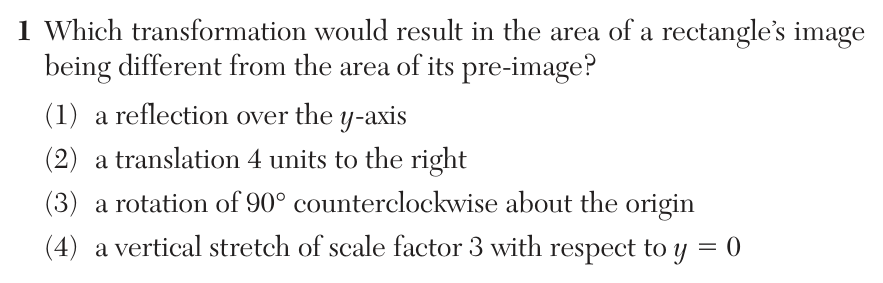
Worked solution for question 1
- A stretch maps (x, y) to (x, 3y), multiplying area by 3.
- Reflection, translation and rotation preserve distances and area.
Answer choice 4Vertical stretch by scale factor 3 about y = 0
Q2 Triangle midsegment
D and E are midpoints of CA and CB. Relate DE to AB.
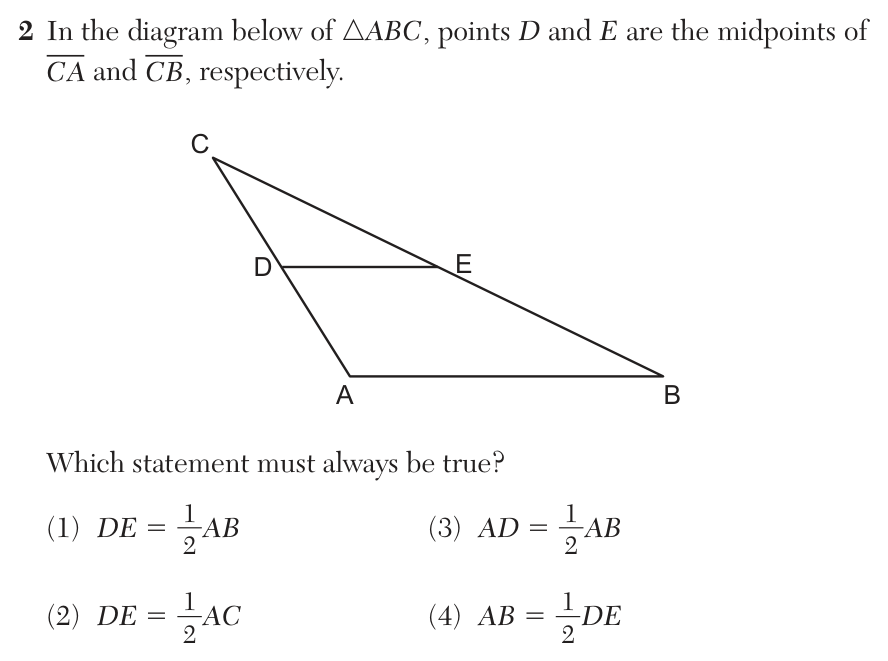
Worked solution for question 2
- CD/CA = CE/CB = 1/2, and the triangles share the included angle at C.
- SAS similarity gives the same ratio for the third pair of sides, DE and AB.
- The same similarity also gives ∠CDE = ∠CAB, explaining why the midsegment is parallel to AB.
Answer choice 1DE = AB/2
Q3 Find a hypotenuse
In right triangle RJM, ∠R = 90°, MR = 7.25 in and ∠M = 35°. Find MJ.
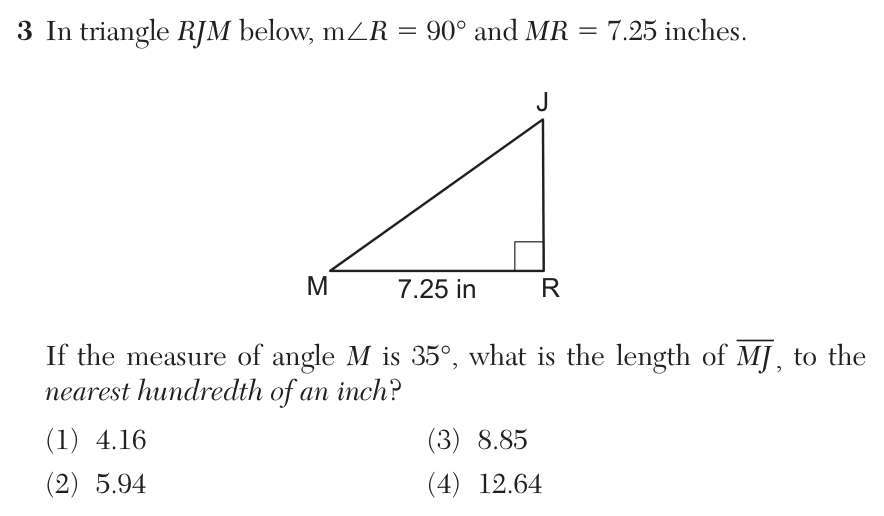
Worked solution for question 3
- Relative to M, MR is adjacent and MJ is the hypotenuse. Write cos 35° = 7.25/MJ.
- Solve MJ = 7.25/cos 35° and round to hundredths.
Answer choice 38.85 inches
Q4 Aquarium volume
A 35 × 17 × 25 cm tank has 3 cm of empty height. Find the water volume in liters.
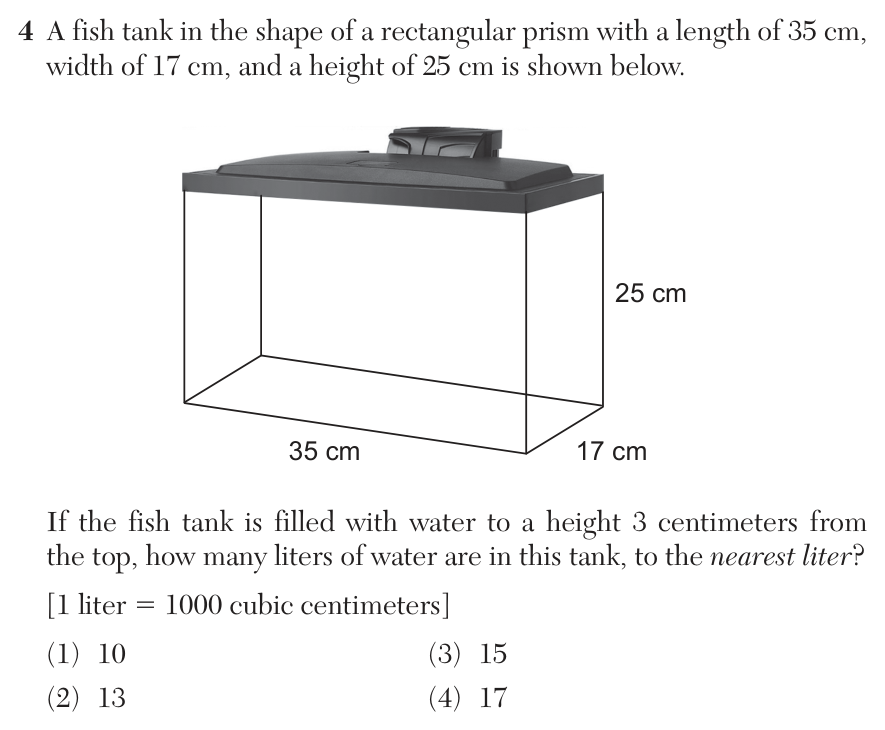
Worked solution for question 4
- The filled depth is 25 − 3 = 22 cm. Multiply 35 · 17 · 22 = 13,090 cm³.
- Divide by 1,000 cm³/L to get 13.09 L and round.
Answer choice 213 liters
Q5 Compose reflections
Reflect ACE across AE to AXE, then across XE to LXE. Track side AC.
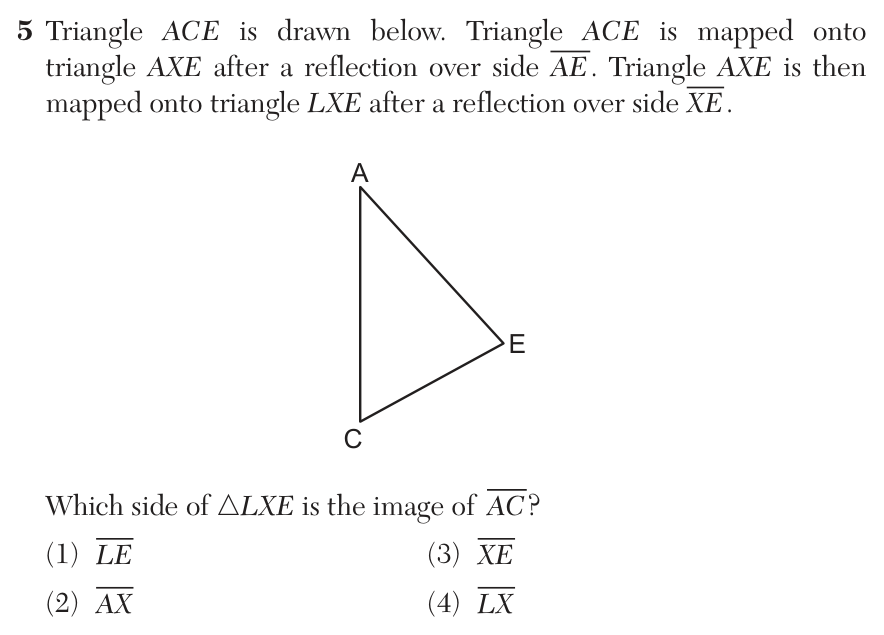
Worked solution for question 5
- The first reflection fixes A and maps C to X, giving AX.
- The second fixes X and maps A to L, so AX becomes LX.
Answer choice 4LX
Q6 Compare slopes
Classify the lines y = −x/2 + 2 and x + 2y = 8.
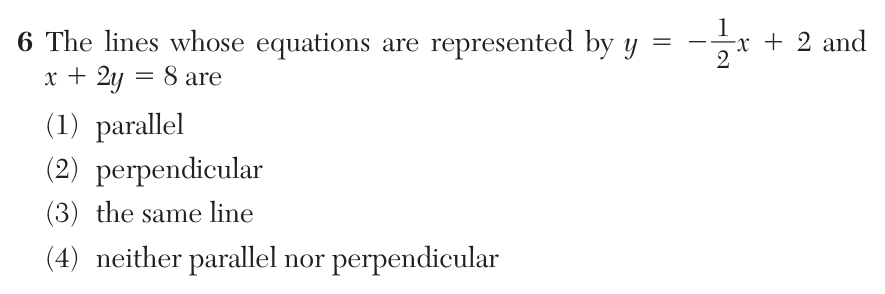
Worked solution for question 6
- Solve the second equation for y to get y = −x/2 + 4.
- The slopes match and the y-intercepts differ, giving distinct parallel lines.
Answer choice 1Parallel distinct lines
Q7 Cone of revolution
Rotate a right triangle with AB = 6 and BC = 8 around AB. Find the resulting volume.
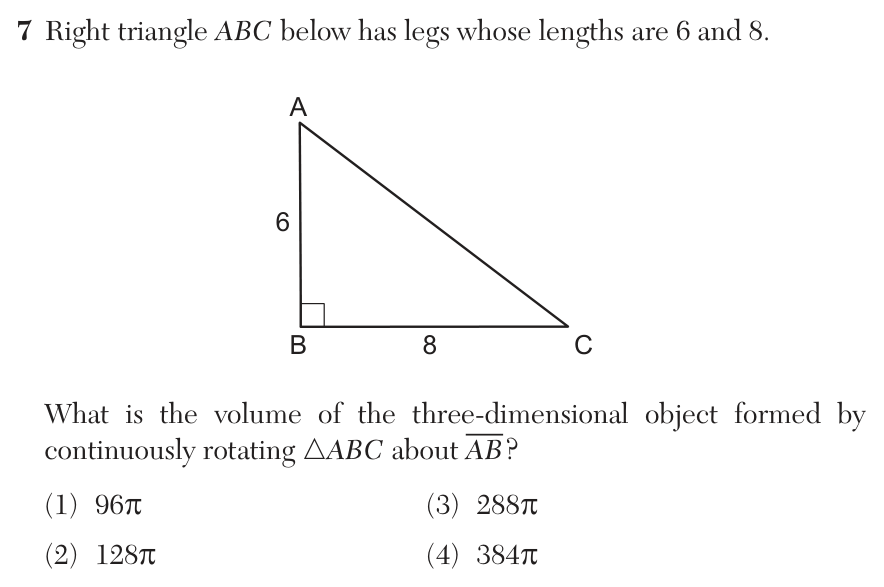
Worked solution for question 7
- AB is the axis, so h = 6. BC sweeps a disk of radius 8.
- Use V = πr²h/3 = π(64)(6)/3.
- The height of the cone stays on the rotation axis. The hypotenuse sweeps the sloping surface, so its length is unnecessary for finding the volume.
Answer choice 2128π cubic units
Q8 Perpendicular bisector theorem
CE is the perpendicular bisector of AB. Which sides must have equal lengths?
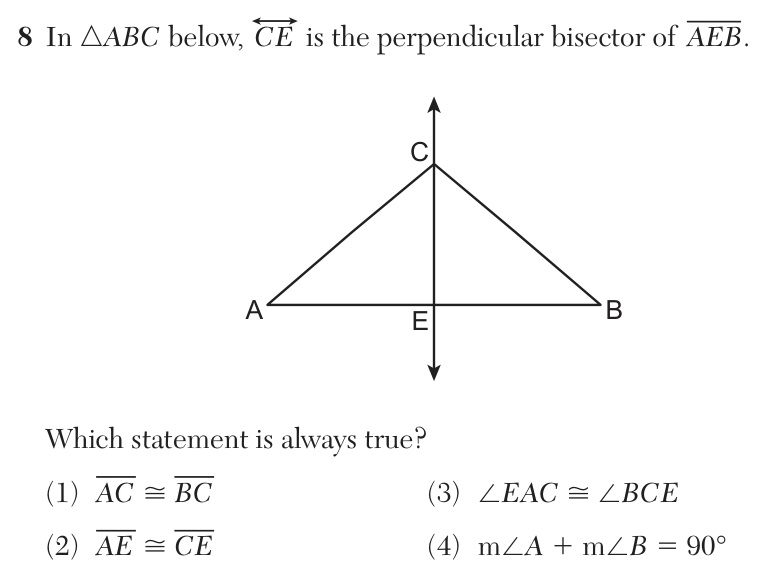
Worked solution for question 8
- E is the midpoint of AB and CE meets AB at a right angle.
- Point C is on the perpendicular bisector, so it is equidistant from A and B.
Answer choice 1AC ≅ BC
Q9 Trig with an altitude
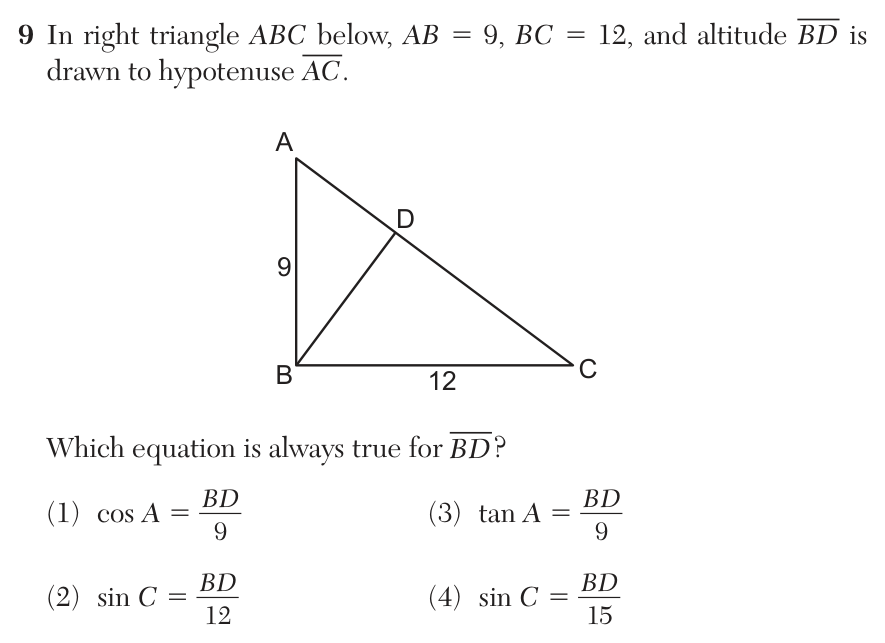
In right △ABC, AB = 9, BC = 12 and BD is the altitude to AC. Express sin C in terms of BD.
Worked solution for question 9
- Use the smaller right triangle BCD. The angle at C is unchanged because D is on AC.
- BD is opposite C and BC is the hypotenuse, so their ratio is the sine.
- Use the hypotenuse of the triangle that actually contains BD as a leg. The whole triangle’s hypotenuse is AC, but BD and C are used together in the smaller triangle BCD.
Answer choice 2sin C = BD/12
Q10 Rotational symmetry
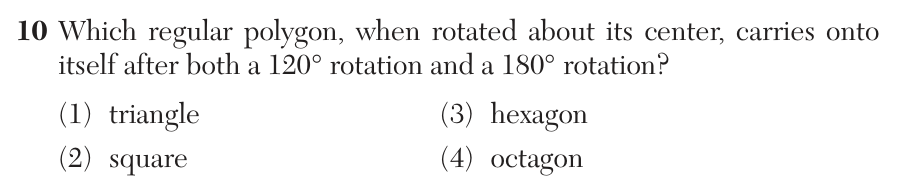
Choose a regular polygon with both 120° and 180° rotational symmetry.
Worked solution for question 10
- Each basic turn is 360° divided by the number of sides.
- For a hexagon the basic turn is 60°. Two turns make 120° and three make 180°.
Answer choice 3Regular hexagon
Q11 Divide a segment
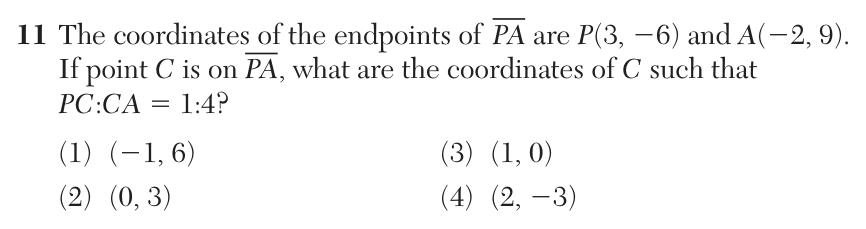
Find C one fifth of the way from P(3, −6) to A(−2, 9).
Worked solution for question 11
- The ratio 1:4 uses five total parts. The full displacement is (−5, 15).
- One fifth is (−1, 3). Add it to the starting point P.
Answer choice 4C(2, −3)
Q12 Dilation center and scale
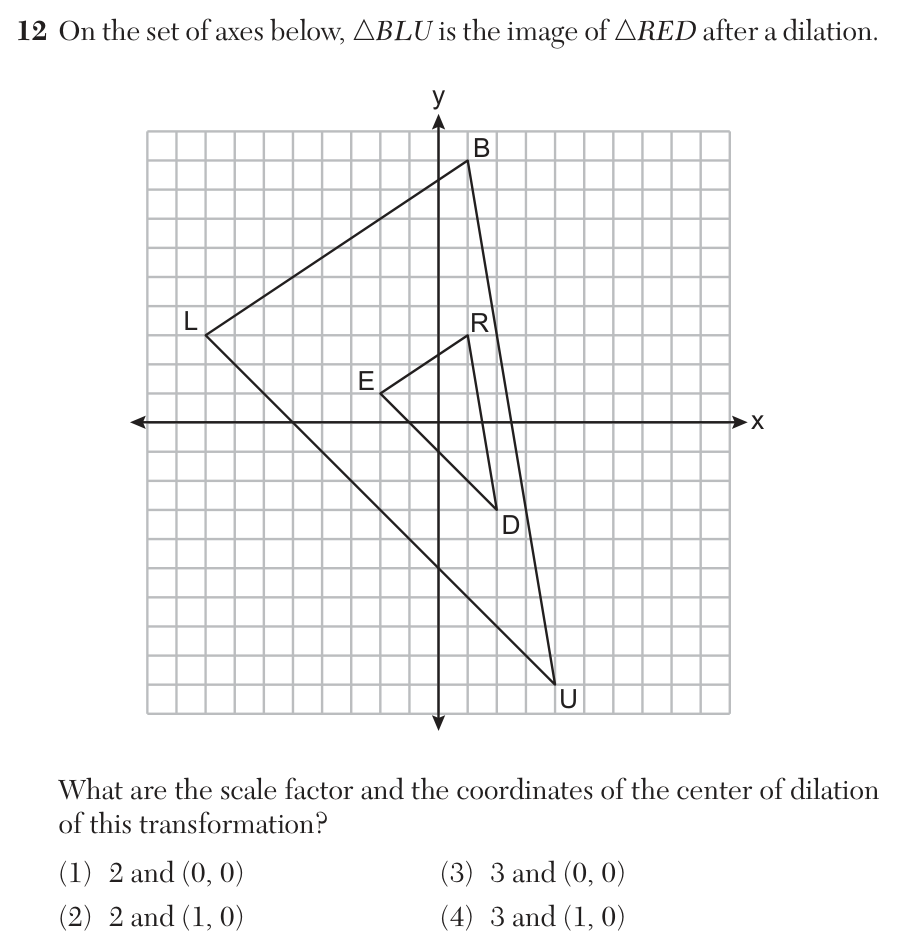
On the diagram, R(1, 3) maps to B(1, 9) and E(−2, 1) maps to L(−8, 3). Find the dilation.
Worked solution for question 12
- From (1, 0), R and B are vertical displacements of 3 and 9, a factor of 3.
- For E, the displacement is (−3, 1). Tripling gives (−9, 3), which ends at L.
- The line through R and B fixes the center’s x-coordinate at 1. The other corresponding pairs meet that line at (1, 0), and distances from that point triple.
Answer choice 4Scale 3 about (1, 0)
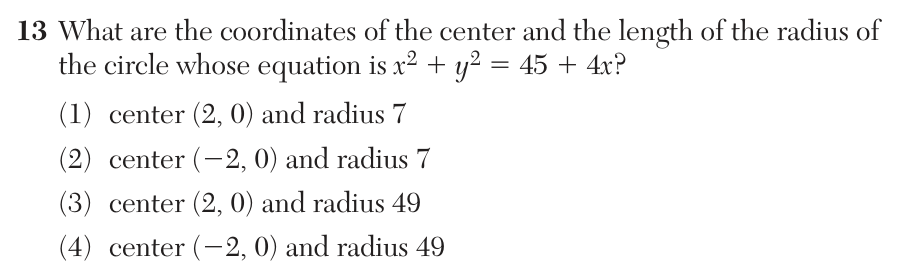
Q13 Circle equation
Find the center and radius of x² + y² = 45 + 4x.
Worked solution for question 13
- Rearrange to x² − 4x + y² = 45. Add 4 to both sides.
- This gives (x − 2)² + y² = 49. The radius is √49.
Answer choice 1Center (2, 0), radius 7
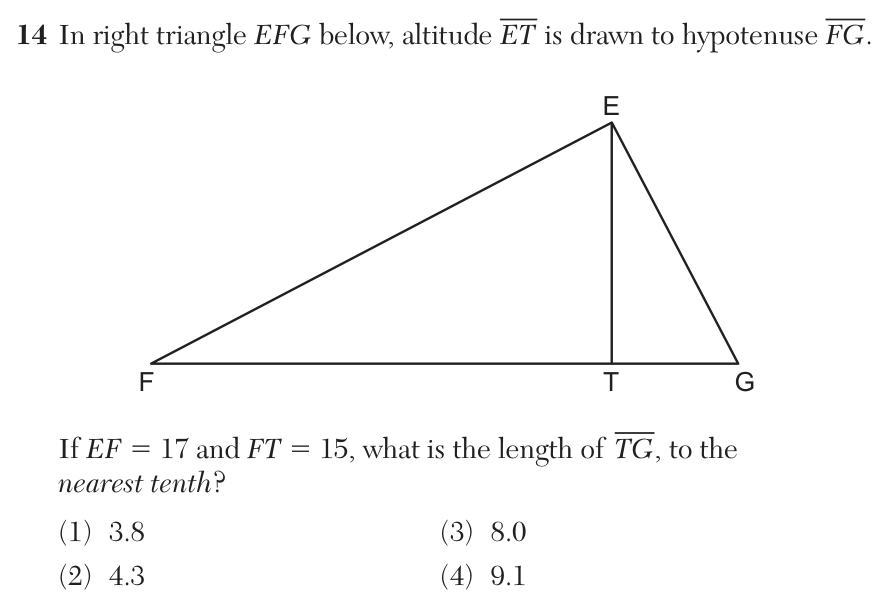
Q14 Hypotenuse projection
Altitude ET meets hypotenuse FG at T. Given EF = 17 and FT = 15, find TG.
Worked solution for question 14
- The leg theorem from similar triangles gives EF² = FT · FG.
- Then FG = 289/15. Subtract FT = 15 to get TG = 64/15 ≈ 4.27.
Answer choice 24.3 units
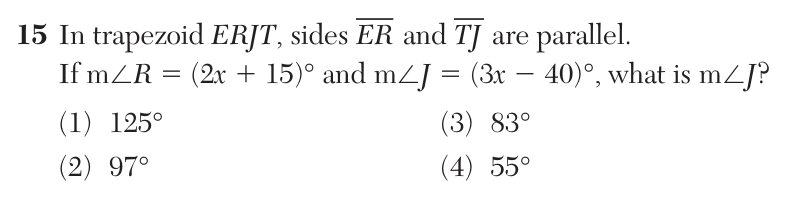
Q15 Trapezoid angles
In ERJT, ER ∥ TJ, ∠R = 2x + 15 and ∠J = 3x − 40. Find ∠J.
Worked solution for question 15
- The two angles are consecutive interior angles along transversal RJ. Their sum is 180°.
- Solve 5x − 25 = 180 to get x = 41. Then 3(41) − 40 = 83.
- The angle at R becomes 97°. Checking 97° + 83° = 180° verifies the pair expected along the transversal.
Answer choice 383°
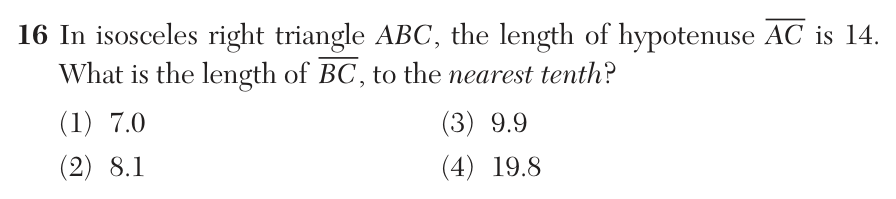
Q16 Isosceles right triangle
Find a leg of a 45°–45°–90° triangle with hypotenuse 14.
Worked solution for question 16
- Let each leg be s. The Pythagorean theorem gives 2s² = 14².
- Take the positive root, s = 14/√2 ≈ 9.90.
Answer choice 39.9 units
Q17 Tangent and secant
From S, AS is tangent and SLE is secant with SL = 8 and LE = 10. Find AS.
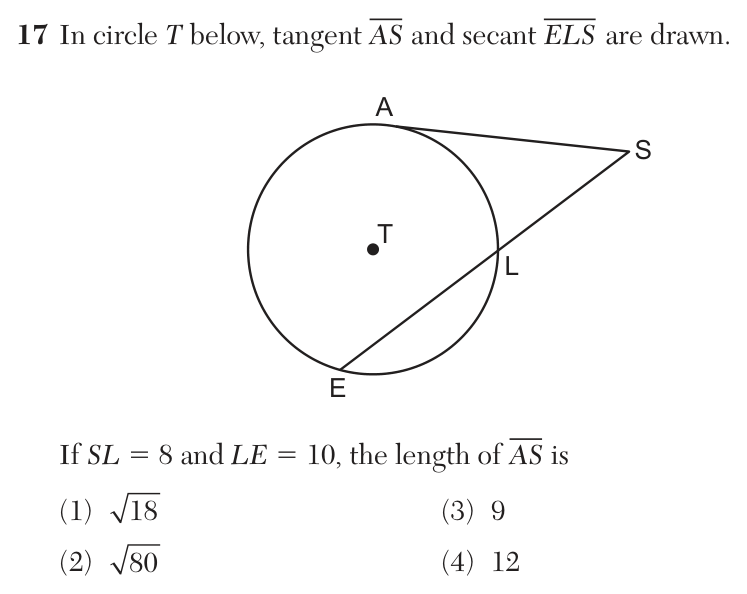
Worked solution for question 17
- The whole secant measures SE = 8 + 10 = 18.
- Power of a point gives AS² = SL · SE = 8 · 18 = 144. Use the positive root.
- Use the entire secant, from S through L to E. Multiplying just the outside piece by the inside piece would give 80, which omits part of the required length.
Answer choice 412 units
Q18 Rhombus diagonals
Which angle condition on the diagonals of parallelogram MERT guarantees a rhombus?
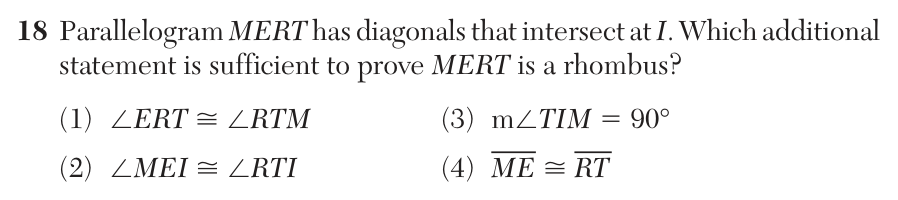
Worked solution for question 18
- I is the intersection of both diagonals. This condition makes them perpendicular.
- Diagonals of a parallelogram already bisect each other. Their perpendicular halves form congruent right triangles, so adjacent sides match.
Answer choice 3∠TIM = 90°
Q19 Complementary acute angles
Solve sin(3x)° = cos(x + 10)° for the smallest angle of the right triangle.
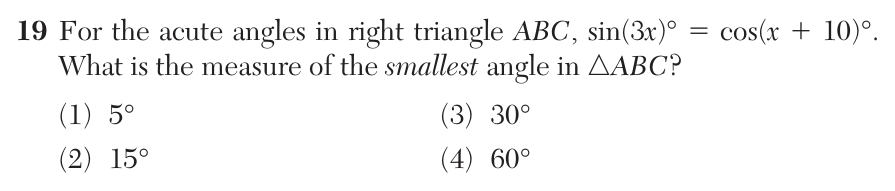
Worked solution for question 19
- The arguments are complementary, so 3x + x + 10 = 90 and x = 20.
- The acute angles are 60° and 30°. Compare those with the right angle.
Answer choice 330°
Q20 Prism cross section
Which listed polygon cannot be a plane section of a rectangular prism?
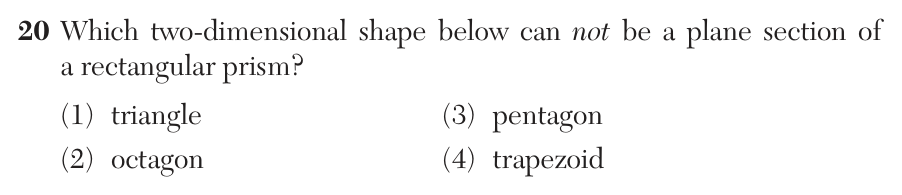
Worked solution for question 20
- A plane can cut each of the six prism faces along at most one edge of the section.
- The section has at most six edges, whereas an octagon needs eight.
Answer choice 2Octagon
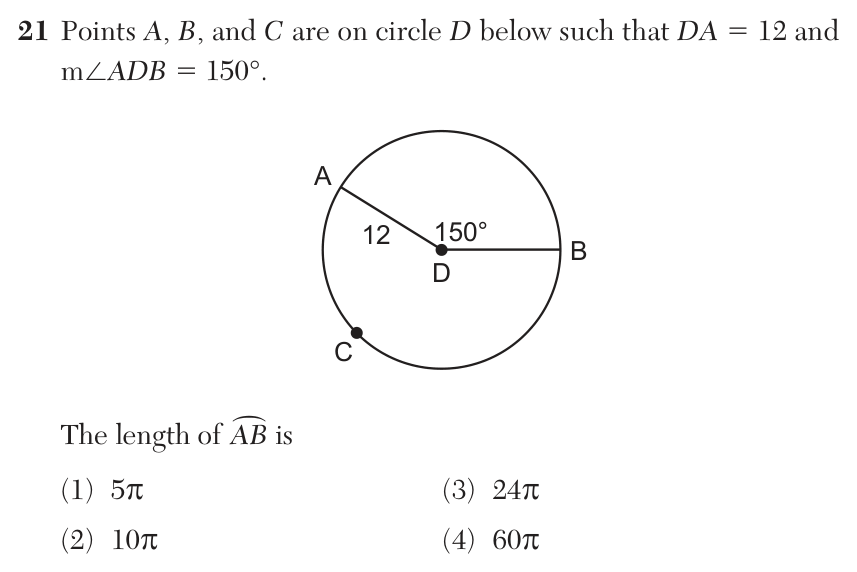
Q21 Length of an arc
Circle D has radius 12 and minor central angle ADB = 150°. Find the minor arc length.
Worked solution for question 21
- Use the fraction 150/360 of the circumference.
- Multiply 150/360 by 2π(12) to get 10π.
- The central angle selects five twelfths of the circle. Multiplying that fraction by the full circumference of 24π yields the length of the shorter arc.
Answer choice 210π units
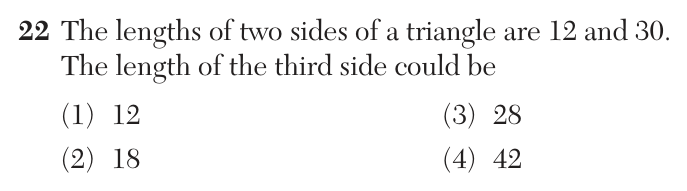
Q22 Triangle inequality
Choose a possible third side when two sides measure 12 and 30.
Worked solution for question 22
- The third side s must lie strictly between 30 − 12 = 18 and 30 + 12 = 42.
- Of the available lengths, 28 is the only one inside that interval.
Answer choice 328 units
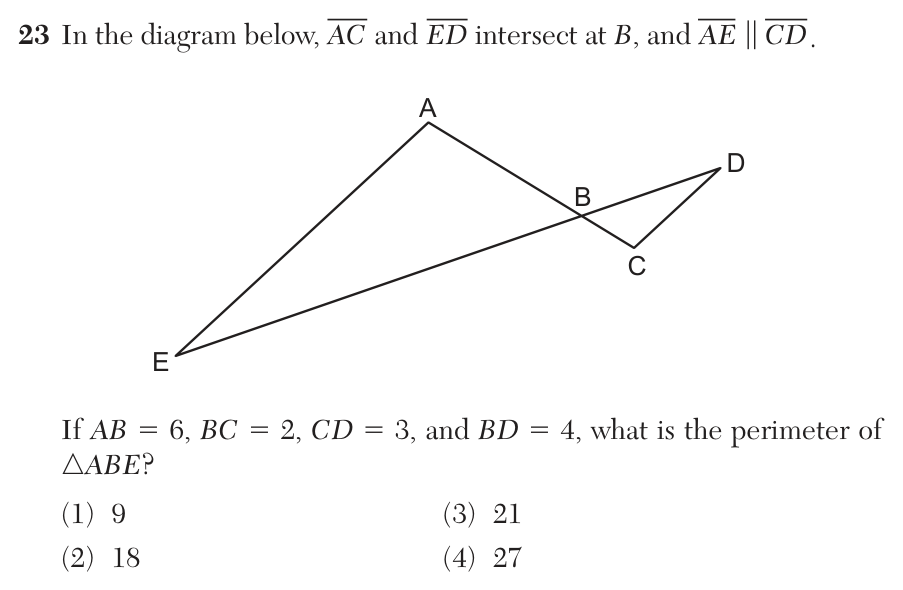
Q23 Similar-triangle perimeter
With AE ∥ CD and crossing diagonals at B, AB = 6, BC = 2, CD = 3 and BD = 4. Find the perimeter of ABE.
Worked solution for question 23
- Parallel and vertical angles give △ABE ∼ △CBD. The scale from CBD to ABE is AB/CB = 3.
- So AE = 3(3) = 9 and BE = 3(4) = 12. Sum 6 + 9 + 12.
Answer choice 427 units
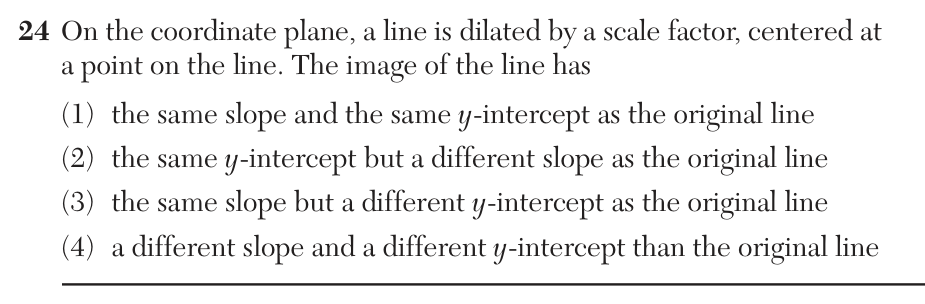
Q24 Dilation centered on a line
What happens to a line when its dilation center lies on it?
Worked solution for question 24
- Each point moves along the line joining it to the center. Here that line is the original line for every other point.
- A nonzero dilation gives the whole line back, preserving slope and intercept wherever defined.
Answer choice 1The image is the same line.
Part II Short response
Question indexQ25 Map congruent triangles
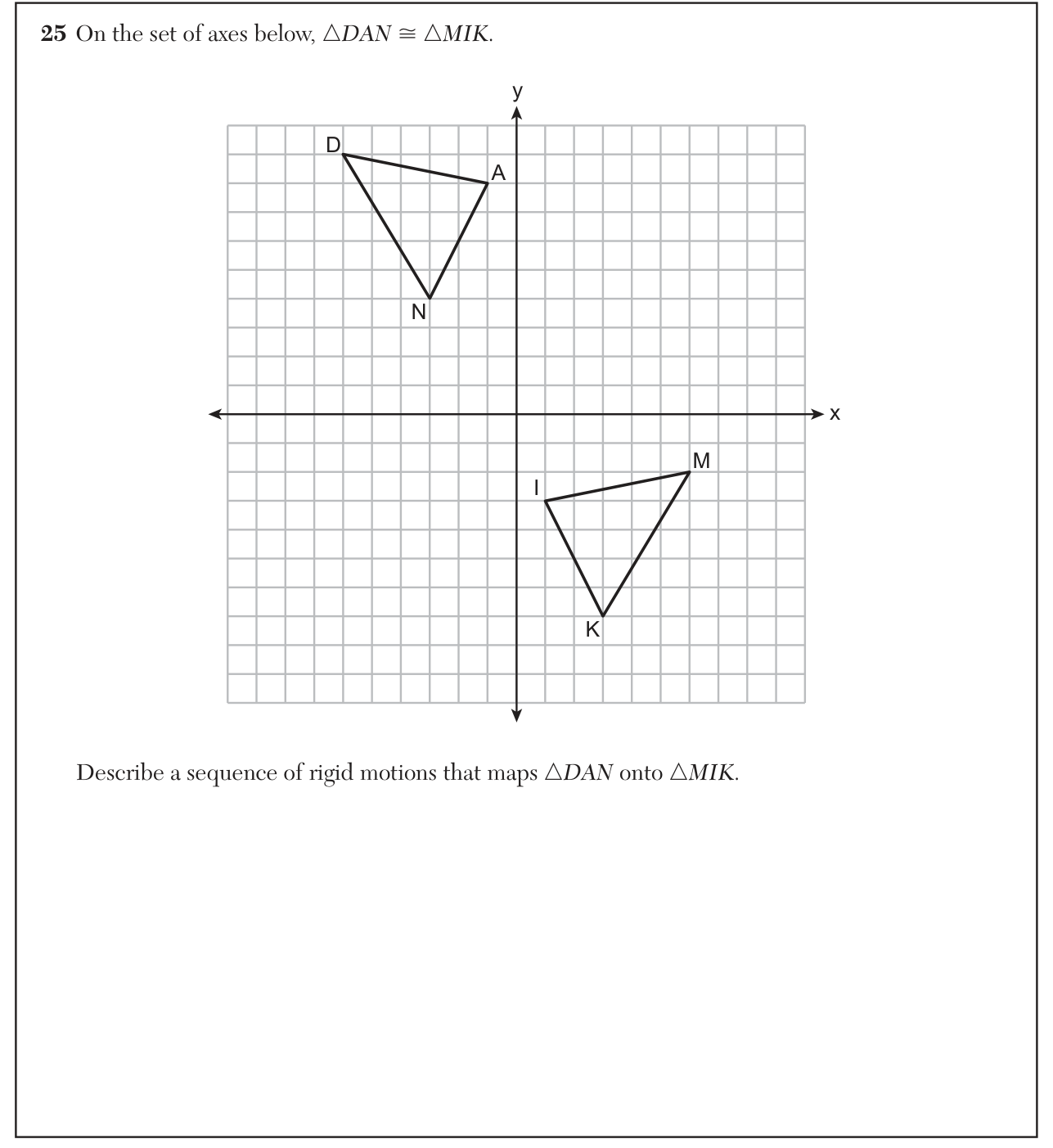
Map D(−6, 9), A(−1, 8), N(−3, 4) to M(6, −2), I(1, −3), K(3, −7).
Worked solution for question 25
- First apply (x, y) ↦ (−x, y). This yields (6, 9), (1, 8), (3, 4).
- Subtract 11 from each y-coordinate to reach M, I and K in order.
- After reflecting, compare a corresponding pair: (6, 9) becomes (6, −2), so the vertical move is −11. Applying the same move to the other vertices verifies the sequence.
Final answerReflect across the y-axis, then translate down 11 units.
Q26 Parallelogram angle
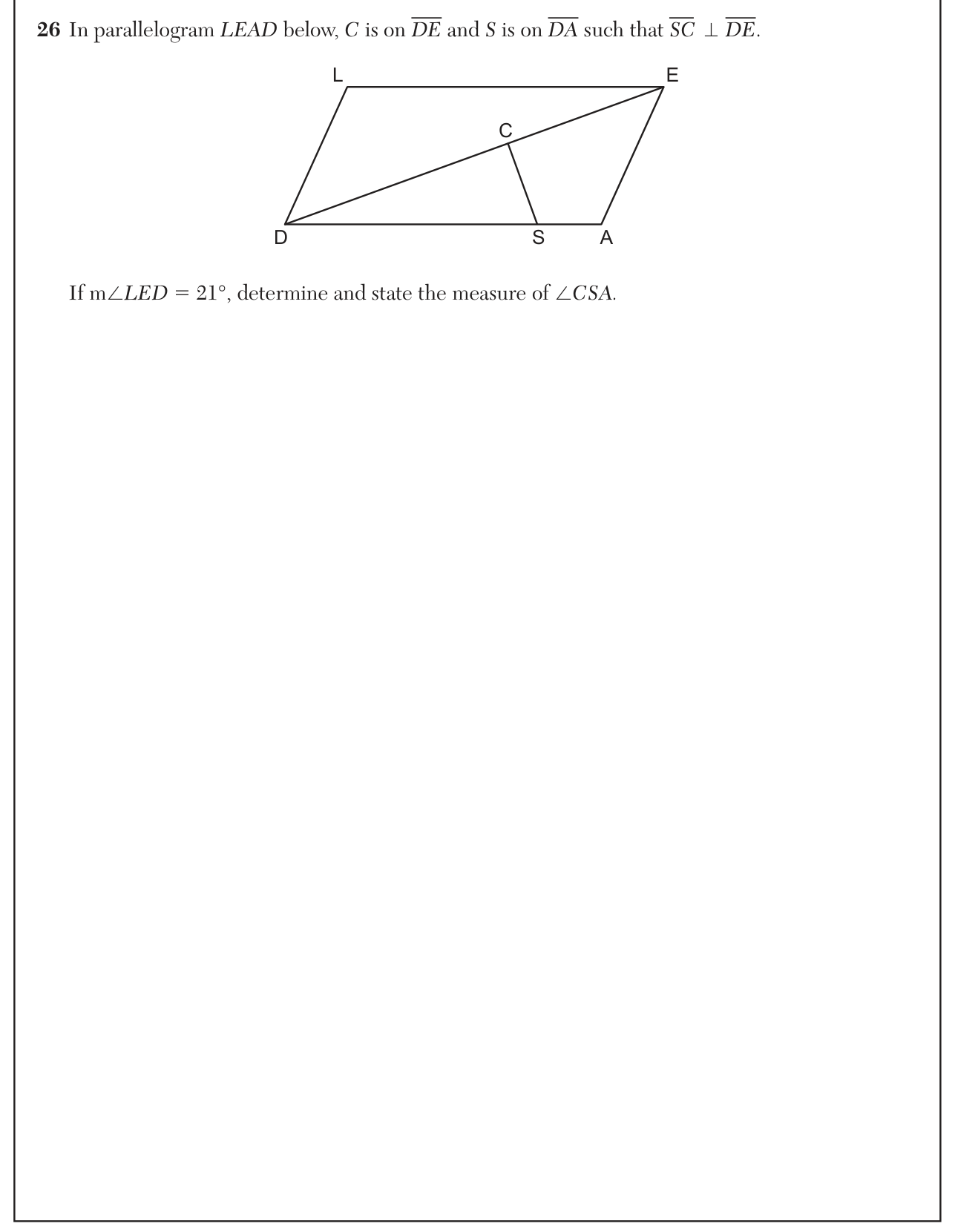
In LEAD, S lies on DA, C lies on DE, SC ⟂ DE, and ∠LED = 21°. Find ∠CSA.
Worked solution for question 26
- Since LE ∥ DA, the alternate interior angle CDS is 21°. In right triangle CDS, ∠CSD = 180° − 90° − 21° = 69°.
- Rays SD and SA are opposite. Thus ∠CSA = 180° − 69°.
Final answer111°
Q27 Trunk weight
A cylindrical section has diameter 1.5 ft, height 8 ft and weight density 25 lb/ft³. Find its weight.
Worked solution for question 27
- The radius is 0.75 ft. The volume is π(0.75)²(8) = 4.5π ft³.
- Multiply by 25 to get 112.5π ≈ 353.43 lb, then round.
Final answer353 pounds
Q28 Converse of side-splitter theorem
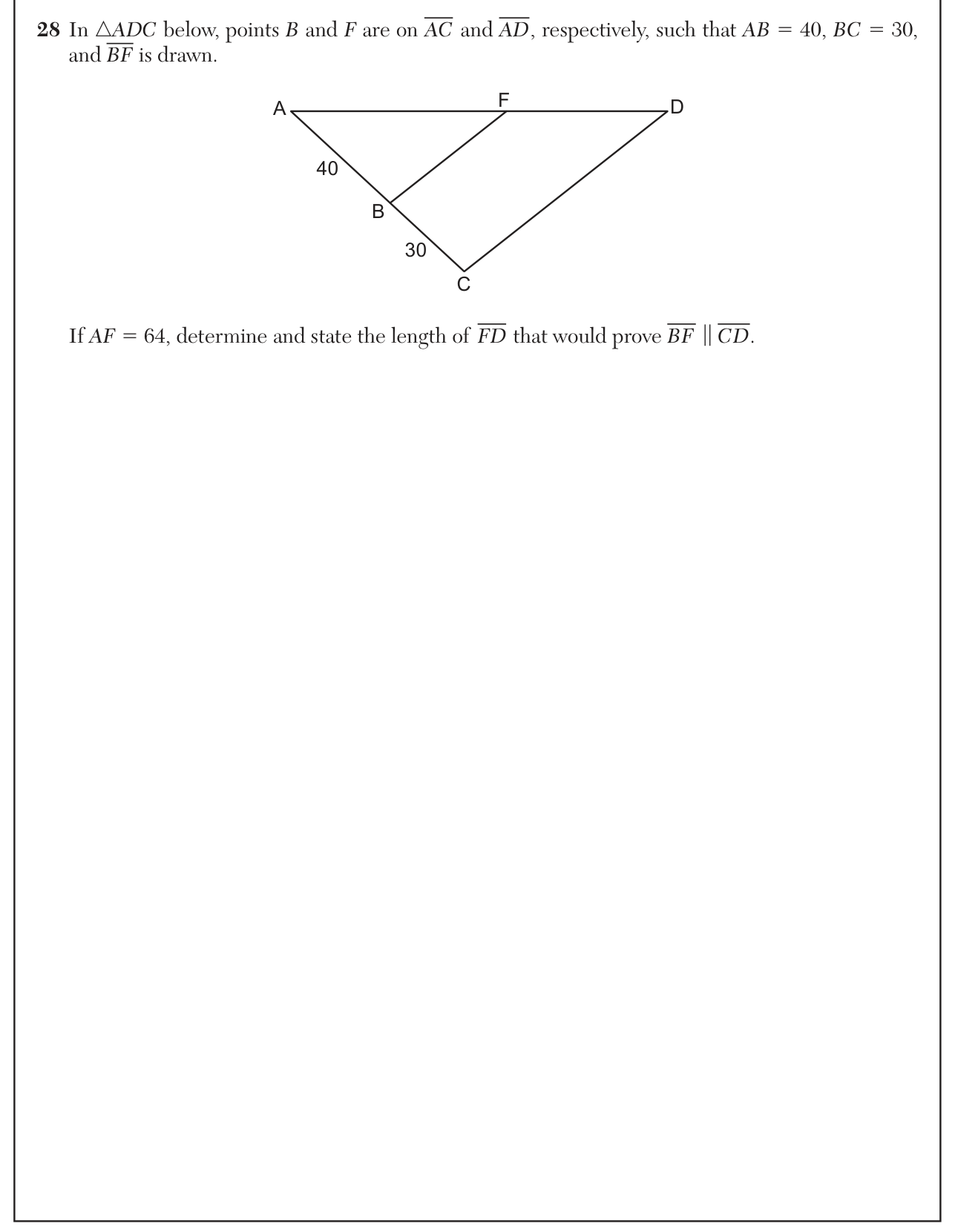
In ADC, B lies on AC and F lies on AD. With AB = 40, BC = 30 and AF = 64, find FD so BF ∥ CD.
Worked solution for question 28
- Matching the partitions requires AF/FD = AB/BC = 40/30.
- Solve 64/FD = 4/3 to obtain FD = 48. The proportional cuts give the parallel segment by the converse theorem.
Final answer48 units
Q29 Area with an included angle
Find the area of CLM if CL = 8 and CM = 15 enclose 33°.
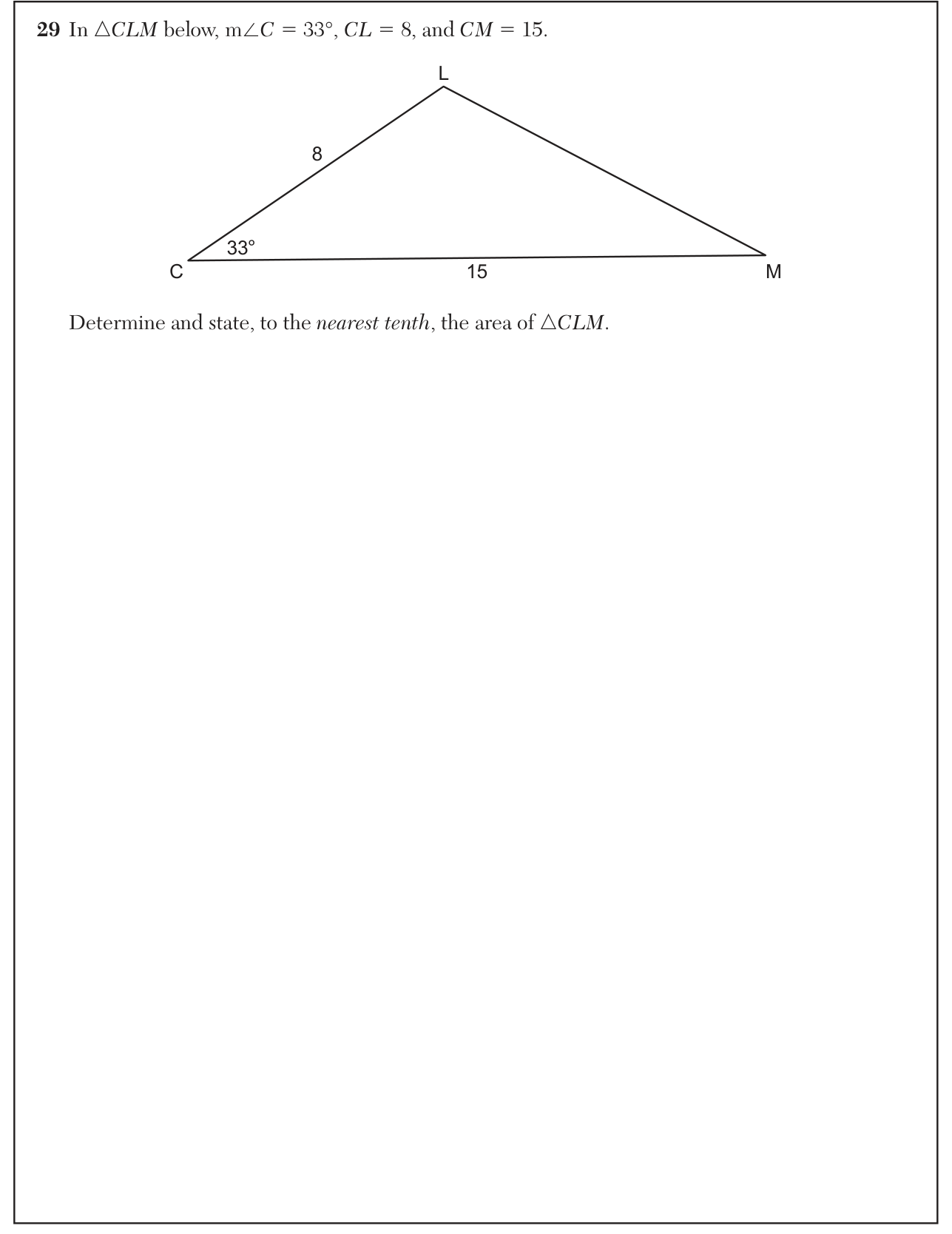
Worked solution for question 29
- Use one half the product of the two sides times the sine of their included angle.
- Evaluate (1/2)(8)(15) sin 33° ≈ 32.678 and round.
Final answer32.7 square units
Q30 Construct an angle bisector
Use a compass and straightedge to bisect ∠ABC.
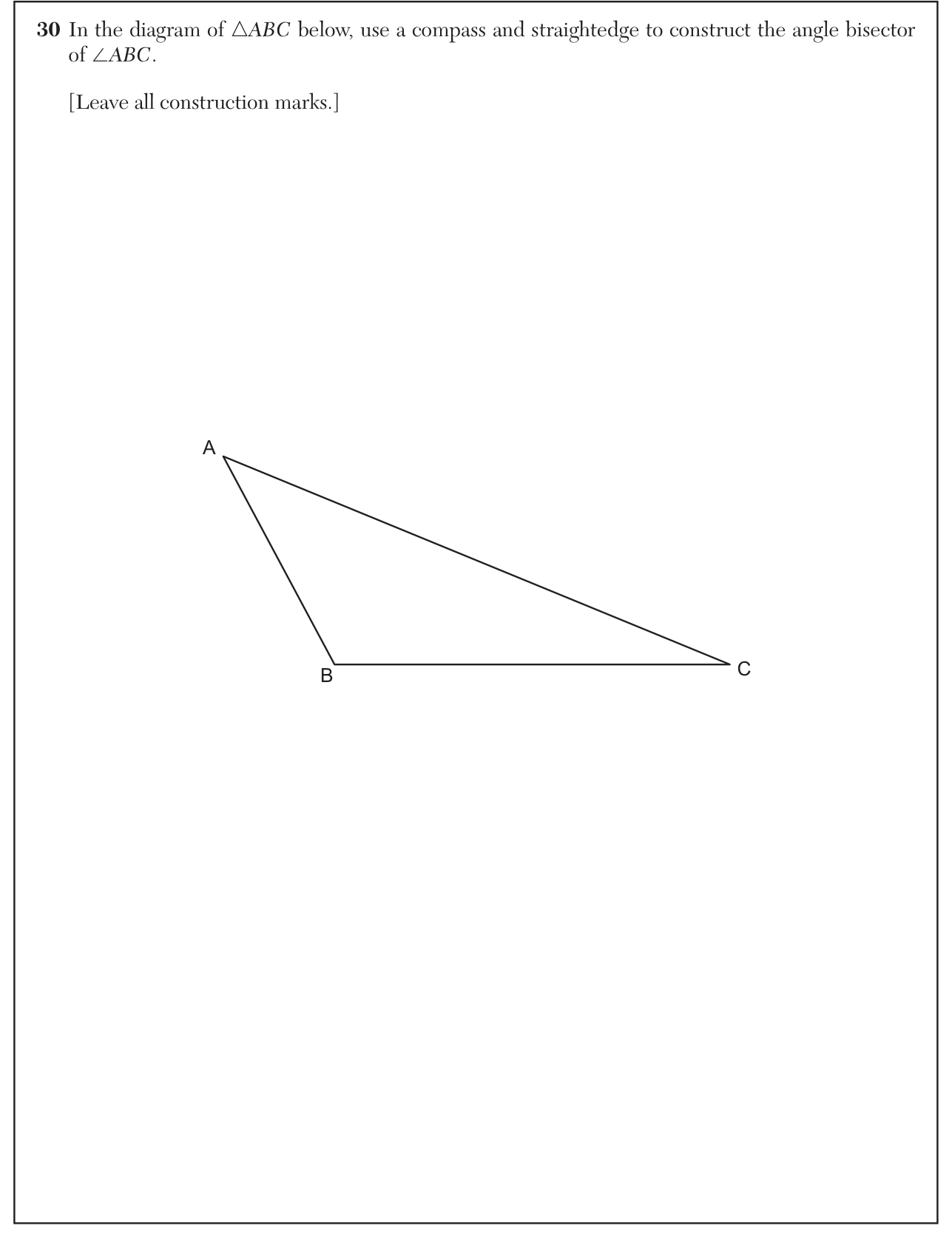
Worked solution for question 30
- Draw an arc centered at B to cross BA and BC at points P and Q.
- Draw equal-radius arcs centered at P and Q so they intersect inside the angle at R.
- Draw ray BR and leave the arcs visible. Equal radii and shared BR make △BPR and △BQR congruent by SSS.
- The compass opening from P and Q must be the same, and the two arcs must actually intersect. Leaving the marks shows why the bisecting ray is equally placed between BA and BC.
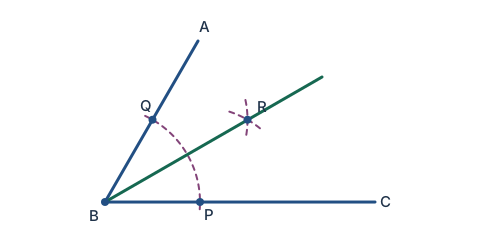
Final answerRay from B through the interior arc intersection
Q31 Rectangle proof
Parallelogram GRAM has diagonals meeting at P, RP = 12, and GA = 24. Prove it is a rectangle.
Worked solution for question 31
- Diagonals of a parallelogram bisect each other, so RP = PM and RM = 24.
- That equals GA. A parallelogram with congruent diagonals is a rectangle.
Final answerThe diagonals RM and GA are congruent.
Part III Extended response
Question indexQ32 Building height
The horizontal distance to a building is 80 ft. The top is at 36° elevation and the base at 18° depression. Find its height.
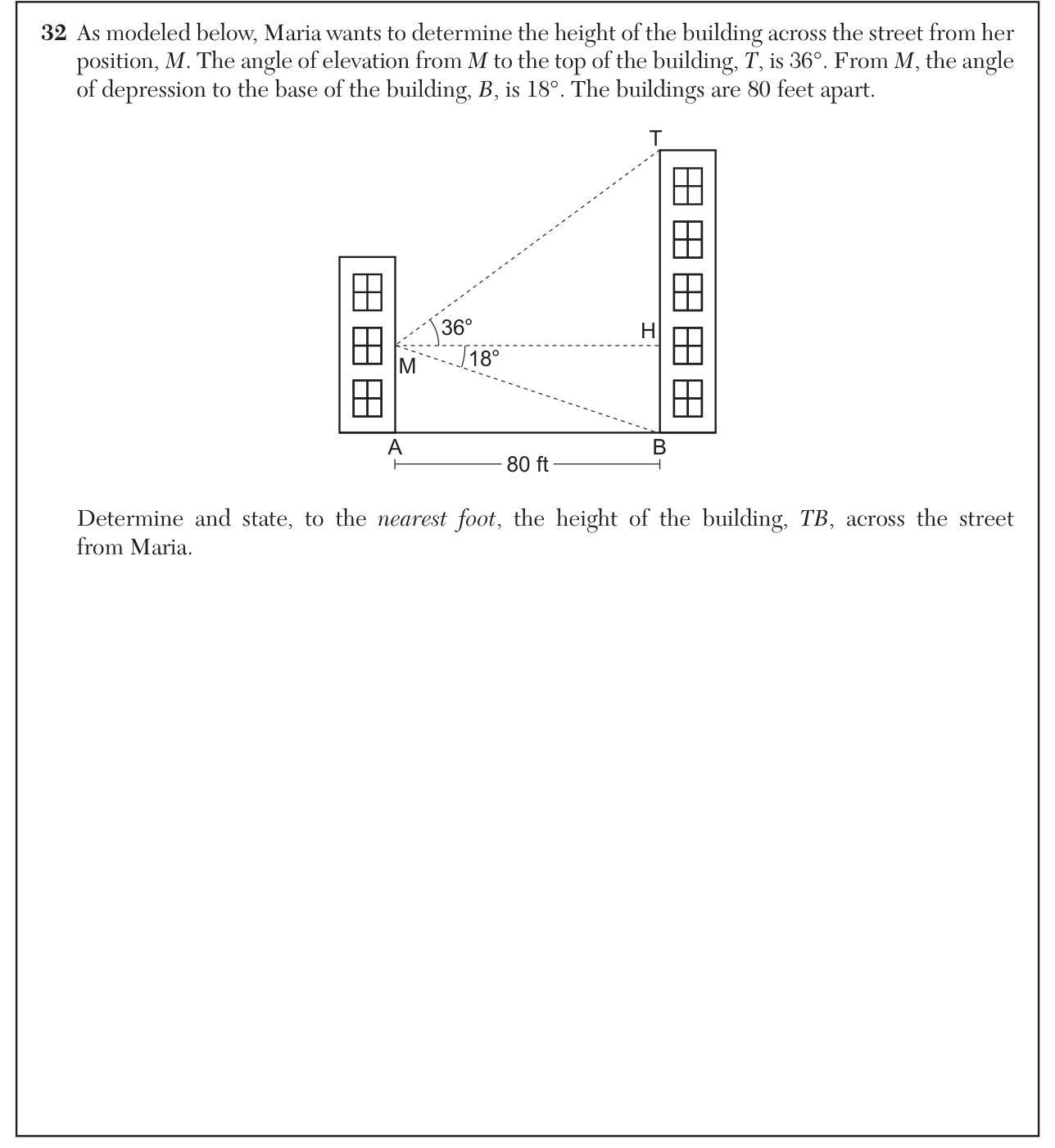
Worked solution for question 32
- The distance from eye level up to the top is 80 tan 36°. The distance down to the base is 80 tan 18°.
- Add the positive vertical distances to obtain about 84.12 ft and round once.
Final answer84 feet
Q33 Clay pyramid count
Each square pyramid has base side 12 cm, height 8 cm and clay density 1.25 g/cm³. How many can 15 kg make?
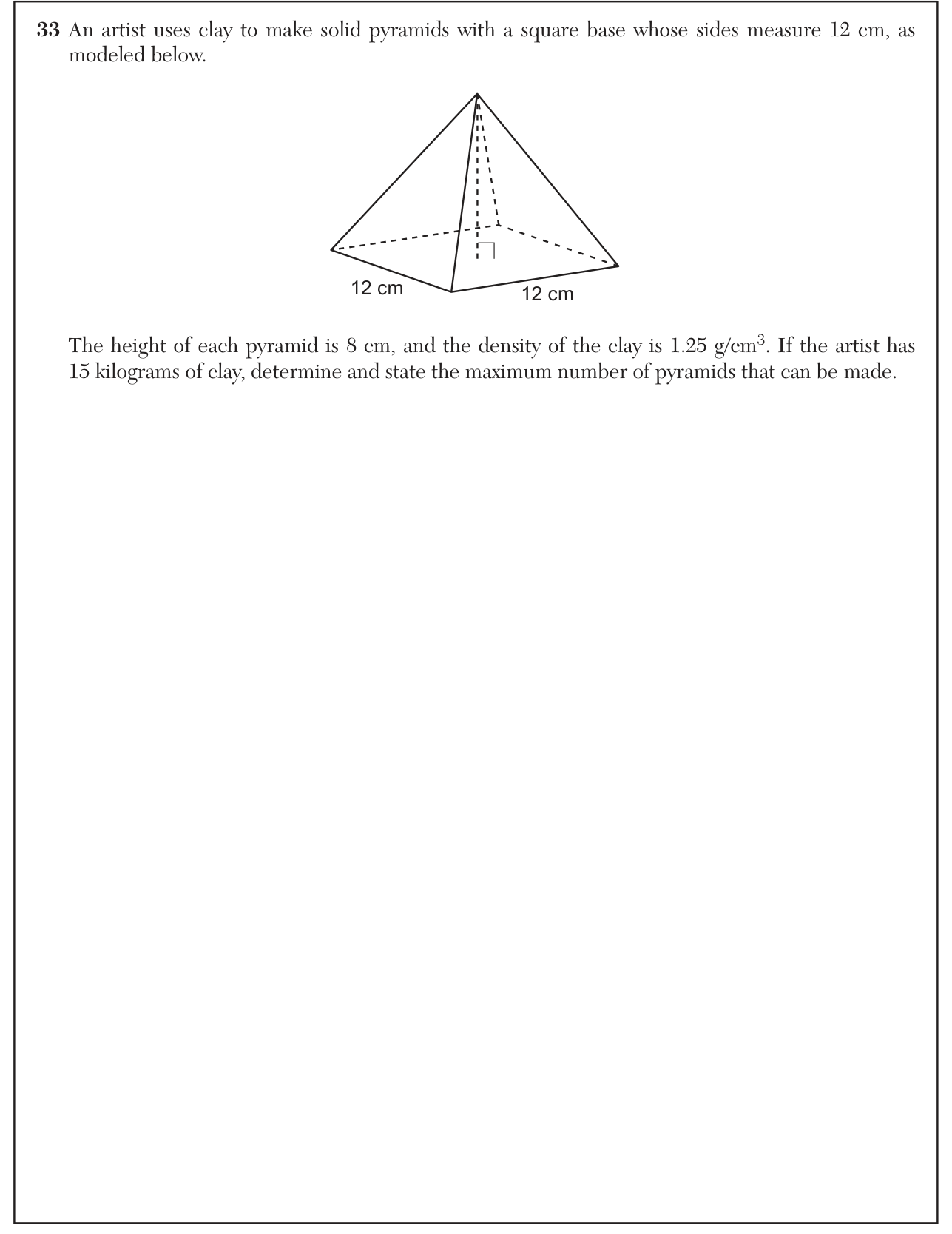
Worked solution for question 33
- One volume is (12²)(8)/3 = 384 cm³, giving mass 480 g.
- Convert 15 kg to 15,000 g. The quotient 15,000/480 = 31.25 allows 31 whole pyramids.
Final answer31 complete pyramids
Q34 Prove proportional heights
AB = AC. D lies on AB and H on AC, with DE and HF perpendicular to BC. Prove DE/BE = HF/CF.
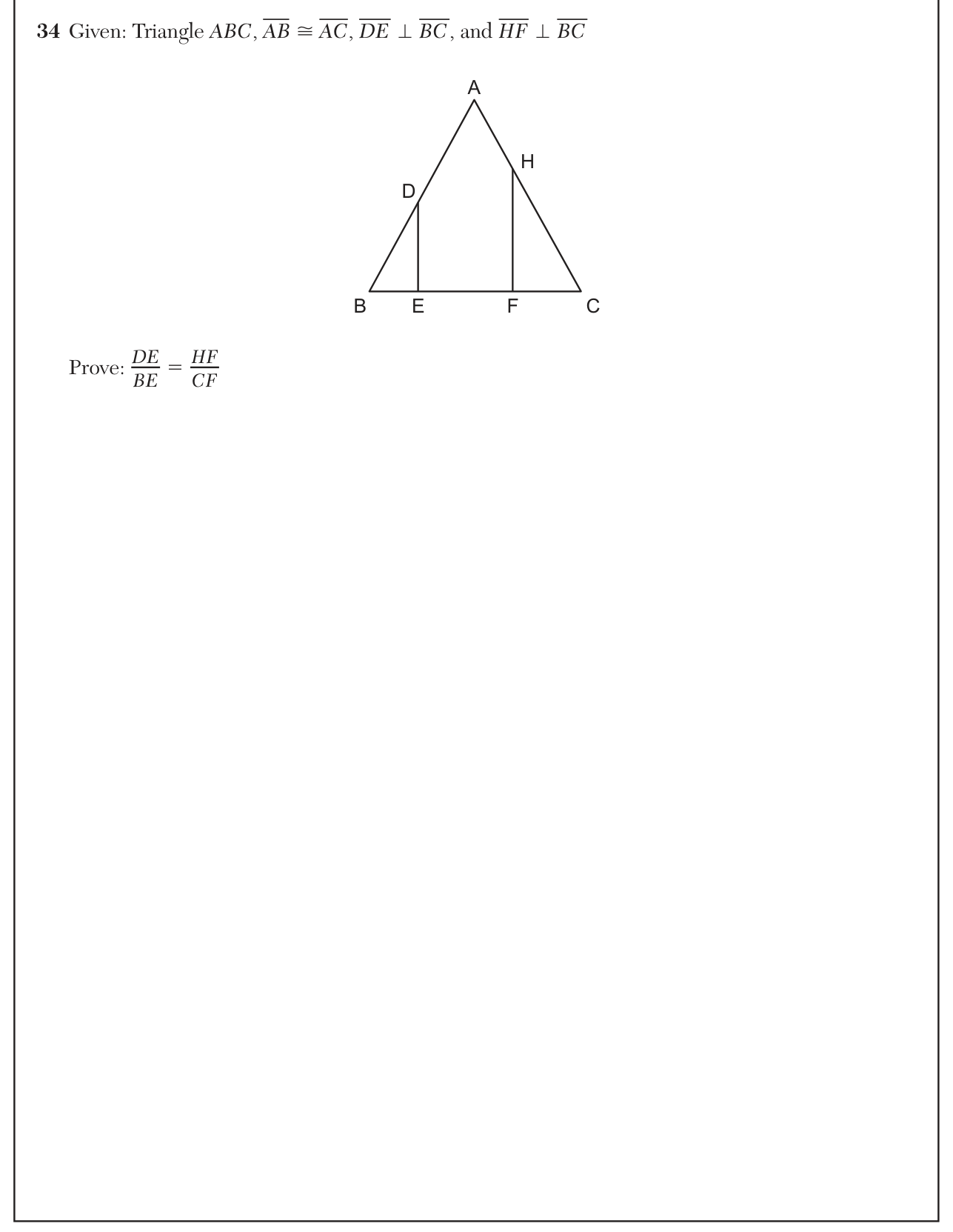
Worked solution for question 34
- The base angles ABC and ACB are congruent because AB = AC. They are the angles DBE and HCF in the smaller right triangles.
- The right angles at E and F also agree, so △BED ∼ △CFH by AA.
- Corresponding legs give DE/BE = HF/CF.
Final answerThe ratios are equal by AA similarity.
Part IV Long response
Question indexQ35 Coordinate parallelogram
Given A(−3, −1), B(−5, 2), C(−1, 8), complete ABCD, find midpoint E of BC and prove ABE is isosceles.
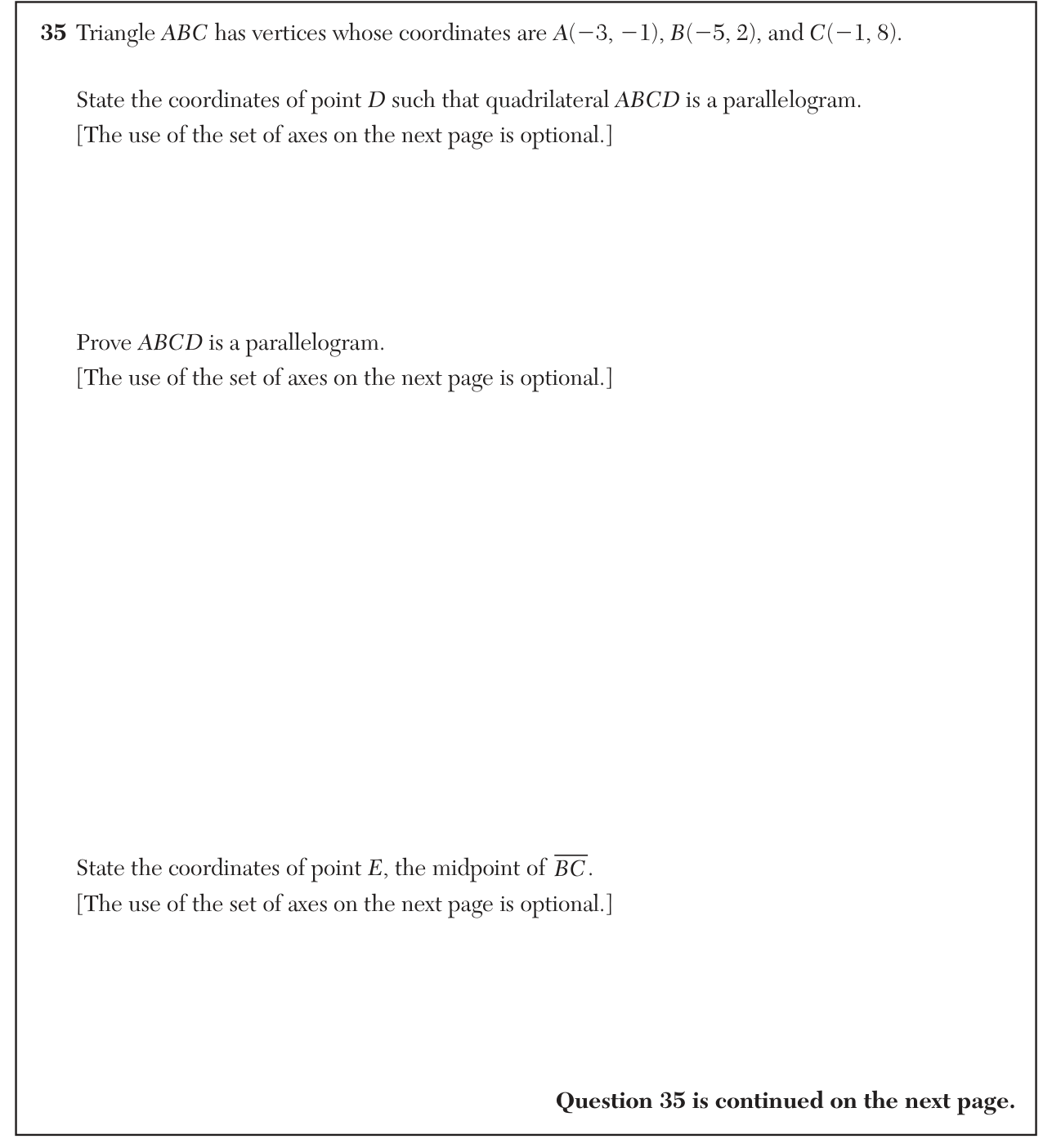
Worked solution for question 35
- Use D = A + (C − B) = (1, 5). The vectors AD and BC both equal (4, 6), while AB and DC both equal (−2, 3). Both opposite pairs are parallel.
- Average the B and C coordinates to get E(−3, 5).
- AB² = (−2)² + 3² = 13 and BE² = 2² + 3² = 13. Two equal sides prove △ABE is isosceles.
- To verify the other pair of opposite sides, compare vectors from D to C and A to B. Both are (−2, 3), which gives equal lengths and the same direction.
Final answerD(1, 5), E(−3, 5), and AB = BE = √13
From the New York State Education Department. June 2026 Geometry Regents Examination. Internet. Available from https://www.nysedregents.org/geometryre/626/geom-62026-exam.pdf. Accessed .