NEW YORK STATE REGENTS · GEOMETRY
January 2026 Geometry Regents Past Paper & Solutions
Work through dilations, triangle congruence and coordinate proofs with a question-by-question walkthrough of the exam.
- 35 worked questions
- 80 raw credits
- 4 exam parts
The question images and page numbers come from the regular-size English exam. OnlyPrepy wrote the summaries and worked solutions.
Quick answer key for Part I
Part I Multiple choice
Question indexQ1 Reflect a triangle
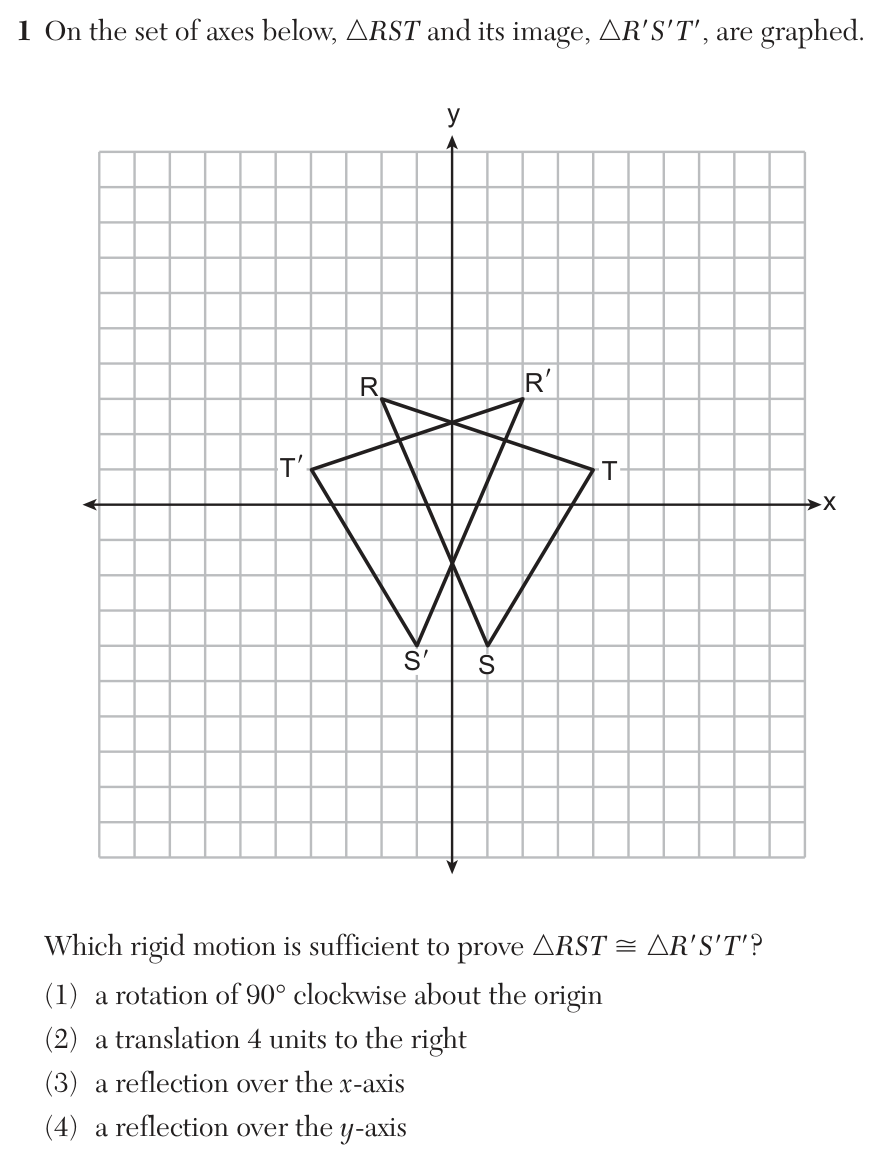
Identify the motion sending RST to its mirror image on the coordinate grid.
Worked solution for question 1
- Corresponding vertices are at the same heights and opposite horizontal offsets from the y-axis.
- The rule (x, y) ↦ (−x, y) sends all three points to their partners and preserves distances.
- A reflection across the x-axis would keep each x-coordinate and reverse its y-coordinate. The plotted pairs show the opposite pattern, which identifies the y-axis reflection.
Answer choice 4Reflection across the y-axis
Q2 Rotational symmetry
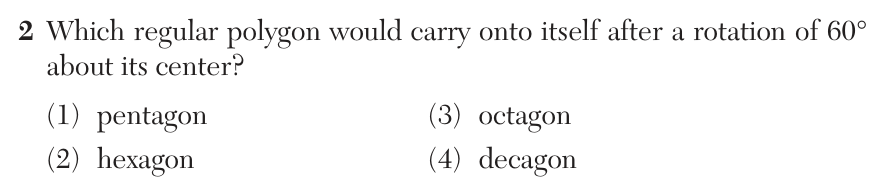
Which listed regular polygon maps onto itself after a 60° turn?
Worked solution for question 2
- The smallest positive turn of a regular n-gon is 360°/n.
- Six 60° turns make a complete turn, so the hexagon works. None of the other listed polygons has 60° as a multiple of its symmetry angle.
Answer choice 2Regular hexagon
Q3 Rotate a right triangle
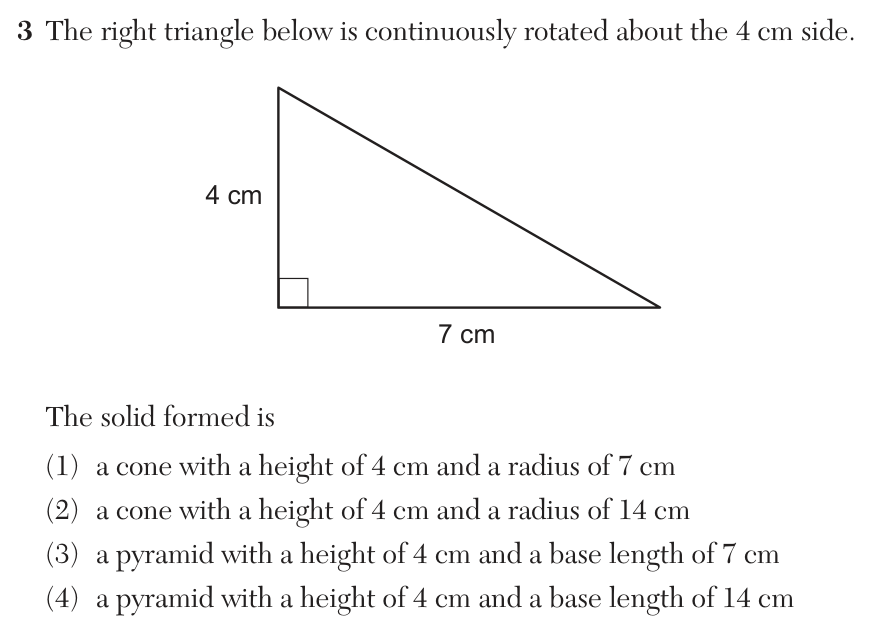
Rotate a right triangle with perpendicular legs 4 cm and 7 cm around its 4 cm leg.
Worked solution for question 3
- The axis leg stays fixed, setting the height.
- The perpendicular 7 cm leg sweeps a circular disk. Its outer endpoint is 7 cm from the axis, making that the radius.
Answer choice 1Cone with height 4 cm and radius 7 cm
Q4 Isosceles exterior angle
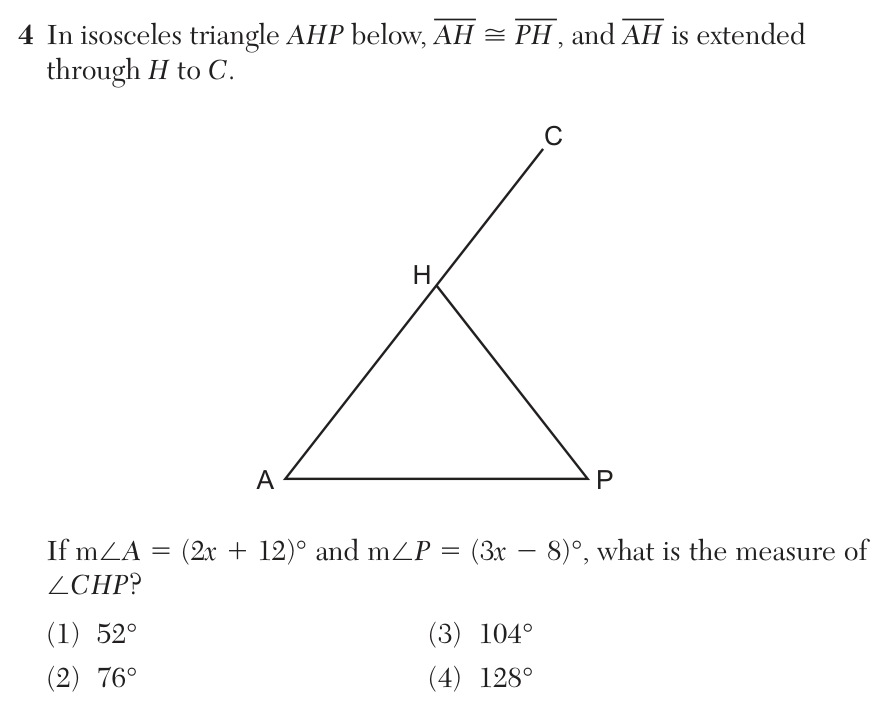
AH = PH, with base angles 2x + 12 and 3x − 8. Find the exterior angle CHP.
Worked solution for question 4
- The base angles opposite the equal sides are equal, so 2x + 12 = 3x − 8 and x = 20.
- Both base angles are 52°. The exterior angle is the sum of those two remote interior angles.
Answer choice 3104°
Q5 Center of a half-size dilation
Under scale 1/2, A(−2, 5) maps to X(0, 2). Locate the center.
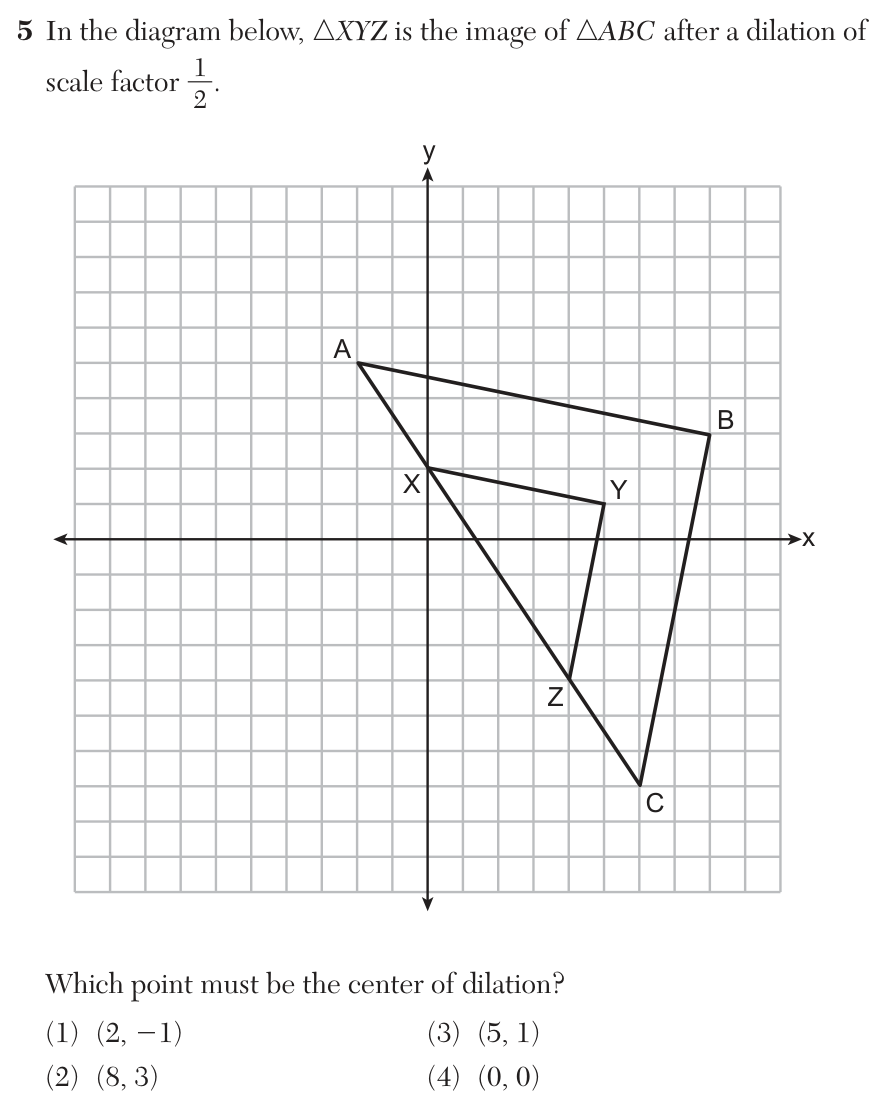
Worked solution for question 5
- With scale 1/2, X is the midpoint between the center and A.
- Continue from X by the displacement from A to X, namely (2, −3). This reaches (2, −1).
- Check with a second pair. The displacement from B(8, 3) to the center (2, −1) is (−6, −4). Half of it ends at Y(5, 1).
Answer choice 1(2, −1)
Q6 Complementary trig angles
Given cos(5x + 7)° = sin(3x + 3)° for acute angles, write the angle equation.
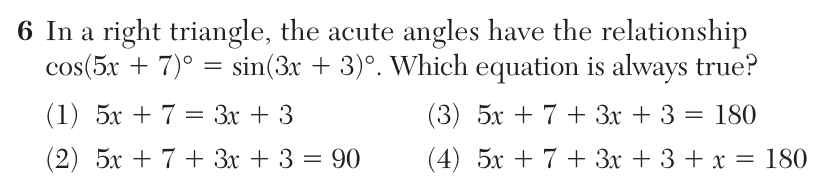
Worked solution for question 6
- For acute θ, cos θ = sin(90° − θ).
- Sine is one-to-one on acute angles, so 3x + 3 = 90 − (5x + 7).
- The relation pairs an angle with its complement. If you solve the resulting equation as a check, x = 10 gives angles 57° and 33°, which add to 90°.
Answer choice 2(5x + 7) + (3x + 3) = 90
Q7 Arc length
Find the nearest centimeter of arc for a 140° central angle and radius 8 cm.
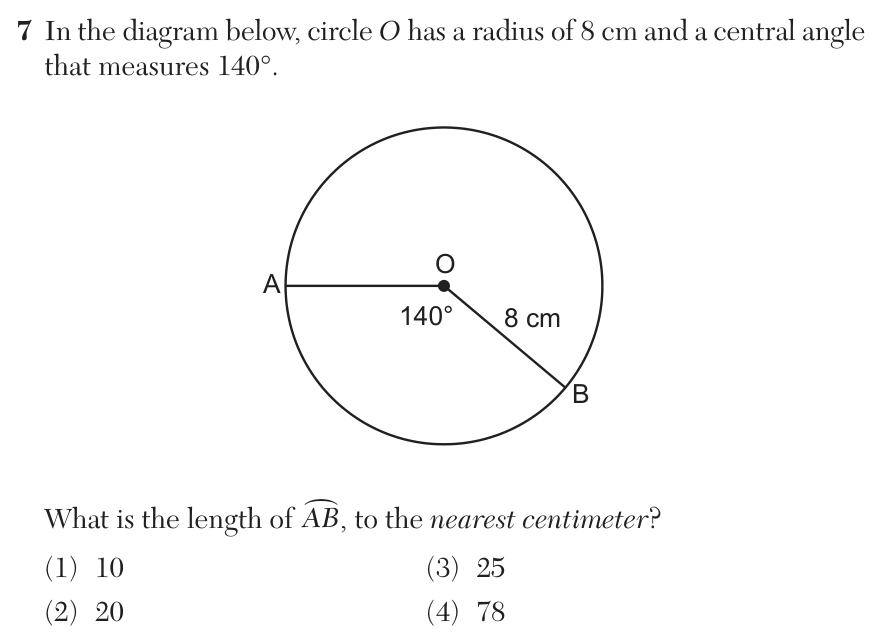
Worked solution for question 7
- The arc is 140/360 of the full circumference.
- Compute (140/360)(16π) = 56π/9 ≈ 19.55 cm, then round.
Answer choice 220 cm
Q8 Cone capacity and trips
A sand cone has radius and height 3.5 ft. A wagon holds 5 ft³. Find the fewest trips.
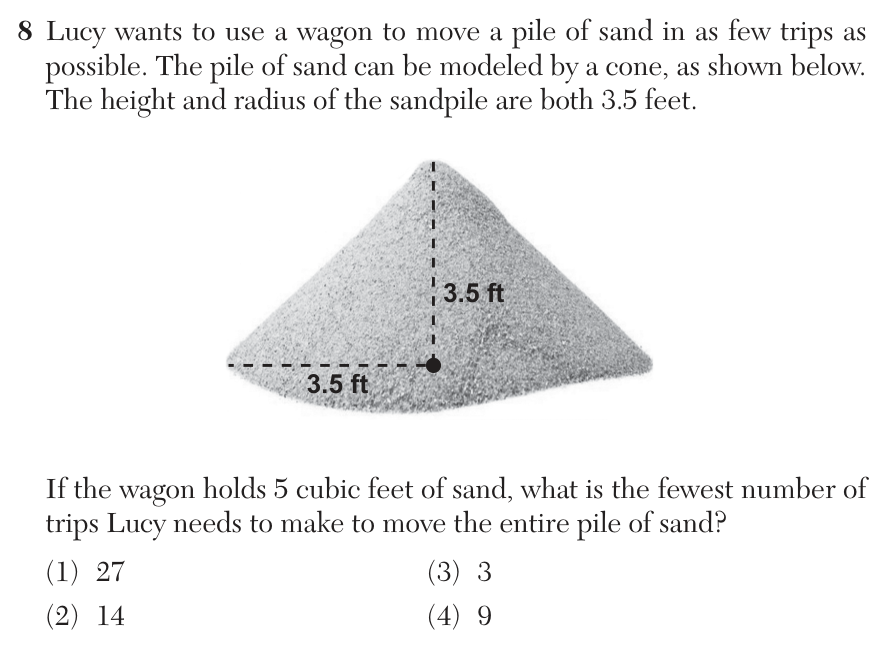
Worked solution for question 8
- Compute cone volume π(3.5)²(3.5)/3 ≈ 44.90 ft³.
- Eight loads carry only 40 ft³, while nine carry up to 45 ft³. Round the volume-to-capacity ratio up.
Answer choice 49 trips
Q9 Similarity from parallels
With BD and AE crossing at C and AB ∥ DE, determine which congruence claim can fail.
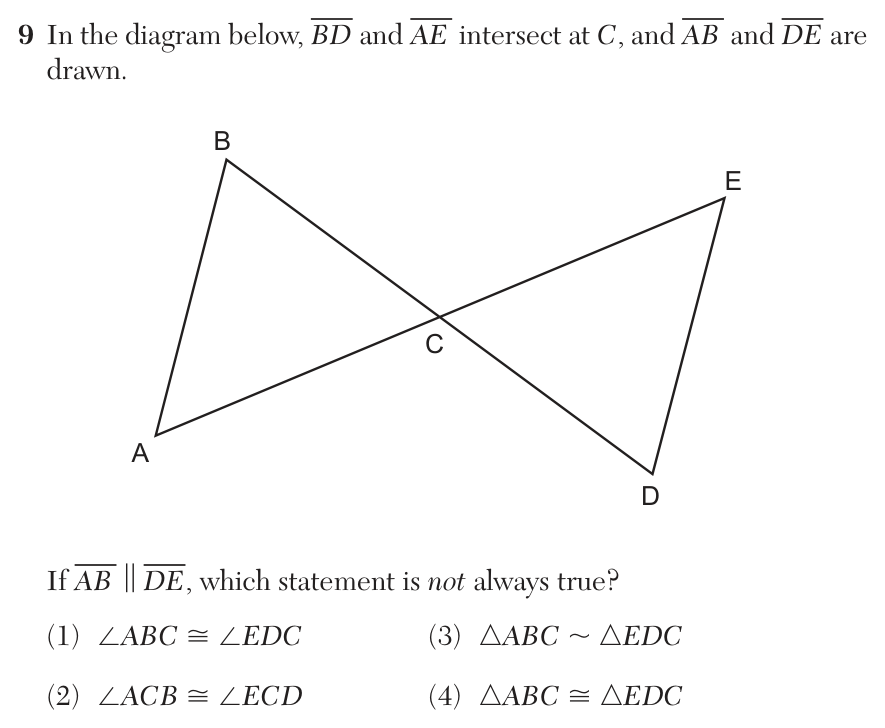
Worked solution for question 9
- The parallel sides give congruent alternate interior angles, and the angles at C are vertical angles.
- Two equal angles establish AA similarity. The scale factor can differ from 1, so corresponding lengths can differ.
- An angle comparison alone allows similar triangles at any positive scale. An additional equality such as AB = DE would fix the scale at 1 and establish congruence.
Answer choice 4△ABC ≅ △EDC can fail.
Q10 Roof angle
An isosceles roof has base FG = 10 ft and altitude ED = 6 ft to midpoint D. Find ∠EGD.
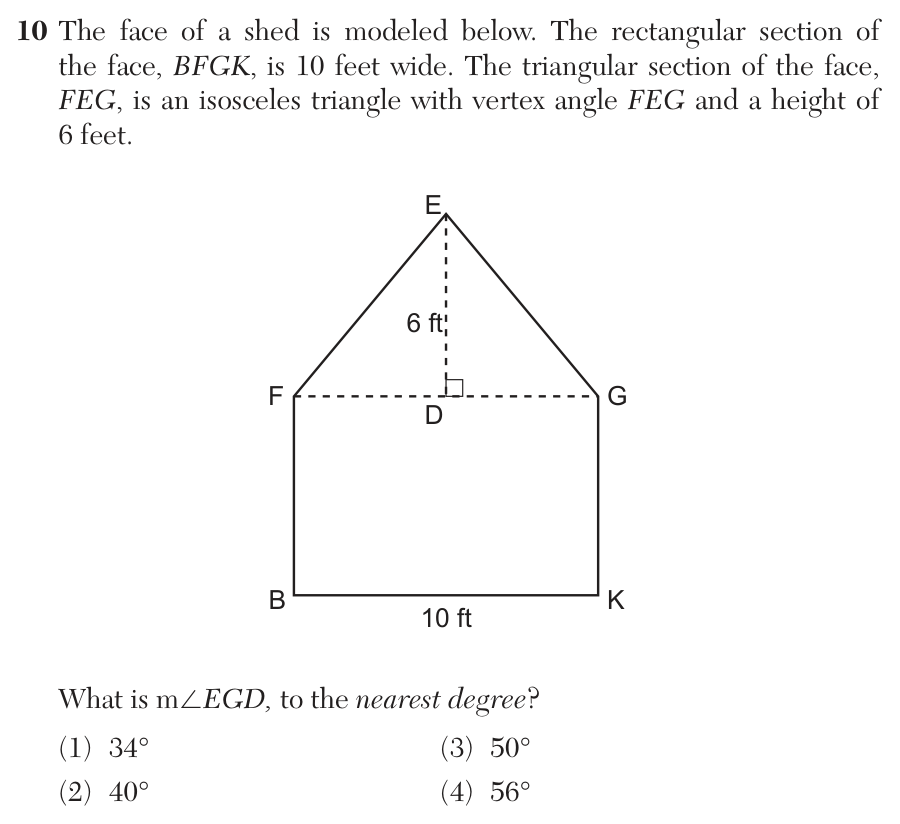
Worked solution for question 10
- The altitude bisects the base, so GD = 5 ft.
- From G, the opposite leg is 6 and the adjacent leg is 5. Compute arctan(6/5) ≈ 50.19°.
Answer choice 350°
Q11 Translation then rotation
Identify the two motions that take ABC through A′B′C′ to A″B″C″.
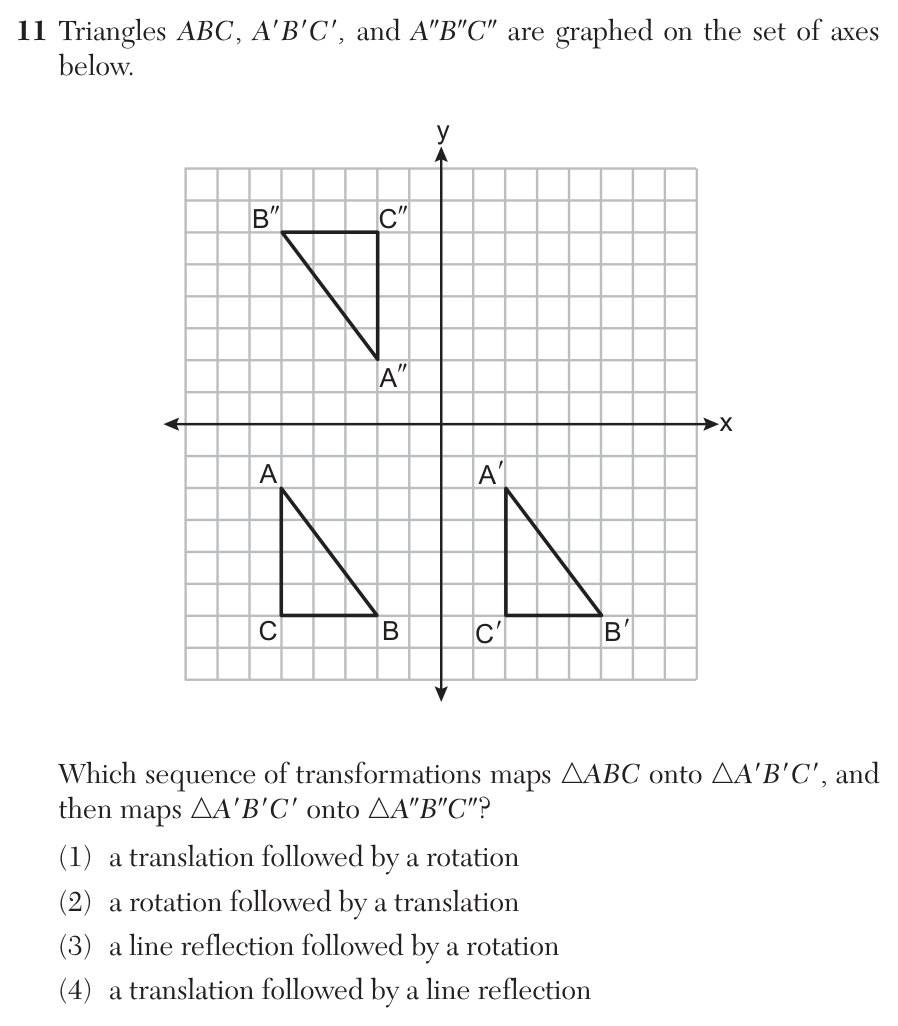
Worked solution for question 11
- The first image has the same orientation and each x-coordinate increases by 7.
- The second move changes the signs of both coordinates, matching the half-turn rule (x, y) ↦ (−x, −y).
- Track vertex A from (−5, −2) to (2, −2), then to (−2, 2). The unchanged y-coordinate in the first move identifies the translation, and the two sign changes identify a 180° turn.
Answer choice 1Translation 7 units right, then 180° rotation about the origin
Q12 Perpendicular slope
Select a line perpendicular to the line through (−1, −4) and (3, −1).
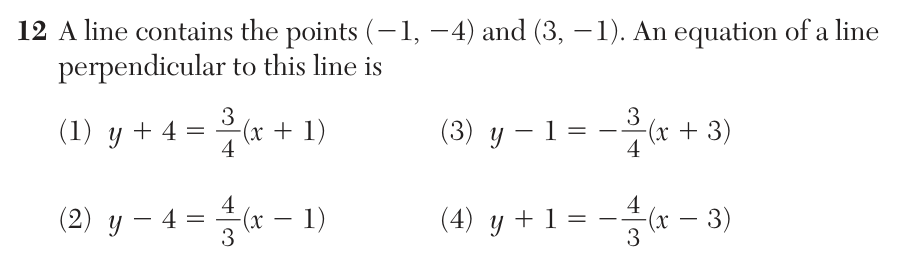
Worked solution for question 12
- The given slope is (−1 + 4)/(3 + 1) = 3/4.
- Its negative reciprocal is −4/3. The selected equation has precisely that slope.
Answer choice 4y + 1 = −(4/3)(x − 3)
Q13 Similar right triangles
In △DAY ∼ △NIT, the first triangle has legs AD = DY = 6 and IT = 16 in the second triangle. Find TN.
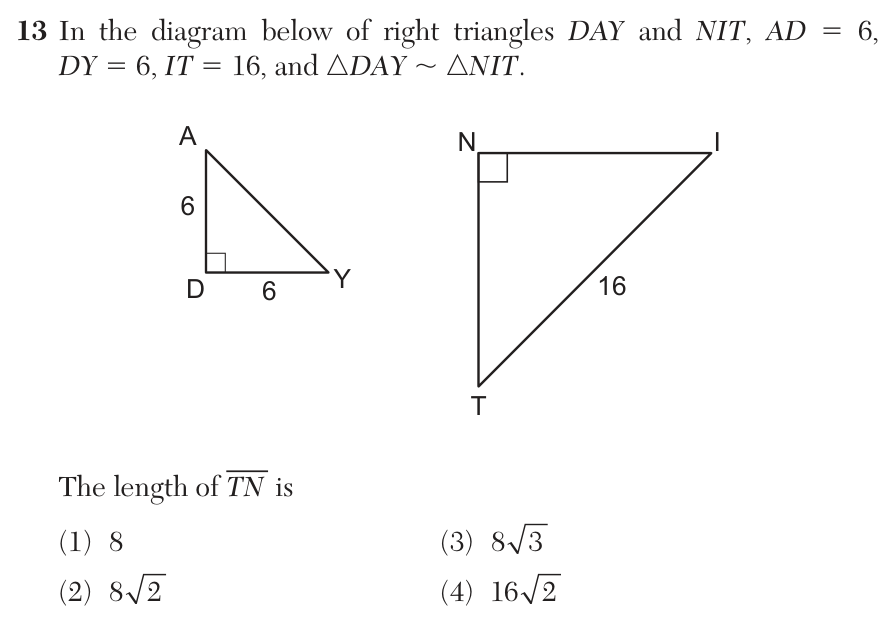
Worked solution for question 13
- The first triangle is 45°–45°–90°, so the second has equal legs and hypotenuse IT = 16.
- A leg is the hypotenuse divided by √2, so TN = 16/√2 = 8√2.
Answer choice 28√2
Q14 Sphere diameter
Find the diameter to tenths when the sphere has volume 333 cm³.
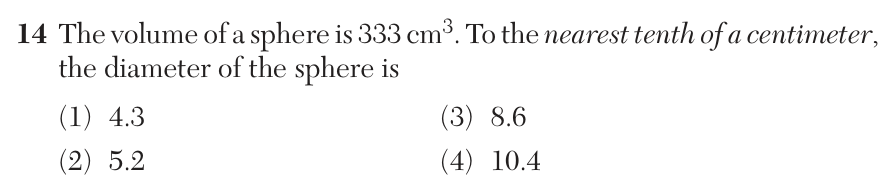
Worked solution for question 14
- Set 333 = (4/3)πr³. Rearrange to r = ∛(999/(4π)).
- Double the unrounded radius to get about 8.60 cm.
- The formula uses radius cubed, so take the cube root before doubling. Doubling the volume or rounding the radius first changes the result.
Answer choice 38.6 cm
Q15 Parallel lines and a perpendicular
BTS ∥ MAVR and AE ⟂ TV. Use ∠STE = 38° to find ∠VAE.
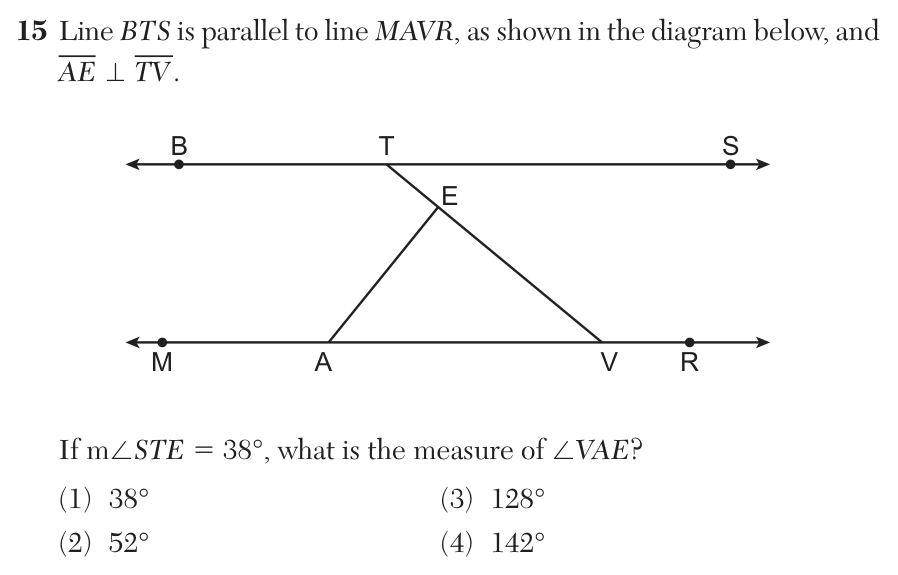
Worked solution for question 15
- The transversal TV makes a 38° acute angle with both parallel lines.
- Because AE is perpendicular to TV, AE makes the complementary acute angle with the lower line, 90° − 38°.
Answer choice 252°
Q16 Partition coordinates
Find A between R(6, 6) and Z(−12, −3) with RA:AZ = 5:4.
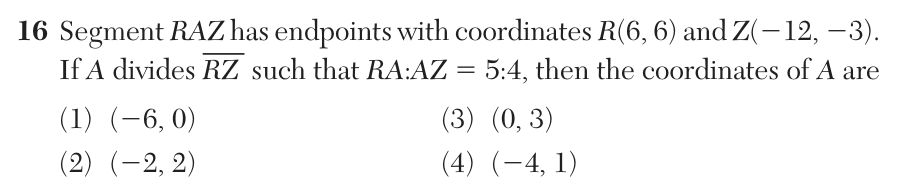
Worked solution for question 16
- The displacement from R to Z is (−18, −9).
- Travel 5/9 of that displacement, (−10, −5), and add it to R.
Answer choice 4(−4, 1)
Q17 Parallel triangle segments
With D on BA and E on BC, DE ∥ AC. Given BD = 9, DA = 3 and EC = 4, find BC.
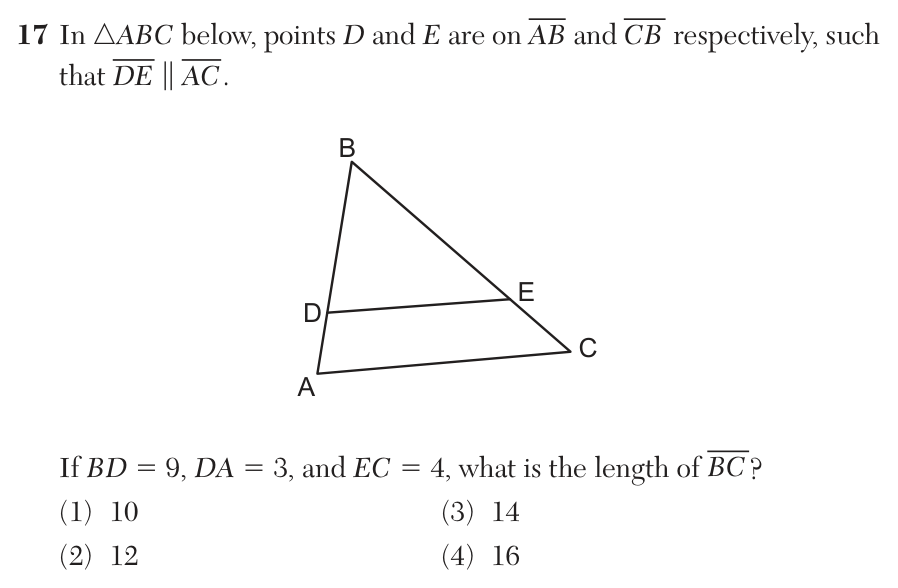
Worked solution for question 17
- AA similarity gives BE/BC = BD/BA = 9/12 = 3/4.
- Therefore EC accounts for the remaining 1/4 of BC, so BC = 4 · 4.
- You can also use the divided-side ratio BD/DA = BE/EC. Then 9/3 = BE/4, so BE = 12 and BC = 12 + 4.
Answer choice 416
Q18 Rigid motion invariant
Which corresponding side property survives every sequence of rigid motions?
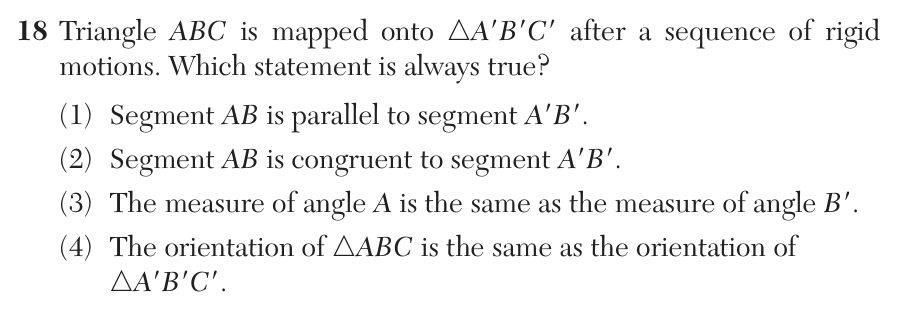
Worked solution for question 18
- Translations, rotations and reflections preserve distances between each pair of points.
- Apply this to endpoints A and B. Their image endpoints are A′ and B′, so the lengths match.
Answer choice 2AB ≅ A′B′
Q19 Complete the square for a circle
Find the center and radius of x² − 16x + y² + 20y = −155.
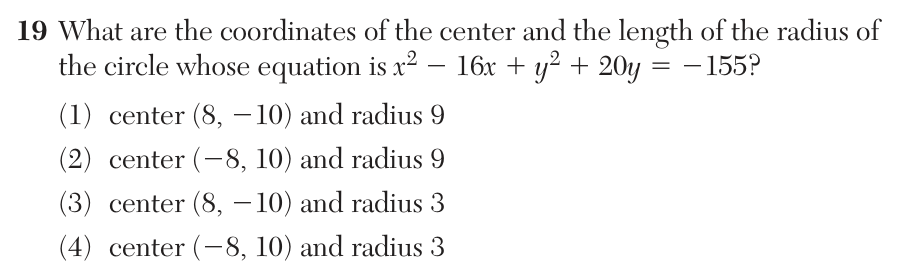
Worked solution for question 19
- Add 64 and 100 to both sides to complete the two squares.
- Then (x − 8)² + (y + 10)² = 9. Read the center from the offsets and take √9.
Answer choice 3Center (8, −10), radius 3
Q20 Rank population densities
Order Pennsylvania, New York, Connecticut and New Jersey by increasing density.
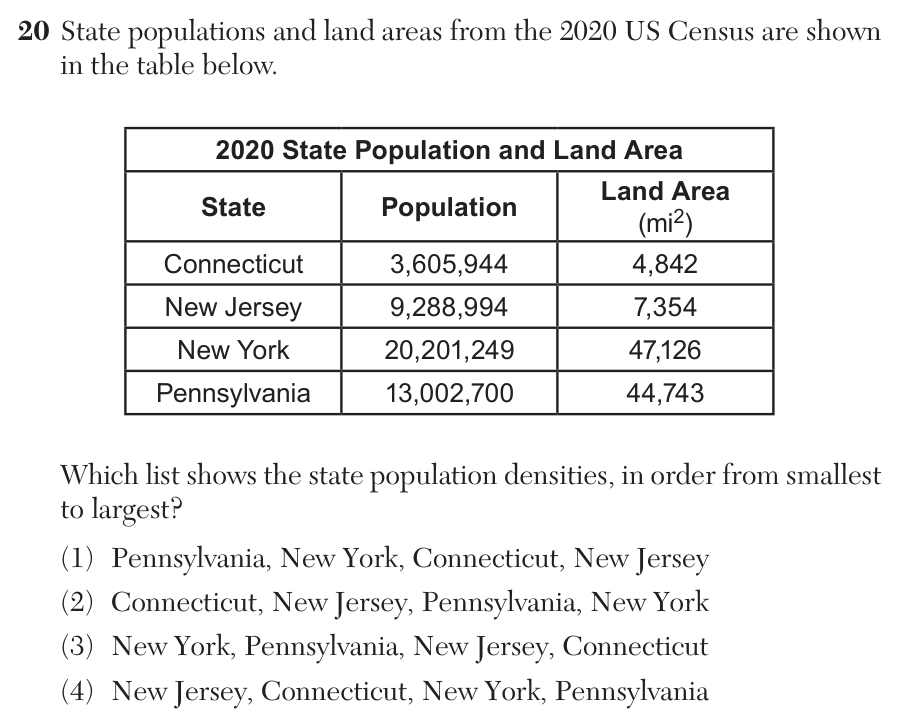
Worked solution for question 20
- Divide each population by its own land area. The approximate densities are 291, 429, 745 and 1,263 people per square mile, respectively.
- Compare those quotients because density measures people per unit area.
Answer choice 1Pennsylvania, New York, Connecticut, New Jersey
Q21 Dilate a line
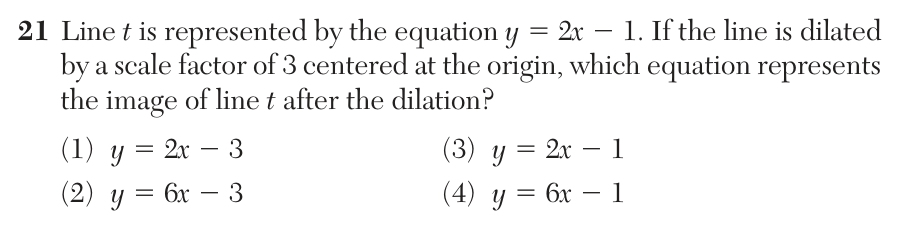
Dilate y = 2x − 1 by factor 3 about the origin.
Worked solution for question 21
- Let (X, Y) = (3x, 3y). Substituting x = X/3 and y = Y/3 into the original gives Y/3 = 2X/3 − 1.
- Multiply by 3. The slope stays 2 and the intercept triples.
- The intercept point (0, −1) maps to (0, −3). Two points on the original line preserve their rise-to-run ratio under a uniform dilation, which explains why the slope remains 2.
Answer choice 1y = 2x − 3
Q22 Rhombus condition
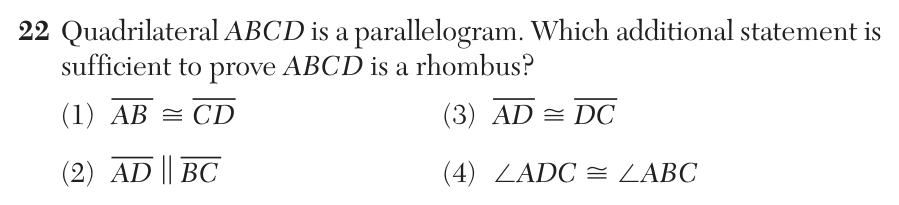
What extra side equality proves parallelogram ABCD is a rhombus?
Worked solution for question 22
- A parallelogram already has AD = BC and DC = AB.
- Equality of the adjacent sides AD and DC makes all four sides equal.
Answer choice 3AD ≅ DC
Q23 Altitude to a hypotenuse
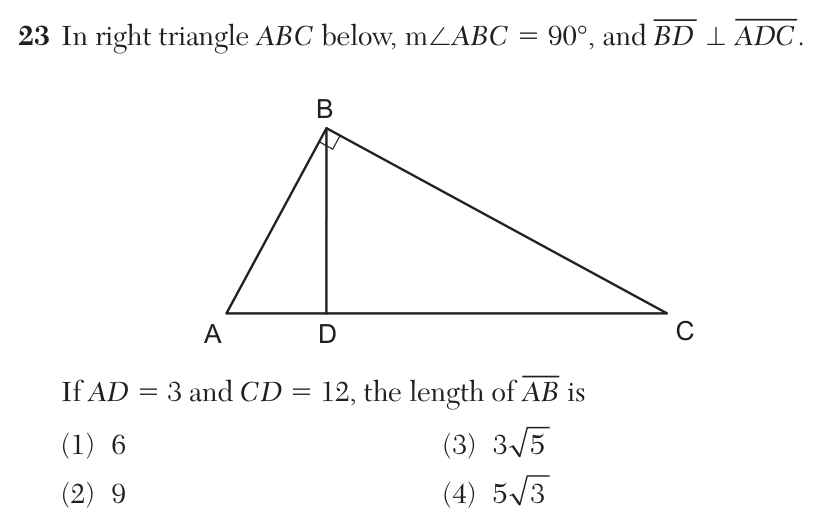
Right triangle ABC has altitude BD to AC with AD = 3 and DC = 12. Find AB.
Worked solution for question 23
- The whole hypotenuse is AC = 15. Similar triangles give AB² = AD · AC.
- Then AB = √45 = 3√5, taking the positive length.
Answer choice 33√5
Q24 Centroid ratio
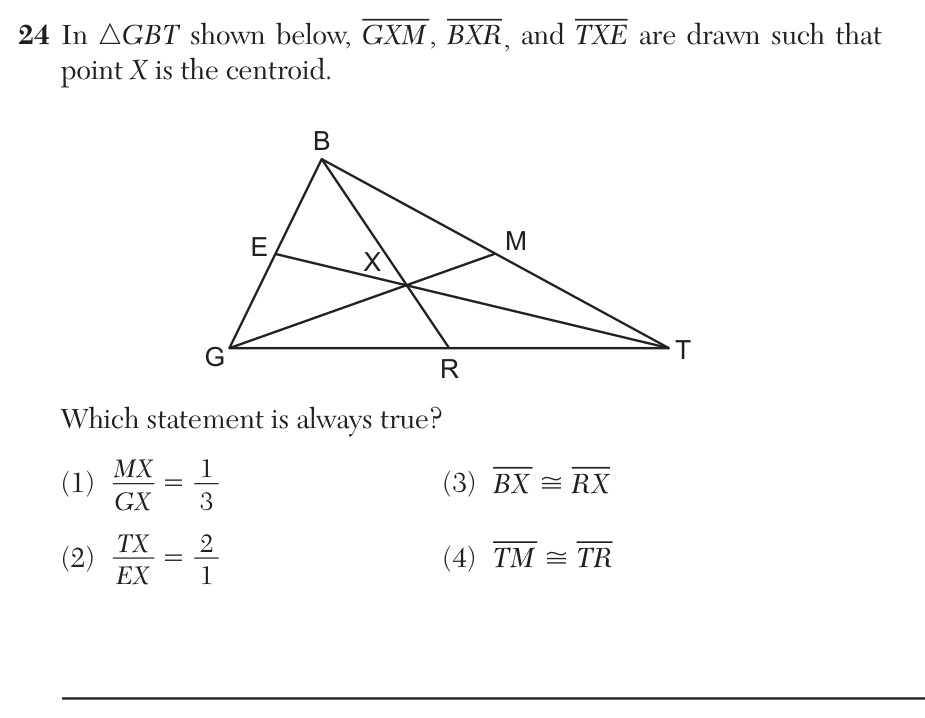
X is the centroid of △GBT. Find the ratio of TX to EX on median TE.
Worked solution for question 24
- A centroid divides every median into two lengths in ratio 2:1.
- The longer part runs from vertex T to the centroid X. The shorter runs from X to the midpoint E.
Answer choice 2TX:EX = 2:1
Part II Short response
Question indexQ25 Reflect and translate
Reflect (2, 1), (0, 3), and (−2, −1) across the x-axis, then move right 3 and down 2.
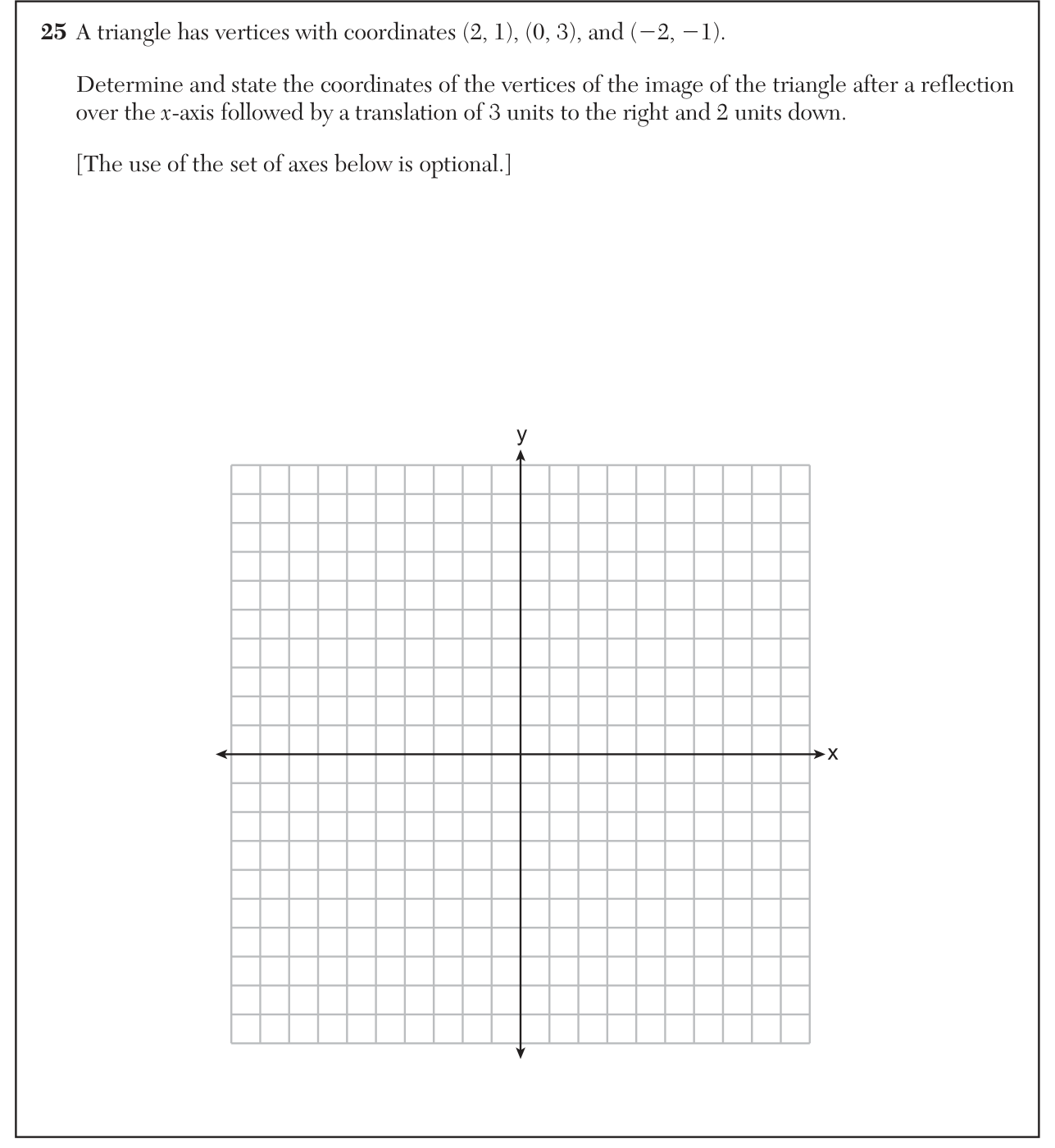
Worked solution for question 25
- Reflection sends (x, y) to (x, −y), giving (2, −1), (0, −3), and (−2, 1).
- Apply (x, y) ↦ (x + 3, y − 2) to each reflected point.
Final answer(5, −3), (3, −5), (1, −1)
Q26 Topsoil weight
A bucket has diameter 10 in and height 15 in. Topsoil weighs 0.0231 lb/in³. Find the full weight.
Worked solution for question 26
- The radius is 5 in. Cylinder volume is π(5)²(15) = 375π in³.
- Multiply by 0.0231 to obtain about 27.21 lb and round to the nearest pound.
Final answer27 pounds
Q27 Adjacent leg
Right triangle SRT has ∠R = 90°, ∠S = 27° and ST = 31.8. Find SR.
Worked solution for question 27
- SR is adjacent to angle S and ST is the hypotenuse, so cos 27° = SR/31.8.
- Calculate 31.8 cos 27° ≈ 28.334 and round to tenths.
Final answer28.3
Q28 Area using an included angle
Find the area with adjacent sides LE = 7.5 and ET = 9.3 enclosing 115°.
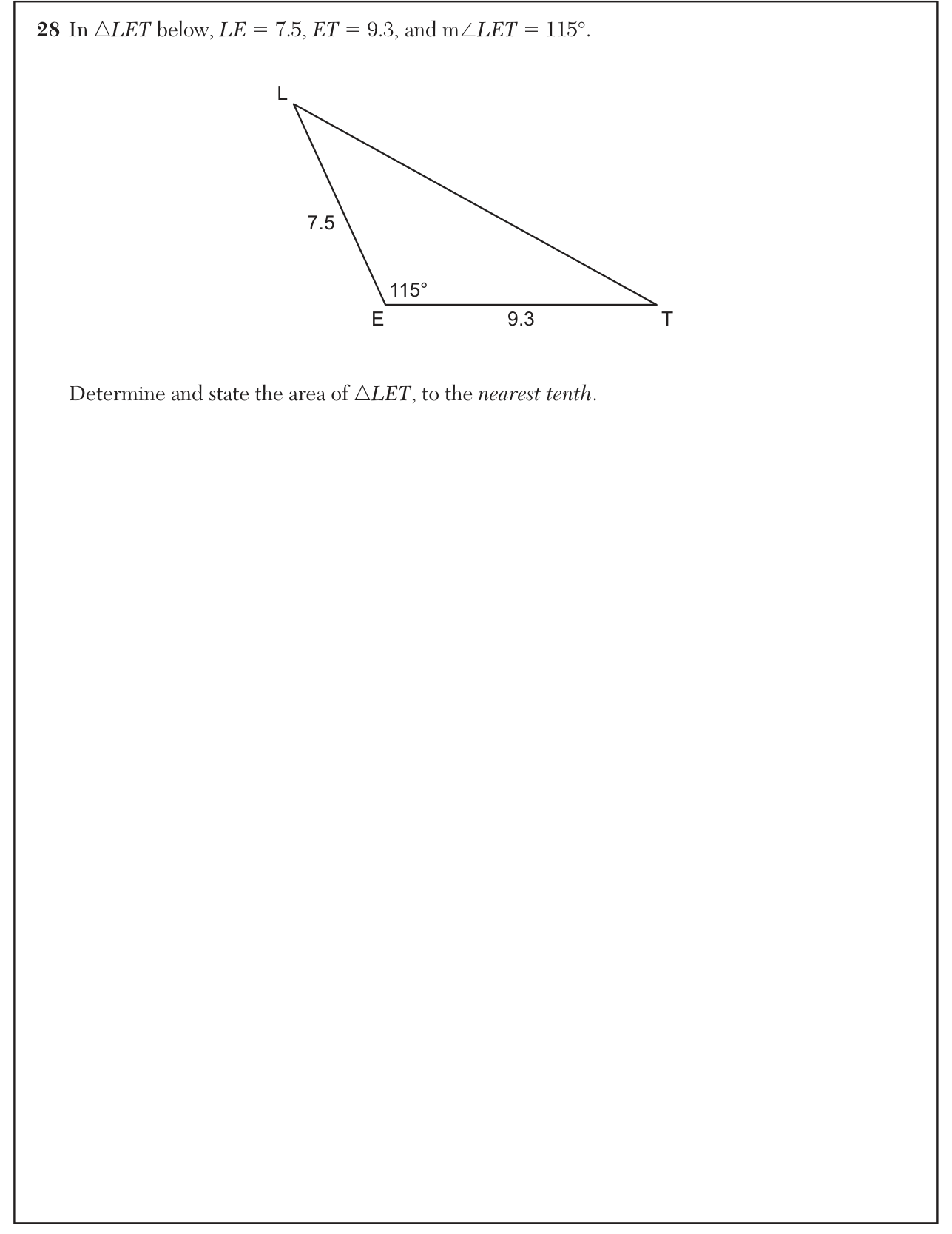
Worked solution for question 28
- Use area = (1/2)ab sin C with C = 115°.
- Compute (1/2)(7.5)(9.3)sin 115° ≈ 31.61. Sine gives the positive altitude even for this obtuse included angle.
Final answer31.6 square units
Q29 Annulus area
A circular pool of diameter 24 ft is surrounded by an 8 ft deck. Find the deck area.
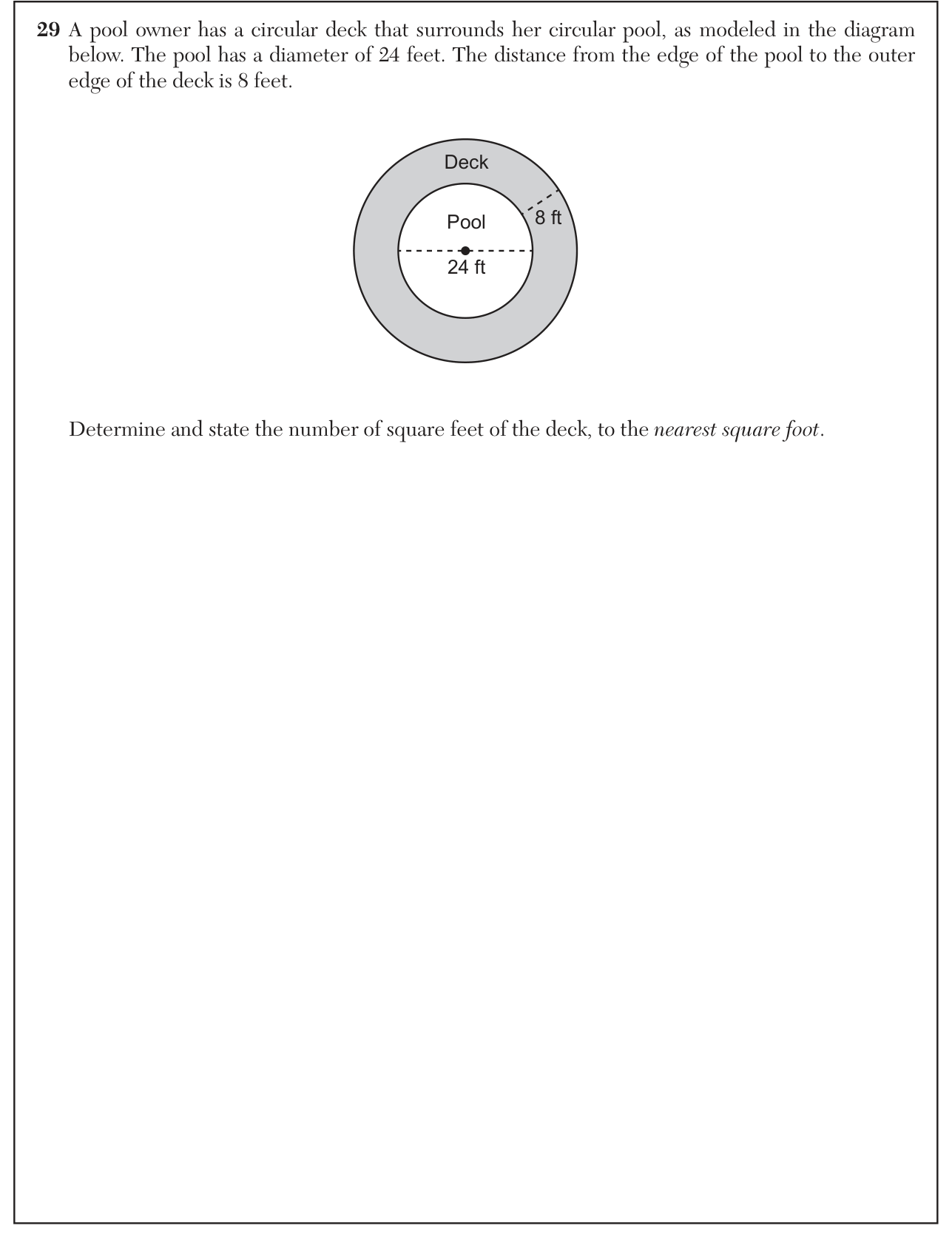
Worked solution for question 29
- The inner radius is 12 and the outer radius is 12 + 8 = 20.
- Subtract the pool disk from the outer disk to obtain π(20² − 12²) = 256π ≈ 804.25.
- Add the deck width to the radius once, because the distance is measured outward from the pool edge. The resulting 20-foot radius gives the whole pool-and-deck disk.
Final answer804 ft²
Q30 Equilateral triangle construction
Use compass and straightedge to construct an equilateral triangle on AB.
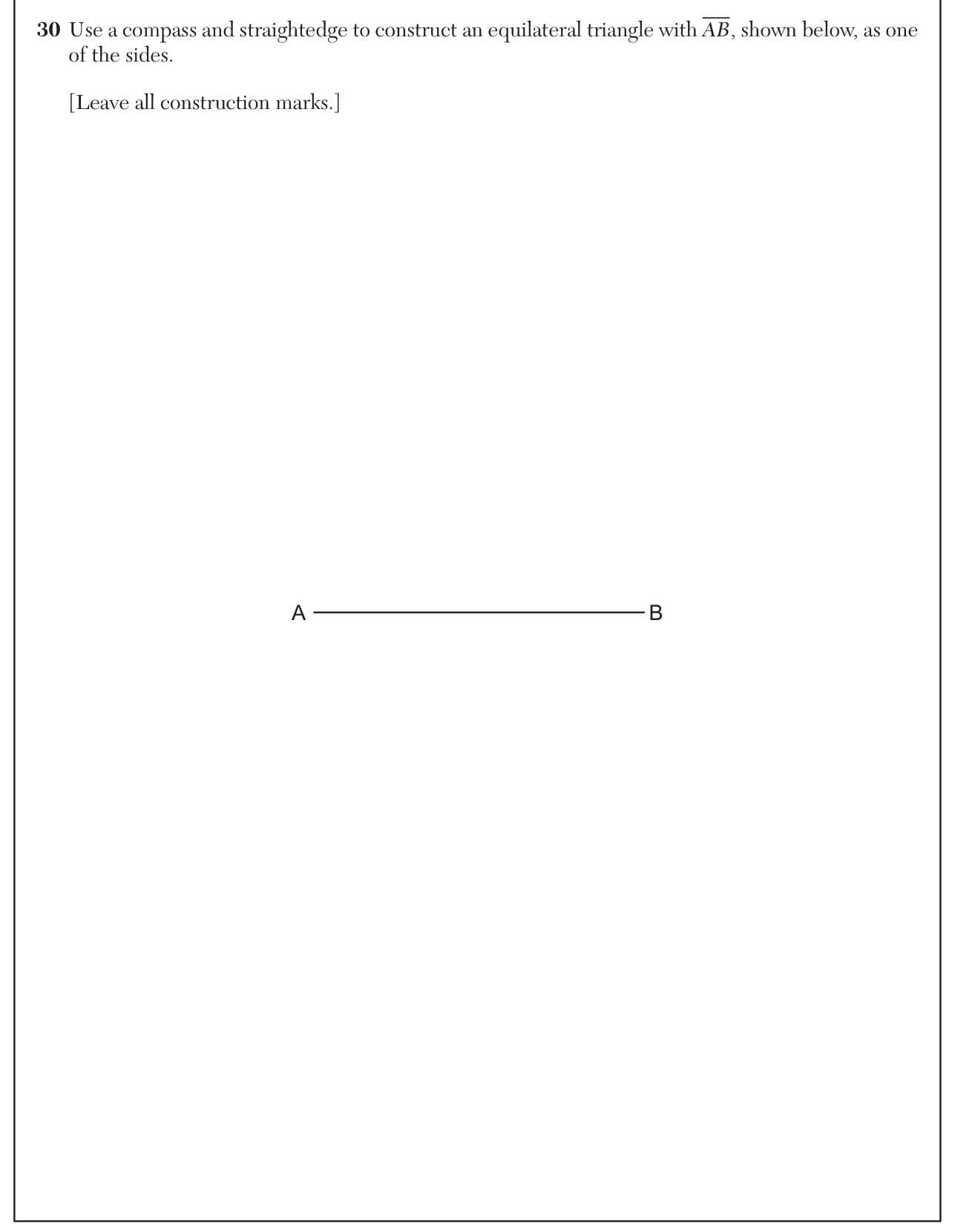
Worked solution for question 30
- Set the compass opening to AB. Draw an arc centered at A and another at B with that same opening.
- Label an intersection C. Draw AC and BC and leave both arcs visible. Each new side equals the compass radius AB.
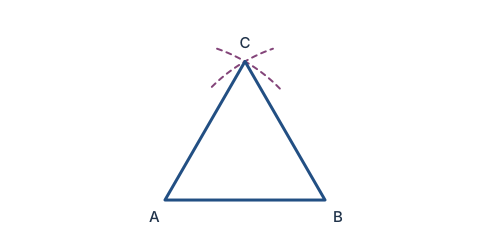
Final answer△ABC with AB = AC = BC
Q31 Diameter proof
Triangle ABC is inscribed with ∠ABC = 90°. Explain why AC is a diameter.
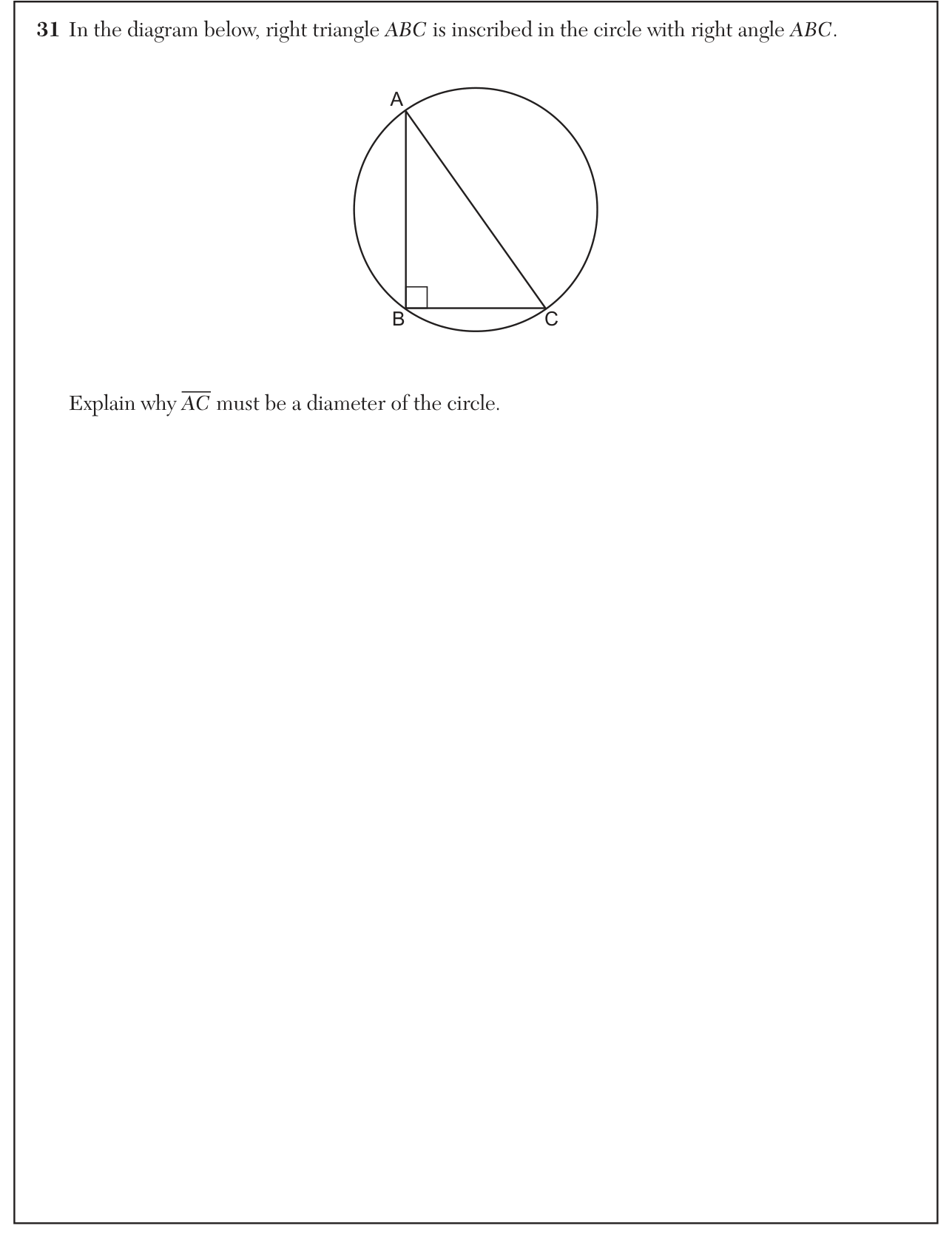
Worked solution for question 31
- An inscribed angle is half the measure of its intercepted arc, so arc AC away from B measures 180°.
- A 180° arc is a semicircle. Its endpoints lie on opposite rays from the center, making AC a diameter.
Final answerAC is a diameter.
Part III Extended response
Question indexQ32 Isosceles perimeter
An isosceles triangle has vertex angle 80° and altitude 8 to its base. Find its perimeter.
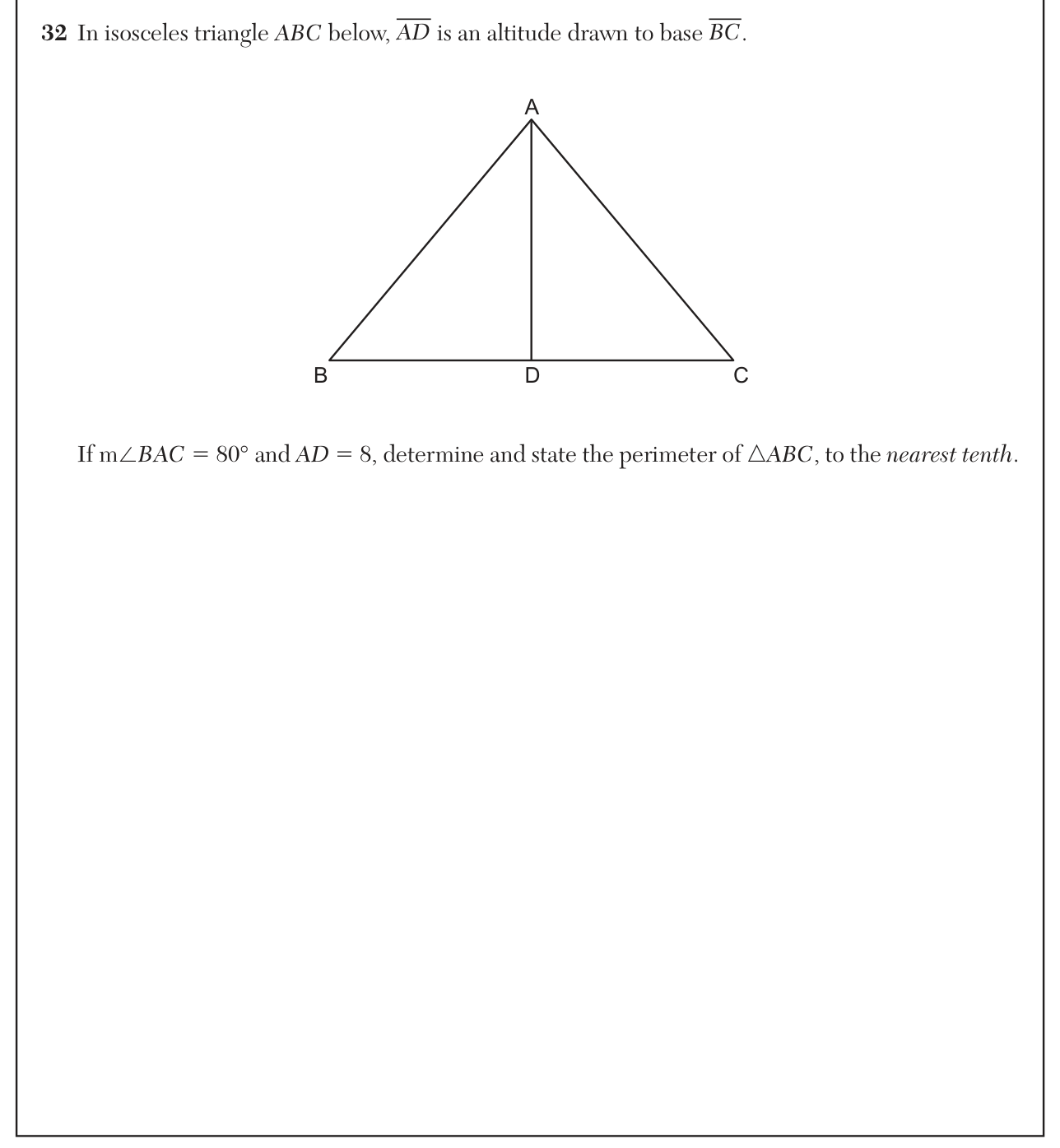
Worked solution for question 32
- The altitude bisects the vertex angle and the base, creating two right triangles with 40° at the apex.
- Each half-base is 8 tan 40° and each sloping side is 8/cos 40°.
- Add twice each length, giving about 34.312, and round once at the end.
Final answer34.3 units
Q33 Congruence proof
In SMIL, diagonals IS and ML intersect at E, with MS ∥ IL and MS ≅ IL. Prove △MIE ≅ △LSE.
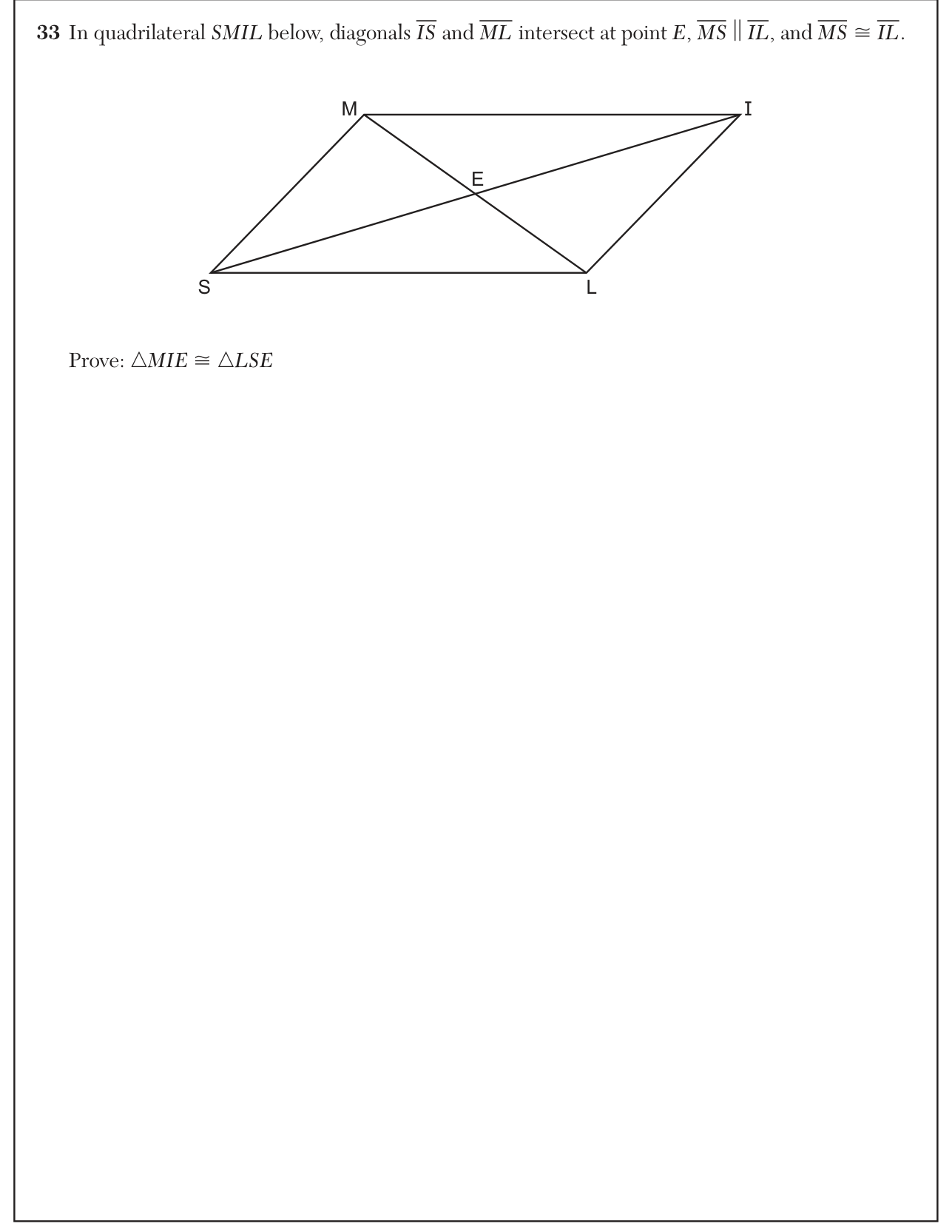
Worked solution for question 33
- One pair of opposite sides is both congruent and parallel, so SMIL is a parallelogram. Consequently MI ∥ LS and MI ≅ LS.
- Transversal ML gives ∠IME ≅ ∠SLE, and transversal IS gives ∠MIE ≅ ∠LSE.
- Use the included congruent sides MI and LS for ASA.
Final answerCongruent by ASA after establishing opposite sides parallel
Q34 Composite solid mass
A 12 × 6 × 3 cm prism supports a pyramid with matching base and height 10 cm. Density is 2.5 g/cm³.
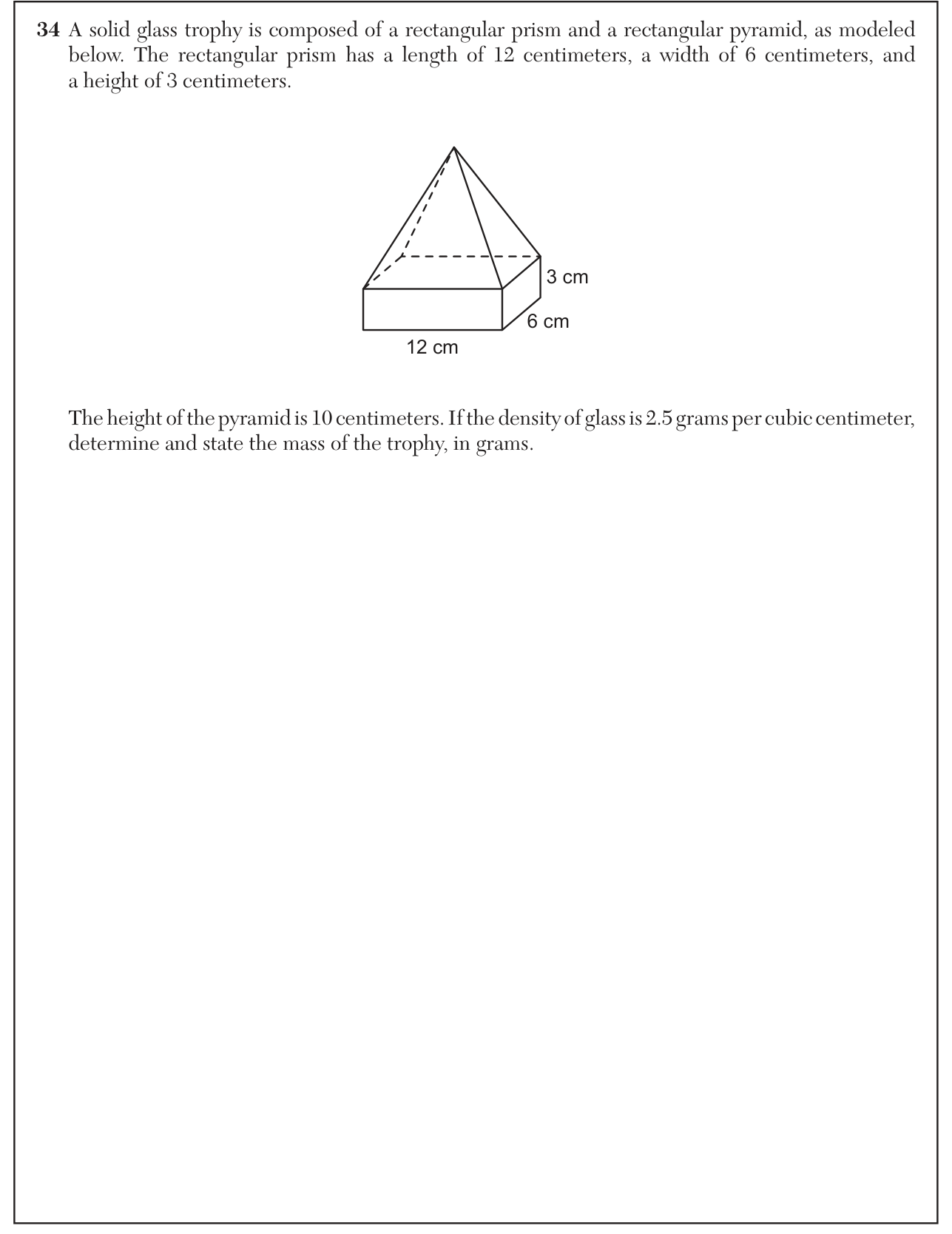
Worked solution for question 34
- The prism volume is 12(6)(3) = 216 cm³. The pyramid volume is 12(6)(10)/3 = 240 cm³.
- Add to get 456 cm³, then multiply by 2.5 g/cm³.
Final answer1,140 grams
Part IV Long response
Question indexQ35 Coordinate trapezoid proof
For A(−3, 1), B(−3, −7), C(6, 5), D(0, 5), E(−3, −3), F(3, 5), prove the trapezoid and segment claims.
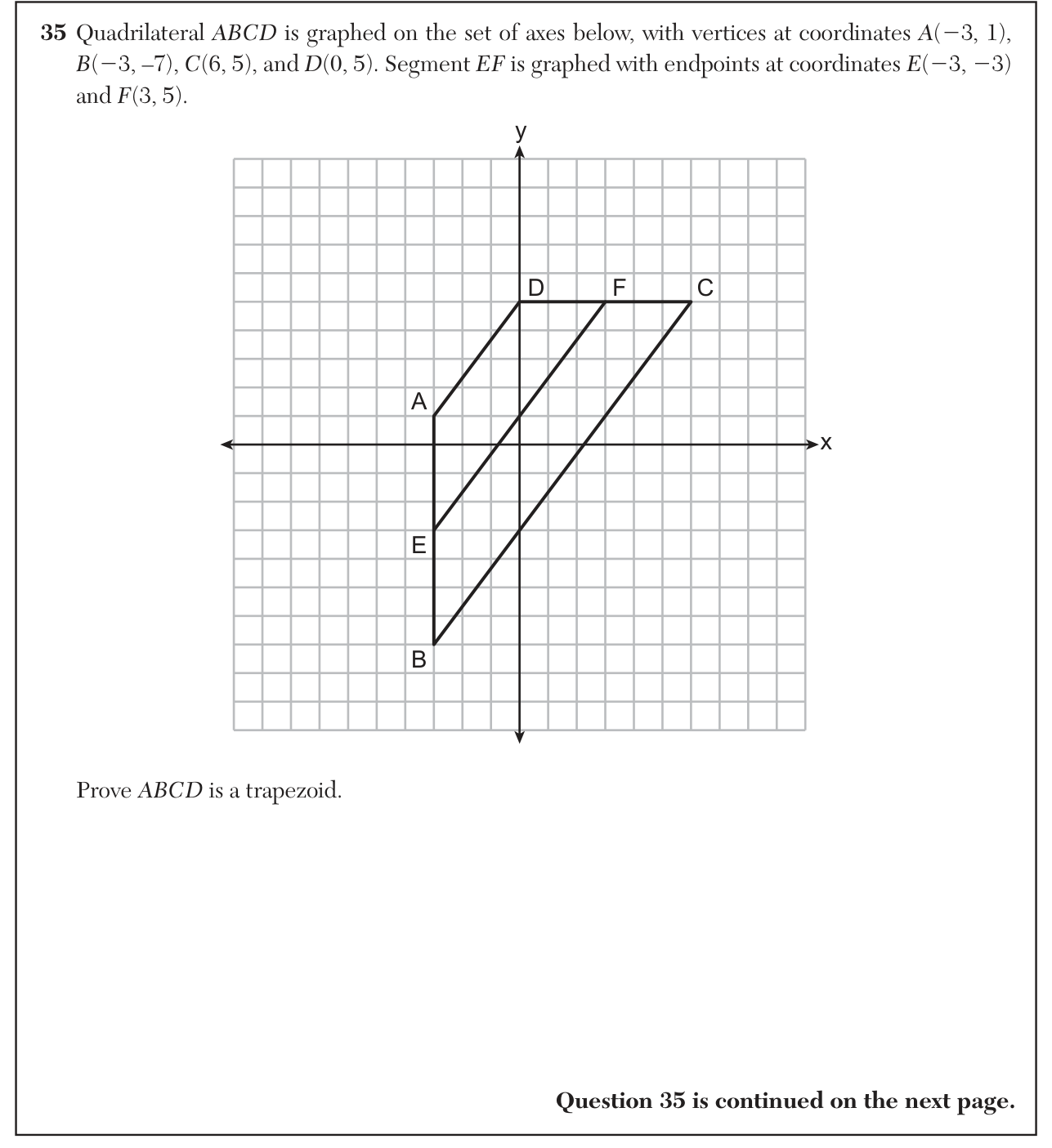
Worked solution for question 35
- Slope AD = 4/3 and slope BC = 12/9 = 4/3. AB is vertical and CD is horizontal, so there is exactly one parallel opposite pair.
- Slope EF = 8/6 = 4/3, proving both parallel claims.
- Use the distance formula. AD = √(3² + 4²) = 5, BC = √(9² + 12²) = 15, and EF = √(6² + 8²) = 10.
- Their lengths satisfy 10 = (5 + 15)/2.
- The coordinates place E and F at the midpoints of the nonparallel sides AB and DC. The coordinate work verifies both the expected direction and the average-length property of that midsegment.
Final answerABCD is a trapezoid, EF ∥ AD ∥ BC, and EF = (AD + BC)/2.
From the New York State Education Department. January 2026 Geometry Regents Examination. Internet. Available from https://www.nysedregents.org/geometryre/126/geom-12026-exam.pdf. Accessed .