NEW YORK STATE REGENTS · ALGEBRA II
August 2026 Algebra II Regents Past Paper & Solutions
Work through radicals, inverse functions and exponential cooling with a question-by-question walkthrough of the exam.
- 36 worked questions
- 82 raw credits
- 4 exam parts
The question images and page numbers come from the regular-size English exam. OnlyPrepy wrote the summaries and worked solutions.
Quick answer key for Part I
Part I Multiple choice
Question indexQ1 Simplify an imaginary radical
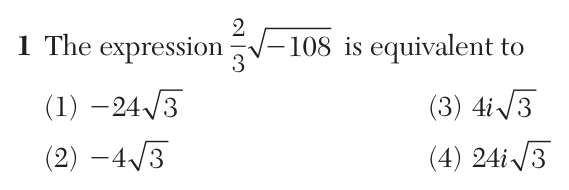
Simplify (2/3)√(−108).
Worked solution for question 1
- Write √(−108) = i√108. Since 108 = 36 · 3, this is 6i√3.
- Multiply by 2/3 to obtain 4i√3.
- Squaring 6i√3 gives 36(−1)(3) = −108, which checks the radical before the factor of 2/3 is applied.
Answer choice 34i√3
Q2 Square-root intercept
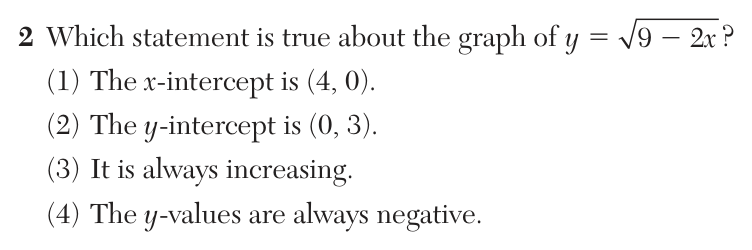
Identify the correct graph fact for y = √(9 − 2x).
Worked solution for question 2
- Put x = 0 to get √9 = 3.
- For comparison, y = 0 occurs at x = 9/2. On the domain x ≤ 9/2, the radicand decreases as x increases.
Answer choice 2The y-intercept is (0, 3).
Q3 Fit an exponential through two points
Find the exponential through (0, 20) and (1, 10).

Worked solution for question 3
- For a · bˣ, the output at zero is a, so a = 20.
- The one-step ratio is 10/20 = 0.5. This supplies the base.
Answer choice 3f(x) = 20(0.5)ˣ
Q4 Probability of a union
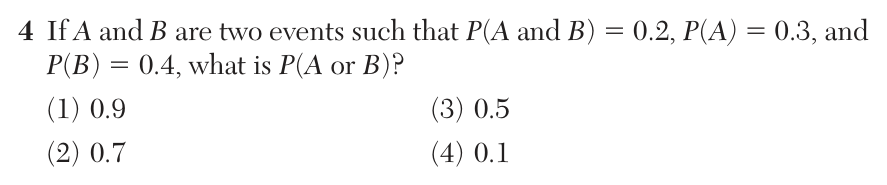
Given P(A) = 0.3, P(B) = 0.4 and P(A and B) = 0.2, find P(A or B).
Worked solution for question 4
- Add the two event probabilities to get 0.7.
- Subtract 0.2 once because the overlap was counted in both probabilities.
- A union includes outcomes in A alone, B alone, or both. In separate pieces these probabilities are 0.1, 0.2, and 0.2, summing to the same 0.5.
Answer choice 30.5
Q5 Compare a cube root and cubic
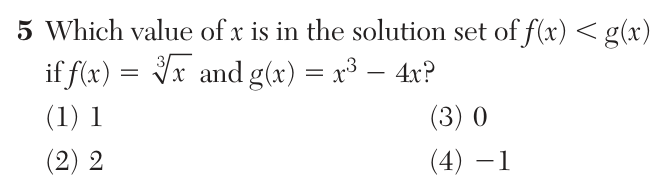
Pick a listed input satisfying ∛x < x³ − 4x.
Worked solution for question 5
- At x = −1, the left side is −1 and the right side is −1 + 4 = 3.
- At x = 0 the values tie. At x = 1 and 2, the right side is −3 and 0 respectively, each smaller than the left side.
Answer choice 4x = −1
Q6 Geometric recurrence
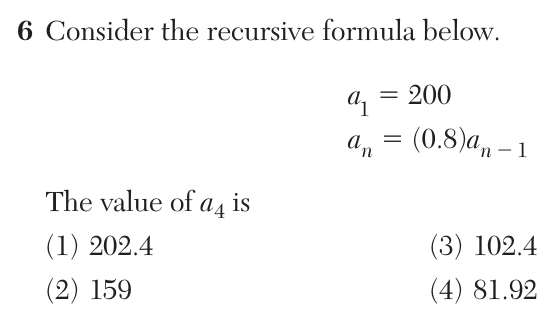
Find term four if a₁ = 200 and each term is 0.8 times its predecessor.
Worked solution for question 6
- Multiply three times to advance from term one to term four.
- The intermediate terms are 160 and 128, followed by 102.4.
Answer choice 3102.4
Q7 Spot a squaring error
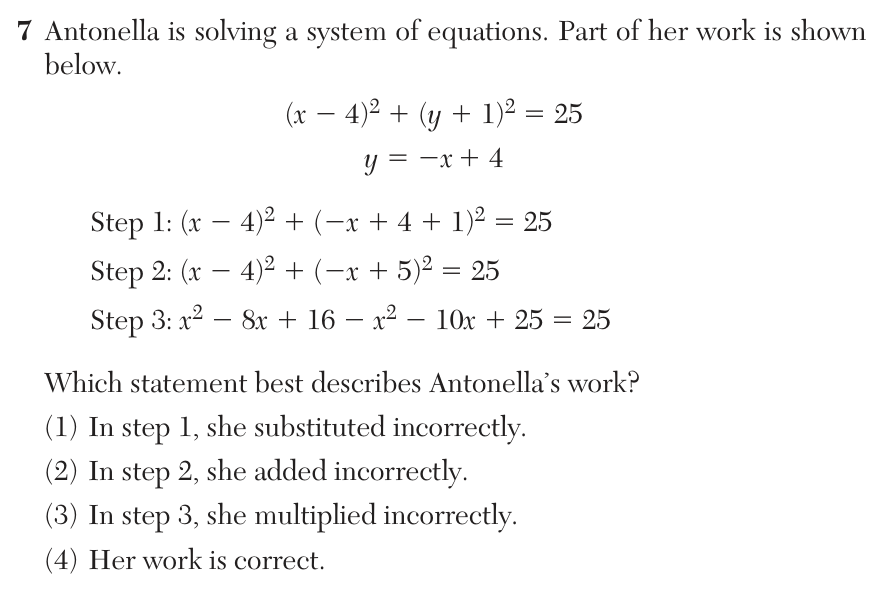
Substitute y = −x + 4 into (x − 4)² + (y + 1)² = 25 and identify the error in the shown work.
Worked solution for question 7
- Substitution correctly gives (x − 4)² + (−x + 5)² = 25.
- Squaring −x gives +x², so the second square expands to x² − 10x + 25. The shown step used −x².
- The middle term is 2(−x)(5) = −10x, and the final term is 25. This gives x² − 10x + 25 and pinpoints the sign error in the x² term.
Answer choice 3The multiplication in step 3 is incorrect.
Q8 Divide radical expressions
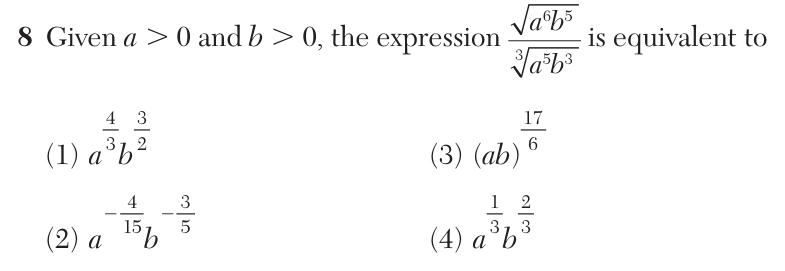
For positive a and b, simplify √(a⁶b⁵) / ∛(a⁵b³).
Worked solution for question 8
- Use half powers in the numerator and one-third powers in the denominator.
- Subtract exponents for each base. For a this is 3 − 5/3 = 4/3, and for b it is 5/2 − 1 = 3/2.
Answer choice 1a^(4/3)b^(3/2)
Q9 Cubic end behavior
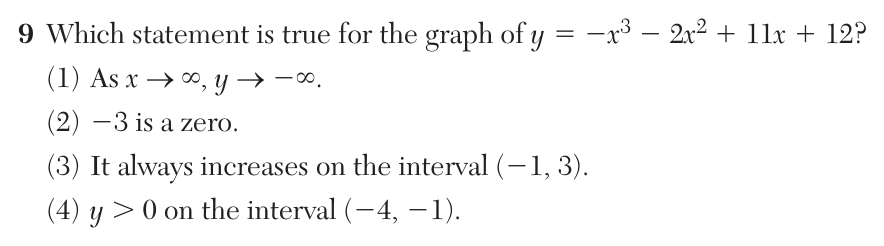
Identify a true statement for y = −x³ − 2x² + 11x + 12.
Worked solution for question 9
- The leading term −x³ dominates for large positive x.
- It tends to negative infinity. The terms of lower degree become negligible relative to x³.
Answer choice 1As x → +∞, y → −∞.
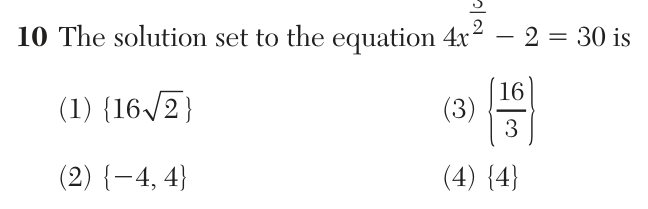
Q10 Fractional-power equation
Solve 4x^(3/2) − 2 = 30 over the reals.
Worked solution for question 10
- Add 2 and divide by 4 to get x^(3/2) = 8, with x ≥ 0.
- Raise both sides to 2/3. The result is (∛8)² = 4, and 4(2³) − 2 = 30 checks.
- The exponent x^(3/2) can be read as (√x)³ for real x. A negative x cannot be another real solution because √x would be undefined.
Answer choice 4x = 4
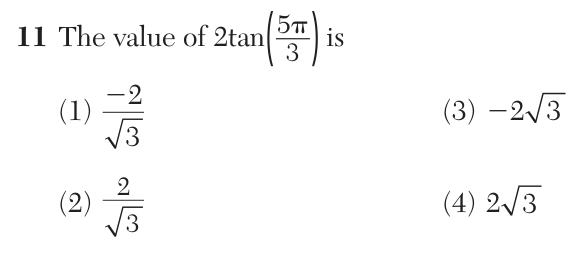
Q11 Exact tangent
Evaluate 2 tan(5π/3).
Worked solution for question 11
- The reference angle is π/3. The terminal side is in quadrant IV, where tangent is negative.
- Use tan π/3 = √3, then multiply by −2.
Answer choice 3−2√3
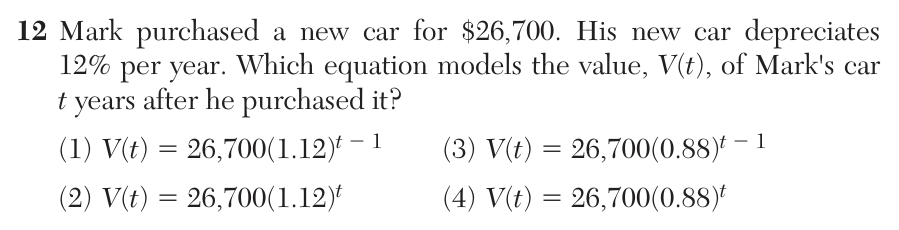
Q12 Annual depreciation
Model a 26,700-dollar car that loses 12% of its value each year.
Worked solution for question 12
- The retained fraction each year is 1 − 0.12 = 0.88.
- At t = 0 the car is worth 26,700, so use t elapsed years as the exponent.
Answer choice 4V(t) = 26,700(0.88)ᵗ
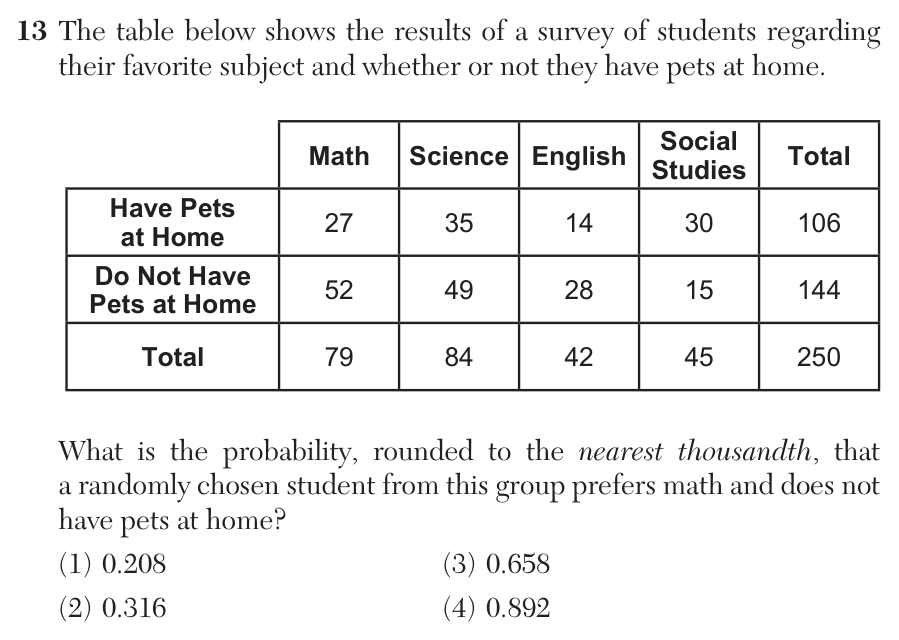
Q13 Joint probability
Out of 250 students, 52 prefer math and have no pets. Find the joint probability.
Worked solution for question 13
- Use the intersection count 52 for both requirements together.
- The selection is from all 250 students, so divide 52 by 250.
Answer choice 10.208
Q14 Factor theorem
If p(5) = 0, what must be a factor of polynomial p?
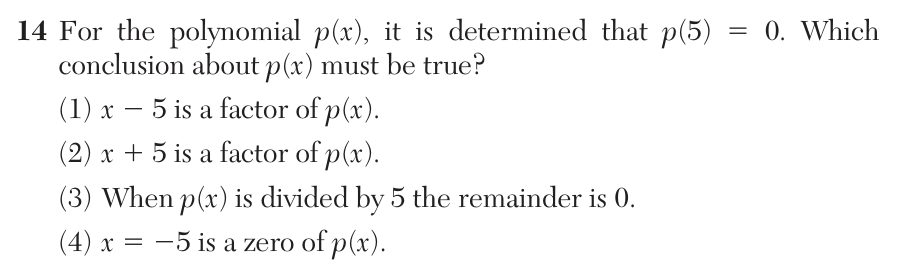
Worked solution for question 14
- Dividing by x − 5 leaves remainder p(5).
- The remainder is zero, so the divisor is a factor.
- The sign in the factor comes from the zero. At x = 5, x − 5 is zero, while x + 5 evaluates to 10.
Answer choice 1x − 5
Q15 Tangent in quadrant II
Given sin θ = 21/29 in quadrant II, find tan θ.
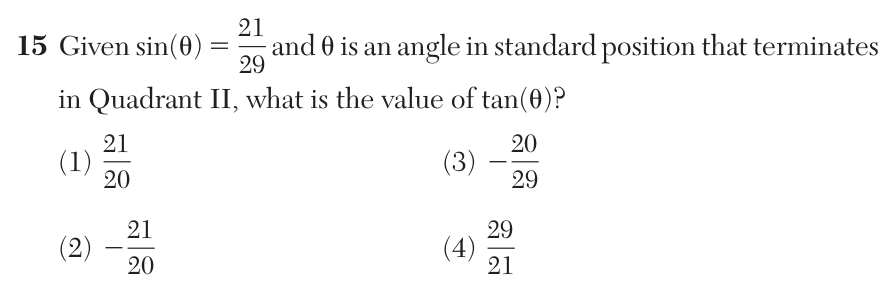
Worked solution for question 15
- Use the identity cos² θ = 1 − (21/29)² = (20/29)². Cosine is negative in quadrant II.
- Divide 21/29 by −20/29.
- The reference triangle has legs 21 and 20 and hypotenuse 29. A point in quadrant II has negative horizontal coordinate and positive vertical coordinate, so the tangent must be negative.
Answer choice 2−21/20
Q16 Solve a rational equation
Solve 6/k + (k + 2)/(k + 3) = 2/(k² + 3k).
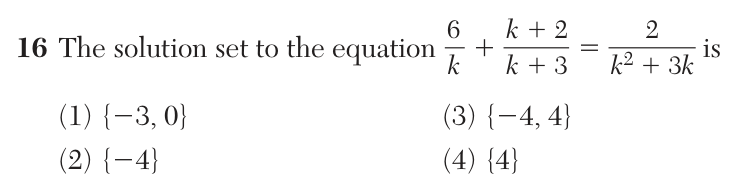
Worked solution for question 16
- Exclude k = 0 and −3. Multiply by k(k + 3) to get 6(k + 3) + k(k + 2) = 2.
- This simplifies to k² + 8k + 16 = (k + 4)² = 0. The repeated root −4 is allowed.
Answer choice 2{−4}
Q17 Normal count near the mean
Of 500 packets with approximately normal weights, mean 0.95 oz and SD 0.04 oz, estimate the count from 0.91 to 0.99 oz.
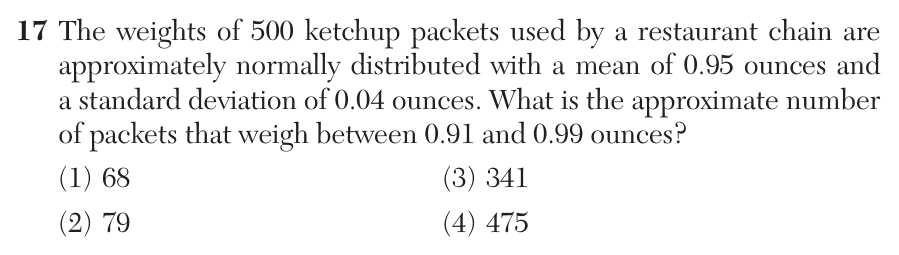
Worked solution for question 17
- Both endpoints are one standard deviation from the mean.
- The normal area from z = −1 to z = 1 is about 0.68269. Multiplying by 500 gives about 341.34 packets.
- The interval is centered at 0.95 with endpoints exactly one standard deviation away. A normal cumulative probability with those endpoints gives a slightly more precise estimate than multiplying by the rounded 68% rule.
Answer choice 3About 341 packets
Q18 Identify a population parameter
A sample of 50 of 503 school juniors reports that 38% plan to attend SUNY. What parameter is being estimated?
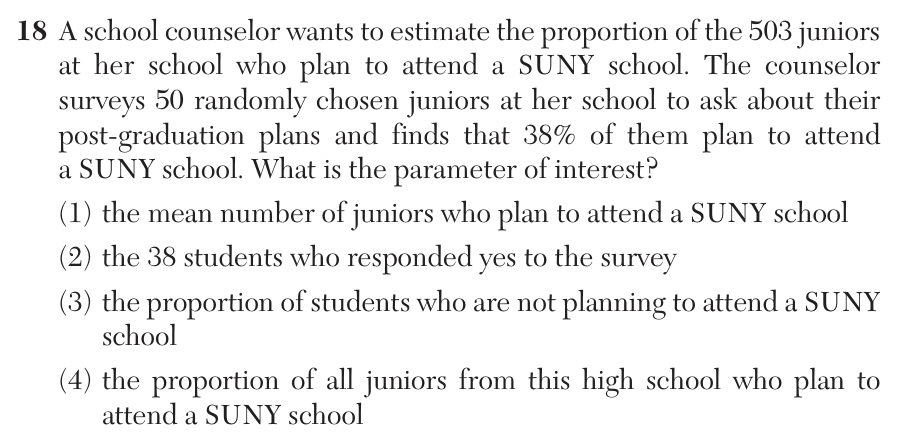
Worked solution for question 18
- The population is the school’s entire junior class.
- The 38% is a sample statistic used to estimate the corresponding unknown population proportion.
Answer choice 4The proportion of all 503 juniors at the school who plan to attend a SUNY school.
Q19 Convert multi-year growth
Rewrite 5.6(1.59)^(t/3) with an annual growth factor.
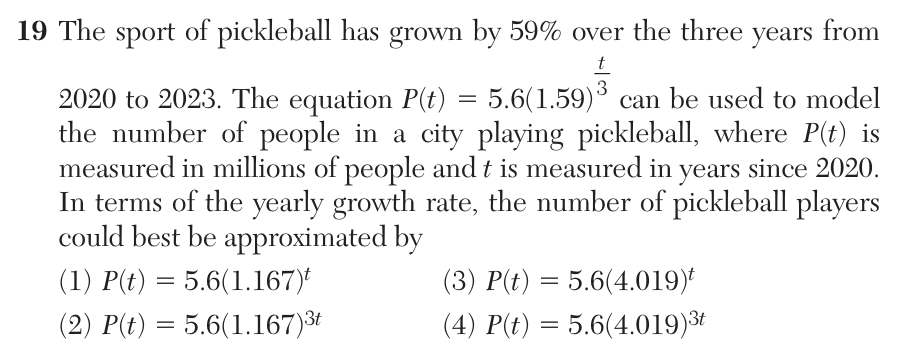
Worked solution for question 19
- One year is one third of the three-year interval, so take the cube root of 1.59.
- This gives about 1.167, and t counts the number of annual steps.
Answer choice 1P(t) ≈ 5.6(1.167)ᵗ
Q20 Complex roots by completing the square
Solve (x² + 7)/2 = −x.
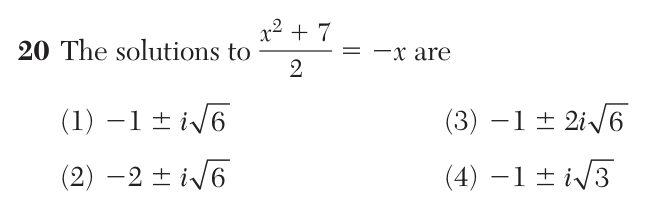
Worked solution for question 20
- Multiply by 2 and rearrange to x² + 2x = −7.
- Add 1 to make (x + 1)² = −6. Take both complex square roots and subtract 1.
Answer choice 1x = −1 ± i√6
Q21 Factor a sextic
Factor x⁶ − 63x³ − 64 completely.
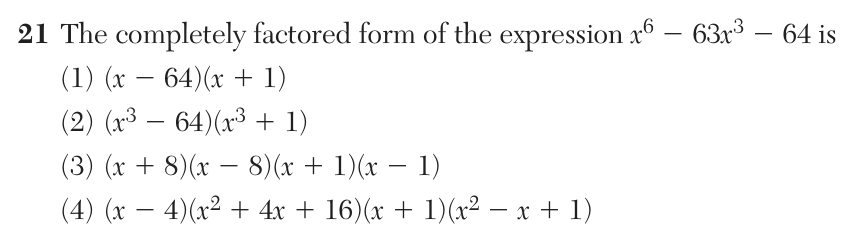
Worked solution for question 21
- Use u = x³ to factor u² − 63u − 64 = (u − 64)(u + 1).
- Apply the difference-of-cubes formula to x³ − 4³ and the sum-of-cubes formula to x³ + 1³.
- Each quadratic factor has negative discriminant, so neither factors further over the reals.
Answer choice 4(x − 4)(x² + 4x + 16)(x + 1)(x² − x + 1)
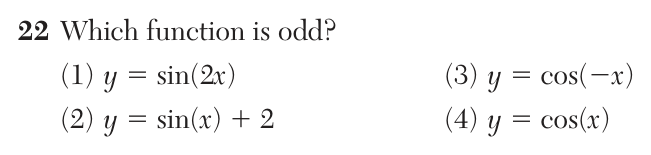
Q22 Identify an odd function
Which of the listed sine and cosine functions is odd?
Worked solution for question 22
- Replacing x with −x gives sin(−2x) = −sin(2x), meeting the odd-function test.
- Cosine is even, and the vertically shifted sine has nonzero output at x = 0.
Answer choice 1y = sin(2x)
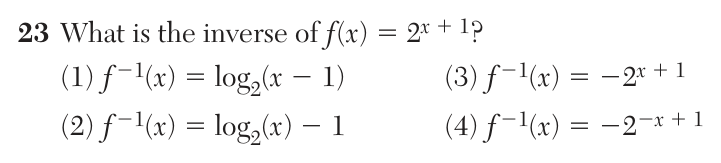
Q23 Inverse of a shifted exponential
Find the inverse of f(x) = 2^(x + 1).
Worked solution for question 23
- Exchange input and output to get x = 2^(y + 1).
- Taking log base 2 gives log₂(x) = y + 1. Subtract 1 to isolate y.
Answer choice 2f⁻¹(x) = log₂(x) − 1, x > 0
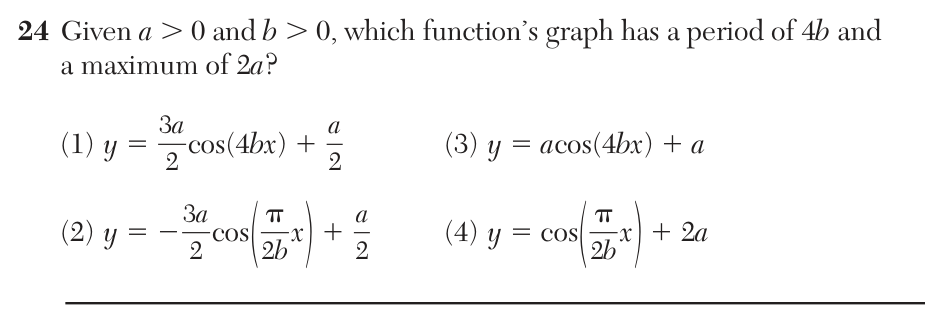
Q24 Match period and maximum
Choose a sinusoid with period 4b and maximum 2a for a, b > 0.
Worked solution for question 24
- Angular frequency π/(2b) gives period 2π divided by that value, which is 4b.
- The amplitude is 3a/2 and the midline is a/2, so the maximum is their sum 2a. The negative coefficient places maxima where cosine equals −1.
Answer choice 2y = −(3a/2) cos(πx/(2b)) + a/2
Part II Short response
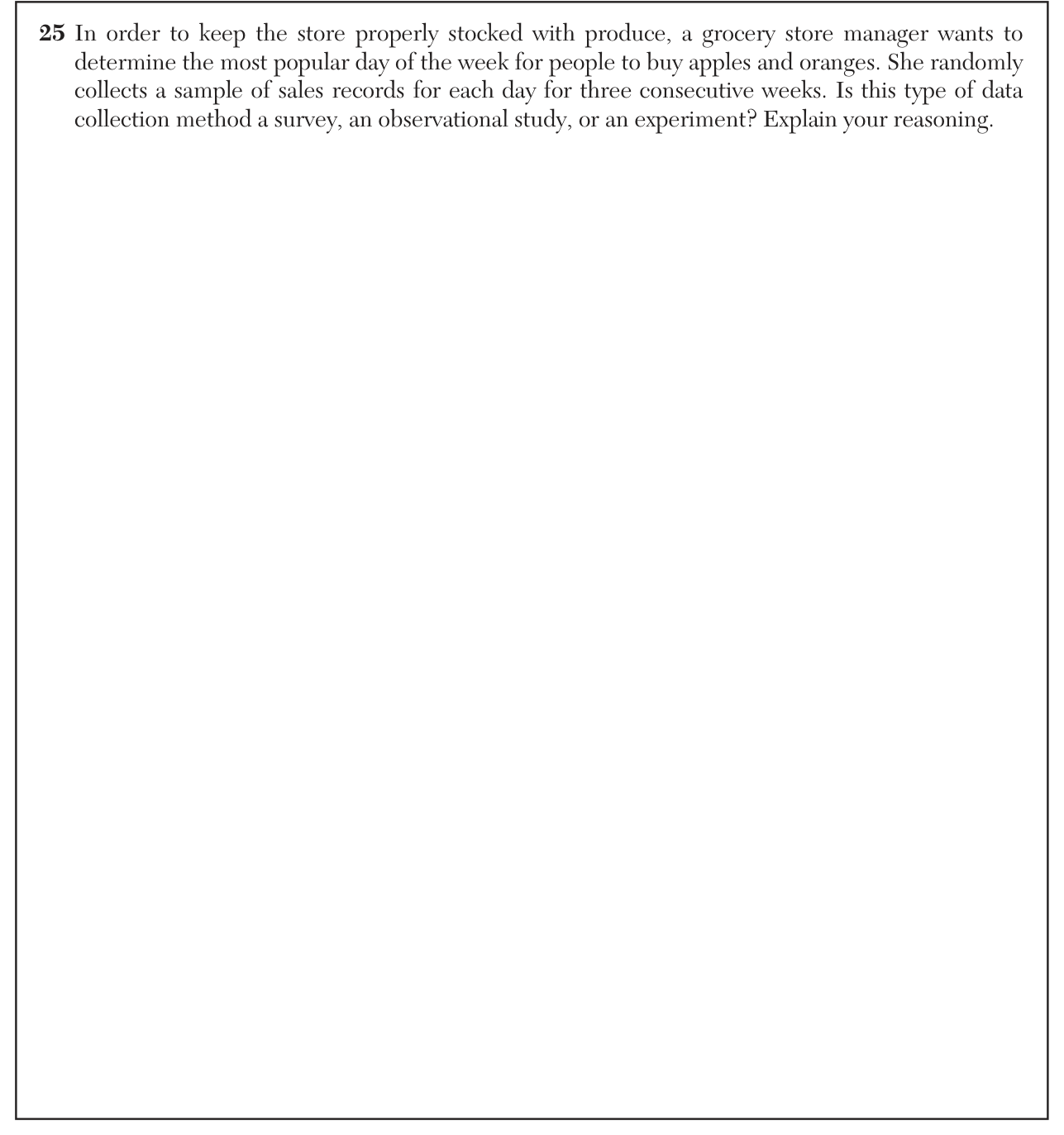
Question indexQ25 Classify a study design
A store manager randomly selects existing daily sales records to compare produce sales. Classify the method.
Worked solution for question 25
- The manager reads records of behavior that already occurred. No buying condition was assigned or changed.
- Random selection is sampling. The data also come from records instead of asking shoppers to respond.
Final answerObservational study
Q26 Subtract two functions
Find f(x) − g(x) for f(x) = 2x² + 3x − 7 and g(x) = 2x − 5.

Worked solution for question 26
- Distribute the subtraction across both terms of g to get 2x² + 3x − 7 − 2x + 5.
- Combine the x terms and the constants.
Final answer2x² + x − 2
Q27 Cubic zeros by grouping
Find the zeros of x³ − 4x² − 9x + 36 algebraically.

Worked solution for question 27
- Group x²(x − 4) − 9(x − 4), then factor (x − 4)(x² − 9).
- Factor the difference of squares and set each of the three linear factors to zero.
Final answer−3, 3 and 4
Q28 Translate a piecewise graph
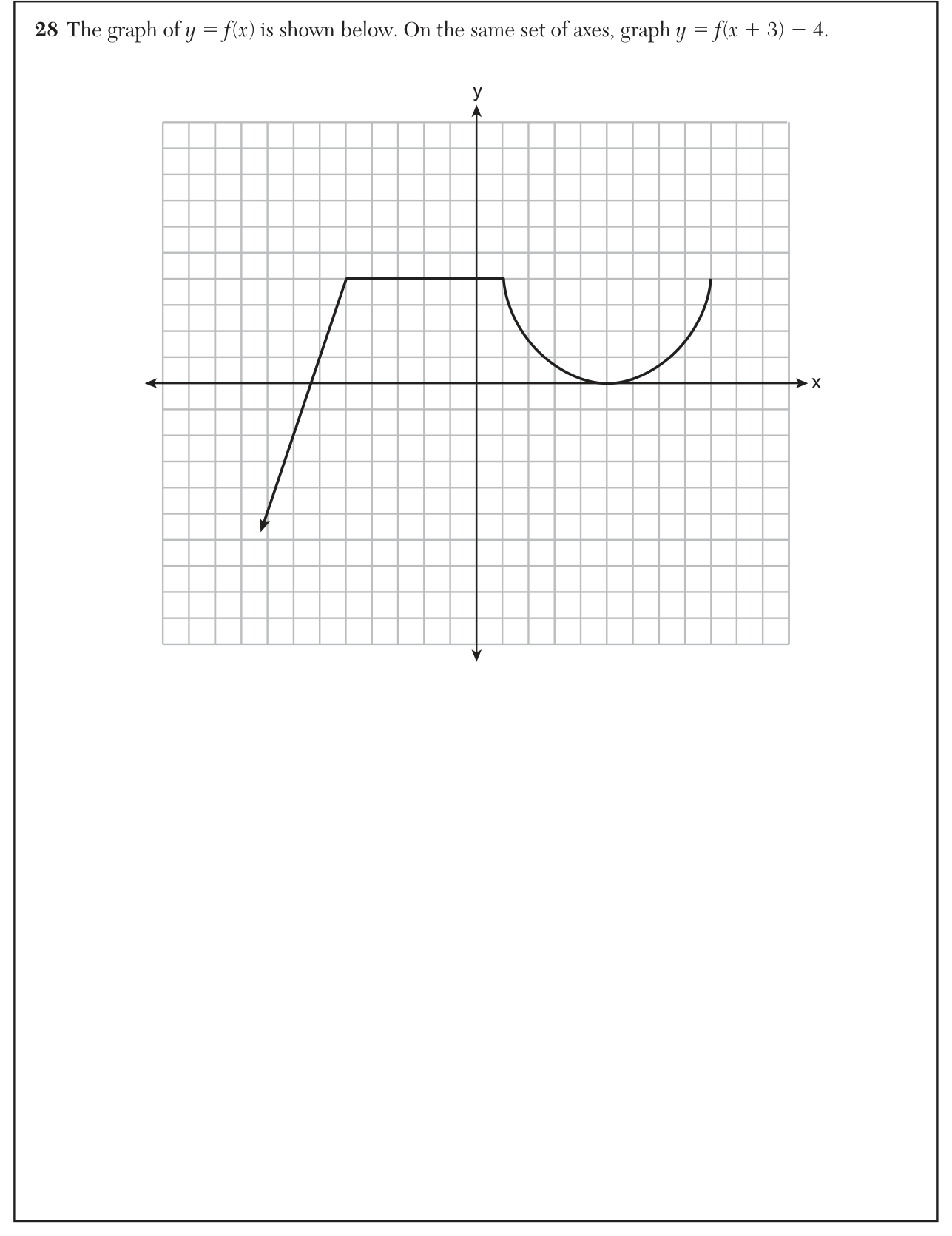
Graph y = f(x + 3) − 4 using the supplied line, flat segment and lower semicircle.
Worked solution for question 28
- Apply (x, y) ↦ (x − 3, y − 4) to each key point.
- The flat segment moves from (−5, 4)–(1, 4) to (−8, 0)–(−2, 0). The semicircle’s low point (5, 0) goes to (2, −4), and its right endpoint (9, 4) goes to (6, 0).
- Keep the same slopes and curvature. The increasing ray still extends down and left from the flat segment.
- Three control points locate the semicircle after translation. Its center moves from (5, 4) to (2, 0), its radius stays 4, and the shown arc is the lower half of that circle.
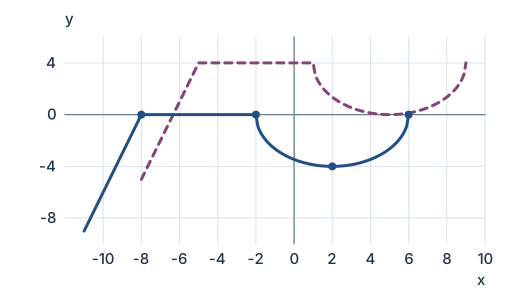
Final answerTranslate the entire graph left 3 and down 4.
Q29 Square a complex number
Express (−2 + √(−25))² in a + bi form.

Worked solution for question 29
- Replace √(−25) with 5i and expand (−2 + 5i)² = 4 − 20i + 25i².
- Since i² = −1, the real part is 4 − 25 = −21.
Final answer−21 − 20i
Q30 Half-life model
Start with 2.7 micrograms of cesium-137 and a 30-year half-life. Write the amount after t years.

Worked solution for question 30
- The initial amount occurs at t = 0. Every 30 years applies one factor of 1/2.
- The number of half-life periods is t/30, giving the exponent.
Final answerc(t) = 2.7(1/2)^(t/30)
Q31 Solve a finite summation
Find x if the sum of ax − 3 for a = 0, 1, 2, 3, 4 is 5.

Worked solution for question 31
- Combine the x-coefficients to get (0 + 1 + 2 + 3 + 4)x = 10x.
- The constant −3 occurs five times. Solve 10x − 15 = 5.
Final answerx = 2
Q32 Rewrite a continuous exponential
Express y = 5.381e^(0.214x) as a · bˣ, rounding to thousandths.

Worked solution for question 32
- The exponent law gives e^(0.214x) = (e^0.214)ˣ.
- Evaluate e^0.214 ≈ 1.23862 and round the base to 1.239.
Final answery ≈ 5.381(1.239)ˣ
Part III Extended response
Question indexQ33 Polynomial long division
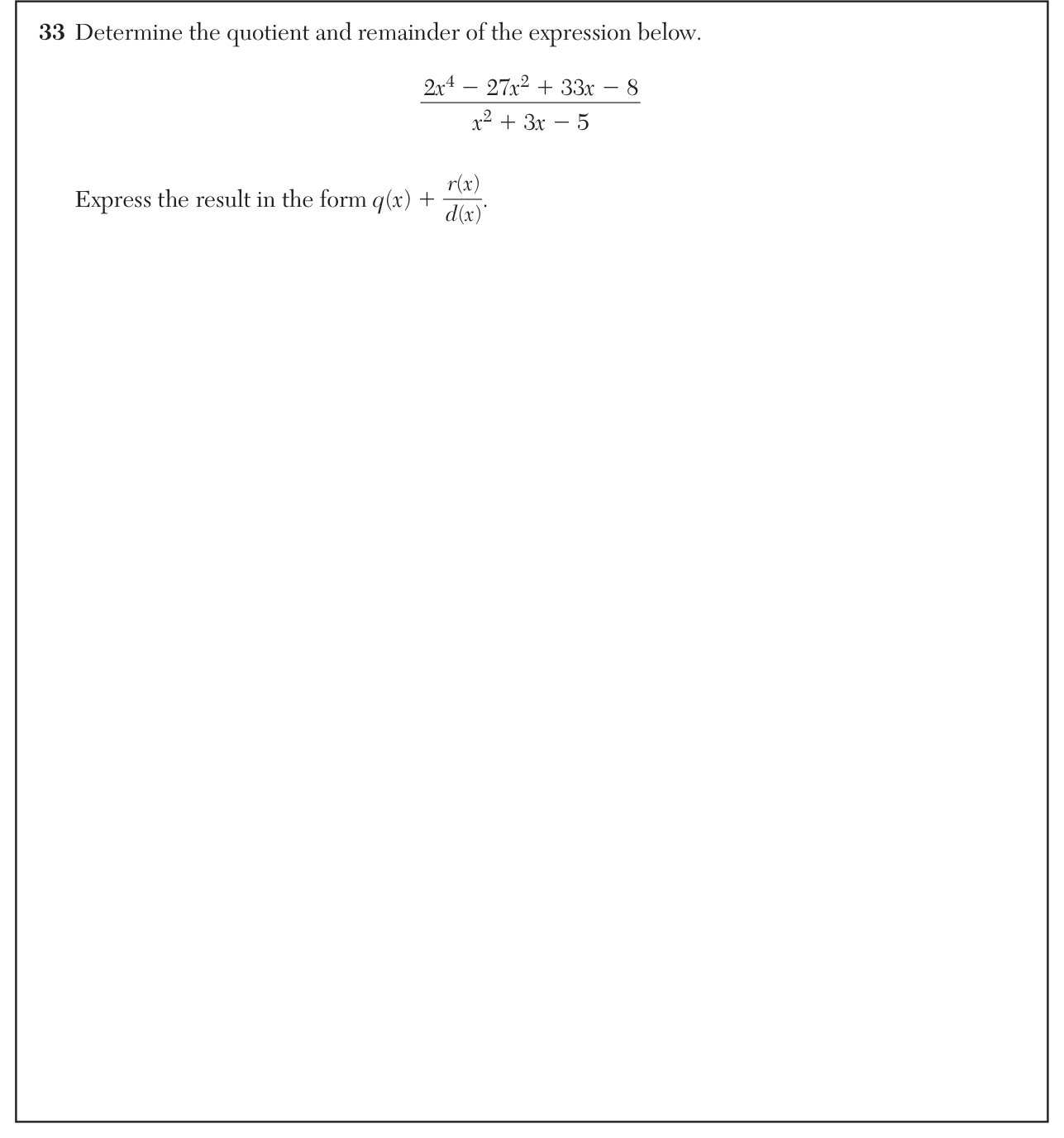
Divide 2x⁴ − 27x² + 33x − 8 by x² + 3x − 5 and write quotient plus remainder over divisor.
Worked solution for question 33
- Use a zero x³ term to keep degrees aligned. Subtract 2x² times the divisor to leave −6x³ − 17x² + 33x − 8.
- Subtract −6x times the divisor to leave x² + 3x − 8.
- Subtract one more copy of the divisor, leaving −3. The quotient is 2x² − 6x + 1.
- A useful check is to multiply the divisor by the quotient and add −3. The x³ terms cancel and the constant becomes −5 − 3 = −8, as in the dividend.
Final answer2x² − 6x + 1 − 3/(x² + 3x − 5)
Q34 Read a sinusoidal graph
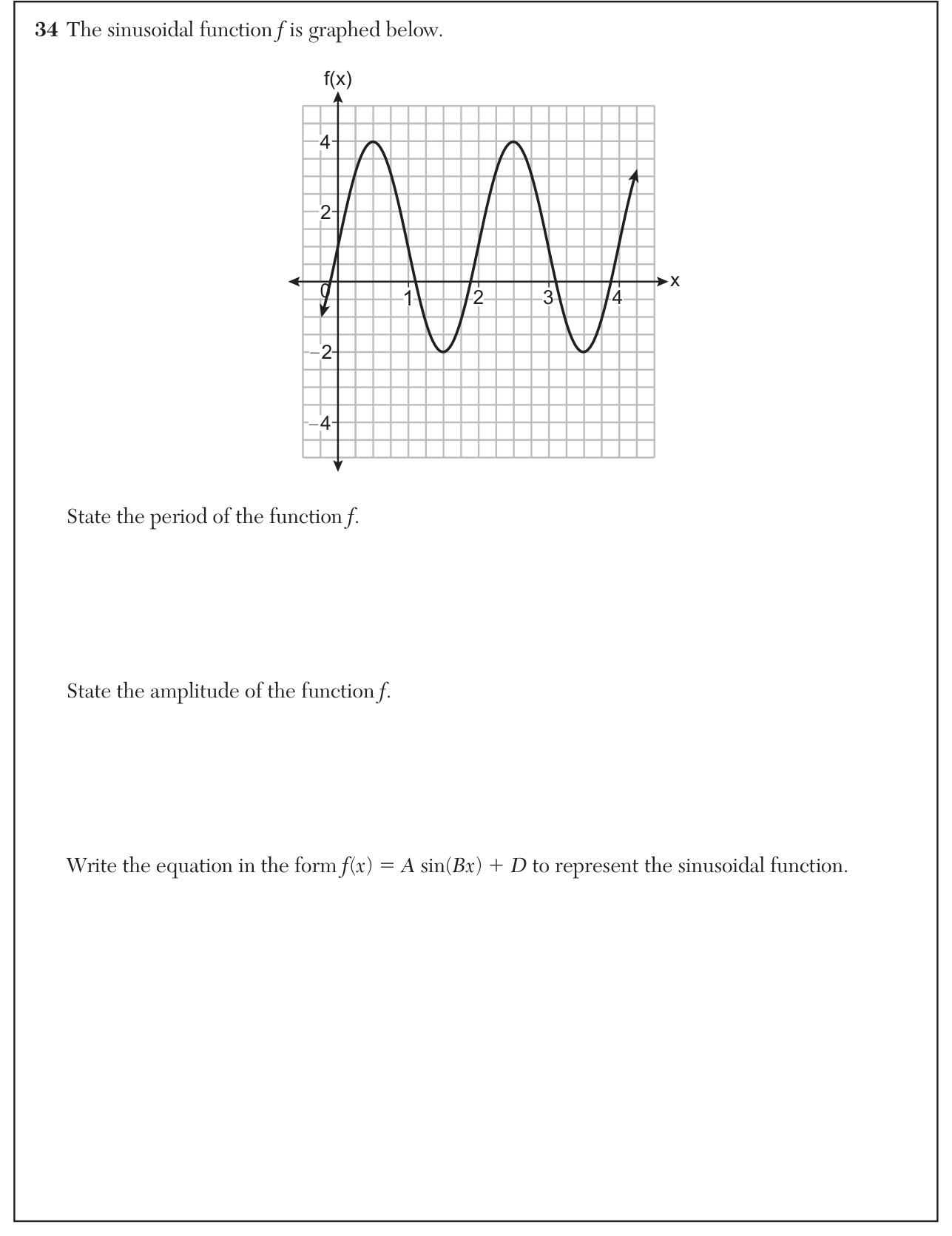
Use the graphed sinusoid to find its period, amplitude and a sine model.
Worked solution for question 34
- The graph ranges from −2 to 4, so its amplitude is (4 − (−2))/2 = 3 and its midline is y = 1.
- Two units separate consecutive peaks, so B = 2π/2 = π.
- At x = 0, the graph crosses the midline going up, matching positive sine with no horizontal shift.
Final answerPeriod 2, amplitude 3, f(x) = 3 sin(πx) + 1
Q35 Simulation interval
Simulated sample proportions have mean 0.652 and SD 0.031. Estimate the middle 95% and assess whether fewer than half of parents restrict phones.
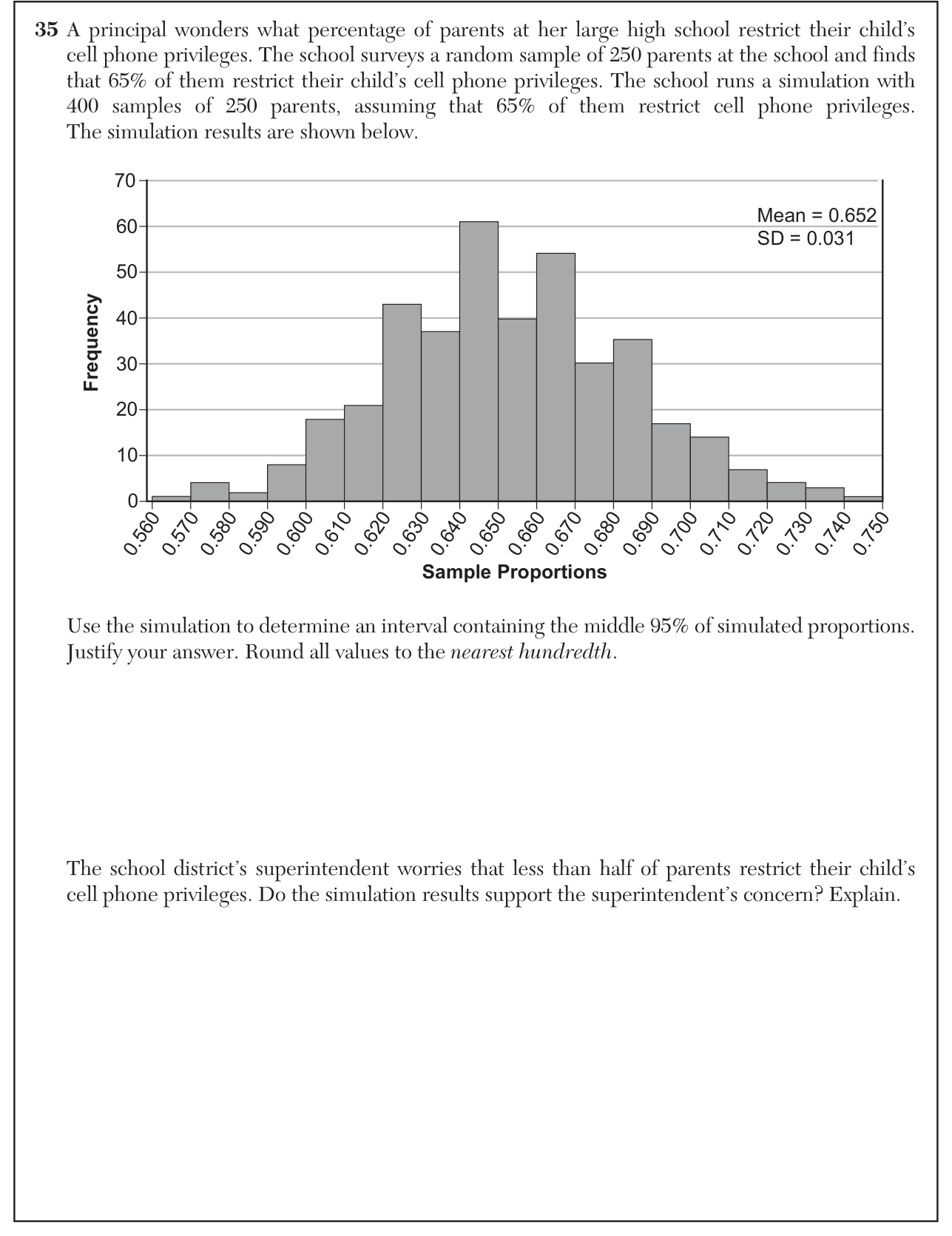
Worked solution for question 35
- Using the approximately bell-shaped simulation, take mean ± 2 SD to get endpoints 0.652 ± 0.062, or 0.590 and 0.714.
- After rounding, the interval lies entirely above 0.50. Values below half are outside this central range under the simulation model.
Final answerApproximately (0.59, 0.71). The simulation does not support the concern.
Part IV Long response
Question indexQ36 Exponential cooling
For T(x) = 110e^(−0.0453x) + 74, find the initial temperature, average change over five minutes and time to reach 120°F.
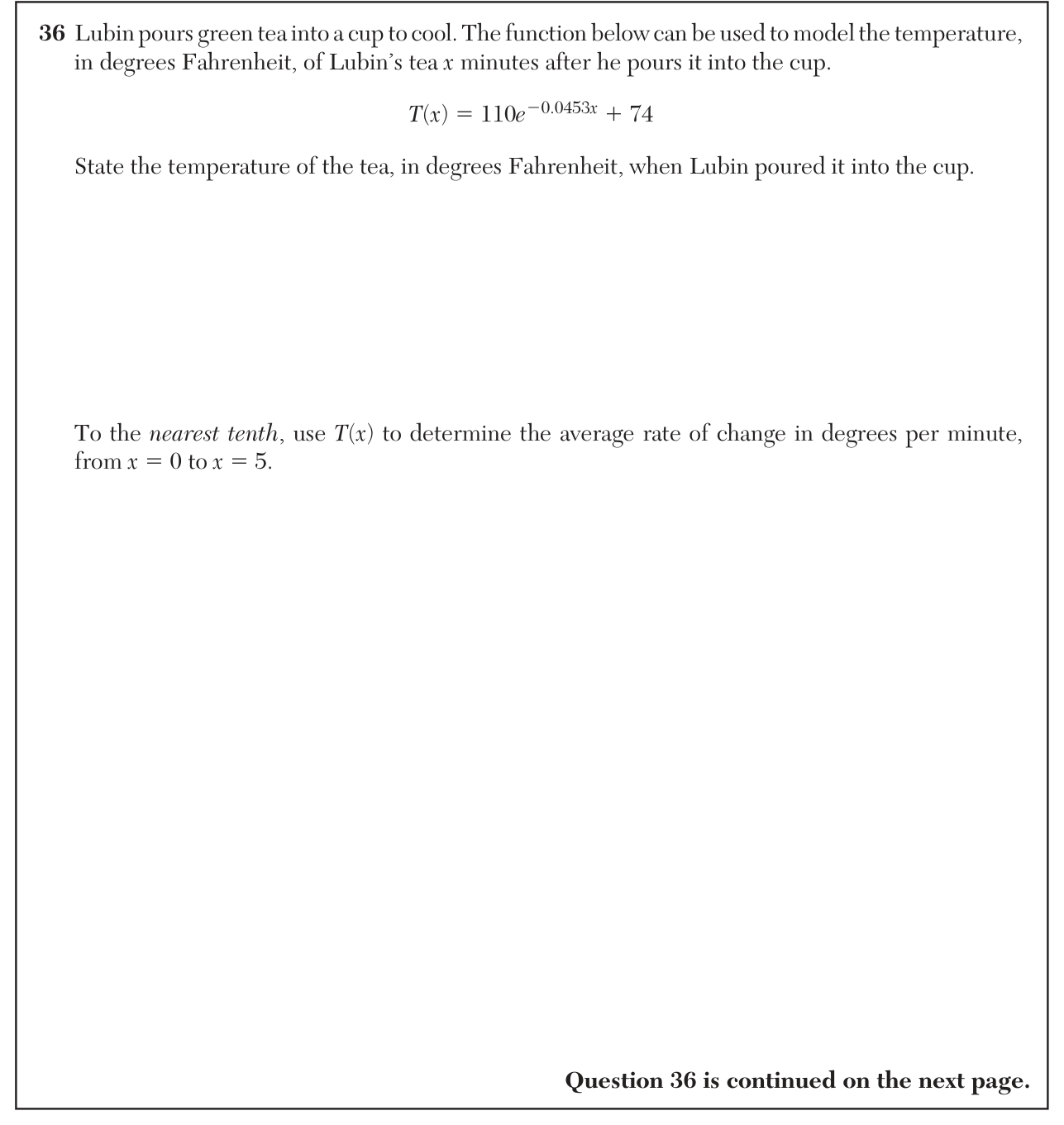
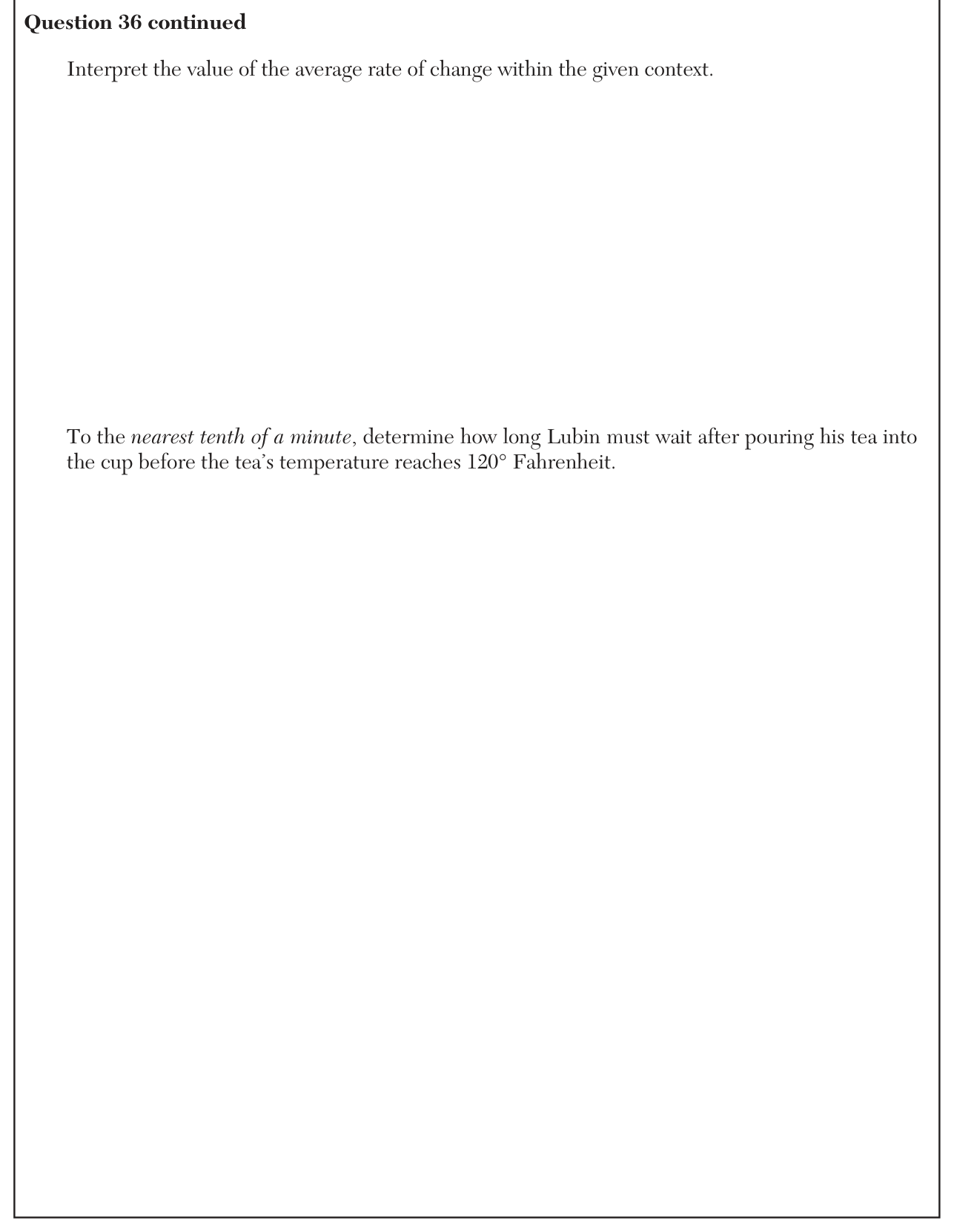
Worked solution for question 36
- At x = 0, e⁰ = 1, so T(0) = 184. At x = 5, T(5) ≈ 161.71.
- Compute (T(5) − 184)/5 ≈ −4.46. The tea cools by about 4.5°F per minute on average during the first five minutes.
- Set T(x) = 120 and isolate e^(−0.0453x) = 46/110. Then x = ln(46/110)/(−0.0453) ≈ 19.2.
- The model approaches 74°F from above as time increases. Because 120°F lies between 184°F and 74°F, the cooling curve crosses the target once.
Final answer184°F initially. Average change −4.5°F/min. About 19.2 minutes to reach 120°F.
From the New York State Education Department. August 2026 Algebra II Regents Examination. Internet. Available from https://www.nysedregents.org/algebratwo/826/algtwo-82026-exam.pdf. Accessed .