NEW YORK STATE REGENTS · U.S. HISTORY AND GOVERNMENT
January 2026 U.S. History and Government Regents Past Paper & Solutions
Work through the Great Depression, Erie Canal and Prohibition with a question-by-question walkthrough of the exam.
- 37 worked questions
- 3 writing models
- 4 exam sections
The question images and page numbers come from the regular-size English exam. OnlyPrepy wrote the summaries and worked solutions.
Quick answer key for Part I
Part I Multiple choice
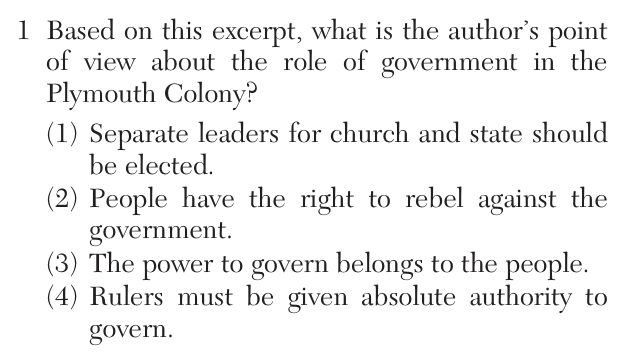
Question indexQ1 Plymouth self-government
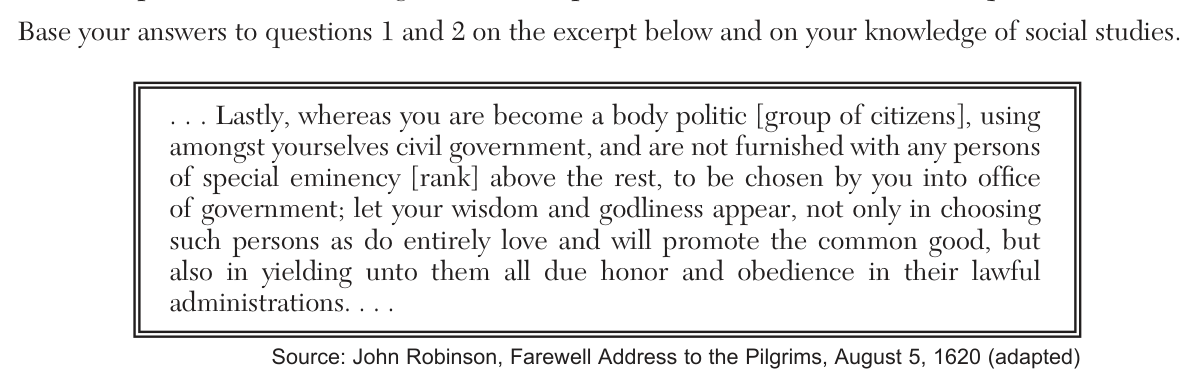
What gives rulers legitimate power in Robinson’s 1620 address?
Worked solution for question 1
- Robinson tells colonists to choose officials committed to the common good.
- Their obedience is owed to lawful administration, consistent with government by consent.
- The signers’ agreement creates an authority to make rules and a promise to obey them. The important evidence is that both steps come from the participants themselves.
Answer choice 3The people are the source of governing power.
Q2 Mayflower Compact
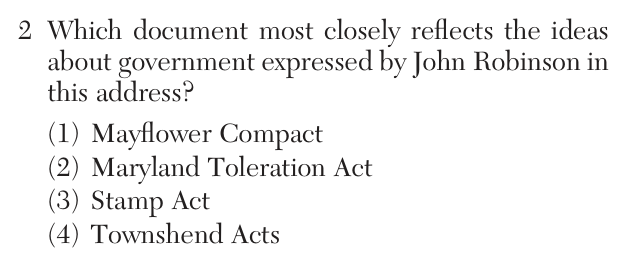
Which founding document reflects Robinson’s advice?
Worked solution for question 2
- The Pilgrims agreed to form a civil body and make rules for their settlement.
- A community agreeing to govern itself matches Robinson’s account of the body politic.
Answer choice 1Mayflower Compact
Q3 Ratification debate
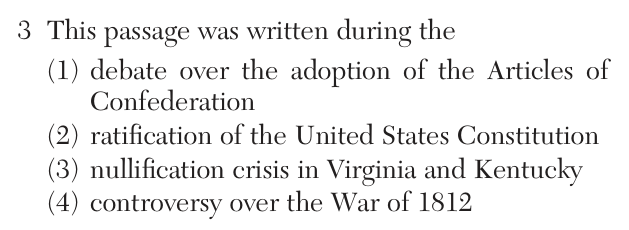
When was Centinel’s criticism written?
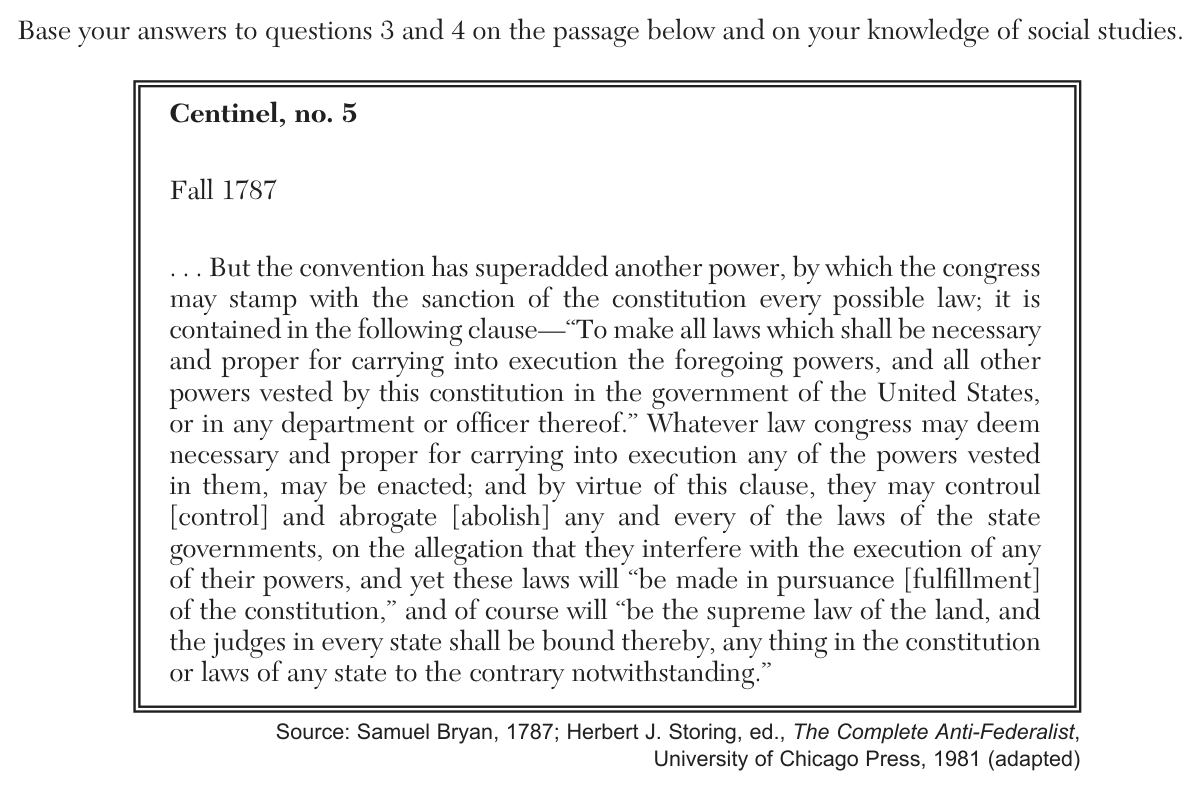
Worked solution for question 3
- The date is 1787 and the author discusses powers in the proposed document.
- This was the period when Federalists and Anti-Federalists disputed adoption.
- Separate writing the Constitution from getting it approved. The public argument about whether to adopt the proposed system belongs to the ratification stage.
Answer choice 2During debate over ratifying the Constitution
Q4 Necessary and proper clause
What danger does Centinel see in the proposed Constitution?
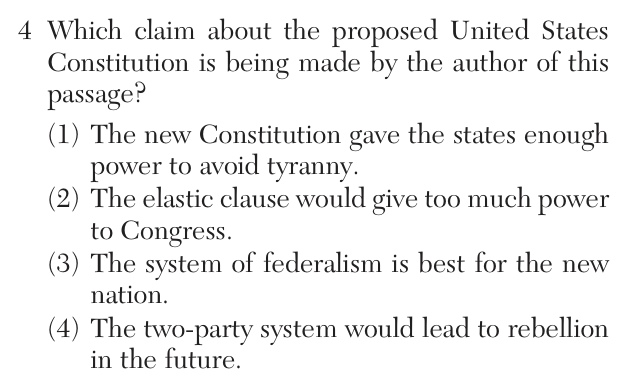
Worked solution for question 4
- The author argues Congress could define many laws as necessary to carry out its powers.
- Federal supremacy could then displace state laws, the danger an Anti-Federalist feared.
Answer choice 2The elastic clause gives Congress too much power.
Q5 Jackson’s case for removal
What benefit does Jackson claim for removal?
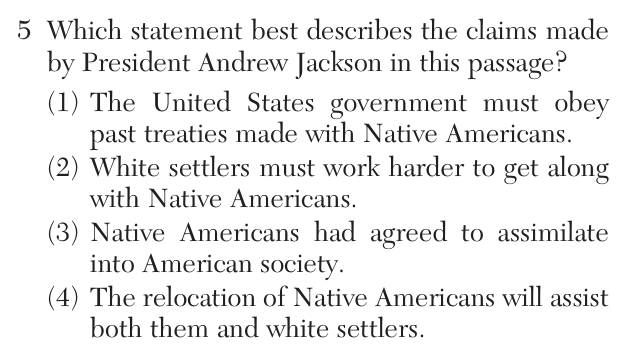
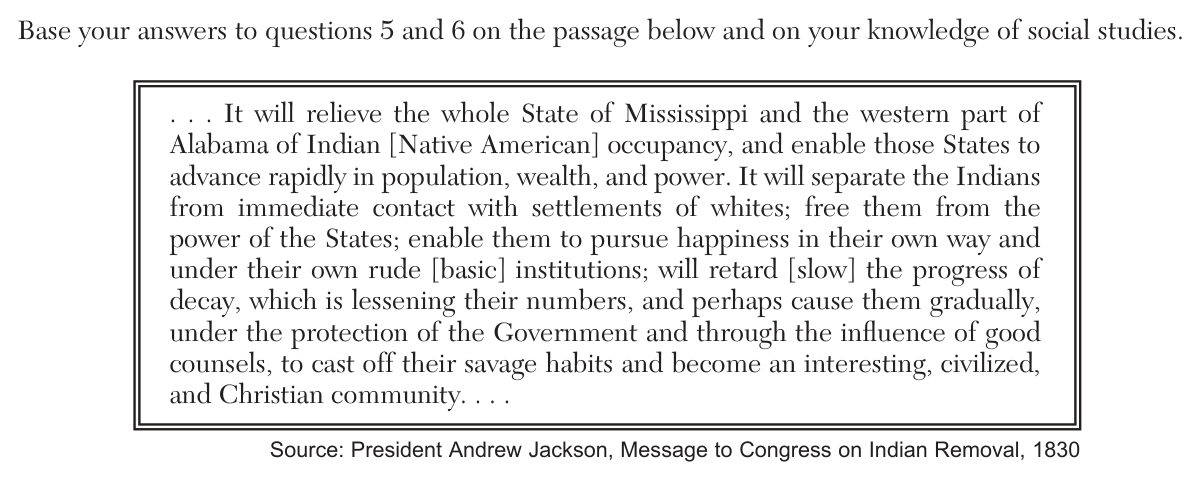
Worked solution for question 5
- He predicts more land and growth for Mississippi and Alabama, and portrays separation as protection for Native communities.
- This identifies the president’s justification in the speech.
- Identify the claim as Jackson’s defense of his policy. His stated benefits help explain how he justified removal, even though forced relocation later caused dispossession and deaths.
Answer choice 4Jackson claims relocation helps both Native peoples and white settlers.
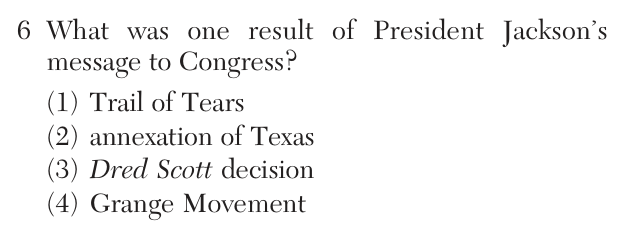
Q6 Trail of Tears
What was a consequence of federal Indian removal?
Worked solution for question 6
- The Indian Removal Act authorized relocation agreements, which the government used to press southeastern nations westward.
- The forced removal of Cherokee people in 1838–39 became known as the Trail of Tears.
Answer choice 1Trail of Tears
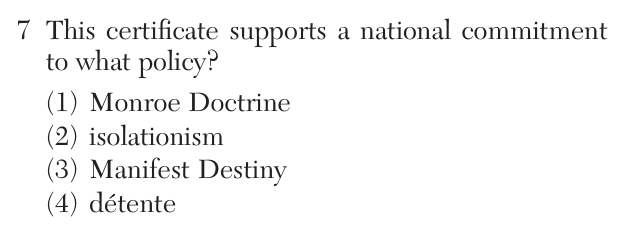
Q7 Homesteading and expansion
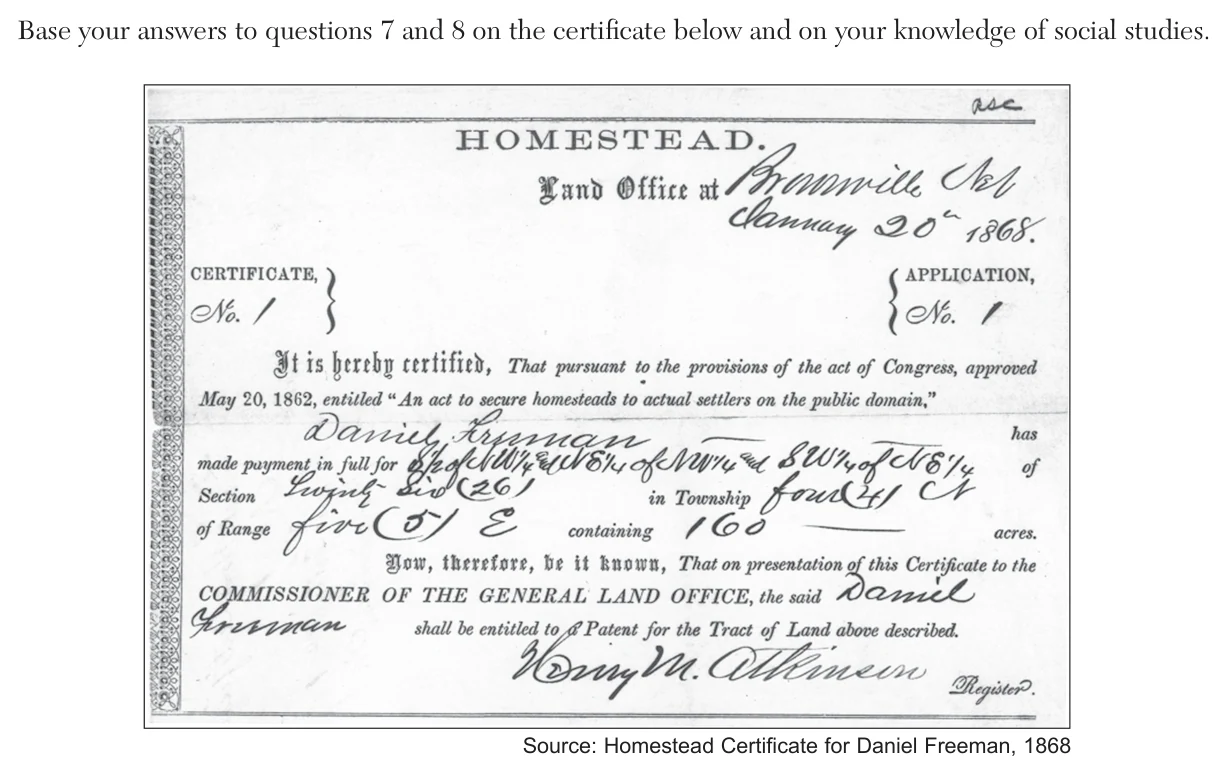
What national policy does the homestead certificate support?
Worked solution for question 7
- A federal land title rewarded settlement on western land.
- That policy translated the broader belief in continental expansion into an incentive to move.
- Federal land policy helped make westward migration feasible by rewarding settlement. Manifest Destiny supplied the wider belief that expansion across the continent was justified.
Answer choice 3Manifest Destiny
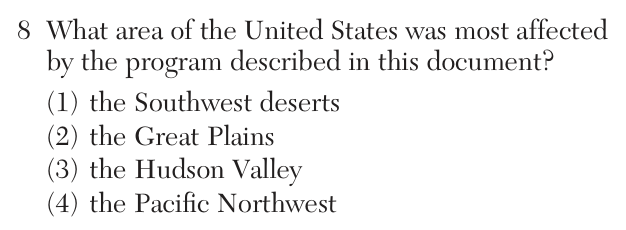
Q8 Geography of homesteading
Which region was particularly affected by the land program?
Worked solution for question 8
- Large areas of prairie were opened to homesteading and farming.
- The Plains became a major destination for people claiming federal land.
Answer choice 2The Great Plains
Q9 Plessy’s legal rule
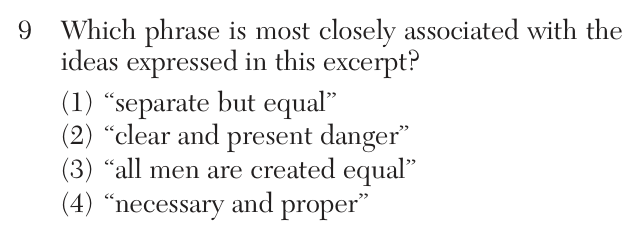
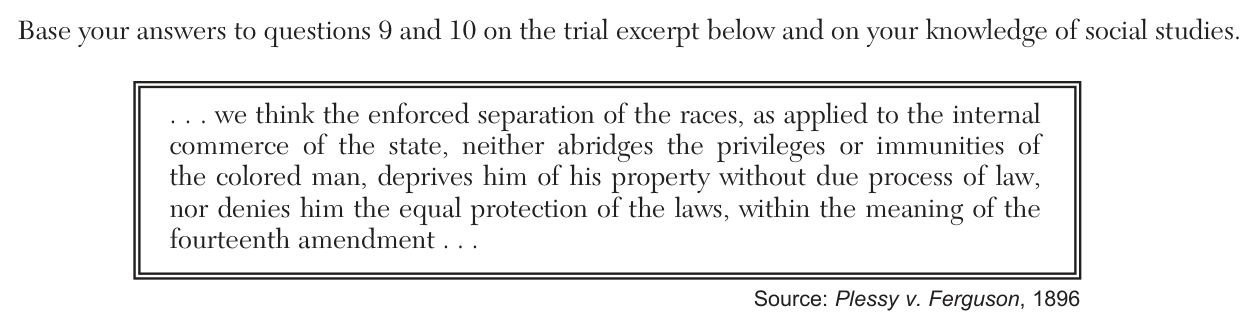
Which doctrine is associated with the quoted ruling?
Worked solution for question 9
- The Court said required racial separation could coexist with the Fourteenth Amendment’s equal protection guarantee.
- That reasoning sustained the doctrine attached to Plessy.
- The Court treated segregation as constitutionally permissible if separate facilities were equal. This is the legal rule the case established, distinct from the actual inequality under Jim Crow.
Answer choice 1Separate but equal
Q10 Impact of Plessy
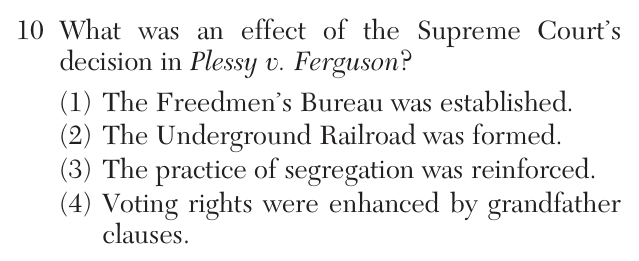
What did the ruling reinforce?
Worked solution for question 10
- By upholding Louisiana’s separate-car law, the Court validated legally segregated facilities.
- The decision supplied constitutional cover for Jim Crow measures.
Answer choice 3Racial segregation
Q11 Riis and tenement reform
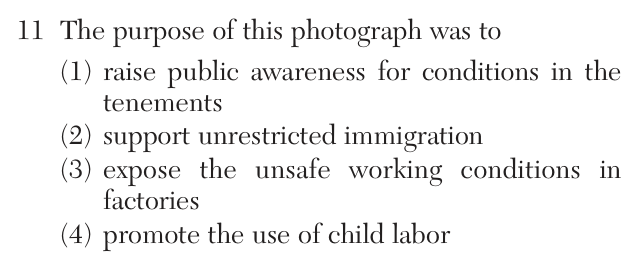
What was Riis trying to accomplish with the photograph?
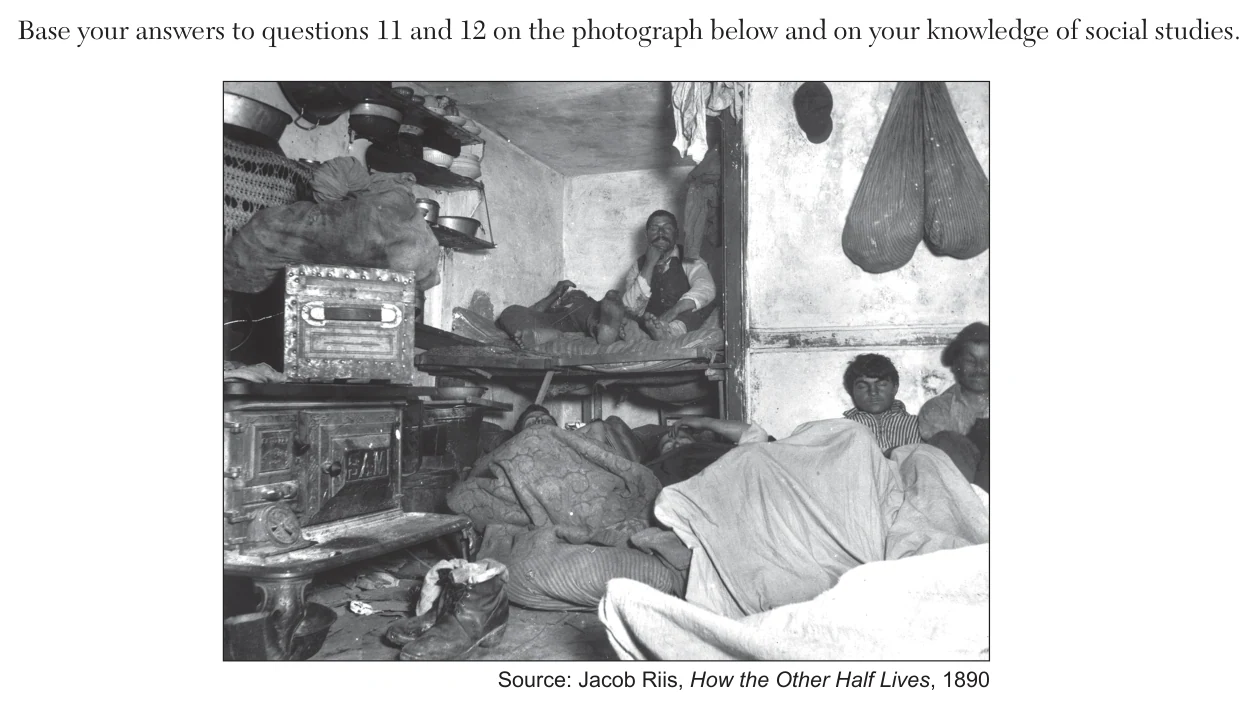
Worked solution for question 11
- Riis documented the daily living conditions of poor urban residents.
- Showing overcrowding or deprivation made housing problems visible to people outside the tenements.
- Showing urban living conditions to an audience unfamiliar with them is part of the reform method. Riis used that exposure to make housing problems harder for the public and officials to ignore.
Answer choice 1Raise awareness of tenement conditions
Q12 Progressive reform
What policy would a reader influenced by Riis likely favor?
Worked solution for question 12
- The conditions Riis exposes require remedies beyond an individual household’s resources.
- Progressive reformers supported measures such as municipal housing standards and safety rules.
Answer choice 4Government action on social and economic problems
Q13 The Maine in the press
Why would newspapers print images of the Maine before and after its destruction?
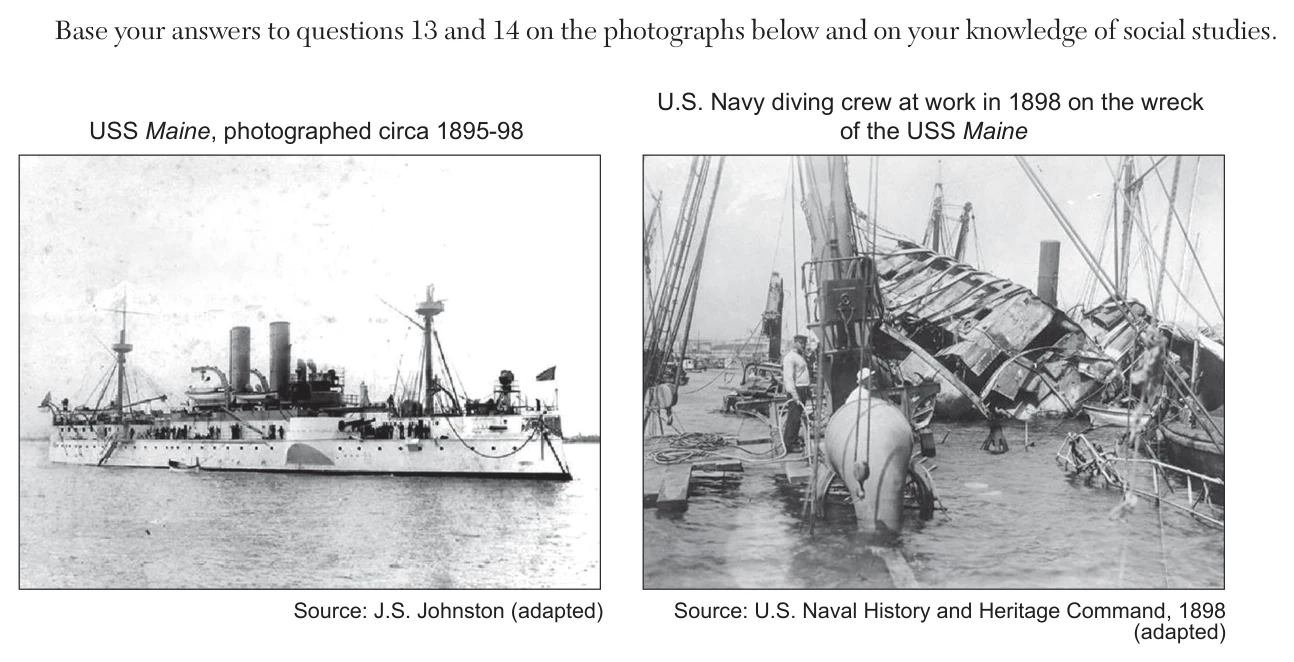
Worked solution for question 13
- Pictures of a ship and its wreck make a dramatic story more immediate.
- Competition for readers encouraged sensational coverage during the crisis.
- Look at the economic incentive of a newspaper publisher. An alarming treatment of the explosion attracts attention and encourages circulation, even when the cause is still uncertain.
Answer choice 1To increase sales
Q14 Pressure for war in 1898
What effect did the Maine’s destruction have on U.S. public opinion?
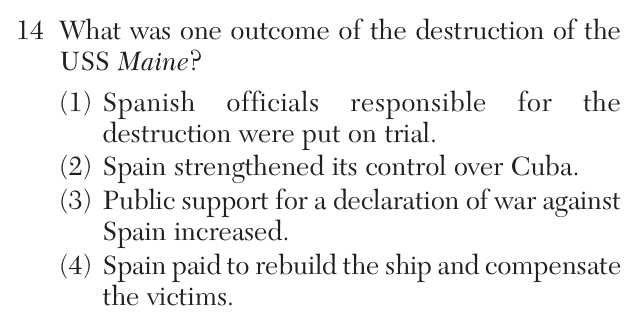
Worked solution for question 14
- News coverage and public anger intensified pressure to intervene in Cuba.
- That political effect does not establish who caused the explosion.
Answer choice 3It increased support for war with Spain.
Q15 Constitutional authority over trusts
Which power supports Roosevelt’s proposed regulation?
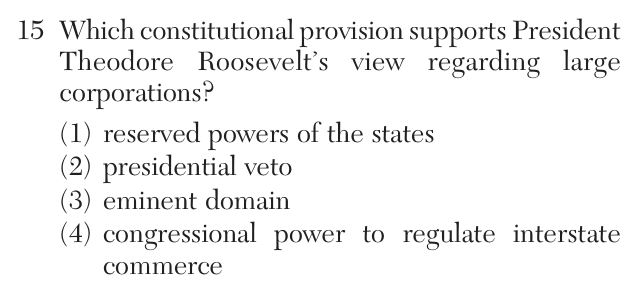
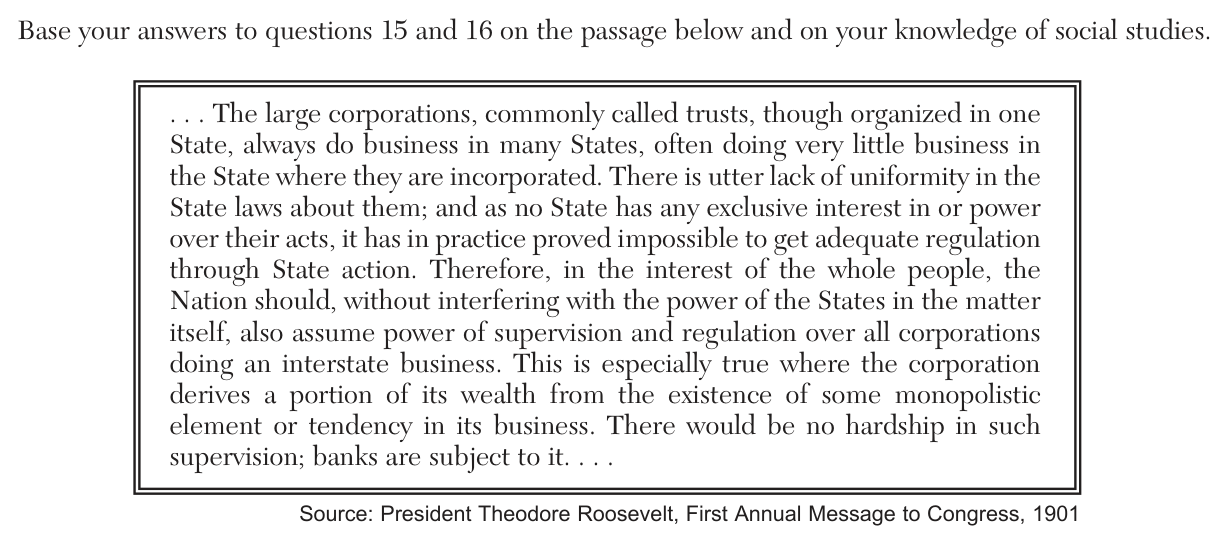
Worked solution for question 15
- The corporations operate across state boundaries despite being registered in one state.
- Their interstate business is the direct connection to the Commerce Clause.
- Trusts often did business across state boundaries. That scale is what connects national regulation to the constitutional authority to regulate interstate commerce.
Answer choice 4Congress’s power over interstate commerce
Q16 A break with laissez-faire
Which economic approach does Roosevelt challenge?
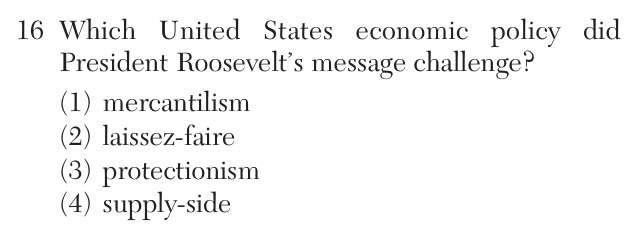
Worked solution for question 16
- He calls for national supervision of corporations that states struggle to regulate independently.
- That is a departure from leaving firms largely free of public intervention.
Answer choice 2Laissez-faire
Q17 Wilson abandons neutrality
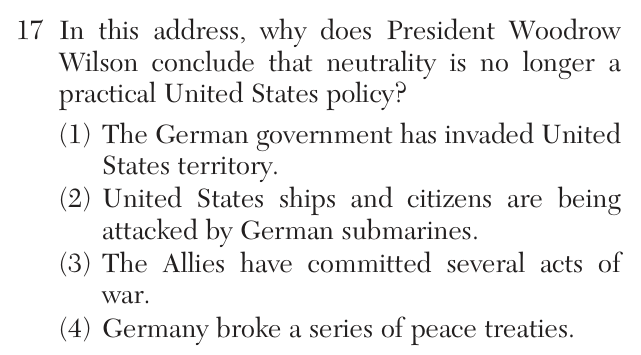
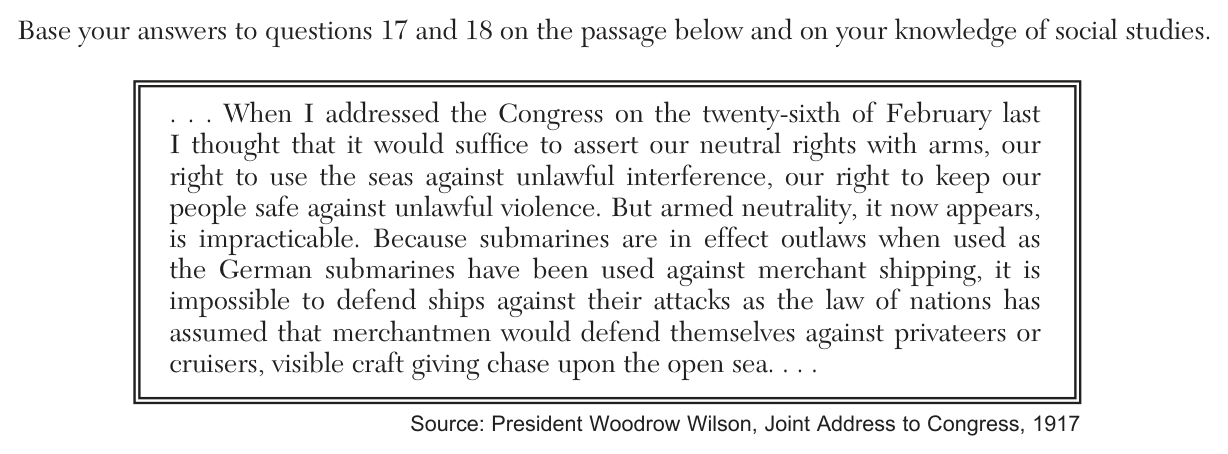
What made armed neutrality impracticable in Wilson’s account?
Worked solution for question 17
- Wilson says merchant ships could not defend themselves against submarines as they might against a visible ship.
- Unrestricted attacks undermined the ability to remain neutral while protecting commerce and lives.
- The distinction is between a conflict Americans could try to stay outside and attacks that put Americans and their trade at risk. That change helps explain the move away from neutrality.
Answer choice 2German submarine attacks on shipping threatened Americans.
Q18 War declaration
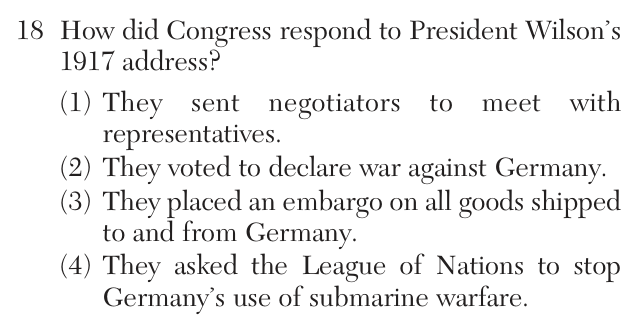
How did Congress respond to Wilson in 1917?
Worked solution for question 18
- Wilson asked Congress to recognize a state of war after concluding neutrality could not protect U.S. rights.
- Congress exercised its constitutional war-declaration power in April 1917.
Answer choice 2It declared war on Germany.
Q19 Social Security registration
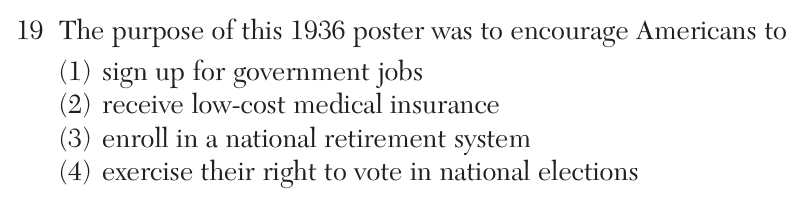
What is the 1936 poster encouraging?
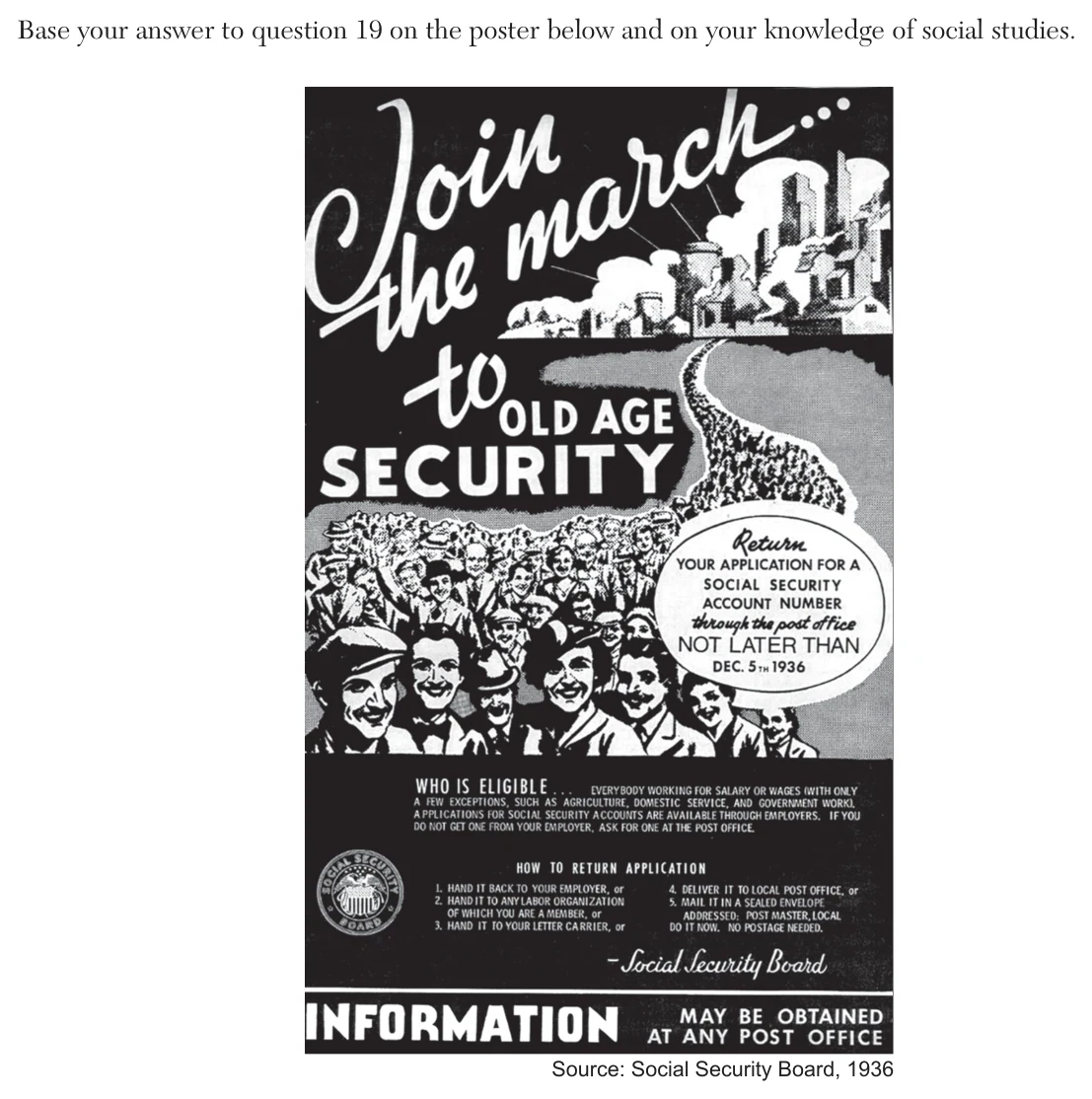
Worked solution for question 19
- The Social Security Board administered the new program established in 1935.
- Registration connected covered workers to an old-age benefits system, rather than providing jobs or voting registration.
- The act of registering points to joining a system that would track covered workers. The Social Security program connected that record to future old-age benefits.
Answer choice 3Enrollment in the national retirement system
Q20 Nuremberg accountability
What was the purpose of the trials?
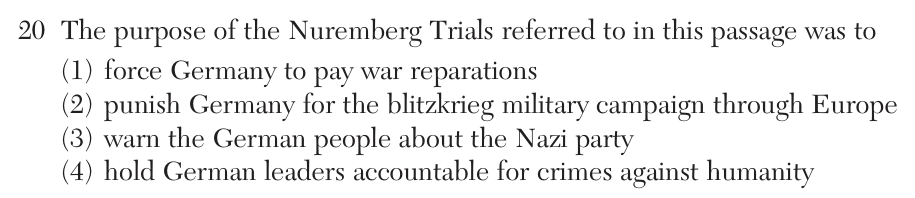
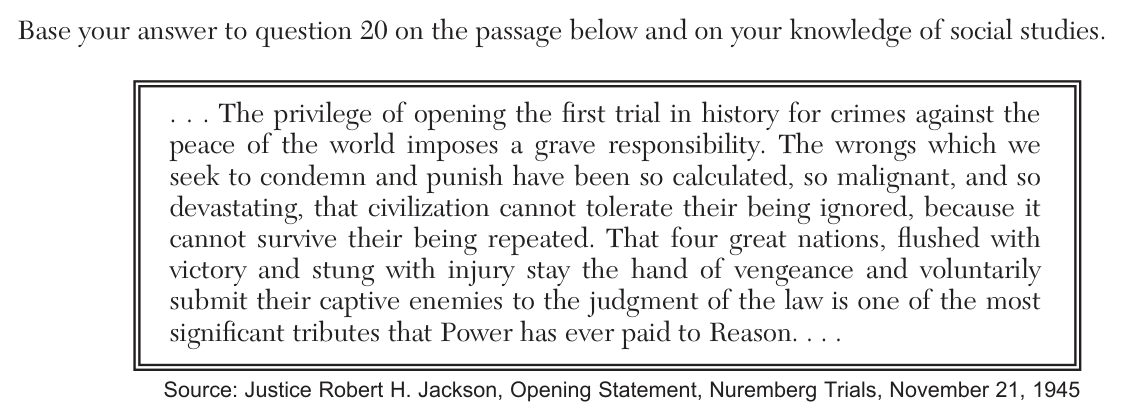
Worked solution for question 20
- Jackson contrasts applying law with taking vengeance on defeated enemies.
- The tribunal prosecuted individuals for grave crimes under international law.
Answer choice 4Hold Nazi leaders accountable for crimes against humanity.
Q21 Aid to Western Europe
How did the United States respond to the European division on the map?

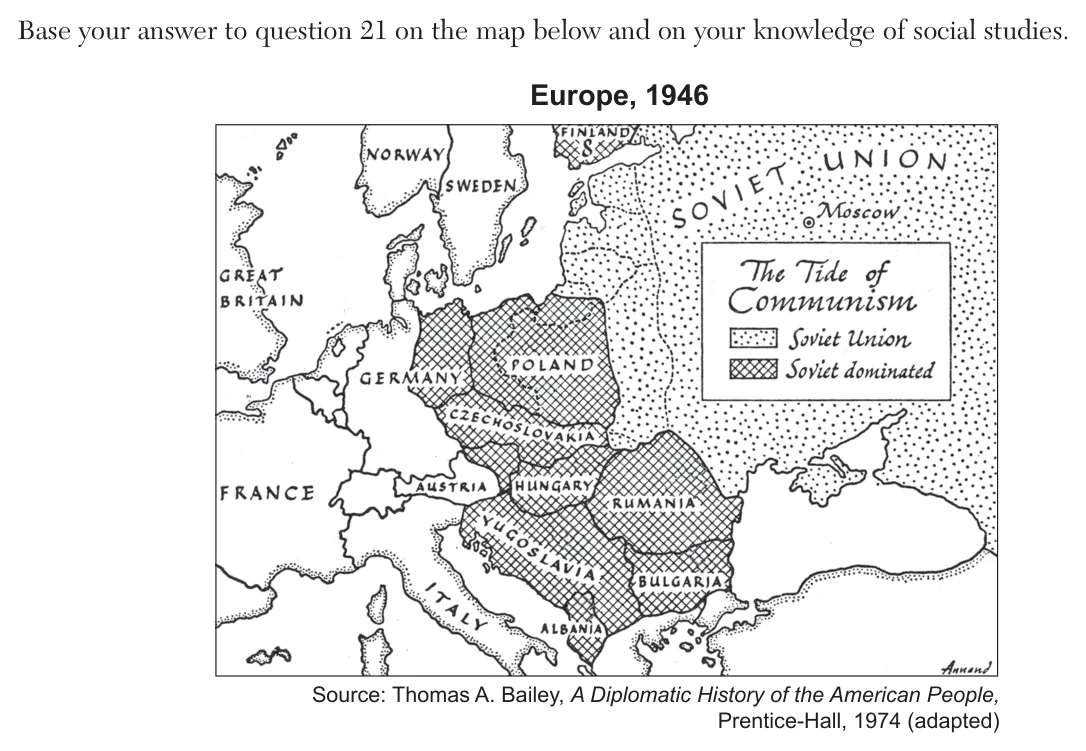
Worked solution for question 21
- With Soviet influence entrenched in the East, the United States supported recovery in Western Europe.
- The Marshall Plan made economic assistance part of containment.
- The aid addressed postwar shortages and weakened economies. The broader aim was to make Western Europe more stable at a time of competition with the Soviet Union.
Answer choice 1It offered economic aid to Western European nations.
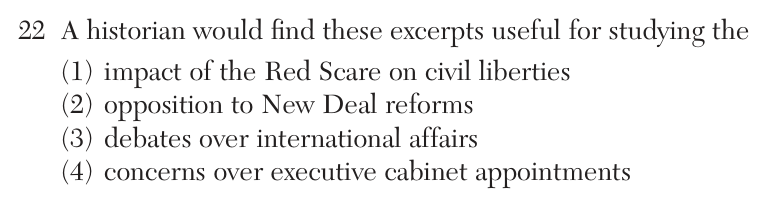
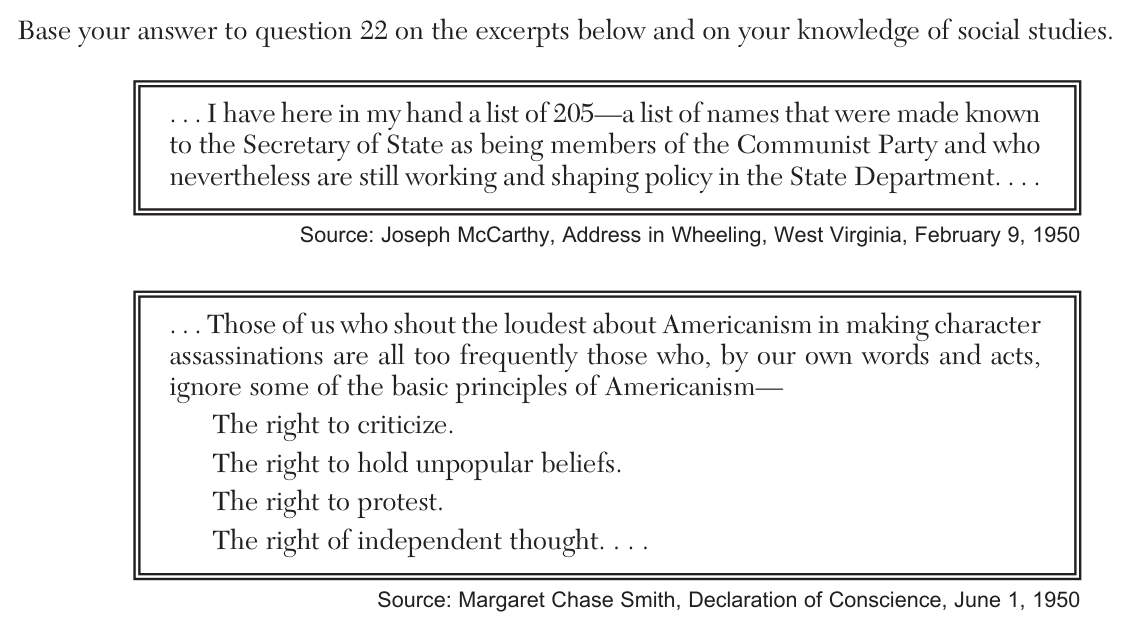
Q22 The Red Scare and liberty
What can a historian study by comparing McCarthy and Smith?
Worked solution for question 22
- McCarthy alleges Communist infiltration in government. Smith argues that public accusations can undermine dissent and independent thought.
- Together they show how anticommunism came into conflict with civil liberties.
Answer choice 1The effects of the Red Scare on civil liberties
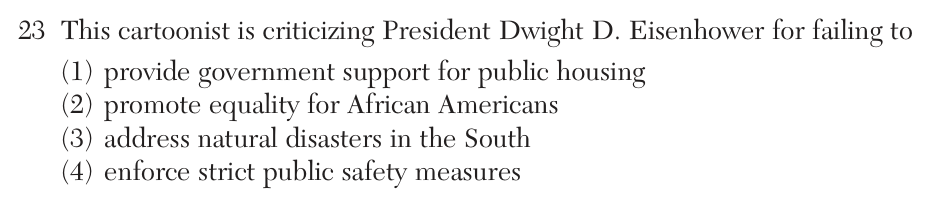
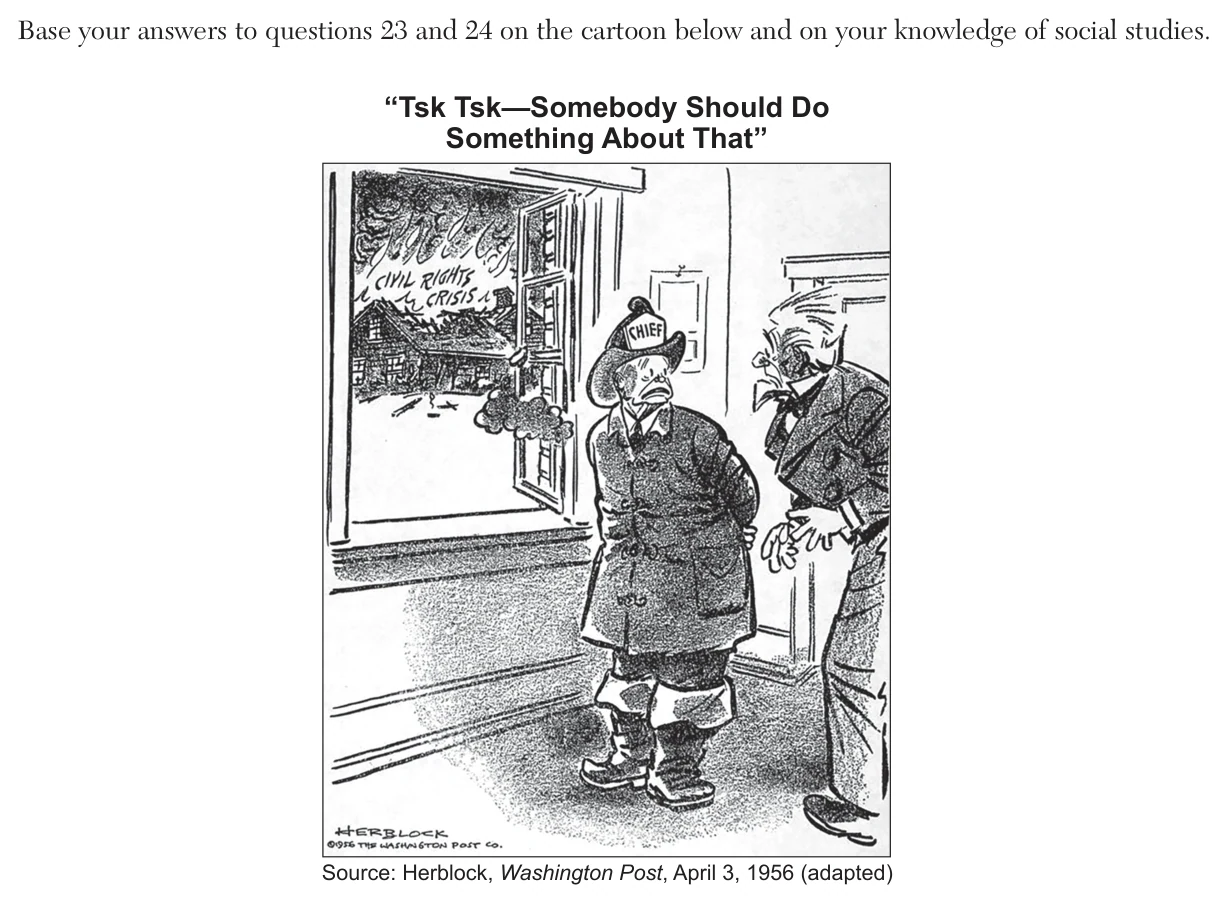
Q23 Herblock on civil rights
What is the criticism of Eisenhower in the cartoon?
Worked solution for question 23
- Herblock contrasts recognition of a problem with a failure to act forcefully.
- In the 1950s this criticism concerned federal leadership against segregation and discrimination.
Answer choice 2Insufficient action to promote racial equality
Q24 Federal troops in Little Rock
Why did Eisenhower send troops in 1957?

Worked solution for question 24
- Arkansas officials obstructed the admission of Black students to Central High School.
- Federal intervention enforced the court-ordered integration that followed Brown v. Board of Education.
Answer choice 1To enforce school desegregation
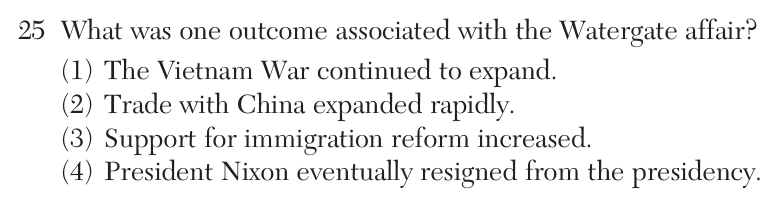
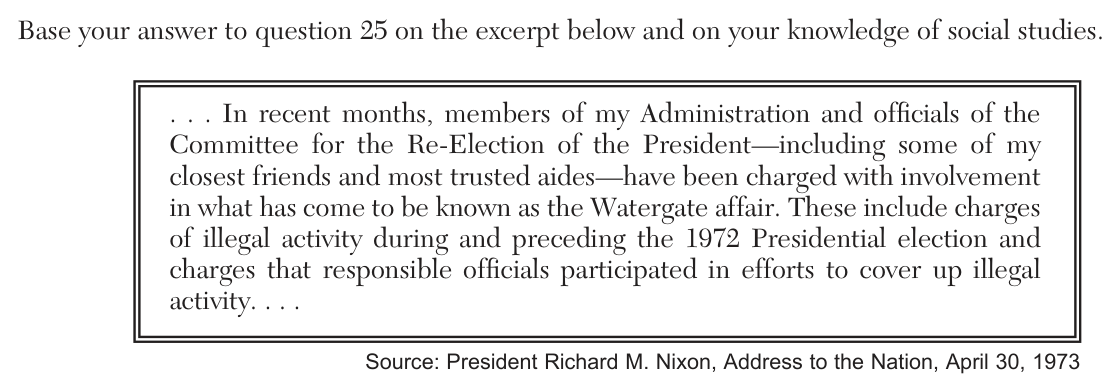
Q25 Watergate’s outcome
What ultimately happened to Nixon?
Worked solution for question 25
- The investigation uncovered a cover-up, and the House Judiciary Committee approved articles of impeachment.
- Nixon resigned in August 1974 before the full House voted.
- Connect the scandal to the constitutional process. Evidence and growing support for impeachment increased the pressure that led Nixon to leave office.
Answer choice 4He resigned from office.
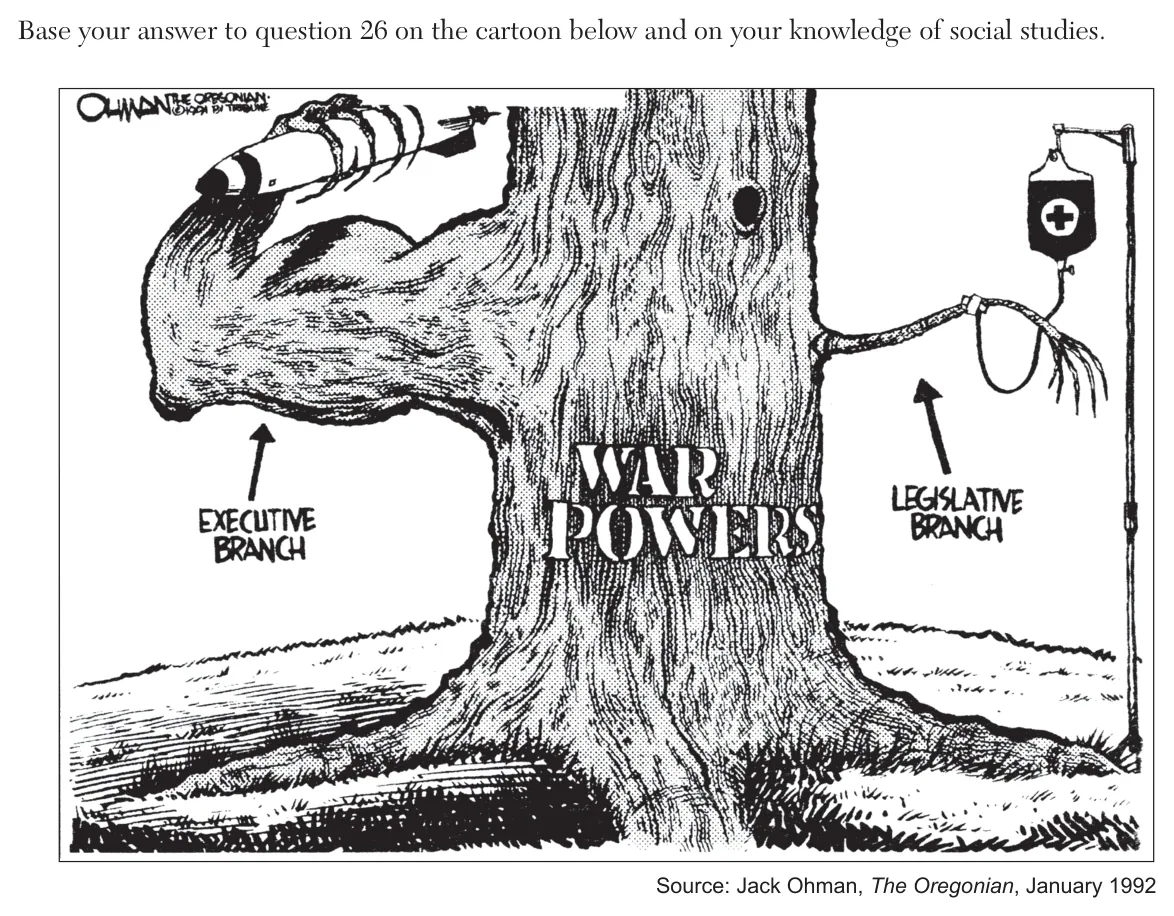
Q26 Changing war powers
What constitutional trend does Ohman’s cartoon convey?

Worked solution for question 26
- Read the cartoon as a comment on the relative power of president and Congress.
- Presidents have directed military operations without formal declarations of war, even though the Constitution gives Congress the power to declare war.
Answer choice 3Executive war powers have expanded.
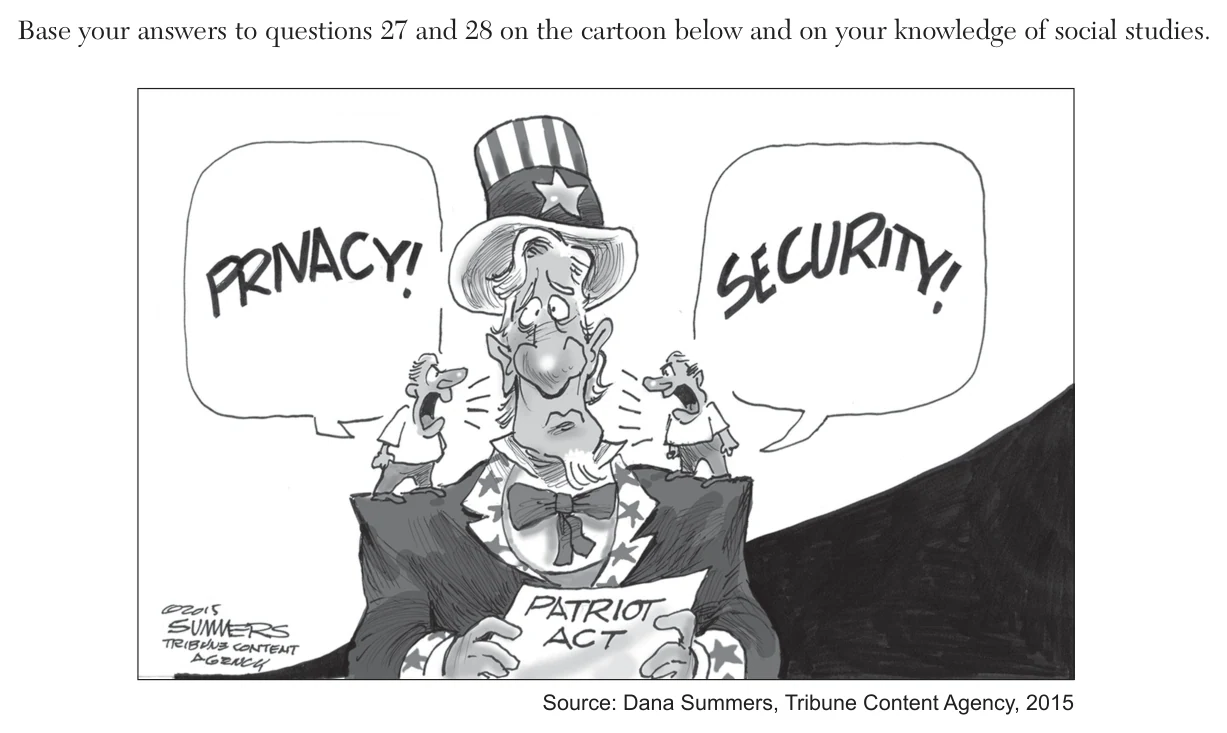
Q27 Security and liberty
What problem does the Patriot Act cartoon depict?

Worked solution for question 27
- The cartoon presents a cost to civil liberties alongside the stated security goal.
- It asks whether surveillance and investigation powers go too far in protecting the nation.
- When judging a security policy, identify both the threat the government cites and the liberty affected by its response. That tension is the relationship the source illustrates.
Answer choice 3Measures aimed at safety can infringe individual rights.
Q28 Origin of the Patriot Act
What event most directly prompted the law?
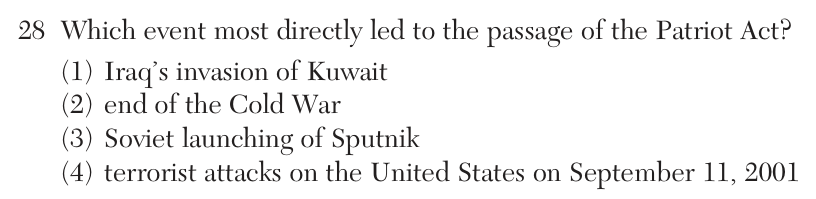
Worked solution for question 28
- Congress passed the act soon after the attacks.
- The government expanded investigative powers in an effort to prevent further terrorism.
Answer choice 4The September 11, 2001 terrorist attacks
Part II Short essays
Question indexQ29 Great Depression and Roosevelt’s response
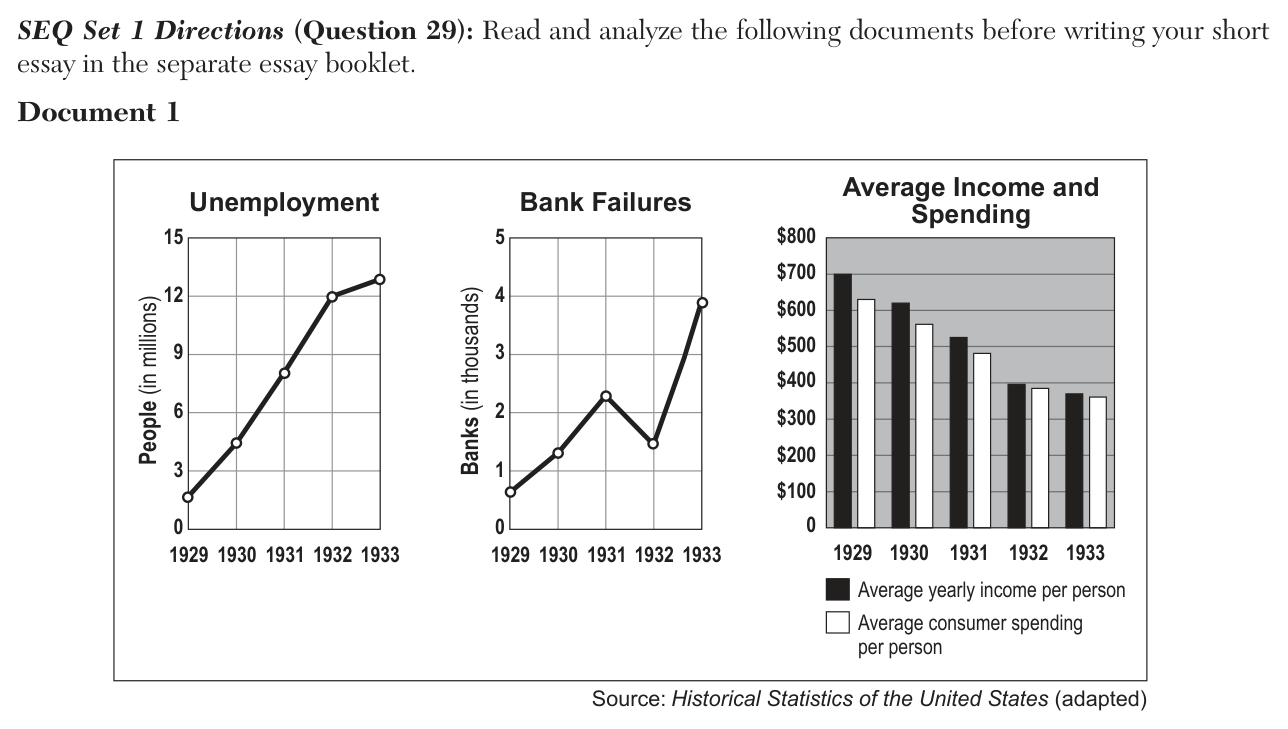
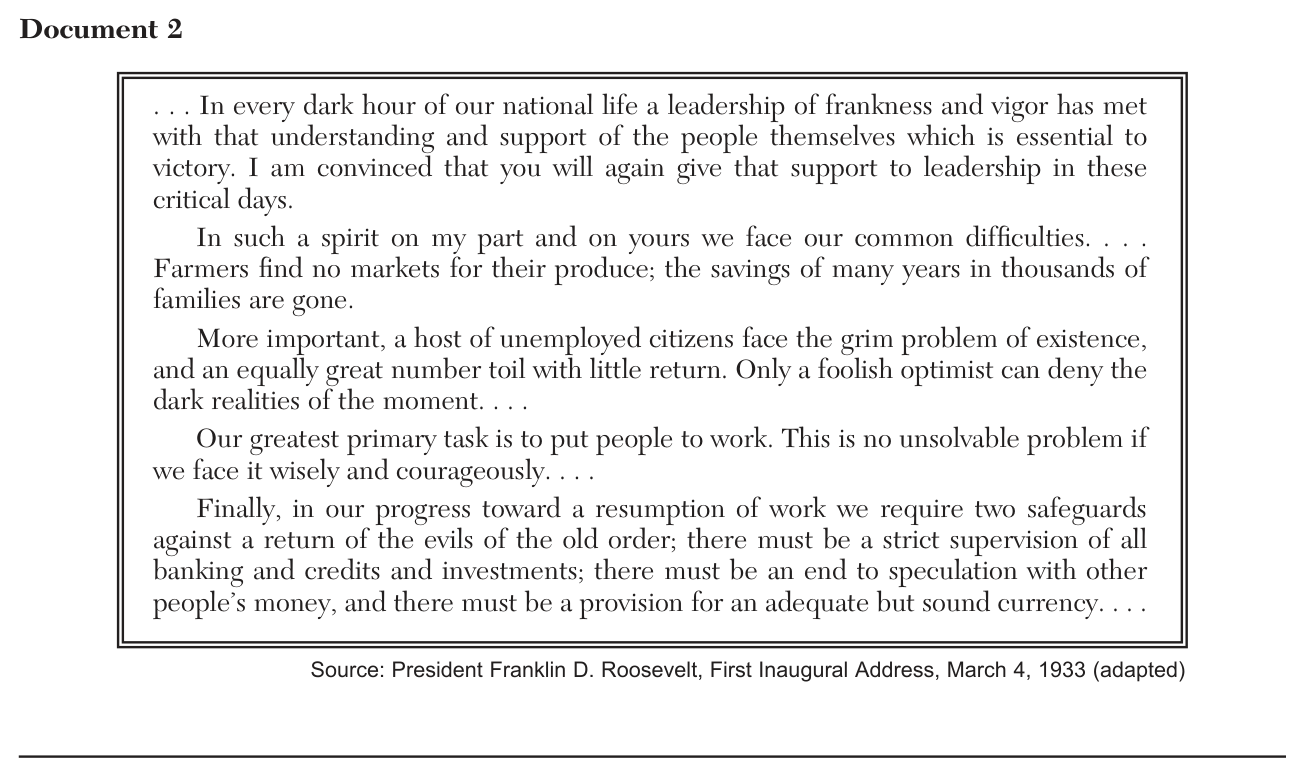
Explain the context of the economic charts and FDR’s inaugural address, and explain a relationship between them.
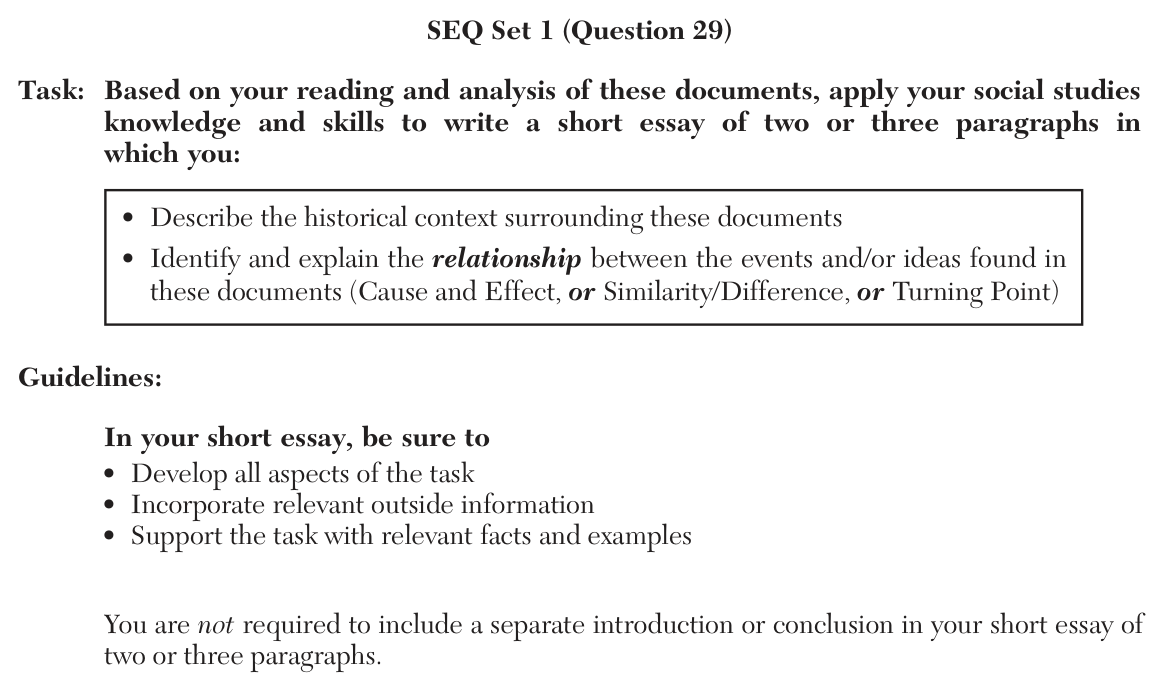
Writing plan and model response for question 29
- Use the trend in the charts as evidence of the crisis and the speech as evidence of Roosevelt’s intended response.
- Connect them through a clear cause-and-effect relationship.
Central claimDeepening unemployment and bank failures helped drive Roosevelt’s shift toward federal relief and reform.
Model response
In 1929 the stock market crashed after a decade of speculative growth. The downturn spread beyond investors as businesses reduced production, consumers cut spending and banks failed. The charts in Document 1 show unemployment rising and income and spending falling from 1929 to 1933. Bank failures added to the contraction by destroying savings and making credit harder to obtain.
That emergency helps explain why Roosevelt made employment and banking safeguards priorities in his March 1933 inaugural address (Document 2). When families lost income and banks stopped serving their communities, Roosevelt argued that vigorous federal action was needed. His administration later backed work relief and created federal deposit insurance through the banking reforms of 1933. The specific problems measured in Document 1 thus help explain the jobs and financial reforms foreshadowed by Document 2.
Q30 Erie Canal and regional trade
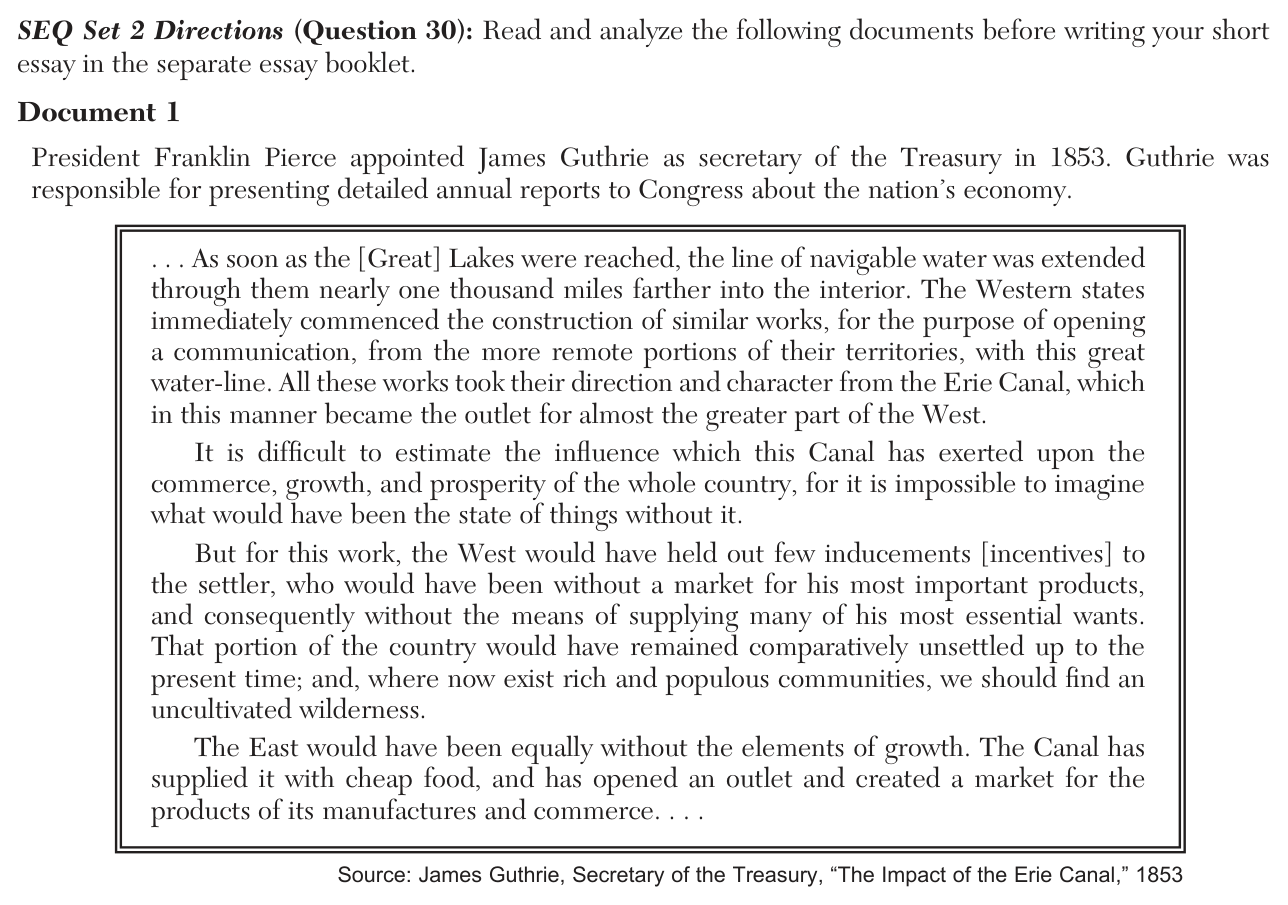
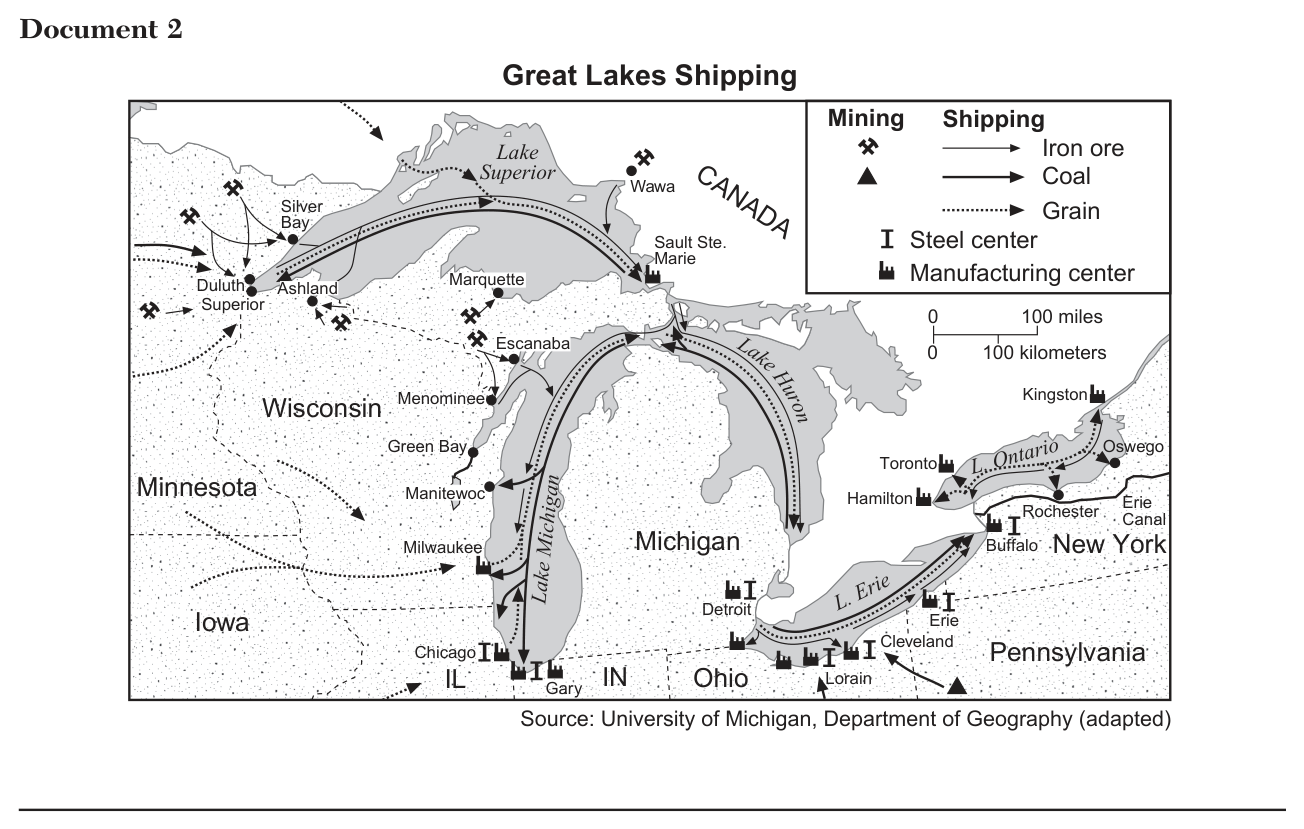
Describe the context of Guthrie’s report and the Great Lakes map. Analyze how one feature of Document 1 affects its use as evidence.
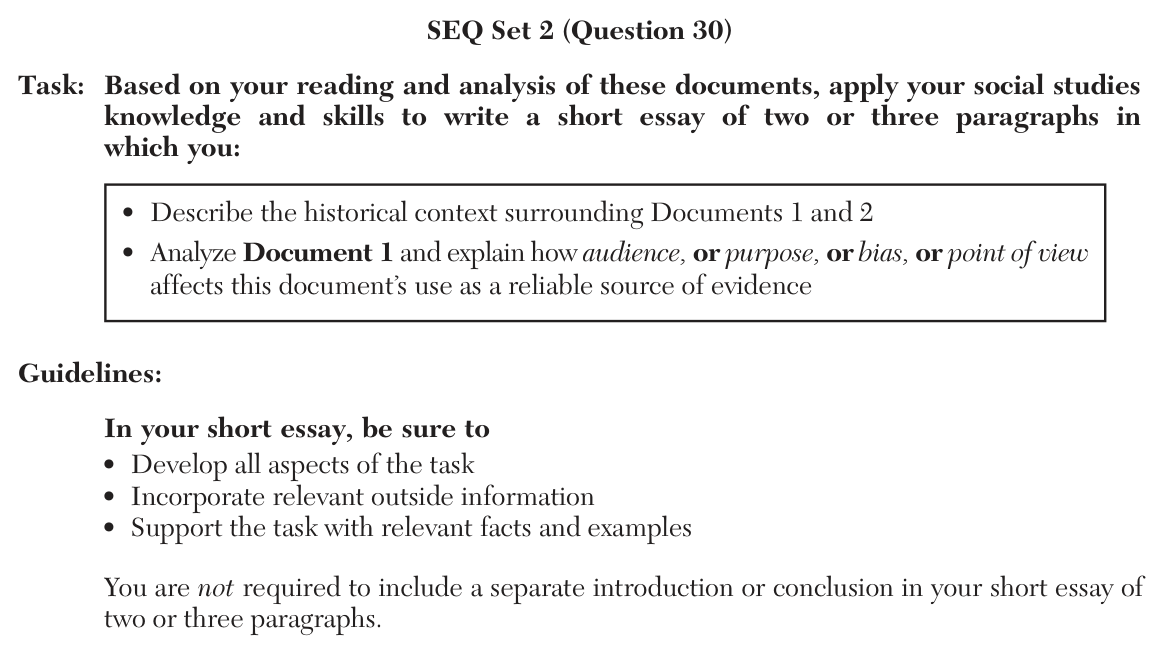
Writing plan and model response for question 30
- Link the canal to the Market Revolution. Analyze the Treasury secretary’s purpose and audience.
- Identify both a useful claim and a question the report alone cannot answer.
Central claimThe report is valuable for understanding a federal official’s view of canal-led growth, with limits as a comprehensive account of its effects.
Model response
Early nineteenth-century Americans invested in transport to connect farms in the interior with Atlantic ports. The Erie Canal, completed in 1825, linked the Hudson River to Lake Erie. Freight could travel at lower cost between the Great Lakes and New York City, sending food east and manufactured goods west. The shipping map in Document 2 places the canal within the broader network of Great Lakes ports and routes.
In Document 1, Treasury Secretary James Guthrie reports to Congress and emphasizes the canal’s benefits for settlement, markets and national growth. His position makes the report useful for understanding how a national economic official explained the canal’s significance in 1853. His focus on prosperity gives less attention to uneven effects or to the costs of construction and expansion. Comparing the report with shipping records and local accounts would help a historian test the magnitude and distribution of the benefits he claims.
Part III A Document questions
Question indexQ31 Origins in temperance
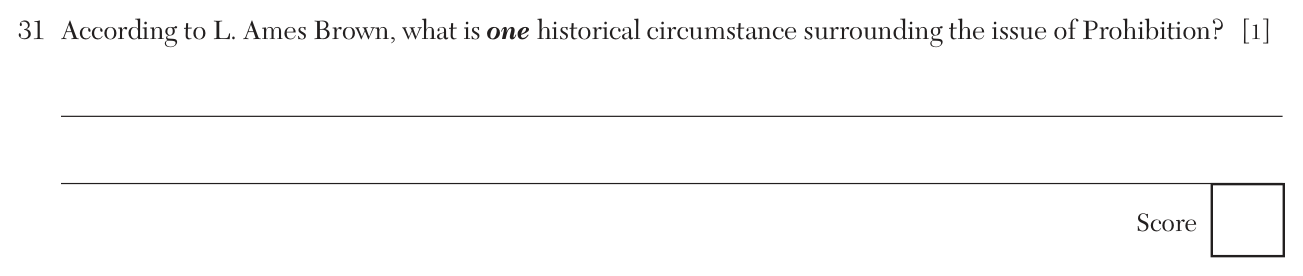
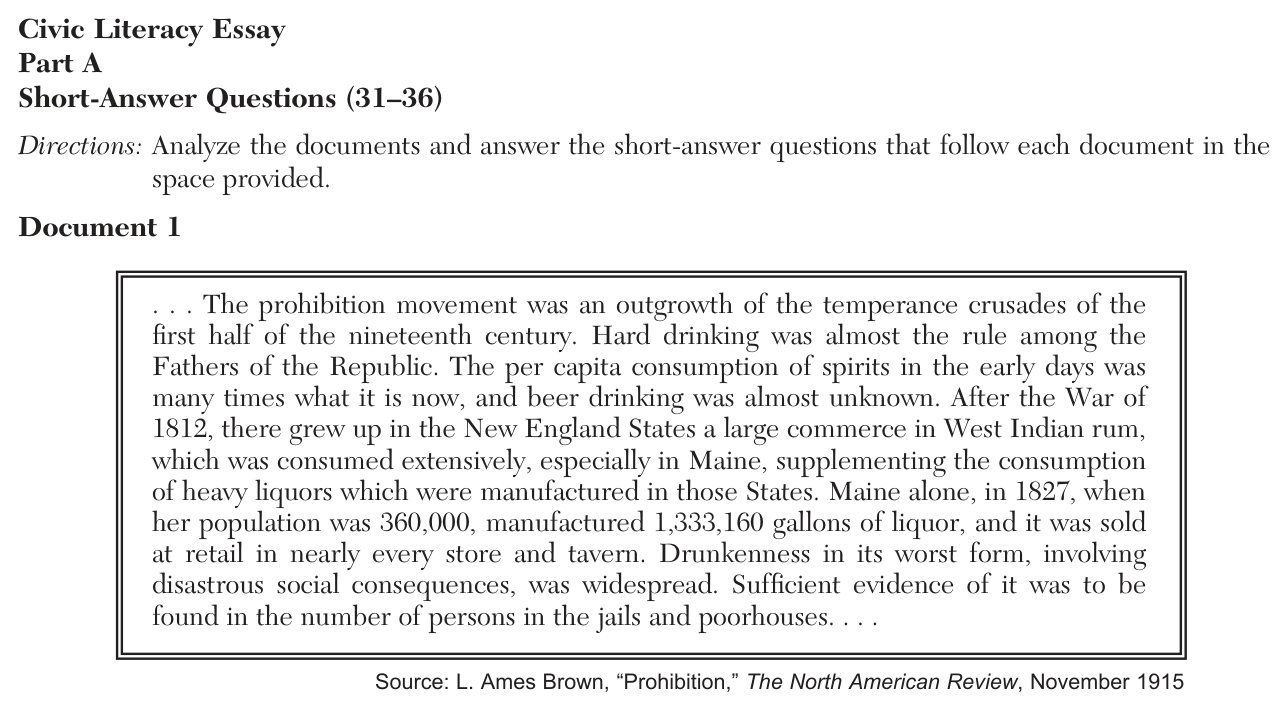
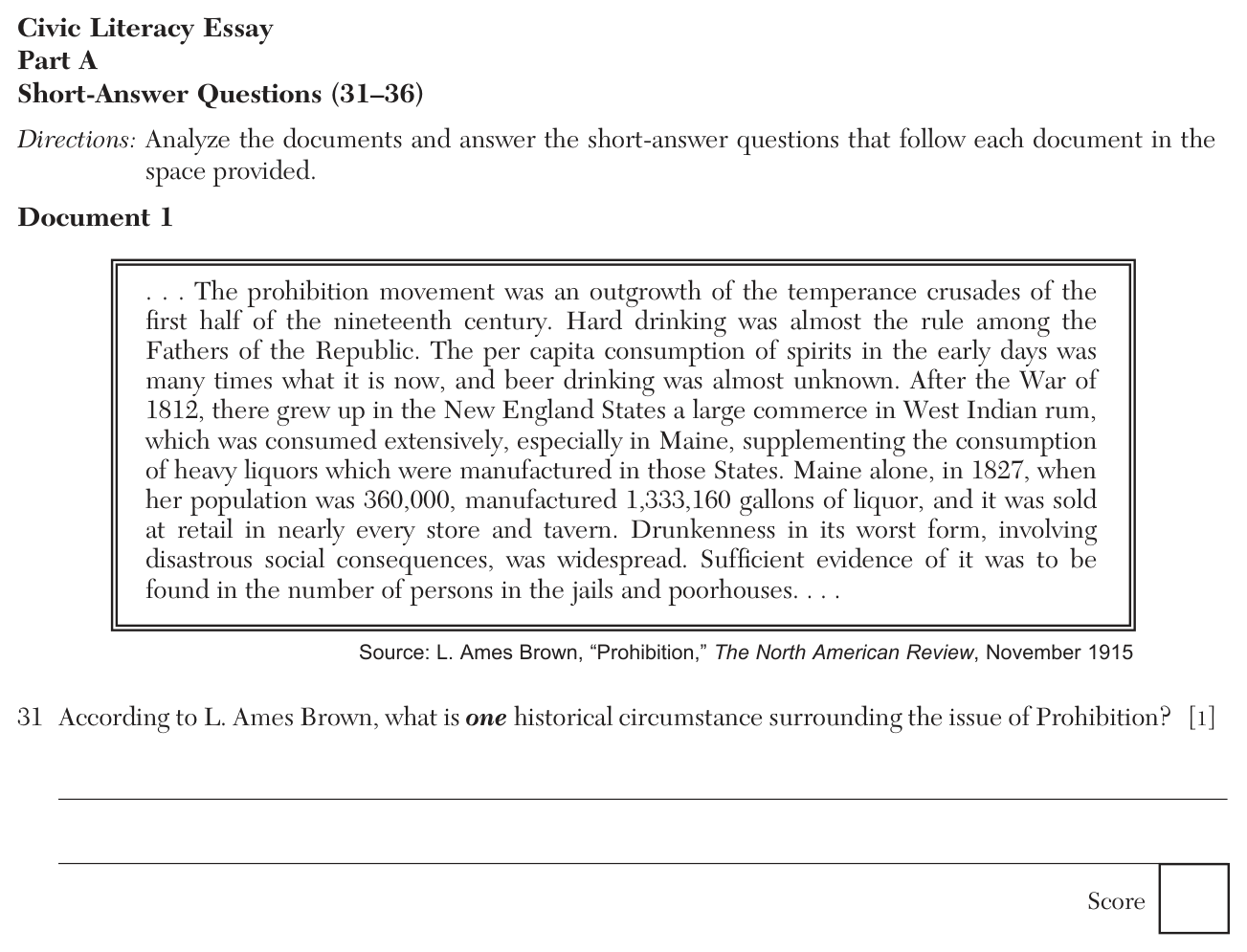
From Document 1, identify a circumstance behind the movement for Prohibition.
Worked solution for question 31
- Brown describes widespread consumption of spirits and associated hardship.
- Connect the problem to the reform movement it helped provoke.
Final answerHeavy drinking and its social consequences encouraged nineteenth-century temperance campaigns.
Q32 Ratification momentum
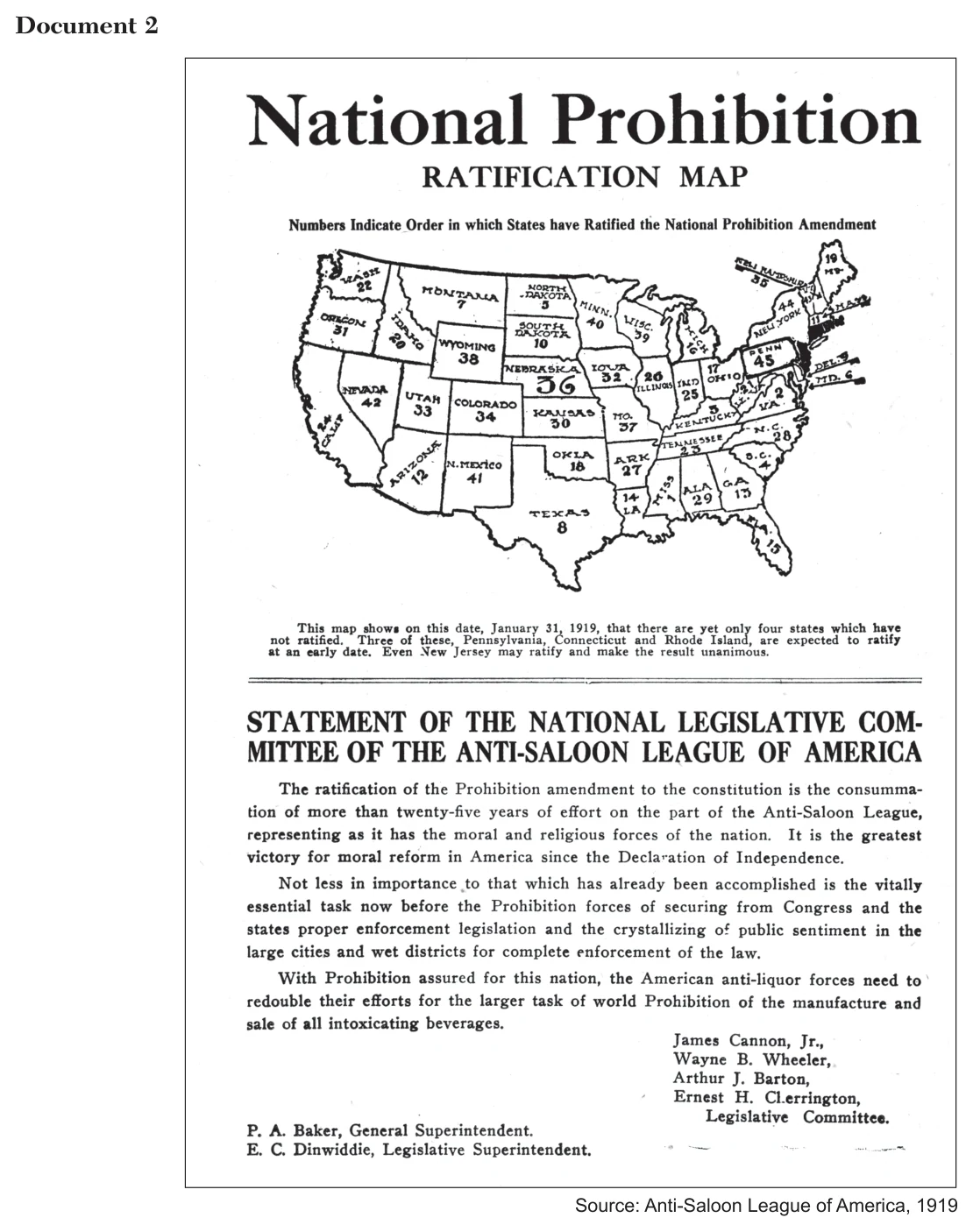
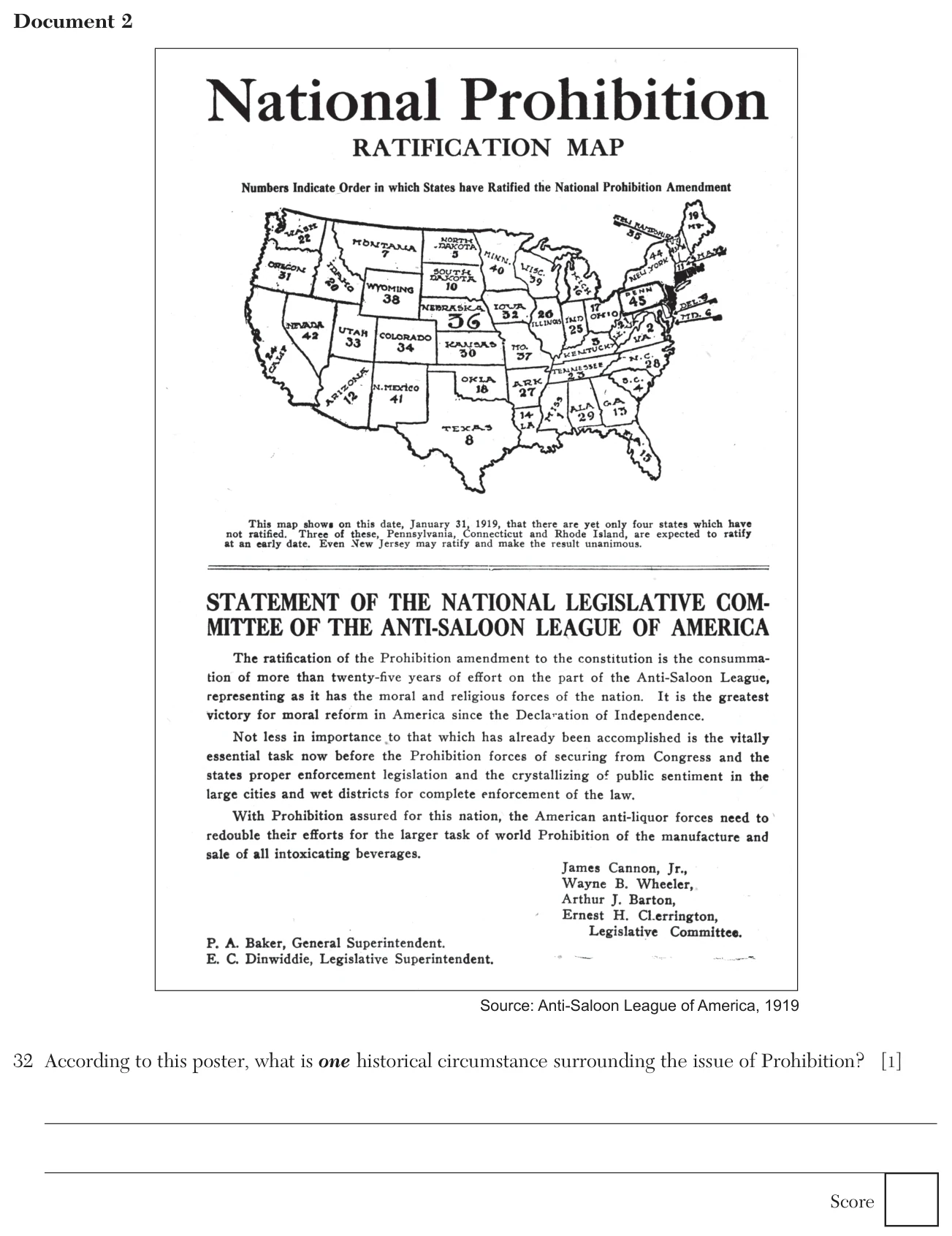
From the Anti-Saloon League poster, identify one circumstance surrounding Prohibition.
Worked solution for question 32
- Read the ratification summary in the poster as evidence of the breadth of support.
- Treat it as a dated snapshot, since states continued to vote.
Final answerBy the poster’s January 1919 snapshot, only four states had yet to ratify the amendment.
Q33 Hoover and enforcement
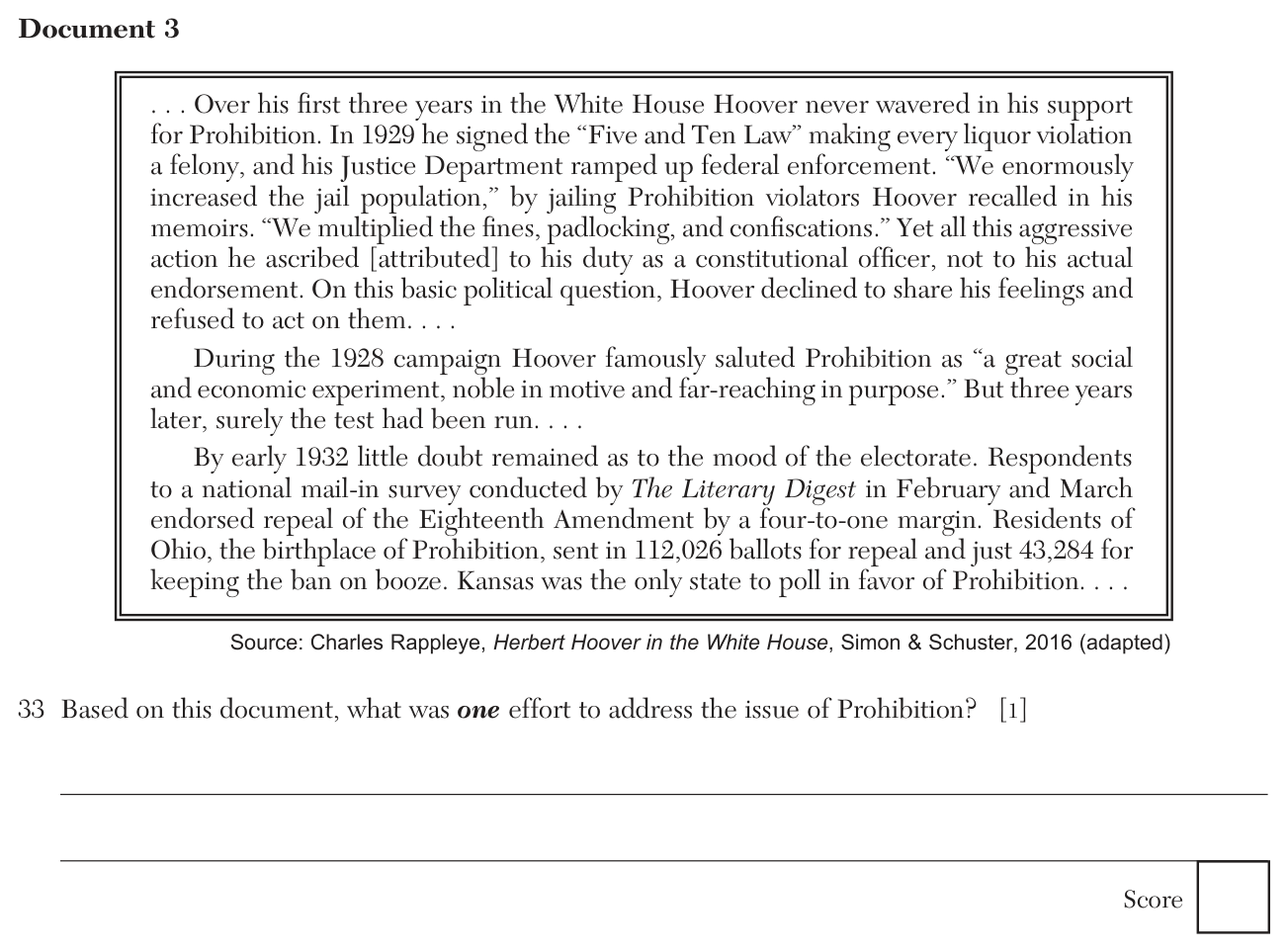
Identify one effort in Document 3 to address Prohibition.
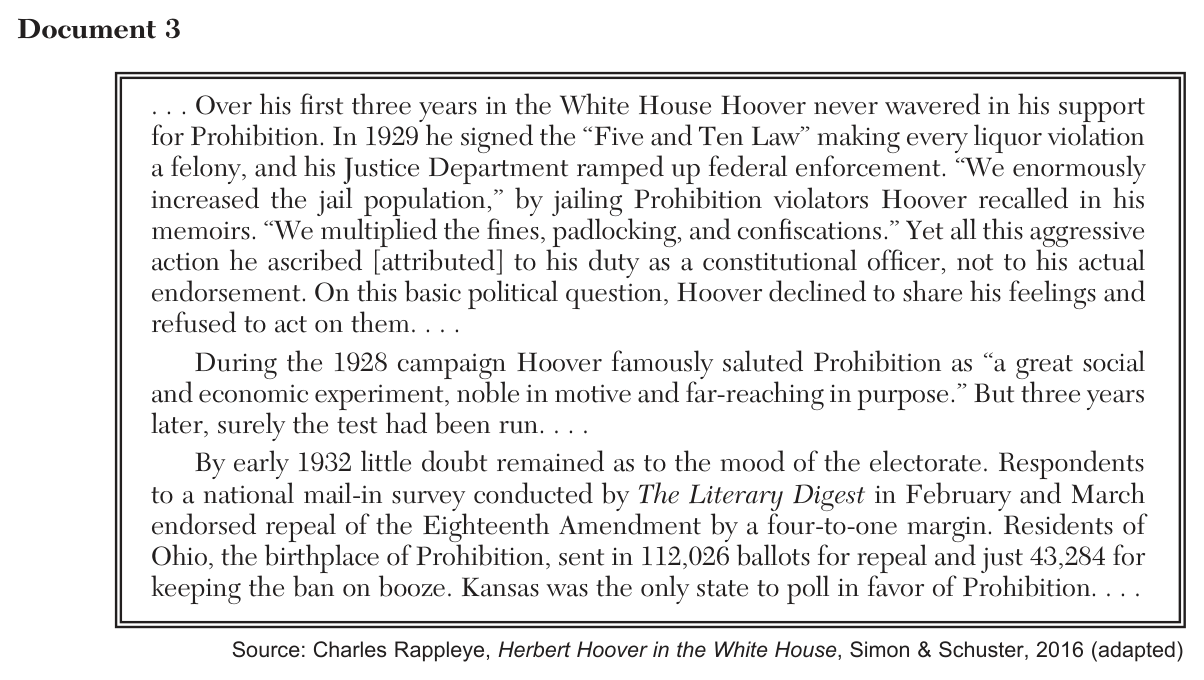
Worked solution for question 33
- The document describes the law and increased federal enforcement.
- Identify how the law tightened enforcement by increasing penalties.
Final answerHoover signed the 1929 Five and Ten Law, strengthening punishment for liquor violations.
Q34 Women organize for repeal
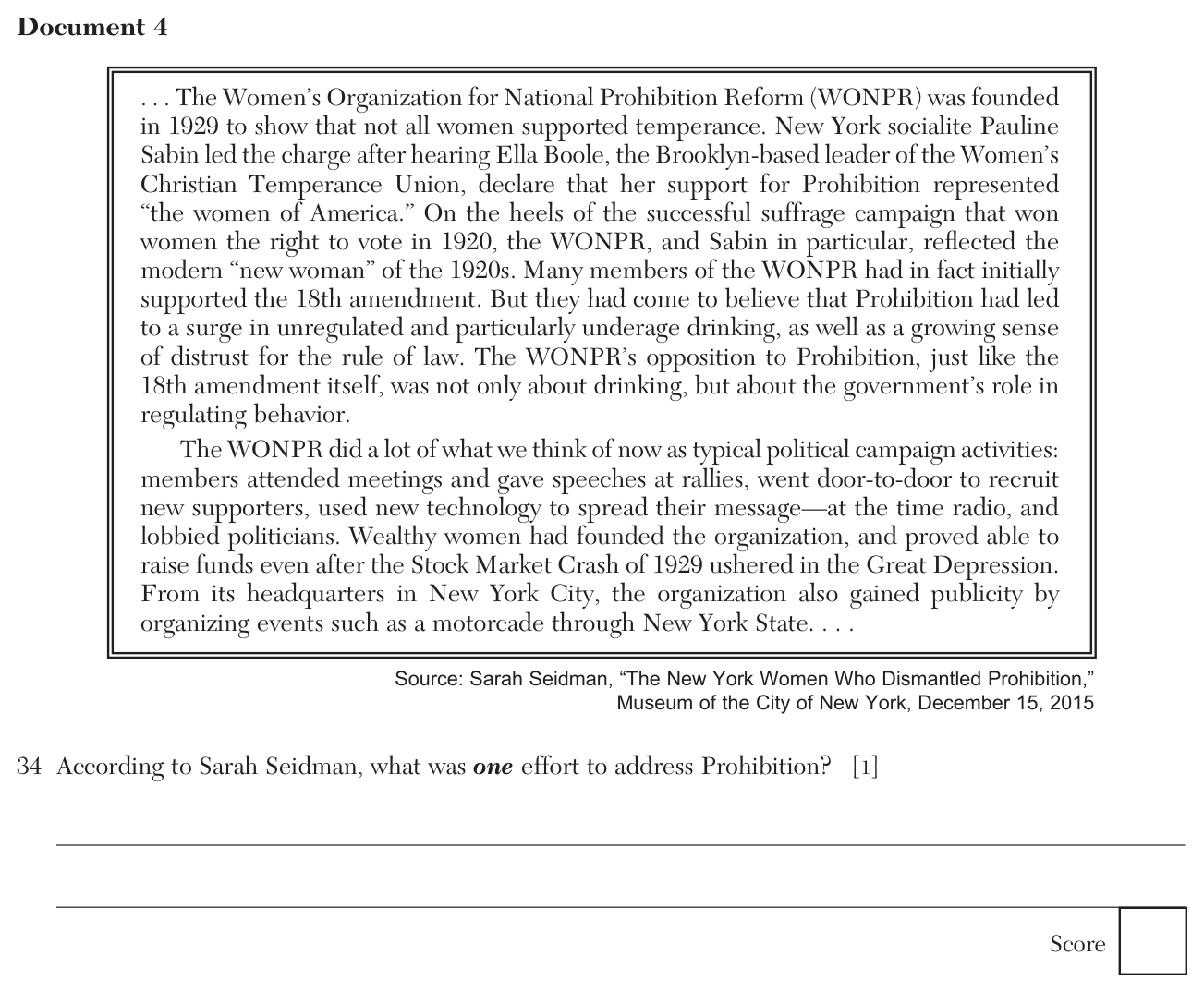
Identify one effort described in Document 4.
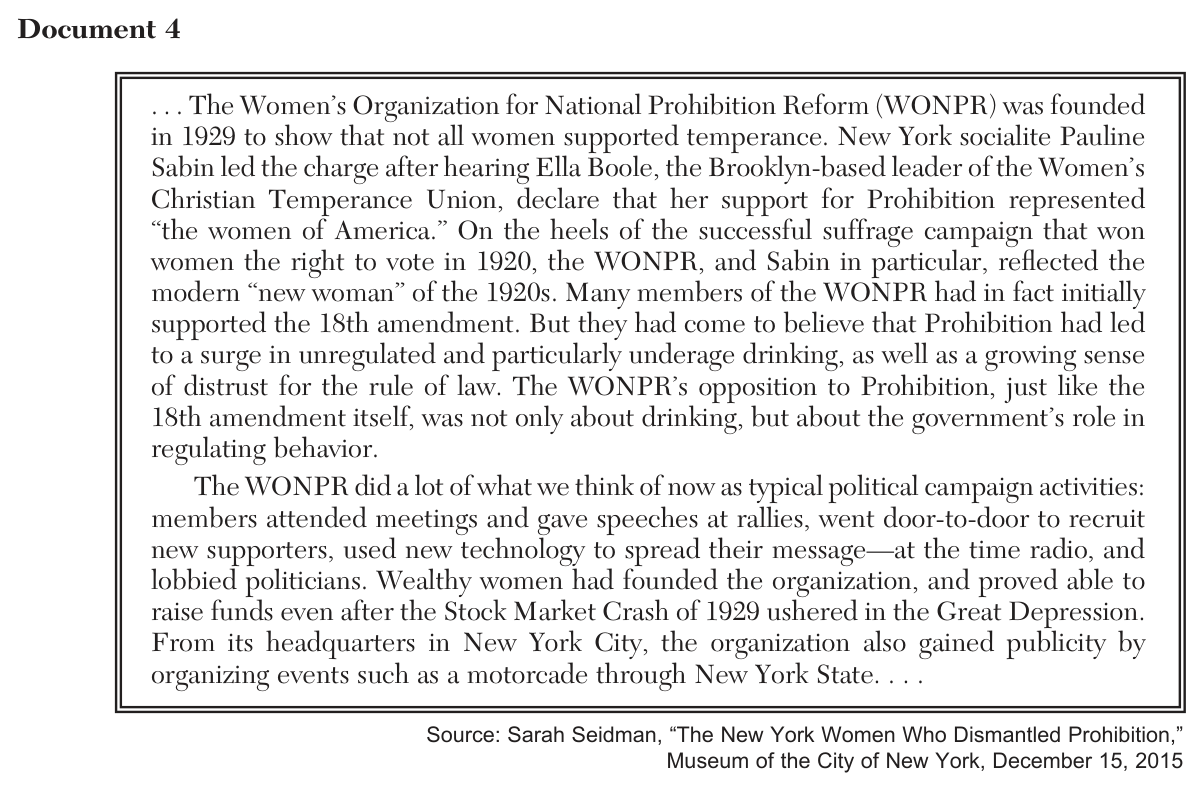
Worked solution for question 34
- The organization used rallies, door-to-door recruitment and radio to build support.
- These activities challenged claims that women uniformly supported the ban.
Final answerPauline Sabin and the Women’s Organization for National Prohibition Reform organized and lobbied for repeal.
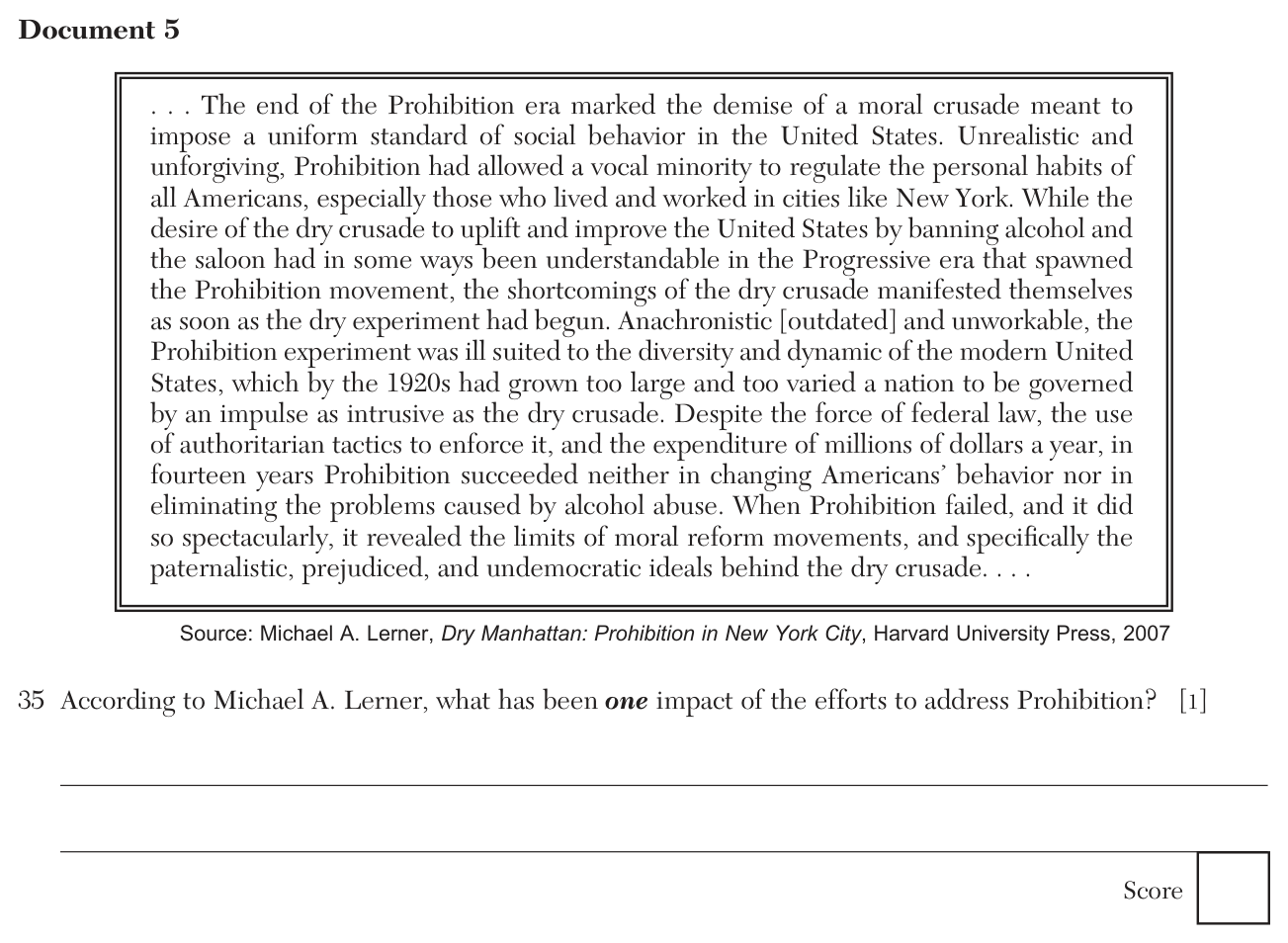
Q35 What Prohibition failed to change
Identify one impact described in Document 5.
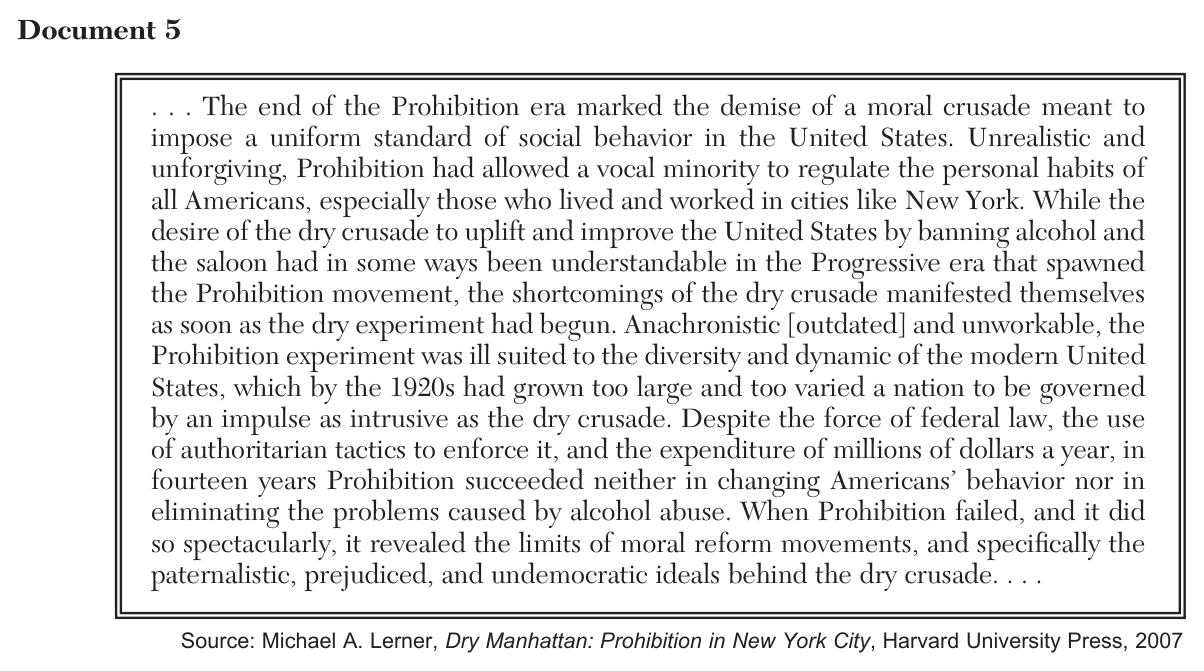
Worked solution for question 35
- Lerner contrasts heavy public spending and enforcement with persistent drinking problems.
- Answer in terms of the outcome he reports.
- Give the contrast directly: the government devoted resources to enforcement, yet the document reports that problems linked to drinking persisted. That contrast is the effect the source supports.
Final answerThe ban failed to eliminate alcohol abuse despite extensive enforcement.
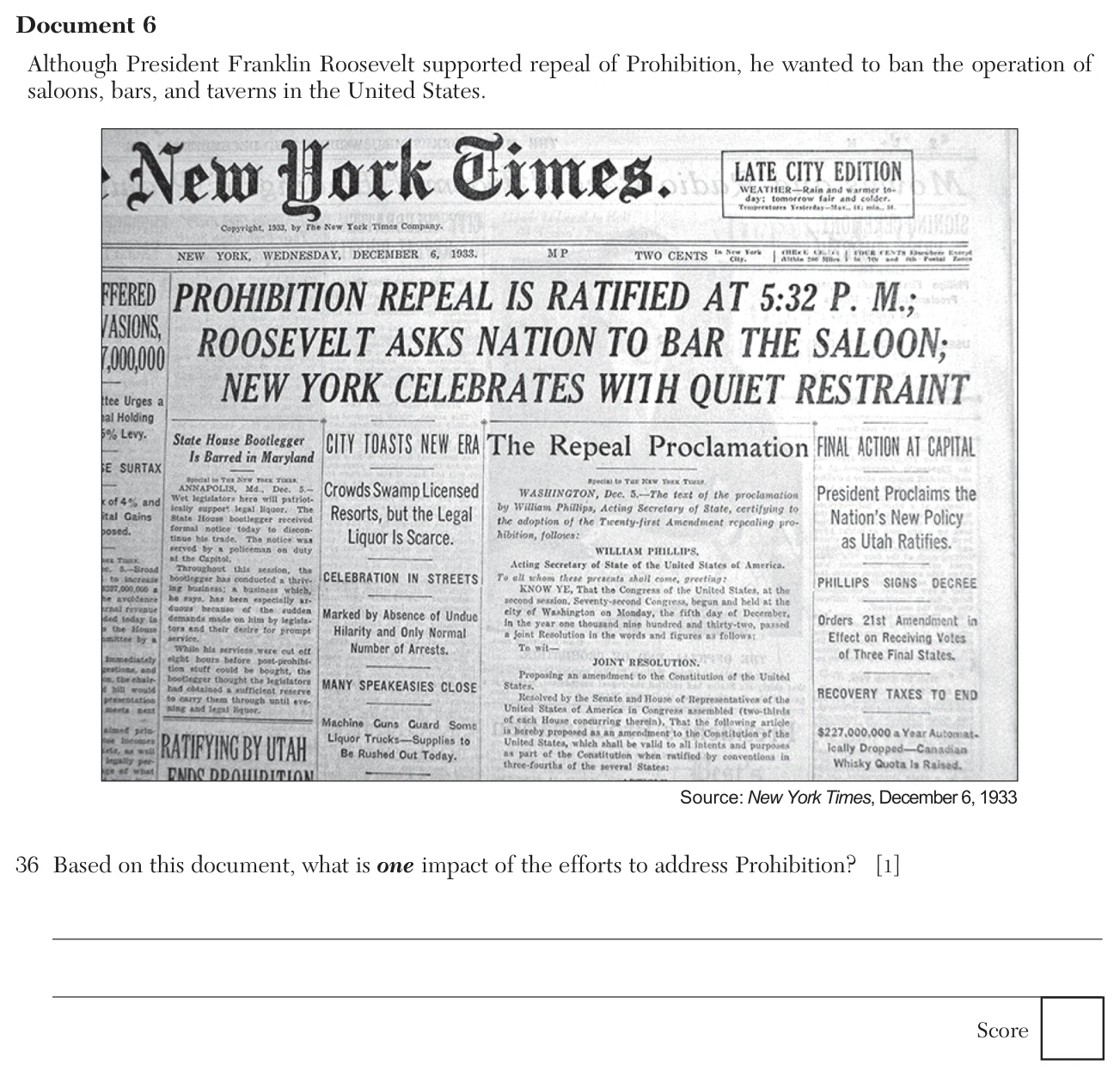
Q36 The end of national Prohibition
Identify one effect shown by Document 6.
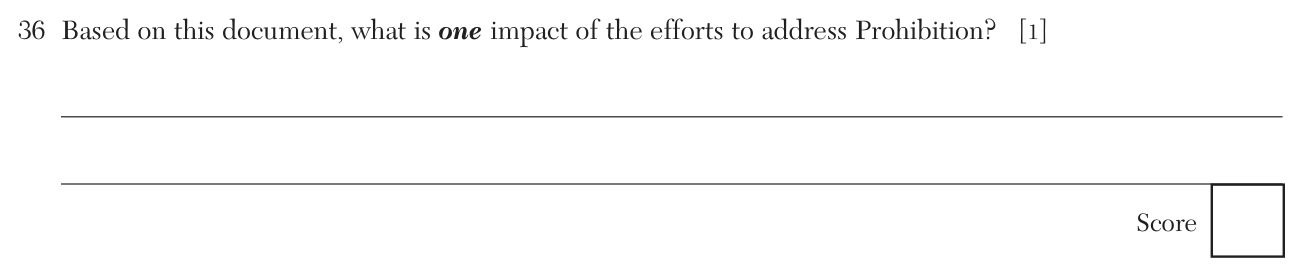
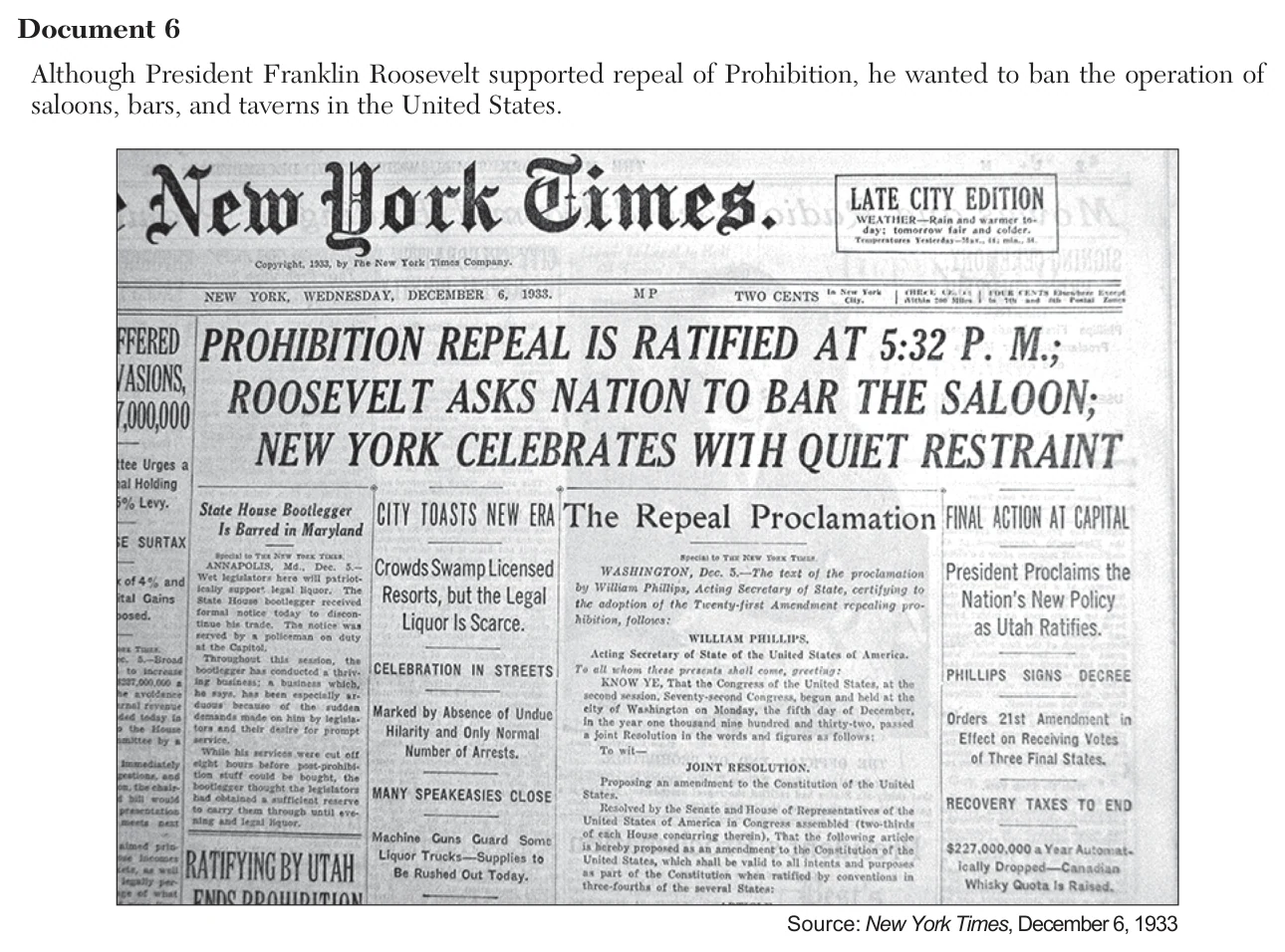
Worked solution for question 36
- The newspaper reports the successful repeal process in December 1933.
- The amendment removed the national constitutional ban.
- Identify the legal change rather than describing only the celebration in the source. The Twenty-First Amendment repealed the Eighteenth Amendment and ended the national ban.
Final answerRatification of the Twenty-First Amendment ended national Prohibition.
Part III B Civic literacy essay
Question indexQ37 Civic literacy essay on Prohibition
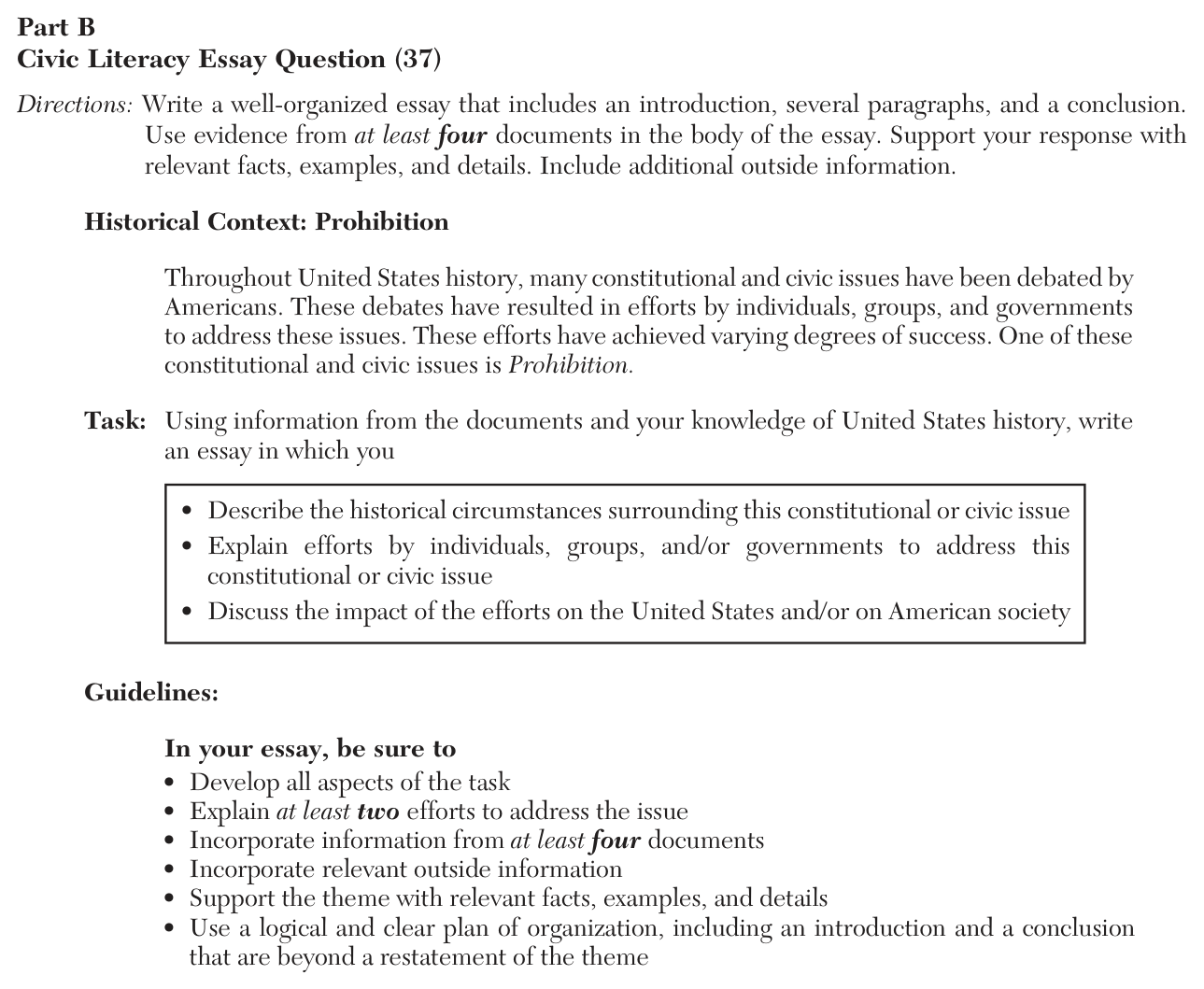
Describe the origins of Prohibition, explain at least two efforts to address it, and discuss their effects. Use at least four documents and outside evidence.
Writing plan and model response for question 37
- Organize by origins, implementation, and repeal. Distinguish a stated objective from an observed result.
- Support the argument with Documents 1–6 and relevant facts such as the Volstead Act or the Twenty-First Amendment.
Central claimA reform campaign secured a national ban, but enforcement difficulties and a broad repeal movement brought the experiment to an end.
Model response
National Prohibition grew out of the conviction that alcohol contributed to problems that communities could address through public action. In the Progressive Era, supporters turned a long reform campaign into a constitutional amendment. The effort to enforce that amendment, and the subsequent effort to repeal it, showed the difficulty of imposing a uniform rule on a divided country.
Brown traces Prohibition to nineteenth-century temperance campaigns against widespread heavy drinking and associated social distress (Document 1). Organizations such as the Woman’s Christian Temperance Union and the Anti-Saloon League converted these concerns into political pressure. The League’s 1919 poster records how broadly ratification had spread (Document 2). The Eighteenth Amendment prohibited manufacture, sale and transport of intoxicating liquor for beverage purposes, and Congress used the Volstead Act to implement it.
The federal government sought to make enforcement more effective. Hoover signed a 1929 law raising penalties, and officials increased fines, seizures and imprisonment (Document 3). Yet illegal markets endured. Speakeasies and bootlegging demonstrated that people could obtain alcohol outside the regulated system. As Lerner argues in Document 5, enforcement consumed resources while failing to eliminate the underlying problems of alcohol abuse.
Repeal required political organization as well. Pauline Sabin’s organization used rallies, lobbying and other campaign tactics to show that women did not speak with one voice on Prohibition (Document 4). In 1933 the Twenty-First Amendment was ratified, ending the federal constitutional prohibition reported in Document 6 and leaving states substantial authority over alcohol regulation. Repeal changed the means of regulation rather than settling the underlying debate about public health and personal behavior.
From the New York State Education Department. January 2026 U.S. History and Government Regents Examination. Internet. Available from https://www.nysedregents.org/us-history-govt/126/ushg-12026-exam.pdf. Accessed .