NEW YORK STATE REGENTS · ALGEBRA II
January 2026 Algebra II Regents Past Paper & Solutions
Work through logarithms, complex numbers and sinusoidal models with a question-by-question walkthrough of the exam.
- 37 worked questions
- 86 raw credits
- 4 exam parts
The question images and page numbers come from the regular-size English exam. OnlyPrepy wrote the summaries and worked solutions.
Quick answer key for Part I
Part I Multiple choice
Question indexQ1 Match exponential bases
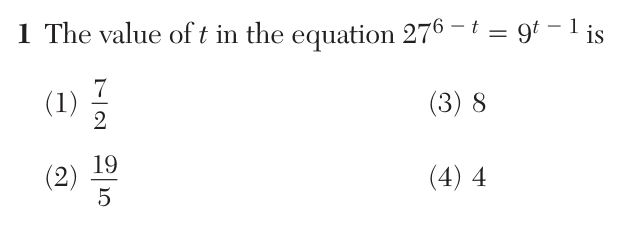
Solve 27^(6 − t) = 9^(t − 1).
Worked solution for question 1
- Rewrite both bases as powers of 3 to get 3^[3(6 − t)] = 3^[2(t − 1)].
- Equate exponents and solve 18 − 3t = 2t − 2, giving 20 = 5t.
Answer choice 4t = 4
Q2 Factor by substitution
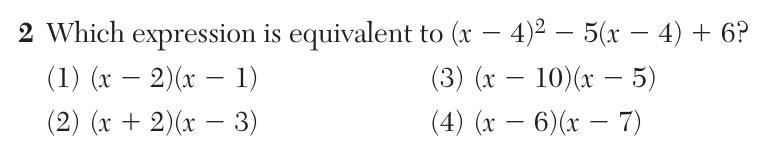
Factor (x − 4)² − 5(x − 4) + 6.
Worked solution for question 2
- Let u = x − 4. Factor u² − 5u + 6 into (u − 2)(u − 3).
- Substitute back to get (x − 4 − 2)(x − 4 − 3).
- The factor constants multiply to 6 and add to −5 before the substitution is undone. Then x − 4 − 2 and x − 4 − 3 simplify to x − 6 and x − 7.
Answer choice 4(x − 6)(x − 7)
Q3 Identify an experiment
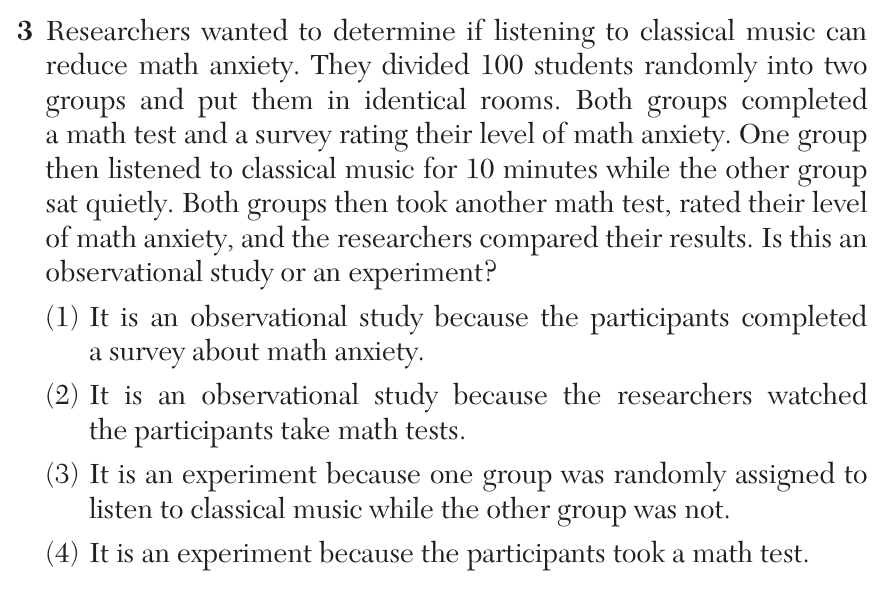
Students were randomly assigned to listen to music or sit quietly before their anxiety was measured. Classify the design.
Worked solution for question 3
- Researchers assigned the treatment of listening to music. The quiet group supplies a comparison.
- The assignment of a treatment is what makes it an experiment. Taking a survey is how the outcome was measured.
Answer choice 3Randomized experiment
Q4 Logarithmic graph
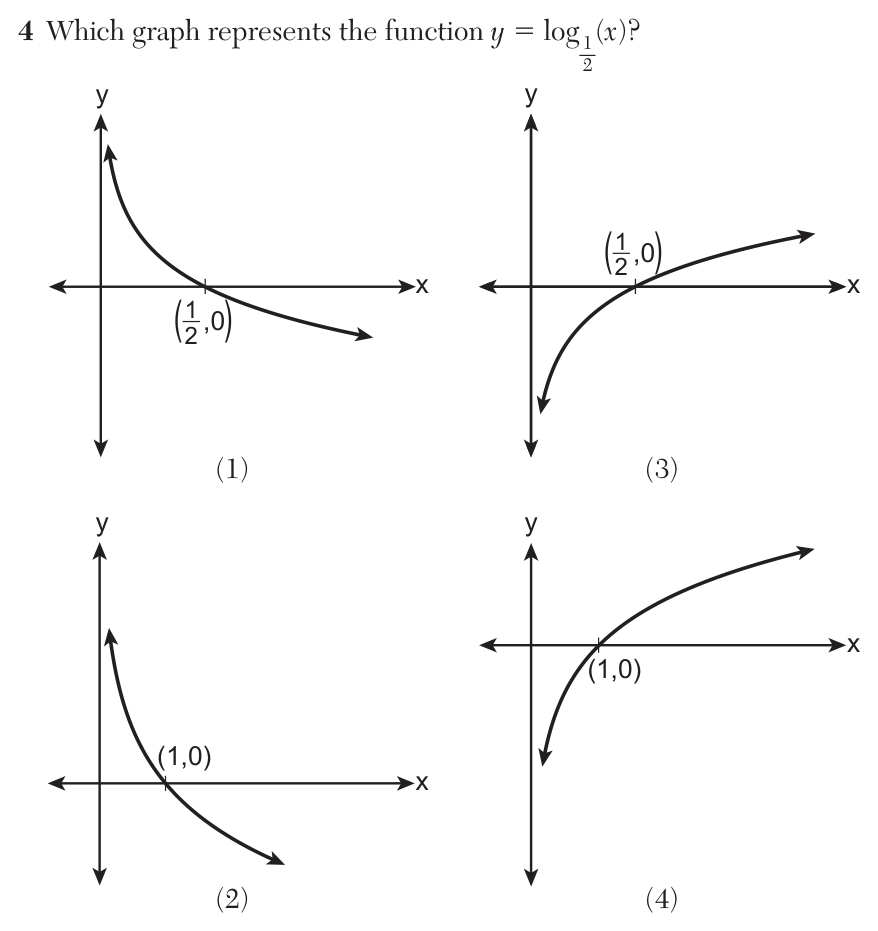
Identify the graph of y = log base 1/2 of x.
Worked solution for question 4
- Every logarithm with a valid base satisfies log(1) = 0 and needs x > 0.
- A base below 1 reverses the ordering: inputs 1/2, 1 and 2 give outputs 1, 0 and −1.
- The curve grows without bound as x approaches zero from the right and falls without bound as x grows. This distinguishes it from a decreasing exponential with a horizontal asymptote.
Answer choice 2Decreasing graph through (1, 0), with x = 0 as its vertical asymptote
Q5 Model a tide
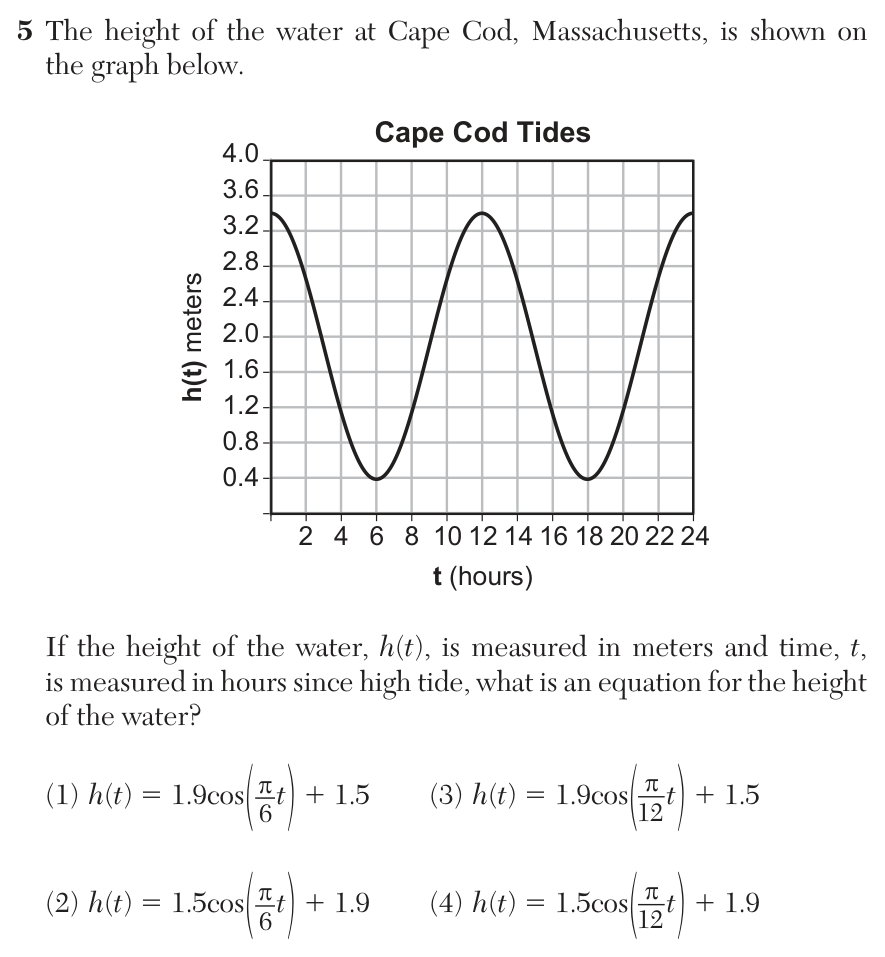
Read the amplitude, midline and period of the Cape Cod tide graph, starting at high tide.
Worked solution for question 5
- The plotted maximum and minimum are 3.4 and 0.4. Their half-difference is 1.5 and their mean is 1.9.
- High tides recur every 12 hours, so angular frequency is 2π/12 = π/6. Positive cosine starts at a maximum.
- The cosine rule gives a maximum of 3.4 at t = 0 and 12 and a minimum of 0.4 at t = 6. Those three checks distinguish the amplitude from the vertical shift and confirm the period.
Answer choice 2h(t) = 1.5 cos(πt/6) + 1.9
Q6 Complex quadratic roots
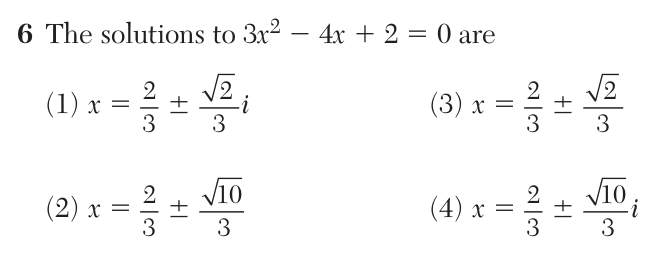
Solve 3x² − 4x + 2 = 0.
Worked solution for question 6
- The discriminant is (−4)² − 4(3)(2) = −8. Its square root is 2i√2.
- The quadratic formula gives (4 ± 2i√2)/6. Reduce by 2.
Answer choice 1x = (2 ± i√2)/3
Q7 Unit-circle equivalence
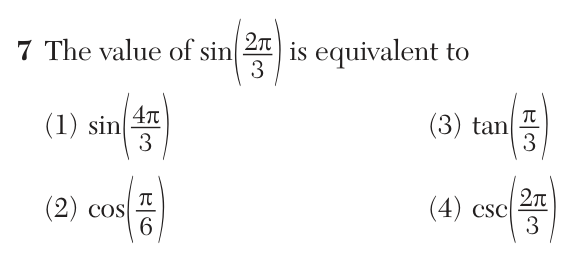
Find the listed expression equal to sin(2π/3).
Worked solution for question 7
- The angle 2π/3 is in quadrant II with reference angle π/3. Its sine is positive, √3/2.
- The complementary angle π/6 has cosine √3/2.
Answer choice 2cos(π/6)
Q8 Invert a cube root
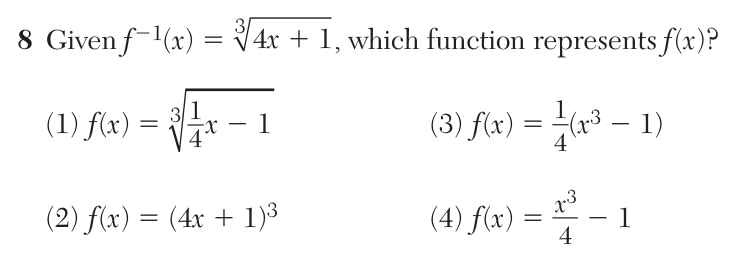
Find f when f⁻¹(x) = ∛(4x + 1).
Worked solution for question 8
- Write y = ∛(4x + 1) and interchange x and y.
- Cube to get x³ = 4y + 1. Subtract 1 and divide by 4.
- Compose the two functions to check the inverse. Substituting f(x) into ∛(4x + 1) gives ∛(x³), which equals x for every real x.
Answer choice 3f(x) = (x³ − 1)/4
Q9 Normal interval probability
Heights are approximately normal with mean 64.7 in and SD 4.267 in. Find P(65 ≤ X ≤ 68).
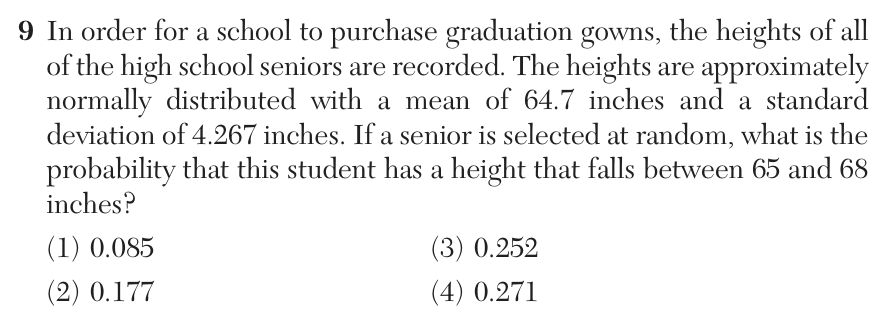
Worked solution for question 9
- Standardize the endpoints to (65 − 64.7)/4.267 ≈ 0.0703 and (68 − 64.7)/4.267 ≈ 0.7734.
- Subtract the lower normal cumulative probability from the upper, or use normalcdf with bounds 65 and 68 and the given parameters.
- The probability is the area between two cutoffs. Using just the upper cumulative area would also include everyone below 65 inches.
Answer choice 3About 0.252
Q10 Circle-line tangency
For (x + 1)² + (y − 4)² = 9 and x = 2, classify the solution coordinates.
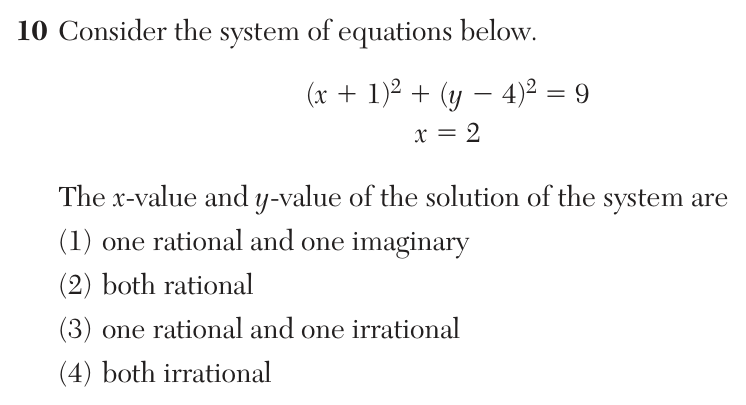
Worked solution for question 10
- Substitute x = 2. The term (2 + 1)² already equals 9.
- Then (y − 4)² = 0, so the only solution is (2, 4), with both coordinates integers.
Answer choice 2Both rational
Q11 Equivalent factorizations
Identify the listed forms equivalent to 36x⁴ − 9x².
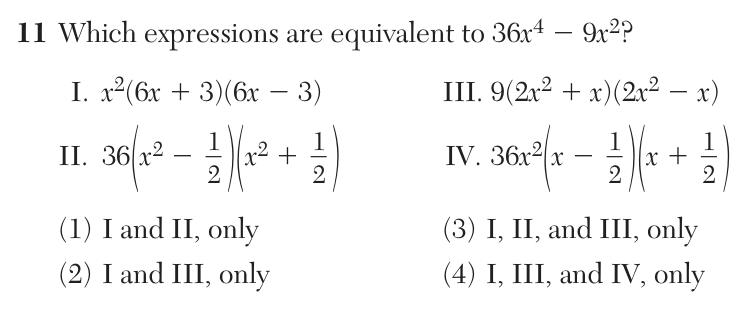
Worked solution for question 11
- Factor x²(36x² − 9) = x²(6x + 3)(6x − 3), which is I.
- III is 9(2x² + x)(2x² − x) = 9(4x⁴ − x²). IV is 36x²(x − 1/2)(x + 1/2) = 36x²(x² − 1/4).
- II would produce a constant term of −9, so it differs.
Answer choice 4I, III and IV
Q12 Equivalent monthly growth
Rewrite 1250(1.0186)ᵗ using a monthly multiplier with t in years.
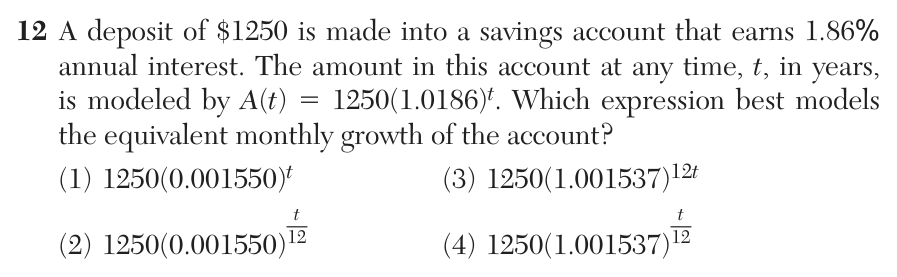
Worked solution for question 12
- Take the twelfth root of 1.0186 to find the equivalent one-month multiplier, about 1.001537.
- There are 12t months in t years. Raising the monthly factor to 12t restores the annual growth.
- Using 0.0186/12 as the monthly interest rate would give an approximation for a nominal annual rate. Here the original annual multiplier is fixed, so the monthly multiplier must satisfy b¹² = 1.0186.
Answer choice 31250(1.001537)^(12t)
Q13 Remainder theorem and graph
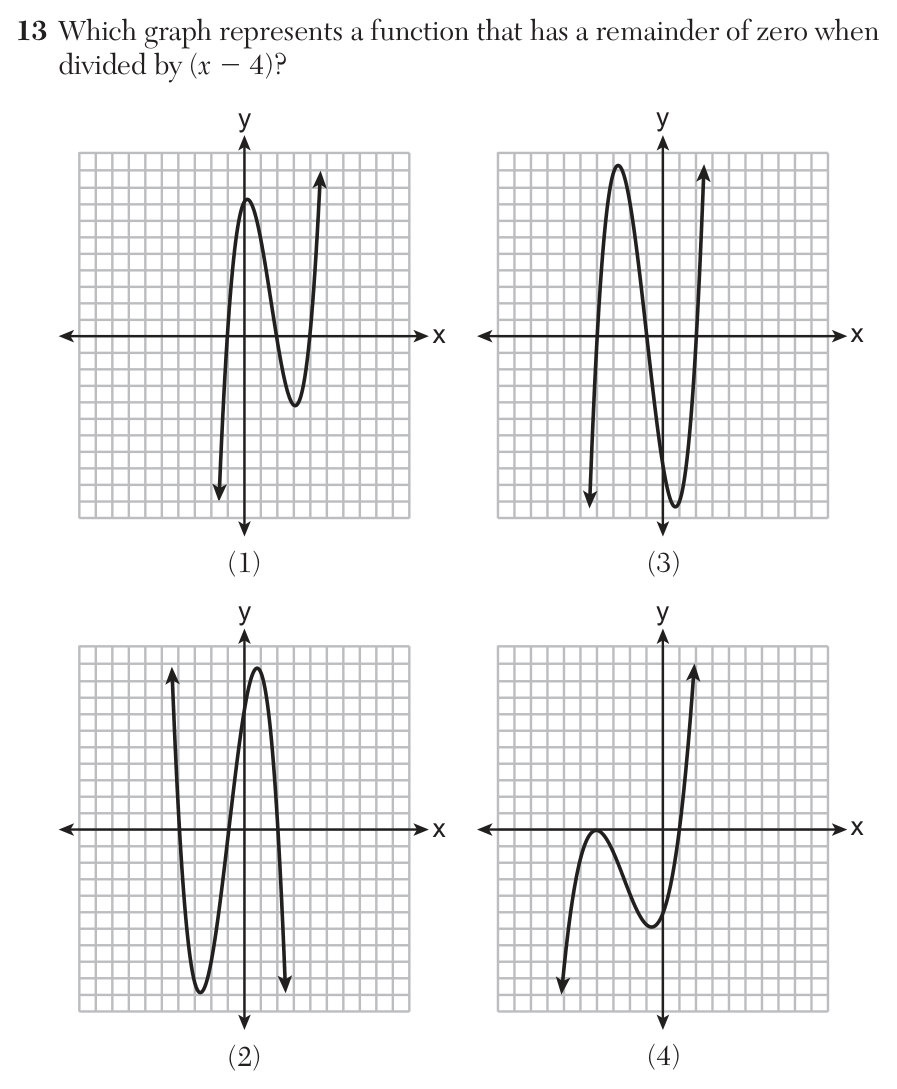
Choose the polynomial graph whose remainder after division by x − 4 is zero.
Worked solution for question 13
- The remainder is f(4), so the sought graph must contain (4, 0).
- Count four grid units to the right of the vertical axis. Graph 1 meets the horizontal axis there.
Answer choice 1Graph 1, with an x-intercept at 4
Q14 Rational exponents
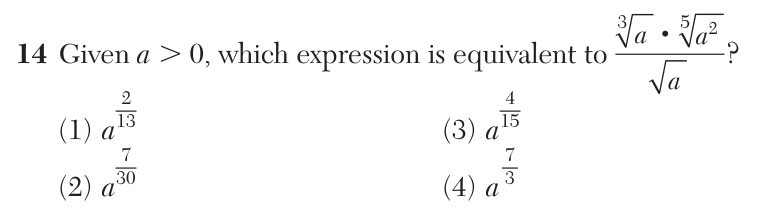
Simplify ∛a · ⁵√(a²) / √a for a > 0.
Worked solution for question 14
- Rewrite the numerator powers as a^(1/3) and a^(2/5), and the denominator as a^(1/2).
- Add numerator exponents and subtract the denominator exponent. In thirtieths this is (10 + 12 − 15)/30.
Answer choice 2a^(7/30)
Q15 Read factors from a graph
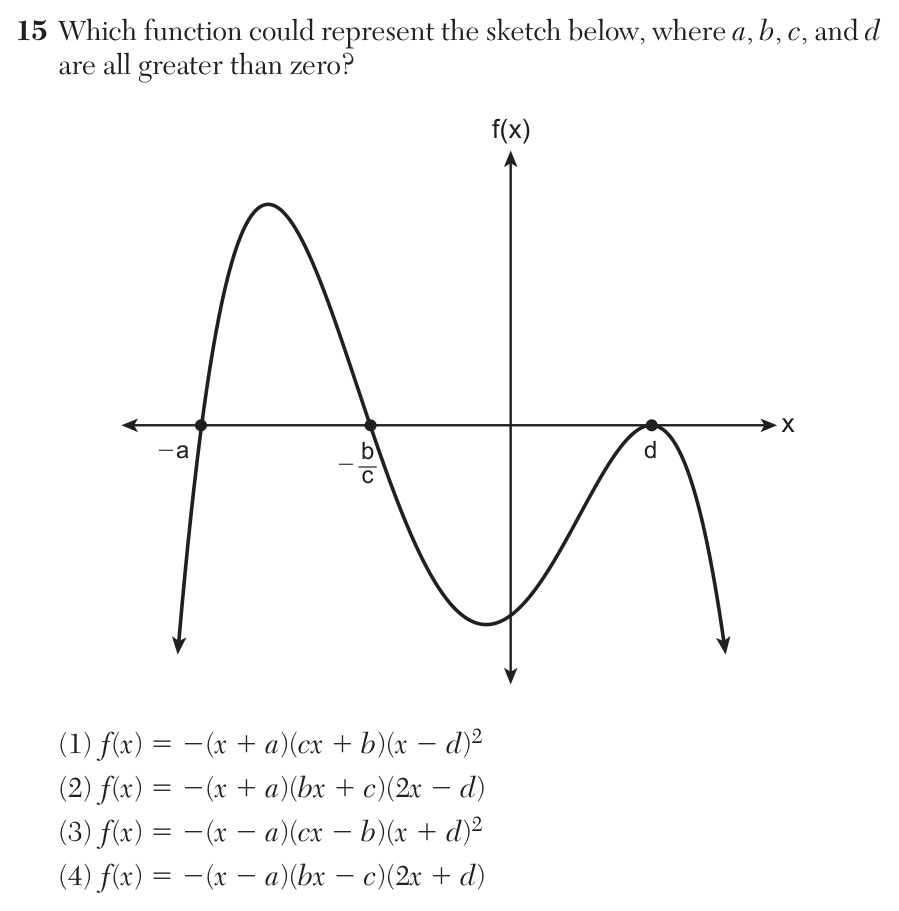
Use the crossings, bounce and end behavior to choose the quartic form.
Worked solution for question 15
- Crossings at −a and −b/c correspond to linear factors x + a and cx + b.
- The bounce at d calls for even multiplicity, here (x − d)². Both ends fall, so the even-degree polynomial needs a negative leading coefficient.
- The sign is negative because both ends of the quartic fall. The zero at d contributes a squared factor because the graph touches the axis and reverses there.
Answer choice 1−(x + a)(cx + b)(x − d)²
Q16 Conditional probability
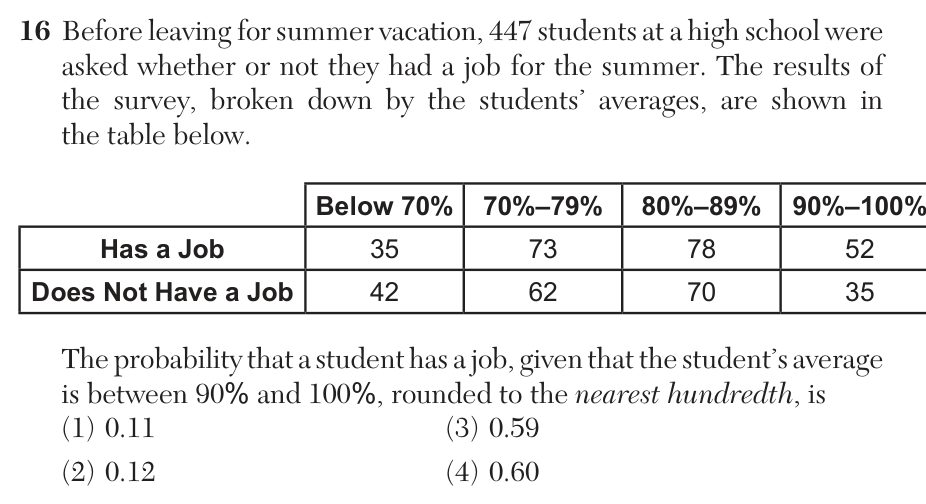
In the 90%–100% grade band, 52 students have a job and 35 do not. Find P(job given this grade band).
Worked solution for question 16
- Conditioning restricts the total to 52 + 35 = 87.
- Divide the 52 job holders by 87 to get about 0.5977, then round to hundredths.
Answer choice 40.60
Q17 Divide and factor
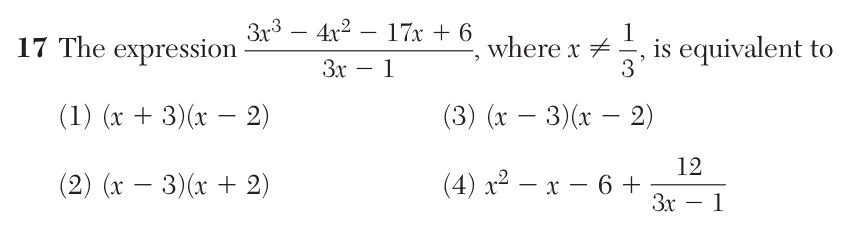
Simplify (3x³ − 4x² − 17x + 6)/(3x − 1) for x ≠ 1/3.
Worked solution for question 17
- Long division gives x² − x − 6 with no remainder. Multiplying it by 3x − 1 returns the numerator.
- The integers −3 and 2 sum to −1 and multiply to −6, giving the factors.
Answer choice 2(x − 3)(x + 2)
Q18 Valid completing-square step
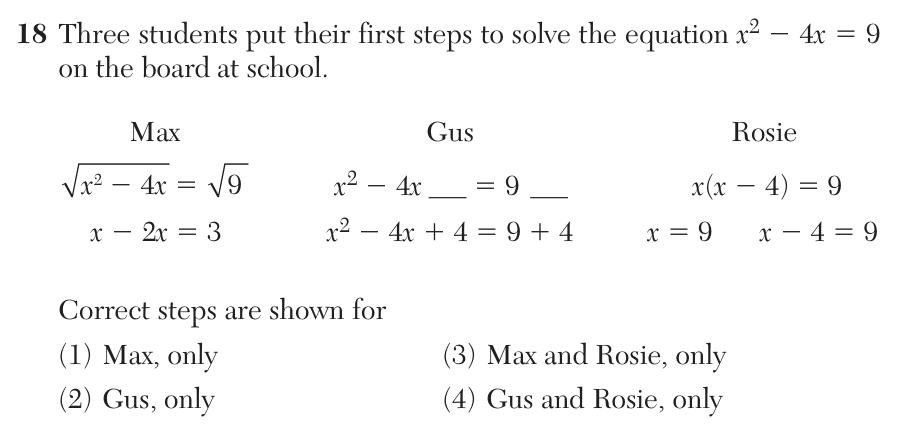
Compare the three proposed first steps for solving x² − 4x = 9.
Worked solution for question 18
- Gus adds 4 to each side to form (x − 2)² = 13, preserving equivalence.
- Max incorrectly distributes a square root over a difference. Rosie applies a factor-by-factor rule to a product equal to 9, where the zero-product rule does not apply.
Answer choice 2Gus only
Q19 Recursive depreciation
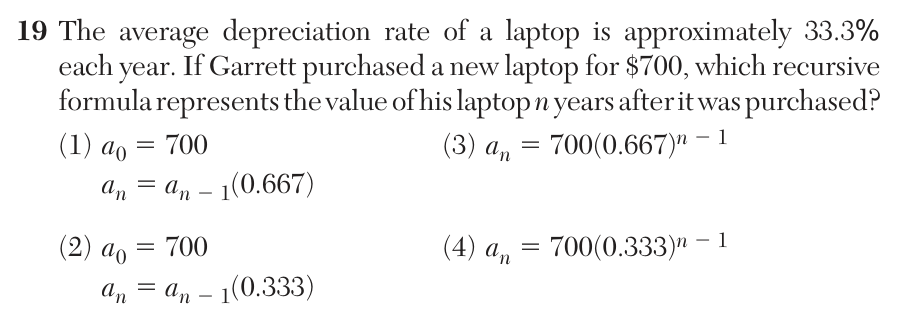
Write a recurrence for a 700-dollar laptop losing 33.3% per year.
Worked solution for question 19
- At purchase, zero years have elapsed. Set a₀ to 700.
- Each subsequent value keeps 1 − 0.333 = 0.667 of the previous year’s value.
Answer choice 1a₀ = 700 and aₙ = 0.667aₙ₋₁ for n ≥ 1
Q20 Focus and directrix
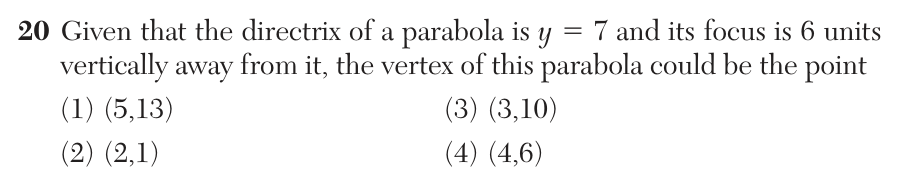
The directrix is y = 7 and the focus lies 6 vertical units away. Select a possible vertex.
Worked solution for question 20
- The focus may have y = 13 or y = 1. The vertex lies halfway from the focus to the directrix on a vertical line.
- Possible vertex heights are 10 or 4. Of the choices, only (3, 10) has either height.
Answer choice 3(3, 10)
Q21 Count rational-absolute intersections
Count solutions to x/(x − 1) = −∣2x − 3∣ + 5.

Worked solution for question 21
- Exclude x = 1. For x < 1.5 the right side is 2x + 2. Clearing the denominator gives 2x² − x − 2 = 0, whose roots (1 ± √17)/4 both fit.
- For x ≥ 1.5 the right side is 8 − 2x. The resulting roots are (9 ± √17)/4. Only the plus root lies in this branch.
- Together there are three valid roots.
- The roots in the first branch are about −0.78 and 1.28. The second branch produces about 1.22 and 3.28, but only 3.28 is at least 1.5. None equals the excluded input 1.
Answer choice 33 solutions
Q22 Quadrant II cosine
Given tan θ = −√6 in quadrant II, find cos θ.
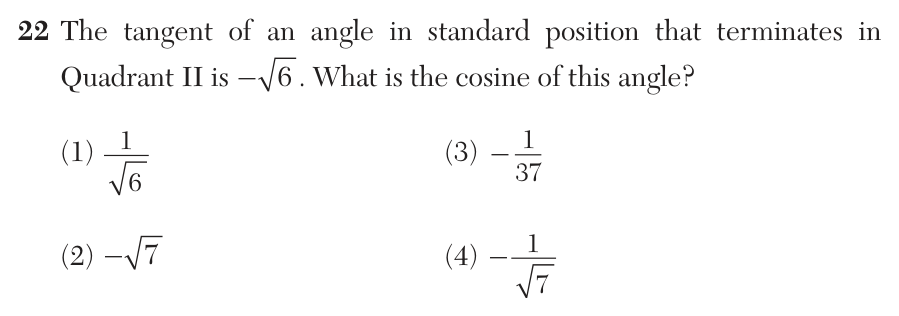
Worked solution for question 22
- Use x = −1 and y = √6 on the terminal ray, so y/x = −√6.
- The radius is √(1 + 6) = √7. Cosine is x/r, which is negative here.
Answer choice 4−1/√7
Q23 Geometric series
A membership costs 400 dollars in year 1 and rises 8% each year. Find the total for six years.
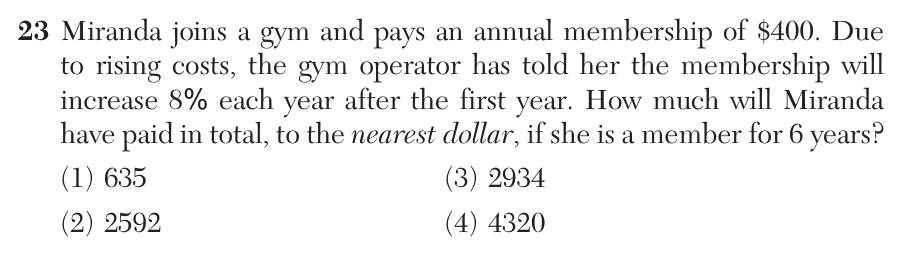
Worked solution for question 23
- The six payments are 400 times powers of 1.08 from exponent 0 to 5.
- Use 400[(1.08⁶ − 1)/(1.08 − 1)] ≈ 2934.37, then round.
- The last payment is 400(1.08)⁵, about 588 dollars. The question asks for all six payments, so this last payment alone is too small.
Answer choice 32,934 dollars
Q24 Exponential doubling time
Use the bacteria observations (0.25, 4.76), (0.75, 6.72), (1.5, 11.31) to identify the growth pattern.
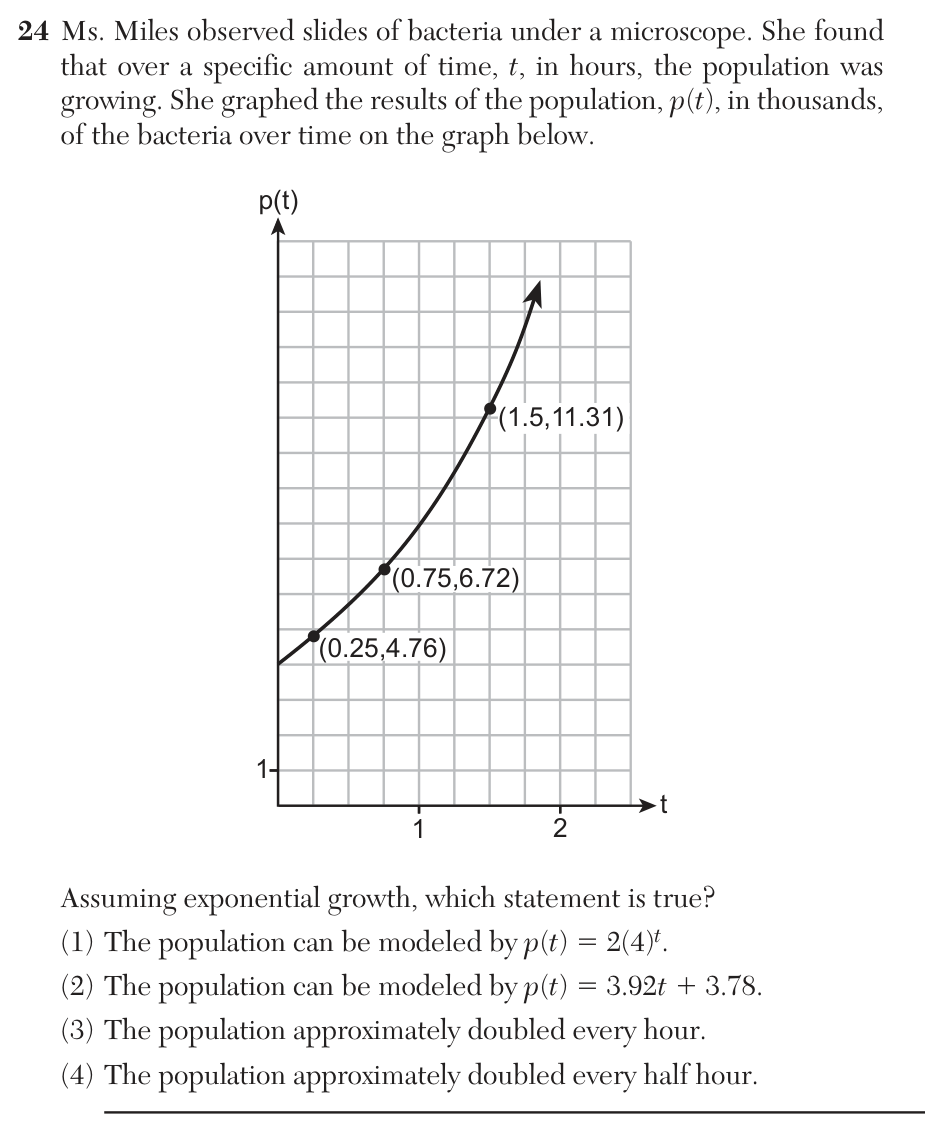
Worked solution for question 24
- Between the first two points, half an hour multiplies the population by 6.72/4.76 ≈ 1.412.
- Two such intervals give 1.412² ≈ 1.99, about double. The third point is consistent with the same exponential pattern.
Answer choice 3Approximately doubles each hour
Part II Short response
Question indexQ25 Solve an exponential equation
Find when B(t) = 250(1.8)ᵗ reaches 2,000 people.
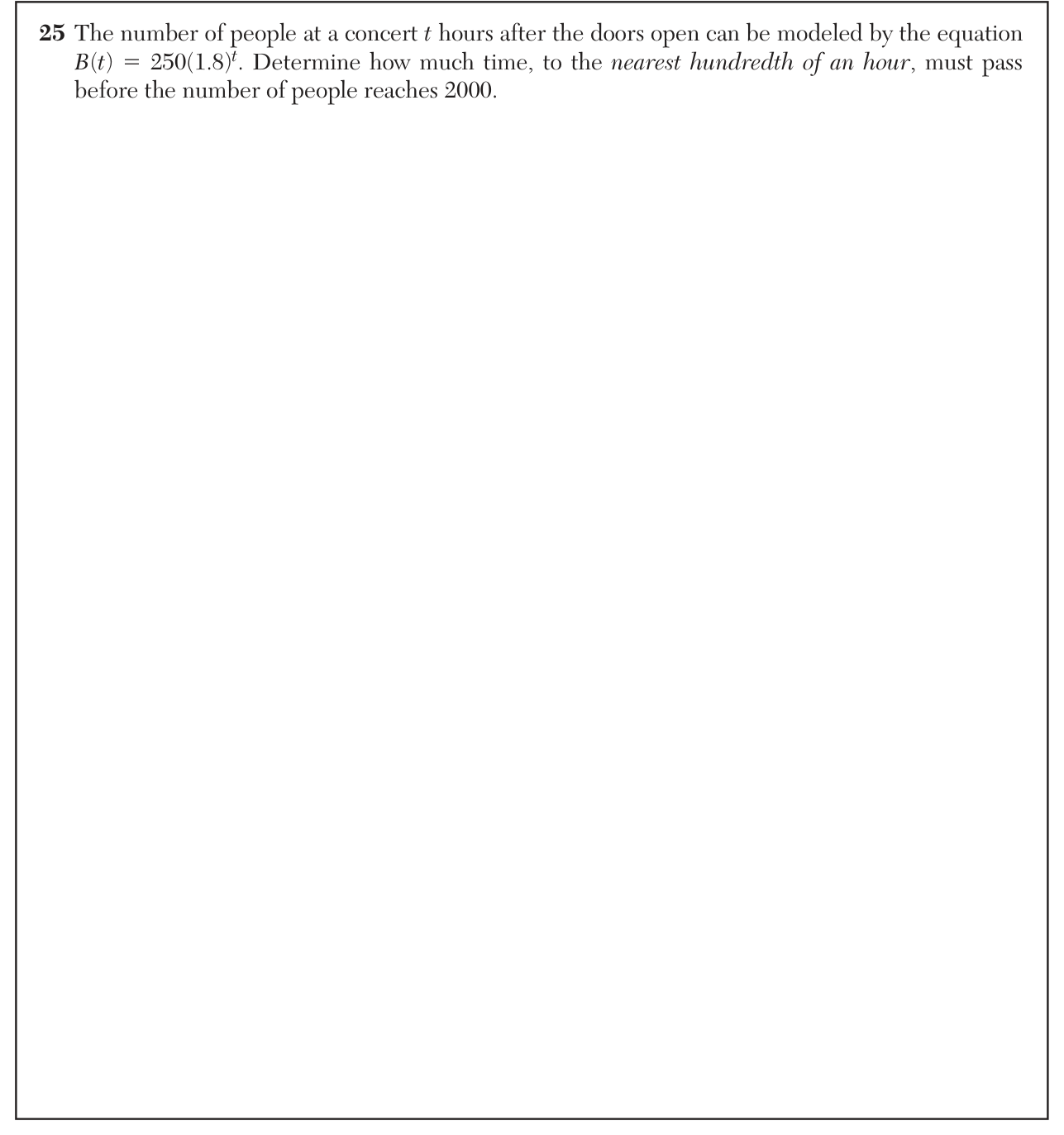
Worked solution for question 25
- Divide by 250 to get 1.8ᵗ = 8.
- Take logarithms and divide by log 1.8. The result log 8/log 1.8 is about 3.5377 hours.
Final answer3.54 hours
Q26 Interpret a sinusoidal model
T(h) = 8 sin(πh/12) + 82 gives Fahrenheit temperature h hours after 9 a.m. Interpret T(6).

Worked solution for question 26
- At h = 6, the sine input is π/2, where sine equals 1. Thus T(6) = 8 + 82.
- Six hours after 9 a.m. is 3 p.m., when the model predicts 90°F.
Final answer90°F at 3 p.m.
Q27 Fractional power of a negative number
Justify (−64)^(2/3) = 16.

Worked solution for question 27
- The odd denominator 3 means take the real cube root, which exists for a negative base.
- The cube root is −4 because (−4)³ = −64. The numerator 2 then squares it to 16.
Final answer16
Q28 Shifted exponential graph
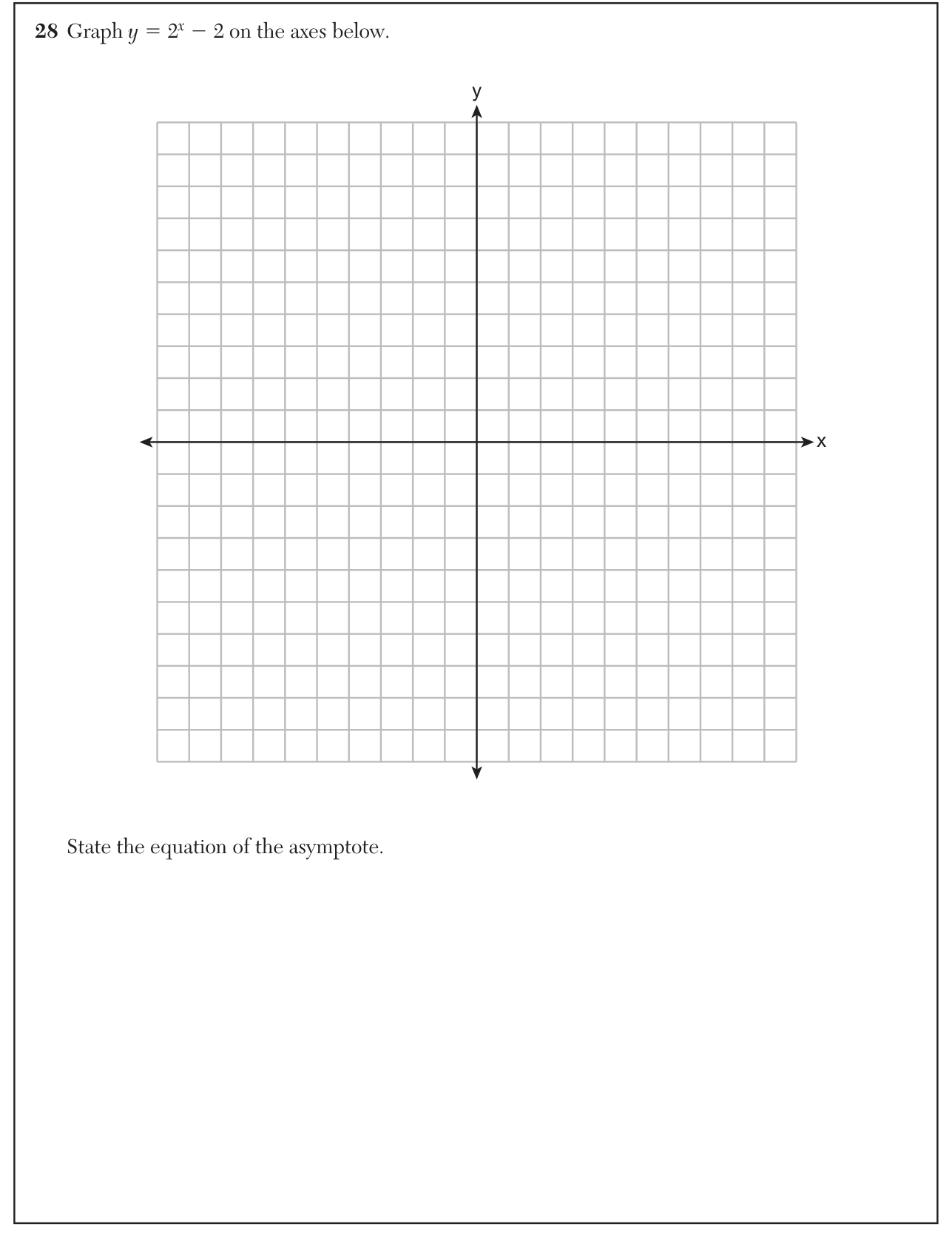
Graph y = 2ˣ − 2 and state its asymptote.
Worked solution for question 28
- Subtract 2 from every output of 2ˣ. At x = −1, 0, 1, 2 and 3 the outputs are −1.5, −1, 0, 2 and 6.
- Join these points smoothly. As x decreases without bound, 2ˣ approaches zero, so the shifted curve approaches −2 from above.
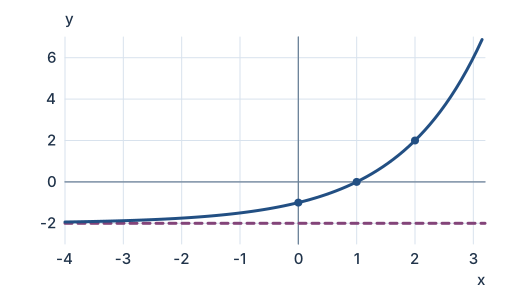
Final answerIncreasing curve through (0, −1), (1, 0), (2, 2), with asymptote y = −2
Q29 Union of overlapping groups
English fluency is 58%, Mandarin fluency 24%, and both 16%. Find the share fluent in at least one.

Worked solution for question 29
- Adding 58% and 24% counts the 16% bilingual group twice.
- Subtract the overlap once to get 58 + 24 − 16 = 66%.
Final answer66%
Q30 Home-value regression
Fit an exponential model to years since 1980 and median values in thousands of dollars.

Worked solution for question 30
- Enter x values 1, 10, 20, 30, 40 and y values 59.07, 97.02, 131.6, 180.7, 269.2.
- Run exponential regression in the form a · bˣ and round a and b to hundredths. Here x is years since 1980.
Final answerŷ = 61.14(1.04)ˣ
Q31 Rational equation
Solve 24/(x² + 4x) + x/(x + 4) = 5/x.

Worked solution for question 31
- Exclude x = 0 and −4. Multiply by x(x + 4) to get 24 + x² = 5(x + 4).
- Simplify to x² − 5x + 4 = 0 and factor (x − 1)(x − 4). Both roots are allowed.
Final answerx = 1 or 4
Q32 Complex expression
Simplify i(x + i) − (x − i)² in a + bi form.

Worked solution for question 32
- Use i² = −1 to expand the first term as xi − 1.
- The square is x² − 2xi − 1. Subtract all its terms, cancel the constants and combine the imaginary terms.
Final answer−x² + 3xi
Part III Extended response
Question indexQ33 Simulation and evidence
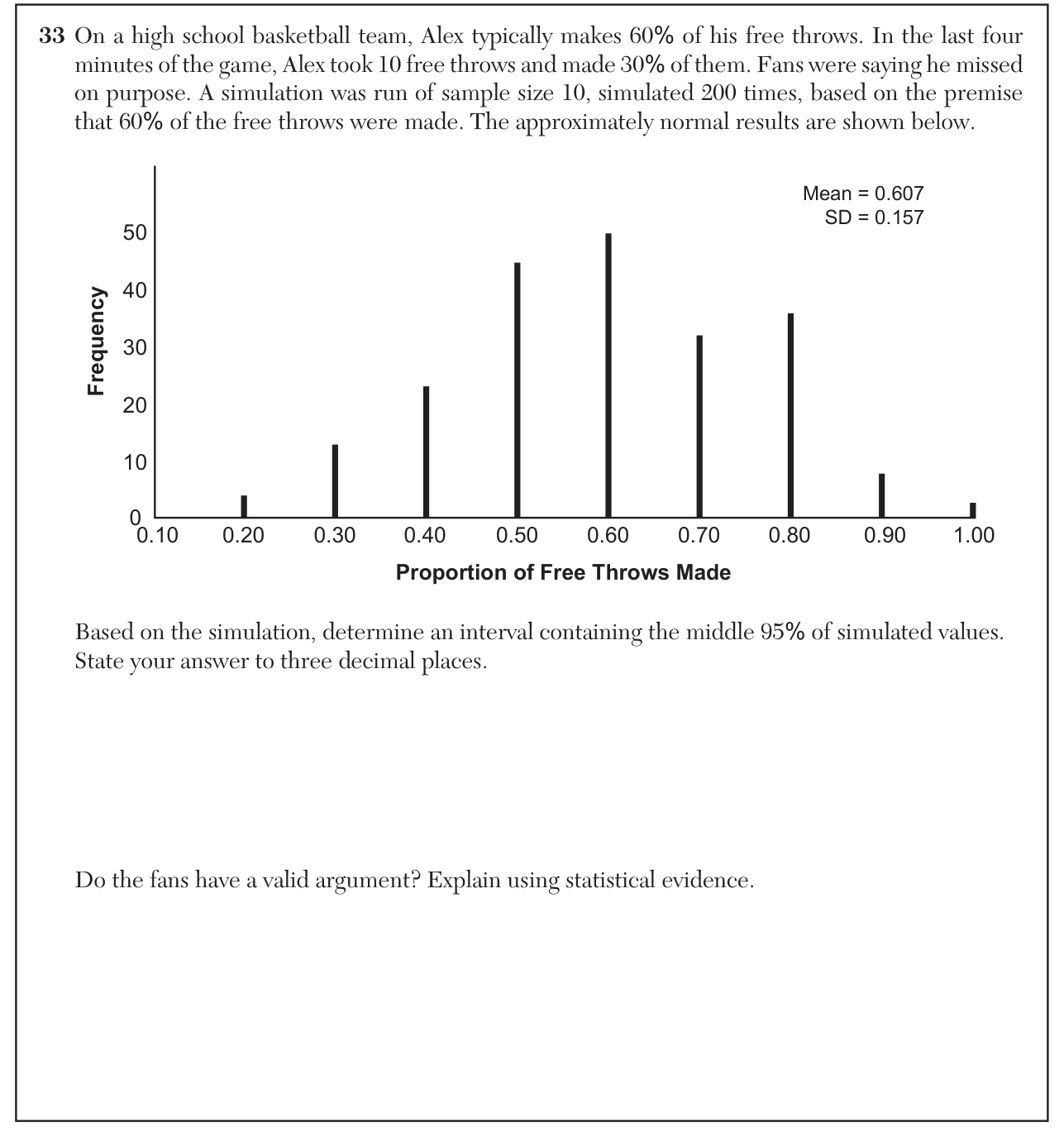
For simulated free-throw proportions with mean 0.607 and SD 0.157, find the middle 95% and assess a 0.30 result.
Worked solution for question 33
- The distribution is approximately normal, so use 0.607 ± 2(0.157) for the middle 95% by the empirical rule.
- The observed 0.30 is inside the interval. It is consistent with ordinary variation in ten shots under the simulation assumption, so the data do not establish deliberate misses.
- The interval tests how unusual 3 makes in 10 would be under the stated 60% model. Even a result outside the interval would raise a statistical question about that model, rather than establish intent.
Final answerApproximately (0.293, 0.921). The result does not support the fans’ claim.
Q34 Compare decay graphs
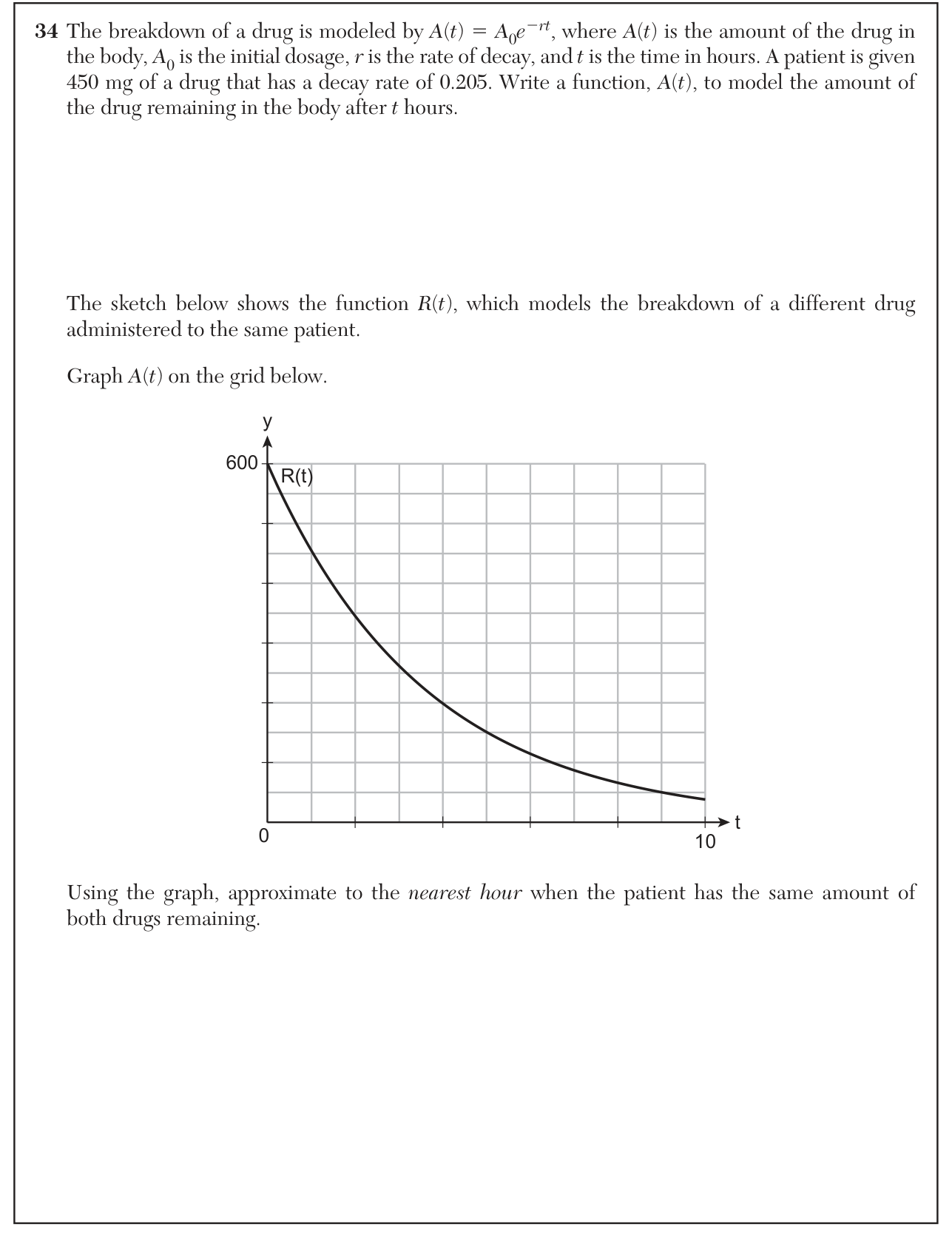
A dose starts at 450 mg with continuous decay rate 0.205 per hour. Graph it alongside the supplied R(t) and estimate when amounts match.
Worked solution for question 34
- Insert the starting dose and rate into A₀e^(−rt).
- Plot approximate points (0, 450), (2, 299), (4, 198), (6, 132), (8, 87), and (10, 58). Draw a smooth decreasing curve.
- Read the x-coordinate where this curve crosses R(t) on the supplied grid. It is closest to 4 hours.
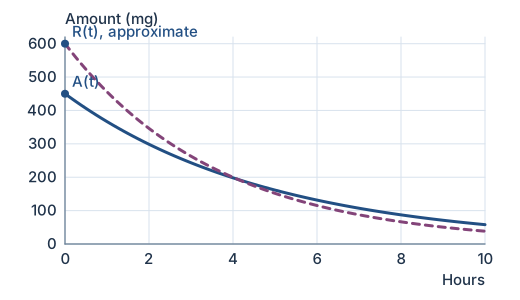
Final answerA(t) = 450e^(−0.205t). The curves meet at about 4 hours.
Q35 Sinusoidal maximum, period and rate
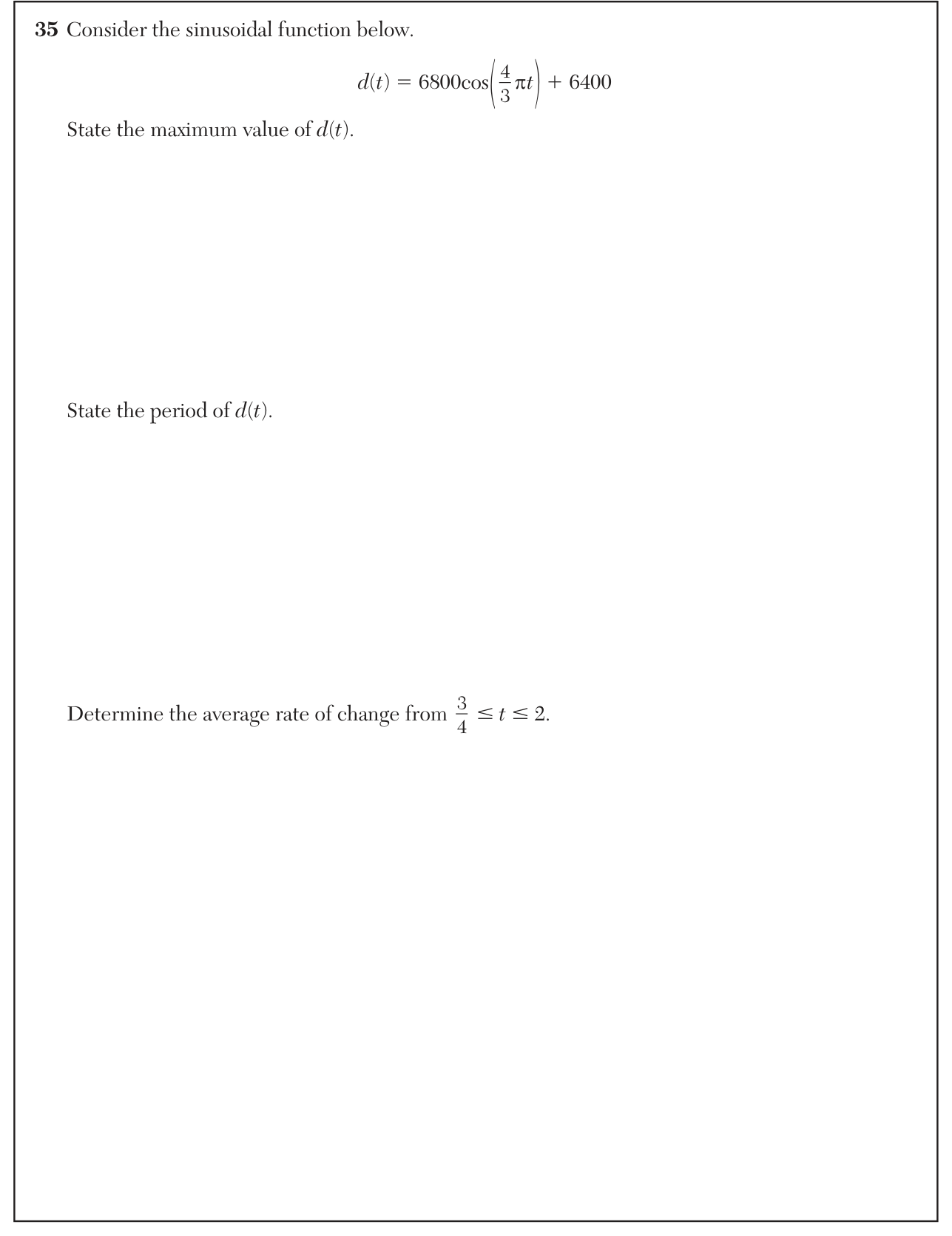
For d(t) = 6800 cos(4πt/3) + 6400, find the maximum, period and average rate on [3/4, 2].
Worked solution for question 35
- Cosine tops out at 1, so the maximum is 6400 + 6800. The period is 2π/(4π/3).
- At t = 3/4, the angle is π, so d = −400. At t = 2, the angle is 8π/3, whose cosine is −1/2, so d = 3000.
- Divide 3000 − (−400) by 2 − 3/4 to obtain 2720.
Final answerMaximum 13,200, period 3/2, and average rate 2,720
Q36 Radical equation
Solve m − 2√(4m − 3) = 3.

Worked solution for question 36
- Isolate the radical to get 2√(4m − 3) = m − 3, so m ≥ 3.
- Square to get 16m − 12 = (m − 3)². Rearrange to m² − 22m + 21 = (m − 1)(m − 21) = 0.
- Reject 1 because m − 3 is negative there. Check 21 − 2√81 = 3.
Final answerm = 21
Part IV Long response
Question indexQ37 Compare practice schedules
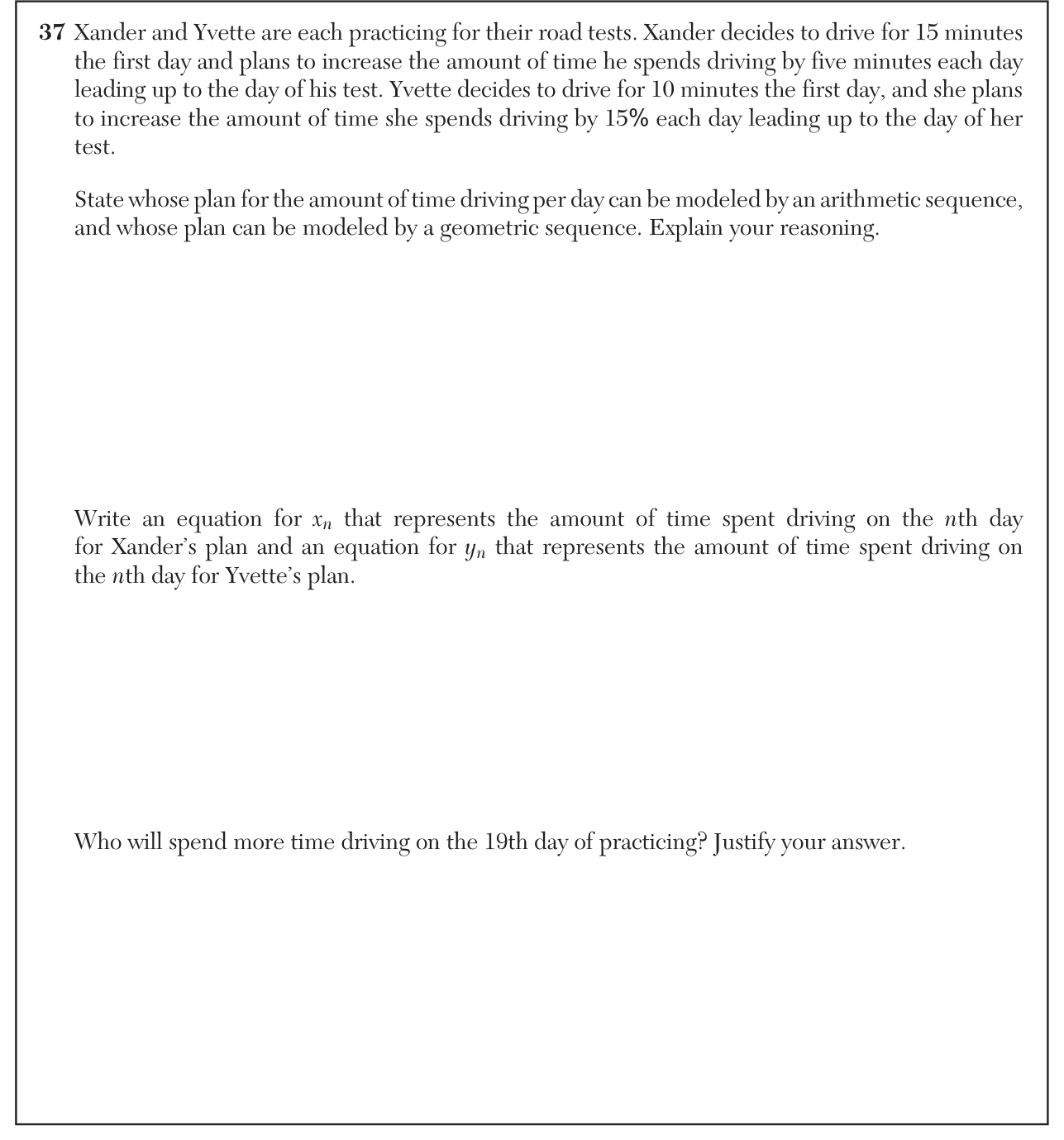
Xander starts at 15 minutes and adds 5 per day. Yvette starts at 10 minutes and increases 15% per day. Model both and compare day 19.
Worked solution for question 37
- Xander adds a fixed 5, giving xₙ = 15 + 5(n − 1). Yvette multiplies by 1.15, giving yₙ = 10(1.15)^(n − 1).
- At n = 19, Xander drives 105 minutes. Yvette drives approximately 123.75 minutes.
- Because 123.75 > 105, Yvette drives longer that day.
Final answerXander is arithmetic, Yvette is geometric, and Yvette drives longer on day 19.
From the New York State Education Department. January 2026 Algebra II Regents Examination. Internet. Available from https://www.nysedregents.org/algebratwo/126/algtwo-12026-exam.pdf. Accessed .