NEW YORK STATE REGENTS · ALGEBRA I
June 2026 Algebra I Regents Past Paper & Solutions
Work through quadratics, graphing inequalities and arithmetic sequences with a question-by-question walkthrough of the exam.
- 35 worked questions
- 82 raw credits
- 4 exam parts
The question images and page numbers come from the regular-size English exam. OnlyPrepy wrote the summaries and worked solutions.
Quick answer key for Part I
Part I Multiple choice
Question indexQ1 Arithmetic sequence
Find term 20 of 4, 7, 10, 13, …

Worked solution for question 1
- The common difference is 3. There are 19 steps from term 1 to term 20.
- Add 19(3) to the initial value 4.
Answer choice 161
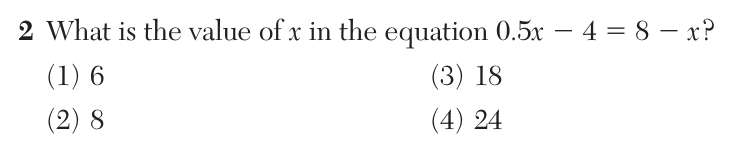
Q2 Linear equation
Solve 0.5x − 4 = 8 − x.
Worked solution for question 2
- Add x and 4 to both sides to obtain 1.5x = 12.
- Divide by 1.5 and check that both sides are 0 when x = 8.
- Substitute x = 8 into the starting equation. The left side is 0.5(8) − 4 = 0 and the right side is 8 − 8 = 0.
Answer choice 2x = 8
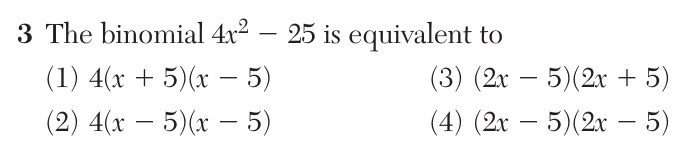
Q3 Difference of squares
Factor 4x² − 25.
Worked solution for question 3
- Recognize (2x)² − 5².
- Use a² − b² = (a − b)(a + b). The mixed terms cancel in the product.
Answer choice 3(2x − 5)(2x + 5)
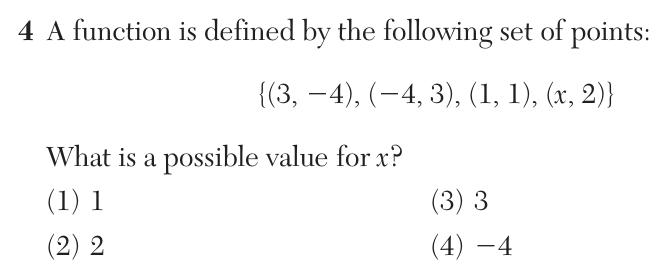
Q4 Function inputs
Choose x so (3, −4), (−4, 3), (1, 1), and (x, 2) form a function.
Worked solution for question 4
- The existing inputs are 3, −4 and 1. Each already has an output different from 2.
- A fresh input is required. Of the choices, only 2 avoids a repeated input.
- For example, x = 3 would assign both −4 and 2 to the same input. It is fine for an input to have the same number as its output.
Answer choice 2x = 2
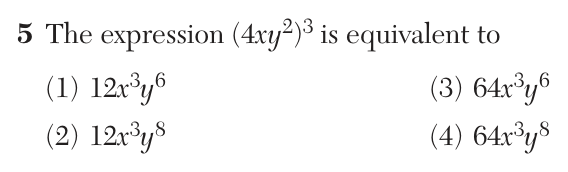
Q5 Power rules
Simplify (4xy²)³.
Worked solution for question 5
- Cube each factor of the product individually.
- Then 4³ = 64 and (y²)³ = y⁶.
- Writing the power as three copies of 4xy² confirms that there are three factors of x and six factors of y. Only the numerical coefficient is cubed to 64.
Answer choice 364x³y⁶
Q6 Polynomial features
Identify a cubic trinomial with leading coefficient 4 and constant 5.
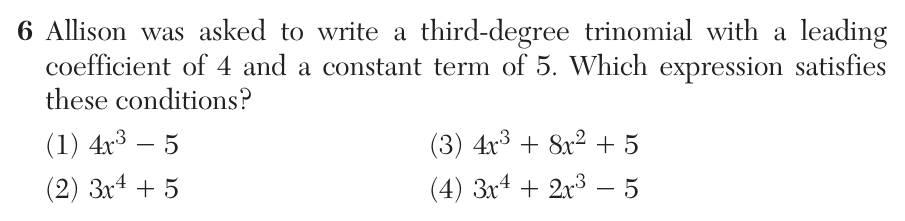
Worked solution for question 6
- The highest term must be 4x³ and the term of degree zero must be 5.
- Count terms after combining like powers. The additional term 8x² makes exactly three.
Answer choice 34x³ + 8x² + 5
Q7 Geometric sequence
Write a formula for term n of 128, 64, 32, …
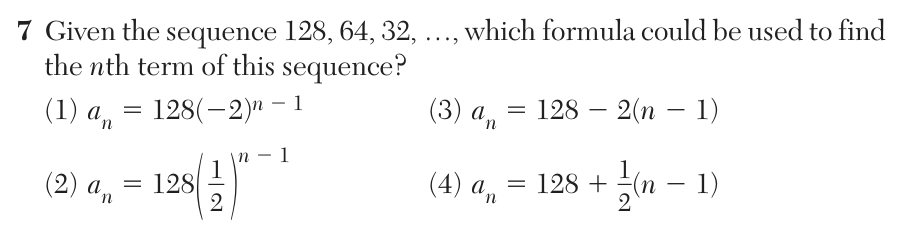
Worked solution for question 7
- Each term is half the previous one, so the common ratio is 1/2.
- Start at 128 and apply the ratio n − 1 times.
Answer choice 2aₙ = 128(1/2)ⁿ⁻¹
Q8 Correlation and cause
Classify the association between brake pressure and bicycle speed while braking.
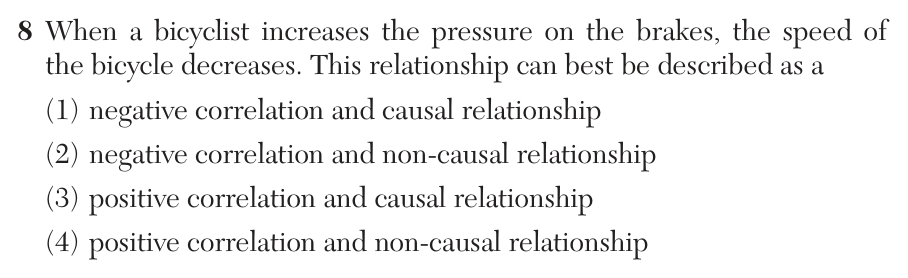
Worked solution for question 8
- Greater brake pressure is paired with lower speed, giving a negative relationship.
- Applying the brakes also changes the force slowing the bicycle, so there is a causal mechanism in this situation.
Answer choice 1Negative association and causal
Q9 Cost model
Model 40 plants costing 170 dollars, with 4-dollar daffodils and 5-dollar tulips. Use d for daffodils.
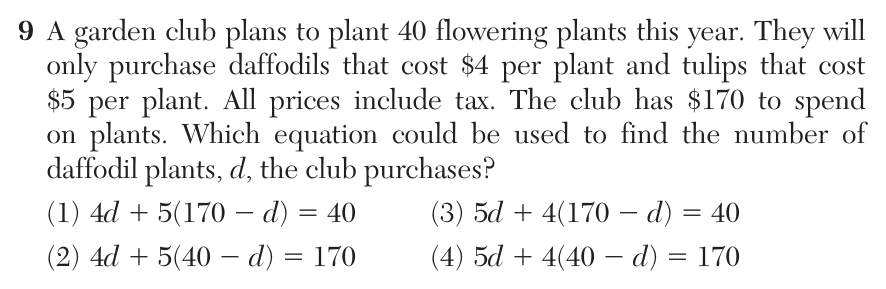
Worked solution for question 9
- If d are daffodils, the remaining 40 − d are tulips.
- Multiply each count by its own unit price and add to match the total spend.
- Solving the model gives 4d + 200 − 5d = 170, so d = 30. This leaves 10 tulips and checks the total at 30(4) + 10(5) = 170 dollars.
Answer choice 24d + 5(40 − d) = 170
Q10 Function evaluation
Evaluate h(−1) for h(x) = x² − 3x + 1.
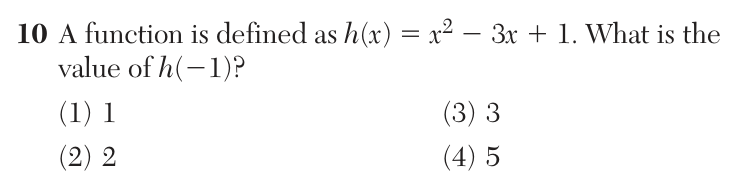
Worked solution for question 10
- Put parentheses around the negative input to get (−1)² − 3(−1) + 1.
- The two variable terms become 1 and 3, giving 5.
Answer choice 45
Q11 Polynomial zeros
Find the zeros of x(3x + 2)(x − 5).
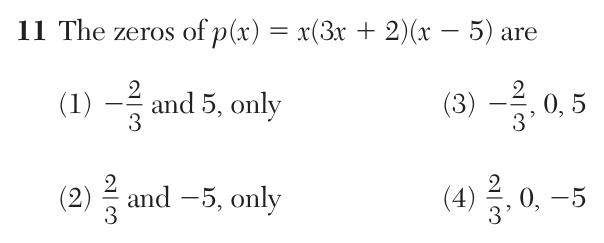
Worked solution for question 11
- Set each factor to zero independently.
- Solving 3x + 2 = 0 gives −2/3, while x = 0 and x − 5 = 0 give 0 and 5.
Answer choice 3−2/3, 0, 5
Q12 Exponential overtaking
Find the first positive integer x with 1.25ˣ > 3x + 10.
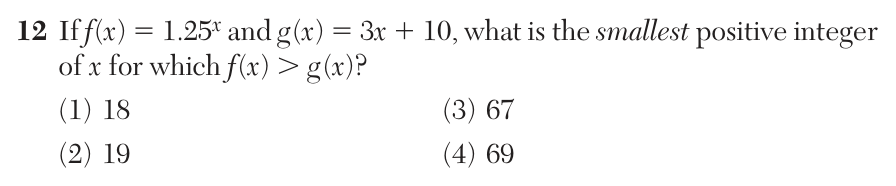
Worked solution for question 12
- Use an integer table beginning at x = 1. Through x = 18 the exponential is below the line. At 18 the values are about 55.51 and 64.
- At 19 they are about 69.39 and 67. This is the first row where the inequality holds.
- A table check is useful here because comparing the functions at 18 and 19 shows a crossing between those inputs, while the rows from 1 through 17 verify that no earlier positive integer works.
Answer choice 219
Q13 Equation through two points
Find a line through (2, 5) and (−2, −1).
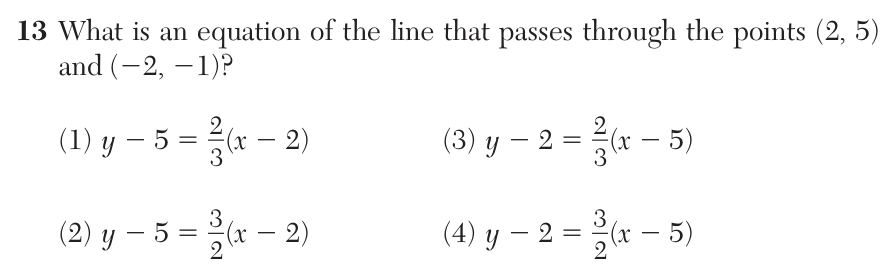
Worked solution for question 13
- Compute slope (5 − (−1))/(2 − (−2)) = 6/4 = 3/2.
- Use point-slope form with (2, 5). The other point gives −6 on both sides.
Answer choice 2y − 5 = (3/2)(x − 2)
Q14 Conditional percentage
Of 70 female respondents, 40 preferred basketball. Find the approximate percentage.
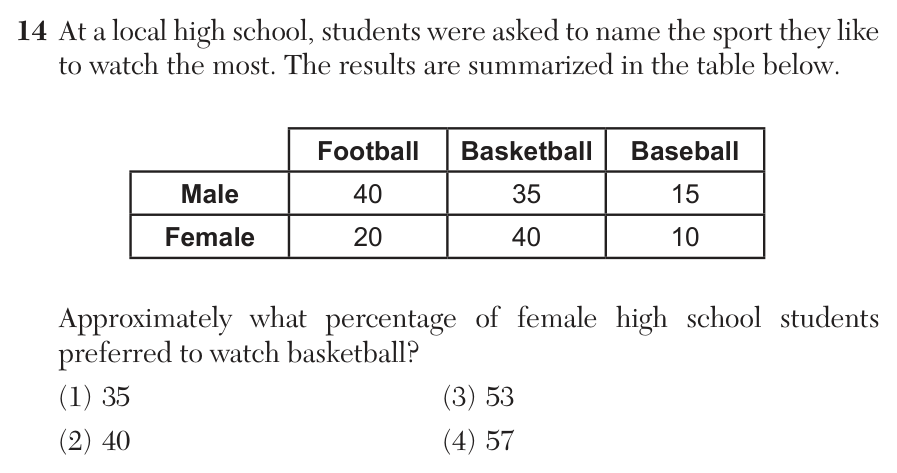
Worked solution for question 14
- The condition limits the denominator to the female row, whose total is 20 + 40 + 10 = 70.
- Compute 40/70 × 100 ≈ 57.14 and choose the closest percentage.
- Using all respondents would give a joint fraction instead. The phrase “of female students” restricts the comparison to the 70 entries in that row.
Answer choice 457%
Q15 Complete the square
Rewrite x² − 10x − 24 = 0 as a squared-binomial equation.

Worked solution for question 15
- Move −24 to the other side, giving x² − 10x = 24.
- Add (−10/2)² = 25 to both sides and factor the left side.
Answer choice 4(x − 5)² = 49
Q16 Graph translation
Shift f three units right and four units up.
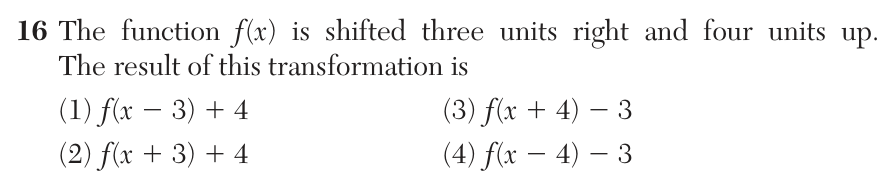
Worked solution for question 16
- A point at input a moves to input a + 3, so the new rule must feed x − 3 to f.
- Add 4 to the resulting output for the vertical move.
Answer choice 1g(x) = f(x − 3) + 4
Q17 Addition property
Name the property used to add 16 to both sides of x² − 8x = 3.
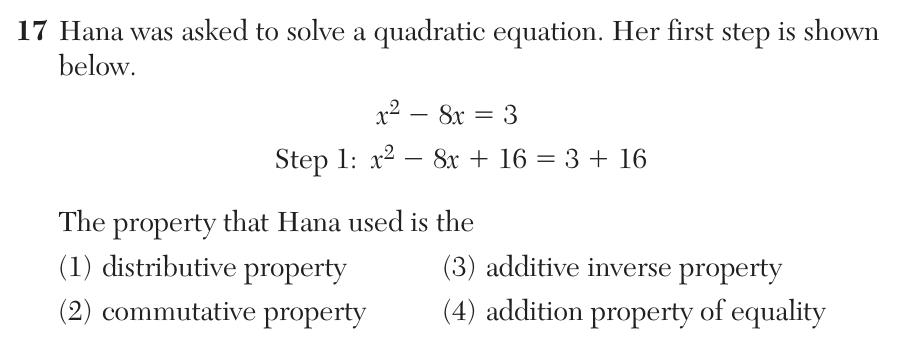
Worked solution for question 17
- Both sides receive exactly the same addend.
- That preserves the solution set and creates a perfect square on the left.
Answer choice 4Addition property of equality
Q18 Upper quartile
Find Q₃ of 28, 28, 28, 28, 32, 32, 34, 34, 40, 42.
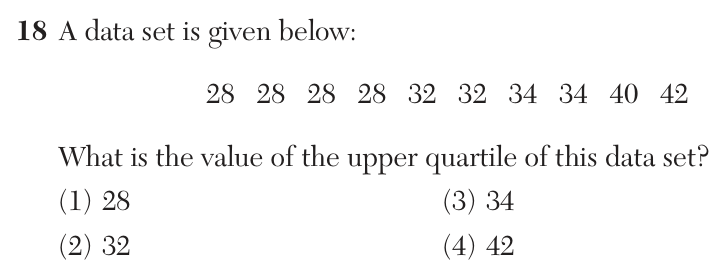
Worked solution for question 18
- The data are sorted and there are ten observations. Take the highest five, 32, 34, 34, 40, 42.
- The middle of that half is its third value, 34.
Answer choice 334
Q19 Subtract polynomials
Compute (2x² − 3x + 10) − (−3x² + 7x − 1).

Worked solution for question 19
- Change all signs in the polynomial being subtracted to get +3x² − 7x + 1.
- Then group the quadratic, linear and constant terms.
Answer choice 25x² − 10x + 11
Q20 Percent growth
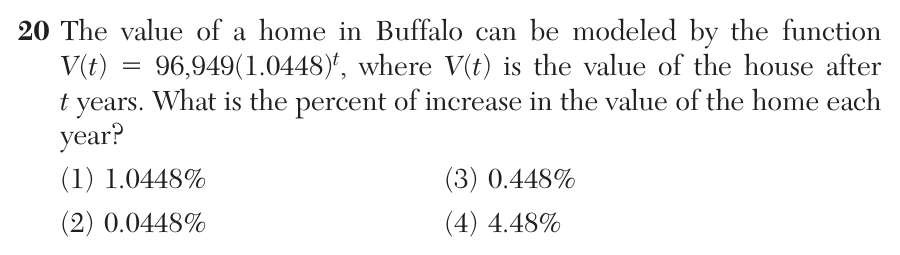
Read the annual growth rate from V(t) = 96,949(1.0448)ᵗ.
Worked solution for question 20
- The yearly multiplier equals 1 + r. Subtract 1 to isolate r = 0.0448.
- Multiply the decimal by 100 to express it as a percentage.
Answer choice 44.48%
Q21 Convert rods to inches
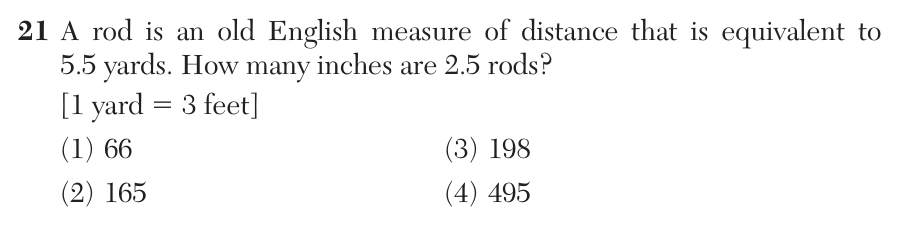
Convert 2.5 rods using 5.5 yards per rod.
Worked solution for question 21
- Multiply by 5.5 to get 13.75 yards.
- Multiply by 3 feet per yard and 12 inches per foot, for 13.75 × 36 = 495.
Answer choice 4495 inches
Q22 Quadratic formula
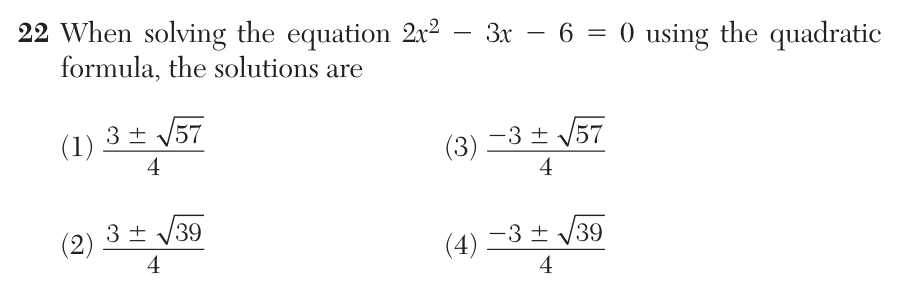
Solve 2x² − 3x − 6 = 0.
Worked solution for question 22
- Use a = 2, b = −3 and c = −6. Then b² − 4ac = 9 + 48 = 57.
- Divide −b ± √57 by 2a = 4.
- The discriminant is positive, so both signs produce real solutions. Keep the whole numerator over 4, including the 3 and the radical.
Answer choice 1x = (3 ± √57)/4
Q23 Axis of symmetry
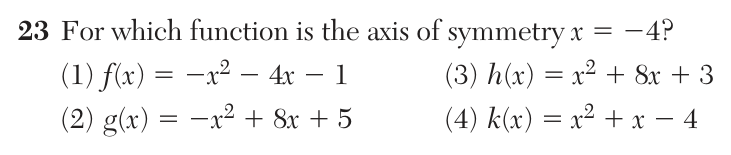
Select the quadratic symmetric about x = −4.
Worked solution for question 23
- The vertical axis for ax² + bx + c is x = −b/(2a).
- For h, this is −8/(2 · 1) = −4, so the vertex lies on the required line.
- To verify the axis directly, complete the square: h(x) = (x + 4)² − 13. Inputs equally far from −4 give the same value.
Answer choice 3h(x) = x² + 8x + 3
Q24 Simplify a radical product
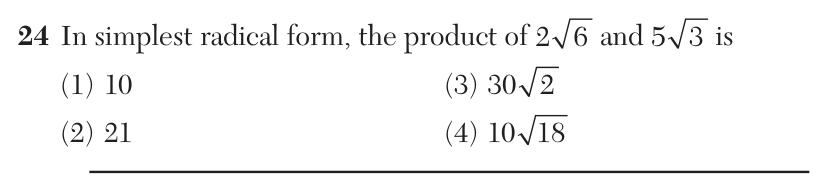
Multiply 2√6 and 5√3 in simplest radical form.
Worked solution for question 24
- Multiply coefficients and radicands separately to get 10√18.
- Since 18 = 9 · 2, extract √9 = 3 to obtain 30√2.
Answer choice 330√2
Part II Short response
Question indexQ25 Expand two binomials
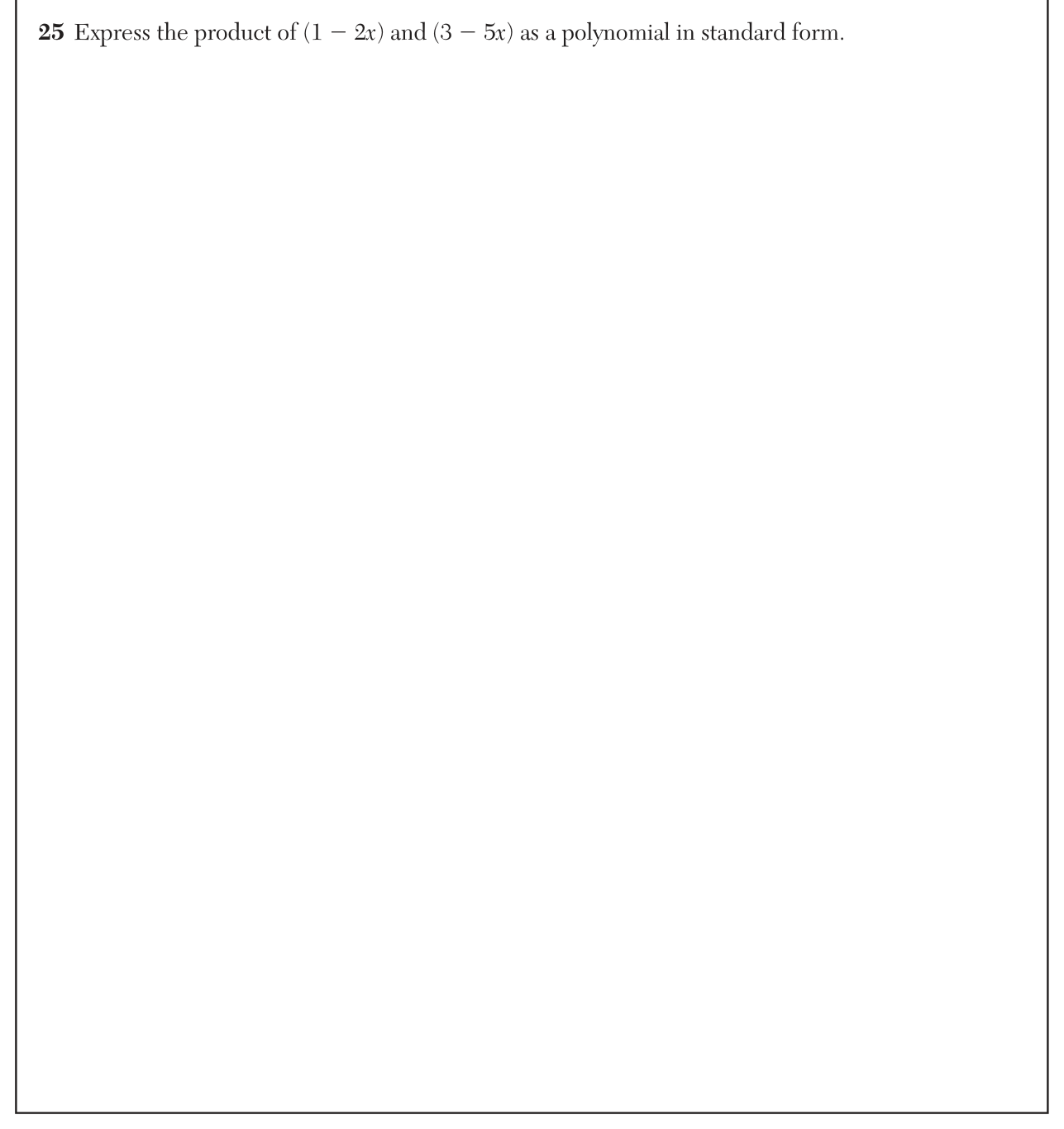
Write (1 − 2x)(3 − 5x) in standard form.
Worked solution for question 25
- Distribute to get 3 − 5x − 6x + 10x².
- Combine the two linear terms, then put the quadratic term first.
Final answer10x² − 11x + 3
Q26 Absolute value graph
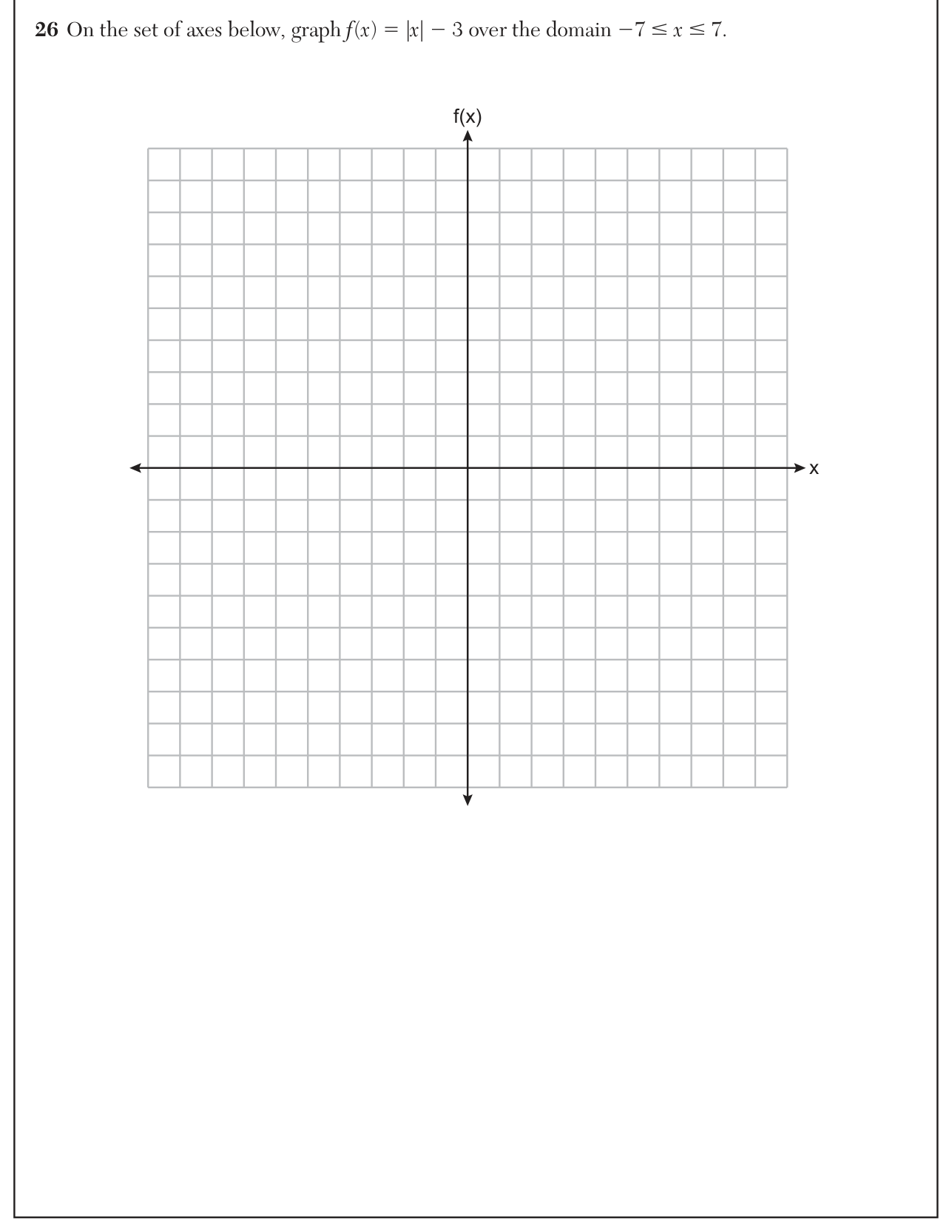
Graph f(x) = ∣x∣ − 3 for −7 ≤ x ≤ 7.
Worked solution for question 26
- The −3 lowers the vertex from (0, 0) to (0, −3). The x-intercepts are at ±3.
- Evaluate the closed endpoints at ±7 to get 4. Join each endpoint to the vertex with a straight segment.
- For x ≤ 0 the equation is y = −x − 3, and for x ≥ 0 it is y = x − 3. This gives the two straight branches, each restricted to the assigned domain.
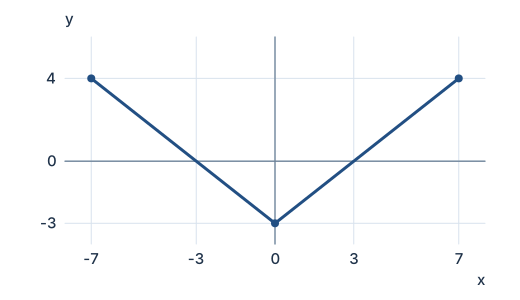
Final answerV through (−7, 4), (0, −3), and (7, 4)
Q27 Solve an inequality
Solve −4x + 1 > 9 + 3(2x + 1) + x.

Worked solution for question 27
- Distribute and collect the right side to get −4x + 1 > 12 + 7x.
- Subtract 7x and 1 to get −11x > 11. Dividing by −11 reverses the inequality.
Final answerx < −1
Q28 Rearrange area formula
Isolate h in A = bh/2.

Worked solution for question 28
- Multiply by 2 to clear the denominator, giving 2A = bh.
- Divide both sides by the nonzero base b.
Final answerh = 2A/b
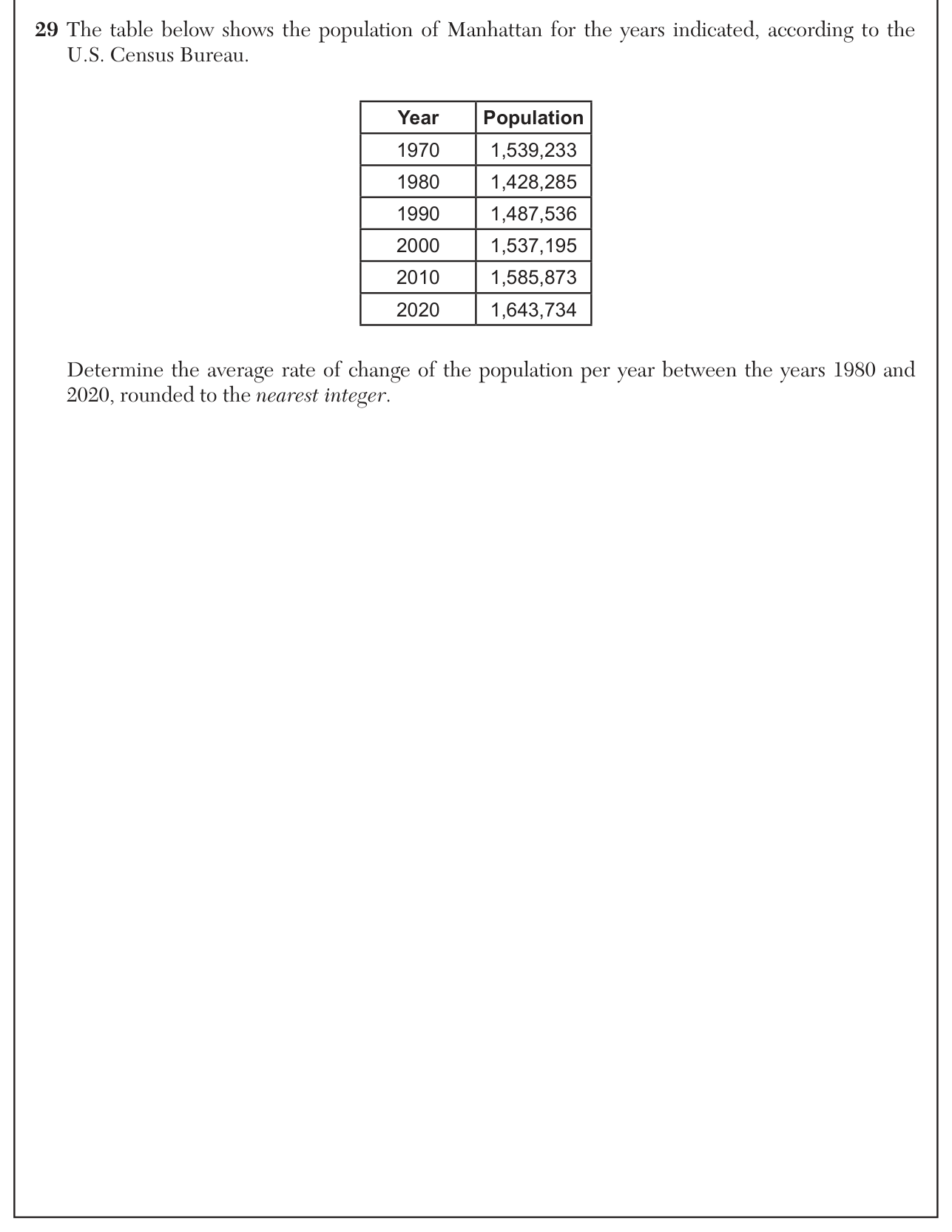
Q29 Population growth
Find the average annual change from 1,428,285 in 1980 to 1,643,734 in 2020.
Worked solution for question 29
- Subtract the starting count to obtain 215,449 additional people.
- Divide by the 40-year interval to obtain 5,386.225, then round.
Final answer5,386 people per year
Q30 Rationalize a denominator
Rewrite 5/√3 with a rational denominator.

Worked solution for question 30
- Multiply by √3/√3, which equals 1.
- The denominator becomes √3 · √3 = 3 and the numerator is 5√3.
Final answer5√3/3
Part III Extended response
Question indexQ31 Projectile graph
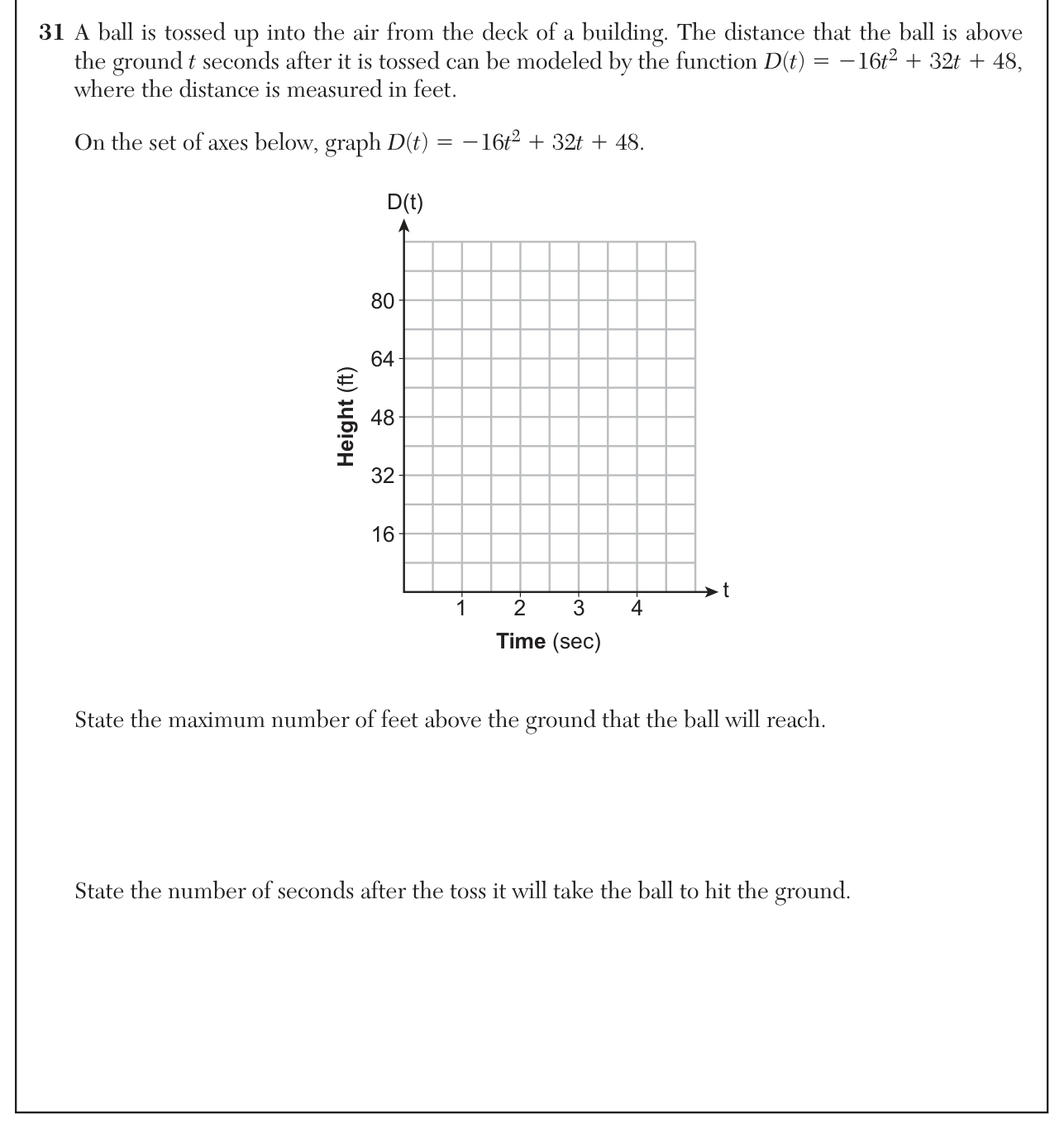
Graph D(t) = −16t² + 32t + 48 and find peak height and landing time.
Worked solution for question 31
- Factor D(t) = −16(t − 3)(t + 1). The nonnegative zero is t = 3.
- The vertex occurs at t = −32/(2 · −16) = 1, where D(1) = 64.
- Plot (0, 48), (1, 64), (2, 48), and (3, 0) and draw the smooth downward arc.
- The algebraic zero at t = −1 is outside the time since the throw. The physical sketch starts at t = 0 and stops at the positive intercept.
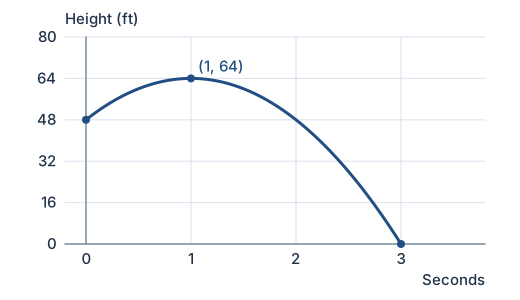
Final answer64 feet at t = 1. The ball lands after 3 seconds.
Q32 Linear and quadratic system
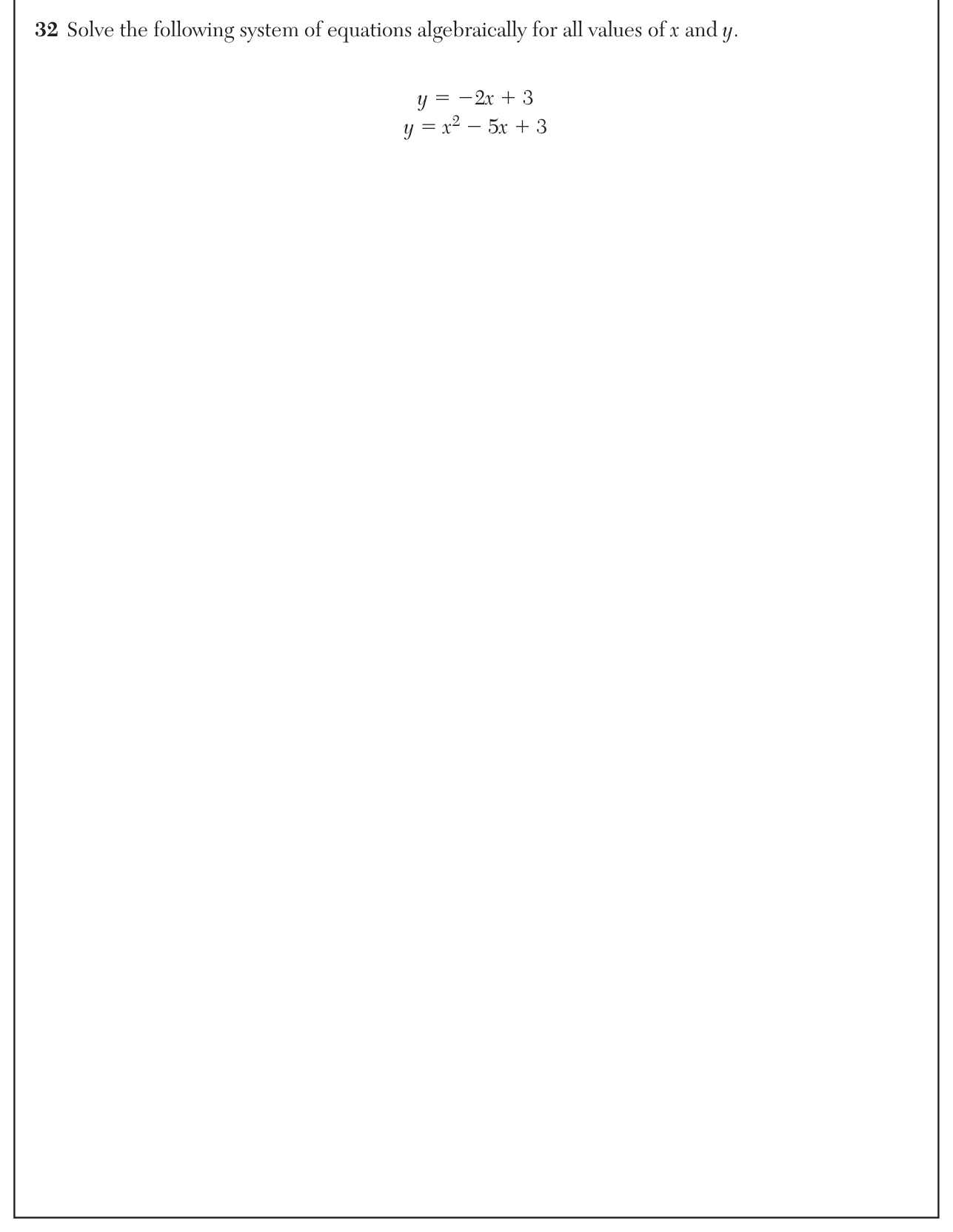
Solve y = −2x + 3 and y = x² − 5x + 3.
Worked solution for question 32
- Equate the right sides and simplify to x² − 3x = 0.
- Factor x(x − 3) to get x = 0 or 3.
- Use y = −2x + 3 to find the corresponding y-coordinates.
Final answer(0, 3) and (3, −3)
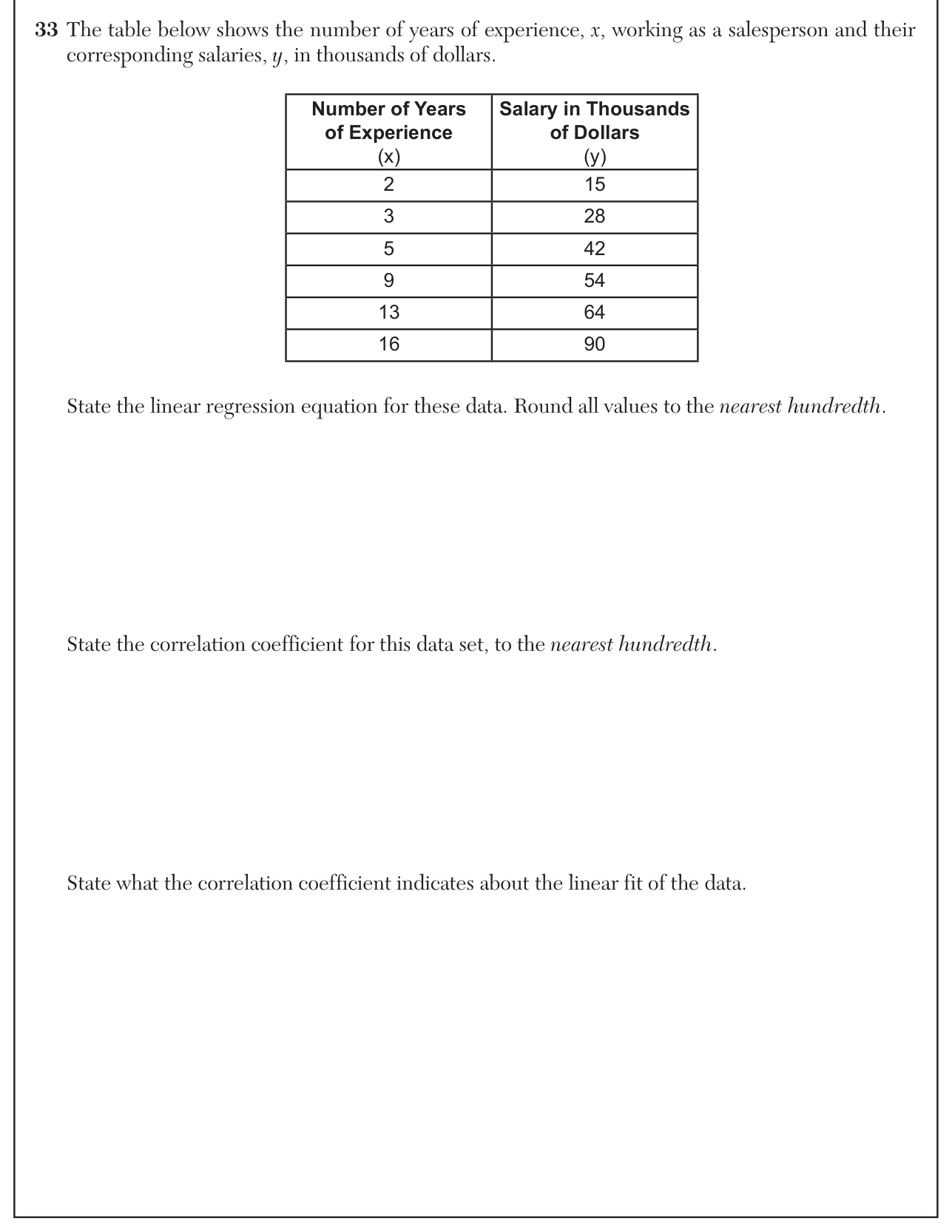
Q33 Sales salary regression
Fit salaries 15, 28, 42, 54, 64, 90 thousand dollars to experience 2, 3, 5, 9, 13, 16 years. Interpret r.
Worked solution for question 33
- Enter the experience years as x and match each with its salary in thousands as y.
- Use least-squares linear regression and round coefficients and r to hundredths.
- The positive correlation near 1 indicates a strong positive linear association.
Final answerŷ = 4.61x + 11.93, r = 0.98
Q34 Overlap of half-planes
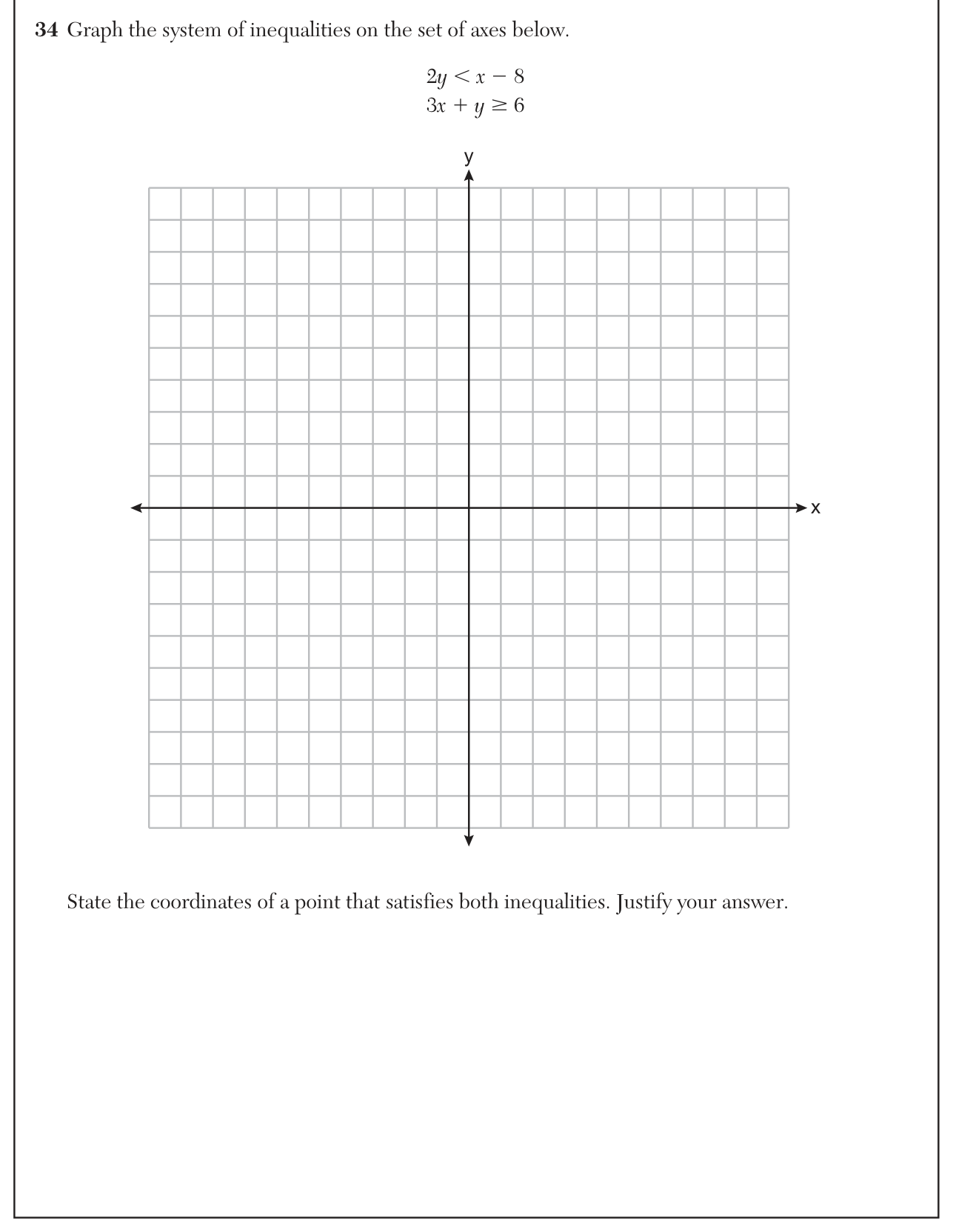
Graph 2y < x − 8 and 3x + y ≥ 6, and justify a solution point.
Worked solution for question 34
- Draw y = x/2 − 4 dashed through (0, −4) and (8, 0). Shade below.
- Draw y = 6 − 3x solid through (0, 6) and (2, 0). Shade above and keep the overlap.
- At (4, −3), −6 < −4 and 12 − 3 = 9 ≥ 6, so both conditions hold.
- The two lines intersect when x/2 − 4 = 6 − 3x, giving x = 20/7. The shaded overlap opens to the right of that intersection.
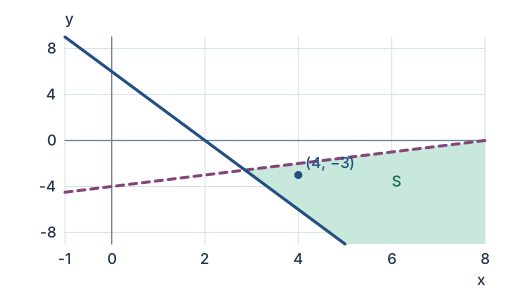
Final answerShade below y = x/2 − 4 and on or above y = 6 − 3x. One solution is (4, −3).
Part IV Long response
Question indexQ35 Graph a price system
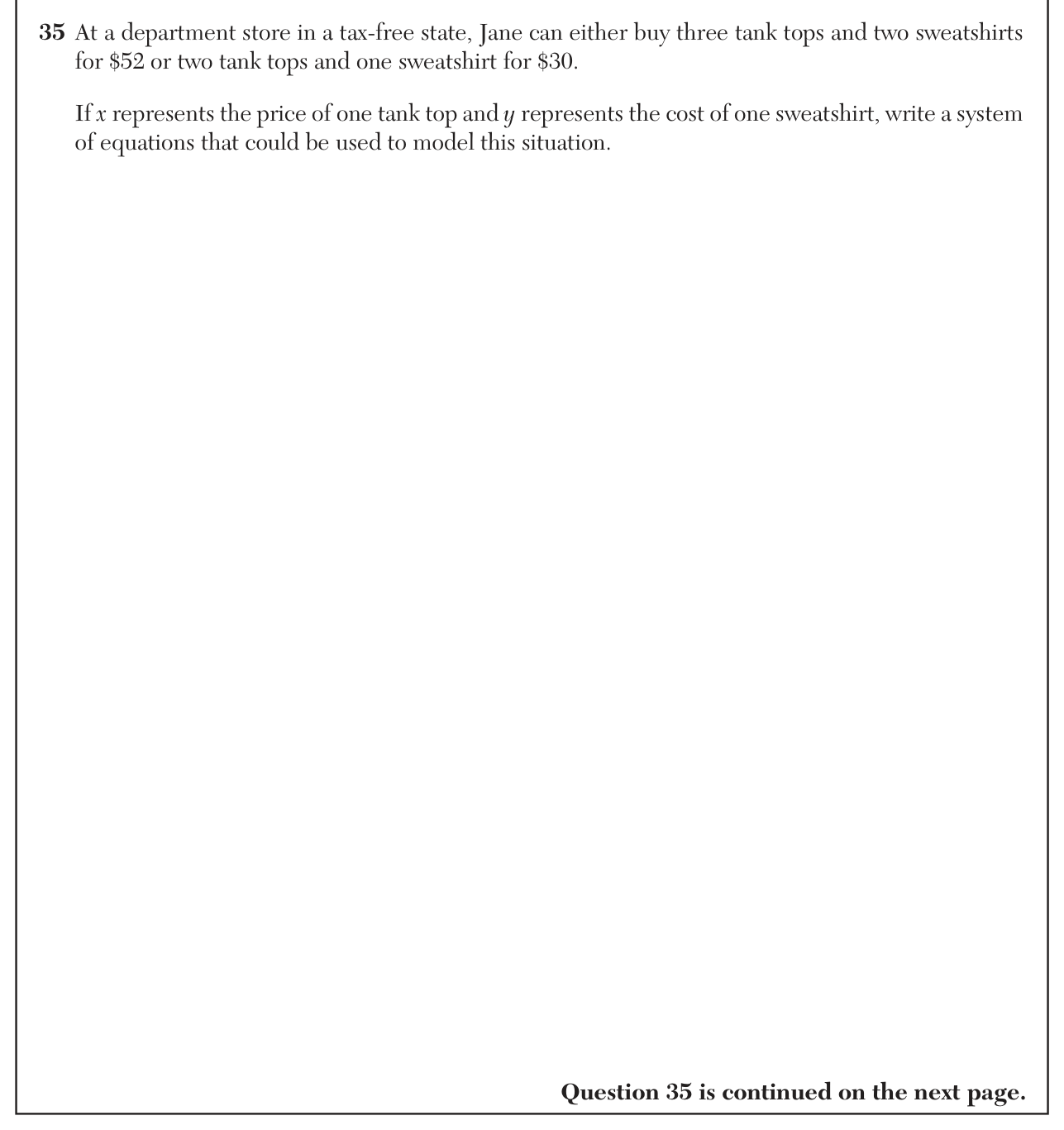
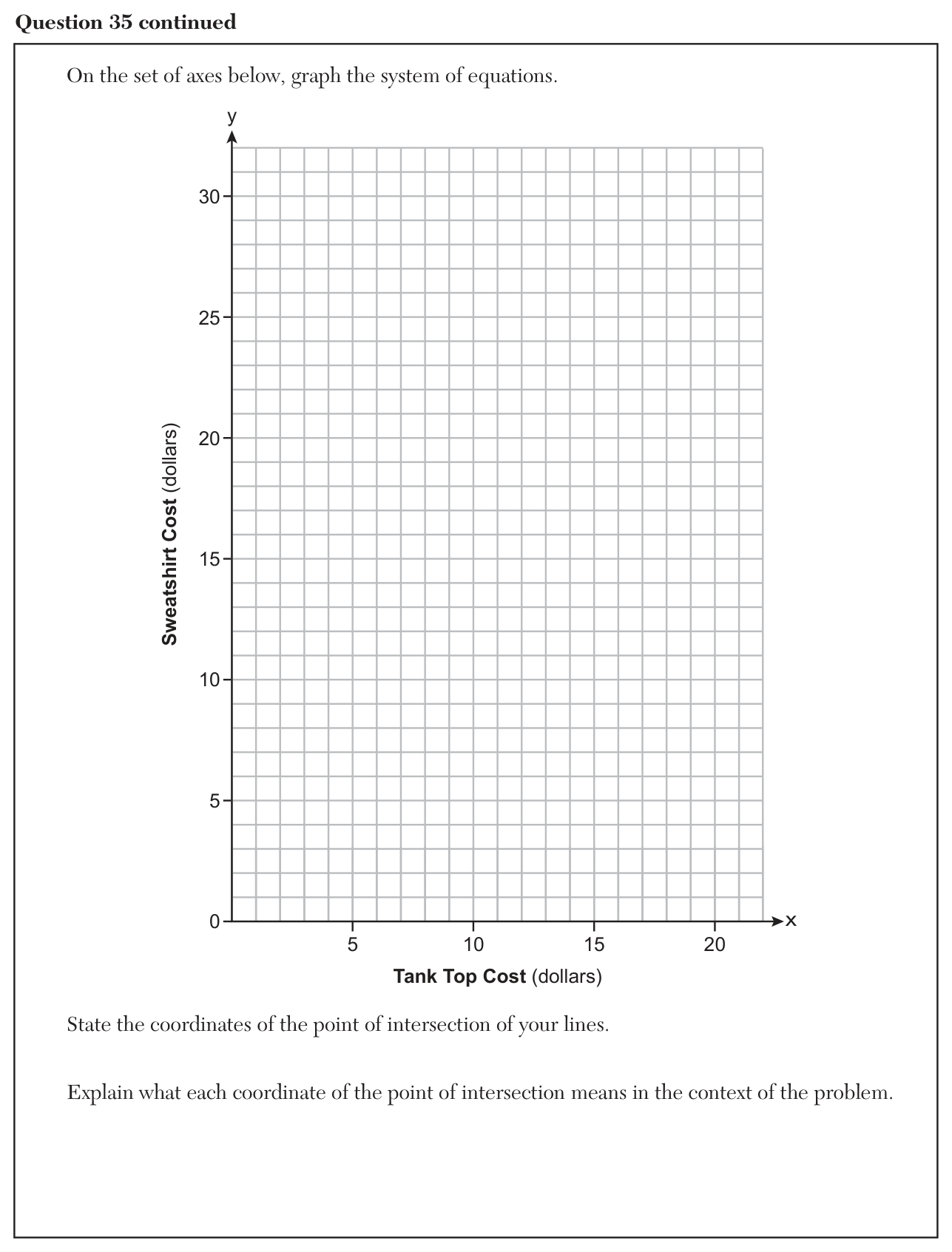
Model and graph prices for 3 tank tops and 2 sweatshirts costing 52 dollars, and 2 tank tops and 1 sweatshirt costing 30 dollars.
Worked solution for question 35
- Set x to the tank-top price and y to the sweatshirt price. Then 3x + 2y = 52 and 2x + y = 30.
- Graph y = 26 − 1.5x through (0, 26) and (12, 8). Graph y = 30 − 2x through (0, 30) and (15, 0).
- They meet at (8, 14). Both totals check since 3(8) + 2(14) = 52 and 2(8) + 14 = 30.
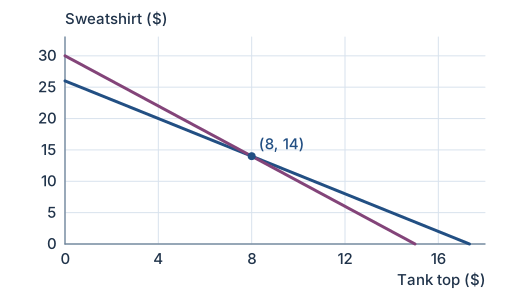
Final answerIntersection (8, 14). Tank tops cost 8 dollars and sweatshirts cost 14 dollars each.
From the New York State Education Department. June 2026 Algebra I Regents Examination. Internet. Available from https://www.nysedregents.org/algebraone/626/algone-62026-exam.pdf. Accessed .