NEW YORK STATE REGENTS · U.S. HISTORY AND GOVERNMENT
August 2026 U.S. History and Government Regents Past Paper & Solutions
Work through labor reform, war powers and Chinese immigration with a question-by-question walkthrough of the exam.
- 37 worked questions
- 3 writing models
- 4 exam sections
The question images and page numbers come from the regular-size English exam. OnlyPrepy wrote the summaries and worked solutions.
Quick answer key for Part I
Part I Multiple choice
Question indexQ1 Purpose of the Compact
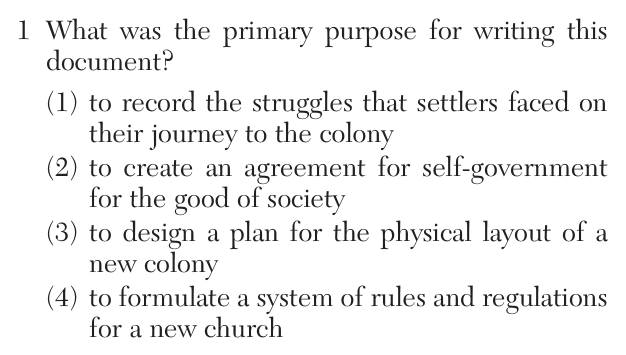
Why did the Mayflower passengers write the agreement?
Worked solution for question 1
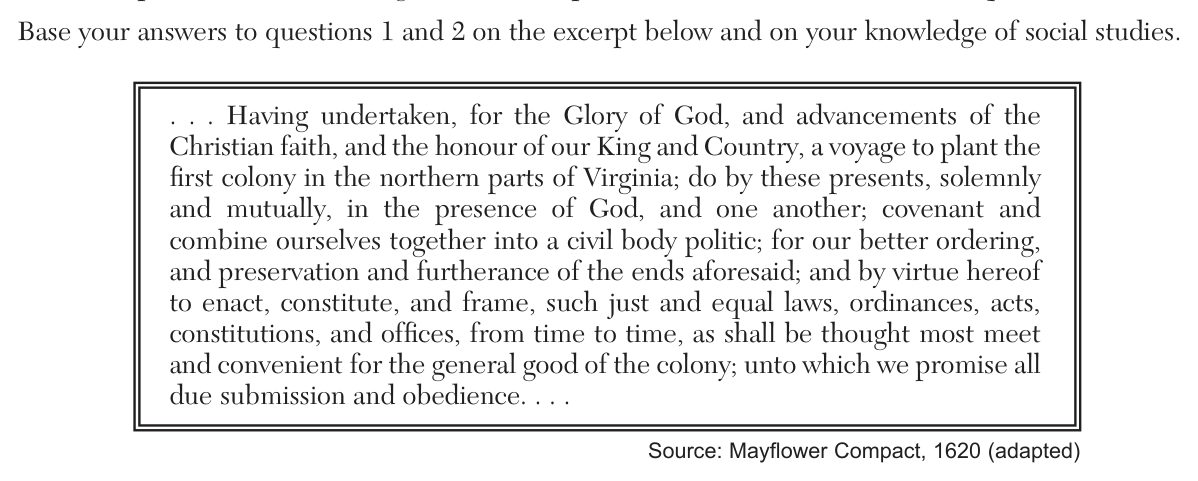
- They agree to form a political community capable of enacting laws.
- Their promise to obey those laws establishes an agreed basis for governing the settlement.
- A compact is a mutual agreement. Here the signers commit to collective rules for the settlement, showing both the origin of authority and its intended purpose.
Answer choice 2To establish self-government for the common good
Q2 Ideas behind self-government
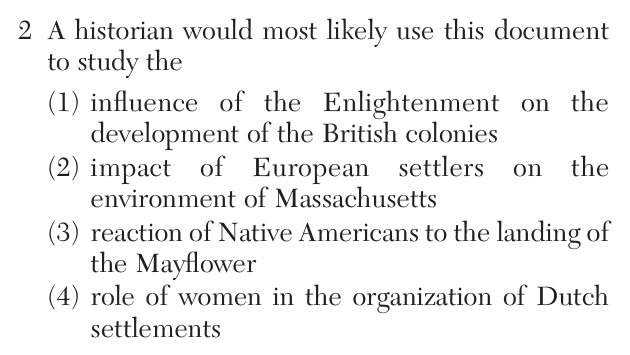
What could a historian use the Compact to study among the listed topics?
Worked solution for question 2
- The official choice refers to Enlightenment influence. The 1620 document predates the mature Enlightenment but shows an early practice of forming government by agreement.
- A historian could compare that earlier practice with later colonial uses of consent and Enlightenment political thought.
Answer choice 1Intellectual roots of self-government in the British colonies
Q3 People as sovereign
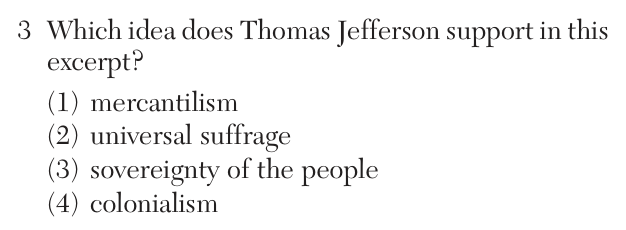
Which principle does Jefferson endorse?
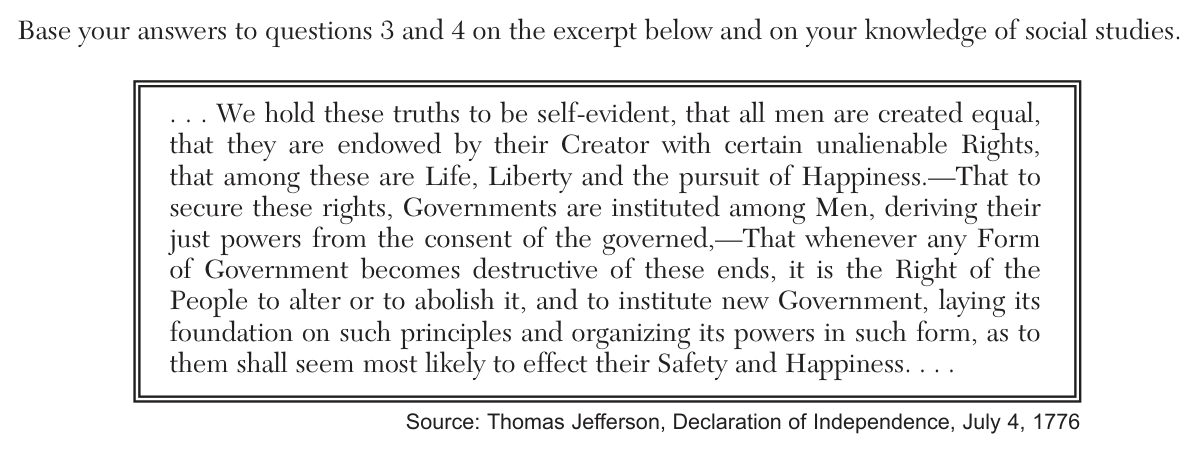
Worked solution for question 3
- The Declaration makes just power depend on the consent of the people.
- It also assigns the people the right to change a government that defeats its purpose.
- Trace political authority back to its source. Popular sovereignty means the people supply the government’s authority, even when elected or appointed officials exercise it.
Answer choice 3Popular sovereignty
Q4 Influence at Seneca Falls
Which later movement drew on the Declaration?
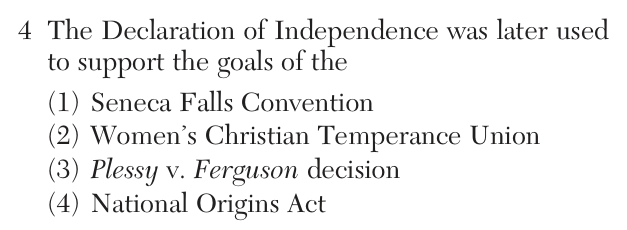
Worked solution for question 4
- The 1848 Declaration of Sentiments adapted the form and equality language of the 1776 declaration.
- Its authors used the founding principle to press for women’s rights.
Answer choice 1The Seneca Falls Convention
Q5 Appointment and confirmation
Which principle appears in Hamilton’s appointment?
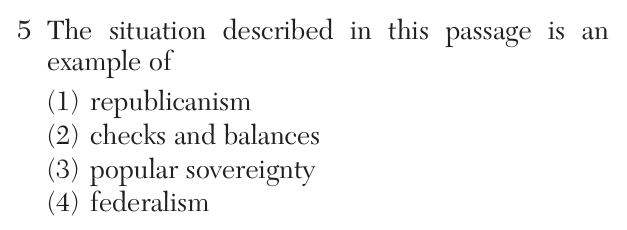
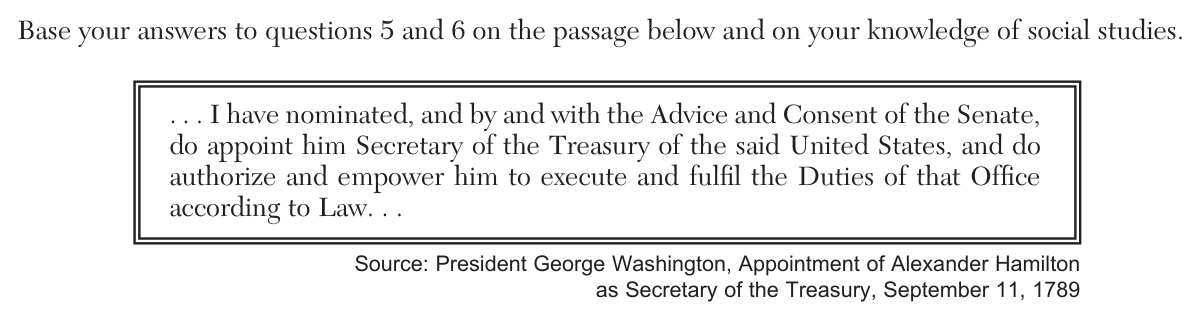
Worked solution for question 5
- Washington nominates and appoints, with the Senate’s advice and consent.
- The Senate’s role checks the president’s control of appointments.
- The president initiates the appointment and the Senate can approve or block it. Sharing the decision gives each branch a distinct way to influence the outcome.
Answer choice 2Checks and balances
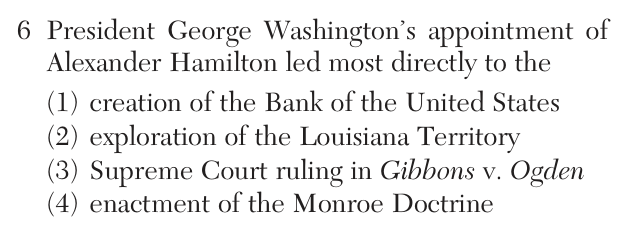
Q6 Hamilton’s financial program
What did Hamilton’s Treasury appointment lead to most directly?
Worked solution for question 6
- Hamilton proposed a national bank as part of a program to strengthen public credit and finances.
- Congress chartered the first Bank in 1791.
Answer choice 1Creation of the Bank of the United States
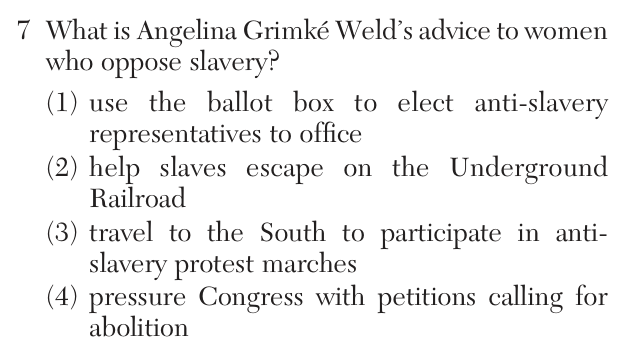
Q7 Women’s abolition petitions
What method does Grimké Weld urge women to use?
Worked solution for question 7
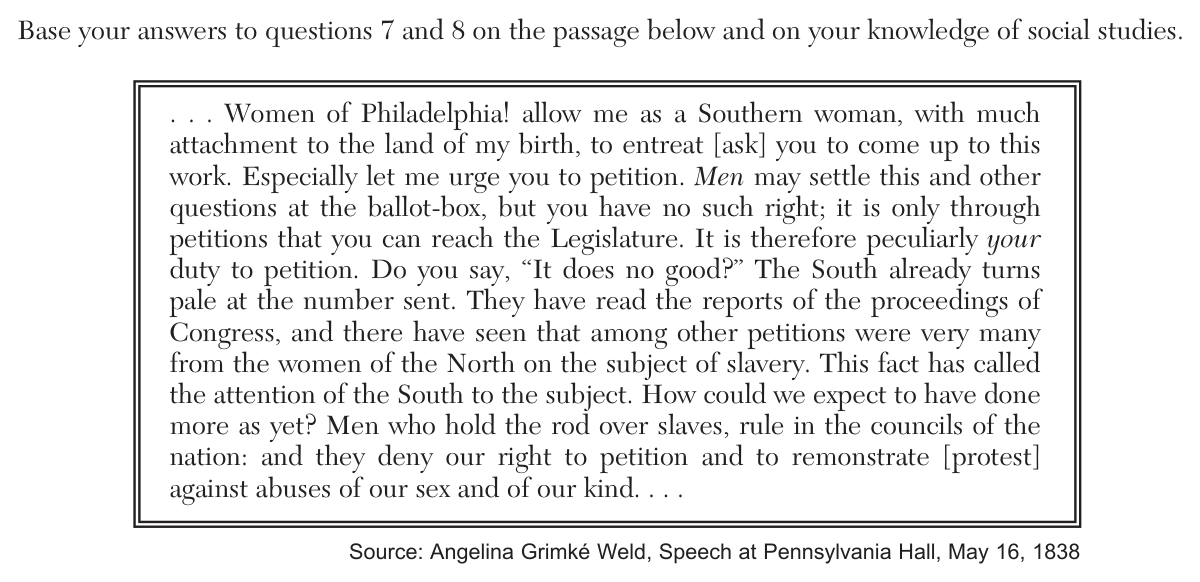
- She points out that women lack the ballot but can send petitions to the legislature.
- Petitions made their opposition visible to Congress and the public.
- The petitions show a method of participation open even to many people excluded from voting. Organizing signatures allowed abolitionists to bring their demand before Congress.
Answer choice 4Petition Congress against slavery.
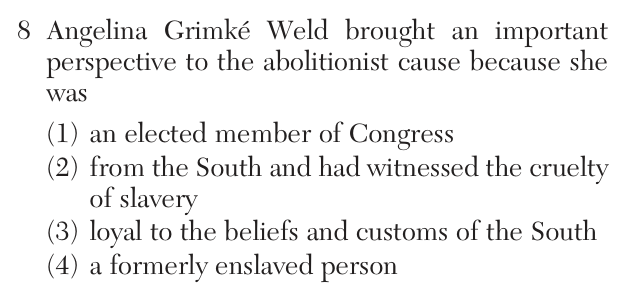
Q8 Grimké Weld’s perspective
Why could she bring a distinctive perspective to abolition?
Worked solution for question 8
- Her speech identifies her Southern origin.
- Having grown up in a slaveholding society, she could challenge it from firsthand knowledge.
Answer choice 2She came from the South and had witnessed slavery’s cruelty.
Q9 Suspension of habeas corpus
What did Proclamation 104 enable in cases it covered?
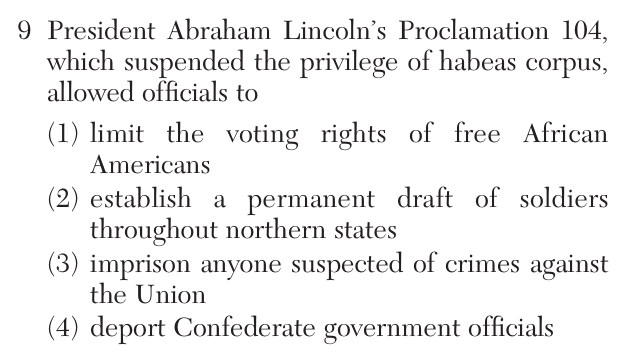
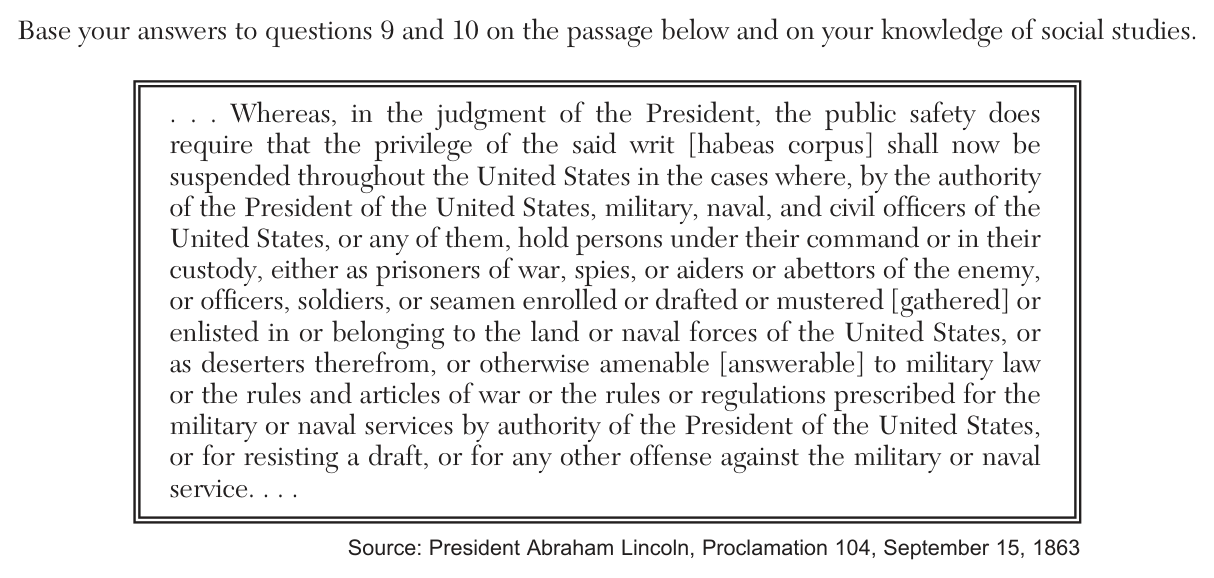
Worked solution for question 9
- Suspending the privilege restricted access to the writ used to challenge detention.
- The proclamation names categories such as spies, deserters and people resisting the draft.
- A writ of habeas corpus lets a detained person challenge the legal basis for detention. Suspending that protection made it easier for authorities to hold people suspected of aiding the rebellion.
Answer choice 3Detention of people suspected of aiding or committing offenses against the Union
Q10 Wartime justification
How did supporters defend that restriction of civil liberties?
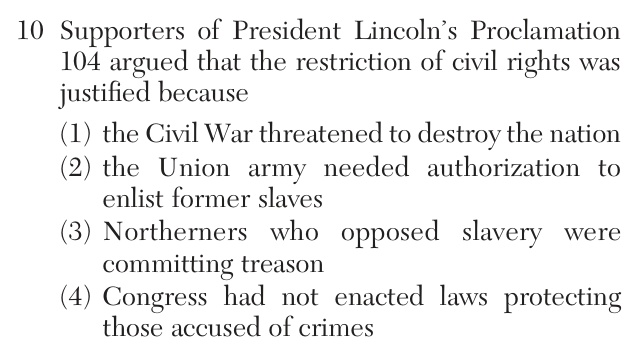
Worked solution for question 10
- Lincoln expressly invokes public safety in the proclamation.
- Supporters treated rebellion as an emergency that justified extraordinary measures.
Answer choice 1The Civil War endangered the nation’s survival.
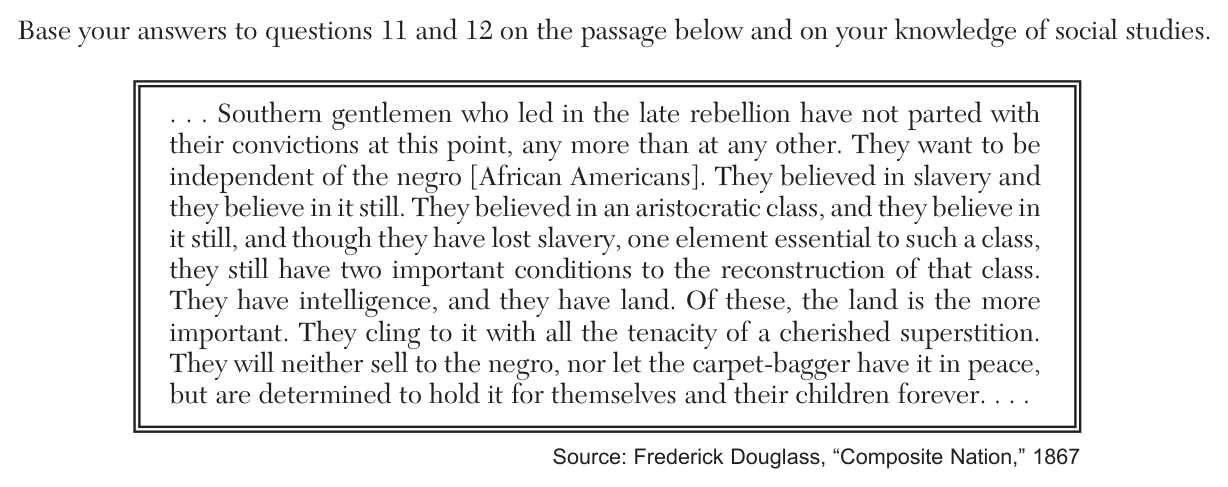
Q11 Continuing racial domination
Which later policy is consistent with the outlook Douglass attributes to former Confederates?
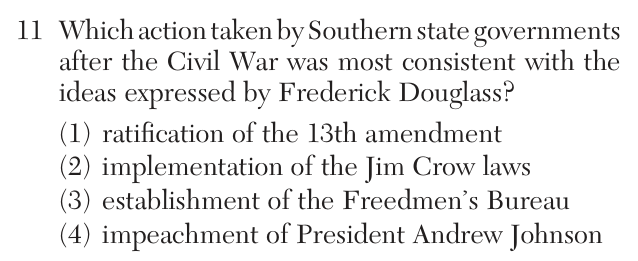
Worked solution for question 11
- Douglass describes former elites as intent on preserving racial hierarchy despite abolition.
- Later Jim Crow legislation imposed segregation and restricted Black Americans’ freedom and access.
- Consider what the system does after slavery has ended. Formal segregation and other restrictions preserved white control despite the end of legal enslavement.
Answer choice 2Jim Crow laws
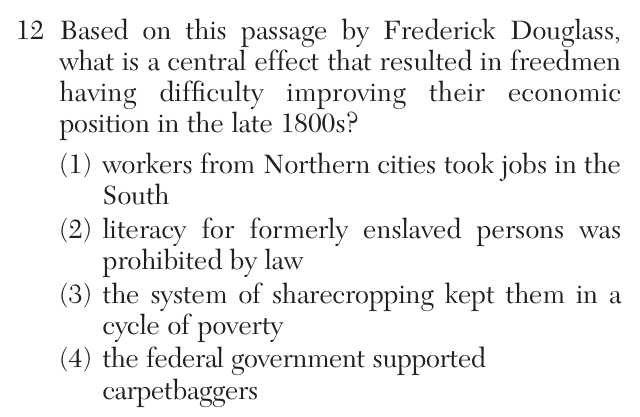
Q12 Sharecropping and poverty
What made economic advancement hard for many freedpeople?
Worked solution for question 12
- Douglass stresses that landowners would not give up their land.
- Many freedpeople farmed land they did not own and owed a crop share and debts for supplies, limiting accumulation of wealth.
Answer choice 3Sharecropping kept many in debt and poverty.
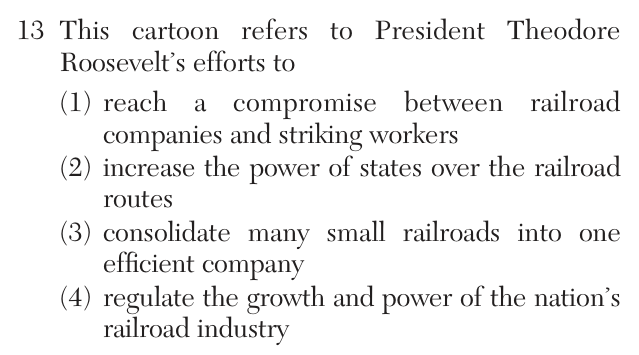
Q13 Regulating railroads
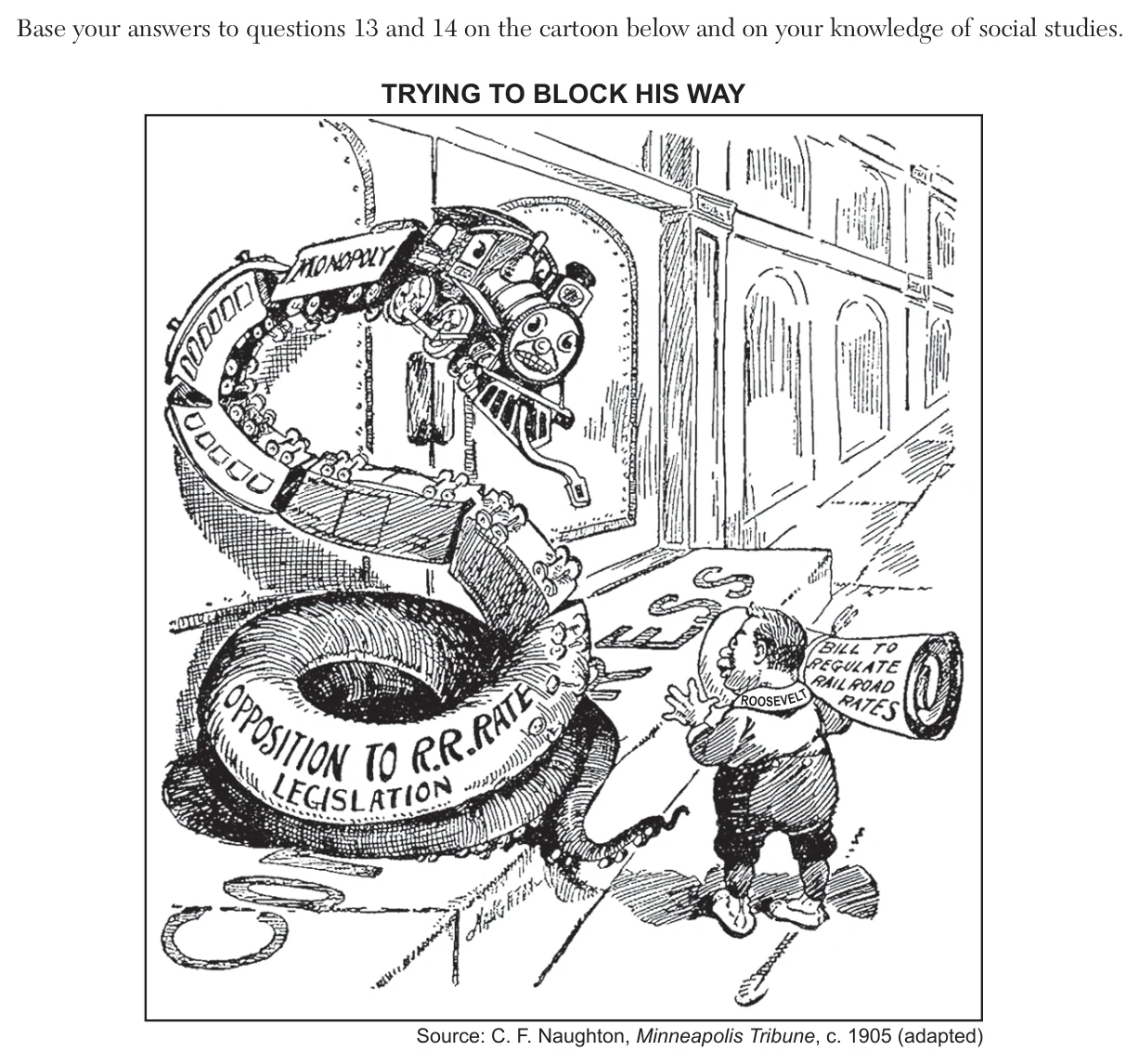
What policy effort appears in the Roosevelt cartoon?
Worked solution for question 13
- The cartoon presents resistance to Roosevelt’s intervention in railroad affairs.
- His administration supported stronger federal oversight of rates and practices.
- Railroads affected interstate trade and could wield great power over rates. That scale helps explain why pressure for regulation moved beyond individual cities and states.
Answer choice 4Regulation of railroad growth and power
Q14 Opponents of regulation
Who would most likely resist this intervention?
Worked solution for question 14
- The policy expands public supervision of private companies.
- Laissez-faire advocates generally favor less government interference in business.
Answer choice 3Advocates of laissez-faire economics
Q15 Trade in World War I
Which conclusion follows from the 1914–1916 export chart?
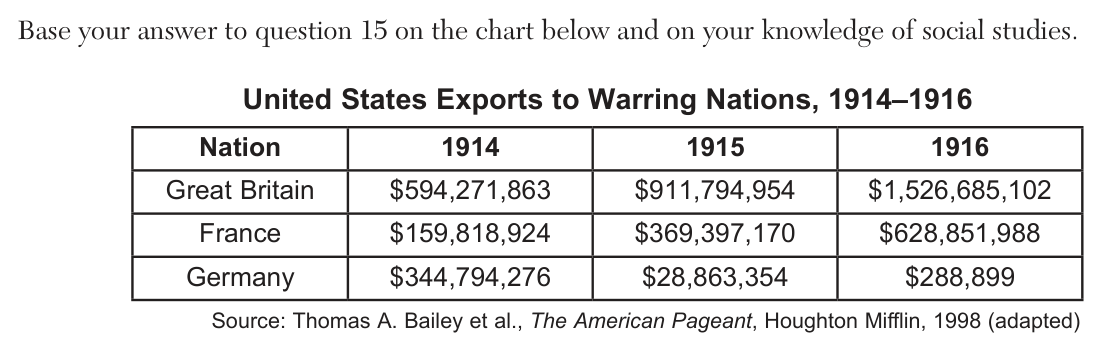
Worked solution for question 15
- Exports to Britain and France rose, while exports to Germany collapsed.
- The direction of the figures shows a strong Allied tilt in trade before U.S. entry.
- Neutral status and equal economic relations are different questions. The trade pattern shows that, in financial practice, the Allies benefited more from U.S. commerce.
Answer choice 3U.S. trade financially favored the Allies.
Q16 Wilson’s appeal to voters
What is Wilson trying to accomplish in the 1919 cartoon?

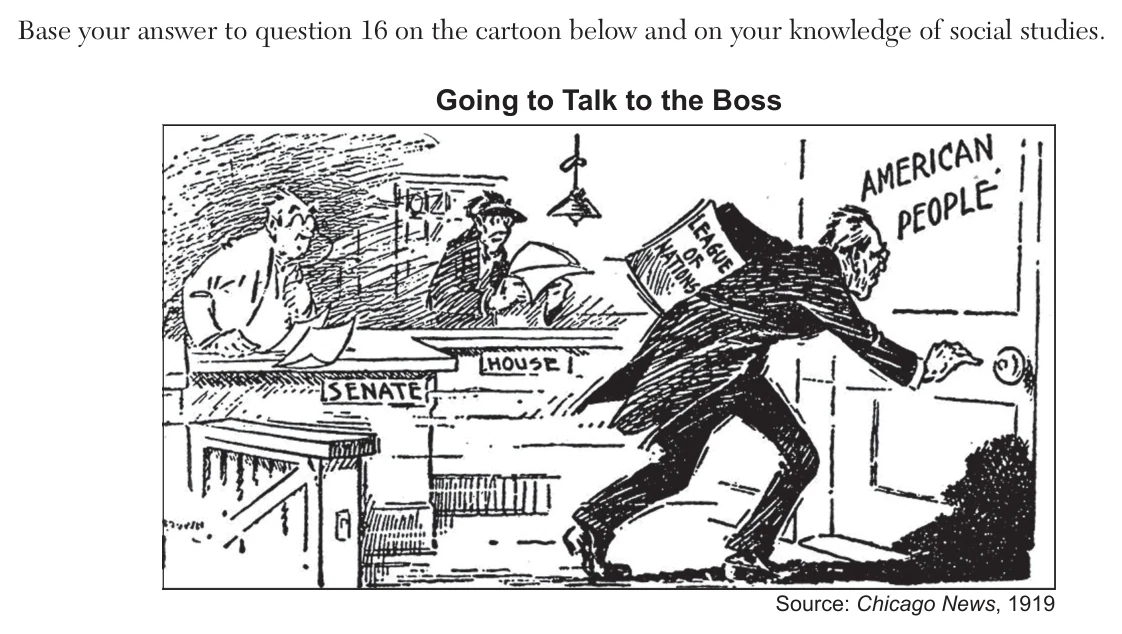
Worked solution for question 16
- Wilson promoted the League as part of the postwar settlement.
- The cartoon’s idea of taking the case to the boss points toward the American public.
Answer choice 4Gain public support for the League of Nations.
Q17 Responding to war in Europe
What debate connects the cartoon and Roosevelt’s address?
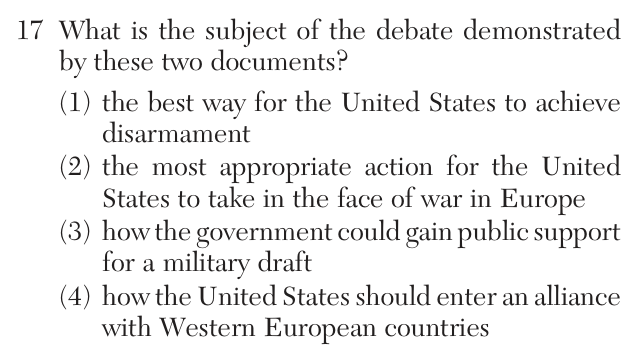
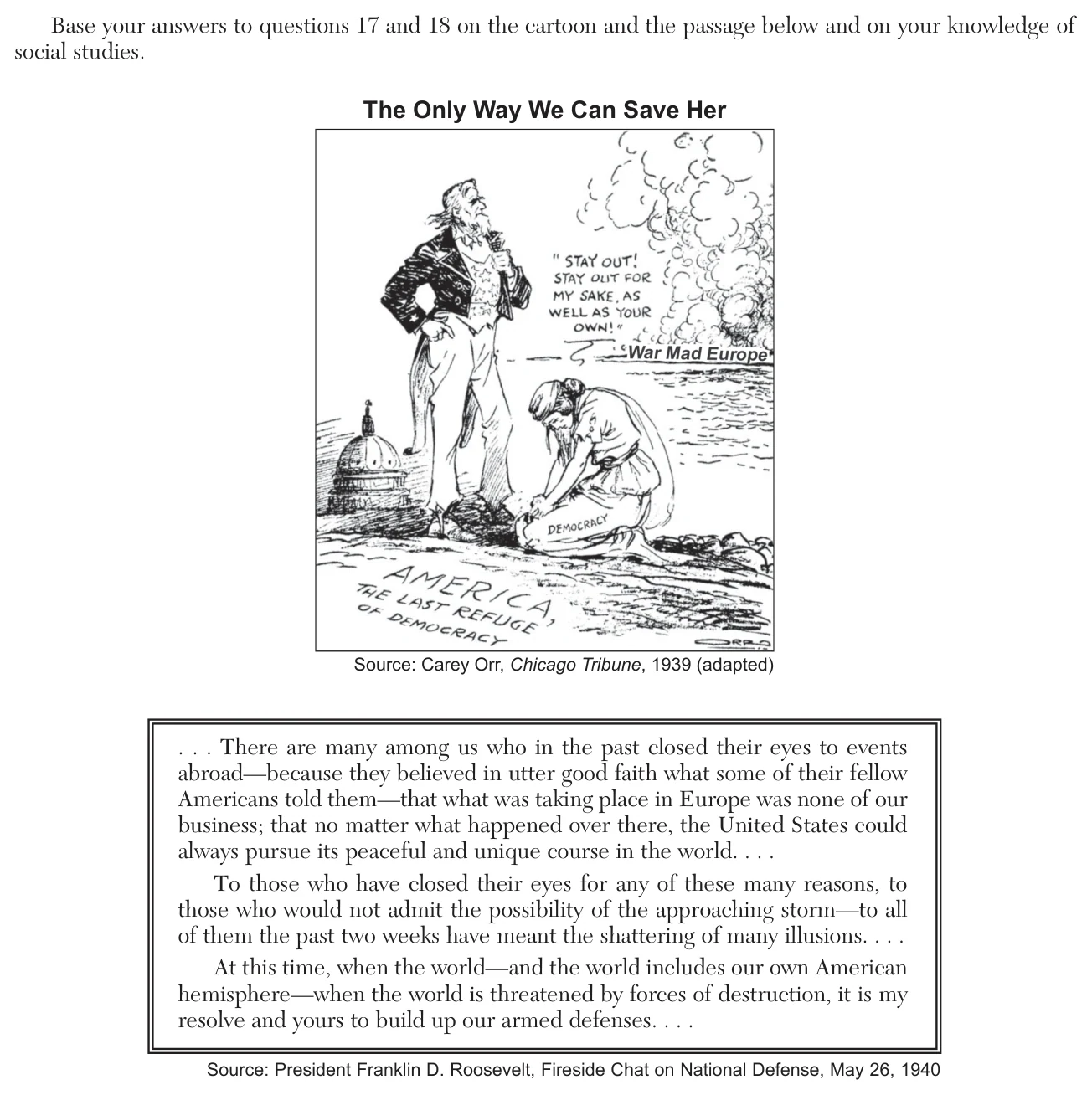
Worked solution for question 17
- The sources differ over how security can be protected as war spreads abroad.
- Roosevelt argues that overseas developments make a buildup of U.S. defenses necessary.
- Place the debate before American entry into the war. The competing positions concern what actions the United States should take in response to a conflict already under way overseas.
Answer choice 2How the United States should respond to the European war
Q18 Isolationism
Which longstanding policy helps explain the disagreement?
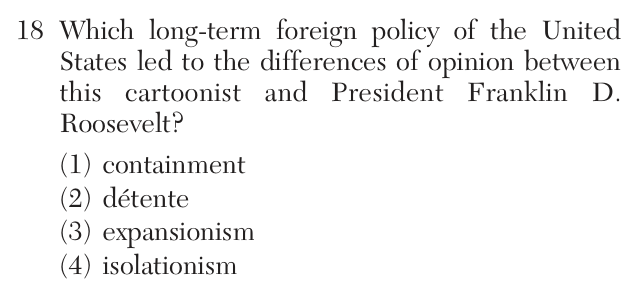
Worked solution for question 18
- Isolationists wanted to avoid commitments in overseas wars.
- Roosevelt challenges the premise that events in Europe could remain entirely separate from American security.
Answer choice 4Isolationism
Q19 Why Navajo was selected
What made the Navajo language useful to the military?
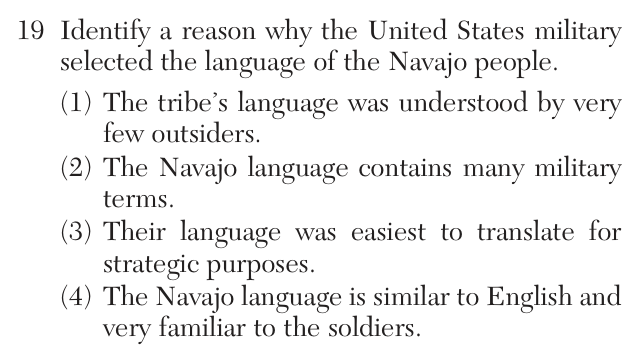
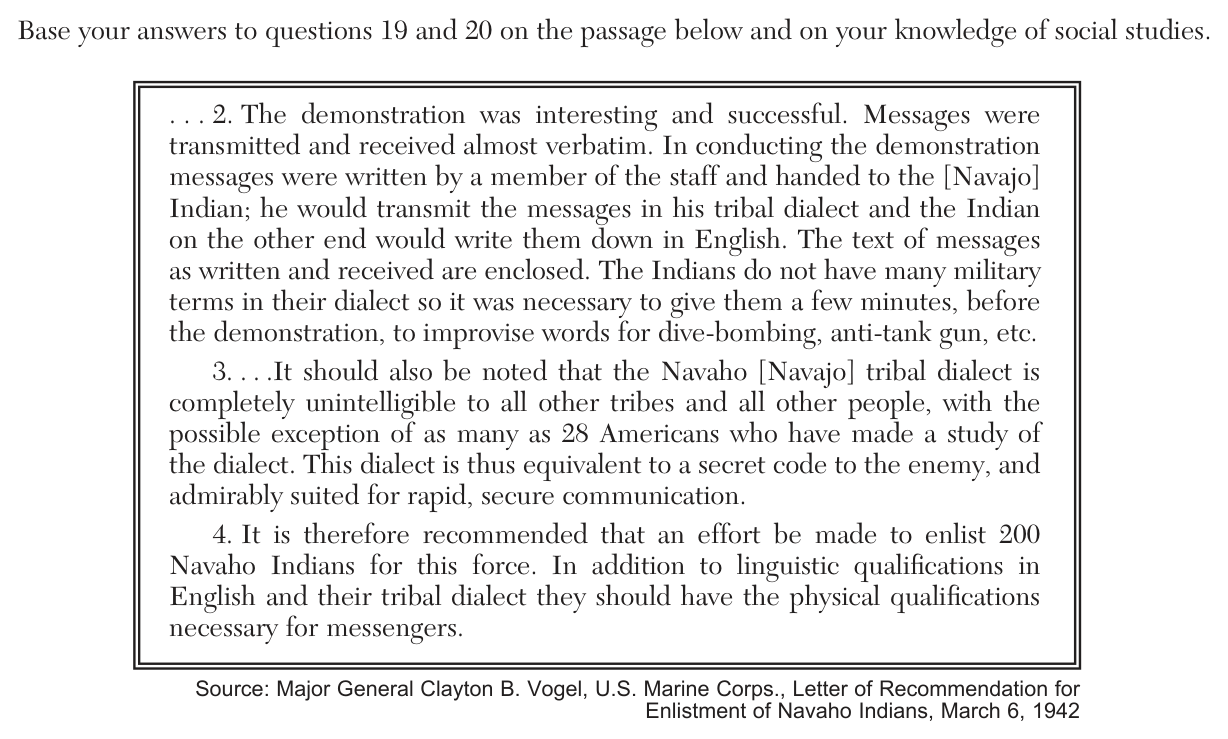
Worked solution for question 19
- Vogel describes the language as almost unknown to outsiders.
- That made a coded message much harder for an enemy interceptor to understand.
- A language seldom understood outside the Navajo community made military messages harder to intercept usefully. Effective code talking also required trained speakers who could encode and relay messages quickly.
Answer choice 1Few outsiders understood it.
Q20 Role of the code talkers
What service did Navajo recruits perform?
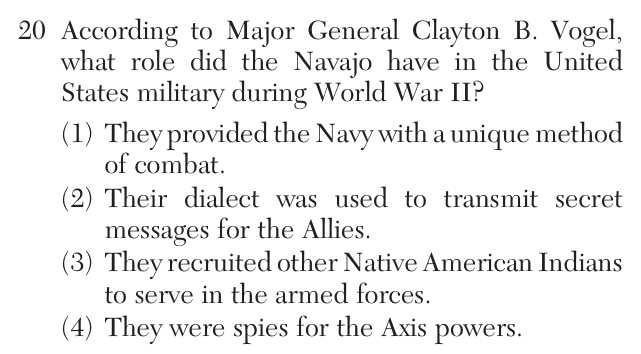
Worked solution for question 20
- The demonstration sent a message in Navajo and recovered the English content accurately.
- Special vocabulary extended this method to military terms.
Answer choice 2They transmitted secure military messages.
Q21 Wartime employment
What does the 1943 poster show about women and work?

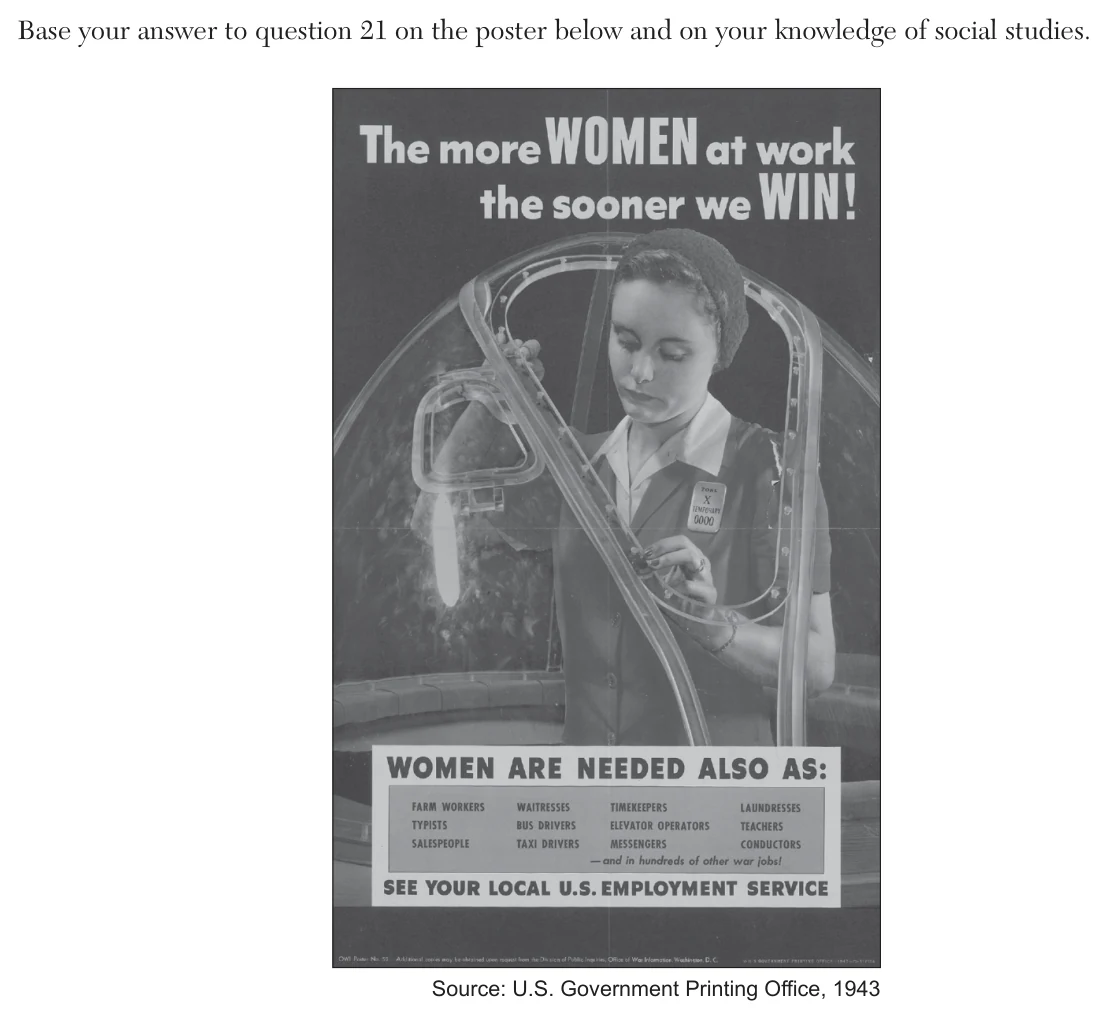
Worked solution for question 21
- The poster recruits women for work needed during wartime.
- It shows expanded opportunity without establishing equal wages or access to every occupation.
- Wartime production increased demand for labor at the same time that military service pulled many men away from civilian jobs. Together those changes opened new roles to women.
Answer choice 2War opened new job opportunities for women.
Q22 Cost of European recovery
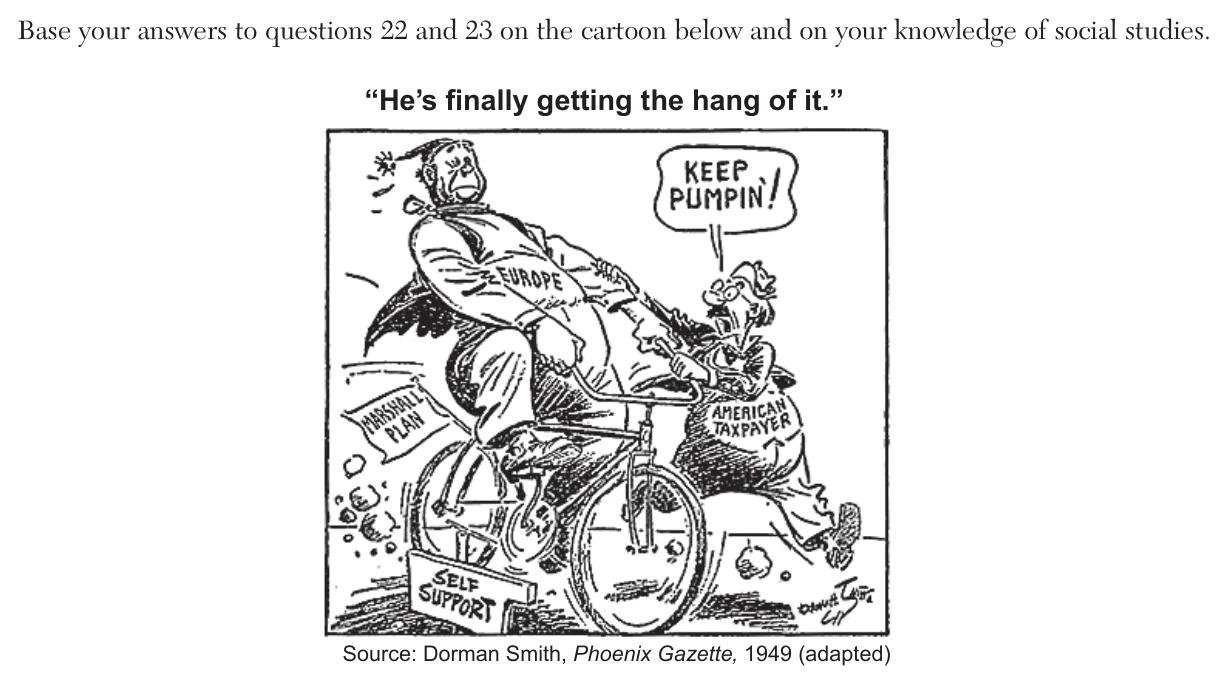
What is the cartoonist’s point about the Marshall Plan?
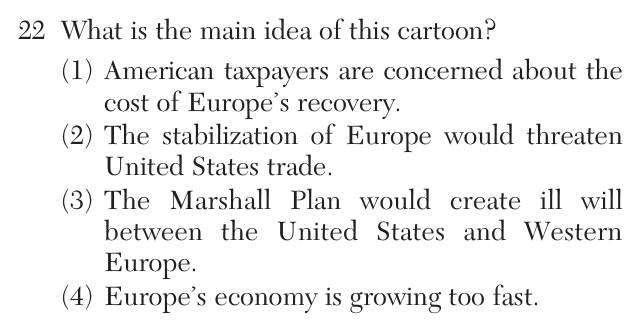
Worked solution for question 22
- The cartoon shows Europe learning to ride a bicycle labeled self-support, while a figure labeled American taxpayer keeps it moving.
- The taxpayer’s visible strain conveys concern about the cost of financing European recovery.
Answer choice 1U.S. taxpayers are concerned about the cost of recovery.
Q23 Purpose of the Marshall Plan
Why did Marshall propose European aid?
Worked solution for question 23
- War damage and shortages threatened stability.
- American aid aimed to support recovery and make democratic institutions more resilient.
- The economic and political goals were linked. Recovery could restore production and trade while reducing the appeal of radical alternatives in countries facing hardship.
Answer choice 4To prevent Western Europe’s economic and political collapse
Q24 Cuban Missile Crisis blockade
Why did Kennedy impose a blockade around Cuba?
Worked solution for question 24
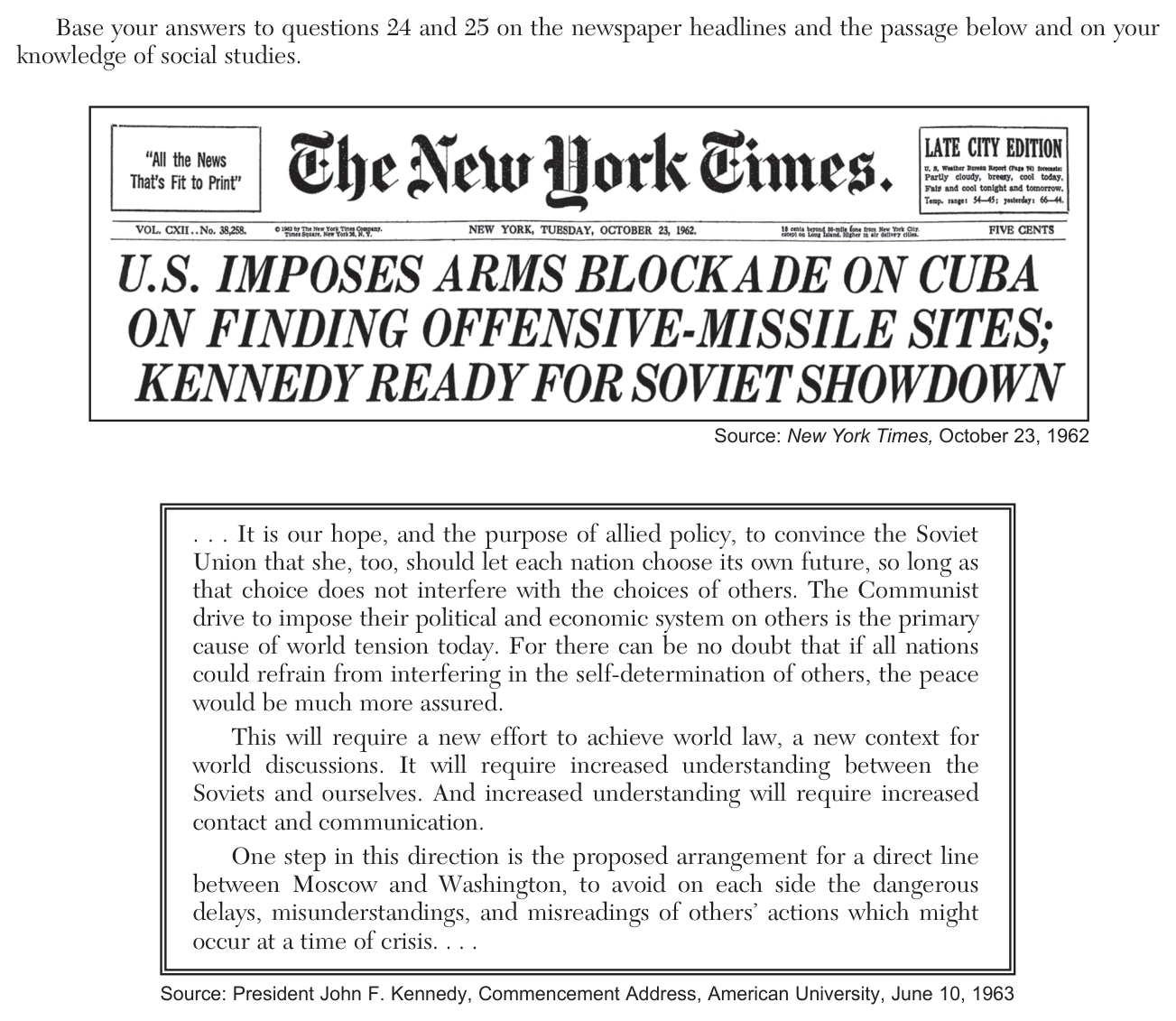
- The United States discovered Soviet missile sites in Cuba.
- The naval quarantine was intended to block further deliveries and press for removal.
Answer choice 4To counter the direct threat of Soviet missiles.
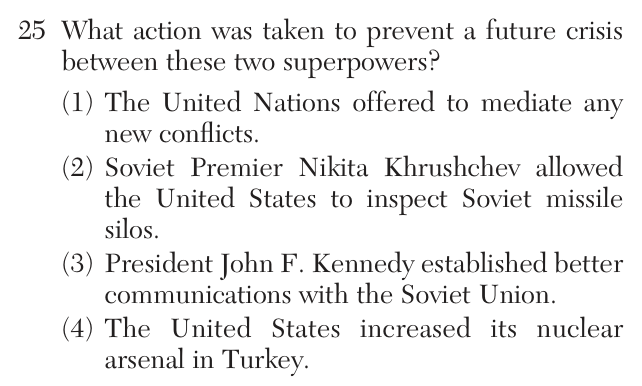
Q25 Improving crisis communications
What action reduced the risk of a similar crisis?
Worked solution for question 25
- Kennedy identifies delays and misunderstandings as dangerous in a crisis.
- A direct line between Washington and Moscow made urgent communication faster.
- A direct line speeds up contact and reduces reliance on intermediaries. That matters in a nuclear crisis because a delayed or misread message could increase the risk of escalation.
Answer choice 3Establishing direct U.S.–Soviet communication
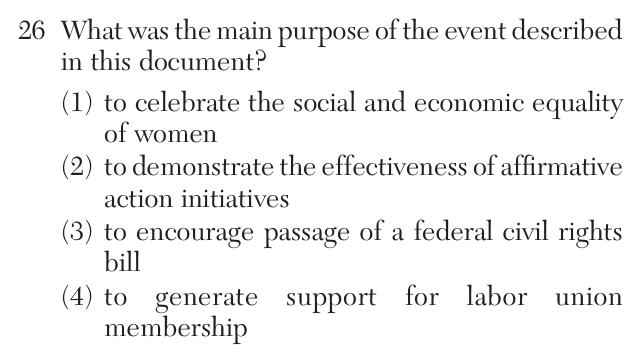
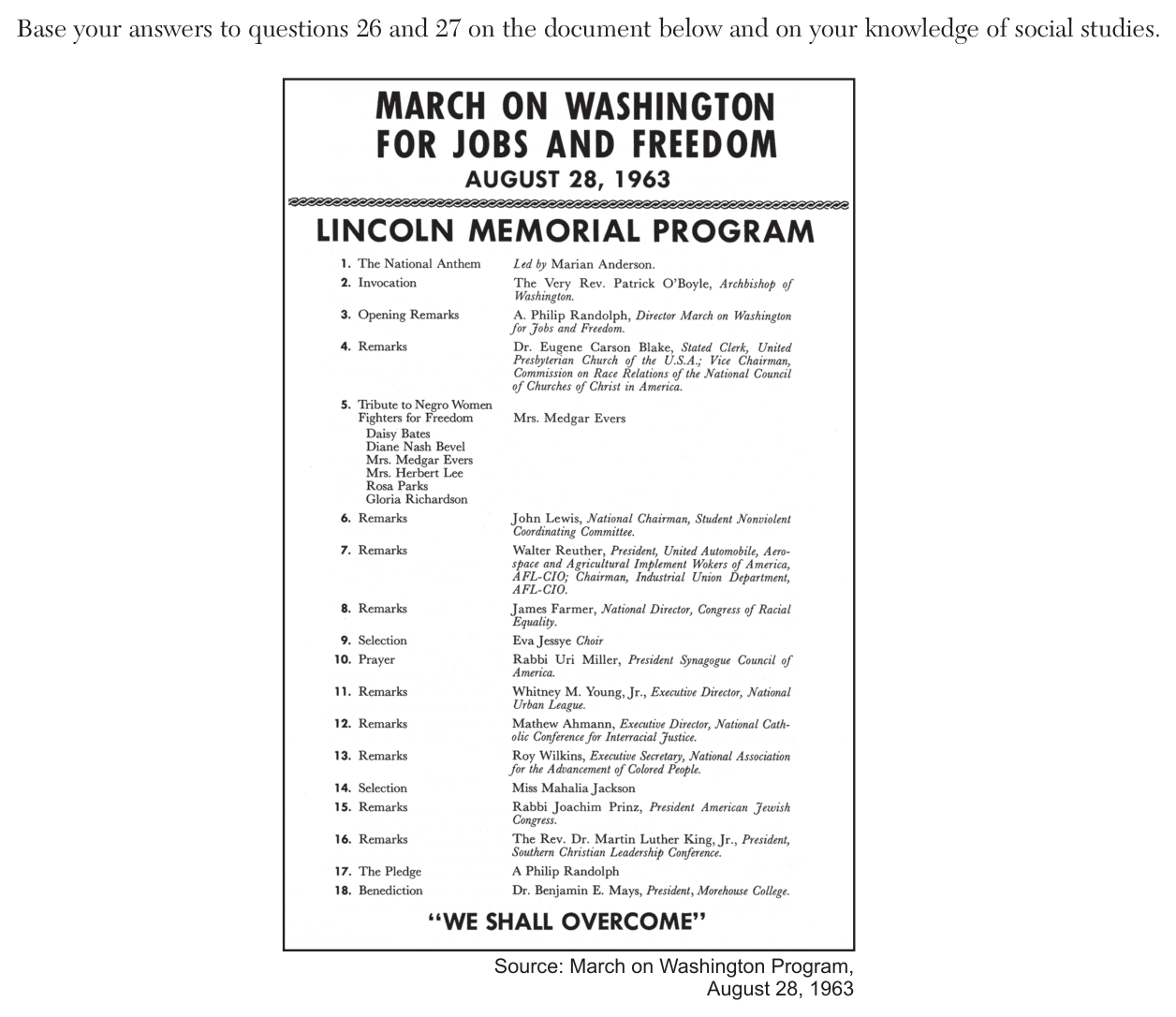
Q26 March on Washington
What was one main goal of the 1963 march?
Worked solution for question 26
- The event called for jobs and freedom and brought national attention to discrimination.
- Demonstrators used public pressure to advance legislation.
Answer choice 3Urge passage of federal civil rights legislation.
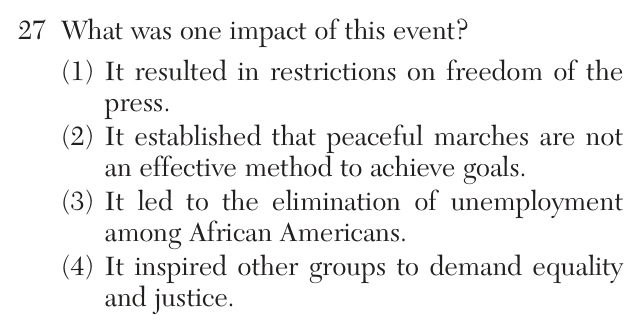
Q27 Influence of the march
What broader impact did the march have?
Worked solution for question 27
- A large peaceful demonstration showed how public organizing could press for rights.
- Other movements could adopt similar tactics and arguments.
- Distinguish a march’s immediate demands from its broader legacy. Its public visibility provided a model of collective action for people pursuing other equality and justice campaigns.
Answer choice 4It inspired other groups to demand equality and justice.
Q28 Popular and electoral votes
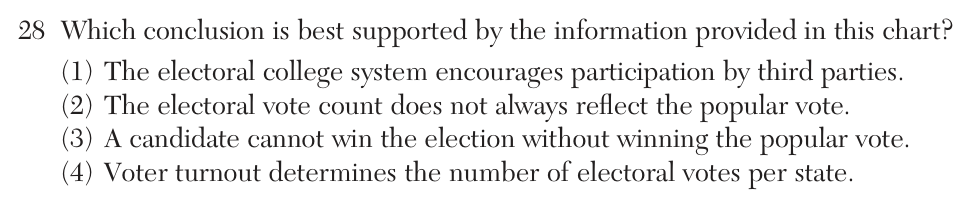
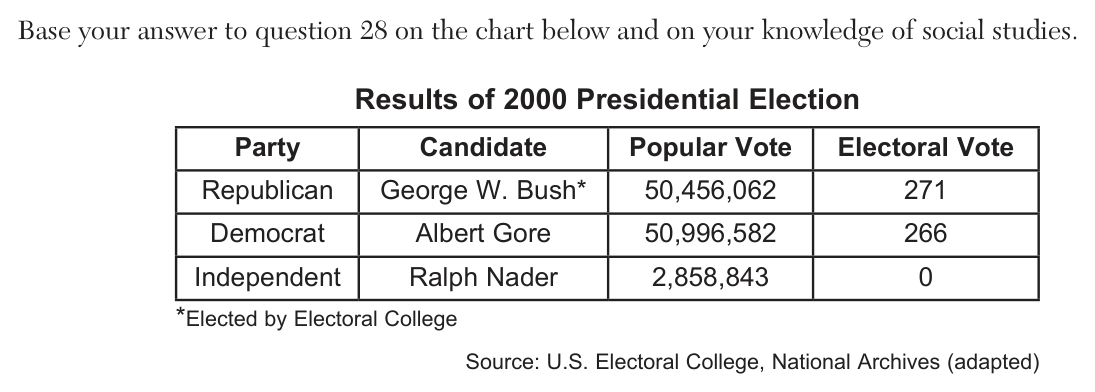
What conclusion is supported by the 2000 election chart?
Worked solution for question 28
- Gore received more popular votes, but Bush had 271 electoral votes to Gore’s 266.
- The candidate with fewer votes nationwide won the Electoral College and the election.
Answer choice 2The electoral result can differ from the national popular vote.
Part II Short essays
Question indexQ29 Factory work and Progressive reform
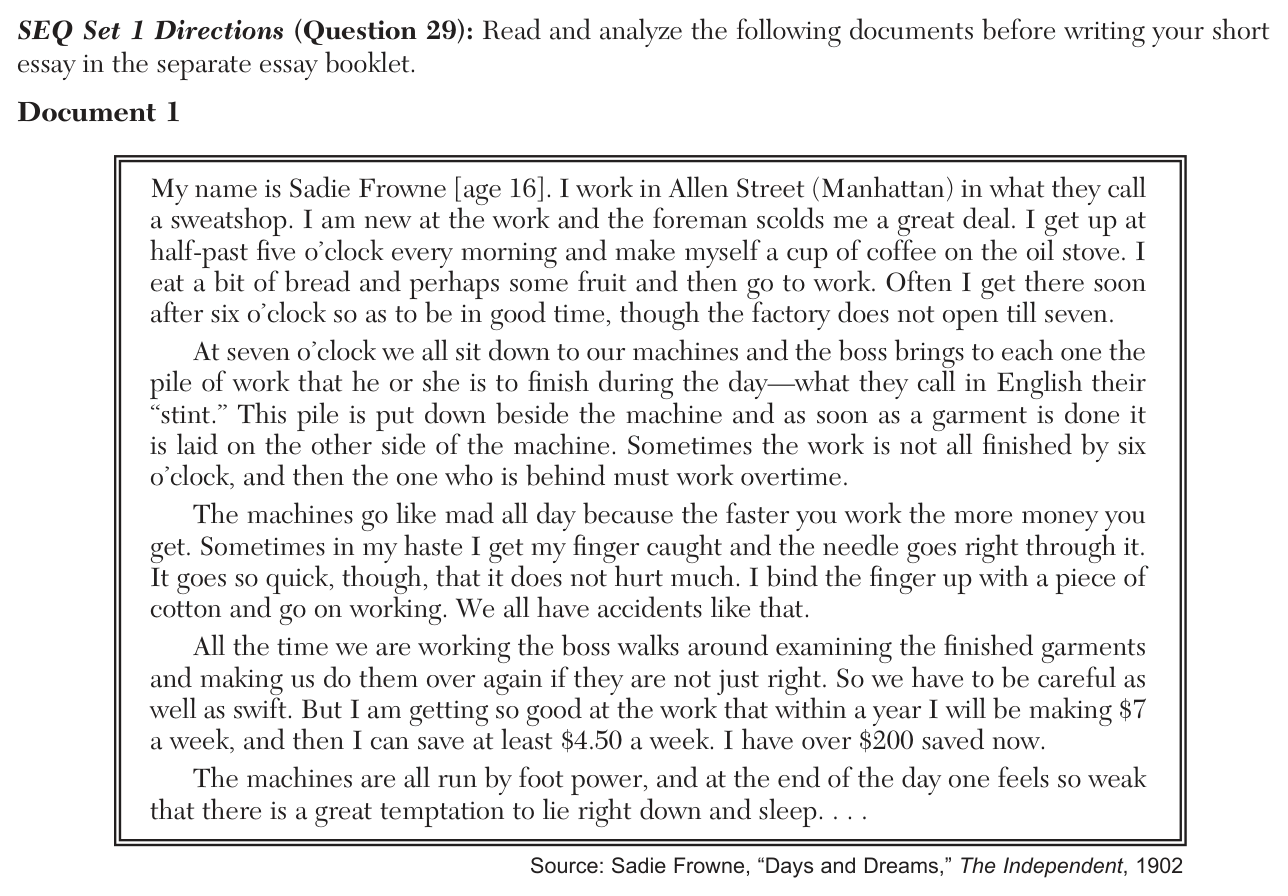
Explain the context linking Sadie Frowne’s account and the Progressive Party platform, then explain a relationship.
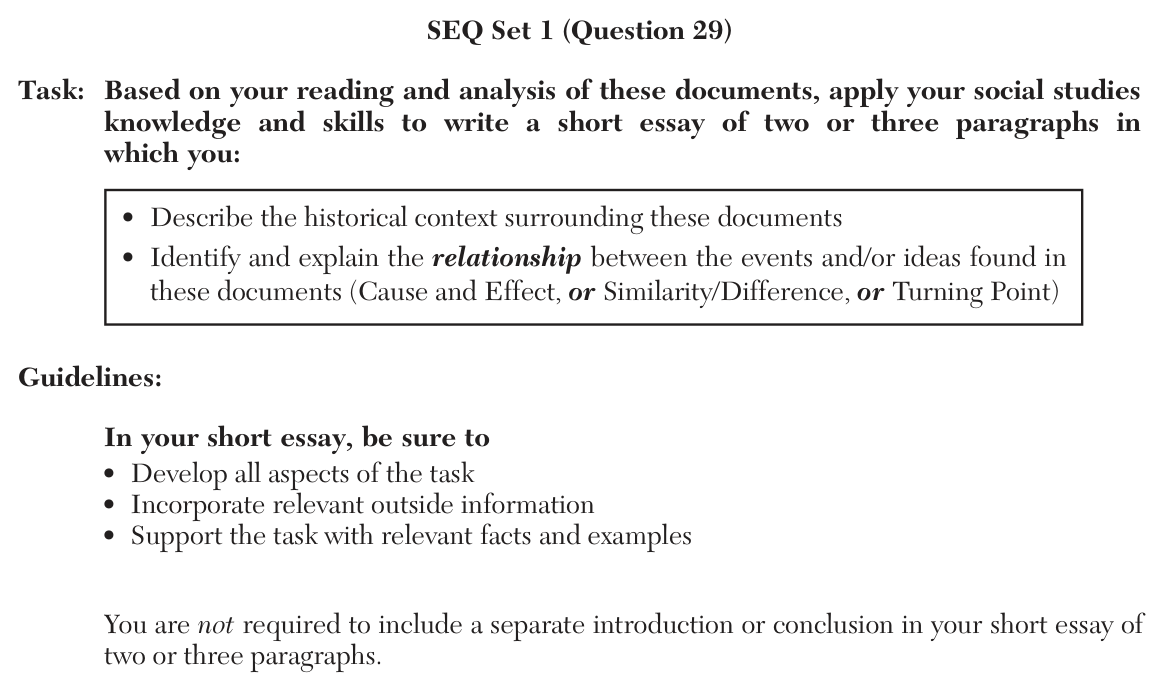
Writing plan and model response for question 29
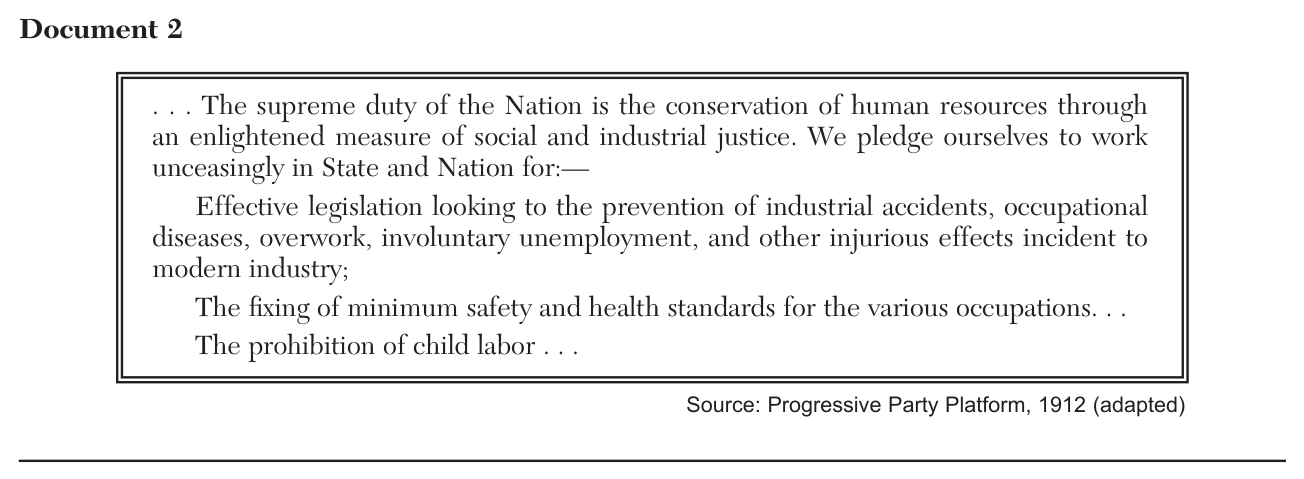
- Describe industrialization and low-wage factory work. Explain how the party’s proposals respond to problems described by workers.
- Use a relevant outside example without claiming that a single account caused the entire platform.
Central claimAccounts of difficult working conditions helped build support for protections proposed by Progressives.
Model response
In the late nineteenth and early twentieth centuries, industrial cities offered wage work to immigrants and women. Factory owners often set long hours and demanding conditions, while workers had few protections. Sixteen-year-old Sadie Frowne describes working from seven in the morning until at least six in a Manhattan garment shop (Document 1). Because she earned more by working faster, she sometimes drove a needle through her finger, wrapped the injury and continued working. Her experience shows how wages and production schedules could make unsafe choices seem unavoidable.
The Progressive Party’s 1912 platform proposed safety and health standards and an end to child labor (Document 2). Those proposals addressed the long hours and repeated injuries described by Frowne. Public concern also increased after the 1911 Triangle Shirtwaist Factory fire exposed how inadequate safeguards could turn a workplace emergency into a mass fatality. The relationship is one of cause and response. Conditions documented by workers and brought to public attention by disasters helped build support for laws that would make employers responsible for minimum protections.
Q30 Congress and presidential war powers
Describe the context of the War Powers Resolution and Nixon’s veto. Explain how a sourcing factor affects Document 2’s use.
Writing plan and model response for question 30
- Explain the relationship to Vietnam-era military commitments. Analyze the purpose of Document 2, the veto message.
- Distinguish what a presidential objection establishes from whether its legal argument is correct.
Central claimThe veto is strong evidence of Nixon’s constitutional position and his effort to defend executive discretion.
Model response
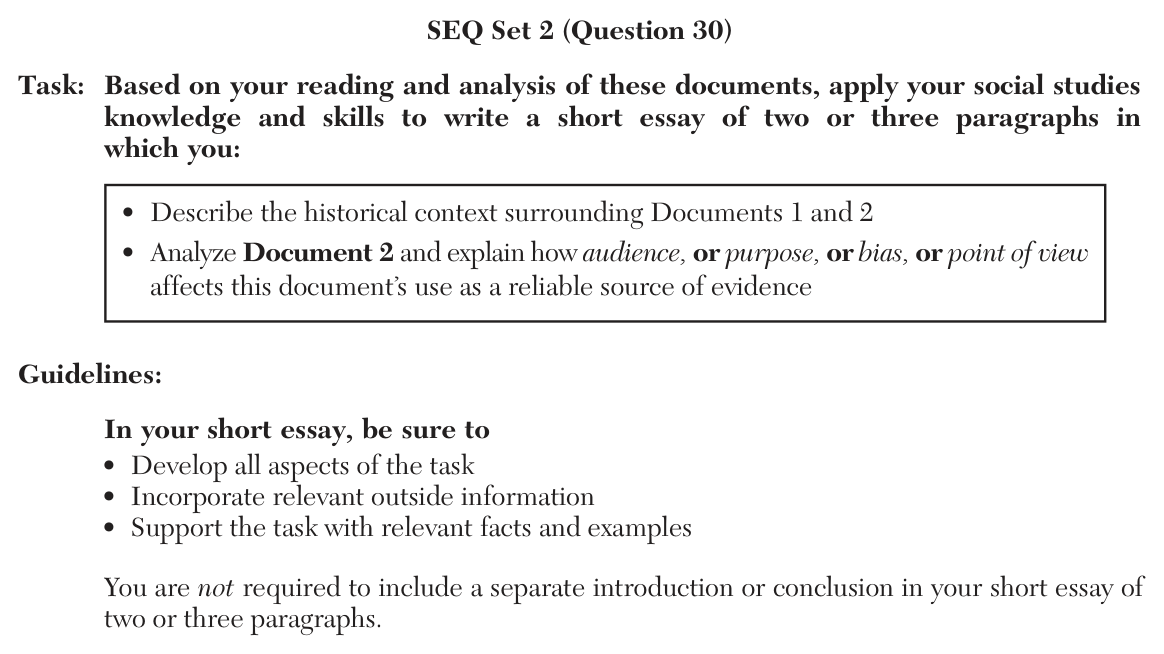
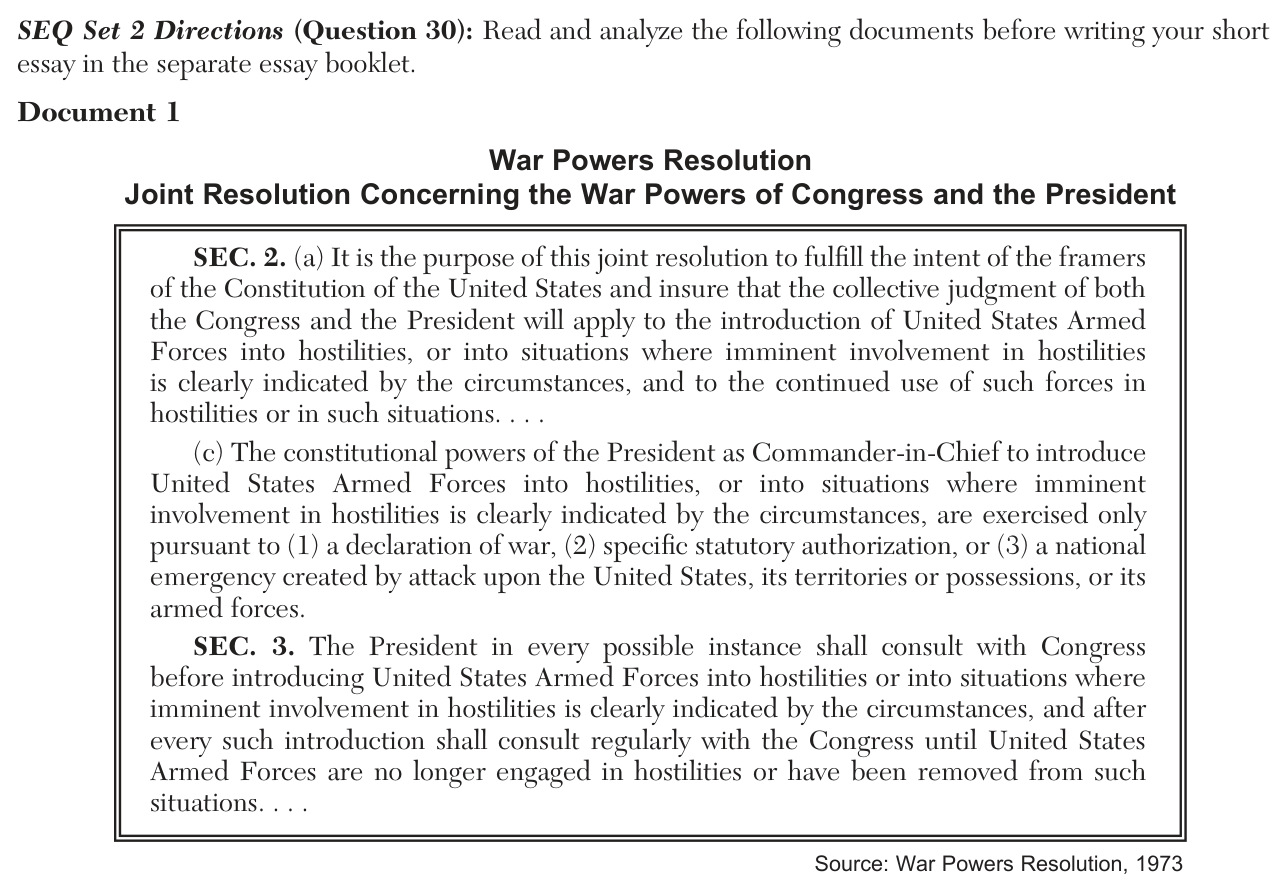
The Constitution makes the president commander in chief but gives Congress the power to declare war. During the Cold War, presidents committed forces abroad without formal declarations. The Vietnam War and its expansion into Cambodia sharpened concern about prolonged operations that Congress could not effectively control. Document 1 responds to this context by calling for congressional consultation and limiting the conditions under which presidents introduce forces into hostilities.
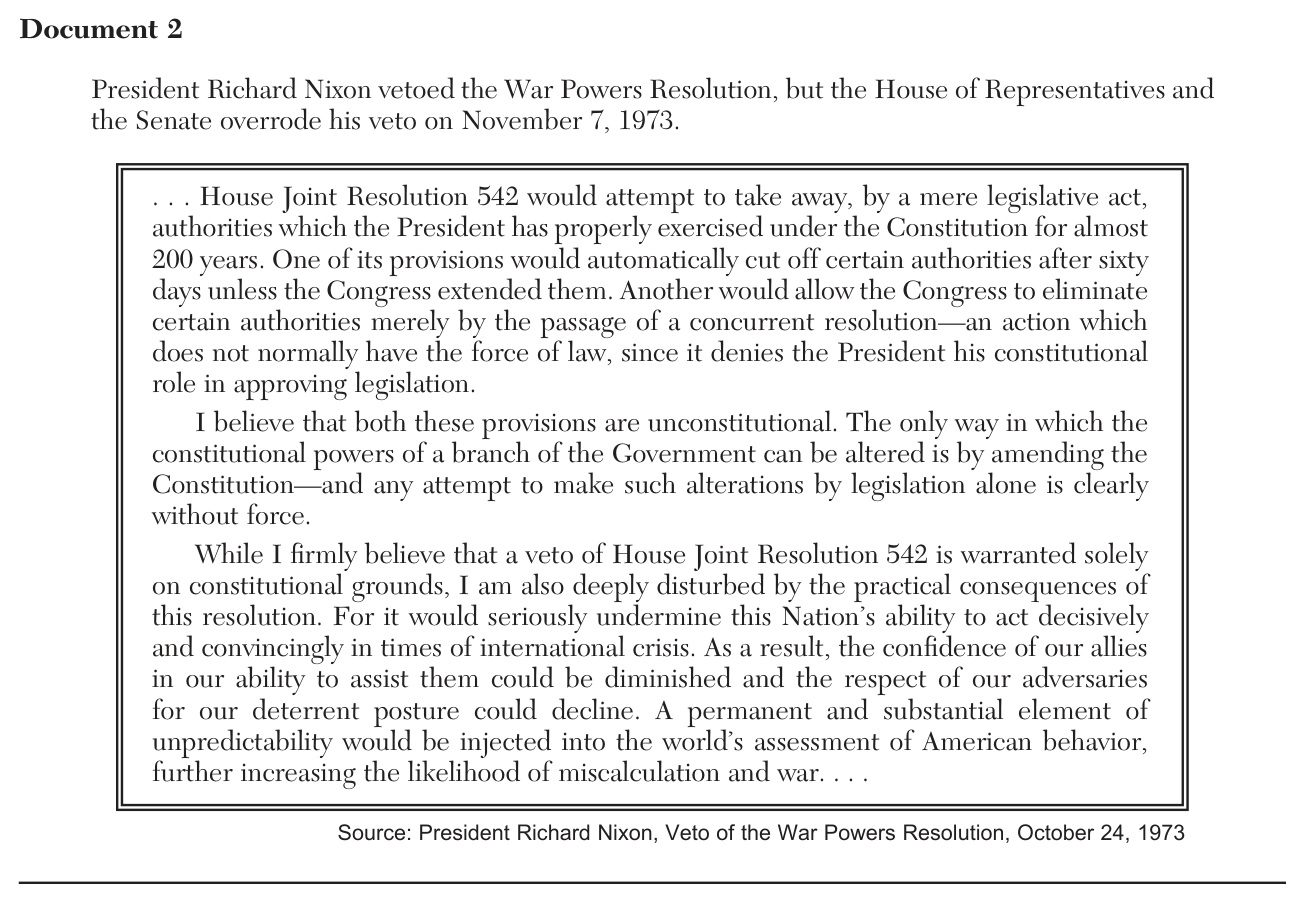
In Document 2, Nixon uses his veto message to persuade Congress that the resolution would improperly restrict executive authority. Its purpose makes it valuable evidence for studying the president’s constitutional objections, including his concern about an automatic cutoff. It gives less weight to the case for legislative control after Vietnam, so a historian would compare it with Document 1 and congressional debate to evaluate both positions. Congress’s override in November 1973 made the resolution law despite Nixon’s objections.
Part III A Document questions
Question indexQ31 Gold Rush migration
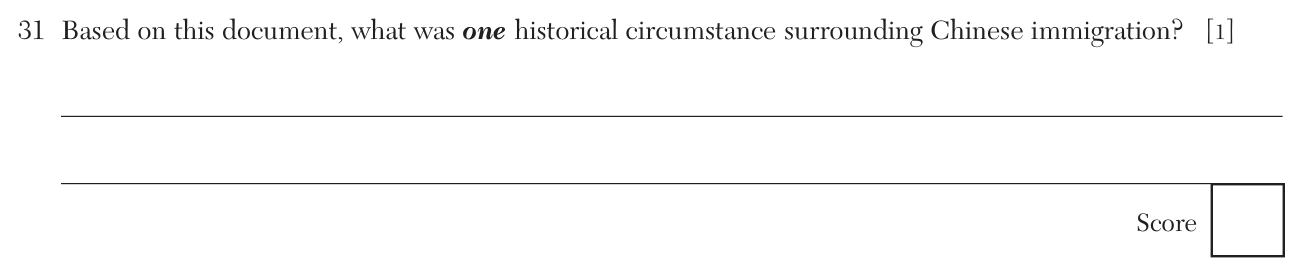
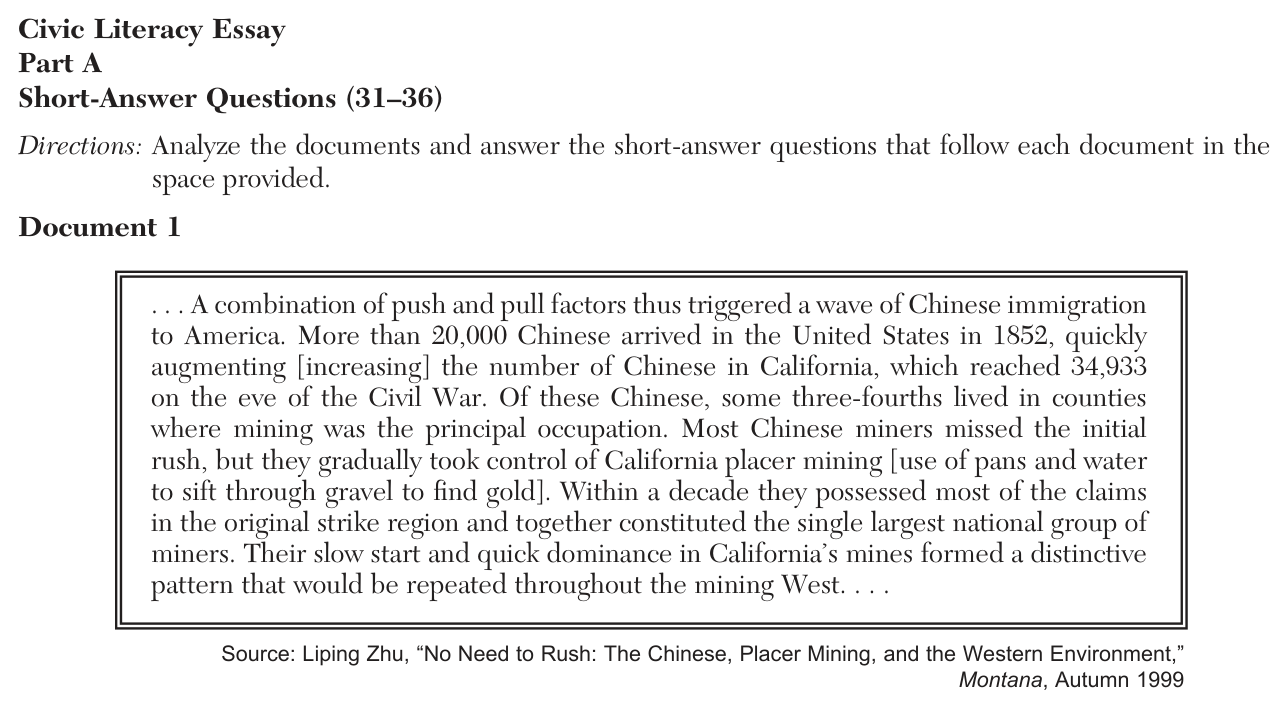
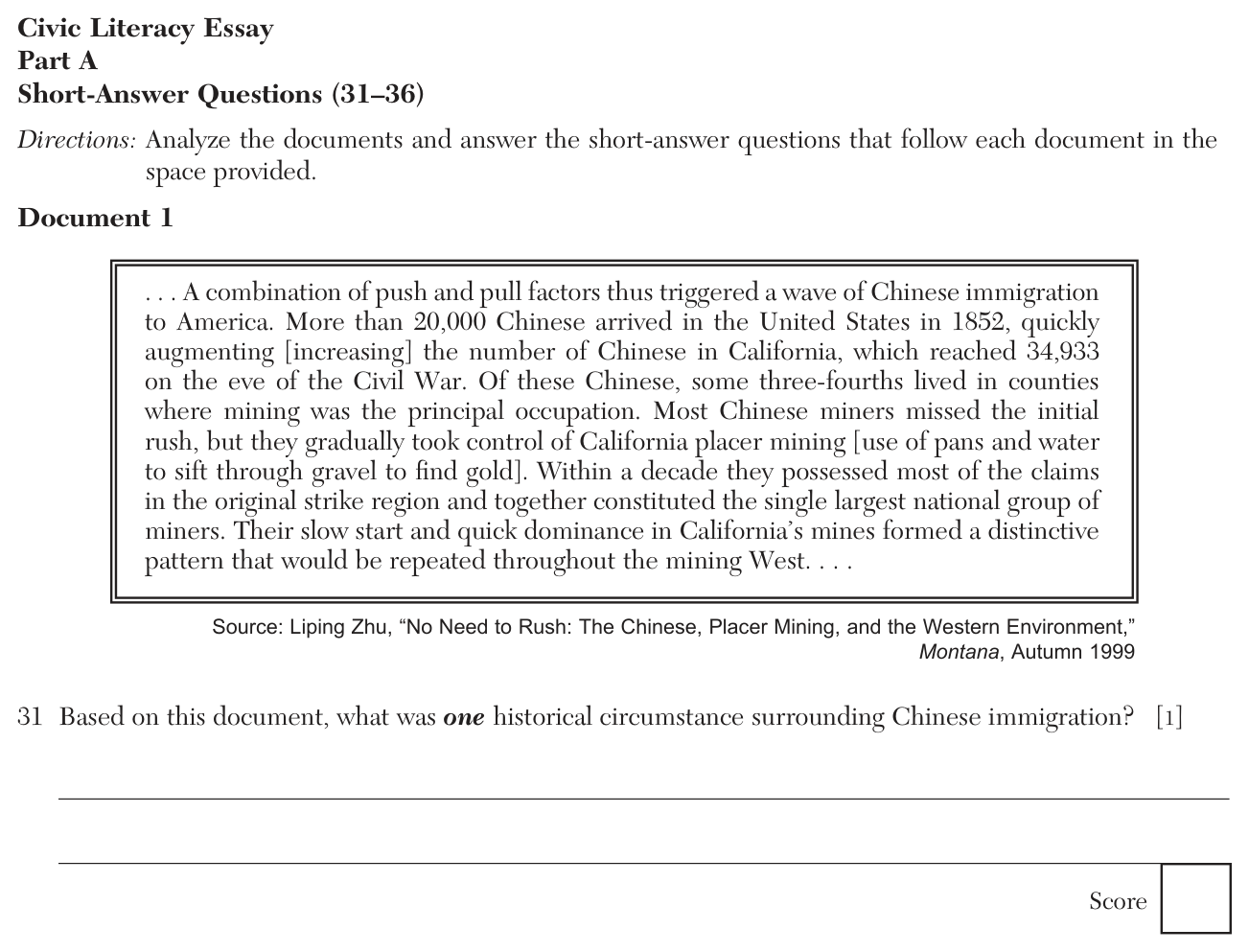
Use Document 1 to identify a circumstance surrounding Chinese immigration.
Worked solution for question 31
- Zhu connects arrivals with mining counties and describes Chinese miners working placer claims.
- The location and work identify an economic pull factor.
Final answerMining opportunities during the California Gold Rush attracted Chinese migrants.
Q32 Debating Chinese immigration
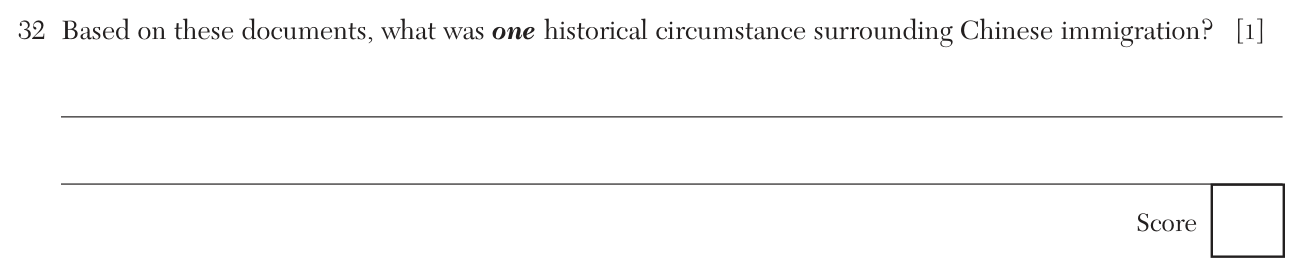
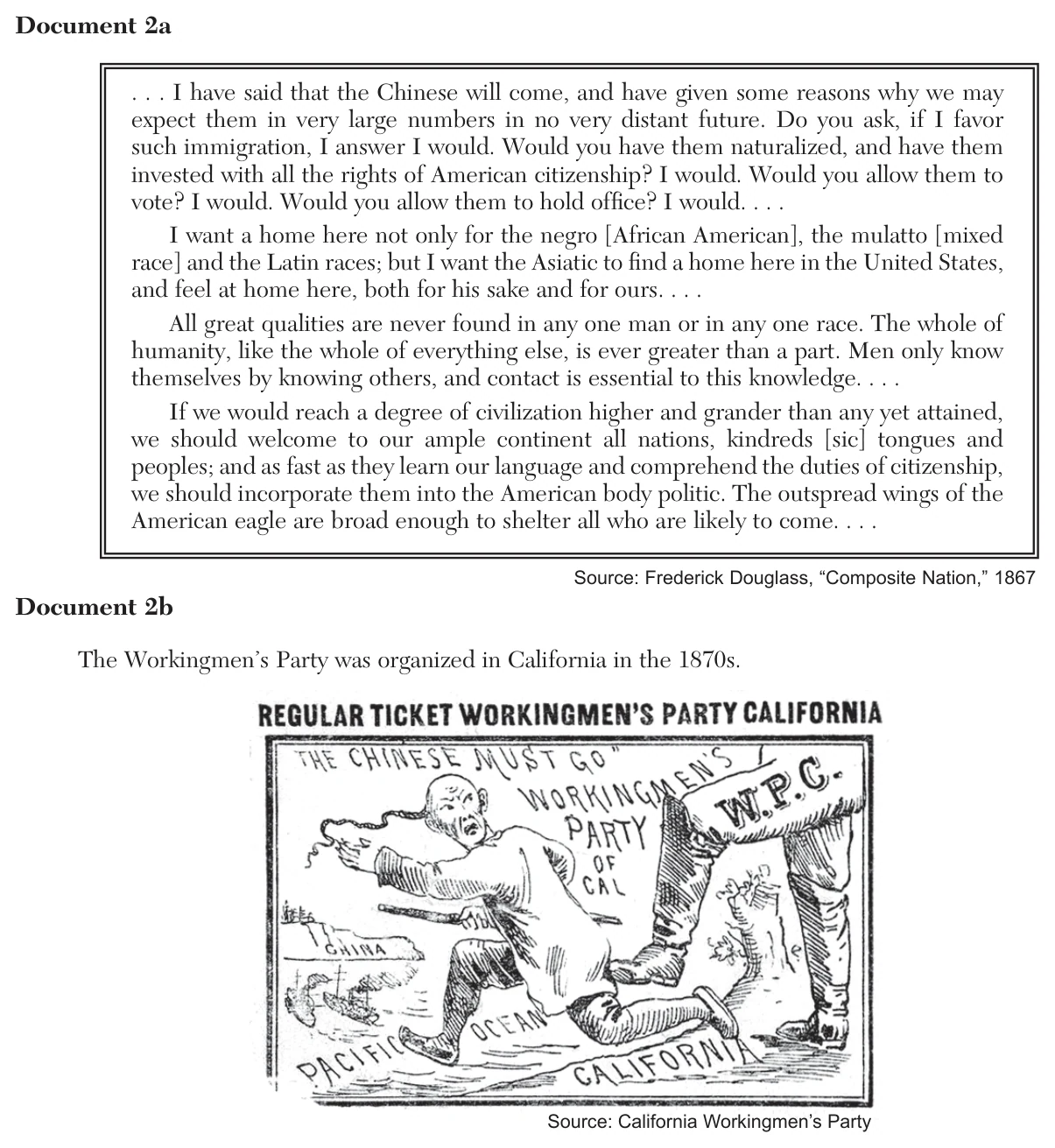
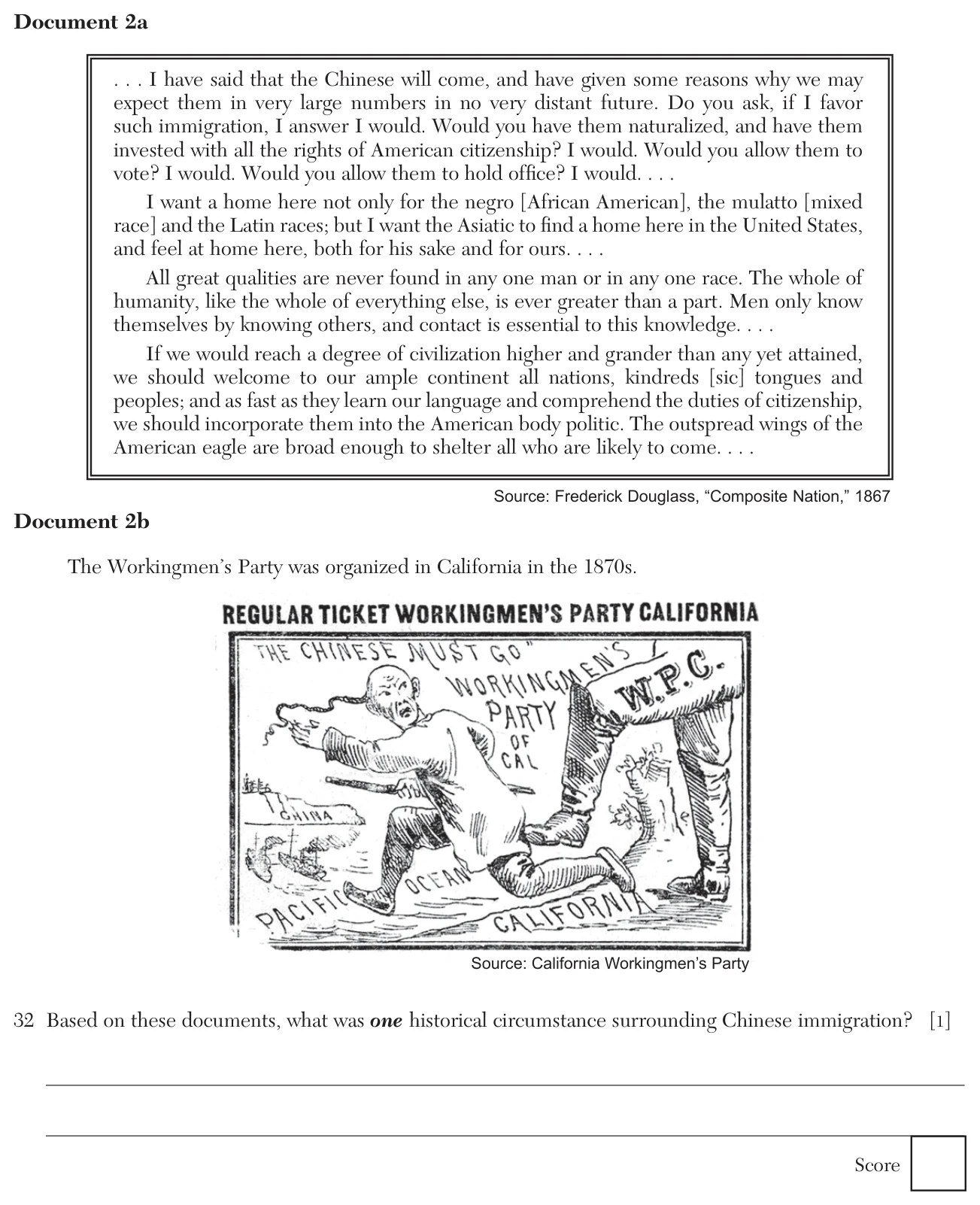
Identify one circumstance shown by Documents 2a and 2b.
Worked solution for question 32
- Douglass defended allowing Chinese immigrants to come and participate. The Workingmen’s Party promoted hostility toward their presence.
- The paired sources show competing views rather than national agreement.
Final answerChinese immigration generated public disagreement about inclusion and exclusion.
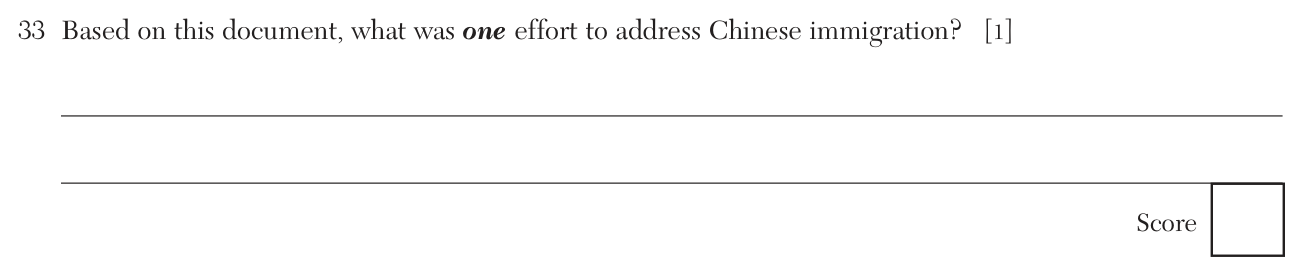
Q33 Legislative exclusion
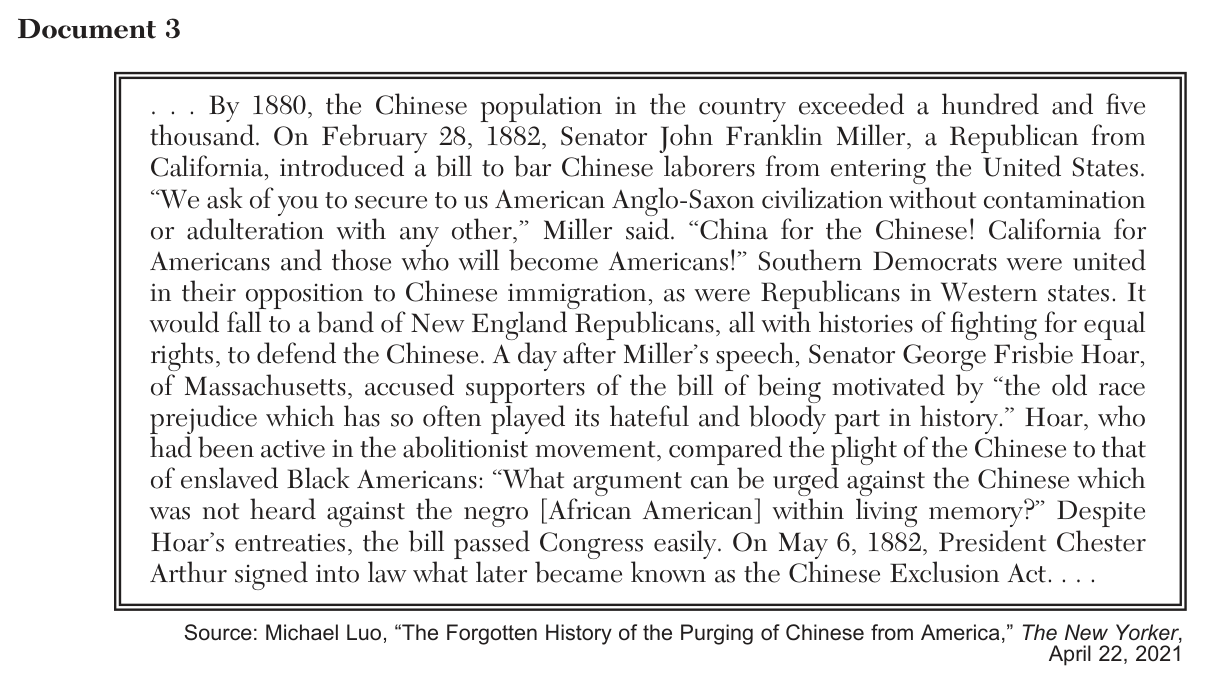
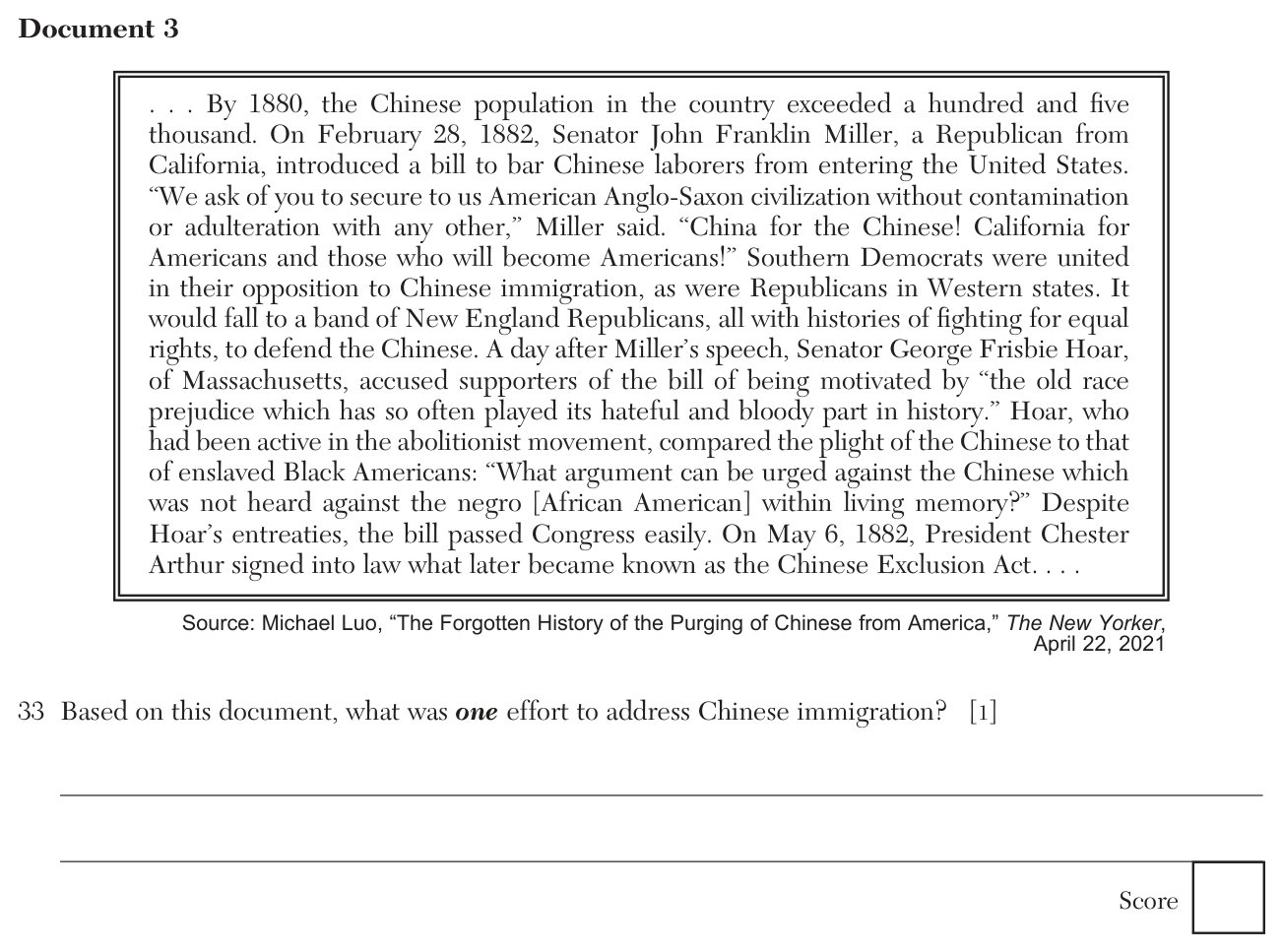
Use Document 3 to identify one effort to address immigration.
Worked solution for question 33
- The proposal sought to bar Chinese laborers from entering.
- Its passage turned a political campaign into federal law.
- Name the federal action and the people it targeted. Identifying Chinese laborers makes the answer specific about the immigration restriction in the document.
Final answerCongress passed and Chester A. Arthur signed the Chinese Exclusion Act in 1882.
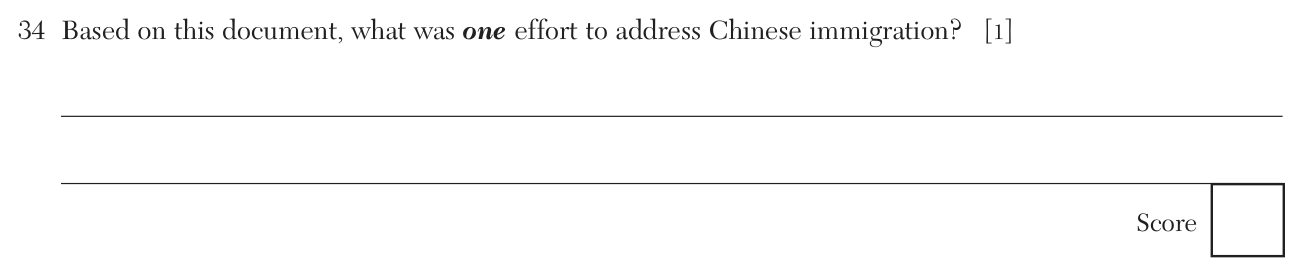
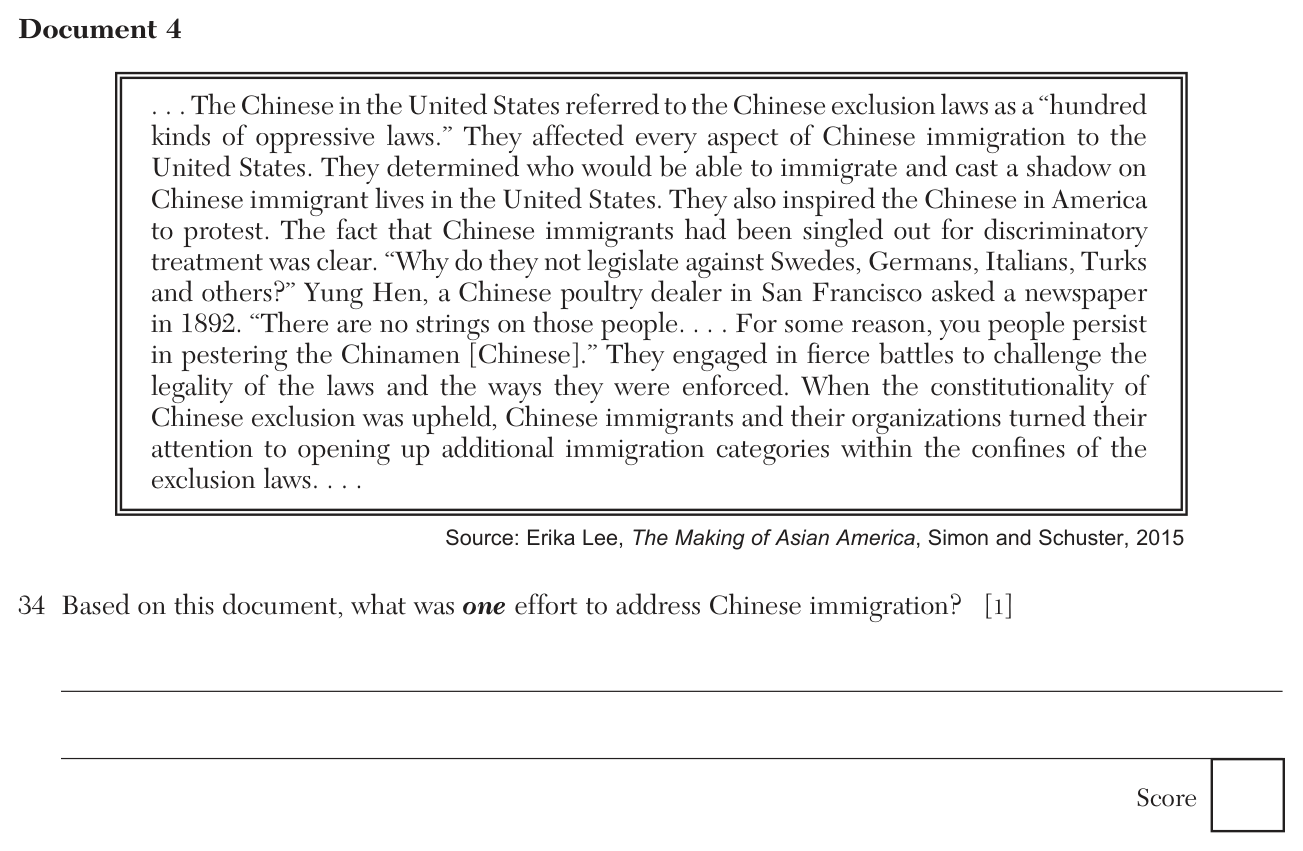
Q34 Resistance to exclusion
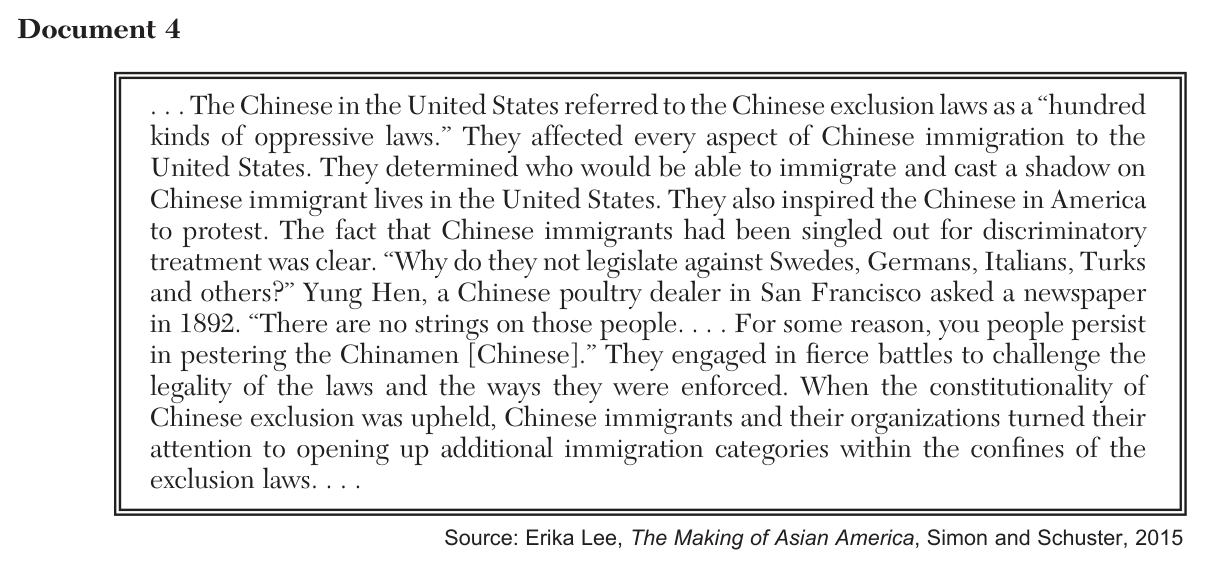
Identify one effort described in Document 4.
Worked solution for question 34
- Lee describes litigation and organized protest against the laws.
- That evidence shows immigrants actively contesting restrictions.
- A strong short answer names the action immigrants took and what it challenged. Filing court cases was a way to contest how exclusion rules were applied.
Final answerChinese immigrants challenged discriminatory exclusion measures in court.
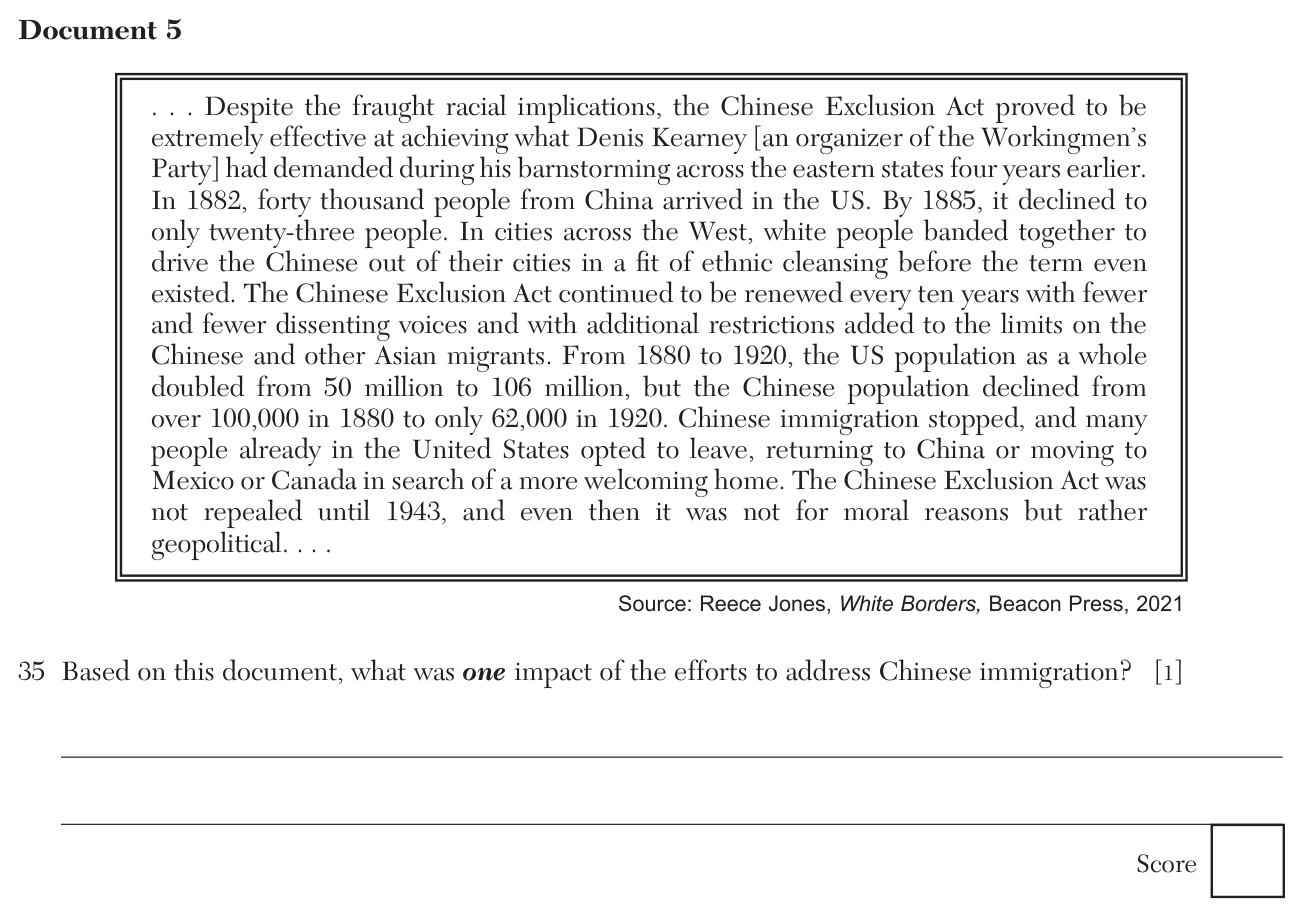
Q35 Population effects
Identify one impact in Document 5.
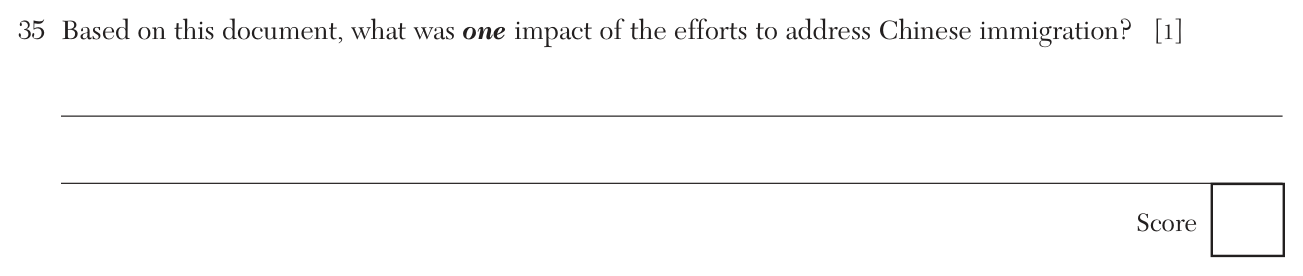
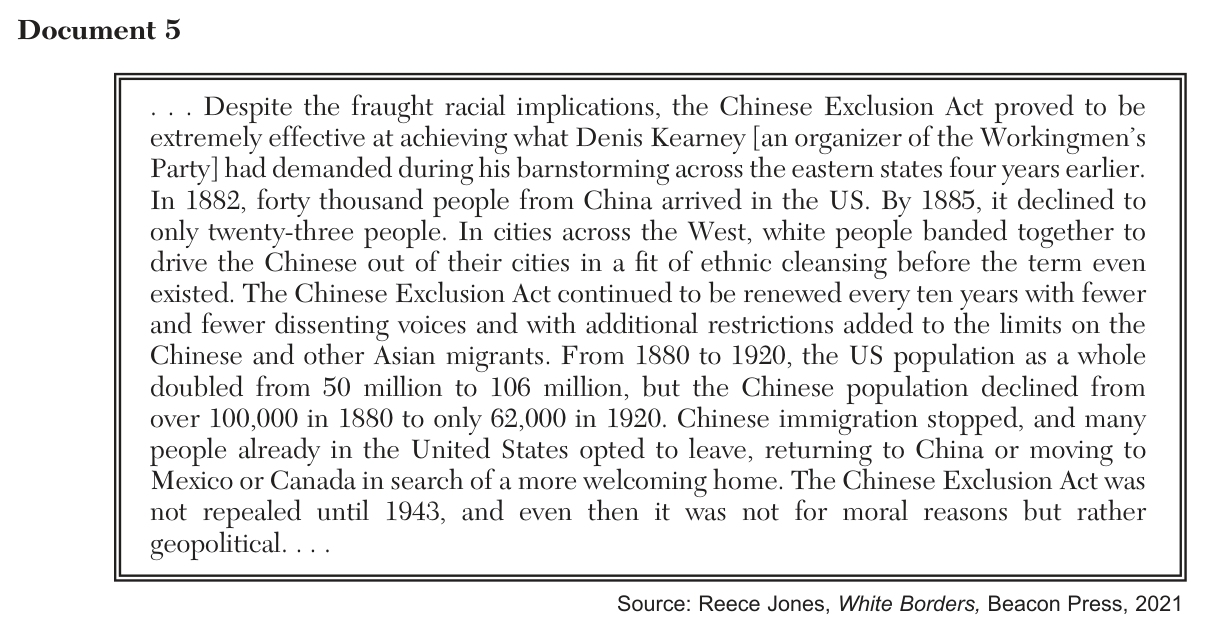
Worked solution for question 35
- Jones contrasts that decline with growth in the country’s overall population.
- The divergence shows the effects of restricted immigration and people leaving.
Final answerThe Chinese population in the United States fell from over 100,000 in 1880 to roughly 62,000 in 1920.
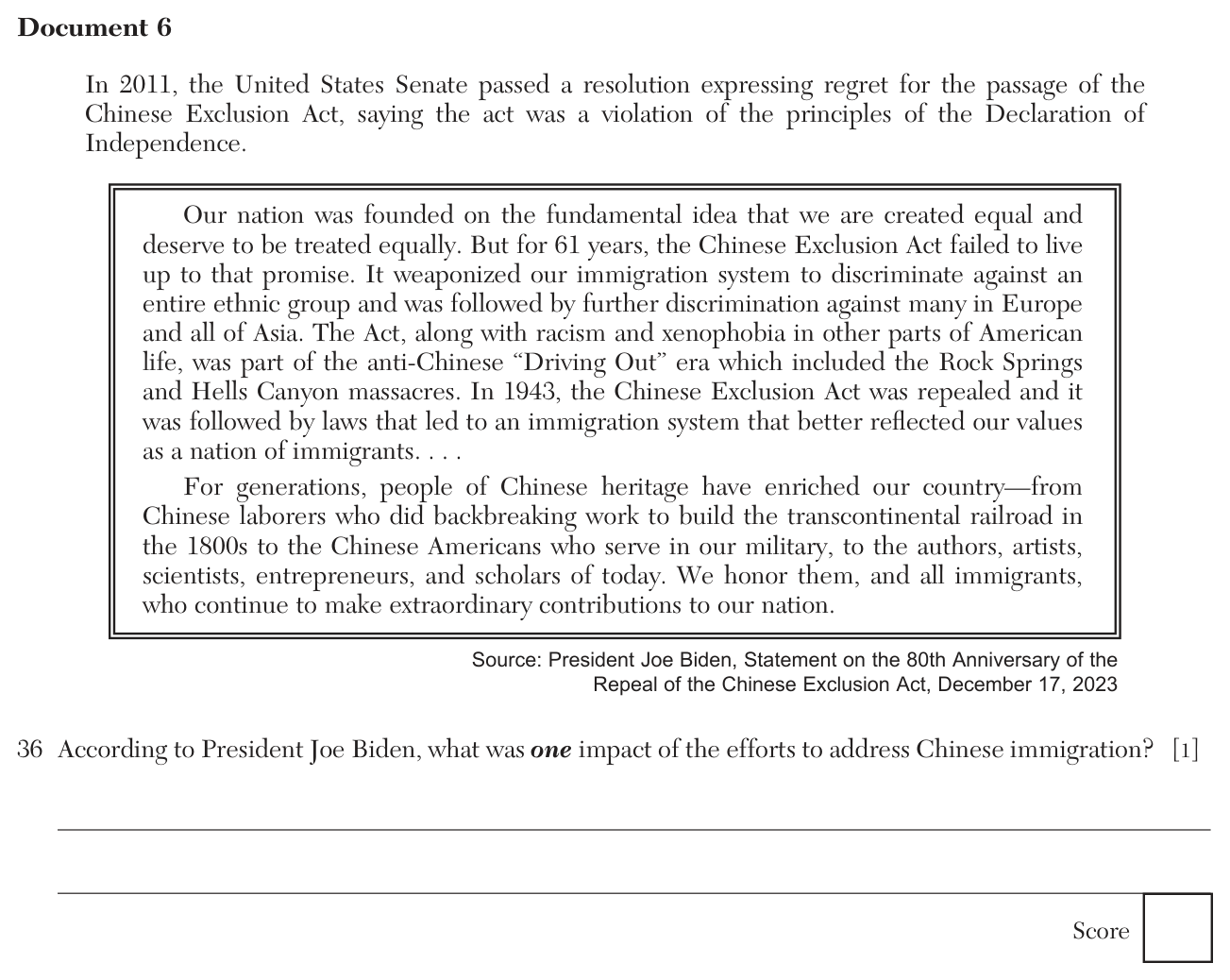
Q36 Impact of exclusion and repeal
Use Biden’s statement to identify one impact.
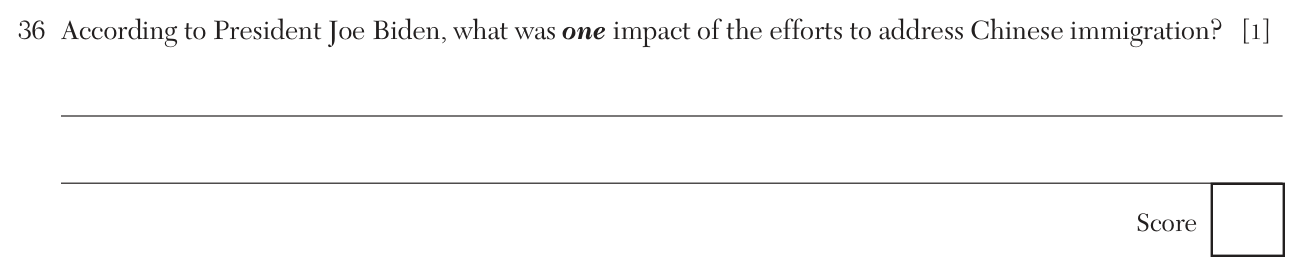
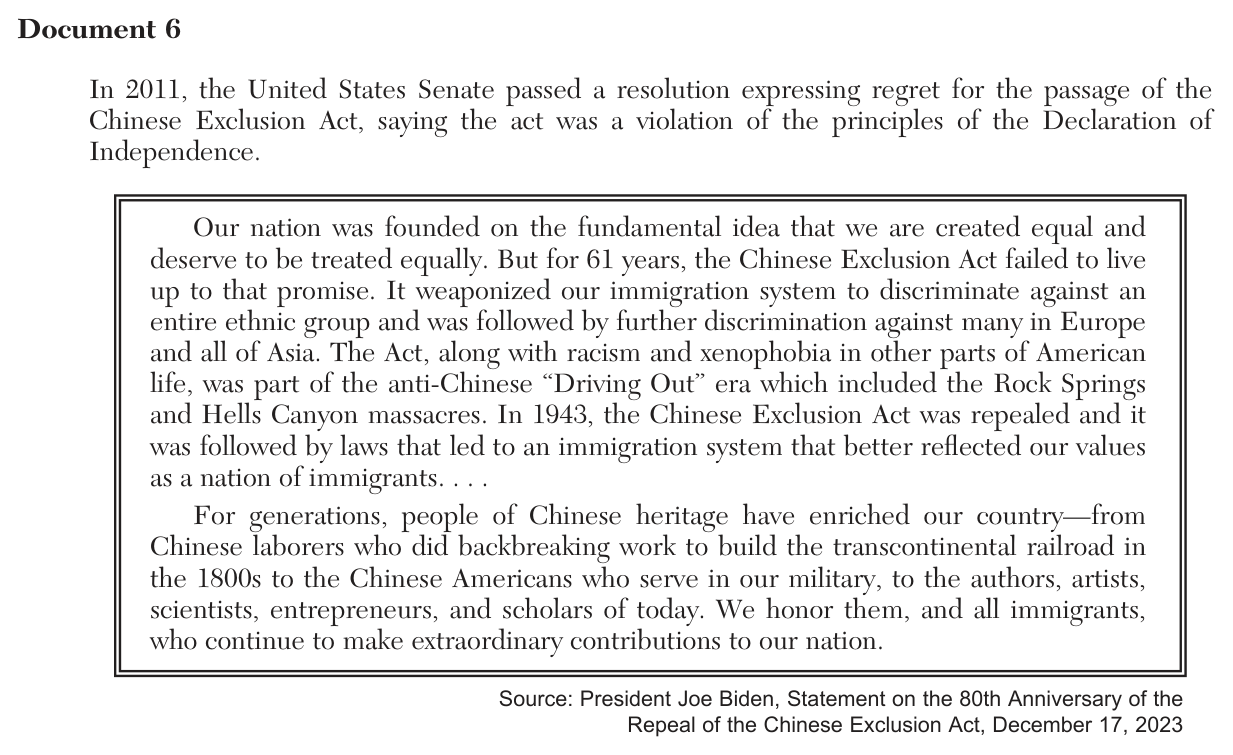
Worked solution for question 36
- The statement places the law within the Driving Out era and cites massacres.
- Its emphasis is on the human consequences of discrimination.
Final answerExclusion and the broader anti-Chinese campaign were accompanied by persecution and violence against Chinese communities.
Part III B Civic literacy essay
Question indexQ37 Civic literacy essay on Chinese immigration
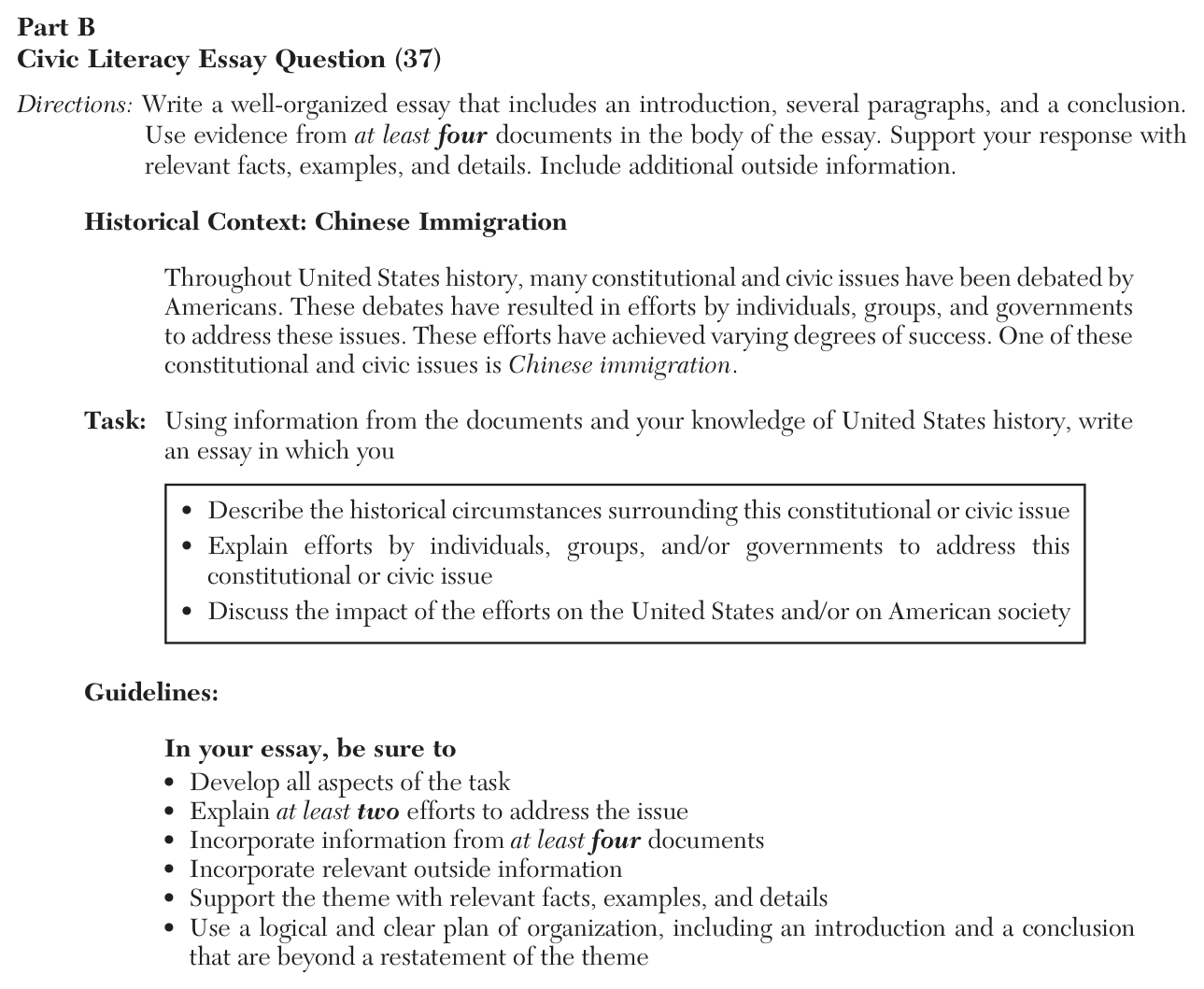
Explain circumstances, at least two efforts and their effects. Use at least four documents and outside evidence.
Writing plan and model response for question 37
- Connect migration, the exclusion campaign, Chinese resistance and the eventual repeal. Use population data to evaluate an outcome.
- Distinguish the federal law’s effects from wider violence and discrimination.
Central claimExclusion turned economic and racial hostility into federal policy, while resistance exposed its injustice and helped challenge the system.
Model response
Chinese migrants came to the United States seeking work, but their labor and presence became the subject of a political struggle over who could enter and belong. The resulting federal exclusion policy sharply limited migration. Chinese communities nevertheless organized against the restrictions and continued to contest discrimination.
As Document 1 shows, the Gold Rush drew migrants to California, where Chinese miners worked placer deposits and claims. Other workers helped build the transcontinental railroad. As settlement and labor markets changed, anti-Chinese politicians treated those workers as economic and racial outsiders. The sources in Document 2 reveal a public debate. Frederick Douglass defended inclusion while the California Workingmen’s Party promoted hostility to Chinese immigration.
One effort to restrict migration succeeded in 1882, when Congress passed and President Arthur signed the Chinese Exclusion Act (Document 3). It targeted Chinese laborers and was renewed in later years. Document 5 shows a measurable outcome. While the national population grew, the number of Chinese residents declined between 1880 and 1920. The law also operated in a climate of expulsions and violence, which the statement in Document 6 places within the anti-Chinese Driving Out era.
A second effort came from Chinese immigrants and their organizations, which protested discrimination and pursued legal challenges (Document 4). A separate case, United States v. Wong Kim Ark, confirmed birthright citizenship for a U.S.-born child of Chinese parents in 1898, illustrating that litigation could protect a specific right even while exclusion continued. In 1943 Congress repealed Chinese exclusion, although the new quota remained small. Repeal removed the earlier categorical restriction, and the history of resistance shows that affected communities contested both the policy and the definition of citizenship it reflected.
From the New York State Education Department. August 2026 U.S. History and Government Regents Examination. Internet. Available from https://www.nysedregents.org/us-history-govt/826/ushg-82026-exam.pdf. Accessed .