NEW YORK STATE REGENTS · GLOBAL HISTORY AND GEOGRAPHY II
January 2026 Global History and Geography II Regents Past Paper & Solutions
Work through collectivization, postwar borders and political oppression with a question-by-question walkthrough of the exam.
- 36 worked questions
- 1 writing models
- 3 exam parts
The question images and page numbers come from the regular-size English exam. OnlyPrepy wrote the summaries and worked solutions.
Quick answer key for Part I
Part I Multiple choice
Question indexQ1 Controlling nobles at Versailles
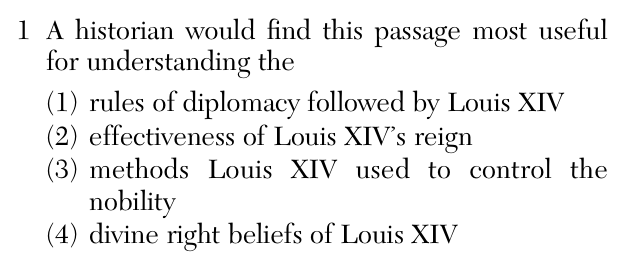
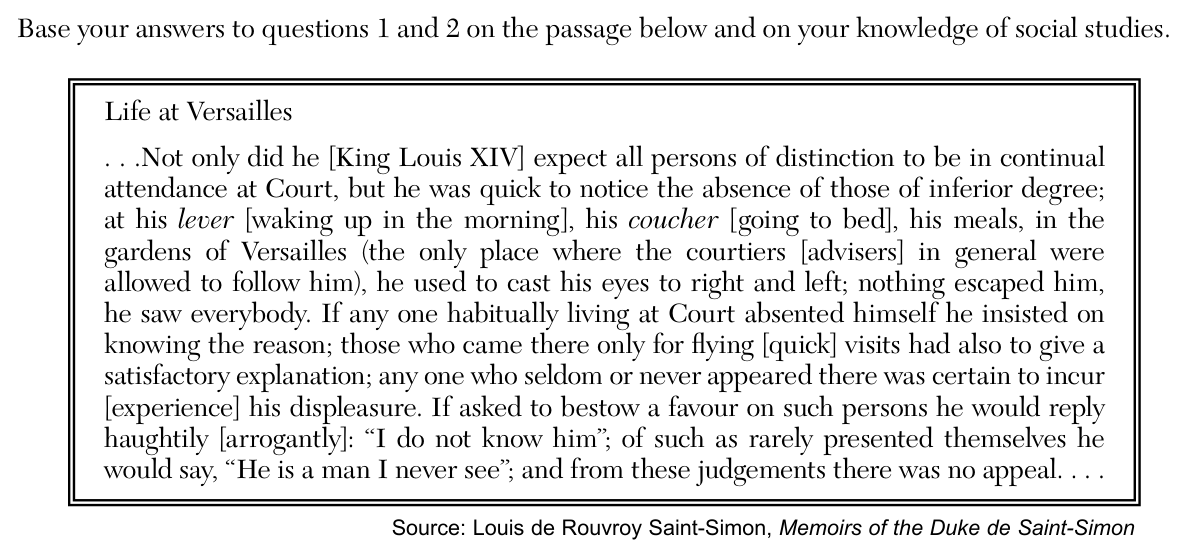
What can a historian best learn from Saint-Simon’s account?
Worked solution for question 1
- The king expected nobles to attend his court and noticed who failed to appear.
- Control of access and favors made nobles depend on the monarch’s approval.
- Requiring nobles to spend time at the royal court put them closer to Louis XIV’s supervision. It also pulled their attention away from building an independent base of power on their estates.
Answer choice 3How Louis XIV controlled the nobility
Q2 A parallel system of attendance
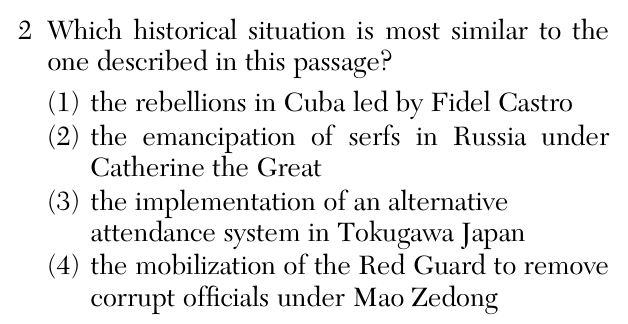
Which historical system most resembles Louis XIV’s use of the court?
Worked solution for question 2
- Japanese daimyo spent time at the shogun’s capital and incurred the costs of maintaining residences.
- Both rulers used compulsory or expected attendance to supervise powerful elites.
Answer choice 3Tokugawa Japan’s alternate attendance system
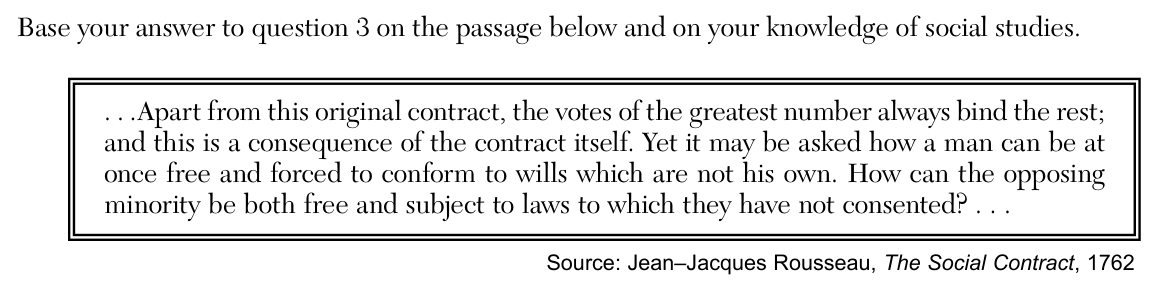
Q3 Rousseau and majority rule
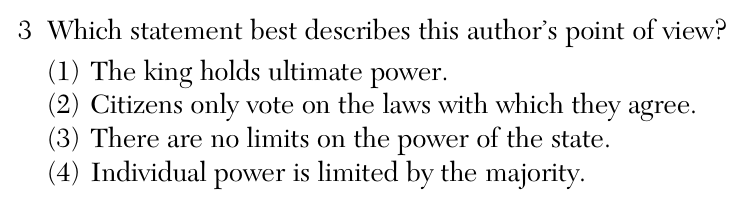
What view of individual political power appears in the excerpt?
Worked solution for question 3
- Rousseau describes the decision of the majority as binding after people enter the political community.
- An individual can disagree with an outcome while still being subject to the shared decision.
- The individual is bound by a decision made collectively. Identify the relationship in the excerpt as majority rule and distinguish it from a monarch imposing a decision by personal authority.
Answer choice 4The majority limits an individual’s power.
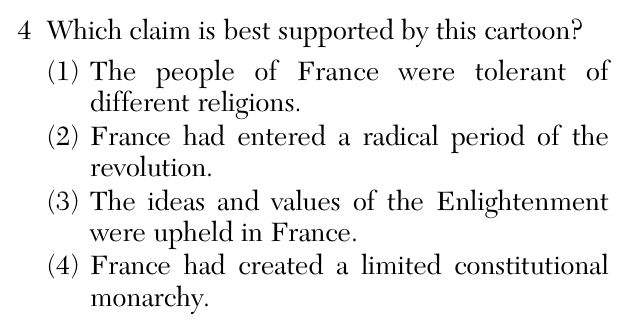
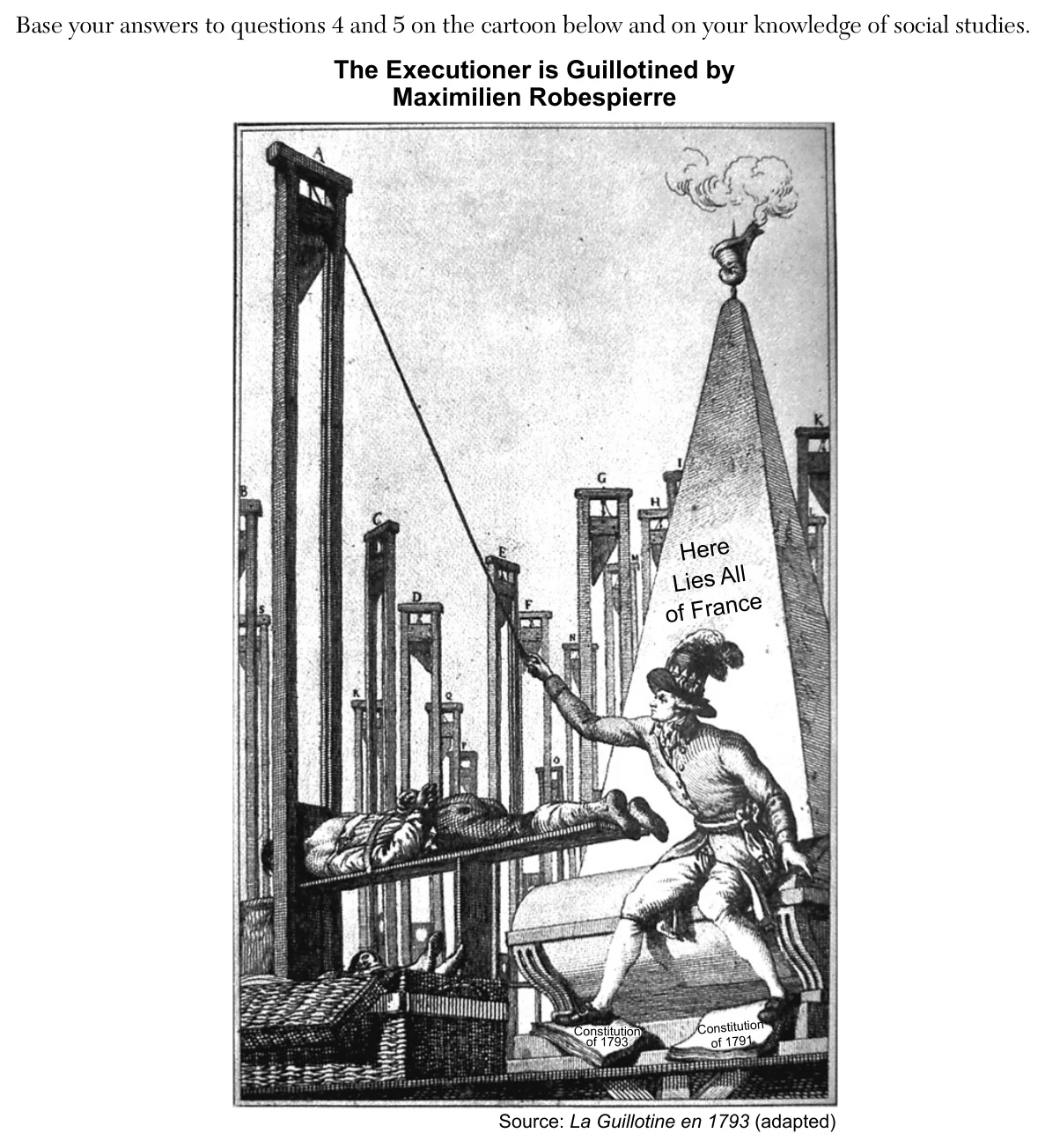
Q4 The Reign of Terror
What phase of the French Revolution is illustrated by the guillotine cartoon?
Worked solution for question 4
- The execution imagery and Robespierre identify the revolutionary Terror.
- Violence used against suspected enemies ultimately reached leaders of the Terror itself.
Answer choice 2A radical phase of the revolution
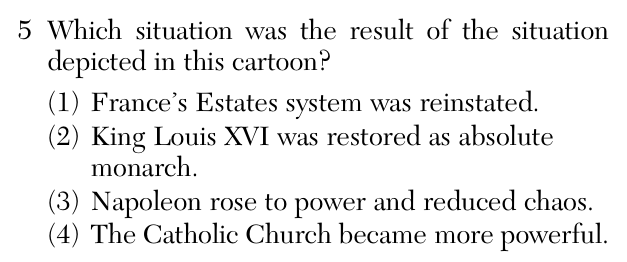
Q5 From revolution to Napoleon
What followed the revolutionary instability illustrated by the cartoon?
Worked solution for question 5
- The Terror and its collapse preceded the Directory, which faced continuing instability.
- Napoleon’s 1799 coup brought centralized rule under the Consulate.
- Place Napoleon after the instability of the Revolution. His rise brought stronger centralized authority, helping explain how political order could return even as representative government weakened.
Answer choice 3Napoleon rose to power and restored a measure of order.
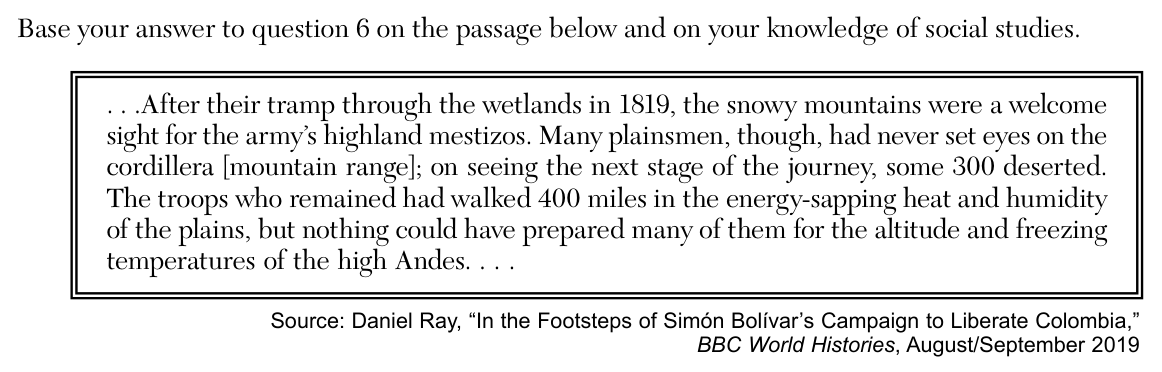
Q6 Geography and Bolívar
What does the account best help a historian investigate?

Worked solution for question 6
- The army moved through wetlands and then faced cold and altitude in the Andes.
- The contrast explains how terrain placed different demands on the soldiers.
Answer choice 4Geography’s impact on Colombia’s struggle for independence
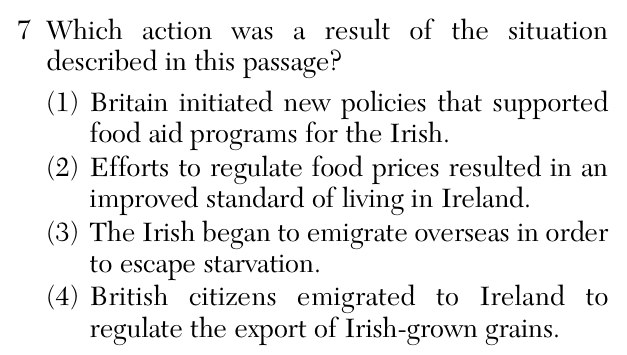
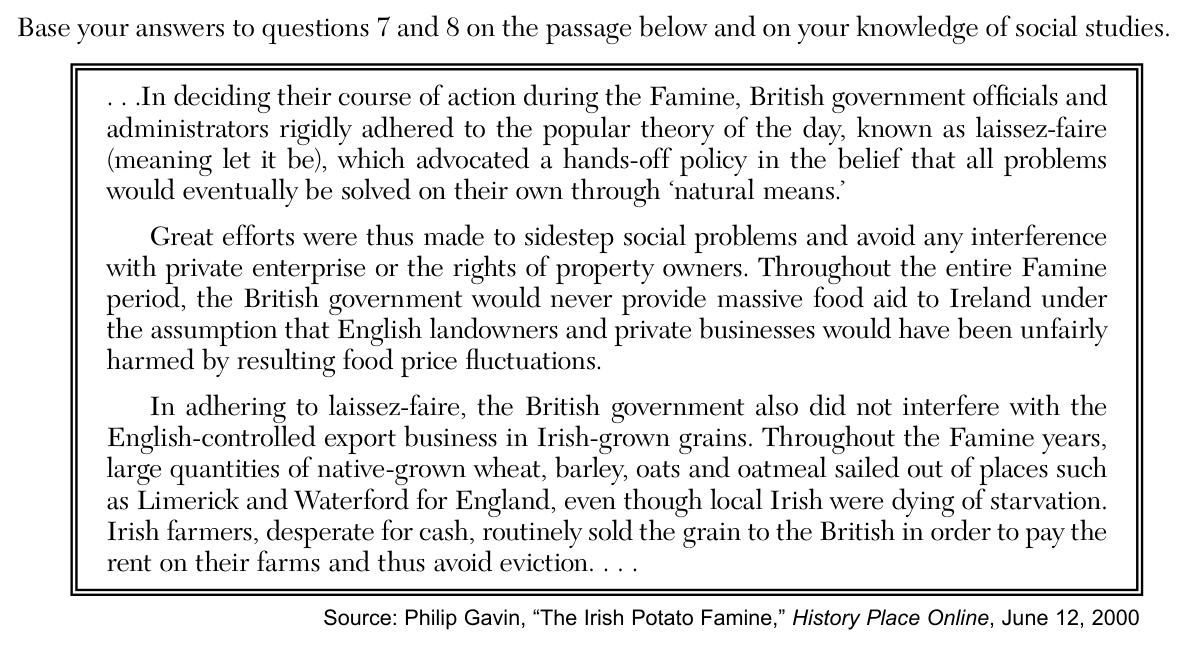
Q7 Famine and emigration
What was one result of the Irish famine described?
Worked solution for question 7
- Potato failure and inadequate relief exposed households to hunger.
- Leaving Ireland offered a way to seek food, work and security.
- The loss of a staple food left families without a reliable way to survive. Emigration is the population movement that follows from that pressure.
Answer choice 3Many Irish people emigrated overseas to survive.
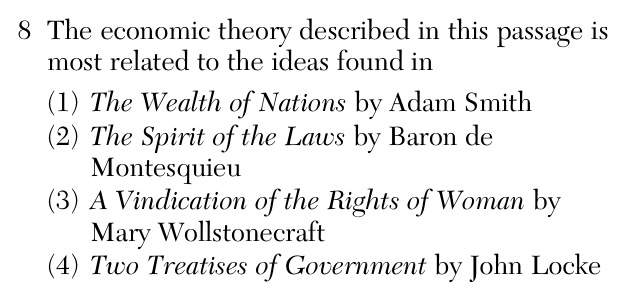
Q8 Laissez-faire ideas
Which work is most closely associated with the approach described?
Worked solution for question 8
- Officials justified limited intervention through confidence in markets.
- Among the choices, Smith’s work is most associated with markets operating with limited interference.
Answer choice 1Adam Smith’s The Wealth of Nations
Q9 Industrial cities and pollution
What led to the environmental problem in the Punch cartoon?
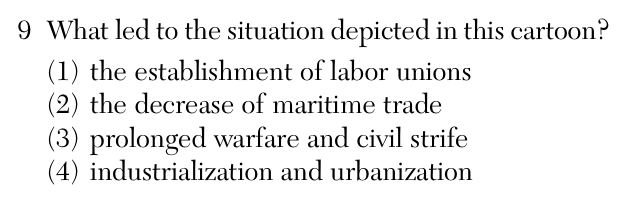
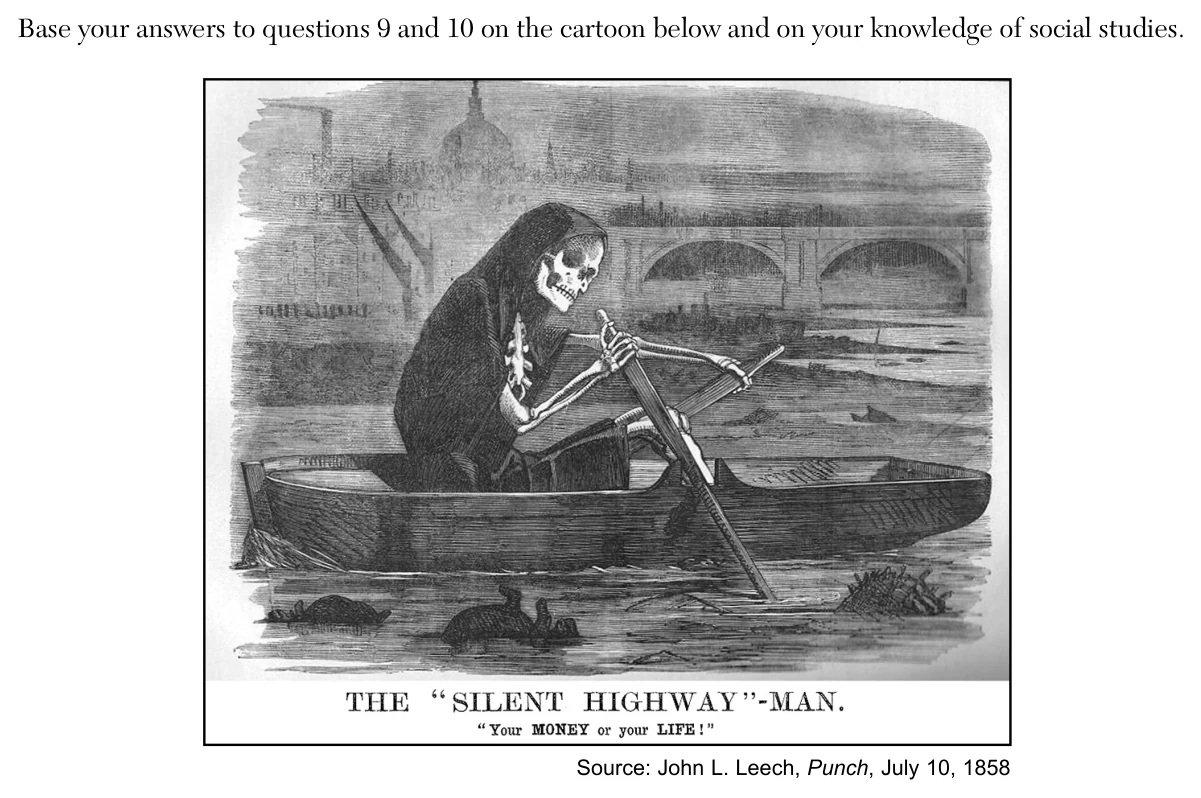
Worked solution for question 9
- Industrial production and growing urban populations increased the waste entering the Thames.
- Existing drainage and sanitation did not keep pace with that growth.
- Connect the physical evidence to two processes. Industry produced pollution, and urbanization placed many people near the sources of that pollution.
Answer choice 4Industrialization and urbanization
Q10 A sanitation response
What did Britain do to address the problem?
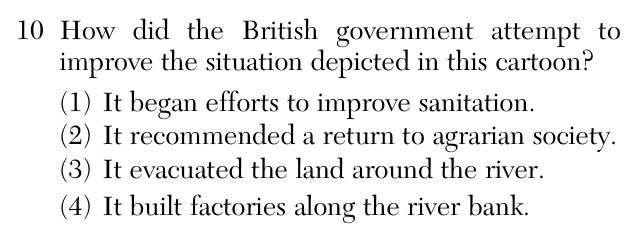
Worked solution for question 10
- The problem required sewage and waste management rather than expansion of factories.
- London’s construction of a modern sewer network was a major response.
Answer choice 1It began improving sanitation.
Q11 Clive and British power
Which claim about Robert Clive follows from the passage?
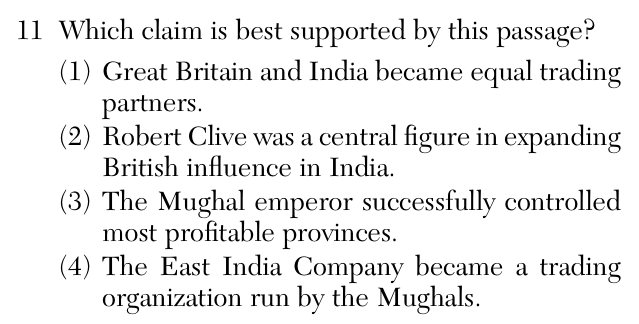
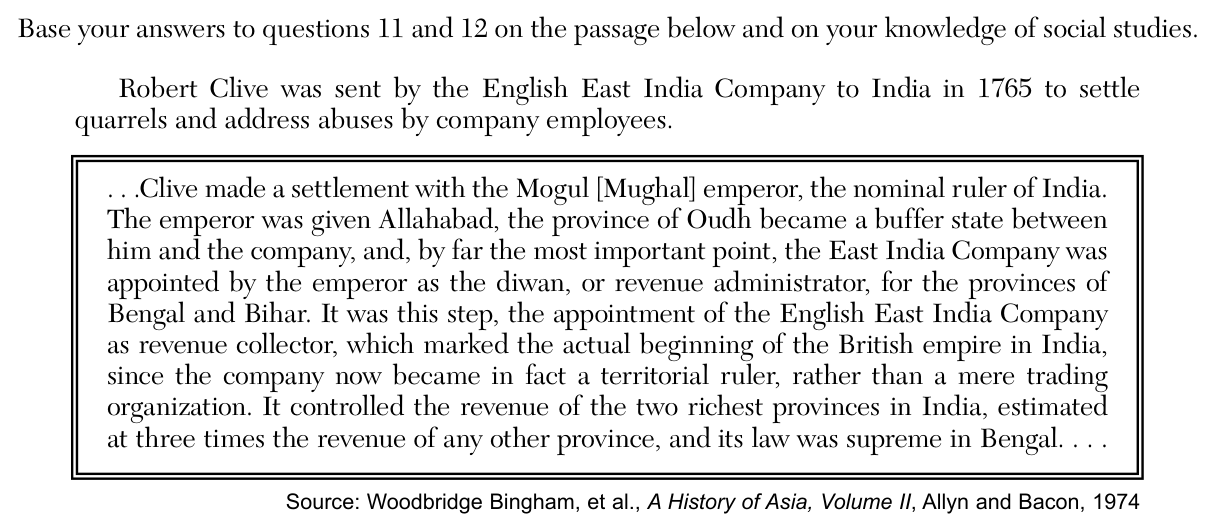
Worked solution for question 11
- Clive negotiated an arrangement that gave the East India Company revenue authority in Bengal and Bihar.
- Collecting revenue turned commercial influence into political and territorial power.
- Clive’s career shows how a trading company could gain political and military power. Those gains helped lay the groundwork for a larger British presence in India.
Answer choice 2He helped expand British influence in India.
Q12 Company rule as a turning point
Why was revenue collection a turning point?
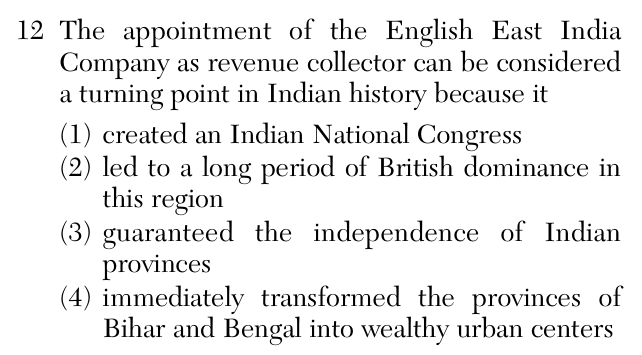
Worked solution for question 12
- Tax revenue financed administration and military power in valuable provinces.
- That foothold enabled the company to function as a ruler and expand its influence.
Answer choice 2It opened a long period of British dominance.
Q13 Hitler Youth
What does this passage help a historian understand?
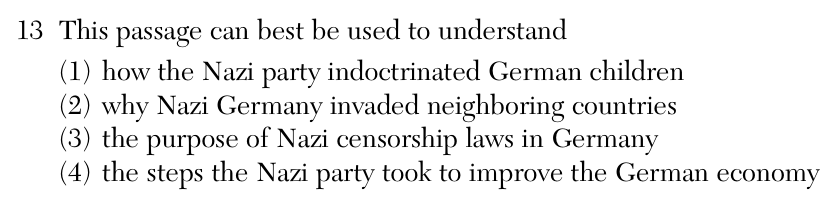
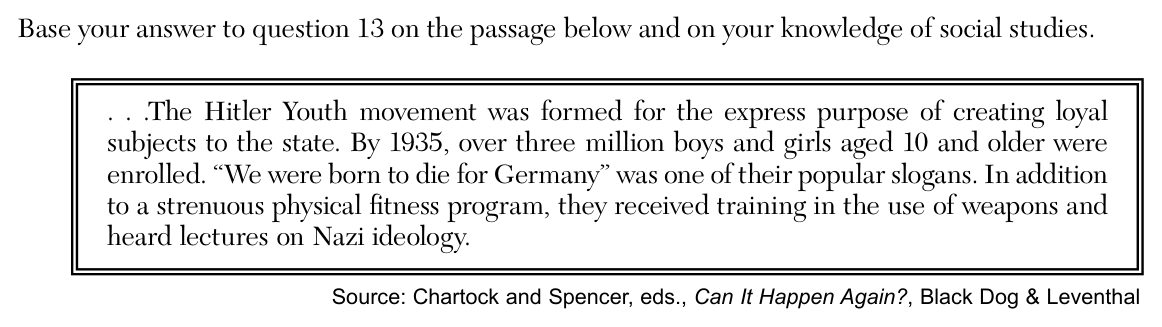
Worked solution for question 13
- The organization combined physical training with instruction in Nazi ideology and loyalty to the state.
- Reaching children at a young age helped the party shape political beliefs.
- State involvement in a youth organization let the regime shape beliefs outside school and family life. That makes the program evidence of political indoctrination.
Answer choice 1Nazi indoctrination of children
Q14 Expansionist states
Which claim is supported by the cartoon of Germany, Italy and Japan?

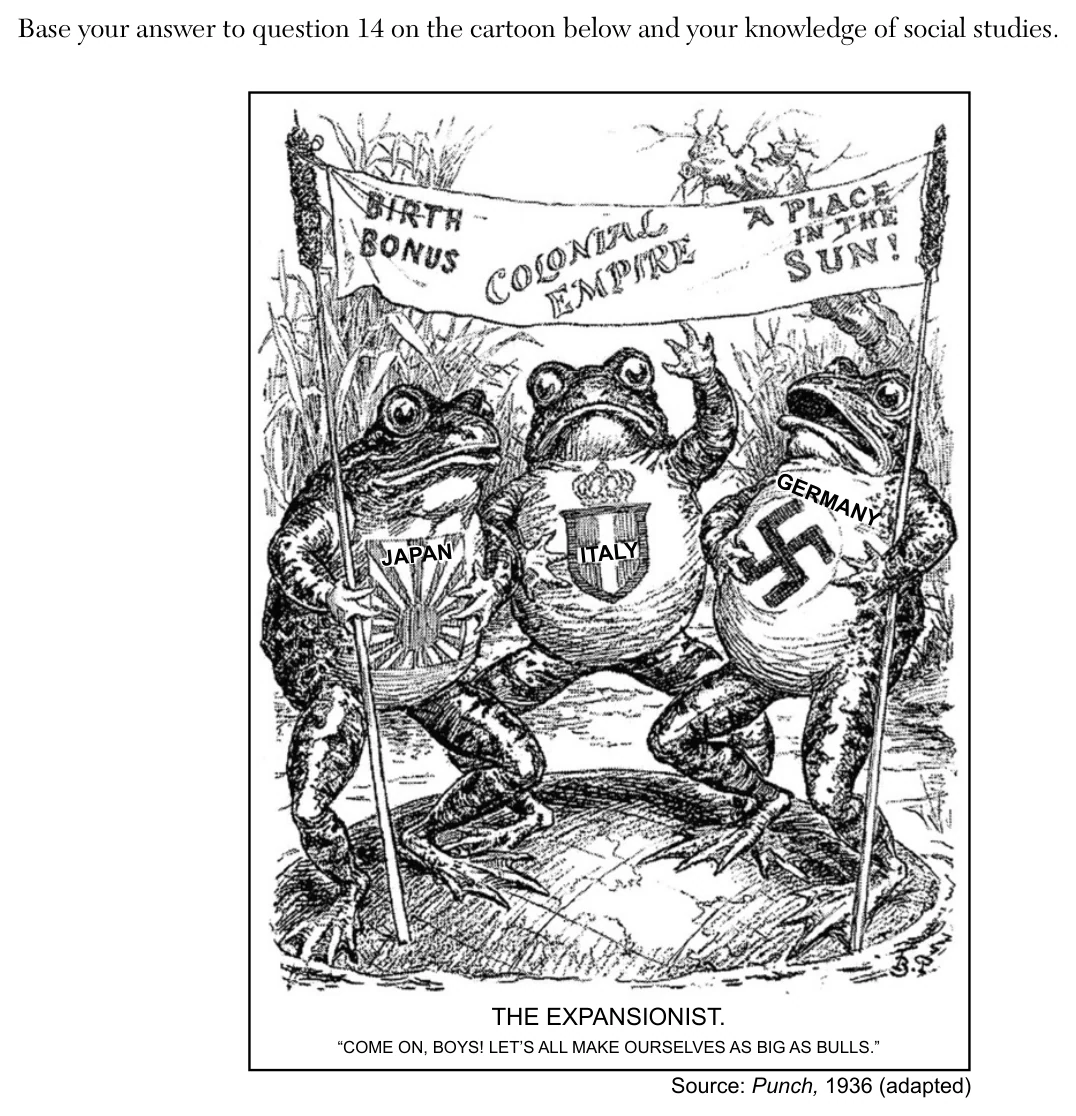
Worked solution for question 14
- The states are depicted urging one another to grow larger.
- The image satirizes national ambitions expressed through expansion beyond existing borders.
Answer choice 2Rising nationalism helped fuel imperialism.
Q15 Japanese expansion in Asia
What does Dorf’s 1937 cartoon demonstrate?
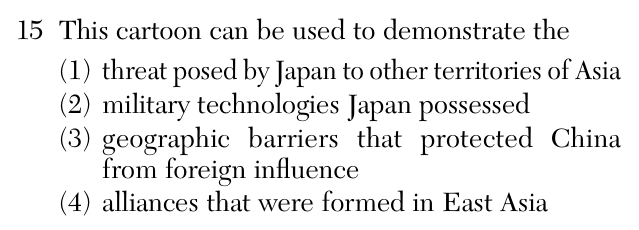
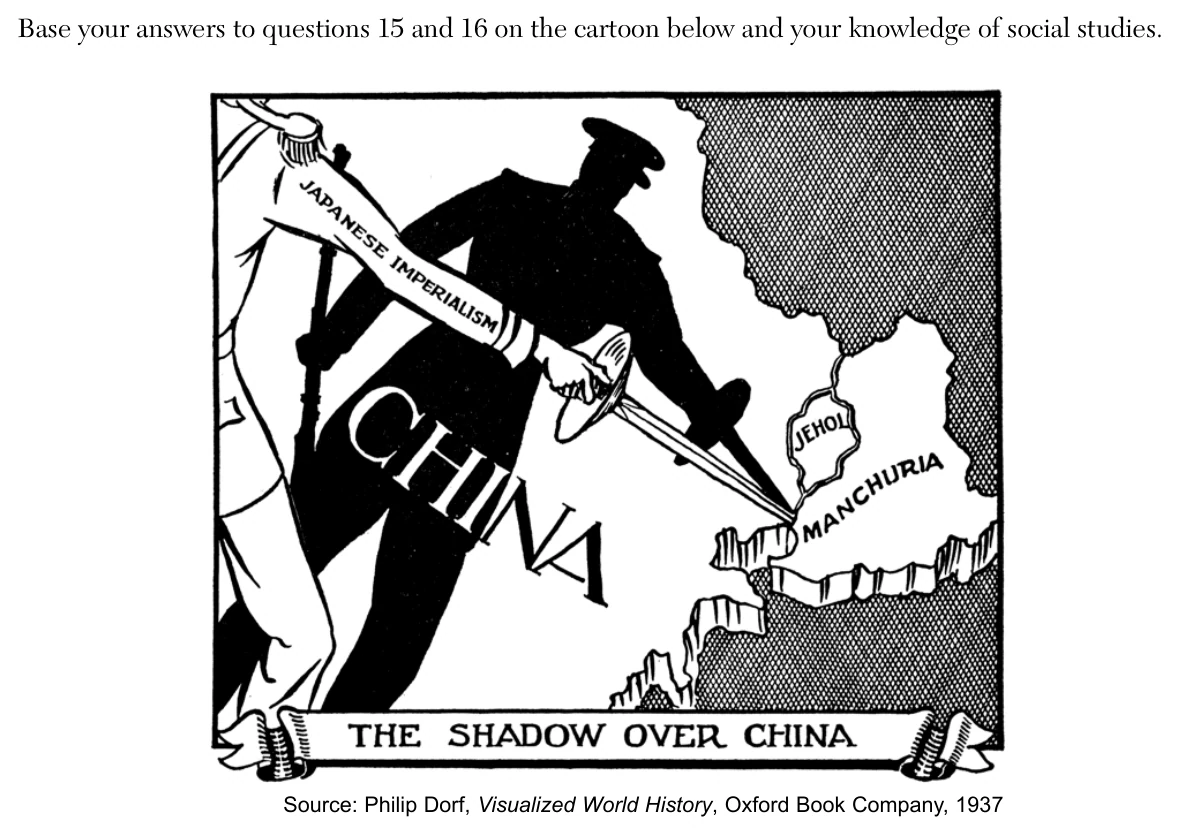
Worked solution for question 15
- The cartoon treats Japanese power as a threat beyond its own islands.
- Expansion into Manchuria and China gives the image its historical context.
- Identify the effect of territorial expansion on nearby states. Japan’s gains increased its reach and exposed neighboring peoples to pressure or occupation.
Answer choice 1Japan’s expansion threatened other parts of Asia.
Q16 Meiji reforms and expansion
What helped make Japan’s expansion possible?
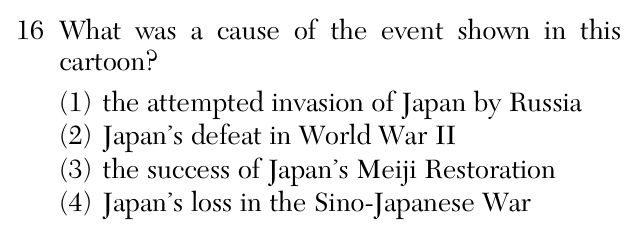
Worked solution for question 16
- Meiji reforms accelerated industrial growth and military modernization.
- A stronger military and industrial base gave Japan the means to pursue an empire.
Answer choice 3The success of the Meiji Restoration
Q17 Communist expansion
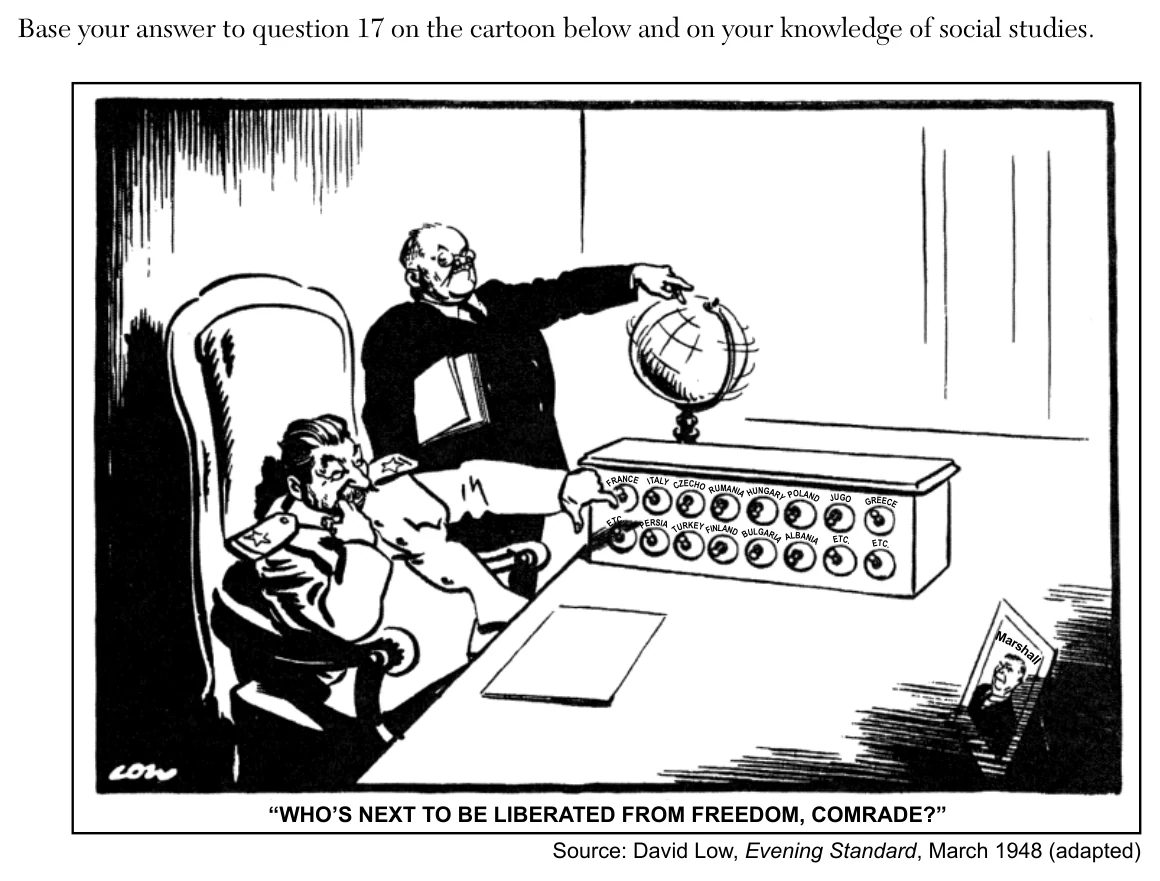
What concern does Low’s 1948 cartoon express?
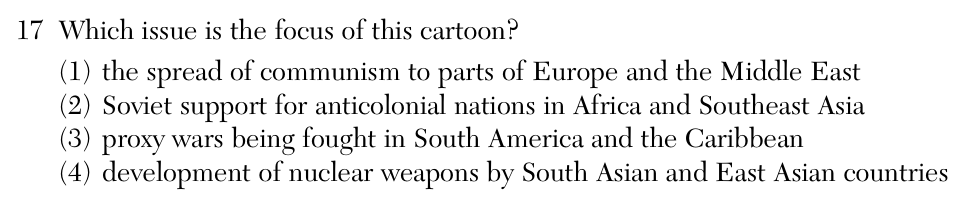
Worked solution for question 17
- The listed countries identify the regions the cartoonist is concerned about.
- The ironic language of liberation portrays Soviet expansion as a loss of freedom.
- Use the geography of the places described. The concern reaches beyond a single country and points to a broader Cold War struggle over political influence.
Answer choice 1The spread of communism in Europe and parts of the Middle East
Q18 Berlin blockade in context
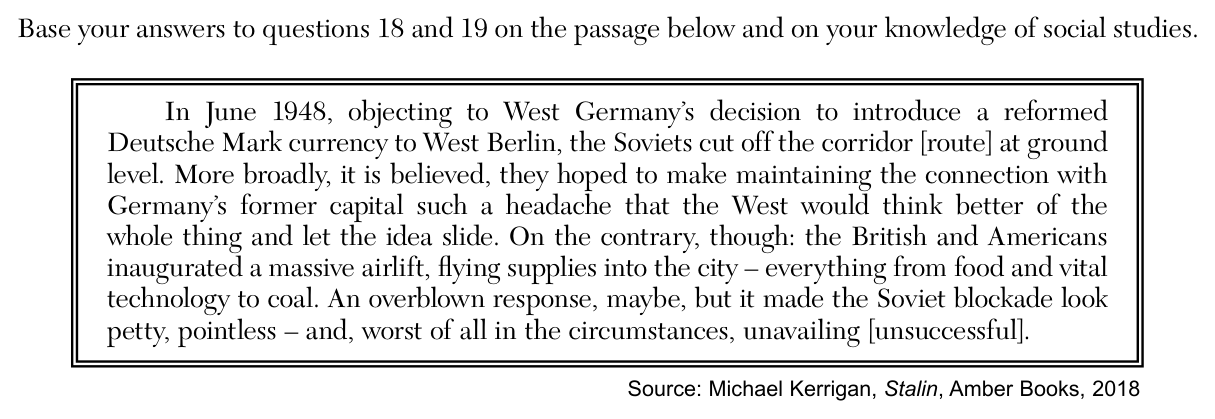
During what conflict did the blockade and airlift occur?
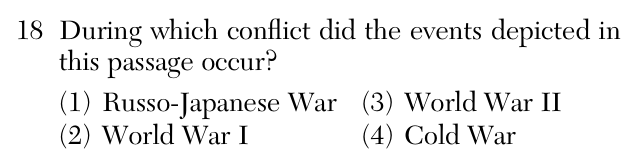
Worked solution for question 18
- The confrontation came after World War II between the Soviet Union and the Western powers.
- Their rivalry over divided Germany made Berlin a focal point of the Cold War.
Answer choice 4The Cold War
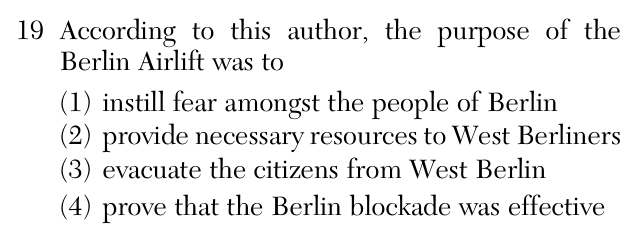
Q19 Purpose of the Berlin Airlift
What did the airlift accomplish for West Berlin?
Worked solution for question 19
- Soviet authorities blocked land routes. Britain and the United States brought coal, food and other necessities by air.
- The deliveries kept the city supplied without breaking the blockade by force.
- Aircraft could still enter West Berlin while Soviet authorities restricted surface routes. Flying in necessities allowed the Western powers to keep the city supplied.
Answer choice 2It provided essential supplies.
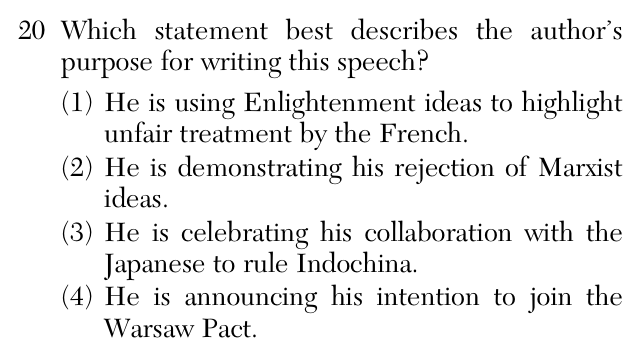
Q20 Ho Chi Minh’s use of rights
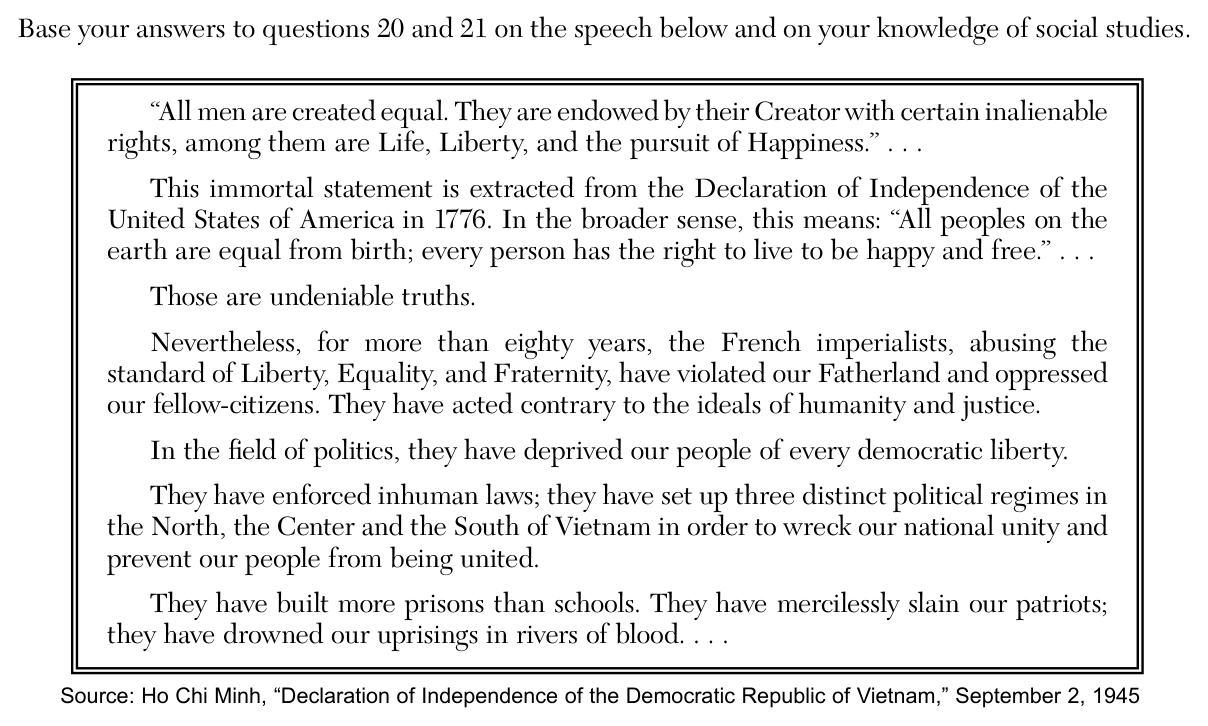
Why does Ho invoke ideas from the American Declaration of Independence?
Worked solution for question 20
- He takes a statement of universal rights and applies it to a people seeking independence.
- The comparison gives an anticolonial argument a principle his foreign audience can recognize.
Answer choice 1To justify Vietnamese independence through Enlightenment principles
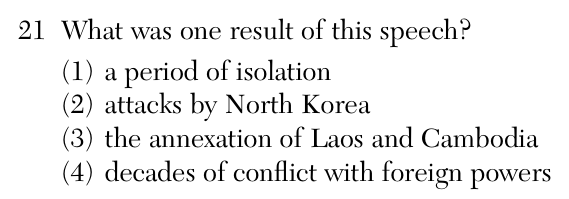
Q21 Conflict after independence was declared
What followed Vietnam’s 1945 declaration?
Worked solution for question 21
- France attempted to reestablish colonial rule. Its defeat was followed by division and further war involving the United States.
- The declaration began a struggle over sovereignty that was not settled in 1945.
- Declaring independence asserts a claim to sovereignty. The later conflict shows why that claim still had to be defended against outside powers.
Answer choice 4Decades of conflict with foreign powers
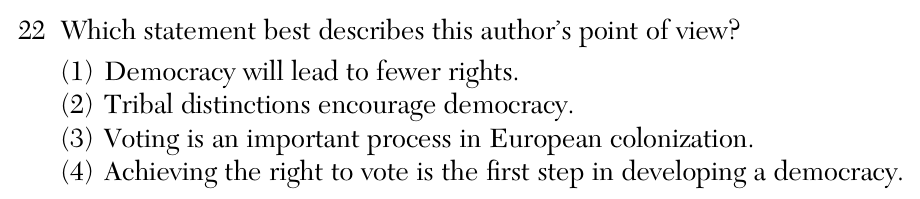
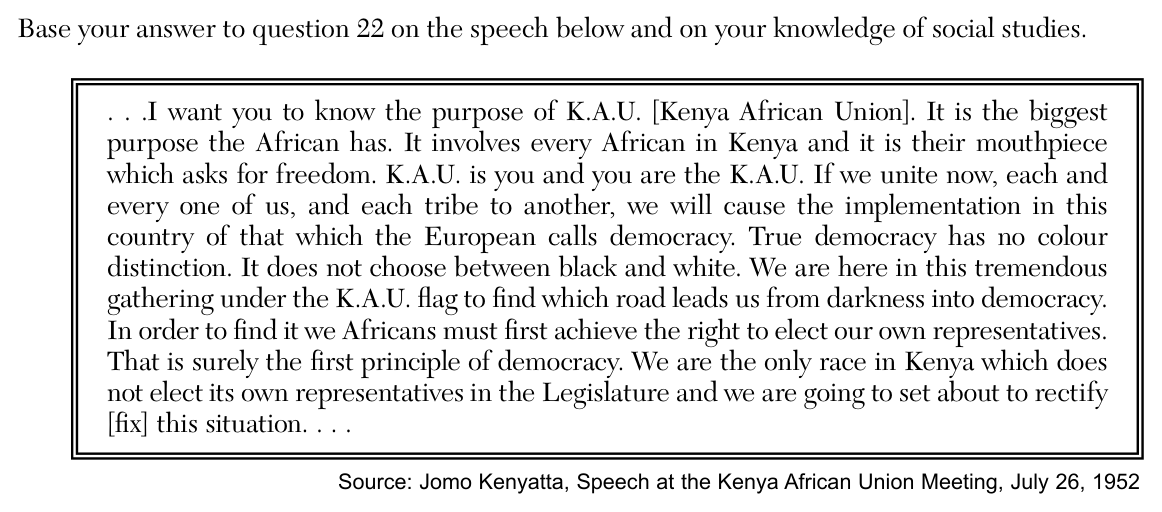
Q22 Voting and Kenyan democracy
What is Kenyatta’s point of view?
Worked solution for question 22
- He presents the Kenya African Union as a voice for Africans under colonial rule.
- Political participation through the vote gives people a means to make that voice effective.
Answer choice 4The right to vote is a first step toward democracy.
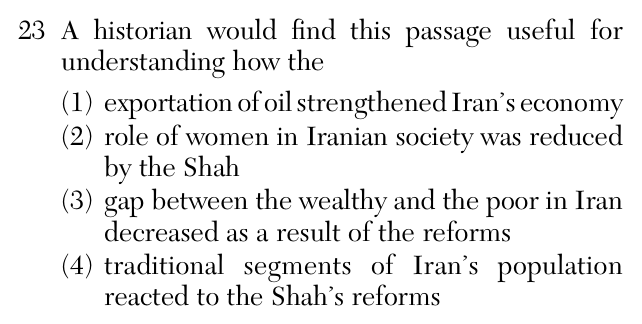
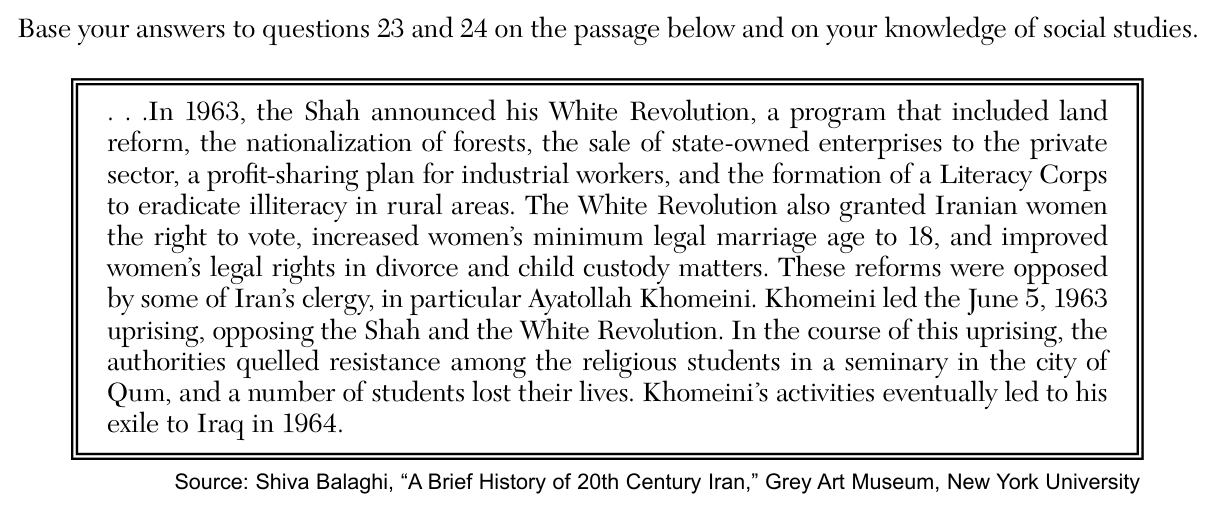
Q23 Resistance to the White Revolution
What does the passage help explain?
Worked solution for question 23
- The Shah’s modernization program included land redistribution and changes in women’s political status.
- The changes challenged interests and institutions that had held authority.
- The Shah’s policies changed landholding and social arrangements. Groups whose property, role, or authority was affected had concrete reasons to oppose the reforms.
Answer choice 4Why traditional groups resisted the Shah’s reforms
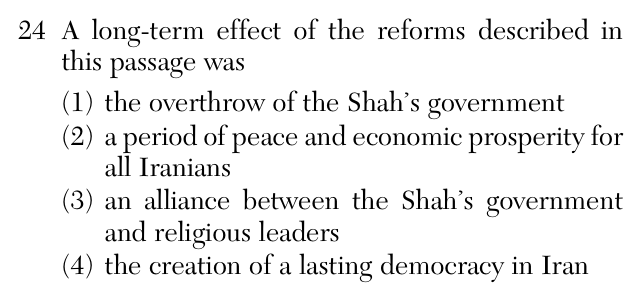
Q24 Long-term result in Iran
What later development followed the opposition to the Shah’s program?
Worked solution for question 24
- Resistance to modernization and authoritarian rule widened into revolutionary opposition.
- The Shah’s regime fell in 1979.
- The later outcome is the Iranian Revolution. Opposition from groups with different grievances converged against the Shah, and the resulting regime change ended his rule.
Answer choice 1Overthrow of the Shah’s government
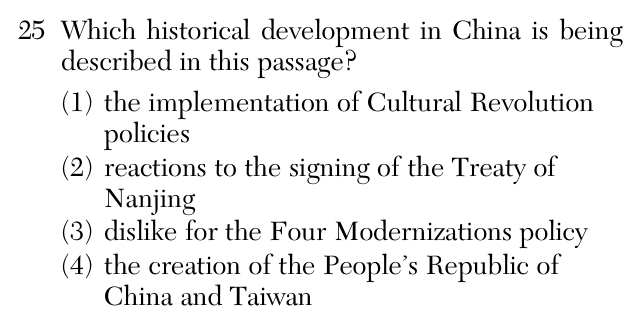
Q25 China’s Cultural Revolution
Which movement is described by the memoir?
Worked solution for question 25
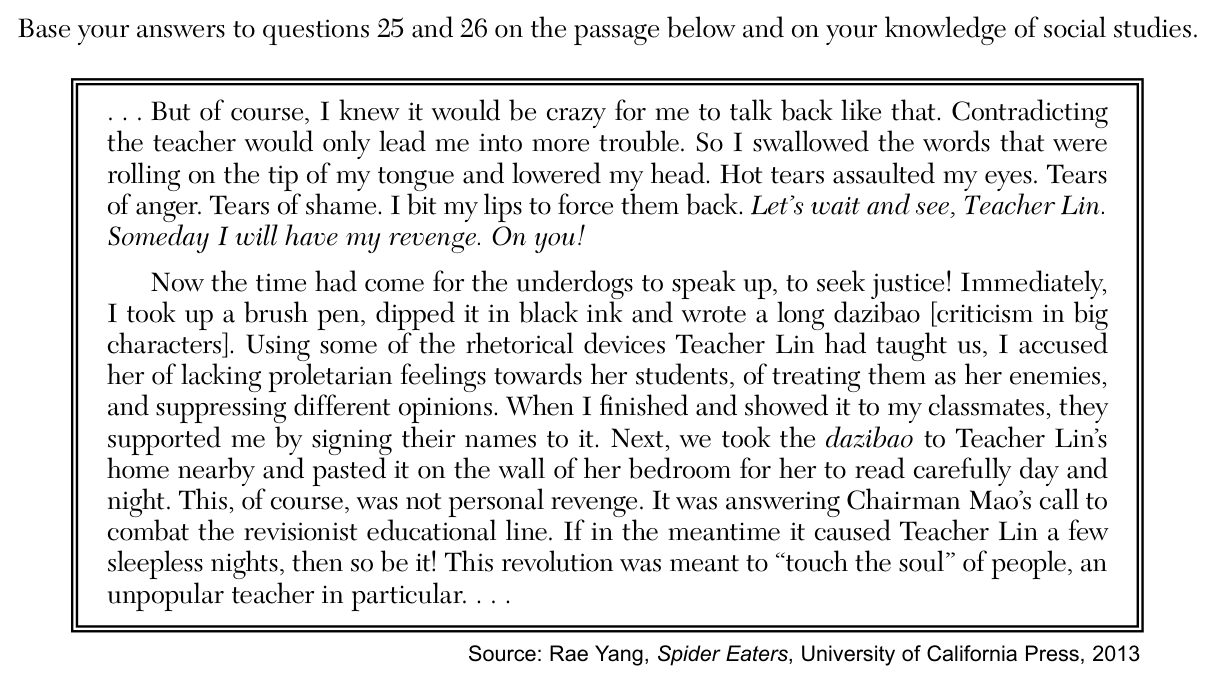
- The student is urged to attack supposed revisionism in education and challenge a teacher’s authority.
- Such campaigns mobilized young people to police ideological conformity.
- Look for the mechanism by which leaders put a policy into action. Mobilizing young supporters to attack alleged enemies of the revolution shows implementation at the level of society.
Answer choice 1Implementation of the Cultural Revolution
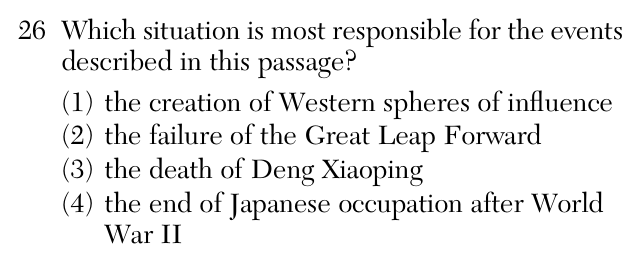
Q26 Background to the Cultural Revolution
Which earlier event best explains its political setting?
Worked solution for question 26
- The economic and human disaster weakened Mao’s political position.
- The Cultural Revolution gave him a way to attack rivals and reassert ideological control.
Answer choice 2Failure of the Great Leap Forward
Q27 Testing for malaria
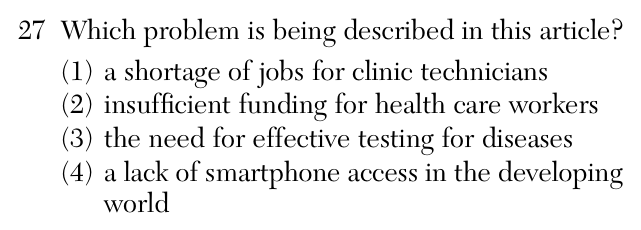
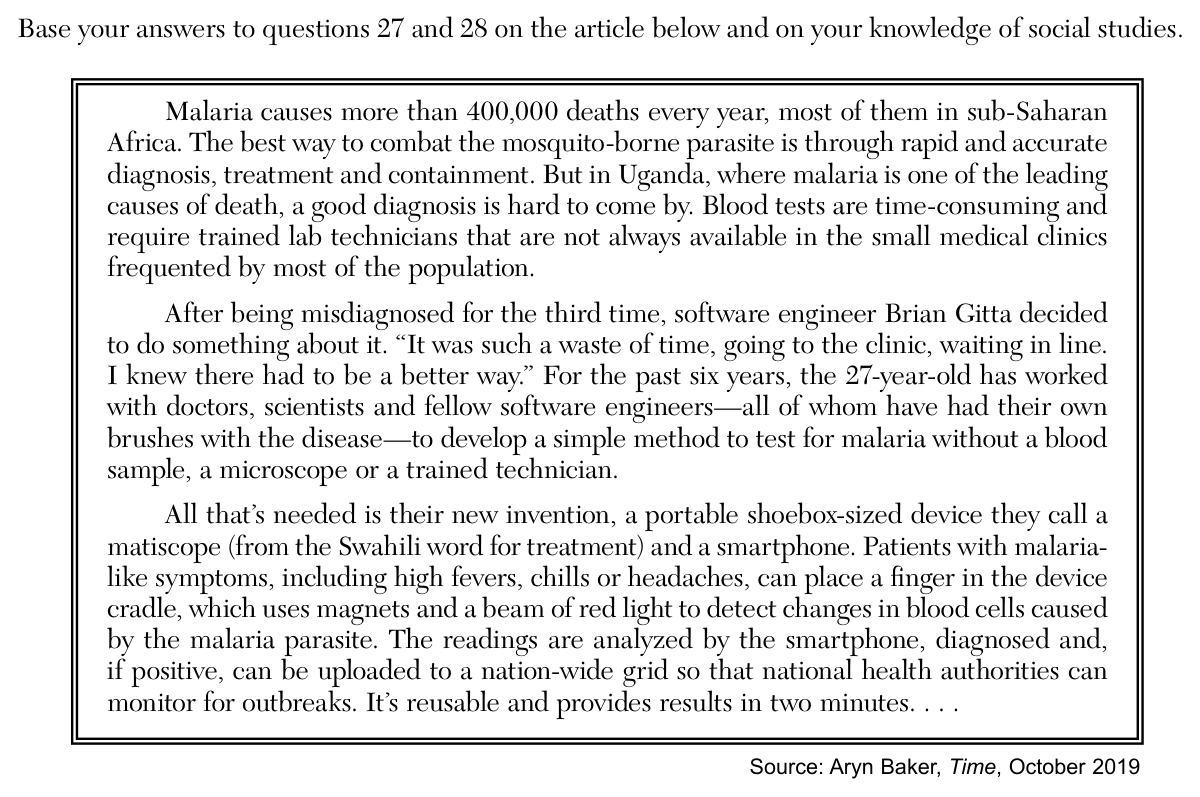
What local challenge is described in the Uganda article?
Worked solution for question 27
- Conventional tests took time and depended on technicians some clinics lacked.
- Late or inaccurate diagnoses made rapid detection a priority.
- Effective testing addresses the problem of identifying who is infected. Accurate diagnosis helps direct treatment and informs decisions about where disease control is needed.
Answer choice 3Need for effective disease testing
Q28 A locally adapted technology
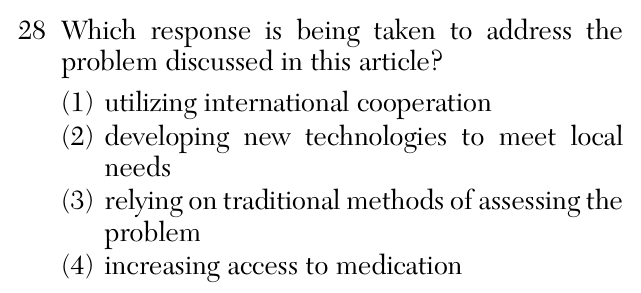
What response does the article describe?
Worked solution for question 28
- The team designed a portable device connected to a smartphone.
- Its goal was rapid screening without a conventional laboratory at every clinic.
- Identify both the design feature and the need it addresses. Portability and a phone connection make it practical to screen where laboratory facilities are limited.
Answer choice 2Development of a technology suited to local needs
Part II Constructed responses
Question indexQ29 Origins of Soviet collectivization
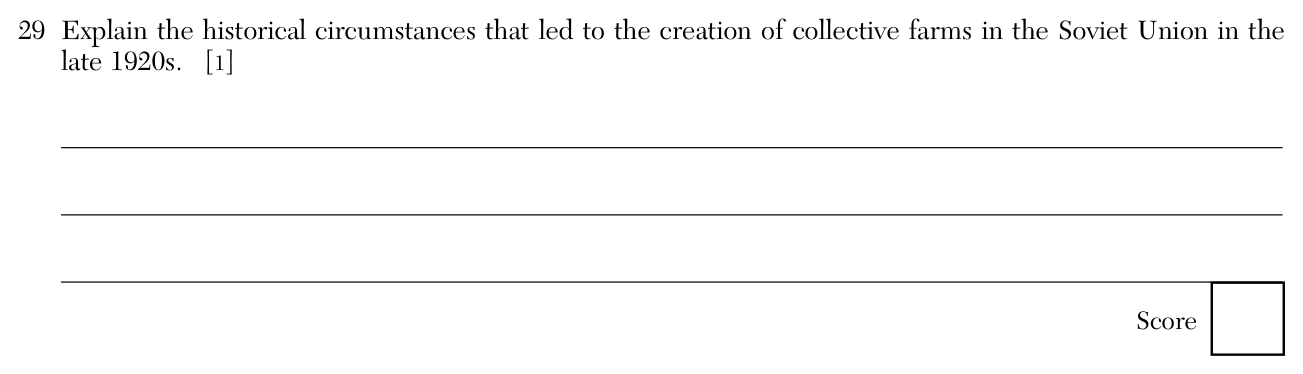
Explain the context that led to collective farms in Document 1.
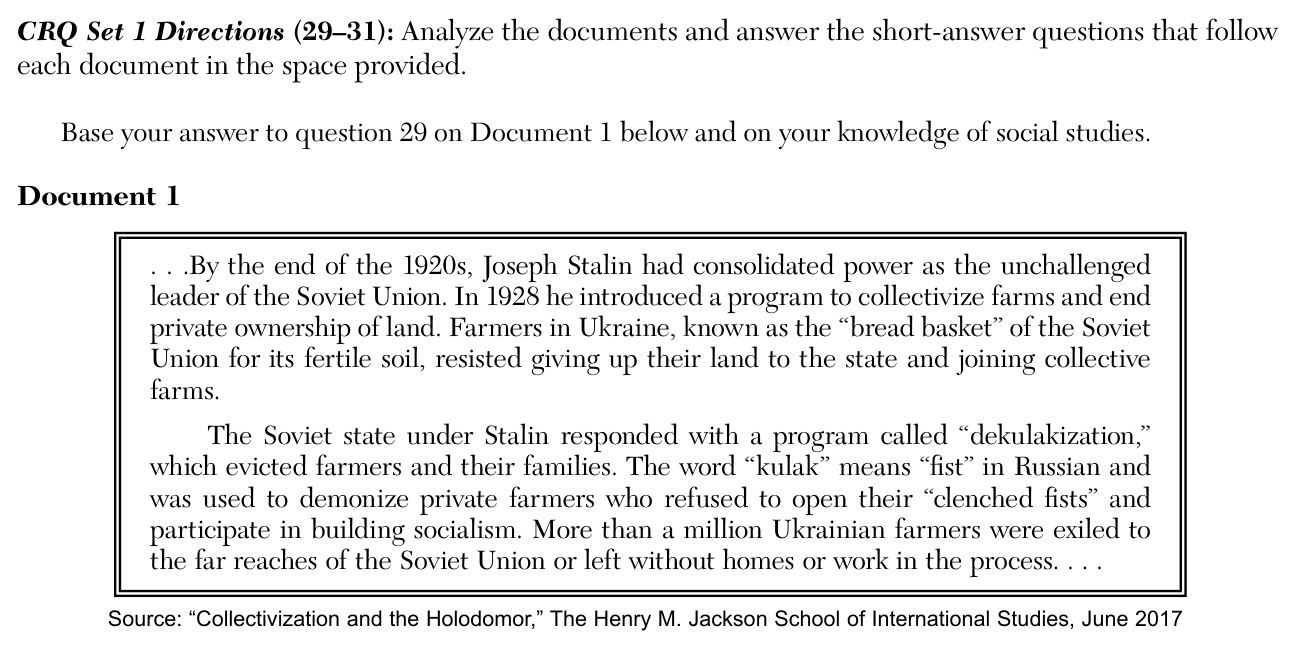
Worked solution for question 29
- Locate the change in the late 1920s after the Soviet leadership struggle.
- Explain why grouping private farms under state direction served Stalin’s economic and political plans.
Final answerAfter consolidating power, Stalin used collectivization to bring agriculture and grain procurement under state control.
Q30 Testimony for the famine commission
Explain how the intended audience shaped Pawlichka’s testimony in Document 2.
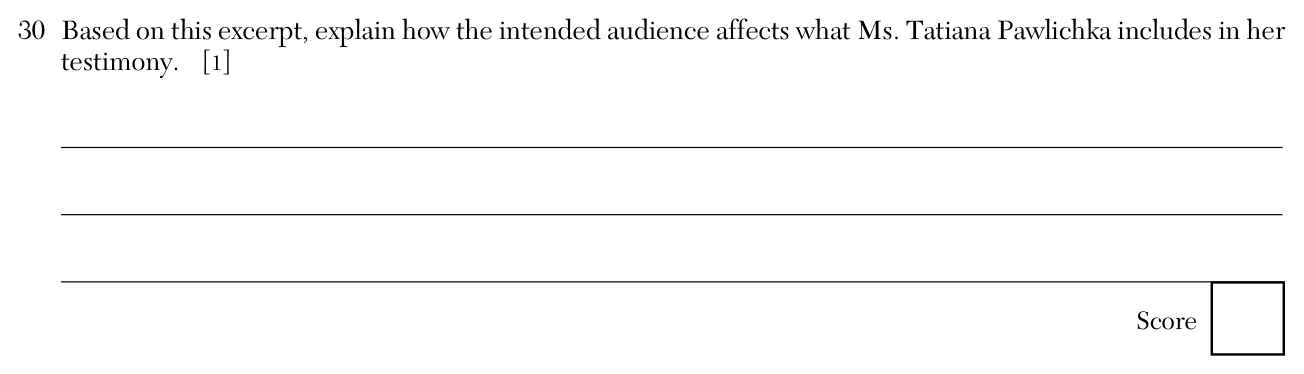
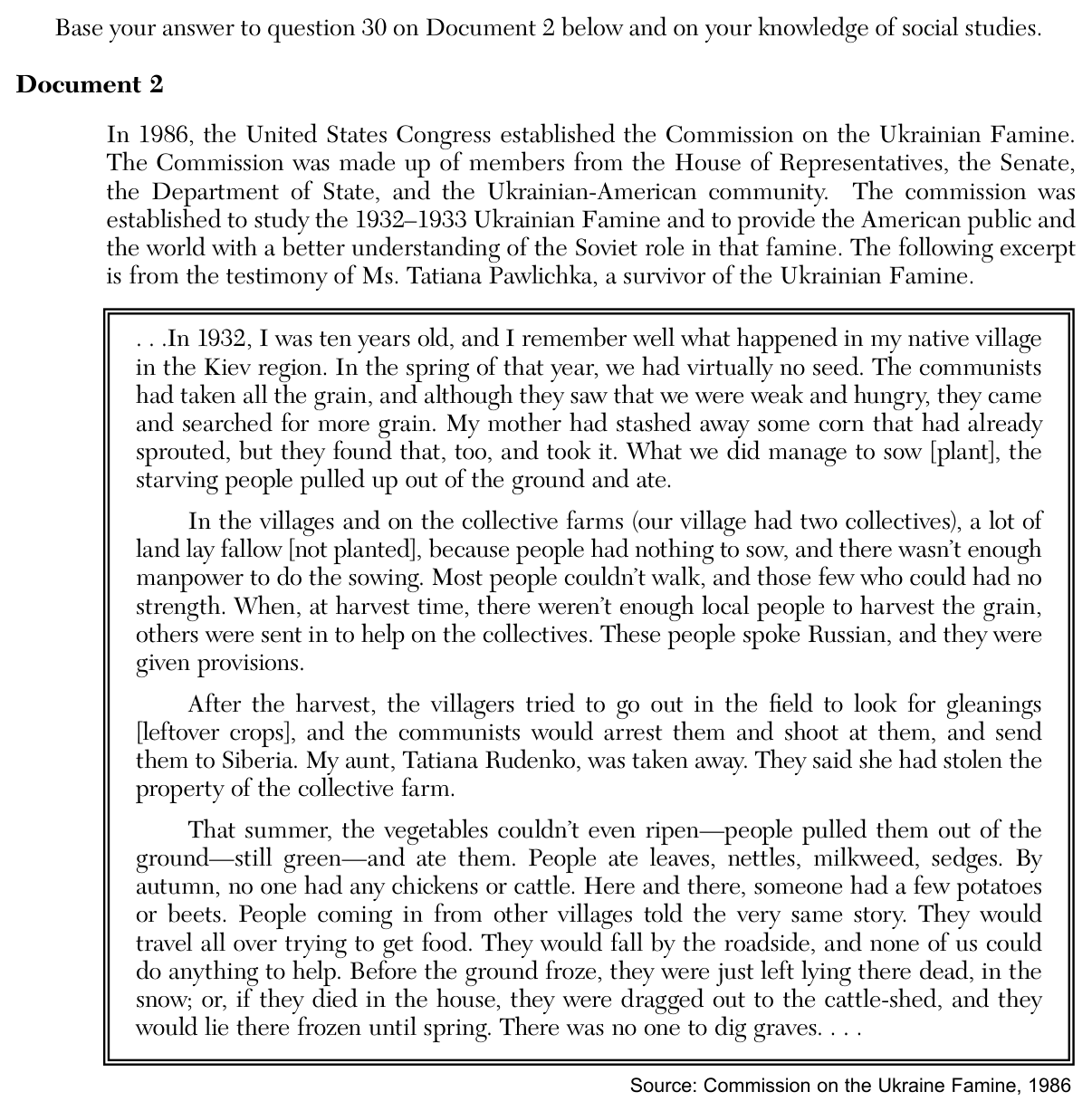
Worked solution for question 30
- Identify the U.S. commission and its inquiry into the famine.
- Link that audience to concrete details such as officials taking grain and punishing people who searched for food.
Final answerA survivor speaking to investigators of the Soviet role describes specific state actions and their effects on her village.
Q31 Collectivization and famine
Explain cause and effect using both documents.
Worked solution for question 31
- Document 1 shows the end of independent farming and eviction of resisting farmers.
- Document 2 shows officials taking seed and food. The loss of supplies and the repression of people seeking food made hunger worse.
Final answerForced collectivization and requisitions contributed to starvation in Ukraine.
Q32 Europe’s changing borders
Explain the geographic context of the 1914 and 1923 maps.
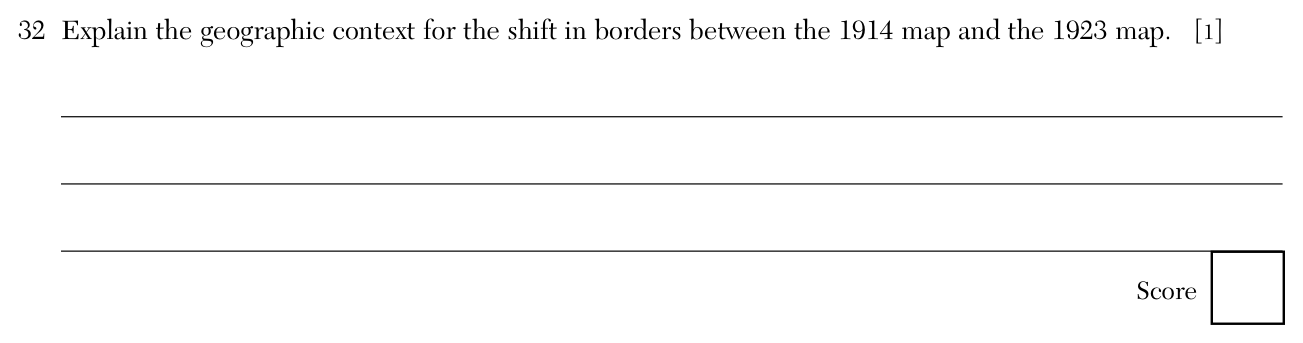
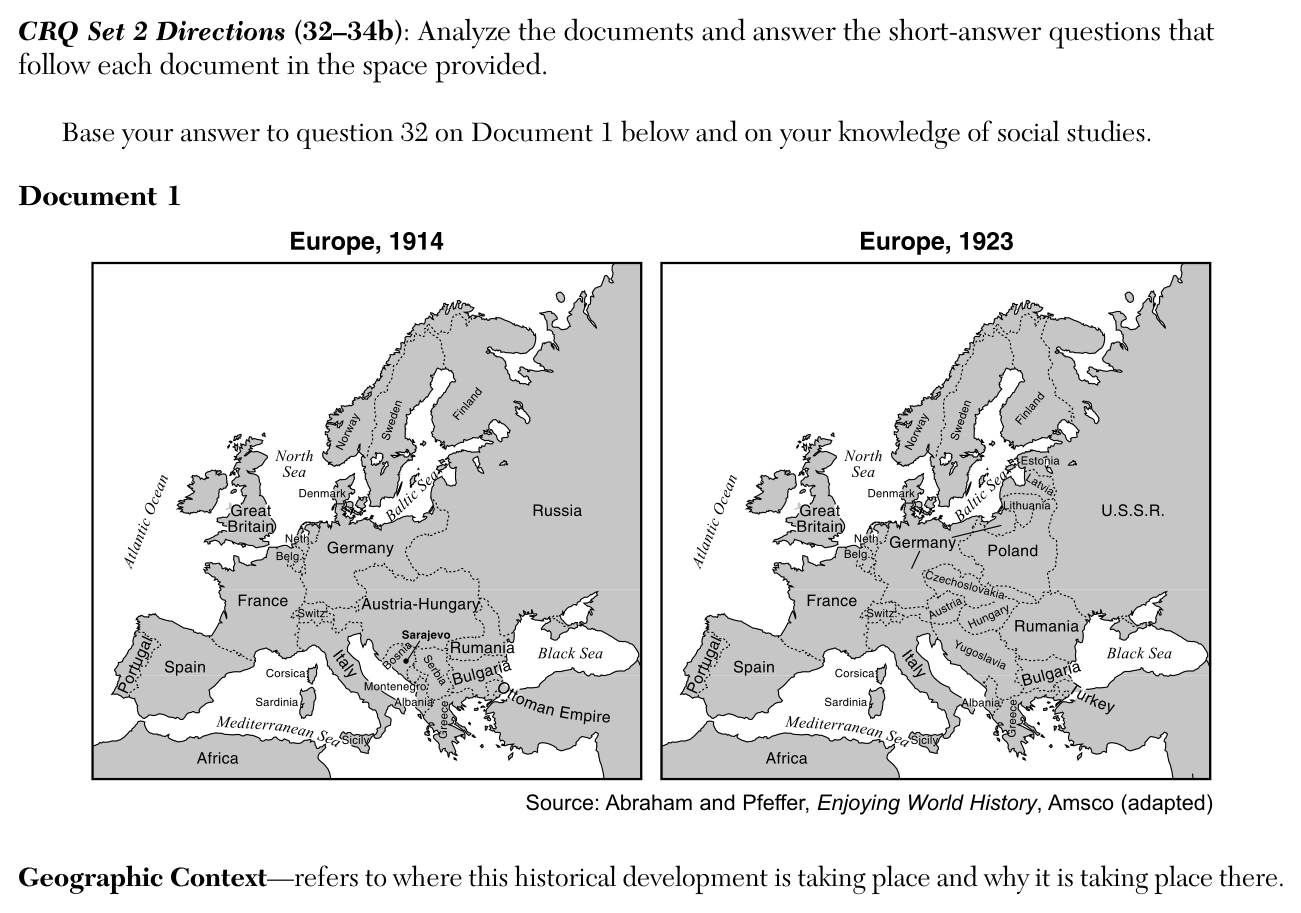
Worked solution for question 32
- Locate the shift in the former imperial territories, including Austria-Hungary.
- Defeat and the peace settlements broke up empires and created or enlarged states such as Czechoslovakia and Poland.
Final answerCentral and Eastern Europe were reorganized after multinational empires collapsed in World War I.
Q33 Wilson’s view of Europe
Explain Wilson’s view in Document 2.
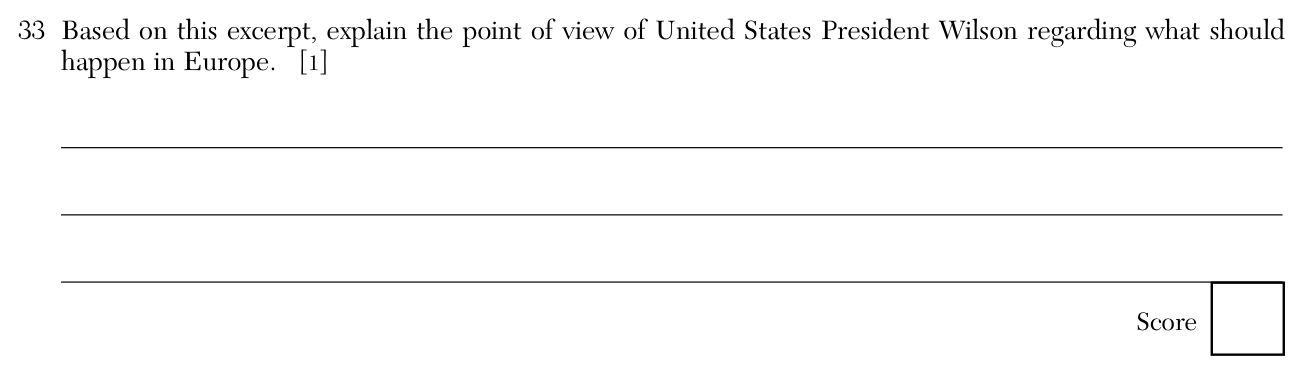
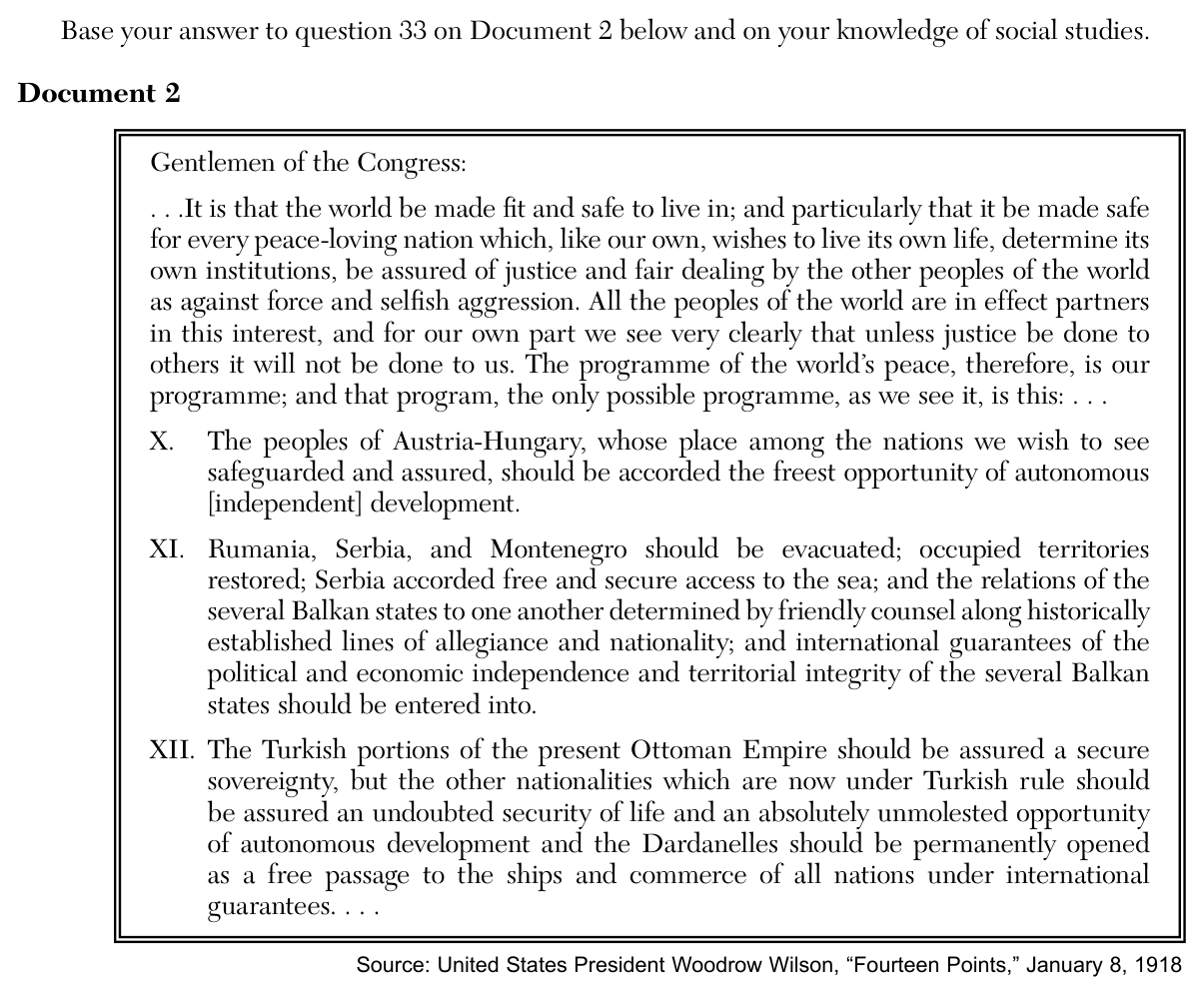
Worked solution for question 33
- He calls for autonomous development for peoples under Austria-Hungary and Ottoman rule.
- His proposals for the Balkans likewise link peace to political independence and security.
Final answerHe favored greater self-government and security for national groups in former imperial territories.
Q34a Identify the turning point
Identify an event shared by the maps and Wilson’s proposal.
Worked solution for question 34a
- The maps frame the war and its territorial aftermath.
- The Fourteen Points were Wilson’s program for the peace while the war was still being fought.
Final answerWorld War I and the postwar peace settlement
Q34b Explain the turning point
Show how the event caused significant change using both documents.
Worked solution for question 34b
- Document 1 shows the change from imperial borders to smaller postwar states.
- Document 2 advocates opportunities for national groups to govern themselves, an idea reflected imperfectly in the new borders.
Final answerThe defeat of empires redrew the political map and gave several national groups new states or political autonomy.
Part III Enduring issues essay
Question indexQ35 Enduring issue of political oppression
Identify an enduring issue, using at least three documents and outside evidence to show its significance across time.
Writing plan and model response for question 35
- Define oppression through specific mechanisms such as enslavement, military force, forced labor and restrictions on movement.
- Compare how people were affected and how they resisted in distinct places and periods.
Central claimAuthorities repeatedly use coercion to preserve control, while affected people resist in ways that can change political systems.
Model response
Political oppression occurs when authorities use their power to deny people freedom and control their labor, movement or political activity. The practices in these documents differ, but each shows an authority enforcing a hierarchy through coercion. The consequences include immediate suffering and longer struggles over political legitimacy.
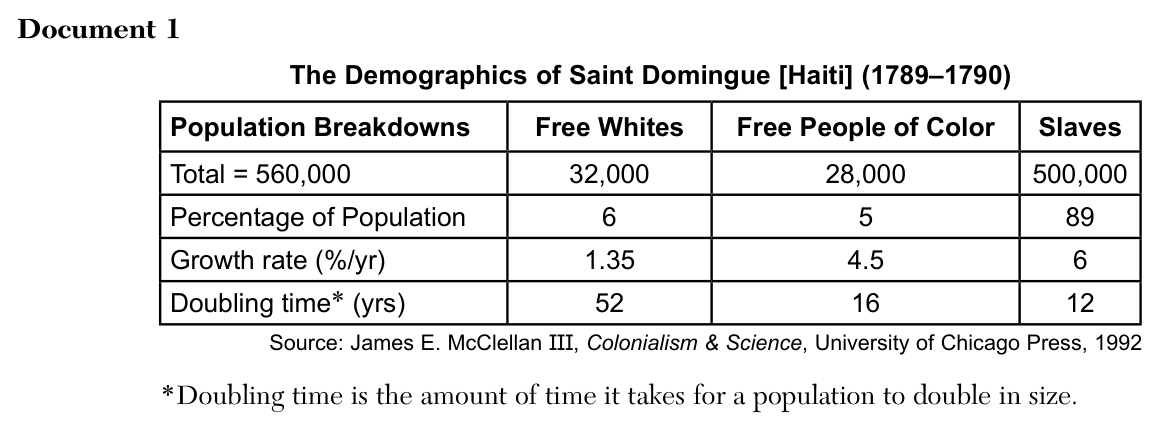
In French Saint-Domingue, enslaved people constituted about 89 percent of the population by the end of the 1780s (Document 1). The plantation economy depended on compelling a large majority to work for a much smaller ruling population. Enslaved people organized a revolt beginning in 1791. The struggle eventually produced independent Haiti in 1804, showing that the people subjected to oppression could overturn the institutions sustaining it.
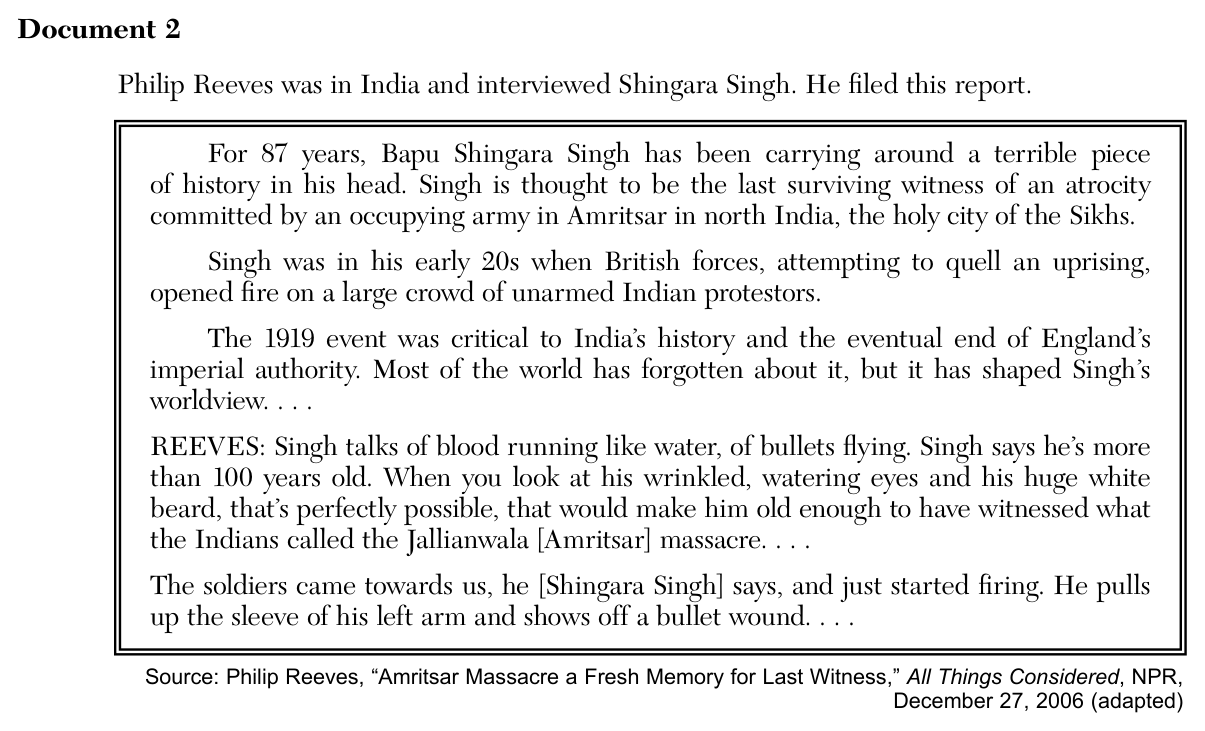
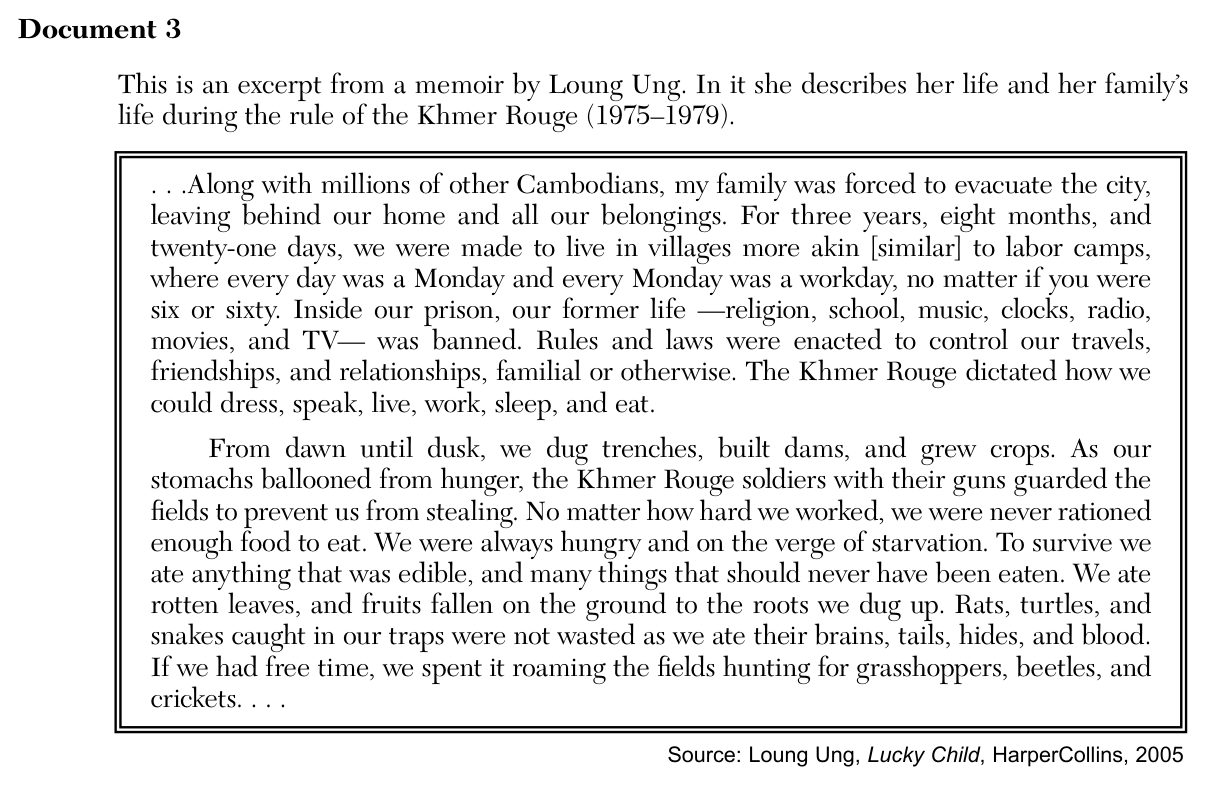
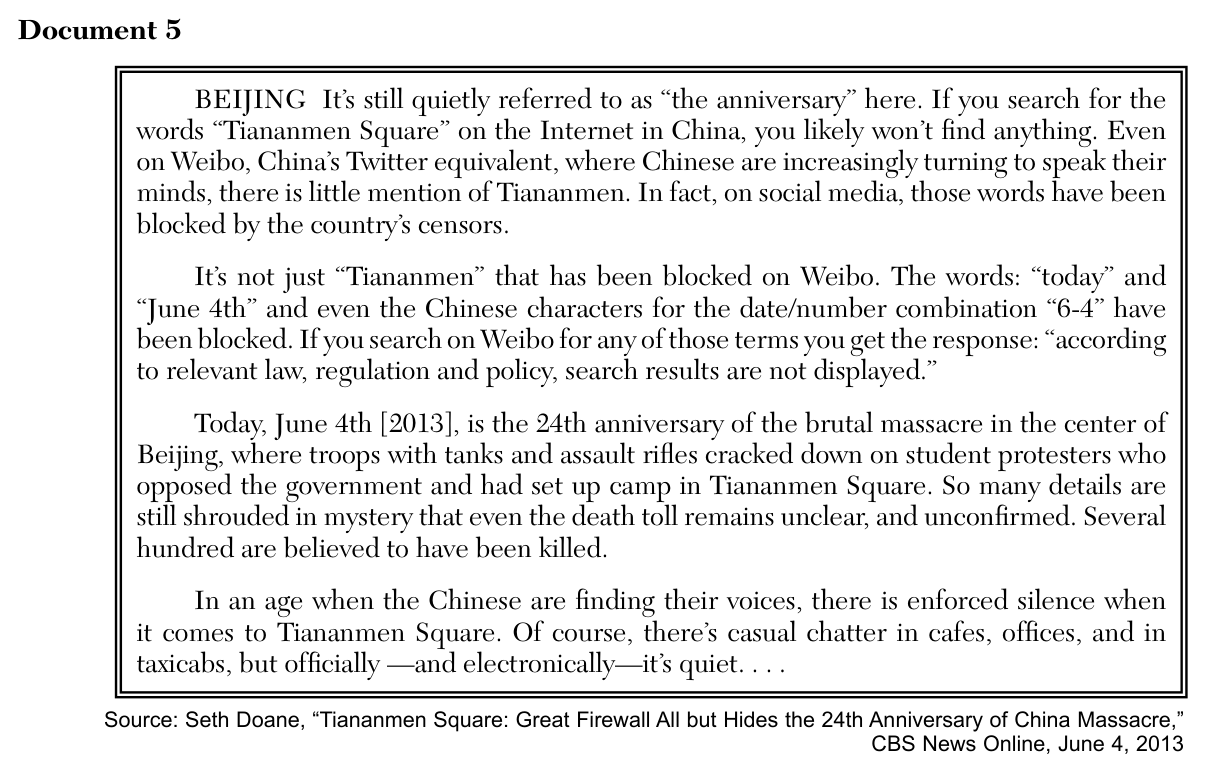
Oppression also operated through military force in colonial India. Document 2 recounts British troops firing on an unarmed gathering at Amritsar in 1919. The massacre killed and wounded civilians, and the survivor’s account shows that the harm lasted well beyond the event. The killings weakened confidence in British rule and helped strengthen the independence movement. In Cambodia, the Khmer Rouge later used forced evacuation and labor to transform society. Loung Ung’s description of compulsory work, armed guards and starvation (Document 3) shows what coercion did to everyday life under a regime with a different ideology.
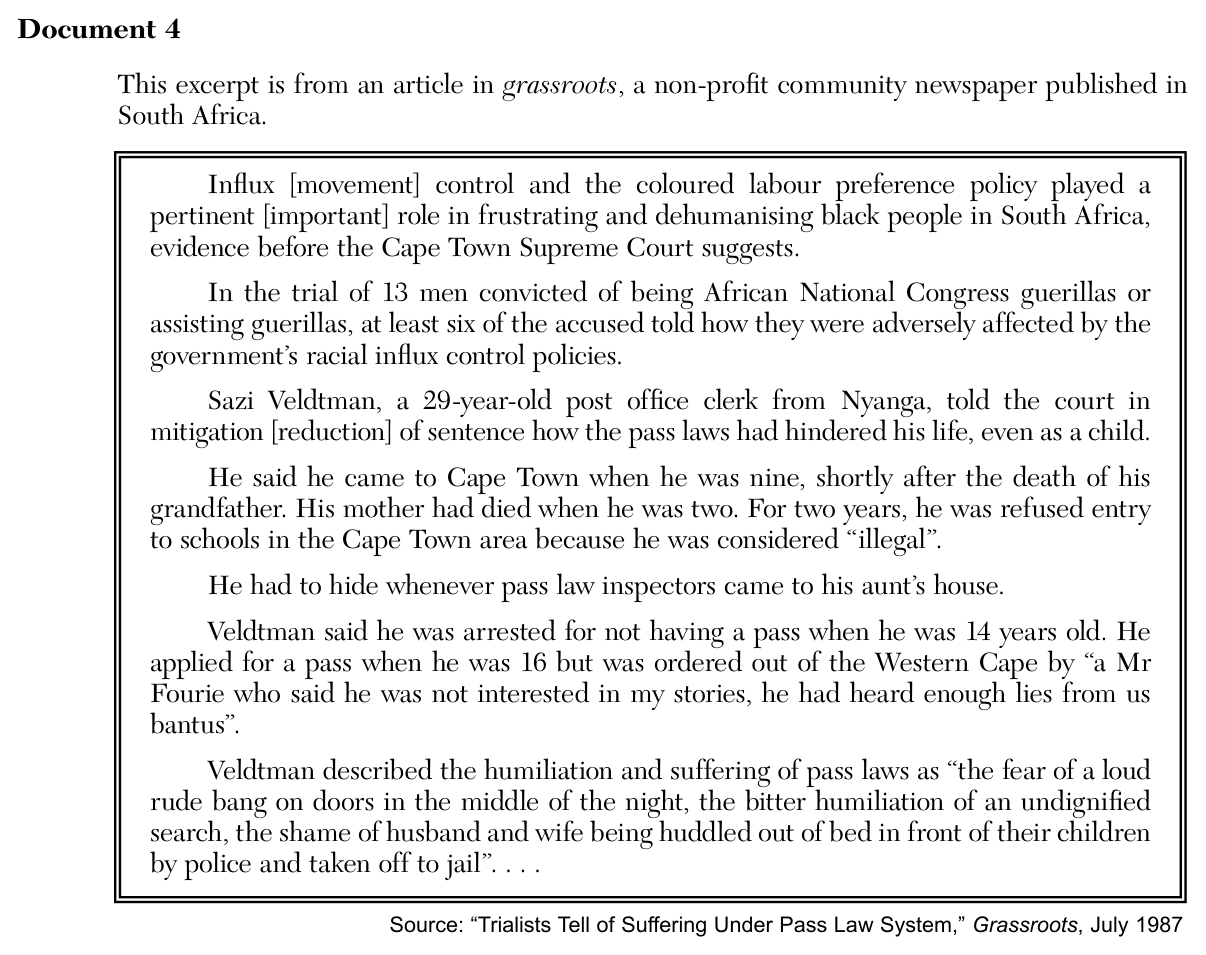
Document 4 shows a more bureaucratic means of control. Apartheid pass laws restricted Black South Africans’ movement and access to schooling, while enforcement could lead to arrest. Resistance by groups including the African National Congress helped bring about negotiations and the 1994 multiracial election. From plantation slavery to colonial massacres, forced labor and pass laws, the methods changed, but control over vulnerable groups remained a recurring problem. The different outcomes show that oppression could endure for decades and still be challenged by organized resistance.
From the New York State Education Department. January 2026 Global History and Geography II Regents Examination. Internet. Available from https://www.nysedregents.org/ghg2/126/glhg2-12026-exam.pdf. Accessed .