NEW YORK STATE REGENTS · GEOMETRY
August 2026 Geometry Regents Past Paper & Solutions
Work through rotations, circle theorems and parallelogram proofs with a question-by-question walkthrough of the exam.
- 35 worked questions
- 80 raw credits
- 4 exam parts
The question images and page numbers come from the regular-size English exam. OnlyPrepy wrote the summaries and worked solutions.
Quick answer key for Part I
Part I Multiple choice
Question indexQ1 Congruent image
Which listed transformation guarantees congruent triangles?
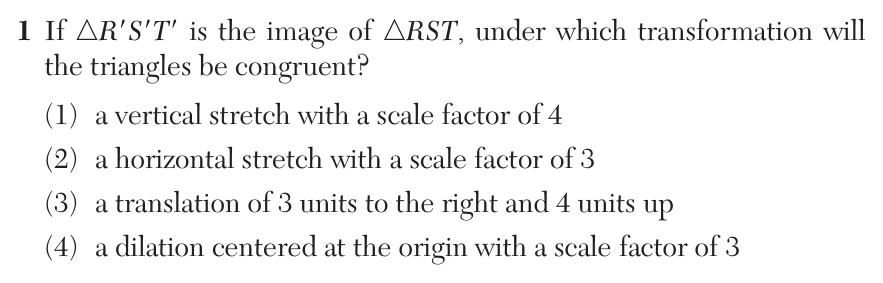
Worked solution for question 1
- Add the same vector (3, 4) to every vertex. The difference between any pair of vertices stays the same.
- Therefore distances and angles are preserved and the triangles are congruent.
Answer choice 3Translation 3 units right and 4 units up
Q2 Find an acute angle
In right △ABC with right angle B, AB = 10.3 and AC = 14.8. Find ∠C.
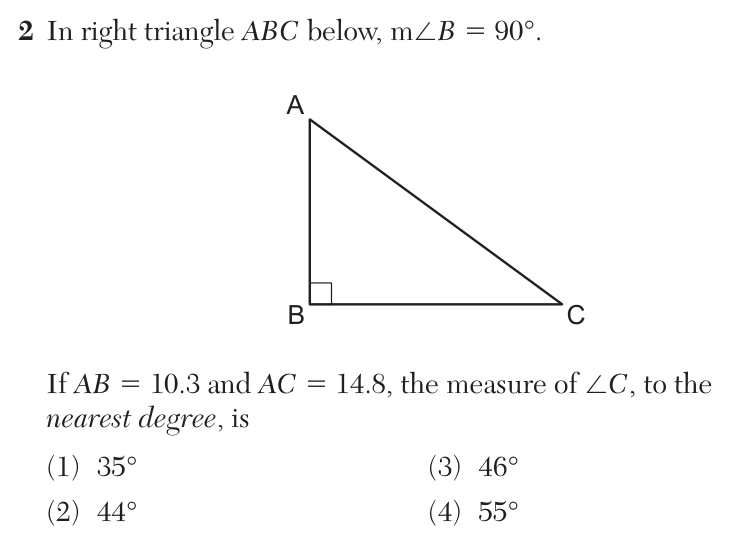
Worked solution for question 2
- For angle C, AB is opposite and AC is the hypotenuse.
- Use arcsin(10.3/14.8) in degree mode and round to the nearest degree.
- Because angle C is acute, arcsin gives the unique angle in the range required by a right triangle. The cosine ratio would instead need the adjacent leg.
Answer choice 244°
Q3 Match corresponding angles
A rotation maps ABC to KLM, and a translation maps XYZ to KLM. Identify an angle equality.
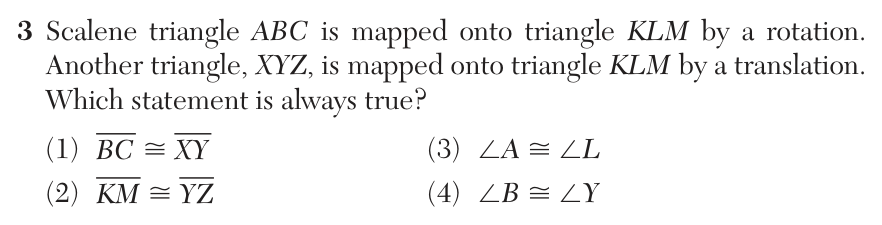
Worked solution for question 3
- The order of the vertices sends B to L and Y to L.
- Both motions preserve angle measure, so ∠B and ∠Y are congruent to the same angle.
Answer choice 4∠B ≅ ∠Y
Q4 Mass of a metal sphere
Find the mass of a sphere of diameter 3.5 cm and density 10.5 g/cm³.
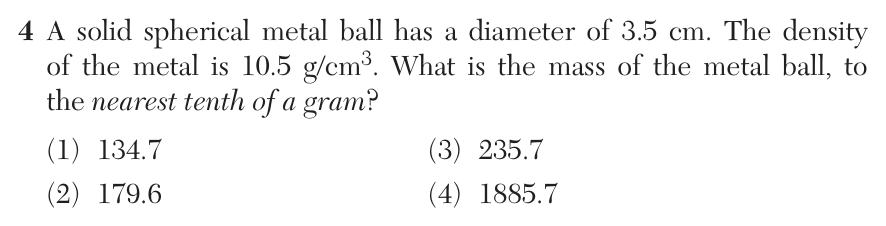
Worked solution for question 4
- The radius is 1.75 cm. Volume is (4/3)π(1.75)³ cm³.
- Multiply by 10.5 and round the result to tenths of a gram.
Answer choice 3235.7 grams
Q5 Centroid and median
Medians AE and BD meet at F. Relate the whole median AE to FE.
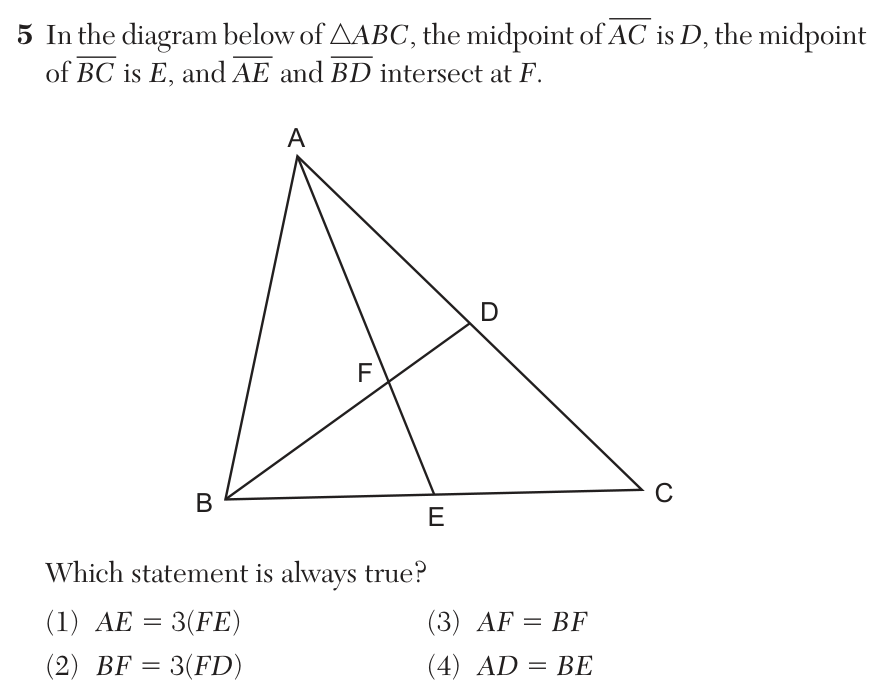
Worked solution for question 5
- F is the centroid, so AF:FE = 2:1 with the longer part next to vertex A.
- The whole median AE is AF + FE = 2FE + FE.
- The longer part of median AE is AF. One convenient way to visualize the ratio is to divide the median into three equal lengths, two before F and one after it.
Answer choice 1AE = 3FE
Q6 Rotate a square
What solid forms by rotating a square continuously about one of its sides?
Worked solution for question 6
- The chosen side stays on the axis and sets the height.
- At every level along that side, a segment of constant length sweeps a disk of the same radius. The stacked disks form a cylinder.
Answer choice 3Cylinder
Q7 Exterior angle theorem
∠TUE is an exterior angle of 120°, and ∠R is twice ∠T. Find ∠R.
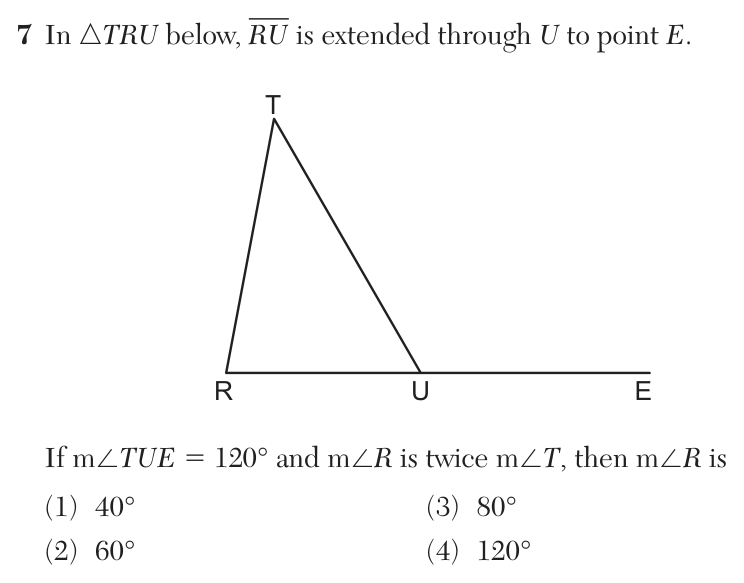
Worked solution for question 7
- The two remote interior angles sum to 120°. With ∠T = x and ∠R = 2x, solve 3x = 120.
- Then x = 40 and ∠R = 80°.
Answer choice 380°
Q8 Horizontal reflection symmetry
Find the horizontal line that reflects the plotted hexagon onto itself.
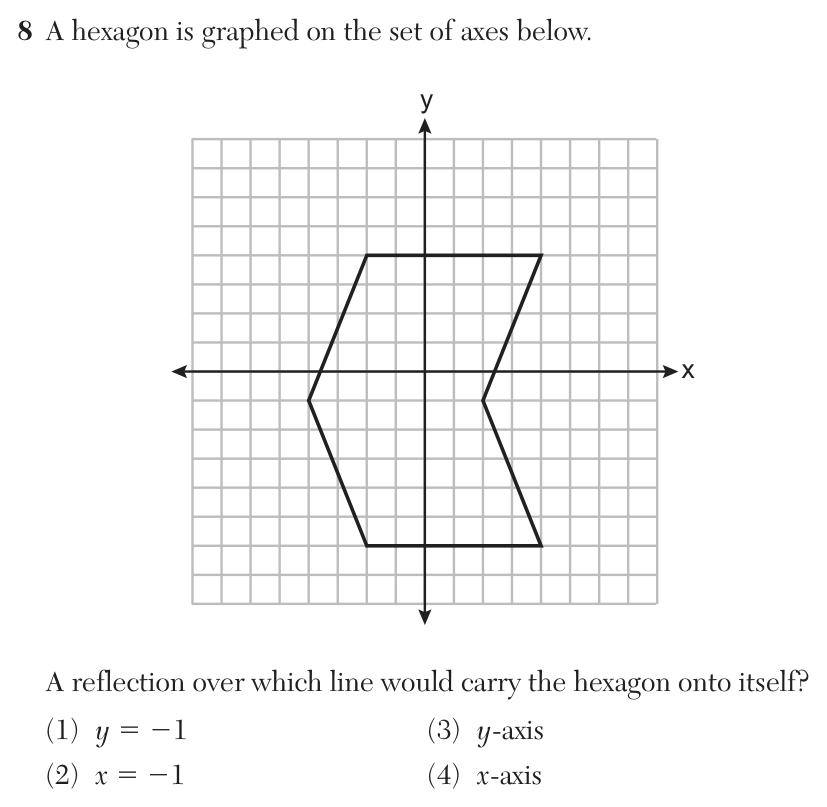
Worked solution for question 8
- Compare the vertical positions of matching vertices. Their y-coordinates have midpoint −1, with equal distances above and below.
- The mirror line is horizontal through those midpoints.
Answer choice 1y = −1
Q9 Isosceles angle pair
MH = TH = AH in the diagram. Identify the angle equal to ∠HTA.
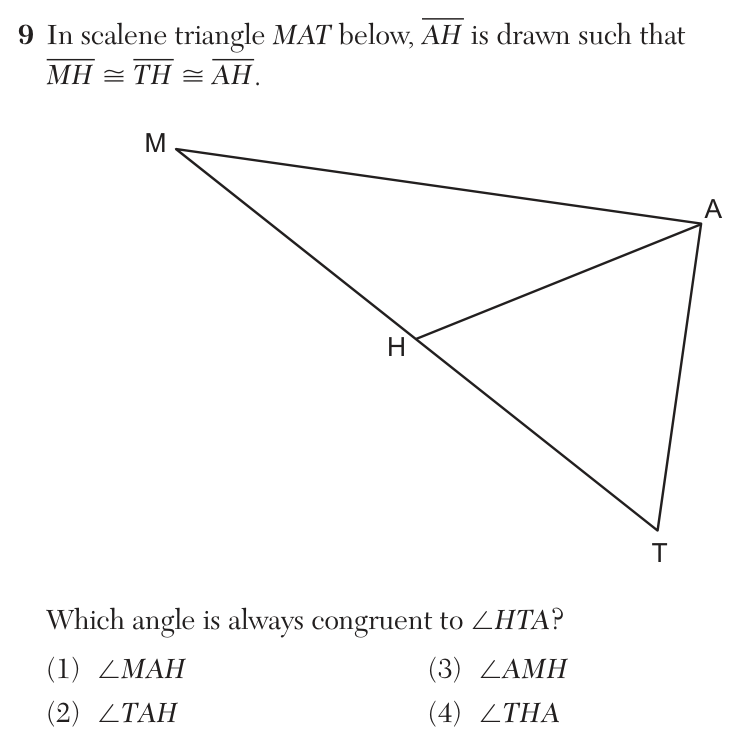
Worked solution for question 9
- In triangle HTA, HT and HA are equal sides.
- The base angles opposite those sides, at A and T, are equal.
Answer choice 2∠TAH
Q10 Pyramid height
A pyramid has a 16 × 12 base and volume 1536. Find its height.
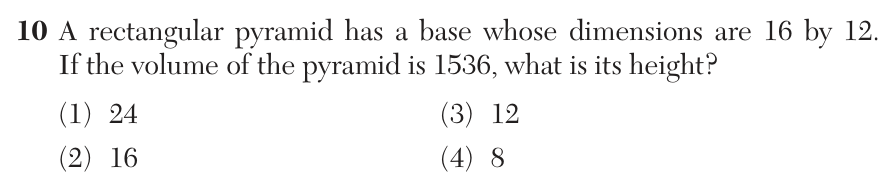
Worked solution for question 10
- The base area is 192. Substitute into V = Bh/3 to get 1536 = 64h.
- Divide by 64.
- A prism with the same base and height would have volume 192h. The one-third factor is why the pyramid’s height is 24 and the check gives 192(24)/3 = 1536.
Answer choice 124 units
Q11 Find the adjacent side
Right △ABC has right angle C, AB = 24 in and ∠B = 37°. Find BC.
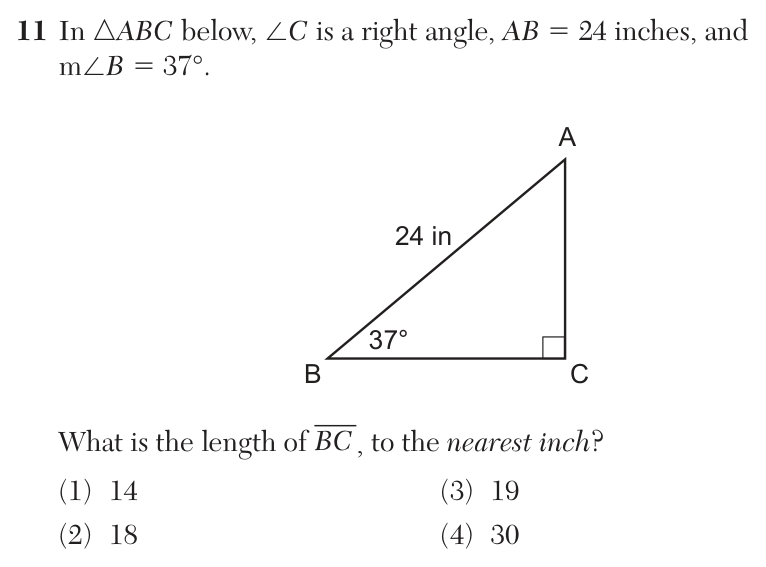
Worked solution for question 11
- BC is adjacent to B and AB is the hypotenuse.
- Compute BC = 24 cos 37° ≈ 19.17 and round to inches.
Answer choice 319 inches
Q12 Segment partition
Find S between R(−5, 6) and T(3, 2) with RS:ST = 3:1.
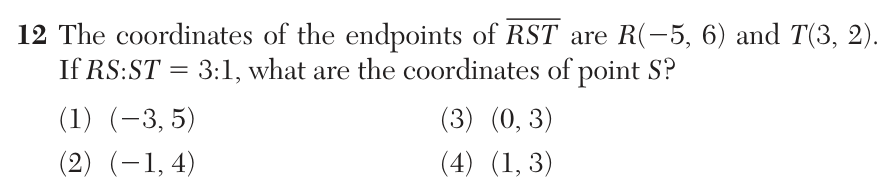
Worked solution for question 12
- The full displacement is (8, −4). The point is 3/4 of the way from R.
- Add (6, −3) to R.
Answer choice 4S(1, 3)
Q13 Reflect then translate
Identify the listed sequence mapping trapezoid ABCD to EFGH.
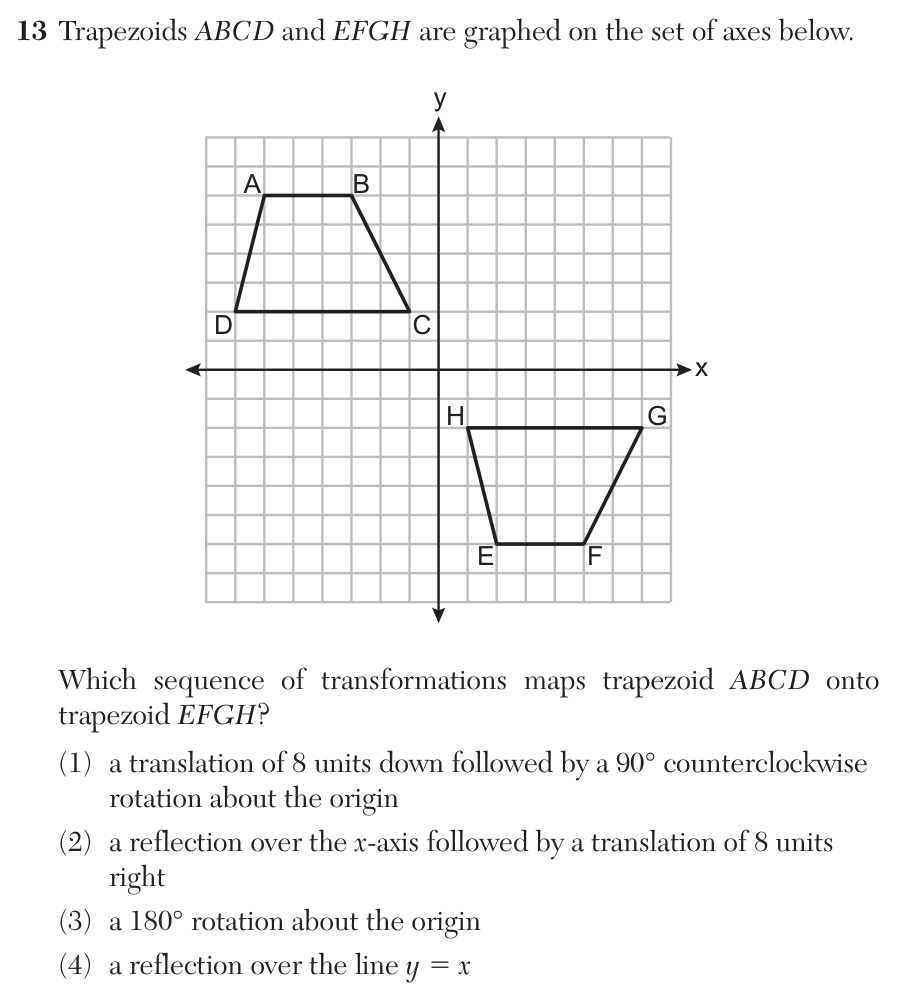
Worked solution for question 13
- The matching vertices reverse their vertical offsets from the x-axis, and the top and bottom edges swap levels.
- After reflection each partner is 8 units right. The composite rule is (x, y) ↦ (x + 8, −y).
- For a check on the plotted grid, A(−6, 6) reflects to (−6, −6) and then translates to E(2, −6). The same rule sends B, C and D to their corresponding vertices.
Answer choice 2Reflect across the x-axis, then translate 8 units right.
Q14 Parallelogram angle measures
In PARK, ∠P = 3x + 42 and ∠K = 5x − 22. Find ∠R.
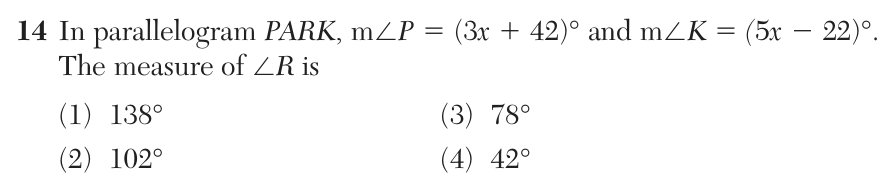
Worked solution for question 14
- Consecutive angles P and K sum to 180°, so 8x + 20 = 180 and x = 20.
- Opposite angles P and R are equal. Use 3(20) + 42 = 102°.
Answer choice 2102°
Q15 Coordinate perimeter
Find the perimeter of C(−2, −1), E(−2, 4), and M(3, 4).
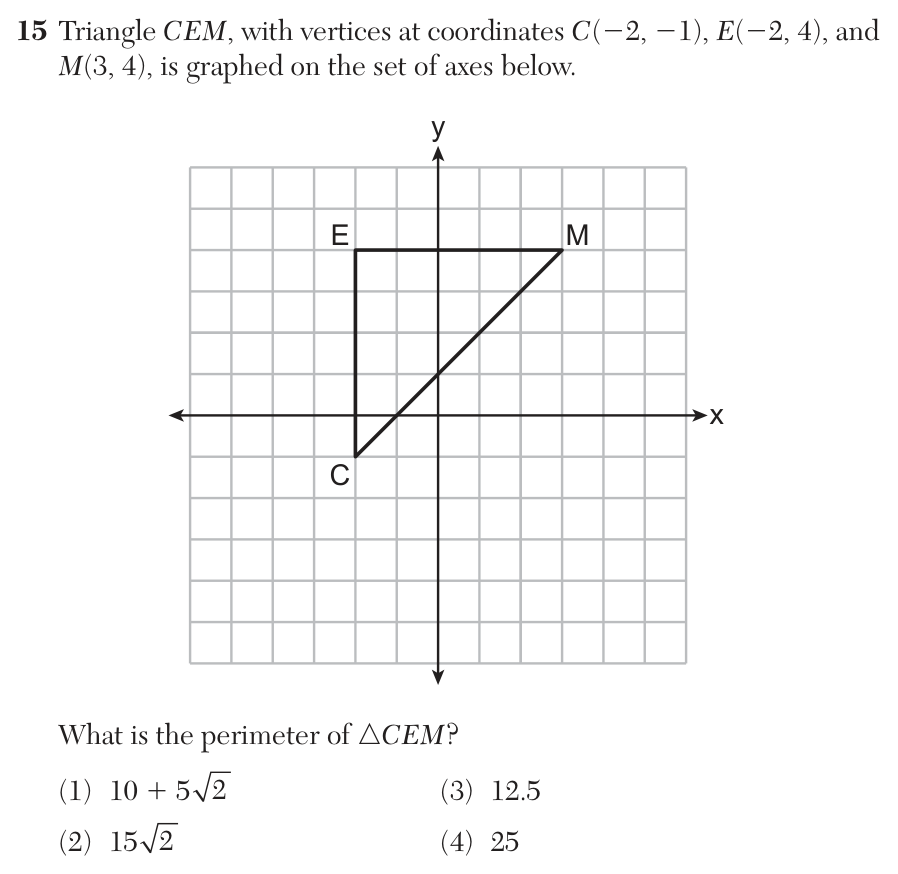
Worked solution for question 15
- CE is vertical of length 5 and EM is horizontal of length 5.
- The diagonal CM has length √(5² + 5²) = 5√2. Add the three lengths.
Answer choice 110 + 5√2 units
Q16 Perpendicular bisector slope
Find the slope of the perpendicular bisector of M(−2, −7) and T(3, 8).
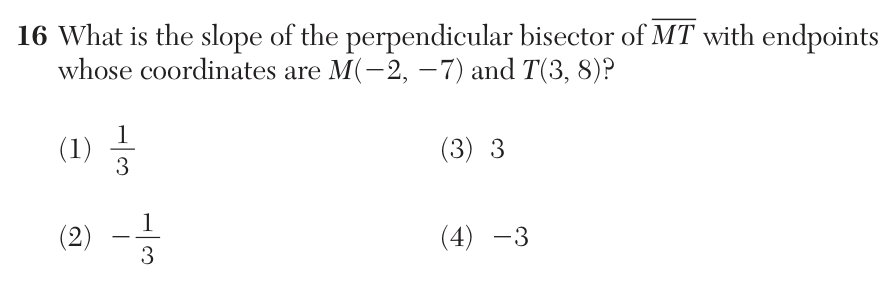
Worked solution for question 16
- Segment MT has slope (8 + 7)/(3 + 2) = 3.
- A perpendicular line has negative reciprocal slope. Passing through the midpoint affects its position, not this slope.
Answer choice 2−1/3
Q17 Two special right triangles
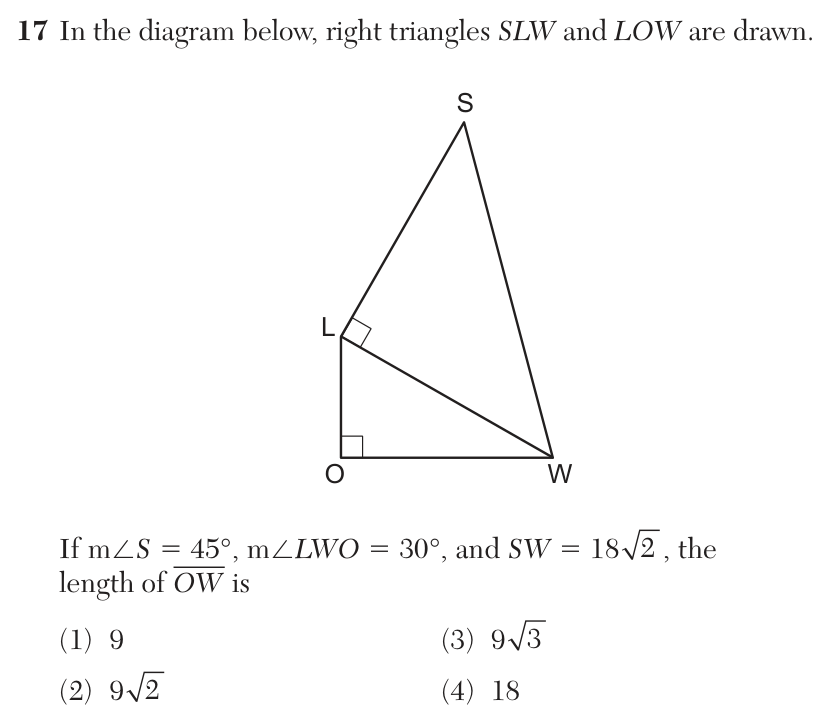
Given ∠S = 45°, SW = 18√2 and ∠LWO = 30° in the two right triangles, find OW.
Worked solution for question 17
- The right angle of SLW is at L, so LW = SW/√2 = 18 by the 45°–45°–90° ratio.
- In LOW, LW is the hypotenuse. Use OW = 18 cos 30° = 9√3.
Answer choice 39√3
Q18 Circle from a diameter
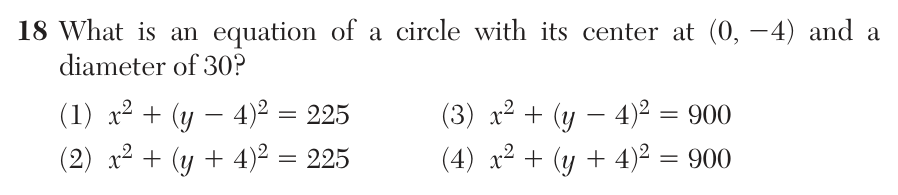
Write the circle centered at (0, −4) with diameter 30.
Worked solution for question 18
- The radius is 15. Use (x − h)² + (y − k)² = r².
- Substitute h = 0 and k = −4 and square 15.
Answer choice 2x² + (y + 4)² = 225
Q19 Batter volume
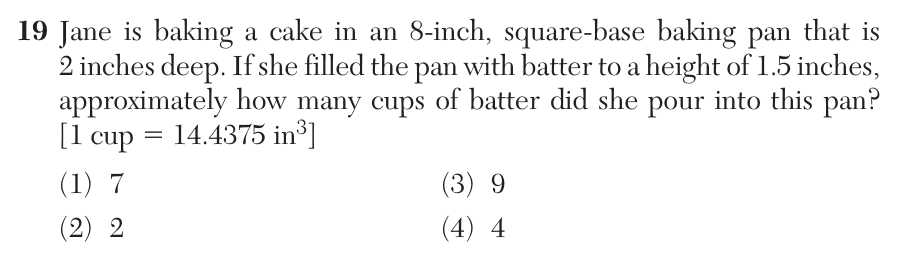
An 8-inch square pan holds batter 1.5 inches deep. Convert to cups using 14.4375 in³ per cup.
Worked solution for question 19
- Multiply the base area 8² by the filled depth 1.5 to get 96 in³.
- Divide 96 by 14.4375 to get about 6.65 cups, closest to 7.
Answer choice 1About 7 cups
Q20 Right-triangle altitude
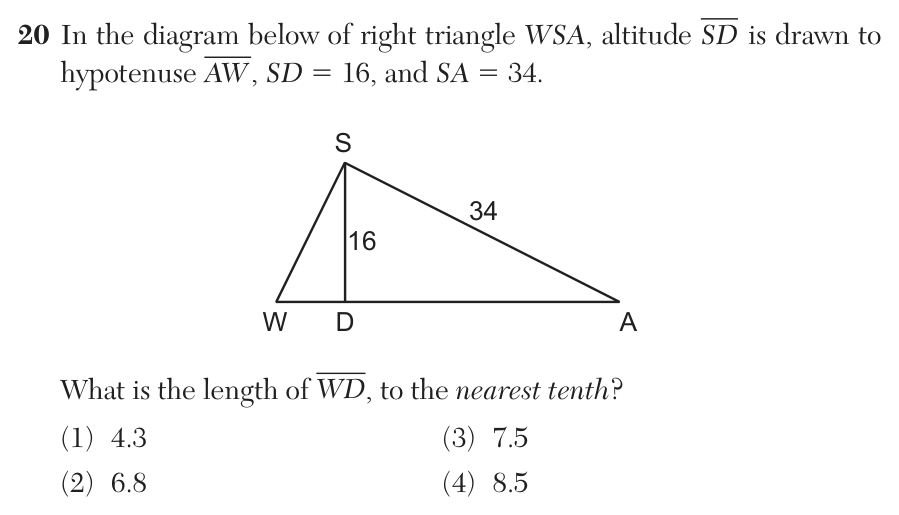
In right △WSA, altitude SD to hypotenuse WA is 16 and SA is 34. Find WD.
Worked solution for question 20
- In right △SDA, DA = √(34² − 16²) = 30.
- The altitude theorem gives SD² = WD · DA. Thus WD = 256/30 ≈ 8.53.
- Check the original altitude equation with the unrounded result. Multiplying 30 by 256/30 returns 256, which is 16².
Answer choice 48.5 units
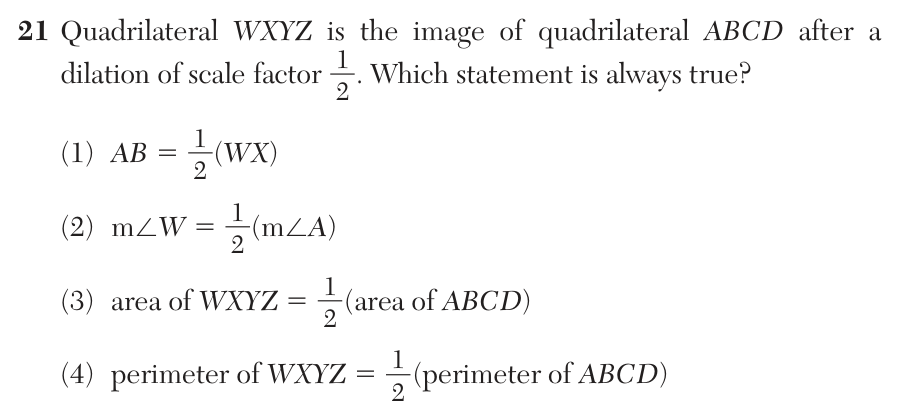
Q21 Dilation and perimeter
WXYZ is a dilation of ABCD with scale factor 1/2. Relate their perimeters.
Worked solution for question 21
- Every corresponding side length is multiplied by 1/2.
- Summing the scaled lengths pulls out that same factor. Area would scale by its square.
Answer choice 4Perimeter of WXYZ = half the perimeter of ABCD.
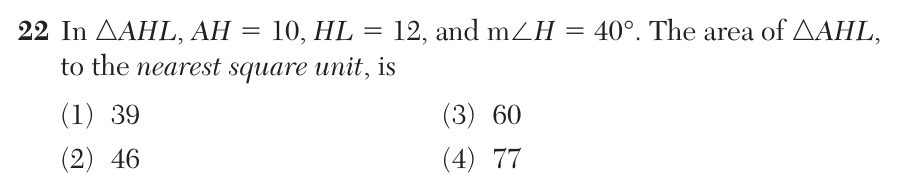
Q22 Sine area
Find the area with sides AH = 10 and HL = 12 enclosing 40°.
Worked solution for question 22
- Use area = (1/2)(10)(12) sin 40°.
- This gives about 38.57 square units, rounded to 39.
- The sides meet at H, so 40° is the included angle. Taking HL as the base gives altitude 10 sin 40°, which leads to the same area.
Answer choice 139 square units
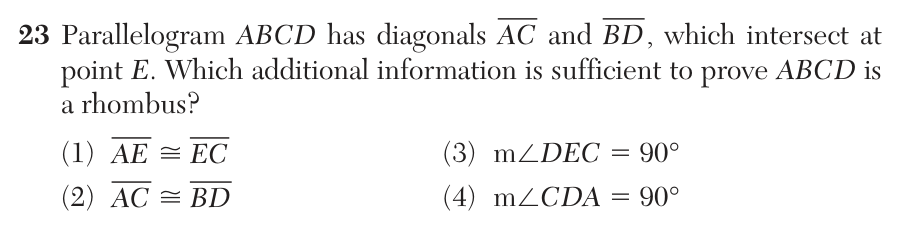
Q23 Rhombus test
What condition on ∠DEC at the intersection of a parallelogram’s diagonals guarantees a rhombus?
Worked solution for question 23
- That angle makes the diagonals perpendicular. The diagonals already bisect each other because ABCD is a parallelogram.
- The perpendicular halves create congruent right triangles with adjacent sides as their hypotenuses, establishing equal sides.
Answer choice 3∠DEC = 90°
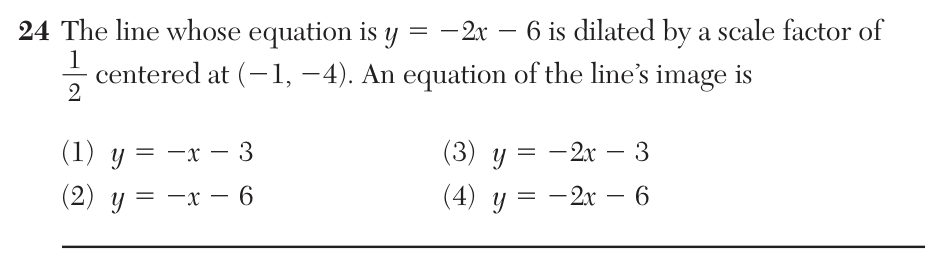
Q24 Dilation with center on a line
Dilate y = −2x − 6 by 1/2 about (−1, −4).
Worked solution for question 24
- At x = −1 the original equation gives −4, so the center lies on the line.
- Each point moves along the same line toward the center. The image is the entire original line.
Answer choice 4y = −2x − 6
Part II Short response
Question indexQ25 Parallelogram and diagonal angles
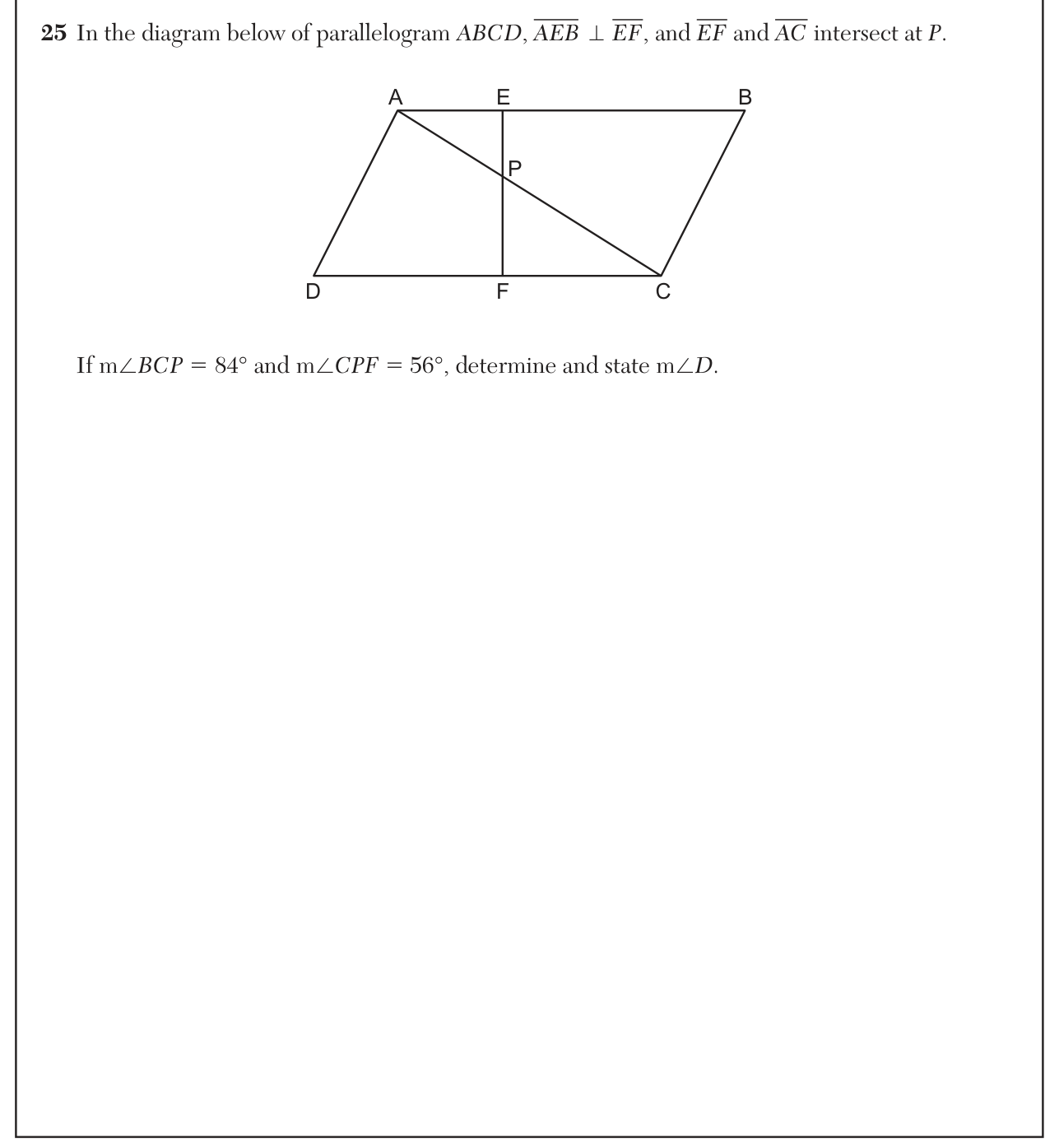
EF is perpendicular to AB in parallelogram ABCD. AC crosses EF at P. Given ∠BCP = 84° and ∠CPF = 56°, find ∠D.
Worked solution for question 25
- Since AB ∥ DC, EF is perpendicular to DC too. In right triangle CPF, ∠PCF = 90° − 56° = 34°.
- The interior angle at C is 84° + 34° = 118°. Adjacent angles of a parallelogram are supplementary, so D measures 62°.
Final answer62°
Q26 Compare population densities
Buffalo has 258,959 people in 40.5 mi². Albany has 98,424 in 21.5 mi². Compare densities.
Worked solution for question 26
- Divide Buffalo’s population by 40.5, giving about 6,394 people per square mile.
- Divide Albany’s by 21.5, giving about 4,578. Compare the two densities.
Final answerBuffalo is denser.
Q27 Parallel segment proportion
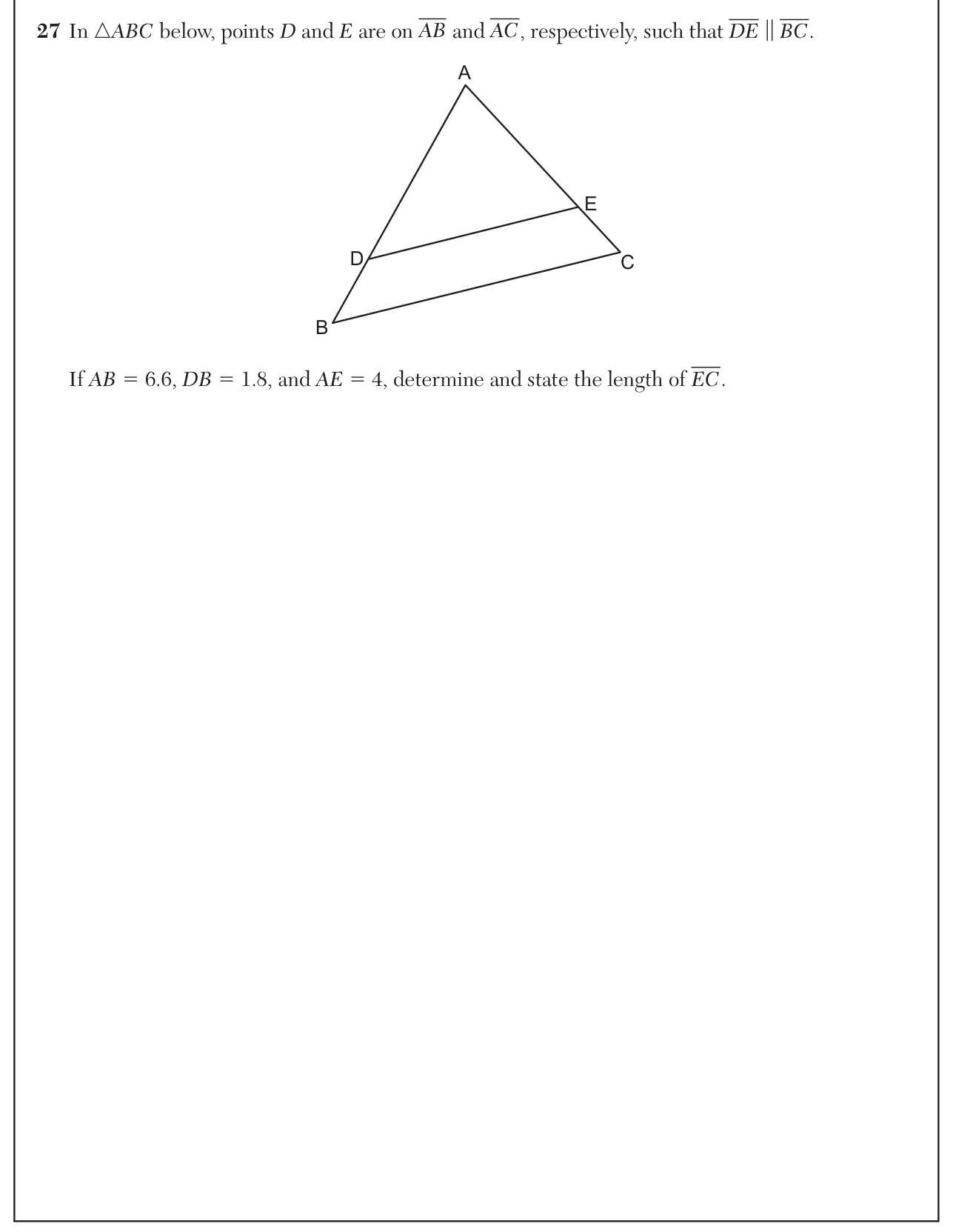
DE ∥ BC, AB = 6.6, DB = 1.8 and AE = 4. Find EC.
Worked solution for question 27
- AD = 6.6 − 1.8 = 4.8. The parallel segment gives △ADE ∼ △ABC.
- Use 4/AC = 4.8/6.6 to get AC = 5.5. Subtract AE to obtain EC = 1.5.
Final answer1.5 units
Q28 Chords crossing inside a circle
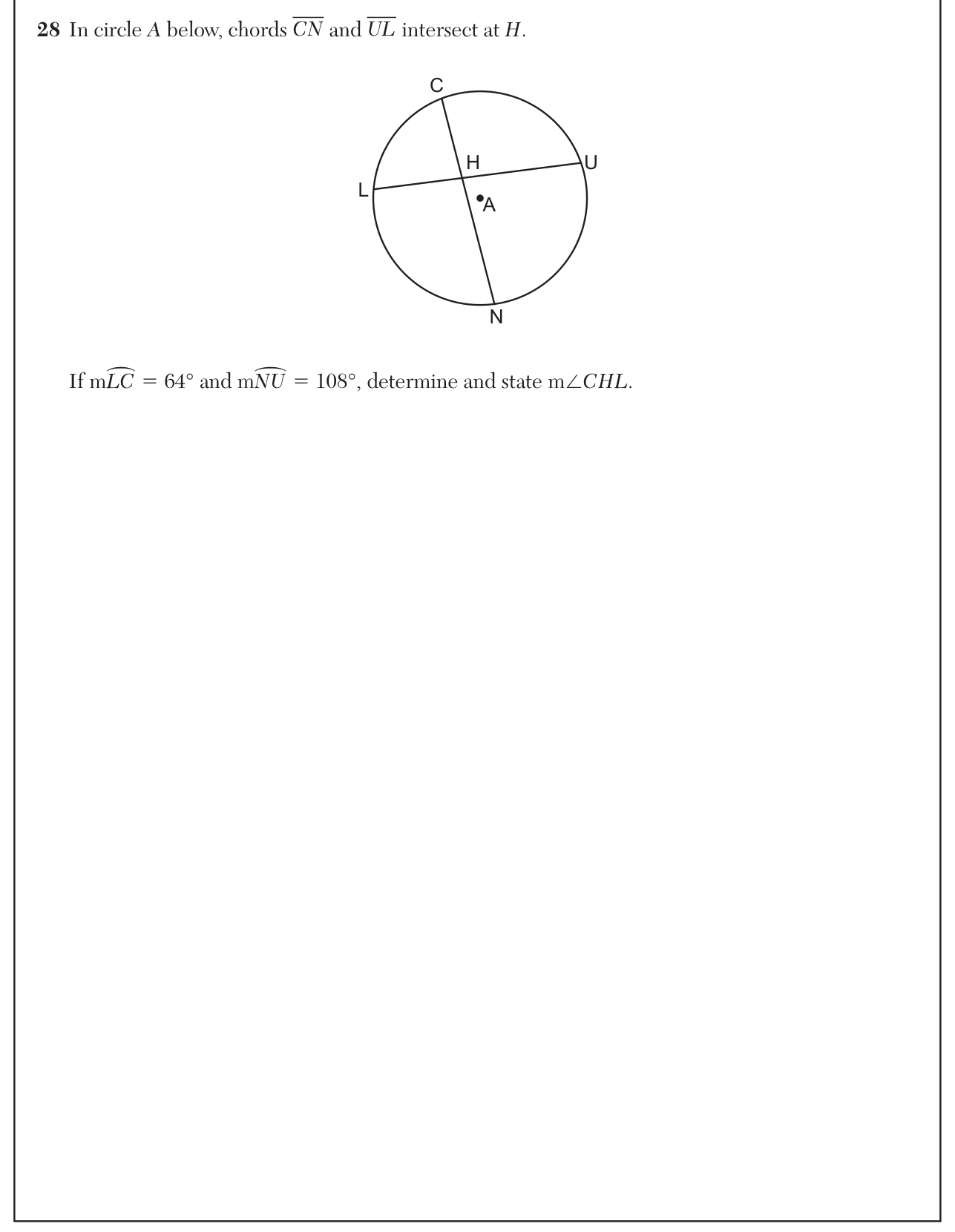
Chords CN and UL meet at H. Arcs LC and NU measure 64° and 108°. Find ∠CHL.
Worked solution for question 28
- The measure of an angle formed by intersecting chords inside a circle is half the sum of the arcs cut by the angle and its vertical opposite.
- For ∠CHL those arcs are LC and NU. Average 64 and 108.
- The intercepted arcs are selected by the rays HC and HL and by the opposite rays HN and HU. Using just one arc would apply the wrong theorem for an interior chord intersection.
Final answer86°
Q29 Inscribed equilateral triangle
Use a compass and straightedge to inscribe an equilateral triangle in the given circle.
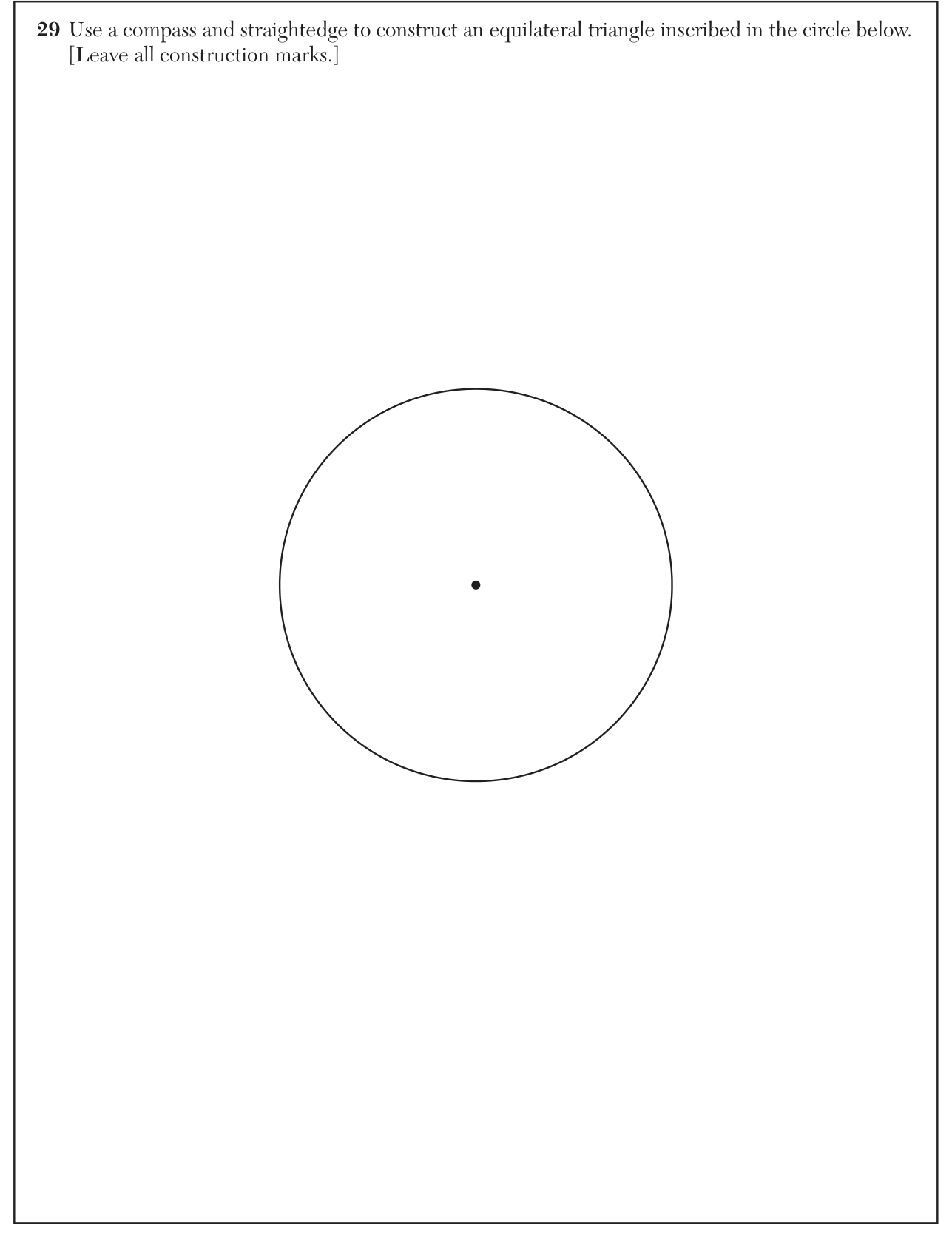
Worked solution for question 29
- If the center is unmarked, construct perpendicular bisectors of two chords. Their intersection locates the center.
- Set the compass to the radius and step that length around the circumference six times. Each equal chord subtends 60°.
- Join every other mark with a straightedge to obtain three equal chords, each subtending 120°. Leave the compass marks.
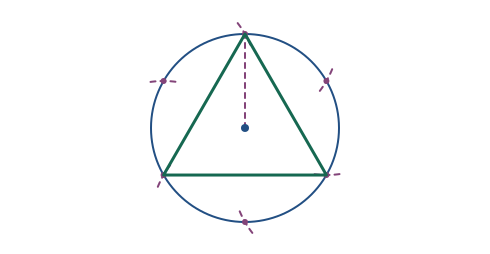
Final answerJoin alternate vertices of a constructed regular hexagon.
Q30 SSS similarity
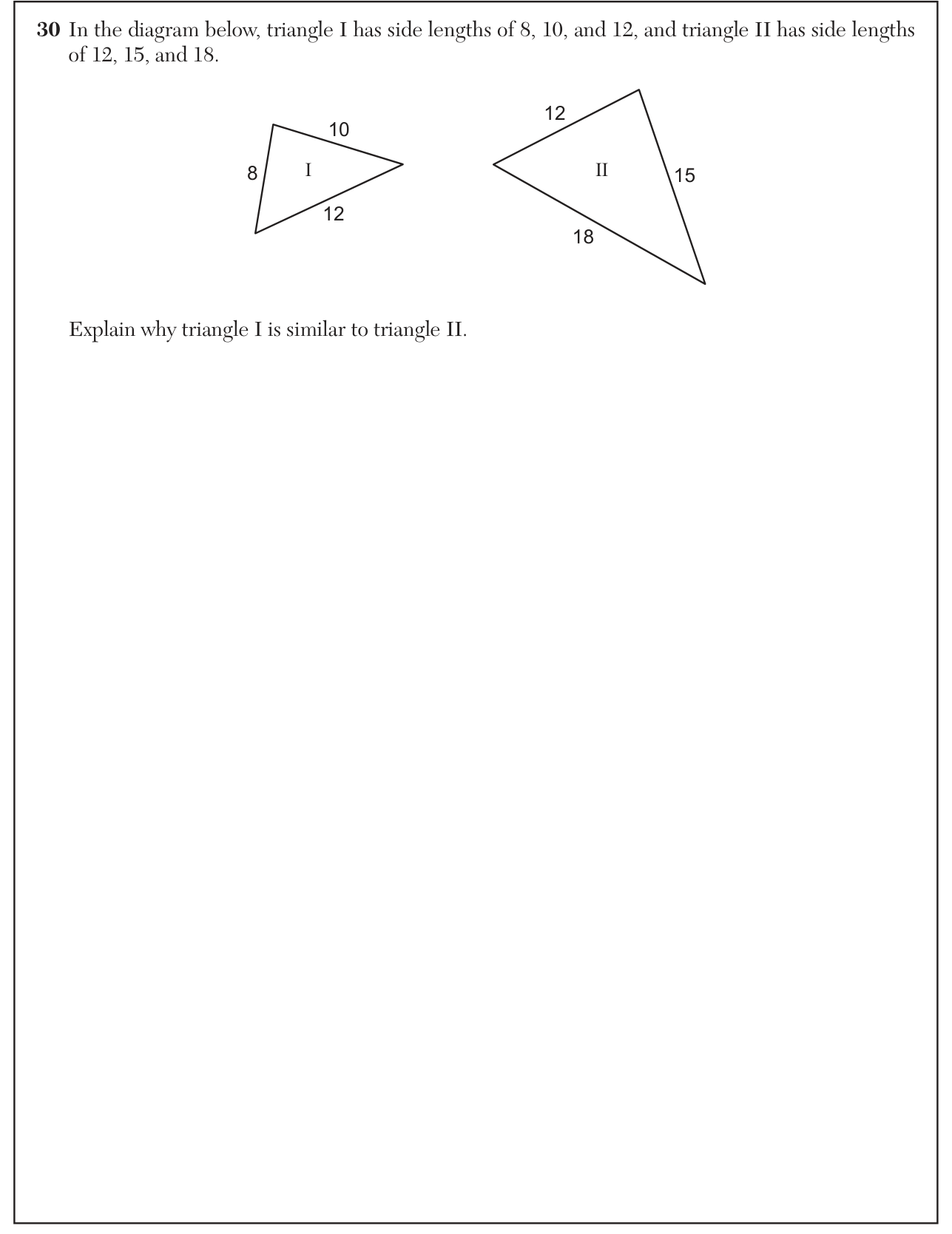
Show that triangles with side lengths (8, 10, 12) and (12, 15, 18) are similar.
Worked solution for question 30
- Compare shortest to shortest, middle to middle, and longest to longest.
- All three ratios are 8/12 = 10/15 = 12/18 = 2/3, so corresponding sides are proportional.
Final answerSimilar by SSS
Q31 Sector between parallel chords
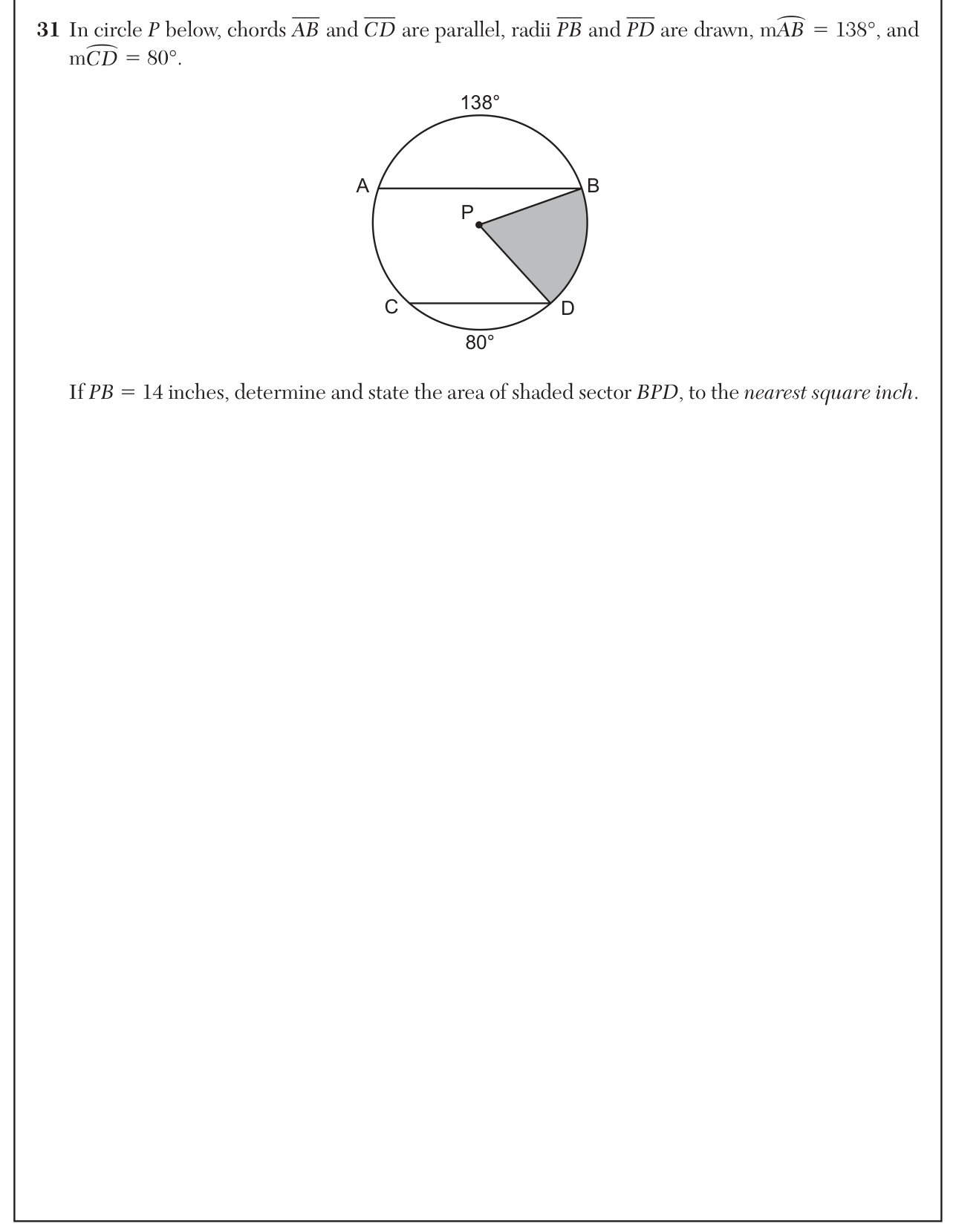
Parallel chords cut off arcs of 138° and 80°. The circle has radius 14 in. Find sector BPD between the right endpoints.
Worked solution for question 31
- Parallel chords cut off equal arcs on the two sides. The two remaining arcs total 360° − 138° − 80° = 142°, so arc BD is 71°.
- Use (71/360)π(14)² ≈ 121.44 in² and round.
- Each sector’s fraction of the circle uses its central angle over 360°. Rounding 71° or π too early is unnecessary; the unrounded calculation is about 121.44 square inches.
Final answer121 square inches
Part III Extended response
Question indexQ32 Cylinder to cone cups
A full cylinder is 10 in across and 20 in tall. Each cone cup is 3.25 in across and 4.25 in tall. Find the maximum full cups.
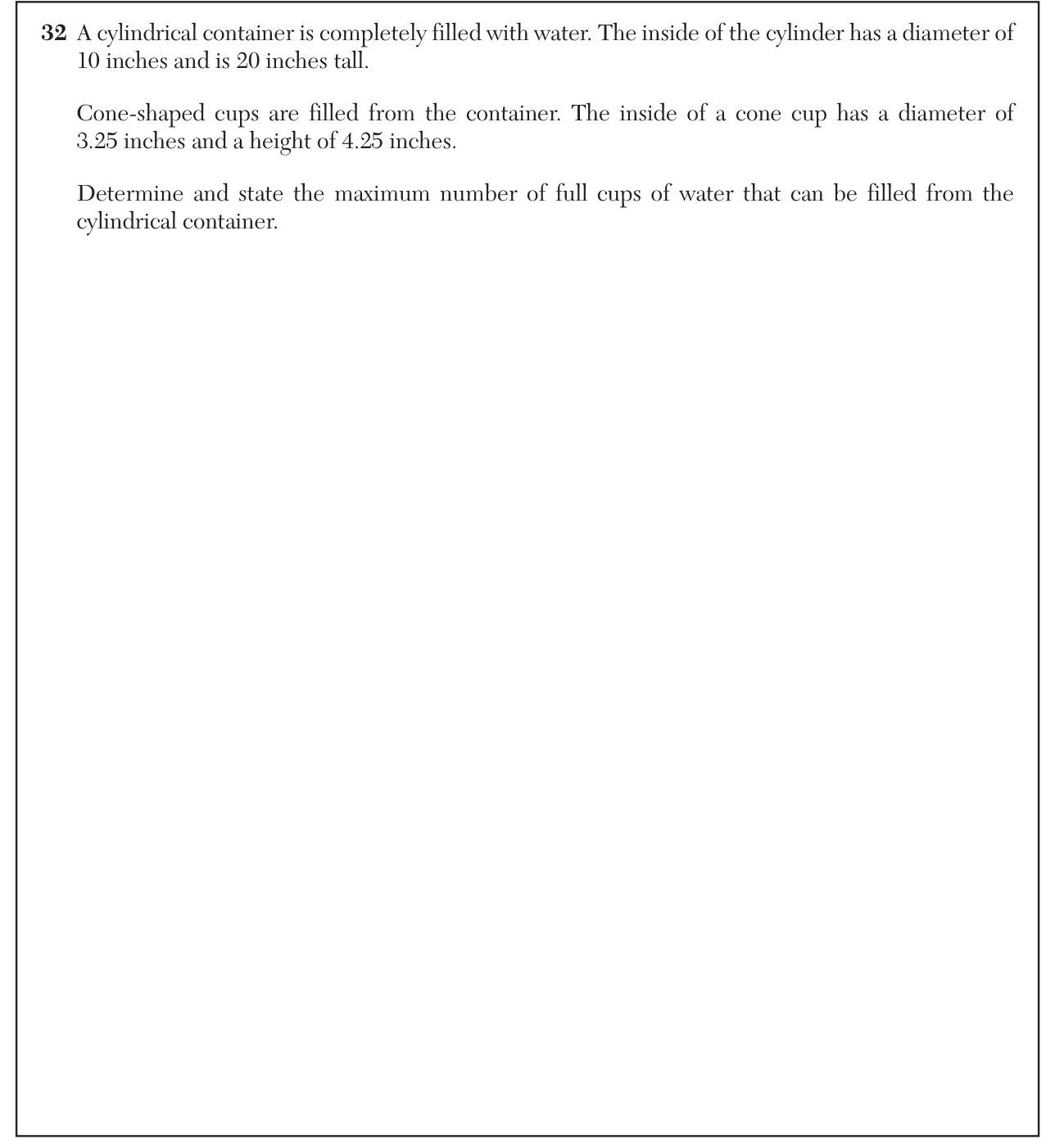
Worked solution for question 32
- The cylinder volume is π(5²)(20) = 500π in³.
- Each cup holds π(1.625²)(4.25)/3 in³. Divide 500π by this amount to get about 133.66.
- Only completed fills count, so take 133.
- The cylinder and cone both contain a factor of π, which cancels in the quotient. Multiplying the exact cup volume by 134 would exceed the water available.
Final answer133 full cups
Q33 Isosceles triangle proof
ABC is isosceles at C, points occur in order A, M, N, B, and AM = BN. Prove △CAN ≅ △CBM.
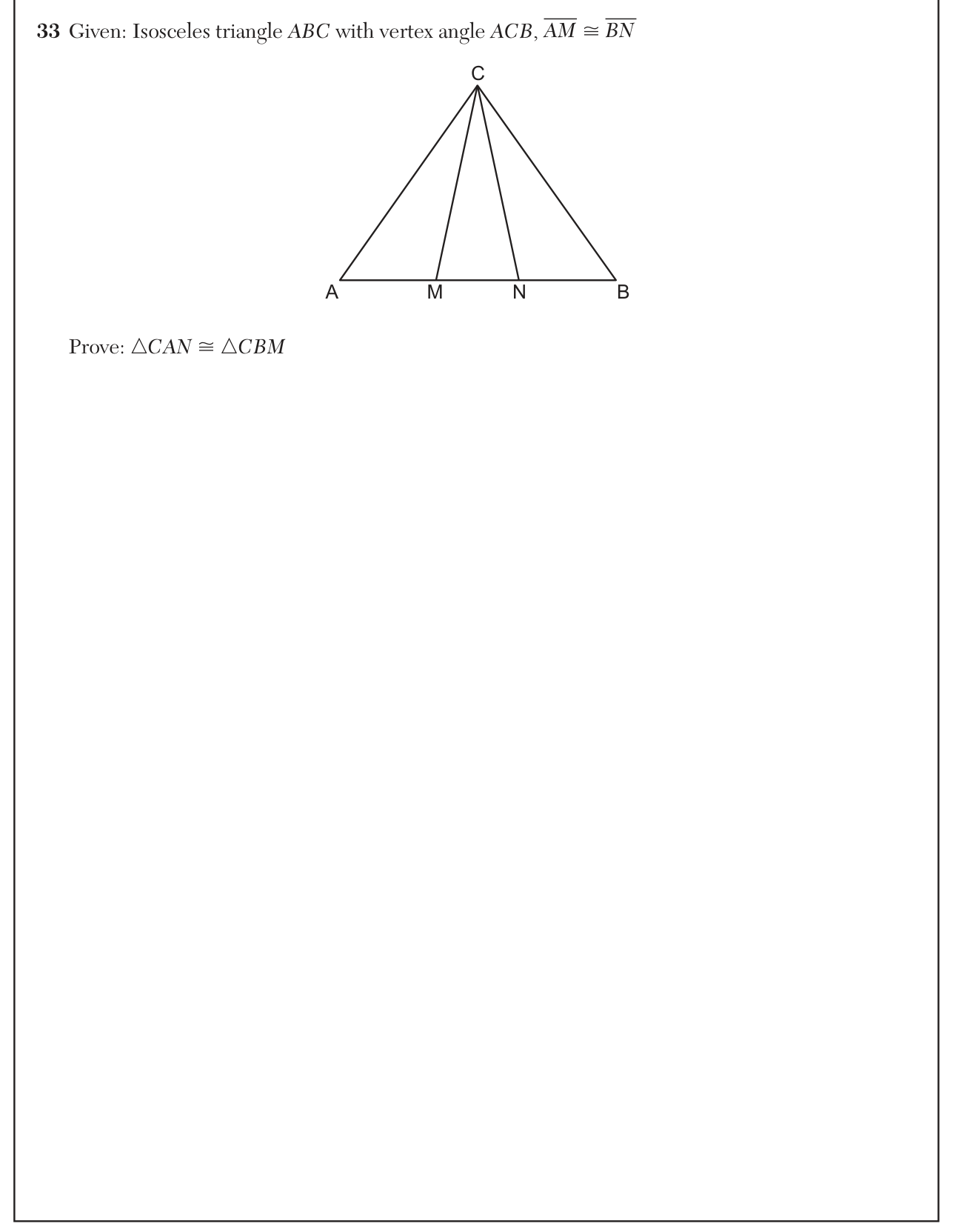
Worked solution for question 33
- CA = CB and ∠CAN = ∠CBM because they are the base angles of the isosceles triangle.
- Add the shared length MN to AM = BN. This gives AN = BM.
- The congruent angles lie between the two corresponding pairs of sides, giving SAS.
Final answerCongruent by SAS
Q34 Subtract horizontal distances
Two people, 68 and 42 inches tall, stand on the same level ray from B. Their heads are both at elevation 23° from B. Find their separation.
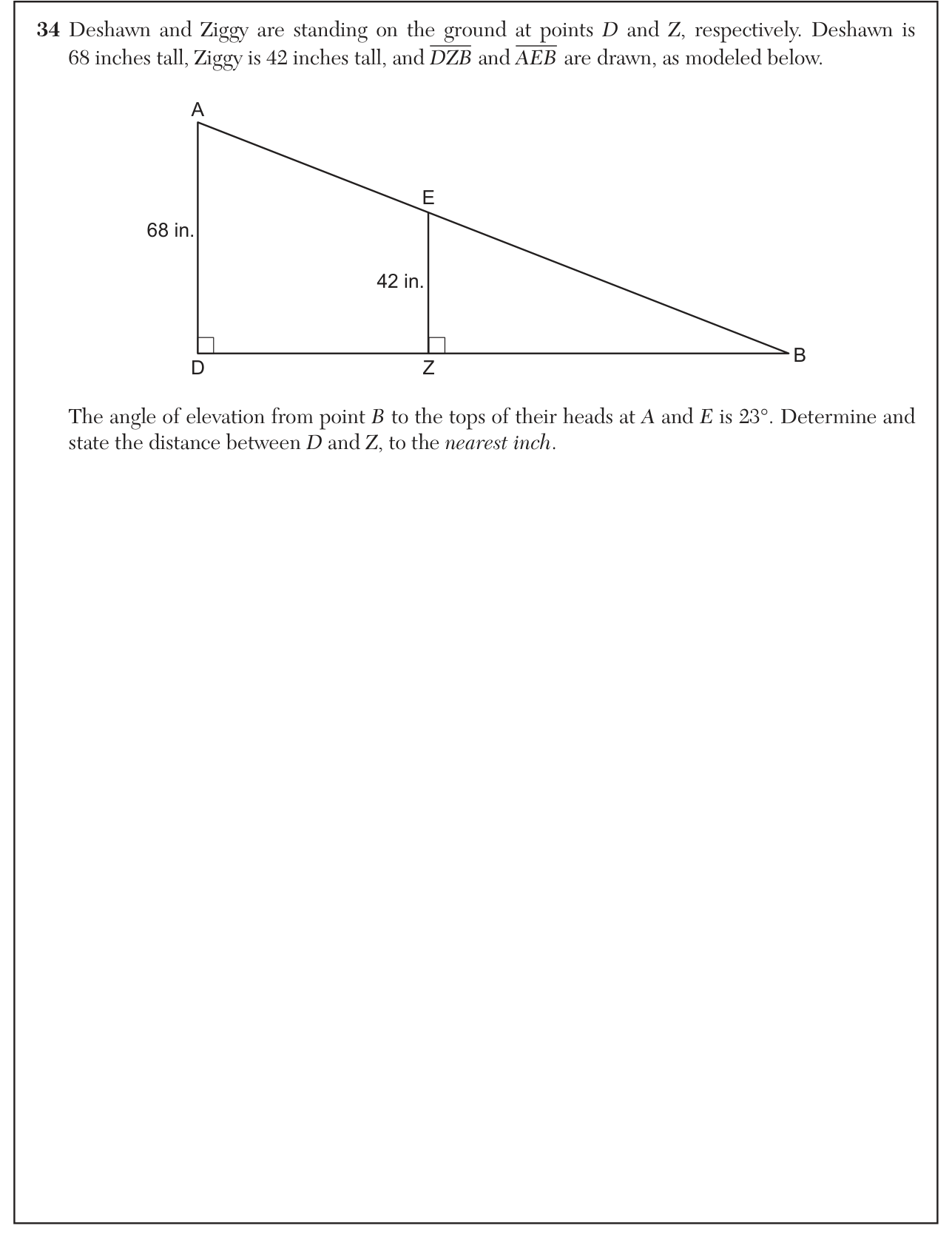
Worked solution for question 34
- Each horizontal distance from B equals the person's height divided by tan 23°.
- Subtract the shorter distance from the longer to obtain (68 − 42)/tan 23° ≈ 61.25 inches.
Final answer61 inches
Part IV Long response
Question indexQ35 Classify a quadrilateral
Classify SHED with S(0, 0), H(3, 4), E(8, 0), and D(5, −4), and test the rectangle and rhombus conditions.
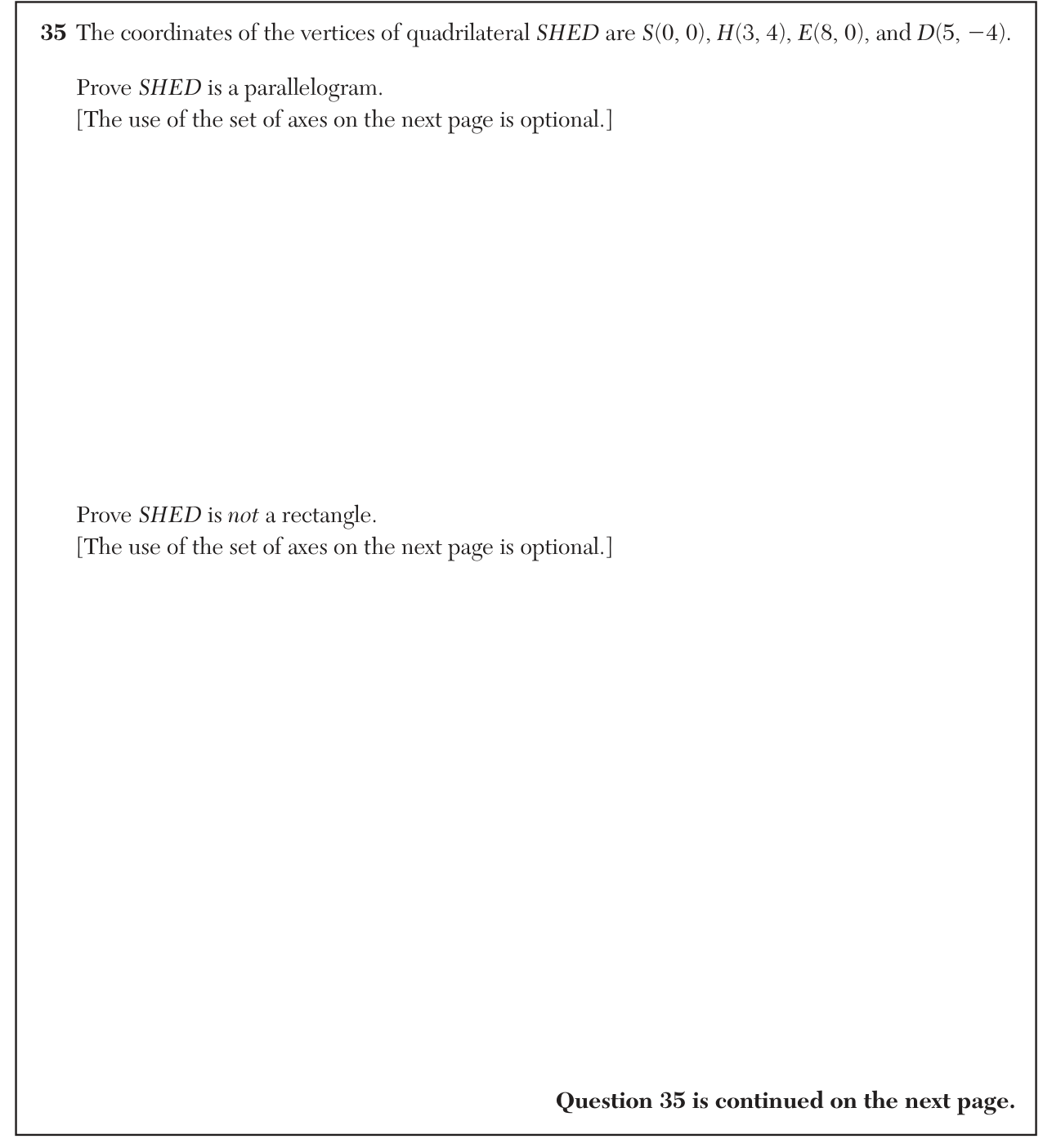
Worked solution for question 35
- The vectors SH and DE are both (3, 4), while HE and SD are both (5, −4). Both pairs of opposite sides are parallel.
- Adjacent slopes are 4/3 and −4/5. Their product is −16/15, so there is no right angle and SHED fails the rectangle condition.
- The squared adjacent lengths are SH² = 25 and HE² = 41, so SHED fails the all-sides-equal condition for a rhombus.
- Testing one adjacent pair is enough to disprove the rectangle and rhombus conditions because each would have to hold for every adjacent pair.
Final answerParallelogram with nonperpendicular adjacent sides and unequal adjacent lengths
From the New York State Education Department. August 2026 Geometry Regents Examination. Internet. Available from https://www.nysedregents.org/geometryre/826/geom-82026-exam.pdf. Accessed .