NEW YORK STATE REGENTS · GLOBAL HISTORY AND GEOGRAPHY II
June 2026 Global History and Geography II Regents Past Paper & Solutions
Work through partition, textile industrialization and the impacts of war with a question-by-question walkthrough of the exam.
- 36 worked questions
- 1 writing models
- 3 exam parts
The question images and page numbers come from the regular-size English exam. OnlyPrepy wrote the summaries and worked solutions.
Quick answer key for Part I
Part I Multiple choice
Question indexQ1 Benin and trade
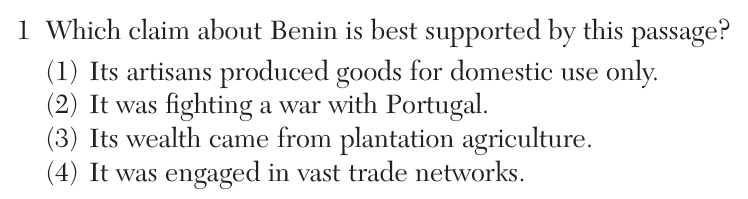
What claim about Benin does the passage support?
Worked solution for question 1
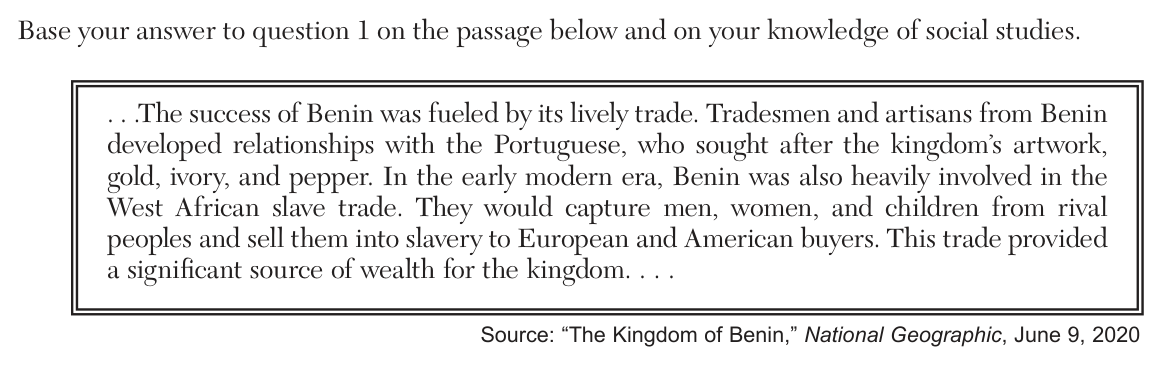
- The account connects Benin’s goods and resources to exchange with outside peoples, including Portuguese traders.
- Trade links extend the kingdom’s economic reach beyond local production.
- Goods moving between Benin and outside partners demonstrate regular contact beyond the kingdom’s borders. Trade is the connection the evidence supports.
Answer choice 4Benin participated in extensive trade networks.
Q2 Aurangzeb’s religious policies
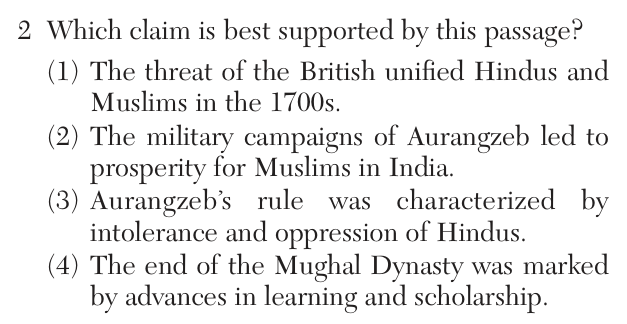
What claim about Aurangzeb is supported by this passage?
Worked solution for question 2
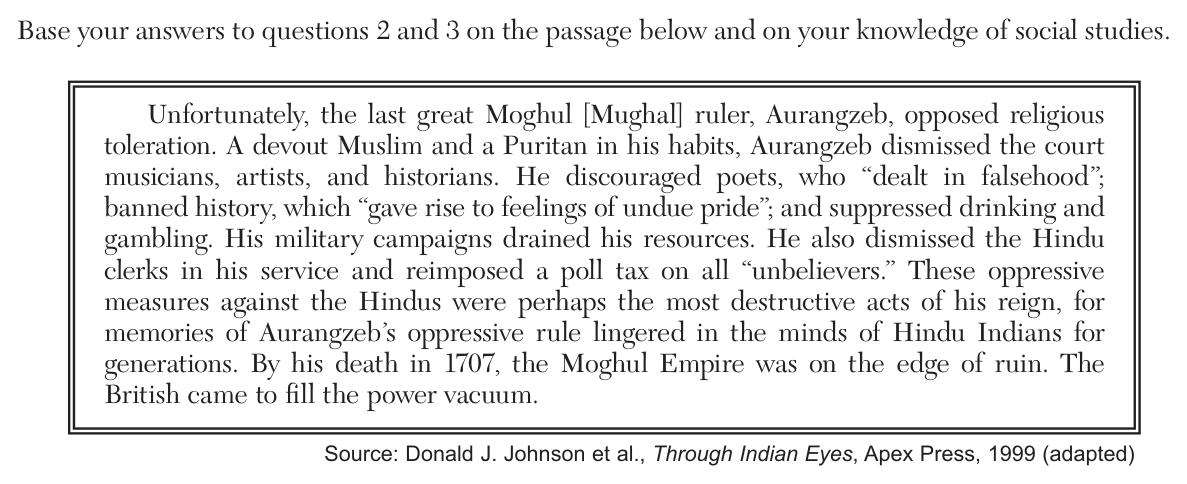
- The account stresses restrictions and policies directed against Hindu subjects.
- These details support a claim about the author’s portrayal of religious policy.
Answer choice 3The passage characterizes his rule as intolerant and oppressive toward Hindus.
Q3 Decline of Mughal authority
What opportunity did the consequences of Aurangzeb’s rule create?
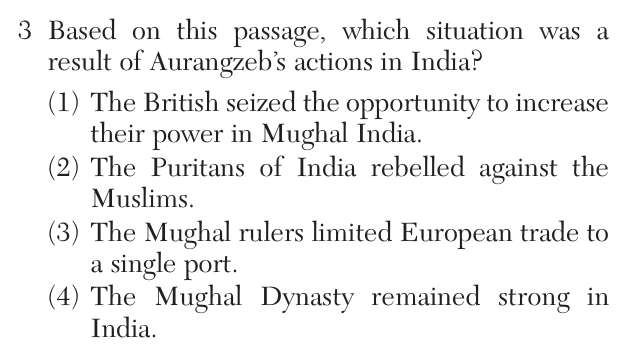
Worked solution for question 3
- Resistance and instability weakened the Mughal state.
- The British East India Company could exploit fragmentation to expand from commerce into political control.
- As Mughal central power weakened, European companies gained room to exercise influence. The British expansion is the change to connect to that weakening.
Answer choice 1The British expanded their power in India.
Q4 Locke’s influence
What is this passage most useful for demonstrating?
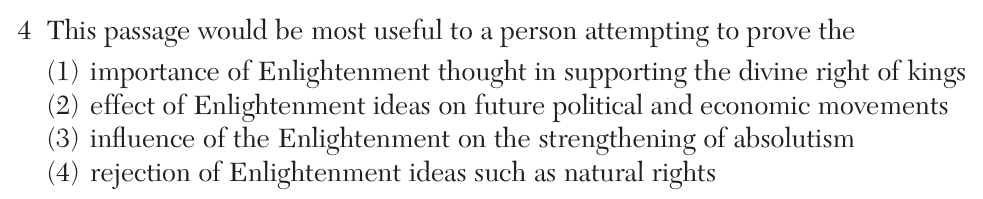
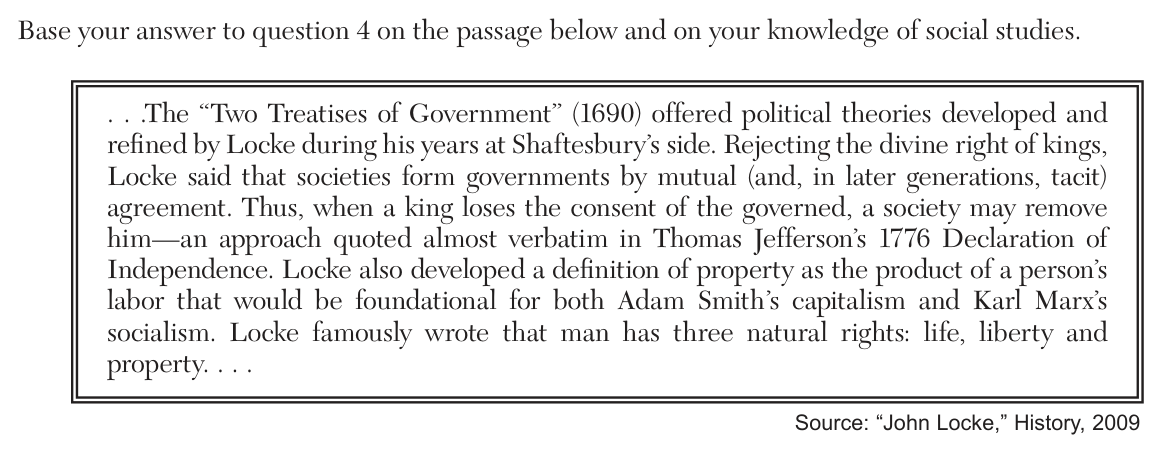
Worked solution for question 4
- Locke’s ideas about rights and legitimate political authority gave later movements arguments against arbitrary government.
- The American Revolution is one example of those ideas being applied.
Answer choice 2The influence of Enlightenment ideas on later movements
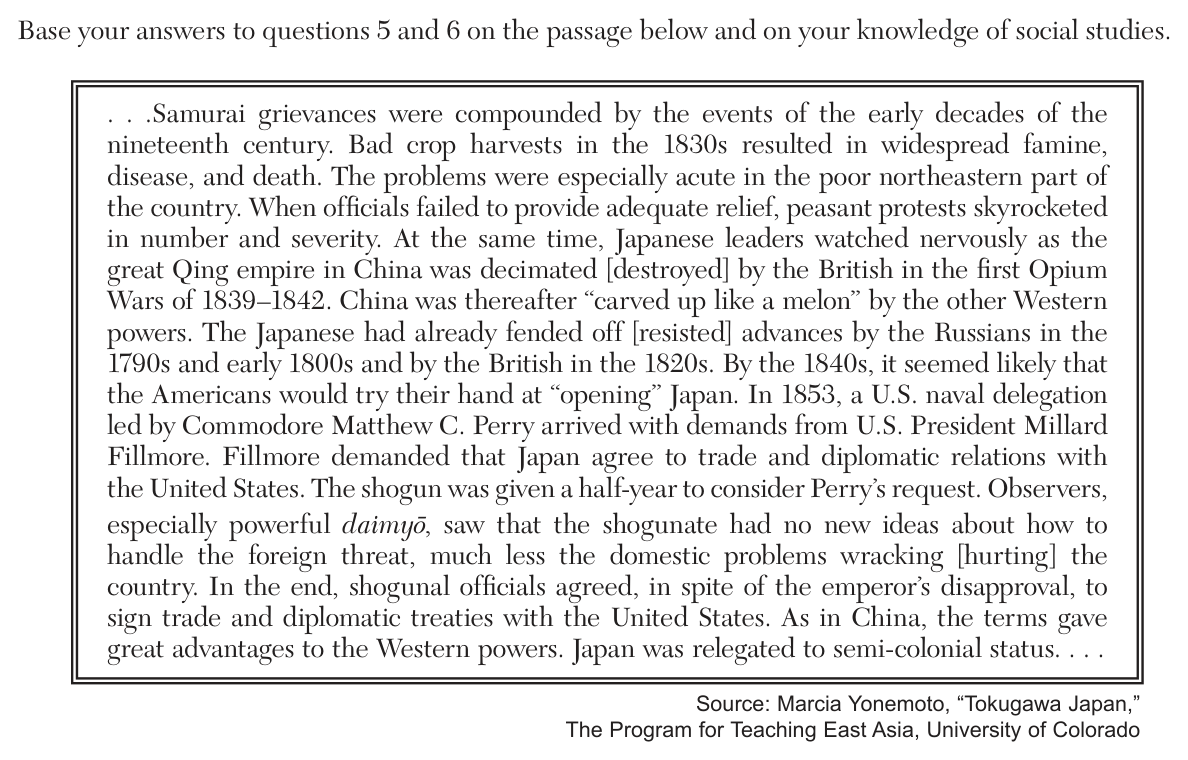
Q5 Japan’s response to foreign pressure
What major change followed the pressures described in the Tokugawa passage?
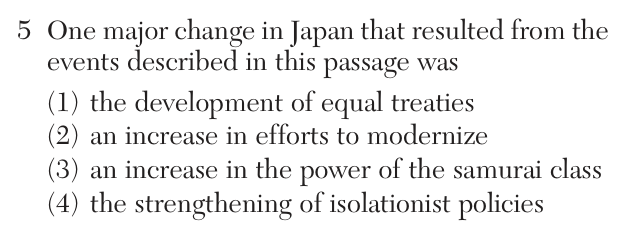
Worked solution for question 5
- Foreign demands exposed the military and diplomatic disadvantages of isolation.
- The Meiji government invested in industry, military reform and institutions that could compete internationally.
- Reform gave Japan a way to meet pressure from industrialized countries. Changes in industry and military organization helped the government protect its independence.
Answer choice 2Japan accelerated its efforts to modernize.
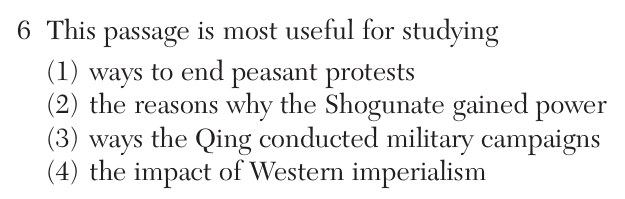
Q6 Western imperialism in East Asia
What is the Tokugawa passage most useful for studying?
Worked solution for question 6
- Foreign pressure altered Japan’s ability to control access to its ports.
- The passage shows how unequal relations with powerful states could force domestic change.
Answer choice 4The impact of Western imperialism
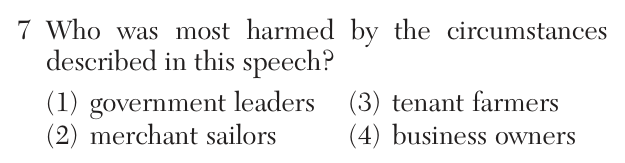
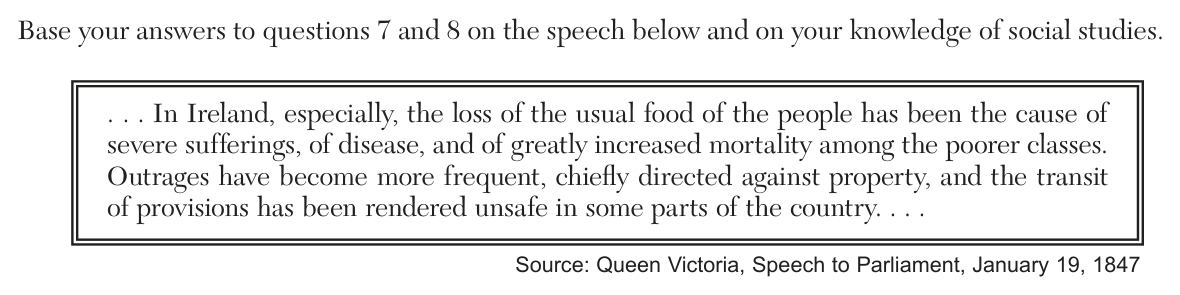
Q7 Who suffered in the Irish famine?
Which group was most harmed by the conditions Victoria describes?
Worked solution for question 7
- Many tenant households depended heavily on potatoes for subsistence.
- Crop failure deprived them of food and income while their obligations remained.
- A tenant farmer depended on the harvest for food while still owing rent. Losing the crop could therefore threaten both subsistence and access to the land.
Answer choice 3Tenant farmers
Q8 Famine migration
What followed the conditions described in the speech?
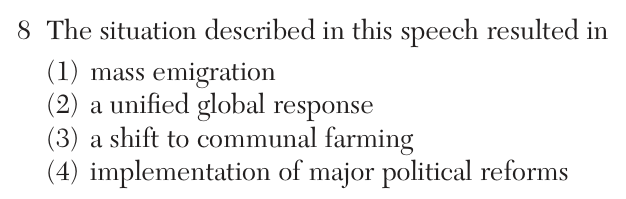
Worked solution for question 8
- Loss of the potato crop brought widespread hunger and hardship.
- Large numbers left Ireland for destinations such as North America and Britain.
Answer choice 1Mass emigration
Q9 Unequal treaties and China
Which event helps explain Keppler’s 1900 cartoon?
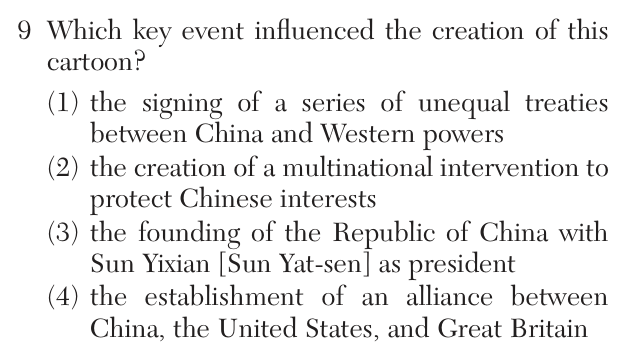
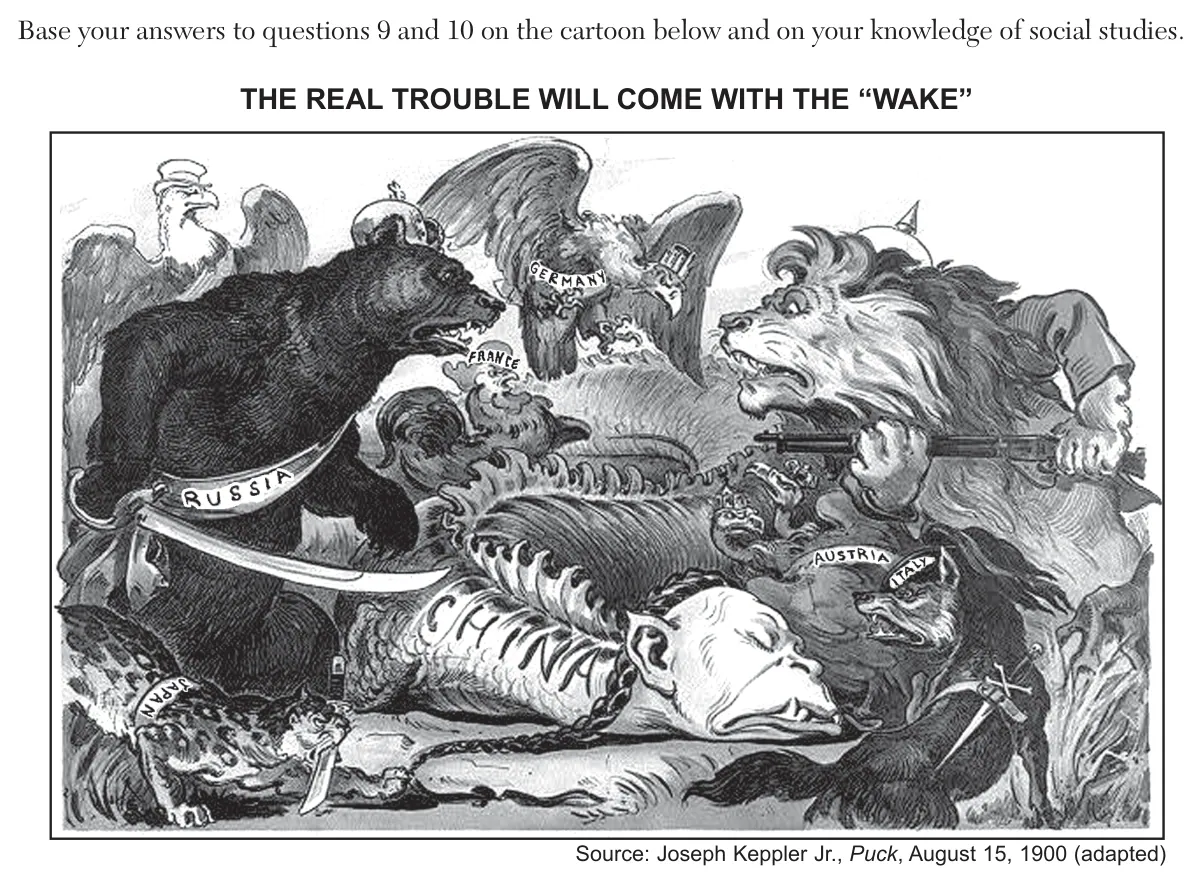
Worked solution for question 9
- Treaties after the Opium Wars opened ports and granted foreign powers privileges.
- These agreements help explain why several powers were competing over access by 1900.
- The treaty arrangements placed obligations on China that the foreign powers could enforce. Their lack of reciprocity is what makes the broader category of unequal treaties fit.
Answer choice 1A series of unequal treaties imposed on China
Q10 Animals surrounding China
What do the animals represent?
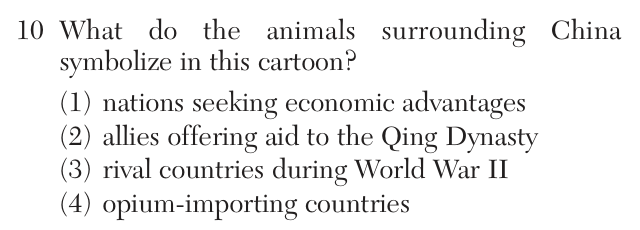
Worked solution for question 10
- The animals stand for powers competing around China.
- The imagery makes rivalry over markets, concessions and influence visible.
- Read the animals as symbols for competing foreign powers. Their placement around China represents rivals seeking access and advantages from the same country.
Answer choice 1Nations seeking economic advantages
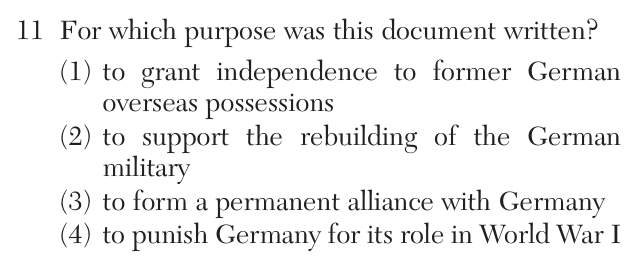
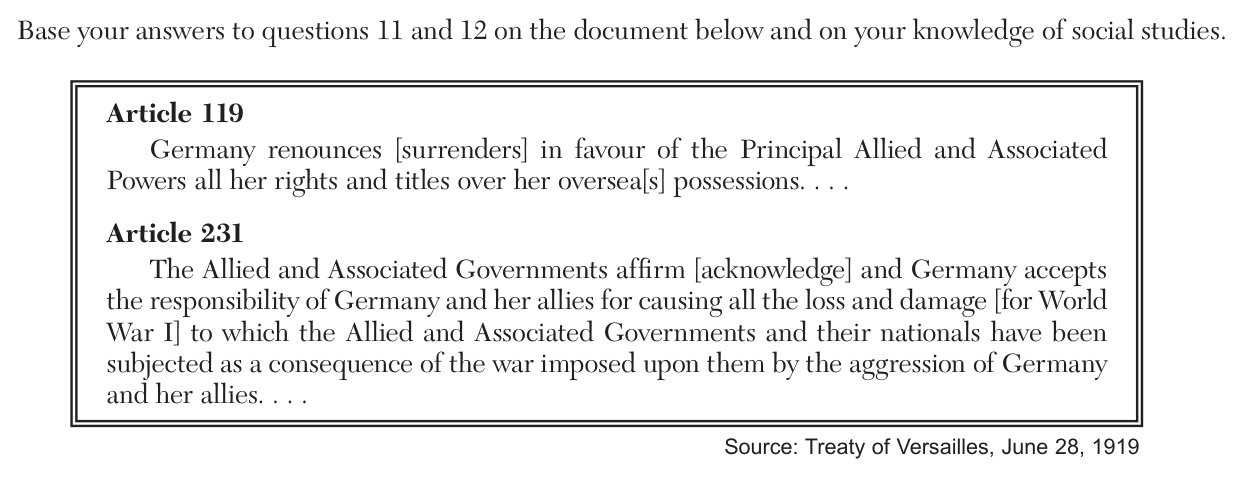
Q11 Purpose of the Versailles terms
Why were the selected articles written?
Worked solution for question 11
- The articles assign responsibility and require reparations for damage.
- Those obligations impose a cost on the defeated state.
- German responsibility, reparations and military limits work together in the settlement. Each places a burden or constraint on Germany after the war.
Answer choice 4To punish Germany for its role in World War I
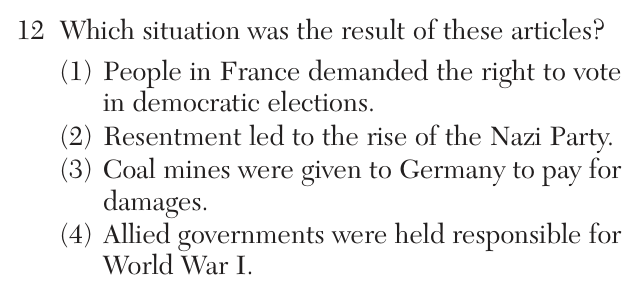
Q12 Versailles and political resentment
What was one longer-term result of the terms?
Worked solution for question 12
- German nationalists condemned the treaty and used that grievance to attack the postwar system.
- The Nazis exploited the issue alongside other factors such as economic crisis.
Answer choice 2Resentment helped the Nazis rise.
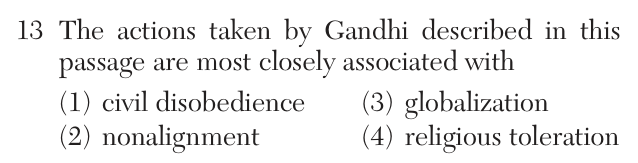
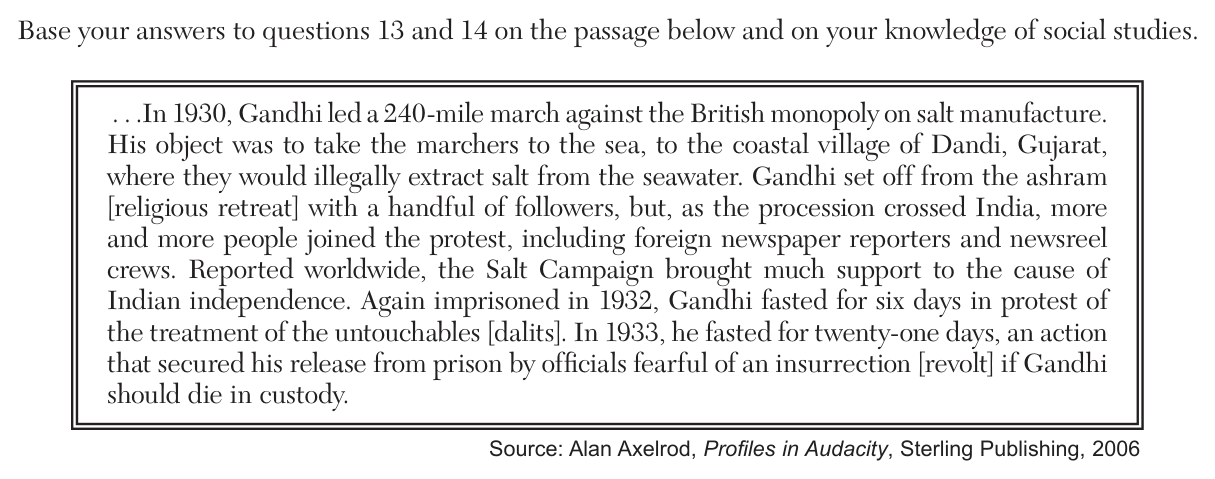
Q13 Gandhi’s tactic
What principle is illustrated by Gandhi’s action in the passage?
Worked solution for question 13
- Gandhi challenges colonial law by breaking it publicly and nonviolently.
- The deliberate violation draws attention to a rule regarded as unjust.
- Civil disobedience involves deliberately and openly breaking or refusing to obey a rule to challenge its legitimacy. Gandhi’s tactic gives authorities a choice between conceding and visibly punishing peaceful protest.
Answer choice 1Civil disobedience
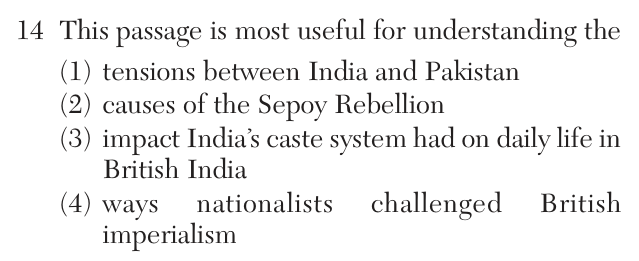
Q14 Challenging colonial authority
What could a historian best study using the Gandhi passage?
Worked solution for question 14
- The action mobilizes people to resist a specific colonial restriction.
- It illustrates a way to oppose the governing power without fighting a conventional war.
Answer choice 4How Indian nationalists challenged British rule
Q15 Appeasement and aggression
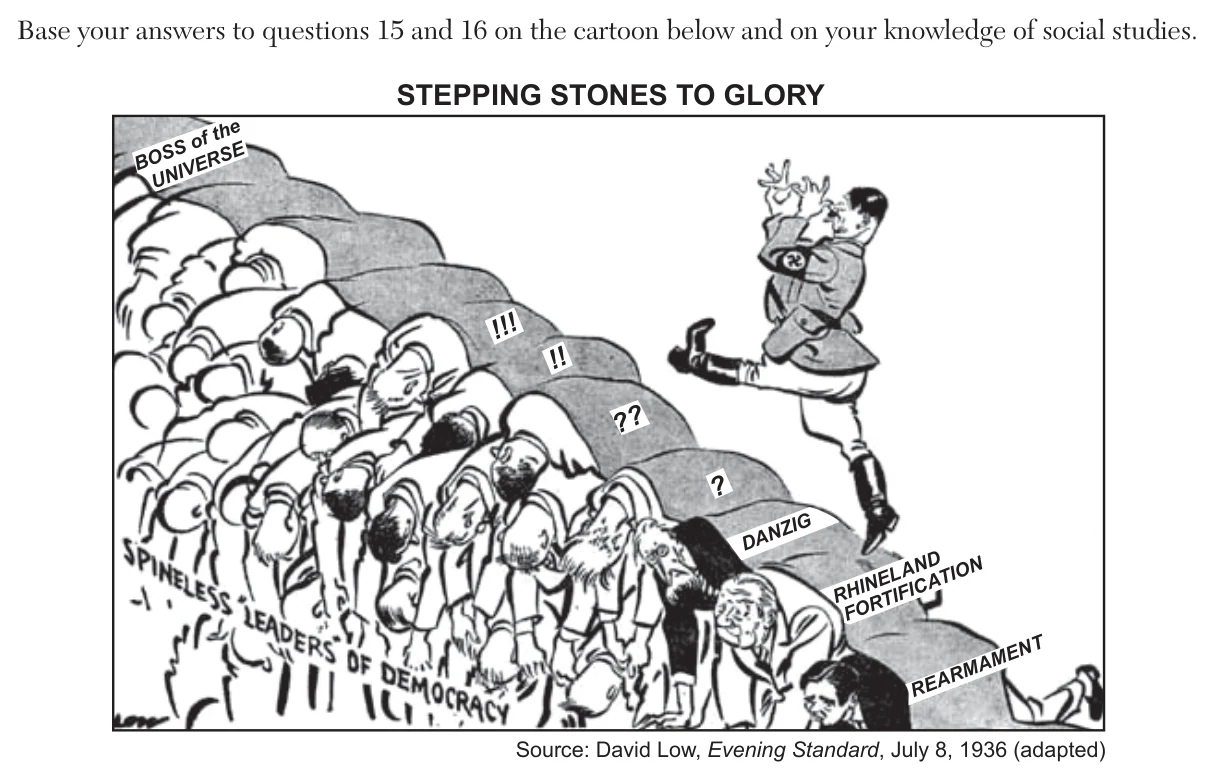
What policy helped produce the situation in Low’s cartoon?
Worked solution for question 15
- Leaders tolerated steps that enlarged dictators’ power in the hope of avoiding war.
- The cartoon criticizes how those concessions encourage further demands.
- Appeasement sought to avoid war through concessions to an aggressive government. The next expansion or demand helps explain why the concessions failed to secure lasting peace.
Answer choice 3Appeasement by European leaders
Q16 Escalation to war
What later event followed the dynamic shown in the cartoon?
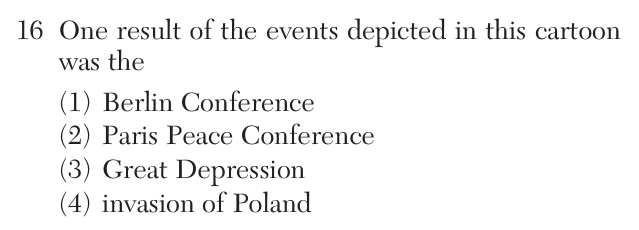
Worked solution for question 16
- Earlier concessions did not stop German territorial expansion.
- The invasion in 1939 led Britain and France to declare war.
- Distinguish a later result from the earlier concessions the cartoon depicts. Germany went on to attack Poland, after which Britain and France entered the war.
Answer choice 4Germany’s invasion of Poland
Q17 International accountability
Which organization is most associated with upholding the principles in the tribunal charter?

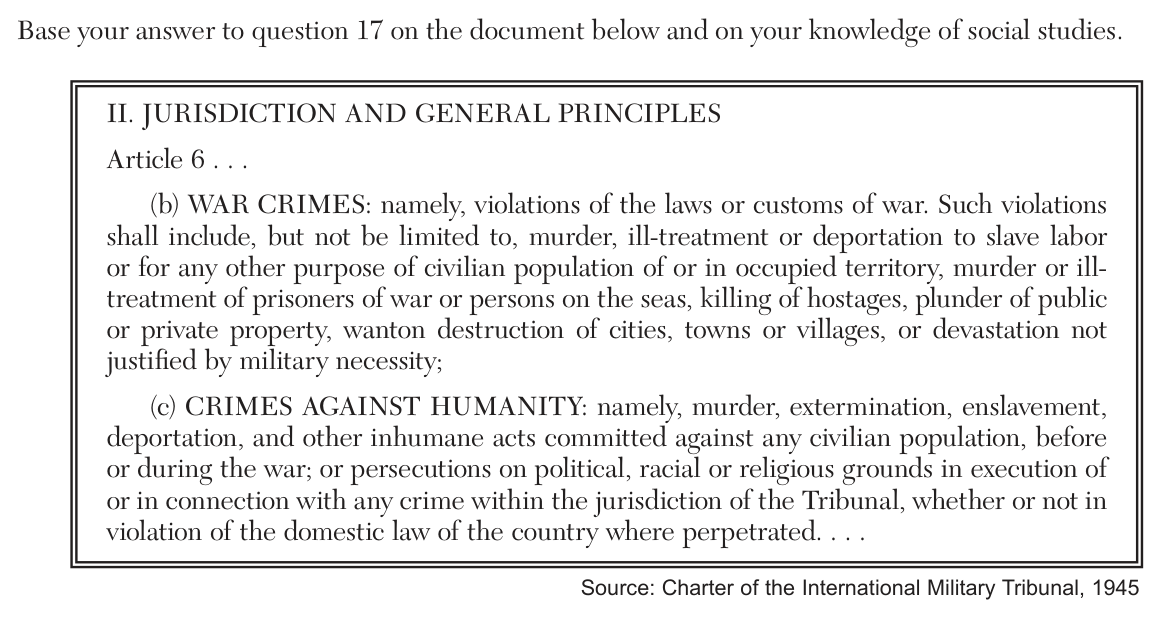
Worked solution for question 17
- The charter identifies crimes whose gravity crosses national boundaries.
- The United Nations later affirmed the Nuremberg principles and supported international mechanisms for accountability.
- The international scale of the issue points toward a body formed by multiple states. The United Nations provides a setting for international action and accountability.
Answer choice 2United Nations
Q18 West Germany’s strategic location
Which claim does the postwar German passage support?
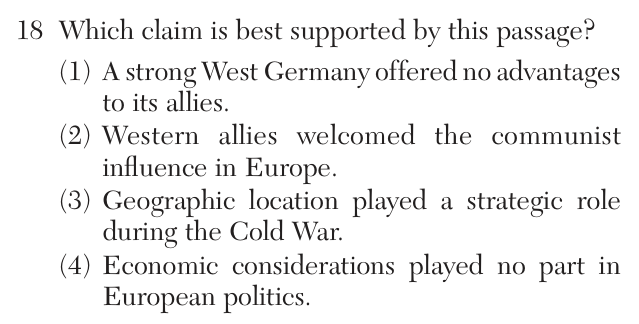
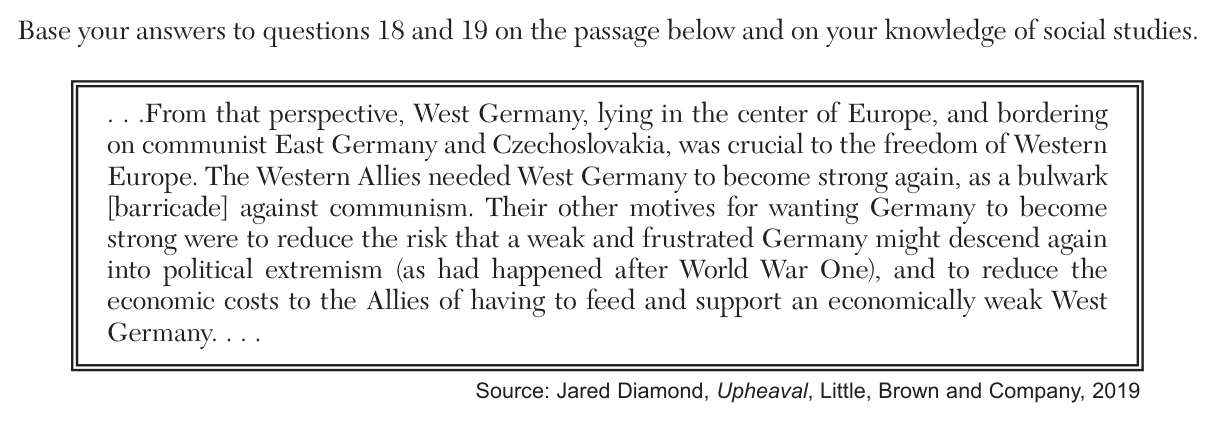
Worked solution for question 18
- West Germany bordered Communist states in central Europe.
- The Western Allies saw a stable West Germany as a barrier to further Soviet influence.
Answer choice 3Geography mattered strategically in the Cold War.
Q19 Why the West sought a strong Germany
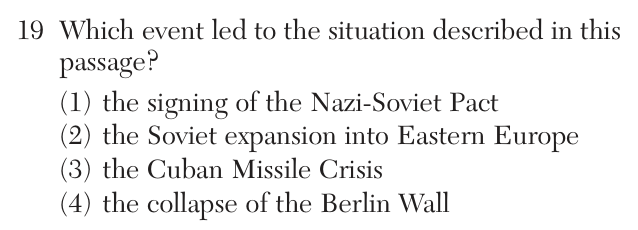
What development produced the situation described?
Worked solution for question 19
- Communist control expanded across Eastern Europe after World War II.
- That placed divided Germany on the front line of the confrontation.
- A viable West Germany could act as a political and economic anchor in Western Europe. This helps explain the Western response to Soviet power across the continent.
Answer choice 2Soviet expansion into Eastern Europe
Q20 Agricultural changes in India
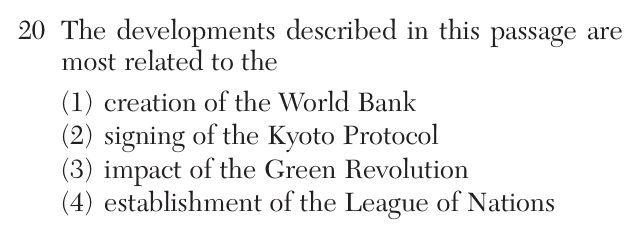
Which development is described in the passage?
Worked solution for question 20
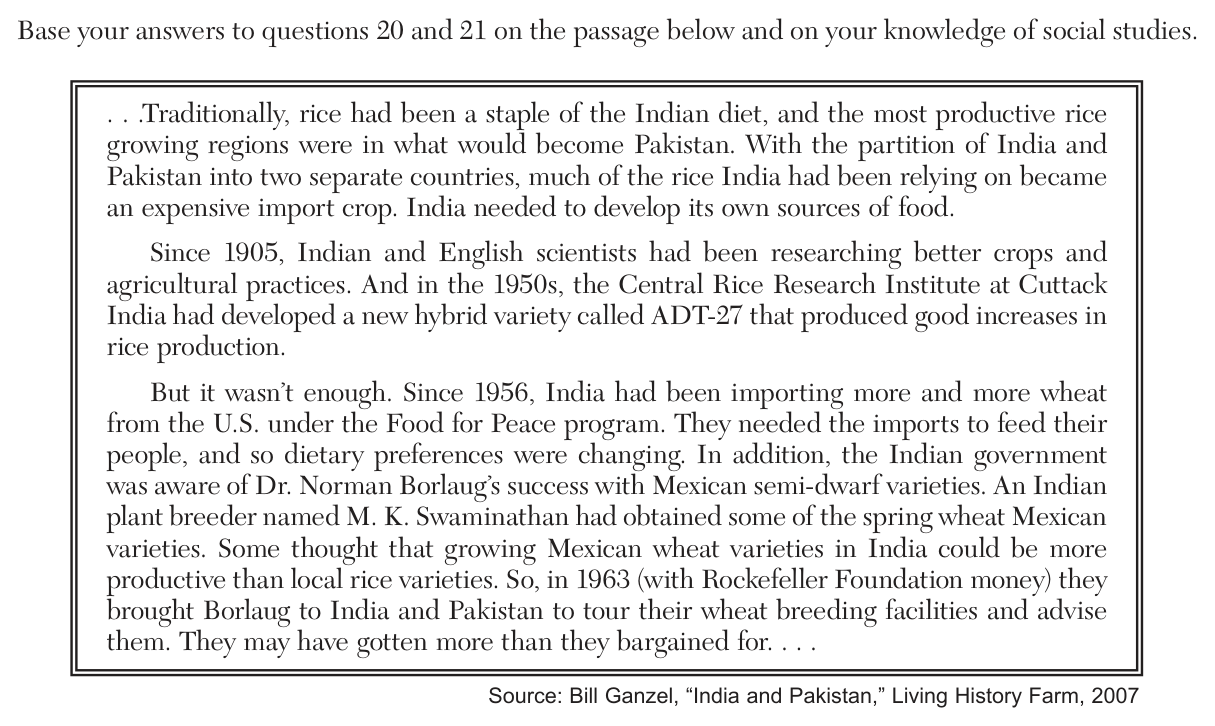
- New crop varieties and changes in farming inputs raised potential yields.
- The passage connects those methods to India’s need for more domestic food production.
Answer choice 3The Green Revolution
Q21 Food production after reform
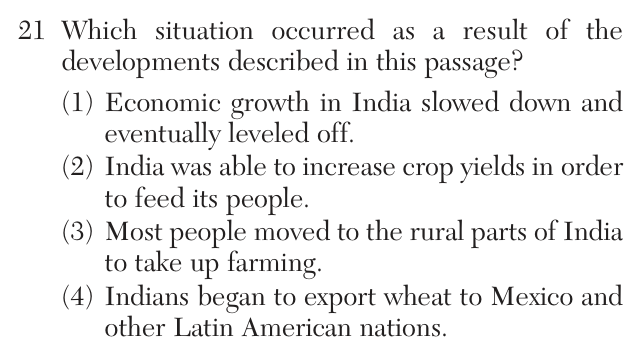
What was a result of the agricultural changes?
Worked solution for question 21
- The new methods made greater grain output possible on cultivated land.
- That helped reduce dependence on expensive imported food.
- Higher yields mean more food from the land under cultivation. That link explains how the agricultural changes could help feed a large population.
Answer choice 2India increased crop yields to feed more people.
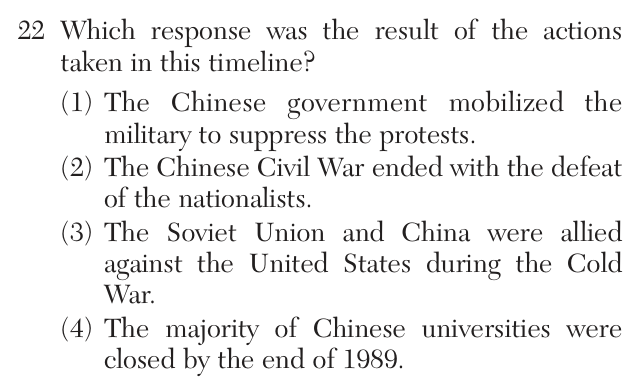
Q22 Suppression at Tiananmen
How did China’s government respond to the 1989 protests?
Worked solution for question 22
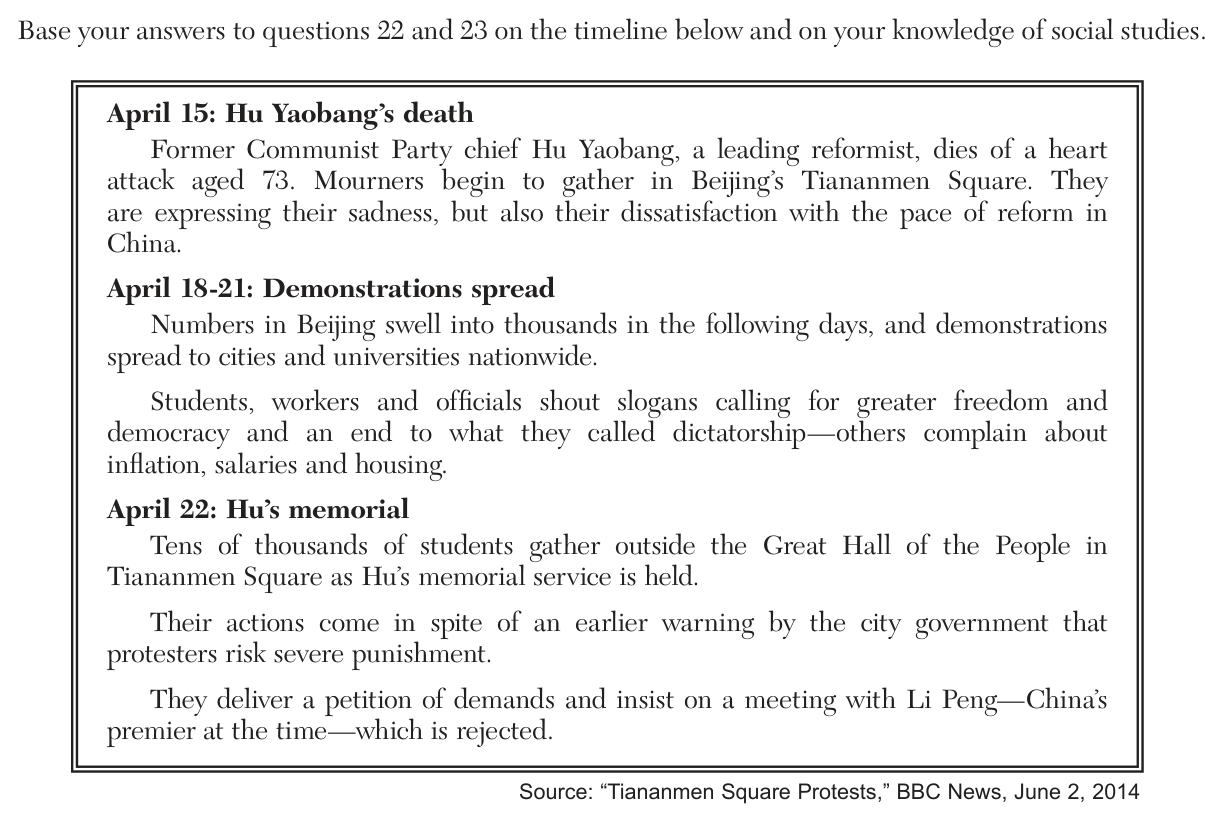
- The timeline builds from demonstrations to a state crackdown.
- Military force ended the occupation of the square and struck protesters and bystanders.
Answer choice 1It mobilized the military to suppress them.
Q23 Reading the protest timeline
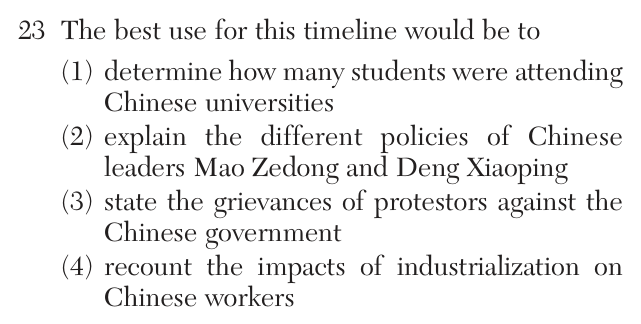
What is the timeline most useful for explaining?
Worked solution for question 23
- The entries record why demonstrators mobilized and what changes they sought.
- A timeline of the protest documents demands and responses more directly than it measures broad economic trends.
- A timeline can show what participants complained about and when their protests grew. Those details are evidence of grievances and mobilization, even if the timeline does not settle how every participant understood the movement.
Answer choice 3Protesters’ grievances against the Chinese government
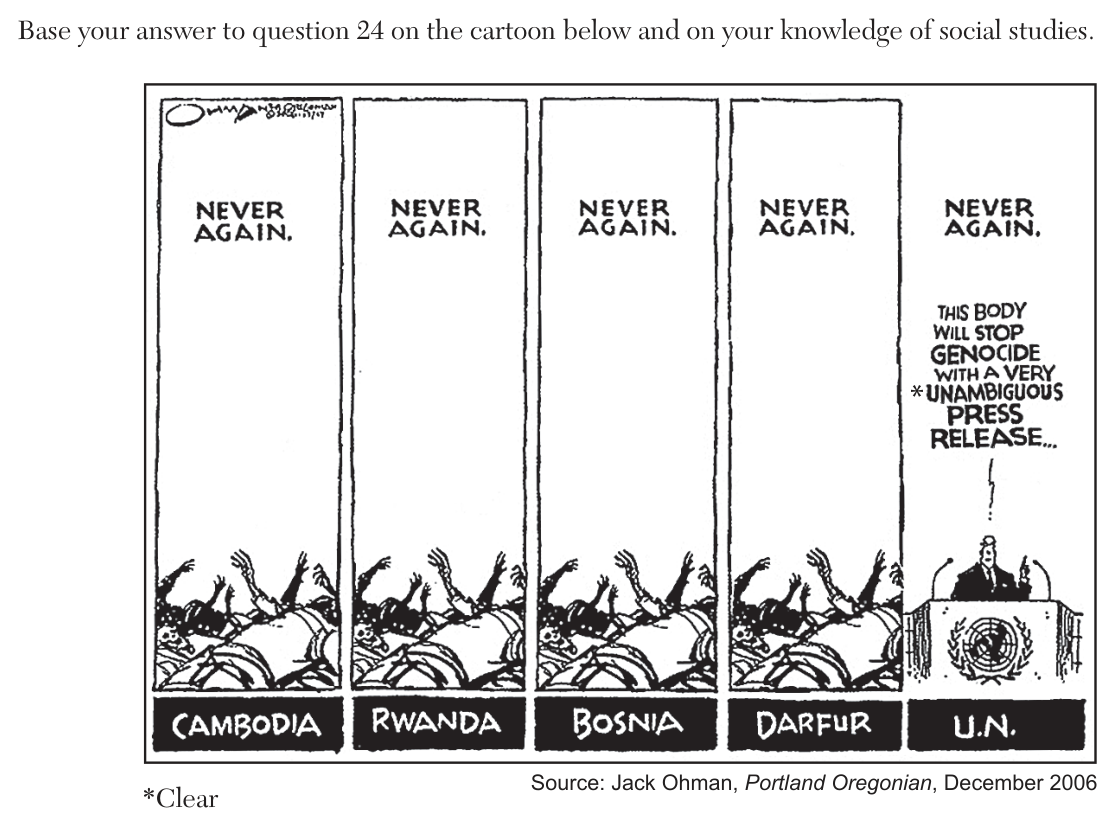
Q24 The UN and genocide
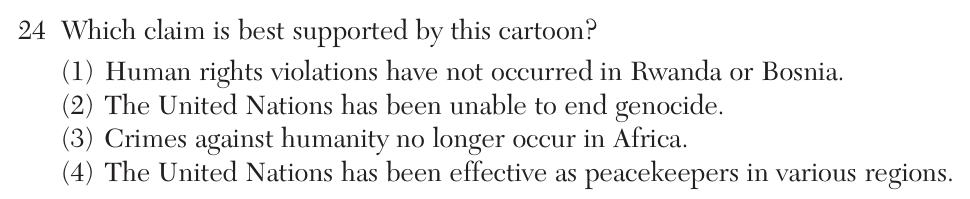
What criticism is supported by the cartoon?
Worked solution for question 24
- The cartoon recalls repeated instances of mass violence despite international pledges.
- The repetition is the evidence for the cartoonist’s criticism of prevention.
Answer choice 2The United Nations has been unable to end genocide.
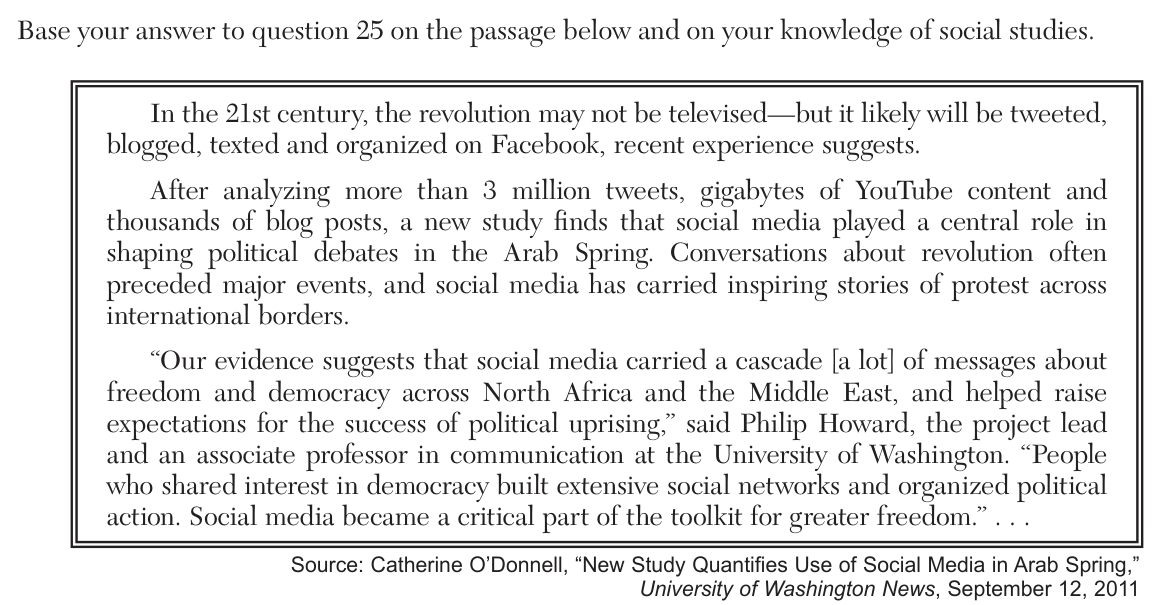
Q25 Social media in the Arab Spring
What does the research suggest about online communication?

Worked solution for question 25
- Online posts spread political discussion and information among people inside and outside the countries concerned.
- Those connections helped circulate demands and mobilize support.
- Posting and sharing messages lowered the cost of reaching people quickly. That communication helped supporters learn about events and organize around common demands.
Answer choice 4It helped build support for revolutions.
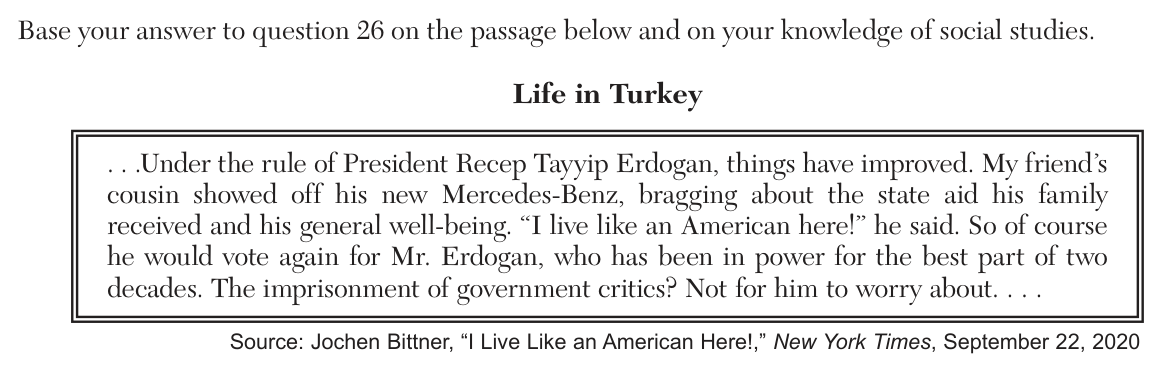
Q26 Economic development and rights
What claim is supported by the account of Turkey?

Worked solution for question 26
- The account contrasts material improvements with pressure on dissent and individual freedoms.
- That contrast supports an argument about the government’s priorities.
Answer choice 3Economic development was emphasized over protecting rights.
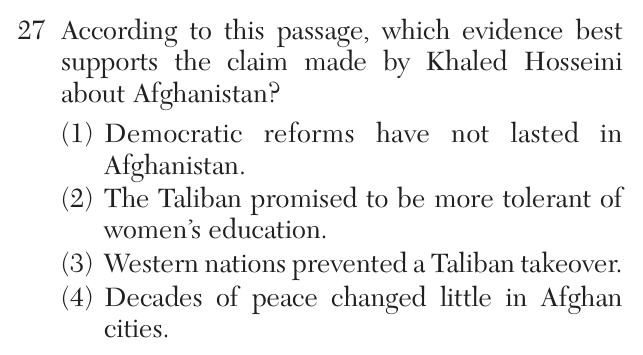
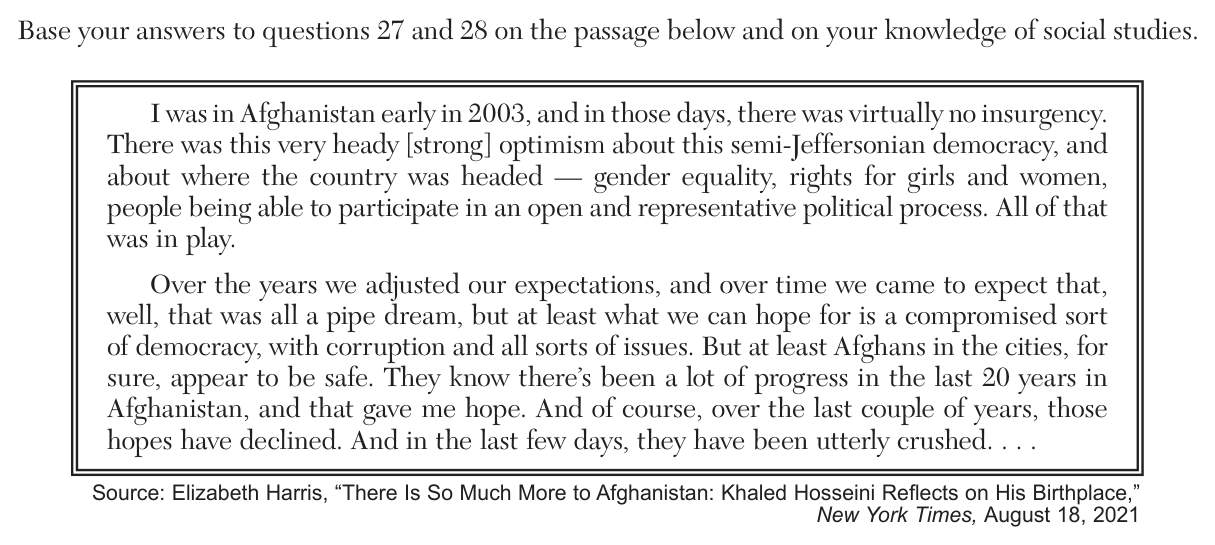
Q27 Evidence of reversal in Afghanistan
Which statement supports Hosseini’s claim?
Worked solution for question 27
- The return of Taliban rule put prior gains at risk after years of attempted reform.
- This gives concrete evidence of the reversal he describes.
- Compare the evidence at the beginning and the end of the period. The return of restrictions or loss of earlier gains indicates a reversal in the institutions people had tried to build.
Answer choice 1Democratic reforms did not last.
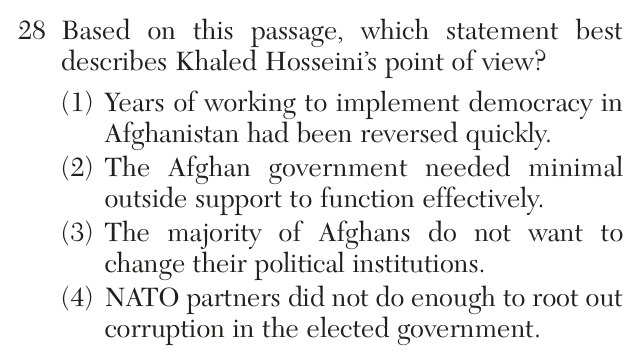
Q28 Hosseini’s point of view
What is Hosseini’s view of the change in Afghanistan?
Worked solution for question 28
- He contrasts the length of the effort with the speed of the collapse.
- That difference explains his alarm at how rapidly the situation changed.
Answer choice 1Years of work toward democracy were reversed quickly.
Part II Constructed responses
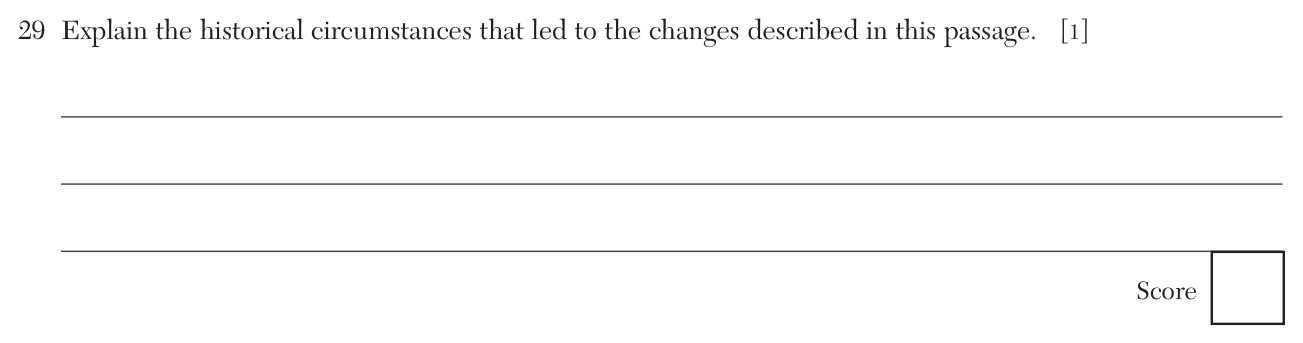
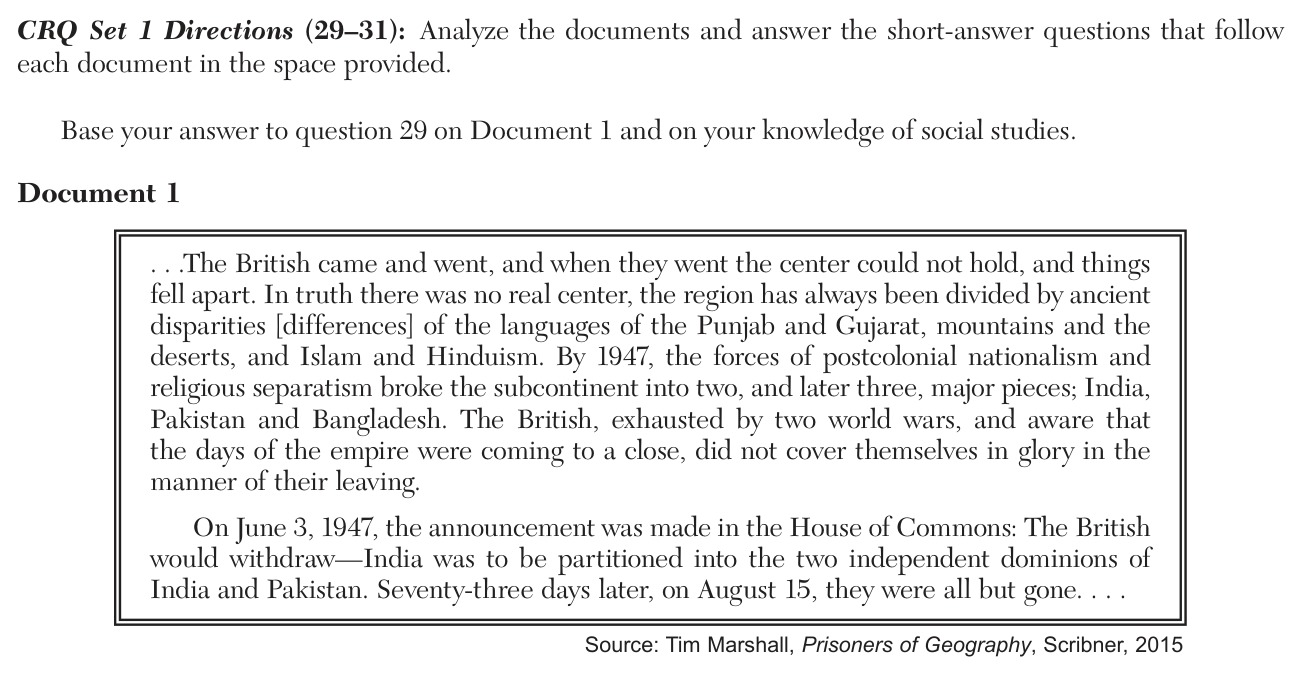
Question indexQ29 The partition of British India
Explain the circumstances behind the changes in Document 1.
Worked solution for question 29
- Connect postcolonial nationalism and demands for a separate Muslim state to the decision to create India and Pakistan.
- Use the document’s timing to show how rapidly withdrawal followed the announcement.
Final answerBritish exhaustion after World War II and pressure from independence movements led to withdrawal and partition in 1947.
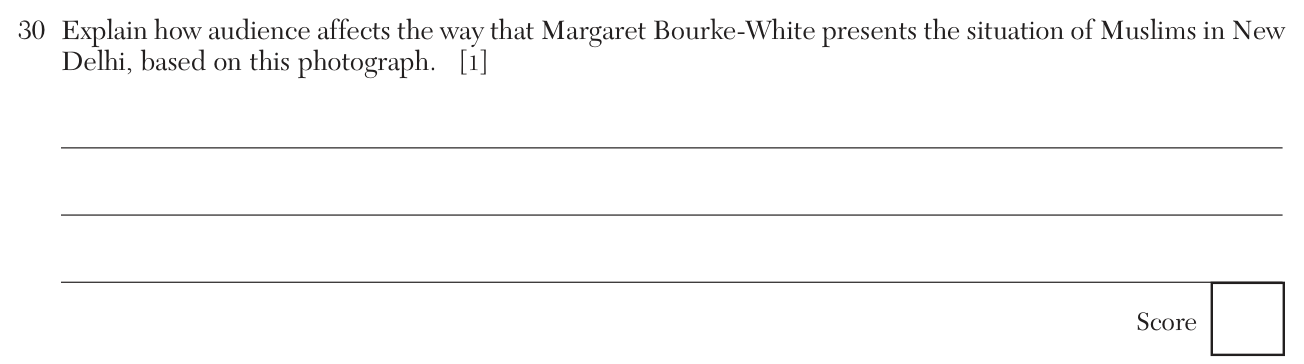
Q30 A photograph for Life readers
Explain how the audience shaped Bourke-White’s portrayal in Document 2.
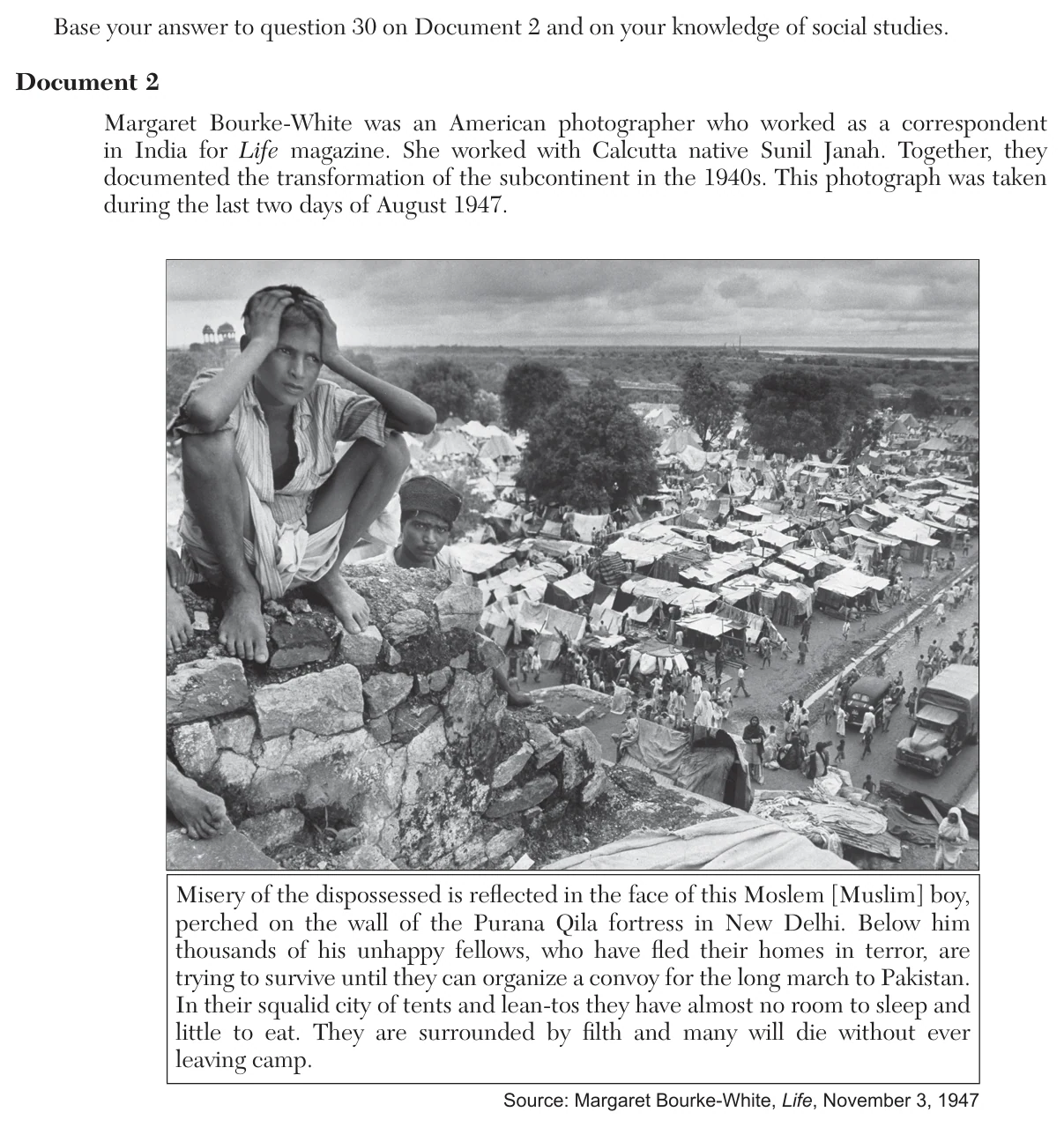
Worked solution for question 30
- Identify the audience as Life’s largely American readers.
- Link the boy’s image and the caption’s details about overcrowding and food shortages to the goal of communicating human consequences.
Final answerFor magazine readers distant from India, Bourke-White uses a close view of a Muslim boy to make refugee suffering immediate.
Q31 Partition and refugee flight
Explain cause and effect using both documents.
Worked solution for question 31
- Document 1 explains the rapid division of British India.
- Document 2 shows Muslim refugees waiting to reach Pakistan after fleeing their homes. The new borders and accompanying violence drove that movement.
Final answerPartition triggered population displacement and helped produce the refugee conditions shown in New Delhi.
Q32 Invention of the power loom
Explain the historical circumstances leading to Cartwright’s invention.
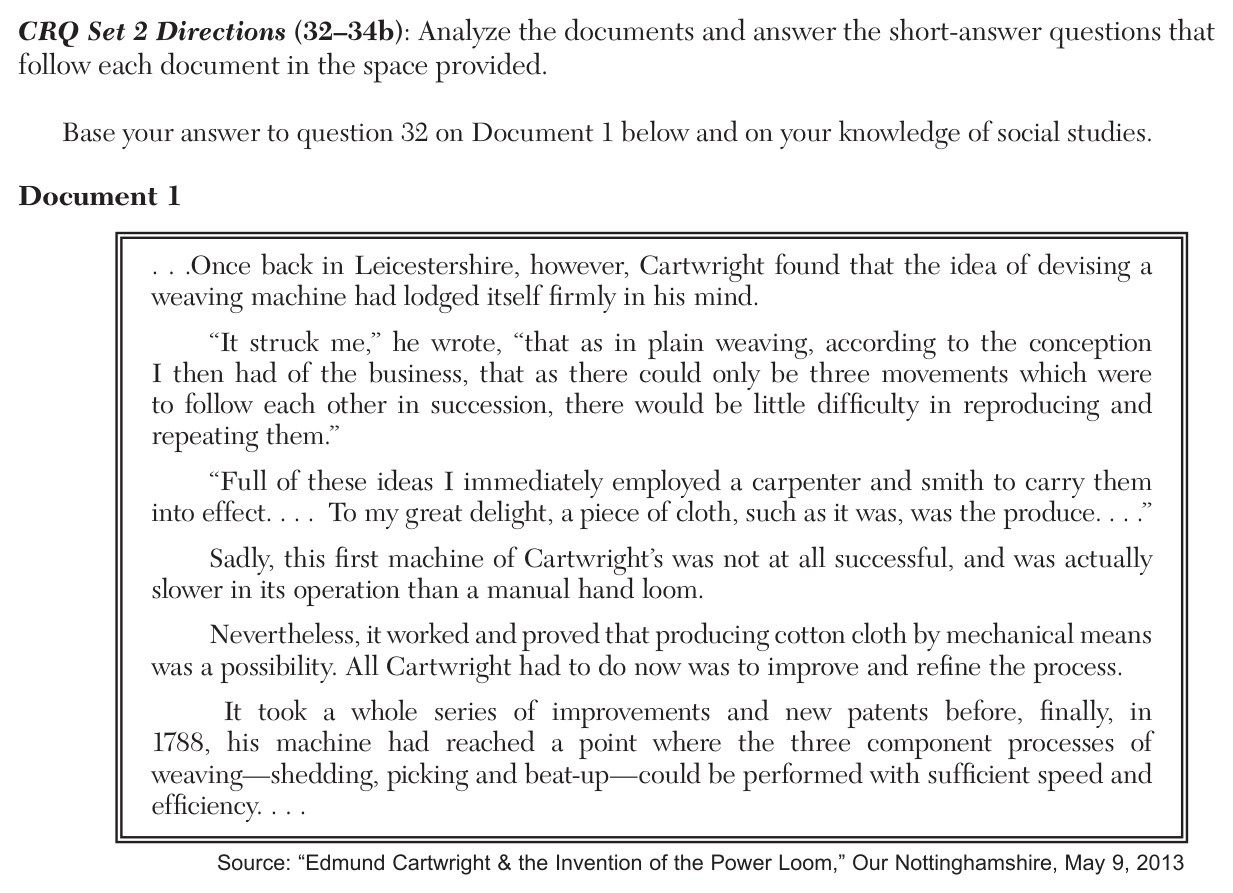
Worked solution for question 32
- Spinning could supply more yarn than hand weaving could readily process.
- Cartwright’s efforts applied mechanical power to that bottleneck as industrial production expanded.
Final answerDemand for cloth and advances in mechanical spinning created pressure to mechanize weaving in Britain.
Q33 Factory inquiry
What was the purpose of the commission’s 1833 report?
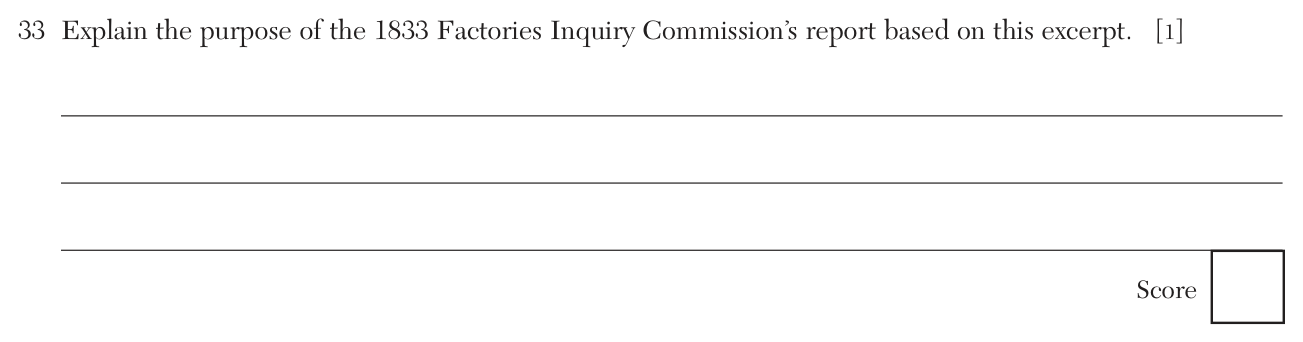
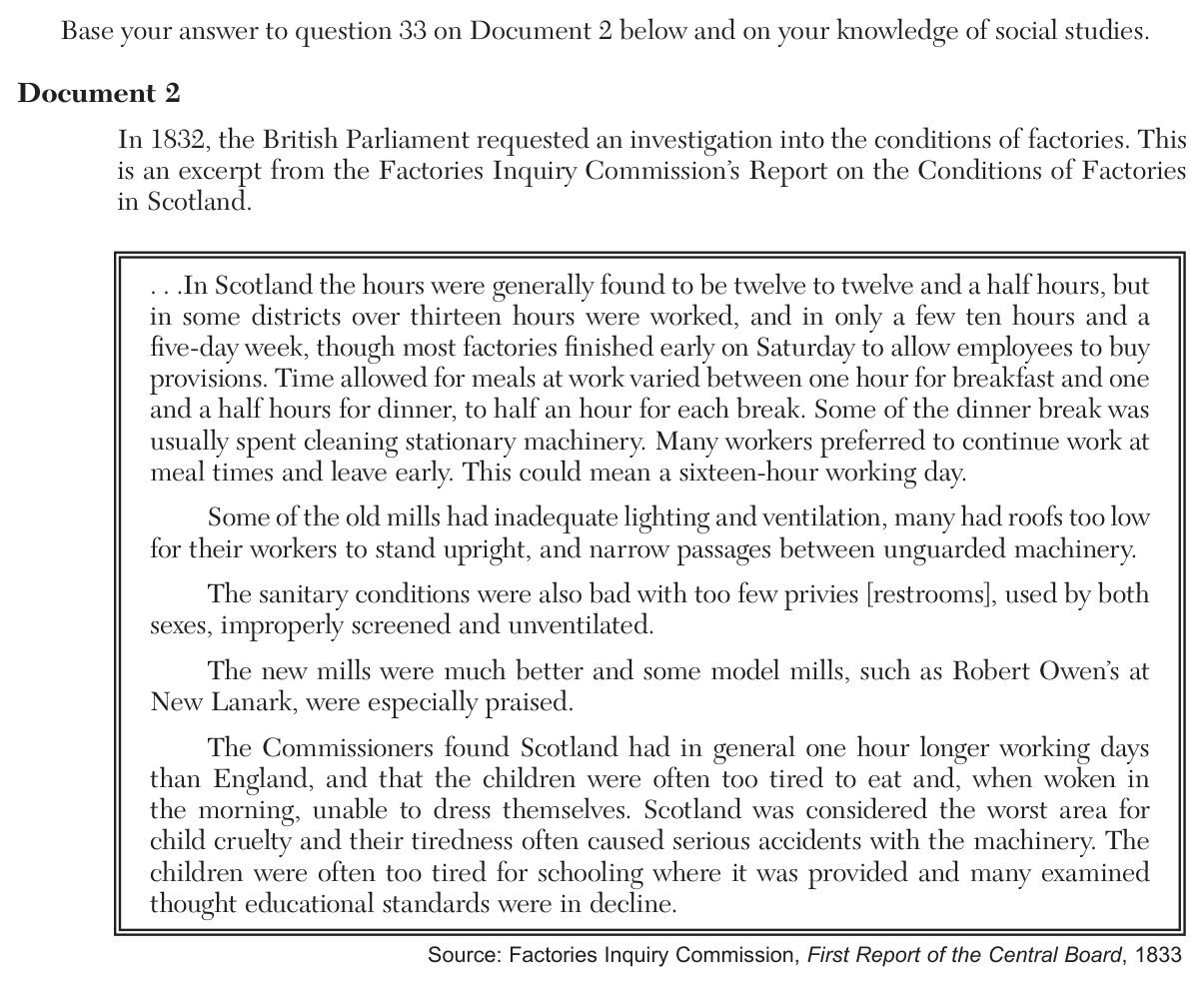
Worked solution for question 33
- The report measures working hours and describes unsafe machines and exhausted children.
- Those observations give lawmakers specific problems to assess.
Final answerInform Parliament about factory working conditions and provide evidence for decisions about regulation.
Q34a Identify the turning point
Identify a turning point connecting the two documents.
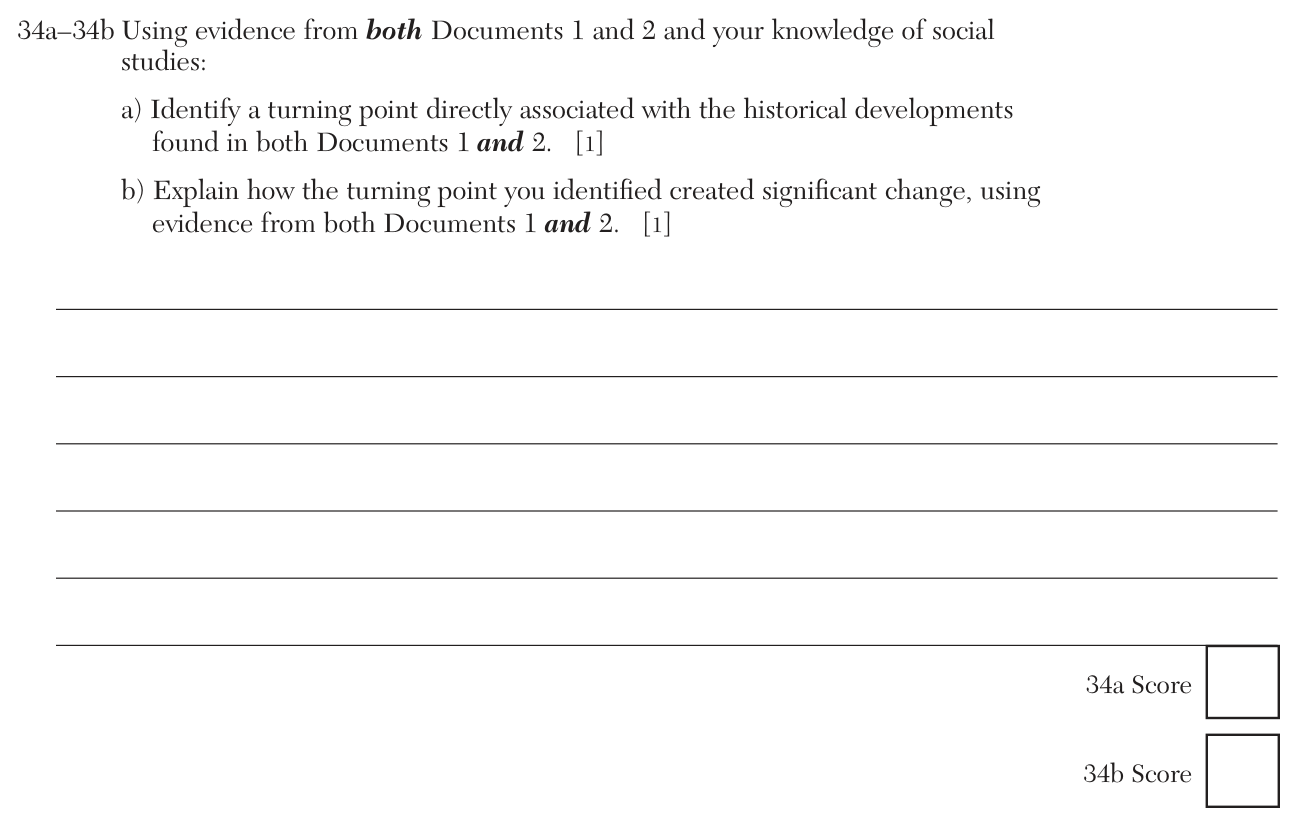
Worked solution for question 34a
- The power loom documents mechanization of textile production.
- The report records working conditions after production shifted to mills.
Final answerThe Industrial Revolution in Britain
Q34b Explain the turning point
Explain the change using both documents.
Worked solution for question 34b
- Document 1 shows the technology that moved weaving toward powered machinery.
- Document 2 shows long hours and unsafe conditions in mills, explaining how industrialization prompted public inquiry.
Final answerMechanization increased factory production and changed working life, creating pressure for regulation.
Part III Enduring issues essay
Question indexQ35 Enduring impacts of warfare
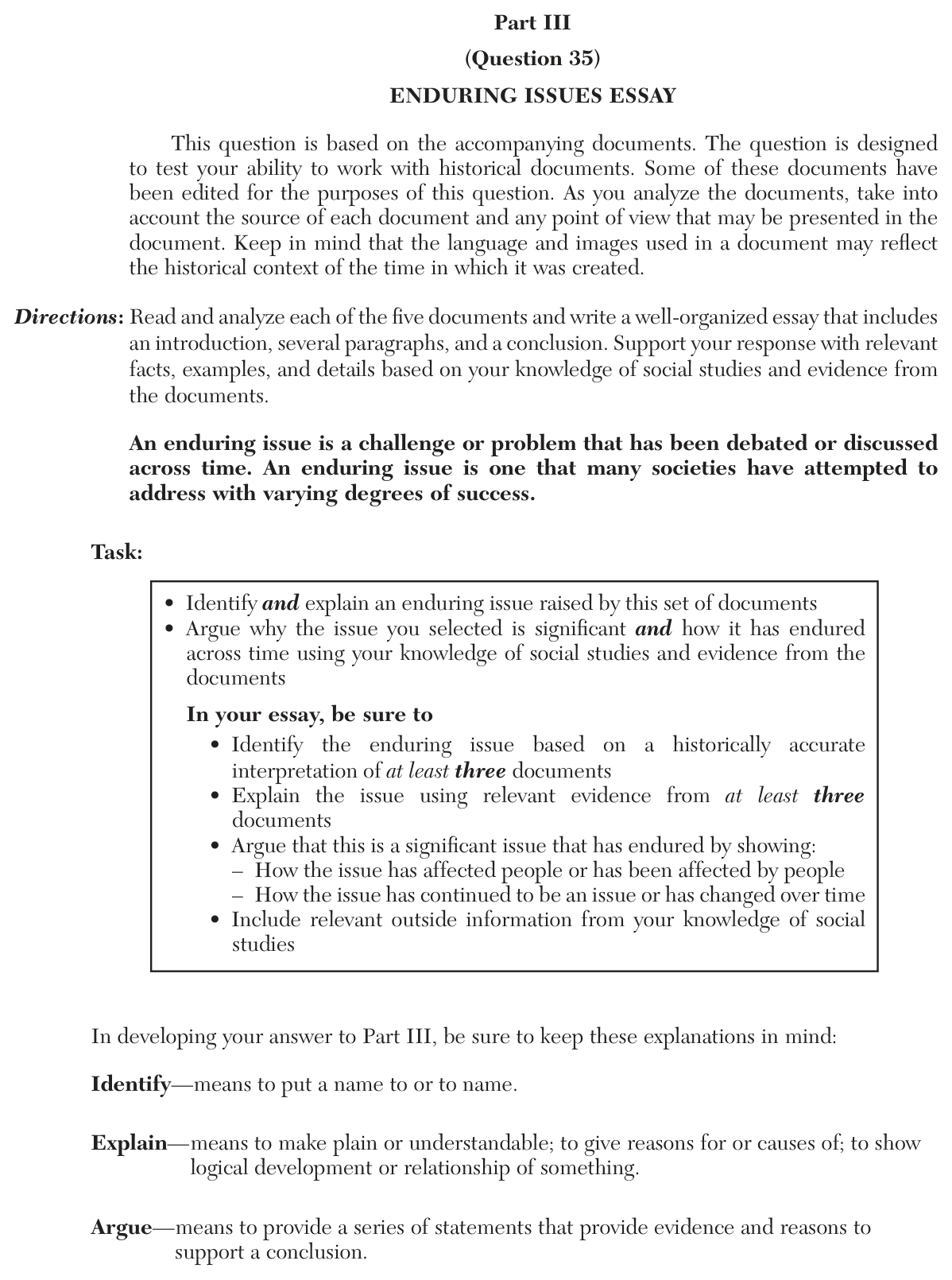
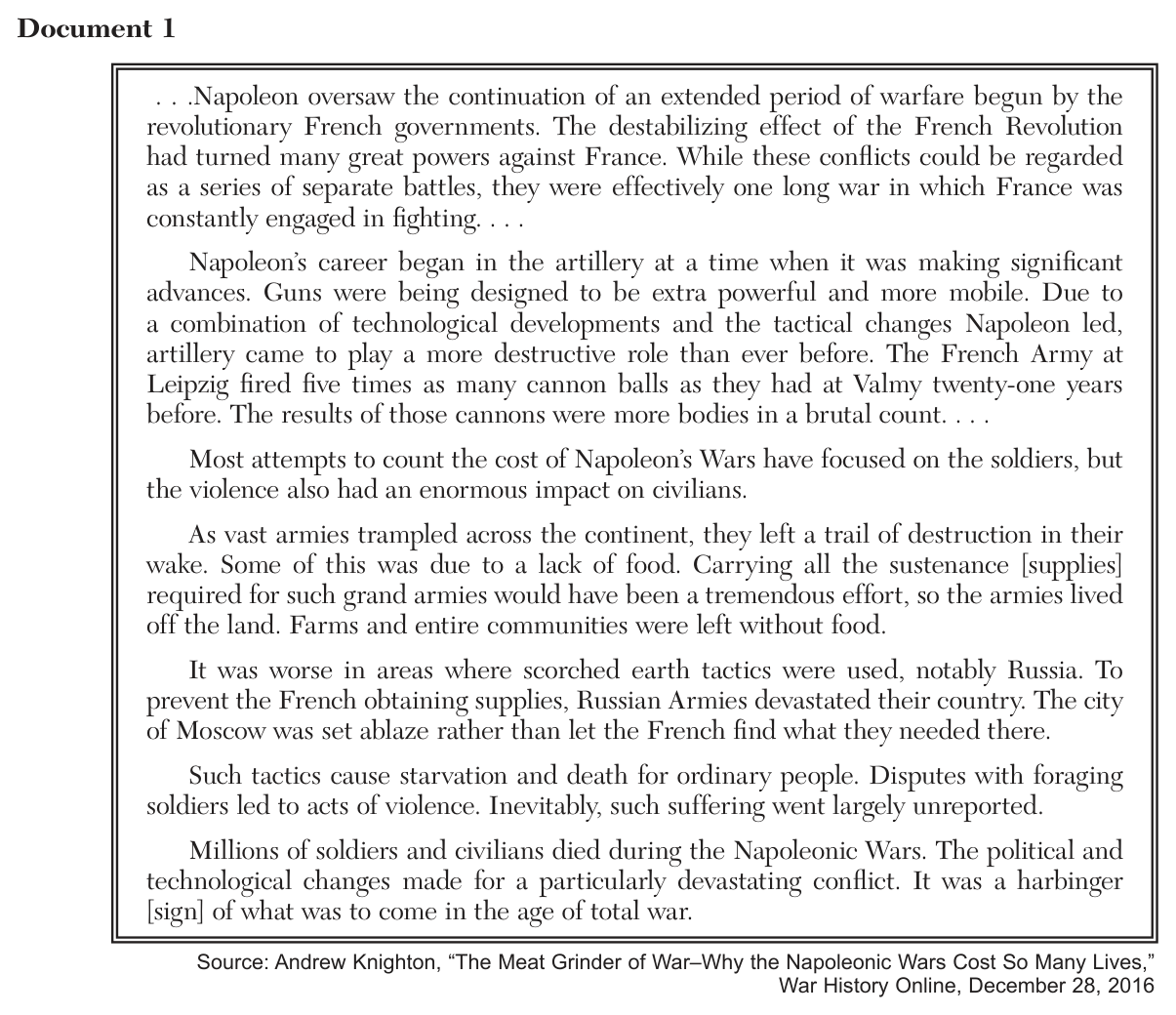
Use at least three documents and outside evidence to show why the impact of warfare is enduring and significant.
Writing plan and model response for question 35
- Connect technologies and tactics to specific effects. Compare both continuity and change across periods.
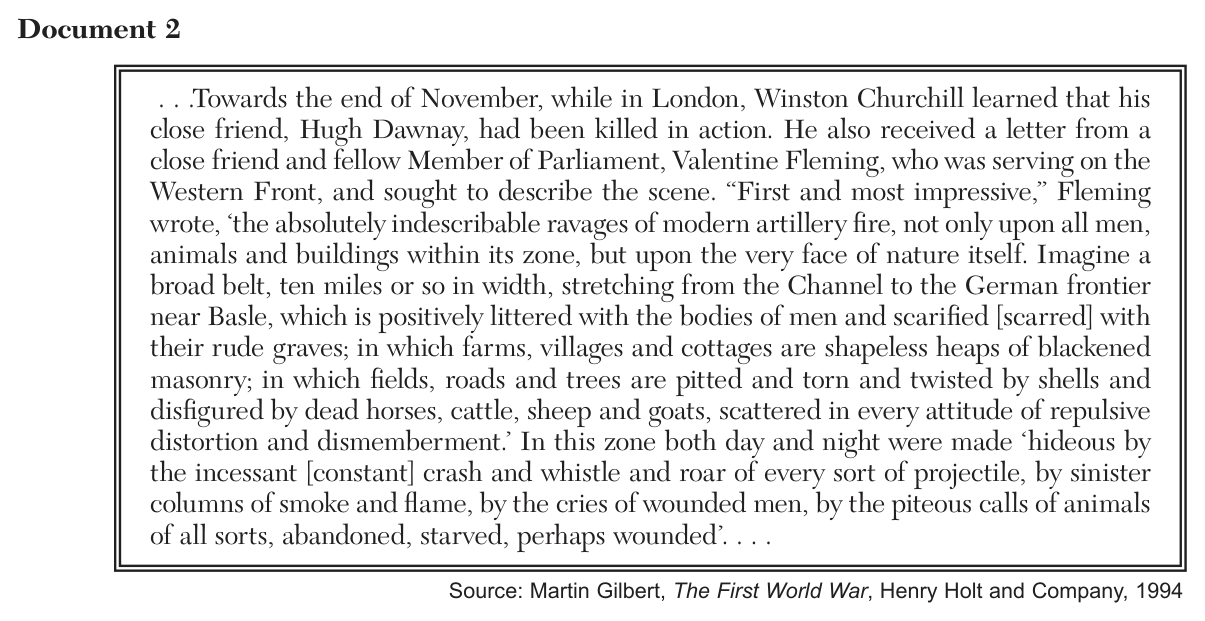
- Use outside context, such as the Western Front or radiation effects after Hiroshima, to develop the argument.
Central claimChanging weapons have repeatedly expanded warfare’s harm to civilians, combatants and the environment.
Model response
The destructive impact of warfare is an enduring issue because weapons and tactics change faster than societies can protect people from their consequences. Even when an attack is directed at a military goal, the damage can spread to civilian communities and survive the end of the fighting.
Document 1 describes the growing mobility and firepower of artillery in the Napoleonic era. Napoleon used artillery tactically to concentrate destructive force on a battlefield. A century later, Document 2 describes the much wider effect of modern artillery on the Western Front. Shelling destroyed farms and villages as well as soldiers and fortifications. Trench warfare and industrial production allowed armies to sustain bombardments over long periods. The development from mobile artillery to industrial shelling changed the scale of a continuing problem.
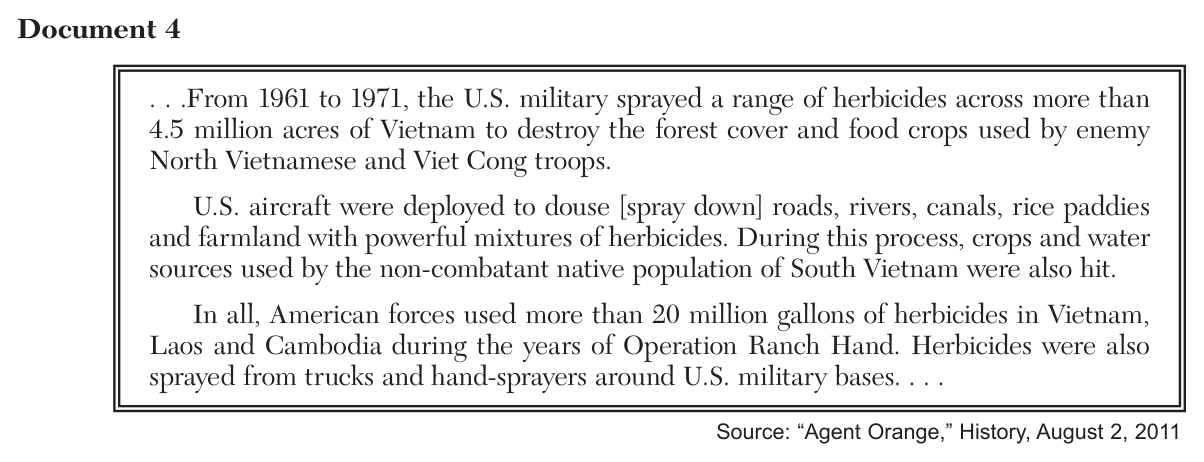
The bombing of Hiroshima shows a further shift. Document 3 contrasts the city before and after the atomic attack. A single weapon devastated a large urban area, and survivors faced burns and the longer-term effects of radiation. In Vietnam, a different technology also extended harm beyond the battlefield. The spraying described in Document 4 targeted forest cover and enemy supplies, but herbicides reached crops and water used by civilians. This made harm persist after the immediate military operation.
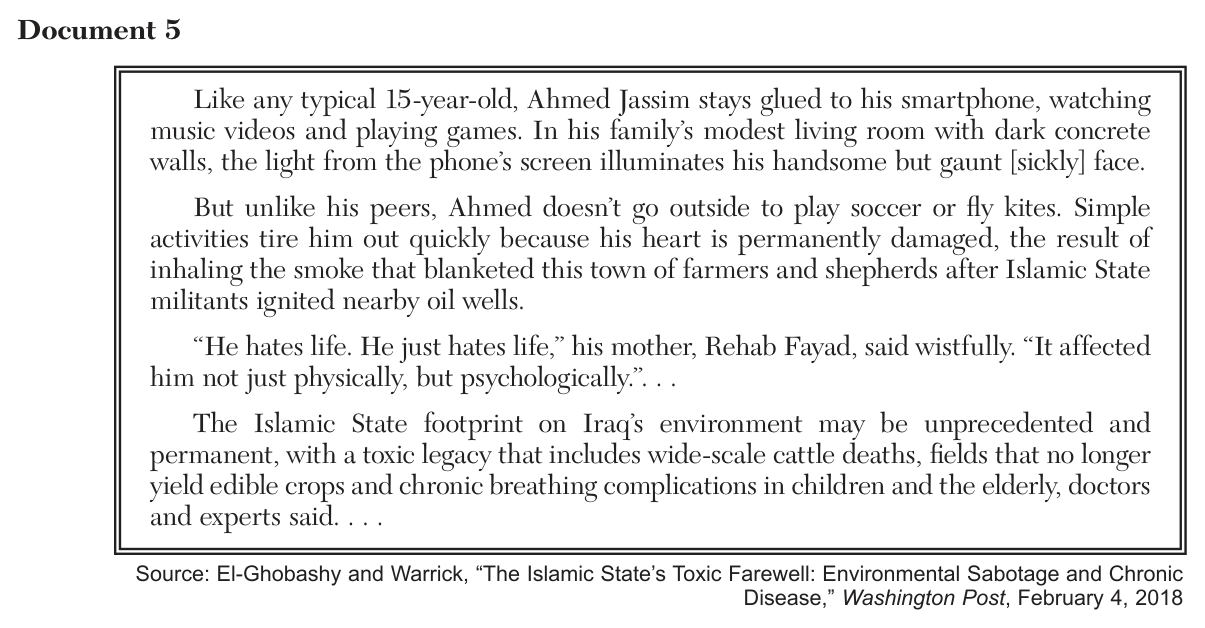
Document 5 shows that military destruction can also be deliberately environmental. The burning of oil wells by Islamic State militants exposed residents to smoke, and the account of Ahmed illustrates the lasting consequences of that exposure. Across the documents, weapons range from artillery to nuclear explosives and chemicals. The continuity lies in the way military action reaches people far from the intended target in space or time. The changes lie in the expanding ways a single operation can damage an entire landscape and the people who depend on it.
From the New York State Education Department. June 2026 Global History and Geography II Regents Examination. Internet. Available from https://www.nysedregents.org/ghg2/626/glhg2-62026-exam.pdf. Accessed .