NEW YORK STATE REGENTS · ALGEBRA I
January 2026 Algebra I Regents Past Paper & Solutions
Work through factoring, linear regression and systems of equations with a question-by-question walkthrough of the exam.
- 35 worked questions
- 82 raw credits
- 4 exam parts
The question images and page numbers come from the regular-size English exam. OnlyPrepy wrote the summaries and worked solutions.
Quick answer key for Part I
Part I Multiple choice
Question indexQ1 Vertex and symmetry
Read the vertex and vertical line of symmetry from the parabola.
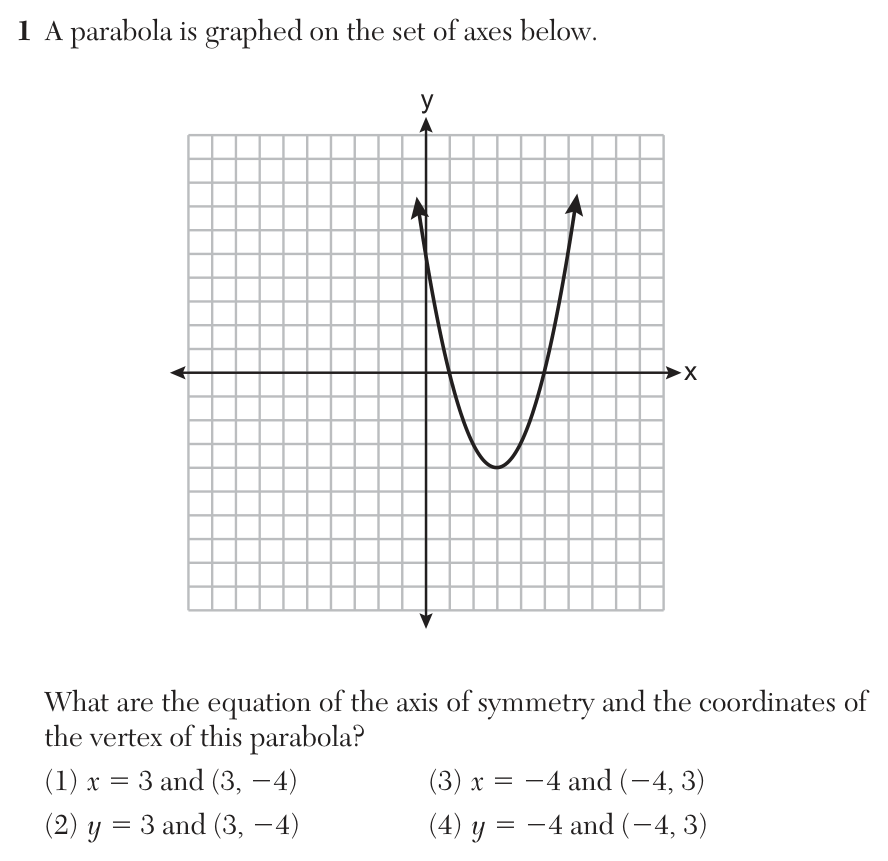
Worked solution for question 1
- Locate the turning point by moving 3 units right and 4 down from the origin.
- The mirror line runs vertically through that point, so its x-coordinate is always 3.
- The vertex is a single point; the axis contains every point with that same x-coordinate. A line y = −4 touches the vertex but does not split the parabola into mirror halves.
Answer choice 1Vertex (3, −4), axis x = 3
Q2 Product of radicals
Classify the number √25 · √2.
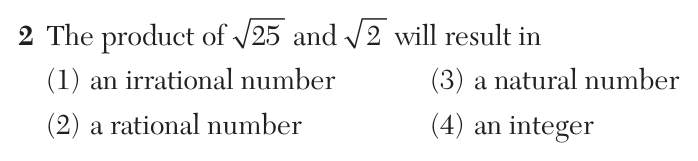
Worked solution for question 2
- The principal square root of 25 is 5, giving 5√2.
- If 5√2 were rational, dividing it by 5 would make √2 rational, which is impossible.
Answer choice 1Irrational
Q3 Intersection with absolute value
Find a listed x where ∣4x + 2∣ = 3x + 5.
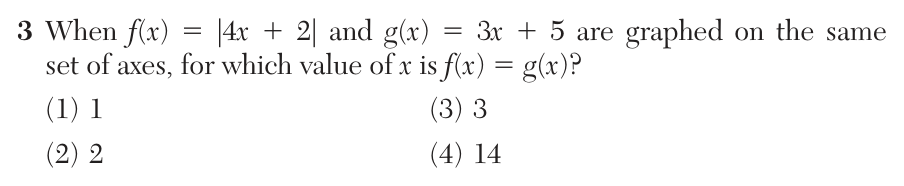
Worked solution for question 3
- On the branch 4x + 2 ≥ 0, solve 4x + 2 = 3x + 5 to get x = 3.
- Both functions equal 14 there. The other branch gives x = −1, which is outside the listed choices.
- Checking both candidate intersections gives f(−1) = g(−1) = 2 and f(3) = g(3) = 14. Only 3 appears among the choices.
Answer choice 3x = 3
Q4 Factor a trinomial
Factor x² − 26x − 120.
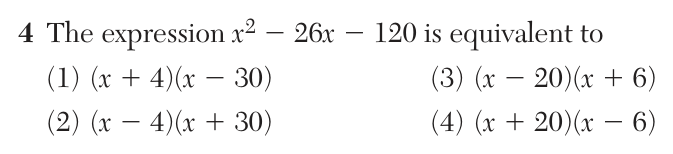
Worked solution for question 4
- Find integers whose product is −120 and whose sum is −26. The pair is 4 and −30.
- Use those numbers in the two factors. Their cross terms combine to −26x.
Answer choice 1(x + 4)(x − 30)
Q5 Combine like radicals
Simplify 3 − 2√5 + 6√5.
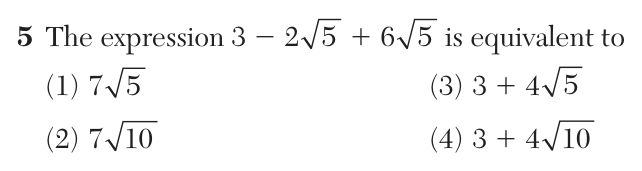
Worked solution for question 5
- Both radical terms share √5. Add their coefficients to get −2 + 6 = 4.
- The constant 3 is a separate term, so retain it.
Answer choice 33 + 4√5
Q6 Degree and leading coefficient
Identify the listed cubic with leading coefficient 2 and constant −6.
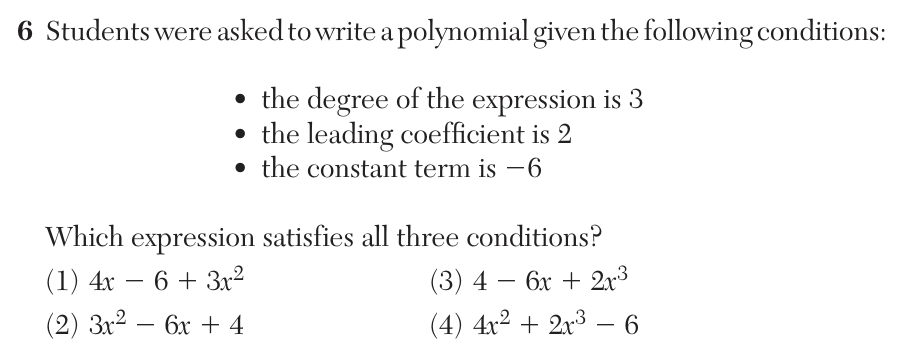
Worked solution for question 6
- Degree 3 requires x³ to be the highest power. Its term must be 2x³.
- The term without x is −6. Reordering the terms leaves the degree and coefficients intact.
Answer choice 44x² + 2x³ − 6
Q7 Vertical line test
Identify the graph that gives a single output at every input in its domain.
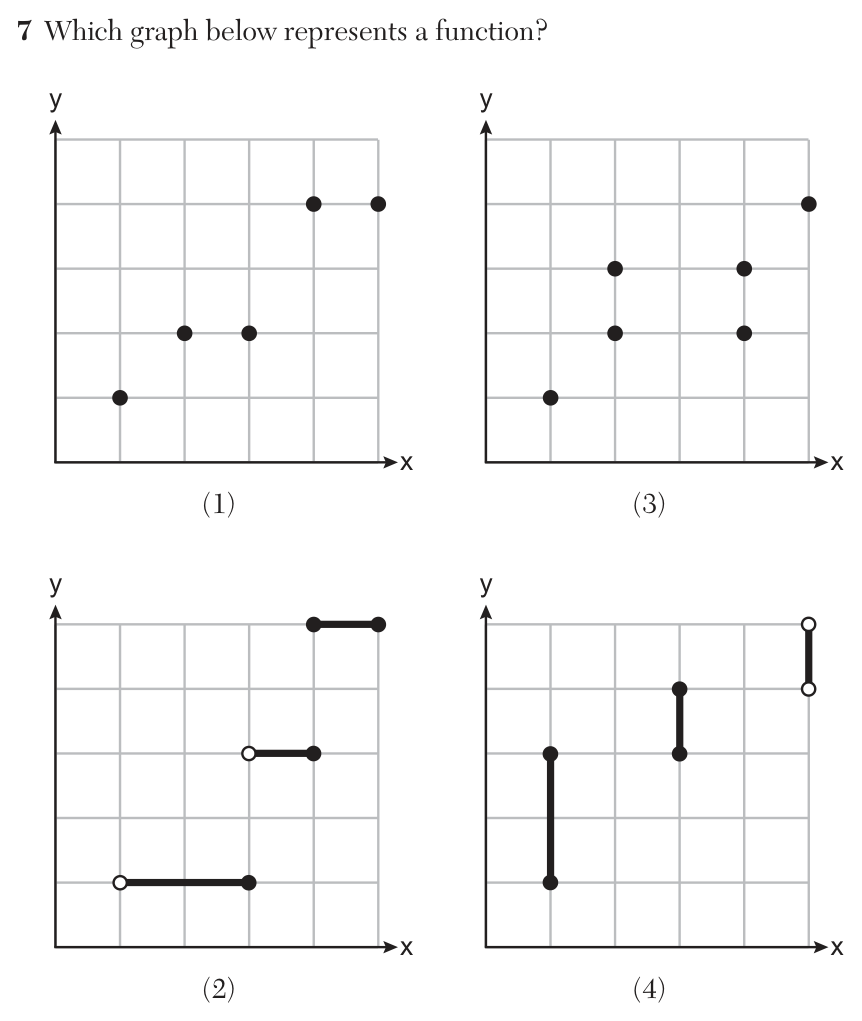
Worked solution for question 7
- Imagine sliding a vertical line from left to right across each graph.
- Only graph 1 never has two intersections at the same x. That makes its input-output assignment a function.
- In graph 2, inspect the input where a filled segment endpoint lines up with another filled point. Graphs 3 and 4 also have repeated x-values with different outputs. Only the points in graph 1 pass the vertical-line test.
Answer choice 1Graph 1
Q8 Initial exponential value
Find the starting value of v(t) = 500(1.08)ᵗ.
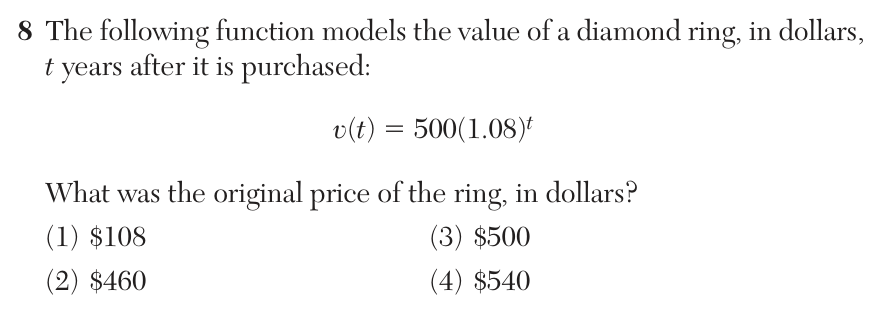
Worked solution for question 8
- The purchase occurs at t = 0.
- Since 1.08⁰ = 1, the model starts at v(0) = 500.
- The 1.08 tells you how the value changes each year. The factor outside the power, 500, is the amount before any growth has taken place.
Answer choice 3500 dollars
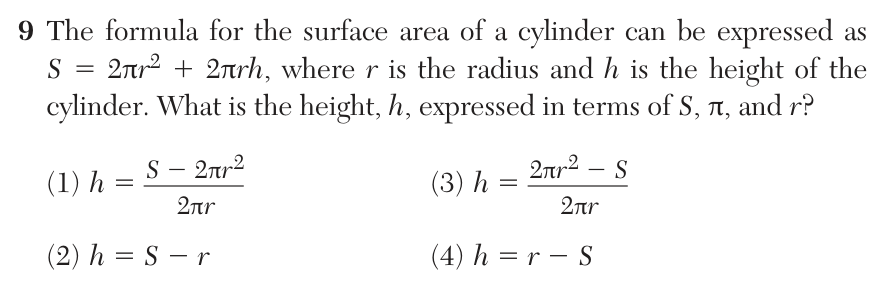
Q9 Cylinder height
Rearrange S = 2πr² + 2πrh for h.
Worked solution for question 9
- Remove the combined area of the circular bases by subtracting 2πr².
- The remaining lateral area is 2πrh. Divide by the circumference 2πr.
- A cylinder with positive radius has 2πr ≠ 0. Substituting the isolated height back gives 2πr² + (S − 2πr²) = S.
Answer choice 1h = (S − 2πr²)/(2πr)
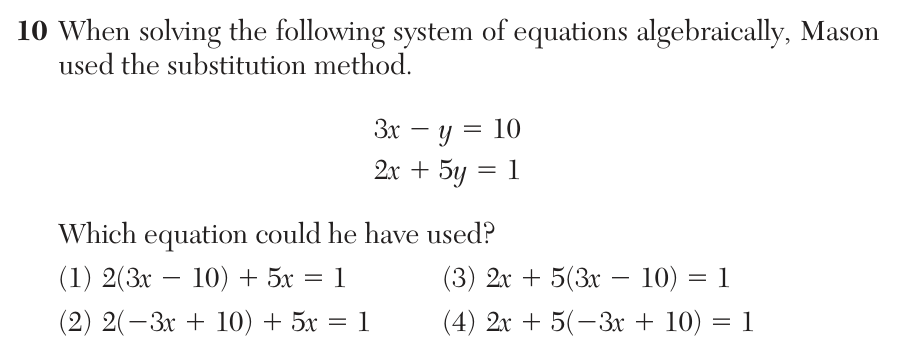
Q10 Substitution
Use 3x − y = 10 to replace y in 2x + 5y = 1.
Worked solution for question 10
- Rearrange the first equation to y = 3x − 10.
- Replace the entire y term with the expression in parentheses so the 5 multiplies both terms.
Answer choice 32x + 5(3x − 10) = 1
Q11 Strict inequality
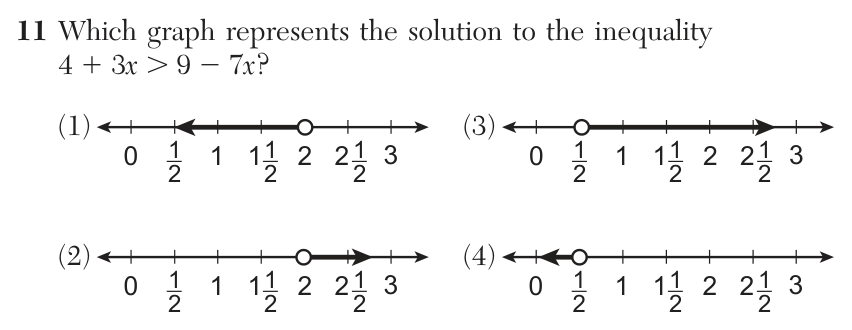
Choose the number line for 4 + 3x > 9 − 7x.
Worked solution for question 11
- Add 7x and subtract 4 to get 10x > 5.
- Divide by positive 10 to keep the inequality direction. Draw an open circle at 1/2 and shade to the right.
Answer choice 3x > 1/2
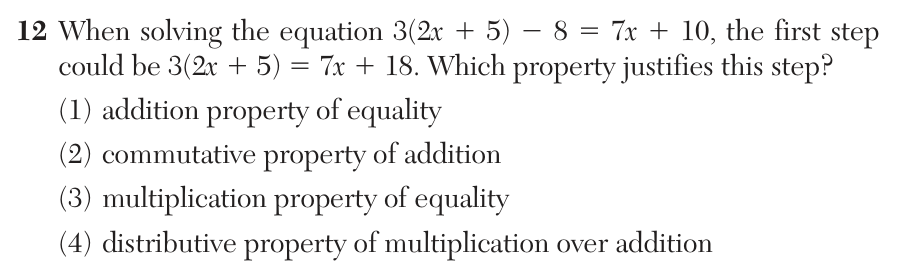
Q12 Equality property
Explain the move from 3(2x + 5) − 8 = 7x + 10 to 3(2x + 5) = 7x + 18.
Worked solution for question 12
- Adding 8 cancels the −8 on the left.
- The same addition on the right turns 10 into 18, preserving equality.
Answer choice 1Addition property of equality
Q13 Recognize exponential decay
Pick the table with a roughly constant decay multiplier at equal input steps.
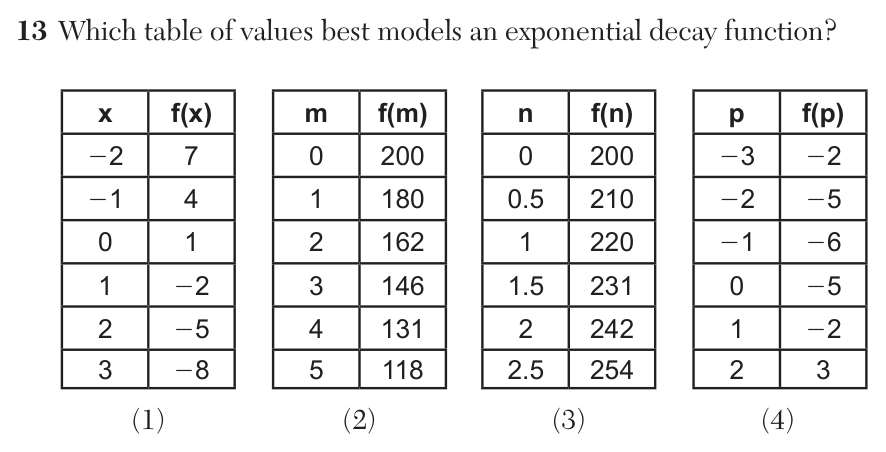
Worked solution for question 13
- For the first two steps, 180/200 = 162/180 = 0.90.
- Multiplying by 0.90 again gives 145.8, which rounds to 146. The later values follow the same rounded decay pattern.
- The first table changes by an additive −3 each step, which is linear. The third increases, while the fourth reverses direction. The approximately constant ratio below 1 distinguishes the decay table.
Answer choice 2200, 180, 162, 146, 131, 118
Q14 Evaluate a radical function
Evaluate f(x) = √(x + 1) + 5 at x = 3.
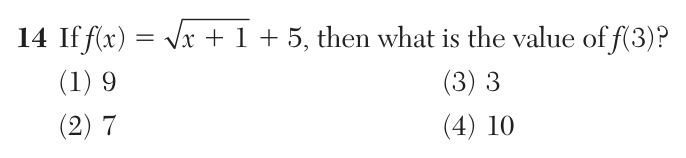
Worked solution for question 14
- Substitute inside the radical first to get √(3 + 1) + 5.
- The principal square root of 4 is 2, so the result is 2 + 5.
Answer choice 27
Q15 Horizontal translation
Shift f(x) = (x + 5)² − 2 three units left.
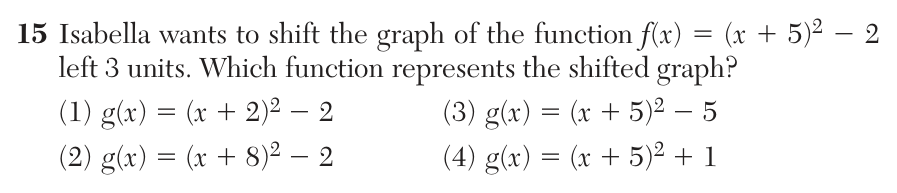
Worked solution for question 15
- Use g(x) = f(x + 3). The original input is reached at an x-coordinate 3 smaller on the shifted graph.
- Simplify ((x + 3) + 5)² − 2 to (x + 8)² − 2.
Answer choice 2g(x) = (x + 8)² − 2
Q16 Zeros of a cubic
Find every zero of x(x² − 36).
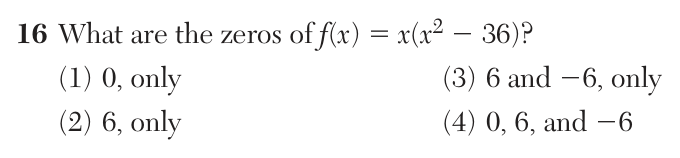
Worked solution for question 16
- Factor the difference of squares to write x(x − 6)(x + 6).
- A product is zero when any factor is zero. Solve the three linear equations individually.
Answer choice 4−6, 0, 6
Q17 Points on a parabola
Find x if (x, −6) satisfies y = −x² − x + 6.
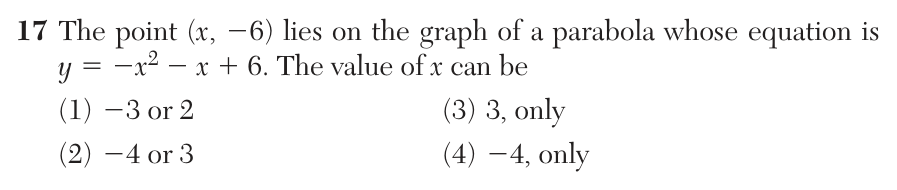
Worked solution for question 17
- Use the equation y = −x² − x + 6 and substitute y = −6.
- Rearrange to x² + x − 12 = 0. The factors (x + 4)(x − 3) give the two solutions.
Answer choice 2−4 or 3
Q18 Joint relative frequency
58 purchases include both pizza and water out of 400 total. Find the joint relative frequency.
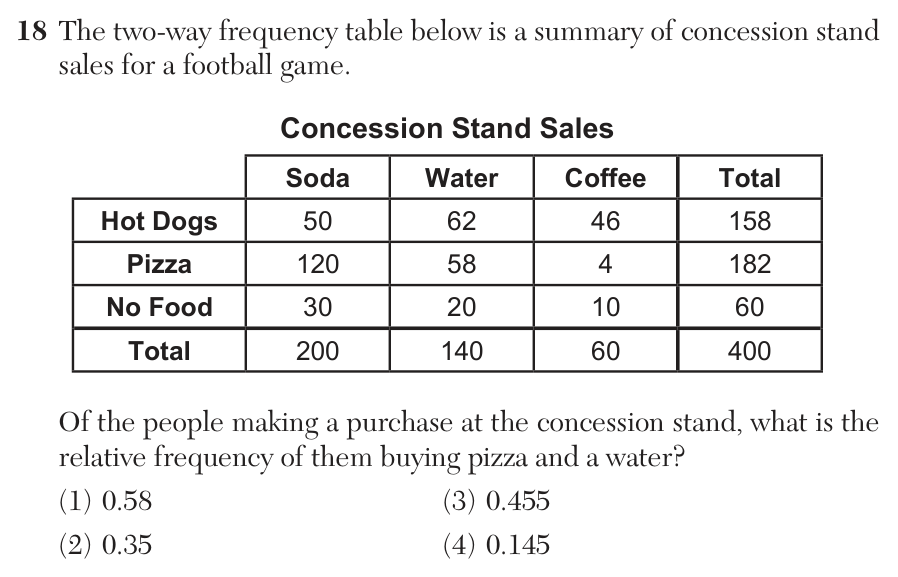
Worked solution for question 18
- The numerator is the pizza–water intersection cell, 58.
- Use the overall total 400 as the denominator. Dividing gives 0.145, or 14.5%.
- The pizza total, 182, would be the denominator if the question conditioned on pizza buyers. Here the sample space includes all 400 purchases.
Answer choice 40.145
Q19 Unit cancellation
Start with km/h and follow the factors converting hours to seconds and kilometers to feet.
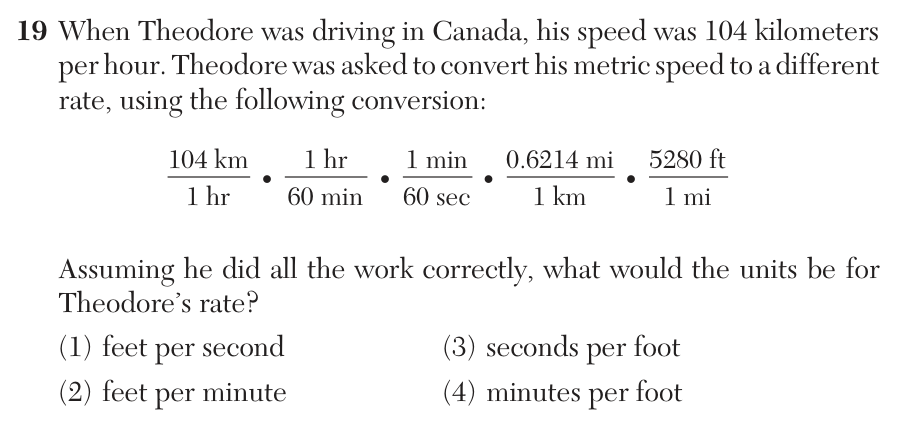
Worked solution for question 19
- In the time factors, hours cancel first, then minutes, leaving seconds in the denominator.
- In the distance factors, kilometers cancel first, then miles, leaving feet in the numerator.
Answer choice 1Feet per second
Q20 Power of a monomial
Simplify (−2x²)³.
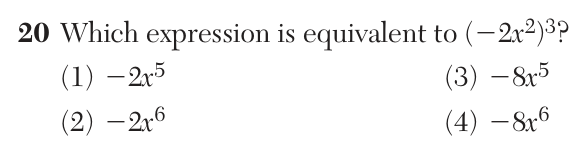
Worked solution for question 20
- Cube the coefficient to get (−2)³ = −8.
- Use the power-of-a-power rule to get (x²)³ = x⁶. Multiply the two pieces.
Answer choice 4−8x⁶
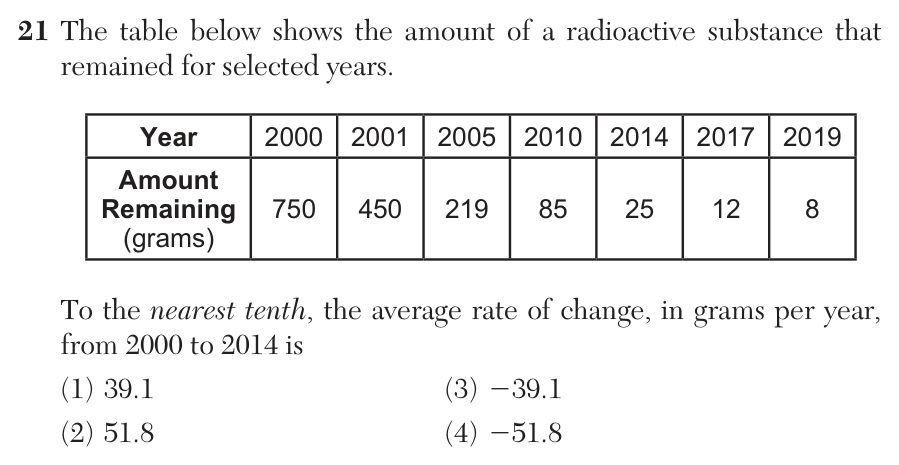
Q21 Average rate of change
Find the yearly rate from 750 grams in 2000 to 25 grams in 2014.
Worked solution for question 21
- The mass change is 25 − 750 = −725 grams over 2014 − 2000 = 14 years.
- Divide −725 by 14 and round to the nearest tenth.
- The sign has meaning. Since the ending amount is smaller, the average change is a loss of about 51.8 grams each year over that interval.
Answer choice 4−51.8 grams per year
Q22 Subtract polynomials
Subtract 2x² − 3x + 4 from x² + 2x − 5.

Worked solution for question 22
- Distribute the subtraction to all three terms of the second polynomial.
- Combine x² − 2x², 2x + 3x, and −5 − 4 separately.
Answer choice 3−x² + 5x − 9
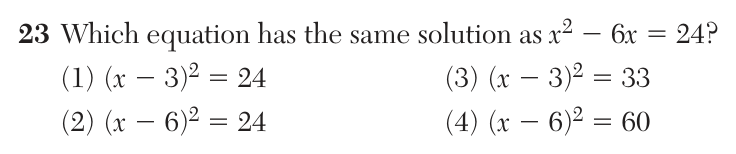
Q23 Complete the square
Write x² − 6x = 24 as an equivalent squared-binomial equation.
Worked solution for question 23
- Take half the x-coefficient, −3, and square it to get 9.
- Add 9 to both sides and factor x² − 6x + 9.
- After adding 9, the right side becomes 24 + 9 = 33. Expanding the left side (x − 3)² gives x² − 6x + 9, confirming equivalence.
Answer choice 3(x − 3)² = 33
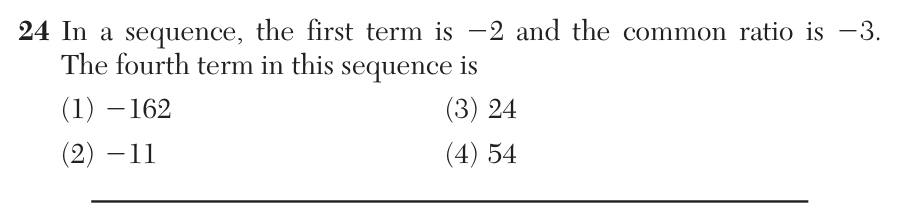
Q24 Geometric sequence
Find the fourth term when a₁ = −2 and the common ratio is −3.
Worked solution for question 24
- Each move to the next term multiplies by −3. Starting at −2 gives 6, then −18, then 54.
- Equivalently, a₄ = −2(−3)³ because three multiplications separate terms one and four.
Answer choice 454
Part II Short response
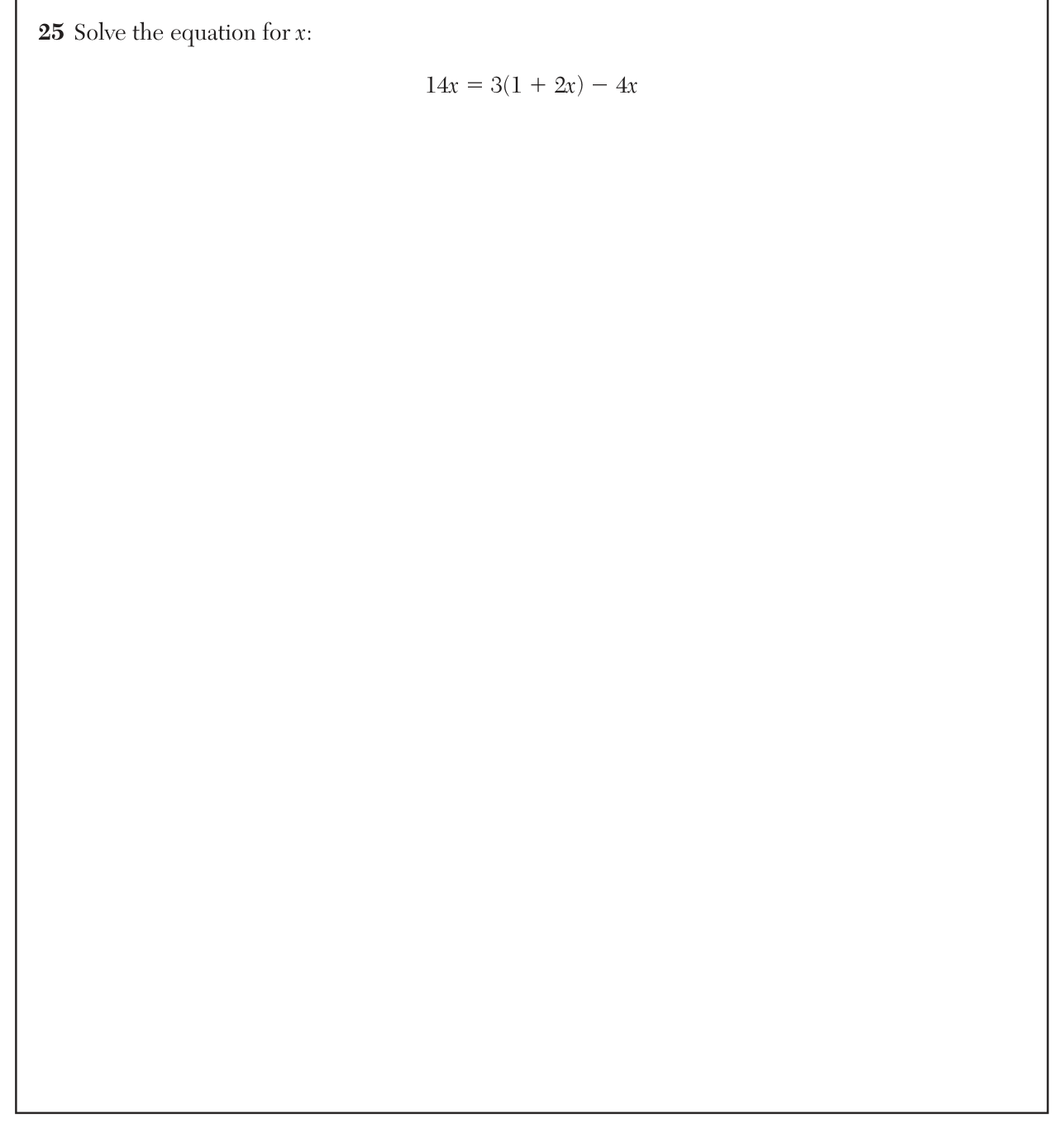
Question indexQ25 Solve a linear equation
Solve 14x = 3(1 + 2x) − 4x.
Worked solution for question 25
- Distribute 3 to get 14x = 3 + 6x − 4x = 3 + 2x.
- Subtract 2x to get 12x = 3. Dividing by 12 gives x = 1/4.
Final answerx = 1/4
Q26 Exponential graph
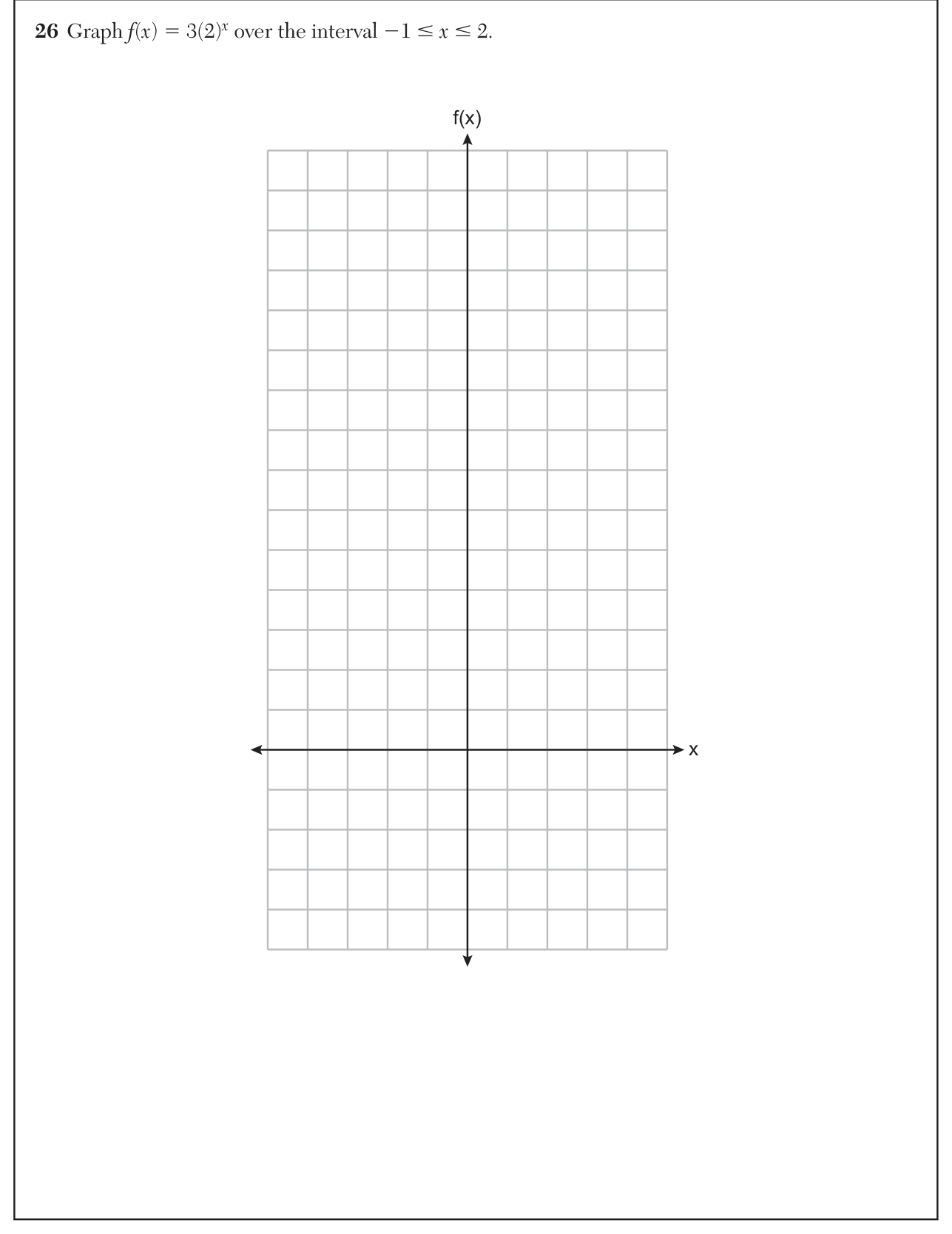
Graph f(x) = 3(2)ˣ on −1 ≤ x ≤ 2.
Worked solution for question 26
- Evaluate the function at x = −1, 0, 1, and 2 to get y = 1.5, 3, 6, and 12.
- Plot all four points and connect them with a smooth increasing, concave-up curve. Include both endpoints.
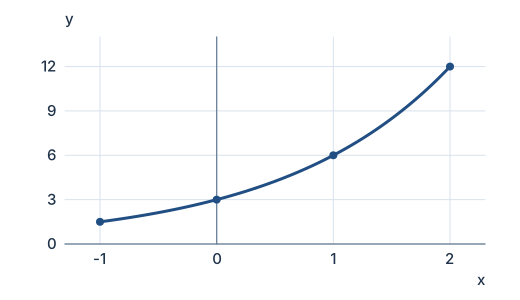
Final answerIncreasing curve from (−1, 1.5) to (2, 12)
Q27 Polynomial multiplication
Multiply (2x + 3)(−6x² + 5x − 1) in standard form.

Worked solution for question 27
- The products from 2x are −12x³ + 10x² − 2x. The products from 3 are −18x² + 15x − 3.
- Combine equal powers and arrange the result from degree 3 down to the constant.
Final answer−12x³ − 8x² + 13x − 3
Q28 Box plot
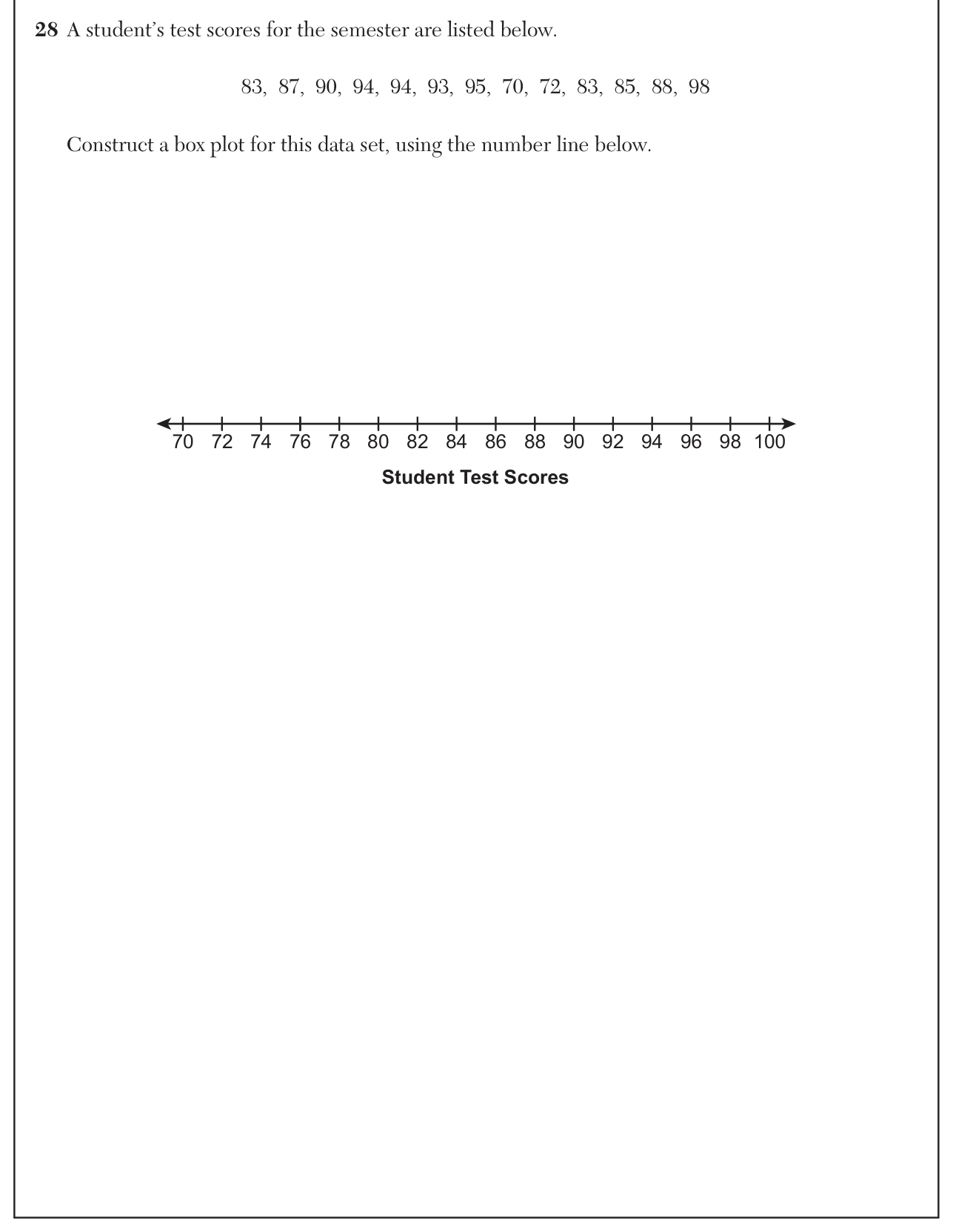
Draw a box plot for the 13 test scores on the paper.
Worked solution for question 28
- Sort to get 70, 72, 83, 83, 85, 87, 88, 90, 93, 94, 94, 95, 98. The seventh score is the median.
- Exclude 88 from the two halves. Average the middle two values in each half to get 83 and 94.
- Draw a box from 83 to 94, a median line at 88 and whiskers to 70 and 98.
- There are six observations on each side of the median. The lower middle values are 83 and 83, and the upper middle values are 94 and 94.
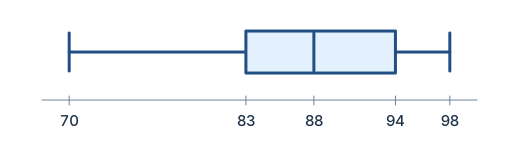
Final answerFive-number summary (70, 83, 88, 94, 98)
Q29 Slope-intercept equation
Find the line with slope 2/3 through (6, 3).

Worked solution for question 29
- Insert the slope in y = mx + b. Substitution of the point gives 3 = (2/3)(6) + b.
- Solve 3 = 4 + b to get b = −1.
Final answery = (2/3)x − 1
Q30 Budget inequality
A 20-dollar budget covers 8.50 dollars of food and tickets at 2.25 dollars each. Find the maximum number of tickets.

Worked solution for question 30
- For t tickets, write 8.50 + 2.25t ≤ 20.
- Subtract 8.50 and divide by 2.25 to get t ≤ 11.50/2.25 ≈ 5.11.
- The largest whole number allowed is 5. Six tickets alone would cost 13.50, above the remaining budget.
Final answer5 tickets
Part III Extended response
Question indexQ31 Rocket height
Sketch h(t) = −16t² + 80t and find when and where it reaches its peak.
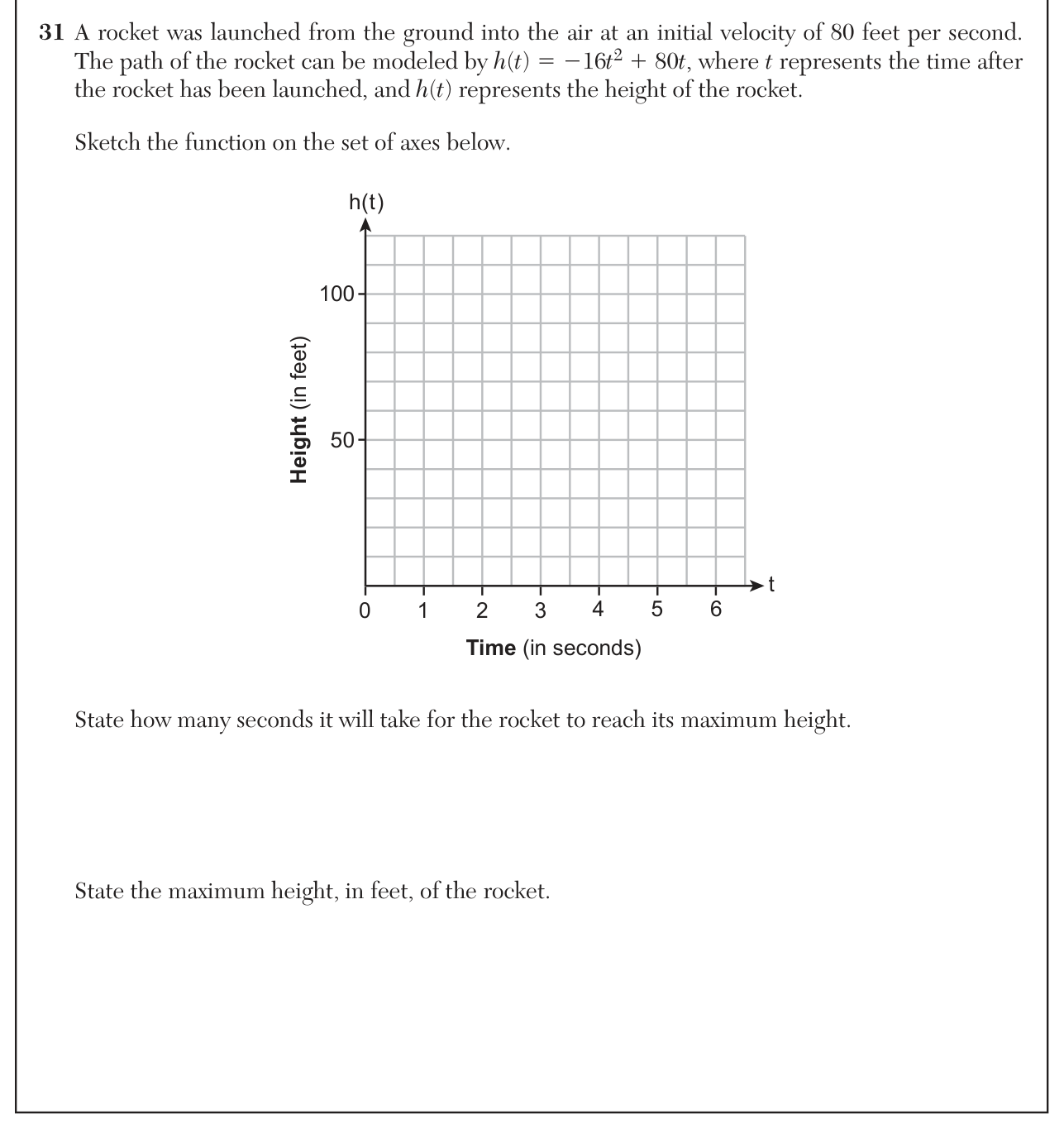
Worked solution for question 31
- Factor h(t) = −16t(t − 5). The rocket is on the ground at t = 0 and 5.
- The downward parabola is symmetric about the midpoint t = 2.5. Evaluate h(2.5) = −100 + 200 = 100.
- Plot (0, 0), (1, 64), (2, 96), (2.5, 100), (3, 96), (4, 64), and (5, 0) and join smoothly over the flight.
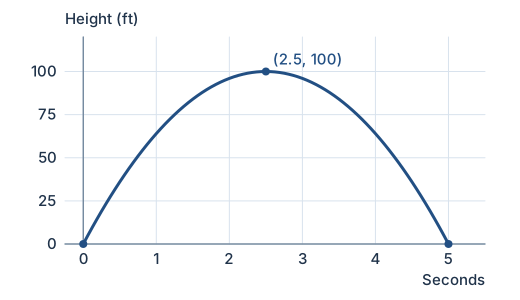
Final answer2.5 seconds, 100 feet
Q32 Quadratic formula
Solve 2x² − 4x − 3 = 0 by the quadratic formula.

Worked solution for question 32
- Use a = 2, b = −4 and c = −3. The discriminant is 16 − 4(2)(−3) = 40.
- Substitute to get x = (4 ± √40)/4. Since √40 = 2√10, reduce numerator and denominator by 2.
Final answerx = (2 ± √10)/2
Q33 Insurance regression
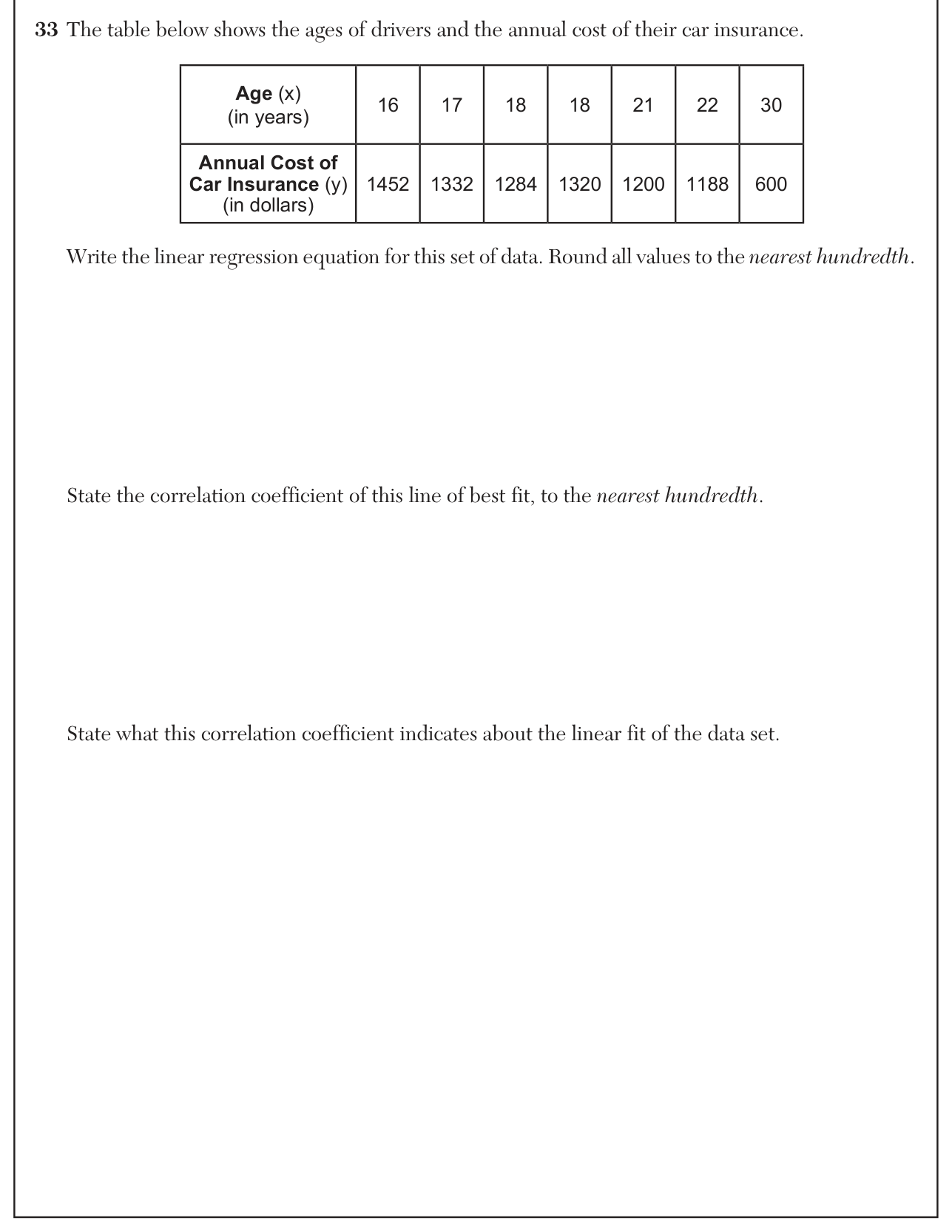
Fit the seven age and annual premium pairs with a line. Report and interpret r.
Worked solution for question 33
- Enter ages 16, 17, 18, 18, 21, 22, 30 as x and premiums 1452, 1332, 1284, 1320, 1200, 1188, 600 as y.
- Run linear regression and round the slope, intercept and r to hundredths.
- The correlation is close to −1, indicating a strong negative linear association.
Final answerŷ = −56.97x + 2352.22, r = −0.98
Q34 Graph a system of inequalities
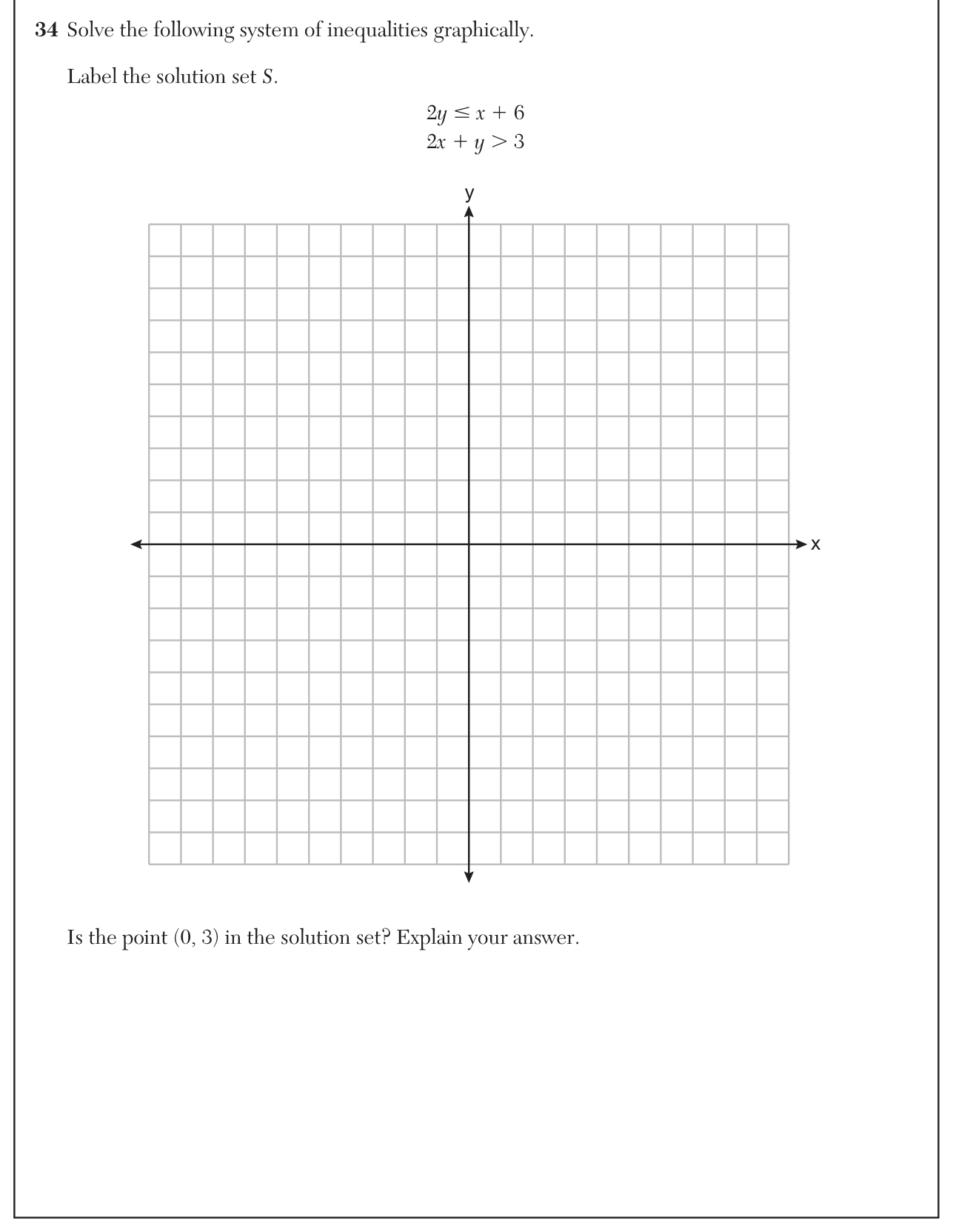
Graph 2y ≤ x + 6 and 2x + y > 3. Test (0, 3).
Worked solution for question 34
- Graph y = x/2 + 3 through (0, 3) and (2, 4) as a solid line. Shade below it.
- Graph y = −2x + 3 through (0, 3) and (1, 1) as a dashed line. Shade above it and label the overlap S.
- At (0, 3), 2x + y = 3. Equality fails the strict second inequality.
- The dashed and solid lines meet at (0, 3). The overlap opens to the right because −2x + 3 < x/2 + 3 requires x > 0. For example, (2, 3) lies in the shaded region.
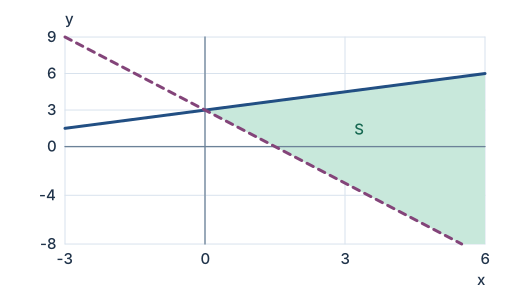
Final answerS is above y = −2x + 3 and on or below y = x/2 + 3. (0, 3) is excluded.
Part IV Long response
Question indexQ35 Solve a price system
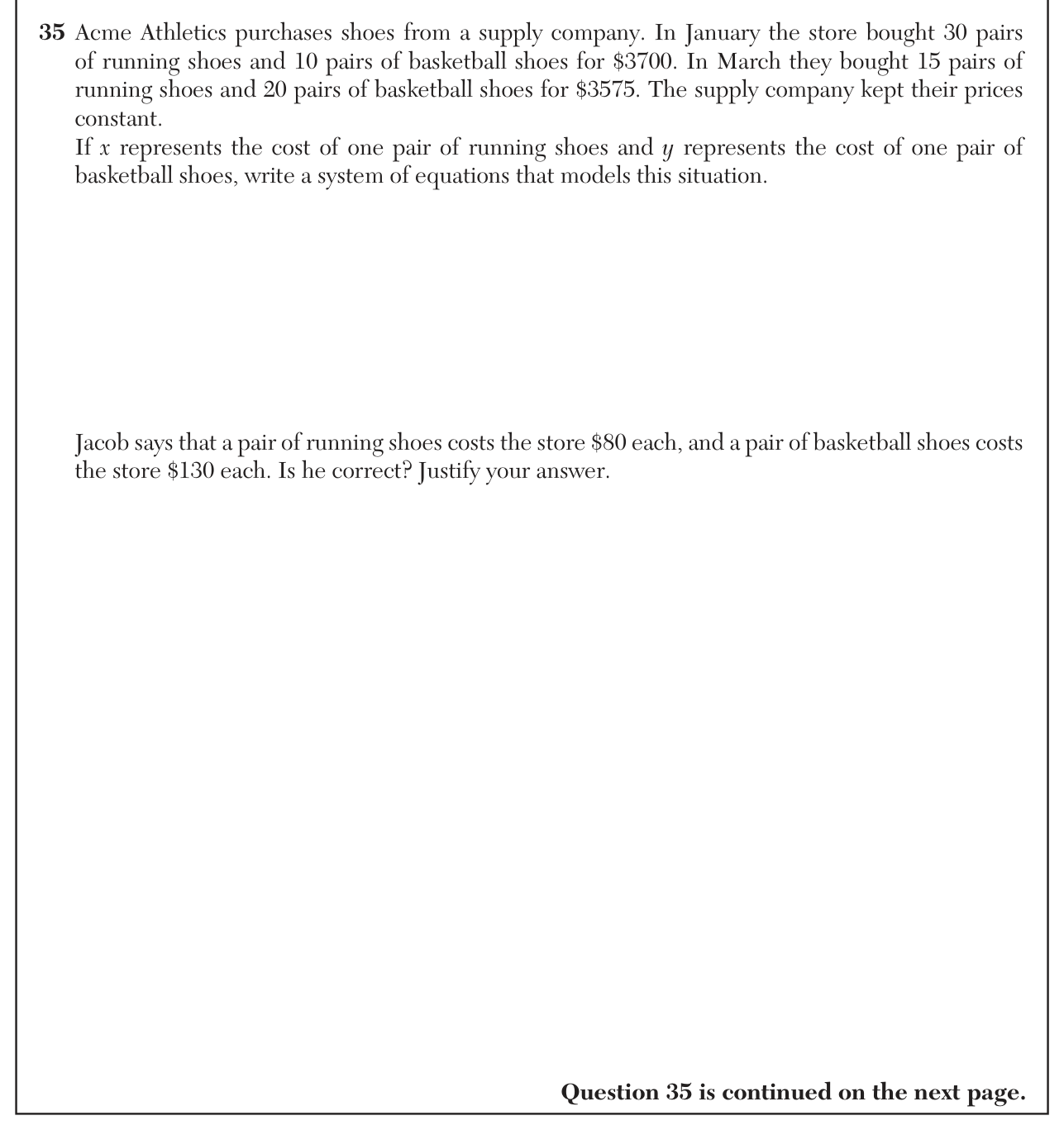
Running and basketball shoe orders give totals of 3700 dollars for (30, 10) and 3575 dollars for (15, 20). Model, test (80, 130), and solve.

Worked solution for question 35
- Let x and y be the respective prices. Write 30x + 10y = 3700 and 15x + 20y = 3575.
- The proposed (80, 130) gives 3700 in the first equation but 3800 in the second, so it fails.
- Double the second equation and subtract the first. Then 30y = 3450 and y = 115.
- Substitute to get 30x = 2550, so x = 85. Check 15(85) + 20(115) = 3575.
Final answerRunning 85 dollars per pair, basketball 115 dollars per pair
From the New York State Education Department. January 2026 Algebra I Regents Examination. Internet. Available from https://www.nysedregents.org/algebraone/126/algone-12026-exam.pdf. Accessed .