NEW YORK STATE REGENTS · GLOBAL HISTORY AND GEOGRAPHY II
August 2026 Global History and Geography II Regents Past Paper & Solutions
Work through late Qing China, Cold War conflicts and food insecurity with a question-by-question walkthrough of the exam.
- 36 worked questions
- 1 writing models
- 3 exam parts
The question images and page numbers come from the regular-size English exam. OnlyPrepy wrote the summaries and worked solutions.
Quick answer key for Part I
Part I Multiple choice
Question indexQ1 Alternate attendance
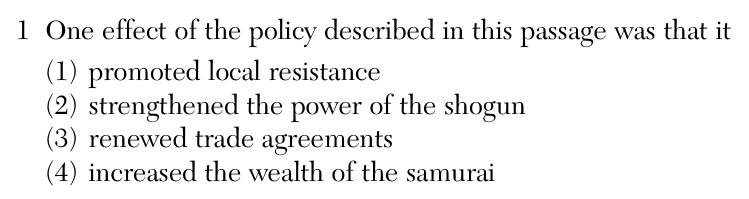
What was one effect of Tokugawa alternate attendance?
Worked solution for question 1
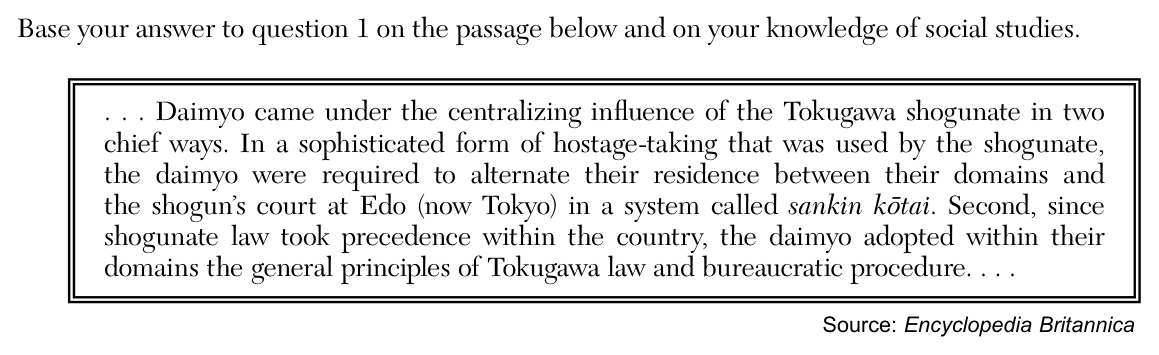
- Daimyo spent alternating periods at the shogun’s capital and maintained residences there.
- That requirement made them easier to supervise and limited their resources for rebellion.
- Alternate attendance put regional lords under regular central supervision. The travel and residence requirements also made it harder to concentrate resources on challenging the shogun.
Answer choice 2It strengthened the shogun’s power.
Q2 Robespierre’s political reasoning
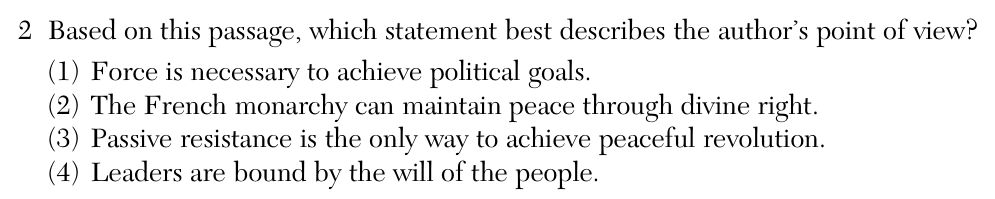
What does Robespierre argue about using force?
Worked solution for question 2
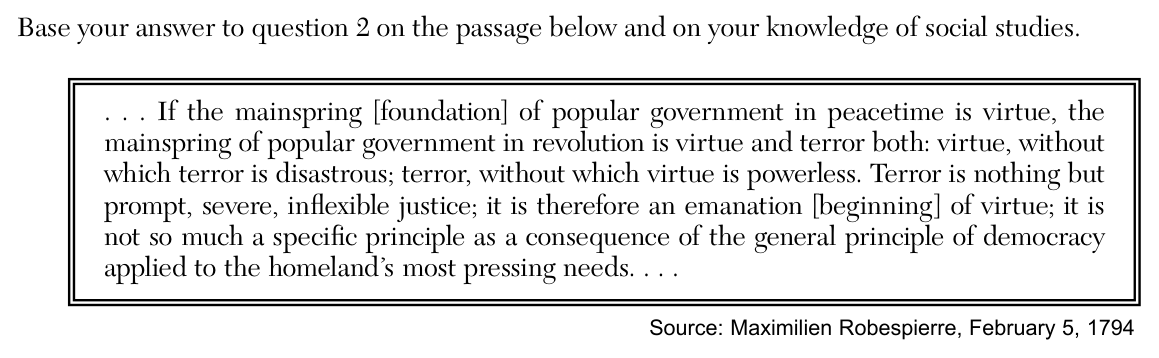
- He describes terror as a form of swift justice in a revolutionary emergency.
- His reasoning treats coercion as a means of defending the revolution.
Answer choice 1Force is necessary to achieve political goals.
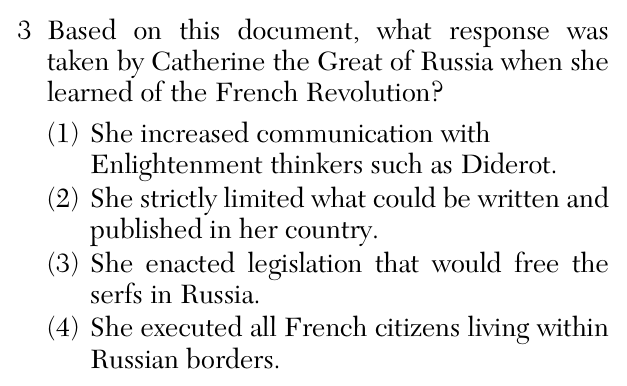
Q3 Catherine responds to revolution
What did Catherine do in response to the spread of French revolutionary ideas?
Worked solution for question 3
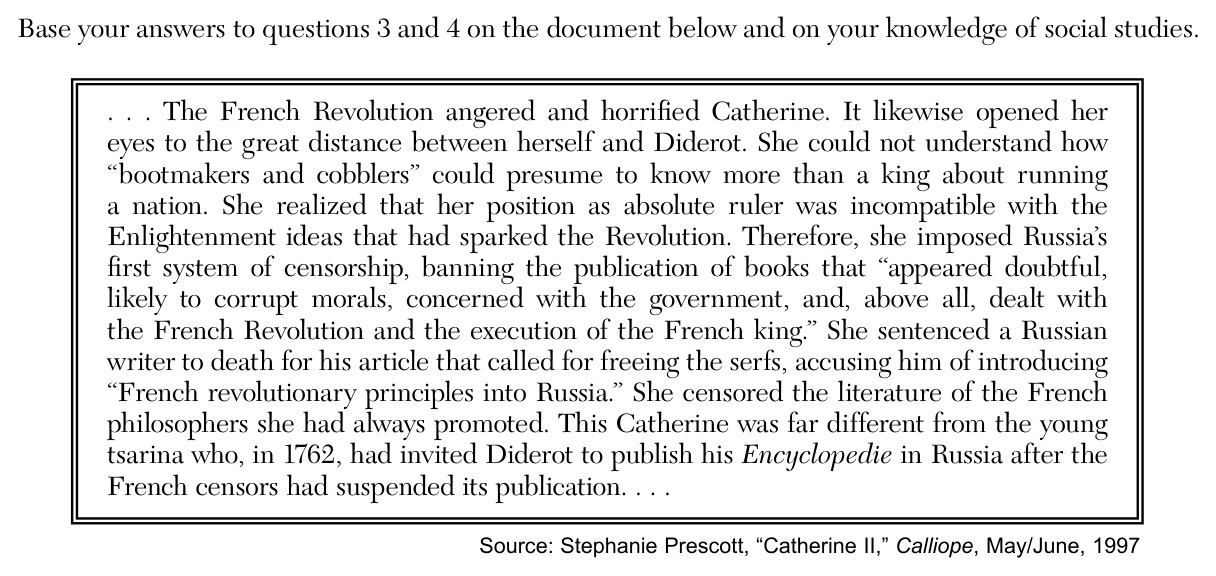
- The passage shows a move toward censorship as she grew more concerned about revolutionary ideas.
- Limiting publication made it harder for opponents to circulate those ideas.
- Rulers could see revolutionary writings as a threat because those ideas questioned established authority. Censorship was a way to limit the circulation of those ideas.
Answer choice 2She restricted what could be written and published.
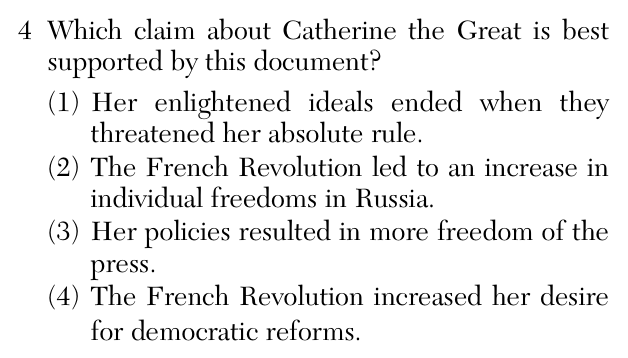
Q4 Limits of enlightened absolutism
What claim about Catherine is supported?
Worked solution for question 4
- Earlier interest in Enlightenment ideas did not prevent later restrictions.
- Her use of censorship when authority seemed endangered shows that retaining control took priority.
Answer choice 1She abandoned Enlightenment principles that threatened her rule.
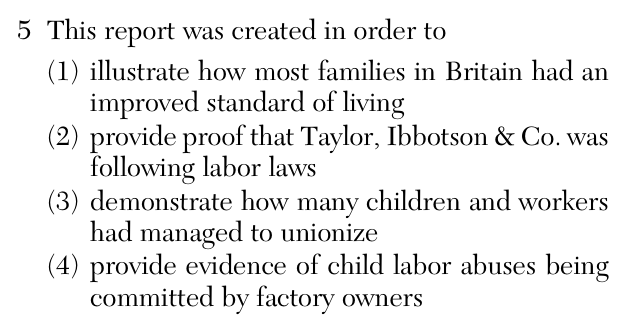
Q5 Why investigate factories?
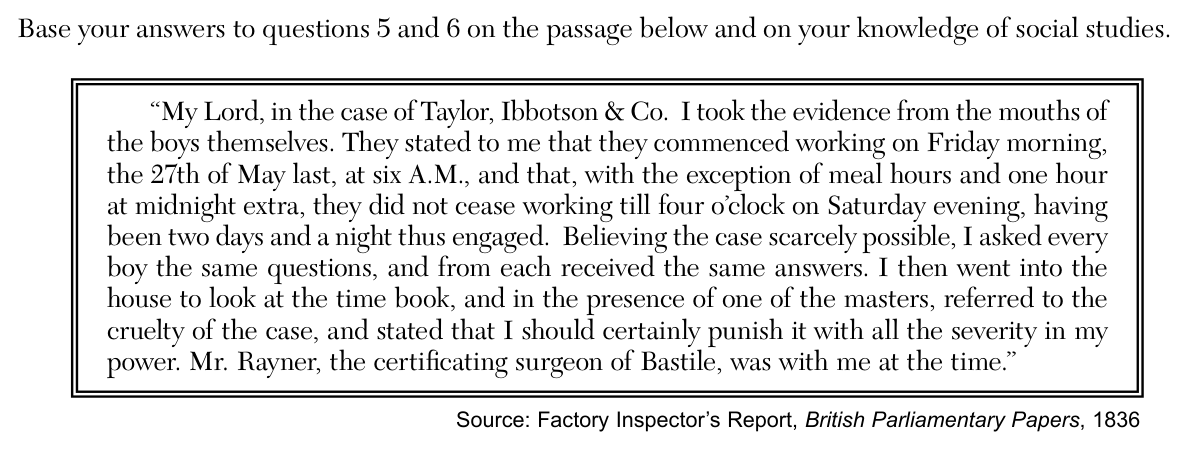
What purpose did the factory inspector’s report serve?
Worked solution for question 5
- The report describes how children were treated and how factory owners or supervisors controlled them.
- Those details give officials evidence of practices requiring scrutiny.
- An investigation can collect testimony and conditions that outsiders would otherwise struggle to observe. Gathering that evidence was a step toward documenting child labor abuses.
Answer choice 4To document abuses of child labor
Q6 Industrial labor reforms
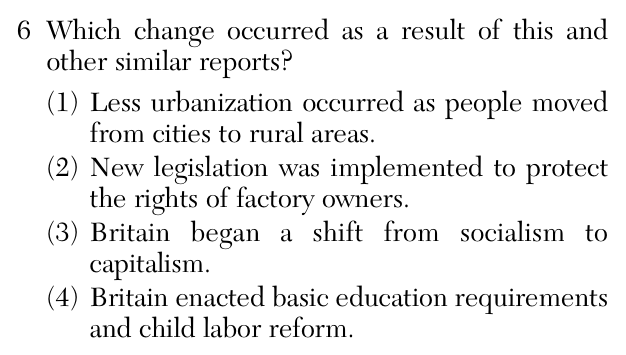
What change followed investigations of factory conditions?
Worked solution for question 6
- Reports made the dangers and lack of schooling visible to lawmakers.
- Factory legislation gradually restricted child labor and required some schooling for covered children.
Answer choice 4Britain enacted education requirements and child labor reforms.
Q7 Garibaldi’s appeal
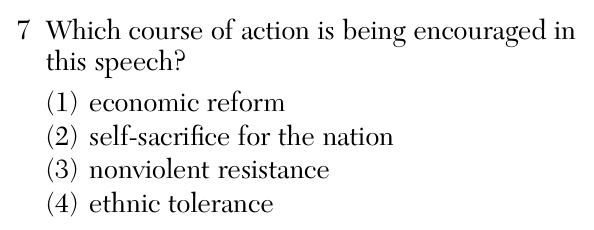
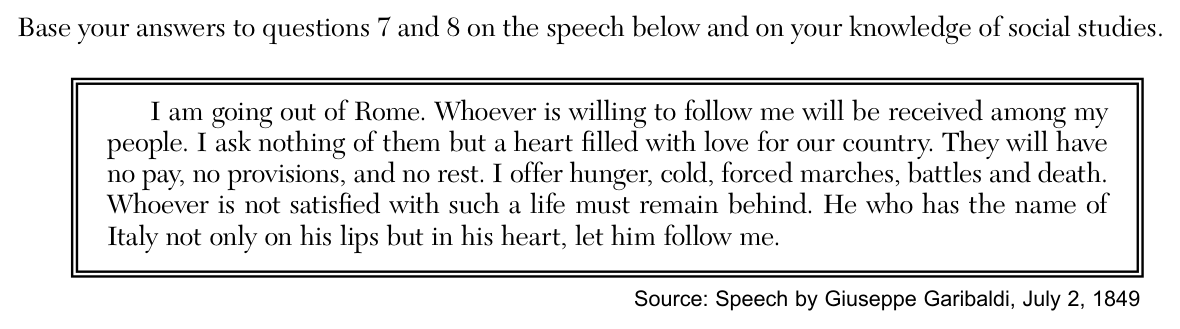
What action does Garibaldi encourage?
Worked solution for question 7
- He asks people to join despite hardship, hunger and danger and without pay.
- He presents devotion to the country as the reason to accept those costs.
- Garibaldi asks people to measure their actions against what Italy needs. That appeal makes willingness to give something up for national unity central to the message.
Answer choice 2Self-sacrifice for the nation
Q8 Garibaldi and Bismarck
How were the two leaders similar?
Worked solution for question 8
- Garibaldi led armed campaigns in the Italian struggle for unity.
- Bismarck’s Prussia also used war as part of building a unified German state.
- Garibaldi’s campaign in southern Italy and Prussia’s wars under Bismarck were different operations with a similar political effect. Both helped consolidate smaller territories into a national state.
Answer choice 1Both used military force in national unification.
Q9 After the uprising of 1857
What turning point followed the revolt in India?
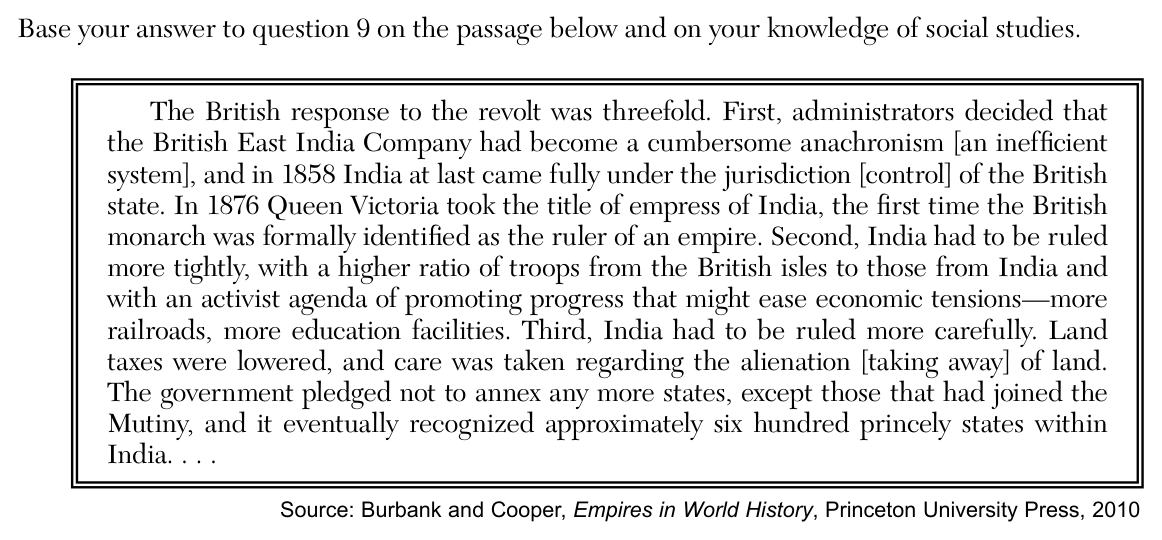
Worked solution for question 9
- The passage describes the end of the East India Company’s governing role.
- The Crown assumed direct rule in 1858.
- The institutional change after the rebellion was a transfer of authority. Direct Crown rule replaced the East India Company’s administration.
Answer choice 1Direct control by the British government
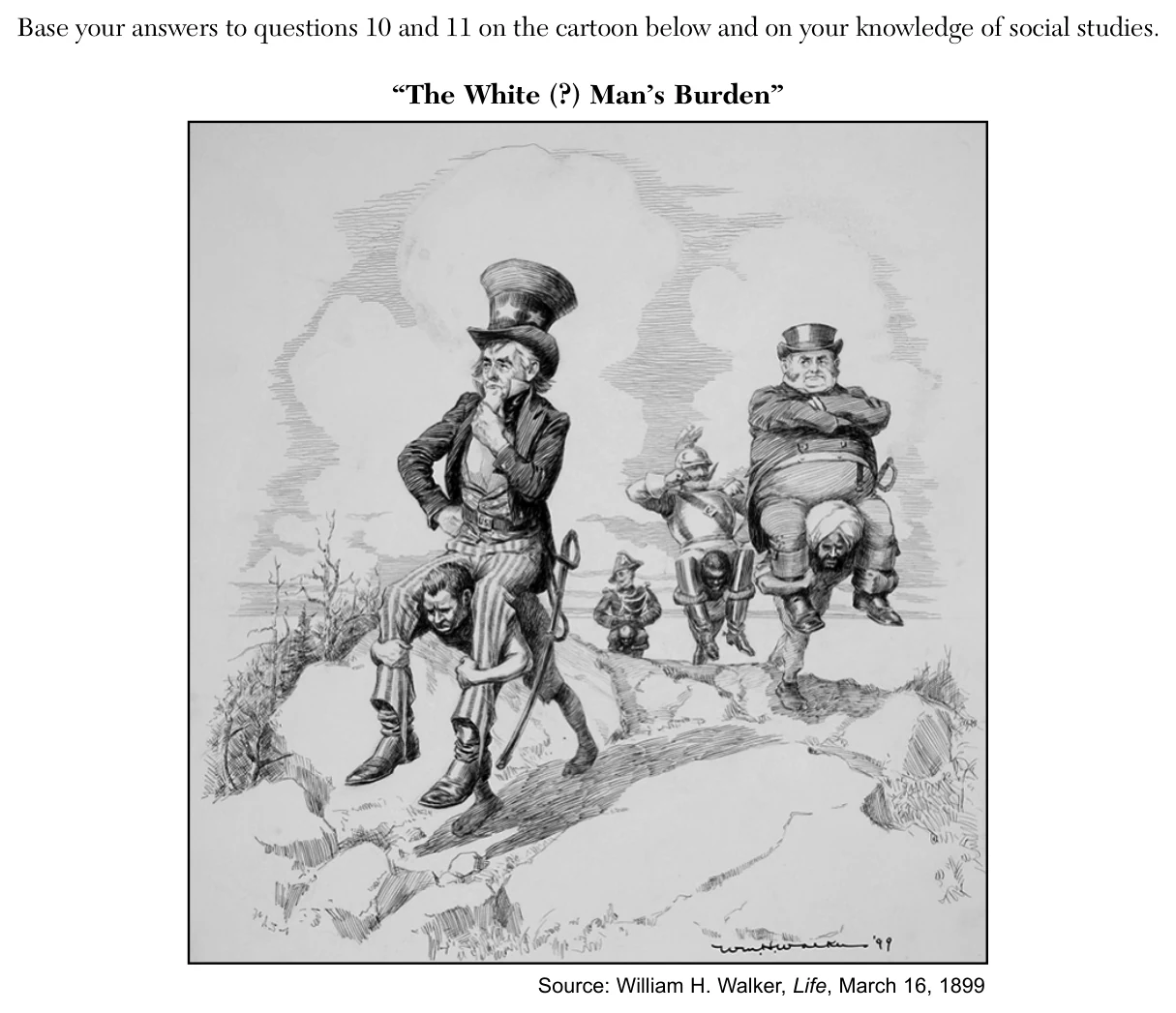
Q10 An anti-imperialist cartoon
What view does the 1899 cartoon express?
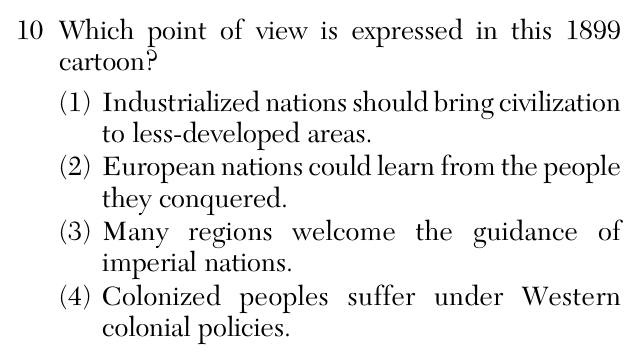
Worked solution for question 10
- The image reverses the supposed burden of empire so that colonized people carry the costs.
- The reversal challenges the claim that expansion primarily benefits those being ruled.
Answer choice 4Colonized peoples suffer under Western imperial policies.
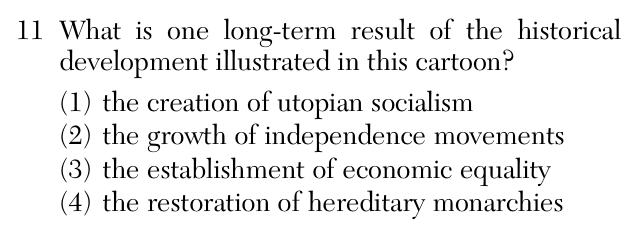
Q11 Long-term response to empire
What was one long-term result of imperial domination?
Worked solution for question 11
- Discriminatory and coercive colonial rule gave people reasons to organize against it.
- Anticolonial movements eventually pressed for political independence.
- Colonial rule created grievances and also gave reformers a shared political target. Over time, movements organized around the goal of ending foreign control.
Answer choice 2Growth of independence movements
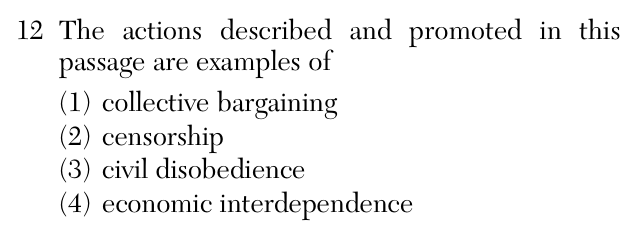
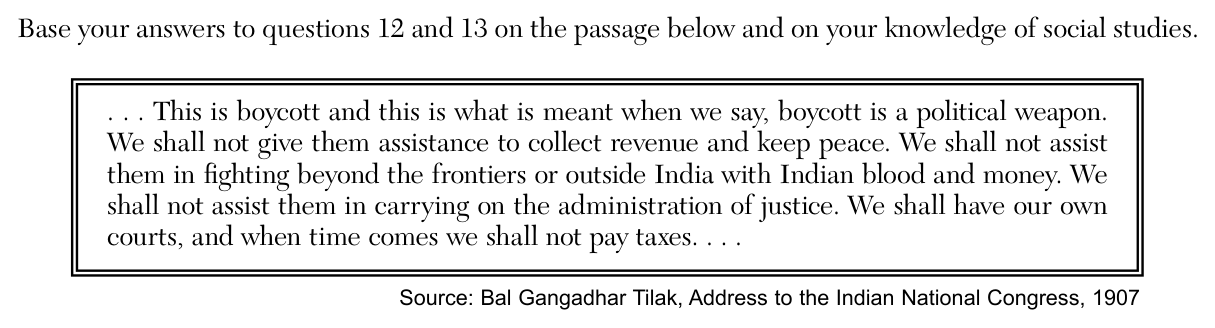
Q12 Tilak’s boycott
What tactic does Tilak advocate by withholding cooperation?
Worked solution for question 12
- He calls on Indians to refuse assistance to colonial administration and to boycott it.
- Withholding cooperation challenges the state’s ability to govern without an armed campaign.
Answer choice 3Civil disobedience
Q13 A comparable Indian leader
Who used methods resembling Tilak’s proposals?
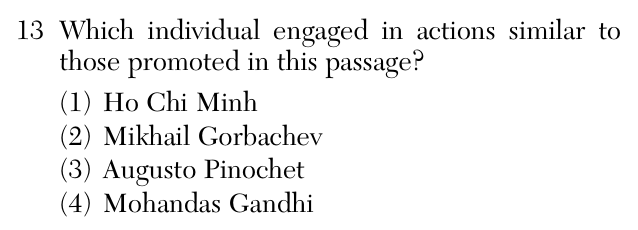
Worked solution for question 13
- Gandhi led boycotts and noncooperation campaigns against British colonial authority.
- His actions similarly made ordinary participation in colonial systems a political choice.
- The comparison works through a shared strategy of organized resistance to imperial authority. Gandhi provides the Indian example of leading people to challenge colonial power.
Answer choice 4Mohandas Gandhi
Q14 Peoples of Austria-Hungary
Which claim about the empire is supported?
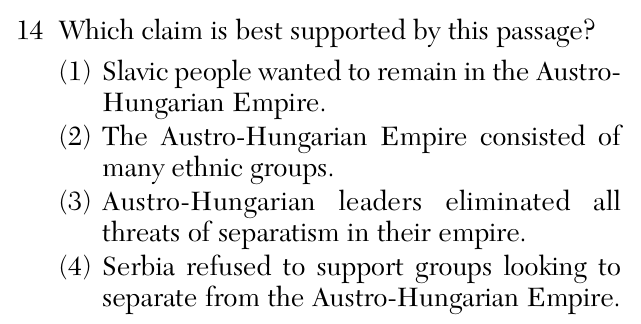
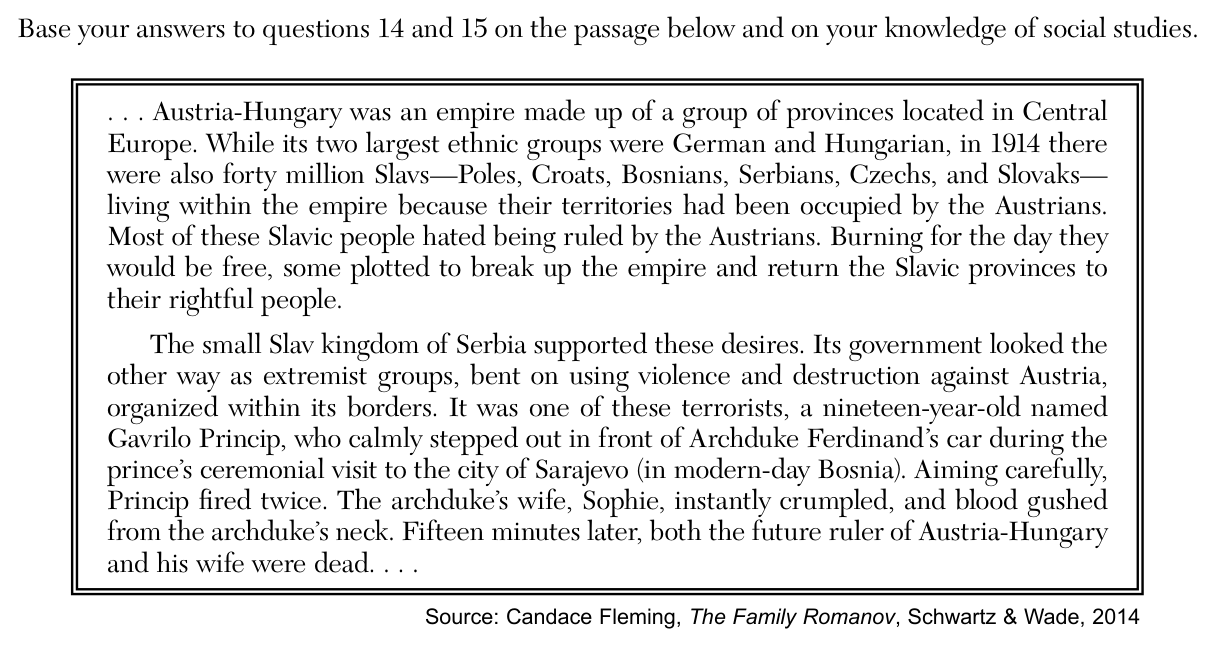
Worked solution for question 14
- The passage lists Germans, Hungarians and numerous Slavic peoples under one imperial structure.
- The population was multinational rather than uniform.
Answer choice 2It included many ethnic groups.
Q15 Nationalism and conflict
What concept explains political tension among groups in the passage?
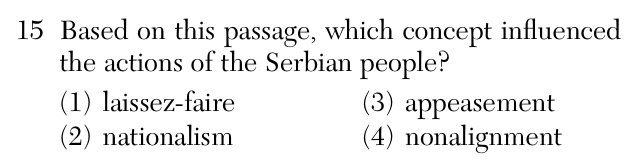
Worked solution for question 15
- Distinct peoples identified with their own communities and political aspirations.
- Those aspirations challenged an empire governing many groups within one set of borders.
- Nationalism can turn loyalty to a national community into a political demand. Where groups or states make competing demands, that loyalty can contribute to conflict.
Answer choice 2Nationalism
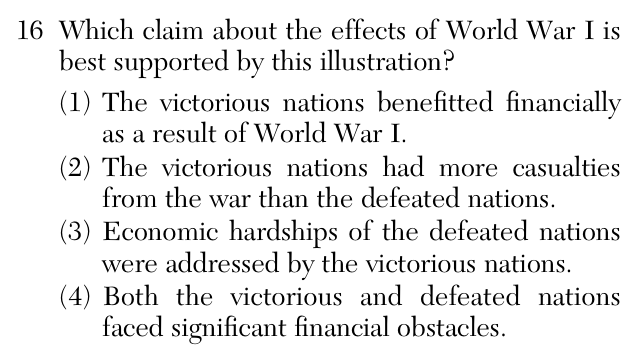
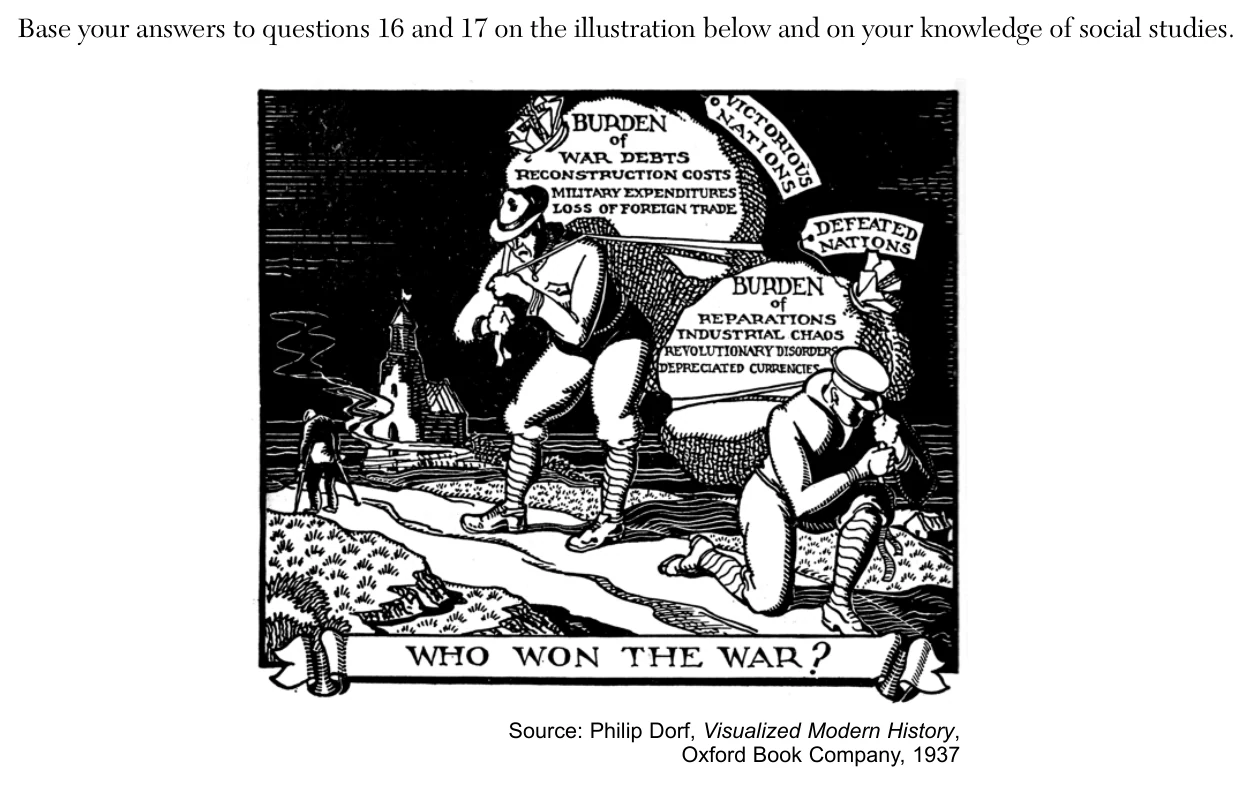
Q16 Postwar economic burdens
What does the World War I illustration show about the war’s effects?
Worked solution for question 16
- Both figures carry burdens. The victor’s labels include war debt and reconstruction, while the defeated figure’s include reparations and industrial losses.
- The different labels show that even the victorious countries faced serious financial hardship.
Answer choice 4Both victors and defeated countries faced financial difficulties.
Q17 The kneeling soldier
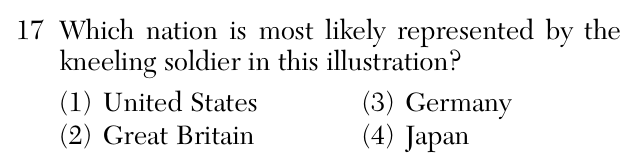
Which nation does the kneeling figure most likely represent?
Worked solution for question 17
- The position of the figure suggests a defeated state bearing a heavy burden.
- Germany’s defeat and postwar reparations provide the relevant historical identification.
- Read the figure in relation to the postwar settlement. The kneeling posture represents the position of a defeated country facing terms imposed by the victors.
Answer choice 3Germany
Q18 What the Berlin timeline shows
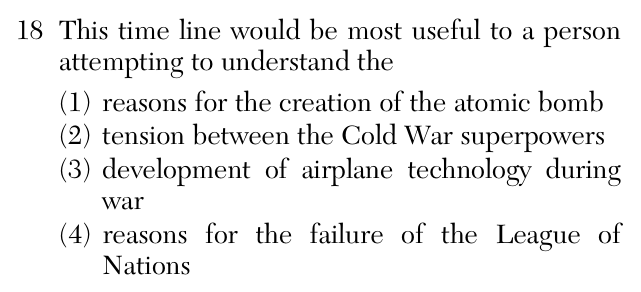
What is the best use of the airlift timeline?
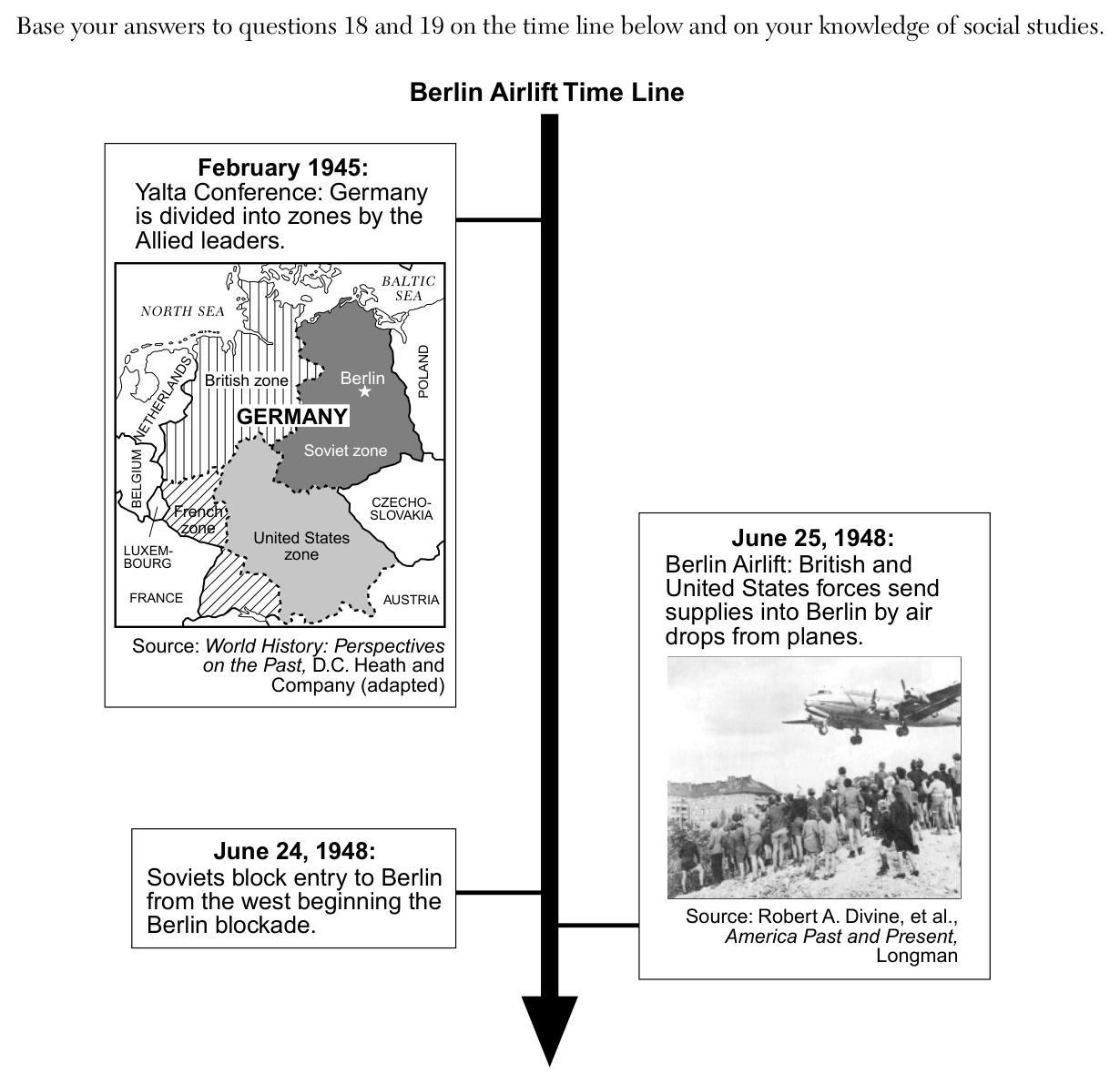
Worked solution for question 18
- The chronology moves from occupation zones to confrontation and air supply.
- It shows how rival policies over Germany produced a standoff between the Soviet Union and the West.
Answer choice 2Studying tension between the Cold War powers
Q19 Outcome of the blockade
How did the Berlin blockade end?
Worked solution for question 19
- The airlift allowed the Western powers to supply their sectors without forcing a land crossing.
- The Soviet Union ended the blockade without obtaining Western withdrawal from Berlin.
- The airlift kept the supply route functioning while avoiding an attack on Soviet forces. Once the blockade ended, the episode concluded without an open war over Berlin.
Answer choice 4The Soviet Union lifted the blockade, avoiding direct war.
Q20 Dismantling apartheid
Why do the photographs of Mandela and de Klerk represent a turning point?
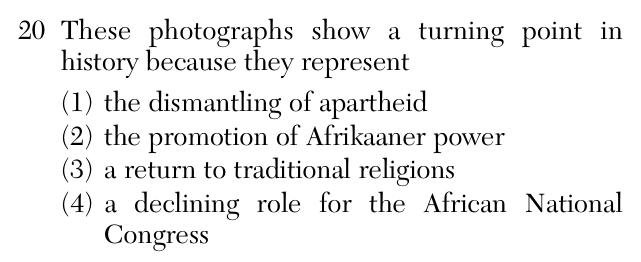
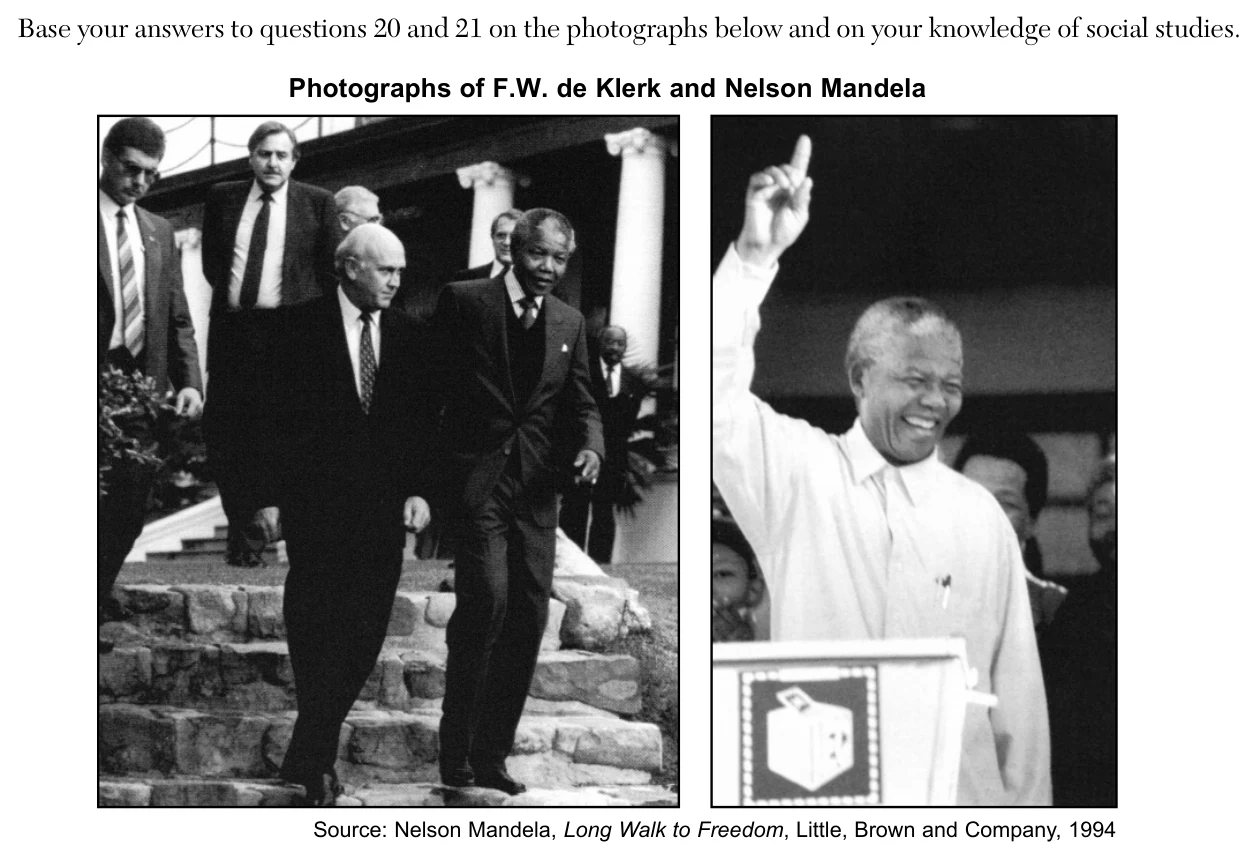
Worked solution for question 20
- The two leaders were associated with the negotiations that ended formal white-minority rule.
- South Africa’s 1994 multiracial elections marked the transition.
Answer choice 1They represent the dismantling of apartheid.
Q21 Pressures for South African change
What helped produce the transition depicted?
Worked solution for question 21
- Protests challenged apartheid from within and boycotts and sanctions raised costs from abroad.
- Together these pressures made the old system harder to maintain.
- Internal uprisings raised the political cost of maintaining apartheid. Boycotts from abroad added economic and diplomatic pressure to that domestic challenge.
Answer choice 2International boycotts and internal uprisings
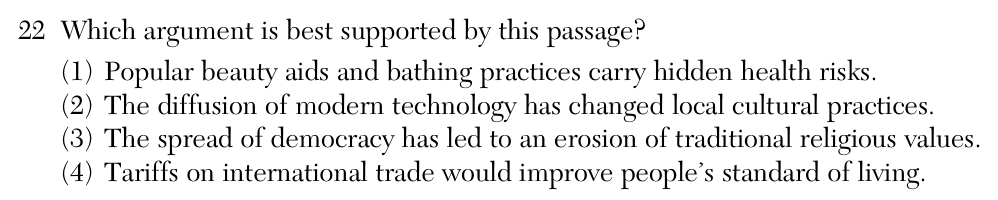
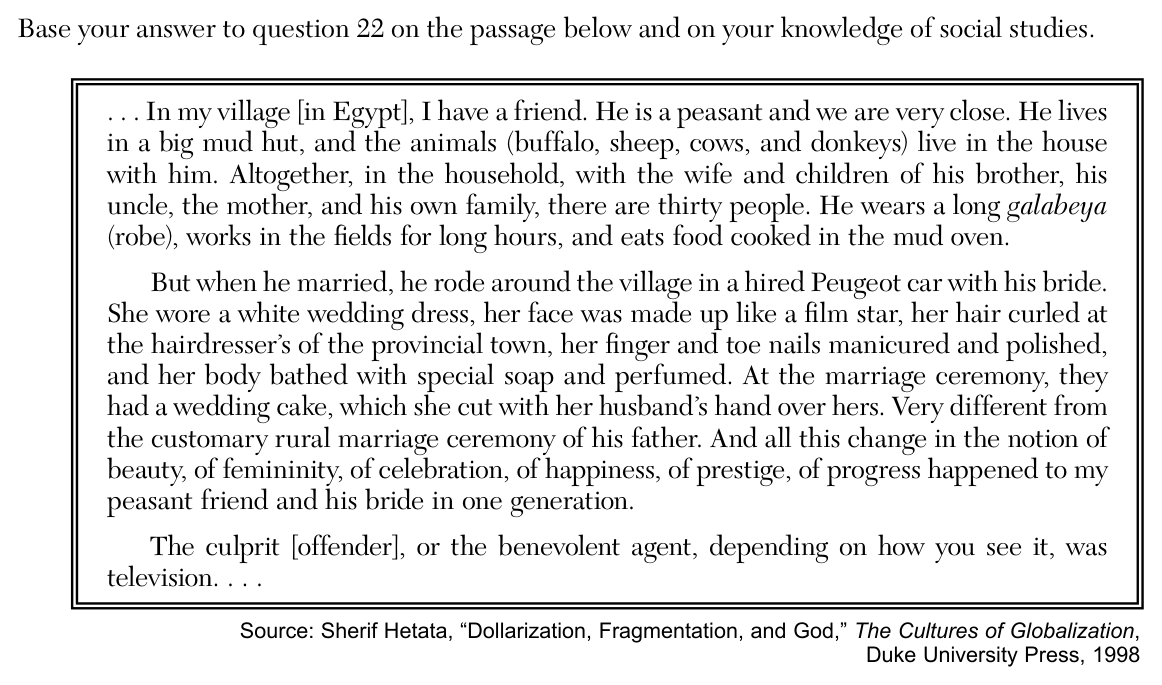
Q22 Television and cultural diffusion
What claim does Hetata’s account support?
Worked solution for question 22
- Television carries images and habits across borders into daily life.
- The passage contrasts these influences with practices already established in the community.
Answer choice 2Modern technology has changed local cultural practices.
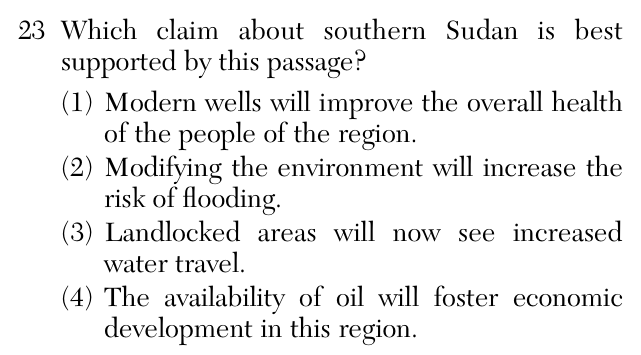
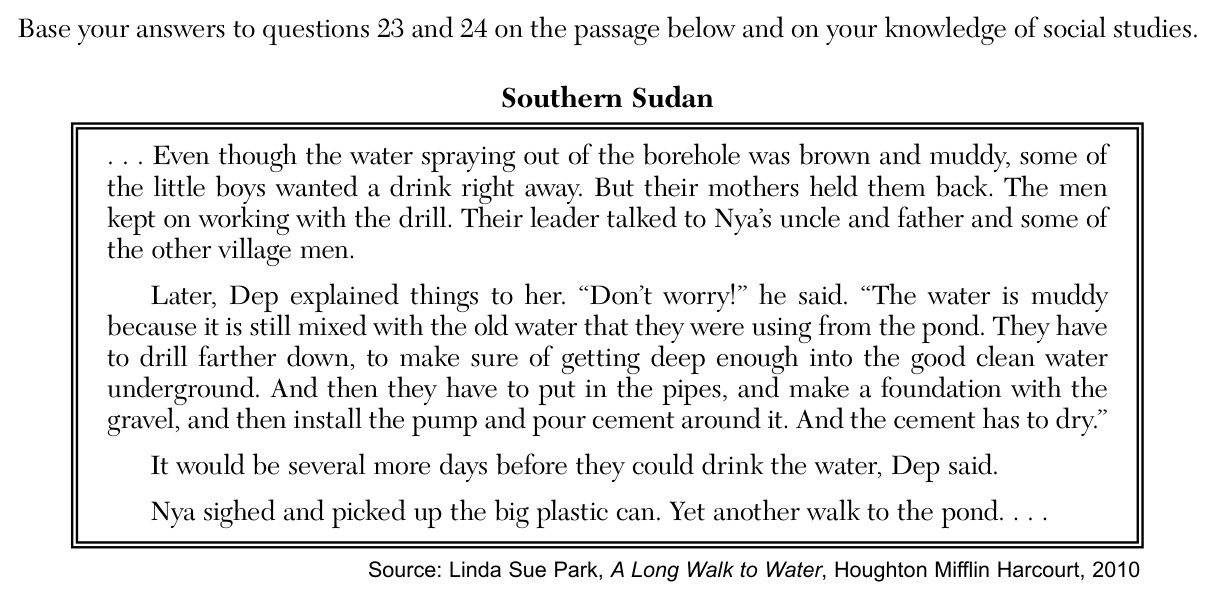
Q23 Access to clean water
What claim about wells is best supported by the southern Sudan passage?
Worked solution for question 23
- The first water is muddy, so the adults prevent children from drinking it while drilling continues.
- The finished well is intended to provide cleaner drinking water and reduce exposure to unsafe sources.
- A well can reduce exposure to contaminated water if it is properly designed and maintained. The causal link is reduced contact with waterborne disease.
Answer choice 1Modern wells can improve health.
Q24 Securing a natural resource
What economic or geographic process does the passage illustrate?
Worked solution for question 24
- The community drills below ground to reach water that is unavailable in a clean, convenient form at the surface.
- The well is a technological modification aimed at securing a basic resource.
Answer choice 3Modifying the environment to obtain a resource
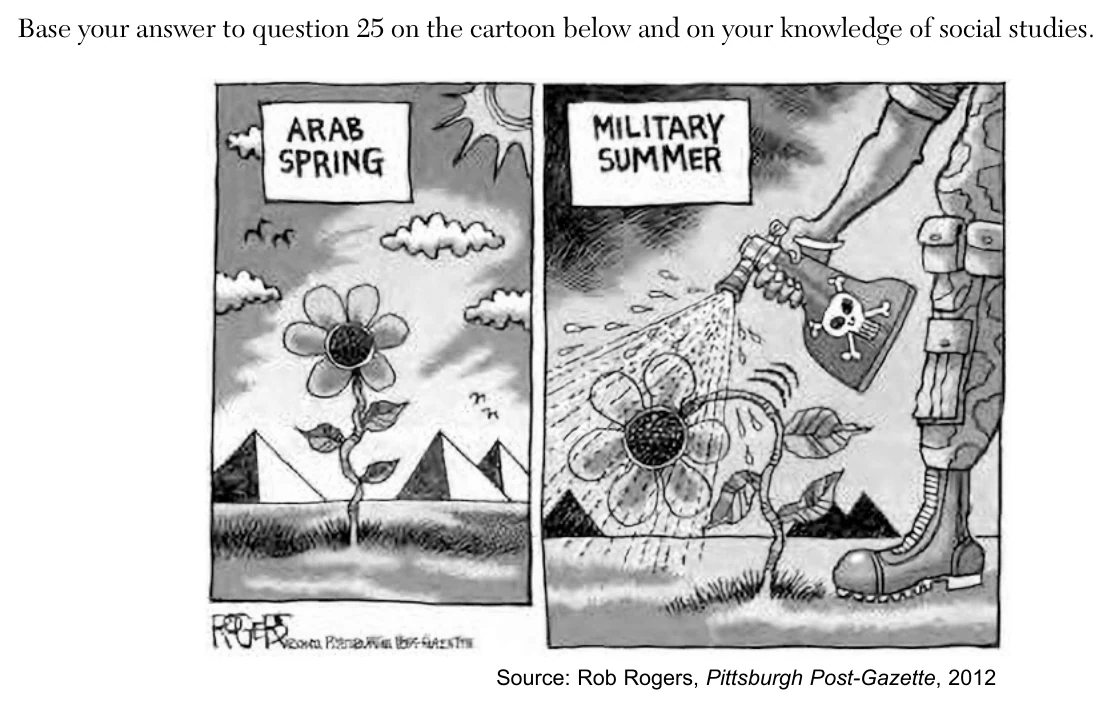
Q25 Government obstacles to democracy
What is the cartoonist’s point of view?

Worked solution for question 25
- The first panel shows the Arab Spring as a blooming flower. In the second, a soldier sprays it with a substance marked as poison.
- The contrast portrays military power as actively stifling the growth of democracy.
- A government can weaken democracy through restrictions that affect who can organize, speak, or compete politically. Trace the obstacles to the actions of officials in the source.
Answer choice 2Government actions can obstruct democratic growth.
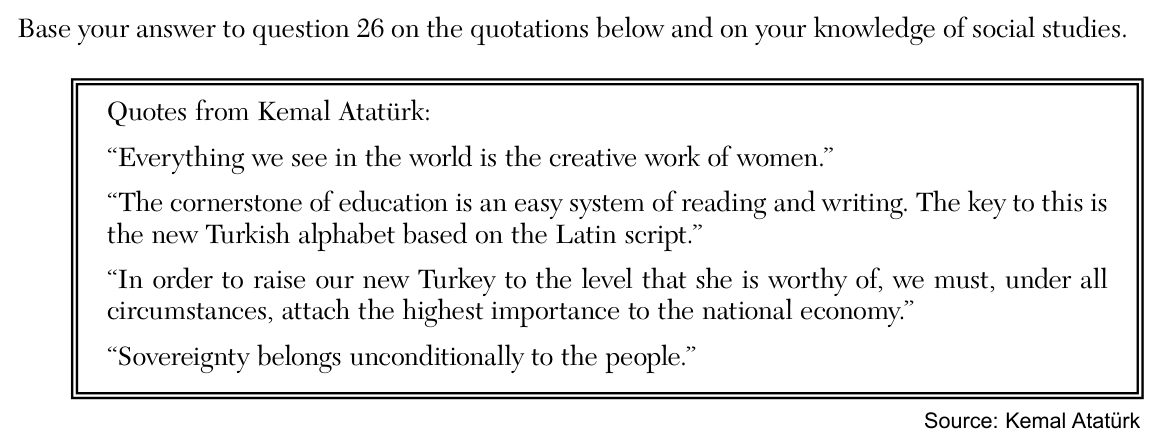
Q26 Atatürk’s secular reforms
What turning point did the views in these quotations support?

Worked solution for question 26
- The views separate modernization and public institutions from inherited religious authority.
- Reforms under Atatürk reduced the religious role in government and law.
Answer choice 2Turkey moved toward more secular policies.
Q27 Internet controls in Hong Kong
Which claim does the article support?
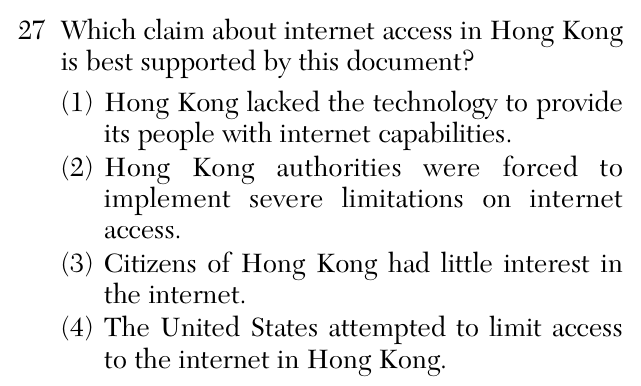
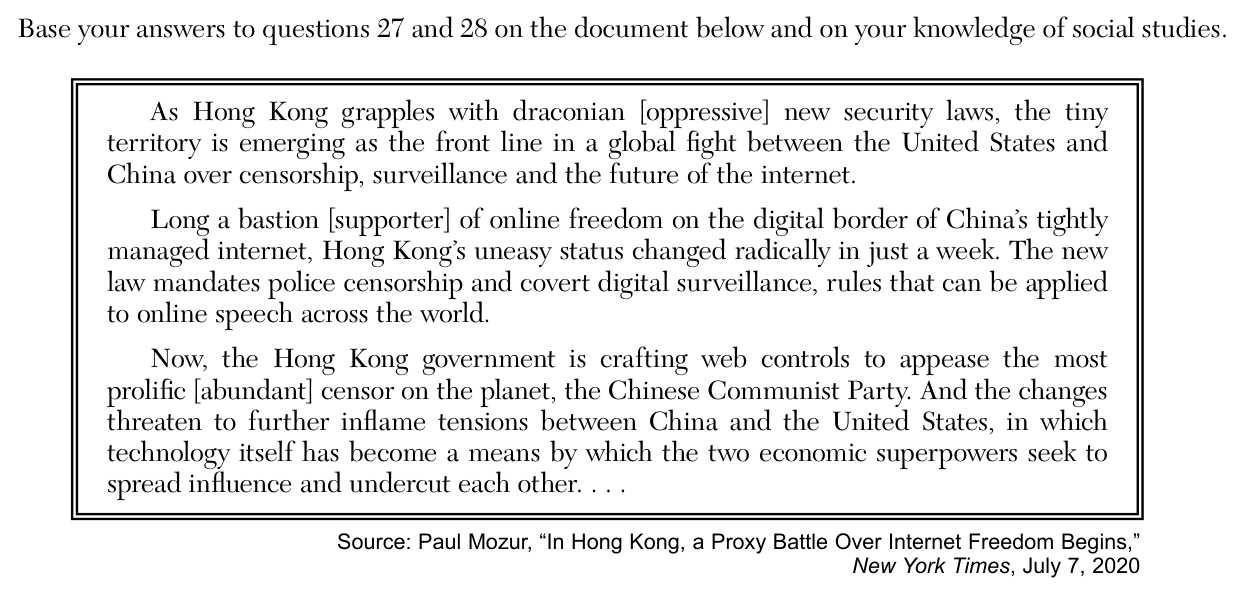
Worked solution for question 27
- The account connects national security measures to stronger controls over online content and services.
- The issue is restriction of an existing network rather than a lack of technology.
- Restrictions on access affect the flow of information as well as communication between users. That explains why the debate over control of the internet mattered politically.
Answer choice 2Authorities faced pressure to impose severe restrictions on internet access.
Q28 An opposing view of speech
Which action is directly opposed to the restrictions described?
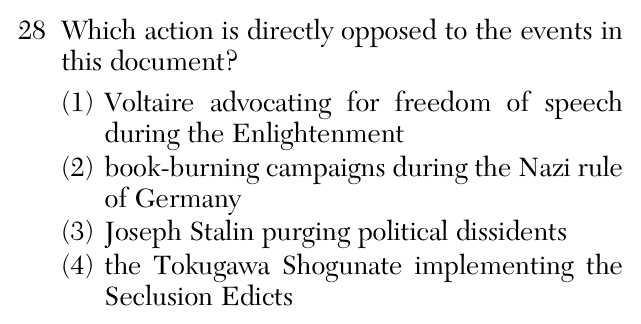
Worked solution for question 28
- Voltaire’s argument favors the ability to express views openly.
- That principle runs against government censorship and suppression of online expression.
Answer choice 1Voltaire’s defense of freedom of speech
Part II Constructed responses
Question indexQ29 Foreign spheres of influence
Explain the geographic context of the map of late Qing China.
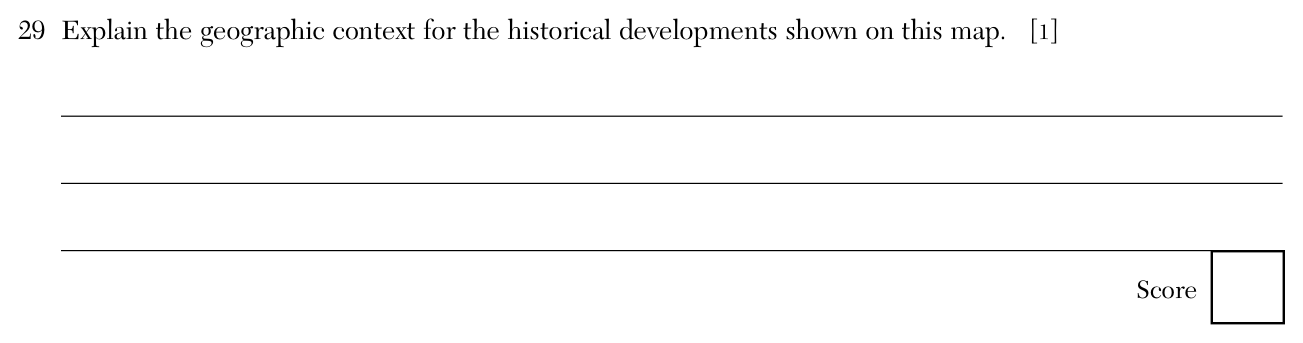
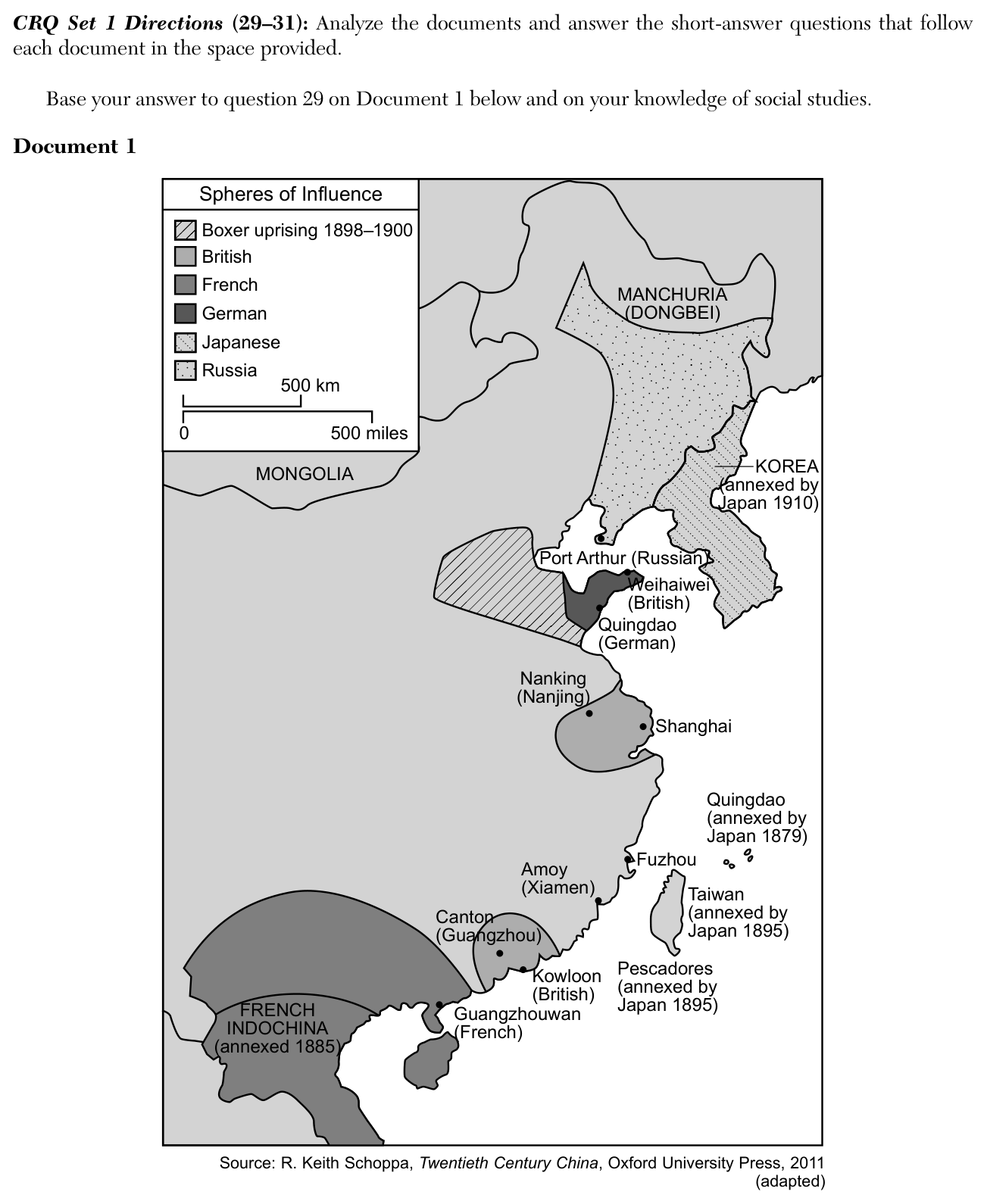

Worked solution for question 29
- Name examples from the map, such as German Qingdao and British Weihaiwei.
- Explain why ports gave foreign states commercial access and naval leverage.
Final answerForeign powers pursued access to China’s coastal ports and strategically located territories, dividing areas into spheres of influence.
Q30 Seeking recognition from the United States
Explain how Ching’s American audience shapes Document 2.
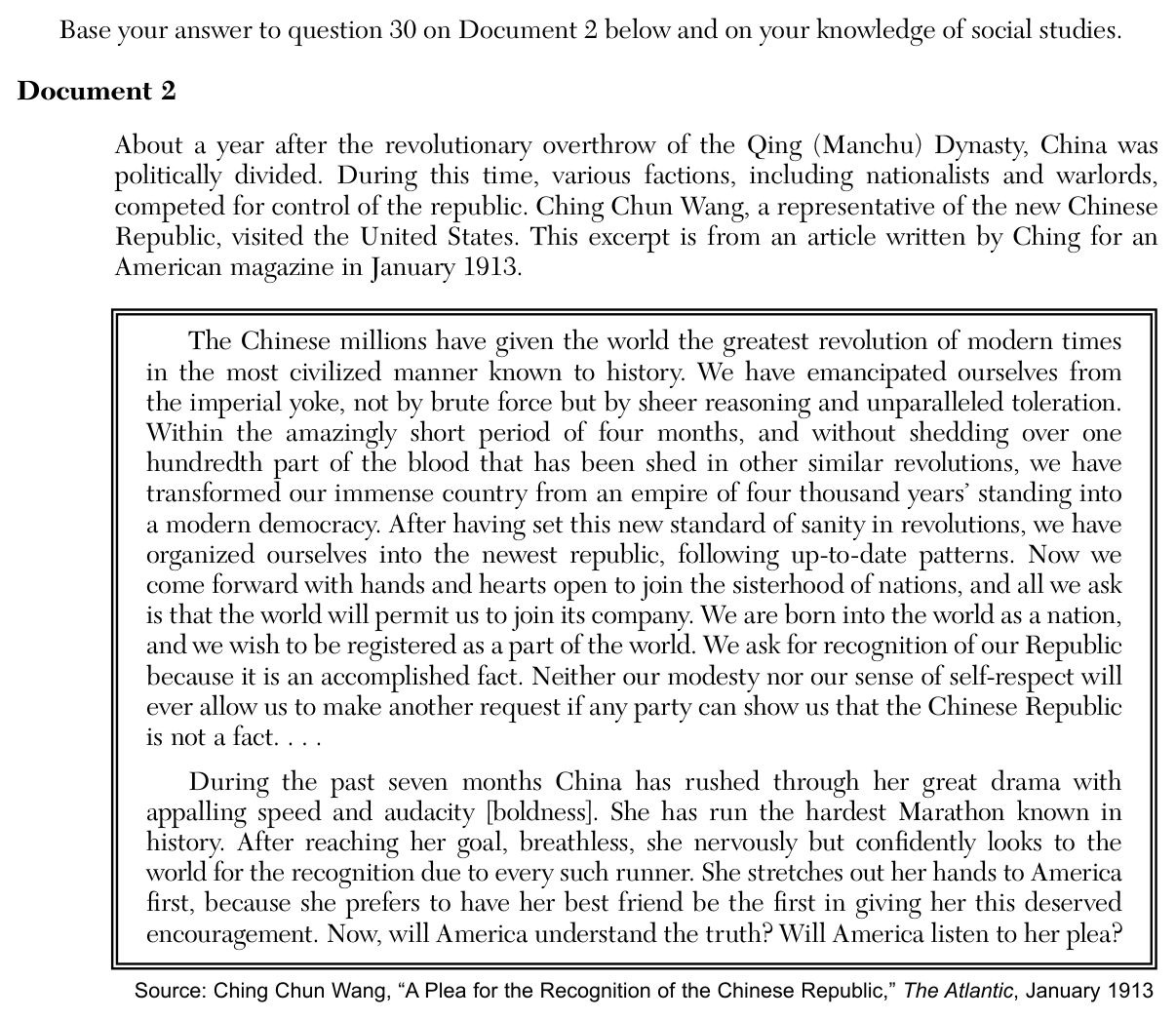
Worked solution for question 30
- Identify the American magazine audience and the writer’s role as a representative of the republic.
- Tie his portrayal of a comparatively orderly revolution and his direct appeal to that audience’s likely values.
Final answerChing highlights the republic’s modern democratic character and appeals directly to American friendship to encourage recognition.
Q31 Foreign pressure and revolution
Use both documents to explain a cause-and-effect relationship.
Worked solution for question 31
- Document 1 shows foreign privileges and territorial influence around China.
- Document 2 shows a representative of the republic seeking international recognition after the Qing overthrow. Connect the earlier loss of authority to the wider revolutionary crisis.
Final answerForeign encroachment weakened confidence in the Qing, helping create conditions for revolution and the new republic’s search for recognition.
Q32 Afghanistan’s location
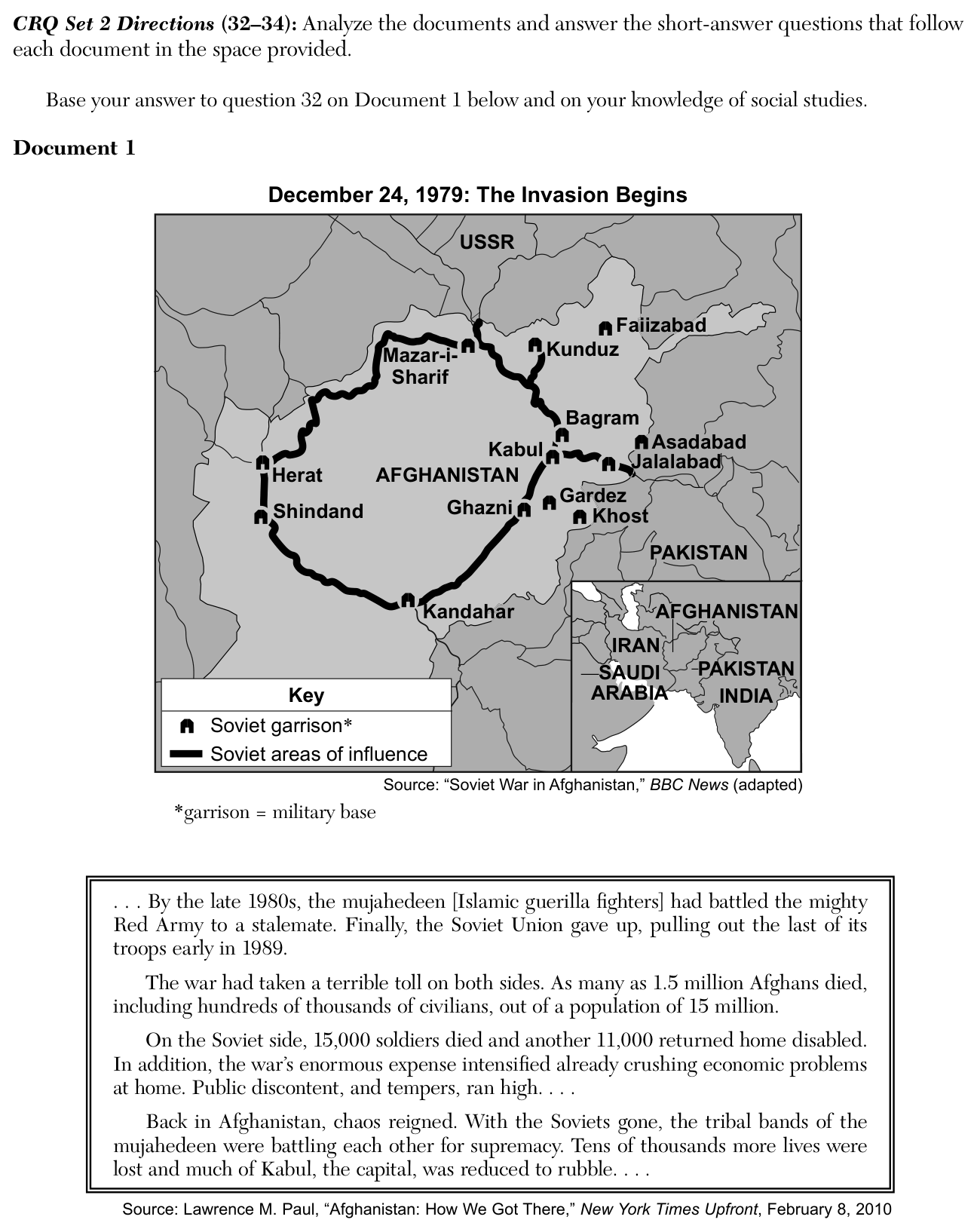
Explain the geographic context of Soviet intervention and resistance in Document 1.
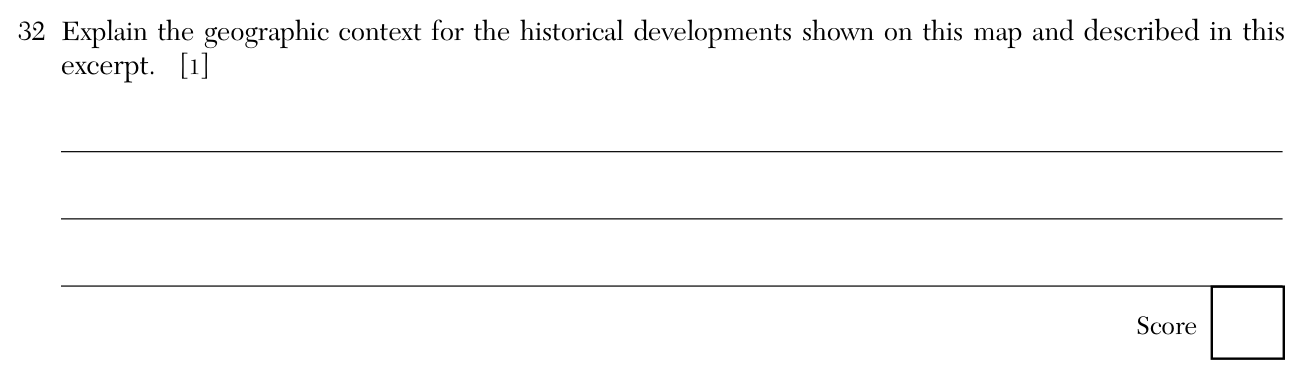

Worked solution for question 32
- Locate Afghanistan immediately south of Soviet territory and connect the invasion routes to the border.
- Use rugged terrain and the mujahedeen’s ability to sustain resistance to explain the drawn-out conflict.
Final answerAfghanistan’s border with the Soviet Union facilitated invasion, while its mountainous terrain helped guerrillas resist occupation.
Q33 Purpose of the Tet telegram
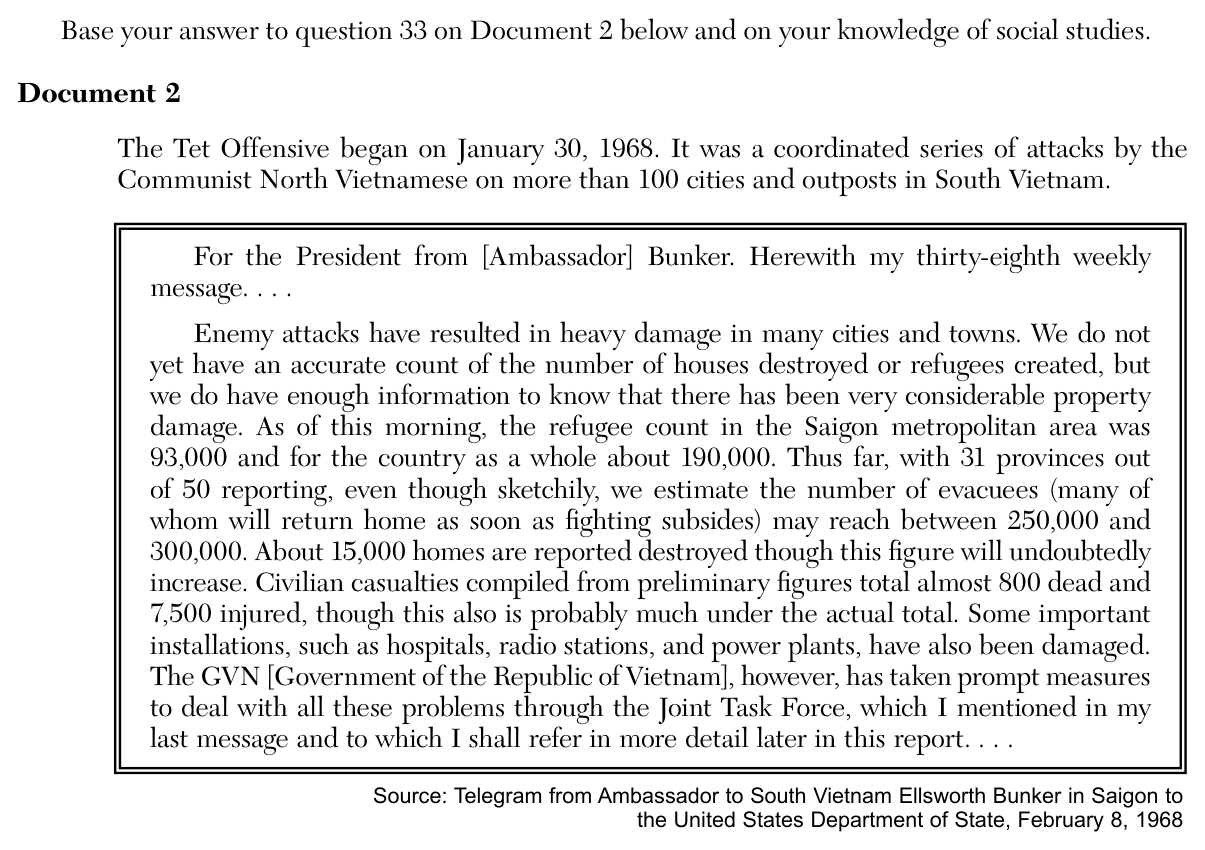
Why did Ambassador Bunker send Document 2?
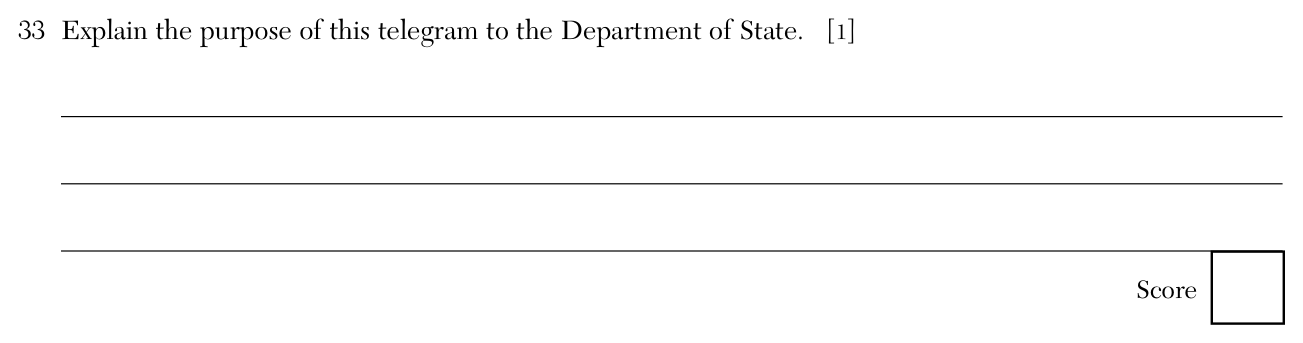
Worked solution for question 33
- Point to his preliminary counts of displacement, casualties and damaged infrastructure.
- The telegram gives decision-makers information about immediate needs and the allied government’s ability to respond.
Final answerTo brief U.S. leaders on the Tet Offensive’s damage and the South Vietnamese government’s response.
Q34a Identify a similarity
Identify a similarity between the conflicts in Afghanistan and Vietnam.
Worked solution for question 34a
- The Soviet Union backed the Afghan government against the mujahedeen.
- The United States supported South Vietnam against Communist forces.
- State one common relationship and connect it to each conflict. In both examples an outside superpower gave backing to one side in a local struggle, which is a more specific similarity than simply saying both involved fighting.
Final answerBoth were Cold War conflicts in which an outside superpower supported a local government against armed opponents.
Q34b Explain the similarity
Use both documents to explain the shared pattern.
Worked solution for question 34b
- Document 1 shows the mujahedeen fighting the Soviet army to a stalemate before withdrawal.
- Document 2 records widespread attacks and serious damage in South Vietnam despite American backing, showing the limits of external power in both conflicts.
Final answerExternal military involvement did not prevent local opponents from mounting sustained or coordinated resistance.
Part III Enduring issues essay
Question indexQ35 Enduring issue of hunger under coercive rule
Use at least three documents and outside evidence to show why politically produced food insecurity is significant across time.
Writing plan and model response for question 35
- Define the issue by showing how policy changes access to food. Compare coercion, confinement and requisition across cases.
- Use outside evidence to explain why these conditions developed and how civilians were affected.
Central claimAuthorities repeatedly deprive civilians of access to food while pursuing extraction, military or ideological goals.
Model response
Food insecurity becomes a political issue when authorities control who can produce, obtain or keep food. Across different periods, governments and armed forces have prioritized revenue, political control or ideological campaigns over civilian survival. The resulting hunger has weakened communities and made resistance more difficult.
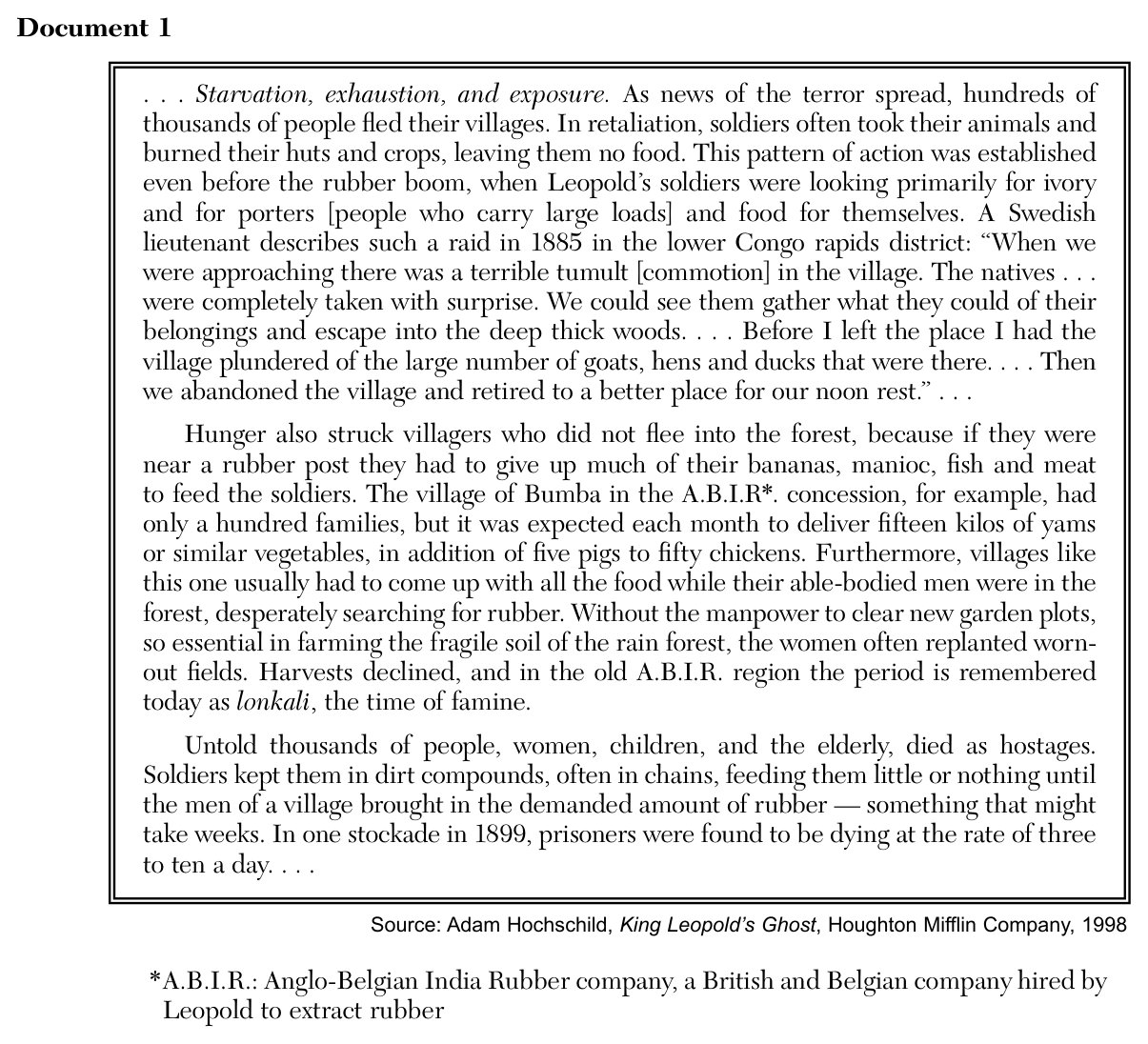
In Leopold II’s Congo Free State, agents demanded supplies and forced people to gather rubber (Document 1). Men sent into the forest could spend less time maintaining farms, while soldiers seized food and held relatives hostage to enforce quotas. These policies reduced both production and access. European demand for rubber gave the administration a financial incentive to continue extraction even as communities experienced famine.
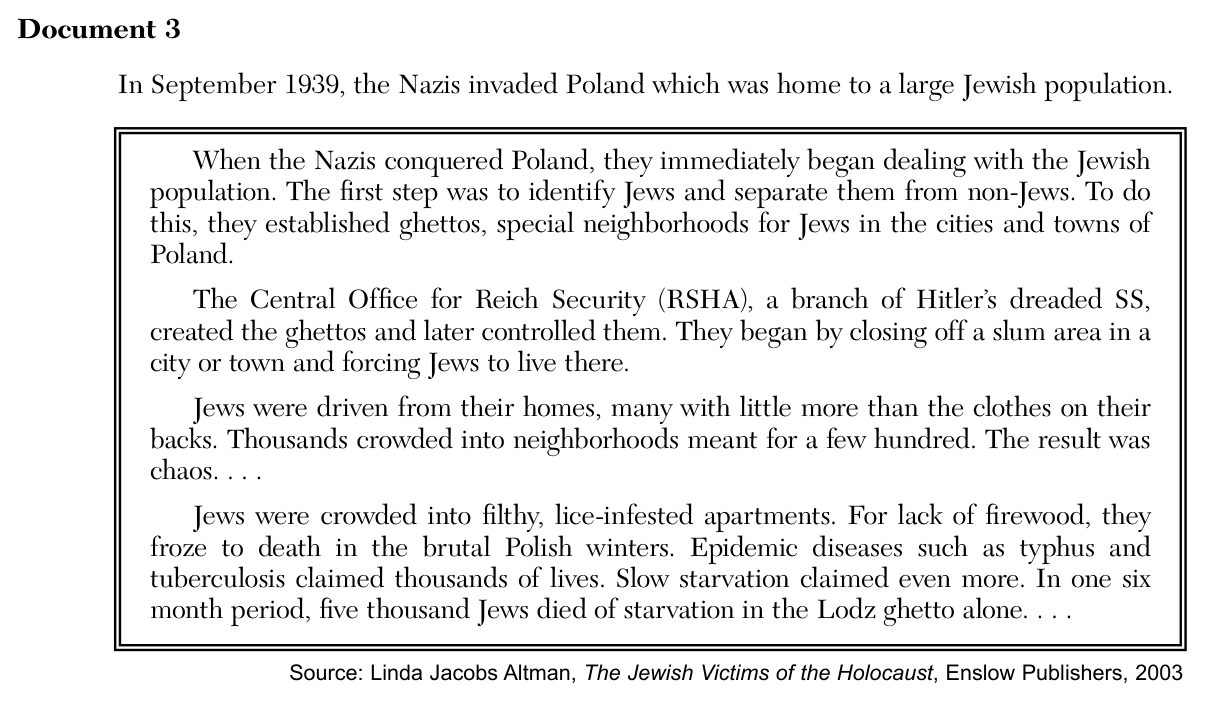
In Nazi-occupied Poland, the regime used a different method. Document 3 describes Jewish people being driven into overcrowded ghettos where starvation and disease killed many. Confinement restricted movement and access to food. Ghettos were part of an escalating system of persecution during the Holocaust, and the deprivation reflected deliberate exclusion and control rather than a general shortage shared equally by everyone.
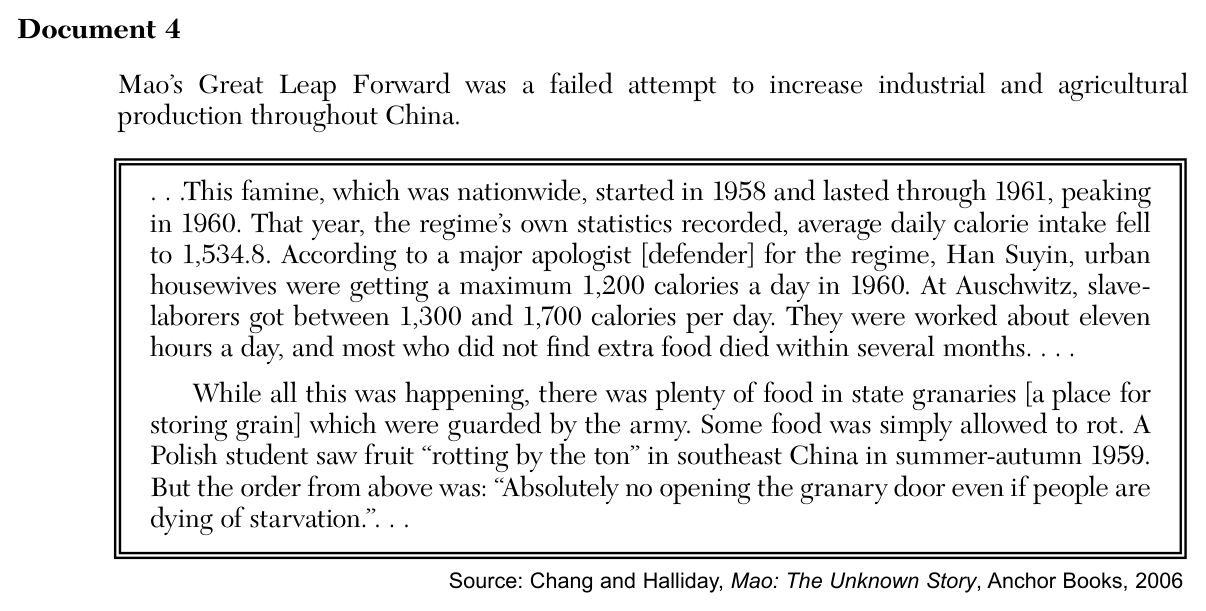
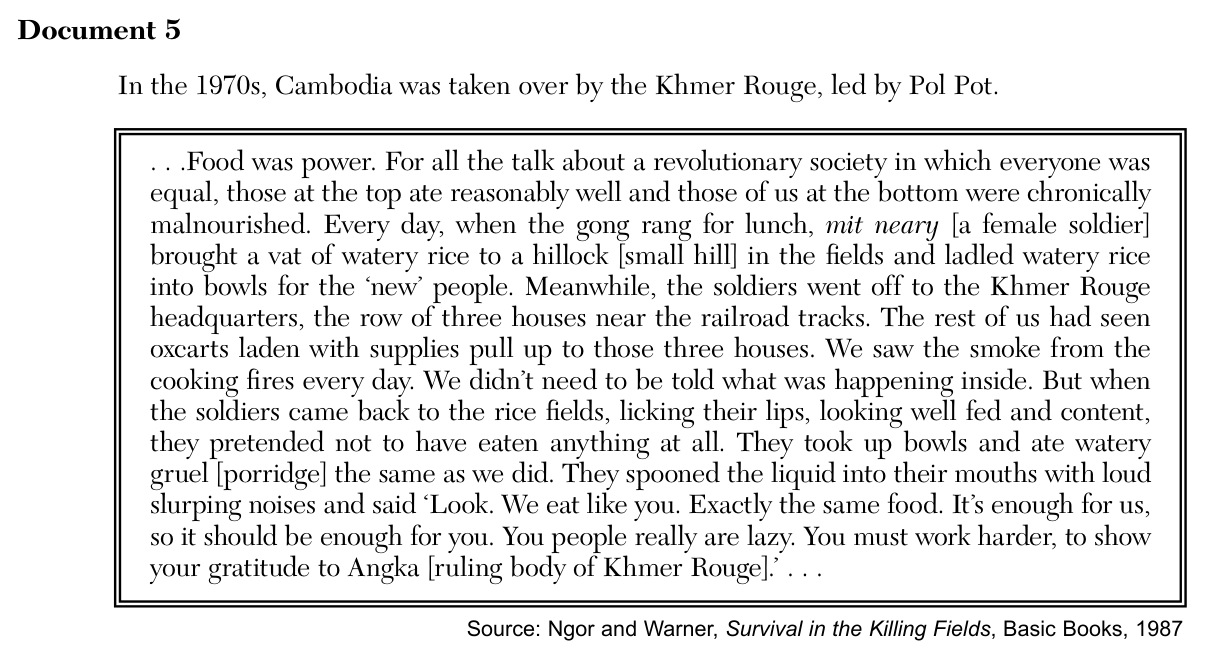
Document 4 describes another mechanism during China’s Great Leap Forward. The government reorganized agriculture into communes and pursued unrealistic output goals. The account describes grain kept in state stores while people went hungry. In Cambodia, Document 5 similarly shows the political distribution of food. Khmer Rouge officials could eat adequately while forced laborers received thin rations. Each system had a different purpose and structure, but leaders retained power over the food supply while those doing the work bore the consequences.
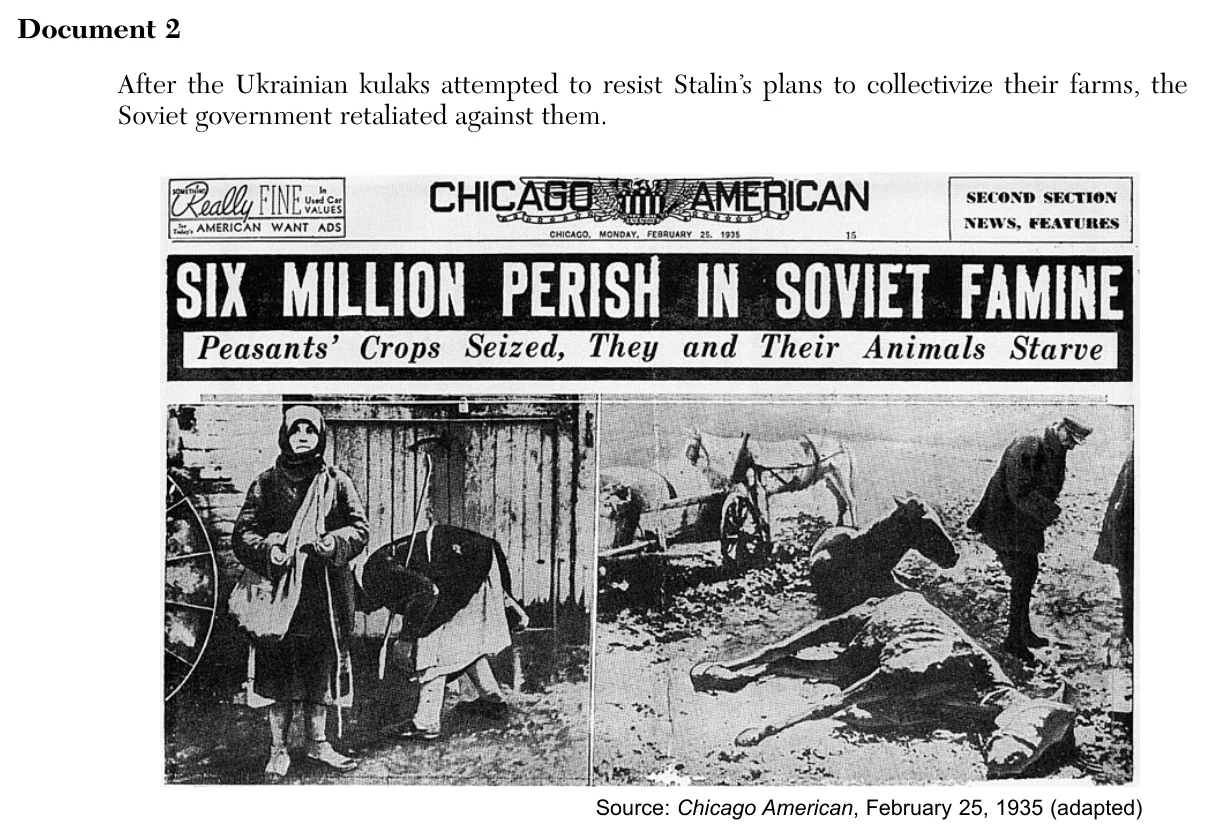
Across these cases, food insecurity endured because the people suffering from it had little power over the policies that caused it. Imperial agents demanded resources, occupation authorities confined populations and revolutionary regimes controlled agricultural production and rations. The repeated result was that political decisions turned existing vulnerability into severe and preventable hunger.
From the New York State Education Department. August 2026 Global History and Geography II Regents Examination. Internet. Available from https://www.nysedregents.org/ghg2/826/glhg2-82026-exam.pdf. Accessed .