NEW YORK STATE REGENTS · ALGEBRA I
August 2026 Algebra I Regents Past Paper & Solutions
Work through exponents, two-way tables and modeling with equations with a question-by-question walkthrough of the exam.
- 35 worked questions
- 82 raw credits
- 4 exam parts
The question images and page numbers come from the regular-size English exam. OnlyPrepy wrote the summaries and worked solutions.
Quick answer key for Part I
Part I Multiple choice
Question indexQ1 Doubling model
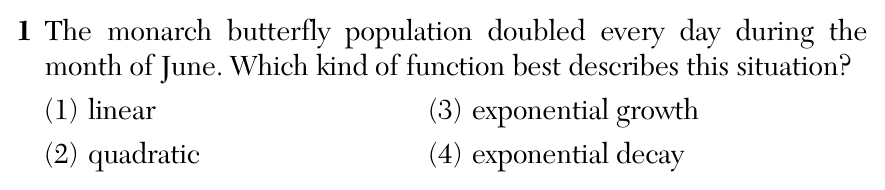
Classify the model for a population that doubles each day.
Worked solution for question 1
- Each additional day multiplies the population by 2.
- A constant multiplier above 1 gives growth of the form P(t) = P₀ · 2ᵗ.
Answer choice 3Exponential growth
Q2 Linear equation
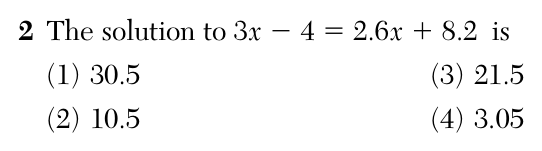
Solve 3x − 4 = 2.6x + 8.2.
Worked solution for question 2
- Subtract 2.6x and add 4, leaving 0.4x = 12.2.
- Divide by 0.4 to obtain 30.5.
- Check in the original equation: 3(30.5) − 4 = 87.5 and 2.6(30.5) + 8.2 = 87.5. Keeping the decimals exact avoids rounding the solution.
Answer choice 130.5
Q3 Substitution
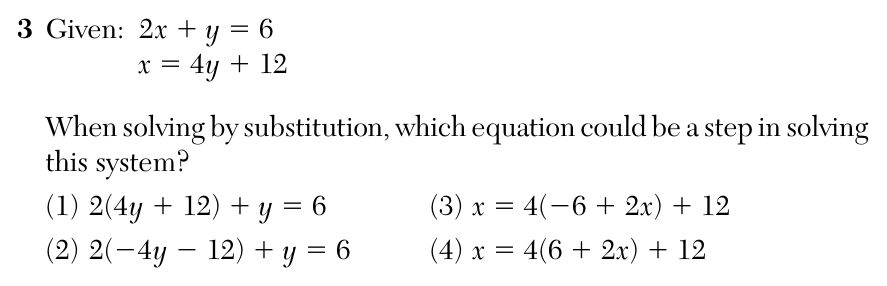
Use x = 4y + 12 in 2x + y = 6.
Worked solution for question 3
- Replace x with its entire equal expression.
- Keep parentheses so that the original coefficient 2 multiplies 4y and 12.
Answer choice 12(4y + 12) + y = 6
Q4 Write an inequality
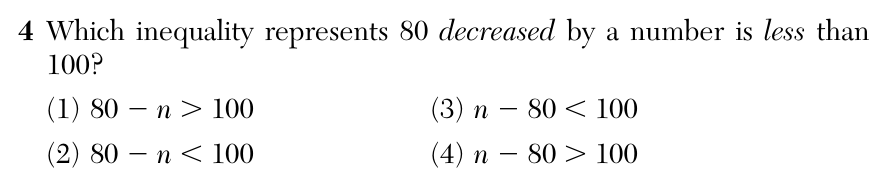
Model 80 reduced by n being below 100.
Worked solution for question 4
- The starting quantity is 80, so subtract n from it.
- Below 100 gives a strict less-than sign.
Answer choice 280 − n < 100
Q5 Depreciation
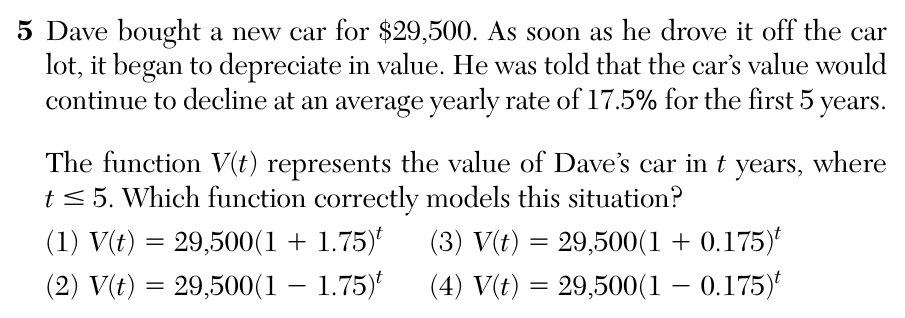
A car starts at 29,500 dollars and loses 17.5% of its value each year. Model the first five years.
Worked solution for question 5
- Convert 17.5% to 0.175 and subtract from 1 to get the retained fraction 0.825.
- Multiply the starting value by this factor once for each elapsed year.
- The base must lie between 0 and 1 for decay. The first year gives 29,500(0.825) = 24,337.50 dollars, a decrease of 5,162.50 dollars.
Answer choice 4V(t) = 29,500(0.825)ᵗ for 0 ≤ t ≤ 5
Q6 Factor a difference of squares
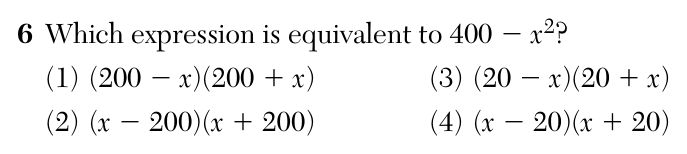
Factor 400 − x².
Worked solution for question 6
- Since 400 = 20², use a² − b² with a = 20 and b = x.
- The product has opposite cross terms, which cancel.
Answer choice 3(20 − x)(20 + x)
Q7 Scatter plot estimate
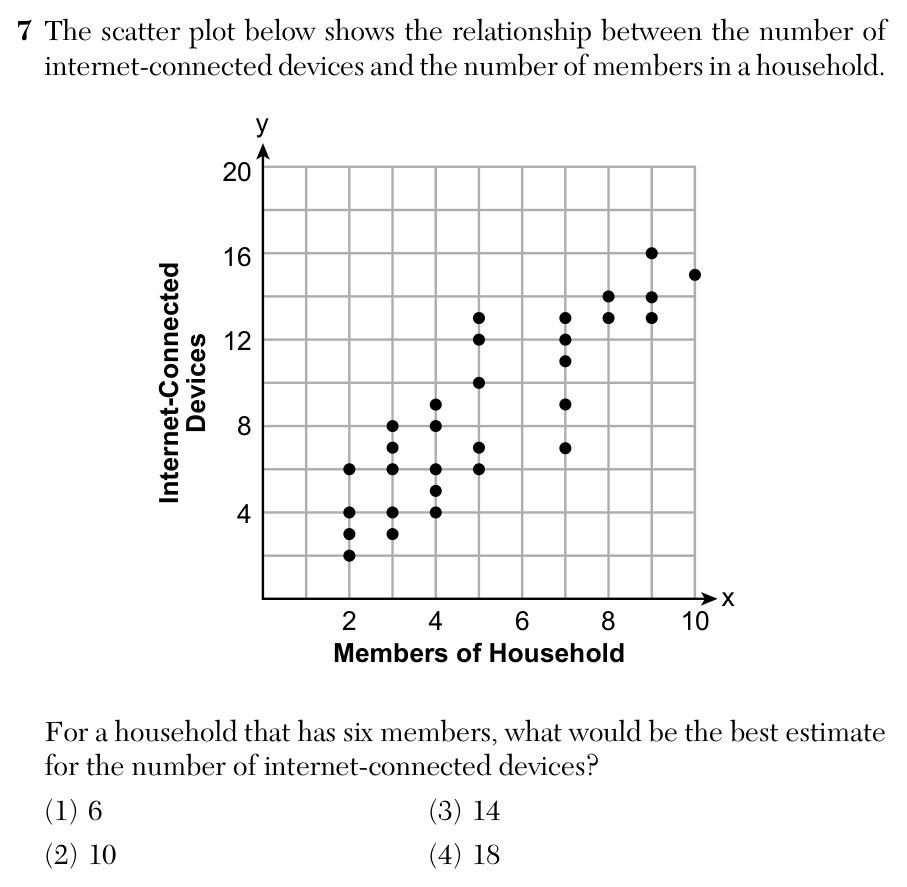
Use the devices-versus-household-size scatter plot to estimate the number of devices for six people.
Worked solution for question 7
- Locate 6 on the horizontal household-size axis and move toward the trend of the points.
- The corresponding vertical level is around 10. An estimate uses the center of the trend.
- Read the axes in their stated order. Household size is the input and devices the output. Nearby plotted values are evidence for an estimate, rather than an exact value for every six-person household.
Answer choice 2About 10 devices
Q8 Axis of symmetry
Find the axis of y = −x² + 6x.

Worked solution for question 8
- Use x = −b/(2a) with a = −1 and b = 6.
- Then −6/(−2) = 3. The axis is vertical.
- Complete the square to get y = −(x − 3)² + 9. The 9 gives the height of the vertex, while x = 3 gives its horizontal location and hence the vertical axis.
Answer choice 4x = 3
Q9 Property of equality
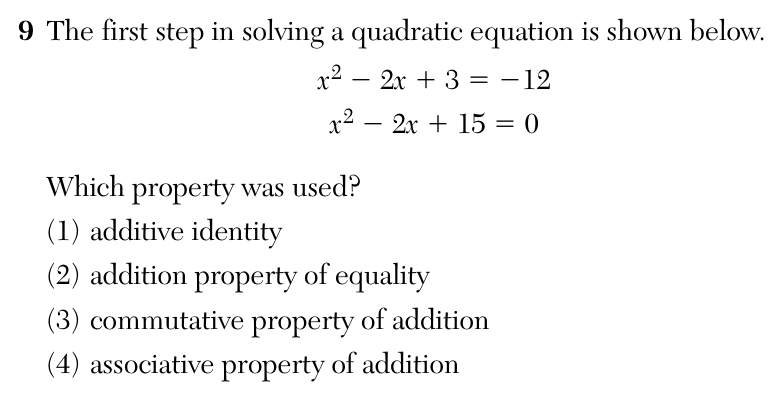
Name the rule used to change x² − 2x + 3 = −12 into x² − 2x + 15 = 0.
Worked solution for question 9
- The step adds 12 to both sides.
- The constant on the left increases to 15 while the right becomes 0, preserving all solutions.
Answer choice 2Addition property of equality
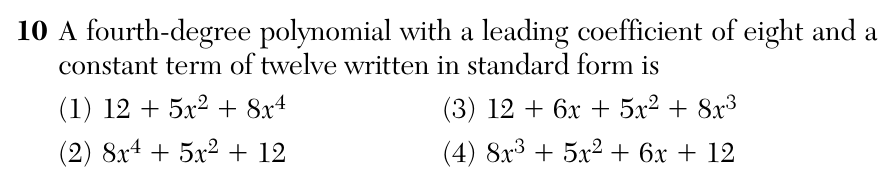
Q10 Standard form
Choose the fourth-degree polynomial in descending powers with leading coefficient 8 and constant 12.
Worked solution for question 10
- Start with 8x⁴ to meet both the degree and leading-coefficient requirements.
- Place the degree-two term next and the degree-zero term last.
Answer choice 28x⁴ + 5x² + 12
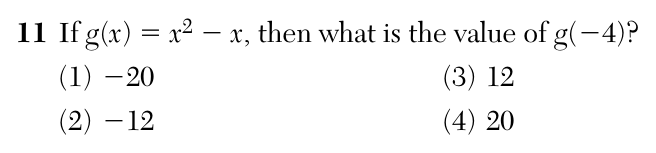
Q11 Evaluate at a negative input
Evaluate g(−4) if g(x) = x² − x.
Worked solution for question 11
- Substitute −4 in parentheses into both terms.
- The square is 16 and subtracting −4 adds 4.
- Write the substitution as (−4)² − (−4) = 16 + 4. Parentheses keep the negative sign inside the square and show why the second subtraction becomes addition.
Answer choice 420
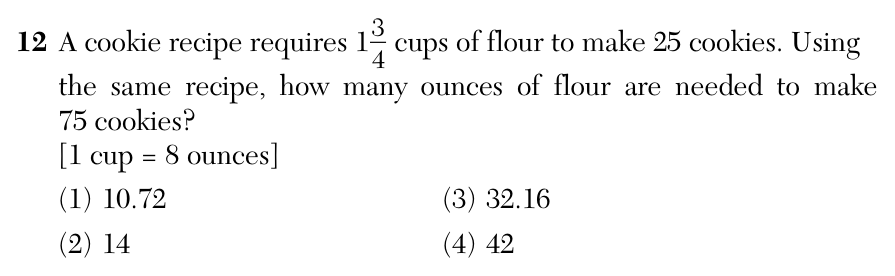
Q12 Scale a recipe
Convert the flour for 75 cookies to ounces if 25 use 1¾ cups and 1 cup equals 8 ounces.
Worked solution for question 12
- Triple the 25-cookie recipe to obtain 3(1.75) = 5.25 cups.
- Multiply by 8 ounces per cup to get 42 ounces.
Answer choice 442 ounces
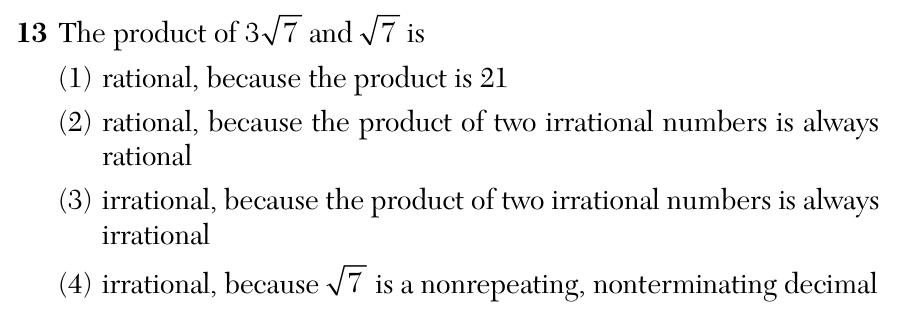
Q13 Rational product
Classify (3√7)(√7).
Worked solution for question 13
- The two radicals multiply to 7.
- The product is 3 · 7 = 21. An integer is rational because it can be written over denominator 1.
Answer choice 121, rational
Q14 Compare increasing functions
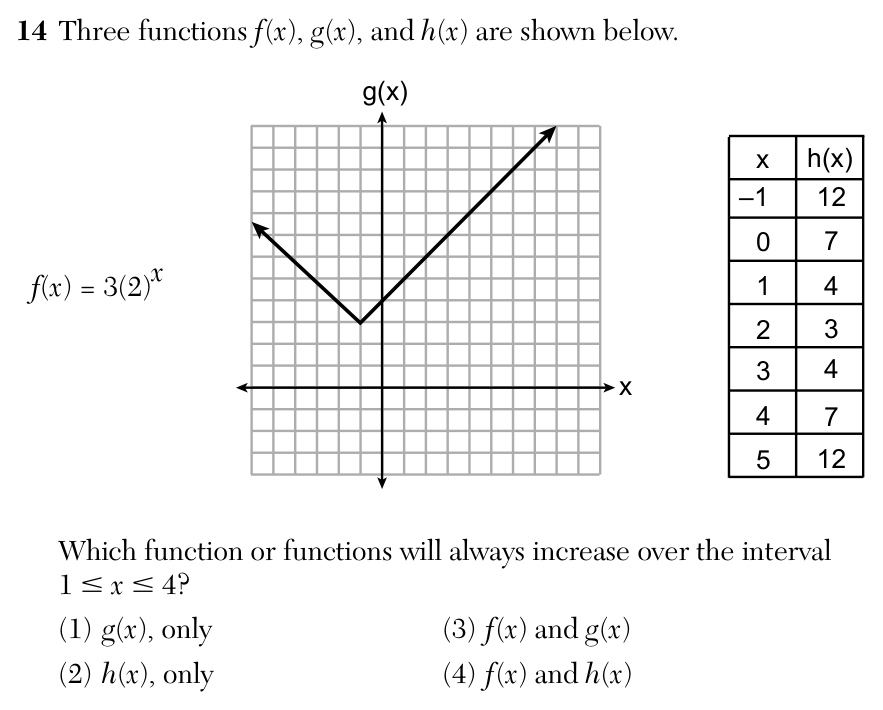
Compare exponential f(x) = 3(2)ˣ, graphed g, and tabulated h on 1 ≤ x ≤ 4.
Worked solution for question 14
- The base 2 makes f increase for every real input. The graph of g rises throughout the specified interval.
- The h values at x = 1, 2, 3, 4 are 4, 3, 4, 7. The first decrease disqualifies h.
- The graph of g has its corner before the interval begins, so the descending branch is outside the comparison. In the table for h, the fall from 4 to 3 occurs inside the interval.
Answer choice 3f and g
Q15 Zeros from factors
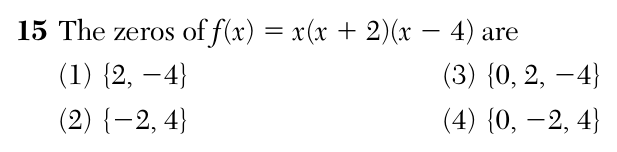
Find the zeros of x(x + 2)(x − 4).
Worked solution for question 15
- Set x, x + 2 and x − 4 equal to zero separately.
- The solutions are 0, −2 and 4 because any zero factor makes the product vanish.
Answer choice 4{−2, 0, 4}
Q16 Equivalent exponential expressions
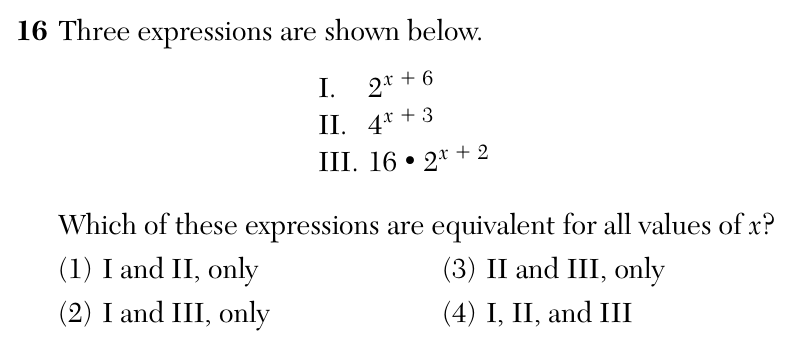
Compare I, 2^(x+6), II, 4^(x+3), and III, 16 · 2^(x+2).
Worked solution for question 16
- Replace 16 with 2⁴ and add exponents in III, giving 2^(x+6).
- For II, rewriting 4 as 2² gives 2^(2x+6), which differs for general x.
- At x = 1, expression II gives 4⁴ = 256, while I and III each give 128. The expressions can coincide at an isolated input without being identical.
Answer choice 2I and III
Q17 Complete the square
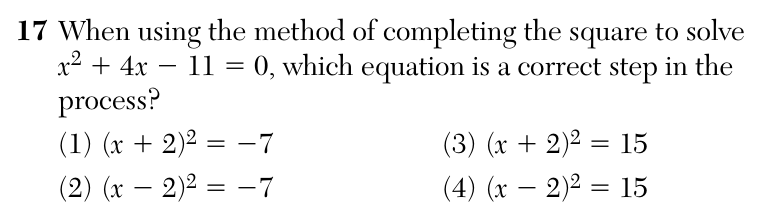
Rewrite x² + 4x − 11 = 0 in squared-binomial form.
Worked solution for question 17
- First obtain x² + 4x = 11.
- Add (4/2)² = 4 to each side and factor the resulting perfect square.
Answer choice 3(x + 2)² = 15
Q18 Compare means and spreads
Compare the center and spread of the two sets of nine bowling scores.
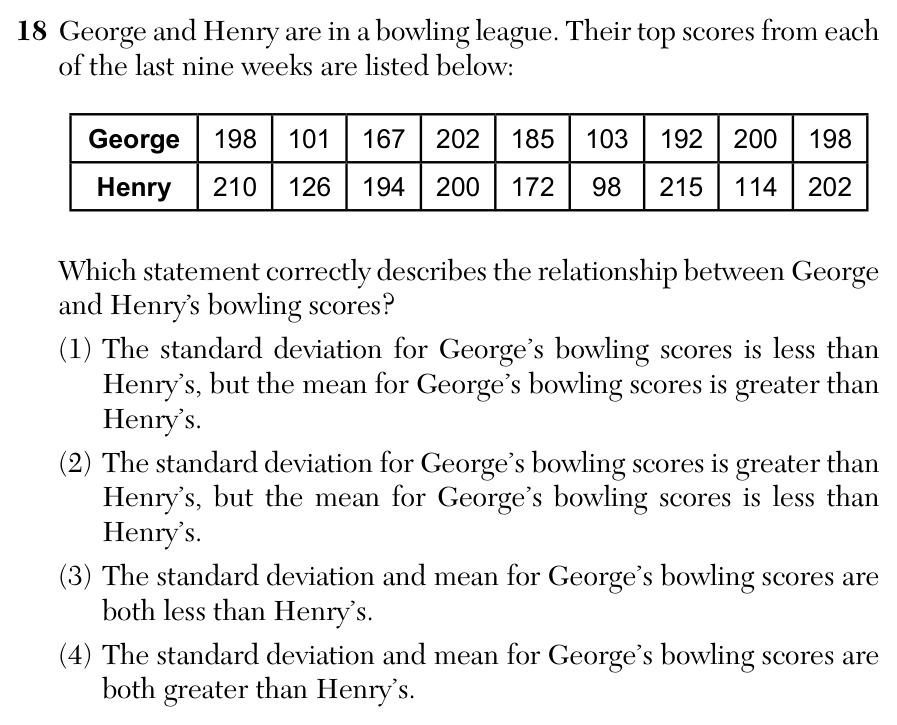
Worked solution for question 18
- Find means by dividing the score sums by 9. George has about 171.78 and Henry about 170.11.
- Using population standard deviation for both lists gives about 38.63 and 42.67 respectively. George's scores vary less around his mean.
- The standard deviations must use the same convention for both lists. A sample standard deviation multiplies both population values by the same factor because both sample sizes are 9, so the comparison stays the same.
Answer choice 1George has the higher mean and lower standard deviation.
Q19 Mapping diagram
Use the arrows from the domain to determine if the diagram gives a function.
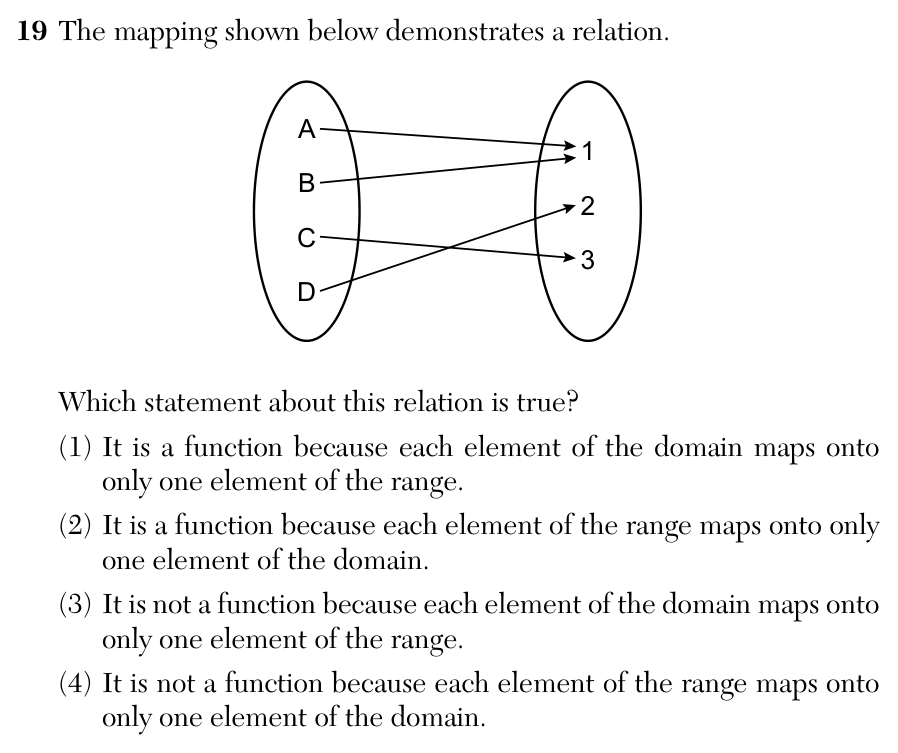
Worked solution for question 19
- Trace the arrows starting from each input separately. Every domain element has exactly one outgoing arrow.
- Several inputs may share an output. It is the number of outputs per input that matters.
Answer choice 1It is a function.
Q20 Shift an absolute value graph
Shift f(x) = ∣x + 6∣ − 5 two units right.
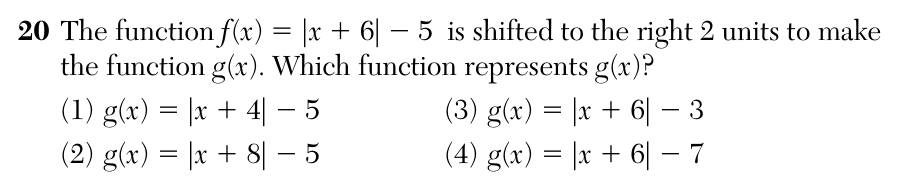
Worked solution for question 20
- For a rightward move, replace x by x − 2 inside f.
- Simplify ∣(x − 2) + 6∣ − 5. The vertex moves from x = −6 to x = −4.
Answer choice 1g(x) = ∣x + 4∣ − 5
Q21 Average price change
Eggs cost 1.34 dollars in 2009 and 2.08 dollars in 2016. Find the annual average change.
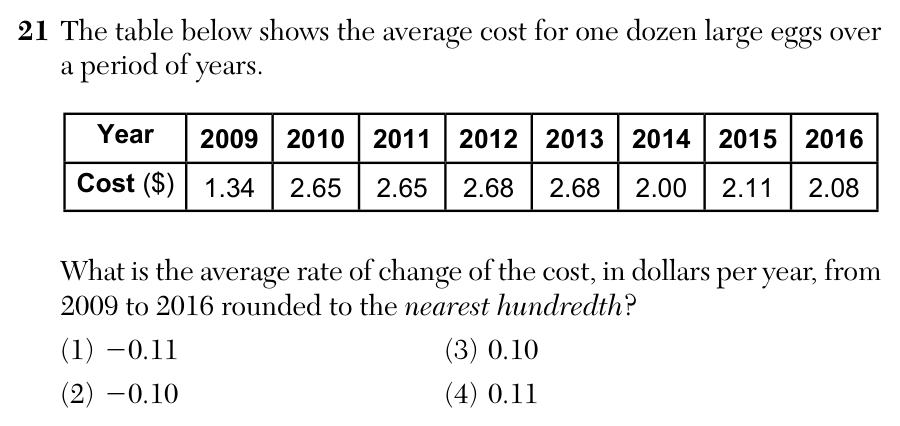
Worked solution for question 21
- The price rises by 2.08 − 1.34 = 0.74 dollars over 7 years.
- Divide to obtain about 0.1057 dollars per year and round to hundredths.
Answer choice 40.11 dollars per year
Q22 Check a point on a parabola
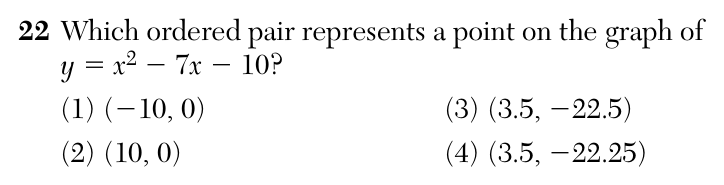
Identify the listed point on y = x² − 7x − 10.
Worked solution for question 22
- Evaluate the rule at x = 3.5 to get 12.25 − 24.5 − 10.
- The sum is −22.25, so the stated coordinates satisfy the equation.
Answer choice 4(3.5, −22.25)
Q23 Factor completely
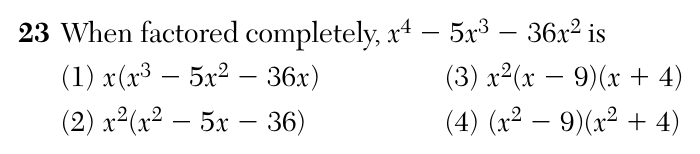
Factor x⁴ − 5x³ − 36x².
Worked solution for question 23
- First pull out x², leaving x² − 5x − 36.
- The numbers −9 and 4 multiply to −36 and sum to −5, giving the last two factors.
Answer choice 3x²(x − 9)(x + 4)
Q24 Subtract quadratics
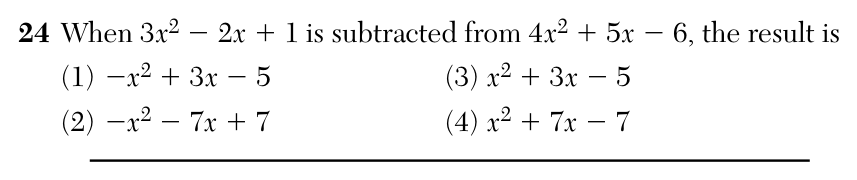
Compute (4x² + 5x − 6) − (3x² − 2x + 1).
Worked solution for question 24
- Distribute the negative to obtain −3x² + 2x − 1 from the second polynomial.
- Combine the x² terms, the x terms and the constants.
Answer choice 4x² + 7x − 7
Part II Short response
Question indexQ25 Two-way table
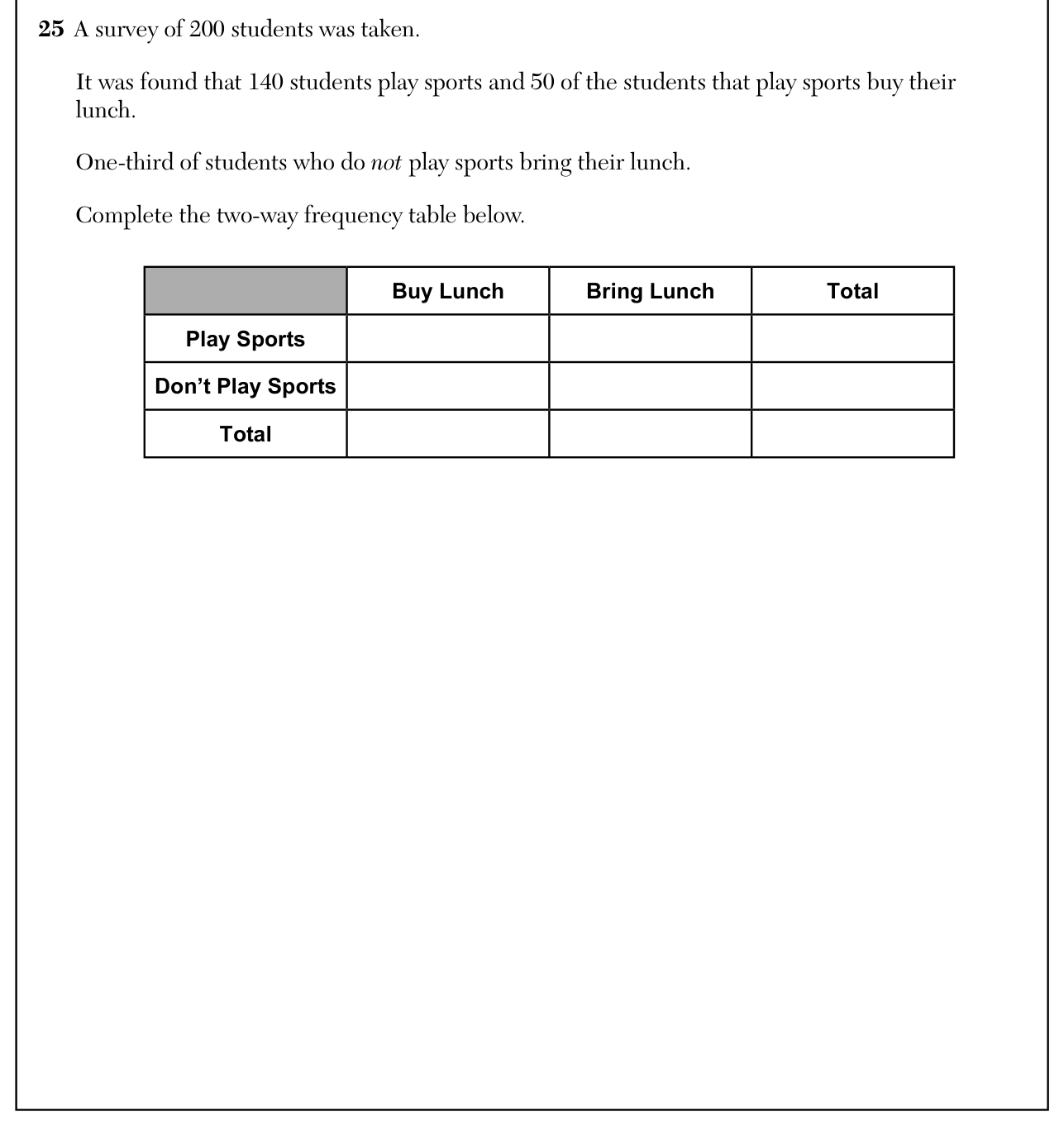
Among 200 students, 140 play sports and 50 of those buy lunch. A third of the other students bring lunch. Complete all counts.
Worked solution for question 25
- Of 140 athletes, 140 − 50 = 90 bring lunch. There are 200 − 140 = 60 non-athletes.
- A third of 60 gives 20 bringing lunch, leaving 40 buying lunch.
- Sum the columns to obtain 90 buying and 110 bringing.
- Check the completed table in both directions. The row totals 140 and 60 add to 200, and the column totals 90 and 110 add to 200.
Final answerBuy, bring, total. Sports (50, 90, 140). No sports (40, 20, 60). Totals (90, 110, 200).
Q26 Rearrange a line formula
Isolate x in y = mx + b.

Worked solution for question 26
- Subtract b from both sides to isolate the product mx.
- Divide the entire difference y − b by m. A zero slope would leave no x-term to isolate.
Final answerx = (y − b)/m for m ≠ 0
Q27 Fractional inequality
Solve (3/4)x + 2/5 < (1/4)x − 2/5.

Worked solution for question 27
- Subtract x/4 and 2/5, leaving x/2 < −4/5.
- Multiply by positive 2, which preserves the inequality direction.
- Multiplying the original inequality by 20 is another way to check: 15x + 8 < 5x − 8 gives 10x < −16.
Final answerx < −8/5
Q28 Arithmetic sequence formula
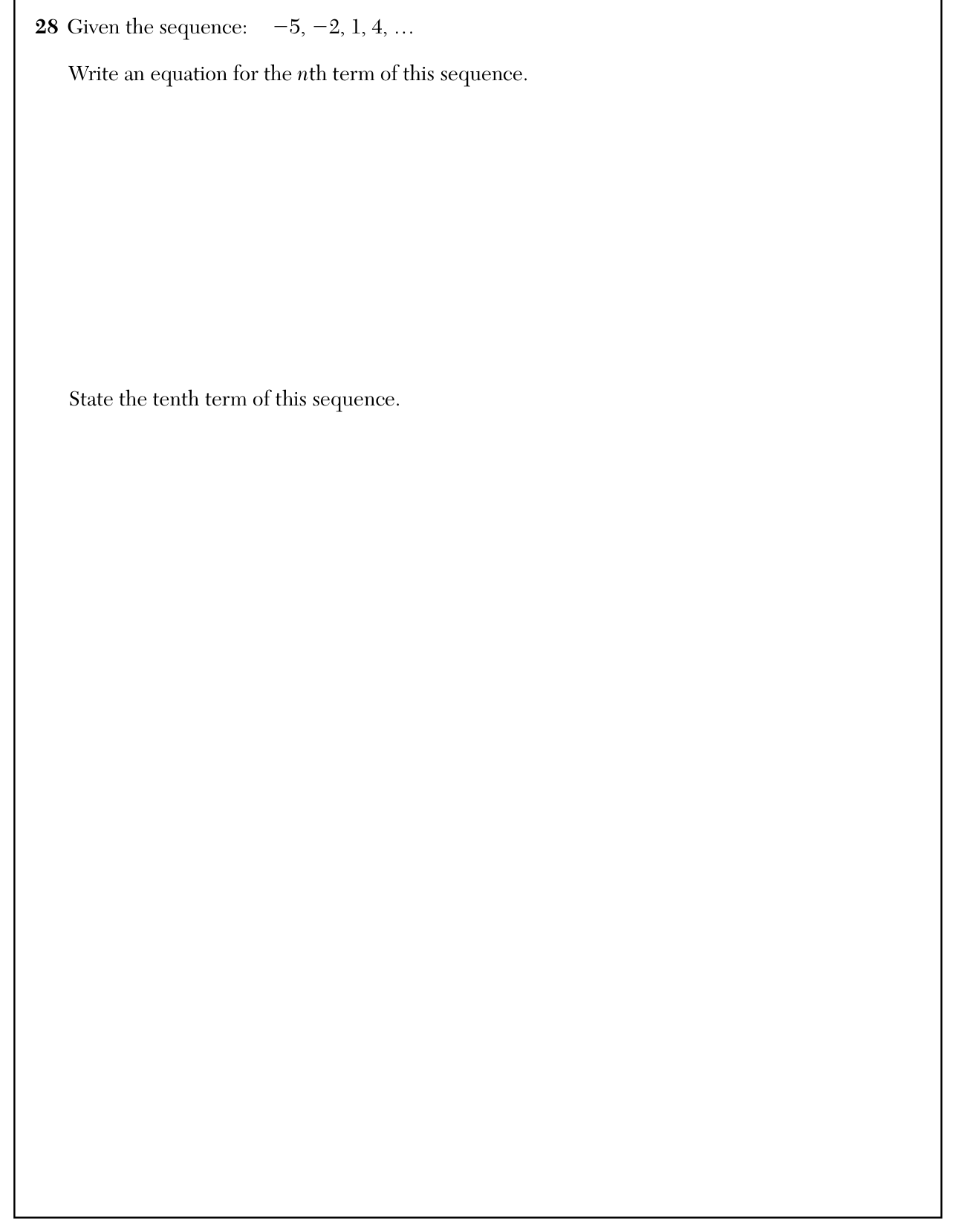
Write the nth term of −5, −2, 1, 4, … and find term 10.
Worked solution for question 28
- Consecutive terms differ by +3. From term 1 to term n there are n − 1 increases.
- At n = 10, evaluate −5 + 3(9) = 22.
Final answeraₙ = −5 + 3(n − 1). The tenth term is 22.
Q29 Quadratic formula
Find exact solutions of 2x² + 3x − 1 = 0 using the formula.

Worked solution for question 29
- Use a = 2, b = 3 and c = −1. The discriminant is 3² − 4(2)(−1) = 17.
- Use denominator 2a = 4 and numerator −3 ± √17.
Final answerx = (−3 ± √17)/4
Q30 Simplify radicals
Combine 5√32 + 10√2.

Worked solution for question 30
- Since √32 = √(16 · 2) = 4√2, the first term becomes 20√2.
- Add the two coefficients because the radicands now match.
Final answer30√2
Part III Extended response
Question indexQ31 Length regression
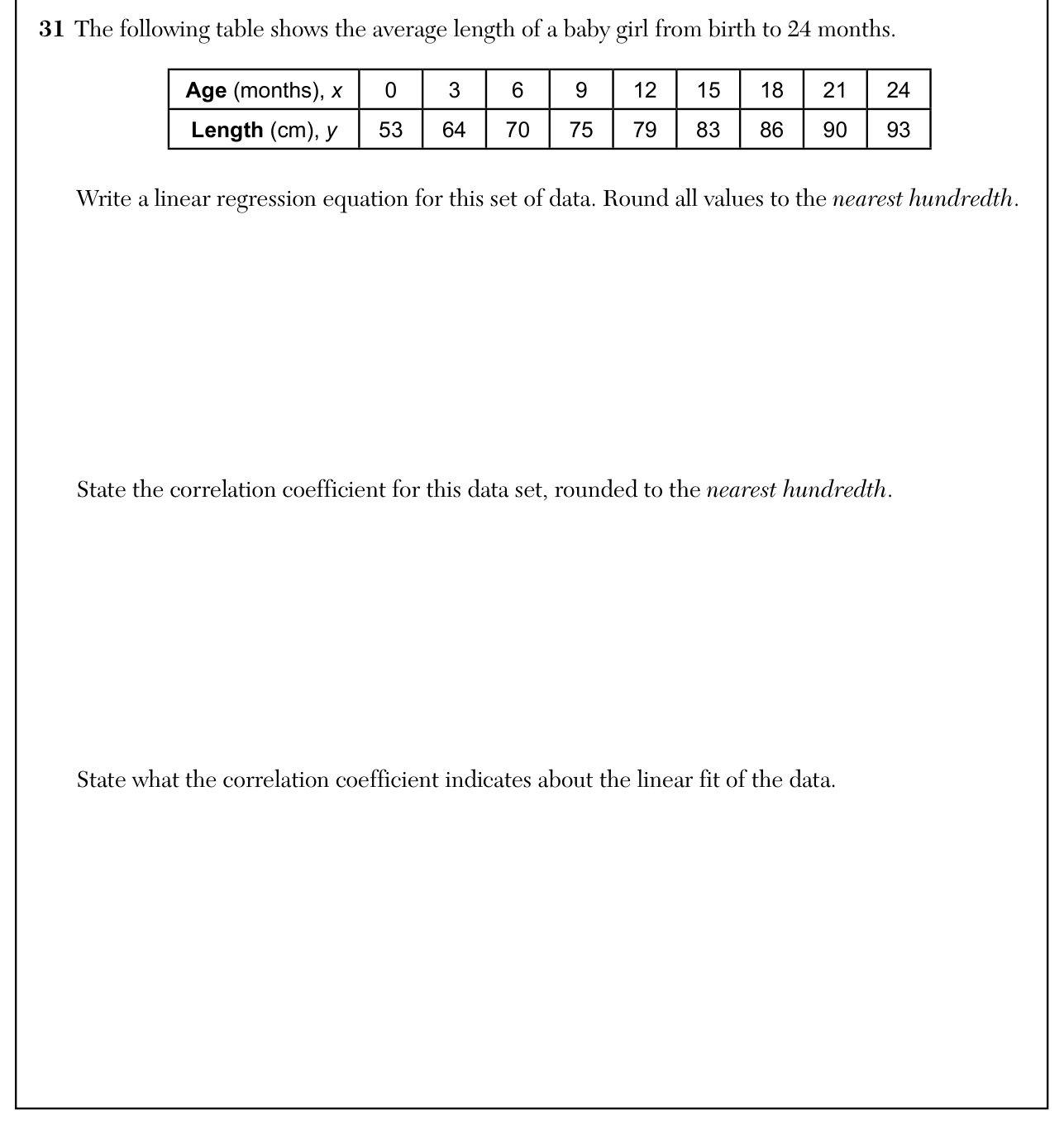
Model the recorded lengths from 0 to 24 months with a linear regression and interpret r.
Worked solution for question 31
- Pair ages 0, 3, 6, 9, 12, 15, 18, 21, 24 with lengths 53, 64, 70, 75, 79, 83, 86, 90, 93.
- Fit a least-squares line and round the slope, intercept and correlation to two decimal places.
- The positive r near 1 indicates a strong positive linear association between age and length.
Final answerŷ = 1.54x + 58.47, r = 0.98
Q32 Graph an inequality system
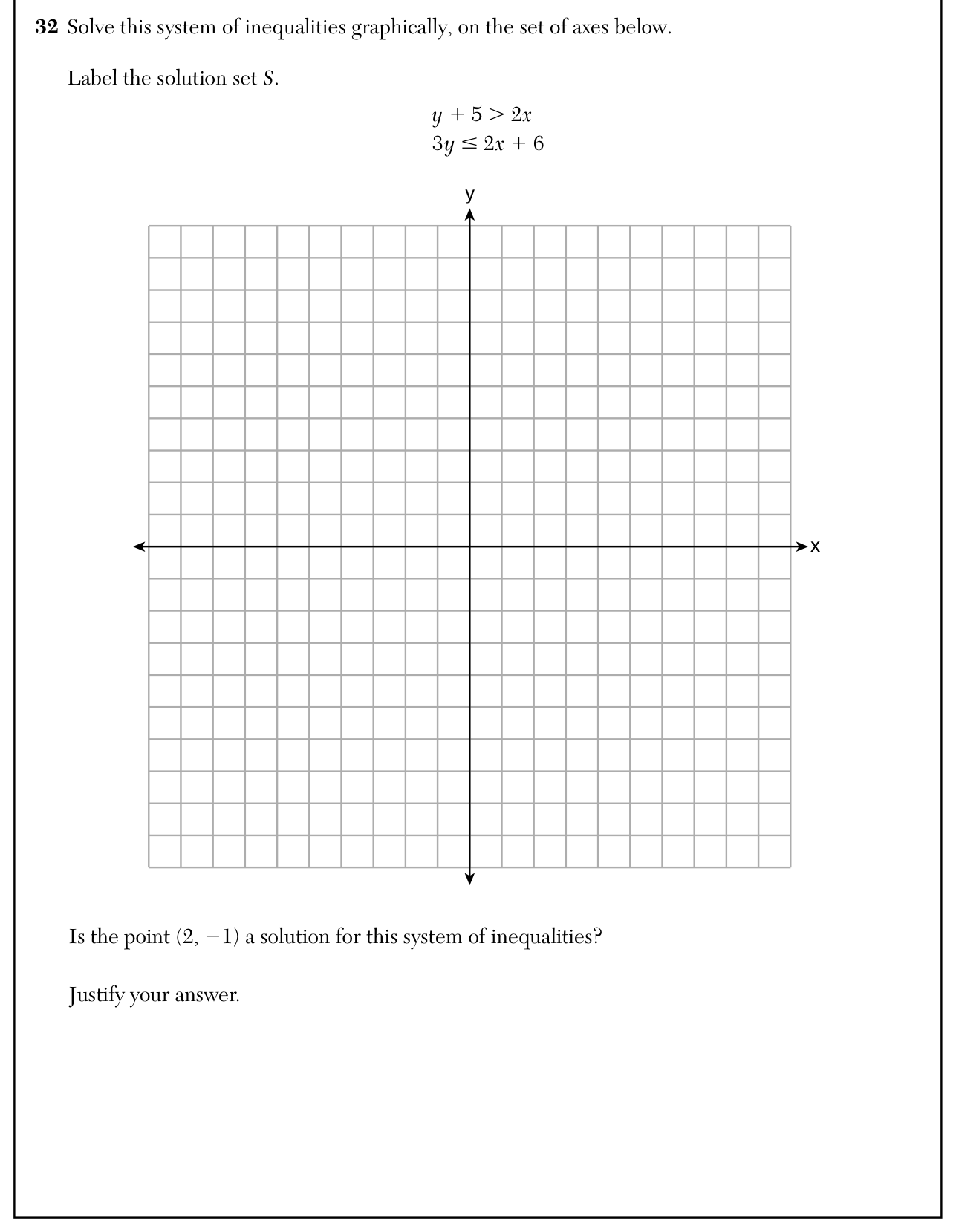
Graph y + 5 > 2x and 3y ≤ 2x + 6. Decide if (2, −1) belongs.
Worked solution for question 32
- Draw y = 2x − 5 dashed through (0, −5) and (2, −1) and shade above.
- Draw y = 2x/3 + 2 solid through (0, 2) and (3, 4), shade below and label the overlap S.
- At (2, −1) the first inequality reads 4 > 4, which is false.
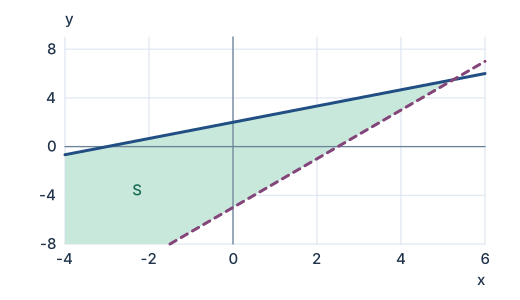
Final answerS is above y = 2x − 5 and on or below y = 2x/3 + 2. The point is excluded.
Q33 Basketball trajectory
Sketch h(t) = −16t² + 48t + 5 and find the peak.
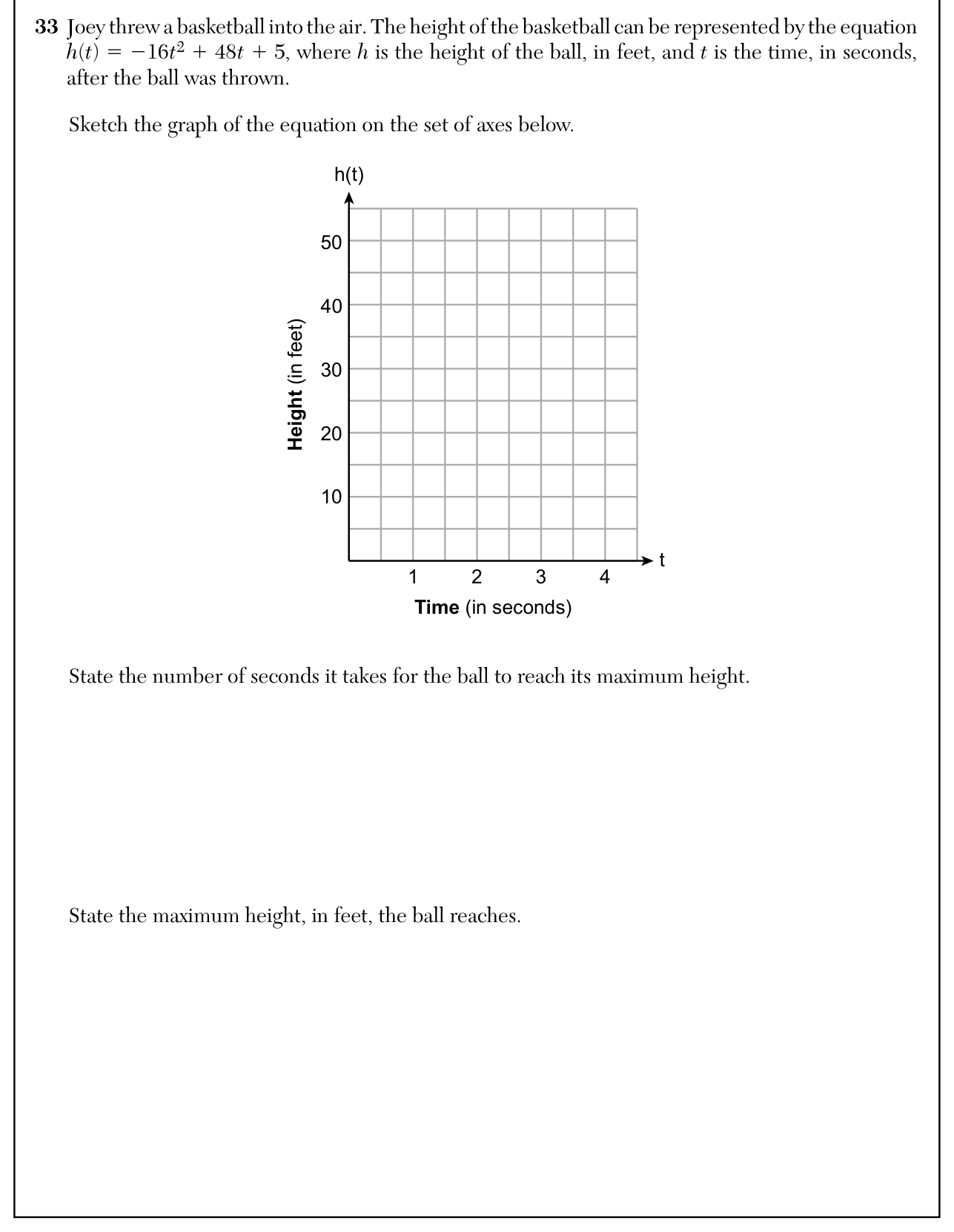
Worked solution for question 33
- The leading coefficient is negative, so the peak is at t = −48/(2 · −16) = 1.5.
- Evaluate h(1.5) = −36 + 72 + 5 = 41.
- Plot (0, 5), (1, 37), (1.5, 41), (2, 37), and (3, 5). Connect smoothly and end at ground level just after t = 3.
- For an accurate right endpoint, solve h(t) = 0. The positive root is (48 + √2624)/32 ≈ 3.10 seconds, so the descending arc reaches the ground just beyond 3.
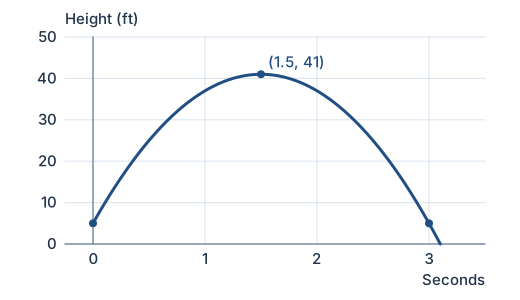
Final answer41 feet at 1.5 seconds
Q34 Solve a nonlinear system
Solve y = x² + 4x − 3 and y = 2x + 5 together.

Worked solution for question 34
- Set the right sides equal. Moving all terms to one side gives x² + 2x − 8 = 0.
- Factor (x + 4)(x − 2). For x = −4 and x = 2, evaluate y = 2x + 5.
Final answer(−4, −3) and (2, 9)
Part IV Long response
Question indexQ35 Solve a purchase system
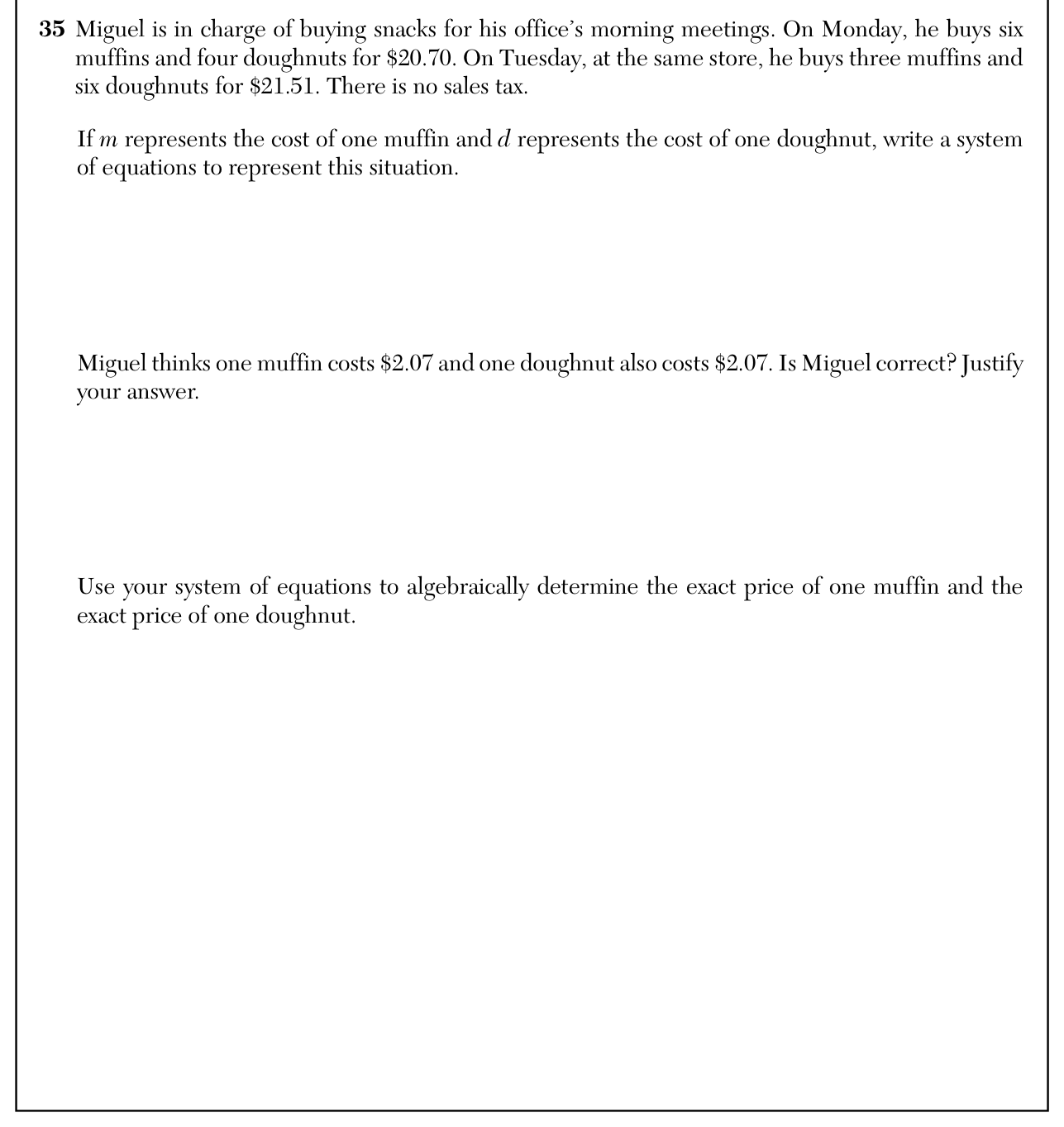
Six muffins and four doughnuts cost 20.70 dollars. Three muffins and six doughnuts cost 21.51 dollars. Test 2.07 dollars for each and find the actual prices.
Worked solution for question 35
- Write 6m + 4d = 20.70 and 3m + 6d = 21.51.
- At m = d = 2.07, Monday's total works, but Tuesday's is 9(2.07) = 18.63, so the claim fails.
- Double Tuesday's equation and subtract Monday's, giving 8d = 22.32 and d = 2.79.
- Substitute into Monday's equation to get 6m = 9.54 and m = 1.59. Tuesday checks as 4.77 + 16.74 = 21.51.
Final answerMuffin 1.59 dollars, doughnut 2.79 dollars
From the New York State Education Department. August 2026 Algebra I Regents Examination. Internet. Available from https://www.nysedregents.org/algebraone/826/algone-82026-exam.pdf. Accessed .