NINE PERIODS · HISTORICAL REASONING · 2027 EXAM
AP United States History
Complete Study Guide
Know the events. Question the sources. Explain the connections. Build a historical argument with evidence you can use accurately.
39 chapters · 734 study topics · Original practice and review tools

CHAPTER 1
1. AP United States History Exam Overview
Back to contents ↑1.1 What Is AP United States History?
AP United States History develops an evidence-based understanding of U.S. history from about 1491 to the present. You study change, continuity, causation and comparison while evaluating sources. Knowing an event matters; explaining how it supports a historical argument matters too.
1.2 What Does APUSH Stand For?
APUSH abbreviates AP United States History; AP means Advanced Placement. The course is not the same as AP U.S. Government and Politics. History emphasizes developments across time, while Government focuses more directly on political institutions, processes and constitutional relationships.
1.3 What Is the Purpose of the AP U.S. History Course?
The course aims to connect historical knowledge with disciplined explanation. You should be able to situate a source, compare interpretations and build a defensible argument. A timeline supplies orientation, but it becomes useful when you can explain relationships between its entries.
1.4 Is APUSH a College-Level History Course?
APUSH is designed as an introductory college-level history course. This describes its learning expectations, not an automatic credit award. A receiving college decides whether your score earns course credit, elective credit, placement or none of those benefits.
1.5 What Historical Periods Does APUSH Cover?
The nine periods run from 1491–1607 through 1980–present. Their boundaries overlap because developments do not stop when a unit ends. The 2027 examination also has task-specific coverage rules: SAQs span 1491–2001 and DBQs address 1754–1980.
1.6 Who Should Take AP United States History?
Consider APUSH if you are ready for sustained reading, careful note-taking and explanation using specific evidence. Interest in politics alone is not enough: economic, social, cultural and environmental histories also matter. Ask to see sample readings and writing assignments.
1.7 What Grade Do Students Typically Take APUSH?
Many schools place APUSH in grade 10 or 11, but the local sequence varies. There is no universal grade-level requirement establishing when every student must take it. Consider readiness, other courses and access to useful writing feedback.
1.8 Does APUSH Have Prerequisites?
College Board lists no required prior AP history course. Students should be able to read college-level texts and write grammatically correct, complete sentences. Schools may add enrollment conditions. A sample source-analysis task can help you judge readiness more concretely than a course label.
1.9 Can Students Self-Study AP U.S. History?
Self-study is possible if you arrange a testing place and a feedback plan. Use an organized chronology, a source-based question routine and repeated essay review. Registration, digital preparation and learning are separate responsibilities; none happens automatically because you read a textbook.
1.10 Can International Students Take APUSH?
International students may register through a willing participating school or authorized center. Confirm external-candidate access, fees, device arrangements and the 2027 local session time early. U.S. political vocabulary may need deliberate study, but citizenship is not a prerequisite for learning the course.
1.11 APUSH vs. Regular U.S. History
Regular U.S. History and APUSH can cover similar eras with different depth and assessment demands. APUSH explicitly requires source interpretation and evidence-based argument under the published exam format. Compare your school's actual assignments rather than assuming every regular course is identical.
1.12 APUSH vs. Honors U.S. History
Honors courses are locally defined. They may offer substantial reading and writing, but they do not necessarily use APUSH's examination tasks or framework. Look at pacing, feedback, source work and total workload before deciding which course fits.
1.13 APUSH vs. AP World History
APUSH focuses on U.S. developments; AP World History: Modern examines broader global patterns from about 1200 onward. Both use historical reasoning and source analysis. Different subject coverage and candidate populations make simple pass-rate rankings unreliable.
1.14 APUSH vs. AP U.S. Government and Politics
AP U.S. Government examines institutions, constitutional principles and political processes. APUSH examines how institutions and society developed and changed. A Supreme Court case may appear in both, but historical questions ask how it relates to developments over time.
1.15 What Skills Will You Learn in APUSH?
Practise identifying developments, sourcing documents, evaluating claims, contextualizing evidence, making connections and constructing arguments. The reasoning processes are comparison, causation and continuity/change. A strong answer uses accurate knowledge to perform the requested reasoning rather than reciting everything remembered.
1.16 Benefits of Taking AP United States History
The course can improve historical literacy, source judgment and explanatory writing. Those skills transfer beyond a future history major. Credit or placement may be an additional benefit under a particular college's policy; admission and credit remain separate decisions.
1.17 Is APUSH Worth Taking in High School?
APUSH is worthwhile when its work fits your interests and you can sustain the reading and revision. Consider the available teaching, your other commitments and concrete goals. A difficult course title alone does not guarantee learning or an admissions advantage.
1.18 How to Use This Complete APUSH Review Guide
Start with the 2027 changes, then use the nine-period map to identify gaps. Combine chronological review with theme comparisons, source analysis and timed writing. Keep an error log and test a repaired skill on a fresh question instead of repeatedly rereading familiar notes.
CHAPTER 2
2. AP United States History Exam Format 2027
Back to contents ↑2.1 Complete APUSH Exam Structure
The standard exam has 55 MCQs in 55 minutes, three required SAQs in 40 minutes, then a DBQ and LEQ in a shared 100-minute section. The recommended writing allocation is 60 minutes for DBQ, including reading, and 40 for LEQ.
2.2 Total Number of Questions
You answer 55 multiple-choice items, three three-part short answers, one document-based question and one long essay. In 2027 all three SAQs and the single broad LEQ are required. Source documents are stimulus material rather than additional separately counted questions.
2.3 Total Exam Duration
Standard assessed time is 3 hours 15 minutes. Check-in, instructions, the scheduled section break and technical procedures add time at school. Individually approved accommodations can alter timing; confirm your arrangement with the coordinator.
2.4 Section I-A: Multiple-Choice Questions
The 55-minute MCQ part contributes 40% of the score. Questions normally appear in source-based sets of three or four. Use the source alongside historical context; neither outside knowledge alone nor a literal source summary answers every task.
2.5 Section I-B: Short-Answer Questions
Three SAQs contribute 20% and share 40 minutes. For 2027 each includes a source, and each focuses on a different historical period. Address every labeled part with a concise answer and the evidence or explanation its verb requires.
2.6 Section II-A: Document-Based Question
The DBQ supplies seven documents and asks for a historical argument using them and relevant outside evidence. It contributes 25%. The recommended 60 minutes includes a 15-minute reading allocation, not 60 minutes plus a separate additional reading block.
2.7 Section II-B: Long Essay Question
The LEQ contributes 15% with a recommended 40 minutes. In 2027 one broad required prompt repositions choice within the evidence and developments you select. You are not expected to narrate the entire broad chronological span.
2.8 Percentage Weight of Each Exam Section
The component weights are 40% MCQ, 20% SAQ, 25% DBQ and 15% LEQ. These are weights, not universal score boundaries. Keep raw maxima distinct: 55 MCQs, nine SAQ points, seven DBQ points and six LEQ points.
2.9 Time Allocation for Each Section
Use 55 minutes MCQ and 40 minutes SAQ, followed by the combined 100-minute essay section. Practise checkpoints within the shared writing time. Do not spend so long on document reading that the required LEQ receives only a few rushed sentences.
2.10 Primary and Secondary Source-Based Questions
Primary sources originate in the period or experience studied; secondary sources interpret historical material. A later historian's account is not invalid because it is secondary. Ask what the source can establish and why its perspective matters to the question.
2.11 Historical Maps, Political Cartoons and Visual Sources
Read a visual's date, title, labels, scale and intended audience before interpreting it. A cartoon exaggerates to make an argument; a map selects a geographic view. Neither should be treated as a transparent photograph of every person's experience.
2.12 Is the APUSH Exam Fully Digital in 2027?
The standard published 2027 APUSH examination is fully digital in Bluebook. MCQ and written responses are completed in the testing app. Confirm individually approved accommodations or authorized contingency arrangements separately with staff.
2.13 How Bluebook Digital Testing Works
Preview Bluebook on the intended approved device and practise reading sources alongside typed responses. The website's tools are ordinary study aids. They cannot reproduce secure exam navigation, certify device compliance or submit an official examination.
2.14 How Students Write Essays in Bluebook
Type responses in their designated Bluebook areas and keep each SAQ part identifiable. Practise accurate typing, paragraphing and concise evidence use. A draft saved on this website is local practice, not a response delivered to College Board.
2.15 Exam Navigation and Time Management
Use the actual interface and proctor instructions for section boundaries. Do not assume you can return to an earlier section after time expires. A home rehearsal should declare pauses and assistance so its conditions are not confused with a standard uninterrupted exam.
2.16 Complete 2027 Exam Format Summary Table
The table below separates counts, time, raw maxima and section weights. The standard total remains 195 assessed minutes. A website composite model is useful for planning component improvement but does not establish a confirmed official 2027 score conversion.
2027 APUSH format at a glance
| Component | Required tasks | Time | Weight | Raw maximum |
|---|---|---|---|---|
| MCQ | 55 questions | 55 minutes | 40% | 55 |
| SAQ | Three source-based questions; all required | 40 minutes | 20% | 9 |
| DBQ | One seven-document question | 60 minutes recommended, including reading | 25% | 7 |
| LEQ | One broad required prompt | 40 minutes recommended | 15% | 6 |
DBQ and LEQ share 100 minutes. Total assessed time: 195 minutes. Standard administration is fully digital in Bluebook; check approved individual arrangements separately.
CHAPTER 3
3. APUSH 2027 Exam Changes and New Question Format
Back to contents ↑3.1 What Changed on the APUSH Exam in 2027?
For May 2027, all three SAQs include sources and are required; a single required broad LEQ replaces the previous menu of prompts. DBQ coverage is 1754–1980. Course content, MCQs and scoring rubrics remain unchanged under the published update.
3.2 Why College Board Updated AP History Exams
College Board describes the changes as improving focus, transparency and consistency while moving choice into the questions. Students spend less time choosing a prompt and more time demonstrating knowledge. This is an assessment redesign, not a removal of the nine historical periods.
3.3 New Short-Answer Question Structure
SAQ 1 uses one or more secondary text sources, SAQ 2 a primary text source and SAQ 3 a primary or secondary non-text source. Each question retains labeled tasks. Practise analyzing the stimulus before selecting historical evidence.
3.4 Why All Three SAQs Are Now Required
All three SAQs must be answered in 2027. There is no old choice between a third and fourth source-free question. Practise allocating time across three required tasks rather than selecting the historical period you prefer.
3.5 Source Requirements for SAQ 1, SAQ 2 and SAQ 3
The three source types differ, so preparation must include historian interpretations, primary prose and visuals. The questions span developments from 1491–2001 and focus on different periods. Source-reading skills matter alongside factual recall.
3.6 Changes to the Long Essay Question
The LEQ becomes one broad required question with an introductory statement suggesting possible analytical areas. You choose relevant developments and evidence within the demand. Do not reproduce the old instruction to select one of three alternative prompts.
3.7 Understanding the New Broad LEQ Prompt
A broad LEQ asks for a defensible argument supported by a purposeful selection of evidence. Its time range is not a command to describe every event across it. Define an appropriate focus while responding to the actual reasoning task.
3.8 How Historical Evidence Choices Work in the New LEQ
Choose one or more relevant developments referenced by the prompt and explain how your evidence supports the thesis. Choice is internal to constructing the argument. It does not authorize ignoring the prompt or using material outside its stated bounds.
3.9 Changes to the DBQ Chronological Coverage
The APUSH DBQ's published 2027 chronological coverage is 1754–1980, broader than the older 1754–1945 range. Practise postwar sources as well as earlier documents. Do not infer that the course's 1491–present span applies identically to every exam component.
3.10 What Remains Unchanged in the MCQ Section
The MCQ format remains 55 questions in 55 minutes, with a 40% weight. Stimulus-based interpretation and historical reasoning remain central. New SAQ and LEQ instructions do not justify abandoning the earlier source-reading skills.
3.11 Are the Scoring Rubrics Different in 2027?
The published update says free-response rubrics and point-earning criteria remain unchanged. Learn the current seven-point DBQ and six-point LEQ rules. Avoid old materials that still demand six documents for the DBQ's two document-evidence points; current criteria use four.
3.12 2026 vs. 2027 APUSH Exam Comparison
The comparison table distinguishes old SAQ/LEQ choice from the 2027 required tasks and notes the expanded DBQ span. Use an old paper for content and reasoning only after adjusting instructions; do not call an unmodified older paper a precise 2027 rehearsal.
3.13 How to Adapt Older Practice Questions
Retain older source analysis and writing practice, but add appropriate stimuli to source-free SAQs and respond to three required source-based tasks. Adapt LEQ practice into a broad evidence-choice task. These adaptations are original study exercises, not altered official releases.
3.14 Updated 2027 APUSH Practice Exam Resources
College Board says two updated practice exams become available during 2026–27 and a third during 2027–28 through its authorized resources. Access is not automatically public. The original practice below is clearly distinguished from those examinations.
3.15 How to Prepare for the New Exam Structure
Learn the revised instructions first, practise all three source types and build evidence that can support broad historical arguments. Review post-1945 material for DBQ readiness. Keep the unchanged rubric criteria visible when evaluating an adapted practice response.
2026 versus 2027: the task changes
| Feature | Before 2027 | Starting May 2027 |
|---|---|---|
| SAQ choice | Required earlier questions plus a choice of later source-free options | Three source-based questions, all required |
| SAQ stimuli | Mixed source-based and source-free structure | Secondary text; primary text; non-text |
| LEQ | Choose one of three questions | One broad required question; evidence choice within the task |
| DBQ span | 1754–1945 | 1754–1980 |
| Course / MCQ / rubrics | Existing framework and criteria | Unchanged under the published update |
SAQs address 1491–2001 and each focuses on a different period. The broad LEQ does not require narrating its entire time span.
CHAPTER 4
4. AP United States History Exam Dates 2027
Back to contents ↑4.1 Official APUSH Exam Date — May 7, 2027
The regular APUSH examination is Friday, May 7, 2027, Session 1. Confirm your ordered place and testing school. The public subject schedule does not independently establish your personal registration or reporting time.
4.2 APUSH Exam Start Time and Session 1
Session 1 clock time varies by location in 2027. For Dubai/UAE, the published UTC+04:00 table gives 11 a.m. local time. Obtain school arrival instructions rather than importing the 8 a.m. convention used in many U.S. locations.
4.3 AP Exam Start-Time Changes for Certain Locations
Session 1 and Session 2 replace the old morning/afternoon labels in the schedule. In many U.S. locations they still correspond to 8 a.m. and noon; elsewhere the clock times differ. APUSH's regular session is Session 1, not a student-selected time slot.
4.4 APUSH Regular Testing Schedule
The regular May 7 administration is the default scheduled examination. Early or independently arranged testing is not an alternative. Keep any school timetable and coordinator messages together so exam date, reporting time and room are not confused.
4.5 APUSH Late-Testing Date — May 18, 2027
Authorized APUSH late testing is Tuesday, May 18, 2027, Session 2. In the published UTC+04:00 table Session 2 is 3 p.m.; the school confirms reporting instructions. Late testing requires an approved coordinator arrangement, not a student-selected second date.
4.6 Who Is Eligible for Late Testing?
Recognized conflicts, illness and other permitted circumstances may support a late-testing arrangement. Whether an additional fee applies depends on the reason and policy. Explain the facts promptly to the coordinator; students cannot independently approve their own late test.
4.7 What Happens If You Miss the APUSH Exam?
Contact the AP coordinator immediately if an emergency may prevent attendance. Ask whether an authorized late administration is possible and what documentation is required. Simply arriving on another day does not create an exam seat or protect the original fee.
4.8 What Happens If Two AP Exams Conflict?
Tell the coordinator as soon as two examinations conflict. The school determines the authorized arrangement and orders any permitted alternate version. Do not simply skip one exam assuming a later session will automatically be available.
4.9 Can You Reschedule the AP U.S. History Exam?
A student does not freely reschedule an AP exam like a private appointment. The school works within College Board's fixed administrations and permitted reasons. Distinguish changing a school order from receiving permission to take an alternate examination.
4.10 Important Registration Deadlines for 2027
The standard school ordering deadline is November 13, 2026. Schools often impose earlier student registration and payment deadlines. March 12, 2027 is the spring ordering/change deadline for relevant cases; it is not a universal penalty-free extension for full-year students.
4.11 APUSH Score Release in July 2027
The official 2026-27 timeline lists score availability in July 2027. An exact personal release day is not confirmed here. Keep account access working and check the announced release information near summer; late or exceptional processing can affect an individual report.
4.12 Complete APUSH 2026–2027 Exam Calendar
Record school registration/payment deadlines, November 13 fall ordering, March 12 spring changes, May 7 regular testing and any approved May 18 late session. Score availability is listed for July 2027. The school's own student deadlines may be earlier.
4.13 Countdown to Exam Day
Count backwards from your assigned exam date: finish skill diagnosis first, reserve repeated essay feedback cycles, then rehearse the full digital sequence. The study planner below uses your chosen date; a countdown alone does not measure readiness.
2027 dates and local time
- Regular: Friday 7 May · Session 1.
- Authorized late testing: Tuesday 18 May · Session 2.
- Dubai/UAE, UTC+04:00: published Session 1 starts at 11 a.m.; Session 2 at 3 p.m. Confirm arrival instructions with the testing school.
- School ordering: 13 November 2026; relevant spring changes by 12 March 2027. Student deadlines may be earlier.
- Scores: July 2027; exact personal release day not stated here.
CHAPTER 5
5. APUSH Exam Registration and Fees
Back to contents ↑5.1 How to Register for AP U.S. History
Start with the school AP coordinator. Obtain the enrollment or exam-only section instructions, verify that the school will order your examination and meet its payment process. Joining a digital class section alone should not be mistaken for a confirmed paid examination order.
5.2 AP Classroom and My AP Registration
Use the teacher's or coordinator's join code in My AP and verify the subject and section. Use your own existing College Board account rather than creating duplicates. Tell staff immediately if the wrong course, name or exam decision appears.
5.3 How to Join Your APUSH Class Section
Use the teacher's or coordinator's join code in My AP and verify the subject and section. Use your own existing College Board account rather than creating duplicates. Tell staff immediately if the wrong course, name or exam decision appears.
5.4 Registering Through Your High School
A student's own school normally coordinates its candidates. Ask how the school records the decision to test, whether payment is separate and when you can confirm the order. Keep a receipt or written acknowledgment if the school supplies one.
5.5 Registering Without Taking an APUSH Class
You can seek an exam-only arrangement without taking the authorized course. A school must agree to host and order the exam. Early contact matters because a school may decline outside candidates or require its own earlier deadline.
5.6 Registration for Homeschooled Students
Homeschooled students should identify a participating host well before fall ordering. Ask about external-candidate admission, payment, identification and device arrangements. Independent study does not waive security procedures or guarantee a place at a nearby school.
5.7 APUSH Registration for International Students
International candidates should confirm which local schools or authorized centers accept them. Request the complete fee, currency, cancellation terms and 2027 reporting time in writing. The international examination fee is not necessarily the final amount a center charges.
5.8 APUSH Exam Fee in the United States
The US$99 category includes Canada and DoWEA schools; it is not limited to schools physically inside the fifty states. School charges and fee assistance can change the amount a student pays. Ask which items are mandatory and when payment is due.
5.9 APUSH Exam Fee Outside the United States
The US$129 category applies outside the listed domestic/Canada/DoWEA group, with authorized-center exceptions. Do not convert that figure into a guaranteed AED price: local center charges, currency handling and refund conditions must be obtained from the host.
5.10 AP Exam Late-Ordering Fees
The standard late-order surcharge is US$40 for applicable full-year or first-semester orders from November 14 through March 12. Exceptions include specified later-starting courses and transfers. Your coordinator decides which policy applies to the actual order.
5.11 Financial Aid and Fee Reductions
Eligible students with significant financial need may receive a US$37 College Board reduction. Additional state or school funding may apply, but amounts and eligibility vary. Ask before payment and do not assume a past year's subsidy has been renewed.
5.12 School Administration and Proctoring Fees
For 2027 the listed standard fee is US$99 in the U.S., U.S. territories, Canada and DoWEA schools, and US$129 at schools elsewhere. Authorized international centers may differ, and a school may add administration charges. Obtain your own itemized total.
5.13 AP Exam Cancellation and Refund Rules
For applicable cancellations after the fall deadline, the unused/canceled charge is US$40 instead of the full exam fee. A late-order surcharge may still matter. Check your school's refund procedure and any separate administration charges rather than promising a universal full refund.
5.14 How to Find an Authorized AP Testing School
Contact participating schools and ask explicitly whether they host outside APUSH candidates in 2027. A school's offering AP courses does not ensure that it accepts visitors. Confirm the coordinator's instructions and avoid treating a directory listing as a reservation.
5.15 APUSH Registration Checklist
Verify the subject, testing school, account name, exam decision, payment, accommodations, device and reporting time. Record who confirmed each item. If one is unresolved, contact the coordinator rather than waiting until the night before the exam.
CHAPTER 6
6. APUSH Exam Rules, Bluebook and Requirements
Back to contents ↑6.1 AP U.S. History Exam Eligibility
No preceding AP examination is required for APUSH, but a testing school can impose enrollment or external-candidate procedures. You must meet registration and security requirements. Course readiness, school access and approved accommodations are separate questions.
6.2 Bluebook App Requirements
Install or arrange Bluebook ahead of time, sign in with the correct account and complete the official preview. School-managed devices need staff preparation. Recheck supported operating systems near testing; avoid an untested last-minute upgrade or a device that merely opens the download page.
6.3 Approved Devices and Operating Systems
Bluebook supports suitable Windows/Mac devices, iPads and school-managed Chromebooks. Personal Chromebooks and phones are not supported. Fully digital tablet testing requires an external keyboard; laptop external keyboards are not permitted. Have the coordinator check the actual model and current specifications.
6.4 Device Setup Before Exam Day
Install or arrange Bluebook ahead of time, sign in with the correct account and complete the official preview. School-managed devices need staff preparation. Recheck supported operating systems near testing; avoid an untested last-minute upgrade or a device that merely opens the download page.
6.5 Bluebook Practice Tests and Test Previews
Bluebook previews develop familiarity with the actual testing interface. They are not interchangeable with a browser essay timer. Practise on the approved device and check tools, navigation and typing before examination week.
6.6 Identification and Check-In Requirements
Students testing at a school they do not attend should bring a government- or school-issued photo ID under the current permitted-items guidance. Confirm host and international requirements early, especially if the account name differs from identification.
6.7 What to Bring to the APUSH Exam
Bring the charged approved device and charger if required, account credentials, permitted pens/pencils and any required ID. Use the school's checklist for approved accommodations and equipment. Know the route and arrival time so technical preparation does not become a late check-in.
6.8 Prohibited Items in the Exam Room
Phones, smartwatches, unauthorized electronics, notes, books and reference materials are prohibited during testing. Do not bring a personal timer or subject notes to consult during the break. Follow the proctor's storage instructions and any specifically approved accommodation.
6.9 Scratch Paper and Note-Taking Rules
The school supplies permitted scratch paper. Bring approved writing implements, but not your own paper or prepared notes. Scratch work is planning material, not an alternate essay submission; enter the response in the authorized response area.
6.10 Can You Use Notes or Textbooks?
Standard APUSH testing does not permit personal notes or textbooks. The provided historical sources are part of the question, not permission to consult outside material. Any specifically approved accommodation must be confirmed beforehand with the coordinator.
6.11 Can You Use a Calculator?
A calculator is not an allowed APUSH examination aid. Interpret quantitative sources through their labels, units and historical meaning. The practice score estimator on this website is a study tool, not something available during the secure examination.
6.12 Can You Use a Dictionary?
Ordinary dictionaries and reference guides are not allowed for standard APUSH testing. An approved accommodation is a separate case requiring advance confirmation. Practise interpreting unfamiliar vocabulary from context rather than relying on a lookup tool.
6.13 Internet Access and Exam Security
Use only authorized materials, keep secure content confidential and follow proctor instructions throughout testing and breaks. Do not copy prompts, communicate answers or use outside assistance. Classroom AI policies do not authorize AI assistance in the secure examination.
6.14 Testing Accommodations
Students with documented disabilities may qualify for College Board-approved accommodations. Work through the school's SSD process early and confirm approval for the actual exam. An existing classroom adjustment does not automatically establish the identical examination arrangement.
6.15 What Happens During Technical Problems?
Raise your hand and notify the proctor immediately about a technical problem. Do not independently switch accounts, devices or applications. Staff follow the authorized recovery procedure; remaining time, response recovery and later arrangements depend on the specific incident.
6.16 Exam Breaks and Student Conduct
There is normally a 10-minute break between the two sections. Follow the proctor's instructions; prohibited device and communication rules continue to apply during breaks. Use the permitted opportunity to reset rather than reviewing notes or discussing questions.
6.17 Final Bluebook and Exam-Day Checklist
Complete a device rehearsal, verify credentials and ID, prepare permitted equipment and confirm location, arrival and accommodation instructions. Finish ordinary revision before the evening. Exam morning is for following a tested routine, not discovering whether the keyboard works.
CHAPTER 7
7. AP U.S. History Scores and Grading System
Back to contents ↑7.1 How Is the APUSH Exam Scored?
The examination combines MCQs, three SAQs, DBQ and LEQ into a reported AP category from 1–5. For practice, normalize each raw component by its maximum and multiply by 40%, 20%, 25% or 15%. Operational annual conversions are not supplied by this guide.
7.2 Understanding the AP Score Scale from 1 to 5
The score descriptors run from 5, extremely well qualified, through 4, very well qualified, and 3, qualified, to 2, possibly qualified, and 1, no recommendation. These describe an AP result; a college chooses its own credit and placement requirements.
7.3 What Does a Score of 5 Mean?
A 5 indicates the highest reported AP category. It does not reveal a perfect MCQ count or three perfect essays. It also does not guarantee admission, credit or exemption from every writing requirement at a particular university.
7.4 What Does a Score of 4 Mean?
A 4 is the very-well-qualified category and can meet many institutions' policies. Check the receiving college's specific exam, minimum score, course equivalence and year. A general statement that a college accepts AP is insufficient.
7.5 What Does a Score of 3 Mean?
A 3 is the qualified category and a common benchmark when reporting the proportion scoring 3 or higher. It is not a universal pass/fail rule and does not require every institution to award credit.
7.6 What Do Scores of 1 and 2 Mean?
A 2 is possibly qualified; a 1 carries no recommendation. Neither defines your future ability to write. Use marked practice work to locate the problem: passage comprehension, evidence selection, commentary, timing or an incomplete response.
7.7 How Multiple-Choice Questions Are Scored
MCQs earn raw credit for correct selections; there is no extra wrong-answer deduction. Answer every item when time permits. Review errors by source interpretation, chronology and reasoning rather than memorizing the correct letter.
7.8 How Short-Answer Questions Are Scored
Each SAQ has three independently scored parts, for up to three points per question and nine across the section. Match the verb and historical demand of each part. A thesis and full essay structure are not required for this short-response task.
7.9 How Document-Based Questions Are Scored
DBQ scoring totals seven: thesis one, context one, evidence three and analysis/reasoning two. Document evidence and sourcing have explicit criteria. A bibliography of seven summaries is not a substitute for using documents to support an argument.
7.10 How Long Essay Questions Are Scored
LEQ scoring totals six: thesis one, context one, evidence two and analysis/reasoning two. Support the argument with specific relevant evidence and the requested historical reasoning. The broad 2027 prompt does not remove the need for a focused thesis.
7.11 How the Four Exam Components Are Weighted
MCQ contributes 40 points, SAQ 20, DBQ 25 and LEQ 15 on a normalized 100-point practice scale. This guide also links the existing 120-point calculator model. The two scales express weights; neither is an official announced annual boundary table.
7.12 Raw Scores vs. Composite Scores
Raw totals have different denominators and cannot simply be added as though every point has the same weight. A DBQ point and a single MCQ correct answer represent different contributions. Use the displayed weighted equation and show the component fractions.
7.13 How Composite Scores Become Final AP Scores
College Board's operational scoring and standards determine the AP result. A historical third-party cutoff model is only an estimate. Do not infer an exact current boundary from global score distributions or a classroom percentage.
7.14 How APUSH Score Cutoffs Are Determined
AP standards use evidence about performance expectations rather than simply awarding a fixed percentage of candidates each score. Form difficulty and scoring processes matter. A global score-distribution table is not a raw-score-to-AP-score conversion.
7.15 Why AP Score Boundaries Can Change
A comparable level of achievement can require different raw results across forms or years. Therefore a remembered percentage from a previous class is not a guaranteed boundary. Improve the component skills rather than optimizing around a supposedly exact unofficial cutoff.
7.16 How AP Readers Grade Free-Response Questions
AP Readers apply the relevant task's scoring guidelines to the response. They assess demonstrated writing, not your intention, effort or vocabulary list. When self-reviewing, identify where the essay actually supplies evidence and explains it, rather than assuming a reader will fill gaps.
7.17 How to Interpret Your APUSH Score Report
Your official report supplies the AP result and score-reporting information, not a personal line-by-line essay diagnosis. Keep your own practice logs for skill analysis. If the reported record seems incorrect, use the official reporting-service procedure rather than estimating a replacement score.
7.18 APUSH Score Calculator and Its Limitations
The existing calculator clearly labels its models and working scale. Use it to compare possible component improvements, not to claim a guaranteed 2027 score. Keep raw counts and essay rubric judgments available so an estimate does not conceal uncertain self-scoring.
Show the component fractions
Here M is correct MCQs, S the total across three SAQs, D the DBQ score and L the LEQ score. With 35 MCQs, SAQs totaling 6, DBQ 4 and LEQ 4, the contributions are about 25.45, 13.33, 14.29 and 10.00, totaling 63.07 out of 100. Divide by each component’s own maximum before weighting. This is a practice calculation, not an official AP category.
Explore the disclosed practice score models →CHAPTER 8
8. APUSH Passing Scores and Requirements
Back to contents ↑8.1 What Is the Passing Score for AP U.S. History?
College Board does not impose a universal AP pass/fail requirement. A 3 is a common qualifying benchmark, while universities and schools set different consequences. State exactly what you mean by passing: a reporting benchmark, a course rule or a particular credit policy.
8.2 Is a 3 on APUSH Considered Passing?
A 3 means qualified on the AP scale and is commonly included in a 3-or-higher statistic. Some institutions award credit for it; others require more or offer no credit. Check the destination policy before translating qualified into a promise.
8.3 Is a 4 on APUSH a Good Score?
A 4 is the very-well-qualified category, but its practical value depends on the receiving institution's policy. A college can grant credit, placement or neither. Check the exam name and matriculation year rather than assuming all four-point results have identical consequences.
8.4 How Difficult Is It to Get a 5?
The top category requires strong performance across the examination, but there is no fixed public percentage guaranteeing a 5 in 2027. Develop accurate reading and sustained commentary, then evaluate several fresh timed attempts.
8.5 What Percentage Is Needed for a 3?
There is no fixed public percentage that guarantees a 3 on every APUSH form. Practise with the weighted components and treat model estimates as approximate. A preparation target should include margin and improved reasoning, not a minimal guessed boundary.
8.6 What Percentage Is Needed for a 4?
A universal percentage for a 4 is not established here. Your live examination's scoring process determines the reported result. Use practice feedback to improve the weakest component and consult a college's score requirement separately.
8.7 What Percentage Is Needed for a 5?
A 5 is not synonymous with 90% on every AP form, and no website can promise the 2027 cutoff in advance. Aim for accurate reading, sustained commentary and complete responses. Track repeated practice performance rather than trusting a single favorable estimate.
8.8 Why There Is No Fixed APUSH Passing Percentage
The AP scale is standards-based, while classroom percentages, examination raw points and college policies are distinct. Mixing them creates misleading passing claims. Always include the denominator and identify whether a number is official, practice-derived or hypothetical.
8.9 What Score Is Required for College Credit?
Credit thresholds are institution- and sometimes department-specific. Record the exact exam, entry year, score, awarded course and restrictions on duplicate credit. A score that satisfies an elective requirement might not waive the required composition course.
8.10 Can You Get a 3 with Weak Essay Scores?
Components combine, so weak writing does not mathematically dictate a single final result. Nevertheless, abandoning SAQ, DBQ or LEQ work wastes major scoring opportunities. Repair specific rubric gaps and practise complete responses rather than planning to avoid a task.
8.11 Can Strong MCQ Performance Offset Weak FRQs?
MCQs carry 40%, so strong performance can offset some lost writing points in a weighted total. It cannot supply historical argumentation absent from the essays. Use component comparisons to choose a realistic improvement task, not to justify leaving responses unwritten.
8.12 Does Failing the APUSH Exam Affect Your GPA?
The AP course may receive a local GPA weighting; the exam score is a separate result. Schools and universities apply their own calculation policies. Ask how your institution treats the course and any required examination participation.
8.13 Does an APUSH Exam Score Affect High School Graduation?
High-school graduation requirements are set locally. An AP examination result and an English course credit are different records. Ask your counselor whether participation, a particular score or neither has a consequence in your school or state.
8.14 What Happens If You Score Below 3?
A result below 3 gives you a reason to review skills and future options, not to discard your course learning. Check whether you need a retake for a concrete goal. Keep practising the specific reading and writing weaknesses shown by your marked work.
8.15 Can You Retake AP U.S. History?
You can retake an AP examination in a later annual administration by registering again. It is not offered every month. Consider cost, timing, college reporting needs and whether another cycle of feedback would materially improve your work.
8.16 Can You Cancel or Withhold an AP Score?
Withholding keeps a score from a specified recipient; cancellation permanently removes a score from the record. The procedures and consequences differ. Check current College Board instructions and deadlines before acting, especially where a free score send has already been selected.
8.17 How to Improve Your APUSH Exam Score
Identify the repeated cause of lost points, select one repair and test it on a fresh task. For example, replace device naming with choice-evidence-effect explanation, then rescore that row. Improvement is clearer when the next attempt changes a specific writing behavior.
CHAPTER 9
9. APUSH Score Distribution, Pass Rates and Statistics
Back to contents ↑9.1 Latest AP U.S. History Score Distribution
The consulted official APUSH table reports 2026 shares of 14% scoring 5, 37% scoring 4, 23% scoring 3, 18% scoring 2 and 8% scoring 1. These rounded population outcomes are not personal probabilities or raw-score boundaries.
9.2 APUSH 2026 Score Distribution
The 2026 table gives a 74% share at 3 or higher. Its test-taker count and mean are blank in the consulted official subject table. Missing values remain unreported rather than being filled with an invented exact total.
9.3 Percentage of Students Who Scored 5
The official 2026 share scoring 5 is 14%. That statistic describes past outcomes for a varied candidate population. It does not reveal an individual preparation plan or the score required on a future raw-score form.
9.4 Percentage of Students Who Scored 4
The official 2026 share at score 4 is 37%. Use the figure as context, then rely on fresh task performance and rubric review for your plan. An apparent population improvement does not isolate teaching quality or examination difficulty.
9.5 Percentage of Students Who Scored 3
The official 2026 share at score 3 is 23%. It contributes to the published 74% at 3 or higher. A 3 is the qualified category, while individual colleges decide whether it meets their credit or placement policies.
9.6 Percentage of Students Who Scored 2
The official 2026 share at score 2 is 18%. Students within one score category can have different component strengths. Use marked work to distinguish source-reading errors, chronology gaps and incomplete historical explanation.
9.7 Percentage of Students Who Scored 1
The official 2026 share at score 1 is 8%. A result does not establish permanent historical ability. Review what the task required and select a concrete repair before deciding whether a future retake serves a real goal.
9.8 APUSH 2026 Percentage Scoring 3 or Higher
The reported 2026 3-or-higher share is 74%. Calling it a pass rate requires that explicit definition; AP examinations do not impose a universal institutional pass/fail rule. It is not the percentage of questions you must answer correctly.
9.9 Historical APUSH Pass Rates (2017–2026)
The historical table covers 2017–2026 with official reported values. Compare cautiously across the exceptional 2020 administration and later standard-setting changes. A jump in qualified-score share cannot by itself prove that students learned more or the paper became easier.
9.10 How Many Students Take the APUSH Exam Each Year?
The official subject table lists 516,738 APUSH test takers in 2025 and 488,688 in 2024. A 2026 total is not shown there. These are examination participants, not a complete count of everyone enrolled in an APUSH class.
9.11 AP U.S. History Student Participation Trends
The 2025 examination total exceeds 2024 by 28,050, about 5.7%. This describes test participation, not all course enrollment. A rise does not establish why students registered or whether the same population would perform identically on another examination.
9.12 Historical Average APUSH Scores
The published mean is 3.30 for 2025 and 3.23 for 2024; earlier values appear in the table. The consulted 2026 table leaves the mean blank. A calculation from rounded percentages would be an approximation, not the official missing value.
9.13 APUSH vs. AP World History Score Distributions
The official 2026 3-or-higher shares are 74% for APUSH and 66% for AP World History: Modern. Candidate populations and course coverage differ. Those shares do not establish which course is harder for a particular student.
9.14 APUSH vs. AP European History Score Distributions
APUSH and AP European History both report 74% at 3 or higher in the official 2026 table. Equal aggregate percentages do not mean equal tasks, identical preparation needs or equivalent outcomes for the same learner.
9.15 Why APUSH Pass Rates Change
Participation, preparation, examination forms and standard-setting can affect distributions. A percentage alone does not identify the cause of a change. Consult the context and measure your own reading and writing through comparable fresh tasks.
9.16 Are APUSH Exams Getting Easier or Harder?
A score-distribution shift is not a controlled experiment in difficulty. Avoid ranking courses by one year of global outcomes. Compare actual sources, knowledge demands, writing tasks and the support available in your school.
9.17 APUSH 2027 Score Predictions — Unofficial Estimates
A verified 2027 outcome distribution does not exist before the exam. Reusing 2026 shares would be an illustrative assumption, not a reliable forecast. This guide does not invent a numerical prediction or label an unofficial model as College Board's boundary.
9.18 What Score Statistics Mean for Your Preparation
Use the statistics for context and personal marked work for decisions. Track periods, source types, reasoning processes and rubric rows across attempts. A weak skill repeated in fresh tasks is a more useful priority than a favorable global percentage.
Official 2017–2026 score history
College Board’s subject table, checked 3 November 2026. Rounded figures can produce small sum differences. The exceptional 2020 administration and standard-setting changes limit simple comparisons. Missing 2026 count/mean values remain unreported.
| Year | 5 | 4 | 3 | 2 | 1 | 3+ | Test takers | Mean |
|---|---|---|---|---|---|---|---|---|
| 2026 | 14% | 37% | 23% | 18% | 8% | 74% | Not published | Not published |
| 2025 | 14.2% | 36.2% | 23.3% | 18.4% | 8% | 73.7% | 516,738 | 3.30 |
| 2024 | 12.8% | 33.3% | 26% | 19.4% | 8.4% | 72.2% | 488,688 | 3.23 |
| 2023 | 10.6% | 14.8% | 22.1% | 22.7% | 29.8% | 47.5% | 467,975 | 2.54 |
| 2022 | 10.8% | 15.6% | 21.9% | 23% | 28.8% | 48.3% | 456,520 | 2.57 |
| 2021 | 10.1% | 15.9% | 21.2% | 21.6% | 31.2% | 47.2% | 399,676 | 2.52 |
| 2020 | 13% | 19.2% | 26.6% | 20.4% | 21% | 58.7% | 472,697 | 2.83 |
| 2019 | 11.8% | 18.4% | 23.4% | 22% | 24.3% | 53.7% | 496,573 | 2.71 |
| 2018 | 10.7% | 18.4% | 22.7% | 22.7% | 25.5% | 51.8% | 501,530 | 2.66 |
| 2017 | 10.8% | 17.7% | 22.3% | 23.5% | 25.6% | 51.8% | 505,302 | 2.65 |
CHAPTER 10
10. APUSH College Credit and University Recognition
Back to contents ↑10.1 Does AP U.S. History Give College Credit?
APUSH can earn college credit at institutions whose policies recognize the exam and your score. Others grant placement only or no benefit. Check the catalog for your matriculation year and retain the institution's written policy before planning your degree around it.
10.2 How Many College Credits Can APUSH Earn?
The credit amount varies. A semester-based college may award a composition course, while a quarter-based institution uses different units; some award none. Do not translate an example's units into a universal number of credits or assume two English exams produce double credit.
10.3 Which Colleges Accept APUSH Scores?
Many universities publish AP credit charts, but accepted exams and conditions vary by year and degree. The comparison below gives named examples with their policy scope. It is a starting point for checking, not a complete list of accepting institutions.
10.4 APUSH College Credit for Scores of 3, 4 and 5
Credit thresholds are institution- and sometimes department-specific. Record the exact exam, entry year, score, awarded course and restrictions on duplicate credit. A score that satisfies an elective requirement might not waive the required composition course.
10.5 APUSH Credit at Ivy League Universities
Ivy League universities do not share one credit policy. Harvard College grants no AP degree credit; Yale's acceleration table and departmental rules differ by subject. Check APUSH explicitly and distinguish a credential considered in admission from a credit award after enrollment.
10.6 APUSH Credit at State Universities
Public universities can award different history equivalents for APUSH scores, subject to catalog and degree rules. Use the named institutional chart for your entry year. Do not turn one institution's semester or quarter award into a national promise.
10.7 APUSH and General Education History Requirements
A college may award composition credit, elective credit or placement into a later course. Those outcomes differ. Ask specifically whether the award fulfills the first-year writing requirement, counts only toward electives or requires additional departmental approval.
10.8 College Credit vs. Advanced Placement
Credit contributes an institutionally defined amount toward a degree; placement determines which course you begin. One can occur without the other. Record both separately when comparing institutions so a placement opportunity is not counted as saved tuition or guaranteed graduation credit.
10.9 Does APUSH Strengthen College Applications?
A challenging course can demonstrate engagement when it fits your school context and performance. No single AP course or score guarantees admission. Strong reading, sustained work and appropriate course selection matter more than collecting a title without the preparation to benefit from it.
10.10 APUSH and Weighted High School GPA
Weighted GPA rules belong to schools and receiving institutions. Some schools add an AP weighting; colleges can recalculate using their own methods. An AP exam score is not automatically the numeric input used for the high-school course grade.
10.11 Is APUSH Useful for History, Law and Political Science?
Historical source evaluation, argumentation and institutional context can support future study in history, law and political science. APUSH is not a professional qualification or a guarantee of admission to those fields. Choose it for the learning and appropriate preparation it offers.
10.12 APUSH Credit for International Students
An international student's credit depends on the receiving institution's recognition policy, not simply nationality. Check score reporting, degree applicability and overlapping qualifications. APUSH does not automatically satisfy a country's local graduation or equivalency requirements.
10.13 How to Check Official University Credit Policies
Use the receiving university's registrar or undergraduate catalog and locate AP U.S. History by its exact name. Record the score threshold, units, course equivalence, limitations and entry year. This guide names references without external links; ask the institution if its wording is unclear.
10.14 Sending APUSH Scores to Colleges
Consider the destination's credit policy and application instructions before sending scores. Official score reporting, application self-reporting and test-optional admission rules are separate systems. The 2027 timeline lists June 20 as the free-score-recipient selection deadline; verify your own account's instructions.
10.15 Should You Submit an APUSH Score of 2 or 3?
Follow the destination's application and credit instructions. A 3 can earn credit at some institutions; a 2 may not meet a specific threshold. Self-reporting, official score sends, withholding and admissions testing policies are distinct decisions.
Five checked credit-policy examples
Checked 3 November 2026. Credit and placement are distinct from admission; refresh the applicable catalog for your matriculation year.
| Institution | Current example | Scope and limit |
|---|---|---|
| Harvard College | No AP degree credit | Current pre-matriculation-credential policy; placement uses are separate. |
| Stanford | No APUSH award listed | Approved external-test chart for 2026–27 matriculants does not include U.S. History. |
| Yale | No APUSH acceleration award listed | Class of 2030 acceleration table does not list U.S. History; do not confuse it with History of Art. |
| MIT | 5: 9 unrestricted-elective units | Class of 2030/fall 2026 policy; does not fulfill the HASS requirement. |
| University of Washington | 3: HSTAA 100; 4 or 5: HSTAA 101; 5 quarter credits | Current departmental chart marks Social Sciences applicability; confirm degree and overlap rules. |
CHAPTER 11
11. APUSH Complete Syllabus Overview
Back to contents ↑11.1 Understanding the AP U.S. History Curriculum
The curriculum combines nine chronological periods with recurring themes and historical thinking skills. Study both what changed and how historians support claims about it. A strong unit summary includes developments, evidence, relationships and a limitation on broad conclusions.
11.2 College Board Course and Exam Description (CED)
The current Course and Exam Description is effective fall 2026 and includes updated 2027 tasks. Read its clarifications alongside the main framework. This guide's expanded chapter labels are study organization, not additional official topic codes.
11.3 Complete List of Nine Historical Periods
The periods are 1491–1607, 1607–1754, 1754–1800, 1800–1848, 1844–1877, 1865–1898, 1890–1945, 1945–1980 and 1980–present. Overlaps help connect transformations such as expansion, Reconstruction and industrialization instead of suggesting clean historical breaks.
11.4 How Historical Periodization Works
Periodization selects boundaries to illuminate change. A war, policy or election can be a useful turning point without transforming every group immediately. Explain why a boundary matters and identify continuities that complicate a simple before-and-after story.
11.5 The Eight APUSH Course Themes
The eight themes are national identity; work, exchange and technology; geography/environment; migration/settlement; politics/power; America in the world; regional/cultural identity; and social structures. Use them as analytical lenses, not eight isolated factual lists.
11.6 Six Historical Thinking Skills
The six skills are developments/processes, sourcing/situation, source claims/evidence, contextualization, connections and argumentation. A source question may require several together. Knowing a document's date is useful only when you explain its historical significance for the task.
11.7 Three Historical Reasoning Processes
The reasoning processes are comparison, causation and continuity/change. Comparison needs meaningful criteria; causation needs a connection beyond sequence; continuity/change requires a defined period and evidence on both sides of a proposed turning point.
11.8 Historical Evidence and Source Analysis
Assess what a source says, what situation shaped it and what it can legitimately establish. A law reveals a legal rule but not automatically its implementation. A personal account reveals experience without necessarily representing an entire population.
11.9 Major Historical Eras and Transitions
Major transitions include colonial development, independence and constitution-making, expansion and sectional conflict, emancipation/Reconstruction, industrialization, expanding global influence and postwar transformations. Connect processes across unit boundaries rather than treating each date as unrelated trivia.
11.10 Political, Economic, Social and Cultural History
Political decisions interact with labor, economic systems, social hierarchies and culture. For example, transportation growth changes markets and settlement while generating new conflicts over power and land. Historical explanation becomes stronger when it identifies those relationships.
11.11 How the Nine Units Are Weighted
Units 1 and 9 each have published 4–6% ranges, Unit 2 has 6–8%, and Units 3–8 each have 10–17%. These are independent ranges for examination weighting, not exact percentages to sum into a fixed paper or a guarantee for an individual question.
11.12 How to Prioritize High-Weight Units
Allocate substantial review to Units 3–8, then use diagnostics to adjust. Low weight does not mean optional: early colonial context and recent developments support longer connections. Preserve time for source skills and writing rather than spending the whole plan on factual coverage.
11.13 Connections Between Historical Periods
Trace themes across periods: federal authority from ratification to Reconstruction and the New Deal, or migration from settlement to industrial cities and postwar suburbs. Explain the changed circumstances rather than claiming the same cause operated unchanged in every era.
11.14 Complete Unit-by-Unit Syllabus Summary
The nine-unit table gives dates, weight ranges, representative developments and a question to explain. Its examples are a study selection, not an exhaustive official inventory. Use the individual chapters to deepen the connections and test them through sources.
Nine historical periods and weighting ranges
| Unit | Period | Weight range | Explain this relationship |
|---|---|---|---|
| 1 | 1491–1607 | 4–6% | How did contact transform existing societies? |
| 2 | 1607–1754 | 6–8% | How did colonial regions differ within Atlantic systems? |
| 3 | 1754–1800 | 10–17% | How did independence change authority and belonging? |
| 4 | 1800–1848 | 10–17% | How did markets and expansion alter opportunity? |
| 5 | 1844–1877 | 10–17% | How did slavery, war and Reconstruction redefine power? |
| 6 | 1865–1898 | 10–17% | How did industrial growth change work and inequality? |
| 7 | 1890–1945 | 10–17% | How did reform, empire and war expand federal roles? |
| 8 | 1945–1980 | 10–17% | How did Cold War and rights struggles reshape society? |
| 9 | 1980–present | 4–6% | How did globalization and political change interact? |
The ranges are independent, not exact percentages for an individual paper. The expanded subtopic labels in this guide are study organization rather than new official topic codes.
CHAPTER 12
12. Unit 1 — Period 1: 1491–1607
Back to contents ↑12.1 Contextualizing Period 1
Begin before European arrival rather than treating the continent as an empty stage. Indigenous societies developed distinct political, economic and cultural systems. Contact transformed existing networks through disease, trade, violence and adaptation; it did not begin human history in the Americas.
12.2 Native American Societies Before European Contact
Native societies ranged from agricultural towns and confederacies to mobile communities using diverse seasonal resources. Explain a specific region and evidence rather than generalizing one lifestyle to all Indigenous peoples. Political organization and environmental adaptation varied substantially.
12.3 Native American Societies in Different Geographic Regions
Compare farming in the Southwest, varied Great Plains lifeways and settled agricultural networks in the Eastern Woodlands. Geography shaped opportunities without mechanically determining culture. Avoid projecting the later horse-centered Plains economy unchanged into the pre-contact period.
12.4 European Exploration in the Americas
European voyages connected the Atlantic world and intensified imperial competition. Columbus's 1492 voyage initiated sustained transatlantic contact; it was not the first human discovery of the Americas. Connect exploration to state sponsorship, commerce and conquest.
12.5 Causes of European Exploration
Commercial ambitions, new navigation possibilities, competition among monarchies and religious objectives contributed to expansion. A strong causal account distinguishes motivations from enabling conditions. Improved ships alone do not explain why states financed particular voyages.
12.6 The Columbian Exchange
The Columbian Exchange moved plants, animals, people and pathogens between hemispheres. American crops affected diets abroad, while introduced disease devastated many Indigenous populations. Explain unequal consequences rather than describing the exchange as a balanced swap of useful goods.
12.7 Spanish Exploration and Conquest
Spanish conquest combined military force, alliances, disease and conflicts within Indigenous societies. Cortés's defeat of the Mexica state and later imperial expansion cannot be explained by European weapons alone. Indigenous allies and resistance remained central historical actors.
12.8 Labor, Slavery and the Spanish Colonial Caste System
Spanish colonial rule used coercive labor systems and racialized social hierarchies, alongside African enslavement. Encomienda connected tribute/labor obligations to colonial control; it was not identical to every later plantation system. Distinguish legal categories from varied lived experience.
12.9 Cultural Interactions Between Europeans, Native Americans and Africans
European, Indigenous and African encounters involved coercion, exchange, adaptation and resistance. New cultural practices developed under profoundly unequal power. Use an example to explain interaction without implying that exploitation and voluntary exchange were equivalent experiences.
12.10 Disease, Population Change and Environmental Effects
Introduced pathogens caused catastrophic population losses, while livestock, crops and land-use changes altered environments. Disease interacted with conquest and displacement. Avoid an exact universal mortality percentage for all regions and communities; timing and available evidence differ.
12.11 Comparison of European and Native American Perspectives
Compare perspectives through a concrete issue such as landholding, religious authority or trade. Neither Europeans nor Indigenous peoples held one uniform view. Identify the specific community, source and situation before drawing a contrast.
12.12 Causation in Period 1
A useful causal chain links imperial objectives, voyages, sustained contact and uneven consequences. Separate short-term triggers from structural conditions. Explain a mechanism, such as how disease weakened communities during conquest, without reducing the whole transformation to one factor.
12.13 Key Historical Figures, Events and Dates
Anchor the unit with 1492 and sustained Atlantic contact, Spanish conquest in the sixteenth century, the 1588 defeat of the Spanish Armada and Jamestown's 1607 establishment at the next period boundary. Explain significance; a date list alone is not historical analysis.
12.14 Unit 1 Multiple-Choice Practice
Use Period 1 source questions in the original practice bank. Identify the regional context and distinguish an effect of contact from a prior condition. Explain why an option reverses chronology or overgeneralizes Indigenous societies.
12.15 Unit 1 SAQ Practice
For a short response, identify one pre-contact regional difference, explain one consequence of contact and support each with a specific example. Keep comparisons within their stated period. Do not substitute a later Plains development for a pre-1492 example.
12.16 Unit 1 Quick Review and Cheat Sheet
Review diversity before contact, motives/enablers of exploration, the Columbian Exchange and colonial labor. Test yourself by explaining one causal relationship and one regional comparison. If the explanation uses only “Europeans changed everything,” add agency, specificity and limits.
CHAPTER 13
13. Unit 2 — Period 2: 1607–1754
Back to contents ↑13.1 Contextualizing Period 2
From 1607–1754, competing empires and colonial regions developed distinctive economies and institutions. Atlantic exchange connected them, but labor systems, settlement and relations with Indigenous peoples differed. Explain both shared imperial connections and regional variation.
13.2 European Colonization of North America
Spanish, French, Dutch and British colonizers pursued resources, trade, settlement and religious goals in different combinations. Their strategies also depended on Indigenous diplomacy and geography. Do not treat any empire's policy as perfectly consistent across places and time.
13.3 Spanish, French, Dutch and British Colonial Approaches
French networks often emphasized trade and alliances; British mainland settlements expanded agricultural landholding; Spanish rule included missions and coerced labor; Dutch activity emphasized commerce. These are broad patterns, not exceptions-free descriptions. Compare a specific setting to support them.
13.4 Establishment of Jamestown and Plymouth
Jamestown began in 1607 and developed around tobacco and contested labor; Plymouth began in 1620 with a different religious and community context. Neither colony prospered automatically. Disease, supply problems, Indigenous relations and environmental conditions shaped survival.
13.5 New England, Middle and Southern Colonies
New England mixed farming, commerce and town institutions; the Middle Colonies combined grain production and trade with diversity; Southern colonies expanded export agriculture and enslaved labor. Explain variation within regions rather than assuming identical experiences for every colonist.
13.6 Regional Economic and Social Differences
Climate, crops, settlement patterns and labor arrangements influenced regional economies and social structures. Plantation concentration differed from many New England towns. Geographic explanation becomes stronger when connected to human decisions and institutions, not presented as climate determining destiny.
13.7 Mercantilism and the Atlantic Economy
Mercantilist policy sought imperial advantage through regulated commerce. Navigation Acts directed trade and promoted British shipping. Explain how rules connected colonial production to imperial markets and why merchants sometimes resisted or evaded them.
13.8 Transatlantic Trade
Atlantic networks moved commodities, migrants and enslaved Africans through coercive and commercial systems. The Middle Passage was a forced voyage within the slave trade, not ordinary migration. Avoid reducing complex routes to a single perfectly triangular pattern.
13.9 Development of Slavery in British Colonies
Racial slavery became increasingly entrenched through law, plantation demand and transatlantic trafficking. Virginia's 1662 rule tying status to the mother helped make enslavement hereditary. Explain how legal choices constructed durable inequality rather than treating it as a natural condition.
13.10 Indentured Servitude and Colonial Labor Systems
Indentured servants worked under time-limited contracts, while racial chattel slavery increasingly imposed hereditary lifelong bondage. Both involved exploitation but were not equivalent statuses. Connect changing labor demand, land access and law to the expansion of enslavement.
13.11 Native American and European Relations
Indigenous peoples used diplomacy, trade, alliances and warfare to pursue their interests amid expanding settlement. Conflicts such as King Philip's War in 1675–1676 illustrate violence and displacement. Do not portray Native communities only as passive victims without political agency.
13.12 Colonial Religion and the Great Awakening
The eighteenth-century Great Awakening emphasized revival and personal religious experience, challenging some established authority. Religious diversity and disagreement persisted. Explain a specific consequence rather than claiming revival directly and single-handedly caused independence.
13.13 Colonial Politics and Self-Government
Assemblies, town meetings and colonial charters created local political experience within imperial rule. Participation remained restricted and unequal. Self-government for some colonists coexisted with enslavement, exclusion and dependence on appointed officials.
13.14 Enlightenment Ideas in Colonial America
Enlightenment ideas about reason, natural rights and government circulated alongside colonial experience. They supplied language later used against imperial policies. Explain how ideas were adapted in particular disputes rather than treating a philosophical text as an automatic cause of revolution.
13.15 Colonial Society and Culture
Population growth, print culture, commercial exchange and religious debate expanded colonial connections. Social hierarchy and coerced labor shaped those developments. A cultural account should identify whose access to education, property and public influence was limited.
13.16 Comparison Across Colonial Regions
Compare regional economies through the same criteria: production, labor, settlement and political participation. Then explain an important similarity, such as integration into Atlantic commerce. A list of unrelated regional facts is not a developed comparison.
13.17 Unit 2 MCQ and SAQ Practice
Use a colonial source set to identify its economic setting and a relevant comparison. For the SAQ, connect a claim to a specific example such as tobacco, an assembly or a revival. Distinguish the source's statement from contextual knowledge you supply.
13.18 Unit 2 Quick Review and Timeline
Anchor Jamestown 1607, Plymouth 1620, increasing hereditary slavery in the seventeenth century, major colonial conflicts and eighteenth-century religious/intellectual exchange. Connect these entries to regional formation. Review what changed before the imperial crisis beginning in Period 3.
CHAPTER 14
14. Unit 3 — Period 3: 1754–1800
Back to contents ↑14.1 Contextualizing Period 3
Period 3 links imperial war, independence, constitution-making and the contested early republic. The same era expanded republican ideas while preserving major exclusions. Explain how institutions and claims changed without assuming independence immediately made political equality universal.
14.2 The French and Indian War
The French and Indian War, part of the Seven Years' War, ended in 1763 with major British territorial gains and debt. Its consequences intensified disputes over imperial taxation, western settlement and colonial authority. The war's outcome changed relationships beyond the battlefield.
14.3 British Imperial Policies After 1763
After 1763, Britain pursued revenue and tighter control through policies including the Proclamation Line, Stamp Act and Townshend duties. Colonists disputed representation and authority. Connect specific measures to organized resistance rather than treating every colonist as initially demanding independence.
14.4 Colonial Resistance and Protest
Resistance included petitions, boycotts, intercolonial coordination and violence. Arguments changed as confrontation escalated. Compare organized economic pressure with later armed conflict, and explain how British responses affected colonial positions.
14.5 Causes of the American Revolution
Imperial policy disputes, political ideas and escalating conflict contributed to revolution. Independence emerged through a process rather than an inevitable decision in 1763. Explain how events changed the range of options colonists considered legitimate.
14.6 Declaration of Independence
The 1776 Declaration justified separation through grievances and claims about rights and consent. Its universal language coexisted with slavery and exclusion. Analyze both its immediate purpose and how later movements invoked its claims to challenge unequal institutions.
14.7 Revolutionary War: Major Events and Turning Points
Saratoga in 1777 encouraged French alliance, and Yorktown in 1781 helped secure a decisive outcome before the 1783 Treaty of Paris. Explain international assistance, strategy and sustained mobilization rather than attributing victory to a single heroic individual.
14.8 The Articles of Confederation
The Articles created a confederation with a limited central government, reflecting fear of concentrated authority. Congress lacked independent taxation power. The arrangement also achieved important measures such as the Northwest Ordinance; avoid treating it as having accomplished nothing.
14.9 Weaknesses of the Articles of Confederation
Revenue problems, interstate disputes and difficulties enforcing national policy exposed limitations of the Articles. Shays' Rebellion heightened some elites' concerns about order. Explain why these issues supported reform without implying every opponent shared the same solution.
14.10 Constitutional Convention of 1787
The 1787 convention created a stronger federal structure through contested compromises. Representation, executive power, federalism and slavery divided delegates. The three-fifths provision enhanced enslaving states' representation while denying rights to enslaved people; it was not a grant of fractional citizenship.
14.11 Federalists vs. Anti-Federalists
Federalists defended the proposed Constitution's stronger national framework; Anti-Federalists feared consolidated power and insufficient protections. Both invoked liberty but disagreed about its institutional safeguards. Ratification debate contributed to the subsequent Bill of Rights.
14.12 Ratification of the U.S. Constitution
Ratification occurred through state conventions and public argument, not a unanimous national vote. The Constitution took effect with a new government in 1789. Explain the contested process and the promise of amendments rather than describing acceptance as automatic.
14.13 The Bill of Rights
The first ten amendments, ratified in 1791, limited federal power and protected specified rights. Their original application differed from later incorporation against states. In an APUSH response, connect amendments to the historical debate instead of offering current legal advice.
14.14 Washington's Presidency and Federal Government
Washington's administration established precedents and tested federal authority. Cabinet disagreements, the Whiskey Rebellion and neutrality debates exposed competing views of the new republic. A precedent is a practice with later influence, not necessarily a binding constitutional rule.
14.15 Hamilton's Financial Program
Hamilton promoted federal assumption of state debts, funding obligations and a national bank to strengthen credit and economic development. Critics feared concentrated financial power and constitutional overreach. Explain how economic policy became an argument about government and social interests.
14.16 Development of Political Parties
Federalists and Democratic-Republicans developed around disputes over finance, federal power and foreign affairs. Parties were not simply today's parties with different names. Situate each coalition in the issues and institutions of the 1790s.
14.17 Foreign Policy and Early National Challenges
The French Revolution, neutrality, Jay's Treaty and tensions with France tested foreign policy. The Alien and Sedition Acts in 1798 intensified domestic disputes about security and dissent. Link foreign conflict to contested authority at home.
14.18 Developing an American National Identity
Republican institutions, print culture and shared wartime experience contributed to national identity, while regional, racial and political divisions persisted. Explain the exclusions from citizenship and participation. A claimed national ideal is not evidence that everyone experienced it equally.
14.19 Continuity and Change in Revolutionary America
Independence changed sovereignty and political institutions but did not eliminate slavery, patriarchy or unequal access to power. Use specific evidence for change and continuity. Avoid claiming that nothing changed merely because equality remained limited.
14.20 Unit 3 MCQ, SAQ, DBQ and LEQ Practice
Practise a comparison of the Articles and Constitution, an SAQ on post-1763 policy and an essay on the limits of revolutionary change. Explain how evidence supports the claim. A date such as 1787 is most useful when connected to an institutional development.
CHAPTER 15
15. Unit 4 — Period 4: 1800–1848
Back to contents ↑15.1 Contextualizing Period 4
Period 4 combines expansion, market transformation, democratization for many white men and growing reform and sectional conflict. These processes overlapped. Explain who gained opportunity and who faced displacement or exclusion rather than presenting one uniform national experience.
15.2 Thomas Jefferson and the Election of 1800
The election of 1800 transferred power from Federalists to Democratic-Republicans. Jefferson emphasized a different political vision while retaining some existing institutions. Use the peaceful transfer as evidence of constitutional development without claiming all political conflict disappeared.
15.3 Louisiana Purchase
The 1803 Louisiana Purchase greatly expanded U.S. territorial claims and raised constitutional and political questions. Expansion also intensified pressure on Indigenous peoples and later disputes over slavery. Purchasing a claim from France did not erase existing Native sovereignty and presence.
15.4 The War of 1812
The War of 1812 grew from maritime conflict, impressment and frontier tensions among other causes. Its outcome encouraged nationalism and weakened Federalists, despite unresolved wartime goals. Connect the war to later political and economic developments rather than treating it as another independence declaration.
15.5 The Era of Good Feelings
The Era of Good Feelings described reduced party competition under Monroe, but sectional and economic tensions persisted. The Panic of 1819 and Missouri debate complicate the label. Period names can emphasize one feature while obscuring others.
15.6 The Missouri Compromise
The Missouri Compromise of 1820 admitted Missouri as a slave state and Maine as free while drawing a territorial restriction line in much of the Louisiana Purchase. It managed sectional conflict temporarily rather than resolving slavery's future.
15.7 The Monroe Doctrine
The Monroe Doctrine of 1823 opposed further European colonization and intervention in the Americas while distinguishing U.S. policy from European affairs. Its later uses differed from immediate enforcement capacity. Explain the original setting before applying later interpretations.
15.8 The Market Revolution
The Market Revolution expanded production for exchange through transport, finance, industry and commercial agriculture. It changed labor and household relations unevenly. Growth created opportunities while increasing dependence on markets and reinforcing slavery in cotton production.
15.9 Industrialization and Transportation Innovations
Canals, roads, steamboats and railroads reduced some transport barriers and connected regions. The Erie Canal opened in 1825. Explain how infrastructure linked producers and consumers rather than describing technology as an automatic benefit for every community.
15.10 Changes in Agriculture and Labor
Cotton expansion, plantation slavery, commercial farming and factory work reshaped labor. Enslaved people's coerced production helped supply textile markets. Keep that connection visible when explaining industrialization; northern manufacturing and southern slavery were not isolated systems.
15.11 Jacksonian Democracy
Jacksonian politics expanded mass participation for many white men while maintaining racial and gender exclusions. Party organization and campaigning changed. Evaluate democratic expansion alongside Indian removal and the preservation of slavery rather than accepting the label as universal democracy.
15.12 Federal Power and States' Rights Debates
Nullification, tariffs and the bank controversy exposed disputes over federal power and economic interests. Political actors' positions could vary by issue. Explain the particular conflict instead of treating states' rights as an unchanging principle detached from policy goals.
15.13 The Second Great Awakening
The Second Great Awakening encouraged revival, moral reform and new religious movements. Participants connected personal transformation to social action in varied ways. Avoid claiming a single religious cause explains every reform movement.
15.14 Religious and Social Reform Movements
Temperance, education, prison reform and other movements sought to reshape society, often through voluntary associations. Their goals and exclusions differed. Compare how reformers used moral language, institutions and political pressure to pursue change.
15.15 Abolitionism and Antislavery Activism
Abolitionists challenged slavery through publishing, organizing, political activity and resistance. Black abolitionists and formerly enslaved speakers were central, not merely supporting figures. Distinguish immediate abolitionism from earlier gradual or colonization proposals.
15.16 Women's Rights and Seneca Falls
The 1848 Seneca Falls convention used the Declaration of Sentiments to demand expanded rights for women. Women's rights activism connected to abolition while also facing internal racial and strategic tensions. Do not present one convention as creating an immediately unified movement.
15.17 African American Experiences in the Early Republic
African Americans experienced enslavement, discrimination and constrained freedom while building institutions and resistance networks. Free status did not ensure equal citizenship. Use specific regional evidence and avoid treating all Black experiences as identical.
15.18 Expansion of Voting Rights for White Men
Many states reduced property requirements for white male voters, expanding participation. The expansion coexisted with exclusions of women, many African Americans and Indigenous peoples. Explain whom a democratic reform included and whom it did not.
15.19 American Culture and National Identity
Print, schooling, reform, transcendentalism and artistic expression shaped debates about national culture. Regional and racial differences persisted. Analyze a specific cultural development in context rather than assuming a single shared national identity.
15.20 Unit 4 MCQ, SAQ, DBQ and LEQ Practice
Use evidence such as the Erie Canal, cotton production, voting changes and reform associations to explain a focused claim. Compare gains and exclusions or connect markets to labor. Support the reasoning rather than listing all four developments without a relationship.
CHAPTER 16
16. Unit 5 — Period 5: 1844–1877
Back to contents ↑16.1 Contextualizing Period 5
Period 5 links territorial expansion, sectional conflict, civil war and Reconstruction. Slavery's expansion and survival were central to the conflict. Explain political, economic and constitutional disputes in relation to slavery rather than replacing it with an abstract disagreement alone.
16.2 Manifest Destiny and Westward Expansion
Manifest Destiny framed expansion as a national mission, often justifying conquest and displacement. Supporters' language reveals ideology, not proof that expansion was inevitable or universally welcomed. Include Indigenous and Mexican experiences in evaluating its consequences.
16.3 Texas Annexation
The United States annexed Texas in 1845 after its earlier separation from Mexico. Annexation intensified disputes over slavery and boundaries. Connect the decision to sectional politics and U.S.–Mexican conflict rather than treating it as a simple uncontested land transfer.
16.4 The Mexican–American War
The Mexican–American War of 1846–1848 expanded U.S. territorial claims and intensified debate over slavery's extension. Critics challenged its motives and conduct. Explain how military victory generated new political conflict rather than ending expansion disputes.
16.5 The Treaty of Guadalupe Hidalgo
The 1848 Treaty of Guadalupe Hidalgo ended the war and ceded extensive territory to the United States. Residents faced changing sovereignty and unequal power. Connect territorial acquisition to later conflicts over citizenship, property and slavery rather than treating the map as the whole story.
16.6 Slavery in New Territories
Disputes over whether slavery would expand into acquired territories destabilized political compromise. The Wilmot Proviso, although not enacted, illustrates northern opposition to expansion. Distinguish opposition to slavery's spread from a universal commitment to racial equality.
16.7 Compromise of 1850
The Compromise of 1850 combined California's admission as free with measures including a stronger Fugitive Slave Act. It temporarily addressed territorial disputes while deepening resistance and sectional mistrust. A compromise's passage does not establish lasting consensus.
16.8 Kansas–Nebraska Act
The Kansas–Nebraska Act of 1854 used popular sovereignty and repealed the earlier Missouri restriction in affected territory. Competition over Kansas produced violence and party realignment. Explain why reopening the territorial question intensified conflict rather than merely increasing local choice.
16.9 Dred Scott Decision
In Dred Scott v. Sandford in 1857, the Supreme Court denied Scott's claim and asserted that Congress could not prohibit slavery in federal territories. The decision intensified sectional conflict. Explain its historical consequences without treating it as a legitimate statement of human equality.
16.10 Growth of Sectional Conflict
Territorial disputes, antislavery organizing, proslavery demands, violence and party breakdown escalated sectional conflict. Use a causal chain with specific events. Do not imply that every northerner opposed slavery for the same reasons or that compromise remained equally viable throughout.
16.11 Lincoln's Election and Southern Secession
Lincoln's 1860 election without broad southern support preceded secession by slaveholding states. Secession declarations prominently defended slavery. Distinguish Lincoln's initial opposition to expansion from immediate abolition everywhere when explaining the crisis.
16.12 Causes of the Civil War
Slavery, especially disputes over its expansion and security, was central to the Civil War's origins. Constitutional arguments and sectional interests were connected to that institution. A claim about states' rights needs to identify which rights and policies were being defended.
16.13 Major Civil War Campaigns and Turning Points
Antietam in 1862, Gettysburg and Vicksburg in 1863, and later Union campaigns changed military and political possibilities. Explain significance rather than memorizing battles alone: control of the Mississippi, for example, affected Confederate resources and movement.
16.14 Emancipation Proclamation
The Emancipation Proclamation took effect in 1863 and applied to enslaved people in designated areas in rebellion, not every slaveholding location. It changed the war's objectives and supported Black enlistment. The Thirteenth Amendment later abolished slavery nationally, with its punishment exception.
16.15 African Americans and the Civil War
African Americans pursued freedom through flight, labor, military service and political action. Black Union soldiers contributed to victory despite discrimination. Emancipation was shaped by their actions as well as federal policy, not simply bestowed on a passive population.
16.16 Union Victory and the End of the Civil War
Union resources, strategy, military developments and the erosion of Confederate capacity contributed to victory in 1865. Lincoln's assassination changed the political setting for Reconstruction. Explain both wartime outcomes and the unresolved struggle over freedom and citizenship.
16.17 Presidential and Congressional Reconstruction
Presidential and congressional Reconstruction differed over readmission, rights and federal enforcement. Congress pursued stronger protections after conflicts with Andrew Johnson. Distinguish legal rebuilding of states from the wider social struggle over land, labor and political power.
16.18 Thirteenth, Fourteenth and Fifteenth Amendments
The Thirteenth Amendment abolished slavery with a punishment exception; the Fourteenth established birthright citizenship and equal-protection/due-process provisions; the Fifteenth prohibited specified racial restrictions on voting. Their enactment did not guarantee equal implementation or end exclusion.
16.19 Reconstruction Policies and Resistance
Freedpeople built schools, families, churches and political organizations, while white supremacist violence and restrictive labor practices contested freedom. Federal enforcement varied. Explain the difference between constitutional rights and the conditions needed to make them effective.
16.20 End of Reconstruction and the Compromise of 1877
The disputed 1876 election and withdrawal of remaining federal troops in 1877 marked the end of Reconstruction governments' strongest federal support. Historians debate the precise bargain implied by “Compromise of 1877.” Avoid presenting a single formal signed agreement as settled fact.
16.21 Causes and Consequences of the Civil War
The war preserved the Union and ended legal slavery, while Reconstruction redefined citizenship and left deep inequalities contested. Support both change and limits with specific evidence. Calling Reconstruction simply a total failure obscures its constitutional and institutional legacies.
16.22 Unit 5 MCQ, SAQ, DBQ and LEQ Practice
Practise linking territorial expansion to sectional conflict and distinguishing emancipation policy from constitutional abolition. For an essay, compare legal changes with enforcement limits. A sequence of dates becomes an argument only when the consequences are explained.
CHAPTER 17
17. Unit 6 — Period 6: 1865–1898
Back to contents ↑17.1 Contextualizing Period 6
After the Civil War, industrial growth, westward expansion, urbanization and racial hierarchy reshaped the country. These developments interacted. Railroad expansion connected markets while facilitating dispossession and producing new conflicts over labor and corporate power.
17.2 Settlement of the American West
Settlement expanded through federal policy, railroads and migration, while Indigenous peoples resisted dispossession. The Homestead Act of 1862 was one framework, not proof that western land was empty or available on equal terms. Identify who gained access and who lost control.
17.3 Federal Policies Toward Native Americans
Reservation policies, warfare, assimilation programs and allotment attacked Indigenous landholding and autonomy. The Dawes Act of 1887 divided communal lands and facilitated major land loss. Explain policy goals and consequences alongside Native resistance and adaptation.
17.4 Transcontinental Railroad
The first transcontinental railroad was completed in 1869, linking rail systems across the continent. Government support and workers including Chinese and Irish laborers were important. The connection accelerated commerce and settlement while intensifying environmental change and Indigenous dispossession.
17.5 Rise of Industrial Capitalism
Industrial capitalism expanded through technology, investment, corporate organization and large labor forces. Growth brought wealth and production alongside instability and inequality. A historical explanation should connect institutions and labor rather than attributing the process only to inventors.
17.6 Railroads, Steel and Oil Industries
Railroads connected markets; steel supported construction and machinery; oil companies developed refining and distribution networks. These industries used integration and scale to expand power. Explain specific organizational strategies instead of treating all corporations as identical monopolies.
17.7 Andrew Carnegie, John D. Rockefeller and Industrial Leaders
Carnegie's steel enterprise and Rockefeller's Standard Oil illustrate different combinations of integration, competition and consolidation. Their philanthropic activity did not erase labor conflict or market-power debates. Analyze the evidence behind competing labels such as innovator or exploiter.
17.8 Big Business, Monopolies and Trusts
Trusts and consolidated corporations sought control, efficiency and reduced competition. Critics challenged concentrated power, while supporters emphasized scale. The Sherman Antitrust Act of 1890 signaled federal concern, but enactment and effective enforcement were not the same development.
17.9 Labor Unions and Industrial Workers
Workers organized through groups including the Knights of Labor and American Federation of Labor, with different strategies and constituencies. Employers and governments frequently resisted strikes. Explain a specific conflict and demand rather than assuming unions represented every worker equally.
17.10 Immigration and Urbanization
Immigration supplied labor and reshaped cities, while nativism and exclusion shaped opportunities. Urban growth created community networks and severe housing/service problems. Distinguish immigrants' agency from the constraints of discrimination and industrial labor demand.
17.11 Working Conditions and Industrial Conflict
Industrial work often involved long hours, danger and insecure employment. Conflicts such as the Homestead strike and Pullman strike exposed corporate and state power. Connect workers' demands to the economic setting rather than portraying strikes simply as disorder.
17.12 The New South
The New South rhetoric promoted industrial development, while much of the region remained tied to agriculture, debt and racial hierarchy. Sharecropping constrained many Black and white farmers. Compare the advertised transformation with evidence of continuity.
17.13 Jim Crow Laws and Segregation
Jim Crow laws, disfranchisement and violence entrenched white supremacy after Reconstruction. Plessy v. Ferguson in 1896 upheld racial segregation under separate-but-equal reasoning. Explain law, implementation and resistance rather than treating formal emancipation as the end of racial domination.
17.14 Gilded Age Politics
Gilded Age politics involved patronage, close party competition, business influence and reform pressure. Government was not absent from the economy: land grants, tariffs and labor intervention mattered. Explain the forms of power rather than using laissez-faire as a complete description.
17.15 Political Machines and Government Corruption
Urban machines exchanged services and patronage for political support, often combining assistance with corruption. Their role cannot be understood through condemnation alone. Explain why inadequate public services and unequal access created opportunities for machine politics.
17.16 Farmers' Movements and Populism
Farmers organized over debt, freight charges and monetary policy through groups including the Farmers' Alliances and Populists. Their demands reflected market dependence and unequal power. Connect policies such as currency reform to the specific problems supporters hoped to solve.
17.17 Social Reform and Debates Over Government Power
Reformers debated regulation, social welfare and economic inequality. Settlement work, labor organizing and antitrust demands challenged different dimensions of industrial society. Distinguish proposed remedies and constituencies instead of calling every reform the same movement.
17.18 Cultural and Economic Transformations
Mass production, urban life and consumer markets reshaped culture, while race, class, gender and region influenced access. A new technology could expand opportunity and reinforce inequality at the same time. Explain the mechanism and affected groups.
17.19 Continuity and Change in Industrial America
Industrial output and corporate organization changed dramatically, while coercion, unequal power and contested citizenship persisted. Choose a defined comparison and evidence for both sides. Continuity does not mean institutions remained literally unchanged in every detail.
17.20 Unit 6 MCQ, SAQ, DBQ and LEQ Practice
Use railroad policy, labor conflict and racial segregation to test different historical claims. Explain why a source's institutional position matters. For an essay, connect corporate growth with both economic integration and challenges to democratic power.
CHAPTER 18
18. Unit 7 — Period 7: 1890–1945
Back to contents ↑18.1 Contextualizing Period 7
Period 7 combines overseas expansion, reform, global war, mass culture, depression and a larger federal role. Explain connections without reducing the era to uninterrupted progress. Reform and wartime mobilization could expand opportunities while intensifying exclusion and coercion.
18.2 American Imperialism and Overseas Expansion
Economic interests, strategic ambitions, racial ideologies and missionary arguments supported overseas expansion, while anti-imperialists challenged it. Explain different motives and opposition. Territorial acquisition did not automatically extend equal citizenship to the people governed.
18.3 Spanish–American War
The Spanish–American War of 1898 expanded U.S. influence, followed by control over Puerto Rico, Guam and the Philippines and a constrained Cuban relationship. The Philippine–American War revealed resistance to U.S. rule. Avoid treating the conflict as liberation without contested consequences.
18.4 Progressive Era Reform Movements
Progressives addressed industrial and urban problems through varied reforms, including regulation, professional administration and political changes. The movement contained major exclusions and disagreements. Analyze a specific reform instead of assuming every progressive supported racial equality or identical policies.
18.5 Progressive Presidents and Federal Reform
Theodore Roosevelt, Taft and Wilson expanded federal involvement in different ways. Antitrust action, food/drug regulation and the Federal Reserve illustrate distinct approaches. Compare policies and limits rather than treating the presidencies as one continuous identical program.
18.6 Women's Suffrage Movement
Suffrage activism used organizing, lobbying, protest and competing strategies over decades. The Nineteenth Amendment in 1920 prohibited denial of voting rights on account of sex, but racial and other barriers continued. Legal change did not ensure equal access for all women.
18.7 World War I: Causes of U.S. Involvement
Unrestricted submarine warfare, the Zimmermann Telegram and broader economic/diplomatic concerns contributed to U.S. entry into World War I in 1917. Separate immediate triggers from longer connections. Avoid claiming one isolated event explains the whole decision.
18.8 U.S. Participation in World War I
U.S. entry involved military deployment, industrial mobilization, propaganda and restrictions on dissent. Federal wartime power expanded. Explain the tension between public claims about democracy and domestic limits on civil liberties and racial equality.
18.9 Treaty of Versailles and League of Nations
Wilson promoted the League of Nations, but Senate conflict prevented U.S. ratification of the Treaty of Versailles. Concerns about commitments and executive power mattered. Opposition did not mean the United States withdrew from every form of international involvement.
18.10 The Red Scare and Immigration Restrictions
The first Red Scare and restrictive immigration policies reflected fears of radicalism and nativism. The 1924 immigration law imposed national-origins restrictions. Explain the relationship between perceived threats, state power and exclusion rather than treating fears as proof that accusations were true.
18.11 The Roaring Twenties
The 1920s brought mass consumption, automobiles, radio and cultural conflict. Prosperity was uneven, especially for many farmers and marginalized groups. A decade's popular label can obscure both inequality and competing visions of modern life.
18.12 Harlem Renaissance
The Harlem Renaissance expressed Black artistic and intellectual creativity amid migration, urban life and racial inequality. Literature, music and visual art engaged identity and freedom. Do not treat cultural achievement as evidence that structural discrimination had ended.
18.13 Economic Growth and Consumer Culture
Advertising, credit and mass production expanded consumer culture. Access and financial security differed sharply. Explain how new consumption practices connected households to industrial production and debt rather than assuming prosperity reached everyone equally.
18.14 Stock Market Crash of 1929
The 1929 stock-market crash was a major event in a wider economic collapse. Banking failures, demand problems and structural vulnerabilities also mattered. Distinguish a dramatic trigger from the complete set of causes of the Great Depression.
18.15 Causes and Effects of the Great Depression
The Depression produced unemployment, business failures and hardship while transforming political expectations. Its causes included financial instability and weaknesses in production/distribution and international arrangements. Avoid a one-cause explanation or an unsupported exact ranking of every factor.
18.16 Franklin D. Roosevelt and the New Deal
Roosevelt's New Deal expanded federal efforts in relief, recovery and reform. Programs changed banking, labor relations and social provision, but excluded or disadvantaged many groups. It did not by itself end every dimension of the Depression.
18.17 New Deal Programs and Criticisms
Social Security, the Wagner Act, public works and financial regulation illustrate different New Deal functions. Critics argued it went too far or not far enough. Explain a program's purpose, beneficiaries and limits rather than simply listing acronyms.
18.18 Origins of World War II
The rise of aggressive authoritarian regimes, imperial expansion and failures of collective security contributed to World War II. U.S. policy moved through neutrality and increasing support for opponents of the Axis. Explain change over time rather than assuming immediate full engagement.
18.19 U.S. Entry into World War II
Japan's attack on Pearl Harbor in December 1941 brought the United States into war against Japan, followed by war with Germany and Italy. Earlier aid and economic measures provide context. A turning point should be explained alongside the developments preceding it.
18.20 Wartime Economy and Home Front
Wartime production expanded employment and migration, including new opportunities for women and Black workers, while discrimination persisted. Federal mobilization and rationing reshaped daily life. Evaluate both change and the limits of equal access.
18.21 Japanese American Incarceration
Executive Order 9066 enabled the forced removal and incarceration of Japanese Americans, including U.S. citizens. Wartime racism and security claims shaped policy without establishing individualized guilt. Explain the violation of rights and later redress rather than adopting the government's justification uncritically.
18.22 Allied Victory and Postwar Diplomacy
Allied victory, atomic warfare and postwar negotiations reshaped global power. The United Nations and emerging U.S.–Soviet tensions illustrate competing postwar possibilities. Distinguish the end of wartime alliance from a fully formed, inevitable Cold War at every earlier moment.
18.23 U.S. Foreign Policy Changes, 1890–1945
From 1890–1945, U.S. power expanded through empire, intervention, economic influence and two world wars, with continuing domestic debate. Trace both change in commitments and continuity in strategic/economic interests. Avoid an oversimplified isolation-to-engagement story.
18.24 Unit 7 MCQ, SAQ, DBQ and LEQ Practice
Compare imperial arguments, progressive reform and New Deal policy with precise evidence. For a source, connect purpose to audience and situation. For an essay, explain the changing federal role without assuming every expansion of authority had the same aims or effects.
CHAPTER 19
19. Unit 8 — Period 8: 1945–1980
Back to contents ↑19.1 Contextualizing Period 8
Period 8 combines Cold War competition, prosperity, civil-rights struggles, social movements and crises of confidence. These developments intersected. Federal power could support rights at home while pursuing controversial interventions abroad; analysis should keep those tensions visible.
19.2 Origins of the Cold War
U.S.–Soviet rivalry arose from ideological, security and geopolitical conflicts after wartime cooperation. Disputes over Eastern Europe and postwar arrangements mattered. Avoid explaining the entire Cold War through one speech or assuming every later conflict was identical.
19.3 U.S. Containment Policy
Containment sought to limit the expansion of Soviet influence and communism through varied political, economic and military measures. Its application changed across regions. Explain the specific policy rather than treating containment as a single action or an entirely defensive experience for everyone affected.
19.4 Truman Doctrine and Marshall Plan
The 1947 Truman Doctrine supported resistance to perceived communist pressure; the Marshall Plan aided European recovery from 1948. Economic rebuilding and strategic aims overlapped. Distinguish assistance mechanisms from direct military intervention.
19.5 NATO and the Korean War
NATO created a collective-defense alliance in 1949. The Korean War began in 1950 and ended in an armistice in 1953, not a final peace settlement. Explain how regional conflict became part of global Cold War competition.
19.6 The Second Red Scare and McCarthyism
The second Red Scare used loyalty investigations and accusations to police alleged subversion. McCarthyism exemplified unsupported or exaggerated allegations and pressure on dissent. A historical account should distinguish actual security concerns from the evidentiary failures and rights violations of particular campaigns.
19.7 Postwar Economic Growth
Postwar growth expanded consumption, education and housing opportunities, supported by production, public policy and international conditions. Benefits were unequal. Analyze how racial discrimination and gender expectations limited access to prosperity.
19.8 Suburbanization and Consumer Culture
Suburbanization reflected housing construction, automobile use, federal support and household aspirations. Redlining, discriminatory lending and exclusion shaped who benefited. The growth of suburbs changed metropolitan geography rather than simply replacing cities for every group.
19.9 Civil Rights Movement
The civil-rights movement combined local organizing, litigation, direct action, federal pressure and diverse strategies. Black activists, institutions and communities were central. Do not reduce the movement to one leader or assume legal victories immediately ended inequality.
19.10 Brown v. Board of Education
Brown v. Board of Education in 1954 rejected segregated public schooling under separate-but-equal reasoning. Implementation faced resistance and delay. Distinguish the constitutional decision from the practical process of desegregation.
19.11 Martin Luther King Jr. and Civil Rights Activism
Martin Luther King Jr. advocated nonviolent direct action and linked racial justice to wider economic and social concerns. His leadership depended on broader organizations and local activism. Analyze his role without erasing other strategies and contributors.
19.12 Civil Rights Act of 1964
The Civil Rights Act of 1964 prohibited major forms of discrimination in public accommodations and employment and strengthened federal enforcement. It was a major legal change, not the end of all racial inequality. Explain both its provisions and implementation context.
19.13 Voting Rights Act of 1965
The Voting Rights Act of 1965 targeted discriminatory voting barriers and expanded federal oversight. Activism and violence against voting-rights campaigns shaped its passage. Connect law to access while recognizing that enforcement and later legal changes require their own historical treatment.
19.14 John F. Kennedy and the New Frontier
Kennedy's New Frontier combined domestic ambitions and Cold War policy, with mixed legislative achievement before his 1963 assassination. Use a specific policy or crisis as evidence. Do not treat campaign proposals and enacted measures as identical.
19.15 Lyndon B. Johnson and the Great Society
Johnson's Great Society expanded federal action in poverty, health, education and rights. Medicare, Medicaid and civil-rights legislation illustrate different objectives. Vietnam spending and political conflict complicated domestic ambitions; distinguish proposed goals from measured outcomes.
19.16 U.S. Involvement in the Vietnam War
U.S. involvement in Vietnam escalated through Cold War commitments and successive decisions, especially in the 1960s. The war generated major military, political and humanitarian consequences. Explain escalation and its contested premises rather than presenting involvement as one isolated event.
19.17 Antiwar Movements
Antiwar activism included students, veterans, religious groups and others with varied arguments. Opposition grew alongside concerns over casualties, credibility and policy. Do not assume all critics shared one ideology or that every form of protest had the same effect.
19.18 Feminism and Women's Rights Movements
Feminist movements challenged discrimination in work, education, law and family life, while differing over race, class and strategy. Title IX in 1972 is one important policy example. Treat equality claims and their uneven implementation as connected but distinct developments.
19.19 Environmental and Other Social Movements
Environmental, Indigenous, Latino, disability-rights and LGBTQ movements pursued varied goals and strategies. The EPA's creation in 1970 and other policy changes illustrate expanded environmental governance. Avoid collapsing distinct movements into one uniform response to the 1960s.
19.20 Youth Culture and Counterculture
Youth and countercultural movements questioned authority, war, consumerism and social norms in varied ways. Participation was not universal among young people. Explain specific practices and contexts rather than using an entire generation as a single historical actor.
19.21 Watergate Scandal
Watergate involved abuses of presidential power and attempts to obstruct investigation, leading to Nixon's 1974 resignation. Institutional checks, journalism and legal proceedings mattered. Connect the scandal to debates over executive authority rather than treating it only as campaign gossip.
19.22 Economic Challenges of the 1970s
The 1970s combined inflation, economic slowdown, energy shocks and industrial changes. Stagflation challenged policy assumptions and affected households unevenly. Distinguish interacting causes from a claim that one oil event alone produced every economic problem.
19.23 Cold War Diplomacy and Détente
Détente sought to manage superpower competition through negotiations and agreements, including arms-control efforts. Opening to China changed diplomatic relationships. Reduced tension in some areas did not end rivalry or every regional conflict.
19.24 Unit 8 MCQ, SAQ, DBQ and LEQ Practice
Practise connecting containment, rights movements and debates over federal authority. Use a policy and an implementation limit to support a qualified claim. For a DBQ, postwar sources are especially relevant to the expanded 2027 coverage through 1980.
CHAPTER 20
20. Unit 9 — Period 9: 1980–Present
Back to contents ↑20.1 Contextualizing Period 9
Period 9 examines conservatism, globalization, technological transformation and continuing debates over identity and power. The present is not a single finished historical episode. Use dated evidence and distinguish documented developments from predictions about unresolved contemporary outcomes.
20.2 Rise of Modern Conservatism
Modern conservatism combined economic, social and anticommunist strands with varied constituencies. Its rise involved responses to earlier policy, activism and political organization. Avoid treating all conservative voters or leaders as sharing identical priorities.
20.3 Ronald Reagan and Reaganomics
Reagan's presidency promoted tax cuts, deregulation and strong anticommunist policy while federal spending and deficits remained contested. Evaluate the mix of policies and effects rather than treating Reaganomics as a slogan with one universally agreed outcome.
20.4 Changes in Federal Government Policies
Debates over regulation, taxation, welfare and federal authority continued across administrations. Policy change was constrained by institutions, economic conditions and political competition. Compare specific enacted measures rather than assuming rhetoric always translated directly into law.
20.5 End of the Cold War
The Cold War ended through interacting developments including Soviet reforms, economic pressures and Eastern European movements; the Soviet Union dissolved in 1991. Do not attribute the outcome solely to one U.S. leader or one policy.
20.6 U.S. Foreign Policy After the Cold War
After the Cold War, U.S. foreign policy addressed shifting alliances, regional conflicts, globalization and security threats. The 1991 Gulf War illustrates one context. Explain the particular goals and limits of an intervention rather than treating post-Cold War policy as uniform.
20.7 Globalization and International Trade
Trade liberalization and global production connected economies while generating disputes over jobs, inequality and sovereignty. NAFTA took effect in 1994 and was later replaced. Use the historically applicable agreement and avoid describing a superseded policy as permanently current.
20.8 Economic and Technological Transformations
Computing, service-sector growth and global supply chains changed work and production. Benefits and disruptions varied by occupation and region. Explain how technology interacts with policy and business decisions rather than assuming it determines outcomes by itself.
20.9 The Internet and Information Revolution
The internet expanded communication, commerce and information access while creating new problems involving privacy, misinformation and unequal connectivity. Historical analysis needs dated examples. Do not treat every digital platform or present regulation as fixed across the whole period.
20.10 Immigration and Demographic Change
Immigration and demographic change reshaped communities and political debate. Laws, economic opportunities, family networks and displacement influenced movement. Avoid treating immigrants as a single group with identical experiences or attributing every population change to one cause.
20.11 Changing American Social and Cultural Identity
Debates over race, gender, religion, family and national identity continued alongside cultural change. Identify the actors, institutions and period involved. A broad claim that society became uniformly more liberal or conservative obscures regional and social differences.
20.12 Political Polarization and Contemporary Debates
Political polarization involves changing party coalitions, media, institutions and policy conflicts. Use a defined indicator and period rather than assuming disagreement itself is historically new. Avoid present-day partisan judgments in place of supported explanation.
20.13 Terrorism and the September 11 Attacks
The September 11, 2001 attacks transformed U.S. security and foreign-policy debates. Their consequences included military action and expanded domestic security measures. Distinguish the attacks, government responses and the experiences of affected communities.
20.14 The War on Terror
The War on Terror included the Afghanistan and Iraq wars and contested security policies. Those conflicts had different immediate justifications and histories. Do not conflate Iraq with responsibility for the September 11 attacks.
20.15 Twenty-First-Century Economic Challenges
The 2008 financial crisis and later disruptions exposed vulnerabilities in finance, employment and public policy. Explain specific mechanisms and uneven consequences rather than attributing every twenty-first-century economic challenge to the same cause.
20.16 Contemporary U.S. Domestic and Foreign Policy
For contemporary policy, define a dated development, its context and the available evidence. The current officeholder or newest rule is not treated as timeless course content here. Use historical reasoning and distinguish ongoing debate from established outcomes.
20.17 Continuity and Change from 1980 to the Present
Compare changes in communication, economic integration and political coalitions with continuities in contested rights and federal authority. Specify the period and groups. A claim about change since 1980 needs evidence on both sides of the proposed transformation.
20.18 Unit 9 MCQ and SAQ Practice
Use a recent-period source set to test context, causation and limits. Remember that the course's present-day coverage and the 2027 SAQ/DBQ chronological rules differ. Do not apply one task's range to every component.
20.19 Unit 9 Quick Review and Historical Timeline
Anchor 1980's political transition, 1989–1991 Cold War changes, 1990s globalization/internet growth, 2001 attacks and the 2008 crisis. Explain relationships and avoid presenting the timeline as exhaustive. Add later events only with reliable dated context.
CHAPTER 21
21. APUSH Eight Course Themes Explained
Back to contents ↑21.1 American and National Identity (NAT)
National identity concerns competing definitions of belonging, citizenship and national purpose. Compare revolutionary rights language with Reconstruction amendments or later civil-rights claims. Explain who was included and excluded instead of assuming one national identity remained fixed.
21.2 Work, Exchange and Technology (WXT)
Work, exchange and technology connects labor systems, markets and production. Compare enslaved cotton labor, industrial wage work and later service-sector changes. Technology matters through institutions and decisions; it does not automatically distribute benefits equally.
21.3 Geography and the Environment (GEO)
Geography and environment concerns how people shape and respond to physical settings. Transportation, resource extraction and conservation offer examples. Avoid environmental determinism: geography creates conditions, while policy, knowledge and power influence the choices people make.
21.4 Migration and Settlement (MIG)
Migration and settlement includes voluntary movement, coerced transportation, displacement and internal migration. Distinguish the Middle Passage, westward settlement and the Great Migration. Their causes, legal circumstances and consequences cannot be collapsed into one generic movement of people.
21.5 Politics and Power (PCE)
Politics and power examines institutions, participation and conflict over authority. Trace federalism from ratification through Reconstruction and the New Deal. A constitutional principle's meaning depends on the historical dispute and the groups able to exercise power.
21.6 America in the World (WOR)
America in the world connects diplomacy, war, trade and international influence. Compare early neutrality, nineteenth-century expansion and Cold War commitments. Explain both change and continuity instead of dividing all history into isolation and engagement.
21.7 American and Regional Culture (ARC)
American and regional culture includes religious, artistic, intellectual and social expression. Compare revival, reform and later cultural movements through context and audience. Cultural production can challenge inequality while also reflecting unequal access to institutions.
21.8 Social Structures (SOC)
Social structures examines race, class, gender, family and other relationships organizing power. Legal changes and lived conditions may move at different speeds. Use evidence about institutions and experience rather than treating a social category as one uniform viewpoint.
21.9 How Themes Connect Different Historical Periods
A theme lets you connect nonadjacent periods through a common question. For example, compare restrictions on political participation before and after Reconstruction. Identify changed circumstances so the connection does not imply that distinct historical systems were identical.
21.10 Thematic Review vs. Chronological Review
Chronology establishes sequence and context; themes reveal longer patterns. Use both. A thematic essay without dates can become anachronistic, while a chronological list without explanation may never answer the comparative or causal question.
21.11 Comparing Themes Across the Nine Units
Choose one criterion and three periods, then record an example and a limit for each. Federal power might connect the bank controversy, Reconstruction enforcement and New Deal regulation. Explain the different purposes rather than assuming all expansion was equivalent.
21.12 Thematic Practice Questions
Try a thematic question: how did arguments about citizenship change between the revolutionary era and Reconstruction? Use at least two precise developments. Explain both the new constitutional framework and continuing barriers to equal participation.
CHAPTER 22
22. APUSH Historical Thinking Skills
Back to contents ↑22.1 Understanding the Six Historical Thinking Skills
The six skills describe what you do with historical knowledge. Identify a development, examine a source's situation, evaluate a claim, establish context, make connections and construct an argument. Practise them together rather than memorizing labels without applying them.
22.2 Skill 1: Developments and Processes
Explain what happened and how a process operated. For industrialization, identify changes in production and labor rather than simply defining an industrial age. The task verb may require a consequence or significance beyond naming an event.
22.3 Skill 2: Sourcing and Situation
Analyze author, audience, purpose and historical situation. Then explain why one feature affects the evidence's use. A source is not automatically false because its author has an interest, nor automatically representative because the author was present.
22.4 Skill 3: Claims and Evidence in Sources
Identify an author's argument and the evidence used to support it. A historian may emphasize economic interests while another emphasizes political ideas. Describe the actual difference and test it with historical knowledge rather than calling every disagreement bias.
22.5 Skill 4: Contextualization
Contextualization connects the specific issue to relevant wider developments. Explain how preceding economic or political conditions shaped the event. A disconnected opening sentence about an earlier century is not useful context merely because it is historically true.
22.6 Skill 5: Making Connections
Make connections using comparison, causation and continuity/change. Define the relationship and support it with examples. Two events occurring in the same era are not necessarily causally connected, and a similarity does not erase important differences.
22.7 Skill 6: Argumentation
Argumentation develops a defensible thesis and uses evidence and reasoning to support it. The reader should understand why each example matters. A paragraph listing laws without explaining their relationship to the claim remains descriptive.
22.8 Historical Causation
Causation distinguishes conditions, triggers and consequences. Explain a mechanism and consider alternative factors. The Kansas–Nebraska Act contributed to sectional escalation through territorial conflict and party realignment; chronological sequence alone would not establish that connection.
22.9 Historical Comparison
Comparison requires the same meaningful criteria for both subjects. Compare labor, political participation or federal power, then explain a consequential similarity and difference. Separate paragraphs of unrelated facts do not automatically form a comparison.
22.10 Continuity and Change Over Time (CCOT)
Continuity/change requires a defined span and evidence across it. Explain what altered, what persisted and why the balance matters. A new law can be a major change while uneven enforcement demonstrates a relevant continuity.
22.11 Developing Historically Defensible Claims
A historical thesis answers the prompt with an arguable relationship, not an announcement that history changed. Specify the extent, cause or comparison you will defend. It should establish a line of reasoning supported by available evidence.
22.12 Selecting Relevant Historical Evidence
Select evidence that actually addresses the time range and claim. A later policy may illustrate a consequence but cannot be presented as a cause of an earlier event. Explain the evidence rather than relying on a familiar name alone.
22.13 Connecting Evidence to Arguments
After an example, state the inference: how did this law, event or practice support the claim? Then connect it to the larger argument. “This proves my thesis” cannot replace the missing historical explanation.
22.14 Common Errors in Historical Reasoning
Common errors include anachronism, single-cause explanations, false equivalence and treating legal enactment as immediate universal implementation. Check dates, scope and mechanism. A confident tone cannot repair an example outside the prompt's period.
22.15 Historical Thinking Skills Practice Questions
Use an unfamiliar source to identify its claim, situate it and connect it to a development. Then write one explanatory sentence. The practice bank's rationales should help you locate the specific reasoning error rather than memorize letters.
CHAPTER 23
23. Primary and Secondary Source Analysis
Back to contents ↑23.1 What Are Primary Sources?
A primary source originates in the historical period or experience being studied, such as a letter, law, photograph or speech. Its status does not make it impartial or complete. Ask what perspective it records and what evidence it cannot supply.
23.2 What Are Secondary Sources?
A secondary source interprets earlier evidence, usually from a later standpoint. A historian's argument can synthesize many primary records. Evaluate its claim and support rather than rejecting it solely because its author did not witness the event.
23.3 Primary vs. Secondary Sources
The distinction depends on the research question. A later textbook is secondary for the Revolution but can be primary evidence for how another era taught the Revolution. Identify the use before assigning a category mechanically.
23.4 Analyzing Historical Documents
Read context, author, date, genre and main claim, then mark a detail relevant to the question. Separate the document's statement from your contextual inference. Explain limitations without assuming that an interested author provides no useful evidence.
23.5 Identifying Historical Context
Context explains the circumstances making the source meaningful. A wartime speech can be shaped by mobilization and dissent; an amendment by a struggle over rights. State the connection rather than attaching a generic event from the same century.
23.6 Identifying Author's Point of View
Point of view concerns the author's position and perspective. Explain how a role, experience or interest shapes the argument. “The author is biased” is incomplete unless you show what that changes about the source's content or evidentiary use.
23.7 Identifying Audience
Identify the intended audience from context and address, then explain its relevance. A petition to legislators may emphasize an argument lawmakers can act on. Do not assume every later reader was part of the original intended audience.
23.8 Identifying Historical Purpose
Purpose is what the author seeks to accomplish, such as persuade, justify, protest or record. Explain how that aim shapes the selection and presentation of evidence. A source may reveal an intended policy more directly than its actual effect.
23.9 Understanding Source Reliability and Limitations
Reliability is question-specific. A propaganda poster may be poor evidence of actual public unanimity but excellent evidence of an official appeal. Corroborate claims and distinguish what the source shows from what you want it to prove.
23.10 Analyzing Political Speeches
For a speech, identify occasion, audience and requested response. Analyze how language frames a policy or identity. A speech's popularity and its factual accuracy are separate questions; neither should be assumed from the text alone.
23.11 Analyzing Laws and Government Documents
A law establishes a formal rule, while enforcement and consequences require additional evidence. Compare legislative text with implementation records or experience where available. Do not infer immediate universal compliance from an enactment date.
23.12 Analyzing Historical Letters and Newspapers
Letters and newspapers provide situated perspectives and selected information. Consider readership, editorial purpose and access to events. A private account is not automatically free of self-presentation, and a widely circulated paper does not represent every member of society.
23.13 Analyzing Political Cartoons
Read labels, symbols, exaggeration and contrasts before identifying a cartoon's claim. Explain which historical dispute makes the imagery intelligible. Do not interpret satire literally or assume a symbol always means the same thing in every context.
23.14 Analyzing Maps and Geographic Evidence
Check a map's date, legend, scale and selected boundaries. A territorial claim is not identical to full effective control or the absence of Indigenous inhabitants. Geographic evidence should support a historical relationship rather than replace explanation with place names.
23.15 Analyzing Graphs and Statistical Sources
Check population, units, dates and denominator. A rising total may reflect population growth rather than a rising rate. A graph can establish a pattern while leaving causes uncertain; identify what additional evidence the causal claim requires.
23.16 Comparing Conflicting Historical Interpretations
Compare what each historian argues, the evidence emphasized and the scope of the claim. Two interpretations may be complementary rather than mutually exclusive. Use specific historical knowledge to assess the difference instead of declaring one correct without reasoning.
23.17 Sourcing Strategies for MCQs, SAQs and DBQs
For MCQs, use sourcing to interpret the stimulus; for SAQs, answer the specific labeled demand; for DBQs, explain why sourcing matters to your argument. A generic author/date checklist does not itself fulfill all three tasks.
23.18 Source Analysis Practice Questions
Practise by identifying one claim, one contextual connection and one limitation in a fresh source. Then explain how its audience or purpose matters. The original trainer assembles your notes without pretending to verify their historical accuracy.
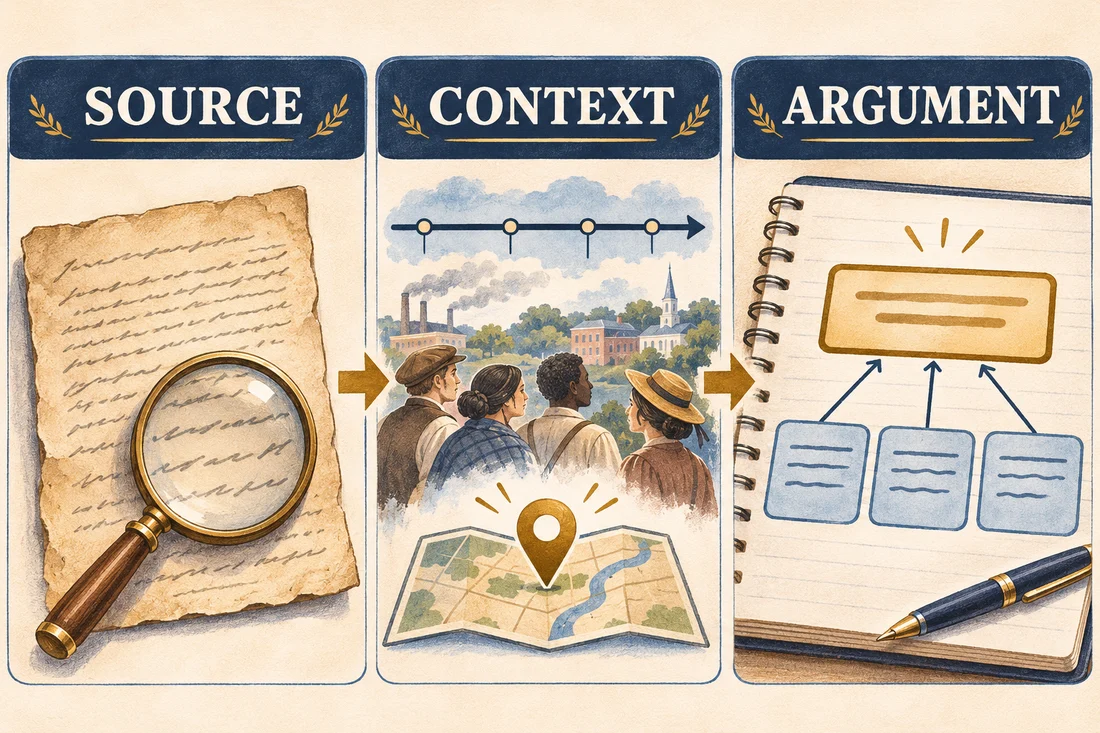
CHAPTER 24
24. APUSH Timelines, Maps, Key Events and Historical Figures
Back to contents ↑24.1 Complete U.S. History Timeline (1491–Present)
The interactive timeline organizes selected anchor events from pre-contact contexts through recent developments. It is a study selection, not every event in U.S. history. Use period and theme filters, then explain one connection across the chosen entries.
24.2 Colonial America Timeline
Connect Jamestown 1607, Plymouth 1620, colonial labor laws, imperial trade and eighteenth-century religious/intellectual exchange. Explain regional differences. Do not let a sequence of settlement dates obscure Indigenous societies and African enslavement.
24.3 American Revolution Timeline
Connect the 1763 war settlement, imperial policies, resistance, the 1776 Declaration, alliance and the 1783 peace. Explain escalation rather than presenting independence as an inevitable immediate response to the first tax dispute.
24.4 Early Republic Timeline
Use the Constitution, Bill of Rights, financial debates, party formation and the election of 1800 to track institution-building. Identify the disagreement each event reveals. A list of presidents alone does not explain the early republic.
24.5 Westward Expansion Timeline
Connect the Louisiana Purchase, Indigenous dispossession, Texas annexation, war with Mexico and disputes over slavery. Territorial maps show changing claims, not empty land. Explain the human and political consequences of expansion.
24.6 Civil War and Reconstruction Timeline
Track secession, war, emancipation, Union victory, Reconstruction amendments and federal enforcement's retreat. Distinguish the legal end of slavery from the struggle over meaningful freedom. The sequence provides evidence for both transformation and limits.
24.7 Industrialization and Gilded Age Timeline
Connect railroads, corporate consolidation, labor conflict, immigration, urban growth and segregation. Use the chronology to explain interacting processes. Industrial growth did not occur separately from racial hierarchy, state policy or workers' collective action.
24.8 Progressive Era Timeline
Progressive reform included regulation, political reform, social provision and suffrage, with uneven inclusions. Compare a policy's enactment with implementation. The era's label should not imply that every development advanced equality for every group.
24.9 World War I and World War II Timeline
For each world war, identify causes of U.S. entry, mobilization, domestic effects and the postwar settlement. Compare civil-liberties tensions and international commitments. Avoid treating the two wars as one continuous conflict with identical goals.
24.10 Cold War Timeline
Use containment, NATO, Korea, Vietnam, détente and the Cold War's end as connected but distinct developments. Identify which institutions and regions were involved. A timeline should reveal policy change and limits rather than simply label every event anticommunist.
24.11 Civil Rights Movement Timeline
Connect litigation, local organizing, direct action, federal legislation and resistance. Brown, the 1964 Civil Rights Act and 1965 Voting Rights Act are anchors, not the whole movement. Explain why implementation and later activism remained necessary.
24.12 Modern U.S. History Timeline
Connect conservative politics, globalization, digital change, the 1991 Soviet collapse, 2001 attacks and the 2008 crisis. Keep later developments dated and evidence-based. Do not convert an unresolved current debate into a settled long-term outcome.
24.13 Major U.S. Presidents and Their Policies
The presidents explorer links selected administrations to historical policies and disputes. It is not an argument that presidents alone cause change. Connect executive decisions to Congress, courts, movements and economic conditions.
24.14 Important Supreme Court Decisions
Use cases including Marbury, McCulloch, Dred Scott, Plessy and Brown to study changing authority and rights. Explain historical context and consequences. A case name without the relevant holding and limit is weak essay evidence.
24.15 Constitutional Amendments and Their Historical Significance
The amendments cards connect constitutional change to historical struggles. Compare enactment with enforcement and access. The Reconstruction amendments and Nineteenth Amendment illustrate why a legal prohibition on exclusion does not immediately remove every practical barrier.
24.16 Major U.S. Foreign Policy Doctrines
Compare the Monroe Doctrine, containment and later security frameworks through aims, setting and means. Similar claims about protection can justify different actions. Explain what changed instead of treating every doctrine as an identical expansion of power.
24.17 Significant Social and Political Movements
Abolition, suffrage, labor, civil rights and other movements mobilized different constituencies and strategies. Compare organizing, legal action and direct protest. Avoid treating a movement as one leader's opinion or assuming internal disagreement means no shared purpose existed.
24.18 Major Economic Crises and Reforms
Compare the Panics of 1819 and 1837, the Depression and the 2008 crisis through mechanisms and policy responses. Their causes differ. A general statement that all crises involved money is too broad to explain historical change.
24.19 Historical Maps and Territorial Expansion
The geography explorer uses clearly labeled schematic connections for settlement, transport and migration. It does not supply authoritative territorial boundaries or precise routes. Pair a geographic pattern with historical evidence and a limitation before using it in an argument.
24.20 Complete APUSH Historical Vocabulary Glossary
Learn vocabulary through examples and contrasts: federalism versus separation of powers, emancipation versus equal citizenship, reform versus revolution. A definition becomes useful when you can identify its role in a source or explain a historical relationship with it.
CHAPTER 25
25. APUSH Multiple-Choice Questions (MCQs)
Back to contents ↑25.1 APUSH MCQ Section Overview
APUSH MCQs combine source interpretation and contextual knowledge. Read what the question asks before supplying facts. An option can be historically true yet irrelevant to the source, period or reasoning demanded.
25.2 How Many MCQs Are on the APUSH Exam?
The standard section contains 55 MCQs. Do not confuse that count with the number of source sets or the three SAQ questions. The original full-count practice forms retain 55 items, while filtered drills deliberately use fewer.
25.3 MCQ Exam Duration and Scoring
MCQs share 55 minutes and contribute 40%. There is no extra wrong-answer deduction. The one-minute average includes reading sources, so rehearse by set rather than allowing every question a separate minute after unrestricted stimulus reading.
25.4 Understanding Stimulus-Based Question Sets
Several questions share a stimulus but ask different things: context, argument, consequence or comparison. Return to the source and dates for each. A correct answer to the first question does not establish the same reasoning for the rest.
25.5 Multiple-Choice Questions Based on Primary Sources
Primary-source questions require understanding what the source can reveal in its situation. A political declaration may state ideals without proving implementation. Use context to interpret the document rather than replacing it with unrelated memorized facts.
25.6 Multiple-Choice Questions Based on Secondary Sources
Secondary-source questions often ask about a historian's interpretation or the evidence supporting it. Identify the actual claim. Do not assume the interpretation is simply a neutral list of events or reject it solely because it was written later.
25.7 Political Cartoon Questions
Identify the historical symbols, labels and argument before evaluating choices. A cartoon's exaggerated scene is not a literal event record. Ask which policy or conflict makes the imagery meaningful to its intended audience.
25.8 Historical Map Questions
Check dates and legends, then distinguish territorial claims, settlement, political control and movement. A map may show one without proving another. Avoid projecting present-day boundaries unchanged into an earlier period.
25.9 Charts, Graphs and Data Interpretation Questions
Read units and denominators before comparing values. Determine whether a source shows totals, rates or shares. Explain a historical connection only when the pattern and contextual evidence support it; correlation alone is not a complete causal account.
25.10 Historical Context Questions
Context questions ask which development makes the source understandable. Choose a relevant preceding or contemporary condition, not a later event. Anachronistic answers are often plausible only when the reader ignores the date.
25.11 Causation Questions
A causal answer explains how a condition contributed to an outcome. Distinguish a long-term cause, trigger and consequence. Two developments occurring near each other do not automatically form a causal relationship.
25.12 Comparison Questions
Compare the same criterion across cases, such as labor systems or views of federal authority. An answer describing one similarity can still be wrong if it concerns the wrong periods. Keep the source's scope and the prompt's comparison together.
25.13 Continuity and Change Questions
For continuity/change, identify evidence across the relevant span and distinguish formal policy from lived experience. A constitutional amendment can mark transformation while discrimination persists. Avoid choices claiming complete permanence or instant universal change without support.
25.14 Identifying Main Arguments and Perspectives
State the main claim as an argument, not a topic. Then identify the perspective shaping it. A source discussing factories may criticize working conditions rather than oppose all industrial production; preserve that distinction when choosing an answer.
25.15 Eliminating Incorrect Answer Choices
Reject options because of chronology, unsupported scope, reversed causation or a mismatch with the question. Do not use option length or a favorite letter as a strategy. Explain why the nearest plausible distractor fails.
25.16 Managing Time on 55 MCQs
Set checkpoints across stimulus sets and make a reasoned selection when stuck. Preserve time for every question. A rehearsal with pauses or repeated familiar questions should be logged honestly rather than treated as an equivalent secure timed result.
25.17 Common APUSH MCQ Mistakes
Common errors include ignoring dates, substituting broad topic knowledge, misreading a visual and overgeneralizing a source. Classify the error before practising again. “Read more carefully” is less actionable than identifying the exact mistaken inference.
25.18 MCQ Practice Questions by Historical Period
Use the period filter to target unfamiliar eras, then return to mixed practice for transfer. A correct answer on a memorized item is not fresh evidence of mastery. Review the supplied rationale and explain the historical relationship in your own words.
25.19 Full MCQ Practice Test with Explanations
Each original full-count form includes 55 questions and explanatory keys. Original stimuli are study summaries, not undisclosed authentic quotations or calibrated exam materials. Use official released tasks as well and keep the practice conditions visible.
CHAPTER 26
26. APUSH Short-Answer Questions (SAQs)
Back to contents ↑26.1 What Is an APUSH SAQ?
An SAQ is a short-answer question with three labeled tasks. It rewards concise historical identification and explanation, not a full essay. Address each part separately so the required evidence and reasoning are easy to locate.
26.2 2027 SAQ Format and Updates
For 2027, all three SAQs include sources and are required. The source types are secondary text, primary text and non-text. Do not follow old instructions telling you to choose between a third and fourth source-free question.
26.3 Why All Three SAQs Are Required
The redesign removes the old external choice among final SAQs. Every student answers the same three source-based questions on the form. Practise different periods and stimuli rather than planning to avoid a source type or era.
26.4 SAQ 1: Secondary Text Sources
SAQ 1 supplies one or more secondary texts. Identify the interpretation and support any requested comparison with historical knowledge. Restating an author's words is insufficient when a part asks you to explain evidence supporting or challenging the interpretation.
26.5 SAQ 2: Primary Text Source
SAQ 2 supplies a primary text. Read its author, date and context before answering. Use the document as evidence of a situated perspective, and add specific contextual knowledge where the task requires it.
26.6 SAQ 3: Non-Text Historical Source
SAQ 3 supplies a primary or secondary non-text source. Interpret the visual's title, labels and argument or pattern. A chart, map or cartoon calls for different reading moves, but every answer must address the exact labeled demand.
26.7 How SAQ Historical Period Coverage Works
The 2027 SAQs cover developments from 1491–2001, each focusing on a different historical period. This is not a promise of three particular units. Prepare flexible source interpretation across the whole stated span.
26.8 Understanding the Three-Part SAQ Structure
Each question contains three independently scored parts, usually labeled a, b and c. Match evidence to each task rather than writing one undifferentiated paragraph. A correct response in one part does not automatically answer another.
26.9 How to Interpret SAQ Task Verbs
Identify asks for a relevant historical example or feature; explain requires the relationship or reason the task specifies. Read the complete instruction, including dates and source references. A memorized acronym cannot override the actual verb.
26.10 Identifying What Each Part Requires
Before writing, mark the action, historical object, period and evidence required for each part. If asked for one cause, develop one clearly instead of listing several unexplained possibilities. Precision helps both accuracy and timing.
26.11 Writing Concise Historical Responses
Use complete, concise sentences and avoid an essay introduction. State the answer, supply the needed example and explain the connection. Brevity should remove repetition, not the reasoning required to earn the point.
26.12 Using Specific Historical Evidence
A specific law, event, practice or development is stronger than a vague statement that people wanted rights. Explain why it fits the task. Do not use a later example as though it occurred within an earlier stated period.
26.13 Explaining Historical Causation
Explain how a factor contributed to an outcome. For example, territorial acquisition intensified conflict by reopening whether slavery could expand. Naming the war and a later dispute without the mechanism is only a sequence.
26.14 Comparing Historical Developments
Use one common criterion and explain the meaningful similarity or difference. Comparing colonial labor systems requires evidence from both cases. A sentence about one region's religion and another's crop does not necessarily establish the requested comparison.
26.15 Using Continuity and Change in SAQs
Define the relevant span, then state a change or continuity with supporting evidence. Distinguish legal reform from implementation where appropriate. Avoid a universal claim that nothing changed because one inequality persisted.
26.16 ACE Method: Answer, Cite, Explain
ACE—answer, cite evidence, explain—is a useful study reminder, not an official compulsory formula. Citation here means historical support, not necessarily a formal bibliography. Adapt the structure to the task and keep the reasoning explicit.
26.17 How to Earn All Three SAQ Points
Earn each point by correctly fulfilling that part's historical demand. There is no bonus for an essay-style thesis. Check that each example is accurate, in range and explained to the extent required by the verb.
26.18 Managing 40 Minutes for Three SAQs
Forty minutes for three questions averages about thirteen minutes each, including source reading. Use flexible checkpoints and preserve time for every part. A polished first response is a poor tradeoff for leaving an entire required question blank.
26.19 Sample SAQs with Step-by-Step Solutions
The original SAQ sets below supply three source types and suggested responses explaining the evidence connection. Treat models as possible answers, not the only wording accepted. The scoring discussion is illustrative rather than an official AP Reader judgment.
26.20 Annotated Student Responses
This guide's annotated examples are original teaching responses, not real student scripts. For official student work, use matching year/set samples in the internal archive. Keep the identity of the source and rubric clear.
26.21 Common SAQ Mistakes
Avoid generic evidence, wrong chronology, source summary in place of explanation and skipping a labeled part. An answer can be concise and still complete. After review, rewrite the missing inference rather than merely adding more dates.
26.22 2027-Format SAQ Practice Sets
Use a three-question sequence with secondary prose, primary prose and a non-text source from different periods. Older official questions can support skills after clearly labeled adaptation. Do not describe an unmodified pre-2027 choice structure as current.
CHAPTER 27
27. APUSH Document-Based Question (DBQ)
Back to contents ↑27.1 What Is an APUSH DBQ?
A DBQ asks you to construct a historical argument using a seven-document packet and relevant knowledge beyond it. Documents provide evidence, not an outline to follow one by one. Group them around claims that advance the thesis.
27.2 DBQ Exam Format
You answer one DBQ within the shared 100-minute DBQ/LEQ section. The recommended DBQ allocation is 60 minutes including a 15-minute reading period. The task requires argument, source use, contextualization and analysis.
27.3 DBQ Score Weight and Time Limit
DBQ carries 25% of the overall score. Its seven-point raw rubric is not the same as 25 raw essay points. The recommended 60 minutes includes reading; adding another 15 would consume time intended for the LEQ.
27.4 Understanding the Seven-Document Set
Read all seven documents for claim, perspective and potential argumentative role. Identify useful agreements and tensions. A document may complicate your thesis or demonstrate a limit rather than simply provide another endorsement.
27.5 Updated 2027 DBQ Chronological Coverage
The published 2027 APUSH DBQ range is 1754–1980. This expands beyond the older 1754–1945 range. Include postwar documents in preparation and avoid assuming every component uses the full course's 1491–present span.
27.6 How to Read a DBQ Prompt
Identify the historical issue, dates and reasoning demand before reading for evidence. An extent-of-change prompt needs a judgment about change, not merely a chronology. Let the prompt determine what a useful document detail must establish.
27.7 Understanding the Historical Reasoning Task
Determine whether the argument requires comparison, causation or continuity/change and how the documents can support it. A reasoning process is not a word to insert mechanically. It should organize the relationship among claims and examples.
27.8 How to Analyze Historical Documents Efficiently
For each document, record a brief claim, a useful detail and a sourcing feature relevant to the argument. Avoid transcribing whole passages. The aim is to see relationships quickly enough to preserve time for explanation.
27.9 Grouping Documents into Arguments
Group documents by the argument they support, such as expanding federal rights versus limits of enforcement. One document can inform more than one relationship. Do not create groups based only on similar dates or convenient letter order.
27.10 Identifying Historical Context
Explain wider developments relevant to the prompt, such as the preceding conflict over slavery before Reconstruction. Context needs more than a phrase or disconnected fact. Keep the evidence used for an outside-evidence point distinct from contextualization.
27.11 Developing a Defensible Thesis Statement
A defensible thesis answers the prompt and establishes a line of reasoning. It can qualify the extent or importance of change. “There were many changes and continuities” is too vague unless the response identifies the relationship it will defend.
27.12 Writing an Effective Introduction
Use a short context-to-thesis progression. Do not spend a large share of the session narrating earlier history unrelated to the question. The introduction should prepare the argument's scope rather than delay the first claim.
27.13 Using Document Evidence
Current document-evidence criteria distinguish using at least three documents to address the topic from supporting an argument with at least four. More documents are not automatically better if they are misread or only listed. Explain how each contributes.
27.14 Explaining the Relevance of Evidence
After describing a document's relevant content, explain its support for a claim. A constitutional provision can establish formal legal change while a later account reveals enforcement limits. The relationship between the documents can advance the larger argument.
27.15 Sourcing: Point of View, Purpose, Audience and Historical Situation
For at least two documents, explain how or why point of view, purpose, audience or historical situation matters to the argument. Identifying an author or date alone is insufficient. Choose the sourcing feature that actually changes the evidence's interpretation.
27.16 Using Historical Evidence Beyond the Documents
Use at least one specific relevant historical example beyond the packet and explain its argumentative role. The example must be distinct from evidence used for contextualization. A name dropped without development is not an automatic outside-evidence point.
27.17 Developing a Consistent Line of Reasoning
Read thesis and topic sentences together, then check whether the documents support the promised relationships. A body paragraph should advance the reasoning, not simply report the next document. Revise a claim that the packet cannot sustain.
27.18 Demonstrating Complex Understanding
Complexity can come from a developed qualification, relationships among causes or meaningful comparison and evidence use. The current rubric permits several routes. It requires more than a phrase announcing complexity or a superficial both-sides sentence.
27.19 Structuring Effective Body Paragraphs
Build paragraphs around claims, then combine relevant documents, explain their relationships and add sourcing where it matters. No fixed paragraph count is required. A paragraph's value is the historical reasoning it develops, not its length.
27.20 Writing a Strong Conclusion
Conclude with the implication of the argument's balance of change, cause or comparison. Do not introduce an unsupported major development merely to sound expansive. If time is short, complete the body reasoning before polishing a repetitive conclusion.
27.21 Managing the Recommended 60 Minutes
Use the reading allocation to group evidence and plan, then draft with checkpoints. Preserve the LEQ's recommended 40 minutes in the shared section. A plan is useful when it reduces uncertainty, not when it becomes a second unwritten essay.
27.22 Understanding the Seven-Point DBQ Rubric
The seven points are thesis one, context one, evidence up to three and analysis/reasoning up to two. Document counts are thresholds within particular criteria, not guaranteed totals. Use the current task-specific decision rules when reviewing a response.
27.23 Sample High-Scoring DBQ Essay
The original DBQ model below shows a defensible thesis, document groupings, outside evidence and sourced reasoning. It is a teaching example, not an authenticated high-scoring student response. Read the matching packet before judging whether the evidence supports its claims.
27.24 Annotated DBQ Scoring Commentary
The annotation identifies where each rubric function is attempted and what could be developed further. Its judgments are provisional. A second reader should challenge factual accuracy, document use and whether complexity is actually demonstrated.
27.25 Common DBQ Mistakes
Common weaknesses include document-by-document summary, incorrect context, generic sourcing and unsupported outside evidence. Older advice can also use outdated document thresholds. Check the current criteria and revise the missing reasoning rather than simply adding more citations.
27.26 DBQ Practice Prompts with Model Answers
The original packets provide prompts, seven clearly labeled study documents and possible lines of reasoning. Historical summaries are identified as paraphrases rather than invented authentic quotations. Use released official packets as well for full authentic-source and length practice.
Original DBQ model: constitutional transformation and contested freedom
Original teaching model, not a real student script or official scored response. Read Form 1’s matching task first.
Reconstruction substantially transformed the constitutional definition of citizenship and the federal government's claimed responsibility for rights, but it did not secure equal lived freedom. The end of slavery, national citizenship and protections against racial voting exclusions created a framework unavailable before the Civil War. Organized resistance and the retreat of federal protection nevertheless limited what that framework could accomplish in practice. This distinction between legal transformation and effective protection explains both Reconstruction's achievement and its vulnerability.
The Civil War provides the immediate context: Union victory ended the Confederacy's attempt to preserve a slaveholding order, while emancipation raised questions about the status and rights of formerly enslaved people. The Thirteenth Amendment in Document 1 made abolition constitutional rather than relying only on a wartime proclamation applying to designated rebellious areas. Its punishment exception remained important, but the nationwide legal prohibition represented a profound institutional change. Document 2's Civil Rights Act account shows Congress asserting national citizenship and specified civil protections despite presidential opposition. Congress's decision to override Johnson's veto demonstrates that defining postwar freedom was a conflict within the federal government, not simply a shared administrative task.
The Fourteenth and Fifteenth Amendments extended that reconstruction of national responsibility. Document 3 connects citizenship and equal protection to constitutional limits on state action; Document 4 identifies a prohibition on specified racial grounds for denying voting rights. Their constitutional form matters to the argument: lawmakers and ratifying states sought durable authority beyond an ordinary policy that a future administration might disregard. They did not thereby guarantee enforcement. Their political purpose and legal status explain why they constitute evidence of transformation while leaving open the question of lived access. Treating their adoption as proof that equality had already been achieved would confuse the asserted rule with the conditions required to make it effective.
Other documents expose that distinction. Document 5 describes freedpeople building schools and organizations, demonstrating agency in pursuing the possibilities of emancipation. Document 6 describes white supremacist violence and restrictive labor arrangements that constrained those possibilities. Together they show that freedom was not merely a legal status delivered from above: communities tried to exercise it while opponents used coercion to narrow it. The Ku Klux Klan Act of 1871 supplies a further specific example beyond the packet's described policies. Federal intervention against racial terror illustrates the need for enforcement and the expansion of national power, but the persistence of resistance also demonstrates why enactment alone was insufficient.
Document 7's account of 1877 marks the fragility of that protection. The withdrawal of remaining federal troops and the retreat of support for Reconstruction governments weakened the conditions under which constitutional rights could be exercised. That outcome does not mean Reconstruction produced no lasting change; the amendments remained a basis for later struggles. It means a major constitutional redefinition could coexist with the loss of practical protections. A full judgment therefore rejects both an account of completed equality and an account in which nothing meaningful changed. Reconstruction created powerful legal claims while leaving their realization dependent on institutions, enforcement and continuing collective action.
Annotated reasoning and rubric discussion
Illustrative rubric discussion, not an official score: the model gives a qualified thesis and relevant Civil War context, supports claims with the packet's documents and develops an outside example. It explains the significance of constitutional authorship/purpose for the amendment documents rather than only identifying dates. The sustained distinction between legal claims and practical protection supplies complexity to discuss. Because this packet uses transparent original paraphrases and secondary study texts, it is not a substitute for authentic-document sourcing practice. A second reader should check each criterion and factual claim.
CHAPTER 28
28. APUSH Long Essay Question (LEQ)
Back to contents ↑28.1 What Is an APUSH LEQ?
An LEQ develops a historical argument from your own relevant knowledge rather than a supplied document packet. A clear thesis, context, specific evidence and the requested reasoning are central. Memorized narrative alone does not answer the analytical task.
28.2 Updated 2027 LEQ Format
The 2027 format presents one required broad prompt with an introductory orientation. Choice lies in the relevant developments and evidence used to construct your argument. Do not rehearse only the old choose-one-of-three instructions.
28.3 One Required Broad LEQ Prompt
Answer the single broad question on the actual form. You can focus on appropriate developments within its scope instead of narrating the entire span. The breadth increases the opportunity to use known evidence, not permission to answer an unrelated question.
28.4 Understanding Evidence Choice Within the Prompt
Select evidence that best supports the thesis and fits the prompt. A broad question may permit several defensible approaches. Explain why your chosen developments demonstrate the claimed relationship rather than mentioning every possible example superficially.
28.5 How the New LEQ Covers Historical Time Periods
The broad prompt can draw from roughly half of the course's periods. Students are not expected to cover every development in that span. Read the introductory statement and actual wording rather than assuming a fixed period combination in advance.
28.6 Identifying the Historical Reasoning Process
Identify the comparison, causation or continuity/change relationship the task asks you to explain. Let that relationship shape the thesis and paragraphs. A chronology can provide evidence, but it must be organized into an argument.
28.7 LEQs Based on Historical Causation
For causation, distinguish conditions, triggers and relative importance. Explain mechanisms through specific examples. A qualified argument can show how economic and political causes reinforced one another instead of ranking them without evidence.
28.8 LEQs Based on Historical Comparison
For comparison, use common criteria and develop both relevant similarities and differences. Explain why the comparison matters to the prompt. Parallel factual lists without an explicit relationship are weaker than a connected argument.
28.9 LEQs Based on Continuity and Change
For continuity/change, establish the starting conditions and explain the extent of transformation. Use evidence throughout the relevant span. A new policy and a persistent social hierarchy can support a nuanced judgment when their relationship is explained.
28.10 Developing a Defensible Thesis
Write a historically defensible claim answering the question and establishing a line of reasoning. Avoid a prompt restatement or an unsupported absolute. The thesis should specify the causal, comparative or change relationship the essay will support.
28.11 Establishing Historical Context
Describe broader relevant developments in enough detail to orient the specific argument. Context need not be the most distant fact you remember. Explain how the setting makes the thesis understandable rather than adding an isolated date.
28.12 Selecting Specific Historical Evidence
Select accurate events, laws, practices or developments that demonstrate the claim. Match their dates and significance to the prompt. A famous name is not sufficient unless you explain the relevant action or evidence associated with it.
28.13 Using at Least Two Relevant Historical Examples
The task expects at least two specific relevant pieces of evidence. To earn stronger evidence credit, use them to support the argument, not merely list them. The quality of the explanation matters alongside the number of examples.
28.14 Developing Argumentation and Analysis
Connect evidence with comparison, causation or continuity/change reasoning. Explain how the example changes the reader's judgment of the thesis. A paragraph that ends immediately after naming a law usually leaves its argumentative role incomplete.
28.15 Demonstrating Complex Historical Understanding
Develop a meaningful qualification, connection or tension supported by historical evidence. Complexity does not require confusing sentences. A clear distinction between formal rights and uneven enforcement can be sophisticated when developed rather than merely announced.
28.16 Organizing a Long Essay
Organize around claims that answer the prompt. Chronology, thematic grouping or a mixed structure can work when relationships are clear. A fixed five-paragraph template does not replace the need to select and explain the evidence.
28.17 Writing Introductions and Conclusions
Use the introduction to establish relevant context and a thesis, then conclude with a warranted implication. Avoid broad claims about all human history. When time is tight, prioritize complete body reasoning over elaborate openings and repeated endings.
28.18 LEQ Paragraph Structure
A useful paragraph states a claim, supplies precise evidence, explains its relationship and connects it to the thesis. This is a functional guide rather than a compulsory sentence formula. Adapt it to the historical reasoning being developed.
28.19 Managing the Recommended 40 Minutes
Plan briefly, draft the argument and reserve a few minutes to check chronology and missing explanations. The recommended LEQ allocation is 40 minutes within the shared essay section. Excessive DBQ time creates a predictable risk of an incomplete LEQ.
28.20 Understanding the Six-Point LEQ Rubric
The six points cover thesis one, context one, evidence two and analysis/reasoning two. Read current decision rules rather than converting a classroom percentage into rubric credit. The self-assessment totals your judgments without grading the essay automatically.
28.21 Sample High-Scoring LEQ Essay
The original LEQ model below demonstrates a focused argument within a broad prompt. It is not a real student script or an officially awarded score. Compare its specific evidence, reasoning and limits with the task before imitating its structure.
28.22 Annotated LEQ Scoring Commentary
The annotation shows thesis, context and the role of each example, then identifies a possible limitation. A rubric discussion should cite the response's actual wording. Good intentions not written in the essay cannot supply missing reasoning.
28.23 Common LEQ Mistakes
Avoid broad narration, evidence outside the period, unsupported causal claims and conclusions that do not answer the question. A broad prompt is not an invitation to list everything remembered. Select fewer examples and explain their relevance carefully.
28.24 Original 2027-Format LEQ Practice Prompts
The original prompts use a broad historical demand and suggest possible analytical areas without prescribing one answer. They are practice adaptations, not predictions of the secure 2027 examination. Use a new prompt after revision to test transfer.
Original LEQ model: federal authority as a contested project
Original teaching model, not a real student script or official scored response. Read Form 1’s matching task first.
Debates over federal authority from the imperial crisis through the early nineteenth century changed who claimed the right to govern and what national institutions could do, but they did not eliminate conflict over concentrated power. Independence transferred sovereignty away from Britain; constitution-making created a stronger national framework; later financial and expansion disputes contested how that framework should operate. The major change was therefore not a steady disappearance of resistance to central authority, but the development of a national system within which that resistance continued.
The imperial crisis after 1763 provides the context. Britain's victory in a costly war enlarged its territorial position and encouraged measures to raise revenue and tighten control. Colonial opposition increasingly challenged the legitimacy of decisions made without the representation colonists claimed. The Stamp Act dispute illustrates how a fiscal measure became an argument about authority rather than merely an objection to the size of a payment. By 1776 the Declaration of Independence used rights and consent to justify separation, changing the level at which political legitimacy was asserted. Independence did not itself decide how much power a new central government should possess.
The Articles of Confederation reflected suspicion of concentrated authority, but its limited revenue powers and interstate difficulties encouraged arguments for reform. The 1787 Constitution created a more capable federal structure with taxation authority, a separate executive and a judiciary. Ratification debate then revealed that a stronger national government did not command automatic agreement. Federalists defended its structure, while Anti-Federalists feared consolidated power and insufficient rights protection. The Bill of Rights responded to those concerns without undoing the new framework. The sequence supports a substantial institutional change qualified by continuing disputes over liberty and power.
Hamilton's financial program shows how disagreement moved inside that framework. Assumption of debts and a national bank aimed to strengthen credit and economic development, but critics questioned constitutional authority and the interests likely to benefit. The dispute contributed to party formation, turning institutional interpretation into organized political competition. The Louisiana Purchase later complicated a simple partisan story: Jefferson's administration accepted a major expansion that raised questions about its own view of federal powers. Political positions could shift with the policy and opportunity involved, so the period cannot be reduced to two parties following perfectly consistent abstract principles.
By the early nineteenth century, federal authority rested on a constitutional framework more substantial than the Articles, while national policy remained politically contested. This combination explains why the development was transformative without being a completed settlement. The institutions changed the available means of governing, but debates over representation, rights, economic interests and expansion continued to define how power would be used. A defensible account must explain both the new national capacities and the persistence of conflict over their limits.
Annotated reasoning and rubric discussion
Illustrative review: the model selects independence, constitution-making and finance/expansion within a broad prompt rather than narrating every event. It supplies context and several specific examples, explaining their relationship to a qualified thesis. A reviewer should test the evidence and causal connections against the six-point LEQ rubric. This original model is not a real student response, an official scored exemplar or a promise that one structure guarantees a score.
CHAPTER 29
29. APUSH Free-Response Scoring Rubrics Explained
Back to contents ↑29.1 Overview of APUSH FRQ Scoring
SAQs use independent task points, while DBQ and LEQ use analytic rubrics. Their raw maxima differ. Keep a record by component and criterion so a total does not conceal whether the problem is knowledge, source use or explanation.
29.2 SAQ Scoring: Three Points per Question
Each SAQ is worth up to three points, normally one for each labeled part. Three required questions yield nine raw points. A full essay introduction is unnecessary; directly fulfill each historical demand.
29.3 How SAQ Responses Earn Individual Points
A point depends on a correct answer meeting the part's task and specificity. Identification and explanation can require different amounts of development. Do not assume repeating a source statement answers a request for outside historical evidence.
29.4 DBQ Rubric: Seven Total Points
DBQ totals seven points across thesis, context, evidence and analysis/reasoning. The categories have distinct functions. A strong thesis does not automatically earn context, and using a document's content is not the same as sourcing it.
29.5 DBQ Thesis/Claim Point
The thesis point requires a defensible claim responding to the prompt and establishing a line of reasoning. A statement that there were many causes or changes needs further specificity. Check whether your claim could actually be supported by the packet.
29.6 DBQ Contextualization Point
Contextualization describes broader historical developments relevant to the prompt. A disconnected reference is insufficient. Explain the relationship, and do not double-count the same undeveloped fact as both context and outside evidence.
29.7 DBQ Evidence Points
DBQ evidence includes document use and a separate outside-evidence opportunity. Current document criteria distinguish three documents addressing the topic from four supporting an argument. Outside evidence must be specific, relevant and explained beyond a passing reference.
29.8 DBQ Analysis and Reasoning Points
DBQ analysis/reasoning includes explaining relevant sourcing for at least two documents and demonstrating complex understanding. Identification alone is not sourcing explanation. Complexity has several permitted routes; it is not guaranteed by a token counterargument.
29.9 LEQ Rubric: Six Total Points
LEQ totals six points: thesis, context, up to two evidence points and up to two analysis/reasoning points. The task supplies no document packet. Your own accurate historical examples must support the argument.
29.10 LEQ Thesis/Claim Point
The LEQ thesis must make a defensible historical argument that answers the actual broad question. It can focus on selected developments within the scope. A sentence announcing the topic does not establish a line of reasoning.
29.11 LEQ Contextualization Point
Relevant context explains the setting for the argument. Do not write a distant historical anecdote merely because it is true. The connection to the prompt is what makes the background useful.
29.12 LEQ Evidence Points
Provide at least two specific relevant examples; stronger evidence performance uses them to support the thesis. Listing names and dates without explaining the relationship leaves the argument undeveloped. Verify chronology before relying on an example.
29.13 LEQ Analysis and Reasoning Points
Use the requested historical reasoning to structure the argument, then develop complexity where warranted. A causal essay needs causal explanation, not just events in order. A clear qualified relationship is stronger than an unsupported absolute.
29.14 How Complexity Is Evaluated
Complexity involves demonstrated understanding through argument or effective evidence use under the rubric. It is more than a phrase but need not require an artificially complicated writing style. Explain why the tension or qualification matters to the historical judgment.
29.15 Low-Scoring vs. High-Scoring Responses
A low-development response names Reconstruction amendments; a stronger one explains how citizenship and voting protections changed federal authority while enforcement faced organized resistance. The difference is reasoning. An isolated paragraph cannot establish the full score of an unwritten essay.
29.16 Using Official College Board Scoring Guidelines
Match released questions to their exact year, version and scoring materials. General current rubrics help with skill review, but question-specific guidance clarifies acceptable evidence. Do not label an invented explanation as a Chief Reader's official judgment.
29.17 How to Self-Score Practice Essays
Score provisionally and cite actual sentences supporting each judgment. Then ask a second reader to challenge unsupported assumptions. The goal is a concrete revision: for example, explain why a document's audience matters rather than merely adding the word audience.
29.18 Common Rubric Misinterpretations
Common misunderstandings include treating document count as an automatic total, confusing summary with support and claiming complexity from a single hedge. Keep category functions separate. Rubric points measure demonstrated response features, not effort or vocabulary alone.
29.19 Improving Your Essay Scores
Find the repeated missing criterion, revise it explicitly and test the skill on a fresh prompt. If outside evidence is vague, build accurate examples; if sourcing is generic, explain its argumentative relevance. Another unreviewed essay can repeat the same gap.
CHAPTER 30
30. APUSH Writing Strategies and Historical Argumentation
Back to contents ↑30.1 How to Write Historically Defensible Arguments
A historical argument makes a defensible claim and explains how specific evidence supports it. It stays within the prompt's period and task. Accuracy and reasoning work together; neither a fact list nor unsupported confidence is enough.
30.2 Writing Effective Thesis Statements
Answer the question with a relationship you can defend, including a meaningful limit if appropriate. For example, distinguish constitutional change from its uneven enforcement. A thesis should guide evidence selection rather than simply announce the century being discussed.
30.3 Difference Between Description and Analysis
Description states what happened; analysis explains its significance or relationship to a claim. “The Fourteenth Amendment was ratified” is descriptive. Explaining how its citizenship and equal-protection provisions changed federal responsibility begins the analytical work.
30.4 Contextualization Strategies
Choose broader developments that make the specific issue intelligible. Before Reconstruction, explain the war and contested future of emancipation. Do not substitute an unrelated fact from the same century for a relevant context connection.
30.5 Using Specific Historical Evidence
Use precise laws, events, institutions and practices with their relevant significance. A reference to “civil rights” is broad; a specific provision and its role in the argument are stronger. Check dates and avoid invented quotations.
30.6 Explaining Evidence Clearly
Explain what the example establishes and why that supports the claim. A law can show an asserted protection while another source shows limits in practice. The relationship between them can create the argument's qualification.
30.7 Organizing Historical Essays
Arrange paragraphs by the reasoning the reader needs: causes, competing effects or dimensions of change, for example. Chronology can help but should not take over. Every paragraph should advance the answer to the prompt.
30.8 Developing Logical Arguments
Check whether the claims form a progression rather than a series of repeated thesis statements. Identify where evidence supports, limits or complicates the argument. If a paragraph cannot be connected to the line of reasoning, revise its purpose.
30.9 Using Comparison in Historical Essays
Compare the same feature across cases and explain its significance. Federal intervention in different eras may share an expanded role while serving distinct goals. A good comparison identifies both the relevant commonality and the difference that matters.
30.10 Using Causation in Historical Essays
Explain mechanisms, timing and relative importance. Distinguish causes from consequences and avoid assuming later events caused earlier ones. A careful causal paragraph shows how the evidence supports the proposed connection, including relevant limits.
30.11 Using Continuity and Change Over Time
Define a span and demonstrate both transformation and persistence with evidence. A legal change can coexist with continuing unequal power. Explain the extent and consequences rather than forcing history into entirely changed or entirely unchanged categories.
30.12 Qualifying an Argument
Qualification narrows or specifies a claim because the evidence requires it. “Legal equality expanded, but enforcement remained uneven” needs examples on both sides. Adding perhaps or sometimes without a supported distinction does not create sophisticated reasoning.
30.13 Analyzing Multiple Historical Perspectives
Explain how differing positions arise from circumstances and interests, then assess the evidence. A planter, an abolitionist and an enslaved person's account do not provide interchangeable perspectives. Acknowledge power without assuming every member of a group spoke identically.
30.14 Avoiding Unsupported Generalizations
Replace universal assertions with the scope supported by evidence. A single account can illuminate experience without representing everyone. If the argument requires a broader claim, supply appropriate additional evidence rather than exaggerating the example.
30.15 Writing Under Time Pressure
Plan a thesis and evidence map, then draft directly. Preserve time for every required response. When revising, prioritize incorrect chronology, unsupported claims and missing explanations over stylistic embellishment.
30.16 Best Practices for Digital APUSH Essay Writing
Practise typing and organizing sources in the actual approved preview environment. Keep paragraphs clear and SAQ parts identifiable. Website drafts are local study work; they do not reproduce Bluebook's secure submission process or certify device readiness.
CHAPTER 31
31. How Hard Is AP United States History?
Back to contents ↑31.1 Is APUSH Hard?
APUSH combines extensive historical knowledge with source interpretation and timed argument. Difficulty depends on preparation and support, not memorization alone. Diagnose whether your gap is chronology, evidence, source reasoning or completing the writing task.
31.2 Why Is APUSH Considered Challenging?
Students must connect many developments across nine periods while applying different response formats. The challenge increases when facts remain isolated. Build cause/effect and comparison links, then test them with unfamiliar sources and concise explanations.
31.3 Is APUSH One of the Hardest AP Exams?
There is no universal ranking of the hardest AP examinations. Candidate populations and scoring standards differ. APUSH may be difficult for a student who dislikes sustained writing, while another finds its reasoning tasks more accessible than a calculation-heavy subject.
31.4 Is APUSH Harder Than AP World History?
APUSH and AP World History use related reasoning skills but different geographic and chronological coverage. A student with strong U.S. context may prefer APUSH; another may find global patterns more engaging. Candidate score shares do not settle individual difficulty.
31.5 Is APUSH Harder Than AP European History?
AP European History emphasizes different content and contexts while sharing historical reasoning and writing demands. Compare sample tasks and available teaching rather than ranking courses by one year's 3-or-higher percentage. Both require specific evidence and analysis.
31.6 Is APUSH Harder Than AP U.S. Government?
AP U.S. Government focuses more directly on institutions and political processes, while APUSH studies developments over a longer span. Neither is universally harder. Compare your interests, background knowledge, required reading and examination tasks.
31.7 APUSH vs. Honors U.S. History Difficulty
An honors class can be rigorous, but its curriculum and assessments are locally defined. Compare sample reading, writing frequency and feedback expectations with APUSH. The label alone cannot determine which is harder at your school.
31.8 How Much Memorization Does APUSH Require?
Remember anchor events, concepts and evidence useful for arguments, not every date in a textbook. Chronology prevents anachronism, while significance makes recall productive. Link a fact to a theme, reasoning process and possible claim.
31.9 How Much Reading Does APUSH Require?
There is no universal daily page count for every APUSH class. Teachers choose materials and pacing. Plan regular reading with note-taking and source analysis; completion without comprehension gives little evidence of readiness.
31.10 How Much Writing Does APUSH Require?
Writing expectations vary by school, but examination preparation needs SAQ, DBQ and LEQ practice with feedback. Mix short explanations and full timed tasks. Repeating essays without reviewing rubric gaps can reinforce the same weaknesses.
31.11 Why Students Struggle with DBQs and LEQs
Students often summarize documents, use vague outside evidence or write a chronology instead of an argument. Repair one missing reasoning function at a time. A longer response does not automatically become a stronger one.
31.12 Can You Get a 5 Without Memorizing Every Date?
You do not need every historical date to build strong arguments. You do need accurate chronology and specific evidence chosen for the task. A smaller set of well-understood examples is more useful than a large list you cannot explain.
31.13 Is APUSH Difficult for International Students?
International students may need additional context for federalism, parties, racial systems and U.S. institutions. Those concepts can be learned deliberately. Citizenship is not a requirement for the course's historical reasoning, but registration and host-school arrangements still need confirmation.
31.14 What Percentage of Students Score 3 or Higher?
The official 2026 APUSH table reports 74% scoring 3 or higher. That describes a past population and is not a personal success probability. College credit and local school consequences use their own policies.
31.15 Is APUSH Worth Taking?
The course can be valuable if its reading and writing goals fit your interests and schedule. Consider teaching quality, feedback access, other commitments and the receiving college's policy. Credit is one possible benefit, not the sole measure of its value.
CHAPTER 32
32. How to Study for APUSH
Back to contents ↑32.1 How to Start Preparing for APUSH
Take a short mixed diagnostic and one writing task, then classify the errors. Build a plan around the repeated gap rather than rereading everything equally. Confirm examination registration separately from beginning a study routine.
32.2 Understand the Official Nine-Unit Syllabus
Use the nine-period table to check coverage and the actual current CED for framework requirements. Keep the 2027 task changes visible. An older review book can help with content while still giving outdated SAQ or LEQ instructions.
32.3 Build a Historical Timeline
Create a timeline with an event, its context and one consequence. Add connections rather than only dates. If two events are linked causally, explain the mechanism; do not let an arrow imply more than the evidence supports.
32.4 Learn Historical Cause-and-Effect Relationships
For each major process, identify conditions, triggers and consequences. Explain why a factor mattered in that setting. The expansion of slavery into territories, for example, connected land acquisition to sectional conflict through concrete political disputes.
32.5 Practice Historical Comparison
Compare two developments using the same criterion and evidence for both. Then explain the meaningful similarity or difference. A comparison table is useful preparation, but the final answer must express the relationship in sentences.
32.6 Practice Continuity and Change
Define a start and end point, identify change and continuity, and select evidence across the span. Distinguish formal institutions from implementation where relevant. Avoid assuming a single event instantly transformed every group.
32.7 Develop Effective Note-Taking Skills
Use notes organized as claim, evidence, relationship and limitation. Summarize in your own words after reading. Copying paragraphs may preserve information without revealing whether you understand its role in a historical argument.
32.8 Create Unit-Wise Flashcards
Make cards asking for significance and connections as well as definitions. “Why did the Missouri Compromise matter?” is stronger than recalling its date alone. Include a limitation preventing an exaggerated claim that it permanently solved sectional conflict.
32.9 Memorize High-Value Historical Evidence
Build an evidence bank of accurate examples that can support several themes. Record dates, details, possible uses and limits. Do not invent facts or quotations to make an example fit a prompt.
32.10 Read Primary and Secondary Sources
Read primary sources for situated perspectives and secondary sources for interpretations. Compare their claims and evidentiary limits. A source's type is not a simple ranking of truthfulness; usefulness depends on the question.
32.11 Practice MCQs Regularly
Practise source-based sets and review why the nearest distractor fails. Return to dates and context for each question. A rising score on repeated familiar items should not be mistaken for fresh transfer.
32.12 Practice SAQs Using the 2027 Format
Use three required source-based SAQs: secondary text, primary text and non-text, from different periods. Answer every labeled part. If adapting an older prompt, identify the adaptation rather than representing it as an unchanged official 2027 paper.
32.13 Practice DBQ Essays
Read a seven-document packet, group evidence by claims and write a focused argument. Review document support, outside evidence and relevant sourcing. Practise preserving the LEQ's share of the combined writing session.
32.14 Practice Broad-Prompt LEQs
Use a broad prompt and choose a manageable set of relevant developments. Support the thesis with specific evidence and requested reasoning. Do not narrate an entire century simply because the prompt's range is broad.
32.15 Review College Board Scoring Guidelines
Mark your response against the correct task's rubric and the released question's scoring guidance. Look for the reasoning actually written on the page. Do not award yourself a point because you intended to explain something but ran out of time.
32.16 Use AP Classroom Progress Checks
AP Classroom progress checks are assigned through authorized access and help identify skills needing attention. Ask your teacher what is available. An independent student should not assume an exam-only section provides the same assignments as a full authorized class.
32.17 Analyze Mistakes from Practice Tests
For each missed MCQ, record the skill, the decisive evidence, why your choice fails and a rule for the next attempt. Then answer a fresh question testing that skill. Memorizing the original option letter does not demonstrate improvement.
32.18 Track Your Progress by Historical Period and Skill
Track unit knowledge and historical thinking separately. A strong memory for Period 5 does not automatically mean strong sourcing; a good source reader can still lack context. Use both dimensions to select the next task.
32.19 How to Self-Study for the APUSH Exam
Self-study requires a reliable chronology, authentic-source practice, feedback and digital rehearsal. Arrange an accepting testing school early. Use original drills for extra practice and released official questions for authentic tasks, keeping their conditions and scoring identities distinct.
CHAPTER 33
33. APUSH Study Plans and Exam Strategies
Back to contents ↑33.1 Six-Month Complete APUSH Study Plan
Months 1–2 build chronology and source habits across early periods; months 3–4 deepen Units 3–8 and rotate writing tasks; month 5 combines tasks under time limits; month 6 uses fresh rehearsals and targeted repair. Keep feedback and device preparation in the plan.
33.2 Three-Month APUSH Study Plan
Weeks 1–4 diagnose and cover major period connections; weeks 5–8 rotate source sets, SAQs and essays; weeks 9–12 rehearse full sequences and repair repeated errors. Adjust the allocation using actual work rather than assuming equal time fits every unit.
33.3 Eight-Week APUSH Study Plan
Week 1 diagnoses and reviews the 2027 format. Weeks 2–5 develop historical connections and all writing tasks. Week 6 emphasizes mixed sources and pacing; week 7 rehearses; week 8 repairs specific weaknesses and confirms logistics.
33.4 Four-Week APUSH Study Plan
Week 1: diagnose and prioritize. Week 2: review high-value evidence and write each task. Week 3: complete a fresh full sequence and revise errors. Week 4: test improvements, rehearse Bluebook and protect rest.
33.5 Two-Week Intensive Review Plan
Use the first days for a diagnostic and chronology repairs, the middle for targeted sources and writing, and the final days for a fresh rehearsal and focused review. Two weeks is an intensive revision window, not a guarantee of foundational mastery.
33.6 Seven-Day APUSH Crash Course
Day 1 diagnose; day 2 review Units 1–3 connections; day 3 Units 4–6; day 4 Units 7–9; day 5 practise required SAQs; day 6 plan and review DBQ/LEQ reasoning; day 7 consolidate errors and logistics. Adapt to your demonstrated gaps.
33.7 Three-Day Emergency Review
Day 1 review the format, diagnose and repair chronology. Day 2 practise representative source and writing tasks. Day 3 revisit a concise evidence/error list and prepare the device. Avoid replacing sleep with an attempt to memorize every detail.
33.8 One-Day Last-Minute Study Plan
Confirm registration, reporting time, device and permitted items first. Review the new required tasks, key evidence and your recurring errors. Use a short warm-up rather than an exhausting new full test. One day can reduce avoidable mistakes without guaranteeing a score.
33.9 Daily Reading and Timeline Review
Read a manageable section, summarize its argument and connect two developments on the timeline. Finish with one evidence-based explanation. The goal is understanding and retrieval, not a universal daily page count.
33.10 Daily MCQ Practice Schedule
Use a short source set with explanation-focused review. Record the period, skill and cause of each error. Add mixed timed work as accuracy becomes more reliable rather than clicking through questions without reflection.
33.11 Weekly SAQ Writing Schedule
Rotate the three 2027 source types and answer each part directly. Review one question for missing specificity or explanation. A weekly routine should include revision and a fresh check, not only new responses.
33.12 Weekly DBQ and LEQ Practice Schedule
Alternate complete DBQ and LEQ sessions with shorter planning and sourcing drills. Reserve time for rubric review. If a long session is unavailable, develop a paragraph or evidence map without calling it a full timed essay.
33.13 How to Allocate Study Time by Unit Weight
Give substantial attention to Units 3–8, then adjust for personal weakness. The published ranges are not exact instructions for dividing study minutes. Early and recent periods still matter for connections and eligible tasks.
33.14 How to Review Units 3–8 Efficiently
Review each unit through a central process, several precise examples and a comparison to another era. This avoids rewriting the textbook. Use a fresh source or writing prompt to check whether the facts support an argument.
33.15 Time Management During the Exam
Rehearse 55 minutes MCQ, 40 minutes SAQ and the shared 100-minute essay section. Within writing, protect a plan for both required responses. Record pauses and accommodations accurately when comparing practice results.
33.16 Strategies for Difficult Source-Based Questions
Read the source's date and context, identify the claim, then eliminate choices using chronology and support. If uncertain, make the best remaining selection and move on. Do not let one dense source consume the entire section's review time.
33.17 Strategies for Timed Essays
Plan a thesis and evidence map, write direct claims and explain the relationships. Prioritize complete reasoning before elaborate prose. The broad LEQ gives evidence choice, but it does not reward an unfocused account of everything remembered.
33.18 Avoiding Common Exam-Day Mistakes
Avoid unverified start-time assumptions, untested devices, skipped SAQ parts and excessive time on one essay. Build a routine from the errors you actually make. Check the school instructions rather than relying on another location's timetable.
33.19 Final 24-Hour APUSH Review Strategy
Use the final day for short retrieval, format checks, a few corrected explanations and logistics. Prepare equipment and credentials. An exhausted extra rehearsal can undermine the reading and judgment you have already developed.
33.20 Complete Exam-Day Readiness Checklist
Confirm location, local time, ID, device, approved accommodations and permitted equipment. Demonstrate source interpretation and each writing task on fresh material. A checklist reports your confirmations; it is not an independent certification of readiness.
CHAPTER 34
34. AP United States History Practice Tests
Back to contents ↑34.1 Why Full-Length APUSH Practice Tests Matter
Full-count rehearsals reveal pacing, endurance and interactions among components. Review is what turns the result into learning. An original compressed-source form and an official-length released task should be logged with their different limitations.
34.2 APUSH Diagnostic Practice Test
Use a short mixed diagnostic to identify possible period and skill gaps, followed by a writing sample. It is uncalibrated and cannot predict a score. Confirm patterns across fresh tasks before treating one result as a complete diagnosis.
34.3 Unit 1–3 Practice Tests
Filter the original bank to Units 1–3 for contact, colonial formation and independence/constitution-making. Explain chronology and source context. These targeted sets are shorter drills, not full examinations.
34.4 Unit 4–6 Practice Tests
Use Units 4–6 to connect markets, expansion, slavery, Civil War, Reconstruction and industrialization. Check how evidence supports a causal or comparative claim. Do not treat adjacent developments as interchangeable examples.
34.5 Unit 7–9 Practice Tests
Use Units 7–9 for reform, global power, postwar change and recent developments. Distinguish the course span from component-specific exam ranges. A source filter supports study without predicting which period a live prompt will feature.
34.6 Historical Thinking Skills Diagnostic Test
Classify errors in sourcing, context, evidence and reasoning as well as factual period knowledge. A student may know an event but misread the author's claim. The practice analysis should suggest a specific repair rather than label overall ability.
34.7 MCQ Practice Test: 55 Questions
Each original full-count MCQ form contains 55 questions with contextual stimuli and explanatory keys. They are not difficulty-equated official exams. Use them for reasoning and additional practice, and keep the shorter-source limitation visible when interpreting timing.
34.8 SAQ Practice Test: Three Required Source-Based Questions
The original SAQ sequences include three source-based questions from different periods with three labeled parts each. Primary quotations are identified; original summaries and visuals are labeled. Follow the 2027 required-source pattern rather than the old choice structure.
34.9 DBQ Practice Test: Seven-Document Set
Each original DBQ packet includes seven clearly identified study documents and a focused prompt. Paraphrases are not presented as authentic verbatim documents. Use the packet to develop grouping, evidence and sourcing, then practise with official releases as well.
34.10 LEQ Practice Test: Broad 2027-Format Prompt
The original LEQ prompt is broad and required, with suggested areas for evidence choice. Select relevant developments and build a defensible argument. The practice task is not a prediction of the secure 2027 question.
34.11 Full-Length APUSH Practice Test 1
Practice Form 1 combines 55 original MCQs, three required source-based SAQs, a seven-document DBQ and one broad LEQ. Source lengths are compressed and the material is uncalibrated. Declare those limits when comparing results with other practice.
34.12 Full-Length APUSH Practice Test 2
Practice Form 2 supplies a different selection of original questions and writing tasks. Use it after reviewing Form 1 errors to test transfer. Any shared historical developments are intentional curriculum connections, not evidence that a secure question can be predicted.
34.13 Full-Length APUSH Practice Test 3
Practice Form 3 revisits the nine periods through new questions and argument demands. Keep raw counts and rubric judgments separate. A higher result on an unequated form is feedback, not proof of a particular official-score increase.
34.14 Full-Length APUSH Practice Test 4
Practice Form 4 supports another fresh mixed rehearsal. Review explanations and identify which claim or source inference caused each error. Do not compare percentages without considering prior familiarity, pauses and differences among tasks.
34.15 Full-Length APUSH Practice Test 5
Practice Form 5 can be reserved for a later check after targeted revision. Complete all required components under declared conditions. Use the resulting pattern to choose the next action rather than treating the form as a standardized readiness certificate.
34.16 Detailed Answer Keys
Every original MCQ includes a correct answer and a historical explanation. Review after committing to a choice. A useful key identifies the relationship and chronology, not merely an option letter.
34.17 Step-by-Step Historical Explanations
Explanations connect the source claim to relevant context and the reasoning demanded. For a wrong answer, identify the missing or reversed relationship, correct it and apply it to a fresh item. Copying a rationale alone does not demonstrate transfer.
34.18 Essay Rubric-Based Model Answers
Original model responses and rubric discussions show possible historical reasoning; they are not real student scripts or official awards. Other positions can succeed when supported. Use a second reader to challenge evidence, chronology and sourcing claims.
34.19 Practice Test Performance Analysis
Compare component performance, period patterns, reasoning processes and completion. Select one repeated weakness for the next session. A total estimate can obscure a strong memory but weak document analysis, or the reverse.
34.20 Personalized Weak-Area Recommendations
Use the weakest repeated skill to choose a short repair: timeline work for anachronism, source comparison for interpretation or paragraph revision for missing explanation. The recommendation is a study suggestion, not an automated diagnosis of ability.
Five original full-count practice forms
Original content-and-source practice. Five full question-count forms with compressed study stimuli. Not official, standardized, difficulty-equated or predictive of an AP score. Some task types deliberately simplify authentic source work; use the released archive and authorized practice for full official-length/genre rehearsal.
Each has 55 MCQs, three source-based SAQs, a seven-document study DBQ and a broad LEQ. These compact learning forms do not reproduce official length or source balance. Use the released APUSH library and authorized practice for authentic-source rehearsal.
275 original questions. Open a form to begin.
Form 1: Rights and government · 55 MCQs and required writing tasks
Three required source-based SAQs
SAQ 1: Secondary text sources
Original teaching interpretations of the Revolution, not quotations from named historians.
Interpretation A emphasizes political ideas about rights and consent in explaining the movement toward independence.
Interpretation B emphasizes how imperial war, taxation and disputes over authority changed colonial political options.
- Identify one difference between the interpretations.
- Explain one development from 1763–1776 that could support Interpretation A.
- Explain one development from 1763–1776 that could support Interpretation B.
Possible answers and reasoning
- A emphasizes the role of ideas, while B emphasizes changing imperial relationships and conflict. This compares the explanations rather than declaring either irrelevant.
- The Declaration of Independence used claims about rights and consent to justify separation. Explain how that language supports the interpretation’s emphasis on political ideas.
- The Stamp Act of 1765 raised disputes about taxation and representation. Explain how resistance to the policy supports the account of escalating imperial conflict.
These are original model explanations, not official scores. Other accurate responses can meet the task.
SAQ 2: Primary text source
Abridged excerpt from the Thirteenth Amendment, ratified 1865. Ellipsis omits words; the criminal-punishment exception is retained in the stated context.
“Neither slavery nor involuntary servitude, except as a punishment for crime ... shall exist within the United States”
- Identify one legal change expressed in the source.
- Explain one Civil War development contributing to that change.
- Explain one limit on freedom or equality during Reconstruction that legal abolition did not remove.
Possible answers and reasoning
- The amendment constitutionally abolished slavery, with its stated punishment exception. This differs from a temporary wartime proclamation applying to designated areas.
- The Emancipation Proclamation and Union military victory changed the political and practical setting for abolition. Develop one connection rather than only naming the war.
- White supremacist violence and restrictive labor practices constrained freedpeople despite legal abolition. Explain a specific mechanism such as coercion or barriers to exercising rights.
These are original model explanations, not official scores. Other accurate responses can meet the task.
SAQ 3: Non-text secondary source
Original chronological diagram of selected legal developments. It represents enactment/decision dates, not immediate universal implementation.
- Identify one change in federal protection of rights illustrated by the diagram.
- Explain one form of activism contributing to a development shown.
- Explain one reason the diagram alone cannot establish equal lived access after 1965.
Possible answers and reasoning
- The sequence includes federal court and legislative action against segregation and discriminatory barriers. Identify one development precisely and describe the relevant change.
- Voting-rights organizing and direct action, including the Selma campaign, helped pressure federal action in 1965. Explain how mobilization made access and violence a national political issue.
- Decision and enactment dates do not measure implementation, resistance or individual experience. Explain how continuing barriers could coexist with the legal protections shown.
These are original model explanations, not official scores. Other accurate responses can meet the task.
Document-based question: seven study documents
Evaluate the extent to which Reconstruction transformed citizenship and federal responsibility from 1865 to 1877.
Compressed original summaries and paraphrases, not an authentic-source examination packet. Preserve their identity when discussing sourcing.
Document 1: Thirteenth Amendment
1865 · U.S. Congress and ratifying states
The Thirteenth Amendment abolished slavery with a punishment exception; the Fourteenth established birthright citizenship and equal-protection/due-process provisions; the Fifteenth prohibited specified racial restrictions on voting. Their enactment did not guarantee equal implementation or end exclusion.
Original study paraphrase/summary; not a verbatim primary document. Identify this source type honestly when discussing sourcing.
Document 2: Civil Rights Act context
1866 · Federal lawmakers responding to restrictive postwar policies
Original paraphrase of the Civil Rights Act of 1866. The act declared national citizenship for people born in the United States under its stated terms and protected specified civil rights, including making contracts and holding property, without the racial distinctions it prohibited. Congress enacted it over President Andrew Johnson’s veto. The law illustrates an expanded federal claim to protect civil rights, but its enactment did not itself guarantee equal enforcement.
Original study paraphrase/summary; not a verbatim primary document. Identify this source type honestly when discussing sourcing.
Document 3: Fourteenth Amendment
1868 · U.S. Congress and ratifying states
The Thirteenth Amendment abolished slavery with a punishment exception; the Fourteenth established birthright citizenship and equal-protection/due-process provisions; the Fifteenth prohibited specified racial restrictions on voting. Their enactment did not guarantee equal implementation or end exclusion.
Original study paraphrase/summary; not a verbatim primary document. Identify this source type honestly when discussing sourcing.
Document 4: Fifteenth Amendment
1870 · U.S. Congress and ratifying states
The Thirteenth Amendment abolished slavery with a punishment exception; the Fourteenth established birthright citizenship and equal-protection/due-process provisions; the Fifteenth prohibited specified racial restrictions on voting. Their enactment did not guarantee equal implementation or end exclusion.
Original study paraphrase/summary; not a verbatim primary document. Identify this source type honestly when discussing sourcing.
Document 5: Freedpeople’s institutions
Reconstruction era · Original secondary account of community action
Freedpeople built schools, families, churches and political organizations, while white supremacist violence and restrictive labor practices contested freedom. Federal enforcement varied. Explain the difference between constitutional rights and the conditions needed to make them effective.
Original study paraphrase/summary; not a verbatim primary document. Identify this source type honestly when discussing sourcing.
Document 6: White supremacist resistance
Reconstruction era · Original secondary account of violence and labor control
Freedpeople built schools, families, churches and political organizations, while white supremacist violence and restrictive labor practices contested freedom. Federal enforcement varied. Explain the difference between constitutional rights and the conditions needed to make them effective.
Original study paraphrase/summary; not a verbatim primary document. Identify this source type honestly when discussing sourcing.
Document 7: Retreat of federal protection
1877 · Original secondary account of the end of Reconstruction
The disputed 1876 election and withdrawal of remaining federal troops in 1877 marked the end of Reconstruction governments' strongest federal support. Historians debate the precise bargain implied by “Compromise of 1877.” Avoid presenting a single formal signed agreement as settled fact.
Original study paraphrase/summary; not a verbatim primary document. Identify this source type honestly when discussing sourcing.
DBQ planning and rubric checks
Group documents around claims rather than summarize them in order. Support the argument with at least four documents, explain relevant sourcing for at least two and add specific outside evidence distinct from context. These compressed authored study texts are not an authentic-source or official-length packet; use the released archive for that rehearsal.
One required broad LEQ
Evaluate the extent to which debates over federal authority changed political relationships from 1754 to 1848. You may focus on developments involving independence, constitution-making, finance or expansion.
LEQ planning and reasoning
Select a focused line of reasoning within the broad scope; do not narrate every development across the entire span. State a defensible thesis, supply relevant context and support it with at least two specific relevant examples. Explain the relationships and a meaningful qualification.
Write the SAQs with response fields · Use the practice timer
Form 2: Expansion and conflict · 55 MCQs and required writing tasks
Three required source-based SAQs
SAQ 1: Secondary text sources
Original teaching interpretations of the Revolution, not quotations from named historians.
Interpretation A emphasizes political ideas about rights and consent in explaining the movement toward independence.
Interpretation B emphasizes how imperial war, taxation and disputes over authority changed colonial political options.
- Identify one difference between the interpretations.
- Explain one development from 1763–1776 that could support Interpretation A.
- Explain one development from 1763–1776 that could support Interpretation B.
Possible answers and reasoning
- A emphasizes the role of ideas, while B emphasizes changing imperial relationships and conflict. This compares the explanations rather than declaring either irrelevant.
- The Declaration of Independence used claims about rights and consent to justify separation. Explain how that language supports the interpretation’s emphasis on political ideas.
- The Stamp Act of 1765 raised disputes about taxation and representation. Explain how resistance to the policy supports the account of escalating imperial conflict.
These are original model explanations, not official scores. Other accurate responses can meet the task.
SAQ 2: Primary text source
Abridged excerpt from the Thirteenth Amendment, ratified 1865. Ellipsis omits words; the criminal-punishment exception is retained in the stated context.
“Neither slavery nor involuntary servitude, except as a punishment for crime ... shall exist within the United States”
- Identify one legal change expressed in the source.
- Explain one Civil War development contributing to that change.
- Explain one limit on freedom or equality during Reconstruction that legal abolition did not remove.
Possible answers and reasoning
- The amendment constitutionally abolished slavery, with its stated punishment exception. This differs from a temporary wartime proclamation applying to designated areas.
- The Emancipation Proclamation and Union military victory changed the political and practical setting for abolition. Develop one connection rather than only naming the war.
- White supremacist violence and restrictive labor practices constrained freedpeople despite legal abolition. Explain a specific mechanism such as coercion or barriers to exercising rights.
These are original model explanations, not official scores. Other accurate responses can meet the task.
SAQ 3: Non-text secondary source
Original chronological diagram of selected legal developments. It represents enactment/decision dates, not immediate universal implementation.
- Identify one change in federal protection of rights illustrated by the diagram.
- Explain one form of activism contributing to a development shown.
- Explain one reason the diagram alone cannot establish equal lived access after 1965.
Possible answers and reasoning
- The sequence includes federal court and legislative action against segregation and discriminatory barriers. Identify one development precisely and describe the relevant change.
- Voting-rights organizing and direct action, including the Selma campaign, helped pressure federal action in 1965. Explain how mobilization made access and violence a national political issue.
- Decision and enactment dates do not measure implementation, resistance or individual experience. Explain how continuing barriers could coexist with the legal protections shown.
These are original model explanations, not official scores. Other accurate responses can meet the task.
Document-based question: seven study documents
Evaluate the causes of expanding conflict over slavery and federal authority from 1845 to 1861.
Compressed original summaries and paraphrases, not an authentic-source examination packet. Preserve their identity when discussing sourcing.
Document 1: Texas annexation
1845 · Original secondary overview of annexation debate
The United States annexed Texas in 1845 after its earlier separation from Mexico. Annexation intensified disputes over slavery and boundaries. Connect the decision to sectional politics and U.S.–Mexican conflict rather than treating it as a simple uncontested land transfer.
Original study paraphrase/summary; not a verbatim primary document. Identify this source type honestly when discussing sourcing.
Document 2: War with Mexico
1846–1848 · Original secondary overview of expansion
The Mexican–American War of 1846–1848 expanded U.S. territorial claims and intensified debate over slavery's extension. Critics challenged its motives and conduct. Explain how military victory generated new political conflict rather than ending expansion disputes.
Original study paraphrase/summary; not a verbatim primary document. Identify this source type honestly when discussing sourcing.
Document 3: Treaty of Guadalupe Hidalgo
1848 · U.S. and Mexican governments
The 1848 Treaty of Guadalupe Hidalgo ended the war and ceded extensive territory to the United States. Residents faced changing sovereignty and unequal power. Connect territorial acquisition to later conflicts over citizenship, property and slavery rather than treating the map as the whole story.
Original study paraphrase/summary; not a verbatim primary document. Identify this source type honestly when discussing sourcing.
Document 4: Compromise legislation
1850 · U.S. Congress
The Compromise of 1850 combined California's admission as free with measures including a stronger Fugitive Slave Act. It temporarily addressed territorial disputes while deepening resistance and sectional mistrust. A compromise's passage does not establish lasting consensus.
Original study paraphrase/summary; not a verbatim primary document. Identify this source type honestly when discussing sourcing.
Document 5: Kansas–Nebraska Act
1854 · U.S. Congress
The Kansas–Nebraska Act of 1854 used popular sovereignty and repealed the earlier Missouri restriction in affected territory. Competition over Kansas produced violence and party realignment. Explain why reopening the territorial question intensified conflict rather than merely increasing local choice.
Original study paraphrase/summary; not a verbatim primary document. Identify this source type honestly when discussing sourcing.
Document 6: Dred Scott decision
1857 · U.S. Supreme Court majority
In Dred Scott v. Sandford in 1857, the Supreme Court denied Scott's claim and asserted that Congress could not prohibit slavery in federal territories. The decision intensified sectional conflict. Explain its historical consequences without treating it as a legitimate statement of human equality.
Original study paraphrase/summary; not a verbatim primary document. Identify this source type honestly when discussing sourcing.
Document 7: Election and secession
1860–1861 · Original secondary overview of secession arguments
Lincoln's 1860 election without broad southern support preceded secession by slaveholding states. Secession declarations prominently defended slavery. Distinguish Lincoln's initial opposition to expansion from immediate abolition everywhere when explaining the crisis.
Original study paraphrase/summary; not a verbatim primary document. Identify this source type honestly when discussing sourcing.
DBQ planning and rubric checks
Group documents around claims rather than summarize them in order. Support the argument with at least four documents, explain relevant sourcing for at least two and add specific outside evidence distinct from context. These compressed authored study texts are not an authentic-source or official-length packet; use the released archive for that rehearsal.
One required broad LEQ
Evaluate the extent to which economic transformation changed social relationships from 1800 to 1898. You may focus on developments involving markets, labor, migration or industrial organization.
LEQ planning and reasoning
Select a focused line of reasoning within the broad scope; do not narrate every development across the entire span. State a defensible thesis, supply relevant context and support it with at least two specific relevant examples. Explain the relationships and a meaningful qualification.
Write the SAQs with response fields · Use the practice timer
Form 3: Work and reform · 55 MCQs and required writing tasks
Three required source-based SAQs
SAQ 1: Secondary text sources
Original teaching interpretations of the Revolution, not quotations from named historians.
Interpretation A emphasizes political ideas about rights and consent in explaining the movement toward independence.
Interpretation B emphasizes how imperial war, taxation and disputes over authority changed colonial political options.
- Identify one difference between the interpretations.
- Explain one development from 1763–1776 that could support Interpretation A.
- Explain one development from 1763–1776 that could support Interpretation B.
Possible answers and reasoning
- A emphasizes the role of ideas, while B emphasizes changing imperial relationships and conflict. This compares the explanations rather than declaring either irrelevant.
- The Declaration of Independence used claims about rights and consent to justify separation. Explain how that language supports the interpretation’s emphasis on political ideas.
- The Stamp Act of 1765 raised disputes about taxation and representation. Explain how resistance to the policy supports the account of escalating imperial conflict.
These are original model explanations, not official scores. Other accurate responses can meet the task.
SAQ 2: Primary text source
Abridged excerpt from the Thirteenth Amendment, ratified 1865. Ellipsis omits words; the criminal-punishment exception is retained in the stated context.
“Neither slavery nor involuntary servitude, except as a punishment for crime ... shall exist within the United States”
- Identify one legal change expressed in the source.
- Explain one Civil War development contributing to that change.
- Explain one limit on freedom or equality during Reconstruction that legal abolition did not remove.
Possible answers and reasoning
- The amendment constitutionally abolished slavery, with its stated punishment exception. This differs from a temporary wartime proclamation applying to designated areas.
- The Emancipation Proclamation and Union military victory changed the political and practical setting for abolition. Develop one connection rather than only naming the war.
- White supremacist violence and restrictive labor practices constrained freedpeople despite legal abolition. Explain a specific mechanism such as coercion or barriers to exercising rights.
These are original model explanations, not official scores. Other accurate responses can meet the task.
SAQ 3: Non-text secondary source
Original chronological diagram of selected legal developments. It represents enactment/decision dates, not immediate universal implementation.
- Identify one change in federal protection of rights illustrated by the diagram.
- Explain one form of activism contributing to a development shown.
- Explain one reason the diagram alone cannot establish equal lived access after 1965.
Possible answers and reasoning
- The sequence includes federal court and legislative action against segregation and discriminatory barriers. Identify one development precisely and describe the relevant change.
- Voting-rights organizing and direct action, including the Selma campaign, helped pressure federal action in 1965. Explain how mobilization made access and violence a national political issue.
- Decision and enactment dates do not measure implementation, resistance or individual experience. Explain how continuing barriers could coexist with the legal protections shown.
These are original model explanations, not official scores. Other accurate responses can meet the task.
Document-based question: seven study documents
Evaluate the extent to which industrial growth changed relationships among workers, corporations and government from 1865 to 1898.
Compressed original summaries and paraphrases, not an authentic-source examination packet. Preserve their identity when discussing sourcing.
Document 1: Railroad expansion
1869 · Original secondary account of rail construction
The first transcontinental railroad was completed in 1869, linking rail systems across the continent. Government support and workers including Chinese and Irish laborers were important. The connection accelerated commerce and settlement while intensifying environmental change and Indigenous dispossession.
Original study paraphrase/summary; not a verbatim primary document. Identify this source type honestly when discussing sourcing.
Document 2: Industrial organization
Late nineteenth century · Original secondary interpretation
Industrial capitalism expanded through technology, investment, corporate organization and large labor forces. Growth brought wealth and production alongside instability and inequality. A historical explanation should connect institutions and labor rather than attributing the process only to inventors.
Original study paraphrase/summary; not a verbatim primary document. Identify this source type honestly when discussing sourcing.
Document 3: Corporate integration
Late nineteenth century · Original secondary comparison
Carnegie's steel enterprise and Rockefeller's Standard Oil illustrate different combinations of integration, competition and consolidation. Their philanthropic activity did not erase labor conflict or market-power debates. Analyze the evidence behind competing labels such as innovator or exploiter.
Original study paraphrase/summary; not a verbatim primary document. Identify this source type honestly when discussing sourcing.
Document 4: Sherman Antitrust Act context
1890 · Original paraphrase of federal policy and its limits
Trusts and consolidated corporations sought control, efficiency and reduced competition. Critics challenged concentrated power, while supporters emphasized scale. The Sherman Antitrust Act of 1890 signaled federal concern, but enactment and effective enforcement were not the same development.
Original study paraphrase/summary; not a verbatim primary document. Identify this source type honestly when discussing sourcing.
Document 5: Labor organization
Late nineteenth century · Original secondary account of union strategies
Workers organized through groups including the Knights of Labor and American Federation of Labor, with different strategies and constituencies. Employers and governments frequently resisted strikes. Explain a specific conflict and demand rather than assuming unions represented every worker equally.
Original study paraphrase/summary; not a verbatim primary document. Identify this source type honestly when discussing sourcing.
Document 6: Industrial conflict
1892–1894 · Original secondary account of strikes
Industrial work often involved long hours, danger and insecure employment. Conflicts such as the Homestead strike and Pullman strike exposed corporate and state power. Connect workers' demands to the economic setting rather than portraying strikes simply as disorder.
Original study paraphrase/summary; not a verbatim primary document. Identify this source type honestly when discussing sourcing.
Document 7: Farmers and Populism
1890s · Original secondary account of agrarian demands
Farmers organized over debt, freight charges and monetary policy through groups including the Farmers' Alliances and Populists. Their demands reflected market dependence and unequal power. Connect policies such as currency reform to the specific problems supporters hoped to solve.
Original study paraphrase/summary; not a verbatim primary document. Identify this source type honestly when discussing sourcing.
DBQ planning and rubric checks
Group documents around claims rather than summarize them in order. Support the argument with at least four documents, explain relevant sourcing for at least two and add specific outside evidence distinct from context. These compressed authored study texts are not an authentic-source or official-length packet; use the released archive for that rehearsal.
One required broad LEQ
Evaluate the relative importance of different causes of expanded U.S. influence from 1844 to 1945. You may focus on territorial expansion, commerce, strategic interests or global war.
LEQ planning and reasoning
Select a focused line of reasoning within the broad scope; do not narrate every development across the entire span. State a defensible thesis, supply relevant context and support it with at least two specific relevant examples. Explain the relationships and a meaningful qualification.
Write the SAQs with response fields · Use the practice timer
Form 4: Federal power and economy · 55 MCQs and required writing tasks
Three required source-based SAQs
SAQ 1: Secondary text sources
Original teaching interpretations of the Revolution, not quotations from named historians.
Interpretation A emphasizes political ideas about rights and consent in explaining the movement toward independence.
Interpretation B emphasizes how imperial war, taxation and disputes over authority changed colonial political options.
- Identify one difference between the interpretations.
- Explain one development from 1763–1776 that could support Interpretation A.
- Explain one development from 1763–1776 that could support Interpretation B.
Possible answers and reasoning
- A emphasizes the role of ideas, while B emphasizes changing imperial relationships and conflict. This compares the explanations rather than declaring either irrelevant.
- The Declaration of Independence used claims about rights and consent to justify separation. Explain how that language supports the interpretation’s emphasis on political ideas.
- The Stamp Act of 1765 raised disputes about taxation and representation. Explain how resistance to the policy supports the account of escalating imperial conflict.
These are original model explanations, not official scores. Other accurate responses can meet the task.
SAQ 2: Primary text source
Abridged excerpt from the Thirteenth Amendment, ratified 1865. Ellipsis omits words; the criminal-punishment exception is retained in the stated context.
“Neither slavery nor involuntary servitude, except as a punishment for crime ... shall exist within the United States”
- Identify one legal change expressed in the source.
- Explain one Civil War development contributing to that change.
- Explain one limit on freedom or equality during Reconstruction that legal abolition did not remove.
Possible answers and reasoning
- The amendment constitutionally abolished slavery, with its stated punishment exception. This differs from a temporary wartime proclamation applying to designated areas.
- The Emancipation Proclamation and Union military victory changed the political and practical setting for abolition. Develop one connection rather than only naming the war.
- White supremacist violence and restrictive labor practices constrained freedpeople despite legal abolition. Explain a specific mechanism such as coercion or barriers to exercising rights.
These are original model explanations, not official scores. Other accurate responses can meet the task.
SAQ 3: Non-text secondary source
Original chronological diagram of selected legal developments. It represents enactment/decision dates, not immediate universal implementation.
- Identify one change in federal protection of rights illustrated by the diagram.
- Explain one form of activism contributing to a development shown.
- Explain one reason the diagram alone cannot establish equal lived access after 1965.
Possible answers and reasoning
- The sequence includes federal court and legislative action against segregation and discriminatory barriers. Identify one development precisely and describe the relevant change.
- Voting-rights organizing and direct action, including the Selma campaign, helped pressure federal action in 1965. Explain how mobilization made access and violence a national political issue.
- Decision and enactment dates do not measure implementation, resistance or individual experience. Explain how continuing barriers could coexist with the legal protections shown.
These are original model explanations, not official scores. Other accurate responses can meet the task.
Document-based question: seven study documents
Evaluate the extent to which federal responses to economic and social problems changed from the Progressive Era through the New Deal.
Compressed original summaries and paraphrases, not an authentic-source examination packet. Preserve their identity when discussing sourcing.
Document 1: Progressive goals
Early twentieth century · Original secondary overview
Progressives addressed industrial and urban problems through varied reforms, including regulation, professional administration and political changes. The movement contained major exclusions and disagreements. Analyze a specific reform instead of assuming every progressive supported racial equality or identical policies.
Original study paraphrase/summary; not a verbatim primary document. Identify this source type honestly when discussing sourcing.
Document 2: Federal regulation
Progressive Era · Original secondary comparison of administrations
Theodore Roosevelt, Taft and Wilson expanded federal involvement in different ways. Antitrust action, food/drug regulation and the Federal Reserve illustrate distinct approaches. Compare policies and limits rather than treating the presidencies as one continuous identical program.
Original study paraphrase/summary; not a verbatim primary document. Identify this source type honestly when discussing sourcing.
Document 3: Consumer culture
1920s · Original secondary account
Advertising, credit and mass production expanded consumer culture. Access and financial security differed sharply. Explain how new consumption practices connected households to industrial production and debt rather than assuming prosperity reached everyone equally.
Original study paraphrase/summary; not a verbatim primary document. Identify this source type honestly when discussing sourcing.
Document 4: Economic collapse
1929 onward · Original secondary interpretation of multiple causes
The Depression produced unemployment, business failures and hardship while transforming political expectations. Its causes included financial instability and weaknesses in production/distribution and international arrangements. Avoid a one-cause explanation or an unsupported exact ranking of every factor.
Original study paraphrase/summary; not a verbatim primary document. Identify this source type honestly when discussing sourcing.
Document 5: New Deal framework
1933 onward · Original secondary account of relief, recovery and reform
Roosevelt's New Deal expanded federal efforts in relief, recovery and reform. Programs changed banking, labor relations and social provision, but excluded or disadvantaged many groups. It did not by itself end every dimension of the Depression.
Original study paraphrase/summary; not a verbatim primary document. Identify this source type honestly when discussing sourcing.
Document 6: New Deal policies
1930s · Original paraphrase of program functions
Social Security, the Wagner Act, public works and financial regulation illustrate different New Deal functions. Critics argued it went too far or not far enough. Explain a program's purpose, beneficiaries and limits rather than simply listing acronyms.
Original study paraphrase/summary; not a verbatim primary document. Identify this source type honestly when discussing sourcing.
Document 7: Government power before the New Deal
Gilded Age context · Original secondary account of earlier state involvement
Gilded Age politics involved patronage, close party competition, business influence and reform pressure. Government was not absent from the economy: land grants, tariffs and labor intervention mattered. Explain the forms of power rather than using laissez-faire as a complete description.
Original study paraphrase/summary; not a verbatim primary document. Identify this source type honestly when discussing sourcing.
DBQ planning and rubric checks
Group documents around claims rather than summarize them in order. Support the argument with at least four documents, explain relevant sourcing for at least two and add specific outside evidence distinct from context. These compressed authored study texts are not an authentic-source or official-length packet; use the released archive for that rehearsal.
One required broad LEQ
Evaluate the extent to which social movements changed access to rights from 1844 to 1980. You may focus on abolition, Reconstruction, labor, suffrage or civil rights.
LEQ planning and reasoning
Select a focused line of reasoning within the broad scope; do not narrate every development across the entire span. State a defensible thesis, supply relevant context and support it with at least two specific relevant examples. Explain the relationships and a meaningful qualification.
Write the SAQs with response fields · Use the practice timer
Form 5: Rights and opportunity · 55 MCQs and required writing tasks
Three required source-based SAQs
SAQ 1: Secondary text sources
Original teaching interpretations of the Revolution, not quotations from named historians.
Interpretation A emphasizes political ideas about rights and consent in explaining the movement toward independence.
Interpretation B emphasizes how imperial war, taxation and disputes over authority changed colonial political options.
- Identify one difference between the interpretations.
- Explain one development from 1763–1776 that could support Interpretation A.
- Explain one development from 1763–1776 that could support Interpretation B.
Possible answers and reasoning
- A emphasizes the role of ideas, while B emphasizes changing imperial relationships and conflict. This compares the explanations rather than declaring either irrelevant.
- The Declaration of Independence used claims about rights and consent to justify separation. Explain how that language supports the interpretation’s emphasis on political ideas.
- The Stamp Act of 1765 raised disputes about taxation and representation. Explain how resistance to the policy supports the account of escalating imperial conflict.
These are original model explanations, not official scores. Other accurate responses can meet the task.
SAQ 2: Primary text source
Abridged excerpt from the Thirteenth Amendment, ratified 1865. Ellipsis omits words; the criminal-punishment exception is retained in the stated context.
“Neither slavery nor involuntary servitude, except as a punishment for crime ... shall exist within the United States”
- Identify one legal change expressed in the source.
- Explain one Civil War development contributing to that change.
- Explain one limit on freedom or equality during Reconstruction that legal abolition did not remove.
Possible answers and reasoning
- The amendment constitutionally abolished slavery, with its stated punishment exception. This differs from a temporary wartime proclamation applying to designated areas.
- The Emancipation Proclamation and Union military victory changed the political and practical setting for abolition. Develop one connection rather than only naming the war.
- White supremacist violence and restrictive labor practices constrained freedpeople despite legal abolition. Explain a specific mechanism such as coercion or barriers to exercising rights.
These are original model explanations, not official scores. Other accurate responses can meet the task.
SAQ 3: Non-text secondary source
Original chronological diagram of selected legal developments. It represents enactment/decision dates, not immediate universal implementation.
- Identify one change in federal protection of rights illustrated by the diagram.
- Explain one form of activism contributing to a development shown.
- Explain one reason the diagram alone cannot establish equal lived access after 1965.
Possible answers and reasoning
- The sequence includes federal court and legislative action against segregation and discriminatory barriers. Identify one development precisely and describe the relevant change.
- Voting-rights organizing and direct action, including the Selma campaign, helped pressure federal action in 1965. Explain how mobilization made access and violence a national political issue.
- Decision and enactment dates do not measure implementation, resistance or individual experience. Explain how continuing barriers could coexist with the legal protections shown.
These are original model explanations, not official scores. Other accurate responses can meet the task.
Document-based question: seven study documents
Evaluate the extent to which postwar developments changed the relationship between national ideals and lived access to rights from 1945 to 1980.
Compressed original summaries and paraphrases, not an authentic-source examination packet. Preserve their identity when discussing sourcing.
Document 1: Postwar opportunity
Post-1945 · Original secondary account of unequal growth
Postwar growth expanded consumption, education and housing opportunities, supported by production, public policy and international conditions. Benefits were unequal. Analyze how racial discrimination and gender expectations limited access to prosperity.
Original study paraphrase/summary; not a verbatim primary document. Identify this source type honestly when discussing sourcing.
Document 2: Suburbanization
Postwar era · Original secondary account of housing access
Suburbanization reflected housing construction, automobile use, federal support and household aspirations. Redlining, discriminatory lending and exclusion shaped who benefited. The growth of suburbs changed metropolitan geography rather than simply replacing cities for every group.
Original study paraphrase/summary; not a verbatim primary document. Identify this source type honestly when discussing sourcing.
Document 3: Brown decision
1954 · U.S. Supreme Court
Brown v. Board of Education in 1954 rejected segregated public schooling under separate-but-equal reasoning. Implementation faced resistance and delay. Distinguish the constitutional decision from the practical process of desegregation.
Original study paraphrase/summary; not a verbatim primary document. Identify this source type honestly when discussing sourcing.
Document 4: Civil Rights Act
1964 · U.S. Congress and executive enforcement
The Civil Rights Act of 1964 prohibited major forms of discrimination in public accommodations and employment and strengthened federal enforcement. It was a major legal change, not the end of all racial inequality. Explain both its provisions and implementation context.
Original study paraphrase/summary; not a verbatim primary document. Identify this source type honestly when discussing sourcing.
Document 5: Voting Rights Act
1965 · U.S. Congress and executive enforcement
The Voting Rights Act of 1965 targeted discriminatory voting barriers and expanded federal oversight. Activism and violence against voting-rights campaigns shaped its passage. Connect law to access while recognizing that enforcement and later legal changes require their own historical treatment.
Original study paraphrase/summary; not a verbatim primary document. Identify this source type honestly when discussing sourcing.
Document 6: Great Society
1960s · Original secondary account of social policy
Johnson's Great Society expanded federal action in poverty, health, education and rights. Medicare, Medicaid and civil-rights legislation illustrate different objectives. Vietnam spending and political conflict complicated domestic ambitions; distinguish proposed goals from measured outcomes.
Original study paraphrase/summary; not a verbatim primary document. Identify this source type honestly when discussing sourcing.
Document 7: Women’s rights movements
1960s–1970s · Original secondary account of activism
Feminist movements challenged discrimination in work, education, law and family life, while differing over race, class and strategy. Title IX in 1972 is one important policy example. Treat equality claims and their uneven implementation as connected but distinct developments.
Original study paraphrase/summary; not a verbatim primary document. Identify this source type honestly when discussing sourcing.
DBQ planning and rubric checks
Group documents around claims rather than summarize them in order. Support the argument with at least four documents, explain relevant sourcing for at least two and add specific outside evidence distinct from context. These compressed authored study texts are not an authentic-source or official-length packet; use the released archive for that rehearsal.
One required broad LEQ
Evaluate the extent to which federal action changed responses to economic and social problems from 1865 to 1980. You may focus on industrial regulation, reform, the New Deal or postwar policy.
LEQ planning and reasoning
Select a focused line of reasoning within the broad scope; do not narrate every development across the entire span. State a defensible thesis, supply relevant context and support it with at least two specific relevant examples. Explain the relationships and a meaningful qualification.
Write the SAQs with response fields · Use the practice timer
CHAPTER 35
35. APUSH Past Exam Questions and Released FRQs
Back to contents ↑35.1 Where to Find Official APUSH Questions
Use the internal APUSH past-paper library for released FRQs, matched scoring materials and samples currently supplied. Released free-response sections are not the same as full public examinations containing every year's secure MCQs.
35.2 APUSH 2026 FRQs
The internal 2026 materials follow the pre-2027 task structure. Use them for historical knowledge and current rubric skills while clearly adapting SAQ/LEQ instructions for a 2027 rehearsal. Preserve the original source identity.
35.3 APUSH 2025 FRQs
Match the 2025 set, question and scoring guide before reviewing a response. Different sets can address different topics. Keep the exact version in your practice log so the commentary actually corresponds to the prompt answered.
35.4 APUSH 2024 FRQs
Use 2024 tasks for argumentation, evidence and source work, then distinguish historical instructions from 2027 requirements. A correct content lesson does not make an unchanged old choice structure current.
35.5 APUSH 2023 FRQs
The 2023 archive offers additional source and writing practice. Review the scoring framework applicable to the material and use current criteria thoughtfully. Do not infer a 2027 topic forecast from themes appearing in that year.
35.6 APUSH 2022 FRQs
Use 2022 releases as fresh tasks where unfamiliar. Keep the question and its supporting documents together. A revised response to a familiar prompt should be logged separately from a first timed attempt.
35.7 Historical FRQs by Period and Theme
The internal finder can organize questions by period, task and topic. Use themes to identify connections, not to replace chronological context. A document about citizenship in one era may support a different argument from a later rights source.
35.8 Historical DBQ Topic Analysis
Historical DBQ topics reveal the kinds of argument and document relationships tested. Their frequency does not reliably predict a secure future prompt. Prepare sourcing, grouping and evidence across the eligible span rather than betting on a theme.
35.9 Historical LEQ Topic Analysis
Older LEQs remain useful for historical reasoning and evidence selection, but the 2027 task is one broad required prompt. Adapt practice explicitly. Do not describe the old menu of three questions as the current examination.
35.10 Historical SAQ Topic Analysis
Older SAQs support concise identification and explanation, while source-free options need adaptation for 2027 source-based rehearsal. Keep original releases intact and label added stimuli or revised instructions as your study exercise.
35.11 Official Scoring Guidelines
Read the exact task's scoring notes, not only the point totals. The explanation of evidence/commentary often reveals why a response stays descriptive. Use a marked sample to identify the difference between summary and a sustained line of reasoning.
35.12 Student Response Samples and Scoring Commentary
Chief Reader reports and sample commentary can identify common performance issues when released for that year and set. The internal library's availability varies. A missing document should be recorded as missing rather than replaced with an invented report summary.
35.13 How to Use Older FRQs for 2027 Preparation
Use older questions for the skills they genuinely test, then correct the choice instructions and coverage assumptions before a full rehearsal. Historical evidence remains useful. A practice adaptation should not masquerade as a new official paper.
35.14 Adjusting Pre-2027 SAQ Practice
Create a three-question sequence with secondary text, primary text and non-text stimuli from different periods. An older source-free question can inspire a task but needs a suitable added stimulus. Clearly distinguish the authored adaptation from the original release.
35.15 Adjusting Pre-2027 LEQ Practice
Turn old LEQ study into a broad historical argument with internal evidence choice, maintaining a clear reasoning demand. Do not merge unrelated questions into an incoherent prompt. The goal is deliberate selection within scope, not coverage of every event.
35.16 Can You Predict APUSH Essay Topics?
Past topics cannot reliably predict a secure future prompt. A historical frequency count also omits the many choices exam developers could make. Use the archive to learn task demands and strategies, not to decide which skills can safely be ignored.
35.17 Why Predictions Cannot Guarantee Exam Content
Past topics cannot reliably predict a secure future prompt. A historical frequency count also omits the many choices exam developers could make. Use the archive to learn task demands and strategies, not to decide which skills can safely be ignored.
35.18 Original Practice Questions vs. Official Released Questions
Official released questions retain their source identity; this guide's original forms are clearly separate. Original questions provide additional practice but have not been calibrated by College Board. Do not equate a practice-bank result with an official test outcome.
Find released FRQs and matching available scoring material →
CHAPTER 36
36. Best APUSH Review Materials and Study Resources
Back to contents ↑36.1 Official College Board APUSH Resources
College Board provides the framework, current task information, released materials and authorized practice. These resources serve different purposes. This independent guide names references without external links and uses the existing internal archive for available released papers.
36.2 AP U.S. History Course and Exam Description
The fall 2026 CED and its clarifications describe the 2027 examination and unchanged course framework. Read task-specific instructions alongside the unit content. A commercial summary is not an authority for a conflicting examination rule.
36.3 AP Classroom Resources
AP Classroom contains teacher-assigned learning and assessment resources under authorized access. Ask which progress checks and videos your section provides. A third-party question bank cannot impersonate those assignments or grant access to secure materials.
36.4 AP Daily Videos
AP Daily videos can reinforce course skills through authorized access. Use a video actively: pause, apply the skill to a paragraph and check your explanation. Watching a full playlist without producing work gives little evidence of writing improvement.
36.5 Bluebook Test Previews
Bluebook previews develop familiarity with the actual testing interface. They are not interchangeable with a browser essay timer. Practise on the approved device and check tools, navigation and typing before examination week.
36.6 Best APUSH Review Books
Choose a review book by sample quality rather than its promises: check the current digital format, six-point rubrics, explained MCQs and useful essay commentary. Compare recent editions of major AP review series at a library before buying. No commercial book can guarantee a score.
36.7 APUSH Topic-Wise Study Notes
Use the 734 topic notes as a study map, then deepen an unfamiliar development with course readings. A short summary does not replace every assigned source. Test understanding by explaining a cause, comparison or limit rather than rereading the paragraph repeatedly.
36.8 Unit-Wise Cheat Sheets
The unit-review cards combine dates, representative evidence and one analytical question. They are selective revision aids, not exhaustive official topic lists. Add your own recurring mistakes and teacher feedback.
36.9 Historical Timeline Posters
The timeline provides selected anchor events and connections. A downloadable revision companion includes a compact chronology. Do not use a poster as a substitute for explaining causation or assume every important event fits on one page.
36.10 Important Historical Documents Collection
The document collection identifies authentic public historical documents and distinguishes short excerpts from original paraphrases. Study purpose, audience and context alongside content. A familiar title alone does not establish what the document actually says.
36.11 Presidents and Supreme Court Cases Study Sheets
Use the presidents and cases explorers to connect decisions with periods, institutions and consequences. They are selective study inventories. Do not assume executive leaders alone caused developments or that a court holding immediately changed every lived condition.
36.12 Free APUSH Review Guide PDF
Download the original APUSH revision companion for format, period connections, writing checks and a final routine. It complements the full guide rather than reproducing all 734 topics in a few pages. It contains no external links.
36.13 APUSH Historical Vocabulary Flashcards
Use vocabulary cards to connect terms with examples and limitations. Constitutional amendments and major case cards add institutional context. Recall is strongest when you can use the term in a historical explanation rather than repeat its definition alone.
36.14 DBQ and LEQ Writing Templates
Templates can remind you to include claim, evidence and explanation, but cannot supply historical reasoning. Adapt organization to the task. Generic sentences about bias or complexity often hide the missing relationship rather than demonstrate it.
36.15 Printable Practice Questions
The original practice sets can be printed from their expanded panels, with answer keys kept separate if desired. The revision PDF supplies compact review. These are authored study resources, not secure official MCQ papers.
36.16 Resources for International and Self-Study Students
International and independent students need historical context, fresh tasks, feedback, registration and device preparation. An accepting host-school arrangement must be confirmed early. Use authorized resources where available and do not assume an exam-only account unlocks every teacher assessment.
Free APUSH revision downloads
Original concise companions to the complete guide, with no external links.
CHAPTER 37
37. AP United States History Frequently Asked Questions
Back to contents ↑What Is AP U.S. History?
AP U.S. History is a college-level introductory course in U.S. history from about 1491 to the present. It combines historical knowledge with source evaluation, comparison, causation, continuity/change and evidence-based argument.
What Does APUSH Stand For?
APUSH stands for AP United States History. It differs from AP U.S. Government and Politics, which focuses more directly on institutions and political processes. The courses overlap in some evidence while asking different questions.
Is APUSH Hard?
It can be demanding because broad content and historical reasoning must work together under time limits. Diagnose specific gaps in chronology, sourcing, evidence or explanation. Regular feedback and targeted revision make the work more manageable.
Is APUSH One of the Hardest AP Exams?
There is no universal ranking of the hardest AP examinations. Candidate populations and scoring standards differ. APUSH may be difficult for a student who dislikes sustained writing, while another finds its reasoning tasks more accessible than a calculation-heavy subject.
When Is the APUSH Exam in 2027?
The regular APUSH examination is Friday, May 7, 2027, Session 1. Confirm the testing school's local arrival and start instructions. The session is not universally an 8 a.m. start in 2027.
How Long Is the APUSH Exam?
Standard assessed time is 3 hours 15 minutes: 55 minutes MCQ, 40 minutes SAQ and 100 minutes for DBQ plus LEQ. Check-in, instructions and the scheduled break add time at school.
Is the APUSH Exam Fully Digital?
The standard published APUSH exam is fully digital in Bluebook. Check any individually approved accommodation with the coordinator. This guide's browser tools support practice but are not Bluebook or a route to submitting an exam.
How Many Questions Are on the APUSH Exam?
You answer 55 MCQs, three required three-part SAQs, one DBQ and one broad LEQ. The seven DBQ documents are source material, not seven additional essay questions. All required writing components matter.
How Many MCQs Are on APUSH?
The standard MCQ section has 55 questions in 55 minutes and contributes 40% of the result. Questions normally appear in stimulus-based sets. There is no extra penalty for a wrong answer.
How Many SAQs Are on APUSH?
There are three required SAQs in 2027, each with three labeled parts and a source. They share 40 minutes and contribute 20%. The old choice between final source-free questions does not apply.
Do You Have to Answer All Three SAQs in 2027?
Yes. All three SAQs are required in 2027. Their sources are secondary text, primary text and non-text, and they focus on different historical periods. Prepare each source type rather than planning to choose one away.
How Many DBQs Are on APUSH?
There is one DBQ with seven documents. It contributes 25%, with a recommended 60 minutes including the reading period inside the shared essay section. The published 2027 APUSH DBQ range is 1754–1980.
How Many LEQs Are on APUSH?
There is one required broad LEQ in 2027. It contributes 15%, with a recommended 40 minutes. Evidence choice is within the prompt, rather than selecting one of three separate questions.
What Changed in the 2027 APUSH Exam?
SAQs all have sources and are required; the LEQ is a single broad required prompt; DBQ coverage expands to 1754–1980. Course content, MCQs and scoring rubrics remain unchanged under the published update.
What Is the Passing Score for APUSH?
There is no universal College Board AP pass/fail requirement. A 3 is a common qualifying benchmark; credit, placement, course and graduation policies differ. State the particular policy you need to satisfy.
Is a 3 on APUSH Good?
A 3 is the qualified category on the AP scale. It can earn credit at some institutions and not at others. Check the exact college policy and use your practice work to identify continuing learning needs.
Is a 4 on APUSH Good?
A 4 is the very-well-qualified category. Whether it fulfills a goal depends on the receiving institution and applicable year. It is a strong reported result, not an automatic waiver of every first-year writing requirement.
How Hard Is It to Get a 5 on APUSH?
The top category requires strong performance across the examination, but there is no fixed public percentage guaranteeing a 5 in 2027. Develop accurate reading and sustained commentary, then evaluate several fresh timed attempts.
What Percentage of Students Pass APUSH?
The official 2026 table reports 74% scoring 3 or higher. This is a qualifying-score benchmark, not a universal institutional pass/fail policy or your personal success probability. Actual college credit requirements vary.
How Many Students Take APUSH Each Year?
The official subject table lists 516,738 test takers for 2025. It leaves the consulted 2026 total blank. Do not relabel an older total as current or confuse exam participation with all course enrollment.
What Is the Hardest APUSH Unit?
There is no universal hardest unit. A student may find early political vocabulary difficult while another struggles with later economic and foreign-policy connections. Use fresh questions and feedback to identify your own priority.
What Is the Most Important APUSH Unit?
Units 3–8 each carry 10–17% weighting ranges, but all nine periods and thinking skills matter. Prioritize repeated weaknesses as well as weight. A lower-weight period is not automatically irrelevant to a broader connection.
How Many Historical Periods Are Covered?
There are nine periods, from 1491–1607 to 1980–present. Some boundaries overlap to connect processes. Component coverage differs: the 2027 SAQs span 1491–2001, while DBQs address 1754–1980.
Do You Need to Memorize Every Historical Date?
No. Learn anchor chronology and specific evidence you can explain accurately. Dates prevent anachronism, but a large list without significance cannot replace source analysis or argumentation. Connect each useful fact to a historical relationship.
How Do You Write a Good APUSH DBQ?
Answer the prompt with a thesis, establish relevant context, use documents as evidence and explain sourcing where it matters. Add specific outside evidence and develop the argument. Document summaries alone do not constitute a strong DBQ.
How Do You Write a Good APUSH LEQ?
Choose relevant evidence within the broad prompt, write a defensible thesis and explain the requested historical reasoning. Use at least two specific relevant examples. You are not expected to narrate the entire broad time range.
How Do You Earn Full Points on an SAQ?
Answer each labeled part accurately with the specificity and explanation its verb requires. Keep the three parts identifiable. A full essay introduction is unnecessary; a direct, supported explanation is more useful.
Can You Self-Study APUSH?
Yes, but arrange an accepting testing school early and obtain essay feedback. Independent reading alone does not check whether your commentary meets the task. Use fresh timed work, explanation-focused MCQ review and a realistic weekly plan.
Can International Students Take APUSH?
International students may take AP examinations through a participating school or authorized testing arrangement. Availability, payment and external-candidate policies vary. Confirm a seat, device provision and the school's 2027 local start time before committing to preparation.
Can You Take APUSH Without Taking the Course?
An exam-only arrangement can be possible through a willing participating school. It is not guaranteed by living nearby or creating a My AP account. Confirm external-candidate access, ordering, payment and device procedures with the host.
How Many Hours Should You Study for APUSH?
The time needed depends on current reading, writing, feedback and available study hours. Several months allow repeated practice cycles. Use a diagnostic and a sample week's workload to choose a plan instead of assuming one duration fits everyone.
Can You Prepare for APUSH in One Month?
One month can support focused revision if foundations exist. Diagnose first, prioritize major gaps and rotate all required tasks with feedback. It cannot guarantee complete foundational learning or a particular score regardless of starting point.
Can You Prepare for APUSH in One Week?
One week can consolidate format knowledge and repair a limited number of weaknesses. It cannot guarantee foundational improvement or a particular score. Prioritize clear thesis/commentary, representative tasks, device readiness and adequate rest.
Is APUSH Harder Than AP World History?
Neither APUSH nor AP World is universally harder. They share reasoning skills but differ in coverage, sources and background knowledge. Compare sample work and available teaching rather than using one year's score shares as a ranking.
Is APUSH Harder Than AP European History?
AP European History and APUSH require different historical knowledge with related analytical tasks. Your interests and preparation affect difficulty. Similar global 3-or-higher percentages do not prove identical demands for an individual student.
Does APUSH Give College Credit?
Yes, at institutions whose policies recognize the examination and your score. Some give placement only or no degree credit. Check the exam name, score, entry year, units and duplicate-credit limitations.
How Much Does the APUSH Exam Cost?
The standard 2027 fee is US$99 in the U.S., territories, Canada and DoWEA schools, and US$129 at schools elsewhere, with authorized-center exceptions. School administration charges and applicable assistance can change the final amount.
When Are APUSH Scores Released?
The official 2026-27 timeline lists score availability in July 2027. An exact personal release day is not confirmed here. Keep account access working and check the announced release information near summer; late or exceptional processing can affect an individual report.
Can You Retake APUSH?
You can register to retake APUSH in a later annual administration. Consider the concrete goal, cost and time before deciding. A retake should follow a changed preparation plan rather than repeating the same unreviewed practice.
Is AP U.S. History Worth Taking in 2027?
It can be worthwhile for developing transferable reading and writing skills, with possible credit or placement depending on policy. Compare your goals, readiness, teacher support and workload. The course title alone does not guarantee an outcome.
CHAPTER 38
38. Free Interactive APUSH Study Tools
Back to contents ↑38.1 Interactive APUSH Exam Score Estimator
Use the existing APUSH score calculator for transparently labeled practice models. It combines component scores without supplying confirmed 2027 boundaries. Keep raw counts and tentative rubric judgments visible so the estimate does not conceal uncertain self-scoring.
38.2 Interactive U.S. History Timeline (1491–Present)
Filter the selected-event timeline by period, theme or a search term. Read the explanation, then connect an event to a cause or consequence. The inventory is selective and does not claim to include every development from 1491 to the present.
38.3 Historical Period Explorer
The period explorer shows each unit's dates, weight range, representative evidence and analytical question. Use it to choose a review target. An opened card is not evidence of mastery; demonstrate the connection on a fresh task.
38.4 APUSH Historical Map Explorer
The geography explorer shows schematic learning connections for Atlantic contact, expansion, migration and transport. It is not an authoritative boundary map or precise route reconstruction. Pair each visual with the stated context and limitation before drawing a historical claim.
38.5 U.S. Presidents Timeline
The presidents timeline links selected administrations with policies and conflicts. Filter by era and compare goals and constraints. Avoid treating presidential dates as a complete history of social movements, Congress, courts or economic transformation.
38.6 Constitutional Amendments Flashcards
Amendment flashcards connect provisions to historical context and implementation limits. Recall before revealing the explanation. A constitutional rule's enactment and equal practical access are related but distinct developments.
38.7 Supreme Court Cases Explorer
The cases explorer summarizes selected historical decisions and their significance. It supports historical study rather than current legal advice. Check the case's date and avoid projecting a later interpretation unchanged into an earlier era.
38.8 Historical Cause-and-Effect Visualizer
The cause/effect tool asks you to record a condition, mechanism, outcome and alternative explanation. It displays your proposed chain without validating causation. Review whether evidence supports the arrows rather than assuming sequence alone proves the relationship.
38.9 Historical Comparison Tool
The comparison organizer places two developments against common criteria. Enter evidence for both and explain the meaningful relationship. The tool arranges your notes; it does not decide whether a comparison is historically accurate.
38.10 Continuity and Change Timeline Builder
The continuity/change builder records a starting condition, turning point, changed feature and persistence. Add dated evidence and a qualification. A completed form is a planning aid, not an automatic demonstration of complex understanding.
38.11 Primary Source Analysis Trainer
The source trainer organizes author, date, audience, purpose, context and argumentative use. Explain why a sourcing feature matters. The tool does not authenticate a document or infer a correct interpretation from a title alone.
38.12 APUSH MCQ Quiz Generator
The quiz picker selects existing original questions by period and skill. It does not generate unlimited new secure-style items. Prior exposure and shorter original stimuli affect how a result should be interpreted.
38.13 Three-Part SAQ Practice Simulator
The SAQ simulator provides the three source-based tasks and separate response areas. Use a declared 40-minute rehearsal and review each labeled part. The website is not Bluebook and does not submit answers for official scoring.
38.14 Interactive DBQ Document Analyzer
The DBQ organizer records document claims, groupings, sourcing relevance and a possible outside example. It helps plan the argument but cannot determine rubric points automatically. Recheck every note against the actual packet.
38.15 LEQ Thesis Builder
The thesis builder uses a broad original prompt and asks for a position, reasons, evidence and a qualification. It assembles a planning statement from your words. It does not create historical facts or guarantee a defensible thesis.
38.16 APUSH Essay Self-Scoring Tool
Choose tentative SAQ, DBQ or LEQ criterion scores and cite evidence from your response. The self-assessment totals your selections only. It does not read or grade writing; ask an independent reader to challenge uncertain judgments.
38.17 AI-Assisted Historical Writing Feedback
AI can help formulate review questions, but it can invent facts, sources and scores. The local feedback-prompt builder prepares a checklist for a tool you separately choose; this page does not run an AI grader or send your writing to an outside service. Verify claims against course sources.
38.18 Personalized APUSH Study Planner
Enter available days, time and a priority period/skill to create a suggested practice cycle. Include retrieval, sources, writing and review. The allocation is adjustable study guidance, not an official workload or success forecast.
38.19 Unit-Wise Progress Tracker
Save self-reported review checkmarks for the nine periods and thinking skills on this browser when storage is available. A checkmark records your review, not independently verified mastery. Use fresh work to decide what still needs attention.
38.20 APUSH Exam Readiness Dashboard
The dashboard summarizes saved activity, declared checks and practice results. It provides a next-action reminder without a validated readiness percentage or score probability. A completed dashboard is not an official examination qualification.
Use a specific tool for a specific task
Core notes, questions, keys and native cards remain readable without JavaScript. Enable it for filtering, calculations, timers and local saving. Study notes remain on this browser when storage is available.
Weighted APUSH practice estimator
Combine raw components on a 100-point weighted practice scale. This does not assign an official AP score.
Historical period explorer
Interactive selected-event timeline
75 study anchors. Approximate years locate longer developments and are marked “c.”; this is not an exhaustive chronology.
75 selected events
1492 · Columbus and sustained Atlantic contact
European voyages connected the Atlantic world and intensified imperial competition. Columbus's 1492 voyage initiated sustained transatlantic contact; it was not the first human discovery of the Americas. Connect exploration to state sponsorship, commerce and conquest.
Study the connection →c. 1500 · Columbian Exchange
The Columbian Exchange moved plants, animals, people and pathogens between hemispheres. American crops affected diets abroad, while introduced disease devastated many Indigenous populations. Explain unequal consequences rather than describing the exchange as a balanced swap of useful goods.
Study the connection →1521 · Spanish conquest of the Mexica state
Spanish conquest combined military force, alliances, disease and conflicts within Indigenous societies. Cortés's defeat of the Mexica state and later imperial expansion cannot be explained by European weapons alone. Indigenous allies and resistance remained central historical actors.
Study the connection →c. 1500 · Colonial labor and hierarchy
Spanish colonial rule used coercive labor systems and racialized social hierarchies, alongside African enslavement. Encomienda connected tribute/labor obligations to colonial control; it was not identical to every later plantation system. Distinguish legal categories from varied lived experience.
Study the connection →c. 1500 · Contact, disease and environmental change
Introduced pathogens caused catastrophic population losses, while livestock, crops and land-use changes altered environments. Disease interacted with conquest and displacement. Avoid an exact universal mortality percentage for all regions and communities; timing and available evidence differ.
Study the connection →1607 · Jamestown and colonial settlement
Jamestown began in 1607 and developed around tobacco and contested labor; Plymouth began in 1620 with a different religious and community context. Neither colony prospered automatically. Disease, supply problems, Indigenous relations and environmental conditions shaped survival.
Study the connection →1651 · Imperial trade regulation
Mercantilist policy sought imperial advantage through regulated commerce. Navigation Acts directed trade and promoted British shipping. Explain how rules connected colonial production to imperial markets and why merchants sometimes resisted or evaded them.
Study the connection →1662 · Hereditary racial slavery
Racial slavery became increasingly entrenched through law, plantation demand and transatlantic trafficking. Virginia's 1662 rule tying status to the mother helped make enslavement hereditary. Explain how legal choices constructed durable inequality rather than treating it as a natural condition.
Study the connection →1675 · Indigenous resistance and colonial war
Indigenous peoples used diplomacy, trade, alliances and warfare to pursue their interests amid expanding settlement. Conflicts such as King Philip's War in 1675–1676 illustrate violence and displacement. Do not portray Native communities only as passive victims without political agency.
Study the connection →c. 1730 · Great Awakening
The eighteenth-century Great Awakening emphasized revival and personal religious experience, challenging some established authority. Religious diversity and disagreement persisted. Explain a specific consequence rather than claiming revival directly and single-handedly caused independence.
Study the connection →1763 · Consequences of the Seven Years’ War
The French and Indian War, part of the Seven Years' War, ended in 1763 with major British territorial gains and debt. Its consequences intensified disputes over imperial taxation, western settlement and colonial authority. The war's outcome changed relationships beyond the battlefield.
Study the connection →1765 · Imperial policies and resistance
After 1763, Britain pursued revenue and tighter control through policies including the Proclamation Line, Stamp Act and Townshend duties. Colonists disputed representation and authority. Connect specific measures to organized resistance rather than treating every colonist as initially demanding independence.
Study the connection →1776 · Declaration of Independence
The 1776 Declaration justified separation through grievances and claims about rights and consent. Its universal language coexisted with slavery and exclusion. Analyze both its immediate purpose and how later movements invoked its claims to challenge unequal institutions.
Study the connection →1777 · Alliance and revolutionary war
Saratoga in 1777 encouraged French alliance, and Yorktown in 1781 helped secure a decisive outcome before the 1783 Treaty of Paris. Explain international assistance, strategy and sustained mobilization rather than attributing victory to a single heroic individual.
Study the connection →1781 · Articles of Confederation
The Articles created a confederation with a limited central government, reflecting fear of concentrated authority. Congress lacked independent taxation power. The arrangement also achieved important measures such as the Northwest Ordinance; avoid treating it as having accomplished nothing.
Study the connection →1787 · Pressure for constitutional reform
Revenue problems, interstate disputes and difficulties enforcing national policy exposed limitations of the Articles. Shays' Rebellion heightened some elites' concerns about order. Explain why these issues supported reform without implying every opponent shared the same solution.
Study the connection →1787 · Constitutional Convention
The 1787 convention created a stronger federal structure through contested compromises. Representation, executive power, federalism and slavery divided delegates. The three-fifths provision enhanced enslaving states' representation while denying rights to enslaved people; it was not a grant of fractional citizenship.
Study the connection →1791 · Bill of Rights
The first ten amendments, ratified in 1791, limited federal power and protected specified rights. Their original application differed from later incorporation against states. In an APUSH response, connect amendments to the historical debate instead of offering current legal advice.
Study the connection →1791 · Hamilton’s financial program
Hamilton promoted federal assumption of state debts, funding obligations and a national bank to strengthen credit and economic development. Critics feared concentrated financial power and constitutional overreach. Explain how economic policy became an argument about government and social interests.
Study the connection →1798 · Security, dissent and foreign affairs
The French Revolution, neutrality, Jay's Treaty and tensions with France tested foreign policy. The Alien and Sedition Acts in 1798 intensified domestic disputes about security and dissent. Link foreign conflict to contested authority at home.
Study the connection →1800 · Election of 1800
The election of 1800 transferred power from Federalists to Democratic-Republicans. Jefferson emphasized a different political vision while retaining some existing institutions. Use the peaceful transfer as evidence of constitutional development without claiming all political conflict disappeared.
Study the connection →1803 · Louisiana Purchase
The 1803 Louisiana Purchase greatly expanded U.S. territorial claims and raised constitutional and political questions. Expansion also intensified pressure on Indigenous peoples and later disputes over slavery. Purchasing a claim from France did not erase existing Native sovereignty and presence.
Study the connection →1812 · War of 1812
The War of 1812 grew from maritime conflict, impressment and frontier tensions among other causes. Its outcome encouraged nationalism and weakened Federalists, despite unresolved wartime goals. Connect the war to later political and economic developments rather than treating it as another independence declaration.
Study the connection →1820 · Missouri Compromise
The Missouri Compromise of 1820 admitted Missouri as a slave state and Maine as free while drawing a territorial restriction line in much of the Louisiana Purchase. It managed sectional conflict temporarily rather than resolving slavery's future.
Study the connection →1823 · Monroe Doctrine
The Monroe Doctrine of 1823 opposed further European colonization and intervention in the Americas while distinguishing U.S. policy from European affairs. Its later uses differed from immediate enforcement capacity. Explain the original setting before applying later interpretations.
Study the connection →1825 · Transportation and markets
Canals, roads, steamboats and railroads reduced some transport barriers and connected regions. The Erie Canal opened in 1825. Explain how infrastructure linked producers and consumers rather than describing technology as an automatic benefit for every community.
Study the connection →c. 1830 · Cotton, manufacturing and labor
Cotton expansion, plantation slavery, commercial farming and factory work reshaped labor. Enslaved people's coerced production helped supply textile markets. Keep that connection visible when explaining industrialization; northern manufacturing and southern slavery were not isolated systems.
Study the connection →1832 · Nullification and federal power
Nullification, tariffs and the bank controversy exposed disputes over federal power and economic interests. Political actors' positions could vary by issue. Explain the particular conflict instead of treating states' rights as an unchanging principle detached from policy goals.
Study the connection →c. 1830 · Abolitionist organizing
Abolitionists challenged slavery through publishing, organizing, political activity and resistance. Black abolitionists and formerly enslaved speakers were central, not merely supporting figures. Distinguish immediate abolitionism from earlier gradual or colonization proposals.
Study the connection →1848 · Seneca Falls
The 1848 Seneca Falls convention used the Declaration of Sentiments to demand expanded rights for women. Women's rights activism connected to abolition while also facing internal racial and strategic tensions. Do not present one convention as creating an immediately unified movement.
Study the connection →1845 · Texas annexation
The United States annexed Texas in 1845 after its earlier separation from Mexico. Annexation intensified disputes over slavery and boundaries. Connect the decision to sectional politics and U.S.–Mexican conflict rather than treating it as a simple uncontested land transfer.
Study the connection →1846 · Mexican–American War
The Mexican–American War of 1846–1848 expanded U.S. territorial claims and intensified debate over slavery's extension. Critics challenged its motives and conduct. Explain how military victory generated new political conflict rather than ending expansion disputes.
Study the connection →1848 · Treaty of Guadalupe Hidalgo
The 1848 Treaty of Guadalupe Hidalgo ended the war and ceded extensive territory to the United States. Residents faced changing sovereignty and unequal power. Connect territorial acquisition to later conflicts over citizenship, property and slavery rather than treating the map as the whole story.
Study the connection →1850 · Compromise of 1850
The Compromise of 1850 combined California's admission as free with measures including a stronger Fugitive Slave Act. It temporarily addressed territorial disputes while deepening resistance and sectional mistrust. A compromise's passage does not establish lasting consensus.
Study the connection →1854 · Kansas–Nebraska Act
The Kansas–Nebraska Act of 1854 used popular sovereignty and repealed the earlier Missouri restriction in affected territory. Competition over Kansas produced violence and party realignment. Explain why reopening the territorial question intensified conflict rather than merely increasing local choice.
Study the connection →1857 · Dred Scott decision
In Dred Scott v. Sandford in 1857, the Supreme Court denied Scott's claim and asserted that Congress could not prohibit slavery in federal territories. The decision intensified sectional conflict. Explain its historical consequences without treating it as a legitimate statement of human equality.
Study the connection →1860 · Election and secession
Lincoln's 1860 election without broad southern support preceded secession by slaveholding states. Secession declarations prominently defended slavery. Distinguish Lincoln's initial opposition to expansion from immediate abolition everywhere when explaining the crisis.
Study the connection →1863 · Emancipation Proclamation
The Emancipation Proclamation took effect in 1863 and applied to enslaved people in designated areas in rebellion, not every slaveholding location. It changed the war's objectives and supported Black enlistment. The Thirteenth Amendment later abolished slavery nationally, with its punishment exception.
Study the connection →1868 · Reconstruction amendments
The Thirteenth Amendment abolished slavery with a punishment exception; the Fourteenth established birthright citizenship and equal-protection/due-process provisions; the Fifteenth prohibited specified racial restrictions on voting. Their enactment did not guarantee equal implementation or end exclusion.
Study the connection →1877 · Retreat from Reconstruction
The disputed 1876 election and withdrawal of remaining federal troops in 1877 marked the end of Reconstruction governments' strongest federal support. Historians debate the precise bargain implied by “Compromise of 1877.” Avoid presenting a single formal signed agreement as settled fact.
Study the connection →1869 · Transcontinental railroad
The first transcontinental railroad was completed in 1869, linking rail systems across the continent. Government support and workers including Chinese and Irish laborers were important. The connection accelerated commerce and settlement while intensifying environmental change and Indigenous dispossession.
Study the connection →1887 · Allotment and Indigenous dispossession
Reservation policies, warfare, assimilation programs and allotment attacked Indigenous landholding and autonomy. The Dawes Act of 1887 divided communal lands and facilitated major land loss. Explain policy goals and consequences alongside Native resistance and adaptation.
Study the connection →c. 1880 · Industrial capitalism
Industrial capitalism expanded through technology, investment, corporate organization and large labor forces. Growth brought wealth and production alongside instability and inequality. A historical explanation should connect institutions and labor rather than attributing the process only to inventors.
Study the connection →c. 1880 · Railroads, steel and oil
Railroads connected markets; steel supported construction and machinery; oil companies developed refining and distribution networks. These industries used integration and scale to expand power. Explain specific organizational strategies instead of treating all corporations as identical monopolies.
Study the connection →1890 · Trusts and antitrust
Trusts and consolidated corporations sought control, efficiency and reduced competition. Critics challenged concentrated power, while supporters emphasized scale. The Sherman Antitrust Act of 1890 signaled federal concern, but enactment and effective enforcement were not the same development.
Study the connection →c. 1886 · Labor organization
Workers organized through groups including the Knights of Labor and American Federation of Labor, with different strategies and constituencies. Employers and governments frequently resisted strikes. Explain a specific conflict and demand rather than assuming unions represented every worker equally.
Study the connection →c. 1882 · Immigration and urbanization
Immigration supplied labor and reshaped cities, while nativism and exclusion shaped opportunities. Urban growth created community networks and severe housing/service problems. Distinguish immigrants' agency from the constraints of discrimination and industrial labor demand.
Study the connection →1892 · Industrial conflict
Industrial work often involved long hours, danger and insecure employment. Conflicts such as the Homestead strike and Pullman strike exposed corporate and state power. Connect workers' demands to the economic setting rather than portraying strikes simply as disorder.
Study the connection →1896 · Jim Crow and Plessy
Jim Crow laws, disfranchisement and violence entrenched white supremacy after Reconstruction. Plessy v. Ferguson in 1896 upheld racial segregation under separate-but-equal reasoning. Explain law, implementation and resistance rather than treating formal emancipation as the end of racial domination.
Study the connection →1892 · Populism
Farmers organized over debt, freight charges and monetary policy through groups including the Farmers' Alliances and Populists. Their demands reflected market dependence and unequal power. Connect policies such as currency reform to the specific problems supporters hoped to solve.
Study the connection →1898 · Spanish–American War and empire
The Spanish–American War of 1898 expanded U.S. influence, followed by control over Puerto Rico, Guam and the Philippines and a constrained Cuban relationship. The Philippine–American War revealed resistance to U.S. rule. Avoid treating the conflict as liberation without contested consequences.
Study the connection →1906 · Progressive federal reform
Theodore Roosevelt, Taft and Wilson expanded federal involvement in different ways. Antitrust action, food/drug regulation and the Federal Reserve illustrate distinct approaches. Compare policies and limits rather than treating the presidencies as one continuous identical program.
Study the connection →1920 · Nineteenth Amendment
Suffrage activism used organizing, lobbying, protest and competing strategies over decades. The Nineteenth Amendment in 1920 prohibited denial of voting rights on account of sex, but racial and other barriers continued. Legal change did not ensure equal access for all women.
Study the connection →1917 · U.S. entry into World War I
Unrestricted submarine warfare, the Zimmermann Telegram and broader economic/diplomatic concerns contributed to U.S. entry into World War I in 1917. Separate immediate triggers from longer connections. Avoid claiming one isolated event explains the whole decision.
Study the connection →1919 · League of Nations debate
Wilson promoted the League of Nations, but Senate conflict prevented U.S. ratification of the Treaty of Versailles. Concerns about commitments and executive power mattered. Opposition did not mean the United States withdrew from every form of international involvement.
Study the connection →1924 · Immigration restrictions
The first Red Scare and restrictive immigration policies reflected fears of radicalism and nativism. The 1924 immigration law imposed national-origins restrictions. Explain the relationship between perceived threats, state power and exclusion rather than treating fears as proof that accusations were true.
Study the connection →c. 1925 · Harlem Renaissance
The Harlem Renaissance expressed Black artistic and intellectual creativity amid migration, urban life and racial inequality. Literature, music and visual art engaged identity and freedom. Do not treat cultural achievement as evidence that structural discrimination had ended.
Study the connection →1929 · Stock-market crash and Depression
The 1929 stock-market crash was a major event in a wider economic collapse. Banking failures, demand problems and structural vulnerabilities also mattered. Distinguish a dramatic trigger from the complete set of causes of the Great Depression.
Study the connection →1935 · New Deal reform
Social Security, the Wagner Act, public works and financial regulation illustrate different New Deal functions. Critics argued it went too far or not far enough. Explain a program's purpose, beneficiaries and limits rather than simply listing acronyms.
Study the connection →1942 · Japanese American incarceration
Executive Order 9066 enabled the forced removal and incarceration of Japanese Americans, including U.S. citizens. Wartime racism and security claims shaped policy without establishing individualized guilt. Explain the violation of rights and later redress rather than adopting the government's justification uncritically.
Study the connection →1947 · Truman Doctrine and Marshall Plan
The 1947 Truman Doctrine supported resistance to perceived communist pressure; the Marshall Plan aided European recovery from 1948. Economic rebuilding and strategic aims overlapped. Distinguish assistance mechanisms from direct military intervention.
Study the connection →1949 · NATO and the Korean War
NATO created a collective-defense alliance in 1949. The Korean War began in 1950 and ended in an armistice in 1953, not a final peace settlement. Explain how regional conflict became part of global Cold War competition.
Study the connection →c. 1950 · Second Red Scare
The second Red Scare used loyalty investigations and accusations to police alleged subversion. McCarthyism exemplified unsupported or exaggerated allegations and pressure on dissent. A historical account should distinguish actual security concerns from the evidentiary failures and rights violations of particular campaigns.
Study the connection →c. 1950 · Suburbanization and unequal access
Suburbanization reflected housing construction, automobile use, federal support and household aspirations. Redlining, discriminatory lending and exclusion shaped who benefited. The growth of suburbs changed metropolitan geography rather than simply replacing cities for every group.
Study the connection →1954 · Brown v. Board of Education
Brown v. Board of Education in 1954 rejected segregated public schooling under separate-but-equal reasoning. Implementation faced resistance and delay. Distinguish the constitutional decision from the practical process of desegregation.
Study the connection →1964 · Civil Rights Act
The Civil Rights Act of 1964 prohibited major forms of discrimination in public accommodations and employment and strengthened federal enforcement. It was a major legal change, not the end of all racial inequality. Explain both its provisions and implementation context.
Study the connection →1965 · Voting Rights Act
The Voting Rights Act of 1965 targeted discriminatory voting barriers and expanded federal oversight. Activism and violence against voting-rights campaigns shaped its passage. Connect law to access while recognizing that enforcement and later legal changes require their own historical treatment.
Study the connection →1965 · Great Society
Johnson's Great Society expanded federal action in poverty, health, education and rights. Medicare, Medicaid and civil-rights legislation illustrate different objectives. Vietnam spending and political conflict complicated domestic ambitions; distinguish proposed goals from measured outcomes.
Study the connection →c. 1968 · Vietnam escalation and conflict
U.S. involvement in Vietnam escalated through Cold War commitments and successive decisions, especially in the 1960s. The war generated major military, political and humanitarian consequences. Explain escalation and its contested premises rather than presenting involvement as one isolated event.
Study the connection →1974 · Watergate and executive power
Watergate involved abuses of presidential power and attempts to obstruct investigation, leading to Nixon's 1974 resignation. Institutional checks, journalism and legal proceedings mattered. Connect the scandal to debates over executive authority rather than treating it only as campaign gossip.
Study the connection →1981 · Reaganomics
Reagan's presidency promoted tax cuts, deregulation and strong anticommunist policy while federal spending and deficits remained contested. Evaluate the mix of policies and effects rather than treating Reaganomics as a slogan with one universally agreed outcome.
Study the connection →1991 · End of the Cold War
The Cold War ended through interacting developments including Soviet reforms, economic pressures and Eastern European movements; the Soviet Union dissolved in 1991. Do not attribute the outcome solely to one U.S. leader or one policy.
Study the connection →1994 · Globalization and trade
Trade liberalization and global production connected economies while generating disputes over jobs, inequality and sovereignty. NAFTA took effect in 1994 and was later replaced. Use the historically applicable agreement and avoid describing a superseded policy as permanently current.
Study the connection →2001 · September 11 attacks
The September 11, 2001 attacks transformed U.S. security and foreign-policy debates. Their consequences included military action and expanded domestic security measures. Distinguish the attacks, government responses and the experiences of affected communities.
Study the connection →2008 · Financial crisis
The 2008 financial crisis and later disruptions exposed vulnerabilities in finance, employment and public policy. Explain specific mechanisms and uneven consequences rather than attributing every twenty-first-century economic challenge to the same cause.
Study the connection →Geographic connections explorer
These schematic learning diagrams show relationships, not authoritative boundaries, exact routes or distance. Indigenous presence and multiple migration routes are not erased by a simple connection.
Selected presidents and policy connections
15 course-relevant administrations, not a complete presidential roster. Connect executive decisions to wider institutions and movements.
George Washington · 1789–1797
Neutrality, federal authority and executive precedents
Thomas Jefferson · 1801–1809
Louisiana Purchase and competing views of federal power
Andrew Jackson · 1829–1837
Bank conflict, removal and unequal democratic expansion
Abraham Lincoln · 1861–1865
Union war leadership and emancipation
Andrew Johnson · 1865–1869
Presidential Reconstruction and congressional conflict
Ulysses S. Grant · 1869–1877
Reconstruction enforcement and contested federal protection
Theodore Roosevelt · 1901–1909
Progressive regulation and expanding global influence
Woodrow Wilson · 1913–1921
Federal reform, World War I and League debate
Franklin D. Roosevelt · 1933–1945
New Deal and World War II mobilization
Harry S. Truman · 1945–1953
Early Cold War, containment and Korea
Dwight D. Eisenhower · 1953–1961
Cold War policy, infrastructure and rights enforcement tensions
John F. Kennedy · 1961–1963
New Frontier and Cold War crises
Lyndon B. Johnson · 1963–1969
Great Society, rights legislation and Vietnam escalation
Richard Nixon · 1969–1974
Détente, opening to China and Watergate
Ronald Reagan · 1981–1989
Conservative policy, taxation and Cold War debates
Constitutional amendment flashcards
Recall the provision and context before opening. Short historical summaries do not replace full constitutional text.
Amendment 1 · 1791
Religion, speech, press, assembly and petition protections.
Explain the historical problem addressed and distinguish enactment from implementation.
Amendment 2 · 1791
Arms provision within the Bill of Rights; interpret in its historical setting.
Explain the historical problem addressed and distinguish enactment from implementation.
Amendment 3 · 1791
Restrictions on quartering soldiers.
Explain the historical problem addressed and distinguish enactment from implementation.
Amendment 4 · 1791
Protection against unreasonable searches and seizures.
Explain the historical problem addressed and distinguish enactment from implementation.
Amendment 5 · 1791
Due process and specified criminal/legal protections.
Explain the historical problem addressed and distinguish enactment from implementation.
Amendment 6 · 1791
Rights of accused people in criminal prosecutions.
Explain the historical problem addressed and distinguish enactment from implementation.
Amendment 7 · 1791
Civil jury provision.
Explain the historical problem addressed and distinguish enactment from implementation.
Amendment 8 · 1791
Bail, fines and punishment restrictions.
Explain the historical problem addressed and distinguish enactment from implementation.
Amendment 9 · 1791
Enumerating rights does not deny others retained by the people.
Explain the historical problem addressed and distinguish enactment from implementation.
Amendment 10 · 1791
Reserved-powers provision within federalism.
Explain the historical problem addressed and distinguish enactment from implementation.
Amendment 11 · 1795
Limits concerning specified suits against states.
Explain the historical problem addressed and distinguish enactment from implementation.
Amendment 12 · 1804
Separate electoral votes for president and vice president.
Explain the historical problem addressed and distinguish enactment from implementation.
Amendment 13 · 1865
Abolition of slavery and involuntary servitude, with punishment exception.
Explain the historical problem addressed and distinguish enactment from implementation.
Amendment 14 · 1868
Citizenship, due process, equal protection and other Reconstruction provisions.
Explain the historical problem addressed and distinguish enactment from implementation.
Amendment 15 · 1870
Prohibits voting denial on specified racial grounds.
Explain the historical problem addressed and distinguish enactment from implementation.
Amendment 16 · 1913
Federal income-tax authority without apportionment among states.
Explain the historical problem addressed and distinguish enactment from implementation.
Amendment 17 · 1913
Direct election of senators.
Explain the historical problem addressed and distinguish enactment from implementation.
Amendment 18 · 1919
Alcohol prohibition provision, later repealed.
Explain the historical problem addressed and distinguish enactment from implementation.
Amendment 19 · 1920
Prohibits voting denial on account of sex.
Explain the historical problem addressed and distinguish enactment from implementation.
Amendment 20 · 1933
Changes federal term start dates and addresses succession contingencies.
Explain the historical problem addressed and distinguish enactment from implementation.
Amendment 21 · 1933
Repeals the Eighteenth Amendment.
Explain the historical problem addressed and distinguish enactment from implementation.
Amendment 22 · 1951
Limits election to the presidency under its specified terms.
Explain the historical problem addressed and distinguish enactment from implementation.
Amendment 23 · 1961
Presidential electors for the District of Columbia.
Explain the historical problem addressed and distinguish enactment from implementation.
Amendment 24 · 1964
Prohibits poll taxes in federal elections.
Explain the historical problem addressed and distinguish enactment from implementation.
Amendment 25 · 1967
Presidential succession and inability procedures.
Explain the historical problem addressed and distinguish enactment from implementation.
Amendment 26 · 1971
Protects voting rights for citizens aged eighteen and older.
Explain the historical problem addressed and distinguish enactment from implementation.
Amendment 27 · 1992
Delays specified congressional compensation changes until after an election.
Explain the historical problem addressed and distinguish enactment from implementation.
Supreme Court cases explorer
Five selected decisions for historical study.
Marbury v. Madison · 1803
Established the Supreme Court’s authority to declare a federal law unconstitutional in the case’s setting.
Connect judicial review to the early republic and institutional authority.
McCulloch v. Maryland · 1819
Upheld the national bank’s constitutionality and rejected Maryland’s tax on it.
Connect implied federal powers and supremacy to economic/political conflict.
Dred Scott v. Sandford · 1857
Denied Scott’s claim and congressional power to prohibit slavery in federal territories.
Explain how the decision intensified sectional conflict; do not endorse its racist reasoning.
Plessy v. Ferguson · 1896
Upheld racial segregation under separate-but-equal reasoning.
Connect legal sanction to Jim Crow and distinguish law from equal lived conditions.
Brown v. Board of Education · 1954
Rejected segregated public schooling under separate-but-equal reasoning.
Distinguish the decision from contested implementation and later activism.
Historical vocabulary cards
Federalism
Division and relationship of authority between national and state governments.
Give a dated example and explain its significance.
Mercantilism
Policies seeking imperial advantage through regulated economic relationships.
Give a dated example and explain its significance.
Sectionalism
Political and economic divisions organized around regional interests.
Give a dated example and explain its significance.
Popular sovereignty
In territorial slavery debates, decision-making assigned to settlers under contested rules.
Give a dated example and explain its significance.
Emancipation
Freedom from enslavement, distinct from full equal citizenship in practice.
Give a dated example and explain its significance.
Reconstruction
Postwar struggle over restoring states and defining freedom, citizenship and power.
Give a dated example and explain its significance.
Industrialization
Transformation of production and labor through industry and related institutions.
Give a dated example and explain its significance.
Nativism
Hostility to immigrants framed around claimed national belonging.
Give a dated example and explain its significance.
Progressivism
Varied reform efforts addressing industrial and social problems with significant limits.
Give a dated example and explain its significance.
Containment
Policies seeking to limit the expansion of Soviet influence and communism.
Give a dated example and explain its significance.
Détente
Attempts to manage or reduce tensions without ending all competition.
Give a dated example and explain its significance.
Contextualization
Explaining broader developments relevant to a specific historical issue.
Give a dated example and explain its significance.
Historical cause-and-effect visualizer
The displayed chain is your proposed reasoning, not a verified causal finding.
Condition → mechanism → outcome · Check alternative explanations.
Historical comparison organizer
Use the same criterion for both developments and explain the relationship.
Continuity and change timeline builder
A turning point need not transform every group or institution simultaneously.
Primary source analysis trainer
The organizer does not authenticate or automatically interpret a document.
DBQ document analyzer
Check each note against the packet. Meeting a note count does not establish rubric points.
Broad-prompt LEQ thesis builder
This assembles your planning notes; it does not supply facts or validate the thesis.
Historical-writing feedback prompt builder
No AI grader runs here and no writing is sent to an outside service. This prepares review instructions for a tool or person you separately choose. Verify factual claims and never use outside assistance in the examination.
Three-part SAQ writing simulator
Use Form 1’s three source sets. Keep source reading within your declared 40-minute rehearsal; this response organizer is separate from Bluebook.
Essay self-assessment total
Enter your own tentative result after reading the rubric. This does not grade the writing.
Practice session timer
40:00
Timer not started. Include pauses when reporting conditions.
Personal study planner
Review tracker and activity dashboard
Checkmarks report your review, not verified mastery. Saving depends on this browser’s storage.
Study notes remain on this browser when saving is available.
CHAPTER 39
39. APUSH Final Review and References
Back to contents ↑39.1 Complete Nine-Unit Review Checklist
For each period, explain a major process, precise evidence and a meaningful connection. Check the early and recent units as well as Units 3–8. A list of read chapters is weaker evidence than a fresh supported explanation.
39.2 Historical Thinking Skills Checklist
Demonstrate sourcing, context, claims/evidence, connections and argumentation on unfamiliar material. Identify the skill actually tested by the question. Knowing the six labels without applying them does not establish readiness.
39.3 MCQ Readiness Checklist
Complete mixed source-based MCQs and explain why the closest distractors fail. Track chronology and interpretation errors separately. Repeated familiar questions should not be presented as an equivalent fresh diagnostic.
39.4 SAQ Readiness Checklist
Answer all three 2027 source-based SAQs and each labeled part within declared conditions. Check source interpretation, specificity and explanation. Do not rely on the old option to choose between final source-free tasks.
39.5 DBQ Readiness Checklist
Develop a DBQ thesis, relevant context, document-supported claims, outside evidence and relevant sourcing. Use the current rubric criteria. Keep a plan for the required LEQ so document analysis does not consume the shared session.
39.6 LEQ Readiness Checklist
Respond to one broad LEQ with a focused thesis and accurate selected evidence. Explain the requested historical reasoning and relevant limits. A broad time range is not a demand to describe every event it contains.
39.7 Important Dates and Events Summary
Review anchor dates through significance and sequence: independence, constitution-making, emancipation, Reconstruction, industrial change, wars and rights legislation. The timeline is selective. Explain why a turning point matters rather than treating its date as a complete answer.
39.8 Most Important Historical Documents
Know the purpose and context of documents such as the Declaration, Constitution, Reconstruction amendments and major rights legislation. Distinguish legal claims from implementation. Do not invent quotations from a familiar title.
39.9 Key Historical Figures
Connect people to actions, institutions and broader movements. Leaders matter, but no individual stands for every member of a community. Include the agency of enslaved people, Indigenous nations, workers and organizers alongside officeholders.
39.10 Major U.S. Laws and Supreme Court Decisions
For a law or case, identify the relevant rule, context and consequence. Compare enactment with enforcement where appropriate. Historical significance requires more than a case name or an assumption that a decision instantly changed all experience.
39.11 Essential Historical Vocabulary
Use historical vocabulary in explanatory sentences: federalism, mercantilism, sectionalism, emancipation, containment and others. Check distinctions rather than memorizing synonyms. A term's usefulness comes from the relationship it helps you express.
39.12 One-Page APUSH Review Cheat Sheet
The one-page final sheet condenses timing, task distinctions, rubric reminders and a short evidence-check routine. It is a companion to the full guide, not an exhaustive history summary. Add personal recurring errors before the final review.
39.13 Final Practice Test Checklist
Before a final rehearsal, confirm fresh material, declared timing, no outside assistance and a plan for review. Record pauses and prior exposure honestly. An original compressed-source form is not a calibrated official exam.
39.14 Last-Minute Exam Strategies
Review a short error list, core chronology and the 2027 task changes. Prepare the device and logistics and protect rest. Avoid last-minute predictions that encourage ignoring parts of the course or one of the required writing tasks.
39.15 Official College Board References
References include the current APUSH course/exam pages, fall 2026 CED and clarifications, 2027 calendars, fee/device guidance, official score tables and named institutional policies. They are identified without external links. Internal released materials preserve their source identities.
39.16 Article Update History and Editorial Policy
Checked 3 November 2026 for the 2027 cycle. Historical summaries, original practice and model discussions are distinguished from official releases and authentic excerpts. Dates, fees, device requirements and university policies should be refreshed for a later cycle; practice estimates remain separate from official outcomes.