READ CLOSELY · REASON CLEARLY · WRITE WITH PURPOSE
AP English Language
and Composition
Learn to explain how arguments work—and build a stronger argument of your own. Explore the exam, master the three essays and turn practice into a focused study plan.
34 chapters · 524 study topics · Original practice and planning tools

CHAPTER 1
1. Course Introduction
Back to contents ↑1.1 What Is AP English Language and Composition?
AP English Language and Composition develops close reading of nonfiction and evidence-based argument. You examine how a writer addresses an audience, then practise making and revising your own claims. The central question is not simply what a text says, but how its choices help it work.
1.2 What Does AP Lang Stand For?
AP Lang is the common abbreviation for AP English Language and Composition. AP means Advanced Placement. It is distinct from AP English Literature and Composition, usually shortened to AP Lit, and from an English-as-an-additional-language proficiency examination.
1.3 What Is the Purpose of the AP English Language Exam?
The exam samples your ability to interpret nonfiction, evaluate revisions and construct three kinds of essay under time constraints. Prepare by practising these tasks, not by memorizing a list of devices or predicting a particular topic.
1.4 Is AP English Language a College-Level Course?
The course is designed around introductory college-level rhetoric and composition. That describes its learning expectations; it does not automatically award college credit. Your receiving institution decides whether a particular score earns credit, placement, both or neither.
1.5 Who Should Take AP English Language and Composition?
Consider the course if you are ready to read challenging nonfiction, discuss interpretations and revise writing after feedback. You do not need a permanently polished writing style. You do need willingness to explain the reasoning between a detail and a claim.
1.6 What Grade Do Students Typically Take AP Lang?
Many schools offer AP Lang in grade 11, but grade placement varies. Some students take it in grade 10 or 12. Use your school's sequence, reading readiness and total workload rather than assuming there is a universal required year.
1.7 Is AP English Language a Junior-Year Course?
Junior-year placement is a common school pattern, not a College Board eligibility rule. Ask whether your school's course satisfies its English requirement and whether AP Literature, another writing course or a different pathway normally follows it.
1.8 What Are the Prerequisites for AP English Language?
College Board recommends that students can read and comprehend college-level texts and write grammatically correct, complete sentences; it does not prescribe a preceding AP course. A school can set its own enrollment conditions. Ask for a sample assignment to judge readiness.
1.9 Can Students Self-Study AP English Language?
Self-study is possible, but registration and learning are separate jobs. Secure a testing place early, then arrange external feedback on essays. A student can memorize terminology independently yet still need help recognizing unsupported commentary or an incomplete line of reasoning.
1.10 Can International Students Take AP English Language?
International students may take AP examinations through a participating school or authorized testing arrangement. Availability, payment and external-candidate policies vary. Confirm a seat, device provision and the school's 2027 local start time before committing to preparation.
1.11 What Skills Will Students Learn?
You will identify rhetorical situations, assess claims, select evidence, explain reasoning, analyze organization and make purposeful style choices. Build a portfolio containing an annotated text, a revised paragraph and a timed essay so progress is visible in actual work.
1.12 What Types of Nonfiction Texts Are Studied?
Useful nonfiction includes speeches, essays, editorials, letters, memoir, journalism and visual arguments. A text's genre does not determine its quality. Examine who produced it, for whom, under what circumstances and with what supporting evidence.
1.13 AP English Language vs. Regular English Classes
A regular English class may emphasize a different balance of literature, grammar and writing. AP Lang concentrates on rhetorical reading and argument, but local teaching differs. Compare actual assignments and feedback expectations rather than judging courses only by their labels.
1.14 AP English Language vs. AP English Literature
AP Lang emphasizes nonfiction rhetoric and argument; AP Lit emphasizes interpretation of fiction, poetry and drama. Both require close reading and supported writing. Choosing one is a question of learning goals and readiness, not a universal ranking of difficulty.
1.15 Benefits of Taking AP English Language and Composition
The strongest benefit is practice transferring evidence into clear reasoning. Those skills help with research, civic reading and writing in other subjects. Possible credit or placement is an additional institutional decision, not a guaranteed return for enrolling.
1.16 Who Should Consider Taking the AP Lang Exam?
Take the exam when you have a viable preparation plan, a confirmed testing arrangement and a reason that fits your goals. Completing the course and registering for the examination are separate processes; ask the coordinator to verify your exam order.
CHAPTER 2
2. Exam Format
Back to contents ↑2.1 Complete AP Lang Exam Structure
The standard exam has a 60-minute multiple-choice section followed by a 135-minute free-response section, including a 15-minute reading period. The writing tasks are synthesis, rhetorical analysis and argument. Approved accommodations can change an individual student's timing or format.
2.2 Total Number of Questions
There are 45 multiple-choice questions and three essay prompts. A synthesis packet contains sources, but the sources are not additional separately scored questions. All three essays must be attempted; they are not a menu from which you choose one.
2.3 Total Exam Duration
The standard assessed time is 3 hours 15 minutes. Check-in, instructions, the scheduled break and technical procedures make the time at the testing school longer. Do not arrange transport as though you leave exactly 195 minutes after arrival.
2.4 Section I: Multiple-Choice Overview
Multiple choice contributes 45% of the overall score. Five passage sets assess reading and writing decisions. Read the question's precise task: the strongest factual statement is not necessarily the answer to a question about purpose or rhetorical effect.
2.5 Section II: Free-Response Overview
Free response contributes 55%. Each of the three essays uses a six-point analytic rubric, with separate judgments for thesis, evidence/commentary and sophistication. A strong response develops the task rather than filling a preset number of paragraphs.
2.6 Reading Multiple-Choice Questions
Reading questions ask you to interpret a published nonfiction passage's situation, evidence, reasoning and style. Ground answers in its wording. A plausible view about the world can still be wrong if the passage does not support that interpretation.
2.7 Writing and Revision Multiple-Choice Questions
Writing questions present a draft and ask which revision best achieves a stated purpose. Evaluate the change in its surrounding paragraph. A grammatically correct replacement may introduce irrelevant evidence, break a transition or alter the intended tone.
2.8 Synthesis Essay Question
Synthesis asks you to take a defensible position using the provided source packet. Attribute material from at least three sources and explain how it advances your reasoning. Reporting what each source says, one after another, is not yet synthesis.
2.9 Rhetorical Analysis Essay Question
Rhetorical analysis asks how a writer's choices contribute to meaning and purpose in a particular situation. Your job is to explain the writer's argument, not to debate whether you agree with it. Track changes in strategy across the passage.
2.10 Argument Essay Question
Argument asks you to develop your own position with specific, relevant evidence. There is no provided source packet to summarize. Choose examples you understand well enough to explain accurately and connect them to your claim.
2.11 Percentage Weight of Each Exam Section
The section weights are 45% multiple choice and 55% free response. These are contributions to the overall exam, not a claim that every essay earns 55 points or that a particular percentage guarantees an AP score.
2.12 How Much Time Should You Spend on Each Question?
Sixty minutes for 45 questions averages 80 seconds per question, including passage reading. Budget by passage set rather than watching a separate timer for each item. For essays, a practical starting allocation is the reading period plus about 40 minutes per response.
2.13 Is the Exam Fully Digital in 2027?
The published standard 2027 AP Lang exam is fully digital in Bluebook. Students enter both MCQ and essay responses in the app. Individually approved accommodations or authorized contingency arrangements should be confirmed with the coordinator rather than inferred from the standard format.
2.14 How Bluebook Digital Testing Works
Bluebook provides the actual testing environment, including on-screen questions and response areas. Complete its official preview on the intended device. A website practice timer can develop habits but cannot reproduce secure testing, official navigation or submission rules.
2.15 Is There a Break During the AP Lang Exam?
There is normally a 10-minute break between the two sections. Follow the proctor's instructions; prohibited device and communication rules continue to apply during breaks. Use the permitted opportunity to reset rather than reviewing notes or discussing questions.
2.16 Complete Exam Format Summary Table
Use the exam summary table below to separate question counts, time and scoring weight. The reading period belongs inside the 135-minute writing section; adding it again would overstate standard assessed time. Rehearse a full sequence before exam week.
AP Lang exam at a glance
| Section | Questions | Standard time | Weight |
|---|---|---|---|
| I: Multiple choice | 45 in five sets · 23–25 reading, 20–22 writing | 60 minutes | 45% |
| II: Free response | Synthesis, rhetorical analysis, argument | 135 minutes, including 15-minute reading period | 55% |
| Total | 45 MCQs + 3 essays | 195 assessed minutes; allow extra time at school | 100% |
Standard published administration: fully digital in Bluebook. Confirm individually approved accommodations and school instructions separately.
CHAPTER 3
3. 2027 Exam Dates and Calendar
Back to contents ↑3.1 Official AP English Language Exam Date 2027
The regular 2027 AP English Language and Composition examination is scheduled for Wednesday, May 12, Session 1. Confirm your assigned location and reporting time with the school. A published subject date is not proof that you personally have a booked place.
3.2 What Time Does the AP Lang Exam Start?
Start time depends on location in 2027. College Board's UTC+04:00 table lists Session 1 at 11 a.m. local time, relevant to Dubai/UAE; the school must confirm your actual reporting instructions. Do not apply a U.S. 8 a.m. assumption internationally.
3.3 Morning Session vs. Afternoon Session
Session 1 and Session 2 replace the old morning/afternoon labels in the schedule. In many U.S. locations they still correspond to 8 a.m. and noon; elsewhere the clock times differ. AP Lang's regular session is Session 1, not a student-selected time slot.
3.4 Where Is the AP Lang Exam Administered?
The exam is administered through a participating school or authorized test center, not remotely at home. External candidates need an accepting host. Confirm the address, room, accessibility arrangements, device and arrival procedure well before the examination.
3.5 Regular Testing vs. Late Testing
Regular testing uses the main scheduled administration. Late testing uses a separate authorized version and date for permitted circumstances. It is not an on-demand second attempt or a way to choose a more convenient practice deadline.
3.6 AP English Language Late-Testing Dates 2027
The published 2027 late-testing date for AP Lang is Friday, May 21, Session 1. Participation requires coordinator approval and ordering. Keep that distinct from the regular May 12 session, and obtain the local start time for the actual assigned school.
3.7 Who Qualifies for Late Testing?
Recognized conflicts, illness and other permitted circumstances may support a late-testing arrangement. Whether an additional fee applies depends on the reason and policy. Explain the facts promptly to the coordinator; students cannot independently approve their own late test.
3.8 What Happens If You Miss the Exam?
Contact the AP coordinator immediately if an emergency may prevent attendance. Ask whether an authorized late administration is possible and what documentation is required. Simply arriving on another day does not create an exam seat or protect the original fee.
3.9 Can You Reschedule an AP Exam?
A student does not freely reschedule an AP exam like a private appointment. The school works within College Board's fixed administrations and permitted reasons. Distinguish changing a school order from receiving permission to take an alternate examination.
3.10 Important AP Exam Registration Deadlines
The standard school ordering deadline is November 13, 2026. Schools often impose earlier student registration and payment deadlines. March 12, 2027 is the spring ordering/change deadline for relevant cases; it is not a universal penalty-free extension for full-year students.
3.11 AP English Language Score Release Date 2027
The official 2026-27 timeline lists score availability in July 2027. An exact personal release day is not confirmed here. Keep account access working and check the announced release information near summer; late or exceptional processing can affect an individual report.
3.12 Complete AP Lang Exam Calendar 2026–2027
Use the calendar table for fall registration, spring confirmation, regular testing, authorized late testing and summer reporting. School deadlines and accommodation submissions can precede these public milestones. Record the school's actual dates alongside the general calendar.
3.13 Exam-Day Countdown and Preparation Timeline
Count backwards from your assigned exam date: finish skill diagnosis first, reserve repeated essay feedback cycles, then rehearse the full digital sequence. The study planner below uses your chosen date; a countdown alone does not measure readiness.
2026–2027 AP Lang calendar
| Milestone | Published date | Your action |
|---|---|---|
| School fall ordering | 13 November 2026 | Meet the school’s earlier student deadline and confirm your order. |
| Spring ordering/change deadline | 12 March 2027 | Relevant changes and later-starting courses; late fees can apply to other orders. |
| Regular AP Lang exam | Wednesday 12 May 2027 · Session 1 | Confirm school and local arrival/start instructions. |
| Authorized AP Lang late testing | Friday 21 May 2027 · Session 1 | Only through an approved coordinator arrangement. |
| Free score recipient selection | 20 June 2027 | Review the recipient in your College Board account. |
| Score availability | July 2027 | Exact personal release day not confirmed here. |
Dubai/UAE: the published UTC+04:00 table lists Session 1 at 11 a.m. local time in May 2027. Obtain the testing school’s reporting instructions; do not substitute the 8 a.m. convention used in many U.S. locations. Review the AP exam timetable guide for related scheduling.
CHAPTER 4
4. Registration and Fees
Back to contents ↑4.1 How to Register for the AP Lang Exam
Start with the school AP coordinator. Obtain the enrollment or exam-only section instructions, verify that the school will order your examination and meet its payment process. Joining a digital class section alone should not be mistaken for a confirmed paid examination order.
4.2 Registration Through Your School
A student's own school normally coordinates its candidates. Ask how the school records the decision to test, whether payment is separate and when you can confirm the order. Keep a receipt or written acknowledgment if the school supplies one.
4.3 How to Join Your AP Class in My AP
Use the teacher's or coordinator's join code in My AP and verify the subject and section. Use your own existing College Board account rather than creating duplicates. Tell staff immediately if the wrong course, name or exam decision appears.
4.4 Registering Without Taking the AP Course
You can seek an exam-only arrangement without taking the authorized course. A school must agree to host and order the exam. Early contact matters because a school may decline outside candidates or require its own earlier deadline.
4.5 AP Exam Registration for Homeschooled Students
Homeschooled students should identify a participating host well before fall ordering. Ask about external-candidate admission, payment, identification and device arrangements. Independent study does not waive security procedures or guarantee a place at a nearby school.
4.6 AP Registration for International Students
International candidates should confirm which local schools or authorized centers accept them. Request the complete fee, currency, cancellation terms and 2027 reporting time in writing. The international examination fee is not necessarily the final amount a center charges.
4.7 AP English Language Exam Fees 2027
For 2027 the listed standard fee is US$99 in the U.S., U.S. territories, Canada and DoWEA schools, and US$129 at schools elsewhere. Authorized international centers may differ, and a school may add administration charges. Obtain your own itemized total.
4.8 AP Exam Fees in the United States
The US$99 category includes Canada and DoWEA schools; it is not limited to schools physically inside the fifty states. School charges and fee assistance can change the amount a student pays. Ask which items are mandatory and when payment is due.
4.9 AP Exam Fees Outside the United States
The US$129 category applies outside the listed domestic/Canada/DoWEA group, with authorized-center exceptions. Do not convert that figure into a guaranteed AED price: local center charges, currency handling and refund conditions must be obtained from the host.
4.10 Late Registration Fees
The standard late-order surcharge is US$40 for applicable full-year or first-semester orders from November 14 through March 12. Exceptions include specified later-starting courses and transfers. Your coordinator decides which policy applies to the actual order.
4.11 AP Fee Reductions and Financial Assistance
Eligible students with significant financial need may receive a US$37 College Board reduction. Additional state or school funding may apply, but amounts and eligibility vary. Ask before payment and do not assume a past year's subsidy has been renewed.
4.12 Exam Cancellation and Unused Exam Fees
For applicable cancellations after the fall deadline, the unused/canceled charge is US$40 instead of the full exam fee. A late-order surcharge may still matter. Check your school's refund procedure and any separate administration charges rather than promising a universal full refund.
4.13 How to Find an Authorized AP Testing School
Contact participating schools and ask explicitly whether they host outside AP Lang candidates in 2027. A school's offering AP courses does not ensure that it accepts visitors. Confirm the coordinator's instructions and avoid treating a directory listing as a reservation.
4.14 Registration Checklist for Students
Verify the subject, testing school, account name, exam decision, payment, accommodations, device and reporting time. Record who confirmed each item. If one is unresolved, contact the coordinator rather than waiting until the night before the exam.
CHAPTER 5
5. Eligibility, Devices and Exam-Day Rules
Back to contents ↑5.1 AP Lang Exam Eligibility Requirements
No preceding AP examination is required for AP Lang, but a testing school can impose enrollment or external-candidate procedures. You must meet registration and security requirements. Course readiness, school access and approved accommodations are separate questions.
5.2 School Enrollment and Testing Policies
Ask whether the school requires course enrollment, accepts exam-only candidates or limits places to its own students. Confirm whether its English course grade requires exam participation. Local conditions should not be presented as universal College Board rules.
5.3 Student Identification Requirements
Students testing at a school they do not attend should bring a government- or school-issued photo ID under the current permitted-items guidance. Confirm host and international requirements early, especially if the account name differs from identification.
5.4 Approved Testing Devices
Bluebook supports suitable Windows/Mac devices, iPads and school-managed Chromebooks. Personal Chromebooks and phones are not supported. Fully digital tablet testing requires an external keyboard; laptop external keyboards are not permitted. Have the coordinator check the actual model and current specifications.
5.5 Bluebook Installation and Device Setup
Install or arrange Bluebook ahead of time, sign in with the correct account and complete the official preview. School-managed devices need staff preparation. Recheck supported operating systems near testing; avoid an untested last-minute upgrade or a device that merely opens the download page.
5.6 Internet and Technical Requirements
The device must connect to the testing school's network and meet current Bluebook requirements. Prepare adequate battery life and a permitted power arrangement. Staff must verify network readiness; a successful home Wi-Fi connection is not proof of testing-school compatibility.
5.7 What to Bring on Exam Day
Bring the charged approved device and charger if required, account credentials, permitted pens/pencils and any required ID. Use the school's checklist for approved accommodations and equipment. Know the route and arrival time so technical preparation does not become a late check-in.
5.8 Items Prohibited in the Exam Room
Phones, smartwatches, unauthorized electronics, notes, books and reference materials are prohibited during testing. Do not bring a personal timer or subject notes to consult during the break. Follow the proctor's storage instructions and any specifically approved accommodation.
5.9 Scratch Paper and Note-Taking Rules
The school supplies permitted scratch paper. Bring approved writing implements, but not your own paper or prepared notes. Scratch work is planning material, not an alternate essay submission; enter the response in the authorized response area.
5.10 Use of Dictionaries and Reference Materials
Ordinary dictionaries and reference guides are not allowed for standard AP Lang testing. An approved accommodation is a separate case requiring advance confirmation. Practise interpreting unfamiliar vocabulary from context rather than relying on a lookup tool.
5.11 Are Calculators Allowed on the AP Lang Exam?
A calculator is not an allowed AP Lang test aid. Quantitative synthesis sources require interpretation of labels, comparisons and limitations rather than advanced calculation. A calculator on this study website is for preparation and is not available during the examination.
5.12 Testing Accommodations for Eligible Students
Students with documented disabilities may qualify for College Board-approved accommodations. Work through the school's SSD process early and confirm approval for the actual exam. An existing classroom adjustment does not automatically establish the identical examination arrangement.
5.13 Digital Exam Security and Academic Integrity
Use only authorized materials, keep secure content confidential and follow proctor instructions throughout testing and breaks. Do not copy prompts, communicate answers or use outside assistance. Classroom AI policies do not authorize AI assistance in the secure examination.
5.14 What Happens if Bluebook Stops Working?
Raise your hand and notify the proctor immediately about a technical problem. Do not independently switch accounts, devices or applications. Staff follow the authorized recovery procedure; remaining time, response recovery and later arrangements depend on the specific incident.
5.15 Exam-Day Checklist
Complete a device rehearsal, verify credentials and ID, prepare permitted equipment and confirm location, arrival and accommodation instructions. Finish ordinary revision before the evening. Exam morning is for following a tested routine, not discovering whether the keyboard works.
CHAPTER 6
6. Scoring Explained
Back to contents ↑6.1 How Is the AP English Language Exam Scored?
MCQ performance and three rubric-scored essays contribute to an overall result reported from 1 to 5. The website's practice composite combines the published section weights. It cannot reproduce every operational scoring and equating decision used for a live exam form.
6.2 Understanding the AP 1–5 Score Scale
The score descriptors run from 5, extremely well qualified, through 4, very well qualified, and 3, qualified, to 2, possibly qualified, and 1, no recommendation. These describe an AP result; a college chooses its own credit and placement requirements.
6.3 What Does a Score of 5 Mean?
A 5 indicates the highest reported AP category. It does not reveal a perfect MCQ count or three perfect essays. It also does not guarantee admission, credit or exemption from every writing requirement at a particular university.
6.4 What Does a Score of 4 Mean?
A 4 is the very-well-qualified category and can meet many institutions' policies. Check the receiving college's specific exam, minimum score, course equivalence and year. A general statement that a college accepts AP is insufficient.
6.5 What Does a Score of 3 Mean?
A 3 is the qualified category and a common benchmark when reporting the proportion scoring 3 or higher. It is not a universal pass/fail rule and does not require every institution to award credit.
6.6 What Do Scores of 1 and 2 Mean?
A 2 is possibly qualified; a 1 carries no recommendation. Neither defines your future ability to write. Use marked practice work to locate the problem: passage comprehension, evidence selection, commentary, timing or an incomplete response.
6.7 Multiple-Choice Section Scoring
Your MCQ raw result is the number answered correctly out of 45. There is no deduction for wrong answers, so answer every item when time permits. A marked wrong answer should become a specific reading or revision lesson during review.
6.8 Free-Response Essay Scoring
Each essay is evaluated on a six-point rubric: one thesis point, up to four for evidence/commentary and one for sophistication. The criteria differ by task. A synthesis response must integrate sources, while rhetorical analysis must explain the writer's choices.
6.9 How the 45% and 55% Weights Are Combined
For practice, normalize the two components and apply their weights: , where M is correct MCQs and F is the total of the three six-point essays. With 30 correct and essay total 12, the result is about 66.67 out of 100. This is not an official AP conversion table.
6.10 Raw Scores vs. Composite Scores
A raw score counts correct answers or rubric points within a component. A weighted composite expresses their combined contribution. Keep denominators visible: MCQ, FRQ and weighted practice points are different quantities.
6.11 How Composite Scores Become AP Scores
Operational scoring converts performance into an AP category using the examination's standards and form-specific processes. A website model is a planning estimate. Never label a third-party cutoff table as College Board's confirmed 2027 boundaries.
6.12 How Score Cutoffs Are Determined
AP standards use evidence about performance expectations rather than simply awarding a fixed percentage of candidates each score. Form difficulty and scoring processes matter. A global score-distribution table is not a raw-score-to-AP-score conversion.
6.13 Why Score Boundaries Can Change
A comparable level of achievement can require different raw results across forms or years. Therefore a remembered percentage from a previous class is not a guaranteed boundary. Improve the component skills rather than optimizing around a supposedly exact unofficial cutoff.
6.14 How AP Readers Grade Essays
AP Readers apply the relevant task's scoring guidelines to the response. They assess demonstrated writing, not your intention, effort or vocabulary list. When self-reviewing, identify where the essay actually supplies evidence and explains it, rather than assuming a reader will fill gaps.
6.15 How to Understand Your AP Score Report
Your official report supplies the AP result and score-reporting information, not a personal line-by-line essay diagnosis. Keep your own practice logs for skill analysis. If the reported record seems incorrect, use the official reporting-service procedure rather than estimating a replacement score.
6.16 Is There Negative Marking on the AP Lang Exam?
There is no wrong-answer penalty on AP Lang multiple choice. Eliminate unsupported options, make your best remaining selection and move on. Do not leave an answer blank solely because you fear losing an additional point for an incorrect choice.
Weighted score: an explained example
Let M be correct MCQs and S, R and A be the three six-point essay scores. With 30 correct and three essays at 4, the MCQ contribution is 30 and the FRQ contribution is 55 × (12 ÷ 18), about 36.67. Their sum is 66.67 out of 100. Normalize each section before applying its weight; adding 30 and 12 directly would ignore the 45% / 55% split. This result does not determine an official AP category.
CHAPTER 7
7. Qualifying Scores and Improvement
Back to contents ↑7.1 What Is the Passing Score for AP English Language?
College Board does not impose a universal AP pass/fail requirement. A 3 is a common qualifying benchmark, while universities and schools set different consequences. State exactly what you mean by passing: a reporting benchmark, a course rule or a particular credit policy.
7.2 Is a Score of 3 Considered Passing?
A 3 means qualified on the AP scale and is commonly included in a 3-or-higher statistic. Some institutions award credit for it; others require more or offer no credit. Check the destination policy before translating qualified into a promise.
7.3 Is a 2 on AP English Language a Passing Score?
A 2 does not meet the common 3-or-higher benchmark. Whether it has any placement value or affects a local program depends on that program's rules. Avoid calling it a universal high-school failure; course and graduation outcomes are separate.
7.4 What Score Is Needed for College Credit?
Credit thresholds are institution- and sometimes department-specific. Record the exact exam, entry year, score, awarded course and restrictions on duplicate credit. A score that satisfies an elective requirement might not waive the required composition course.
7.5 Do You Need a 4 or 5 for Top Universities?
Highly selective universities do not share one AP credit rule. Some award particular benefits for a 5, some limit their use and some give no degree credit. A high score can demonstrate achievement without fulfilling a graduation requirement.
7.6 What Percentage Is Needed to Get a 3?
There is no fixed public percentage that guarantees a 3 on every AP Lang form. Practise with the weighted components and treat model estimates as approximate. A preparation target should include margin and improved reasoning, not a minimal guessed boundary.
7.7 What Percentage Is Needed to Get a 4?
A universal percentage for a 4 is not established here. Your live examination's scoring process determines the reported result. Use practice feedback to improve the weakest component and consult a college's score requirement separately.
7.8 What Percentage Is Needed to Get a 5?
A 5 is not synonymous with 90% on every AP form, and no website can promise the 2027 cutoff in advance. Aim for accurate reading, sustained commentary and complete responses. Track repeated practice performance rather than trusting a single favorable estimate.
7.9 Why There Is No Fixed AP Lang Passing Percentage
The AP scale is standards-based, while classroom percentages, examination raw points and college policies are distinct. Mixing them creates misleading passing claims. Always include the denominator and identify whether a number is official, practice-derived or hypothetical.
7.10 Can You Pass AP Lang with a Weak Essay?
The total combines components, so a weaker essay need not determine the whole result. However, deliberately abandoning a task wastes a substantial opportunity. Secure a defensible thesis and a developed evidence-based response for each essay before chasing stylistic polish.
7.11 Can Strong MCQ Scores Compensate for Weak FRQs?
Strong MCQ work can offset some lost essay points in a weighted total, but it cannot make an unwritten essay demonstrate writing proficiency. Use the calculator to explore tradeoffs. Improving commentary across three essays may be more useful than guessing a few additional MCQs.
7.12 Does Failing an AP Exam Affect High School Graduation?
High-school graduation requirements are set locally. An AP examination result and an English course credit are different records. Ask your counselor whether participation, a particular score or neither has a consequence in your school or state.
7.13 Does the AP Exam Score Affect Your Course Grade?
Teachers and schools decide how AP participation or results interact with course grading where permitted. There is no universal rule that your exam score replaces the year's grade. Read the course policy early and ask about exam-related exemptions or final assessments.
7.14 What Happens If You Score Below 3?
A result below 3 gives you a reason to review skills and future options, not to discard your course learning. Check whether you need a retake for a concrete goal. Keep practising the specific reading and writing weaknesses shown by your marked work.
7.15 Can You Retake the AP English Language Exam?
You can retake an AP examination in a later annual administration by registering again. It is not offered every month. Consider cost, timing, college reporting needs and whether another cycle of feedback would materially improve your work.
7.16 AP Lang Score Improvement Strategies
Identify the repeated cause of lost points, select one repair and test it on a fresh task. For example, replace device naming with choice-evidence-effect explanation, then rescore that row. Improvement is clearer when the next attempt changes a specific writing behavior.
CHAPTER 8
8. Score Distributions and Trends
Back to contents ↑8.1 Latest AP English Language Score Distribution
The official table currently reports 2026 AP Lang percentages as 15% scoring 5, 28% scoring 4, 32% scoring 3, 15% scoring 2 and 10% scoring 1. These rounded population outcomes describe past candidates, not your probability of success.
8.2 AP English Language 2026 Score Distribution
The 2026 table reports 75% scoring 3 or higher. Candidate count and mean are blank in the consulted official subject table. Leave unavailable fields unavailable rather than inventing an exact total or presenting a mean calculated from rounded percentages as the official mean.
8.3 Percentage of Students Who Scored 5
The official 2026 table lists 15% at score 5. That proportion says nothing about which essay topic you will receive. Your useful question is whether you can consistently explain evidence and reasoning across unfamiliar passages under the actual time limits.
8.4 Percentage of Students Who Scored 4
The reported 2026 share at score 4 is 28%. This is a global examination outcome, not a recommended proportion of your study time or an admission likelihood. Review your own component results to set the next practice task.
8.5 Percentage of Students Who Scored 3
The reported 2026 share at score 3 is 32%. Adding the displayed 3, 4 and 5 percentages gives the published 75% benchmark for that year. Rounding can cause small differences when doing similar arithmetic on other years' figures.
8.6 Percentage of Students Who Scored 2
The 2026 table lists 15% at score 2. Do not infer that every student in that group had the same writing weakness. Two similar final results can arise from very different patterns of reading accuracy, incomplete essays and evidence development.
8.7 Percentage of Students Who Scored 1
The 2026 table lists 10% at score 1. Statistics should guide realistic preparation, not label students as incapable. A diagnostic followed by explanation-focused revision is more actionable than comparing yourself with an anonymous population.
8.8 AP English Language 2026 Pass Rate
When people call 75% the 2026 pass rate, they usually mean the share scoring 3 or higher. The guide uses that explicit definition. It is neither a universal institutional passing rule nor the percentage of questions required for a qualifying result.
8.9 Historical AP Lang Pass Rates (2020–2026)
The historical table below includes official 2020–2026 values. Comparisons require caution: 2020 used an exceptional administration and recent standard-setting changes can affect distributions. The figures do not isolate changes in teaching, candidate populations or paper difficulty.
8.10 How Many Students Take AP English Language Each Year?
The official table lists 616,294 AP Lang test takers in 2025 and 597,097 in 2024. It does not currently give the 2026 total in the consulted subject table. Exam participation counts should not be relabeled as everyone enrolled in an AP class.
8.11 AP English Language Enrollment Trends
The 2025 test-taking total exceeds 2024's by 19,197, about 3.2%. That is an examination participation comparison, not a complete course-enrollment trend. No causal claim about popularity, teaching quality or difficulty follows from the difference alone.
8.12 Average AP English Language Score by Year
The official mean was 3.19 in 2025 and 2.79 in 2024; earlier values appear below. The consulted 2026 table leaves mean blank. Distinguish a published mean from a rough estimate using rounded score shares.
8.13 AP Lang vs. AP Literature Score Distributions
For 2026 the official 3-or-higher shares are 75% for Lang and 73% for Literature. Different candidate groups take the exams. Those percentages do not establish that Lang is easier for a particular student or that one course prepares you better for a specific goal.
8.14 Is AP Lang Getting Easier or Harder?
A change in score distribution is not proof that an exam became easier. Candidate preparation, participation and standard-setting processes can all matter. Choose based on the work involved and your skills, then measure progress with comparable practice tasks.
8.15 AP English Language 2027 Score Predictions — Clearly Labeled Estimates
No verified 2027 result distribution exists before the exam. An illustrative scenario could reuse 2026 proportions, but that would be an assumption, not a forecast. This guide does not invent a prediction or attach a numerical success probability to your practice work.
8.16 What Score Statistics Mean for Your Preparation
Use population statistics for context and personal evidence for planning. Record MCQ error types, essay rubric rows and timing across several attempts. A broad improvement pattern is more informative than concluding that a historical 75% benchmark makes success automatic.
Official historical score distributions
College Board’s AP Lang subject table, checked 3 November 2026. A 3+ share is a reporting benchmark, not a universal pass/fail policy. Percentages are rounded; 2020 was an exceptional administration, and recent standard-setting changes limit simple comparisons.
| Year | 5 | 4 | 3 | 2 | 1 | 3+ | Test takers | Mean |
|---|---|---|---|---|---|---|---|---|
| 2026 | 15% | 28% | 32% | 15% | 10% | 75% | Not published in consulted table | Not published |
| 2025 | 13.4% | 28% | 32.8% | 16.1% | 9.7% | 74.3% | 616,294 | 3.19 |
| 2024 | 9.8% | 21.4% | 23.5% | 28.8% | 16.6% | 54.6% | 597,097 | 2.79 |
| 2023 | 10.3% | 19.7% | 26.1% | 29.5% | 14.4% | 56.1% | 562,328 | 2.82 |
| 2022 | 10.4% | 21.1% | 24.2% | 29.8% | 14.5% | 55.7% | 520,771 | 2.86 |
| 2021 | 9.1% | 22.9% | 25.8% | 29.3% | 12.9% | 57.7% | 518,548 | 2.86 |
| 2020 | 12.6% | 20.4% | 29.1% | 26.2% | 11.8% | 62.1% | 535,478 | 2.96 |
CHAPTER 9
9. College Credit and Placement
Back to contents ↑9.1 Does AP English Language Give College Credit?
AP Lang can earn college credit at institutions whose policies recognize the exam and your score. Others grant placement only or no benefit. Check the catalog for your matriculation year and retain the institution's written policy before planning your degree around it.
9.2 How Many College Credits Can AP Lang Earn?
The credit amount varies. A semester-based college may award a composition course, while a quarter-based institution uses different units; some award none. Do not translate an example's units into a universal number of credits or assume two English exams produce double credit.
9.3 Which Universities Accept AP English Language?
Many universities publish AP credit charts, but accepted exams and conditions vary by year and degree. The comparison below gives named examples with their policy scope. It is a starting point for checking, not a complete list of accepting institutions.
9.4 AP Lang Credit Requirements for Harvard
Harvard College's current policy does not grant degree credit for pre-matriculation AP credentials. Such qualifications can have placement uses, but AP Lang is not a promised composition exemption. Distinguish evidence useful in an application from credit toward the Harvard degree.
9.5 AP Lang Credit Requirements for Stanford
Stanford’s approved external-test chart for undergraduates matriculating in 2026–27 does not include AP English Language among accepted subjects, so no AP Lang credit award is listed. Do not confuse AP English with separate foreign-language awards. Refresh the chart for your own matriculation year.
9.6 AP Lang Credit Requirements for Yale
Yale’s acceleration table for the Class of 2030 lists one acceleration credit for a 5 on either AP English examination, subject to its rules and forfeiture conditions. Acceleration credit is not a blanket waiver of writing requirements. Refresh the catalog for the year you enter.
9.7 AP Lang Credit Requirements for MIT
MIT's policy for the Class of 2030, entering fall 2026, gives a 5 in AP English 9 unrestricted-elective units and a specified communication-placement category without the First Year Essay Evaluation. A first-year communication-intensive subject is still required; refresh the policy for later entering classes.
9.8 AP Lang Credit at Public Universities
The University of Washington's current AP chart lists scores 3, 4 or 5 in English Language for ENGL 106 and 5 quarter credits. This is one public-university example, not a national rule. Confirm how that credit applies to your particular degree and writing requirements.
9.9 AP English Language and First-Year Composition Requirements
A college may award composition credit, elective credit or placement into a later course. Those outcomes differ. Ask specifically whether the award fulfills the first-year writing requirement, counts only toward electives or requires additional departmental approval.
9.10 AP Lang for College Placement vs. Credit
Credit contributes an institutionally defined amount toward a degree; placement determines which course you begin. One can occur without the other. Record both separately when comparing institutions so a placement opportunity is not counted as saved tuition or guaranteed graduation credit.
9.11 Does AP English Language Strengthen College Applications?
A challenging course can demonstrate engagement when it fits your school context and performance. No single AP course or score guarantees admission. Strong reading, sustained work and appropriate course selection matter more than collecting a title without the preparation to benefit from it.
9.12 How AP Courses Affect Weighted GPA
Weighted GPA rules belong to schools and receiving institutions. Some schools add an AP weighting; colleges can recalculate using their own methods. An AP exam score is not automatically the numeric input used for the high-school course grade.
9.13 Does an AP Lang Score of 5 Guarantee College Credit?
A 5 does not guarantee credit everywhere. Harvard's no-degree-credit policy illustrates why the exam's highest score and a university's award are separate facts. Check duplicate-credit limits and the exact catalog year before assuming additional English exams increase the award.
9.14 How to Find Official AP Credit Policies
Use the receiving university's registrar or undergraduate catalog and locate AP English Language by its exact name. Record the score threshold, units, course equivalence, limitations and entry year. This guide names references without external links; ask the institution if its wording is unclear.
9.15 Should You Send Your AP Lang Score to Colleges?
Consider the destination's credit policy and application instructions before sending scores. Official score reporting, application self-reporting and test-optional admission rules are separate systems. The 2027 timeline lists June 20 as the free-score-recipient selection deadline; verify your own account's instructions.
9.16 AP Score Reporting, Withholding and Cancellation
Withholding keeps a score from a specified recipient; cancellation permanently removes a score from the record. The procedures and consequences differ. Check current College Board instructions and deadlines before acting, especially where a free score send has already been selected.
College credit and placement: five policy examples
Checked 3 November 2026. These policies concern credit or placement, not admission. Refresh the catalog for your own matriculation year, especially where the displayed policy is for fall 2026 entrants.
| Institution | AP Lang result | Policy scope | Important distinction |
|---|---|---|---|
| Harvard College | No AP degree credit | Current undergraduate policy | AP credentials can have placement uses; no AP Lang composition exemption is promised. |
| Stanford | No AP Lang award in the approved chart | Undergraduates matriculating 2026–27 | English Language is not among the chart’s accepted subjects. Do not confuse English with foreign-language awards. |
| Yale | 5: one English acceleration credit | Class of 2030 / 2026–27 table | Subject to acceleration/forfeiture rules; contact the department about course equivalence. |
| MIT | 5: 9 unrestricted-elective units | Class of 2030 / fall 2026 entrants | Specified communication placement without the FEE; a first-year communication-intensive subject remains required. |
| University of Washington | 3, 4 or 5: ENGL 106, 5 quarter credits | Current AP departmental chart | Confirm degree application; the chart does not mark this individual exam as a composition-requirement award. |
CHAPTER 10
10. Curriculum and Skills
Back to contents ↑10.1 Complete AP Lang Curriculum Explained
The course returns repeatedly to rhetorical situation, claims/evidence, reasoning/organization and style. Reading and writing develop together: noticing a writer's useful choice gives you something to test in your own draft, and revising your draft sharpens your reading of others.
10.2 College Board Course and Exam Description (CED)
The Course and Exam Description sets out the official framework, skill progression, exam information and sample tasks. Use it to check requirements rather than treating a commercial chapter list as the syllabus. A teacher may organize the same skills through different readings and sequences.
10.3 The Nine AP English Language Units
The nine units spiral skills rather than dividing the exam into nine isolated factual domains. Early work on claims returns with more complex evidence and perspectives. Do not interpret a unit's place in the sequence as its fixed percentage of the final examination.
10.4 Big Idea 1: Rhetorical Situation
Rhetorical situation connects writer, audience, purpose and context. Identify what prompted the communication and what response the writer seeks. A historical speech to lawmakers and a contemporary article for families can use the same technique for different purposes.
10.5 Big Idea 2: Claims and Evidence
A claim is an arguable assertion; evidence supplies support. Evaluate relevance, specificity, credibility and limits. A striking anecdote can establish an experience without proving how common it is, while a statistic needs population and measurement context.
10.6 Big Idea 3: Reasoning and Organization
Reasoning explains the connection between evidence and a conclusion; organization arranges those connections into a progression. Test whether one paragraph gives the next a reason to exist. Transitions should identify a relationship, not merely decorate a sequence.
10.7 Big Idea 4: Style
Style includes choices of words, sentence patterns, punctuation and emphasis. Analyze the choice's function for this audience and purpose. Calling a sentence sophisticated because it is long is less useful than explaining how its structure delays or sharpens an idea.
10.8 The Eight AP English Language Skill Categories
The eight categories pair reading and writing for each big idea: rhetorical situation, claims/evidence, reasoning/organization and style. A reading task interprets an existing choice; its writing partner asks you to make or revise a choice for an intended effect.
10.9 Reading Skills vs. Writing Skills
Read as an analyst, then write as a decision-maker. After identifying how a paragraph qualifies a claim, try adding a precise qualification to your own paragraph. This transfer is more useful than keeping separate notebooks of devices and essay templates that never interact.
10.10 Nonfiction Text Analysis
Annotate the central claim, shifts in reasoning and details that matter to the audience. Do not highlight every sentence. Finish by explaining how the text progresses from its opening situation to the response it wants the reader to adopt.
10.11 Argument Development and Revision
Develop a position, select relevant evidence, explain its implications and revise the relationship between paragraphs. Revision is not just correcting punctuation. It may require narrowing a thesis, replacing an example or acknowledging a limitation that changes the argument's scope.
10.12 How Skills Progress Across the Nine Units
Move from a supported paragraph toward a sustained, qualified argument. Revisit earlier skills under greater time pressure and with less familiar sources. A skill is not finished because its first unit ended; it becomes dependable through repeated application.
10.13 AP English Language Course Difficulty and Pacing
The course requires regular reading and revision rather than a short memorization burst. Plan small feedback cycles across the year. A useful week includes close reading, a focused writing task, MCQ review and one revision based on an identified weakness.
10.14 Complete Unit-by-Unit Syllabus Table
The unit table below translates the spiral into study actions. Its descriptive labels are study summaries, not additional official unit titles or new content domains. Use the matching CED skills and your teacher's sequence to check coverage.
Nine-unit study map
Descriptive study summaries of the CED skill spiral; these are not separate content domains or fixed unit exam weights.
| Unit | Study focus | Demonstrate it |
|---|---|---|
| 1 | Rhetorical situation, claims and evidence | Identify audience/purpose; write a supported paragraph. |
| 2 | Audience, thesis and organization | Develop a thesis and a sequence of supporting ideas. |
| 3 | Perspectives and source integration | Explain source relationships and attribute material. |
| 4 | Argument development | Use introductions, conclusions and methods of development purposefully. |
| 5 | Evidence and commentary | Explain support and qualify claims precisely. |
| 6 | Multiple perspectives and tone | Respond to evidence and analyze shifts in attitude. |
| 7 | Complex reasoning and qualification | Develop counterarguments and relationships between sentences. |
| 8 | Rhetorical style | Revise diction, syntax and choices for audience and purpose. |
| 9 | Complex argument in practice | Integrate reasoning, evidence, limits and effective style. |
CHAPTER 11
11. Units 1-3: Foundations
Back to contents ↑11.1 Unit 1 Overview: Identifying Claims and Evidence
Begin Unit 1 with a claim and a small amount of precise evidence. Write a paragraph that explains why the detail matters. Full essays become more manageable once this relationship works at paragraph level; length cannot substitute for the missing connection.
11.2 Rhetorical Situation: Writer, Audience, Purpose and Exigence
Identify writer, audience, purpose and exigence: the situation prompting the text. A principal requesting a budget increase and a student requesting a club meeting address different decision-makers. Explain how that difference influences the evidence and tone each might choose.
11.3 Recognizing Defensible Claims
A defensible claim requires support and can be reasonably disputed. “Libraries lend books” is factual; “Libraries should retain evening hours because daytime access excludes some workers” takes a position. The second creates a clear responsibility to provide evidence.
11.4 Evaluating Supporting Evidence
Ask whether the evidence actually supports this claim, whether the source is credible for this question and what limitations remain. A survey of library visitors may explain their needs without representing residents who cannot currently visit.
11.5 Developing Evidence-Based Paragraphs
Try claim, detail, explanation and implication. For example, a late bus schedule may support a claim about access only when you explain whose journey it changes and why that matters. These are reasoning functions, not mandatory sentence counts.
11.6 Unit 2 Overview: Organizing Arguments
Unit 2 practice develops arguments as a sequence of connected claims. Outline the job of each paragraph in a short phrase. If two paragraphs perform the same job, combine them or clarify what additional reasoning the second contributes.
11.7 Audience and Purpose in Argumentation
An argument for school leaders may emphasize feasibility and outcomes; one for students may foreground daily experience and fairness. Audience adaptation does not justify inventing facts. Select and explain accurate evidence that addresses the intended reader's concerns.
11.8 Developing Thesis Statements
A useful thesis answers the prompt with a position, not merely an announcement that several factors exist. “Schools should pilot later library hours before expanding them permanently” specifies a decision and leaves room for evidence about access and staffing.
11.9 Organizing Evidence and Lines of Reasoning
Group evidence by the claims it supports rather than by where you found it. Arrange claims so the reader understands the problem before judging the proposed response. A line of reasoning is a relationship among ideas, not a list of transition words.
11.10 Unit 3 Overview: Perspectives and Source Integration
Unit 3 study introduces more deliberate attention to perspectives and source use. Identify what different sources prioritize, where they agree and why their conclusions diverge. Two sources mentioning the same subject do not necessarily support the same position.
11.11 Identifying Different Perspectives
A perspective reflects an angle of interpretation or a set of concerns. A librarian may prioritize staffing, a student access and a resident public cost. Represent each accurately before deciding whether the evidence justifies reconciliation or disagreement.
11.12 Recognizing Faulty Reasoning
Look for unsupported leaps: a single example generalized to everyone, a false two-option choice or a causal claim supported only by coincidence. Explain the missing reasoning. Naming a fallacy without showing its role in the actual passage is incomplete analysis.
11.13 Integrating and Citing Sources
Introduce source material where your argument needs it, attribute the borrowed idea and explain its relevance. In AP synthesis, identifiers such as Source A are sufficient when used clearly. Your commentary must remain distinguishable from the source's claim.
11.14 Developing Cause-and-Effect and Narrative Arguments
A narrative can make a problem concrete; cause-and-effect reasoning proposes how one condition produces another. Separate the two. A story about one student's improved attendance illustrates experience but does not alone establish that a policy caused a schoolwide change.
11.15 Units 1–3 Practice Questions
Use the original reading and writing practice below: identify the claim, select the supporting detail and explain the paragraph's progression. Check the rationale after answering. Then write one paragraph that applies the same skill to a different issue.
CHAPTER 12
12. Units 4-6: Developing Arguments
Back to contents ↑12.1 Unit 4 Overview: Developing Arguments
In Unit 4 study, develop an argument through deliberate paragraph functions. State the issue, establish relevant distinctions and support the response. Readers should understand why each example appears, rather than being asked to infer the connection from a sequence of quotations.
12.2 Effective Introductions and Conclusions
An introduction establishes the relevant problem and position; a conclusion explains what the reasoning now allows the reader to see. Avoid a grand claim about all human history. Start where the actual question begins and end with its implications.
12.3 Comparison and Contrast
Comparison becomes argument when the basis matters. Comparing a library's opening hours with a school's transport schedule can expose an access gap. Simply listing differences between two institutions will not establish which policy should change.
12.4 Definition and Description
Definitions establish the meaning of a contested term, while description selects details readers need to understand a situation. If you define access only as physical entry, acknowledge that cost, time and usable resources may complicate the claim.
12.5 Strengthening Thesis Statements
Strengthen a vague thesis by specifying the decision and its scope. Replace “Technology has advantages and disadvantages” with a position about a particular classroom use under defined conditions. The narrower thesis gives the essay an arguable task.
12.6 Unit 5 Overview: Developing Commentary
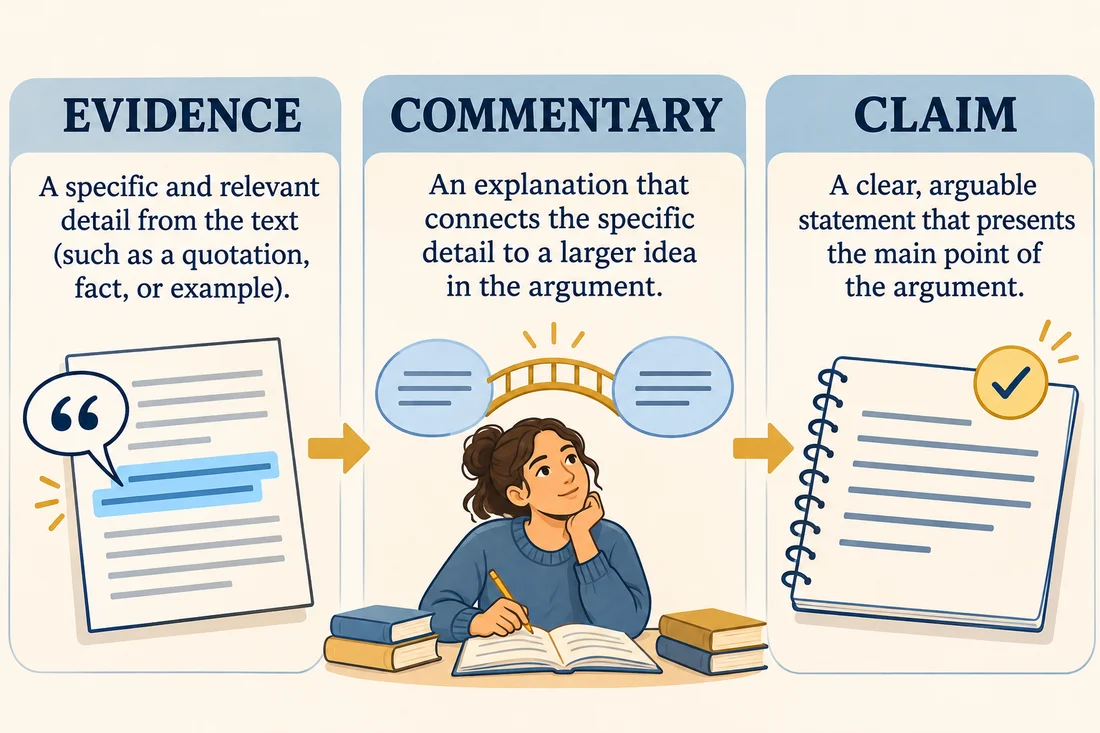
Unit 5 practice should make commentary do more work. After evidence, explain the mechanism connecting it to the claim and the significance for your larger position. Repeating a quotation in simpler words is paraphrase, not a complete explanation.
12.7 Connecting Evidence to Claims
Use a because test: “This detail supports my claim because…” If the rest of the sentence merely repeats the detail, identify the missing inference. For a cost figure, explain what the amount makes feasible or impossible under the proposal.
12.8 Maintaining a Logical Line of Reasoning
Read only your thesis and topic sentences. Do they form a coherent argument? Next check whether each paragraph supplies the promised evidence and explanation. A strong introduction cannot rescue paragraphs that pursue a different position.
12.9 Effective Transitions
Choose a transition after identifying the relationship: contrast, cause, qualification, example or consequence. “However” cannot create a genuine contrast where none exists. Sometimes revising the previous sentence makes the connection clearer than inserting another transition.
12.10 Qualification and Modifiers
Modifiers can make a claim more accurate: often, under these conditions, for this group. Qualification should explain a real limit, not turn every sentence into a hedge. Specify which evidence supports the condition and why it matters.
12.11 Unit 6 Overview: Considering Multiple Perspectives
In Unit 6 work, test your argument against other perspectives and evidence. Acknowledge the strongest relevant challenge, then explain whether it narrows, strengthens or changes your position. An invented weak opponent creates only the appearance of complexity.
12.12 Position vs. Perspective
A position is a conclusion about an issue; a perspective is the angle or set of concerns informing interpretation. People with different perspectives can reach the same position for different reasons. Analyze that relationship instead of treating every source as simply for or against.
12.13 Recognizing Bias
Bias can affect selection, framing and interpretation of evidence. Identify the specific choice and its consequence, rather than dismissing a source because its author has a viewpoint. A source can be interested in an outcome and still provide useful, verifiable information.
12.14 Adjusting Arguments to New Evidence
When new evidence challenges a claim, revise the scope or reasoning instead of ignoring it. A successful small pilot may justify expansion with safeguards, not immediate universal adoption. Explain what the evidence warrants and what remains uncertain.
12.15 Analyzing Tone and Tone Shifts
Describe tone with a precise adjective and support it with language. Trace a shift from humorous observation to urgent appeal by showing where the vocabulary, sentence form or evidence changes. Mood is the atmosphere experienced; tone is the writer's conveyed attitude.
12.16 Units 4–6 Practice Questions
Attempt the middle-unit practice tasks, then revise one answer into a fuller explanation. Ask how a counterargument changes the thesis and why a transition fits a particular relationship. Recheck with a fresh passage rather than memorizing the supplied answer.
CHAPTER 13
13. Units 7-9: Complexity and Style
Back to contents ↑13.1 Unit 7 Overview: Analyzing Complex Arguments
Advanced study connects multiple claims, conditions and perspectives without losing the central position. Map the argument's structure before judging individual devices. Complexity is useful only when the relationships remain intelligible to the intended reader.
13.2 Recognizing Nuance and Complexity
Nuance means making distinctions that the issue actually requires. A policy may help one group while burdening another, or work only with adequate staffing. Explain the tension and its consequences rather than adding a sentence that merely says the issue is complex.
13.3 Counterarguments and Alternative Perspectives
Present a relevant opposing argument accurately and give it enough evidence to matter. Then test it against your reasoning. Addressing a substantive challenge can clarify the limits of your position even if you retain the main conclusion.
13.4 Qualification and Limitations of Claims
Specify where a claim holds and where its support weakens. A survey of one school can inform that school's trial without proving a national effect. A qualified conclusion is stronger when it matches the evidence rather than reaching beyond it.
13.5 Sentence Development and Meaning
Sentence development can show relationships: a subordinate clause can establish a condition; parallel clauses can place alternatives on equal terms. Describe how the actual syntax directs attention. A long sentence is not inherently more sophisticated than a short one.
13.6 Unit 8 Overview: Rhetorical Style
Unit 8 study emphasizes rhetorical style as purposeful choice. Compare two versions of the same sentence for different audiences. Decide which details, vocabulary and rhythm best serve the argument rather than choosing whichever sounds most elaborate.
13.7 Diction and Audience
Diction is word choice. Compare “an investment” with “an expense”: both can name the same payment while framing its value differently. Explain how the wording positions the audience toward the policy in this passage.
13.8 Syntax and Sentence Structure
Syntax is sentence arrangement. A sequence of short commands can create urgency, while a balanced comparison can slow readers to weigh alternatives. Analyze the pattern in context instead of claiming every short sentence is emotional.
13.9 Rhetorical Choices and Their Effects
Use the sequence choice, specific evidence, audience implication and purpose. For example, addressing listeners as neighbors can frame a dispute as a shared civic task. Explain how that framing supports the particular appeal rather than assuming an automatic emotional reaction.
13.10 Tone, Voice and Style
Tone concerns conveyed attitude; voice is the distinctive speaking presence; style is the pattern of choices shaping expression. They overlap without being identical. Use these terms only when your explanation shows what the language is doing.
13.11 Unit 9 Overview: Developing Complex Arguments
Unit 9 study combines a defensible position with sustained reasoning, strategic evidence and meaningful qualification. Practise integrating an opposing perspective within a paragraph's logic. A detached concession paragraph can feel pasted on if it never affects the conclusion.
13.12 Strategic Concession and Rebuttal
A concession accepts a valid part of an objection; a rebuttal answers its implications. “The plan costs more initially” can be conceded while arguing that access justifies a limited trial. Explain the tradeoff instead of pretending the expense disappears.
13.13 Refuting Counterarguments
Refutation challenges a claim or its reasoning. Identify the disputed premise, supply relevant evidence and explain the consequence. Attacking the opponent's intelligence neither disproves the argument nor strengthens your own position.
13.14 Developing Sophisticated Arguments
Sophistication can emerge from sustained exploration of tensions, limits or implications and from an effective rhetorical approach. It is not guaranteed by a counterargument, a historical name or elaborate vocabulary. Develop complexity where the argument actually needs it.
13.15 Applying Advanced Rhetorical Choices
Try strategic contrast, precise qualification and purposeful sentence variation in a revision. Keep only choices that clarify the argument or fit the audience. A draft overloaded with devices can obscure meaning even when every term is correctly identified.
13.16 Units 7–9 Practice Questions
Use the advanced practice set to explain a limitation, revise a claim and analyze a tone shift. Compare your rationale with the explanation. Then write a new example in which a concession changes the argument's scope.
CHAPTER 14
14. Rhetorical Concepts and Devices
Back to contents ↑14.1 What Is Rhetoric?
Rhetoric is the practice and study of purposeful communication in a situation. It includes choices about evidence, structure, language and audience. Rhetorical analysis explains those choices; it is more than spotting figurative language.
14.2 Rhetorical Situation
A rhetorical situation includes who communicates, to whom, why and in what circumstances. Identify relationships the passage actually supports. Do not infer a writer's entire life story or an audience's unanimous reaction from a brief excerpt.
14.3 Ethos, Pathos and Logos
Ethos concerns credibility or character, pathos appeals to values and emotions, and logos concerns reasoning. They can overlap. A firsthand account may establish experience and evoke concern while supplying evidence; explain its particular function rather than assigning it one compulsory label.
14.4 Diction
Analyze a cluster of consequential words, not an isolated synonym. Calling a public service a lifeline suggests dependence and urgency. Explain what that framing asks the audience to value and whether the rest of the argument supports it.
14.5 Syntax
Study where a sentence places its main claim, how clauses relate and what a pattern emphasizes. A delayed conclusion can build anticipation or qualification. Quote only enough syntax to demonstrate the effect and explain it in relation to the argument.
14.6 Tone and Mood
A writer's tone might be skeptical, reflective or insistent; the atmosphere might be tense or reassuring. Support the distinction with actual details. “The tone is good” is not precise enough to explain rhetorical function.
14.7 Imagery and Figurative Language
Imagery uses sensory detail; figurative language creates meaning beyond a strictly literal statement. A description of dark windows can make institutional closure concrete. Analyze why that detail appears at that moment rather than claiming imagery always creates the same emotion.
14.8 Analogy and Metaphor
An analogy reasons through a comparison; a metaphor describes one thing as another. Test what similarities the comparison illuminates and where it breaks down. A memorable metaphor can frame a problem without providing sufficient evidence for the proposed solution.
14.9 Repetition and Parallelism
Repetition returns to a word or idea; parallelism repeats grammatical structure. The original phrase “We need time to read, time to question, time to revise” gives equal emphasis to three practices. Explain why that equal weighting matters to the speaker's purpose.
14.10 Juxtaposition and Antithesis
Juxtaposition places elements together to expose a relationship; antithesis uses contrast, often in balanced form. A passage contrasting an impressive new building with empty shelves can challenge how success is measured. Name the actual contrast and its implication.
14.11 Rhetorical Questions
A rhetorical question prompts reflection or guides an implied answer rather than requesting information. Ask what assumption it invites the audience to accept. A question can expose uncertainty as well as pressure agreement; context determines the interpretation.
14.12 Allusion and Anecdote
Allusion invokes a familiar text, event or idea; anecdote supplies a brief narrative. Explain what shared knowledge or experience the writer expects. If you do not recognize an allusion, use the passage's contextual clues rather than inventing a historical identification.
14.13 Appeals to Authority
An appeal to authority supports a claim through relevant expertise or credibility. Evaluate the match between the expert's field and the issue. A celebrity endorsement and a well-designed research report do not supply the same kind of support.
14.14 Cause-and-Effect Reasoning
A causal argument proposes a mechanism connecting conditions and outcomes. Check alternative causes, sequence and available evidence. “After the club began, attendance rose” establishes timing but not automatically causation; the writer needs a justified connection.
14.15 Comparison and Contrast
A comparison needs a meaningful common basis. If a writer compares two schools' library use, consider enrollment, opening hours and measurement period. Explain how similarities or differences support the claim rather than treating any numerical contrast as decisive.
14.16 Concession and Refutation
Concession acknowledges a valid opposing point; refutation contests a claim. A strong response can use both: recognize a genuine expense, then dispute that it makes every version of the proposal unaffordable. Specify which part is accepted and which is challenged.
14.17 Logical Fallacies
Common weaknesses include hasty generalization, false dilemma, straw man, circular reasoning and unsupported causation. Explain the exact missing step. An argument is not fallacious simply because you dislike its conclusion or because it uses emotion.
14.18 Rhetorical Analysis Vocabulary List
Use the flashcards below for definitions, original examples and analytical questions. Learn rhetorical situation, exigence, claim, evidence, warrant, qualification, concession, diction, syntax and tone alongside devices. Vocabulary matters most when it improves explanation.
14.19 How to Explain the Effect of a Rhetorical Choice
Replace “This uses repetition to emphasize” with an explanation of what is repeated, what idea gains weight and why that matters to this audience. Avoid universal claims such as “This makes everyone agree.” Describe the plausible rhetorical invitation supported by the text.
14.20 Rhetorical Devices Practice Questions
Answer the device and function questions in the original practice bank. After choosing a label, write one sentence explaining the choice's purpose. A correct term with a vague effect should become a revision target, not a completed analysis.
CHAPTER 15
15. Multiple-Choice Section Overview
Back to contents ↑15.1 How Many MCQs Are on the AP Lang Exam?
The standard AP Lang multiple-choice section contains 45 questions. Use a full practice set to rehearse endurance and pacing; a five-question drill is useful for diagnosis but should not be described as a full examination.
15.2 Multiple-Choice Section Duration
Standard MCQ time is 60 minutes. Approved accommodations can alter individual timing. Practise allocating time to passage reading and answer review as well as selecting options; the 80-second average includes all of that work.
15.3 Multiple-Choice Score Weight
Multiple choice contributes 45% of the overall score. Each correct answer contributes one raw MCQ point in the guide's normalized practice model. Missing an item does not subtract an extra penalty point.
15.4 Reading Questions vs. Writing Questions
Reading items interpret an existing nonfiction argument. Writing items ask which revision best serves a specified purpose in a draft. For both, the surrounding passage matters; do not answer only from an isolated phrase or a general grammar preference.
15.5 Number of Reading Questions
The published range is 23–25 reading questions, not an invariant 23. The original practice forms here use 24 reading questions across two sets. That is one permitted structure, not a prediction of the exact split on your live form.
15.6 Number of Writing Questions
The published writing range is 20–22 questions. The practice forms here use 21 writing questions across three sets. Reading and writing questions together total 45; they are not two separately timed sections.
15.7 Number of Passage Sets
The section has five passage sets: two reading sets and three writing sets in the CED structure. The original forms use 12, 12, 8, 8 and 5 questions. Other allocations within the published ranges are possible.
15.8 How Passage-Based Questions Work
A shared passage supports several questions about different features. Read the introductory context and keep track of paragraph functions. Return to the relevant evidence for each question instead of assuming all items test the passage's central claim.
15.9 Types of Nonfiction Passages
Passages can include essays, journalism, speeches and other nonfiction, with varied eras and subjects. You do not need specialized factual expertise in the passage topic. Use the supplied language and context rather than bringing an unsupported outside assumption.
15.10 How Difficult Are AP Lang MCQs?
Difficulty often comes from close distinctions between plausible answers, not rare vocabulary alone. An option may be partly accurate but too broad, too narrow or inconsistent with the stated purpose. Explain why the best answer is better than the nearest distractor.
15.11 How MCQ Answers Are Scored
Count correct answers and review errors by skill. A missed revision question about evidence needs a different repair from misreading a pronoun reference. The original bank supplies explanatory keys so review can focus on the underlying decision.
15.12 Common MCQ Distractors
Watch for extreme claims, a true detail answering the wrong question, reversed relationships and plausible statements not supported by the text. Do not reject every strong word automatically; evaluate whether the actual passage justifies its scope.
15.13 Best Strategies for the 60-Minute Section
Move through all five sets with a flexible checkpoint plan, for example roughly 12 minutes per set before adjusting for size and difficulty. Make a reasoned selection when stuck and preserve time for the rest. Review flagged items only within the allowed section.
CHAPTER 16
16. Reading Multiple-Choice Practice
Back to contents ↑16.1 Understanding Reading Questions
Reading questions require interpretation of what the text does as well as what it says. Begin with the rhetorical situation and paragraph roles. A summary is useful groundwork, but a purpose question asks why that content is presented.
16.2 Identifying the Author's Main Argument
Express the main argument as a claim, not merely a topic. “The passage discusses libraries” is a topic; “It advocates extending access through a limited, evaluated pilot” identifies an arguable position. Test that statement against the whole passage.
16.3 Understanding Rhetorical Purpose
Purpose concerns the response the writer seeks: persuade, challenge, explain, commemorate or qualify, for example. Support the choice with the passage's development. A humorous anecdote can serve a serious policy purpose rather than making entertainment the overall goal.
16.4 Identifying the Intended Audience
Infer audience from address, context, assumed knowledge and the decision being requested. A proposal submitted to a council may address officials directly while also considering residents. Distinguish the immediate audience from everyone who might later read it.
16.5 Analyzing Rhetorical Choices
Identify a consequential choice and connect it to a function. A speaker may begin with shared values before introducing disagreement. That sequence can create common ground, but explain which values and why they matter to these listeners.
16.6 Interpreting Tone and Attitude
Use diction, qualification and emphasis to infer attitude. A passage acknowledging progress while questioning a measurement can be cautiously skeptical rather than wholly dismissive. Prefer an answer that captures the full attitude, including its limits.
16.7 Analyzing Claims and Supporting Evidence
Separate an assertion from the support offered for it. Ask whether the evidence establishes the claim's actual scale. A small local example may support feasibility without establishing universal effectiveness.
16.8 Understanding Lines of Reasoning
Trace the sequence of claims: problem, evidence, alternative, qualification, recommendation. A question may ask why a paragraph appears where it does. Identify what the reader needs to know before accepting the next step.
16.9 Analyzing Text Organization
Describe organization by function rather than counting paragraphs. “It moves from a personal experience to a policy proposal and then addresses cost” explains progression. “It has an introduction, middle and end” does not distinguish this argument.
16.10 Interpreting Words in Context
Substitute each possible meaning into the sentence and test it against nearby ideas. A familiar word can have an unfamiliar contextual sense. Avoid choosing a dictionary meaning solely because it is the one you use most often.
16.11 Evaluating Evidence and Reasoning
Examine whether the source is relevant, the comparison fair and the inference justified. A question asking which evidence would strengthen a claim requires the missing support, not simply another interesting fact about the broad topic.
16.12 Understanding Paragraph Relationships
A paragraph can illustrate, qualify, contrast with or extend a preceding claim. Name the relationship and identify the shared idea. A shift in subject matter does not necessarily mean the writer has abandoned the main argument.
16.13 Inferring Meaning from Nonfiction Passages
An inference must follow reasonably from the text while staying within its support. Avoid adding motives, events or attitudes not supplied. The most imaginative possibility is not the strongest inference unless the passage warrants it.
16.14 Identifying Rhetorical Shifts
Look for a change in audience address, vocabulary, sentence pattern, evidence or argumentative role. A shift from describing a problem to proposing action is structural even if the tone stays steady. Explain both what changes and why.
16.15 Reading MCQ Practice with Answers
Open an original form or choose a reading drill below. Answer before revealing explanations. For every error, quote or paraphrase the decisive passage detail and explain why the distractor fails; then practise that skill on a fresh set.
CHAPTER 17
17. Writing and Revision Practice
Back to contents ↑17.1 Understanding Writing MCQs
Writing questions ask you to act as an editor with a purpose. Read the stated goal and the draft's surrounding sentences. The best revision preserves relevant meaning while improving the specific feature being assessed.
17.2 Improving Thesis Statements
Select a thesis that matches the evidence and provides a defensible direction. A broader sentence is not automatically better. If the draft supports a local pilot, a claim about every school in the world would overreach.
17.3 Choosing Relevant Evidence
Choose evidence for relevance to the claim, credibility and useful specificity. A dramatic anecdote about another issue may distract. If the claim concerns evening access, information about opening hours and affected users is more direct than a building's paint color.
17.4 Revising Topic Sentences
A topic sentence should establish the paragraph's main contribution to the argument. Check that the following evidence supports it. A sentence that introduces a new unsupported theme may weaken organization even if it sounds polished.
17.5 Improving Paragraph Organization
Arrange information so references and reasoning are clear. Define a proposal before evaluating its consequences; introduce a concern before answering it. Test the revised order by reading transitions and pronouns in context.
17.6 Adding Effective Transitions
Identify the relationship before selecting the connector. Use a contrast when the next sentence limits the preceding claim, not when it supplies an example. A transition must express a genuine logical link rather than substitute for one.
17.7 Revising Introductions and Conclusions
An introduction should set up the actual argument; a conclusion should develop its significance. Avoid adding a major new reason in the final sentence when the essay has not supported it. Prefer closure that follows from the established evidence.
17.8 Improving Clarity and Precision
Replace vague references with precise nouns and remove ambiguity without changing the claim. “This proves it” can become an explanation of what evidence supports which conclusion. Clarity is about the relationship of ideas as well as sentence length.
17.9 Eliminating Redundancy
Delete repeated information when it adds no distinction, emphasis or reasoning. Do not remove purposeful repetition merely because a word reappears. Judge whether the second occurrence performs a new rhetorical job for the intended audience.
17.10 Improving Sentence Structure
Choose syntax that makes relationships clear and preserves intended emphasis. Correct grammar alone does not settle a revision question. A sentence can be grammatical yet obscure which action caused an outcome or who holds a particular view.
17.11 Choosing Effective Diction
Select words that are accurate for the context and appropriate for the audience. A technical term can help an expert audience but need explanation for general readers. Avoid an ornate synonym if it changes the claim or makes the tone inconsistent.
17.12 Adjusting Tone for Audience and Purpose
Match the tone to the relationship and task. A request to administrators can be firm without insulting their motives. The best revision can challenge a policy while preserving the credibility and constructive purpose of the argument.
17.13 Strengthening Lines of Reasoning
Look for a sentence that explains how the evidence advances the claim. Another statistic may be less useful than the missing inference. A coherent line of reasoning needs connections between facts, not merely more facts.
17.14 Combining Sentences Effectively
Combine sentences when their relationship becomes clearer and no important distinction is lost. Use subordination for a condition and coordination for comparable ideas. The shortest option is not always best if it obscures contrast or causation.
17.15 Writing MCQ Practice with Answers
Choose a writing drill in the practice bank and explain the goal each correct revision serves. Compare it with the nearest alternative. Then edit one of your own paragraphs using the same test of relevance, organization and precision.
CHAPTER 18
18. Free-Response Section Overview
Back to contents ↑18.1 How Many FRQs Are on the AP Lang Exam?
There are three required essays: synthesis, rhetorical analysis and argument. Each has its own task and six-point score. Completing only your preferred essay type leaves substantial writing performance unrepresented.
18.2 Free-Response Section Timing
Standard free-response time is 2 hours 15 minutes, including the 15-minute reading period. Plan for all three responses within that section. Follow the actual Bluebook and proctor instructions for your approved administration.
18.3 Free-Response Score Weight
Free response contributes 55% of the overall exam. In the guide's weighted practice model, each essay's six-point total is treated equally within the 18-point FRQ maximum. Rubric row points are not separate AP scores.
18.4 The Three Required Essay Types
Synthesis combines provided sources into your argument; rhetorical analysis explains a supplied writer's choices; argument develops your own evidence-based position. Before writing, identify which task you face so you do not debate when asked to analyze.
18.5 Understanding the 15-Minute Reading Period
Use the reading period to understand the three tasks, map synthesis sources and plan efficiently. It is included in the writing section, not an extra break. Follow current instructions; the website simulator's optional 15-minute block is only a practice aid.
18.6 How to Allocate Time Among Essays
A workable starting plan is about 40 minutes per essay after the reading allocation. Within an essay, leave a few minutes for planning and checking. Adapt through practice rather than sacrificing the final response to perfect the first introduction.
18.7 How FRQ Prompts Are Structured
Prompts establish context and a specific writing demand. Underline the action you must perform and the claim or passage you must address. Do not replace that task with a memorized essay on a vaguely related theme.
18.8 How Essays Are Submitted in Bluebook
Type answers in the designated Bluebook response areas during the examination. Practise keyboard fluency and reading alongside typing on the intended device. Work saved in a browser study tool is not an examination submission.
18.9 How AP Lang Essays Are Graded
Readers evaluate each response using the relevant analytic criteria. Evidence and commentary carry up to four of the six points. Prioritize developed reasoning and clear task fulfillment over a long introduction or a catalog of rhetorical vocabulary.
18.10 Official Free-Response Scoring Rubrics
The official rubric separates thesis, evidence/commentary and sophistication. Study its task-specific decision rules, especially source use in synthesis and choice analysis in rhetorical analysis. The self-assessment below is a revision checklist, not an automated or official score.
18.11 Common Mistakes That Lower Essay Scores
Common problems include prompt restatement, summary without explanation, unsupported claims, mislabeled evidence and unfinished reasoning. Identify the pattern before revising. Adding a conclusion cannot repair a body paragraph that never explains its evidence.
18.12 What a High-Scoring AP Lang Essay Includes
A strong response addresses the exact task, establishes a defensible position or analysis, uses precise evidence and develops a coherent explanation. Complexity should emerge from the argument's tensions or implications. There is no universal paragraph count or mandatory vocabulary recipe.
CHAPTER 19
19. The Synthesis Essay
Back to contents ↑19.1 What Is the AP Lang Synthesis Essay?
Synthesis is your argument in conversation with a provided source packet. Organize around your claims, not a source-by-source report. Readers should see why evidence from different sources belongs together and what conclusion their relationship supports.
19.2 Understanding the Synthesis Essay Prompt
Identify the issue and the decision or judgment requested. A prompt about which factors matter most requires prioritization, not simply a for/against vote. Frame a position that answers that exact demand and can be supported by the sources.
19.3 How to Analyze Six Sources
Preview all six sources for perspective, evidence type and limits. Mark a useful detail and possible argumentative role for each. Do not assume a graph is neutral or a firsthand account representative; evaluate how each can legitimately be used.
19.4 Identifying Source Perspectives
Identify what each source values and what its evidence can establish. One may emphasize cost while another prioritizes access. Their disagreement can become a productive tension if you explain why both concerns affect the decision.
19.5 Understanding Visual and Quantitative Sources
Read titles, axes, dates, units, sample definitions and any legend before interpreting a visual. A chart can show an association without proving causation. The original packets include hypothetical quantitative and conceptual visual sources, clearly labeled as invented practice material.
19.6 Choosing at Least Three Sources
The task requires use of at least three provided sources. Choose sources that support or complicate your line of reasoning, not merely the shortest three. Attribution alone is insufficient: explain how each relevant detail advances an actual claim.
19.7 Developing a Defensible Thesis
Write a position that responds to the issue and can be defended from the packet. A qualified thesis can identify both a recommendation and a condition. Avoid a vague statement that several views exist without deciding what the reader should conclude.
19.8 Creating a Strong Line of Reasoning
Build claims that work together: establish the need, evaluate the proposal and set conditions for implementation, for example. Evidence should appear where each claim needs support. A thesis followed by six disconnected summaries has no sustained line of reasoning.
19.9 Integrating Sources into Body Paragraphs
Introduce evidence in a sentence shaped by your claim, attribute it and explain its relevance. Bring two sources together when their relationship matters. “Source A says” repeated at the start of every paragraph can let the packet determine the structure instead of your argument.
19.10 Using Quotations and Paraphrases
Quote when the exact wording matters; paraphrase when the idea or finding matters. Both require attribution. Keep quotations accurate and limited, and supply your own explanation rather than using a long borrowed passage to occupy the paragraph.
19.11 Citing Sources Correctly
Use clear source labels such as Source B or the provided author description. Citation must let a reader identify the borrowed material. A formal bibliography is not the central timed task, but unclear attribution and invented quotations undermine the response.
19.12 Explaining Evidence with Commentary
Explain what the evidence establishes, how it supports this claim and what limit remains. A budget figure can show cost without establishing value; your commentary must make the value judgment explicit. This is where source use becomes reasoning.
19.13 Addressing Counterarguments
Address a substantive challenge supported by the packet. Explain whether it changes the recommendation, demands a safeguard or is outweighed by other evidence. Do not insert a token opposing sentence that the rest of the essay ignores.
19.14 Developing Nuanced Arguments
Nuance can come from distinguishing short- and long-term outcomes, different affected groups or conditions of success. Develop the distinction with sources. An assertion that both sides have good points is not yet a reasoned position.
19.15 Synthesis Essay Structure
A useful structure introduces the decision, develops two or three connected claims, addresses a real limitation and concludes with implications. This is an option, not a scoring requirement. Let the argument determine paragraph boundaries.
19.16 Synthesis Essay Sample Response
Read the complete original synthesis model below alongside its six-source packet. Its recommendation is deliberately conditional, and sources are combined within claims. The material is an invented teaching example, not a released examination response or a quotation from a real student.
19.17 Sample Scoring and Commentary
The model commentary identifies thesis, source-supported reasoning and an unresolved opportunity for greater complexity. Its suggested rubric discussion is illustrative, not an official AP Reader judgment. Use it to locate the reasoning moves, then apply those moves to a new issue.
19.18 Common Synthesis Essay Mistakes
Avoid source dumping, using fewer than three sources, misreading units, inventing data and substituting outside examples for the required packet. Do not assume six citations automatically earn a stronger score than three well-explained sources.
19.19 Synthesis Essay Practice Prompts
Use the five original synthesis packets in the practice forms. Each has six sources, including a quantitative table and a conceptual visual. Their compressed invented sources support reasoning practice; they are not calibrated replicas of the length or difficulty of official packets.
Original synthesis model: a trial with conditions
Practice Form 1: conditions for continuing evening library sessions. · Original teaching example, not a real student script or official scored response.
A library should not judge access only by the hours printed on its door. Evening sessions deserve a trial where existing schedules exclude intended users, but they should continue only if the trial demonstrates additional access, provides sustainable staffing and makes its limits visible. This position asks for evidence of a useful change rather than a promise that any longer timetable must be better.
The strongest reason to test the proposal is the gap between nominal availability and usable opportunity. Source C’s account of a cleaner arriving after closure gives that gap a concrete form. It does not prove how many people share the problem, but it identifies a question that a trial can investigate: who can now attend who previously could not? The hypothetical comparison in Source E is consistent with improved opportunity, since 46 of 80 participants in the pilot group report a new opportunity compared with 24 of 80 under the current arrangement. Those figures cannot establish causation, because the groups were not randomized, and they do not measure long-term benefits. They nevertheless suggest which question a better-designed local evaluation should pursue. Raw visitor totals would be a less direct answer to the stated access problem.
A useful opportunity also needs an arrangement that can sustain it. Source B correctly insists that staff attention and security have costs even when an event is popular. Calling a project community-minded does not make that work free. The council should therefore approve a maximum trial budget, record staffing demands and identify any daytime service displaced by the new sessions. This does not reduce the decision to the cheapest possible option. It makes the cost of the intended benefit available for judgment. Source A’s bounded twelve-week proposal is preferable to an immediate permanent commitment because it leaves room to compare the gain with the resources actually required.
The review must also be able to produce an unwelcome answer. Source D warns that participation and benefit are different and that a short pilot cannot resolve every long-term question. Organizers should report those limits alongside visitor accounts, rather than using a favorable number to close discussion. Source F’s poster gives equal space to access, resources and review, a useful framing for the decision, but the diagram itself proves no outcome. Its promise must be tested by the more demanding evidence the other sources request. Continuation could mean revising hours or reducing frequency rather than choosing only between total expansion and complete closure.
The council should continue evening opening when the evidence supports a distinct access benefit that the town can sustain without concealing its tradeoffs. A trial is valuable precisely because it can change the proposal. Treating uncertainty as a reason for indefinite delay would ignore the present barrier; treating a hopeful pilot as permanent proof would ignore the responsibility to evaluate it. A limited, transparent decision respects both concerns.
Annotated rubric discussion
Illustrative review, not an official score: the opening supplies a defensible conditional thesis. The response attributes five text/table sources plus the visual and explains their relationships rather than summarizing one per paragraph. It distinguishes an individual account, a hypothetical association and a causal claim. A reviewer could discuss strong Row B evidence/commentary and the sustained tension between present access and uncertain long-term value. A complete official scoring judgment requires the relevant rubric and an independent reader; source quantity alone does not determine it.
CHAPTER 20
20. The Rhetorical Analysis Essay
Back to contents ↑20.1 What Is the AP Lang Rhetorical Analysis Essay?
Rhetorical analysis explains how a writer's choices work together toward a purpose. You analyze the supplied text in its situation. Your agreement with the writer is secondary and should not replace evidence-based explanation of the writer's strategy.
20.2 Understanding the Rhetorical Analysis Prompt
Read the context, identify the writer's purpose and note the actual analytical task. A prompt asking how a writer develops an argument requires attention to progression. Do not automatically organize the response into one paragraph each for ethos, pathos and logos.
20.3 Analyzing the Rhetorical Situation
Identify the immediate audience, occasion, constraints and desired response. Then examine how the text adapts to them. A public request for funding may acknowledge cost because the audience controls resources, not simply because the writer wants to sound balanced.
20.4 Identifying the Writer's Purpose
State purpose as an action toward an audience: persuade council members to authorize a trial, for example. “To inform” can be too broad if the passage clearly requests a decision. Support the inferred purpose with the ending and overall progression.
20.5 Identifying Audience and Context
Use provided context and textual evidence to identify audience and situation. Avoid speculative claims about all listeners' beliefs. Explain how a choice appeals to a plausible concern the text actually addresses.
20.6 Analyzing Rhetorical Choices
Choose a few important, connected strategies rather than every device you can name. Track how the opening creates a frame, the middle supplies reasons and the ending directs action. A chronological structure can work well when it reveals this progression.
20.7 Understanding Appeals and Their Functions
Describe what establishes credibility, what values are invoked and how reasoning is presented. The labels ethos, pathos and logos can help, but the analysis needs the particular evidence and function. An appeal can operate in more than one way.
20.8 Analyzing Diction and Syntax
Show how word choice and sentence form create emphasis or relationships. A repeated negative construction can reject a misleading standard before introducing a new one. Explain the actual contrast; do not stop at “the author uses diction and syntax.”
20.9 Identifying Tone and Tone Shifts
Identify the initial attitude and the later shift with evidence. A speaker can move from reflective recollection to a direct call for action. Explain why the change suits the argument's stage and audience rather than merely listing two tone adjectives.
20.10 Writing a Defensible Rhetorical Thesis
A rhetorical thesis should make a defensible claim about how the writer develops meaning or purpose. “The writer uses devices” is too general. Identify a strategic relationship, such as moving from shared experience to a qualified practical request.
20.11 Structuring Body Paragraphs
Build a paragraph around an analytical claim, then supply short textual details and explain how they support it. End by connecting the strategy to the larger progression. The goal is an explanatory unit, not a quotation followed by a device label.
20.12 Using Textual Evidence
Use precise references to the passage, quoting when wording is essential and paraphrasing accurately elsewhere. Do not invent line numbers or quotation marks around a remembered approximation. The explanation should remain understandable when the reader checks the source.
20.13 Explaining How Rhetorical Choices Work
Ask what the choice makes salient, what assumption it challenges or what relationship it establishes. Then connect that function to the audience and purpose. This is stronger than asserting an unknowable guaranteed reaction such as making every reader feel inspired.
20.14 Avoiding Device-Listing Without Analysis
Device listing treats features as isolated objects. Analysis explains their roles and relationships. Instead of naming an anecdote, repetition and a question, show how the anecdote establishes the problem, repetition reframes it and the question invites a decision.
20.15 Establishing a Coherent Line of Reasoning
Make each paragraph advance a single interpretation of the passage. If you argue the writer builds a practical case for change, explain how every selected choice contributes. Do not let a vivid device pull the essay toward an unrelated claim.
20.16 Writing a Sophisticated Rhetorical Analysis
Consider a tension within the strategy: the writer may appeal to shared values while challenging how those values are applied. Develop that tension through several details. Complexity is sustained interpretation, not a final sentence announcing that rhetoric is powerful.
20.17 Sample High-Scoring Essay
The original analysis model below examines the fictional council speech in Practice Form 1. Read the speech first and check each textual reference. The model demonstrates developed analysis but carries no official AP score or claim of student authenticity.
20.18 Annotated Scoring Commentary
The accompanying annotation explains the thesis, specific evidence and commentary links, plus a limitation in the treatment of audience uncertainty. Use the rubric to discuss the response, not to assume one exemplar defines every successful structure.
20.19 Rhetorical Analysis Practice Prompts
Each original form contains a complete rhetorical-analysis speech with a situation and prompt. Try a new one after reviewing the model. Compare whether you can explain different choices without recycling the same claims about emotion or credibility.
Original rhetorical-analysis model: redefining an open door
Practice Form 1: Mara Ellis addresses the fictional town council. · Original teaching example, not a real student script or official scored response.
In her request for evening library sessions, Mara Ellis changes the council’s measure of access before asking it to spend more money. She begins with a worker excluded by the current timetable, contrasts genuine inquiry with predetermined justification and takes the cost objection seriously. That progression presents a limited trial as a practical way to fulfill the library’s purpose rather than as an unqualified demand for expansion.
The opening anecdote makes the existing measure look incomplete without first accusing the council of indifference. The cleaner arrives only ten minutes after her shift ends, with the needed books visible behind glass. Those details make the barrier temporal rather than a lack of interest: the visitor has a specific reason to use the service and has physically reached it. Ellis then places the institution’s eight hours against the worker’s experience that it had not opened at all. The contradiction does not mean the building was literally closed all day. It exposes the difference between a timetable and an opportunity, preparing officials to evaluate the proposal by a more demanding standard.
Ellis next converts that reframing into a testable request. The twelve-week trial and separately approved staffing budget give the council a bounded decision rather than a permanent promise. Her statement that figures should inform a decision rather than decorate one already made contrasts investigation with publicity. The contrast matters for an audience responsible for allocating public resources: a review can protect the council from committing to a proposal merely because its purpose sounds admirable. The speech therefore makes measurement part of the case for change instead of treating numerical evaluation as the enemy of compassion.
Her response to the quiet-evening objection further limits what she asks officials to believe. The brief sentence acknowledging that an evening might not justify its cost accepts a genuine risk. She then narrows the interpretation of attendance: counting people cannot alone establish whether new access was created. Together, the concession and the proposed visitor questions suggest that the speaker is willing to distinguish a useful trial from a favorable-looking report. That willingness can support her credibility, though the speech cannot guarantee that every council member will trust the proposed evaluation or agree on what benefit is worth its cost.
The ending returns to the door and key from the opening but changes their meaning. They now stand for an institutional standard: whether people can cross the threshold, not simply whether the lock is open. By asking for a fair test rather than a permanent expansion that night, Ellis connects the worker’s concrete exclusion to a manageable act of public judgment. The speech’s force comes from keeping moral purpose and practical uncertainty in the same argument. Its success with this council would still depend on evidence and priorities beyond the excerpt, but its rhetorical progression makes the requested decision clear.
Annotated rubric discussion
Illustrative review: the thesis makes a claim about strategic progression. Body paragraphs use precise references and repeatedly connect choices to the council’s task. The final discussion returns to the opening image and sustains a distinction between persuasive invitation and guaranteed audience reaction. A possible revision would develop the competing budget priorities more fully if the passage supported them. This is an original teaching model, not an official high-scoring student script.
CHAPTER 21
21. The Argument Essay
Back to contents ↑21.1 What Is the AP Lang Argument Essay?
The argument essay asks for your own defensible position supported by specific evidence. You decide which examples are relevant and how they establish your reasoning. A fluent opinion without support is not a developed argument.
21.2 Understanding the Argument Prompt
Identify the exact claim or issue to evaluate and any key term needing interpretation. Do not answer a broader familiar question instead. If the prompt concerns when convenience should guide decisions, an essay only praising technology misses the conditional task.
21.3 Developing a Defensible Position
Take a position that can be supported and reasonably contested. You can qualify or partly agree, but the reader must know what you conclude. “It depends” needs the actual conditions and an explanation of why they matter.
21.4 Writing a Clear Thesis Statement
Write a thesis that answers the prompt and establishes the scope of the argument. A sentence listing three unrelated topics is not enough. Show the relationship between your position and the reasons you will develop.
21.5 Brainstorming Relevant Evidence
Brainstorm examples you know accurately, then choose those with the clearest connection to the claim. One well-explained case can be stronger than many name drops. Do not manufacture research, quotations or historical details to make the evidence sound authoritative.
21.6 Using Historical Examples
Historical examples need accurate, relevant specifics and a reasoned connection. Explain the decision, circumstance and consequence you actually know. A broad reference to a war, movement or famous leader proves little without that analytical work.
21.7 Using Literary and Cultural Examples
Literary and cultural examples can support an argument when explained and relevant. Distinguish a fictional illustration of a mechanism from empirical proof about real populations. The example should illuminate the issue rather than become an unrelated plot summary.
21.8 Using Personal Observations Appropriately
A personal observation can be useful if concrete, credible and connected to the claim. Acknowledge its scale. Your experience of one club may illustrate coordination problems without proving that every organization behaves the same way.
21.9 Developing Claims and Subclaims
A subclaim advances part of the main position. If the thesis supports limited experimentation, subclaims might explain learning value and the conditions protecting participants. Each needs evidence and commentary rather than being a reworded version of the thesis.
21.10 Organizing an Argument Essay
Organize by reasons and relationships: establish a principle, test it through evidence and address a limitation. Chronology or comparison can work when suited to the task. A fixed five-paragraph form is neither required nor automatically sufficient.
21.11 Explaining Evidence with Commentary
After presenting an example, explain the mechanism it reveals and why that mechanism matters to the prompt. “This shows my point” adds no reasoning. Name the particular conclusion and the evidence that makes it plausible.
21.12 Acknowledging Counterarguments
Choose an objection that an informed reader could reasonably raise. Answer it by narrowing scope, weighing a tradeoff or explaining why the alternative fails. A token objection that disappears without affecting the reasoning adds little.
21.13 Concession, Rebuttal and Refutation
Concession accepts a valid concern, rebuttal answers it and refutation challenges a claim. Use whichever the argument needs. Do not treat the mere presence of an opposing paragraph as a guaranteed sophistication point.
21.14 Avoiding Unsupported Generalizations
Replace “everyone always” claims with evidence-supported scope. One example can illustrate a possibility, not establish a universal law. If broader support is unavailable, state the narrower claim honestly and explain why it still matters.
21.15 Writing Effective Introductions and Conclusions
Begin with the problem and your position rather than a dictionary definition of every word. Conclude by drawing a consequence from the argument. Repeating the thesis word for word does not add the final layer of reasoning.
21.16 Demonstrating Sophistication
Develop a real tension, implication or limit through the essay. For example, responsible experimentation can require both permission to fail and safeguards against preventable harm. Explain how the conditions fit together instead of presenting them as empty opposites.
21.17 Sample Argument Essay
Read the original argument model below about the value and limits of small trials. It uses explicitly illustrative experiences, not fabricated historical facts or external research. Its structure shows how an example can be explained rather than merely mentioned.
21.18 Sample Essay Scoring Breakdown
The scoring discussion locates a defensible thesis, specific examples and commentary, then asks whether complexity is sustained. It is a teaching judgment rather than an official score. Use the same questions on your own writing and seek a second reader's feedback.
21.19 Argument Essay Practice Prompts
The five forms include original argument prompts about experimentation, access, attention, convenience and public participation. Keep an evidence bank organized by mechanisms and limitations so examples can be adapted responsibly to an unfamiliar prompt.
Original argument model: why a small trial needs a real decision
Practice Form 1: when a small trial is preferable to immediate commitment or delay. · Original teaching example, not a real student script or official scored response.
A small trial is a responsible basis for action when the main uncertainty can be tested at limited cost and the people running it are willing to change course. It is less useful when it exposes participants to unacceptable harm or postpones a decision whose consequences are already clear. The value of a pilot lies not in making caution sound active, but in creating evidence that can genuinely alter what happens next.
A student club provides a simple illustrative case. Suppose organizers want to move all meetings online because some members cannot stay after school. Immediately abandoning in-person meetings could solve one access problem while creating another for students without a quiet connection at home. A two-week comparison of meeting arrangements could reveal which members attend, how they contribute and what barriers remain. The useful evidence would not be a bare count of logins. It would explain whether the arrangement changes meaningful participation. The trial is preferable to immediate permanence because the uncertainty concerns a practical design that can be adjusted at low cost.
The same example shows why a trial needs a decision rule. Organizers who call every result successful have not created an experiment; they have created a ceremony supporting an existing preference. Before beginning, the club should decide what information matters and what changes it could justify: different times, a hybrid arrangement, or retaining in-person meetings with another access measure. This does not require a mechanical rule in which one number controls every choice. It requires enough openness that contrary evidence can affect the recommendation. Otherwise the word trial protects the organizers from criticism while offering participants no genuine influence.
Limited experimentation also has ethical boundaries. A hypothetical community workshop can test whether residents find an event useful, but it should not test unsafe procedures on unsuspecting participants simply to see what happens. The organizers must distinguish uncertainty about demand from preventable risk. Consent, appropriate supervision and a clear stopping condition can make a small test responsible; without them, being small does not make the action harmless. This limit complicates the attractive claim that trying something is always better than doing nothing. Sometimes preparation or a different design must come first.
Delay has costs too. If a club spends the entire school year discussing an easily reversible meeting time, the members currently excluded continue to lose opportunities. Requiring certainty before any limited action can preserve a known problem while claiming to protect against every unknown one. A bounded trial offers an alternative when it addresses the relevant uncertainty and does not hide its own burdens. It should be small enough to learn from, clear enough to evaluate and consequential enough that the findings matter. Under those conditions, a pilot joins caution with responsibility rather than using either as an excuse for avoiding a decision.
Annotated rubric discussion
Illustrative review: the thesis takes a conditional position. Clearly hypothetical club and workshop cases are developed through mechanisms and limits rather than presented as invented research. The argument sustains a tension between the costs of action and delay. A second reader should assess whether the examples are sufficiently specific and whether all claims receive adequate commentary. The model does not guarantee any rubric total or AP result.
CHAPTER 22
22. Six-Point Essay Rubrics
Back to contents ↑22.1 The Six-Point Essay Rubric
The six-point rubric allocates one point to thesis, up to four to evidence/commentary and one to sophistication. A total is not a percentage or AP category. Study how the three tasks differ before applying a generic checklist.
22.2 Row A: Thesis (0–1 Point)
Row A asks whether the response makes a defensible thesis addressing the task. A thesis can exist outside the introduction, but clarity helps the reader follow the response. Restating the prompt without an arguable position or analysis does not fulfill that function.
22.3 Row B: Evidence and Commentary (0–4 Points)
Row B evaluates the quality of evidence and the explanation supporting a line of reasoning. The upper range requires specific support across claims and sustained commentary. Source count matters for synthesis; explaining multiple rhetorical choices matters for rhetorical analysis.
22.4 Row C: Sophistication (0–1 Point)
Row C recognizes sophistication demonstrated in the argument or analysis, not an isolated phrase. Meaningful treatment of tensions, broader implications or an effective rhetorical approach can contribute. Complex vocabulary and a counterargument checklist alone are unreliable substitutes.
22.5 What Earns the Thesis Point?
A thesis earns its role by answering the prompt with a defensible claim. It need not preview exactly three paragraphs. Test whether an informed reader could identify what you assert and what evidence could plausibly support it.
22.6 What Earns Full Evidence and Commentary Points?
For strong evidence/commentary, support all substantive claims with specific material and repeatedly explain the connection. In synthesis, meet the source requirement; in analysis, connect choices to purpose. A strong first paragraph does not compensate for later unsupported assertions within that row.
22.7 How to Build a Consistent Line of Reasoning
Underline each claim and draw a connection to its evidence and explanation. Then explain how it advances the thesis. If a paragraph cannot be linked to the larger position, revise its purpose or remove material that distracts.
22.8 What Counts as Sophistication?
Sophistication involves developed understanding, not decoration. A response may examine why a persuasive strategy must both reassure and challenge its audience. To count as sustained insight, that tension needs to shape the analysis beyond one introductory sentence.
22.9 How Synthesis Essays Are Scored
Synthesis Row B depends on attributed use of the provided sources as well as reasoning. Fewer than three sources limits the available evidence/commentary score under the rubric. Quoting every source without explaining the relationships is not an effective workaround.
22.10 How Rhetorical Analysis Essays Are Scored
Rhetorical analysis must explain how choices contribute to purpose or meaning. A response can accurately identify several features while still offering mostly description. Keep asking what the evidence establishes about the writer's strategy in this particular situation.
22.11 How Argument Essays Are Scored
Argument scoring depends on specific, relevant evidence and developed commentary, not whether readers personally share the conclusion. Choose a defensible position and demonstrate its reasoning. Unsupported certainty is weaker than a qualified claim supported carefully.
22.12 Comparing Low-, Mid- and High-Scoring Responses
The examples below contrast summary, partial explanation and sustained commentary using the same original detail. Their purpose is to expose the difference in reasoning. A paragraph excerpt alone cannot establish the complete six-point score of an unwritten essay.
22.13 Annotated Student Essay Examples
All model responses in this guide are original teaching examples, not real student scripts. Their annotations show choices to retain and weaknesses to revise. For official student samples, use the matched year, task and version in the internal past-paper library.
22.14 Scoring Your Own Practice Essay
Read once for task fulfillment, once for evidence/commentary and once for complexity and clarity. Record tentative row judgments with quotations from your response. Ask another reader to challenge your assumptions; self-scoring becomes more useful when it produces a specific revision.
22.15 Using College Board Scoring Guidelines Effectively
Pair a released question with its exact scoring guidelines and sample commentary. Do not apply a historical nine-point rubric as though it were today's six-point framework. Use general criteria to learn, then check the question-specific expectations.
Summary versus commentary: one original detail
Textual detail: a cleaner arrives just after the library closes, despite eight nominal opening hours.
Summary: “A cleaner finds the library closed.” This retells the event.
Partial explanation: “The story shows that opening hours can be inconvenient.” This names an implication but leaves the policy connection broad.
Developed commentary: “By placing eight recorded opening hours against a worker who cannot use any of them, Ellis separates institutional availability from usable access. The council is invited to evaluate hours through the lives they accommodate, preparing it to consider a limited evening trial.”
These paragraph-level contrasts illustrate reasoning; they do not assign complete six-point essay scores to isolated sentences.
CHAPTER 23
23. Difficulty and Course Choice
Back to contents ↑23.1 Is AP English Language Hard?
AP Lang is demanding because reading, judgment and writing must work together under time constraints. The difficulty is trainable: a student may understand a passage but need practice explaining how its evidence functions. Diagnose the specific task rather than deciding you are simply bad at English.
23.2 Is AP Lang One of the Hardest AP Exams?
There is no universal ranking of the hardest AP examinations. Candidate populations and scoring standards differ. AP Lang may be difficult for a student who dislikes sustained writing, while another finds its reasoning tasks more accessible than a calculation-heavy subject.
23.3 AP Lang Difficulty Compared with Other AP Courses
Compare the actual work rather than only score distributions. AP Lang requires unfamiliar nonfiction reading and timed evidence-based essays. Other courses may require different factual or mathematical foundations. Your preparation, interests, timetable and teacher support affect the comparison.
23.4 AP English Language vs. AP English Literature Difficulty
Lang emphasizes nonfiction argument; Literature emphasizes literary interpretation. Both require close evidence and clear commentary. A student who enjoys poetry may prefer Lit even if Lang's global 3-or-higher percentage is slightly greater in one year.
23.5 Is AP Lang Harder Than Honors English?
An honors class can be rigorous, but its curriculum and assessments are locally defined. Compare sample reading, writing frequency and feedback expectations with AP Lang. The label alone cannot determine which is harder at your school.
23.6 Why Students Struggle with Rhetorical Analysis
Students often summarize a passage or list devices instead of explaining how choices serve purpose. Repair that by adding an explicit because connection after a precise detail. Ask what the choice changes about the reader's understanding of the writer's argument.
23.7 Why Students Struggle with Timed Essays
Timed writing requires simultaneous planning, evidence selection and sentence production. Practise those components separately before combining them. If introductions consume half the session, rehearse a concise thesis and start developing evidence sooner.
23.8 Multiple-Choice Section Challenges
MCQ difficulties include plausible distractors, dense syntax and answering a topic question instead of a purpose question. Review the exact reason each wrong option fails. General advice to read more carefully is less useful than identifying the mistaken inference.
23.9 Most Difficult AP Lang Skills
Common demanding skills include sustained commentary, distinguishing perspectives, interpreting a visual source's limits and revising a passage without disrupting its logic. Track these separately so a weakness in one does not become an assumption about every part of the course.
23.10 Can You Get a 5 Without Being a Strong Writer?
A 5 requires strong demonstrated examination performance, but writing ability can improve through feedback and revision. There is no shortcut replacing that work with device memorization. Judge progress by successive responses to unfamiliar prompts rather than a fixed identity as a weak writer.
23.11 How Much Reading Is Required?
There is no universal page count assigned by College Board for every AP Lang class. Teachers choose readings to develop the framework. Regular purposeful reading matters more than a claimed daily number that ignores text complexity and the quality of analysis.
23.12 How Much Writing Is Required?
Writing frequency depends on the class, but improvement requires repeated practice and revision. Mix short thesis drills, analytical paragraphs and complete timed responses. Writing many unreviewed essays can repeat the same error without improving it.
23.13 Is AP English Language Worth Taking?
The course can be valuable if its reading and writing goals fit your interests and schedule. Consider teaching quality, feedback access, other commitments and the receiving college's policy. Credit is one possible benefit, not the sole measure of its value.
CHAPTER 24
24. How to Prepare
Back to contents ↑24.1 How to Start Preparing for AP Lang
Begin with a short reading/writing diagnostic and one essay. Classify errors before building a plan. A student with accurate reading but weak commentary needs a different week from one who repeatedly misidentifies the central claim.
24.2 Recommended Preparation Timeline
Start early enough to complete several feedback cycles and at least one full rehearsal. More calendar months do not help if every week is passive reading. Build repeated attempts, review and fresh-task transfer into the schedule.
24.3 Building a Strong Reading Foundation
Read varied nonfiction and summarize each argument in one sentence. Then identify a pivotal choice and explain its role. Gradually increase complexity while maintaining accurate comprehension; speed built on misunderstanding will not help under time pressure.
24.4 Learning Rhetorical Analysis Skills
Use the rhetorical situation analyzer to record writer, audience, purpose, context, evidence and a possible effect. Then test the effect against the passage. The tool organizes your thinking; it does not infer a correct analysis automatically.
24.5 Developing Evidence-Based Writing Skills
Write a claim, select a precise example and explain the connection. Revise by asking what a skeptical reader would still need to know. A useful paragraph makes the inference explicit rather than relying on the reader to agree with your conclusion.
24.6 Improving Thesis Statements
Rewrite prompt restatements as positions with scope. Practice both a direct and a qualified version. A qualification should identify a real condition, not make the thesis indecisive or unrelated to the supplied evidence.
24.7 Strengthening Commentary
Highlight evidence in one color and explanation in another. If most of the paragraph is quotation or retelling, add the missing reasoning. Explain what the detail establishes, how it supports the claim and why the relationship matters.
24.8 Learning to Analyze Nonfiction Texts
Annotate paragraph roles and shifts while reading nonfiction. Compare two texts addressing a similar issue to different audiences. Explain why their evidence and tone differ rather than treating one rhetorical style as universally superior.
24.9 Creating an Evidence Bank for Argument Essays
Build an evidence bank of accurate examples with a mechanism, possible uses and limitations. Include experiences, history, reading and public issues you genuinely understand. Avoid memorized anecdotes you cannot adapt or verify.
24.10 Improving Writing Speed
Improve speed by practising planning and keyboard fluency, not by eliminating thought. Draft short, clear sentences first and revise selectively. An accurate, complete argument is more valuable than a rapid stream of loosely connected assertions.
24.11 How to Practice Timed Essays
Use a prompt, start a realistic timer and write without outside assistance. Afterward, separate timing problems from reasoning problems. Repeat the weakest skill in a short drill before returning to another full response.
24.12 How to Review Incorrect MCQ Answers
For each missed MCQ, record the skill, the decisive evidence, why your choice fails and a rule for the next attempt. Then answer a fresh question testing that skill. Memorizing the original option letter does not demonstrate improvement.
24.13 Using Official FRQ Scoring Guidelines
Mark your response against the correct task's rubric and the released question's scoring guidance. Look for the reasoning actually written on the page. Do not award yourself a point because you intended to explain something but ran out of time.
24.14 Using AP Classroom Progress Checks
AP Classroom progress checks are assigned through authorized access and help identify skills needing attention. Ask your teacher what is available. An independent student should not assume an exam-only section provides the same assignments as a full authorized class.
24.15 Tracking Your Progress
Log MCQ counts, essay row scores, timing and the next action. Compare several attempts with similar conditions. A single favorable composite estimate is less reliable than repeated improvement in the same underlying skill.
24.16 How to Identify Weak Skills
Look for repeated patterns across tasks: missing qualifications, evidence without explanation, purpose confusion or unfinished essays. Choose one priority for the next week. Keep a fresh task in the plan to test whether the improvement transfers.
24.17 Effective AP Lang Self-Study Strategies
Self-study needs structure, external feedback, authorized registration and digital rehearsal. Use this guide for original practice and the internal archive for released FRQs. Arrange a knowledgeable reader to challenge your scoring, especially when your own analysis feels persuasive but remains vague.
CHAPTER 25
25. Study Plans
Back to contents ↑25.1 Six-Month AP Lang Study Plan
Months 1–2: build nonfiction reading and paragraph commentary. Months 3–4: rotate the three essays with feedback and targeted MCQ sets. Month 5: combine tasks under time limits. Month 6: complete full rehearsals, repair recurring errors and confirm device and examination arrangements.
25.2 Three-Month AP Lang Study Plan
Weeks 1–4: diagnose and practise the four big ideas. Weeks 5–8: write each essay type repeatedly and review MCQ errors by skill. Weeks 9–12: rehearse full sequences, revise the weakest row and finalize registration, device and reporting details.
25.3 Eight-Week AP Lang Preparation Plan
Week 1 diagnoses; weeks 2–3 build rhetorical analysis and commentary; weeks 4–5 develop synthesis and argument; week 6 integrates MCQ pacing; week 7 rehearses the full exam; week 8 repairs specific weaknesses and confirms logistics. Adjust workload to the evidence from your attempts.
25.4 Four-Week AP Lang Study Plan
Week 1: diagnose and repair the largest gap. Week 2: rotate essay tasks and targeted MCQ drills. Week 3: take a full practice form and revise errors. Week 4: complete a fresh rehearsal, reduce avoidable mistakes and protect sleep and device readiness.
25.5 Two-Week Intensive Preparation Plan
Days 1–3 diagnose and revise core reasoning. Days 4–8 rotate all essay types and targeted MCQs. Days 9–11 complete and review one full sequence. Days 12–14 consolidate a short checklist, preview Bluebook and rest. This is an intensive revision plan, not a replacement for foundational learning.
25.6 Seven-Day AP Lang Review Plan
Day 1 diagnose; day 2 practise commentary; day 3 synthesis; day 4 rhetorical analysis; day 5 argument; day 6 rehearse pacing and review MCQ errors; day 7 check logistics and review briefly. Keep tasks realistic and prioritize a known weakness rather than collecting more resources.
25.7 Three-Day Emergency Review
Day 1: read the format, diagnose and repair thesis/commentary. Day 2: practise representative tasks across all three essays and review MCQs. Day 3: revisit a concise error list and prepare the device. Avoid spending the final hours trying to memorize an entire rhetoric glossary.
25.8 One-Day Last-Minute Review
Confirm location, timing, account and equipment first. Review the three essay tasks, citation expectations and your recurring mistakes. Do a short warm-up rather than an exhausting full test. One day can reduce avoidable errors but cannot guarantee a particular score.
25.9 Daily Reading Practice Schedule
A manageable reading session can use 15–25 focused minutes: read an argument, state its claim, identify a key choice and explain its function. Adjust duration to your schedule. The example is a study routine, not an official daily reading requirement.
25.10 Daily Writing Practice Schedule
Alternate a thesis drill, one developed paragraph and a revision of yesterday's work. A short session with a clear improvement goal can be productive. Reserve longer blocks for full essays so planning and endurance also develop.
25.11 Weekly MCQ Practice Schedule
Schedule at least one reading set and one writing set, followed by explanation-focused review. Add a timed mixed set when accuracy improves. Do not count clicking through questions without examining mistakes as completed deliberate practice.
25.12 Weekly FRQ Writing Schedule
Rotate synthesis, analysis and argument, including planning, writing and rubric review. If only one essay block fits, cycle the types across weeks and add shorter paragraph drills. Protect time for revision rather than filling every session with new drafts.
25.13 Personalized Preparation Plan Based on Weaknesses
Select the weakest demonstrated skill, not merely the task you dislike. The planner below allocates a repeatable cycle using your available days and minutes. Its suggestions are adjustable practice tasks, not a diagnostic prediction or guarantee of readiness.
CHAPTER 26
26. Exam Strategies
Back to contents ↑26.1 Best Strategies for Multiple-Choice Questions
Read the precise task, locate relevant context, eliminate unsupported options and choose the answer that best fulfills the requirement. Distinguish correctness from relevance. Return to an answer only when you have a textual reason, not merely growing anxiety.
26.2 How to Read Passages Efficiently
Read for claim, paragraph function and meaningful shifts. Annotate sparingly so markings remain useful. Skimming every sentence equally can miss a qualification that changes the answer, while excessive annotation can consume the time needed for questions.
26.3 How to Identify the Main Argument Quickly
Look at the opening problem, repeated concerns and concluding recommendation. Form a provisional one-sentence argument, then test it against the middle paragraphs. Revise if the ending narrows or complicates the initial impression.
26.4 Eliminating Incorrect Answers
Explain why an option fails: unsupported, too broad, reversed, irrelevant or inconsistent with the goal. Elimination is stronger when grounded in evidence. Do not rely on a rule that long options, repeated words or specific letters are usually correct.
26.5 Managing Time in the MCQ Section
Use checkpoints by set and keep moving when the evidence has been exhausted. Make the best remaining selection and reserve review time. The practice timer is a rehearsal aid; during the examination use the authorized interface and proctor instructions.
26.6 Using the FRQ Reading Period Effectively
Use the FRQ reading allocation to understand demands and map the synthesis packet's perspectives. Create a provisional line of reasoning before drafting. Avoid spending the entire period polishing a first sentence or copying extensive source summaries.
26.7 Planning Three Essays Under Time Pressure
Plan a thesis, two or three connected claims and the evidence each needs. Keep the plan brief enough to leave writing time. A plan's value is the reasoning it clarifies, not the number of bullet points it contains.
26.8 Writing a Strong Thesis Quickly
Answer the task directly, then add an important condition if the evidence warrants one. A concise defensible thesis is enough to begin. Do not postpone body development while searching for a spectacular opening quotation.
26.9 Selecting Relevant Evidence
Select examples you can explain accurately and connect clearly to the claim. In synthesis, use the provided sources and meet attribution requirements. In analysis, prioritize textual details; in argument, choose relevant knowledge or observations without inventing facts.
26.10 Writing Effective Commentary
Explain the evidence's meaning and the inference supporting the claim. Then connect that claim to the larger thesis. Avoid repeating a generic sentence about persuasion after every quotation; the explanation should change with the evidence.
26.11 Avoiding Essay Repetition
Give paragraphs distinct argumentative jobs and remove sentences that repeat the thesis without adding support. Repetition can be purposeful, but repeated assertions do not create additional reasoning. Use the saved draft to identify where the argument stops moving.
26.12 Strategies for Earning the Sophistication Point
Explore a meaningful tension, limitation or implication through the argument. Do not bolt on an elaborate sentence at the end solely to chase Row C. Secure task fulfillment and sustained evidence/commentary before adding complexity that the essay cannot support.
26.13 Editing and Revising Under Time Pressure
Check thesis alignment, missing explanations, source labels and sentences whose grammar obscures meaning. Prioritize errors affecting the argument. Under time pressure, a clear correction is more useful than replacing ordinary words with risky synonyms.
26.14 Common Exam-Day Mistakes
Common avoidable errors include wrong arrival assumptions, untested devices, spending too long on one essay, misreading a prompt and leaving MCQs blank. Build a routine addressing your actual history of mistakes rather than relying on a generic motivational checklist.
26.15 Final Exam Readiness Checklist
Verify registration and device readiness, complete all three essay tasks, interpret a fresh passage accurately and explain your rubric judgments. Readiness is a collection of demonstrated habits. The dashboard below counts your checklist entries and practice records, not your probability of earning a 5.
CHAPTER 27
27. Original Practice Tests
Back to contents ↑27.1 Why Practice Tests Matter
Practice tests expose pacing, endurance and transfer across unfamiliar material. Review is essential: a score without error analysis cannot tell you what to fix. Separate a full timed rehearsal from a short targeted drill in your log.
27.2 Official AP English Language Practice Materials
Released official FRQs, the CED sample material, AP Classroom where authorized and Bluebook previews serve different purposes. The internal archive contains released FRQs and supporting documents, not a public full-length MCQ examination for every year.
27.3 AP Lang Diagnostic Test
Use the diagnostic mode below for a short selection of reading and writing items, then write a brief analytical paragraph. This identifies possible practice priorities but is not standardized or predictive. Confirm a weakness across more than one set before redesigning your plan.
27.4 MCQ Reading Practice Test
Reading-only mode draws original questions from the five practice forms with their full supporting passages. Answer and inspect explanations. For an endurance session, use a complete form's two reading sets instead of treating isolated items as equivalent to full passage reading.
27.5 MCQ Writing Practice Test
Writing-only mode focuses on revision decisions about thesis, evidence, organization and style. Read the whole draft before deciding. A revision can improve one sentence while weakening the paragraph's purpose, so review the rationale in context.
27.6 Synthesis Essay Practice Test
Each form provides a complete original synthesis task and six invented sources, including quantitative and conceptual visual material. All data and speakers are fictional teaching material. Source lengths are compressed; use the official archive as well for authentic packet-length rehearsal.
27.7 Rhetorical Analysis Practice Test
Each form includes an original nonfiction speech and a rhetorical-analysis task identifying writer, audience and situation. Explain several connected choices rather than counting devices. Pair your response with the six-point self-review and another reader's feedback.
27.8 Argument Essay Practice Test
Each form includes an original argument prompt and planning questions. Supply your own accurate evidence, develop its relevance and address a real limitation. The practice prompt does not require invented external research or a quotation you cannot verify.
27.9 Full-Length AP Lang Practice Test 1
Practice Form 1 concerns community-library access. It contains 45 original MCQs in five sets and three essay tasks. The 60-minute MCQ and 135-minute FRQ rehearsal follows the standard time budget, while the shorter invented texts are not difficulty-equated to an official exam.
27.10 Full-Length AP Lang Practice Test 2
Practice Form 2 concerns a school-garden proposal and related civic decisions. Its questions, explanations and essay tasks differ from Form 1. Use it as fresh reasoning practice, and record the shorter-text limitation when interpreting timing or accuracy.
27.11 Full-Length AP Lang Practice Test 3
Practice Form 3 explores a repair initiative and public decision-making. Use the complete form after reviewing earlier errors so you can test transfer. A higher result on original material is useful feedback, not a converted official AP score.
27.12 Full-Length AP Lang Practice Test 4
Practice Form 4 considers a shared transport proposal and how evidence informs policy. It supplies 45 questions, explanations and the three essay types. Compare your error categories across forms rather than assuming their scores have been statistically equated.
27.13 Full-Length AP Lang Practice Test 5
Practice Form 5 examines a neighborhood arts program and questions about participation. Reserve it for a later fresh attempt if possible. Its evidence is invented for practice; do not cite its hypothetical statistics as research about real communities.
27.14 Practice Test Answer Keys and Explanations
Each MCQ has an answer and a passage-specific rationale; incorrect options are written to reflect meaningful reading or revision errors. Reveal explanations after committing to answers. Essay guidance describes possible reasoning and rubric checks, not a single compulsory position.
27.15 Self-Scoring FRQ Responses
Score essays provisionally by row, citing the actual words supporting each judgment. For synthesis, check source attribution and use; for analysis, choice-to-purpose explanation; for argument, evidence and reasoning. A second reader helps detect generous self-scoring and unclear claims.
27.16 Practice Test Performance Analysis
Compare reading versus writing accuracy, recurring skills, completion and essay row patterns. Select one improvement action before another test. Keep raw counts and rubric points separate from model AP estimates and from your final official report.
Five original practice forms
Original, uncalibrated practice. Five full question-count forms; shorter invented passages and sources are not official-length or difficulty-equated replicas. All people, proposals and numerical data are fictional teaching material.
Each form has 45 MCQs (24 reading + 21 writing) and three essay tasks. Rehearse 60 minutes for MCQs and 135 minutes for FRQs, including source reading. For official-length released FRQ practice, use the AP Lang past-paper library.
225 original questions across five forms. Open a form to begin; explanations can be revealed individually.
No questions match these filters. Select another skill or show all questions.
Practice Form 1 · Community library · 45 MCQs + 3 essays
Essay 1: Synthesis
What conditions should the town council require before continuing evening library sessions? Develop a defensible position using and clearly citing at least three of Sources A–F. Explain the evidence, address a relevant limitation and use clear prose.
All sources below are original fictional teaching material. Figures are hypothetical, and text sources are compressed for practice.
Source A: Project proposal
Fictional planning memorandum. The proposal is a twelve-week trial on two evenings each week for evening library sessions. Its stated purpose is to help residents whose shifts overlap current opening hours. Organizers argue that the trial would permit a better decision than immediate permanent expansion. They would define participation and record visitor reports about previously unmet access alongside staffing costs. The memorandum does not establish that these goals will be achieved. It requests permission to gather evidence and promises to publish the basis for the later recommendation. Readers should distinguish that promise from an independently verified outcome.
Source B: Budget review
Fictional finance review. The project requires staffing and security costs. A small trial can still consume staff attention that another service needs. The reviewer supports specifying a maximum budget and an end date before approval, rather than assuming all extra labor is donated. A popular event is not automatically the best use of limited resources. The review asks what existing commitments might be displaced and whether the same need could be met more simply. It provides a question for comparison, not a claim that the project can never be worthwhile.
Source C: Participant account
Fictional first-person account. One participant describes a cleaner who reaches the building just after it closes. The account argues that a service can appear available while its practical arrangements exclude people. It asks organizers to consult intended users before deciding how the trial operates. This is one illustrative experience, not a survey or an estimate of prevalence. It can help identify a possible mechanism of exclusion, but other evidence is needed to establish how common the barrier is and whether the proposal addresses it effectively.
Source D: Evaluation note
Fictional evaluator’s note. The evaluator warns that attendance alone cannot establish whether previously excluded residents gained access. A useful evaluation must separate what happened from what caused it, and participation from benefits. Asking who could not participate may reveal more than counting only those who arrived. The note favors publishing limitations and allowing a conclusion to revise or stop the trial. It also cautions that a short pilot cannot resolve every long-term question. The appropriate conclusion should match the strength and scope of the evidence collected.
Source E: Hypothetical pilot comparison
Invented numbers for interpretation practice only. These groups are not randomized, equal-sized participation totals do not imply equal benefit, and the table measures stated opportunity rather than proven long-term outcomes.
| Arrangement | Participants asked | Reported a new opportunity | Reported a practical barrier |
|---|---|---|---|
| Current arrangement | 80 | 24 | 41 |
| Proposed pilot | 80 | 46 | 29 |
Source F: Imagined public-information poster
Original conceptual poster for a fictional library. It places the people served in the center of three equally sized questions: access, resources and review. No numerical results are shown. Consider how the arrangement frames the project and what evidence the poster itself cannot provide.
Possible reasoning and self-review
A defensible response could support a bounded trial with explicit provision for staffing and security costs, access consultation and a genuine review. Other positions are possible if supported. Relate Source C’s experience to the limits in D, interpret E as hypothetical association rather than causal proof, and examine F’s framing without treating a poster as outcome evidence.
Use the task-specific rubric self-assessment after writing.
Essay 2: Rhetorical analysis
Original fictional speech by librarian Mara Ellis to a town council considering evening opening hours.
Last Thursday, a cleaner arrived at our library just as I turned the key. Her shift had ended ten minutes earlier. Behind the glass were the books she needed for a course; beside her was a timetable showing that our next opening would again overlap her work. We had counted the building as open for eight hours. For her, it had not opened at all.
A service is not accessible merely because its doors move. Access requires hours that meet actual lives. Students with shared bedrooms need a quiet desk; workers need an opportunity that begins after a shift. These needs do not make every evening hour equally valuable, but they should change the question we ask.
I propose a twelve-week trial of two evening sessions, using a separately approved staffing budget. We would record attendance, ask visitors why they came and check which existing services, if any, were affected. The figures would inform a decision, not decorate one already made.
Some residents reasonably ask whether a quiet evening would justify its cost. It might not. We should publish staffing costs and explain what attendance counts cannot tell us: whether a visitor gained access that daytime hours denied. Counting bodies without asking that question would replace one misleading measure with another.
We do not need to promise a permanent expansion tonight. We need to authorize a fair test and specify what would make it worth continuing. Let us measure an open door by the people able to cross it, not simply by the hours the key remains turned.
Analyze how the speaker’s rhetorical choices develop the argument for this particular audience. Use specific textual evidence and explain how choices contribute to the speaker’s purpose.
Possible analysis and self-review
A possible approach follows the opening example, the reframing of success, and the qualified request. Explain their relationship and the audience’s decision-making role. Naming an anecdote, contrast and concession is only the start; the commentary must explain how they work.
Essay 3: Argument
Develop a position on when a small trial is a better basis for action than either immediate permanent commitment or indefinite delay. Use specific evidence and explain relevant limits.
Planning and self-review
Take a clear position, choose accurate examples and explain the mechanism connecting them to the claim. A qualified answer can be strong. Avoid inventing research or treating one personal example as proof about everyone.
Practice Form 2 · School garden · 45 MCQs + 3 essays
Essay 1: Synthesis
What conditions should the school planning committee require before continuing a school garden? Develop a defensible position using and clearly citing at least three of Sources A–F. Explain the evidence, address a relevant limitation and use clear prose.
All sources below are original fictional teaching material. Figures are hypothetical, and text sources are compressed for practice.
Source A: Project proposal
Fictional planning memorandum. The proposal is a small planting area for one growing season for a school garden. Its stated purpose is to help students needing practical opportunities to investigate plant growth. Organizers argue that the trial would permit a better decision than immediate permanent expansion. They would define participation and record documented investigations, maintenance hours and accessible participation. The memorandum does not establish that these goals will be achieved. It requests permission to gather evidence and promises to publish the basis for the later recommendation. Readers should distinguish that promise from an independently verified outcome.
Source B: Budget review
Fictional finance review. The project requires holiday care, accessible paths and replacement tools. A small trial can still consume staff attention that another service needs. The reviewer supports specifying a maximum budget and an end date before approval, rather than assuming all extra labor is donated. A popular event is not automatically the best use of limited resources. The review asks what existing commitments might be displaced and whether the same need could be met more simply. It provides a question for comparison, not a claim that the project can never be worthwhile.
Source C: Participant account
Fictional first-person account. One participant describes a caretaker who watered the classroom pots throughout the summer holiday. The account argues that a service can appear available while its practical arrangements exclude people. It asks organizers to consult intended users before deciding how the trial operates. This is one illustrative experience, not a survey or an estimate of prevalence. It can help identify a possible mechanism of exclusion, but other evidence is needed to establish how common the barrier is and whether the proposal addresses it effectively.
Source D: Evaluation note
Fictional evaluator’s note. The evaluator warns that a harvest count alone cannot establish what students learned. A useful evaluation must separate what happened from what caused it, and participation from benefits. Asking who could not participate may reveal more than counting only those who arrived. The note favors publishing limitations and allowing a conclusion to revise or stop the trial. It also cautions that a short pilot cannot resolve every long-term question. The appropriate conclusion should match the strength and scope of the evidence collected.
Source E: Hypothetical pilot comparison
Invented numbers for interpretation practice only. These groups are not randomized, equal-sized participation totals do not imply equal benefit, and the table measures stated opportunity rather than proven long-term outcomes.
| Arrangement | Participants asked | Reported a new opportunity | Reported a practical barrier |
|---|---|---|---|
| Current arrangement | 80 | 24 | 41 |
| Proposed pilot | 80 | 46 | 29 |
Source F: Imagined public-information poster
Original conceptual poster for a fictional garden. It places the people served in the center of three equally sized questions: access, resources and review. No numerical results are shown. Consider how the arrangement frames the project and what evidence the poster itself cannot provide.
Possible reasoning and self-review
A defensible response could support a bounded trial with explicit provision for holiday care, accessible paths and replacement tools, access consultation and a genuine review. Other positions are possible if supported. Relate Source C’s experience to the limits in D, interpret E as hypothetical association rather than causal proof, and examine F’s framing without treating a poster as outcome evidence.
Use the task-specific rubric self-assessment after writing.
Essay 2: Rhetorical analysis
Original fictional address by teacher Leila Noor to a school planning committee.
A photograph of seedlings makes a persuasive beginning to a garden proposal. The photograph ends, however, before the summer holiday begins. Last year our classroom pots survived because one caretaker quietly watered them throughout August. His work was absent from the display celebrating our experiment.
I support a school garden, but not a plan that calls labor free simply because it has not assigned anyone to do it. Before expanding, we need a holiday rota, an accessible path and a modest budget for replacement tools. A timetable is less picturesque than a sunflower; it is also one reason the sunflower survives.
A small pilot beside the science room would let classes measure growth and compare planting conditions. Those observations could support learning even when a crop fails. They would not, by themselves, establish that a garden improves every student’s health or that it can supply the cafeteria.
The committee should first approve the care plan and then authorize a limited planting area. Publish the tasks alongside the photographs. If the garden is to teach responsibility, its organization must make responsibility visible.
Analyze how the speaker’s rhetorical choices develop the argument for this particular audience. Use specific textual evidence and explain how choices contribute to the speaker’s purpose.
Possible analysis and self-review
A possible approach follows the opening example, the reframing of success, and the qualified request. Explain their relationship and the audience’s decision-making role. Naming an anecdote, contrast and concession is only the start; the commentary must explain how they work.
Essay 3: Argument
Develop a position on the extent to which an unsuccessful outcome can contribute to worthwhile learning. Use specific evidence and explain the conditions your claim requires.
Planning and self-review
Take a clear position, choose accurate examples and explain the mechanism connecting them to the claim. A qualified answer can be strong. Avoid inventing research or treating one personal example as proof about everyone.
Practice Form 3 · Repair workshop · 45 MCQs + 3 essays
Essay 1: Synthesis
What conditions should the neighborhood association require before continuing supervised repair workshops? Develop a defensible position using and clearly citing at least three of Sources A–F. Explain the evidence, address a relevant limitation and use clear prose.
All sources below are original fictional teaching material. Figures are hypothetical, and text sources are compressed for practice.
Source A: Project proposal
Fictional planning memorandum. The proposal is three monthly workshops with a named coordinator for supervised repair workshops. Its stated purpose is to help residents wanting safe opportunities to learn basic repair decisions. Organizers argue that the trial would permit a better decision than immediate permanent expansion. They would define participation and record referrals, safety records, volunteer workload and participant explanations. The memorandum does not establish that these goals will be achieved. It requests permission to gather evidence and promises to publish the basis for the later recommendation. Readers should distinguish that promise from an independently verified outcome.
Source B: Budget review
Fictional finance review. The project requires qualified supervision, tools and liability arrangements. A small trial can still consume staff attention that another service needs. The reviewer supports specifying a maximum budget and an end date before approval, rather than assuming all extra labor is donated. A popular event is not automatically the best use of limited resources. The review asks what existing commitments might be displaced and whether the same need could be met more simply. It provides a question for comparison, not a claim that the project can never be worthwhile.
Source C: Participant account
Fictional first-person account. One participant describes a teenager who learns why a volunteer declines an unsafe repair. The account argues that a service can appear available while its practical arrangements exclude people. It asks organizers to consult intended users before deciding how the trial operates. This is one illustrative experience, not a survey or an estimate of prevalence. It can help identify a possible mechanism of exclusion, but other evidence is needed to establish how common the barrier is and whether the proposal addresses it effectively.
Source D: Evaluation note
Fictional evaluator’s note. The evaluator warns that a repair total alone cannot establish safety or long-term learning. A useful evaluation must separate what happened from what caused it, and participation from benefits. Asking who could not participate may reveal more than counting only those who arrived. The note favors publishing limitations and allowing a conclusion to revise or stop the trial. It also cautions that a short pilot cannot resolve every long-term question. The appropriate conclusion should match the strength and scope of the evidence collected.
Source E: Hypothetical pilot comparison
Invented numbers for interpretation practice only. These groups are not randomized, equal-sized participation totals do not imply equal benefit, and the table measures stated opportunity rather than proven long-term outcomes.
| Arrangement | Participants asked | Reported a new opportunity | Reported a practical barrier |
|---|---|---|---|
| Current arrangement | 80 | 24 | 41 |
| Proposed pilot | 80 | 46 | 29 |
Source F: Imagined public-information poster
Original conceptual poster for a fictional workshop. It places the people served in the center of three equally sized questions: access, resources and review. No numerical results are shown. Consider how the arrangement frames the project and what evidence the poster itself cannot provide.
Possible reasoning and self-review
A defensible response could support a bounded trial with explicit provision for qualified supervision, tools and liability arrangements, access consultation and a genuine review. Other positions are possible if supported. Relate Source C’s experience to the limits in D, interpret E as hypothetical association rather than causal proof, and examine F’s framing without treating a poster as outcome evidence.
Use the task-specific rubric self-assessment after writing.
Essay 2: Rhetorical analysis
Original fictional speech by technician Rosa Bell to a neighborhood association.
On Saturday a teenager brought a lamp to our volunteer table. She expected a quick repair. Instead, the volunteer asked her to describe when it stopped working and to watch each safety check. She left with a working lamp and a clearer idea of when not to attempt a repair alone.
A repair event can reduce waste, but its less visible benefit is shared judgment. Demonstrating a safe decision can be more valuable than fixing one object quickly. That is why I propose a monthly supervised workshop rather than an unstaffed table of tools.
We would begin with a restricted list of low-risk items, record what volunteers can handle and refer other cases to qualified services. There would be no promise that every object can or should be saved. A clear refusal can be a responsible outcome.
Residents rightly ask whether volunteer enthusiasm will last. Start with three events and a named coordinator, then review attendance, workload and safety records. A community skill becomes sustainable when enthusiasm has an arrangement to support it.
Analyze how the speaker’s rhetorical choices develop the argument for this particular audience. Use specific textual evidence and explain how choices contribute to the speaker’s purpose.
Possible analysis and self-review
A possible approach follows the opening example, the reframing of success, and the qualified request. Explain their relationship and the audience’s decision-making role. Naming an anecdote, contrast and concession is only the start; the commentary must explain how they work.
Essay 3: Argument
Develop a position on how convenience should influence decisions about repairing or replacing things. Use specific evidence and address a relevant limitation.
Planning and self-review
Take a clear position, choose accurate examples and explain the mechanism connecting them to the claim. A qualified answer can be strong. Avoid inventing research or treating one personal example as proof about everyone.
Practice Form 4 · Shared transport · 45 MCQs + 3 essays
Essay 1: Synthesis
What conditions should the transport board require before continuing a revised shared bus route? Develop a defensible position using and clearly citing at least three of Sources A–F. Explain the evidence, address a relevant limitation and use clear prose.
All sources below are original fictional teaching material. Figures are hypothetical, and text sources are compressed for practice.
Source A: Project proposal
Fictional planning memorandum. The proposal is a six-week route trial with specified review criteria for a revised shared bus route. Its stated purpose is to help residents whose full door-to-destination journeys are poorly served. Organizers argue that the trial would permit a better decision than immediate permanent expansion. They would define participation and record door-to-destination times, missed connections and operating cost. The memorandum does not establish that these goals will be achieved. It requests permission to gather evidence and promises to publish the basis for the later recommendation. Readers should distinguish that promise from an independently verified outcome.
Source B: Budget review
Fictional finance review. The project requires extra vehicle time and possible delays to existing riders. A small trial can still consume staff attention that another service needs. The reviewer supports specifying a maximum budget and an end date before approval, rather than assuming all extra labor is donated. A popular event is not automatically the best use of limited resources. The review asks what existing commitments might be displaced and whether the same need could be met more simply. It provides a question for comparison, not a claim that the project can never be worthwhile.
Source C: Participant account
Fictional first-person account. One participant describes a resident who spends longer walking to the stop than riding the bus. The account argues that a service can appear available while its practical arrangements exclude people. It asks organizers to consult intended users before deciding how the trial operates. This is one illustrative experience, not a survey or an estimate of prevalence. It can help identify a possible mechanism of exclusion, but other evidence is needed to establish how common the barrier is and whether the proposal addresses it effectively.
Source D: Evaluation note
Fictional evaluator’s note. The evaluator warns that boarding totals alone cannot establish reliability for different rider groups. A useful evaluation must separate what happened from what caused it, and participation from benefits. Asking who could not participate may reveal more than counting only those who arrived. The note favors publishing limitations and allowing a conclusion to revise or stop the trial. It also cautions that a short pilot cannot resolve every long-term question. The appropriate conclusion should match the strength and scope of the evidence collected.
Source E: Hypothetical pilot comparison
Invented numbers for interpretation practice only. These groups are not randomized, equal-sized participation totals do not imply equal benefit, and the table measures stated opportunity rather than proven long-term outcomes.
| Arrangement | Participants asked | Reported a new opportunity | Reported a practical barrier |
|---|---|---|---|
| Current arrangement | 80 | 24 | 41 |
| Proposed pilot | 80 | 46 | 29 |
Source F: Imagined public-information poster
Original conceptual poster for a fictional route. It places the people served in the center of three equally sized questions: access, resources and review. No numerical results are shown. Consider how the arrangement frames the project and what evidence the poster itself cannot provide.
Possible reasoning and self-review
A defensible response could support a bounded trial with explicit provision for extra vehicle time and possible delays to existing riders, access consultation and a genuine review. Other positions are possible if supported. Relate Source C’s experience to the limits in D, interpret E as hypothetical association rather than causal proof, and examine F’s framing without treating a poster as outcome evidence.
Use the task-specific rubric self-assessment after writing.
Essay 2: Rhetorical analysis
Original fictional speech by organizer Nia Ford to a transport board.
The proposed shared bus route looks efficient on the map. Its straight line connects the station and the college in twelve minutes. Yet the residents who asked for the route live along a hill beyond the nearest stop. A straight line is not the same thing as a useful journey.
Before authorizing a permanent service, test a route that includes those residents and measure total travel time from door to destination. Extra minutes on the bus may reduce the time people spend reaching it. The relevant comparison is the journey, not only the ride.
A detour can also delay existing passengers, and our trial must record that cost. Ask riders about transfers and missed connections as well as counting boardings. A large boarding total might conceal a route that is useful to one group and unreliable for another.
The board can approve a six-week trial with clear review criteria. Do not choose between efficiency and inclusion as though they were unrelated: define efficiency around the people the service is meant to move.
Analyze how the speaker’s rhetorical choices develop the argument for this particular audience. Use specific textual evidence and explain how choices contribute to the speaker’s purpose.
Possible analysis and self-review
A possible approach follows the opening example, the reframing of success, and the qualified request. Explain their relationship and the audience’s decision-making role. Naming an anecdote, contrast and concession is only the start; the commentary must explain how they work.
Essay 3: Argument
Develop a position on what makes a public measure useful for the people whose lives it describes. Use specific evidence and explain your reasoning.
Planning and self-review
Take a clear position, choose accurate examples and explain the mechanism connecting them to the claim. A qualified answer can be strong. Avoid inventing research or treating one personal example as proof about everyone.
Practice Form 5 · Neighborhood arts · 45 MCQs + 3 essays
Essay 1: Synthesis
What conditions should the community funding panel require before continuing a neighborhood arts series? Develop a defensible position using and clearly citing at least three of Sources A–F. Explain the evidence, address a relevant limitation and use clear prose.
All sources below are original fictional teaching material. Figures are hypothetical, and text sources are compressed for practice.
Source A: Project proposal
Fictional planning memorandum. The proposal is three events with published selection criteria for a neighborhood arts series. Its stated purpose is to help new participants who do not already know the organizers. Organizers argue that the trial would permit a better decision than immediate permanent expansion. They would define participation and record new-participant feedback, outreach routes and reasons applicants could not attend. The memorandum does not establish that these goals will be achieved. It requests permission to gather evidence and promises to publish the basis for the later recommendation. Readers should distinguish that promise from an independently verified outcome.
Source B: Budget review
Fictional finance review. The project requires accessible rehearsal times, transport support and staff coordination. A small trial can still consume staff attention that another service needs. The reviewer supports specifying a maximum budget and an end date before approval, rather than assuming all extra labor is donated. A popular event is not automatically the best use of limited resources. The review asks what existing commitments might be displaced and whether the same need could be met more simply. It provides a question for comparison, not a claim that the project can never be worthwhile.
Source C: Participant account
Fictional first-person account. One participant describes a capable performer who sees the invitation only after registration closes. The account argues that a service can appear available while its practical arrangements exclude people. It asks organizers to consult intended users before deciding how the trial operates. This is one illustrative experience, not a survey or an estimate of prevalence. It can help identify a possible mechanism of exclusion, but other evidence is needed to establish how common the barrier is and whether the proposal addresses it effectively.
Source D: Evaluation note
Fictional evaluator’s note. The evaluator warns that audience totals alone cannot establish fair opportunity to participate. A useful evaluation must separate what happened from what caused it, and participation from benefits. Asking who could not participate may reveal more than counting only those who arrived. The note favors publishing limitations and allowing a conclusion to revise or stop the trial. It also cautions that a short pilot cannot resolve every long-term question. The appropriate conclusion should match the strength and scope of the evidence collected.
Source E: Hypothetical pilot comparison
Invented numbers for interpretation practice only. These groups are not randomized, equal-sized participation totals do not imply equal benefit, and the table measures stated opportunity rather than proven long-term outcomes.
| Arrangement | Participants asked | Reported a new opportunity | Reported a practical barrier |
|---|---|---|---|
| Current arrangement | 80 | 24 | 41 |
| Proposed pilot | 80 | 46 | 29 |
Source F: Imagined public-information poster
Original conceptual poster for a fictional arts program. It places the people served in the center of three equally sized questions: access, resources and review. No numerical results are shown. Consider how the arrangement frames the project and what evidence the poster itself cannot provide.
Possible reasoning and self-review
A defensible response could support a bounded trial with explicit provision for accessible rehearsal times, transport support and staff coordination, access consultation and a genuine review. Other positions are possible if supported. Relate Source C’s experience to the limits in D, interpret E as hypothetical association rather than causal proof, and examine F’s framing without treating a poster as outcome evidence.
Use the task-specific rubric self-assessment after writing.
Essay 2: Rhetorical analysis
Original fictional address by arts organizer Imani Cole to a community funding panel.
At our first neighborhood performance, the polished stage was full and the registration sheet was nearly empty. The performers who already knew the organizers had found their places. Others had seen the invitation too late or assumed the event was not for them.
Funding another stage without changing the invitation would repeat the mistake. We need an open call, accessible rehearsal times and a small allowance for transport. Talent does not become visible merely because someone builds a platform.
This does not mean every event must include every possible performance. Space, time and safety impose limits. But selection criteria should be published early, and feedback should explain how decisions relate to those criteria rather than to familiarity with the organizers.
Approve a modest series with a review after three events. Ask not only how many attended, but how new participants heard about it and what prevented others from joining. A community program deserves its name when opportunity is organized as carefully as the show.
Analyze how the speaker’s rhetorical choices develop the argument for this particular audience. Use specific textual evidence and explain how choices contribute to the speaker’s purpose.
Possible analysis and self-review
A possible approach follows the opening example, the reframing of success, and the qualified request. Explain their relationship and the audience’s decision-making role. Naming an anecdote, contrast and concession is only the start; the commentary must explain how they work.
Essay 3: Argument
Develop a position on the relationship between providing a platform and creating a genuine opportunity to participate. Use specific evidence and address a meaningful tension.
Planning and self-review
Take a clear position, choose accurate examples and explain the mechanism connecting them to the claim. A qualified answer can be strong. Avoid inventing research or treating one personal example as proof about everyone.
CHAPTER 28
28. Past Free-Response Questions
Back to contents ↑28.1 Where to Find Official AP Lang FRQs
Use the internal AP English Language past-paper library to locate released FRQs by year, task and topic. Match question and scoring documents carefully. Released FRQs are not the same as a full public examination containing its secure MCQ section.
28.2 AP English Language 2026 FRQs
The supplied internal archive includes the 2026 question paper; it does not contain the complete set of 2026 scoring materials. College Board's current release page separately lists scoring guidelines. Do not mislabel a prior year's rubric or commentary as a supplied 2026 file.
28.3 AP English Language 2025 FRQs
For 2025, select the exact set and task, then pair the question with matching scoring guidance and samples. Different sets may address different topics. Preserve the distinction when recording practice so a scoring discussion refers to the response you actually wrote.
28.4 AP English Language 2024 FRQs
The 2024 released sets offer current-style synthesis, analysis and argument practice. Read the full source packet and contextual information, then review the matching commentary. Topic familiarity should not replace careful interpretation of the prompt's demand.
28.5 AP English Language 2023 FRQs
Use 2023 materials to practise the task and study why sample responses earn different rubric judgments. A topic's appearance in that year does not make it likely or unlikely in 2027. Train transferable reasoning rather than a prediction list.
28.6 AP English Language 2022 FRQs
The 2022 collection can provide another fresh current-rubric session. Keep source packet, question number, version and scoring guide together. When comparing attempts, distinguish a revised familiar response from a first timed response to new material.
28.7 Historical FRQ Topic Trends
Recurring broad themes can include education, civic life, technology and culture, but the rhetorical task matters more than the theme label. Build adaptable evidence knowledge and practice varied nonfiction. Do not turn a small archive into a numerical forecast of future topics.
28.8 Understanding Official Scoring Guidelines
Read the exact task's scoring notes, not only the point totals. The explanation of evidence/commentary often reveals why a response stays descriptive. Use a marked sample to identify the difference between summary and a sustained line of reasoning.
28.9 Chief Reader Reports and Scoring Commentary Where Available
Chief Reader reports and sample commentary can identify common performance issues when released for that year and set. The internal library's availability varies. A missing document should be recorded as missing rather than replaced with an invented report summary.
28.10 How to Practice with Past FRQs
Choose a fresh task, complete it under declared conditions, score by row, compare with matching examples and revise one weak passage. Then try another prompt to test transfer. Recopying a model's language is not independent practice.
28.11 Limitations of Past-Paper Predictions
Past topics cannot reliably predict a secure future prompt. A historical frequency count also omits the many choices exam developers could make. Use the archive to learn task demands and strategies, not to decide which skills can safely be ignored.
28.12 Official Questions vs. Original Practice Questions
Official released questions retain their source identity; this guide's original forms are clearly separate. Original questions provide additional practice but have not been calibrated by College Board. Do not equate a practice-bank result with an official test outcome.
Browse released AP Lang questions, available scoring guides and samples →
CHAPTER 29
29. Resources and Downloads
Back to contents ↑29.1 Official College Board Resources
College Board supplies the course framework, examination information, official previews and released scoring materials. Access to some practice depends on authorized enrollment. References are named in the final chapter without external links; use the internal archive for available hosted papers.
29.2 AP English Language Course and Exam Description
Use the CED to check the framework and stable exam tasks. Its sample material illustrates expectations rather than defining every possible topic. Follow current digital instructions alongside any older printed sample pages.
29.3 AP Classroom
AP Classroom contains teacher-assigned learning and assessment resources under authorized access. Ask which progress checks and videos your section provides. A third-party question bank cannot impersonate those assignments or grant access to secure materials.
29.4 Bluebook Test Previews
Bluebook previews develop familiarity with the actual testing interface. They are not interchangeable with a browser essay timer. Practise on the approved device and check tools, navigation and typing before examination week.
29.5 Official FRQ Archives
The internal FRQ archive organizes available released papers, scoring documents and samples by year and version. Some supplied years have gaps. Read the library's availability notes before assuming every question has a matching commentary file.
29.6 AP Daily Videos
AP Daily videos can reinforce course skills through authorized access. Use a video actively: pause, apply the skill to a paragraph and check your explanation. Watching a full playlist without producing work gives little evidence of writing improvement.
29.7 Recommended AP Lang Review Books
Choose a review book by sample quality rather than its promises: check the current digital format, six-point rubrics, explained MCQs and useful essay commentary. Compare recent editions of major AP review series at a library before buying. No commercial book can guarantee a score.
29.8 Recommended Nonfiction Reading Materials
Read editorials, speeches, long-form reporting, memoir and accessible research commentary with varied viewpoints. Ask who is addressed and how claims are supported. A reading list is strongest when it produces annotations and explanations, not merely a count of completed articles.
29.9 Online Practice Resources
Use the original drills here for additional practice, the internal score calculator for transparent estimates and the paper library for released FRQs. Check explanations and source labels in any resource. Avoid answer-only banks that cannot explain why an option fits the passage.
29.10 Rhetorical Devices Cheat Sheet
The rhetorical-device reference and flashcards below combine definitions with examples and effect questions. Use them to improve analysis, not to force every device into an essay. Relevant ordinary-language explanation is better than an incorrectly used technical label.
29.11 Essay Writing Templates and Their Limitations
A template can remind you to include claim, evidence and explanation, but it cannot supply the reasoning. Adapt structure to the prompt. Mechanical phrases about making the reader emotional often conceal rather than solve the analytical task.
29.12 Printable Revision Notes
The revision PDF condenses task distinctions, timing, commentary questions and an exam-day checklist. Use it for review after studying the full explanations. It contains original guidance and no external links, secure questions or official score-conversion table.
29.13 Free AP Lang Review Guide PDF
Download the free AP Lang review PDF in the resources panel below. It is a concise companion to this longer guide, not a claim that every chapter fits in a short booklet. Print or save it for offline revision and add your own recurring errors.
29.14 Study Resources for Self-Study Students
A self-study toolkit needs fresh prompts, explained MCQs, rubric practice, external feedback and device preparation. Arrange registration separately. Keep a weekly log of completed work so resource collection does not substitute for actual reading and writing.
Free AP Lang revision companion
A concise original PDF covering task distinctions, timing, commentary, rubric checks and preparation. It complements the full guide and contains no external links.
Download the revision PDFReview rhetorical concept cards · Organize a synthesis packet
CHAPTER 30
30. AP Lang versus AP Literature
Back to contents ↑30.1 AP Lang vs. AP Lit: Main Differences
Lang centers on nonfiction rhetoric and argument; Literature on fiction, poetry and drama. Both ask for careful evidence and commentary. Compare your interests, available teaching and intended college policies before choosing one or both.
30.2 Course Content Comparison
Lang's framework spirals rhetorical situation, claims/evidence, reasoning/organization and style. Literature develops interpretation of literary works and their elements. Neither is simply a course in memorizing authors or writing grammatically correct sentences.
30.3 Nonfiction vs. Fiction and Poetry
Nonfiction analysis often considers a real-world audience and purpose. Literary analysis examines how a work's choices create meaning within fiction, poetry or drama. These emphases differ, though close attention to language helps in both courses.
30.4 Reading Skills Comparison
Both require inference, contextual interpretation and attention to structure. Lang often asks how a claim or revision works for an audience; Literature asks how literary details contribute to an interpretation. Practise the actual task rather than assuming all English MCQs are identical.
30.5 Writing Skills Comparison
Lang includes source-based synthesis and an independently supported argument alongside rhetorical analysis. Literature's responses build literary interpretations. A clear thesis and sustained commentary transfer, while the evidence and task demands change.
30.6 MCQ Format Comparison
The published Lang structure has 45 MCQs in 60 minutes; Literature has 55 in 60 minutes. Counts alone do not establish relative difficulty because passages and tasks differ. Use each course's current format when rehearsing pacing.
30.7 FRQ Format Comparison
Lang's essays are synthesis, rhetorical analysis and argument. Literature's usual essays address poetry analysis, prose-fiction analysis and literary argument. The generic instruction to write three essays hides substantial differences in source material and preparation.
30.8 Pass Rate Comparison
The official 2026 table reports 75% scoring 3 or higher in Lang and 73% in Literature. These are different candidate populations. They do not prove which examination will be easier for you or which course a university values more.
30.9 Which AP English Exam Is Harder?
Difficulty depends on interests and demonstrated skills. A student comfortable with rhetorical nonfiction may find Lang more natural; a reader experienced in poetry may prefer Literature. Compare sample tasks and teacher feedback rather than using a one-year percentage as a ranking.
30.10 Which Is Better for College Credit?
Credit depends on the receiving institution, including overlap rules for the two English examinations. Two high scores do not necessarily yield two awards. Record exact course equivalents and whether an institution grants composition credit, elective credit or placement.
30.11 Should You Take Both AP Lang and AP Lit?
Taking both can broaden analytical experience if it fits your timetable and school sequence. Consider workload, teaching and goals. Do not take the second solely assuming duplicate credit; check the policy and whether the course provides meaningful new learning.
30.12 Which AP English Course Should You Choose?
Choose with a sample-task comparison: read a nonfiction argument and a poem or prose-fiction excerpt, then write a short supported response to each. Discuss the work with a teacher. Let interest, readiness and feedback inform the decision.
Choose the task you want to learn
| Compare | AP Lang | AP Literature |
|---|---|---|
| Primary reading | Nonfiction rhetoric | Fiction, poetry and drama |
| MCQ | 45 · 60 minutes | 55 · 60 minutes |
| Essays | Synthesis, rhetorical analysis, argument | Poetry analysis, prose-fiction analysis, literary argument |
| FRQ time | 135 minutes including reading period | 120 minutes |
| 2026 3+ share | 75% | 73% |
| Credit | Institution-specific | Institution-specific; check overlap rules |
Compare actual tasks in the AP Lang library and AP Literature library. Population score shares do not rank personal difficulty.
CHAPTER 31
31. Frequently Asked Questions
Back to contents ↑What Is AP English Language and Composition?
AP English Language and Composition is a college-level rhetoric and writing course emphasizing nonfiction analysis and evidence-based arguments. Its exam combines reading/revision multiple choice with synthesis, rhetorical analysis and argument essays.
Is AP Lang Hard?
It can be challenging because close reading and sustained explanation must happen under time limits. Regular feedback and targeted revision help. Identify a specific gap before deciding that the entire subject is beyond you.
How Long Is the AP Lang Exam?
Standard assessed time is 3 hours 15 minutes: 60 minutes multiple choice and 135 minutes free response, including a 15-minute reading period. Allow additional time at school for check-in, instructions and the scheduled break.
When Is the AP English Language Exam in 2027?
The regular 2027 examination is Wednesday, May 12, Session 1. The coordinator confirms your reporting place and local time. Do not assume every location uses 8 a.m.; 2027 start times vary by location.
Is AP Lang Fully Digital?
The standard published AP Lang exam is fully digital in Bluebook. Check any individually approved accommodation with the coordinator. This guide's browser tools support practice but are not Bluebook or a route to submitting an exam.
How Many MCQs Are on the AP Lang Exam?
There are 45 multiple-choice questions in five passage sets. The published mix is 23–25 reading and 20–22 writing questions. The standard section lasts 60 minutes and contributes 45% of the result.
How Many Essays Are on the AP Lang Exam?
There are three required essay responses. You write synthesis, rhetorical analysis and argument, rather than choosing your favorite. Each is scored on a six-point rubric; together they contribute 55% of the overall result.
What Are the Three AP Lang Essays?
Synthesis uses provided sources for your argument; rhetorical analysis explains how a supplied writer's choices serve meaning and purpose; argument develops your own supported position. Read the exact task before deciding which evidence belongs in the response.
What Percentage of the Exam Is Multiple Choice?
Multiple choice contributes 45%. This is a section weight, not the percentage required for a particular AP category. The overall result combines MCQ and essay performance through the examination's scoring process.
What Percentage Is Free Response?
Free response contributes 55%. The guide's practice model distributes that weight across the three six-point essays. A weighted practice composite is not a guaranteed official score conversion.
What Is the Passing Score for AP Lang?
There is no universal College Board AP pass/fail requirement. A 3 is a common qualifying benchmark; credit, placement, course and graduation policies differ. State the particular policy you need to satisfy.
Is a 3 on AP Lang Good?
A 3 is the qualified category on the AP scale. It can earn credit at some institutions and not at others. Check the exact college policy and use your practice work to identify continuing learning needs.
Is a 4 on AP Lang Good?
A 4 is the very-well-qualified category. Whether it fulfills a goal depends on the receiving institution and applicable year. It is a strong reported result, not an automatic waiver of every first-year writing requirement.
How Hard Is It to Get a 5?
The top category requires strong performance across the examination, but there is no fixed public percentage guaranteeing a 5 in 2027. Develop accurate reading and sustained commentary, then evaluate several fresh timed attempts.
What Percentage of Students Get a 5?
The official 2026 table lists 15% scoring 5 in AP Lang. This population share is not a personal probability or a 2027 forecast. Candidate groups and scoring contexts can change.
Can You Get College Credit with AP Lang?
Yes, at institutions whose policies recognize the examination and your score. Some give placement only or no degree credit. Check the exam name, score, entry year, units and duplicate-credit limitations.
Is AP Lang Easier Than AP Literature?
Neither is universally easier. Lang emphasizes nonfiction rhetoric and argument; Literature emphasizes literary interpretation. Different candidate populations make a simple pass-rate comparison an unreliable basis for choosing.
Can You Self-Study AP Lang?
Yes, but arrange an accepting testing school early and obtain essay feedback. Independent reading alone does not check whether your commentary meets the task. Use fresh timed work, explanation-focused MCQ review and a realistic weekly plan.
Can You Take AP Lang Without Taking the Course?
An exam-only arrangement can be possible through a willing participating school. It is not guaranteed by living nearby or creating a My AP account. Confirm external-candidate access, ordering, payment and device procedures with the host.
How Many Months Should You Study?
The time needed depends on current reading, writing, feedback and available study hours. Several months allow repeated practice cycles. Use a diagnostic and a sample week's workload to choose a plan instead of assuming one duration fits everyone.
Can You Prepare for AP Lang in One Week?
One week can consolidate format knowledge and repair a limited number of weaknesses. It cannot guarantee foundational improvement or a particular score. Prioritize clear thesis/commentary, representative tasks, device readiness and adequate rest.
Are There Official AP Lang Practice Tests?
Official released FRQs, CED sample questions, authorized AP Classroom assessments and Bluebook previews are available in different forms. Public FRQ archives do not provide every year's full secure MCQ examination. Keep official and original materials clearly separate.
Can You Use a Dictionary?
A dictionary is not allowed for standard AP Lang testing. Any specifically approved accommodation must be confirmed beforehand. Practise interpreting unfamiliar wording from the passage's context.
Do You Have to Cite Sources in the Synthesis Essay?
Yes. Clearly attribute quotations, paraphrases and borrowed ideas from the provided sources. Use identifiers such as Source A or the supplied author description, and meet the requirement to use at least three sources in developing the response.
How Long Should an AP Lang Essay Be?
Write enough to develop the task with specific support and sustained explanation within the time available. There is no universal successful length. A longer essay full of summary can be weaker than a shorter, coherent argument.
Is There a Required Essay Word Count?
There is no required AP Lang essay word count specified by the scoring rubric. The timer's word count here is a personal drafting aid. Do not treat reaching an arbitrary number as evidence that the argument is complete.
Can You Retake AP Lang?
You can register to retake AP Lang in a later annual administration. Consider the concrete goal, cost and time before deciding. A retake should follow a changed preparation plan rather than repeating the same unreviewed practice.
Does AP Lang Count Toward Your GPA?
The AP course may receive a local GPA weighting; the exam score is a separate result. Schools and universities apply their own calculation policies. Ask how your institution treats the course and any required examination participation.
Does AP Lang Help with SAT Reading and Writing?
Close reading, evidence evaluation and revision can support SAT Reading and Writing skills, but the tests differ in format and tasks. AP Lang practice is not a substitute for learning the current SAT's specific structure and timing.
Is AP English Language Worth Taking?
It can be worthwhile for developing transferable reading and writing skills, with possible credit or placement depending on policy. Compare your goals, readiness, teacher support and workload. The course title alone does not guarantee an outcome.
CHAPTER 32
32. Final Readiness Checklist
Back to contents ↑32.1 Rhetorical Situation Mastery
Can you identify writer, audience, purpose and context in a fresh passage and explain how they affect one choice? Demonstrate the skill in a short paragraph before checking it off. Familiarity with the vocabulary alone is not mastery.
32.2 Claims and Evidence Mastery
Can you distinguish a claim from its support, judge relevance and explain a limitation? Use a new example rather than one whose explanation you remember. Record a specific repair if the connection remains vague.
32.3 Reasoning and Organization Mastery
Can you map the argument's progression and write connected claims in your own response? Read your topic sentences together, then check the supporting details. A list of good ideas is not automatically a line of reasoning.
32.4 Style and Rhetorical Choices Mastery
Can you explain how diction, syntax or another choice contributes to this argument's effect? Avoid saying a device always persuades. Show the relationship with precise passage evidence and a plausible audience implication.
32.5 Reading MCQ Readiness
Can you complete fresh reading sets accurately enough to explain both correct answers and the closest distractors? Track the recurring skill gaps. Raw accuracy on a previously memorized set is not the same demonstration.
32.6 Writing MCQ Readiness
Can you select revisions that satisfy the stated purpose without disrupting the draft? Explain how evidence, organization and style choices interact. A grammatical sentence is not always the best answer to a rhetorical revision task.
32.7 Synthesis Essay Readiness
Can you develop a defensible position, integrate at least three sources and explain how their evidence supports the argument? Check quantitative labels and citations. A source tally without coherent claims is not readiness.
32.8 Rhetorical Analysis Essay Readiness
Can you analyze several connected choices and relate them to purpose without simply summarizing the passage? Use a new text and check the reasoning. If the same generic effect appears after every quotation, revise it.
32.9 Argument Essay Readiness
Can you produce accurate, specific examples and explain their relevance to an unfamiliar issue? Include a meaningful limitation where needed. Evidence banks help only when examples are understood rather than mechanically attached.
32.10 Essay Rubric Understanding
Can you distinguish the thesis, evidence/commentary and sophistication rows and explain task-specific differences? Give tentative scores with evidence from the actual essay. Ask for feedback when your interpretation of a row is uncertain.
32.11 Time Management Readiness
Can you complete the five MCQ sets and all three essays under declared timing conditions? Record pauses and assistance honestly. Rehearse checkpoints and identify which stage repeatedly consumes time intended for the next task.
32.12 Bluebook Readiness
Have you previewed Bluebook on the approved device, confirmed credentials and checked the required keyboard and power arrangements? Website practice cannot certify this. Verify the actual examination configuration with staff.
32.13 Exam-Day Preparation Checklist
Confirm the school, date, local session time, arrival instructions, ID, device, permitted equipment and approved accommodations. Keep the final checklist short enough to use. A checked box reflects your confirmation, not an independent verification by this website.
CHAPTER 33
33. Interactive Study Tools
Back to contents ↑33.1 AP Lang Practice Score Calculator
Use the weighted practice calculator below for 45 MCQs and three six-point essays, or open the existing AP Lang score calculator for disclosed model estimates. Neither supplies confirmed 2027 boundaries. The guide's embedded tool reports component percentages and a weighted total, not a guaranteed AP category.
33.2 Interactive Rhetorical Device Flashcards
The flashcards provide definitions, original examples and a question about rhetorical function. Filter by concept and reveal the explanation after attempting it. Knowing a term should lead to a better analytical sentence, not merely a longer glossary.
33.3 Rhetorical Situation Analyzer
The analyzer organizes your own notes about writer, audience, purpose, exigence, choice, evidence and effect. It uses no automatic essay judgment. Check every claim against the passage, and revise an effect that relies on guessing how all readers must react.
33.4 Thesis Statement Practice Generator
The thesis generator rotates original prompts and planning questions. It generates a practice task, not a completed thesis or an official examination prediction. Draft your position, test its scope and use the checklist to decide what evidence it requires.
33.5 Synthesis Essay Source Organizer
Use six source fields to record each source's perspective, evidence, limitation and role in your claim. The organizer counts nonempty notes, not accurate citations or rubric compliance. Review the resulting plan before drafting your own argument.
33.6 Argument Evidence Bank Builder
Save accurate examples with their context, possible argument use and limits in the evidence bank. Avoid invented historical details. Saved material stays in this browser when storage is available and is not automatically fact-checked or uploaded to a tutor.
33.7 AP Lang MCQ Practice Generator
The practice picker selects existing original questions by reading/writing category and skill; it does not create unlimited new questions. A fresh selection may contain previous items. Complete the passage-based work and review its explanations before drawing conclusions from the score.
33.8 Timed Essay Writing Simulator
Use the simulator for a 40-minute essay, 15-minute planning block or 135-minute FRQ rehearsal. It offers start, pause, resume, reset and local draft saving. It is not Bluebook, and pausing changes the conditions of a timed comparison.
33.9 Essay Rubric Self-Assessment Tool
Select tentative Row A, B and C scores with the task-specific reminders. The tool totals your selections and asks for the evidence supporting them. It does not read, grade or validate an essay; a teacher or peer can challenge the judgment.
33.10 FRQ Feedback and Improvement Tracker
Record a task, date, feedback, tentative row scores and a next action. Compare the recurring pattern across records. A log entry is a revision commitment, not proof that an official reader would award the same points.
33.11 AP Lang Study Planner
Enter available days, minutes per day and a weak skill to build a repeatable practice cycle. The plan includes reading, writing, error review and fresh-task checks. Adjust for schoolwork and feedback access rather than treating suggested tasks as a mandatory workload.
33.12 Personalized Readiness Dashboard
The dashboard combines your saved practice/feedback records, stated checklist progress and recent MCQ result. It reports activity and self-assessment without a readiness percentage or score prediction. Use it to choose a next action, not to certify examination success.
Apply the guide
Core notes, original questions, explanations, FAQs and downloads work without JavaScript. Enable it for calculations, filters, saving and the practice timer. Browser storage keeps study notes on this device; clearing browser data removes them.
Weighted practice score calculator
Enter marked scores. This combines the published 45% / 55% weights; it does not assign an official AP category.
Rhetorical concept flashcards
20 concepts
Rhetorical situation
Writer, audience, purpose and context shaping a text.
Original example: A librarian asks a council to authorize evening opening.
Apply it: Which audience concern explains the choice of budget evidence?
Exigence
The circumstance prompting a communication.
Original example: A closure proposal prompts residents to write a public letter.
Apply it: What makes this argument necessary now?
Claim
An assertion requiring support or defense.
Original example: The town should trial later library hours.
Apply it: What would a reasonable reader ask the writer to prove?
Evidence
Material used to support a claim.
Original example: A visitor describes being unable to attend during a work shift.
Apply it: What does this detail establish, and what does it not establish?
Commentary
Explanation connecting evidence to a claim and line of reasoning.
Original example: The schedule excludes shift workers even though nominal opening hours are long.
Apply it: Where is the inference explained rather than merely repeated?
Qualification
A condition or limit making a claim more precise.
Original example: Expand the service if staffing can be sustained.
Apply it: Why is this condition relevant to the evidence?
Concession
Acknowledgment of a valid opposing point.
Original example: The trial would require additional staff time.
Apply it: How does acknowledging this cost affect the recommendation?
Rebuttal
An answer to an opposing argument.
Original example: A limited trial can test whether the additional cost creates worthwhile access.
Apply it: Which implication of the objection is being answered?
Refutation
A reasoned challenge to a claim or premise.
Original example: The attendance figure counts repeat visits, so it does not show unique users.
Apply it: Which inference no longer follows?
Ethos
Credibility or character established within communication.
Original example: A speaker explains the limits of her own evidence.
Apply it: How might that transparency support this argument?
Pathos
An appeal to audience emotions or values.
Original example: An account of a student studying in a crowded room makes access concrete.
Apply it: Which value is invoked, and how is it connected to the proposal?
Logos
Reasoning and evidentiary relationships.
Original example: A writer compares cost with additional service hours.
Apply it: Is the comparison fair and sufficient for the claim?
Diction
Word choice and its implications.
Original example: Calling a payment an investment frames it as future value.
Apply it: What attitude does this wording invite?
Syntax
Arrangement of words, phrases and clauses.
Original example: A condition comes before the main recommendation.
Apply it: How does that ordering guide the reader’s judgment?
Tone
The writer’s conveyed attitude.
Original example: A cautiously hopeful proposal acknowledges possible failure.
Apply it: Which words establish both hope and caution?
Parallelism
Repeated grammatical structure.
Original example: Time to read, time to question, time to revise.
Apply it: Why give these actions similar grammatical weight?
Antithesis
A pointed contrast, often in balanced form.
Original example: Count the opportunities, not only the visitors.
Apply it: What standard of judgment is being replaced?
Anecdote
A brief narrative used within a larger communication.
Original example: A late-arriving worker finds a locked library door.
Apply it: How does the story introduce the wider access issue?
Analogy
A comparison used to explain or reason.
Original example: An evaluation is compared with a map that needs a scale.
Apply it: Where does the comparison illuminate, and where might it break down?
Hasty generalization
A broad conclusion unsupported by the sample.
Original example: One visitor’s view is treated as every resident’s view.
Apply it: What evidence would justify the proposed scope?
No matching concept. Try a shorter term.
Rhetorical situation analyzer
Organize your own reading. The tool assembles your notes; it does not infer or validate an interpretation.
Thesis statement practice generator
Original prompts with planning questions. Draft your own thesis; the tool does not write or score it.
Argument task 1
When is a small trial more responsible than permanent commitment?
Check: State a position, name a condition and choose an example you can explain accurately.
Argument task 2
To what extent should convenience guide public decisions?
Check: Distinguish whose convenience matters and what other consequences require attention.
Argument task 3
What makes a public measure useful?
Check: Consider the difference between easy counting and meaningful interpretation.
Argument task 4
Does providing a platform create a genuine opportunity?
Check: Identify a barrier beyond physical provision, then explain the scope of the claim.
Synthesis task 5
Using Practice Form 1 Sources A–F, propose conditions for continuing evening library hours.
Check: Choose at least three sources and organize by your claims rather than by source letters.
Rhetorical analysis task 6
Using Practice Form 1’s speech, explain how the speaker reframes access.
Check: Identify a strategic progression, not just three device names.
Synthesis source organizer
For each source, record perspective, a useful detail, its limitation and the claim it might support. Notes alone do not verify correct use of three sources.
Argument evidence bank
Save accurate examples with a possible use and a limitation. Maximum 20 entries. Notes stay in this browser when storage is available.
Timed essay writing simulator
A browser rehearsal, separate from Bluebook. Pauses change the conditions of a timed attempt. Your draft can be saved locally; it is never submitted as an AP examination response.
Timer not started.
40:00
0 words
Essay rubric self-assessment
Choose your own tentative row judgments. This tool totals your choices; it does not read or grade the essay.
Synthesis: attribute at least three sources and explain their use. Analysis: explain choices in relation to purpose. Argument: develop specific, relevant evidence.
FRQ feedback and improvement tracker
Keep up to 30 records. Include the actual feedback and next revision, not just a hoped-for score.
AP Lang study planner
Build a cycle within your available time. This is a suggested practice allocation, not an official prescribed workload.
My readiness dashboard
Self-reported habits and saved activity. This is not a validated assessment, readiness percentage or score forecast.
Interactive tools need JavaScript. Core reading, questions, answers and PDFs remain available.
CHAPTER 34
34. Reference Notes and Updates
Back to contents ↑34.1 College Board AP English Language Course Page
The official AP English Language course page establishes the subject's purpose and recommended preparation. This independent guide translates skills into study activities. It does not claim to replace your teacher's course or issue College Board certification.
34.2 Official AP English Language Exam Specifications
The AP Central examination page and current student assessment page specify section counts, time, weights and digital administration. When a future format changes, update the affected preparation plan rather than assuming a historical sample still describes test-day procedure.
34.3 2027 AP Exam Schedule
The 2027 regular calendar, late-testing calendar and start-time table are separate references. A subject date alone does not establish the local reporting time. Use your school's confirmed arrangement for attendance and travel.
34.4 Course and Exam Description
The Course and Exam Description is the framework reference for the nine-unit skill spiral. Descriptive unit labels and original exercises in this guide are study aids. They do not introduce additional official units or replace the course's full requirements.
34.5 Official FRQ Scoring Rubrics
The official six-point rubrics provide task-specific scoring criteria. Our model annotations and self-review tools are provisional teaching aids. For a released question, match the year, set and scoring guide rather than applying unrelated commentary.
34.6 AP English Language Score Distributions
College Board's subject distribution table supplies the displayed historical percentages, counts and means where published. Missing values remain unreported. Population results should not be converted into personal success probabilities or universal raw-score boundaries.
34.7 College Credit and Placement Policies
University catalogs and registrar policies determine credit and placement. Named examples identify the applicable scope where available and require refreshing for a new entry year. An institution's admission standards are separate from its credit award.
34.8 AP Exam Registration and Fee Information
The current fee schedule and ordering timeline distinguish school ordering from student deadlines and include exceptions. Local charges can differ. Confirm the full amount and order status directly with the testing school.
34.9 Bluebook Digital Testing Information
Bluebook's approved-device and examination guidance govern actual digital preparation. Device support can change. This guide's browser tools are ordinary practice aids and do not certify compliance with the secure testing environment.
34.10 AP Classroom and Practice Resources
AP Classroom and official previews provide authorized practice in their own environments. The internal archive provides the released materials currently supplied to OnlyPrepy. Missing documents and historical format differences are identified rather than filled with invented official content.
34.11 Article Editorial Policy and Last Updated Date
This guide was checked on 3 November 2026. Dates, fees, device policies and university examples describe the stated cycle. Original passages, hypothetical data and teaching models are labeled. Corrections should preserve that distinction and keep practice estimates separate from official outcomes.