NEW YORK STATE REGENTS · ENGLISH LANGUAGE ARTS
August 2026 English Language Arts Regents Past Paper & Solutions
Work through reading analysis, invasive species and a story about aging with a question-by-question walkthrough of the exam.
- 26 worked questions
- 2 writing models
- 3 exam parts
The question images and page numbers come from the regular-size English exam. OnlyPrepy wrote the summaries and worked solutions.This page uses the scoring key updated by NYSED on August 18, 2026.
Quick answer key for Part 1
Part 1 Reading comprehension
Question indexQ1 Remembering the drive
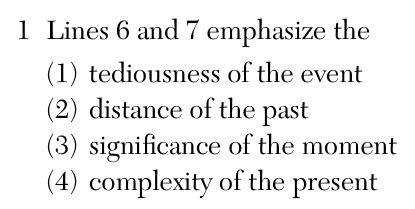
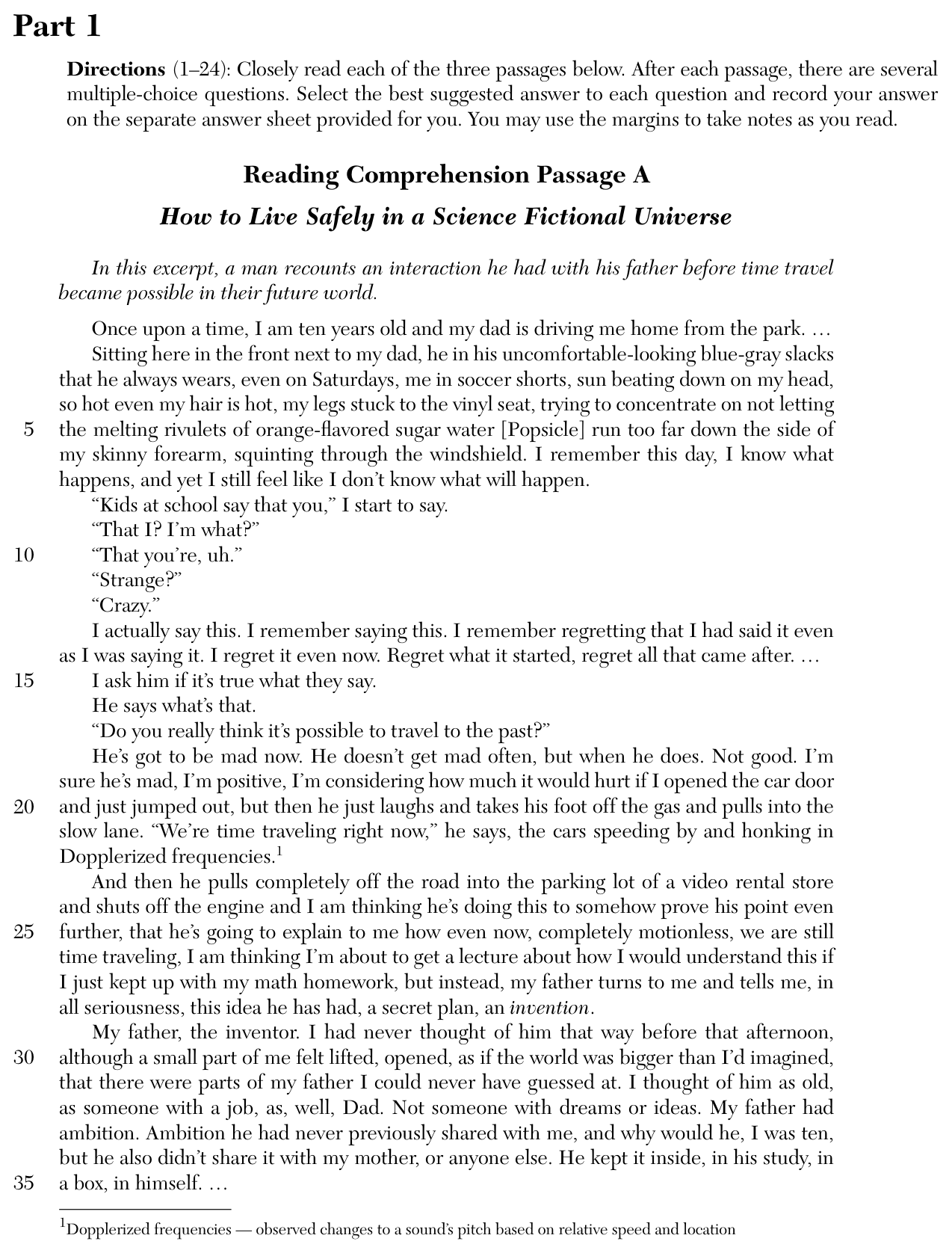
What do the apparently contradictory thoughts in lines 6–7 emphasize?
Worked solution for question 1
- The adult remembers what happened but experiences the uncertainty of the child again.
- The tension makes the encounter feel emotionally unresolved even years later.
- The adult can remember the facts while still reliving his childhood uncertainty. The two perspectives in one account explain why the moment has stayed with him.
Answer choice 3The significance of the moment
Q2 Awareness of reputation
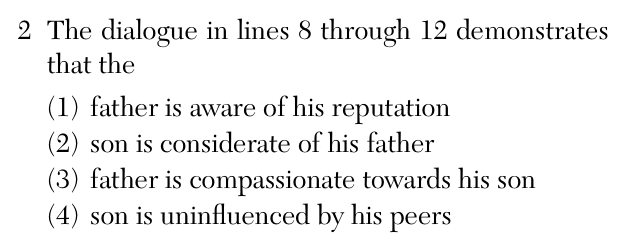
What does the opening dialogue reveal about the father?
Worked solution for question 2
- Before his son can finish, he supplies the possibility that people think him strange.
- He recognizes the judgment without having to hear it in full.
Answer choice 1He knows others regard him as unusual.
Q3 The secret invention
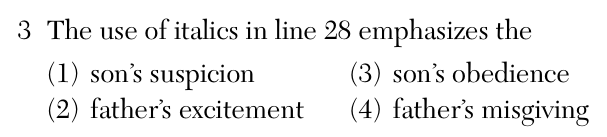
What do the italics in the disclosure emphasize?
Worked solution for question 3
- The emphasized idea caps a progression from an idea to a plan to an invention.
- He stops the car to tell his son in earnest, conveying how much the project matters to him.
- Watch how the disclosure builds from thought to practical plan. The father’s emphasis and his decision to stop the car give the reader evidence of the emotional weight of the last revelation.
Answer choice 2The father’s excitement
Q4 Keeping ambition private
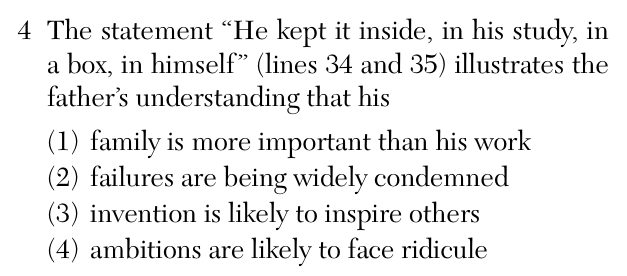
What does the repeated idea of keeping the invention inside imply?
Worked solution for question 4
- The ambition is concealed even from people close to him, and the conversation begins with the son reporting classmates’ judgments.
- The description presents the secret as emotionally guarded as well as physically hidden.
Answer choice 4The father expects his ambitions may be ridiculed.
Q5 A comic-book trifle
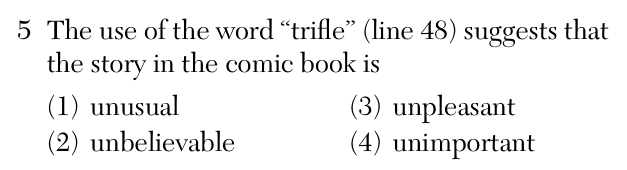
What does trifle suggest about the comic’s story?
Worked solution for question 5
- He dismisses the superhero and quickly turns to the advertisement.
- The contrast separates the forgettable story from the image that stays with him.
- The advertisement has the lasting effect on the narrator. The word for the comic’s story helps mark the difference between what occupied the page and what occupied his attention.
Answer choice 4It is unimportant to the narrator.
Q6 Different priorities
What does the son’s question about poverty reveal?
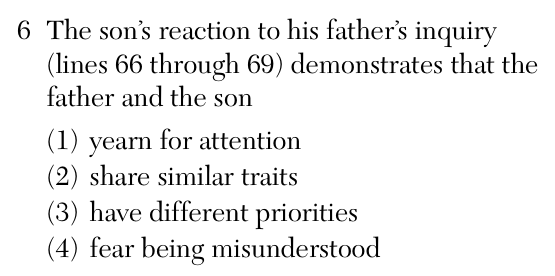
Worked solution for question 6
- The father asks for a reaction to his scientific plans. The son responds with a question about family finances.
- The two questions reveal what each person most wants to discuss.
Answer choice 3Father and son are preoccupied with different things.
Q7 Wanting a reaction
Why does the son want to provoke a response?
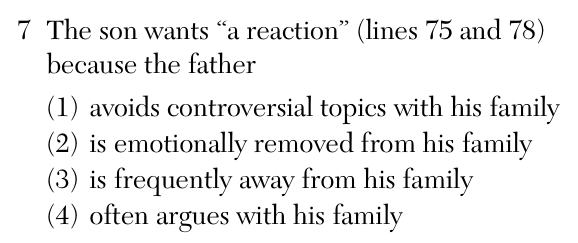
Worked solution for question 7
- The narrator describes a man normally cold or remote who suddenly speaks with passion.
- The son wants to see the emotion he rarely sees in ordinary family life.
- The contrast between ordinary distance and sudden enthusiasm explains the son’s curiosity. He is looking for an emotional response from someone whose feelings are usually hard to read.
Answer choice 2The father is often emotionally distant.
Q8 The father’s disappointment
Why does the father look crushed?
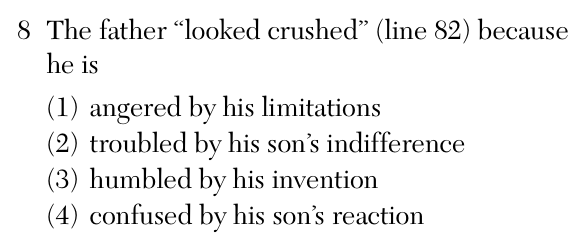
Worked solution for question 8
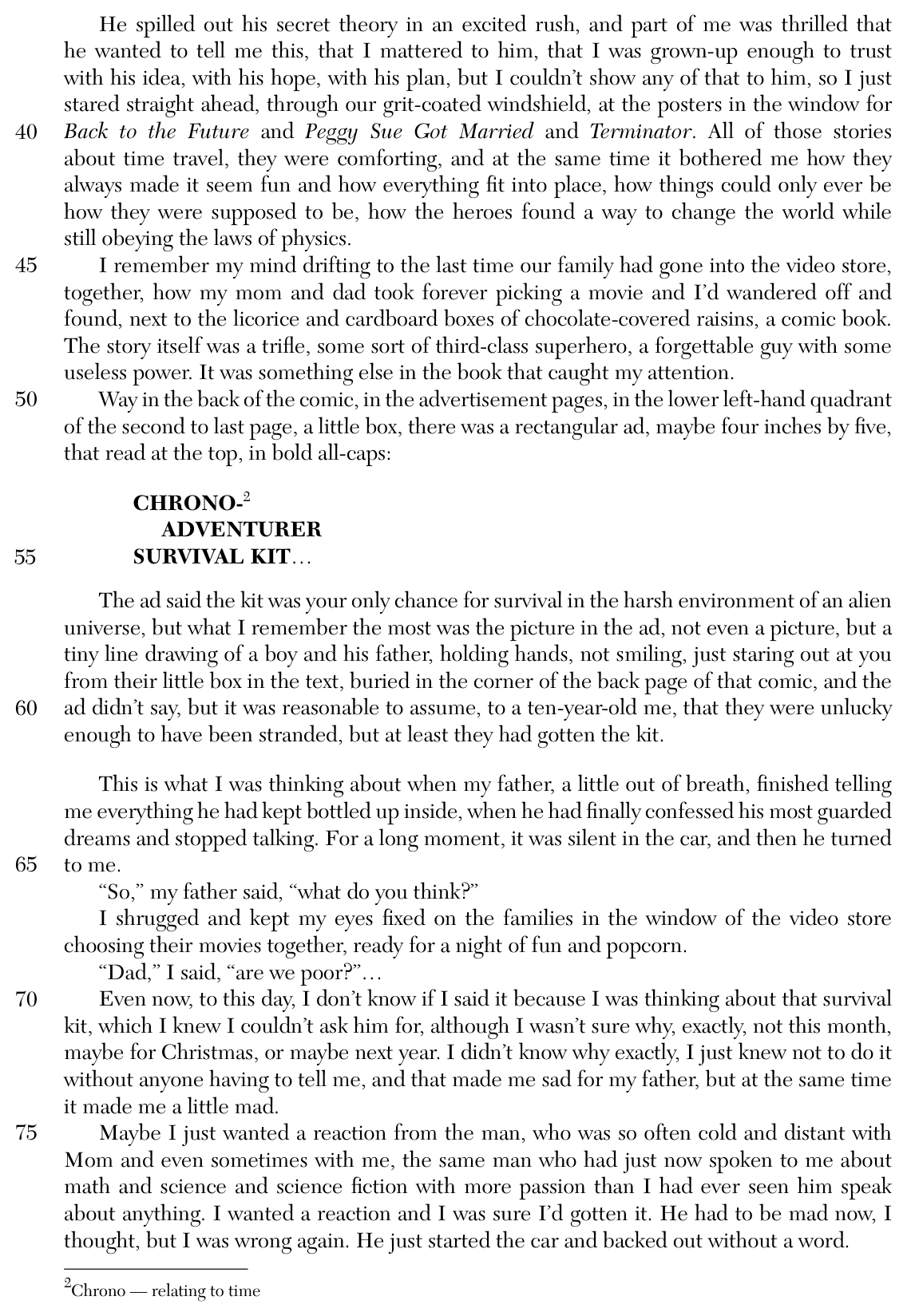
- The father has just shared a guarded dream and asks what his son thinks.
- The boy’s shrug and change of subject leave that disclosure unacknowledged.
Answer choice 2The son seems indifferent to his revelation.
Q9 What the exchange opens
What does the narrator finally conclude about their relationship?
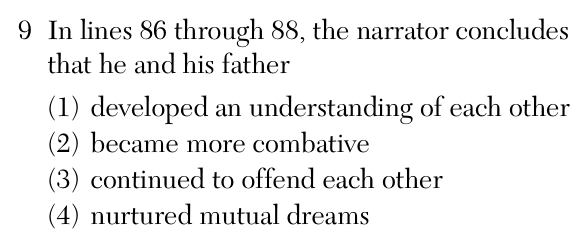
Worked solution for question 9
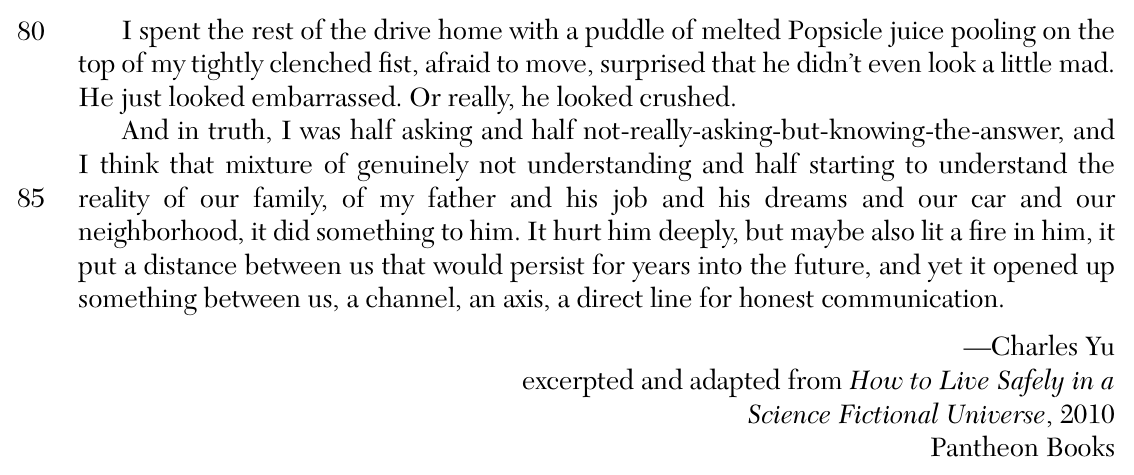
- The question hurts his father and creates distance, yet the adult narrator also sees it opening a channel for honesty.
- Both effects matter to the ending.
- The ending interprets the exchange from a later vantage point. A response that feels hurtful in the car can also be the beginning of greater honesty between them.
Answer choice 1They develop an understanding of each other.
Q10 The people watching
What does the opening show about the two observers?
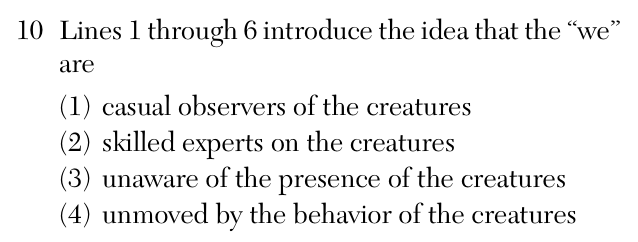
Worked solution for question 10
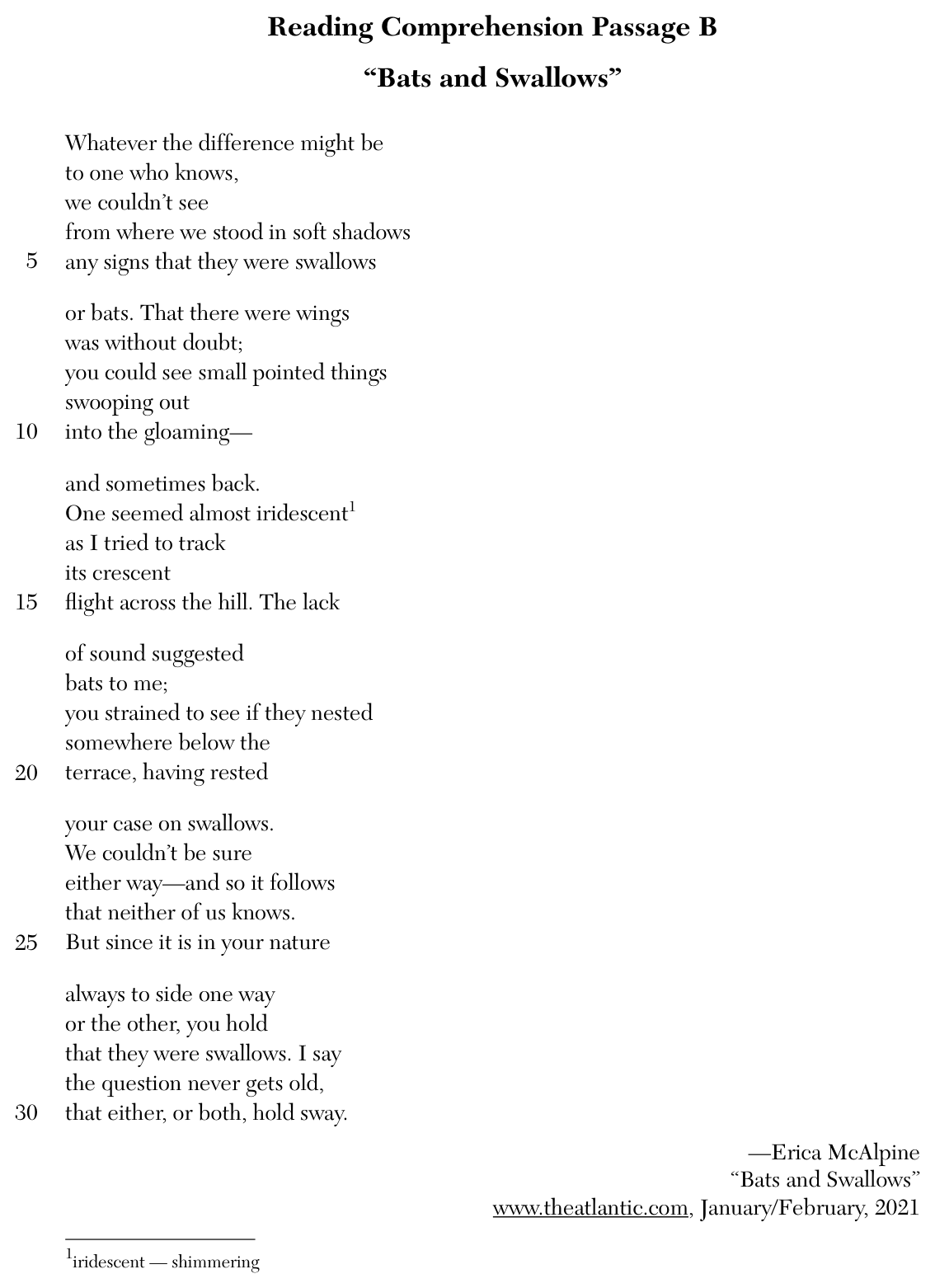
- From the shadows they can see movement but cannot identify the creatures.
- Their viewpoint and knowledge are limited, unlike those of an expert.
- The fact that the two people watch closely is compatible with being casual observers. Their inability to identify what they see establishes the limit of their expertise.
Answer choice 1They are casual observers.
Q11 Features in common
What do lines 6–9 describe?
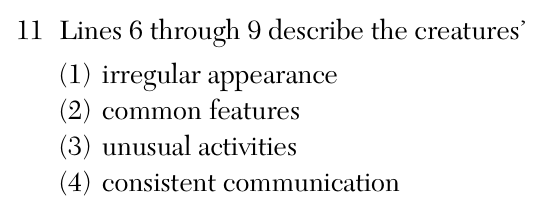
Worked solution for question 11
- The observers can make out wings and a swooping movement.
- Those details are compatible with either creature, so they do not resolve the question.
- If wings or swooping belonged to only one of the two possible animals, the description would settle the question. The fact that both fit is what lets the uncertainty continue.
Answer choice 2Features shared by the possible creatures
Q12 The meaning of gloaming
Which phrase provides a clue to the meaning of gloaming?
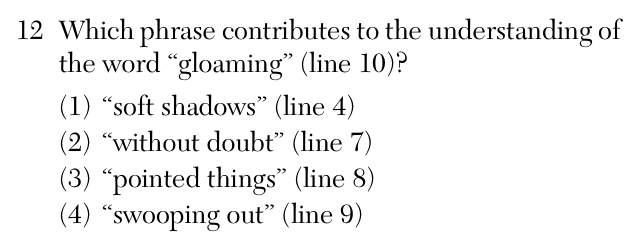
Worked solution for question 12
- The shadows in line 4 indicate fading light.
- That detail supports reading gloaming as dusk rather than as a kind of movement.
- Replace the word with “dusk” to test the reading. The soft shadows fit that time of day, while the swooping in nearby lines describes the animals’ motion.
Answer choice 1The reference to soft shadows
Q13 The beauty of the flight
What does the imagery in lines 8–15 convey?
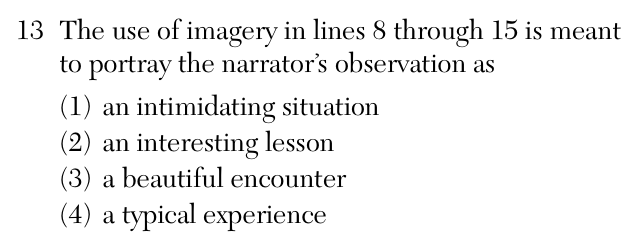
Worked solution for question 13
- The winged shape seems to shimmer and follows a curved path across the hill.
- The speaker lingers on the visual effect while trying to track it.
- The shimmering appearance and curved path make the flight worth watching in its own right. That emphasis is why the imagery can convey beauty even while the observers remain unsure.
Answer choice 3A beautiful encounter
Q14 Accepting uncertainty
What does the last line show about the narrator’s attitude?
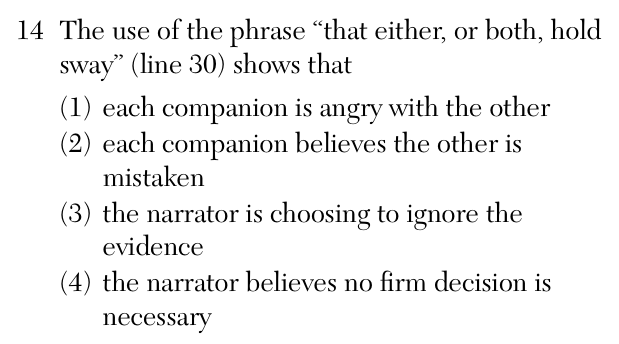
Worked solution for question 14
- The companion commits to swallows, while the narrator keeps more than one possibility open.
- The question’s continued interest matters more to the narrator than settling it.
Answer choice 4A firm decision is unnecessary.
Q15 Fiction and human nature
What central idea appears in the opening paragraph?
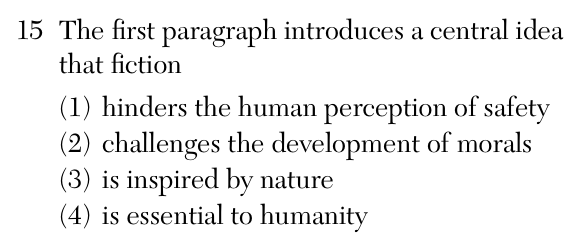
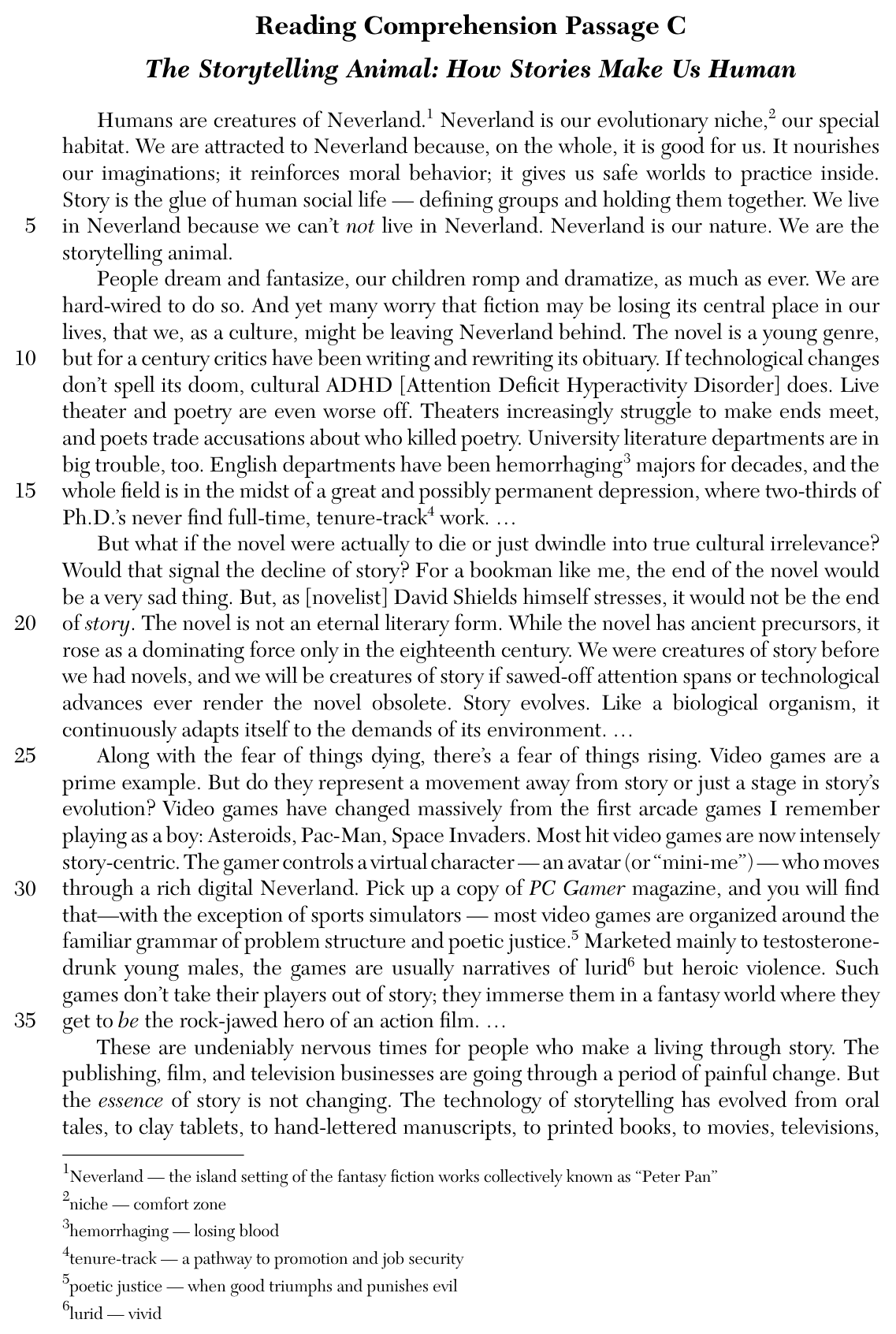
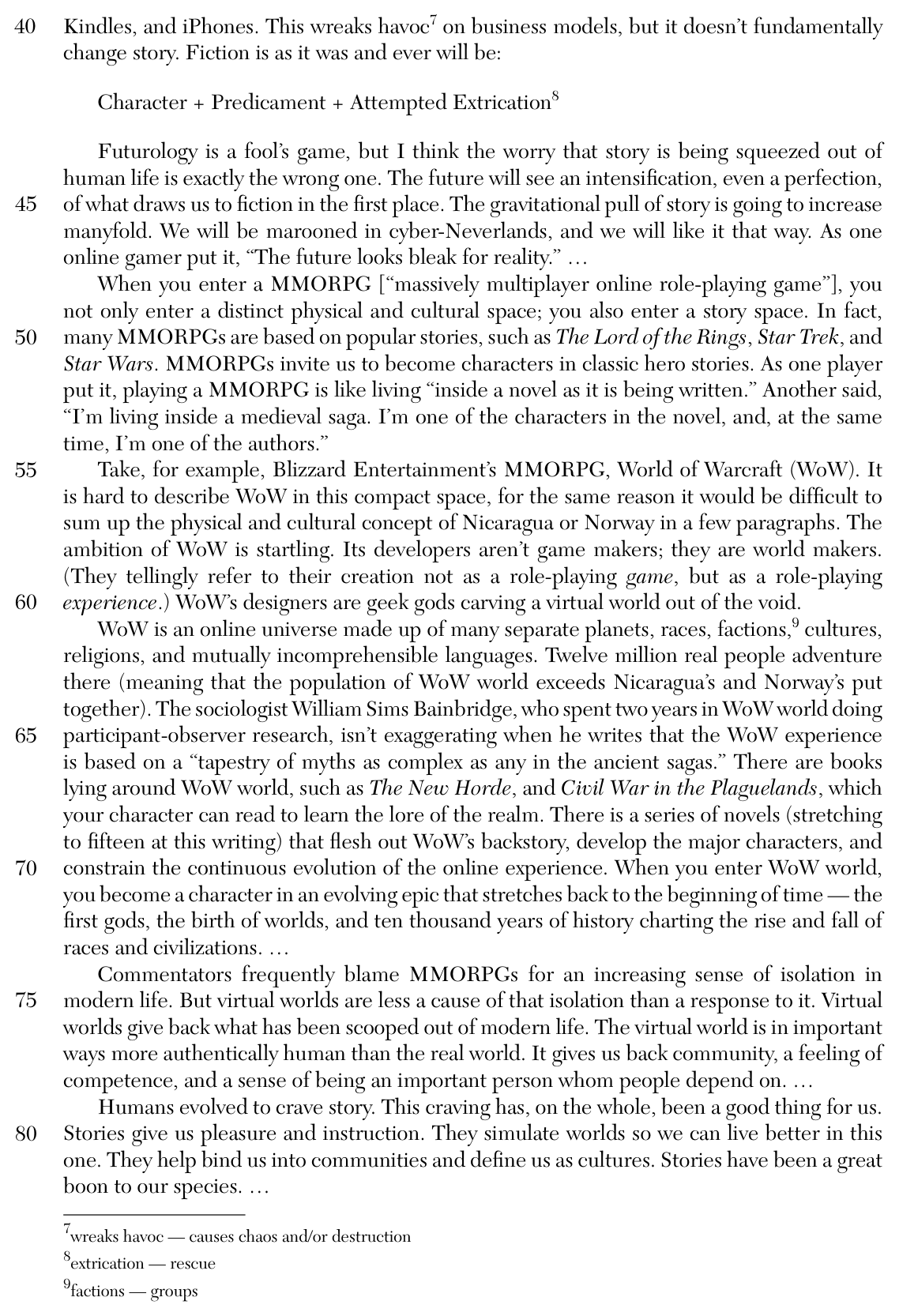
Worked solution for question 15
- The author presents imaginative worlds as a recurring part of how people live.
- The Neverland allusion makes the human impulse toward story feel permanent.
- The reference to a familiar imaginary place connects the opening claim to an experience readers can recognize. The rest of the argument can then extend the claim to newer forms of fiction.
Answer choice 4Fiction is essential to humanity.
Q16 Language of decline
What do the terms associated with death and blood loss emphasize?
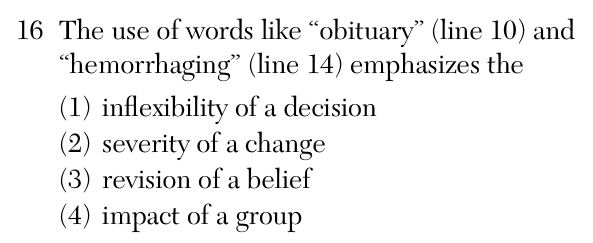
Worked solution for question 16
- An obituary suggests a form is dying, and hemorrhaging suggests rapid, serious loss.
- Both metaphors intensify the account of declining support for familiar literary institutions.
Answer choice 2The severity of the change
Q17 The novel and storytelling
What role do lines 18–23 play in the argument?
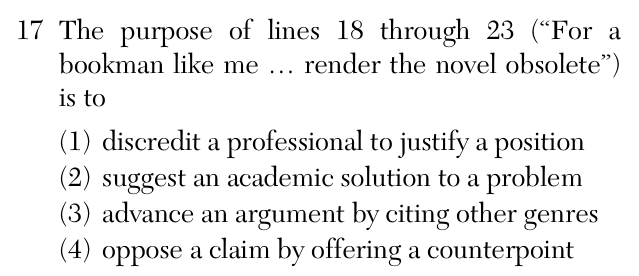
Worked solution for question 17
- The author distinguishes the possible decline of the novel from the disappearance of story itself.
- A particular form can lose prominence while the human practice continues.
- Identify the statement that the example answers before deciding what it does. The example has an argumentative function because it supplies a case against the preceding claim.
Answer choice 4They counter a claim.
Q18 Anxiety about new forms
What do fears of things disappearing and emerging imply?
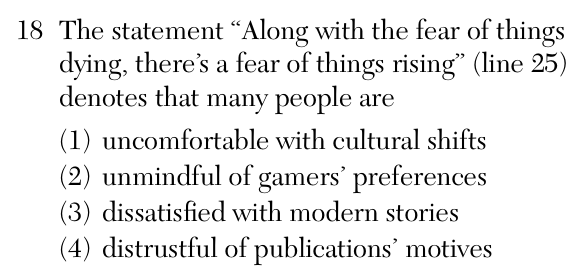
Worked solution for question 18
- The article pairs anxiety about older forms with anxiety about video games and new forms.
- That pairing locates the discomfort in the transition itself.
Answer choice 1Many people are uncomfortable with cultural shifts.
Q19 Changing ways to tell stories
What do lines 36–40 illustrate?
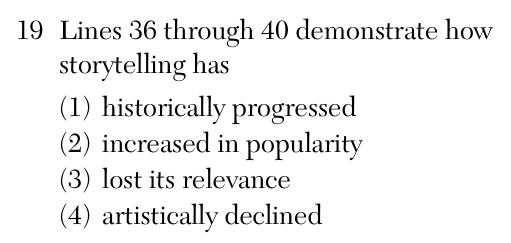
Worked solution for question 19
- The author traces the delivery of stories across different media, including digital devices.
- Changes in medium reveal a historical progression in how people encounter stories.
- The sequence invites comparison across formats and periods. If the forms change while people continue making stories, the examples support an evolution in storytelling.
Answer choice 1Storytelling has evolved over time.
Q20 Limits of forecasting
What is the point of the author’s remark about futurology?
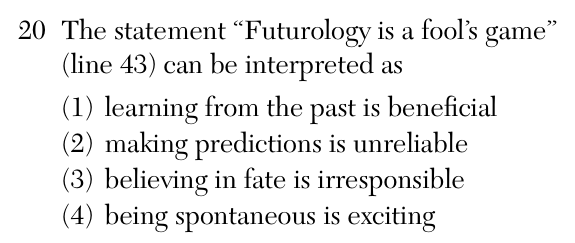
Worked solution for question 20
- The remark cautions against claiming certainty about what stories will become.
- The author can identify a continuing human appetite for story while allowing its form to change unpredictably.
Answer choice 2Predictions are unreliable.
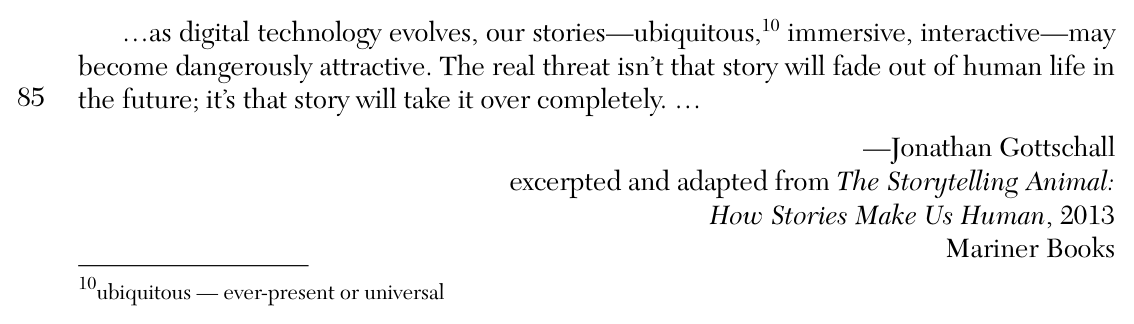
Q21 The scope of Warcraft
Why does the author find the virtual world startling?
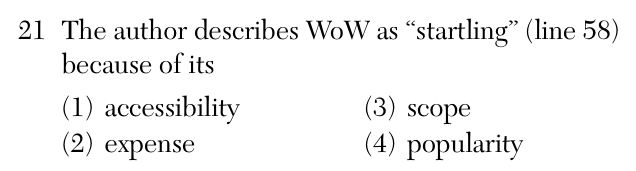
Worked solution for question 21
- The description expands from an online game to a world of places, histories, societies and languages.
- The breadth of the created world explains the reaction.
- Scale is the feature to track. References to the size and detail of the online world establish how much there is for players to explore.
Answer choice 3Its scope
Q22 Designers as creators
What does the figurative description of the game designers emphasize?
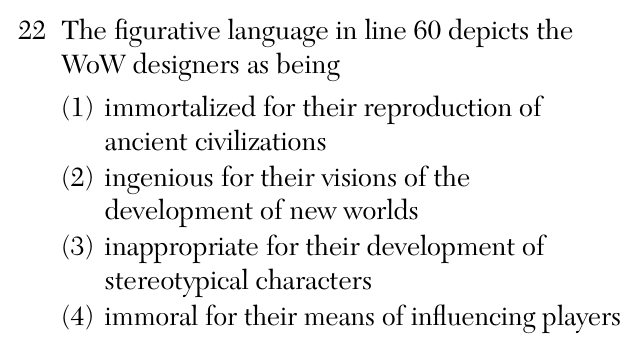
Worked solution for question 22
- The metaphor casts them as creators who bring a world into being.
- It credits the imagination needed to produce an extensive, internally organized setting.
Answer choice 2Their ingenuity in imagining worlds
Q23 Research on a virtual world
What does Bainbridge’s account support?
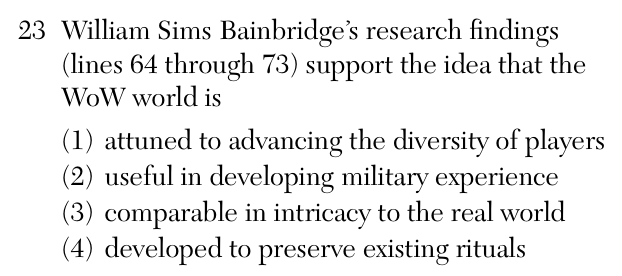
Worked solution for question 23
- He describes complex myths. The passage adds books, histories and a developing body of lore.
- Together these details make the setting more than a simple backdrop for play.
- Research makes the comparison concrete by treating the online world as a place with observable complexity. That supports the author’s point about the intricacy of a fictional setting.
Answer choice 3The game world rivals the real world in intricacy.
Q24 Final warning
How does the author end the argument?
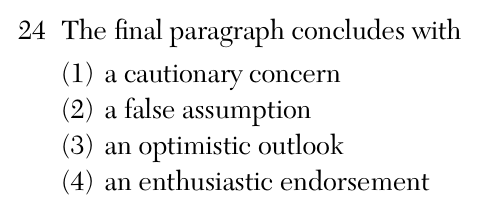
Worked solution for question 24
- The last paragraph shifts from the benefits of storytelling to the possibility that digital stories could become overwhelmingly attractive.
- The concern is about their growing power over life.
Answer choice 1With a caution about immersive stories
Part 2 Argument essay
Question indexArgument Argument on invasive species
Decide whether invasive species need to be controlled. Use at least three sources and address a competing position.
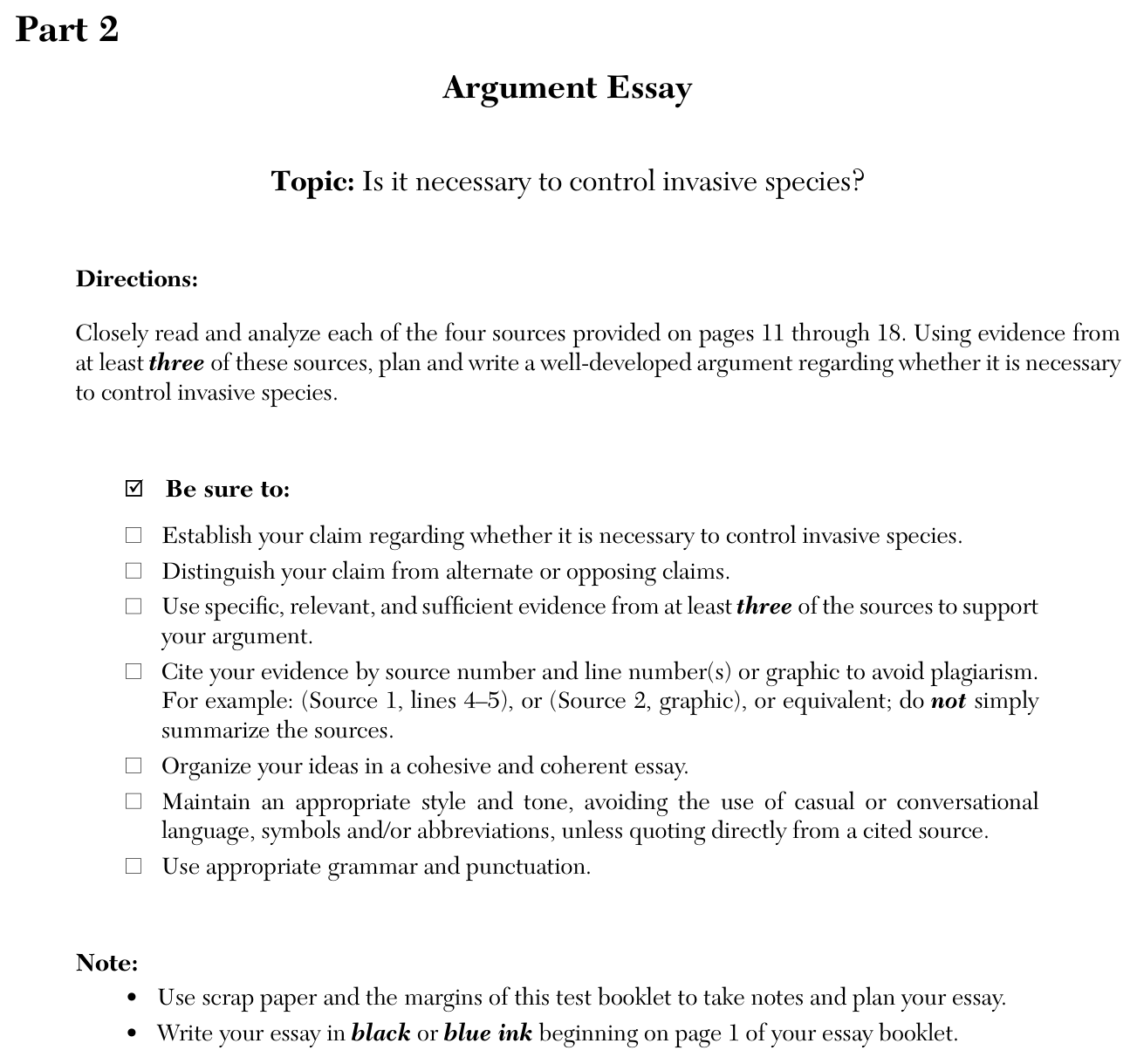
Writing plan and model response for argument
- Distinguish introduction from demonstrated harm. Pair a specific damaging example with evidence that removal can also have costs.
- Make the counterclaim do real work by explaining when a control program should be narrowed or redesigned.
Central claimControl introduced organisms when evidence shows substantial harm, with methods tailored to the ecosystem.
Model response
When an introduced organism threatens a native population or alters the habitat that sustains it, leaving the problem alone can make later recovery harder. Control is therefore necessary in some cases. It should follow evidence of damage and a comparison of the likely effects of intervening and doing nothing.
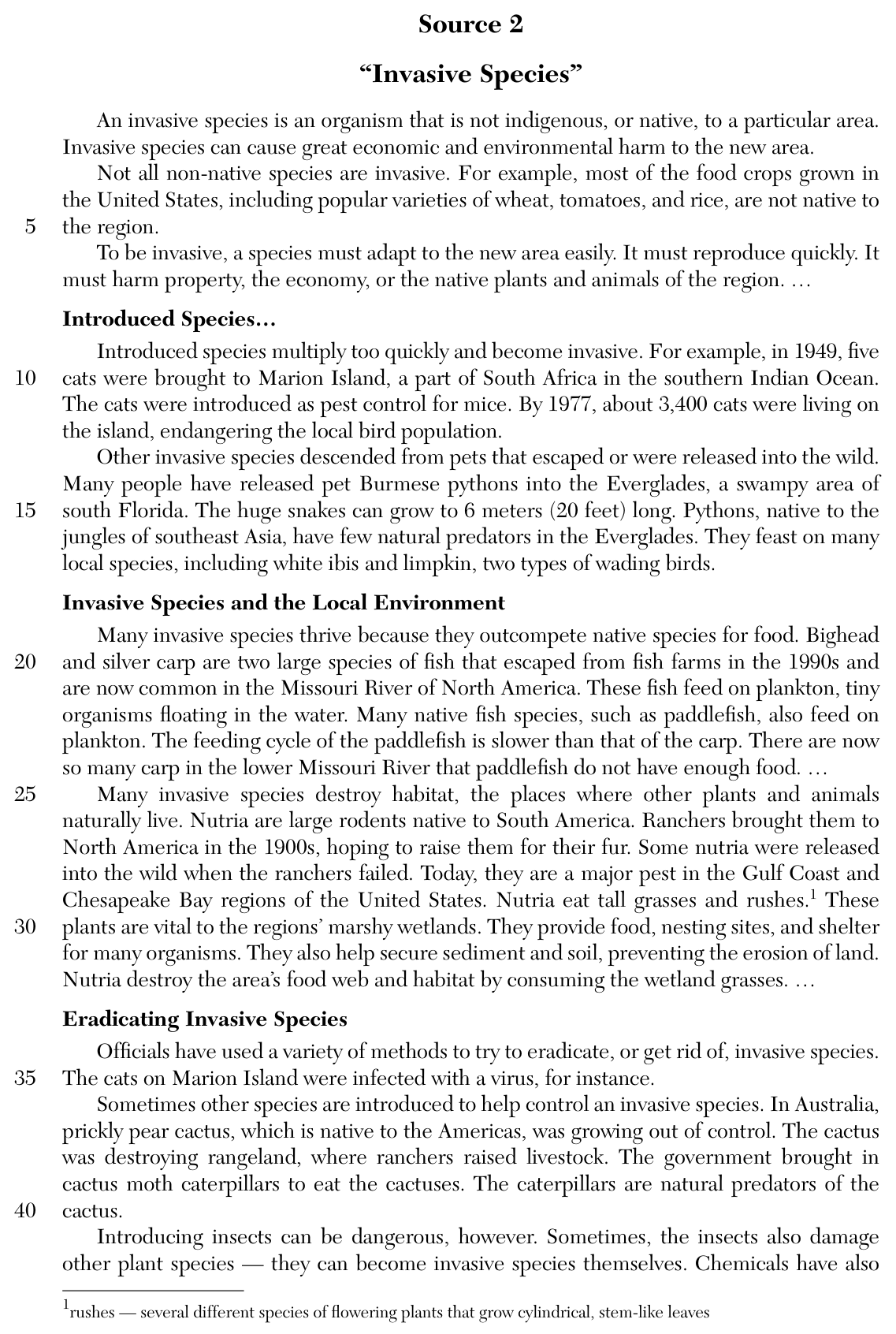
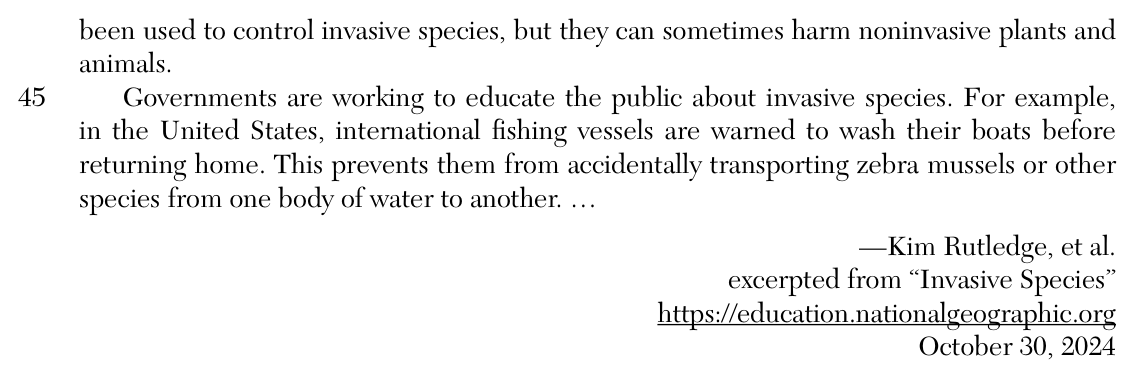
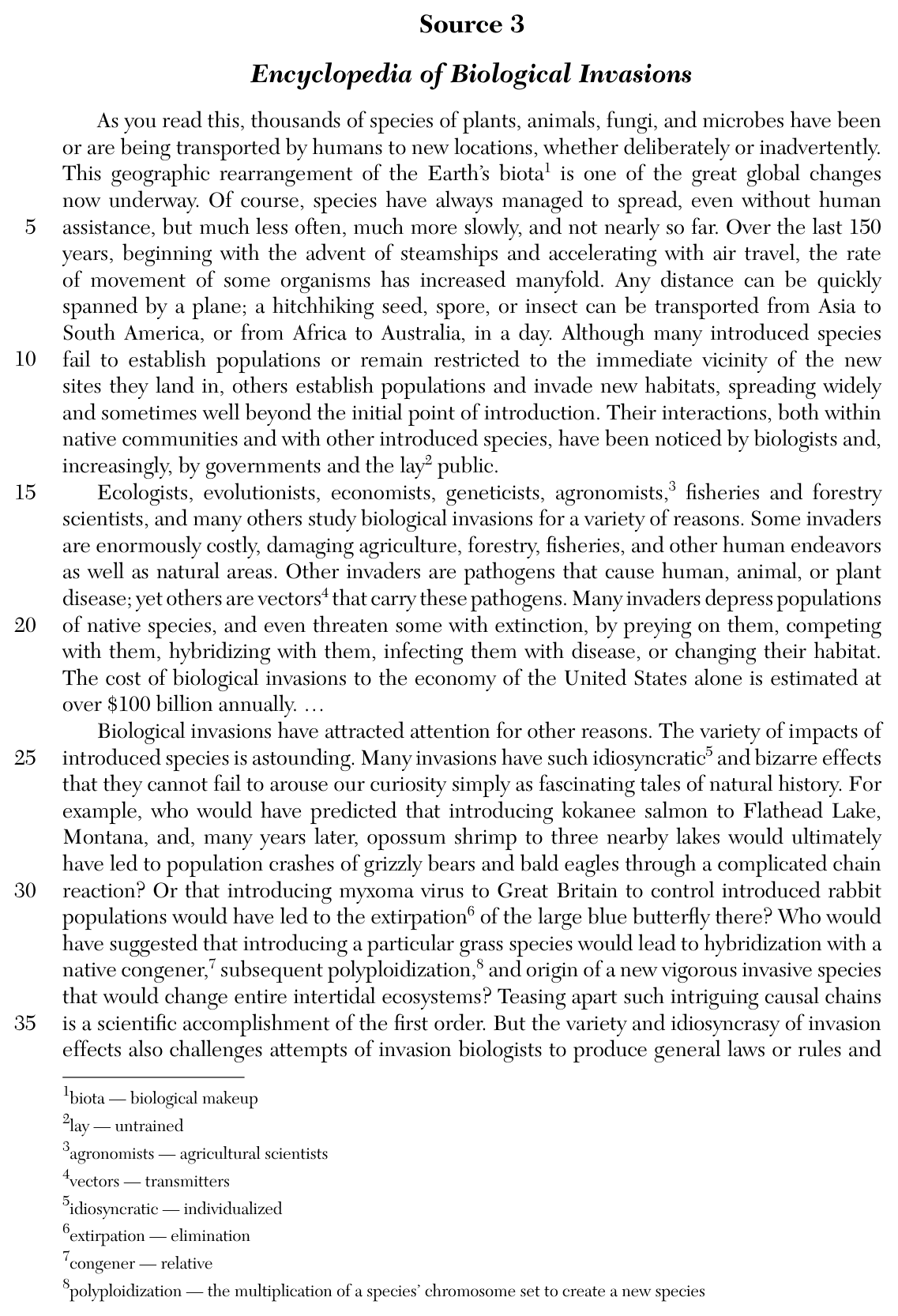
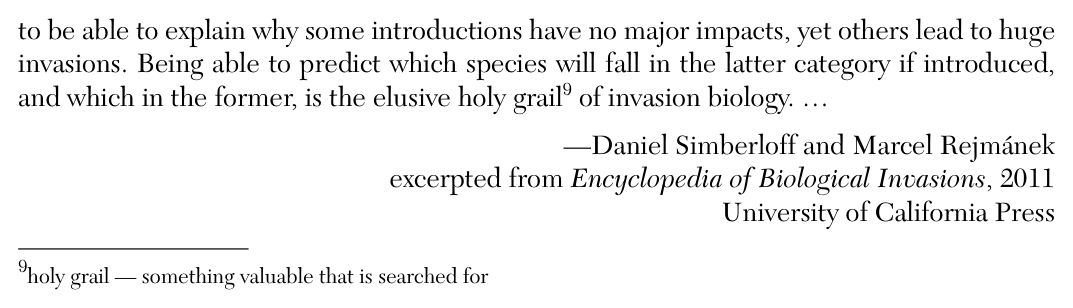
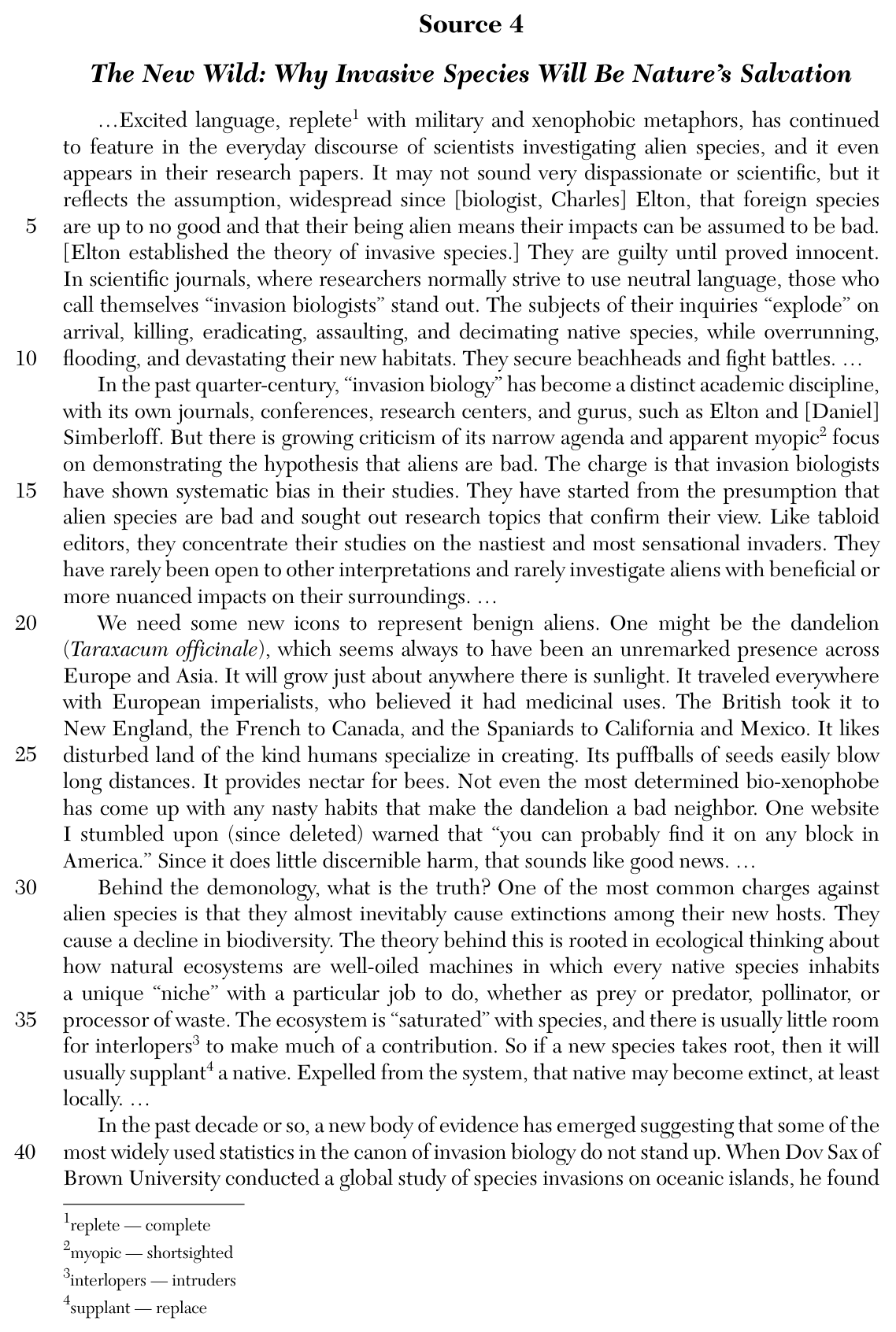
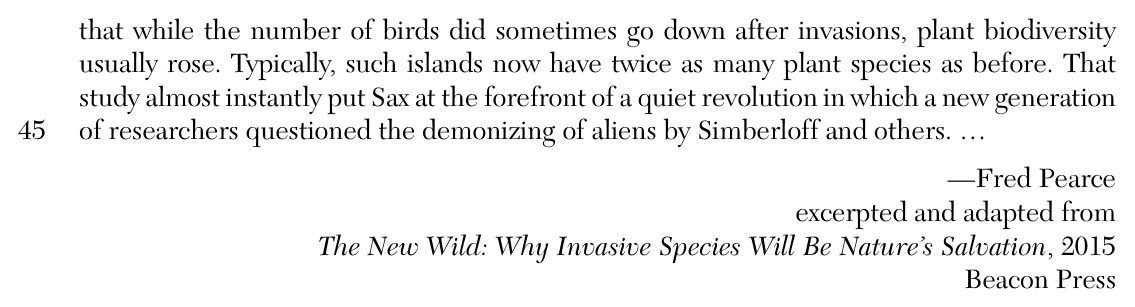
Source 2, lines 9–17, describes predators introduced outside their original ranges, including cats on Marion Island and pythons in Florida. These examples matter because new prey may face a predator against which they have little protection. Source 3, lines 18–24, describes several ways introduced organisms can reduce native populations, from direct predation to competition. A program that limits the spread of a damaging population can therefore protect an ecosystem before the losses become difficult to reverse.
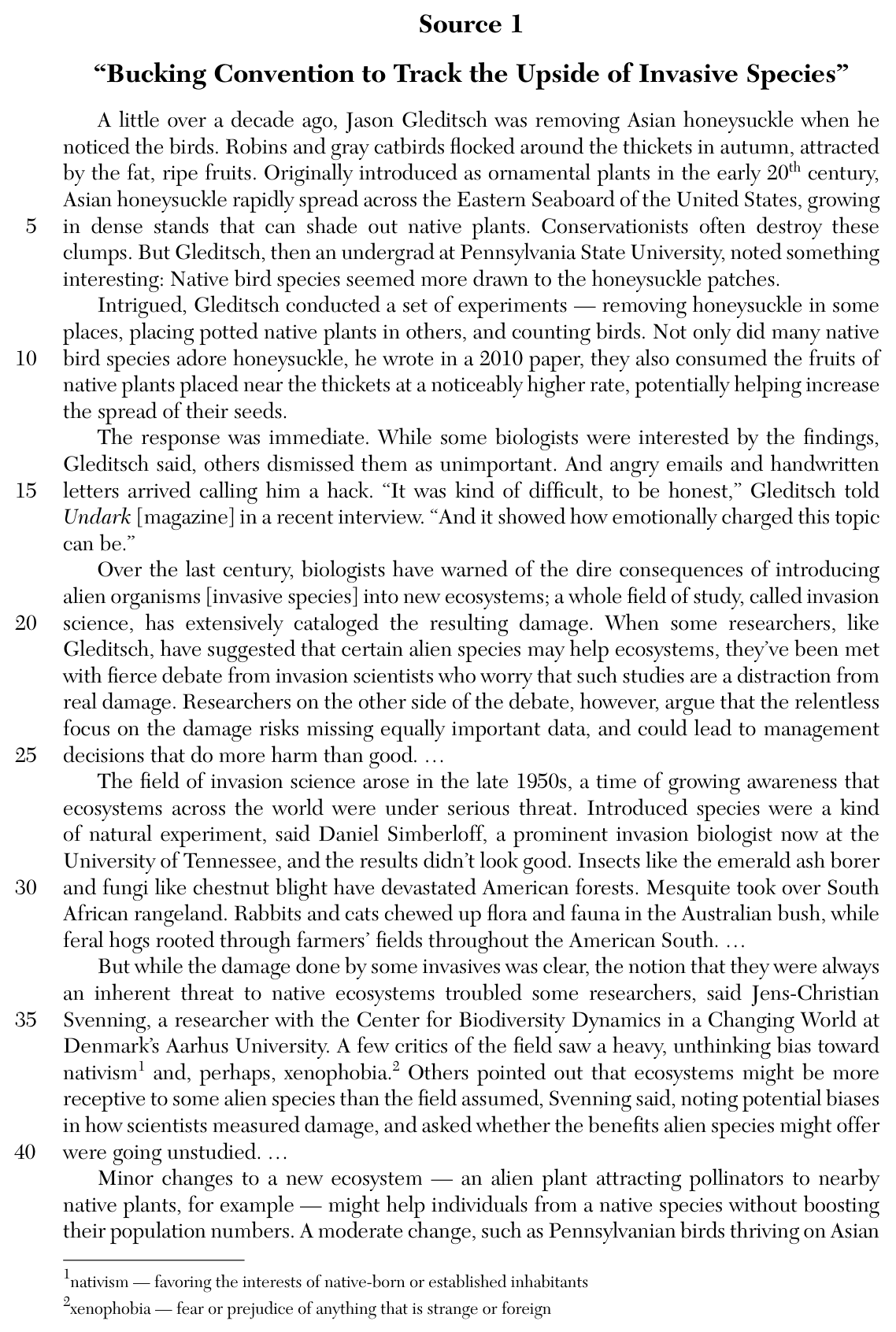
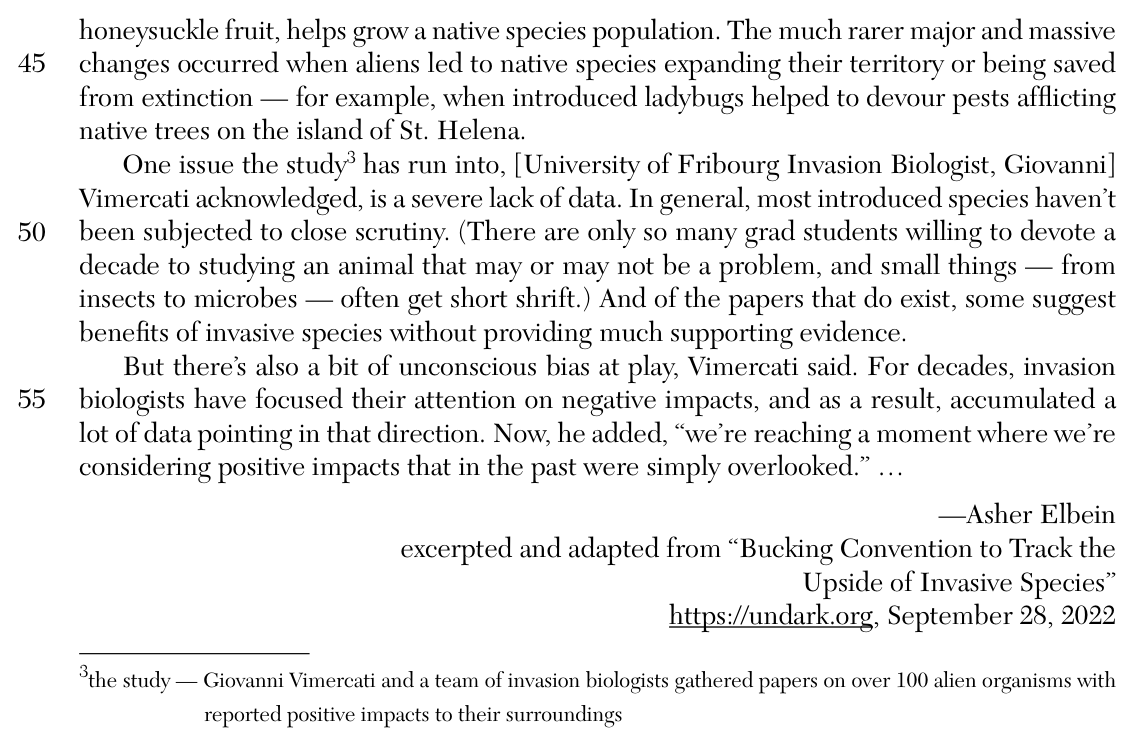
However, the strongest objection to a blanket removal policy is that ecosystems change around the organisms already present. In Source 1, lines 1–12, birds feed on introduced honeysuckle even though dense stands can shade native plants. Removing all the shrubs at once could take away a food source before native plants have recovered. Source 3, lines 25–35, also describes unexpected effects of biological interventions. The possibility of a harmful side effect calls for testing, monitoring and, where appropriate, replacing a resource as part of removal.
The decision should begin by identifying the harm to be reduced, such as predation on a vulnerable species. The control method should then be chosen for its likely benefit and revised if monitoring reveals greater harm. That approach protects native communities from demonstrably damaging introductions while recognizing that a species’ place of origin alone is insufficient grounds for eradication.
Part 3 Text-analysis response
Question indexAnalysis Another April
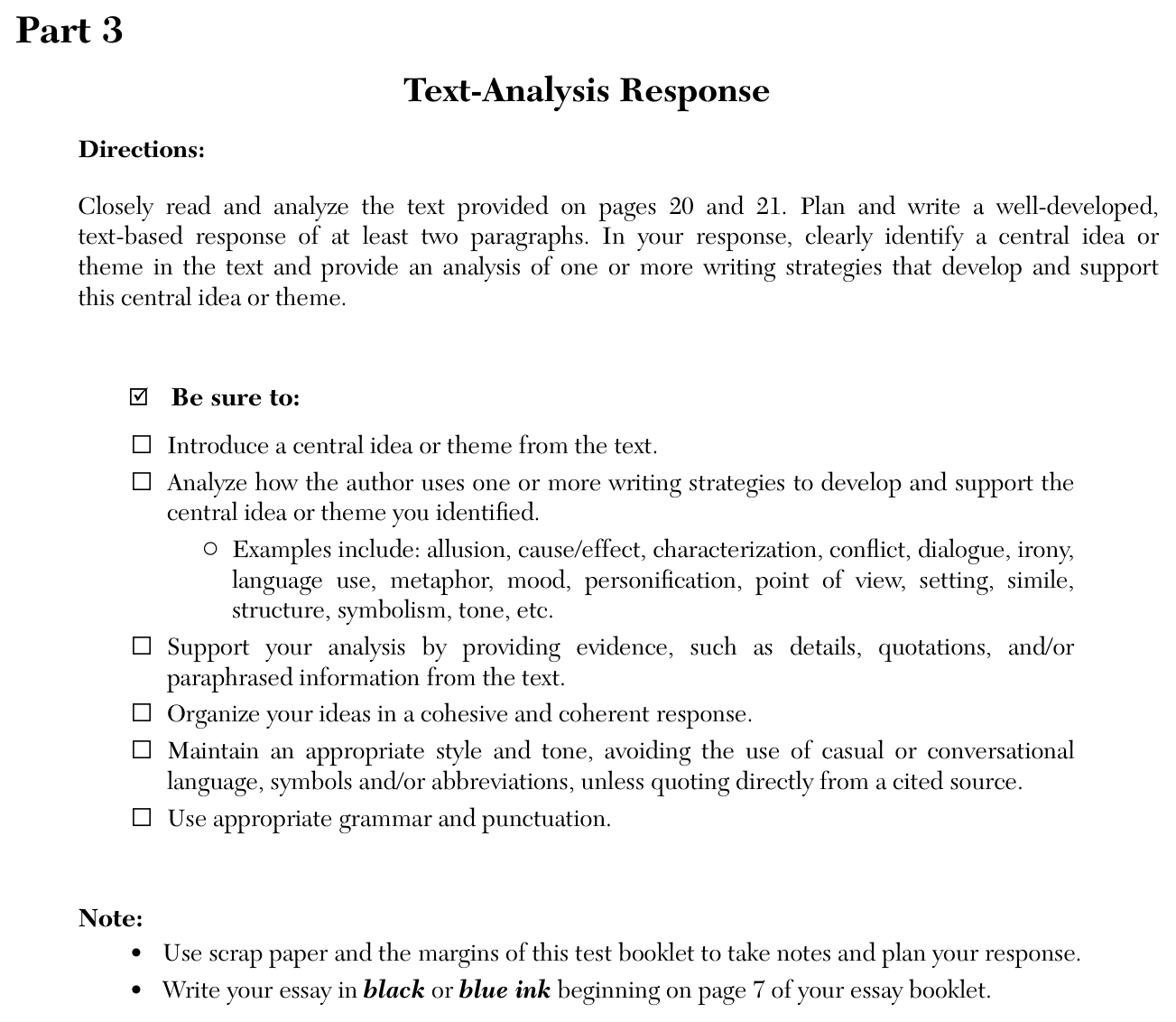
Explain a central idea in Jesse Stuart’s story through a writing strategy.
Writing plan and model response for analysis
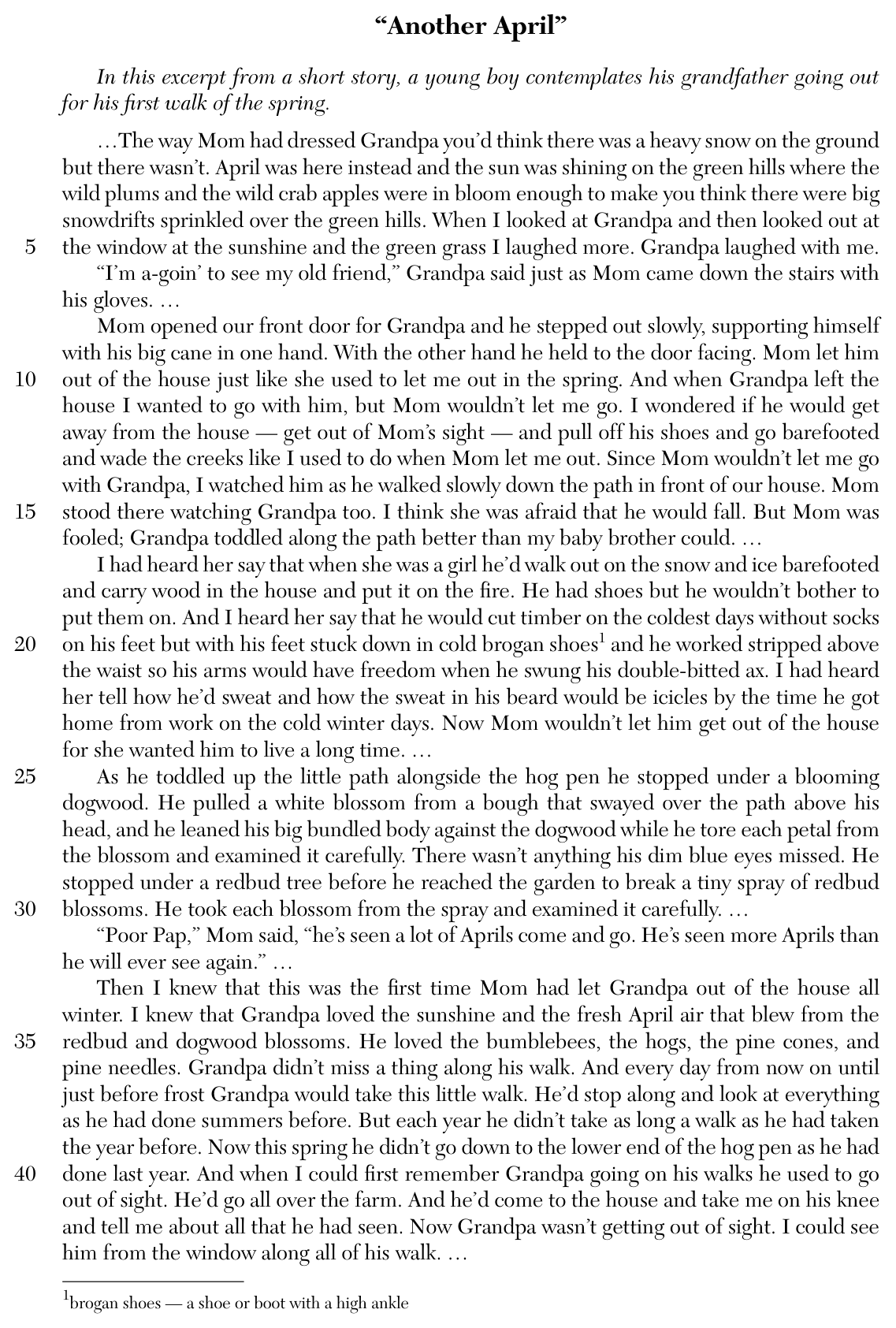
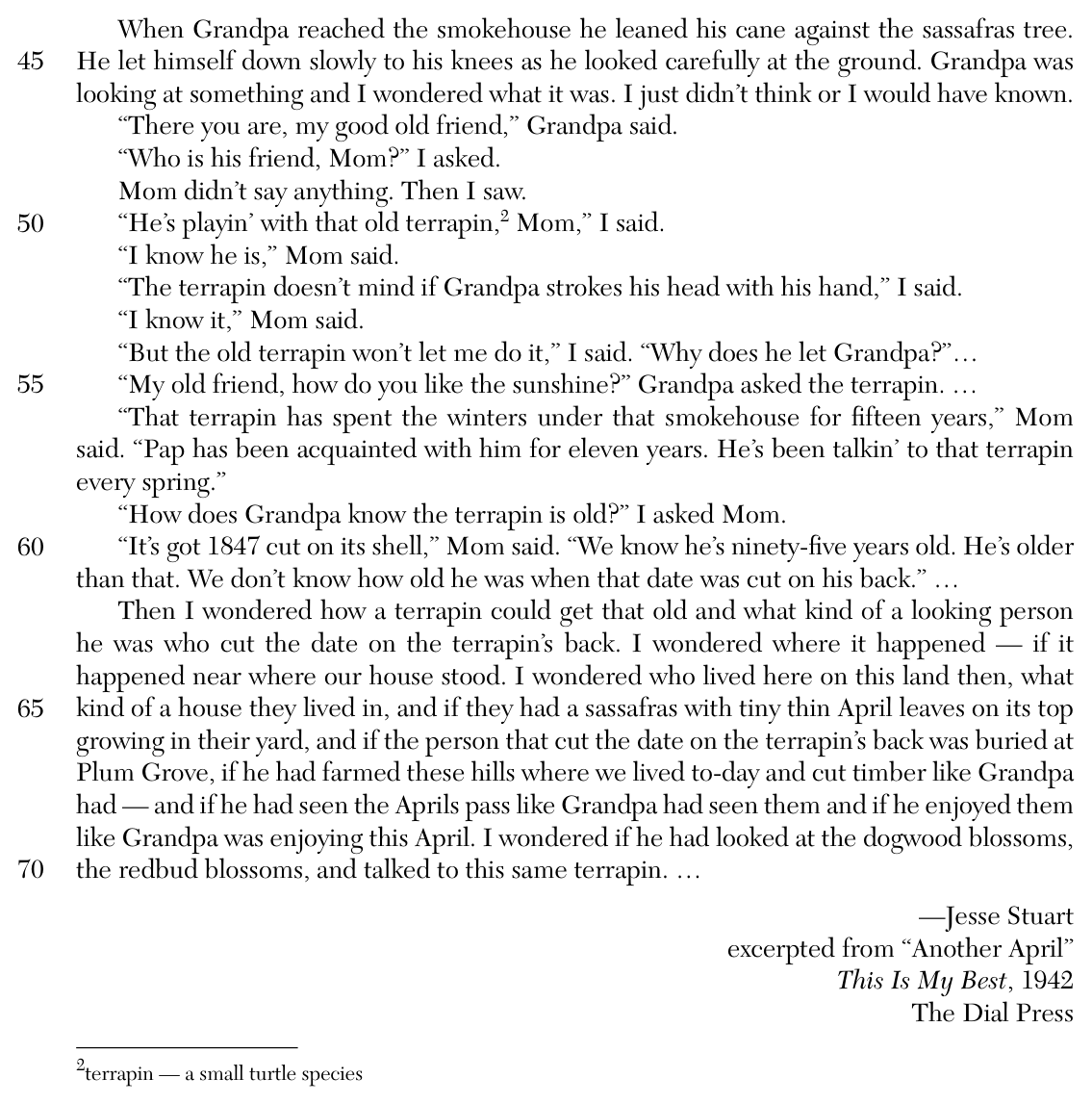
- Track the narrator’s evolving interpretation of his grandfather’s walk. Use the turtle and engraved date to connect the family’s present to earlier lives.
- Explain the role of the boy’s limited knowledge and questions in the reader’s discovery.
Central claimThe boy’s first-person point of view turns an ordinary spring walk into an understanding of aging and continuity.
Model response
Jesse Stuart’s excerpt shows how attention to the natural world can connect people across generations even as their lives change. He develops the idea through the boy’s first-person point of view. At first the boy laughs at his grandfather’s heavy clothing and compares his slow walk to a child’s first freedom outdoors (lines 1–16). Later, the boy remembers stories of his grandfather’s hard winter labor and notices how much his range around the farm has shrunk (lines 17–24 and 36–43). Because readers learn the details in the order the boy understands them, the walk changes from an amusing sight into evidence of what age has taken and what his grandfather still values.
The boy’s discovery of the terrapin extends the idea beyond his own family. The grandfather greets it as a friend, and the mother explains that its shell bears a date from long before the boy’s lifetime (lines 44–61). In the final lines, the boy imagines an earlier person farming the same hills and looking at the same spring blossoms. Those unanswered questions are the point of his perspective. Having watched his grandfather take pleasure in a small familiar place, he can imagine a continuity that reaches back beyond anyone he knows.
From the New York State Education Department. August 2026 English Language Arts Regents Examination. Internet. Available from https://www.nysedregents.org/hsela/826/reela-82026-exam.pdf. Accessed .