NEW YORK STATE REGENTS · ENGLISH LANGUAGE ARTS
January 2026 English Language Arts Regents Past Paper & Solutions
Work through reading analysis, social media screening and ballpark design with a question-by-question walkthrough of the exam.
- 26 worked questions
- 2 writing models
- 3 exam parts
The question images and page numbers come from the regular-size English exam. OnlyPrepy wrote the summaries and worked solutions.
Quick answer key for Part 1
Part 1 Reading comprehension
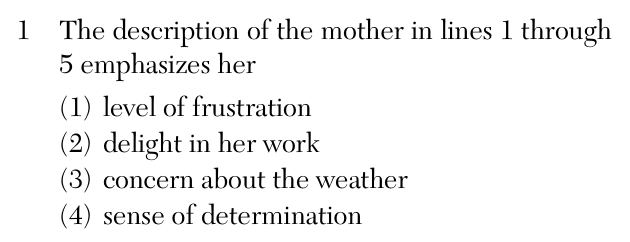
Question indexQ1 The mother’s resolve
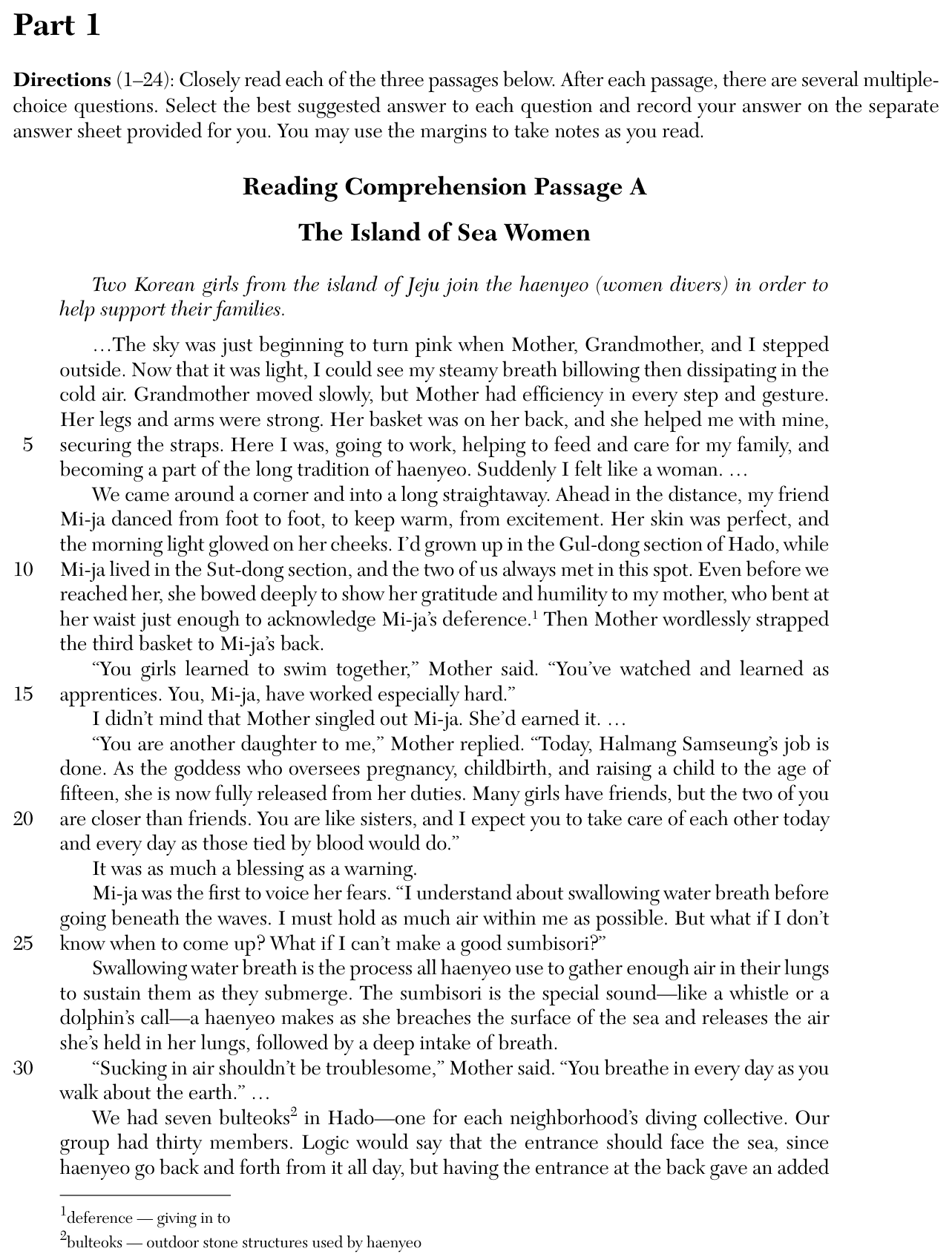
What trait stands out in lines 1–5?

Worked solution for question 1
- The narrator notices how efficiently her mother moves and how firmly she secures the equipment.
- These deliberate actions establish resolve before the day’s work begins.
- The opening gives a sequence of physical actions instead of naming an emotion. Securing equipment with practiced care before going out also shows that her resolve comes with preparation.
Answer choice 4Determination
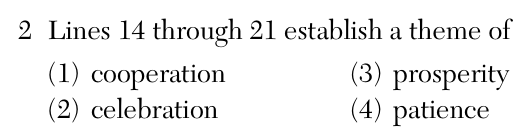
Q2 Taking care of each other
What theme emerges in lines 14–21?
Worked solution for question 2
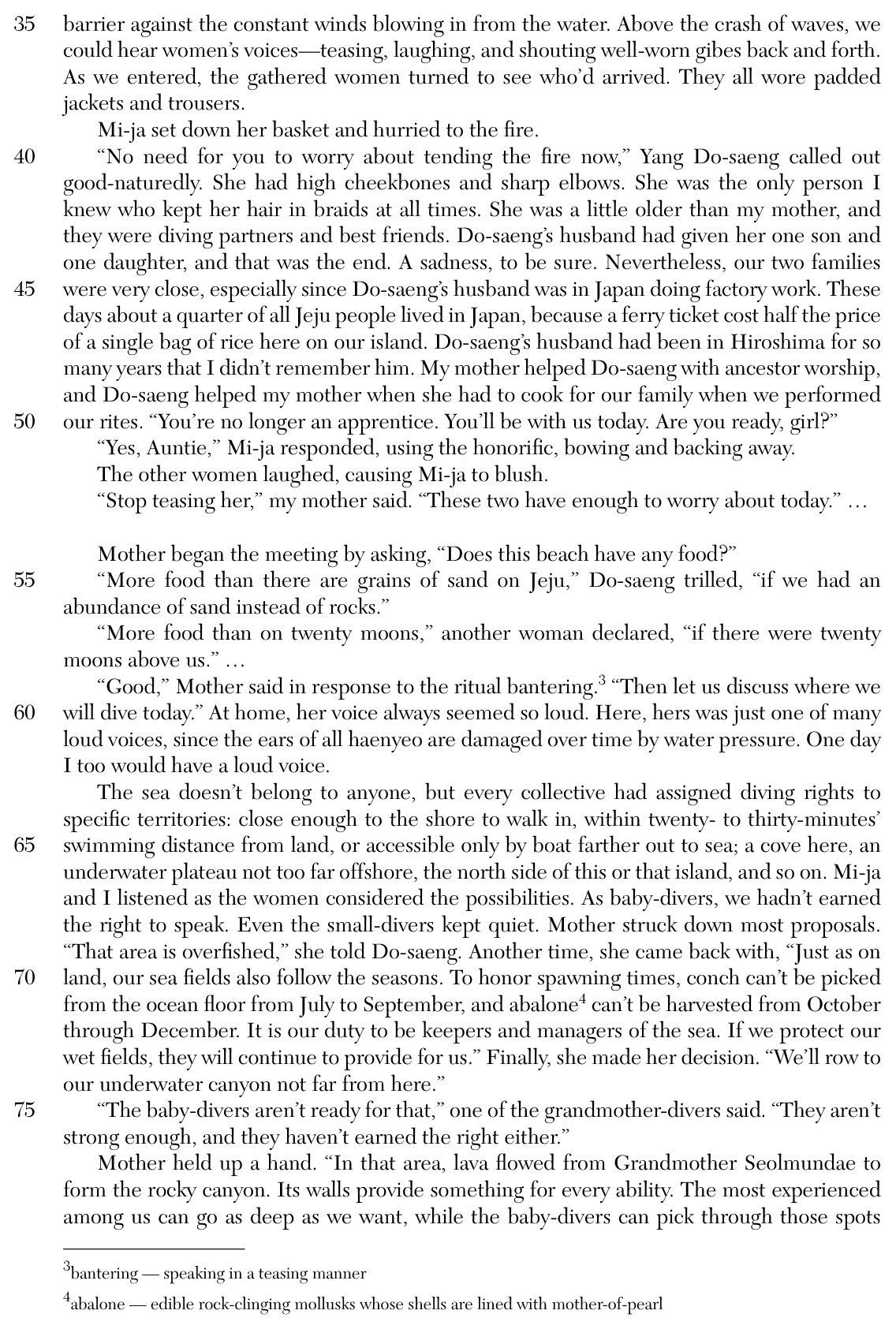
- The girls trained together and the mother expects them to watch out for one another like sisters.
- Her instruction makes mutual responsibility part of learning to dive.
Answer choice 1Cooperation
Q3 A blessing and a warning
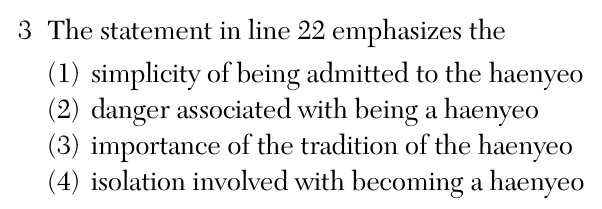
What does the narrator’s double description in line 22 emphasize?
Worked solution for question 3
- A blessing fits the honor of joining. A warning fits the genuine risks of entering the sea.
- The next exchange about breathing and surfacing makes the danger concrete.
- A blessing alone would suggest reassurance. Pairing it with a warning prepares the reader for the way the mother talks about staying safe underwater.
Answer choice 2The danger of diving
Q4 Explaining diving terms
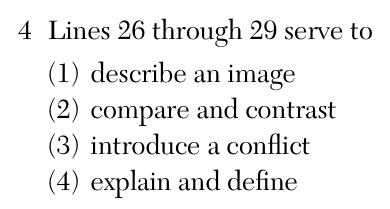
What do lines 26–29 contribute?
Worked solution for question 4
- The narrator explains how a diver takes in air before submerging and describes the sound made on surfacing.
- Both details clarify unfamiliar vocabulary introduced in the dialogue.
Answer choice 4Definitions of two diving practices
Q5 An affectionate honorific
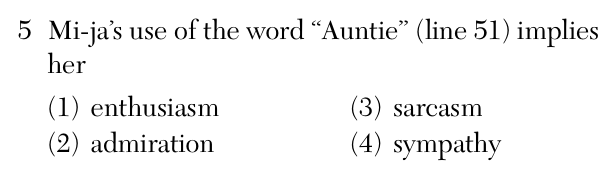
What does Mi-ja’s form of address in line 51 imply?
Worked solution for question 5
- Her respectful title and accompanying bow signal regard for the experienced diver.
- The gesture fits the respect she has already shown the narrator’s mother.
- Mi-ja’s choice of title matters together with her bow. Either detail might be ordinary courtesy on its own, but together they convey deference toward a more accomplished diver.
Answer choice 2Admiration
Q6 Humor before work
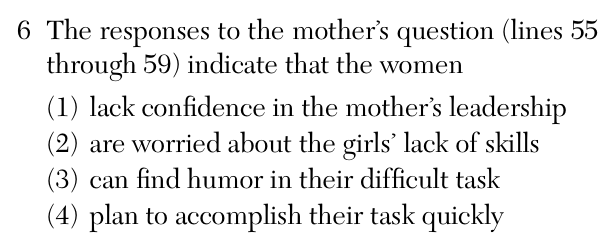
What does the exchange about food reveal about the divers?
Worked solution for question 6
- The women answer a serious question with extravagantly impossible comparisons.
- This ritual joking lightens the mood before they discuss where to dive.
- The effect comes from how exaggerated the comparisons are. They turn the question into shared amusement even though the upcoming dive is serious.
Answer choice 3They find humor in demanding work.
Q7 Assigned diving grounds
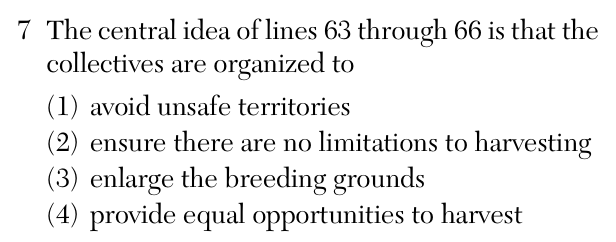
Why are the territories divided among collectives?
Worked solution for question 7
- The passage assigns each group access to particular coves or stretches of sea.
- The organizing principle is access to fishing grounds, rather than ownership of the ocean.
- Connect the rule to the work. The divers gather resources from particular parts of the sea, so assigning separate areas organizes where each collective can look for a harvest.
Answer choice 4To give groups opportunities to harvest
Q8 Ranks among divers
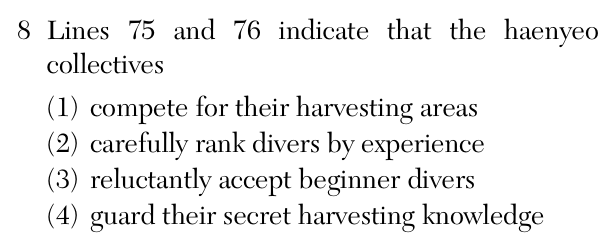
What do the objections in lines 75–76 reveal?
Worked solution for question 8
- An older diver objects that the youngest members lack both strength and the standing to dive there.
- The chief resolves this by assigning easier areas and mentors, preserving the distinctions among ranks.
Answer choice 2Divers are ranked by experience.
Q9 A shift in mood
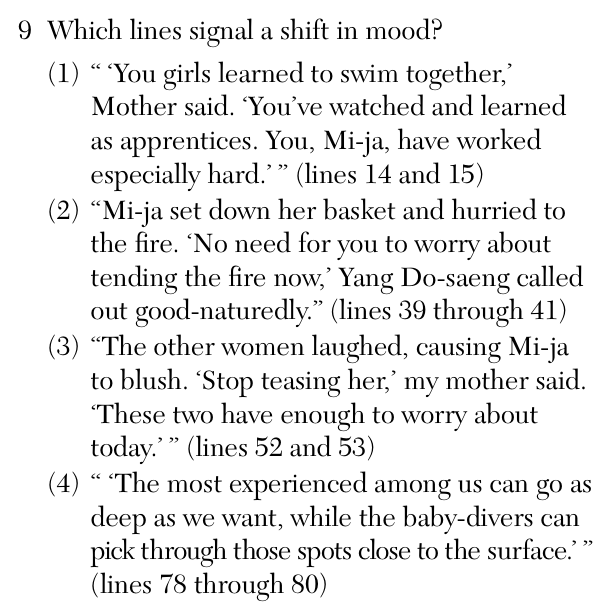
Which exchange changes the atmosphere of the gathering?
Worked solution for question 9
- The women are laughing and Mi-ja blushes. The mother intervenes and points out that the newcomers have real worries.
- This shifts the focus from playful initiation to the seriousness of the day.
- The key evidence is the change in how the women respond. The earlier exaggeration keeps the joke going, while the mother’s interruption asks the group to take the new divers’ anxiety seriously.
Answer choice 3The mother stops the teasing in lines 52–53.
Q10 The snake’s appearance
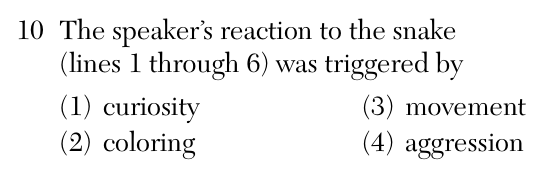
Which detail triggers the speaker’s first fear?
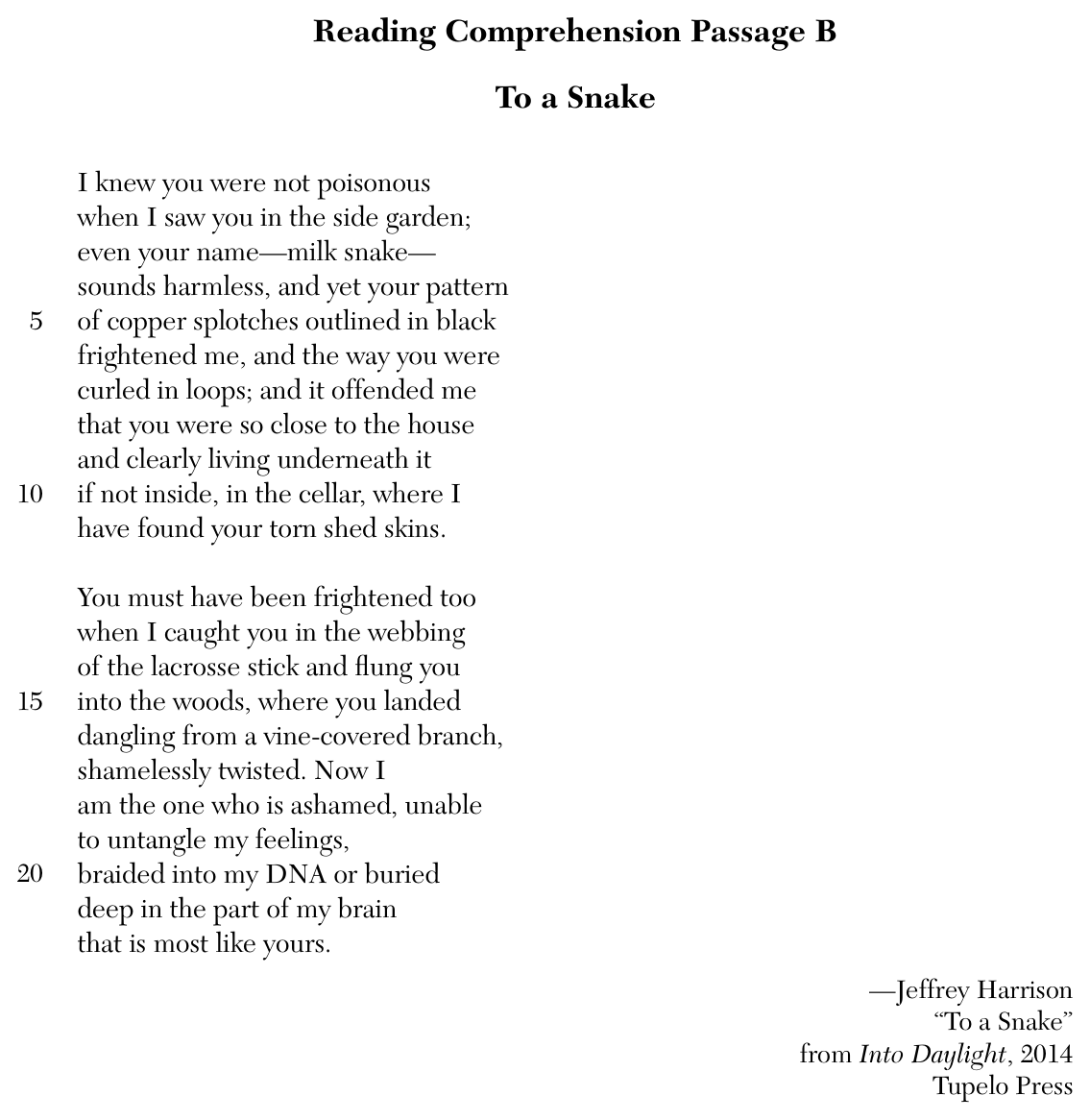
Worked solution for question 10
- The speaker already knows the snake is harmless but describes the copper patches and dark outlines just before admitting fear.
- That contrast makes the visible pattern the immediate trigger.
Answer choice 2Its coloring
Q11 Resentment at intrusion
What does the qualification in line 10 imply about the speaker?
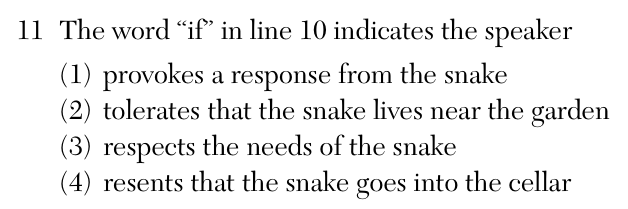
Worked solution for question 11
- The thought progresses from a snake near the house to one potentially inside it.
- The shed skins give the speaker reason to see the cellar as part of the snake’s territory.
- The shed skins are evidence that the animal has already used the cellar. That detail explains why the speaker’s objection goes beyond simply seeing a snake outdoors.
Answer choice 4The speaker resents the snake entering the cellar.
Q12 Using the lacrosse stick
What does the improvised method of moving the snake suggest?
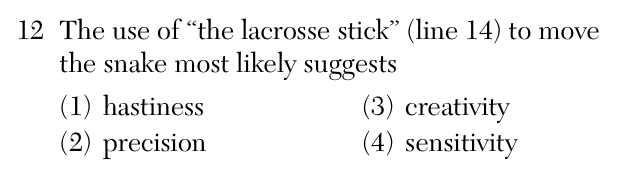
Worked solution for question 12
- The speaker grabs the snake with sports equipment and flings it away.
- The rough, immediate response fits an impulse to remove it quickly.
- The unusual tool and abrupt motion both signal that the speaker acts before considering a gentler way to move the snake. That helps explain the regret that follows.
Answer choice 1Hastiness
Q13 A reversal of shame
What emotion does the description of the twisted snake develop?
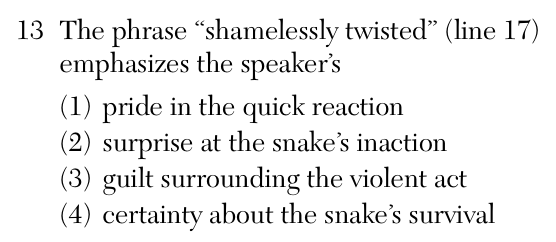
Worked solution for question 13
- The description briefly puts shame on the snake before the speaker takes it on personally.
- That reversal directs attention to the human action that left the snake dangling.
- Follow who performs the rough action. The snake’s twisted position results from the speaker’s decision, so the image can express the speaker’s growing guilt through a description of the animal.
Answer choice 3Guilt about the rough treatment
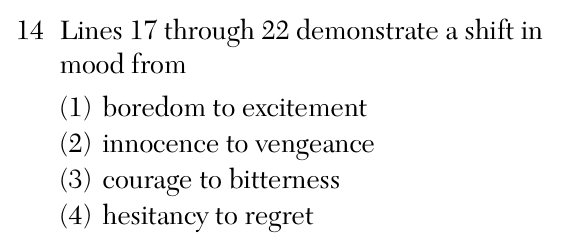
Q14 Change in mood
How does the ending change the speaker’s attitude?
Worked solution for question 14
- The speaker’s uneasy first reaction becomes self-reproach after the snake is thrown.
- The closing comparison between their brains deepens that regret by recognizing a shared instinctive fear.
Answer choice 4Hesitancy gives way to regret.
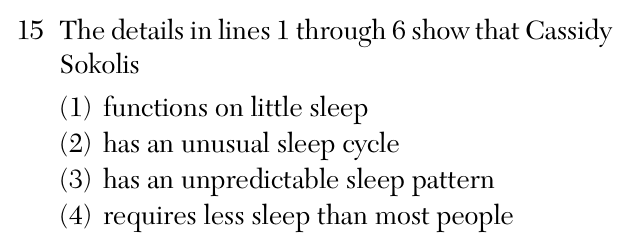
Q15 Sokolis’s sleep schedule
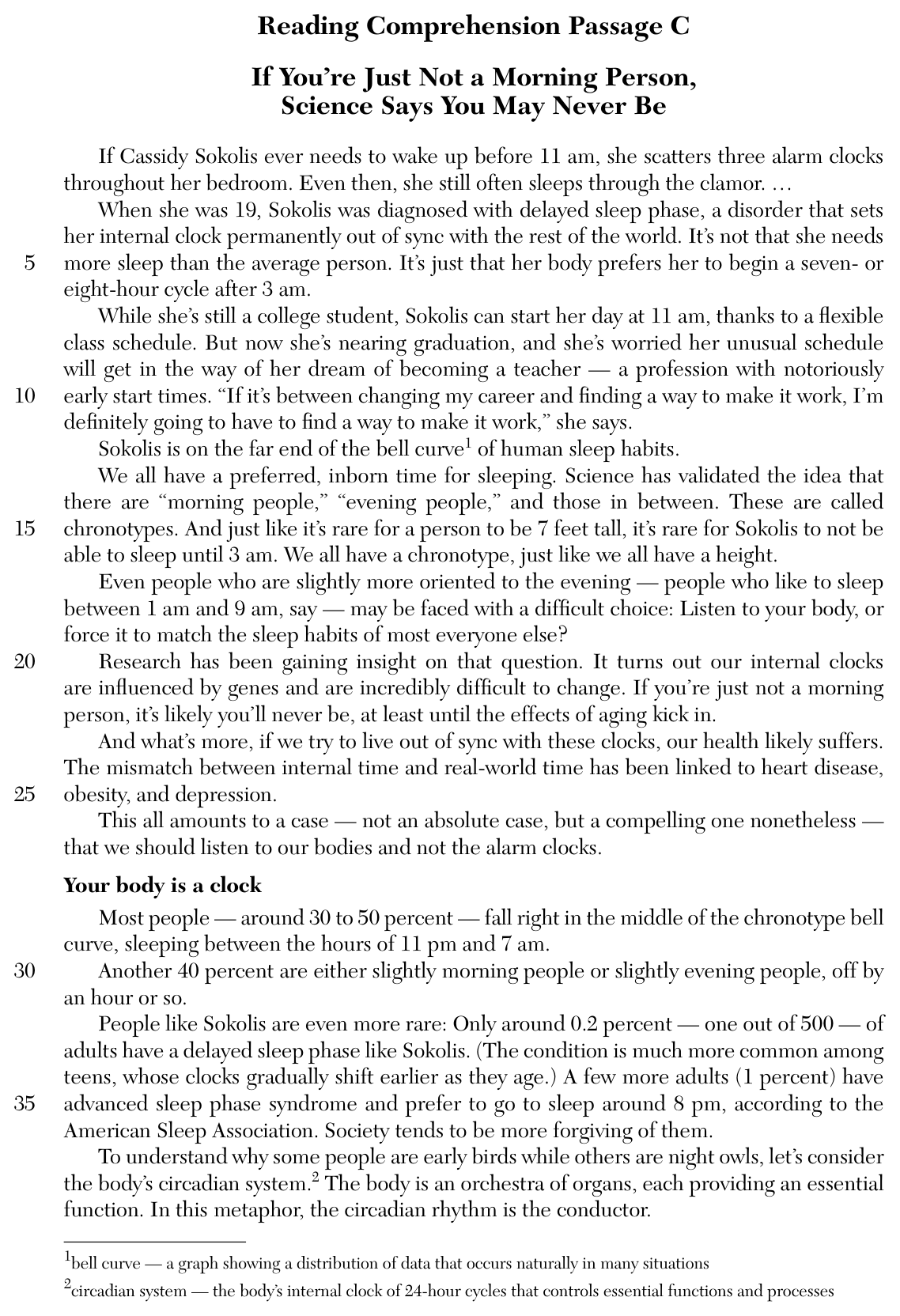
What do the opening alarm-clock details show?
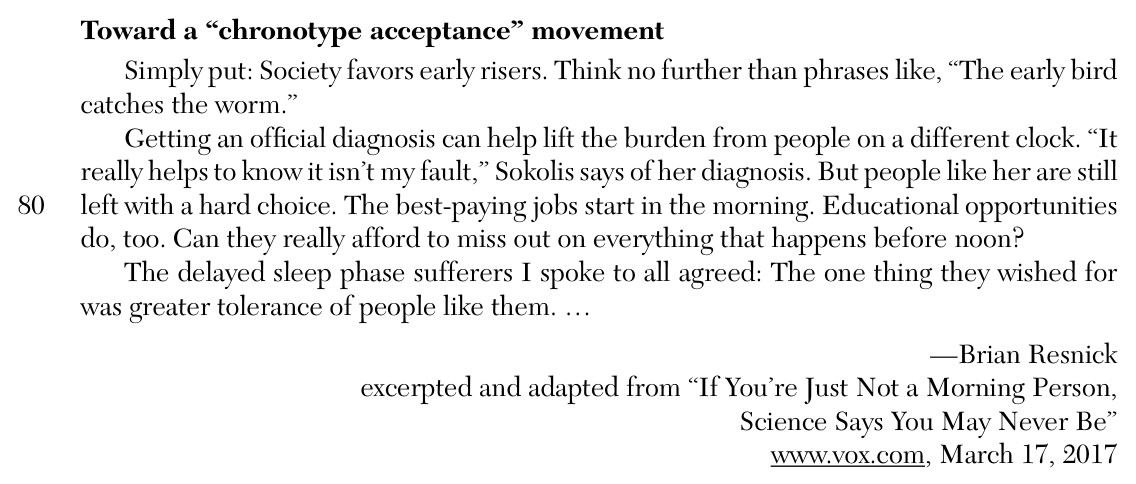
Worked solution for question 15
- She can sleep through several alarms when trying to rise early, yet her body still needs a typical duration of sleep.
- The unusual feature is when her sleep begins and ends.
- Compare the timing of sleep to the clock time others expect. A person can sleep a substantial number of hours and still have a schedule out of phase with work or school.
Answer choice 2Her sleep cycle occurs at unusual hours.
Q16 Chronotypes and height
What does comparing sleep timing to height clarify?
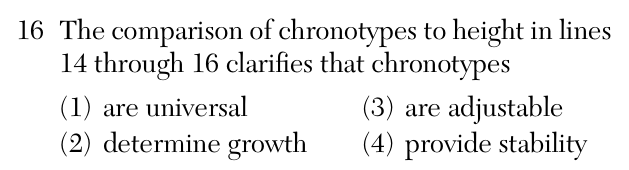
Worked solution for question 16
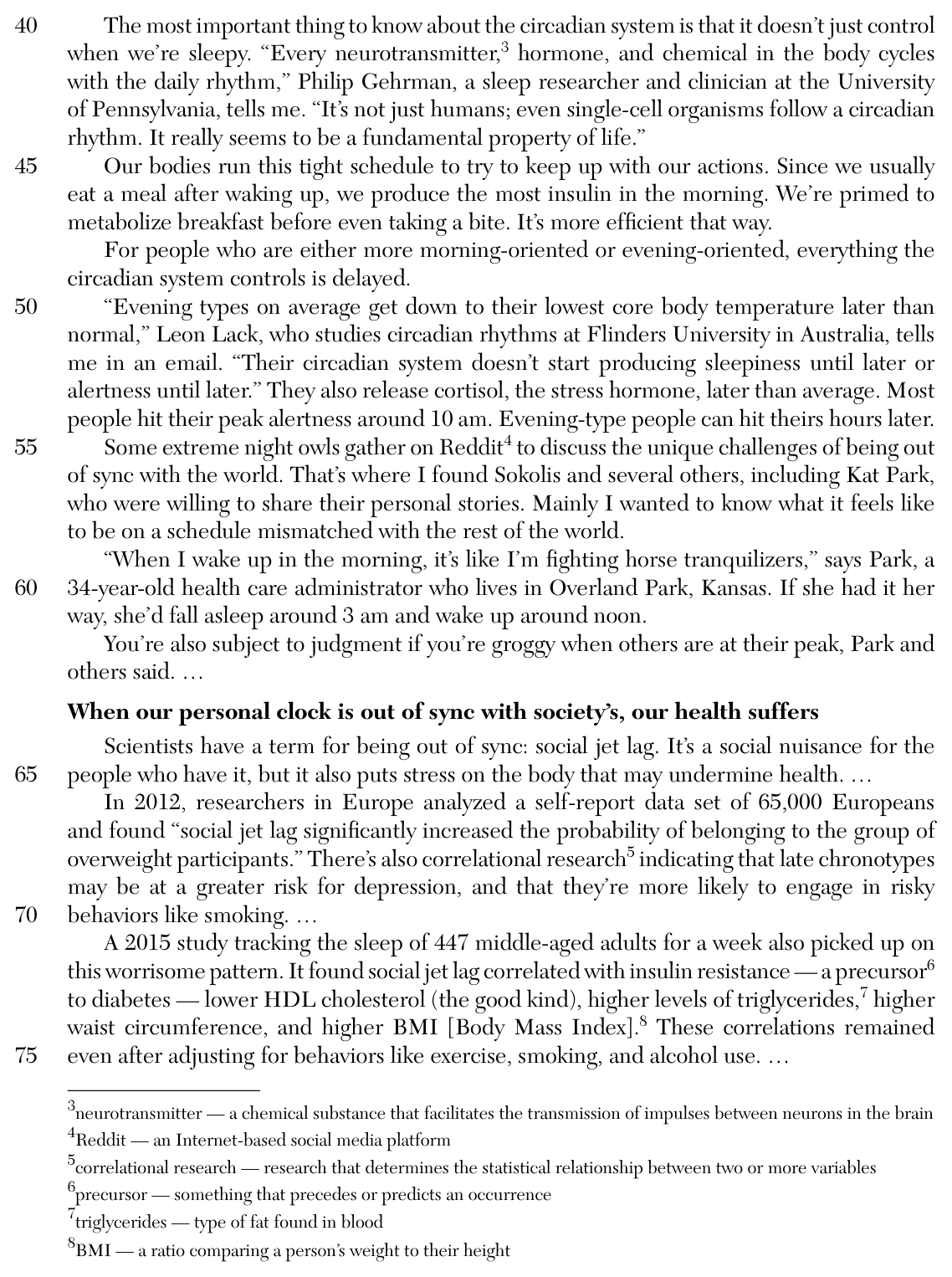
- Every person has a height, though very tall people are rare. The same pattern applies to preferences for sleep timing.
- Sokolis illustrates an extreme on a scale that includes everyone.
Answer choice 1Everyone has a chronotype.
Q17 Vocabulary in context
What does oriented toward the evening mean in line 17?
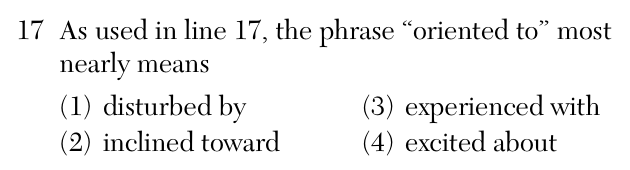
Worked solution for question 17
- The example describes a person who naturally prefers later sleep hours.
- The context is about tendency or preference, rather than enthusiasm for a particular event.
- Try the answer as a replacement in the sentence. The phrase points to a tendency toward a particular pattern, without making that pattern inevitable for every individual.
Answer choice 2Inclined toward
Q18 The body as an orchestra
What does the conductor metaphor suggest?
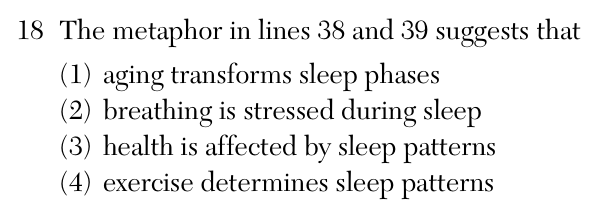
Worked solution for question 18
- A conductor coordinates many musicians. In the comparison, the circadian rhythm coordinates many bodily processes.
- The metaphor prepares readers for the discussion of health effects when timing is disrupted.
Answer choice 3Sleep timing and health are connected.
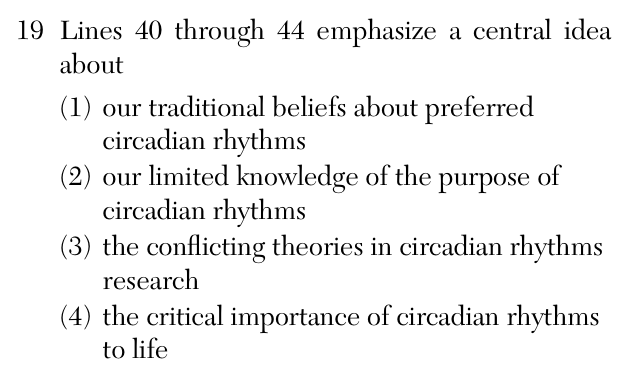
Q19 Circadian rhythms across life
What do lines 40–44 stress?
Worked solution for question 19
- The quoted researcher extends daily cycles beyond sleep to hormones and even single-celled organisms.
- That breadth supports the claim that biological timing is fundamental.
- The range of organisms matters because it broadens the example beyond human sleep habits. It gives the reader a reason to view internal timing as a basic biological process.
Answer choice 4Their fundamental importance to life
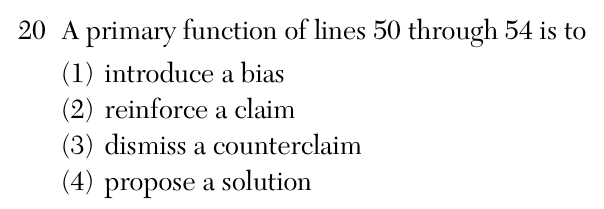
Q20 Evidence about later schedules
What do the researcher’s examples in lines 50–54 do?
Worked solution for question 20
- Temperature, alertness and cortisol follow a later timetable in evening types.
- These examples support the preceding claim that the whole circadian schedule can shift.
Answer choice 2Reinforce a claim
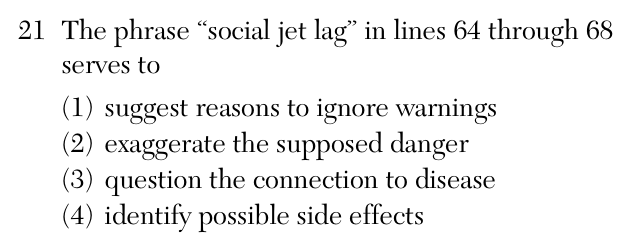
Q21 Social jet lag
What does naming and discussing the mismatch accomplish?
Worked solution for question 21
- The passage connects a mismatch in internal and social timing with stress and research on weight and metabolic outcomes.
- The studies report associations, which the passage presents as possible consequences.
- The travel comparison illustrates what happens when external obligations and internal timing conflict even without crossing time zones. The consequences help explain why schedule design matters.
Answer choice 4It identifies possible adverse effects.
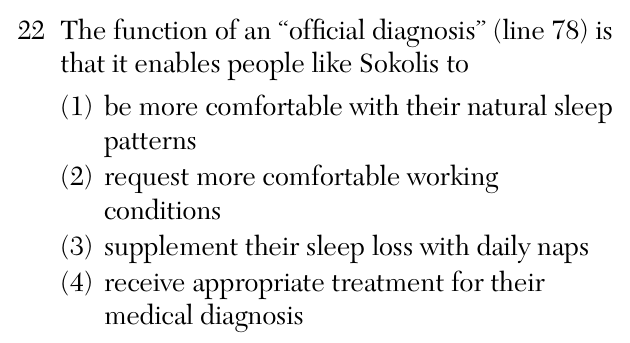
Q22 Purpose of a diagnosis
What does a diagnosis do for someone such as Sokolis?
Worked solution for question 22
- Sokolis expresses relief at learning the schedule is not a personal fault.
- This part of the article emphasizes reduced self-blame, while the practical scheduling conflict remains.
Answer choice 1Helps her accept her natural pattern
Q23 Central claim
Which statement captures the article’s overall argument?
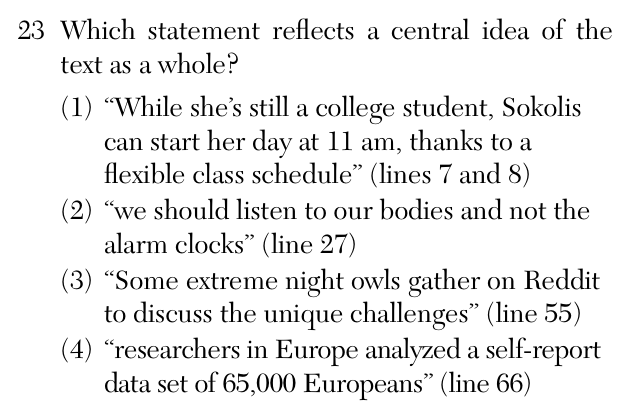
Worked solution for question 23
- The opening case shows a naturally delayed pattern. The research connects forced mismatch with health concerns.
- Together these strands support paying attention to biological timing.
- The examples of unusual sleep timing and schedule mismatch do more than describe variety. Together they provide reasons to consider the body’s timing when deciding when people should work or study.
Answer choice 2Take the body’s timing seriously when setting schedules.
Q24 Overall organization
How does the author primarily develop the article?
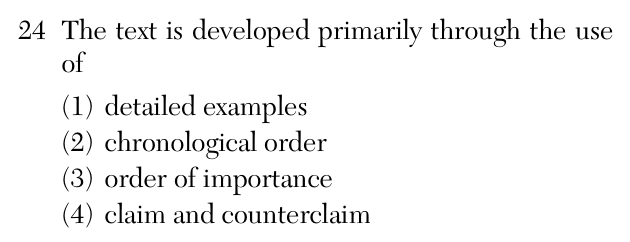
Worked solution for question 24
- Sokolis and Park illustrate personal effects, while researchers and studies supply physiological examples.
- The argument moves between these cases and findings to build a general explanation.
Answer choice 1Detailed examples
Part 2 Argument essay
Question indexArgument Argument on social media screening
Take a position on whether employers should examine applicants’ social media. Develop the argument with at least three texts and address a counterclaim.
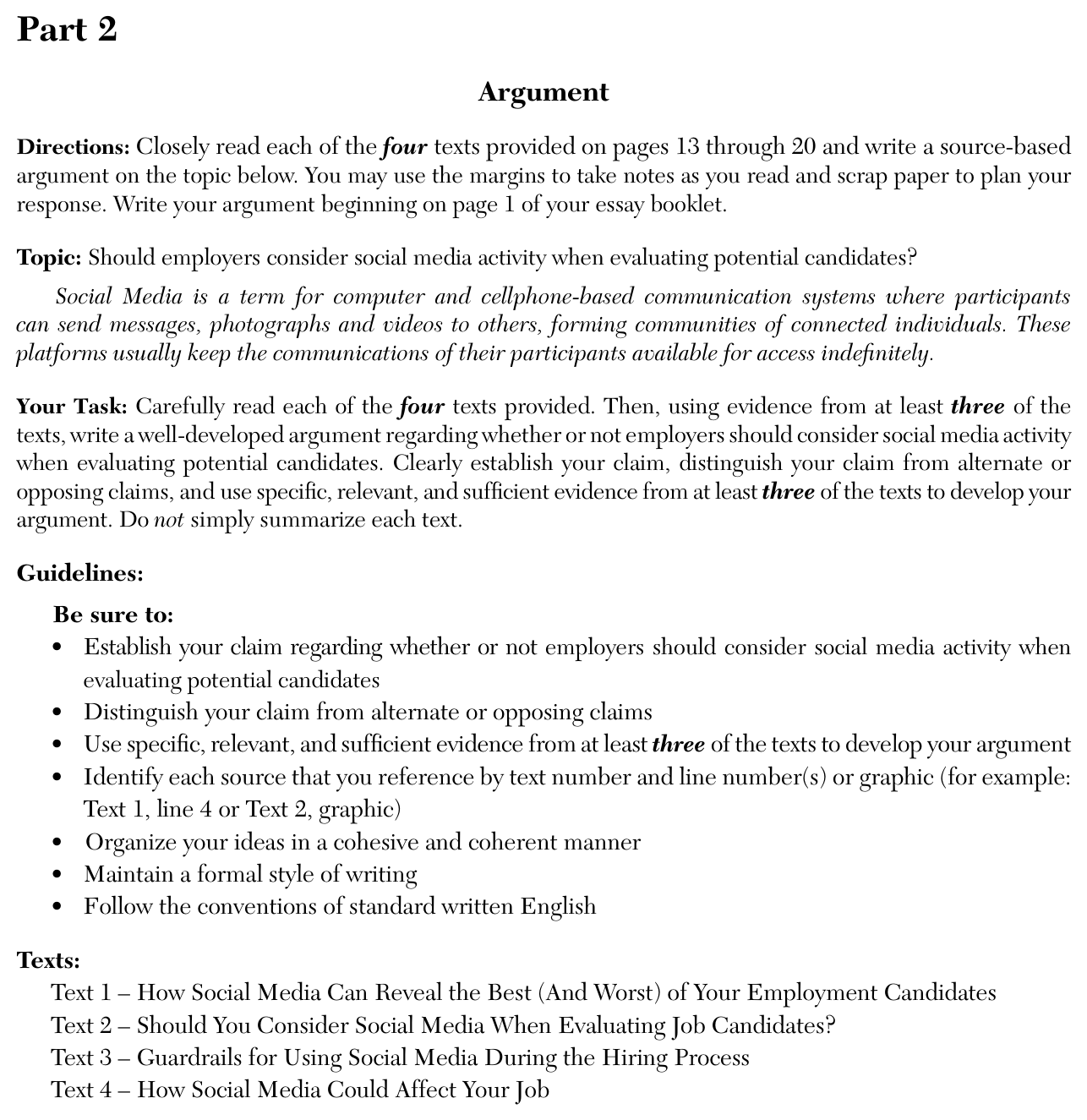
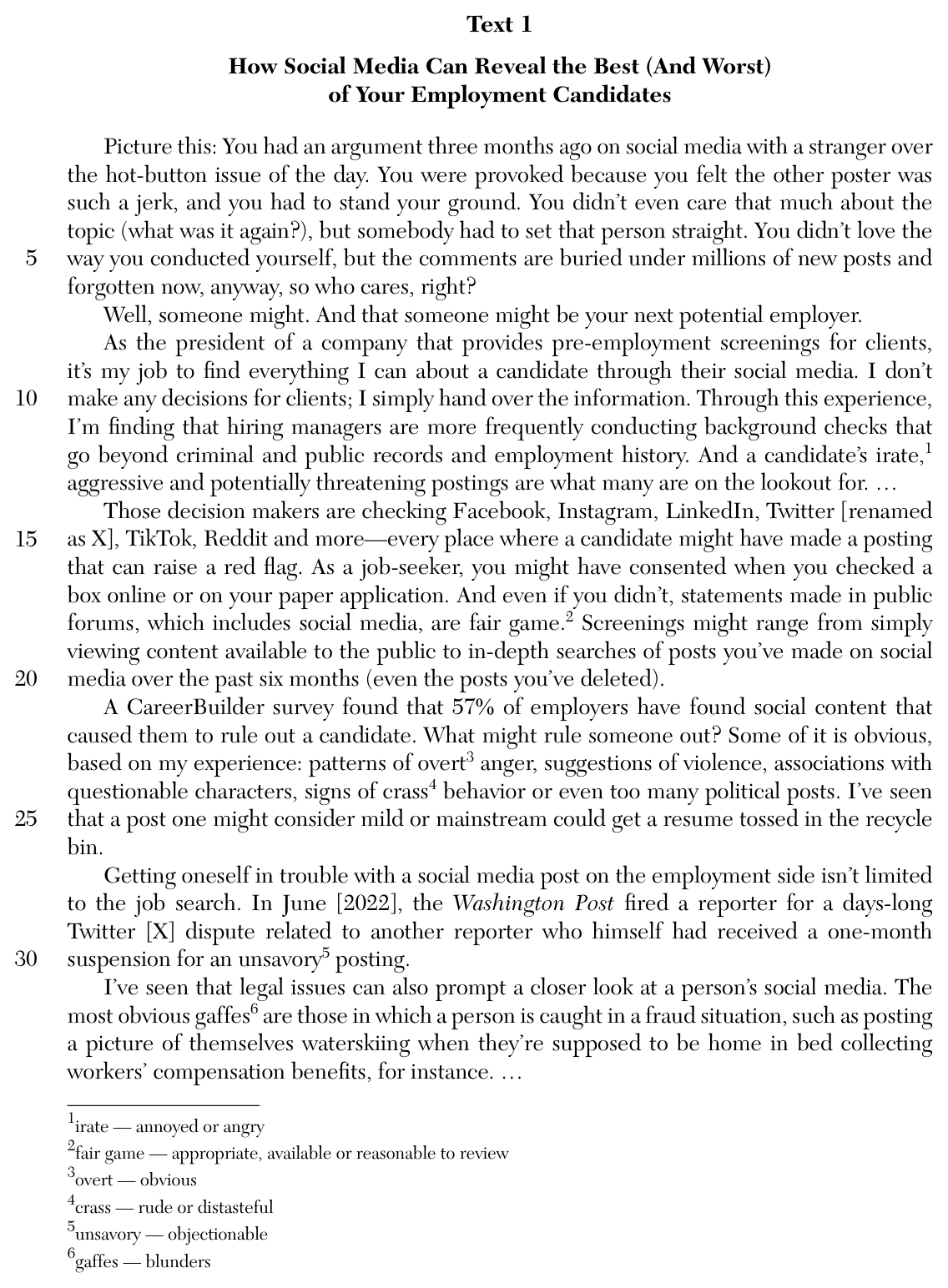
Writing plan and model response for argument
- Frame the claim around relevance to the job and distinguish professional evidence from personal activity.
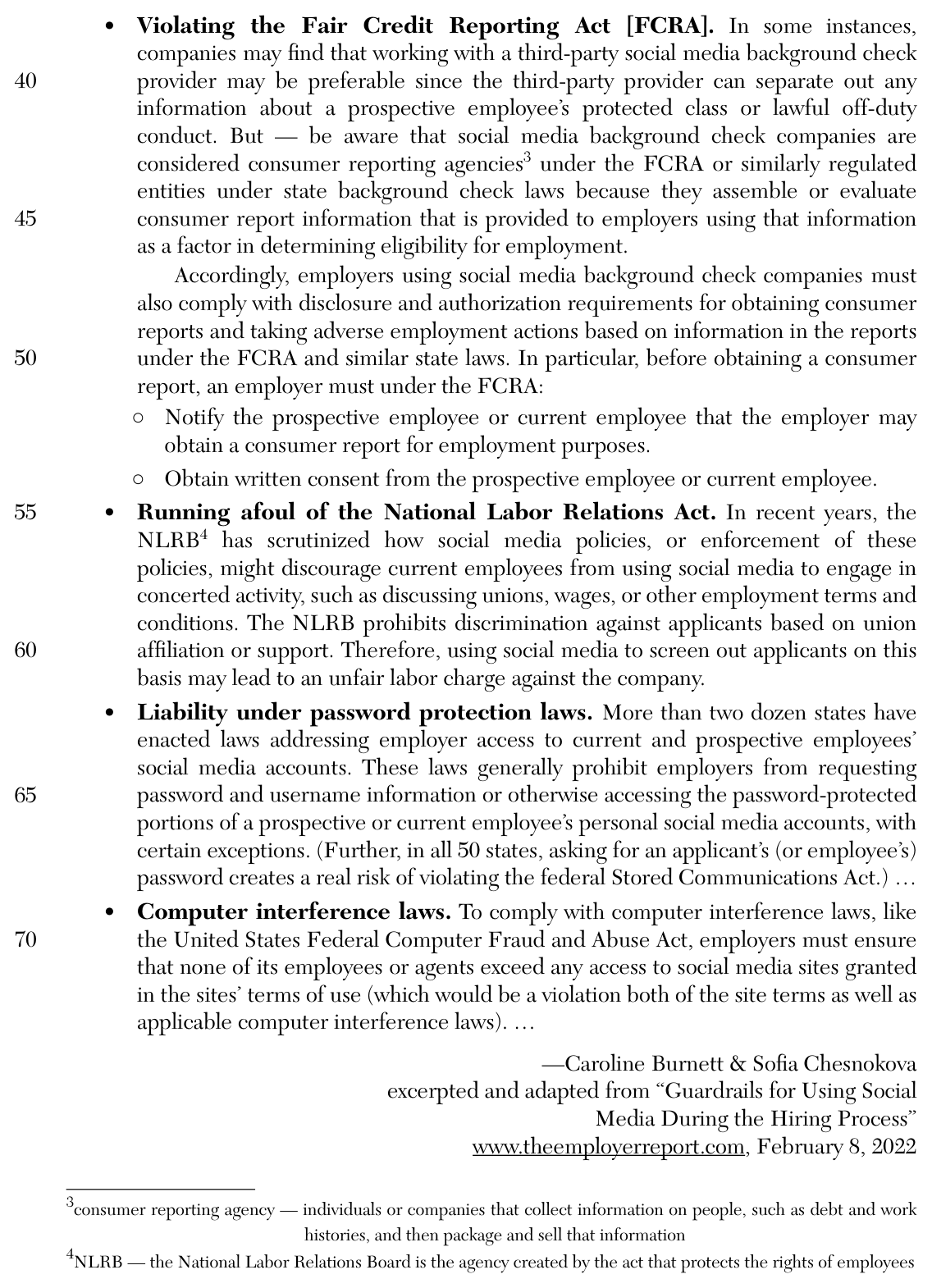
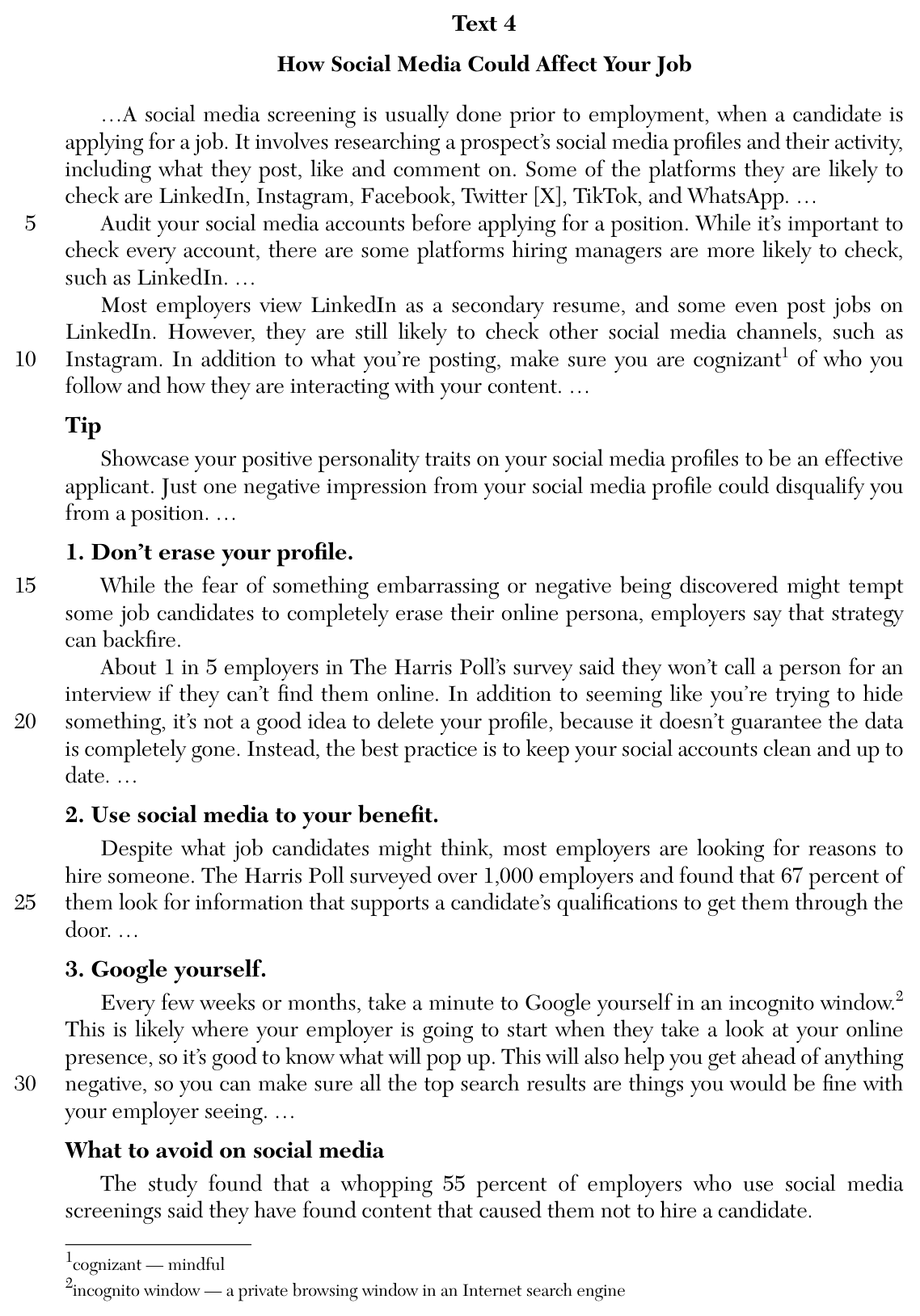
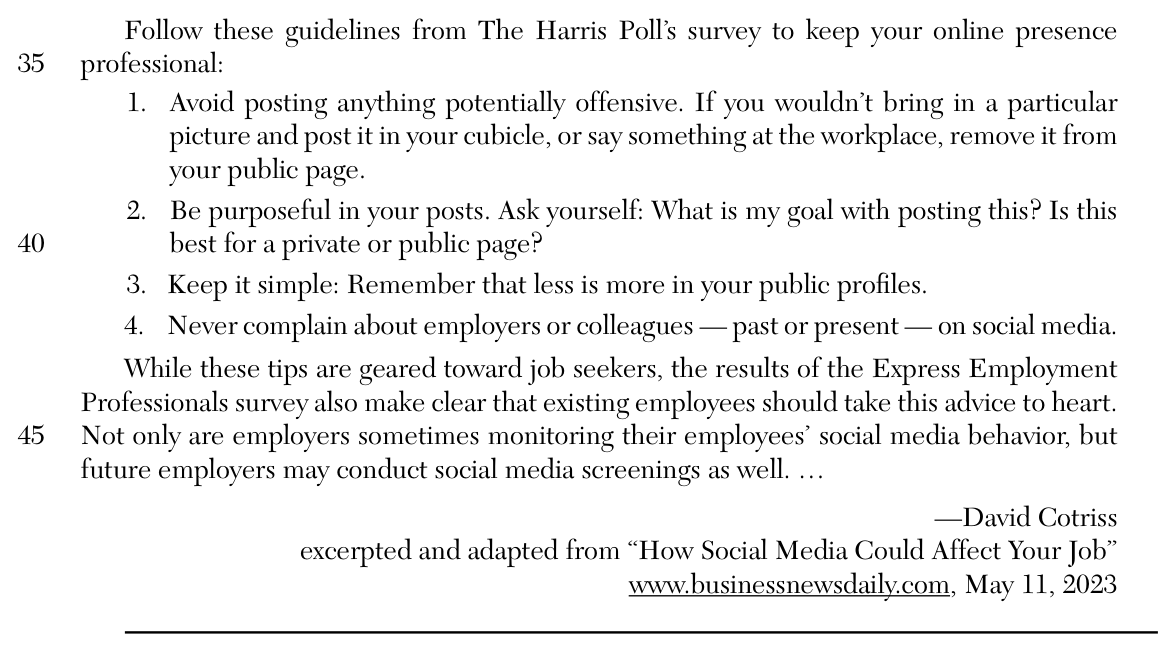
- Use Texts 2 and 3 to connect specific risks to the safeguards. Use Text 4 to concede that public work samples can support qualifications.
Central claimUse narrowly defined, public, job-related checks with safeguards.
Model response
An applicant’s public profile can sometimes show skills that a résumé merely lists. It can also reveal private beliefs and personal details that have little bearing on the job. Employers should use social media only for a clearly defined, job-related purpose, after an initial assessment of qualifications. A fair review should use public information and apply the same criteria to everyone.
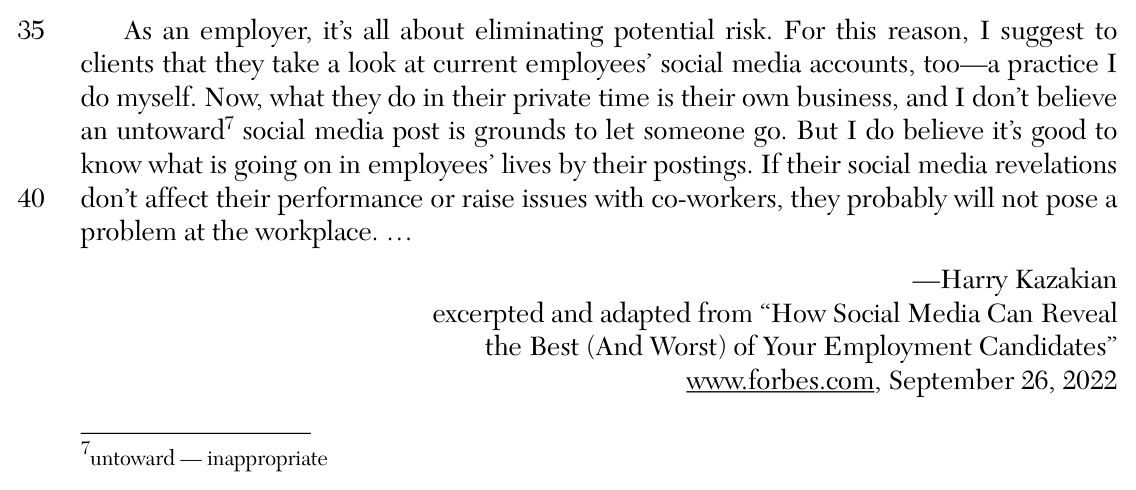
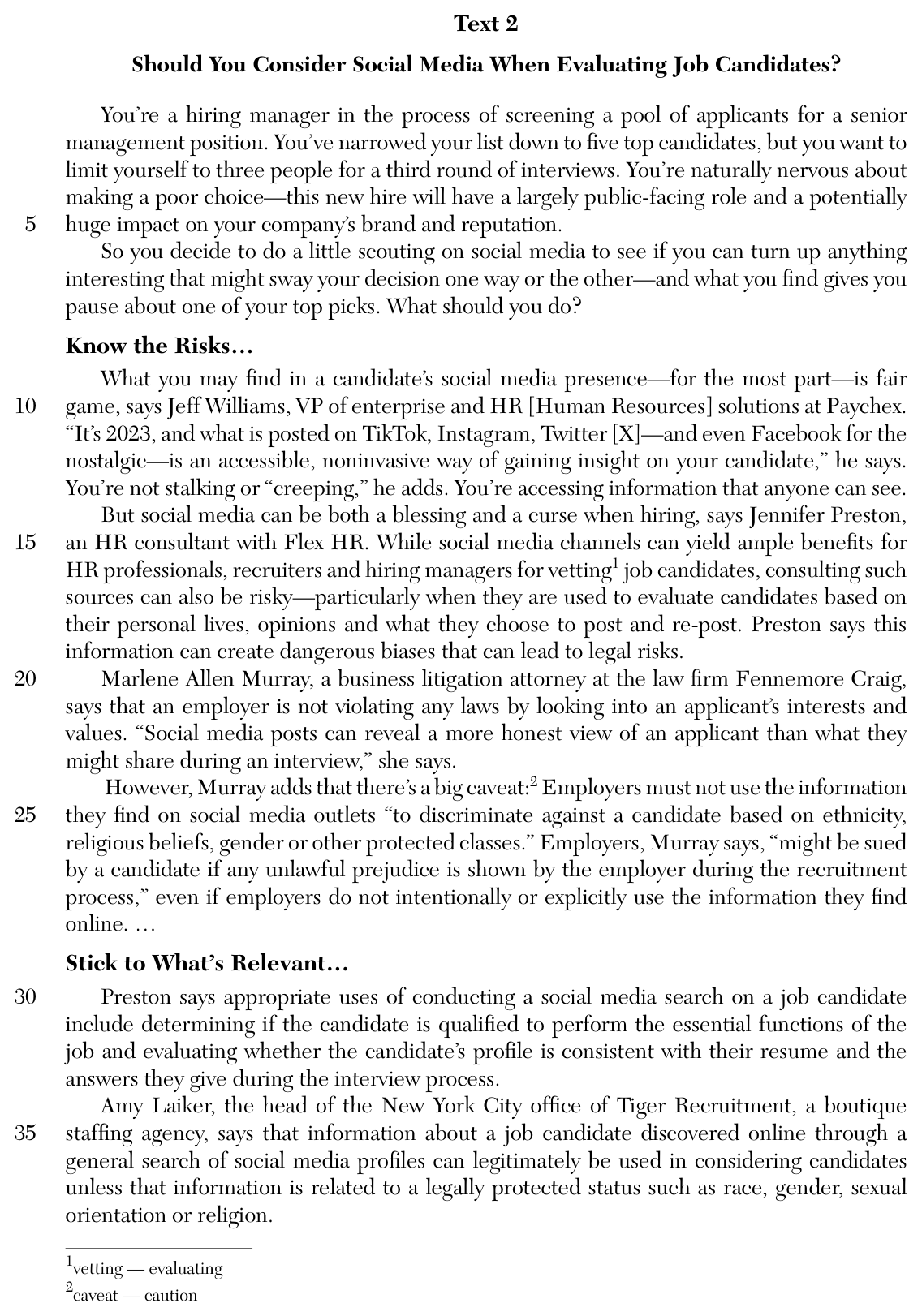
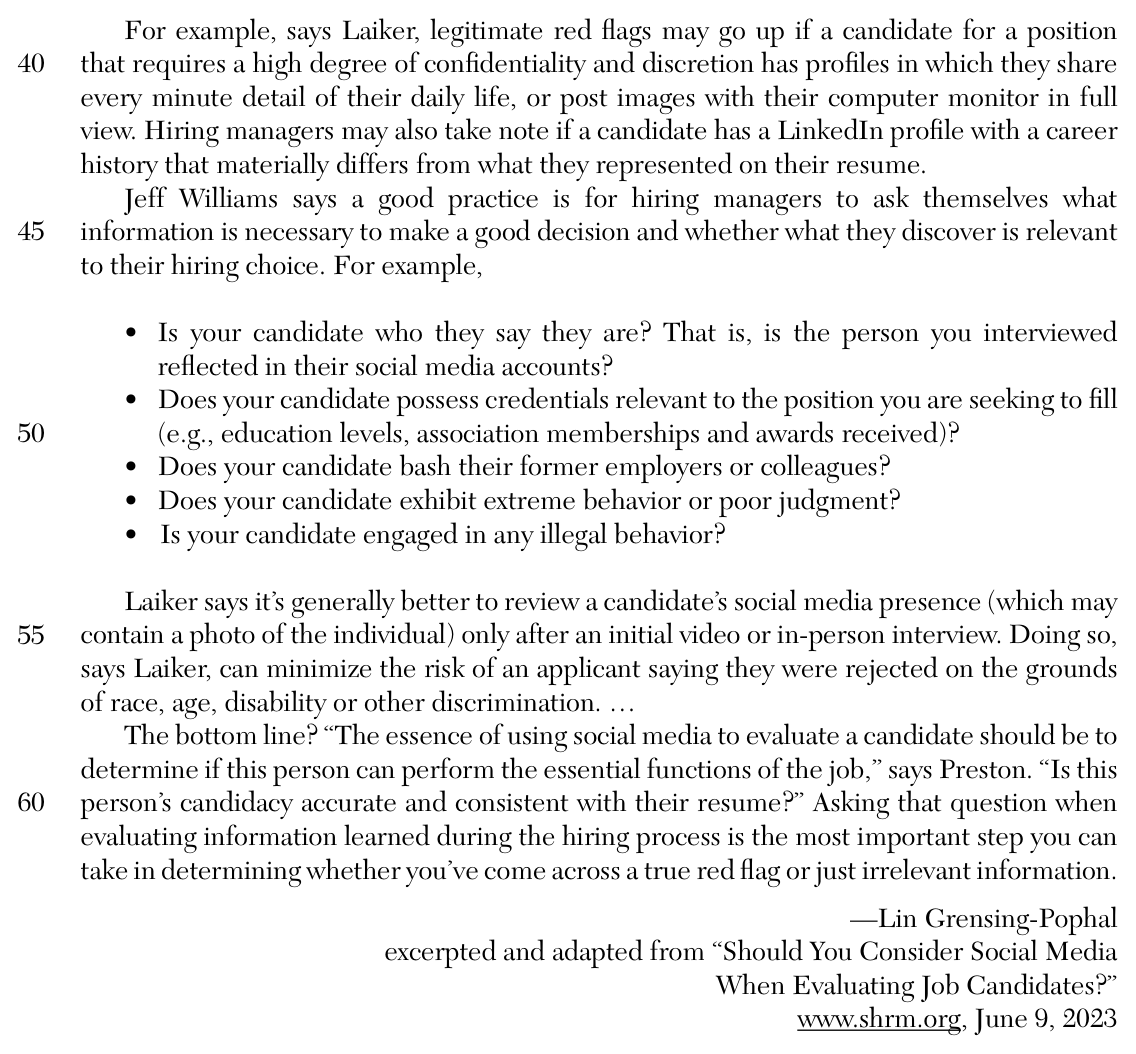
A limited check can add meaningful information. Text 2, lines 35–45, describes a situation in which an applicant for a role requiring discretion publicly shares sensitive information. In that case, the conduct is directly connected to a duty of the job. Text 4, lines 22–26, describes the other side of the same process, in which a profile can confirm qualifications. A candidate’s public design portfolio, for example, gives an employer a concrete product to assess. The link between the evidence and the task is what justifies considering it.
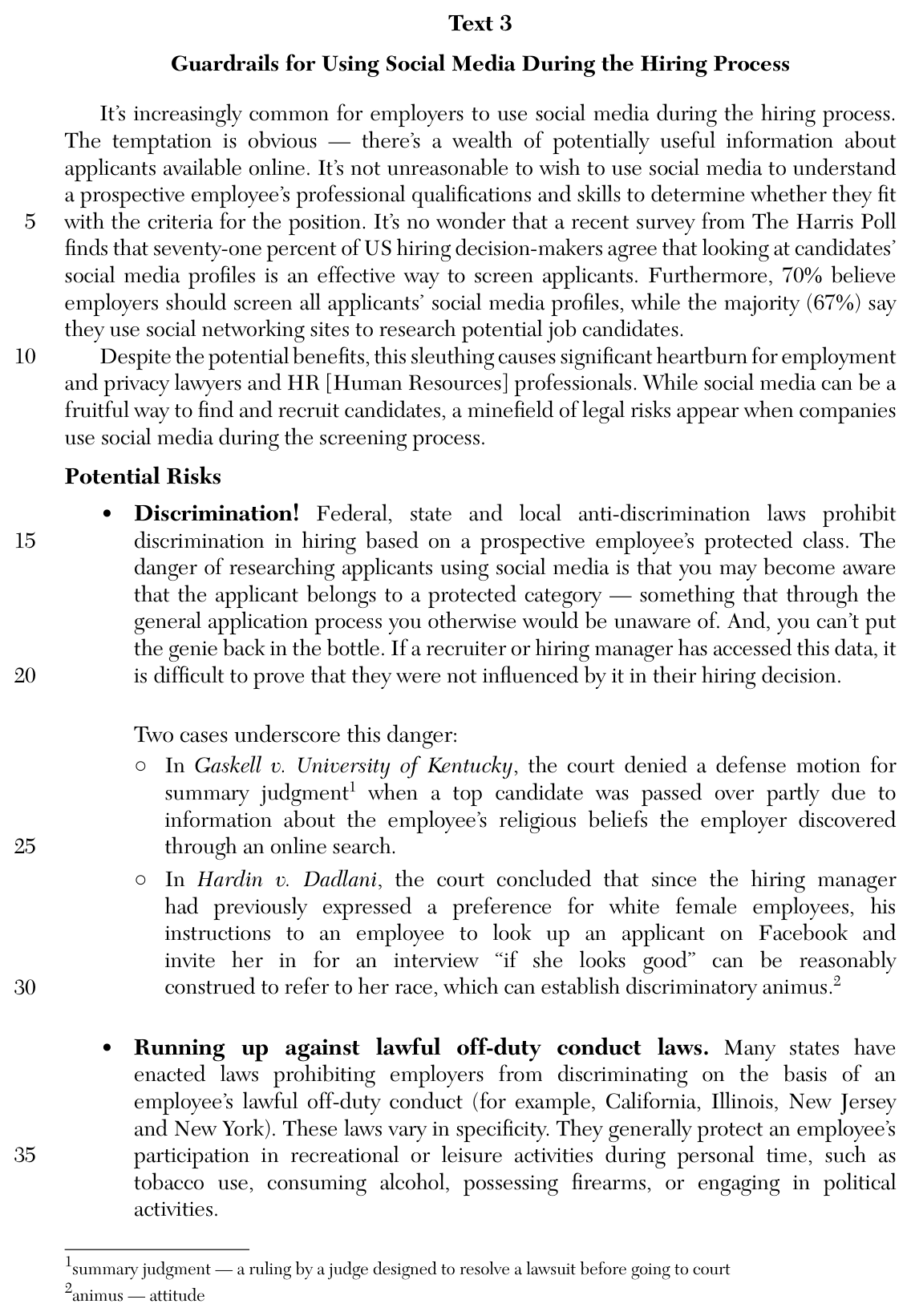
Supporters of wider screening might argue that public profiles offer a more candid impression than interviews. Yet a profile can reveal characteristics that an employer should never use in hiring. Text 3, lines 14–25, explains how easily a search can expose protected personal information and how difficult it is to separate that knowledge from a later decision. Text 2, lines 54–60, proposes waiting until after an interview and checking whether the information is accurate and consistent with the application. Those steps limit the opportunity for an irrelevant impression to decide who gets an interview.
The best policy is therefore a narrow one. An employer should decide in advance what evidence is relevant, verify the identity and context of any material it uses, and give the applicant an opportunity to clarify it. A review governed by those limits can add evidence of job performance while protecting applicants from arbitrary judgments about their personal lives.
Part 3 Text-analysis response
Question indexAnalysis Ballparks and community
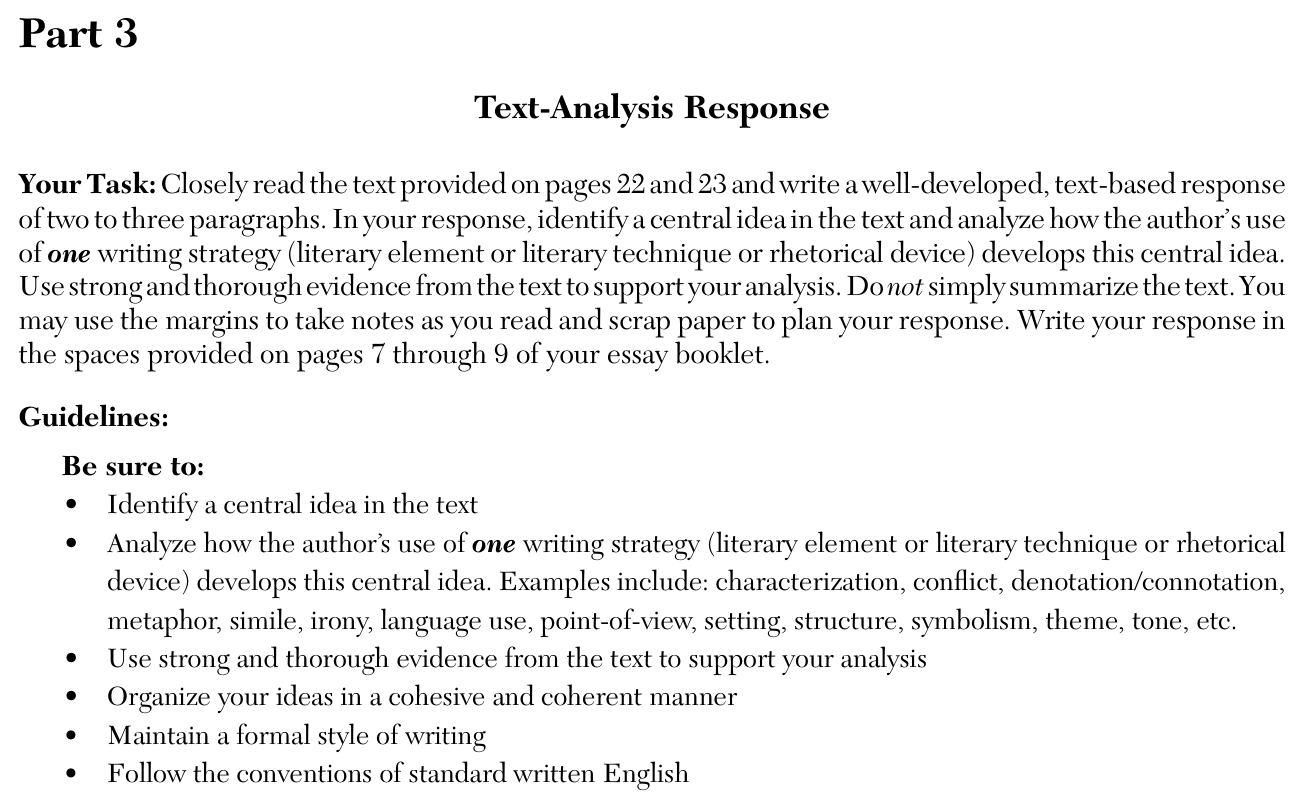
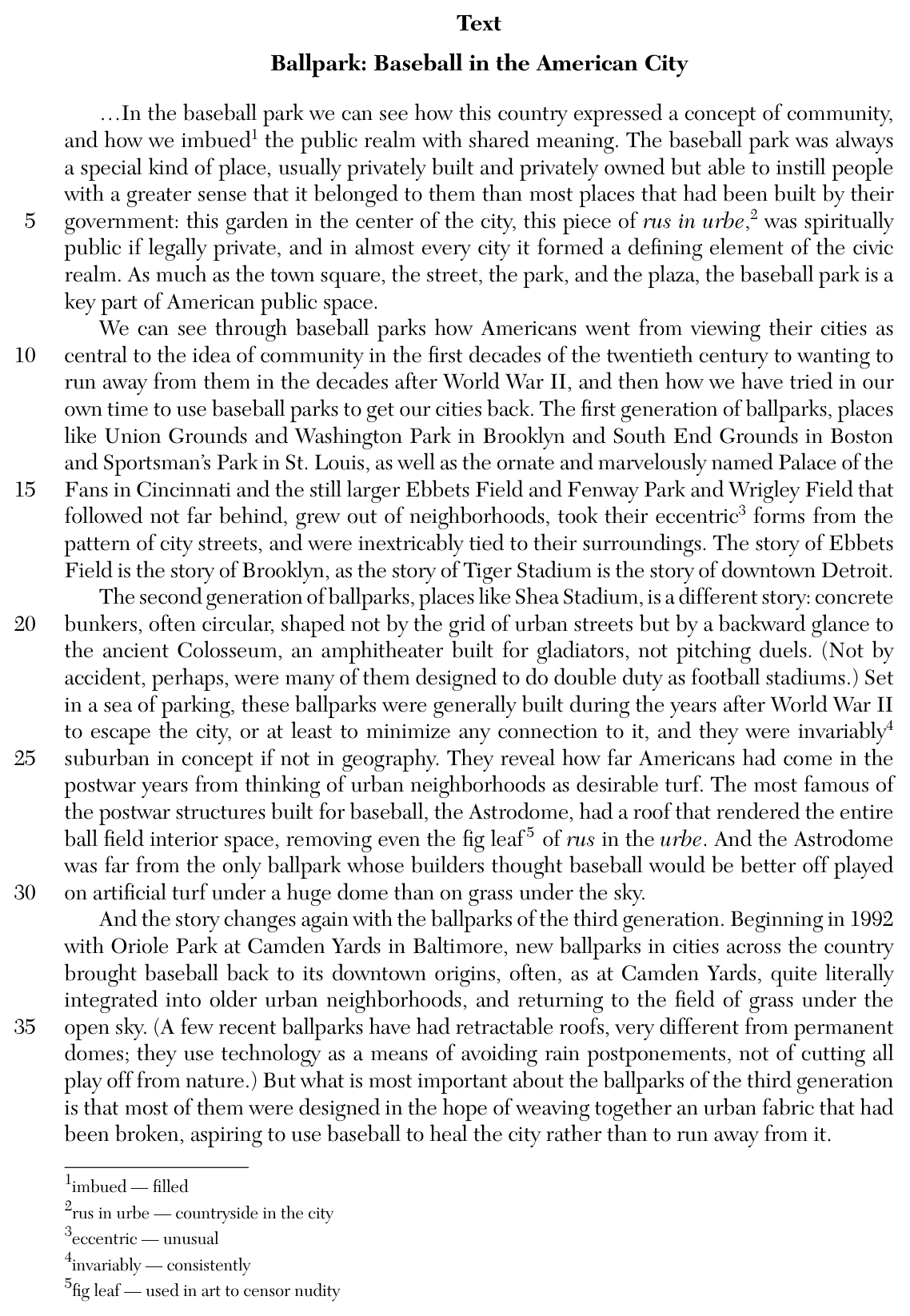
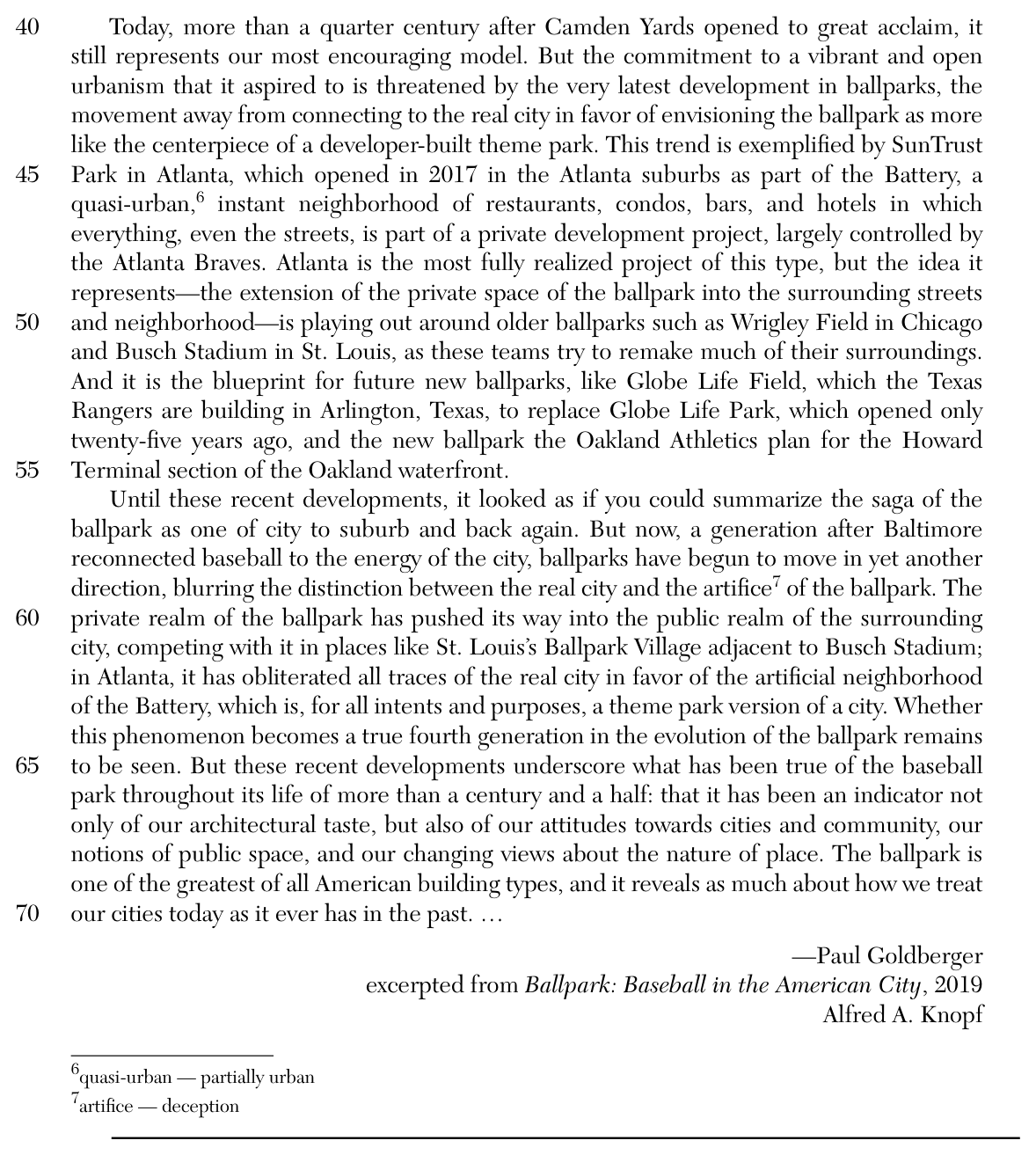
Explain a central idea in Goldberger’s ballpark excerpt through one writing strategy.
Writing plan and model response for analysis
- Name the strategy as chronological contrast, then connect each stadium design to its relationship with the city.
- Use the latest privately planned district to show why the author questions appearances of urban community.
Central claimThe chronological contrast among stadium designs shows how public space reflects changing ideas of community.
Model response
Paul Goldberger argues that ballpark design reveals how Americans have understood community and their relationship to cities. He develops this idea by arranging the excerpt around generations of stadiums and contrasting their settings. In lines 12–18, neighborhood parks such as Ebbets Field take their forms from the surrounding streets. Lines 19–30 shift to postwar parks surrounded by parking and, in the case of the Astrodome, closed off from the outdoors. The change in physical design gives readers a visible way to understand the decline of the neighborhood’s importance.
The chronological sequence also shows that the trend can reverse and then reappear in a new form. Camden Yards, introduced in lines 31–39, illustrates an effort to reconnect baseball with existing city streets and neighborhoods. The recent Atlanta development in lines 40–49 resembles a neighborhood, but the ball club’s control extends into the surrounding development. Placing these two examples side by side makes the difference clear. A park can help strengthen a living city, while a development can borrow the city’s appearance without offering the same shared civic space.
From the New York State Education Department. January 2026 English Language Arts Regents Examination. Internet. Available from https://www.nysedregents.org/hsela/126/reela-12026-exam.pdf. Accessed .