NEW YORK STATE REGENTS · ALGEBRA II
June 2026 Algebra II Regents Past Paper & Solutions
Work through polynomial division, exponential regression and probability with a question-by-question walkthrough of the exam.
- 36 worked questions
- 82 raw credits
- 4 exam parts
The question images and page numbers come from the regular-size English exam. OnlyPrepy wrote the summaries and worked solutions.
Quick answer key for Part I
Part I Multiple choice
Question indexQ1 Factor a cubic
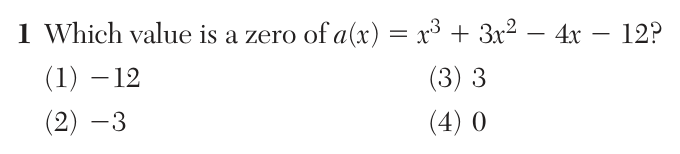
Identify a listed zero of x³ + 3x² − 4x − 12.
Worked solution for question 1
- Group x²(x + 3) − 4(x + 3), yielding (x + 3)(x² − 4).
- The zeros are −3, −2, and 2. Only −3 appears in the choices.
Answer choice 2x = −3
Q2 Set complement
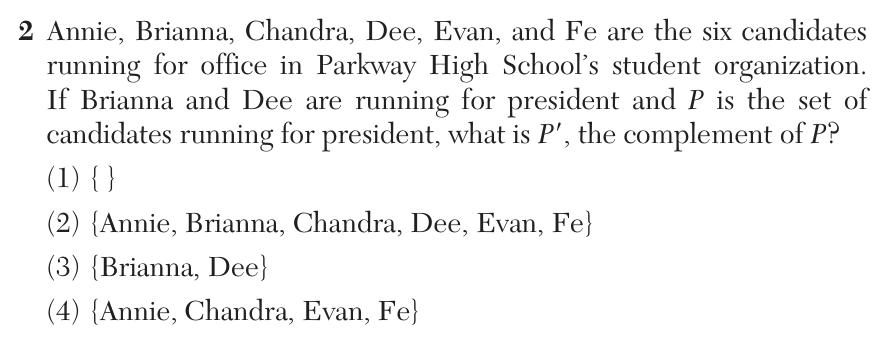
Of six candidates Annie, Brianna, Chandra, Dee, Evan and Fe, Brianna and Dee belong to P. Find P′.
Worked solution for question 2
- The universe is all six candidates. The complement keeps exactly the candidates outside P.
- Remove Brianna and Dee and retain the other four.
Answer choice 4{Annie, Chandra, Evan, Fe}
Q3 Fixed and hourly costs
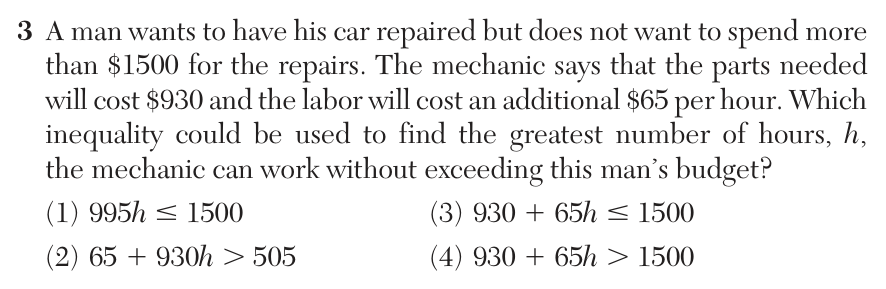
Repairs have a 930-dollar parts charge plus 65 dollars per hour. Model a 1500-dollar cap.
Worked solution for question 3
- Parts are charged once, and h hours cost 65h.
- The total can equal the budget or be smaller, which calls for ≤.
Answer choice 3930 + 65h ≤ 1500
Q4 Polynomial division
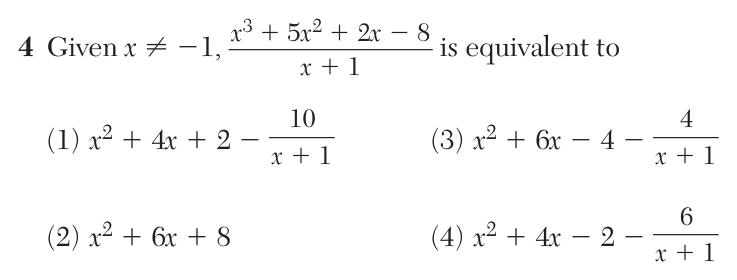
Divide x³ + 5x² + 2x − 8 by x + 1, with x ≠ −1.
Worked solution for question 4
- Use synthetic division with −1. From coefficients 1, 5, 2, −8, the new row is 1, 4, −2, −6.
- The first three values give the quotient and the last is the remainder. Write remainder over the original divisor.
- A remainder check uses the original dividend at x = −1. It equals −1 + 5 − 2 − 8 = −6, which matches the remainder from synthetic division.
Answer choice 4x² + 4x − 2 − 6/(x + 1)
Q5 Rational exponents
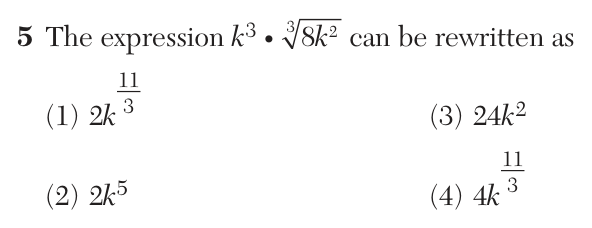
Simplify k³ · ∛(8k²).
Worked solution for question 5
- Separate the cube root of 8 as 2. The remaining cube root is k^(2/3).
- Multiply by k³ and add the exponents 3 + 2/3 = 11/3.
Answer choice 12k^(11/3)
Q6 Translate a graph
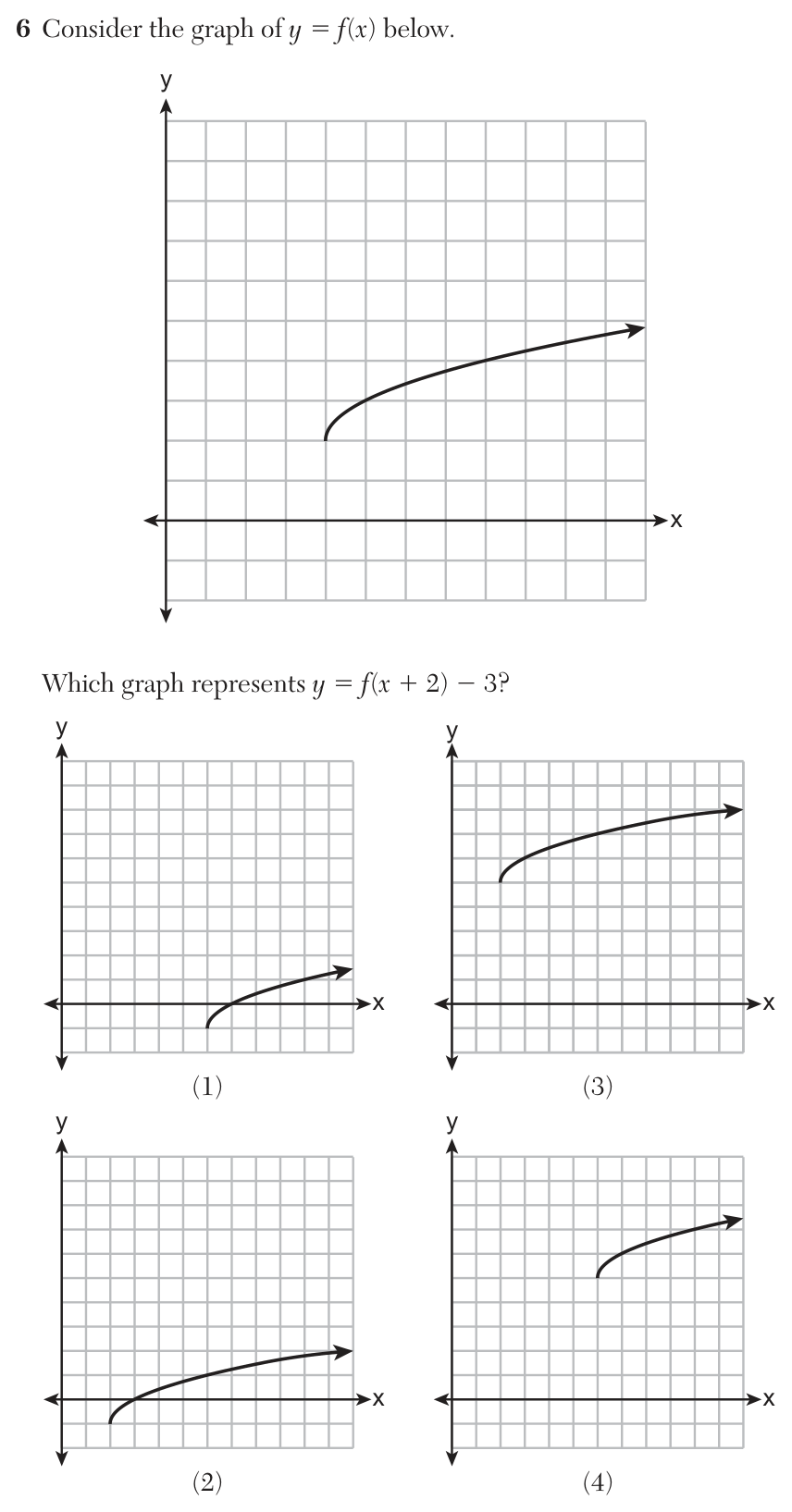
Select the graph of y = f(x + 2) − 3.
Worked solution for question 6
- The old point (a, f(a)) occurs at new input a − 2 because (a − 2) + 2 = a.
- Its new output is f(a) − 3. Apply (x, y) ↦ (x − 2, y − 3) to the graph.
- For any recognizable corner (a, b) on the original graph, its partner must be (a − 2, b − 3). A choice that moves the corner right is treating the sign inside f as a change to its output.
Answer choice 2The graph shifted left 2 and down 3
Q7 Read a growth rate
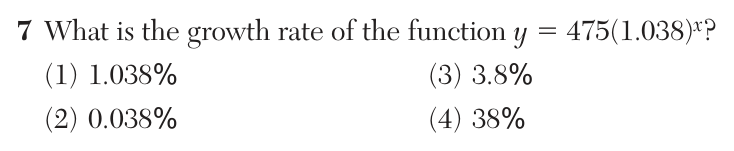
Find the growth rate in y = 475(1.038)ˣ.
Worked solution for question 7
- A growth base has the form 1 + r. Subtract 1 from 1.038 to get 0.038.
- Convert the decimal to a percentage by multiplying by 100.
Answer choice 33.8%
Q8 Intersect a circle and a line
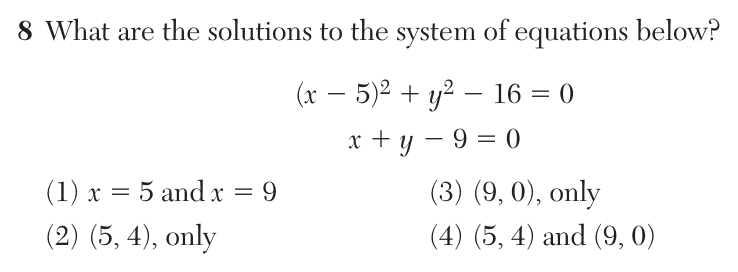
Solve (x − 5)² + y² = 16 and x + y = 9.
Worked solution for question 8
- Substitute y = 9 − x. Expanding gives 2x² − 28x + 90 = 0.
- Divide by 2 and factor (x − 5)(x − 9). Use y = 9 − x to recover both y-values.
Answer choice 4(5, 4) and (9, 0)
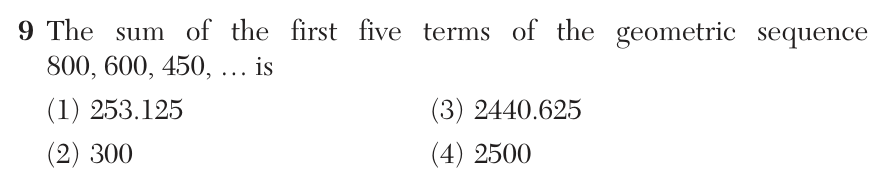
Q9 Finite geometric sum
Add the first five terms of 800, 600, 450, …
Worked solution for question 9
- The common ratio is 600/800 = 0.75. The fourth and fifth terms are 337.5 and 253.125.
- Add 800 + 600 + 450 + 337.5 + 253.125.
Answer choice 32440.625
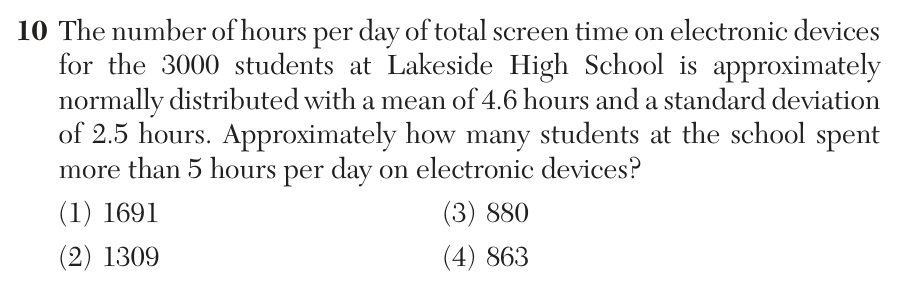
Q10 Normal upper tail
Among 3,000 students with screen time approximately normal at mean 4.6 h and SD 2.5 h, estimate the number over 5 h.
Worked solution for question 10
- The cutoff has z = (5 − 4.6)/2.5 = 0.16.
- The upper-tail probability is about 0.43644. Multiply by 3,000 and round to a whole student.
Answer choice 2About 1,309 students
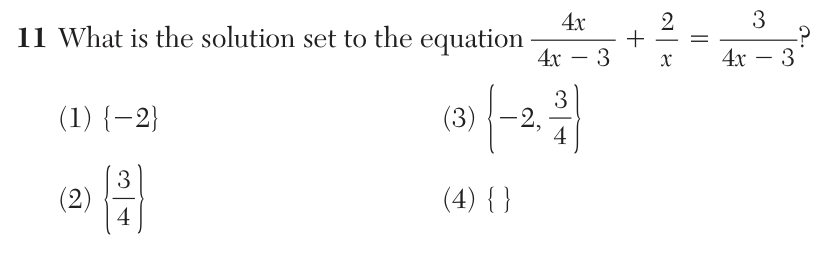
Q11 Domain restrictions
Solve 4x/(4x − 3) + 2/x = 3/(4x − 3).
Worked solution for question 11
- Exclude 0 and 3/4. Multiply through by x(4x − 3) to get 4x² + 8x − 6 = 3x.
- Factor 4x² + 5x − 6 as (4x − 3)(x + 2). The root 3/4 is excluded, leaving −2.
- Check x = −2 in the original equation. The left side is 8/11 − 1 = −3/11, which agrees with 3/(−11).
Answer choice 1{−2}
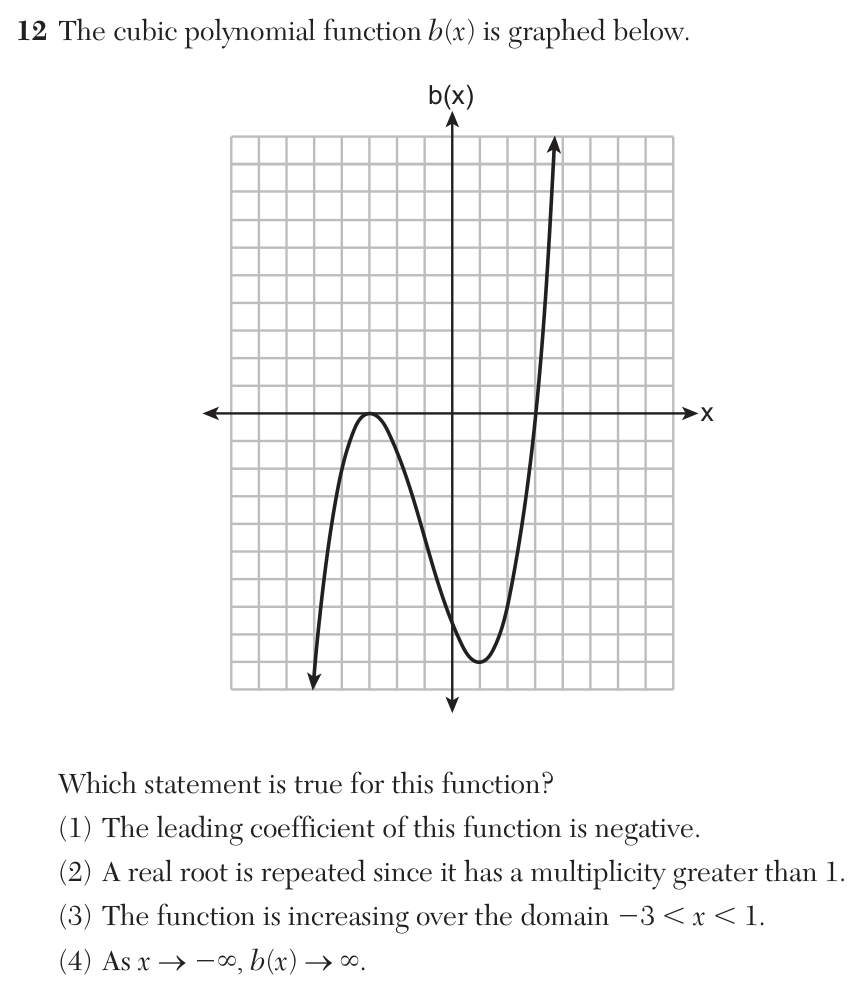
Q12 Repeated zero from a graph
Identify what the cubic’s contact with the x-axis says about a root.
Worked solution for question 12
- At the turning point on the x-axis the graph touches the axis and turns back.
- This is a zero with even multiplicity. In a cubic with another crossing, that touching zero has multiplicity 2.
Answer choice 2One real root is repeated.
Q13 Standard-position angle
Choose the radian measure for the terminal ray shown in quadrant IV.
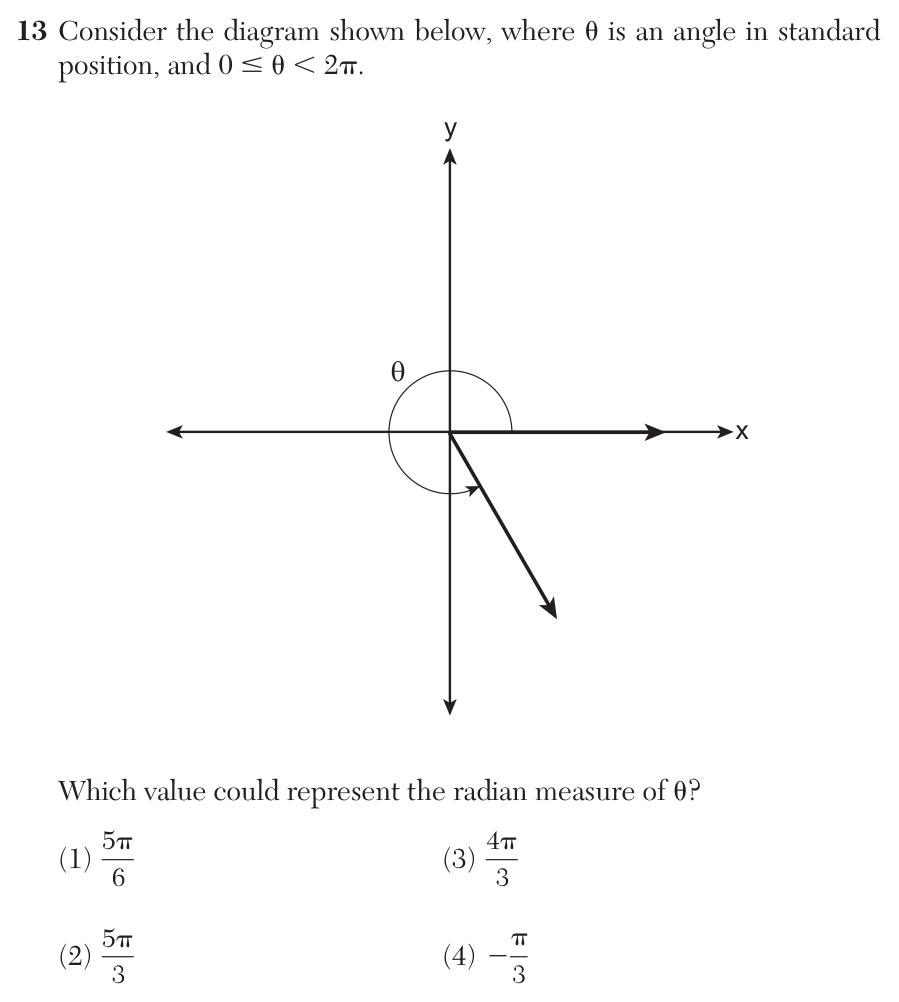
Worked solution for question 13
- The terminal ray lies in quadrant IV and makes an acute reference angle of π/3 with the positive x-axis.
- The nonnegative counterclockwise angle is 2π − π/3 = 5π/3. The coterminal angle −π/3 falls outside the required interval.
- The ray is below the positive x-axis. Its reference angle is π/3, so it takes a positive rotation of 300°, rather than the shorter clockwise rotation, to land on the same ray.
Answer choice 25π/3
Q14 Maximum and frequency
Compare the sinusoid drawn on the paper with g(x) = 2 sin(3x).
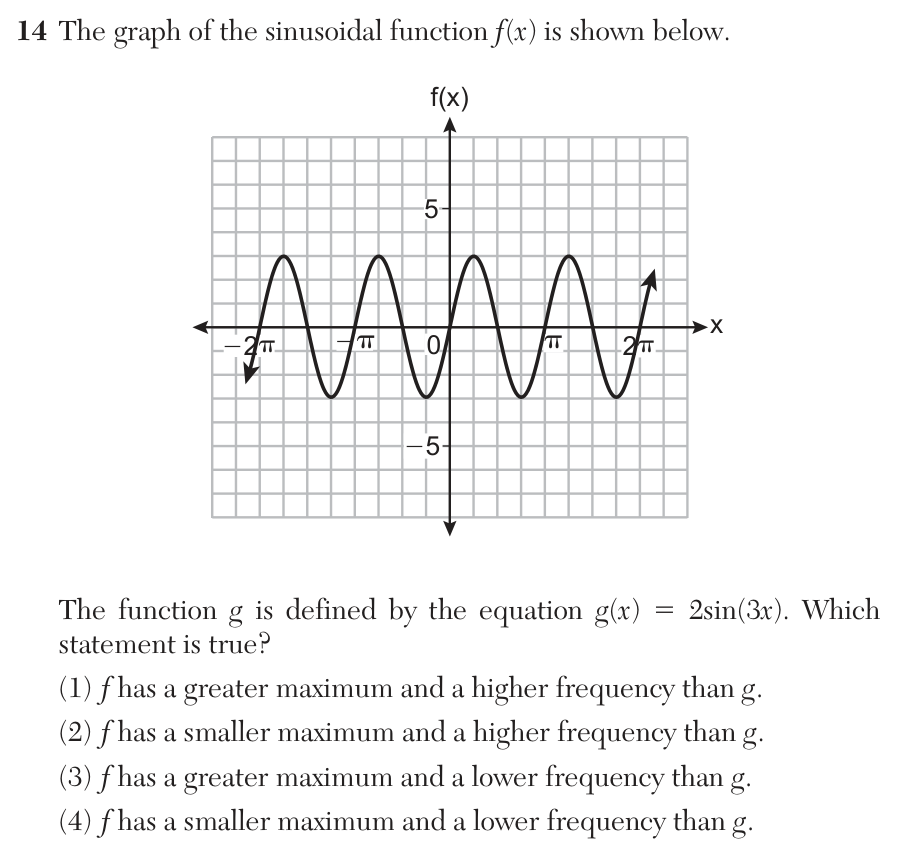
Worked solution for question 14
- The plotted f peaks at 3, while g peaks at 2.
- Consecutive peaks of f are π apart, while g repeats every 2π/3. A longer period means a lower frequency.
- Over the interval from 0 to 2π, the graph of f completes two cycles and g completes three. That is another way to see that f has the lower frequency.
Answer choice 3f has a greater maximum and a lower frequency.
Q15 Negative fractional exponent
Rewrite (1/x²)^(−3/4) for x ≠ 0.
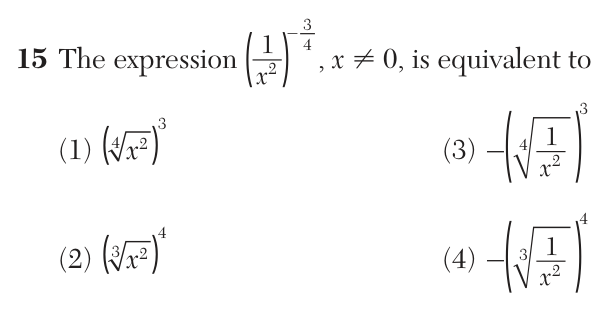
Worked solution for question 15
- Use the negative exponent to take the reciprocal of the positive base, giving (x²)^(3/4).
- The denominator of the exponent means take a fourth root, and the numerator means cube it. This form works for negative and positive x.
Answer choice 1(⁴√(x²))³
Q16 Factor a multivariable expression
Factor 3xy − 27x³y³.
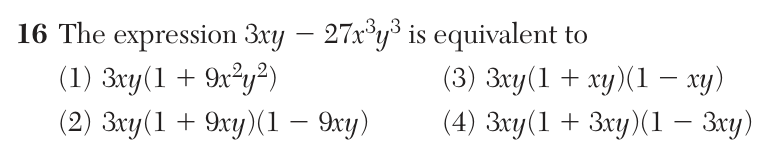
Worked solution for question 16
- First extract the greatest common factor 3xy.
- Inside remains 1 − 9x²y², a difference of the squares 1 and (3xy)².
Answer choice 43xy(1 + 3xy)(1 − 3xy)
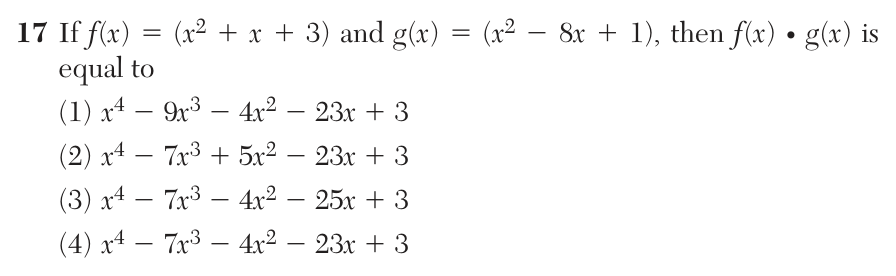
Q17 Multiply functions
Multiply (x² + x + 3)(x² − 8x + 1).
Worked solution for question 17
- Distribute the first polynomial term by term, yielding x⁴ − 8x³ + x², x³ − 8x² + x, and 3x² − 24x + 3.
- Collect by degree to obtain the product in standard form.
Answer choice 4x⁴ − 7x³ − 4x² − 23x + 3
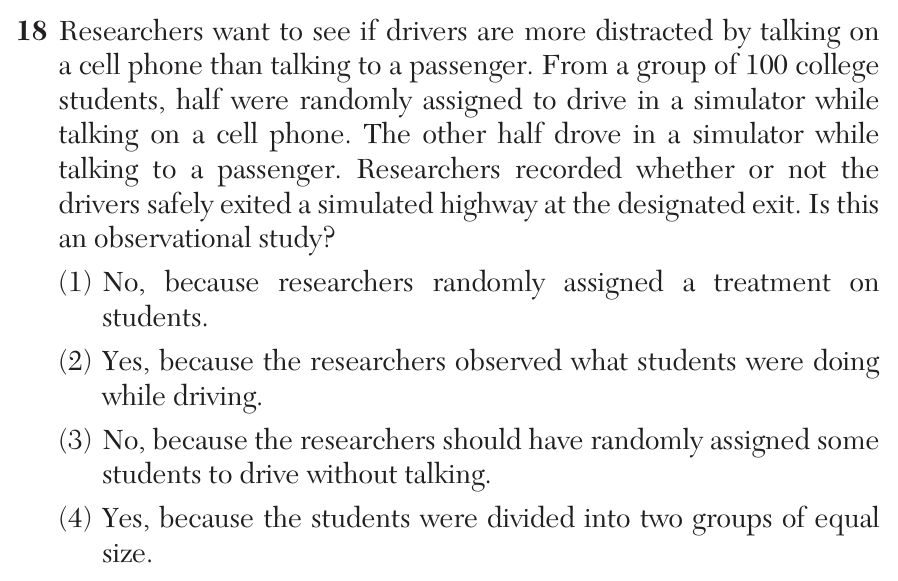
Q18 Assigned treatments
Drivers were assigned randomly to talk on a phone or to a passenger while using a simulator. Classify the study.
Worked solution for question 18
- The researchers determined the kind of conversation for each driver.
- This assignment manipulates a treatment. Observing the outcome afterward does not make the design observational.
Answer choice 1Randomized experiment
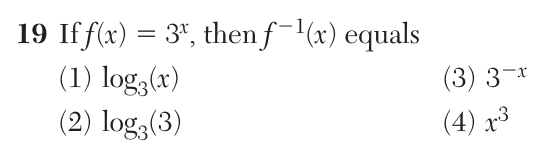
Q19 Inverse of an exponential
Find the inverse of f(x) = 3ˣ.
Worked solution for question 19
- Write y = 3ˣ and switch input and output, giving x = 3ʸ.
- Solve for the exponent with a logarithm of base 3. Its domain is the positive range of f.
Answer choice 1f⁻¹(x) = log₃(x), x > 0
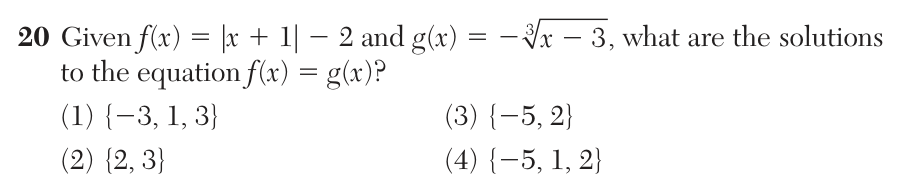
Q20 Absolute value and cube root
Solve ∣x + 1∣ − 2 = −∛(x − 3).
Worked solution for question 20
- For x ≥ −1, the left side x − 1 increases and the right side strictly decreases. They meet at x = 2, with both sides 1.
- For x < −1, let u = −x − 3. Cubing the equation gives u³ = u + 6.
- Factor u³ − u − 6 = (u − 2)(u² + 2u + 3). Only u = 2 is real, giving x = −5, where both sides equal 2.
Answer choice 3{−5, 2}
Q21 Powers of i
Simplify 3xi² − 2yi³ + 7xi⁶ − 4yi⁵.

Worked solution for question 21
- Powers of i repeat every four. Here i² = i⁶ = −1, i³ = −i, and i⁵ = i.
- The real terms sum to −3x − 7x and imaginary terms sum to 2yi − 4yi.
Answer choice 1−10x − 2yi
Q22 Odd sinusoidal function
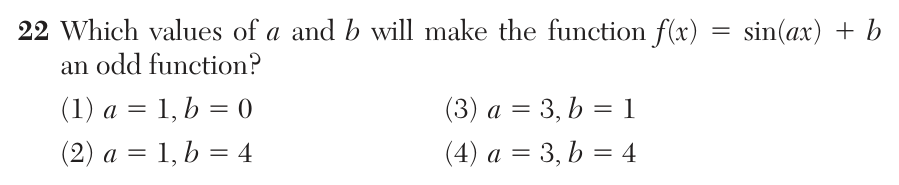
Choose a and b so f(x) = sin(ax) + b is odd.
Worked solution for question 22
- An odd function has f(0) = 0, so b must be zero.
- With no vertical shift, sin(a(−x)) = −sin(ax). The listed pair with b = 0 works.
Answer choice 1a = 1 and b = 0
Q23 Use logarithms
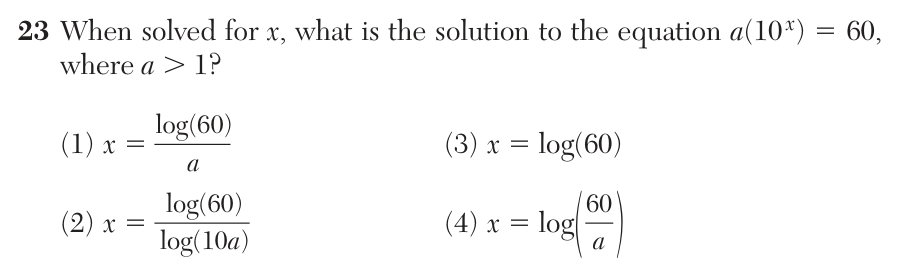
Solve a · 10ˣ = 60 for x, with a > 1.
Worked solution for question 23
- Divide by a to isolate 10ˣ = 60/a.
- Apply log base 10 to both sides to undo the exponential.
- Substitution checks the inverse relationship: a · 10 raised to log₁₀(60/a) equals a(60/a) = 60. The condition on a keeps 60/a positive.
Answer choice 4x = log₁₀(60/a)
Q24 Convert half-life to hourly decay
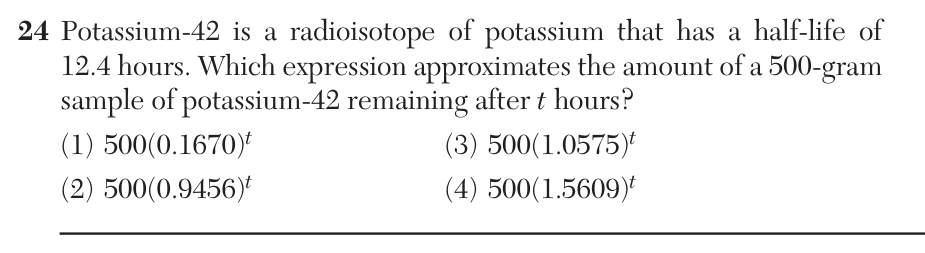
A 500-gram sample has a half-life of 12.4 hours. Choose its hourly decay model.
Worked solution for question 24
- After t hours, t/12.4 half-lives have elapsed. The model is 500(1/2)^(t/12.4).
- The hourly multiplier is (1/2)^(1/12.4) ≈ 0.9456, which is between 0 and 1.
Answer choice 2500(0.9456)ᵗ
Part II Short response
Question indexQ25 Evaluate a recurrence
Find a₃ when a₁ = 5 and aₙ = (aₙ₋₁)² + 4.

Worked solution for question 25
- Use the starting value to compute a₂ = 5² + 4 = 29.
- Feed a₂ back into the recurrence, giving a₃ = 29² + 4 = 845.
Final answer845
Q26 Tuition exponential regression
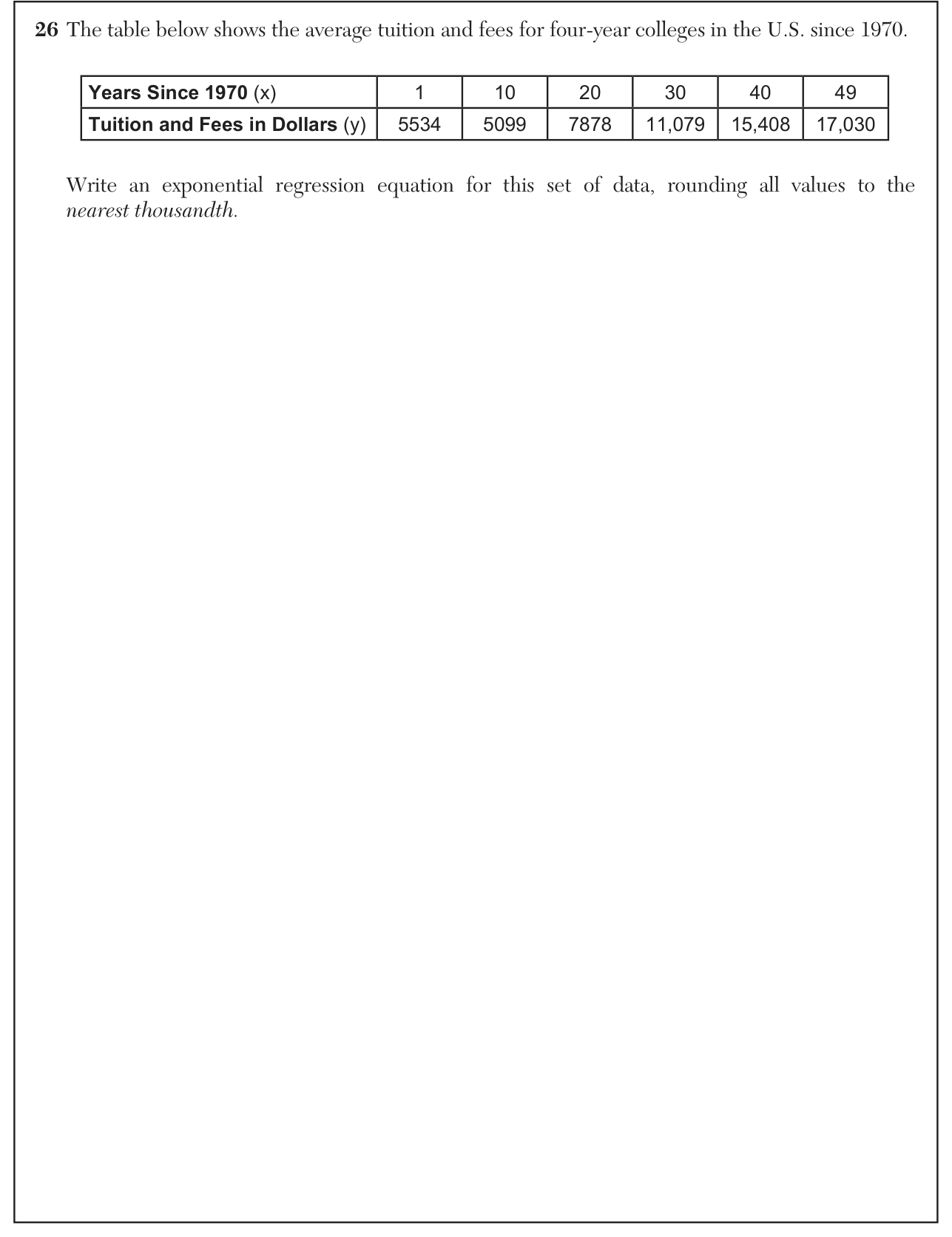
Use the tuition data to fit y = a · bˣ, rounding both coefficients to thousandths.
Worked solution for question 26
- Enter years since 1970 as 1, 10, 20, 30, 40, 49. Pair them with 5534, 5099, 7878, 11079, 15408, 17030 dollars.
- Run exponential regression and round the fitted starting amount and multiplier to three decimal places.
- NYSED’s clarification permits the coefficient as truncated to two decimals on affected calculators. The base still rounds to 1.028.
- The rounded model starts at 4686.771 dollars when x = 0, or the year 1970. This starting value is fitted to the whole dataset, so it does not have to match the first observed tuition.
Final answerŷ = 4686.771(1.028)ˣ
Q27 Polynomial remainder
Find the remainder when 3x³ − 2x + 5 is divided by x − 2.

Worked solution for question 27
- The remainder theorem gives f(2).
- Evaluate 3(8) − 2(2) + 5 = 24 − 4 + 5.
- The divisor is x − 2, so substitute positive 2. The question asks for the remainder, which you can find without determining the quotient.
Final answer25
Q28 Empirical rule
For mean 8 hours and standard deviation 1 hour, label μ ± kσ for k = 0, 1, 2, 3 and give the central 68% interval.
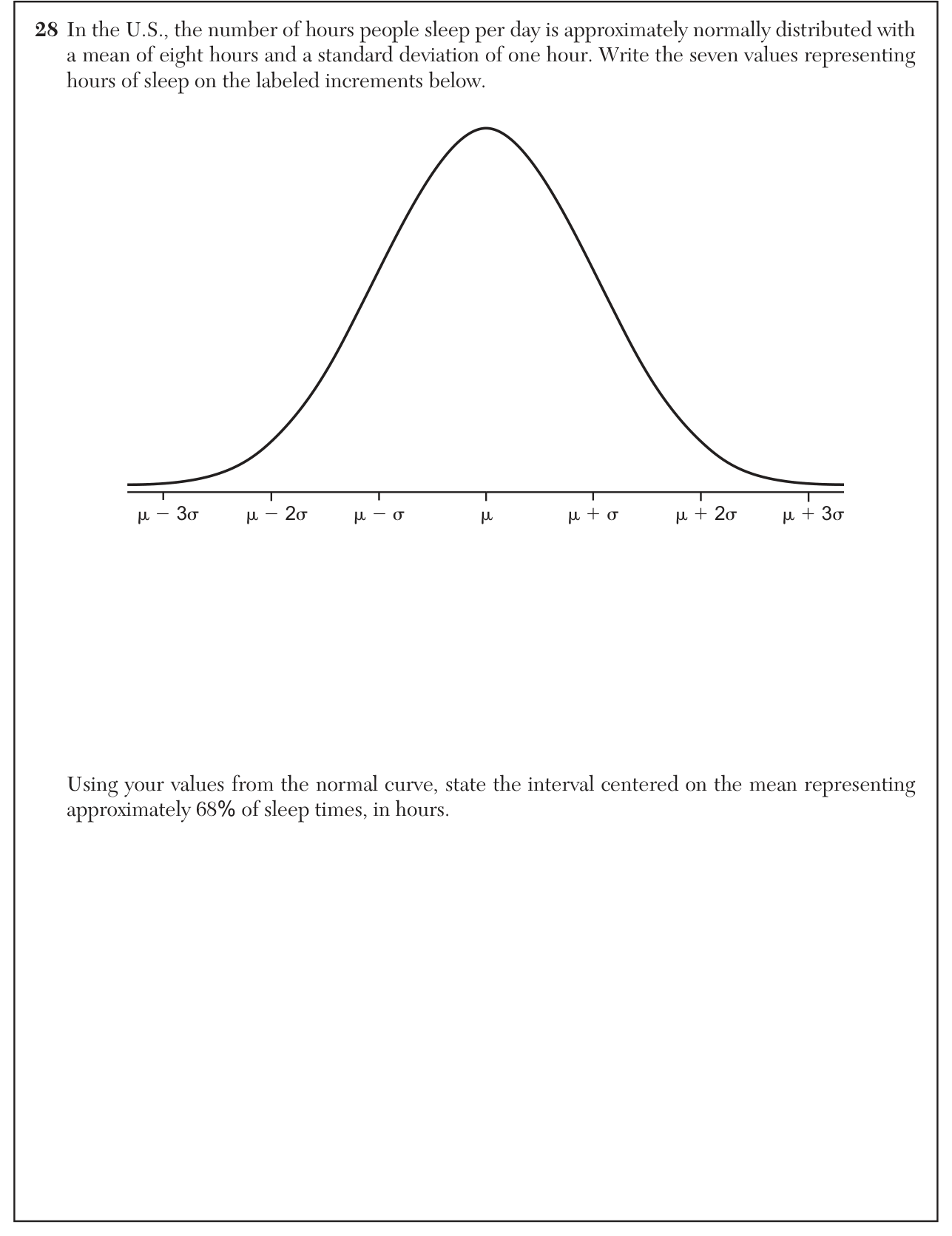
Worked solution for question 28
- Move in one-hour steps to the left and right of 8 to label the normal curve.
- Approximately 68% of a normal distribution lies within one standard deviation of the mean.
Final answerLabels 5, 6, 7, 8, 9, 10, 11. Central interval 7 to 9 hours.
Q29 Sketch a cubic
Sketch a cubic with zeros −3, 2 and 5 and relative maximum near (−1, 9) as indicated.
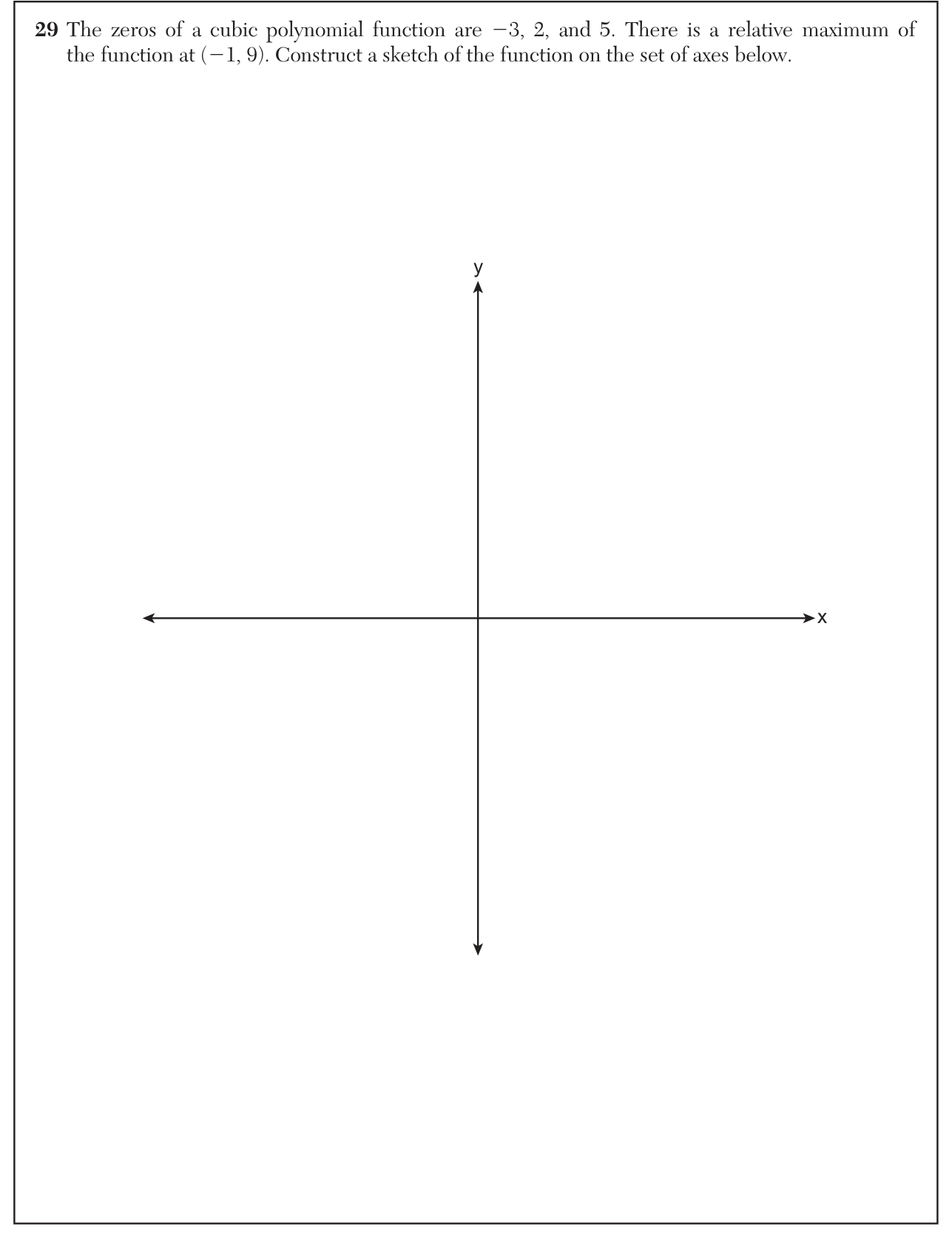
Worked solution for question 29
- Mark the three x-intercepts and the given peak. To have a positive lobe between −3 and 2, the curve crosses upward at −3 and downward at 2.
- Draw the local minimum below the axis between 2 and 5. Cross upward again at 5 and continue upward on the right.
- The polynomial (x + 3)(x − 2)(x − 5)/2 is a useful guide for a hand sketch. It goes through the three intercepts and reaches its peak close to (−1, 9), the turning point marked for the sketch.
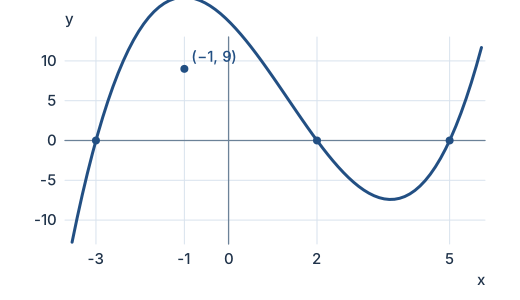
Final answerCubic crossing all three zeros with left tail down and right tail up
Q30 Tangent from cosine
Given cos θ = 7/12 and sin θ < 0, find tan θ exactly.

Worked solution for question 30
- Cosine positive and sine negative place θ in quadrant IV. Then sin θ = −√(1 − 49/144) = −√95/12.
- Divide sine by cosine and cancel the denominator 12.
Final answer−√95/7
Q31 Complex square roots
Solve 6x² + 50 = 2 over the complex numbers.

Worked solution for question 31
- Subtract 50 and divide by 6 to obtain x² = −8.
- Take both square roots. Since i² = −1 and √8 = 2√2, the solutions are ±2i√2.
Final answerx = ±2i√2
Q32 Simplify a rational expression
Reduce (x³ + 64)/(2x² + 7x − 4) on its original domain.

Worked solution for question 32
- Factor the sum of cubes as (x + 4)(x² − 4x + 16).
- Factor the denominator as (x + 4)(2x − 1) and record its zeros. Cancel x + 4 only for inputs in the original domain.
Final answer(x² − 4x + 16)/(2x − 1), with x ≠ −4 and x ≠ 1/2
Part III Extended response
Question indexQ33 Probability and independence
Of 312 adults, 78 prefer ebooks. Among 168 aged 27–58, 42 prefer ebooks. Find both probabilities and test independence.
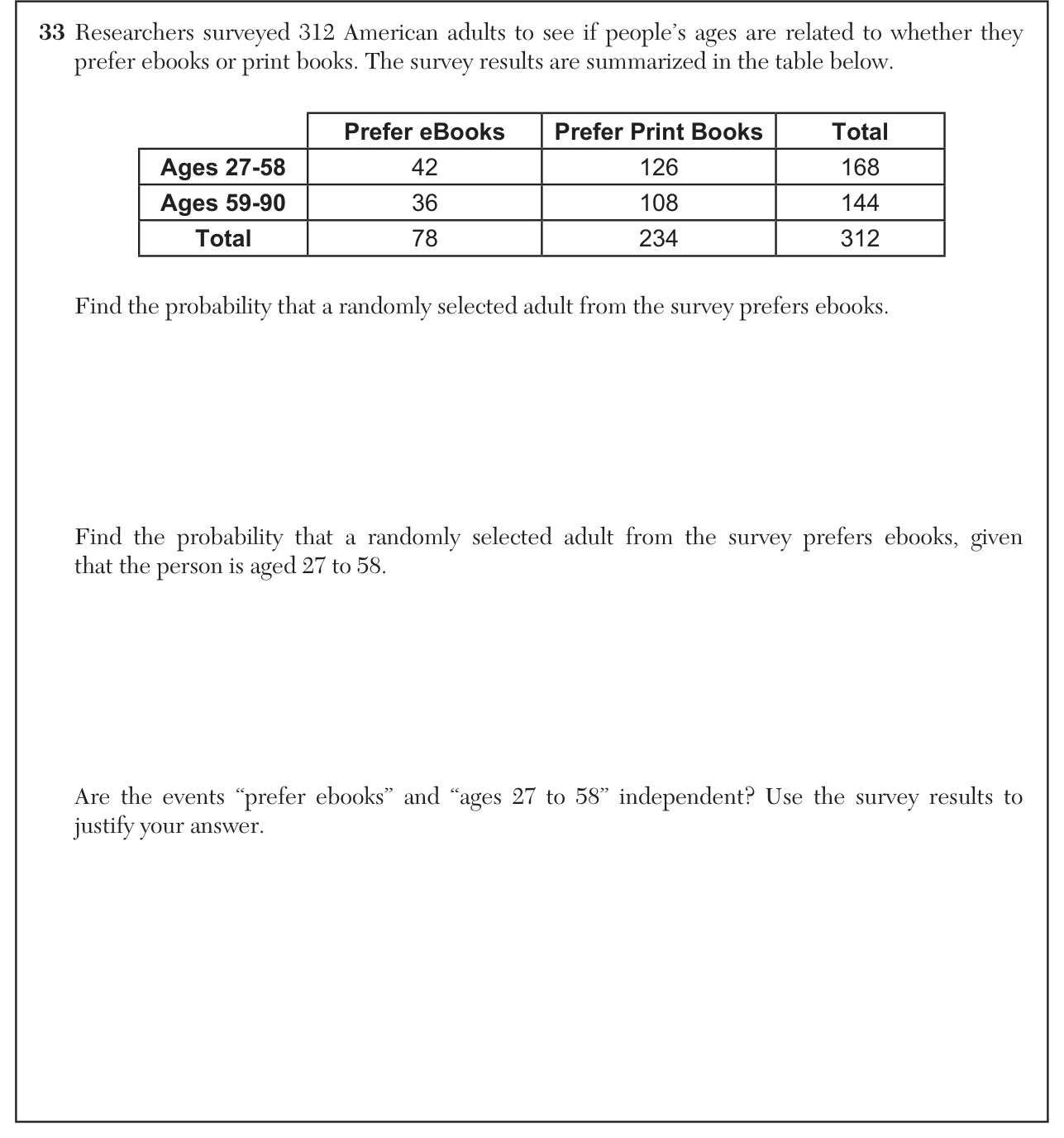
Worked solution for question 33
- The overall probability is 78/312 = 0.25.
- Condition on age 27–58 to get 42/168 = 0.25.
- Since the conditional probability equals the overall probability, knowing the age group does not change the ebook preference probability in this sample.
Final answerBoth probabilities equal 1/4. The events are independent in the survey.
Q34 Monthly compounding
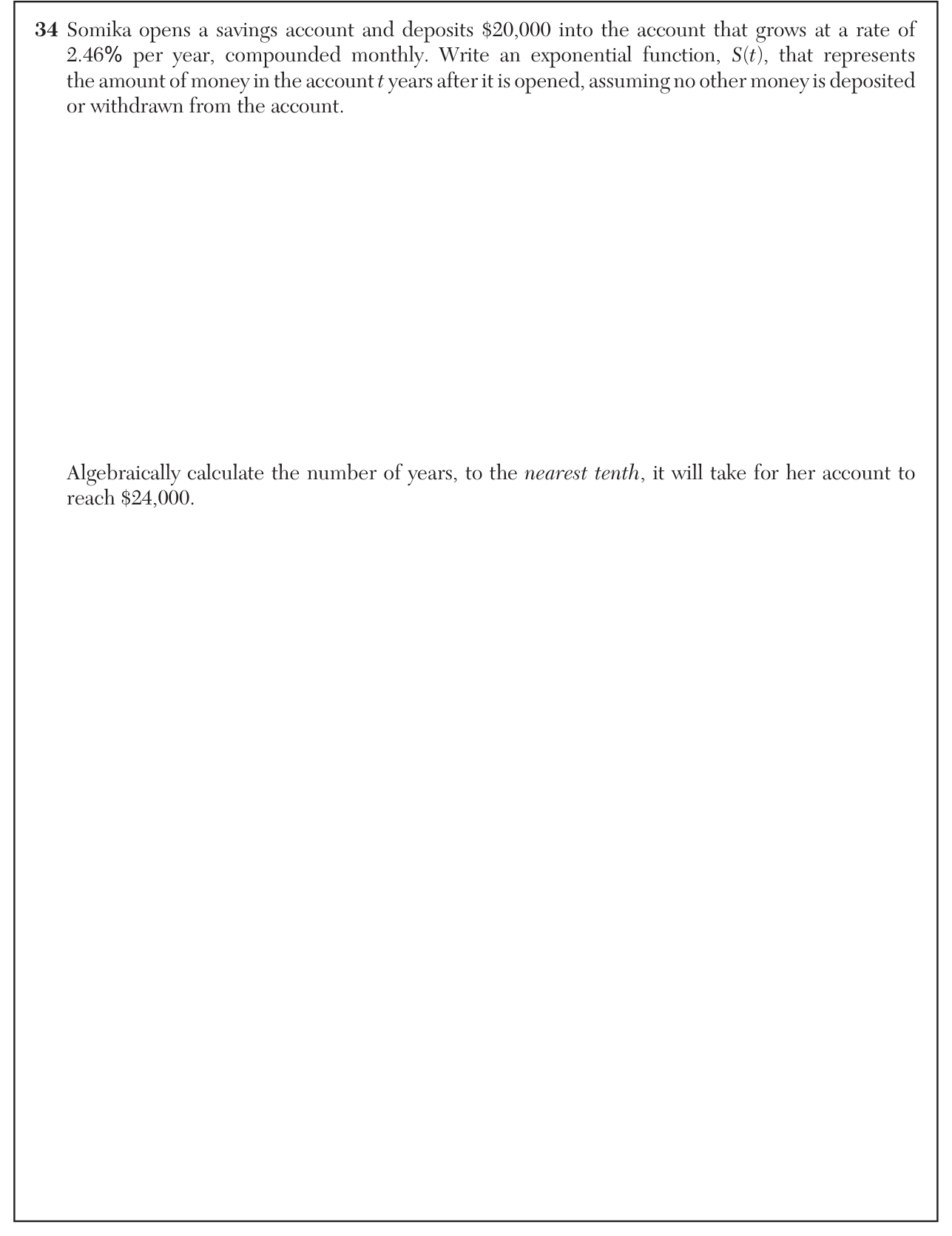
Invest 20,000 dollars at 2.46% annual interest compounded monthly. Model the balance and find when it reaches 24,000 dollars.
Worked solution for question 34
- The monthly interest rate is 0.0246/12 = 0.00205. There are 12t compounding periods in t years.
- Divide the target balance by 20,000 to get (1.00205)^(12t) = 1.2.
- Take logs and solve t = ln(1.2)/(12 ln(1.00205)) ≈ 7.4.
Final answerS(t) = 20,000(1.00205)^(12t). About 7.4 years.
Q35 Solve a radical equation
Solve √(x + 4) − √(3x) = −2.

Worked solution for question 35
- Require x ≥ 0. Isolate √(3x) = √(x + 4) + 2 and square to get 3x = x + 8 + 4√(x + 4).
- Rearrange to (x − 4)/2 = √(x + 4), so x ≥ 4. Squaring gives x² − 12x = 0.
- Reject 0. Check 12 in the original: 4 − 6 = −2.
Final answerx = 12
Part IV Long response
Question indexQ36 Model lung capacity
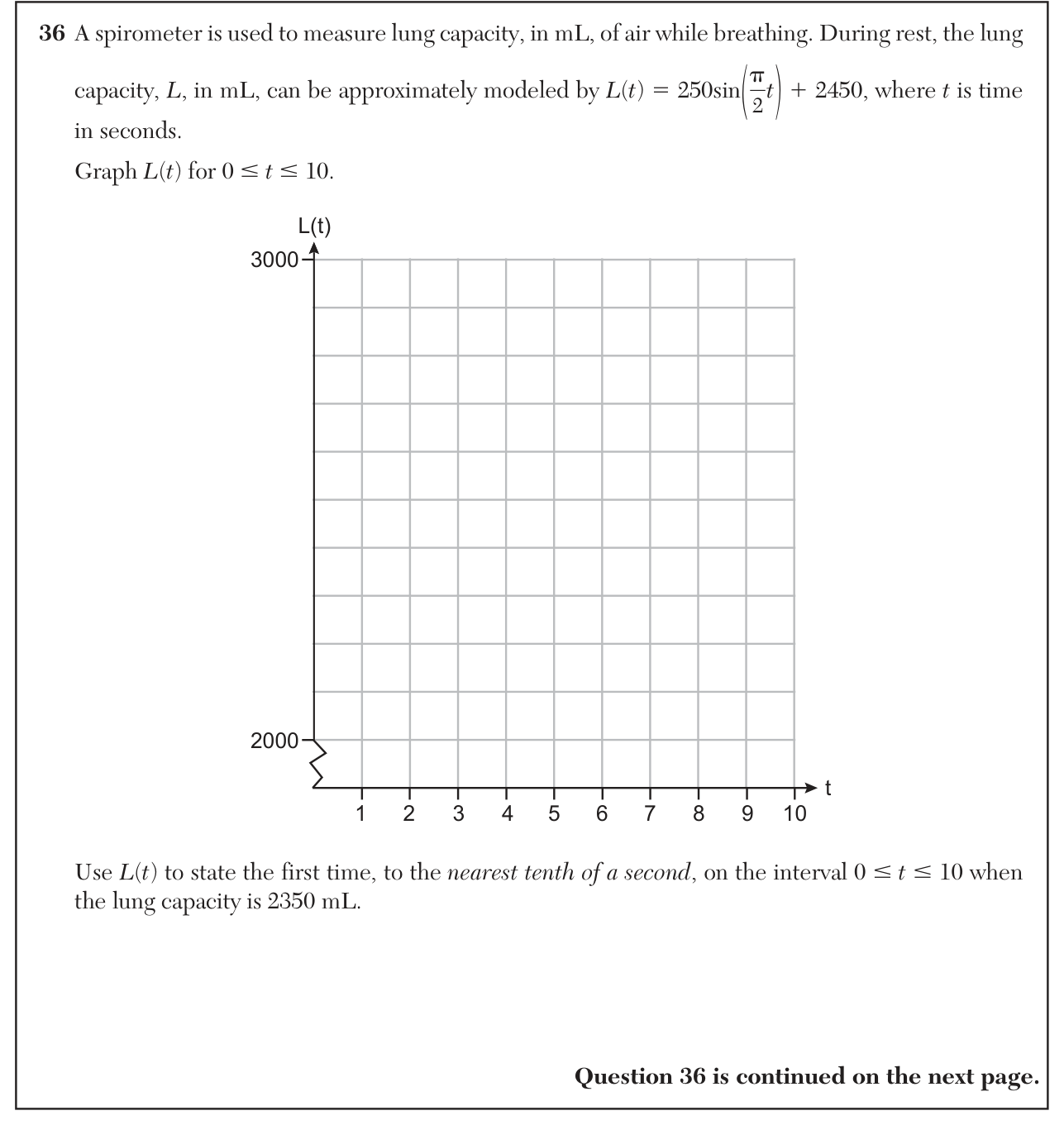
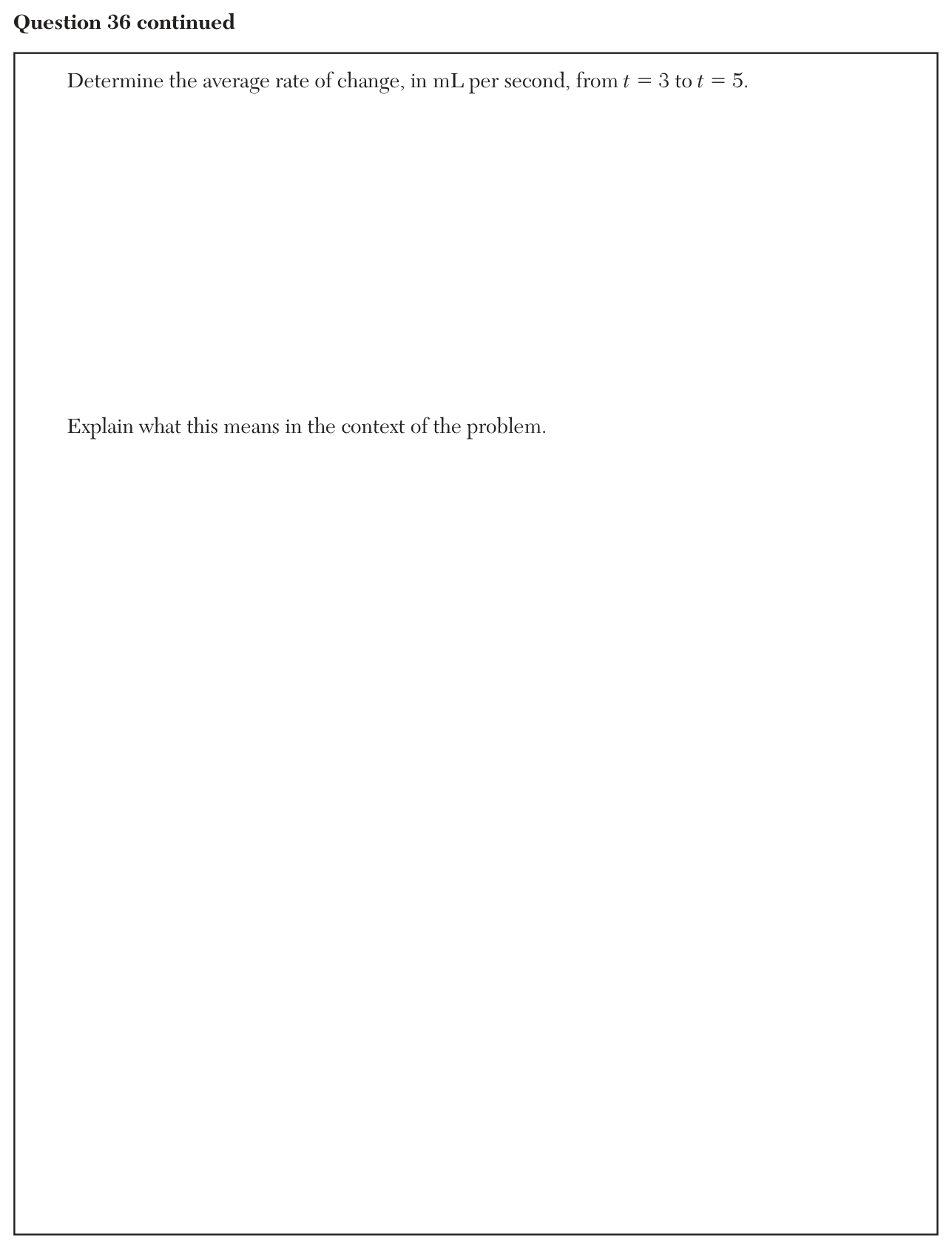
Graph L(t) = 250 sin(πt/2) + 2450 for 0 ≤ t ≤ 10. Find the first time at 2350 mL and the average change from 3 to 5 seconds.
Worked solution for question 36
- The period is 4. Plot (0, 2450), (1, 2700), (2, 2450), (3, 2200), and (4, 2450), then repeat the smooth pattern through t = 10.
- The first 2350 crossing is on the downswing after t = 2. Solving sin(πt/2) = −0.4 there gives t = 2 + (2/π)arcsin(0.4) ≈ 2.3.
- L(3) = 2200 and L(5) = 2700. Divide their difference by 2. Lung capacity increased by an average of 250 mL per second over that interval.
- The 250 mL/s rate describes only the net increase between the two endpoints. Over that interval the actual sinusoidal rate changes as the lung volume rises.
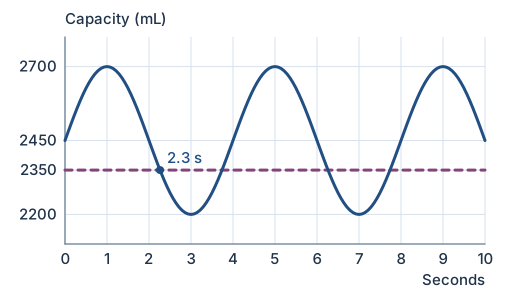
Final answerFirst at about 2.3 seconds. Average rate +250 mL per second.
From the New York State Education Department. June 2026 Algebra II Regents Examination. Internet. Available from https://www.nysedregents.org/algebratwo/626/algtwo-62026-exam.pdf. Accessed .