FLORIDA B.E.S.T. · 2026–27
Geometry EOC
Complete Study Guide
Understand the theorem. Show the reasoning. Check the answer. Build your Geometry revision around clear explanations, original practice and the next skill you need to improve.
31 chapters · 349 study topics · 6 original 48-question forms
PART 1 · CHAPTER 1
1. Geometry EOC Exam Overview
Back to contents ↑1.1 What Is the Florida Geometry EOC?
The Florida Geometry End-of-Course assessment checks the mathematics taught in the state’s Geometry course. Think of it as a course-wide reasoning assessment: you need to interpret diagrams, connect properties and justify a method, not just recall a list of formulas. This guide covers the B.E.S.T. version used for the 2026–27 school year.
1.2 What Does B.E.S.T. Stand For?
B.E.S.T. means Benchmarks for Excellent Student Thinking. A benchmark describes a mathematical skill, while a reporting category groups related skills for the test blueprint. A lesson heading such as “circle theorems” can support several benchmarks; knowing the code is less important than being able to apply the underlying relationship in a new problem.
1.3 Who Must Take the Geometry EOC?
Students completing a corresponding Geometry course participate in its EOC assessment. Eligibility follows the course and applicable participation rules, not simply the student’s age. If you transferred schools, already earned credit, are using credit acceleration or have a documented assessment exemption, ask your school assessment coordinator to confirm your individual requirement before planning a test date.
1.4 Geometry EOC vs. Algebra 1 EOC
Geometry and Algebra 1 are separate assessments with different content. Algebraic manipulation still appears throughout Geometry, but the mathematical goal often concerns figures, transformations, measurements or proof. Passing Algebra 1 is a standard-diploma assessment requirement; Geometry has its own course-grade and Scholar designation roles. A strong Geometry result can also have a comparative-score role for eligible students.
1.5 Geometry EOC vs. FAST Mathematics
FAST Mathematics measures grade-level mathematics in grades 3–8 through progress-monitoring administrations. The Geometry EOC measures a high-school course. Do not use a FAST grade-level score chart to interpret a Geometry score, and do not assume their testing times or question counts are identical. Use the name printed on your current assessment report.
1.6 Geometry EOC for Middle School and High School Students
A middle school student completing Geometry takes the corresponding course assessment under the applicable participation rules. That does not create a separate, easier middle-school Geometry test. Ask the school how the course credit, EOC result and mathematics testing schedule will be recorded, especially when the course is taken early or through a different provider.
1.7 Geometry EOC and Geometry Honors
Geometry and Geometry Honors use the Geometry EOC, rather than separate regular and honors EOC examinations. An honors class can study additional depth, but the state test follows its published assessment blueprint. Match revision to the assessed benchmarks while continuing to meet your teacher’s expectations for course assignments, explanations and classroom assessments.
1.8 How the Geometry EOC Affects Your Course Grade
For the applicable standard-diploma course requirement, the Geometry EOC contributes 30% of the final course grade. This does not mean that a scale score such as 410 is a percentage. Your district supplies the conversion and grade-calculation procedures. Ask how the EOC component combines with classroom grades rather than trying to multiply a scale score by 0.30.
1.9 Geometry EOC and Florida Graduation Requirements
Geometry course credit is part of the standard mathematics credit requirements, but passing the Geometry EOC is not the same universal standard-diploma passing requirement as Algebra 1. The result still matters for the course grade. Transfer, disability and cohort-specific provisions can affect individual situations; check your graduation plan with a school counselor rather than assuming one rule covers every pathway.
1.10 Geometry EOC for Scholar Diploma Designation
For students in the applicable cohorts pursuing the Scholar designation, passing Geometry is an additional requirement. The current B.E.S.T. Level 3 threshold is 404. Older provisional or alternate passing provisions concern specifically eligible earlier test takers; do not treat an older 401 or 499 figure as the general 2027 threshold. Ask your counselor which designation and assessment rules apply to you.
PART 1 · CHAPTER 2
2. Geometry EOC 2027 Exam Format
Back to contents ↑2.1 Geometry EOC Exam Structure
Prepare for one computer-based, computer-adaptive Geometry session. The assessment draws items to meet the blueprint while adjusting difficulty using the response information available. It is not a fixed paper in which every classmate necessarily receives the same questions. Our practice tests are fixed original study sets, so use them to rehearse skills rather than reproduce the state’s adaptive system.
2.2 Total Number of Questions
The published design gives an approximate range of 45–50 items. That range includes experimental items when they are administered; students should work carefully on every question because the screen does not identify which items contribute to the score. Do not plan to skip a certain number of “unscored” questions or expect an identical count in every practice resource.
2.3 Time Limit and Testing Breaks
The scheduled session is 160 minutes, with a short break after the first 80 minutes. Students who need additional time may continue up to the length of a typical school day under the administration directions. Practise steady pacing, but follow your administrator’s break and dismissal instructions rather than assuming a home practice timer changes the school’s rules.
2.4 Computer-Adaptive Testing Explained
Adaptive testing selects questions using more than the previous answer: the assessment also has content and design constraints. A difficult-looking item does not prove that you are passing, and an easier-looking item does not prove failure. Focus on the question in front of you. The readiness tools in this guide do not emulate the operational item-selection or scoring algorithm.
2.5 Multiple-Choice Questions
For a single-answer multiple-choice item, identify the requested quantity before inspecting distractors. Solve independently when practical, then match the answer and its units. If a radius is given but an option uses the diameter as though it were the radius, the option can look familiar while representing a different calculation. Choose one response when the item requests one.
2.6 Multi-Select Questions
A multi-select item can require more than one valid response. Test each statement against the givens instead of stopping after the first true option. Read any instruction specifying a number of selections. For study purposes, our multi-select questions use all-or-nothing scoring so an extra incorrect selection is visible in your feedback; that is our practice rule, not a claim about every state item.
2.7 Technology-Enhanced Questions
Enhanced items can use selections, matching, editing, graphing or constructed entries. The mathematics still comes first: determine what the completed statement or diagram must represent, then use the response control. A correct idea can be entered incorrectly if you overlook which cells, points or choices are selected. Rehearse the interaction as well as the calculation.
2.8 Equation Editor and Graphing Questions
Before entering an equation, decide whether the response needs a value, an expression or a complete equation. Use parentheses to preserve grouping and check whether an exponent or negative sign applies to the whole term. In graphing tasks, distinguish plotting a point from drawing a line or selecting a region. Our equation and coordinate practice is a study approximation, not the secure testing interface.
2.9 Calculator Rules and Approved Calculators
An online scientific calculator is provided. A handheld scientific model must meet the current state and district rules; a graphing calculator is not automatically acceptable. Published examples include TI-30Xa, Casio fx-260 solar, Casio fx-82 solar, Sharp and EL-510RN. Confirm your specific device with the school, and practise degree mode, inverse trig, powers, square roots and parentheses.
2.10 Geometry EOC Reference Sheet
A reference sheet is available in the testing platform. It supplies selected formulas and conversions, but it does not choose the right relationship or explain a proof. Practise locating a formula, defining each variable and deciding which measurements belong in it. The printable study sheet in this guide is independently written and is not permission to bring personal notes into the assessment.
2.11 Online Testing Tools and Work Folders
Computer-based work folders support written calculations and diagrams. Use a consistent system: record the item number, sketch the essential information and box the quantity you will enter. Learn the platform’s available tools through your school’s sample-item practice. Do not assume a personal notebook, phone or the study tools on this page can be used during the secure assessment.
2.12 Testing Accommodations
Allowable accommodations depend on the applicable plan and administration guidance. Some students use approved computer supports or paper-based formats; English language learners can also qualify for designated accommodations. Discuss arrangements early with the school rather than improvising on test day. Practise with the supports you are actually authorized to use so the mathematical task and response process feel familiar.
PART 1 · CHAPTER 3
3. Geometry EOC Dates, Scores & Passing Requirements
Back to contents ↑3.1 Florida Geometry EOC 2027 Testing Windows
The published 2026–27 schedule places spring Geometry EOC testing in May 3–28, 2027. The summer schedule lists June 21–25 and July 12–16, 2027. These are administration windows, not the length of the exam and not a promise that your school offers every date. The winter EOC window is November 30–December 18, 2026. Confirm the selected day locally.
3.2 How to Find Your School's Exact Exam Date
Start with your school’s assessment calendar or contact its testing coordinator. Confirm the date, arrival time, room, permitted materials and make-up arrangements. If a district calendar shows a broad window, you still need a school-specific appointment. Put the confirmed information in your revision planner and recheck it after a school announcement or schedule change.
3.3 Geometry EOC Scale Scores
Geometry is reported on a B.E.S.T. scale from 325 to 475. Scale scores place performance on the assessment’s reporting scale; they are not the number of correct items and not classroom percentages. Keep the test name, school year and score scale together when comparing reports. A result on the older FSA scale should not be inserted into a current B.E.S.T. chart.
3.4 Achievement Levels 1–5
The current Geometry ranges are Level –384; Level –403; Level –422; Level –431; Level –475. Level 3 represents on-grade-level performance. Read the category feedback too: two students with the same overall level can need different practice in proof, transformations or measurement. The scale interpreter below uses these ranges only for an actual reported scale score.
3.5 What Is a Passing Geometry EOC Score?
The current Level 3 minimum is 404. What “passing” must accomplish depends on the purpose: distinguish an achievement threshold, a course-grade contribution, a comparative-score use and the Scholar designation. Do not confuse meeting a test threshold with automatically earning course credit or completing every graduation requirement. Your school can confirm how your reported result is applied.
3.6 What Percentage Is Needed to Pass?
There is no universal public rule such as “60% always equals 404.” Adaptive forms can differ and operational scoring is not a simple percentage conversion. A practice percentage tells you how you performed on that particular set. Use errors by skill and repeat independent practice; do not treat an unofficial raw-to-scale chart as a guaranteed passing calculation.
3.7 How Computer-Adaptive Scoring Works
An adaptive assessment uses calibrated items and a defined scoring model to estimate performance. The difficulty and information supplied by responses matter, so a home-made count of correct answers cannot reconstruct an official scale score. This guide records transparent practice accuracy and category results. It does not claim access to state item parameters or a student’s secure test form.
3.8 Geometry EOC Score Calculator: What It Can and Cannot Predict
Use the tools below in two different ways: enter an actual scale score to identify its achievement range, or review practice accuracy to plan study. Neither function predicts a secure future result. A practice set is useful when its errors reveal a missing theorem, weak algebra or a response-entry problem; a precise-looking unofficial pass probability would not establish readiness.
3.9 How to Check Geometry EOC Results
Schools receive results through the Florida Reporting System, and families access results through the Family Portal using the school’s access process. Ask your school for help with access credentials or a missing report. Results may be available to school users promptly after testing, while family-facing release and notification can follow local procedures. A school report is the source for your actual score.
3.10 What Happens If You Fail the Geometry EOC?
A result below the required achievement threshold does not by itself answer every credit or graduation question. Review the course-grade calculation, your designation goal and any applicable retake or support arrangements with your counselor. Then identify whether your main difficulty was content, timing or entering responses. Build the next study cycle from that diagnosis rather than repeating the same unfocused revision.
3.11 Geometry EOC Retakes
Retake eligibility and scheduling depend on the reason for testing and the school’s arrangements. Examples include improving a course grade through an applicable grade-forgiveness process or meeting a Scholar requirement. Ask which administration is available and how a new result would be used. Do not assume that registering for any later window automatically replaces an existing course grade.
3.12 Geometry EOC Score Improvement Strategies
Compare errors across at least two fresh practice sets. Choose one recurring skill, study a worked explanation, solve a new version independently and revisit it after a gap. Track whether you can explain the first decision, not only whether you recognize an answer. Mix repaired skills with older ones so improvement transfers to unfamiliar questions.
PART 1 · CHAPTER 4
4. Florida B.E.S.T. Geometry EOC Blueprint
Back to contents ↑4.1 Official B.E.S.T. Mathematics Standards
The assessment blueprint identifies tested benchmarks and their reporting categories. This guide maps every benchmark entry shown in the published Geometry blueprint, including entries marked “also assesses,” to a study chapter and original practice. A broad textbook chapter can include supporting material beyond a named benchmark. Use the mapping to keep the tested mathematics central without discarding prerequisites.
4.2 Reporting Category 1: Logic, Relationships, and Theorems
Logic, Relationships, and Theorems accounts for 33–40% of the blueprint. Prioritise properties of figures, angle and circle relationships and the reasoning that connects givens to conclusions. A memorised statement is useful only when its conditions hold. In practice, write the theorem and the specific facts that allow you to apply it before solving for a missing measurement.
4.3 Reporting Category 2: Congruence, Similarity, and Constructions
Congruence, Similarity, and Constructions accounts for 27–33%. Learn how transformations, matching parts and construction steps establish a relationship, rather than relying on a diagram’s appearance. A scale change preserves shape but not generally size. A rigid motion preserves both. In a proof question, the correspondence and sufficient conditions matter as much as the final congruence or similarity symbol.
4.4 Reporting Category 3: Measurement and Coordinate Geometry
Measurement and Coordinate Geometry accounts for 33–40%. Work on distance, slope, circle equations, right-triangle trigonometry, area, surface area, volume and contextual models. Keep algebra and units visible. These problems often require several decisions before the arithmetic, such as finding a hidden height or identifying which faces are exposed on a composite solid.
4.5 Official Benchmark Codes and Coverage
Benchmark codes organise standards; they are not a set of separate question promises. The mapping table below reproduces the code inventory and distinguishes primary entries from supporting “also assesses” entries. Each row points to a chapter, a practice task and a review checkbox. These are independent study connections, not an official item-by-item prediction for your test.
4.6 How to Identify High-Priority Topics
Start with the category ranges, then adjust practice using evidence from your own work. A useful default cycle is 11 logic/theorem questions, 9 congruence/similarity questions and 10 measurement questions in a 30-question week. Change the balance when one area is clearly weaker. Do not use percentages to decide that an entire category can be skipped.
4.7 Geometry EOC Difficulty and Cognitive Demand
Difficulty is not just the size of a number. A short proof can demand more reasoning than a long substitution exercise. Practise recognizing a relationship, explaining why it applies, combining two methods and evaluating a model. Our labels “foundation,” “intermediate” and “advanced” describe local study sets; they are not official state cognitive-demand ratings for operational items.
4.8 Complete Standards-to-Practice-Question Mapping
Use the benchmark table as a route from standard to action: open the linked chapter, attempt its mapped original question, explain the solution and record a review. Several rows can share a question when a task connects standards. A completed checkbox means you reviewed that benchmark here; mastery requires fresh independent work and a delayed check.
All 35 blueprint entries: study and original-practice connections
The 31 primary entries and four supporting “also assesses” entries below follow the published blueprint inventory. Chapter and question links are OnlyPrepy study connections. “Reviewed” records your review on this browser; it is not a mastery certification.
0 of 35 benchmark entries reviewed
PART 2 · CHAPTER 5
5. Geometry Fundamentals and Mathematical Logic
Back to contents ↑5.1 Points, Lines, Planes, Rays and Segments
A point names a position; a line extends without end in two directions; a plane extends in two dimensions. A ray has one endpoint, while a segment has two. Distinguish the segment AB from its length. Three non-collinear points determine a plane; a sketch of a plane’s boundary does not mean the plane stops there.
5.2 Geometry Symbols and Notation
Read notation before using it. Segment AB, line AB and ray AB represent different objects. usually denotes a length, while has vertex B. Congruence concerns equal shapes or measures; parallel and perpendicular symbols assert specific relationships. Never infer a right angle, equal length or parallelism from visual appearance alone when it is not given or established.
5.3 Angle Classification and Measurement
An acute angle is between and , a right angle is , an obtuse angle lies between and , and a straight angle is . A reflex angle exceeds but is below . Identify which region the question means: two rays can describe a smaller angle and a larger turn.
5.4 Segment and Angle Addition Postulates
When B lies between A and C, . When a ray lies inside an angle, its two adjacent angle measures sum to the whole. The “between” or “inside” condition matters. Example: if , and , then , so and .
5.5 Conditional Statements: If–Then
A conditional has a hypothesis and a conclusion: “If P, then Q.” Its truth does not assert that Q can occur only when P occurs. Example: if a figure is a square, then it is a rectangle. This statement remains true even though many rectangles are not squares. Translate the direction before deciding which fact a proof allows.
5.6 Converse, Inverse and Contrapositive
For “if P then Q,” the converse is “if Q then P,” the inverse is “if not P then not Q,” and the contrapositive is “if not Q then not P.” The original and contrapositive are logically equivalent; the converse and inverse are equivalent to each other. The converse of a true statement need not be true.
5.7 Biconditional Statements
A biconditional joins a conditional and its converse using “if and only if.” Both directions must hold. “A triangle is equilateral if and only if it is equiangular” is an example in Euclidean geometry. To disprove a proposed biconditional, it is enough to find a counterexample to either direction; checking only the forward statement is incomplete.
5.8 Inductive and Deductive Reasoning
Inductive reasoning notices a pattern and suggests a conjecture. Deductive reasoning derives a conclusion from definitions, givens and valid implications. Seeing that several measured triangles have angle sum near is evidence for a conjecture, not a proof for every triangle. A deductive angle-sum argument can use a parallel through a vertex and alternate interior angles.
5.9 Counterexamples and Valid Arguments
One valid counterexample disproves a universal claim. “Every quadrilateral with perpendicular diagonals is a square” is false: a non-square rhombus is a counterexample. To validate an argument, check both its premises and its inference. A visually plausible conclusion does not repair a missing premise or an invalid converse.
5.10 Properties of Equality and Congruence
Reflexive, symmetric and transitive properties justify equalities or congruences. A shared segment is congruent to itself by the reflexive property, not because it was drawn twice. Substitution replaces an equal quantity inside an expression. When writing a reason, match it to the actual statement: equality of numbers and congruence of segments are related but expressed differently.
5.11 Introduction to Geometric Proofs
A proof starts with givens and reaches the target through justified steps. Mark what is known, identify a theorem that could establish the target and work backwards to its required conditions. Then write the argument forward. If the goal is congruent corresponding sides, you may first need to establish triangle congruence using a sufficient criterion.
5.12 Two-Column, Flowchart and Paragraph Proofs
A two-column proof pairs statements with reasons. A flowchart highlights dependencies, while a paragraph proof expresses the same logical chain in sentences. Choose a format that makes each dependency clear. Listing true facts without connecting them to the conclusion is not a proof. In a missing-step question, check which statements are already available at that point.
PART 2 · CHAPTER 6
6. Lines, Angles and Parallel Line Theorems
Back to contents ↑6.1 Complementary and Supplementary Angles
Complementary angles sum to ; supplementary angles sum to . They do not have to be adjacent. If two supplementary angles are and , solve , giving and angles and . Substitute back and confirm their sum rather than assuming the algebraic variable itself is an angle measure.
6.2 Vertical Angles and Linear Pairs
Vertical angles are opposite angles formed by two intersecting lines and are congruent. A linear pair consists of adjacent angles whose outer sides form a straight line; its measures sum to . For an intersecting-lines diagram, identify whether the labelled pair is opposite or adjacent before writing an equation.
6.3 Adjacent Angles and Angle Bisectors
Adjacent angles share a vertex and a side without overlapping interiors. An angle bisector divides an angle into two equal measures. If the two pieces are and , equality gives , so each piece is and the whole is . “Bisector” refers to equality of the pieces, not a predetermined measure.
6.4 Parallel Lines and Transversals
A transversal intersects two or more lines at distinct points. First decide whether the lines are given parallel or whether parallelism is the conclusion to prove. With parallel lines, corresponding and alternate angle equalities follow. Without that condition, the diagram’s angle positions alone do not guarantee those equalities.
6.5 Corresponding Angles
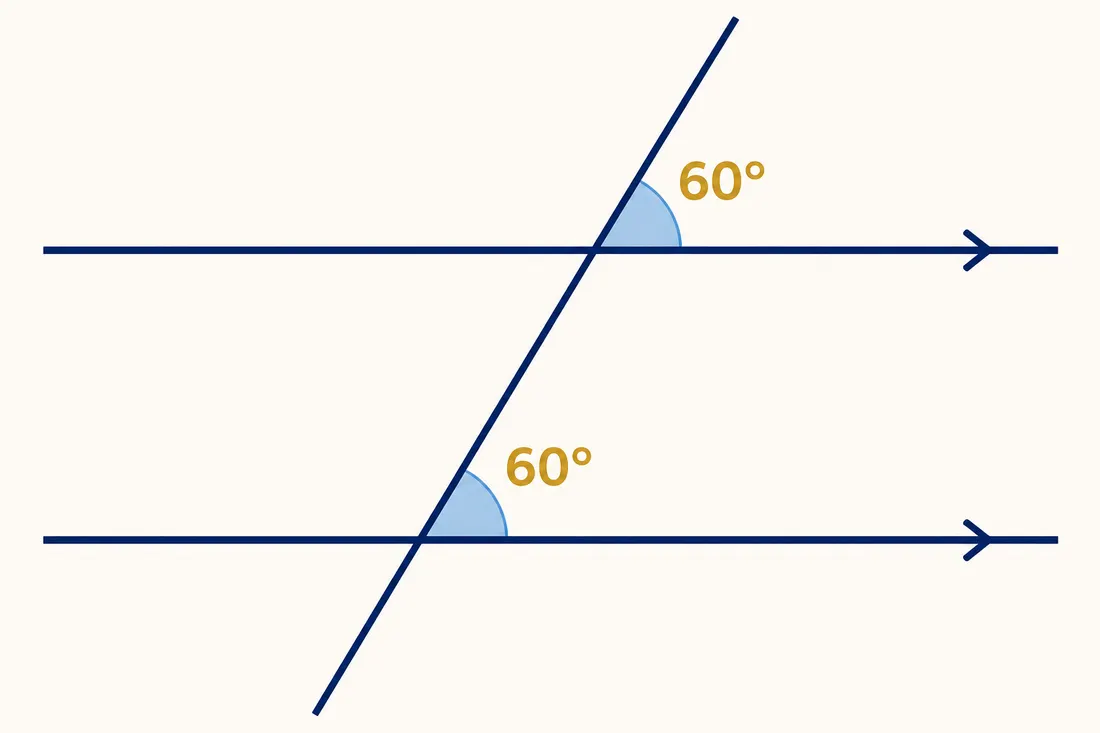
Corresponding angles occupy the same relative corner at the two intersections. When the two lines are parallel, their measures are equal. In the diagram below, the two upper-right acute angles are corresponding. Rotating the entire page changes neither that positional relationship nor the equality. Identify positions rather than memorising a page-specific “top angle” rule.
6.6 Alternate Interior and Exterior Angles
Alternate interior angles lie between the two lines on opposite sides of the transversal. Alternate exterior angles lie outside the lines on opposite sides. Each pair is congruent when the lines are parallel. Extend only the lines needed to see the positions clearly; an additional crossing line can create several angles at one intersection.
6.7 Same-Side Interior Angles
Same-side interior angles lie between the lines on the same side of a transversal. For parallel lines they are supplementary, not generally equal. Example: if their measures are and , then , so and the angles are and .
6.8 Proving Lines Parallel
Use a converse theorem to prove parallelism: congruent corresponding angles, congruent alternate interior angles, or supplementary same-side interior angles can establish that two lines are parallel. Name the relevant pair before applying a converse. “They look parallel” and equal unrelated angles are not sufficient proof.
6.9 Perpendicular Lines
Perpendicular lines meet at a right angle. In a plane, two lines perpendicular to the same line are parallel to each other, provided they are distinct. Coordinate slope tests need a special case for horizontal and vertical lines. A vertical line does not have slope zero; it has undefined slope.
6.10 Algebraic Angle Problems
Translate the angle relationship into an equation, solve, then return to the requested angle. Suppose a pair of vertical angles is labelled and . Equality gives , so both angles are . A neighbouring linear-pair angle is . State which of these the question asks for.
6.11 Proofs Involving Lines and Angles
An angle proof can chain several facts: vertical-angle congruence, equality from a parallel-line theorem, then transitivity. Write each step separately when the relationship is not immediate. If parallelism is the target, do not use a theorem that already assumes the very lines are parallel; that would make the argument circular.
PART 2 · CHAPTER 7
7. Triangle Relationships and Theorems
Back to contents ↑7.1 Classifying Triangles
Classify a triangle by sides and by angles independently. It can be isosceles and obtuse, or scalene and right. “Equilateral” means three equal sides and therefore three angles. An isosceles triangle has at least two equal sides under the inclusive convention used here; label the equal legs and the corresponding base angles.
7.2 Triangle Angle-Sum Theorem
The three interior angle measures of a Euclidean triangle sum to . If the angles are , and x, then . Confirm that the angles are the triangle’s interior angles rather than an exterior angle formed by an extended side.
7.3 Exterior Angle Theorem
An exterior angle formed by extending a triangle side equals the sum of its two remote interior angles. It is also supplementary to the adjacent interior angle. If the remote angles are and , the exterior angle is and its neighbouring interior angle is . These are two consistent routes to the same relationship.
7.4 Isosceles and Equilateral Triangle Properties
Equal sides of a triangle have equal opposite angles, and equal angles have equal opposite sides. In an isosceles triangle with vertex angle , the two base angles share , so each is . Do not assume the labelled apex is the vertex between equal legs; use the congruence marks.
7.5 Triangle Inequality Theorem
For positive side lengths a, b and c, a triangle requires each side to be shorter than the sum of the other two. Equivalently, the possible third side satisfies . If two sides are 7 and 12, then . The endpoints produce degenerate straight configurations, not triangles.
7.6 Relationships Between Sides and Angles
Within a triangle, the larger angle lies opposite the longer side. This orders measurements but does not give a numerical proportionality between side and angle measures. To compare two triangles using an included angle and two matching sides, examine the hinge relationship carefully. Keep the “opposite” pairings explicit in a labelled sketch.
7.7 Triangle Midsegments
The segment joining midpoints of two triangle sides is parallel to the third side and half its length. If a midsegment is 6.5 cm, the parallel third side is 13 cm. A line that merely looks halfway up the diagram is not a midsegment unless the endpoints are established midpoints.
7.8 Medians, Altitudes and Angle Bisectors
A median joins a vertex to the midpoint of the opposite side. An altitude is perpendicular to the opposite side or its extension. An angle bisector divides a vertex angle equally. These can be different segments in a scalene triangle. The centroid lies two-thirds of the way from a vertex along its median.
7.9 Perpendicular Bisectors and Triangle Centers
A perpendicular bisector is perpendicular to a side at its midpoint; it need not pass through a vertex. The circumcenter is where perpendicular bisectors meet and is equidistant from vertices. The incenter comes from angle bisectors and is equidistant from sides. The orthocenter comes from altitudes; the centroid comes from medians.
7.10 Triangle Theorem Proofs
A useful triangle proof often introduces a parallel line, a shared side or a matching angle. State the construction or given that permits each step. For an isosceles-triangle argument, identify whether you are using equal sides to obtain equal angles or the converse. The theorem’s direction determines which fact must already be established.
7.11 Multi-Step Triangle Problems
Work in layers: solve an angle equation, use a triangle sum, then transfer a relationship through equal sides or parallel lines. Example: an exterior angle of and a remote interior angle of give the other remote angle . If that angle is a base angle of an isosceles triangle, the remaining vertex angle is .
PART 2 · CHAPTER 8
8. Quadrilaterals and Polygon Theorems
Back to contents ↑8.1 Classifying Quadrilaterals
Quadrilateral families overlap. A square is also a rectangle, a rhombus and a parallelogram. Here a trapezoid means exactly one pair of parallel sides; if a task supplies another convention, follow its definition. Classify using established properties, not orientation. A tilted rectangle remains a rectangle.
8.2 Parallelogram Properties
A parallelogram has both pairs of opposite sides parallel. Its opposite sides and opposite angles are congruent, consecutive angles are supplementary and its diagonals bisect each other. Its diagonals need not be equal or perpendicular. Keep these properties separate so a rectangle or rhombus condition is not applied to every parallelogram.
8.3 Conditions That Prove a Parallelogram
Sufficient tests include both pairs of opposite sides congruent, both pairs of opposite angles congruent, diagonals bisecting each other, or one pair of opposite sides both parallel and congruent. One parallel pair alone only gives a trapezoid under the convention here. Select a test supported by the available measurements rather than collecting unrelated facts.
8.4 Rectangle Properties
A rectangle is a parallelogram with four right angles. Its diagonals are congruent and bisect each other. If one diagonal is and the other is , then equality gives and each diagonal is 20. This does not mean adjacent rectangle sides are equal.
8.5 Rhombus Properties
A rhombus is a parallelogram with all four sides congruent. Its diagonals are perpendicular and bisect opposite angles as well as each other. If the half-diagonals have lengths 6 and 8, a side is . The diagonals do not have to have the same length.
8.6 Square Properties
A square satisfies both rectangle and rhombus properties. Its diagonals are equal, perpendicular, bisect each other and bisect the vertex angles. If its side is s, the diagonal is . A diagonal of 12 gives side and area 72. Use the stated measurement rather than interchanging a side and a diagonal.
8.7 Trapezoid Properties
A trapezoid’s parallel sides are its bases. Its height is the perpendicular distance between those bases, not usually a slanted leg. The segment joining the leg midpoints has length . With bases 8 and 14, that midsegment is 11. Pair the correct bases before using area or midsegment relationships.
8.8 Isosceles Trapezoids
An isosceles trapezoid has congruent legs, congruent base angles and congruent diagonals. Consecutive angles along a leg are supplementary because the bases are parallel. A base angle of pairs with a top angle of . Equal diagonals alone do not establish an arbitrary quadrilateral is an isosceles trapezoid without the needed structure.
8.9 Kite Properties and Related Geometry
A kite has two pairs of adjacent congruent sides. For the usual non-rhombus kite, its symmetry diagonal bisects the other diagonal at right angles and bisects the appropriate opposite vertex angles. Avoid assuming that both diagonals bisect each other. Kite facts are useful supporting geometry, but this chapter’s breadth does not mean every named shape is separately guaranteed on the blueprint.
8.10 Diagonals of Quadrilaterals
Ask three separate questions about diagonals: are their lengths equal, are they perpendicular and do they bisect each other? Rectangles, rhombi and general parallelograms give different answers. Build a property table from definitions. In a proof, state the conditions you have established before using a diagonal property specific to a narrower family.
8.11 Polygon Interior and Exterior Angles
For an n-sided simple polygon, the interior angle sum is . One exterior turning angle at each vertex sums to when taken consistently around a convex polygon. A regular polygon has equal angles, so each exterior angle is . Do not divide the interior sum equally unless regularity or equal angles is established.
8.12 Quadrilateral Proofs
Coordinate or synthetic methods can prove a quadrilateral type. Show both opposite side pairs parallel for a parallelogram, then add a right angle for a rectangle or equal adjacent sides for a rhombus. A proof that establishes only equal diagonals in an otherwise unrestricted quadrilateral is incomplete. Match your conclusions to a sufficient classification test.
PART 2 · CHAPTER 9
9. Circle Theorems and Relationships
Back to contents ↑9.1 Basic Circle Vocabulary
A radius joins the center to the circle, a diameter is a chord through the center and a chord joins two points on the circle. A tangent meets the circle at one point; a secant line crosses it at two. An arc is part of the circumference. Arc measure in degrees is different from arc length in linear units.
9.2 Central Angles and Intercepted Arcs
A central angle has its vertex at the center. Its degree measure equals that of its intercepted arc. If a central angle is , the corresponding minor arc measures and the remaining major arc measures . To avoid ambiguity, a major arc is often named with three points, including a point on the intended longer path.
9.3 Inscribed Angles and Arcs
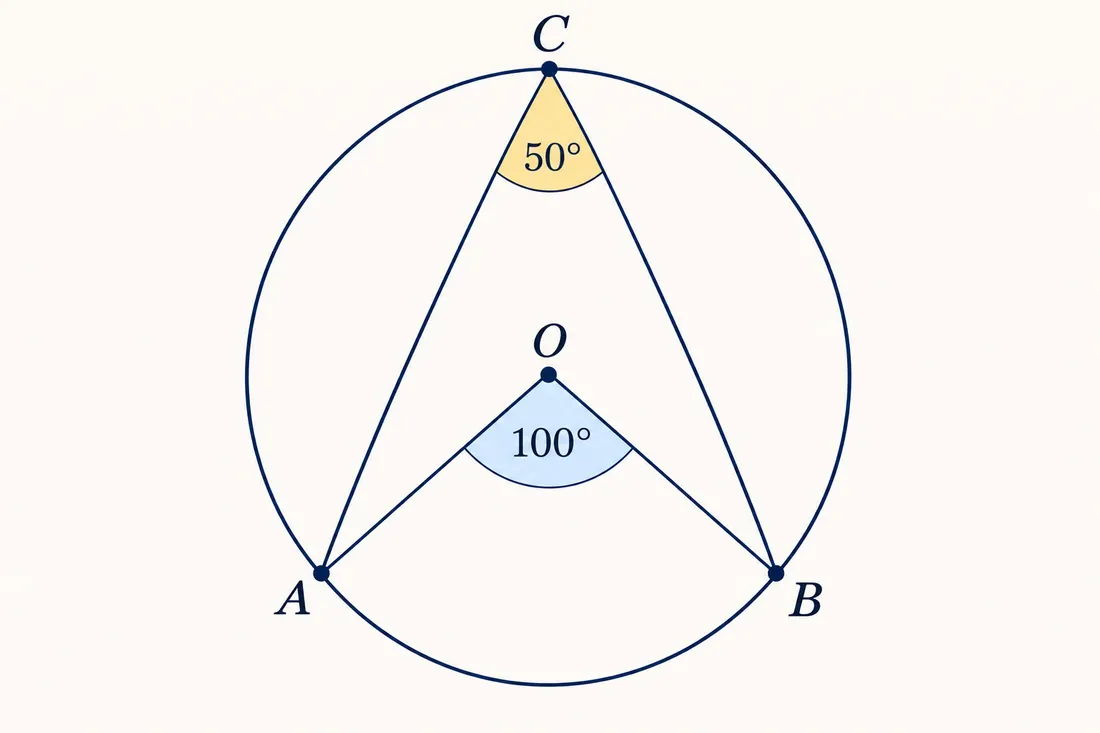
An inscribed angle has its vertex on the circle and intercepts an arc not containing that vertex. Its measure is half the intercepted arc’s degree measure. An inscribed angle intercepting a arc is , as illustrated below. Identify the correct arc before halving: the vertex’s position determines which arc is intercepted.
9.4 Inscribed Triangles and Quadrilaterals
An angle inscribed in a semicircle is a right angle. Opposite angles of an inscribed quadrilateral are supplementary. If one angle of a cyclic quadrilateral is , the opposite angle is . This converse-style reasoning requires the vertices to lie on a common circle, not merely resemble a quadrilateral inside a circular sketch.
9.5 Chord Relationships
In the same circle or congruent circles, congruent chords correspond to congruent minor arcs and congruent central angles. Chords equally distant from the center are congruent. A longer chord lies closer to the center. These statements compare chords under the correct circle conditions; they do not make chord length proportional to arc degree measure.
9.6 Perpendicular Chords and Bisectors
A line through the center perpendicular to a chord bisects that chord. Use the resulting right triangle to connect radius, center-to-chord distance and half-chord. If the radius is 13 and the distance to the chord is 5, half the chord is , so the chord length is 24.
9.7 Tangent–Radius Theorem
A radius to a point of tangency is perpendicular to the tangent line. Two tangent segments drawn from the same external point have equal lengths. Label the point of contact before drawing the right-angle mark. A radius to some other point on the circle does not automatically make a right angle with the tangent.
9.8 Secants, Tangents and Intersecting Chords
Distinguish intersections inside, on and outside a circle. Intersecting chords inside give equal segment products; two secants from an external point give external-times-whole products; a tangent and secant give tangent squared equal to external-times-whole. For angles, the position of the vertex determines whether to use half a sum or half a difference of intercepted arcs.
9.9 Angle Relationships in Circles
Two chords intersecting inside give angle measure half the sum of the intercepted arcs for that angle and its vertical partner. Two secants or tangents meeting outside give half the positive difference of the relevant arc measures. Example: exterior intercepted arcs and give an angle of .
9.10 Segment Length Theorems
For intersecting chords, use . For two external secants, use , where each w is the whole secant length. For a tangent t, . If the external part is 4 and the inside part is 12, the whole is 16, so .
9.11 Arc Length
For a degree angle θ and radius r, arc length is . A arc in a circle of radius 8 has length . The angle is a fraction of a complete turn; multiplying that fraction by the circumference supplies a length. Keep π exact until a decimal is requested.
9.12 Area of Sectors
Sector area is . A sector with radius 6 has area . A sector includes the radii and an arc; a circular segment is the region between a chord and its arc. For a segment, subtract the appropriate triangle area from the sector instead of using the sector formula unchanged.
9.13 Circle Proofs and Multi-Step Problems
A circle proof can combine equal radii, an isosceles triangle and an inscribed-angle relationship. A measurement task may first require a chord length, then a right triangle, then an arc or sector. Annotate each established fact before the next step. A diagram is not a substitute for checking which angle intercepts which arc.
PART 3 · CHAPTER 10
10. Geometric Transformations
Back to contents ↑10.1 Introduction to Transformations
A transformation maps every point of a figure according to a rule. The original is the preimage; the result is the image. Track vertices in a consistent order, preserving the correspondence. Testing only one point may not distinguish two possible rules, so compare a second point or a defining feature when identifying a transformation.
10.2 Translations and Coordinate Rules
A translation by vector sends to . Positive a moves right and positive b moves up. Example: translating by gives . All points move the same distance and direction; subtracting the same vector reverses the translation.
10.3 Reflections Across Axes and Other Lines
Across the x-axis use ; across the y-axis use ; across use ; across use . A reflection reverses orientation. For a vertical mirror , the new x-coordinate is . A point on the mirror stays fixed.
10.4 Rotations: 90°, 180° and 270°
About the origin, counterclockwise sends to ; gives ; counterclockwise gives . A clockwise rotation equals counterclockwise. If the center is not the origin, translate it to the origin, rotate the relative coordinates and translate back.
10.5 Dilations and Scale Factors
A dilation with center C and positive scale factor k sends a displacement from C to k times that displacement. At the origin this becomes . Lengths multiply by k while angles remain equal. With center , point and , the image is .
10.6 Rigid vs. Non-Rigid Transformations
Translations, reflections and rotations are rigid motions: distances and angle measures are preserved. A dilation with positive k different from 1 changes size while preserving shape, so it establishes similarity rather than congruence. Reflections reverse orientation; translations and rotations preserve it. Area alone does not determine whether two figures are congruent.
10.7 Compositions of Transformations
Apply a composition in the stated order. Reflecting across the x-axis gives ; translating right 4 then gives . Reversing transformation order can change the result, especially with different centers or mirror lines. Write the intermediate point instead of trying to combine several mental steps at once.
10.8 Mapping Preimages to Images
Use corresponding point pairs to determine a rule, then check the entire figure. For a translation, subtract preimage coordinates from image coordinates; the resulting vector should match for every vertex. For a dilation, compare displacements from the stated center. A ratio computed from coordinates relative to the wrong center can suggest an incorrect scale factor.
10.9 Transformational Symmetry
A symmetry maps a figure onto itself. Reflection symmetry uses a mirror line; rotational symmetry uses a turn less than a complete revolution. A regular n-gon has a smallest positive rotational symmetry angle of . A non-square rectangle has rotational symmetry but not . Check the actual shape rather than transferring a square’s symmetries to it.
10.10 Transformation-Based Congruence and Similarity
Figures are congruent when a sequence of rigid motions maps one onto the other. Similarity allows a dilation together with rigid motions. The transformation description can therefore justify corresponding equal angles or proportional lengths. A visual size comparison is weaker evidence than a rule that correctly maps the vertices and relevant sides.
PART 3 · CHAPTER 11
11. Triangle and Figure Congruence
Back to contents ↑11.1 Meaning of Congruence
Congruent figures match in shape and size. For triangles, a congruence statement also specifies vertex correspondence: in , A matches D, B matches E and C matches F. Write the order carefully; the correct unordered collection of letters can still express the wrong matching.
11.2 Corresponding Sides and Angles
Use the congruence statement to pair sides and angles before substituting values. If ABC matches DEF, then AB matches DE and angle C matches angle F. Do not pair sides solely because they occupy the same left-right position in two drawings. One figure may be rotated or reflected.
11.3 SSS Congruence
SSS establishes triangle congruence when all three corresponding side pairs are congruent. A shared side can supply the third pair through the reflexive property. The criterion is about matching side lengths, not having three arbitrary equal segments somewhere in a larger figure. Keep the two triangles’ vertex order aligned.
11.4 SAS Congruence
SAS requires two corresponding sides and the included angle between them. An equal angle that lies opposite one of the given sides does not automatically supply SAS. When checking a proof, touch the two sides in each triangle and identify the angle where they meet before accepting the criterion.
11.5 ASA Congruence
ASA uses two corresponding angle pairs and the included side between those angles. With two matching angles the third angles match too, but the side requirement still establishes scale. Choose the side between the named angles rather than assuming any marked side is “included.”
11.6 AAS Congruence
AAS uses two corresponding angle pairs and a corresponding non-included side. It works because the third angle follows from the triangle sum, allowing an ASA argument. State a sufficient criterion directly when supported; do not insert a measurement that was never given or proved simply to make a preferred theorem fit.
11.7 HL Congruence
HL applies only to right triangles with congruent hypotenuses and one corresponding leg. First establish the right angles. The hypotenuse is opposite the right angle and is the longest side; a marked leg cannot be substituted for it. This special right-triangle condition explains why an unrestricted SSA claim is not generally valid.
11.8 Why SSA and AAA Do Not Prove Congruence
AAA fixes shape but not scale, so it proves similarity rather than congruence. General SSA can describe two different triangles because the same side-side-angle data can admit an ambiguous configuration. A correct response identifies the missing sufficient information rather than declaring triangles congruent because three markings are present.
11.9 CPCTC
CPCTC means corresponding parts of congruent triangles are congruent. It is used after triangle congruence has been established. In a proof aiming to show two segments equal, first identify triangles containing them, prove congruence with a valid criterion and then conclude the correctly corresponding parts match.
11.10 Congruence Proofs
Organise a congruence proof around the chosen criterion. Two marked side pairs plus a shared side suggest SSS; parallel lines may produce angle pairs for ASA or AAS. Explain the source of every required pair. The conclusion “triangles are congruent” must come before using their unmarked corresponding parts.
11.11 Applications of Congruence
Congruence can justify matching components in a frame, distance across an obstacle or equal clearances in a design. State which measurements correspond and what assumptions make the shapes triangles with the required properties. A physical model may need an explicit right-angle or equal-length condition; the story alone does not guarantee it.
PART 3 · CHAPTER 12
12. Similarity and Proportional Reasoning
Back to contents ↑12.1 Understanding Similar Figures
Similar figures have equal corresponding angles and proportional corresponding lengths. The scale factor depends on direction: image divided by preimage is the reciprocal of preimage divided by image. Two rectangles are not necessarily similar just because each has four right angles; their side ratios must also match.
12.2 AA Similarity
AA proves triangle similarity when two corresponding angle pairs are congruent. The third pair follows from the angle sum. Parallel lines are a common source of the required angles. AA does not apply to arbitrary polygons without additional conditions, and it does not establish equal side lengths unless the scale factor is one.
12.3 SAS Similarity
SAS similarity requires two corresponding side pairs in the same ratio and the included angles congruent. Check both ratios in the same direction. If sides 6 and 9 correspond to 10 and 15, both ratios are ; the equal angle must lie between those respective side pairs.
12.4 SSS Similarity
SSS similarity requires all three corresponding side ratios equal. Sort lengths by size if helpful, but verify the intended correspondence. Triangles with sides 3, 4, 5 and 6, 8, 10 are similar with scale factor 2 from the first to the second. They are not congruent.
12.5 Proportions in Similar Triangles
Write corresponding lengths above and below each other consistently. If a small triangle’s 8-unit side matches a large triangle’s 12-unit side, the large-to-small factor is . A second small side of 10 matches a large side of 15. Cross-multiplication is a solving method, not a substitute for choosing valid corresponding ratios.
12.6 Scale Factor Calculations
Use for a stated transformation direction. A factor between 0 and 1 is a reduction; greater than 1 is an enlargement. If the question asks for the original size, divide an image length by k instead of multiplying again. Include units when scale drawings relate different measurement units.
12.7 Triangle Proportionality Theorem
A line parallel to one triangle side divides the other two sides proportionally. If D lies on AB and E on AC with DE parallel to BC, then . This is a part-to-part relationship. The related similar-triangle ratio uses part-to-whole lengths; do not mix the denominators.
12.8 Parallel Lines and Proportional Segments
Several parallel lines cutting transversals produce proportional intercepted segments. Match the same pair of parallel boundaries on both transversals. Add adjacent lengths when a whole segment is needed. A ratio using one short interval on one transversal and two intervals on the other generally compares different objects.
12.9 Similarity Proofs
Prove the prerequisite equal angles or side ratios before declaring similarity. Then use similarity to obtain new proportions. If the target is a side ratio, do not use that unproved target as a premise for the similarity criterion. A diagram with nested triangles often supplies shared angles and parallel-line angle pairs.
12.10 Perimeter, Area, Surface Area and Volume Scaling
If corresponding lengths scale by k, perimeter scales by k, area and surface area by , and volume by . A doubling of every dimension multiplies volume by 8, not 2. Given an area ratio of , the positive length ratio is . Take the appropriate root when working backwards.
12.11 Real-World Similarity Problems
Shadow, map and model problems require similar shapes and matching measurements. If a 1.5 m post casts a 2 m shadow while a tree casts a 12 m shadow under the same sun angle on level ground, , so m. State the shared-angle and ground assumptions before treating the triangles as similar.
PART 3 · CHAPTER 13
13. Geometric Constructions
Back to contents ↑13.1 Construction Tools: Compass and Straightedge
A classical construction uses a compass to transfer distances or draw arcs and a straightedge to draw lines through established points. A ruler’s measured tick marks are not the justification for a compass-and-straightedge construction. Explain why equal radii, intersecting arcs or perpendicular bisectors guarantee the property requested.
13.2 Copying Line Segments
To copy a segment, draw a ray from the new starting point, open the compass to the original segment’s length and mark that distance on the ray. The intersection defines the new endpoint. Keeping the compass width unchanged transfers the length; visually placing a nearby point does not establish equality.
13.3 Copying Angles
To copy an angle, draw an arc from its vertex crossing both sides. Draw an equal-radius arc from the new vertex, then transfer the distance between the original arc’s two crossing points to the new arc. Draw the new ray through the resulting point. Both the radius and chord-distance transfer matter.
13.4 Constructing Perpendicular Bisectors
For a segment AB, use equal-radius arcs centered at A and B, with radius greater than half AB, to create two intersections. The line through those intersections is the perpendicular bisector. Each intersection is equally distant from A and B, so the connecting line lies on their equidistance locus.
13.5 Constructing Angle Bisectors
Draw an arc from the angle vertex meeting both sides at P and Q. Using equal radii centered at P and Q, create an intersection inside the angle and connect it to the vertex. The symmetric distances establish the angle bisector. Changing one radius breaks the equal-distance argument.
13.6 Constructing Perpendicular Lines
Through a point on a line, mark equally distant points to either side and construct their perpendicular bisector. From a point off a line, first choose an arc meeting the line twice, then use equal-distance constructions to locate a perpendicular direction through the original point. The construction must retain the required point, not just produce any perpendicular line.
13.7 Constructing Inscribed Circles
An incircle touches all three triangle sides. Construct two internal angle bisectors to find the incenter, then draw a perpendicular from it to a side to obtain the radius. The radius is a perpendicular distance to the side, not the distance from the incenter to a vertex.
13.8 Constructing Circumscribed Circles
A circumcircle passes through all triangle vertices. Construct perpendicular bisectors of two sides to locate the circumcenter, then use the distance from that center to any vertex as radius. For an obtuse triangle the center can lie outside the triangle; that does not invalidate the construction.
13.9 Incenter and Circumcenter
The incenter is equidistant from sides and controls an inscribed circle. The circumcenter is equidistant from vertices and controls a circumscribed circle. These coincide in an equilateral triangle but generally differ. Match the words “touches sides” and “passes through vertices” to the correct center before selecting construction steps.
13.10 Identifying Missing Construction Steps
In a missing-step task, identify what information the next step needs. A copied angle requires the transferred chord distance; a perpendicular bisector requires equal-radius arcs from both endpoints. Check the order: a point cannot be used before it has been constructed. A final-looking line does not explain why it has the desired property.
13.11 Finding Errors in Geometric Constructions
Look for unequal compass settings, an arc radius too small to create the needed intersections or a line drawn through the wrong points. Explain the consequence, not just that the sketch looks wrong. For example, unequal endpoint radii no longer guarantee that their arc intersections are equidistant from both segment endpoints.
13.12 Construction-Based Exam Questions
Study a construction as a geometric argument. Label known equal lengths created by a common compass setting, identify resulting congruent triangles or an equidistance locus and connect that fact to the requested angle or line. In our construction practice, ordering and selecting steps rehearses the reasoning; it does not reproduce a secure testing-platform item.
PART 4 · CHAPTER 14
14. Coordinate Geometry
Back to contents ↑14.1 Cartesian Coordinate Plane
A coordinate pair lists horizontal position first and vertical position second. Quadrants run counterclockwise from the upper-right region; points on an axis are not inside a quadrant. Mark the scale on both axes before reading a diagram. A one-square change can represent different physical amounts on differently scaled axes.
14.2 Distance Formula
For points and , distance is . The squared coordinate differences are the legs of a right triangle. Between and , the changes are 6 and 8, so the distance is 10. Distance is non-negative even when coordinate differences are negative.
14.3 Midpoint Formula
The midpoint is . Average each coordinate separately. The midpoint of and is . It lies halfway along the segment, not necessarily on either axis. Reversing the endpoint order leaves the midpoint unchanged, which gives a useful check.
14.4 Missing Endpoints
If one endpoint A and midpoint M are known, the other endpoint is coordinate by coordinate. With and , B is . Average A and the proposed B to confirm M. Adding the midpoint to the endpoint once does not generally reverse the averaging operation.
14.5 Slope Formula
Slope is when the denominator is non-zero. Subtract in the same endpoint order in numerator and denominator. A horizontal line has slope 0; a vertical line has undefined slope. Slope measures vertical change per horizontal change, so include those contextual units when using it in a design or measurement problem.
14.6 Parallel and Perpendicular Slopes
Distinct non-vertical parallel lines have equal slopes. Non-vertical, non-horizontal perpendicular lines have slopes whose product is . A slope of pairs perpendicularly with , not . Horizontal and vertical lines are perpendicular to each other, and that special case cannot be checked using a finite slope product.
14.7 Equations of Lines
Use for a known point and finite slope, or when the intercept is useful. A line through with slope 3 is , hence . A vertical line is written rather than forced into slope-intercept form.
14.8 Partitioning Line Segments in Ratios
To divide AB internally in ratio , use . For , and ratio , . The fraction is measured from A, so the numerator is the part adjacent to A. Reversing the ratio changes the point.
14.9 Weighted Average of Points
A point on a segment can be a weighted average with . The weights sum to one. A point one-quarter of the way from A to B has weights on A and on B. Larger weight pulls the average toward that endpoint; it does not mean travelling farther away from it.
14.10 Coordinate Proofs
A coordinate proof translates a geometric claim into distances, slopes or midpoint equalities. Place a figure strategically while preserving all its possible cases. To show diagonals bisect each other, compute both midpoints; to show perpendicularity, use appropriate direction or slope tests. Avoid choosing coordinates that accidentally impose an unproved extra condition such as equal sides.
14.11 Classifying Triangles Using Coordinates
Compare squared side lengths to classify a triangle without unnecessary radicals. If the largest squared length equals the sum of the other two, the triangle is right. Equal squared lengths identify equal sides. Check that the three points are not collinear before claiming a non-degenerate triangle; otherwise an angle classification is not meaningful.
14.12 Classifying Quadrilaterals Using Coordinates
Use opposite-side slopes for parallelism, adjacent slopes for a right angle, squared lengths for equal sides and diagonal midpoints for bisection. Choose enough evidence to establish a sufficient classification. Four equal side lengths give a rhombus but not necessarily a square; a right-angle condition supplies the extra distinction.
14.13 Perimeter and Area on the Coordinate Plane
Find perimeter by summing side lengths around the boundary, not the diagonals. For area, use a base and perpendicular height, split a figure into simpler regions or enclose it in a rectangle and subtract outside pieces. Coordinate grids can reveal horizontal and vertical distances directly. Keep square units distinct from the perimeter’s linear units.
14.14 Coordinate Geometry Word Problems
Translate locations into a consistent coordinate system and unit scale before calculating. A map’s straight-line distance is not automatically a road distance. If a proposed boundary must be equally distant from two facilities, a perpendicular bisector is the relevant locus. Finish by explaining what the coordinates or calculated length mean in the original setting.
PART 4 · CHAPTER 15
15. Two-Dimensional Measurement
Back to contents ↑15.1 Perimeter and Area Fundamentals
Perimeter measures boundary length; area measures the size of a two-dimensional region. A 3 by 8 rectangle has perimeter 22 units and area 24 square units. Equal areas need not imply equal perimeters. Determine whether the problem asks for fencing, covering, edging or capacity before selecting a formula.
15.2 Areas of Triangles
Triangle area is , where h is perpendicular to the chosen base or its extension. A base of 12 and height of 5 give area 30. A slanted side is not a height unless perpendicularity is established. You may choose a different base, but the height must change to match that base.
15.3 Areas of Parallelograms
Parallelogram area is , using a base and the perpendicular distance to its opposite parallel side. Sliding the top edge sideways without changing that height does not change area. If the area is 84 and the base is 12, the corresponding height is 7. This does not determine a slanted side length by itself.
15.4 Areas of Rectangles and Squares
Rectangle area is length times width; square area is . A square with area 50 has side , not 25. When a rectangular border is added around a region, calculate outer and inner areas separately. A uniform border of width w adds to each overall dimension, not w.
15.5 Areas of Trapezoids
Trapezoid area is . Only the parallel sides are the bases, and h is their perpendicular separation. With bases 7 and 13 and height 6, the area is 60. The same expression is the average base length times height, connecting it with the trapezoid midsegment.
15.6 Areas of Circles
Circle area is and circumference is . If diameter is 10, radius is 5, area is and circumference is . Squaring the diameter in the radius formula creates an area four times too large. Keep an exact π form when requested and round only at the end.
15.7 Composite Figure Areas
Split a composite region into non-overlapping familiar pieces, or subtract holes from a larger enclosing shape. A rectangle 10 by 8 with a semicircle of radius 2 removed has area . Mark shared boundaries carefully: an internal dividing line contributes to neither the outside perimeter nor extra area.
15.8 Missing Dimensions
Rearrange the formula before substituting when a missing dimension is requested. For a triangle with area 42 and base 12, . Check whether the recovered quantity is a height, radius or side. If a square root gives two algebraic signs, a physical length uses the positive value.
15.9 Scale Factor and Area Relationships
Similar regions with length factor k have area factor . Enlarging a plan from scale factor 1 to 3 multiplies a room’s represented area by 9. If two similar figures have areas 32 and 72, the length ratio is . A change in only one dimension is not a uniform similarity scaling.
15.10 Density and Population Density Applications
Population density is population divided by land area. If 12,000 people occupy 30 square kilometres, density is 400 people per square kilometre. A material’s mass per volume is a different density measure. Write the numerator, denominator and units before comparing places; a larger population does not automatically imply a higher density.
15.11 Measurement Unit Conversions
A length conversion factor must be squared for area and cubed for volume. Since 1 cm, and . Converting 2 gives 20,000 , not 200 . Convert all dimensions to compatible units before using a measurement formula.
PART 4 · CHAPTER 16
16. Three-Dimensional Geometry
Back to contents ↑16.1 Introduction to 3D Solids
A solid occupies three-dimensional space. Identify its bases, lateral faces or curved surface, perpendicular height and any slant height. A net unfolds the surface into a plane and helps distinguish surface area from volume. Perspective sketches distort apparent lengths; use labelled dimensions rather than measuring the drawing.
16.2 Prisms
A prism has congruent parallel bases and constant cross-sectional area parallel to them. Its volume is . For a right prism, lateral area is base perimeter times height, and total surface area adds both bases. With a triangular base area of 18 and height 10, volume is 180 cubic units.
16.3 Cylinders
A cylinder is a solid with circular bases. For a right cylinder, and total surface area is . An open container may omit one base from its material area. With radius 3 and height 8, volume is and closed total surface area is .
16.4 Pyramids
Pyramid volume is , using base area and perpendicular height. For a regular pyramid, lateral area is half the base perimeter times the common slant height. A square pyramid with base side 6 and perpendicular height 4 has volume 48. Its slant height requires a separate right triangle and is not simply 4.
16.5 Cones
For a right cone, , lateral area is and total area adds . The slant height satisfies . With and , slant height is 5 and volume is . Do not use slant height in the volume formula.
16.6 Spheres
A sphere of radius r has surface area and volume . A hemisphere has half the sphere’s volume, but its total exposed surface includes a circular base if that base is present. A closed hemisphere has total area ; its curved area alone is .
16.7 Surface Area Formulas
For surface area, count only exposed faces and keep square units. A right prism uses ; a closed cylinder uses two discs and its curved surface. Drawing a net or listing the faces prevents missing a base or counting a shared face inside a composite object. An opening changes the material area without changing the container’s outer dimensions.
16.8 Volume Formulas
Use for prisms and cylinders and for pyramids and cones. The sphere uses a different radius-based formula. These are volume relationships, so use cubic units. If two solids have the same base area and perpendicular height, the pyramid or cone occupies one-third the volume of the corresponding prism or cylinder.
16.9 Finding Missing Dimensions
Rearrange the volume or surface formula for the missing measurement, then check physical feasibility. For a cylinder with and , , so . If a question gives diameter, halve it first. A recovered negative height indicates an algebra or interpretation error rather than a usable physical solution.
16.10 Scale Factor and Surface Area
For similar solids, corresponding surface areas scale with . If each dimension is enlarged by factor 1.5, surface area multiplies by 2.25. This rule assumes every relevant dimension scales uniformly. Increasing only a cylinder’s height while keeping its radius fixed does not make a similar cylinder and cannot use a single global area factor.
16.11 Scale Factor and Volume
For similar solids, volume scales with . A volume ratio of corresponds to positive length ratio and surface-area ratio . Taking a square root of a volume ratio confuses dimensions. Write the quantity type next to each ratio before choosing a power or root.
16.12 Cross-Sections of Solids
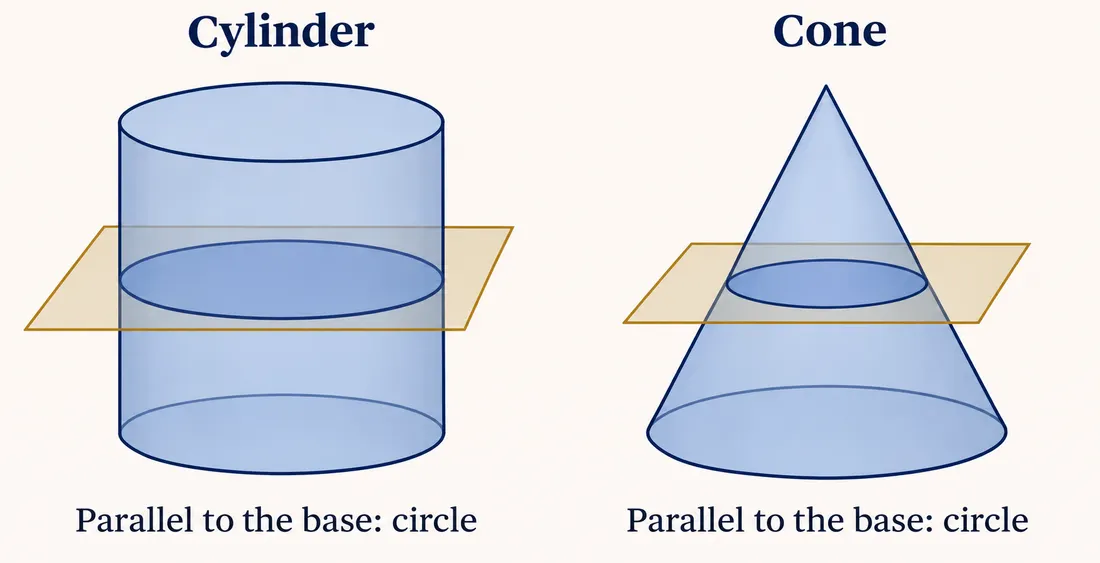
A plane slice produces a two-dimensional cross-section. A cut parallel to a cylinder’s base is a congruent circle; a cut parallel to a cone’s base is a smaller circle above the base. Other orientations can produce different shapes. In a drawing, a circular section can appear elliptical because of perspective; the mathematical plane and solid determine its actual shape.
16.13 Solids of Revolution
Rotating a plane region around an axis creates a solid of revolution. A rectangle rotated about one side produces a cylinder; a right triangle rotated about one leg produces a cone. Identify which segment becomes the height and which becomes the radius. Rotating about a different axis can create a different solid, so the axis is essential information.
16.14 Composite Solids and Real-World Applications
Break a composite solid into simpler volumes and add or subtract without double-counting overlap. For a tank with a cylindrical middle and hemispherical end, volume combines the relevant pieces. Surface area requires separate attention to hidden joining faces. State whether the problem models capacity, outer material or displaced volume before calculating.
PART 4 · CHAPTER 17
17. Equations of Circles
Back to contents ↑17.1 Circles in the Coordinate Plane
A circle in the coordinate plane is the set of points a fixed distance from its center. Starting from the distance formula leads to an equation with two squared coordinate differences. A point on the circle satisfies the equation exactly; points inside or outside give a smaller or larger squared distance than the radius squared.
17.2 Center–Radius Form
Center–radius form is with center and positive radius r. It expresses a constant distance using the Pythagorean theorem. The right side is the squared radius. A right side of 49 gives radius 7, not 49.
17.3 Identifying Center and Radius
In , the center is and the radius is 5. The signs inside the brackets are opposite the center coordinates because the formula subtracts them. Read both coordinates and the square root of the right side before sketching.
17.4 Writing Equations of Circles
Substitute the center and radius into center–radius form. With center and a point , the squared radius is . The equation is . Check the supplied point in the equation as a final verification.
17.5 Graphing Circles
Plot the center, then move r units left, right, up and down to find four convenient circle points. Use equal coordinate scales when a circle is expected to look circular. A compressed display can make a correct circle look elliptical. An equation alone does not tell you that an unlabeled sketch uses equal physical scales.
17.6 Circles from Diameter Endpoints
A diameter’s midpoint is the center, and half its length is the radius. For endpoints and , the center is , diameter is 10 and radius is 5. Therefore . Using the full diameter as r would multiply the area by four.
17.7 Converting Circle Equations into Standard Form
Group x and y terms and complete each square. The equation becomes , giving center and radius 5. If the coefficients on both squared terms are equal but not one, divide by that common coefficient before completing squares.
17.8 Completing the Square for Circle Equations
For , add to form , balancing the addition on the other side. With two variables, track both added constants. A common error is adding 9 and 4 inside the left-hand groups but adding only one of them on the right.
17.9 Interpreting Circle Models
A circle model can represent a fixed-distance boundary, coverage radius or a circular design. Establish the units and whether the boundary is included. An inequality with squared distance less than or equal to describes the entire disc, while equality describes only its circumference. A real coverage model can have obstacles not captured by straight-line distance.
17.10 Real-World Circle Equation Problems
Translate the location and distance into center–radius form, test candidate points and interpret the conclusion. A sensor centered at with range 5 covers point on its boundary because squared distance is 25. It does not cover point , whose distance is 6. Explain coverage rather than reporting an unexplained inequality.
PART 4 · CHAPTER 18
18. Right Triangle Trigonometry
Back to contents ↑18.1 Right Triangle Basics
A right triangle has one angle. Its hypotenuse is opposite that angle; the other sides are legs. Relative to an acute reference angle, one leg is opposite and the other adjacent. Changing the reference angle swaps those two labels but does not change the hypotenuse.
18.2 Pythagorean Theorem
For a right triangle, with c the hypotenuse. Legs 9 and 12 give hypotenuse 15. If c and one leg are known, subtract the leg’s square from before taking a square root. The theorem does not apply directly to a non-right triangle.
18.3 Converse of the Pythagorean Theorem
For positive side lengths sorted so c is largest, equality establishes a right triangle. If is larger than that sum, the triangle is obtuse; if smaller, it is acute, provided the triangle inequality holds. Sides 5, 12, 13 form a right triangle because .
18.4 Special Right Triangles: 45-45-90
A –– triangle has side ratio . Equal legs follow from equal acute angles. A hypotenuse of 10 gives each leg . Distinguish the requested leg from the hypotenuse before multiplying or dividing by .
18.5 Special Right Triangles: 30-60-90
A –– triangle has side ratio opposite , and respectively. With short leg 4, the long leg is and hypotenuse 8. With long leg , the short leg is 9. Angle-to-opposite-side matching prevents a common reversed ratio.
18.6 Sine, Cosine and Tangent Ratios
For an acute angle θ, , and . These ratios apply in a right triangle. Select the ratio containing the known side and the unknown side instead of choosing sine or cosine by habit.
18.7 SOH-CAH-TOA
SOH-CAH-TOA is a memory aid for the three ratios, not a replacement for identifying the triangle and reference angle. Label O, A and H on your sketch first. The adjacent side in CAH or TOA is the leg touching the reference angle, not the hypotenuse, even though the hypotenuse also meets the angle.
18.8 Finding Missing Side Lengths
Write a ratio equation before solving for a side. If an angle is and the hypotenuse is 12, the opposite side is . If the unknown is in the denominator, rearrange carefully rather than multiplying by the same ratio automatically. Check that a leg is shorter than the hypotenuse.
18.9 Finding Missing Angles
Use an inverse trigonometric function to recover an angle from a known ratio. With opposite leg 7 and adjacent leg 10, . Inverse tangent is not the reciprocal of tangent. Check degree mode when the question requests degrees.
18.10 Inverse Trigonometric Functions
The buttons sin⁻¹, cos⁻¹ and tan⁻¹ return angles from ratios. Enter the complete ratio inside parentheses and distinguish the inverse function from . In a right-triangle problem the requested acute angle lies between and , giving a quick range check. A ratio supplied to inverse sine or cosine must be between and 1.
18.11 Angles of Elevation and Depression
Elevation and depression are measured from a horizontal line, not from a vertical object. Parallel horizontals can transfer an angle of depression to the corresponding angle of elevation. If an observer’s eye is 1.6 m above the ground, a calculated vertical rise above eye level must be increased by 1.6 m to obtain the object’s full height.
18.12 Multi-Step Right Triangle Problems
Identify the shared measurement connecting two right triangles. A first triangle may give a horizontal distance that becomes a leg in the next. Keep unrounded intermediate values, then round the final requested quantity. Draw separate right-angle marks and reference angles so a ratio from one triangle is not applied to an unrelated side in the other.
18.13 Trigonometry and Real-World Applications
For a ramp, ladder or surveying model, identify the right-angle assumption and physical measurement limits. A 5 m ladder leaning at to level ground reaches m vertically. The ladder length is the hypotenuse; the wall height reached is not . Interpret the calculated value in the model’s units.
PART 4 · CHAPTER 19
19. Applied Geometry and Mathematical Modeling
Back to contents ↑19.1 Real-World Measurement Problems
A measurement model begins with a useful shape and enough labelled dimensions. Decide whether you need length, area or volume before selecting relationships. If a dimension is missing, identify a smaller problem—perhaps a right triangle or a scale factor—that supplies it. Include the assumption that a real object is being approximated by the chosen ideal shape.
19.2 Architecture and Construction Applications
Construction problems can combine area, surface material, similarity and perpendicularity. A roof’s slanted panel length differs from its vertical rise, and a paint calculation excludes hidden surfaces or openings. Draw a cross-section when a three-dimensional view hides the right triangle. Convert material coverage rates only after the relevant exposed area has been established.
19.3 Surveying and Indirect Measurement
Indirect measurement replaces an inaccessible length with a geometric relationship. Shadows can use similar triangles under a common sun angle; surveying can use a right-triangle ratio with a measured baseline. State why the triangles have the needed equal angles. A sloping ground surface can invalidate the simple level-ground sketch unless accounted for.
19.4 Coordinate-Based Design Problems
Coordinate design can encode boundaries, alignments and circular clearances. Use slopes to check orientation, distances to check spacing and circle equations to check fixed-radius coverage. Place all measurements in one scale. A design constraint such as “at least 3 units from the center” describes an inequality, not just the circle boundary.
19.5 Multi-Step Geometry Modeling
Write a short chain of goals before calculating: determine radius, calculate capacity, subtract unusable volume, then convert to the required unit. Check each intermediate result against the sketch. A plausible final number does not show that the geometry was set up correctly if an earlier quantity was misidentified.
19.6 Choosing Appropriate Mathematical Models
Choose the simplest model that preserves the features relevant to the question. A cylinder may approximate a tank, but a tapered tank needs a different model. Describe what is ignored, such as wall thickness or uneven ground, and whether that omission increases or decreases the estimate. A formula’s familiarity is not evidence that its shape assumptions hold.
19.7 Interpreting and Checking Solutions
Check sign, units, scale and constraints. A calculated radius must be positive, a point claimed inside a circle must satisfy the distance condition and a predicted quantity should match the context. Where possible, verify with a second representation: substitute into the original equation, compare a bounding estimate or reconstruct the measurement from the proposed answer.
PART 5 · CHAPTER 20
20. Geometry EOC Formula Sheet and Cheat Sheet
Back to contents ↑20.1 Official Geometry EOC Reference Sheet Explained
The official testing reference sheet and our study sheet have different purposes. The official version is supplied through authorized testing arrangements; our two-page download helps you revise. Learn what each variable represents and practise finding relationships quickly. Do not assume a personally annotated study sheet can be taken into the secure exam.
20.2 Angle Formulas
Keep the basic angle totals together: a right angle is , a straight angle is and a full turn is . Complementary and supplementary pairs use the first two totals. Vertical angles are equal. Parallel-line conclusions require a parallelism condition or an appropriate converse proof; the same picture without that condition does not justify equal angles.
20.3 Triangle Formulas
Triangle essentials include interior sum , exterior angle equal to the remote-angle sum, area , the triangle inequality and, for right triangles, . Match the theorem to its conditions. The Pythagorean relationship is not a general triangle side rule, and an area height must be perpendicular to its chosen base.
20.4 Quadrilateral and Polygon Formulas
Use rectangle , parallelogram , trapezoid and regular-polygon interior sum . If a convex regular polygon has n sides, each exterior angle is . Diagonal properties depend on the figure family: equal, perpendicular and mutually bisecting are three distinct conditions.
20.5 Circle and Sector Formulas
Circle relationships include , , and sector area . The last two forms use degree angles. An inscribed angle is half its intercepted arc measure; an angle at the center equals its intercepted arc measure. Keep degree measure and linear arc length separate.
20.6 Coordinate Geometry Formulas
Coordinate essentials are distance, midpoint, slope and line equations. The circle equation is . Before substituting, identify which object is sought: a location, a length, a gradient or an entire locus. The same pair of endpoints can support several calculations, and only one may answer the question.
20.7 Transformation Rules
At the origin, use translation , reflection in the x-axis , reflection in the y-axis , counterclockwise rotation and dilation . Other centers require relative coordinates. Preserve the stated transformation order and confirm a second point when identifying a rule from a diagram.
20.8 Congruence and Similarity Rules
Triangle congruence criteria are SSS, SAS, ASA, AAS and right-triangle HL. Similarity criteria are AA, SAS proportionality with included-angle equality and SSS proportionality. AAA gives similarity only. After congruence, use corresponding-part equality; after similarity, use consistent side ratios. A criterion is a sufficient package of conditions, not a list of unrelated markings.
20.9 Surface Area Formulas
For right prisms use ; for closed cylinders use ; for spheres use . A right cone’s total area is . Adapt these for openings and hidden faces. Slant height appears in some lateral-area formulas while perpendicular height controls volume.
20.10 Volume Formulas
Volume reference: prism or cylinder ; pyramid or cone ; sphere . Include cubic units and compatible dimensions. Similar solids have volume factor . These compact expressions become useful only after the correct base area, radius and perpendicular height have been identified.
20.11 Right Triangle Trigonometry Formulas
Use sine for opposite/hypotenuse, cosine for adjacent/hypotenuse and tangent for opposite/adjacent. Use an inverse function to obtain an angle. Special right-triangle ratios are and . A calculator should confirm your setup rather than decide which quantities are opposite, adjacent and hypotenuse.
20.12 All Important Geometry Theorems at a Glance
The theorem flashcards below cover angle sums, parallel-line relationships, isosceles triangles, triangle midsegments, congruence, similarity, quadrilateral diagonals and circle relationships. Before turning a card over, state both the conclusion and its required conditions. Naming a theorem without recognizing when it applies is a common source of incorrect proof reasons.
20.13 Formulas Provided vs. Additional Relationships Worth Knowing
Current policy provides selected formulas and conversions, not every theorem or worked decision. Use the school-provided current sheet to mark the formulas actually supplied for your administration; do not infer that list from an old FSA sheet. Independently know the meanings and conditions of congruence, similarity, parallel-angle and circle theorems, plus how to choose variables and rearrange a formula.
20.14 Printable Two-Page Geometry EOC Cheat Sheet
Download the two-page study reference below. Page one concentrates on plane geometry, coordinates and transformations; page two covers solids, trigonometry and theorem conditions. Print at actual size and check that fractions and labels are legible. Use it for retrieval practice: cover a relationship, reconstruct it and then explain a case in which it would not apply.
Searchable formula reference
30 formula cards
Complementary or supplementary, respectively; identify the relationship first.
Interior angles of a Euclidean triangle.
All three side lengths are positive; endpoints are excluded.
The height is perpendicular to the chosen base.
Use a perpendicular height for a parallelogram.
The bases are parallel.
The equal exterior-angle formula requires a regular polygon.
Use radius, not diameter.
Here θ is in degrees.
A sector includes two radii and an arc.
Coordinate differences are the legs of a right triangle.
Average each coordinate independently.
Internal ratio .
The slope form excludes vertical lines.
Center , positive radius r.
The dilation shown is centered at the origin.
Rotation of about the origin.
Across the x-axis and y-axis, respectively.
Uniform positive similarity scale factor k.
Use perpendicular height.
Use perpendicular height rather than slant height.
A hemisphere’s total surface may also include its base.
P is the perimeter of the base; both bases are exposed.
Adjust if a base is open or hidden.
The lateral area uses slant height ℓ.
Only for right triangles; c is the hypotenuse.
–– and ––, ordered by opposite angle.
O opposite, A adjacent leg, H hypotenuse, for an acute angle.
Intersecting chords; external secants; tangent and secant, respectively.
Report people per unit area.
Theorem recall flashcards
Explain the conditions before revealing a relationship.
Vertical angles
Opposite angles formed by intersecting lines are congruent.
Parallel lines
Corresponding and alternate angles are congruent; same-side interior angles are supplementary, when the lines are parallel.
Triangle sum
Interior angles total ; an exterior angle equals the sum of the two remote interior angles.
Isosceles triangle
Equal sides have equal opposite angles; the converse also holds.
Triangle midsegment
The segment joining two side midpoints is parallel to, and half as long as, the third side.
Congruence
SSS, SAS, ASA, AAS and right-triangle HL are sufficient packages; match the correspondence.
Similarity
AA, proportional SAS with equal included angle, or proportional SSS establishes triangle similarity.
Parallelogram
Opposite sides and angles match; diagonals bisect each other. Equal or perpendicular diagonals require extra conditions.
Rectangle
A parallelogram with a right angle is a rectangle; its diagonals are equal.
Rhombus
A parallelogram with all sides equal has perpendicular diagonals that bisect its opposite angles.
Circle angles
A central angle equals its intercepted arc measure; an inscribed angle is half its intercepted arc.
Cyclic quadrilateral
Opposite angles sum to when all four vertices lie on one circle.
Tangent and radius
A radius to the contact point is perpendicular to the tangent.
External tangents
Two tangent segments from the same external point are congruent.
Circle centers
Angle bisectors locate the incenter; perpendicular side bisectors locate the circumcenter.
PART 5 · CHAPTER 21
21. Geometry EOC Common Mistakes
Back to contents ↑21.1 Most Common Angle Errors
Do not treat every pair in a transversal picture as equal. Identify vertical, corresponding, alternate or same-side positions and check whether parallel lines are established. When solving for x, substitute back to find the actual angle. A result such as for an acute marked region signals that either the relation or the requested angle was misread.
21.2 Congruence vs. Similarity Mistakes
Congruence preserves lengths; similarity preserves proportional lengths. A dilation with makes a triangle similar but not congruent to its preimage. Equal angles alone do not determine size. Write “equal” or “in the same ratio” next to the relevant measurements before choosing a criterion.
21.3 Incorrect Proof Reasons
A reason must justify the statement at that point in the proof. CPCTC cannot establish the triangle congruence that it assumes. A converse cannot be substituted for a forward theorem without checking its conditions. When repairing a proof, identify the first unsupported inference rather than merely replacing the last line.
21.4 Coordinate Geometry Sign Errors
Subtract coordinates in matching order and use parentheses around negative values. For a circle, means center x-coordinate , not 4. In distance calculations, square the full coordinate difference. Use a quick plot or midpoint check to detect a sign error before carrying it into a classification proof.
21.5 Wrong Transformation Direction
Distinguish clockwise from counterclockwise, preimage from image and the stated center from the origin. A counterclockwise origin rotation uses ; a clockwise one uses . Apply each transformation to a labelled point and test another vertex. Reversing the order of a translation and rotation can change the answer.
21.6 Radius vs. Diameter Confusion
Radius is half the diameter. Circle area and volume formulas generally use radius, so inserting a diameter can produce a squared or cubed error. If a diameter is 14, write immediately. For a circle equation, remember that the constant is , so take its positive square root to recover r.
21.7 Area vs. Surface Area vs. Volume
Length, area, surface area and volume have different units and purposes. A wrapping-material problem usually asks for exposed area; filling a container asks for volume. Surface area can require subtracting openings or hidden faces. Write units on the setup line so a cubic answer to a painting question becomes visibly inconsistent.
21.8 Trigonometric Ratio Mistakes
The opposite and adjacent legs depend on the chosen angle. Re-label when the reference angle changes, and keep the hypotenuse opposite the right angle. If an inverse trig result lies outside – in a simple acute right-triangle task, check the input and angle mode. A leg larger than the stated hypotenuse also fails a basic plausibility test.
21.9 Calculator Degree and Radian Errors
Degree and radian modes represent the same angles with different numbers. A degree-angle calculation such as should give 0.5; use that as a quick mode check. Do not change mode randomly until an answer looks plausible. Read the task’s units and use the corresponding setting deliberately.
21.10 Incorrect Rounding and Units
Carry unrounded intermediate values, retain π or radicals when an exact answer is requested and round the final result to the stated precision. Label degrees, linear units, square units or cubic units appropriately. Rounding a computed height before using it in a large-area calculation can shift the final answer enough to matter.
21.11 How to Identify and Correct Reasoning Errors
Use a four-column error log: your first incorrect step, the reason it was invalid, a corrected explanation and a fresh question to test the repair. Include reasoning errors as well as arithmetic slips. Recognizing a solution after reading it is weaker evidence than producing the same decision unaided on a different problem.
PART 6 · CHAPTER 22
22. Geometry EOC Worked Examples
Back to contents ↑22.1 Basic-Level Examples with Solutions
Begin with one-step tasks to secure the underlying relationship. Example: two supplementary angles measure 3x and 2x, so , giving and angles and . The example is complete only after returning from the variable to the requested measurements and confirming the relationship.
22.2 Intermediate-Level Examples with Solutions
Combine a theorem with algebra. An isosceles triangle has base angles and . Equality gives ; each base angle is , so the vertex angle is . Explain why the two expressions are equal before solving. A correct equation shows the geometric reason rather than hiding it.
22.3 Advanced Multi-Step Examples
Work backwards from a composite objective. A cylinder of radius 3 and height 8 is topped by a cone of the same radius and height 4. Total volume is . Exposed area excludes the shared circular face. Distinguishing the volume calculation from an outer-material calculation is the central reasoning step.
22.4 Diagram-Based Questions
In the circle diagram below, the central angle and inscribed angle intercept the same arc. Their measures are and , respectively. If the inscribed angle instead measured x and the central angle , then , giving . Identify the shared intercepted arc before writing that equation.
22.5 Proof-Based Questions
Suppose AB and AC are congruent and AD bisects angle BAC. Triangles ABD and ACD have one given side pair, the shared side AD and equal included angles. SAS establishes their congruence, then CPCTC gives . Do not use as an initial premise when it is the conclusion to prove.
22.6 Real-World Application Questions
A 1.8 m survey marker casts a 2.4 m shadow while a tree casts a 10 m shadow on level ground. Equal sun angles produce similar triangles, so , giving m. State the model’s shared-angle assumption and compare the height-to-shadow ratios as a check.
22.7 Technology-Enhanced Practice
For multi-select practice, test every statement. For a general rectangle, “diagonals are congruent” and “opposite sides are parallel” are always true; “diagonals are perpendicular” is not. Our graph task asks you to enter the image coordinates of a point after a transformation, while editing tasks ask you to choose a missing theorem or equation component.
22.8 Step-by-Step Solution Explanations
A useful worked explanation has a setup, a theorem or model choice, algebraic steps and a check. In the practice bank, reveal the explanation only after you have attempted the question. Compare the first decision you made with the suggested method; copying the final number leaves the most useful part of the feedback unused.
PART 6 · CHAPTER 23
23. Topic-Wise Geometry EOC Practice Questions
Back to contents ↑23.1 Logic and Geometric Proofs
Use the topic selector below for Logic and proofs. Translate conditionals, identify valid contrapositives and choose reasons that are available at the stated proof step. After answering, state why each competing claim fails. For a universal statement, distinguish one valid counterexample from several examples that merely support a conjecture.
23.2 Lines and Angles
Choose Lines and angles to practise complementary, supplementary, vertical and parallel-line relationships. Before calculating, name the angle pair and check whether parallelism is given. Review whether the question asks for x, an acute angle or its supplement. A correct variable with the wrong reported angle is still a mismatched answer.
23.3 Triangles and Quadrilaterals
Choose Triangles and quadrilaterals for angle sums, isosceles relationships, triangle inequality and figure properties. Build a labelled sketch for each question. When several classifications could be true, distinguish a property guaranteed for the whole family from a property specific to a square, rectangle or rhombus.
23.4 Circle Theorems
Choose Circles for central and inscribed angles, radius–tangent perpendicularity, arc length and sector area. Follow the intercepted arc with your finger before using an angle formula. For a length task, identify whether a number represents radius, diameter, chord, external secant portion or whole secant.
23.5 Transformations
Choose Transformations to practise translations, reflections, rotations and dilations. Write the center and direction before applying a coordinate rule. In the coordinate explorer, change one parameter at a time and describe which measurements stay fixed. A graph can help check a rule but does not replace explaining it.
23.6 Congruence
Choose Congruence to select sufficient triangle conditions and establish corresponding-part conclusions. Practise rejecting AAA as a size condition and recognizing the restrictions of HL. In each explanation, point out which side or angle is included. A random collection of three correct markings does not necessarily form a valid criterion.
23.7 Similarity
Choose Similarity to work on corresponding ratios and scale factors. Write the mapping order before calculating. For an area or volume task, convert the linear factor to the correct power. If you are given an area ratio and need a length ratio, take a positive square root rather than using the area ratio directly.
23.8 Geometric Constructions
Choose Constructions for copying lengths and angles, creating perpendicular and angle bisectors and locating circle centers. Evaluate the reason each compass setting must remain equal. A step-selection task should be solved by its geometric effect, not by how a familiar construction picture is usually arranged on a page.
23.9 Coordinate Geometry
Choose Coordinates for midpoint, partition, slope, distance and coordinate proofs. Use squared lengths where a square root is unnecessary. Check negative signs by plotting rough positions, and substitute proposed points into the appropriate equation. A vertical segment needs a different slope treatment from an ordinary slanted segment.
23.10 2D and 3D Measurement
Choose Measurement for plane areas, solid volumes and exposed surfaces. Identify units before choosing a formula. For composite objects, decide what is added or removed and whether a shared surface is hidden. The wrong answer options often represent a sensible formula applied to the wrong measurement or geometric object.
23.11 Equations of Circles
Choose Circle equations for center–radius form, completing squares and diameter endpoints. Read the signs and squared radius carefully. Test a proposed point in the equation as a check. When completing squares, record both balancing constants so the equation remains equivalent.
23.12 Right Triangle Trigonometry
Choose Right triangles for Pythagorean and special-triangle relationships and sine, cosine and tangent. Keep degree mode for degree questions. Decide whether the unknown is a side or an angle before selecting a direct or inverse function. State the rounding rule before evaluating a decimal.
23.13 Mixed Application Questions
Use Mixed applications when isolated skills feel reliable. These questions require connecting a geometric fact to a measurement or contextual conclusion. Review whether a model assumption is justified and whether a numerical answer has the requested units. The “new quiz” control supplies a fresh selection from the original practice pool rather than claiming to generate secure state items.
PART 6 · CHAPTER 24
24. Geometry EOC Full-Length Practice Tests
Back to contents ↑24.1 Diagnostic Test — Identify Your Weak Areas
Start with the 48-question diagnostic. Work independently and use the results to identify uncertain categories, not to predict a scaled score. Record whether each error came from a concept, a method, accuracy or response entry. Blank items count as unearned in our local practice report, so an unfinished set does not inflate the displayed percentage.
24.2 Practice Test 1 — Foundation Level
Practice Test 1 contains 48 original questions and emphasises building a careful written setup. Treat it as a foundation rehearsal: name the relationship, enter a response and check units. It samples all three reporting categories rather than only easier arithmetic. The label describes a study purpose, not a calibrated state difficulty rating.
24.3 Practice Test 2 — Intermediate Level
Practice Test 2 supplies a different 48-question form. Use it after repairing diagnostic weaknesses, with less reliance on the formula sheet. Explain why each selected theorem applies. Comparing category performance across forms is more useful than assuming a small percentage difference proves a change in official achievement level.
24.4 Practice Test 3 — Mixed Difficulty
Practice Test 3 mixes topics and response formats across 48 questions. Practise changing method without a chapter heading telling you what to use. Review every multi-select and numeric response before finishing. A formula remembered from the previous item may be irrelevant to the next one.
24.5 Practice Test 4 — Advanced Reasoning
Practice Test 4 uses 48 original items as an advanced-reasoning study session. Pay special attention to linked steps, sufficient proof conditions and interpreting the model. The form remains a fixed, uncalibrated local practice set; its title does not mean it matches a particular official score range.
24.6 Practice Test 5 — Final Exam Simulation
Practice Test 5 is a 48-question fixed simulation for a final rehearsal. Use a quiet setting, a permitted-style scientific calculator and the practice timer. Pause at the planned 80-minute point if rehearsing the break, then continue. The state assessment is adaptive, and school testing directions govern actual timing and permitted materials.
24.7 Complete Answer Keys
Every local form has a complete answer key in its downloadable PDF and after submission in the on-page practice tool. Keys identify all required selections, not just the first true option. Review your own saved attempt before opening the key so the answer is evidence about your independent work rather than recognition after seeing a solution.
24.8 Detailed Step-by-Step Explanations
Each question includes a worked explanation that states the relationship and shows how the answer follows. Where a numeric result is requested, check whether it is exact or rounded. If your method differs, verify that it uses valid assumptions and reaches the same requested quantity; there can be more than one sound solution route.
24.9 Performance Analysis by Reporting Category
The report separates Logic/Relationships/Theorems, Congruence/Similarity/Constructions and Measurement/Coordinates. It displays earned items, total items and practice accuracy in each category. The 48-question forms use 17, 14 and 17 questions respectively, within the blueprint’s category ranges. These practice figures are not official reporting-category scale scores.
24.10 Personalized Weak-Topic Recommendations
Use the weakest category as a starting point, then inspect specific missed topics. The practice report links back to relevant chapters. Retest those skills with a different form or question selection after studying. A category with only a few attempted items has limited evidence, so do not treat a single lucky or unlucky response as a complete diagnosis.
Choose a complete 48-question form
Read all diagnostic questions and worked solutions
These 48 original questions are also available as a PDF. Each practice item is worth one local point; multi-select requires all correct selections and no incorrect selections.
Question 1 · Lines and angles
Two parallel lines are cut by a transversal. A corresponding angle is . What is the other corresponding angle in degrees?
90
25
45
135
Show answer and reasoning
Answer: 45
Corresponding angles are congruent when the two lines are parallel.
Set the unknown angle equal to , rather than taking its supplement.
Answer: . A linear-pair neighbour would instead be .
Question 2 · Triangles and quadrilaterals
A triangle has interior angles and . Find its third angle in degrees.
Show answer and reasoning
Answer: 77
The three interior angles sum to .
.
The three positive angles sum back to .
Question 3 · Congruence
For triangle pair 1, all three corresponding side pairs are congruent. Which criterion directly establishes congruence?
SSS
SAS
ASA
AAS
Show answer and reasoning
Answer: SSS
A congruence criterion must include every required condition, with correct correspondence.
The stated information is exactly the SSS package.
The criterion fixes size as well as shape.
Question 4 · Triangles and quadrilaterals
One interior angle of a parallelogram is . Find the adjacent interior angle in degrees.
Show answer and reasoning
Answer: 125
Consecutive parallelogram angles are supplementary.
.
Opposite, rather than adjacent, angles would be congruent.
Question 5 · Triangles and quadrilaterals
A trapezoid has bases 7 cm and 15 cm. Find its midsegment length in cm.
Show answer and reasoning
Answer: 11
The segment joining the leg midpoints is the average of the parallel bases.
.
The result lies between the two base lengths.
Question 6 · Circles
An inscribed angle intercepts a minor arc of . Find the inscribed angle in degrees.
Show answer and reasoning
Answer: 35
An inscribed angle measures half its intercepted arc.
.
A central angle on that same arc would equal the full arc measure.
Question 7 · Circles
A radius-15 circle has a chord whose perpendicular distance from the center is 9. Find the full chord length.
Show answer and reasoning
Answer: 24
A perpendicular from the center bisects a chord. The radius is the hypotenuse of the right triangle formed with the half-chord and the perpendicular distance.
Half-chord: .
The full chord is .
Question 8 · Circles
A quadrilateral is inscribed in a circle. One angle is . Find its opposite angle in degrees.
Show answer and reasoning
Answer: 86
Opposite angles of a cyclic quadrilateral are supplementary.
.
The rule depends on all four vertices lying on the circle.
Question 9 · Circles
Find the length of a arc in a circle of radius 6. Enter the coefficient of π, so an arc length of 6π would be entered as 6.
Show answer and reasoning
Answer: 3
A arc is one quarter of a full circle.
Arc length: .
Enter 3, the requested coefficient of π.
Question 10 · Logic and proofs
Consider: If a figure or number is a square, then it is a rectangle. Which is its contrapositive?
It is both a square and a rectangle.
If it is not a rectangle, then it is not a square.
If it is a rectangle, then it is a square.
If it is not a square, then it is not a rectangle.
Show answer and reasoning
Answer: If it is not a rectangle, then it is not a square.
Write the original as if P, then Q.
The contrapositive reverses and negates both parts: if not Q, then not P.
It is logically equivalent to the original conditional.
Question 11 · Logic and proofs
Claim 1: Every rectangle is a square. Which rectangle is a counterexample?
3 by 5
3 by 3
4 by 4
5 by 5
Show answer and reasoning
Answer: 3 by 5
A counterexample must satisfy the hypothesis and fail the conclusion.
A rectangle with unequal adjacent side lengths is not a square.
3 by 5 is a rectangle but has unequal adjacent sides.
Question 12 · Triangles and quadrilaterals
A triangle exterior angle is , and one remote interior angle is . Find the other remote interior angle in degrees.
Show answer and reasoning
Answer: 72
An exterior triangle angle equals the sum of the remote interior angles.
Unknown angle: .
Do not subtract the remote angle from ; the given exterior angle supplies the sum.
Question 13 · Triangles and quadrilaterals
The diagonals of a parallelogram meet at M. One diagonal has length 12. Find the distance from M to either endpoint of that diagonal.
Show answer and reasoning
Answer: 6
Parallelogram diagonals bisect each other.
.
This uses bisection; the two complete diagonals need not have equal lengths.
Question 14 · Circles
Two tangent segments from point P touch a circle. One is 11 units long. How long is the other?
9
11
22
5
Show answer and reasoning
Answer: 11
Tangent segments from the same external point are congruent.
Both tangent lengths therefore equal 11.
The shared external point is the condition that makes this equality valid.
Question 15 · Lines and angles
A linear pair consists of angles and . Find x.
Show answer and reasoning
Answer: 29
A linear pair sums to .
, so .
. The actual angle measures are and .
Question 16 · Circles
A sector has radius 9 and central angle . Find the area as a coefficient of π.
Show answer and reasoning
Answer: 27
A sector is one third of the disc.
Area: .
Enter 27, not the arc-length coefficient.
Question 17 · Circles
A triangle has one side that is a diameter of its circumcircle. The third vertex is on the circle. Its other two angles are and . Select the missing reason: the angle opposite the diameter is because it is ___.
opposite a radius
part of a linear pair
inscribed in a semicircle
a central angle
Show answer and reasoning
Answer: inscribed in a semicircle
A diameter determines a semicircle of .
An inscribed angle intercepting it measures .
The remaining angles sum to ; here .
Question 18 · Similarity
Similar triangles have matching sides 6 and 9. A second side of the smaller triangle is 12. Find the corresponding larger side.
Show answer and reasoning
Answer: 18
The larger-to-smaller scale factor is .
.
Both side pairs must use the same correspondence and direction.
Question 19 · Transformations
Point A is . A translation moves it 3 units right and 1 unit down. Enter image coordinates as x,y.
Show answer and reasoning
Answer: 4,2
Add the horizontal movement to x and subtract the downward movement from y.
; .
The image is .
Question 20 · Transformations
A figure is translated 3 units, reflected, rotated , or dilated by factor 2. Select every move that always preserves its lengths.
reflection
rotation
dilation by 2
translation
Show answer and reasoning
Answer: translation; reflection; rotation
Translations, reflections and rotations are rigid motions.
A positive dilation with a scale factor different from 1 changes all lengths.
Select translation, reflection and rotation only.
Question 21 · Transformations
Point P is . Reflect across the x-axis, then translate 1 unit left. Enter final x,y.
Show answer and reasoning
Answer: 2,
Reflection across the x-axis sends to .
Intermediate point: .
After moving 1 left, the final point is .
Question 22 · Transformations
Plot in words by entering coordinates: rotate point counterclockwise about the origin. Enter x,y.
Show answer and reasoning
Answer: ,3
The counterclockwise rule is → .
Substitute to obtain .
The distance from the origin is unchanged.
Question 23 · Congruence
Triangle T is translated 3 units right, then rotated . Which conclusion follows from these moves alone?
The image is congruent to T.
Every side doubles.
The image has half the area.
The triangles cannot be congruent.
Show answer and reasoning
Answer: The image is congruent to T.
Both moves are rigid transformations.
Their composition preserves all lengths and angles.
A rigid-motion mapping establishes congruence.
Question 24 · Similarity
Triangle R is dilated about a vertex by factor 2, then reflected. Select the strongest guaranteed size-and-shape conclusion.
It is always congruent.
Its angles double.
Its side ratios no longer match.
It is similar but not congruent to its preimage.
Show answer and reasoning
Answer: It is similar but not congruent to its preimage.
A dilation preserves angles and scales lengths.
The factor 2 is not 1, so the non-degenerate triangle changes size.
A reflection preserves the scaled measurements, so the final image is similar but not congruent.
Question 25 · Similarity
A square design is enlarged by linear scale factor 2. Its original area is 9. Find the enlarged area.
Show answer and reasoning
Answer: 36
Area scales by the square of the length factor.
.
Multiplying only by the linear factor would undercount the area change.
Question 26 · Constructions
To copy a segment of length 3 without using measurement marks, what compass setting must be transferred?
The distance from the new point to the page edge.
The distance between the original segment endpoints.
Half the original distance.
Any convenient radius.
Show answer and reasoning
Answer: The distance between the original segment endpoints.
The original endpoint separation is the desired copied length.
Keep that compass opening while marking a point on the new ray.
The resulting segment has the same endpoint distance.
Question 27 · Constructions
Segment AB is 6 units long. Equal-radius arcs from A and B intersect above and below it. The line through the intersections is its perpendicular bisector. Which statements must be true?
It passes through the midpoint.
It is perpendicular to AB.
It must pass through A.
It must be parallel to AB.
Show answer and reasoning
Answer: It passes through the midpoint.; It is perpendicular to AB.
Each arc intersection is equidistant from A and B.
The line through them is the perpendicular bisector.
It meets AB at its midpoint, 3 units from either endpoint, at a right angle.
Question 28 · Constructions
Triangle 1 needs a circle touching all three sides. Which center construction is appropriate?
Intersect the perpendicular side bisectors.
Use any vertex.
Use the midpoint of the longest side.
Intersect the internal angle bisectors.
Show answer and reasoning
Answer: Intersect the internal angle bisectors.
A circle touching all three sides is an incircle.
Its center is equidistant from the sides.
Intersect internal angle bisectors to obtain the incenter; a perpendicular to a side supplies its radius.
Question 29 · Similarity
Similar solid models have length scale factor 2 from small to large. The small volume is 3. Find the large volume.
Show answer and reasoning
Answer: 24
Volume scales with the cube of the length factor.
.
A square factor would describe surface area instead.
Question 30 · Transformations
After reflecting point across , which plotted coordinate is correct?
Show answer and reasoning
Answer:
Reflection across exchanges the two coordinates.
becomes .
Reflecting a second time returns the original point.
Question 31 · Similarity
A 3-metre pole casts a 6-metre shadow. At the same sun angle a tree casts a 18-metre shadow on level ground. Find the tree height in metres.
Show answer and reasoning
Answer: 9
The sun angle and level ground give similar right triangles.
.
metres.
Question 32 · Coordinates
A triangle has a median from to midpoint of its opposite side. Find the median length.
Show answer and reasoning
Answer: 15
The coordinate differences are the legs of a right triangle.
Median length: .
This is a length, not a slope or midpoint coordinate.
Question 33 · Coordinates
Find the midpoint of and . Enter x,y.
Show answer and reasoning
Answer: 3,3
Average each coordinate independently.
; .
The midpoint is .
Question 34 · Coordinates
On a number line, P lies one-quarter of the way from to . Find P.
Show answer and reasoning
Answer: 4
Use the weighted average .
.
The point is nearer A than B.
Question 35 · Coordinates
A coordinate rectangle has vertices , , , . Find its area.
Show answer and reasoning
Answer: 24
Horizontal and vertical differences give perpendicular side lengths.
Area: .
Report square units; adding side lengths would give a perimeter.
Question 36 · Measurement
A right circular cylinder is cut by a plane parallel to its circular bases. Choose the most specific shape guaranteed by this description.
rectangle
square
isosceles triangle
circle
Show answer and reasoning
Answer: circle
Identify the plane’s stated orientation in the right circular cylinder.
That slice is a circle.
The perspective sketch of a circular slice can look elliptical without changing its actual shape.
Question 37 · Measurement
A rectangle 3 by 6 is rotated about its side of length 6. Which solid is formed?
sphere
pyramid
cylinder
cone
Show answer and reasoning
Answer: cylinder
The rotating opposite side stays at constant distance from the axis.
Circular cross-sections stack along the rotation axis.
The result is a cylinder of radius 3 and height 6.
Question 38 · Measurement
A 12 by 9 rectangular floor contains a square opening of side 3. Find the remaining floor area.
Show answer and reasoning
Answer: 99
Subtract the opening from the enclosing rectangle.
Area: .
Only the remaining covering area is requested, in square units.
Question 39 · Measurement
A cylinder has radius 3 and height 5. Find its volume as a coefficient of π.
Show answer and reasoning
Answer: 45
Cylinder volume is .
.
Enter 45; the volume uses cubic units.
Question 40 · Measurement
A closed cylinder has radius 3 and height 5. Find its total surface area as a coefficient of π.
Show answer and reasoning
Answer: 48
A closed cylinder has two bases plus its curved surface.
.
The coefficient of π is 48; use square units.
Question 41 · Circle equations
A circle has center and radius 4. Select its equation.
Show answer and reasoning
Answer:
Use .
The center’s negative y-coordinate gives .
The right side is .
Question 42 · Circle equations
The equation models a circular boundary. Find its radius.
Show answer and reasoning
Answer: 5
The right side in center–radius form is .
.
The center is ; the question asks for radius instead.
Question 43 · Right triangles
A right triangle has hypotenuse 13 and an acute angle . Find the opposite leg, rounded to the nearest hundredth.
Show answer and reasoning
Answer: 6.5
for the stated reference angle.
Opposite = 13 × sin(), in degree mode.
Rounded to the nearest hundredth: 6.5. It is shorter than the hypotenuse.
Question 44 · Right triangles
A right triangle has legs 9 and 12 and hypotenuse 15. For the angle opposite the 9 leg, which ratio equals its sine?
Show answer and reasoning
Answer:
Sine is opposite divided by hypotenuse.
.
The adjacent/hypotenuse ratio would be cosine.
Question 45 · Measurement
A cone has radius 9 and perpendicular height 4. Find its volume as a coefficient of π.
Show answer and reasoning
Answer: 108
Cone volume is .
The coefficient is .
Answer: 108. Do not replace perpendicular height with slant height.
Question 46 · Measurement
A region has population 3600 and area 9 square kilometres. Find population density in people per square kilometre.
Show answer and reasoning
Answer: 400
Population density is .
.
The population and area grow together, so the density remains 400 for these values.
Question 47 · Coordinates
One side of a parallelogram has slope . Which slope must its opposite parallel side have?
Show answer and reasoning
Answer:
Opposite parallelogram sides are parallel.
Non-vertical parallel sides have equal slopes.
The opposite side therefore has slope , not its negative reciprocal.
Question 48 · Circle equations
Complete the square in . Find the radius of the resulting circle.
Show answer and reasoning
Answer: 6
Add 9 to both sides to complete the x square; balancing preserves the original equation.
.
The radius is .
PART 6 · CHAPTER 25
25. Geometry EOC Released Tests and Official Resources
Back to contents ↑25.1 Florida DOE Official Practice Materials
Florida DOE publishes assessment guidance and the statewide portal supplies authorized practice materials. Ask your teacher to provide the current Geometry sample-item access and a matching reference sheet. This guide keeps its navigation internal; it does not reproduce secure materials or claim that our independently written questions were released by the state.
25.2 B.E.S.T. Sample Test Questions
Sample items help you learn response controls as well as mathematics. Use a question first to understand the task and then to rehearse entering the answer correctly. Confirm that the resource is labelled B.E.S.T. Geometry, not just a document with “Geometry” in its filename. A sample set may be shorter than a full operational assessment.
25.3 Official Released Test Availability
The current fact sheet describes released assessments and their support documents on the state portal. Availability must be checked for the named subject and administration; a resource called a sample item is not automatically a complete released test. Ask your teacher for the exact current resource. Our six downloadable forms are original OnlyPrepy practice, not copies of a state release.
25.4 Sample Test Answer Keys
Use an official answer key only with the matching official sample or release. Item numbers from a different version can produce misleading comparisons. If a support document includes benchmark or category information, use it to organise follow-up study. The answer keys supplied on this page belong exclusively to the original local forms named on their covers.
25.5 How to Use Official Practice Tests
Attempt an authorized practice resource independently, then compare your setup, response entry and conclusion with its key. Record which part was unfamiliar: content, item wording or the interface. Do not memorise answer positions. A productive second session uses a new question requiring the same mathematical decision.
25.6 Differences Between Older FSA and Current B.E.S.T. Geometry Assessments
Older FSA or pre-B.E.S.T. Geometry materials can still supply useful mathematics, but their standards coverage, score scale, item format or administration rules may differ. Label historical practice clearly and use the current B.E.S.T. blueprint for priority decisions. Do not interpret an old passing figure as the current 404 threshold.
25.7 Original EOC-Style Practice vs. Actual Released Questions
Original practice is written for study and is labelled by its creator. An actual released question is an item the assessment authority publicly released. The distinction matters for provenance and expectations. This guide’s questions, explanations, PDFs and simulations are independently authored; no state seal, official-test label or implied assessment-authority endorsement is used.
PART 7 · CHAPTER 26
26. Geometry EOC Study Plans
Back to contents ↑26.1 How to Create a Personalized Study Plan
Take a diagnostic, list recurring errors and divide available days into learning, independent practice and review. Choose a realistic daily block instead of filling every spare hour. The planner below turns your selected preparation length and weak category into a sequence. Revisit its recommendation when fresh work provides better evidence of your strengths.
26.2 Four-Week Geometry EOC Study Plan
For four weeks, use week 1 for logic, lines, triangles and proof; week 2 for transformations, congruence, similarity and constructions; week 3 for coordinates, circles, measurement and trigonometry; week 4 for mixed tests and targeted repair. Each week include one delayed review of earlier topics and one brief session explaining errors aloud.
26.3 Two-Week Geometry EOC Study Plan
For two weeks, alternate category-focused days with mixed practice. Spend days 1–4 diagnosing and repairing logic/theorem gaps, days 5–7 on transformations and proportional reasoning, and days 8–10 on measurement and coordinates. Use the remaining days for two fresh practice forms, correction and a lighter final review rather than continuous testing.
26.4 Seven-Day Geometry EOC Crash Course
In seven days, begin with the diagnostic, then spend one day each on logic/theorems, congruence/similarity, measurement/coordinates and your weakest cross-topic skill. Day 6 is a fixed practice simulation and correction. Day 7 is retrieval practice, logistics and rest. The downloadable planner leaves space for your own error pattern and confirmed school date.
26.5 Three-Day Emergency Review
With three days, do not attempt to learn every extension. Day 1: diagnose and repair the two most frequent reasoning errors. Day 2: complete a mixed form and study its missed setups. Day 3: practise formula selection, theorem conditions and a small fresh set, then confirm exam arrangements. Protect sleep rather than turning the plan into an overnight cram.
26.6 One-Day Geometry EOC Cram Guide
With one day, use a short mixed quiz to identify the highest-value repair, review the formula and theorem sheet actively and practise the calculator operations you actually need. Work through a few explanations without looking at them. Finish by checking the school instructions and materials. A one-day review can organise knowledge but does not replace missing course learning.
26.7 Daily Revision Checklist
A daily cycle can be five minutes of recall, twenty minutes of focused practice, ten minutes of correction and five minutes of a mixed or delayed task. Adjust the length to your schedule. Record one specific takeaway such as “I must use the whole secant length,” rather than a vague note to “study circles more.”
26.8 Study Schedule by Blueprint Weight
Allocate a balanced week using the blueprint ranges rather than an exact prediction for your individual form. A item split in a 48-question practice test lies within all three bands. Keep extra time for the category where you need reasoning repair; balancing question counts does not require ignoring a clear weakness.
26.9 How to Improve Weak Topics
Trace a weak topic to its prerequisite. A circle-equation mistake may be a completing-square error; a similarity error may come from mismatched correspondence. Study one worked example, close it and solve a new version. Revisit it after a delay and then mix it with other topics to check whether the repair holds without a chapter cue.
26.10 Revision Strategies for Students Retaking the EOC
For a retake, use the previous report and your own attempts to identify what should change. If timing was the issue, practise response-entry and pacing; if content was weak, begin with its prerequisites. Confirm retake eligibility and how the result will be applied. Repeating a full test every day is less useful than repairing recurring decisions between tests.
PART 7 · CHAPTER 27
27. Geometry EOC Test-Taking Strategies
Back to contents ↑27.1 Managing Time During the Exam
Use the published 160-minute session as a rehearsal frame, with the planned break point in mind. A 48-question practice form averages about 3.3 minutes per question, but individual tasks vary. Check progress periodically and avoid spending a large block on one uncertain item. Follow the actual platform and administrator directions for moving, pausing and reviewing.
27.2 Reading Geometry Questions Carefully
Identify the requested quantity, givens, units and conditions before calculating. Words such as “always,” “could,” “exact,” “nearest tenth,” “included” and “corresponding” can change the task. Underline the final question in your work folder. When a result seems correct, compare it with that request rather than with the first number you happened to calculate.
27.3 Interpreting Geometry Diagrams
Treat a diagram as information with stated markings, not a scale drawing unless specified. Equal-looking lengths, apparent right angles and centered-looking points need evidence. Add only facts supported by the givens or a theorem. In a crowded figure, redraw the relevant triangle or circle relationship separately to reveal what is actually connected.
27.4 Eliminating Incorrect Answer Choices
Eliminate an answer by a reason: impossible units, an angle outside the allowed range, a side longer than the hypotenuse or a formula using a diameter as radius. Approximate magnitudes can expose an error before a full calculation. Do not eliminate solely because an option looks more complicated; an exact radical or π expression may be the required form.
27.5 Solving Multi-Step Questions Efficiently
Write the intermediate goal for a multi-step problem. For example, first find the radius from a diameter, then the sector fraction, then the arc length. Keep exact intermediate values so rounding does not accumulate. If a later step fails, this structure lets you inspect the first incorrect choice rather than restarting the whole problem without a diagnosis.
27.6 Recognizing Which Theorem to Apply
Match a theorem to a visible condition: parallel lines suggest angle relationships, a tangent and radius suggest perpendicularity, two midpoints suggest a midsegment and an isosceles marking suggests equal base angles. Then check the conclusion you need. A theorem’s familiar name does not make it applicable when one of its prerequisites is absent.
27.7 Checking Calculations and Units
Check units and an independent estimate before submitting a measurement. Area should use square units and volume cubic units. Substitute an algebraic solution into the original relation. For a coordinate point, check its approximate location. A second method is especially useful when a distractor corresponds to a common but plausible setup error.
27.8 Using the Scientific Calculator Efficiently
Practise parentheses, negative entries, squares, square roots and inverse trig on a permitted-style scientific calculator. Keep degree mode for degree problems. Enter a complex expression in stages if that reduces mistakes, but retain unrounded values. A calculator can evaluate a correct setup; it cannot decide whether you chose the right triangle or theorem.
27.9 Navigating Computer-Based Questions
Read the response-control instructions each time. Confirm the number of selected options, the signs in a numeric entry and the position of plotted points. Use school-provided platform familiarisation for actual navigation rules. Our practice tool lets you move between items and review locally, but that does not establish every rule of the secure operational interface.
27.10 Strategies for Difficult Questions
If stuck, identify what the problem is asking and list one relevant condition. Try a clean sketch, a special case or an estimate to reveal a route. Make the best supported response you can, then follow the available navigation rules. Do not infer your eventual score from how difficult an adaptive item feels.
27.11 Final Review Before Submitting
Review unanswered items, extra multi-select choices, copied signs, rounding and units. Check that an equation response contains the requested variable or relation. Follow the testing platform’s actual review and submission instructions, and ask the administrator if an operational step is unclear. A rushed final click should not replace a check of the answer you intended to enter.
PART 7 · CHAPTER 28
28. Geometry EOC Final Readiness Checklist
Back to contents ↑28.1 Logic and Proof Mastery Checklist
Without opening notes, explain a conditional and its contrapositive, identify one invalid converse and outline a short geometric proof. Then attempt fresh items on lines, triangles and figure properties. Mark this area reviewed only after checking your reasoning; a correct guess without an explanation signals that more independent practice is needed.
28.2 Congruence and Similarity Checklist
Identify sufficient congruence and similarity criteria, map corresponding vertices and solve a scale problem involving area or volume. Explain why AAA is not a congruence test and why a non-unit dilation changes size. In the mastery tracker, keep benchmark review separate from a claim that every future problem on that skill is secure.
28.3 Circle Geometry Checklist
Connect central and inscribed angles to the correct intercepted arc, use tangent–radius perpendicularity and distinguish arc length from sector area. Test yourself on a diagram rotated from the one you studied. If the theorem works only when a radius or tangent is established, include that condition in your explanation.
28.4 Coordinate Geometry Checklist
Calculate a distance, midpoint and partition point; check parallel and perpendicular relationships; identify a circle’s center and radius; complete a square correctly. Use a rough plot as a check. If signs are your recurring error, write parentheses around each coordinate subtraction rather than relying on mental shortcuts.
28.5 Measurement Checklist
Choose the correct area, exposed surface or volume model, find a missing dimension and perform an area or volume unit conversion. Explain how a uniform scale factor changes each quantity. For a composite object, point out which faces are hidden and whether an opening changes the requested material calculation.
28.6 Trigonometry Checklist
Label opposite, adjacent and hypotenuse for the stated acute angle, choose a suitable ratio, find a missing side or angle and use a special-triangle relationship. Check degree mode and plausibility. A complete answer includes both the numerical result and a clear identification of the geometric quantity it represents.
28.7 Formula Recall Test
Use the formula search and flashcards below for retrieval practice. State the relationship before revealing it, then supply its conditions and one example. Distinguish knowing a printed formula from being able to select it. If you can reproduce a formula but cannot name its variables, return to a worked setup rather than memorising the symbols again.
28.8 Timed Practice Readiness
Complete a fresh fixed form under a realistic practice schedule, then correct it without hiding the reasoning errors behind a single percentage. Compare your pace across item types. Readiness means you can make sound decisions independently and handle the format; no local percentage on this page guarantees a particular future state score.
28.9 Common Errors Checklist
Before the final practice set, review your personal top three errors: for example, wrong arc, reversed scale factor or rounded intermediate height. Give each a concrete checking action. A long generic mistake list is less useful than remembering the few checks your own recent work repeatedly shows you need.
28.10 Final Exam-Day Checklist
Confirm your school’s time and room, approved calculator arrangements, access or identification instructions and any authorized accommodations. Prepare sleep, transport and a calm arrival. Personal study PDFs and interactive tools are for revision, not automatically permitted materials. Follow the administrator’s directions for belongings, breaks and final submission.
PART 8 · CHAPTER 29
29. Geometry EOC Frequently Asked Questions
Back to contents ↑Is the Florida Geometry EOC Hard?
The Geometry EOC can feel demanding when a task combines a theorem, algebra and interpretation. Difficulty varies with your preparation and the adaptive items. Build confidence by repairing repeated setup errors and explaining fresh problems independently, rather than trying to judge the entire exam from one practice percentage.
How Many Questions Are on the Geometry EOC?
The published Geometry test-design range is approximately 45–50 items. Operational forms can include experimental items. Work on every question and use the current administration directions; the exact number in an unofficial worksheet does not establish the number you will see on test day.
How Long Is the Geometry EOC?
The scheduled session is 160 minutes with a short break after 80 minutes. Students needing more time may continue up to the length of a typical school day under the administration rules. Your school controls the actual session arrangements.
What Score Do You Need to Pass?
The current B.E.S.T. Geometry Level 3 minimum is 404. Be clear about the purpose of that threshold: it is not a universal raw percentage and does not by itself settle course-credit, graduation-pathway or designation questions.
What Happens If You Fail?
Ask your counselor how the result affects your course grade and any designation or comparative-score requirement. Review the category feedback and plan targeted practice. A below-threshold result should prompt an individual review of next steps, rather than an assumption that every student faces the same consequence.
Can You Retake the Geometry EOC?
Eligible students can take later administrations for applicable purposes, including certain grade-forgiveness or Scholar requirements. The school confirms eligibility, available testing dates and how a new result would be used. Do not assume a later test automatically overwrites an earlier course grade.
Does the Geometry EOC Count Toward Graduation?
Geometry credit is part of the standard mathematics requirements, and its EOC affects the course grade. Passing Geometry is an additional requirement for the Scholar designation in applicable cohorts. The universal standard-diploma assessment passing requirement is different from that designation rule; confirm your own pathway with your counselor.
How Much Does the EOC Count Toward Your Grade?
The Geometry EOC constitutes 30% of the applicable final course grade. A scale score is not itself a percentage. Your district’s conversion and grading procedures determine the EOC grade component used in the course calculation.
Can You Use a Calculator?
Yes. An online scientific calculator is supplied, and handheld scientific calculators must satisfy the current policy and school approval arrangements. A graphing, solver or computer-algebra device is not automatically permitted. Practise with an authorized model or the school’s supported online calculator.
Is a Formula Sheet Provided?
Yes. Selected formulas and conversions are available through the testing reference sheet. Learn to identify variables and choose the right relationship. Our independently written study sheet is for revision and does not replace the school-provided examination reference or authorize personal notes in the test.
What Topics Are Most Important?
All three reporting categories matter: logic/relationships/theorems 33–40%, congruence/similarity/constructions 27–33%, and measurement/coordinates 33–40%. Use those ranges to balance revision, then add time where your own independent work shows a weakness.
Are Proofs on the Geometry EOC?
The assessed standards include geometric reasoning and proof-related relationships. Practise selecting valid reasons, identifying sufficient conditions and connecting givens to conclusions. An item can assess proof reasoning through a response format rather than requiring a long handwritten two-column proof.
Are Trigonometry Questions Included?
Yes. Right-triangle ratios, the Pythagorean theorem and related applications appear in the assessed blueprint. Practise identifying the acute reference angle, using degree mode, selecting sine/cosine/tangent and interpreting a rounded side length or angle.
Can You Take the Exam in Middle School?
Yes. A middle school student completing a corresponding Geometry course takes the course assessment under the participation rules. Ask the school how the course credit and mathematics assessment schedule apply to that student’s enrolment.
Are Geometry and Geometry Honors EOCs Different?
Geometry and Geometry Honors use the Geometry EOC. Honors classroom work can extend the depth of study, but there is not a separate state Geometry Honors EOC paper in this guide’s framework.
Where Can You Find Practice Tests?
Use the original topic practice, 48-question diagnostic and five fixed practice forms below, with complete local answer explanations and PDF downloads. Ask your teacher for the current authorized state sample items and released assessment materials when you need platform-specific familiarisation.
Can You Pass Without Memorizing Every Formula?
A reference sheet reduces the need to recall every printed formula, but you still need theorem conditions, variable meanings and a method for choosing and rearranging relationships. Learn through problems and explanations, not only through repeated formula copying.
How Accurate Are Geometry EOC Score Calculators?
An unofficial calculator cannot turn a raw practice percentage into a guaranteed B.E.S.T. scale score or passing probability. Our scale interpreter classifies an actual reported score; our practice report records local accuracy. Neither predicts your future secure assessment result.
How Should You Study the Night Before?
Use a light recall session, inspect your recurring errors, check your calculator arrangements and confirm school logistics. Avoid a long new mock late at night if it replaces sleep. The night before is for organising and consolidating, not trying to replace an entire course.
When and Where Are Scores Released?
Schools receive results through the Florida Reporting System; families use the Family Portal through the school’s access arrangements. Contact the school about access, notification timing or a missing report. The on-page practice tool does not retrieve official student records.
PART 8 · CHAPTER 30
30. Free Geometry EOC Study Tools and Downloads
Back to contents ↑30.1 Interactive Geometry EOC Score Estimator
Enter an actual reported Geometry scale score in the interpreter to see its current achievement range. For preparation, the separate practice accuracy report identifies areas to revisit. No input is sent to a scoring service, and the tool does not generate a raw-to-scale conversion or a guaranteed passing prediction.
30.2 Interactive Geometry Formula Sheet
Search the formula reference by a topic such as circle, distance, sector or volume. Read the condition note beside each relationship before using it. The static list remains readable without JavaScript; search simply narrows what you see. Practice includes selecting a formula from the question’s geometry, not just finding one by its name.
30.3 Geometry Theorem Flashcards
The theorem cards below show a prompt first and reveal a concise relationship with its conditions. Say your answer before opening a card, then apply it to a fresh question. Correctly recognizing the printed answer is not the same as recalling the theorem and knowing when it can be used.
30.4 Interactive Geometry Diagrams
Use the coordinate explorer to change a point, transformation and scale factor. The plotted preimage and image update together with a written coordinate result. Describe what changes and what is preserved. The tool illustrates geometric rules; it is not the testing system and its visual output is not proof for an unrelated question.
30.5 Geometry EOC Practice Quiz Generator
Select a topic and request a new quiz to draw original questions from the local practice pool. The quiz includes answer checking and worked feedback. “New” means a different selection of available authored items; the control does not access secure state questions or invent an official difficulty classification.
30.6 Diagnostic Skill Assessment
Use the diagnostic form as a baseline, then inspect its category and topic feedback. Attempt it before studying its explanations. The result is local practice evidence, not a state scale score. Repeat the process with a different form after targeted study so improvement is tested on fresh questions.
30.7 Personalized Study Planner
Choose your preparation length and weak category to create a practical sequence of study sessions. Each plan includes content review, independent questions and correction. You can print the result or use the seven-day PDF. Adjust the time allocation when new practice shows a different weakness or your school confirms a changed test date.
30.8 Printable Formula Sheet PDF
The formula-sheet download is a genuine two-page PDF made for this guide. It contains independent explanations and mathematical relationships, not an official state handout. Open it before printing to check page scale and legibility. Use it for study and follow the school’s rules for materials permitted in the exam room.
30.9 Printable 7-Day Revision Planner
Download the seven-day revision planner for a printable schedule with daily goals, a space for your specific weak skill and an exam-logistics checklist. Use it alongside the live planner if you have more or fewer days. A planned task is complete when you have attempted and reviewed it, not just read its heading.
30.10 Geometry EOC Vocabulary Glossary
The glossary below defines the terms used throughout this guide, including corresponding, included angle, rigid motion, intercepted arc, slant height and scale factor. When a question feels unfamiliar, locate the term and restate it in a diagram or sentence. Vocabulary helps identify the relationship; it should lead back to a mathematical action.
30.11 Free Practice Questions PDF
The free practice-questions PDF is the 48-question diagnostic mixed set with an answer key and worked explanations. Attempt the question section before reading the solution section. These are independent study questions and are not represented as an official Florida release. You can also answer the diagnostic interactively and compare topic feedback.
30.12 Full-Length Mock Exam PDFs
Each of the six 48-question forms has its own PDF with complete solutions. The covers identify the form and the original-practice status. Download the diagnostic or the desired practice form from the internal download list. Use a fresh form for a timed rehearsal instead of repeatedly testing recall of the same answer positions.
30.13 Benchmark-by-Benchmark Mastery Tracker
The benchmark tracker lists the complete published Geometry blueprint code inventory, including supporting entries. It links each code to relevant guide content and an original diagnostic task. Checkmarks record review on this browser when storage is available; they do not certify mastery or send a score to your school. Clear them when beginning a new review cycle.
Original Geometry practice lab
Choose a 48-question form, or build a shorter topic quiz. Every question has a worked explanation. This is fixed independent practice, not an official adaptive test or scale-score predictor.
Select a form to begin. PDFs and the complete diagnostic explanation are also available below.
Interpret an actual reported Geometry scale score
This classifies a reported B.E.S.T. Geometry score. It does not convert a practice percentage or predict a future result. Historical alternate-passing provisions are separate from these current achievement bands.
Enter an actual reported score, not a percentage.
Explore a coordinate transformation
Change the point and rule. Compare the labelled coordinates and describe what the transformation preserves.
Initial point (2,3); reflected image (2,−3).
Geometry vocabulary glossary
- Adjacent
- Sharing a vertex and side without overlapping interiors.
- Altitude
- A perpendicular from a triangle vertex to the opposite side or its extension.
- Arc
- Part of a circle’s circumference; degree measure differs from length.
- Biconditional
- A statement requiring both a conditional and its converse.
- Chord
- A segment whose endpoints lie on the circle.
- Circumcenter
- The intersection of perpendicular side bisectors; equidistant from vertices.
- Congruent
- Matching in shape and size.
- Contrapositive
- If not Q then not P, formed from if P then Q.
- Corresponding
- Paired by the stated matching or transformation.
- Counterexample
- A case satisfying a universal claim’s hypothesis but contradicting its conclusion.
- Dilation
- A scale change about a specified center.
- Hypotenuse
- The side opposite the right angle in a right triangle.
- Incenter
- The intersection of internal angle bisectors; equidistant from sides.
- Included angle
- The angle between the two sides being discussed.
- Intercepted arc
- The arc cut off by the sides of a circle angle, identified relative to its vertex.
- Median
- A segment from a triangle vertex to the opposite side’s midpoint.
- Midsegment
- A segment joining midpoints of two triangle sides.
- Perpendicular bisector
- A line perpendicular to a segment through its midpoint.
- Preimage
- The figure or point before a transformation.
- Radius
- Distance from a circle’s center to its circumference.
- Rigid motion
- A transformation preserving distance and angle measure.
- Scale factor
- The ratio of corresponding image length to preimage length in a stated direction.
- Secant
- A line intersecting a circle at two points.
- Similar
- Equal corresponding angles and proportional corresponding lengths.
- Slant height
- A surface distance on a cone or regular pyramid, distinct from perpendicular height.
- Tangent
- A line meeting a circle at one contact point.
- Transversal
- A line crossing two or more lines at distinct points.
- Volume
- Three-dimensional space measured in cubic units.
Free study PDFs
All downloads are original OnlyPrepy resources. The diagnostic PDF is also the free mixed practice-question set. Each form includes 48 questions followed by its complete worked answer key.
PART 8 · CHAPTER 31
31. References and Official Sources
Back to contents ↑31.1 Florida Department of Education Geometry EOC Overview
The Florida Department of Education’s 2026–27 B.E.S.T. Algebra 1 and Geometry EOC fact sheet, dated August 2026, was used to check participation, administration and reporting information. The public guide names its source documents without outbound links. Ask your school for current official materials and individual participation directions.
31.2 B.E.S.T. Geometry Standards
Florida’s B.E.S.T. Standards for Mathematics supplies the benchmark framework. This guide explains the mathematics independently and includes supporting content requested in the outline. A chapter heading is not an assurance that every extension is separately assessed. The benchmark table identifies the actual blueprint entries rather than treating the whole textbook as a test-item list.
31.3 Official Geometry EOC Blueprint
The Test Design Summary and Blueprint: FAST Mathematics and B.E.S.T. EOCs, updated February 5, 2025, supplies the category bands, code inventory and approximate item count used here. Our 48-question forms follow the three category proportions, but remain fixed uncalibrated practice. No claim is made that they reproduce operational adaptive selection.
31.4 Official Calculator and Reference Sheet Policies
The Calculator and Reference Sheet Policies, updated July 2026, was used for the current calculator and supplied-reference guidance. Our formula PDFs and interactive tools are study resources. Only the school and current administration rules determine what you may use during testing; possession of a download does not make it an authorized examination aid.
31.5 Geometry EOC Achievement Level Descriptions
The current achievement-level information defines the score bands used by the scale interpreter. A reported level describes performance on the state assessment, while our question feedback describes performance on a local practice set. These two kinds of evidence should remain separate. No local percentage is labelled as an official level prediction.
31.6 Florida Statewide Assessments Portal
The Florida Statewide Assessments Portal is the official location for family and school resources, sample-item access and reporting-system information. This guide provides internal study navigation and does not embed a portal login or request student credentials. Ask the school to help you access official resources or reports using its approved process.
31.7 Test Dates and Assessment Schedules
The Florida Statewide Assessment Program 2026–2027 Schedule supplies the windows summarized in Chapter 3. A window can cover many school testing days; it is not an individual appointment. Your school selects the applicable day and communicates operational arrangements. Recheck the calendar if a district or school announces an update.
31.8 Guide Updates and Editorial Review Information
Guide checked on 3 November 2026 for the 2026–27 assessment year. Study explanations, question forms, answer keys and diagrams are independently prepared for this resource. Administrative facts can change, so follow current school directions. If you spot a mathematical inconsistency, keep the question or chapter number and discuss the reasoning with your teacher before relying on an answer.